Social Work Theory and Methods Comparison Table
Theory Key Concepts Advantages Limitations Situations where this
may be useful
Systems Theory  People are not isolated
individuals but operate
as part of wider
networks or "systems"
 Systems may be
informal (e.g. family or
friends), formal (e.g.
clubs, support groups)
or public (schools,
hospitals)
 Difficulties may arise if
there is a lack of fit
between the person
and the systems they
operate within.
 Systems can be
employed to support
the service user to
achieve change.
 Emphasis on changing
environments rather
than individuals.
 Focus on patterns
rather than "cause and
effect" – allows for
different ways of
getting to the desired
outcome.
 Sees worker as part of
a system of change
rather than solely
responsible – may
lend itself to multi-
disciplinary work.
 Does not explain why
things happen or give
guidance about how to
act to bring about
change.
 May overemphasise
"bigger picture" at the
expense of details.
 Values maintenance
and integration over
conflict – may not
explicitly challenge
inequality. Does not
encourage challenge
of oppressive systems.
Ecological Approach  Germain and
Gitterman – "Life
model" (1980 / 1996) -
people are
interdependent with
each other and their
environment – each
influences the other
over time.
 People move through
their own unique life
course and may
 Acknowledgement of
interrelationship
between person and
environment.
 Consideration of a
range of resources to
support people – both
internal and external.
 As above.
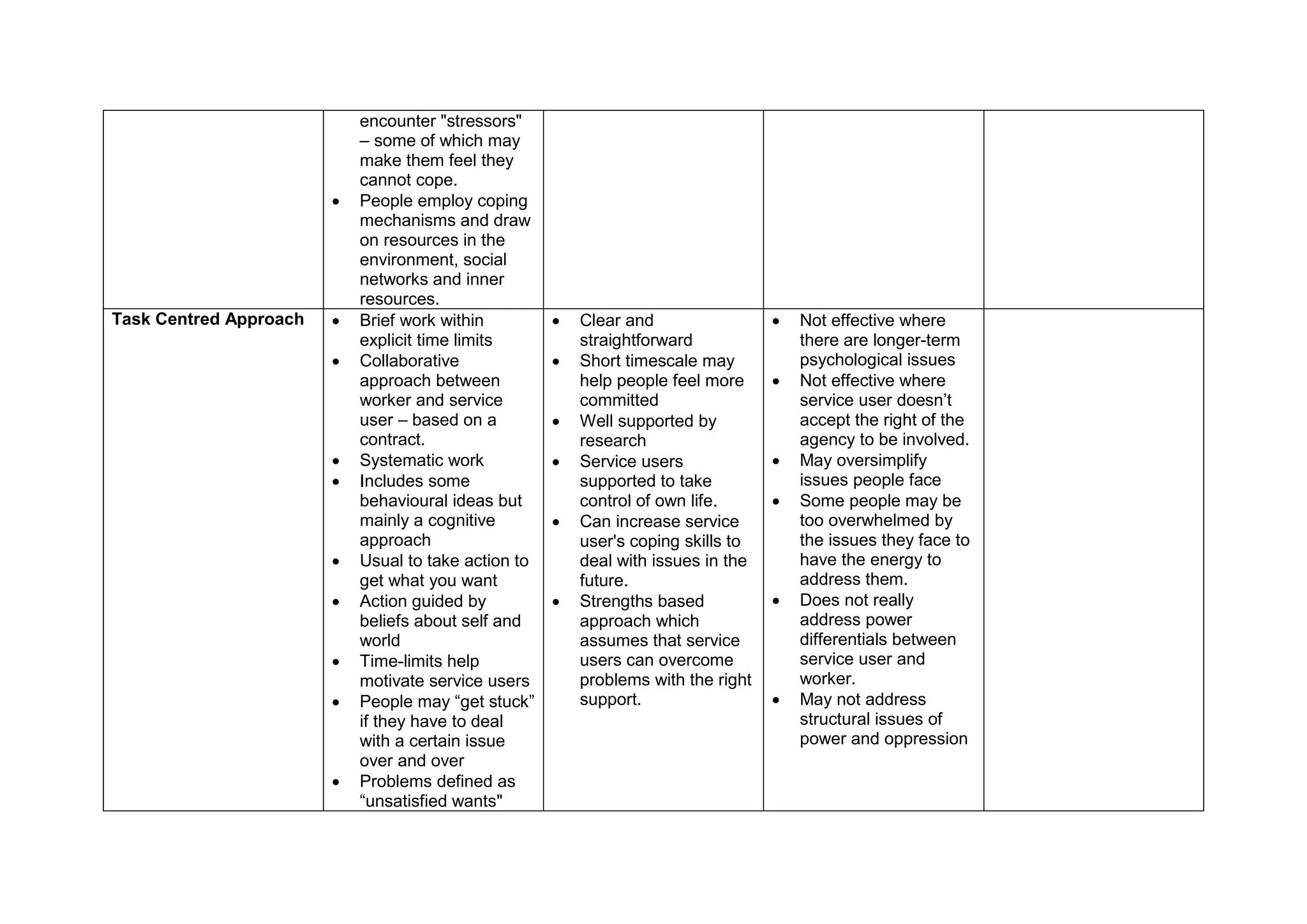
encounter "stressors"
– some of which may
make them feel they
cannot cope.
 People employ coping
mechanisms and draw
on resources in the
environment, social
networks and inner
resources.
Task Centred Approach  Brief work within
explicit time limits
 Collaborative
approach between
worker and service
user – based on a
contract.
 Systematic work
 Includes some
behavioural ideas but
mainly a cognitive
approach
 Usual to take action to
get what you want
 Action guided by
beliefs about self and
world
 Time-limits help
motivate service users
 People may “get stuck”
if they have to deal
with a certain issue
over and over
 Problems defined as
“unsatisfied wants"
 Clear and
straightforward
 Short timescale may
help people feel more
committed
 Well supported by
research
 Service users
supported to take
control of own life.
 Can increase service
user's coping skills to
deal with issues in the
future.
 Strengths based
approach which
assumes that service
users can overcome
problems with the right
support.
 Not effective where
there are longer-term
psychological issues
 Not effective where
service user doesn’t
accept the right of the
agency to be involved.
 May oversimplify
issues people face
 Some people may be
too overwhelmed by
the issues they face to
have the energy to
address them.
 Does not really
address power
differentials between
service user and
worker.
 May not address
structural issues of
power and oppression
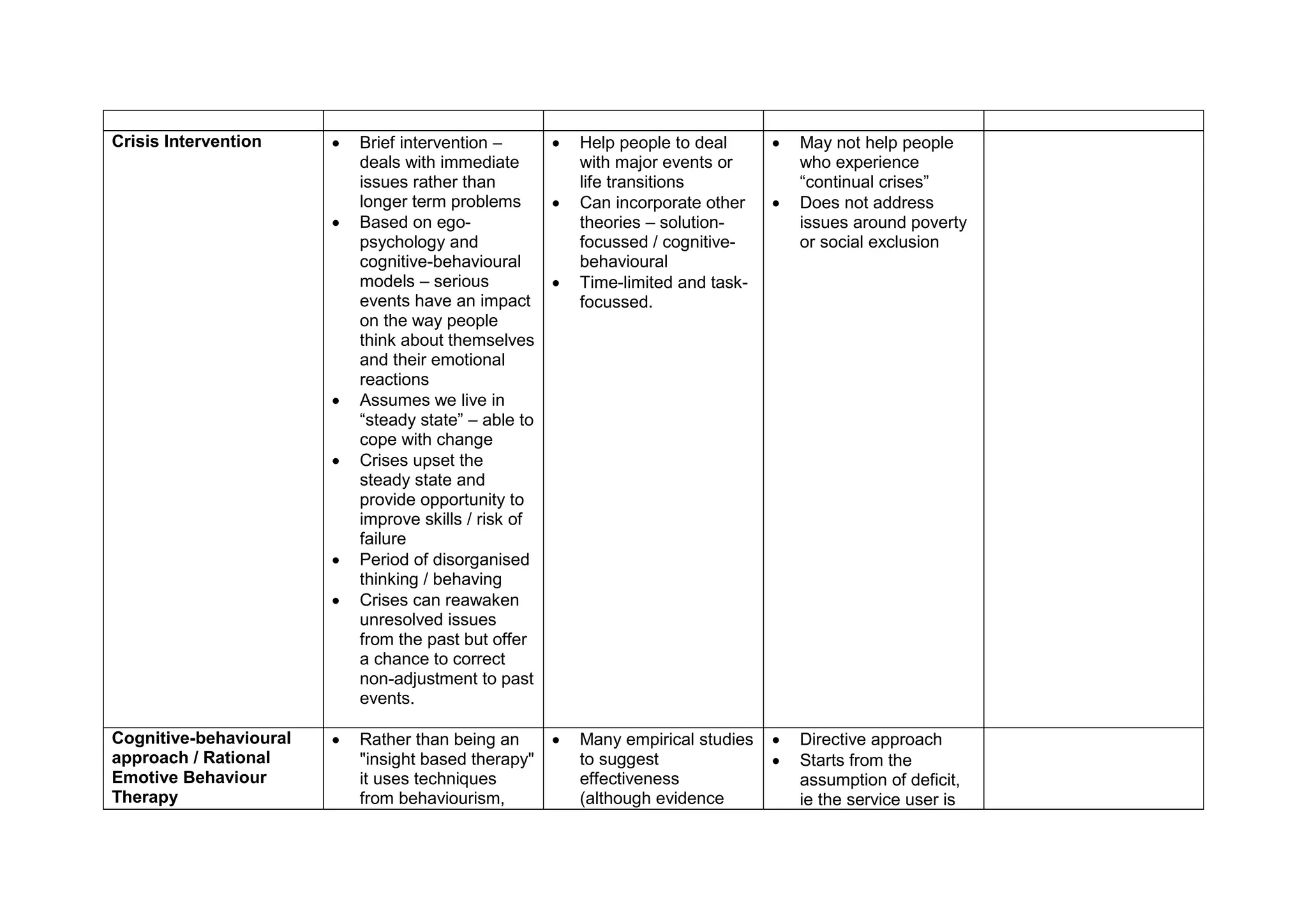
Crisis Intervention  Brief intervention –
deals with immediate
issues rather than
longer term problems
 Based on ego-
psychology and
cognitive-behavioural
models – serious
events have an impact
on the way people
think about themselves
and their emotional
reactions
 Assumes we live in
“steady state” – able to
cope with change
 Crises upset the
steady state and
provide opportunity to
improve skills / risk of
failure
 Period of disorganised
thinking / behaving
 Crises can reawaken
unresolved issues
from the past but offer
a chance to correct
non-adjustment to past
events.
 Help people to deal
with major events or
life transitions
 Can incorporate other
theories – solution-
focussed / cognitive-
behavioural
 Time-limited and task-
focussed.
 May not help people
who experience
“continual crises”
 Does not address
issues around poverty
or social exclusion
Cognitive-behavioural
approach / Rational
Emotive Behaviour
Therapy
 Rather than being an
"insight based therapy"
it uses techniques
from behaviourism,
 Many empirical studies
to suggest
effectiveness
(although evidence
 Directive approach
 Starts from the
assumption of deficit,
ie the service user is
social learning theory
and cognitive theory.
 Based on the
assumption that our
thoughts, beliefs,
images and attitudes
influence our
behaviour and if these
are changed, our
behaviour will change.
 "Self-talk" reinforces
irrational thinking.
 Involves identifying
and reframing
unhelpful beliefs.
Worker teaches
service user to
challenge own beliefs.
 Can involve modifying
behaviour using a
system of rewards.
 Use of ABC system –
activating event –
belief – consequence
and Ellis (1962)
extends to DEF –
Dispute beliefs,
replace beliefs with
Effective rational
belief, describe the
Feelings which will be
the result.
around degree of
effectiveness is
disputed.)
 Can be used to
support service users
to increase their
problem solving skills
and coping skills.
 Effective over a wide
range of issues.
lacking something.
 Requires a high level
of knowledge and skill
to apply.
 Focussed on the
presenting issues
rather than addressing
causes.
 "Much behaviour may
be perceived to be
emotionally driven and
irrational, when it
represents.. a rational
response to very
upsetting and
disturbing
experiences. (Lindsay,
2009)
 Doesn't take account
of socio-economic
factors.
Motivational
Interviewing
 Applied form of CBT,
developed by Miller
and Rollnick (1991,
 Accepts change must
come from intrinsic
motivation and cannot
 Usage and research
around effectiveness
have been largely
2002) defined as "a
person-centred
directive method for
enhancing an intrinsic
motivation to change
by exploring and
resolving
ambivalence."
 Worker adopts an
empathic and non-
confrontational
approach but worker is
directive.
 Worker is alert to
language person uses
and looks for language
of change.
 Worker provides
education / information
about situation the
service user is in (e.g.
effects of smoking /
drinking alcohol /
taking drugs etc)
 Worker encourages
service user to list
benefits and costs of
lifestyle and alternative
lifestyles
 Explore barriers to
goals
 Reframe past events –
focus on more positive
aspects.
 Supported by an
be forced upon people.
 Supports people to
explore their
ambivalence around
change.
 Accepts that people
may "lapse" but this is
part of learning
process.
around addictive
behaviours
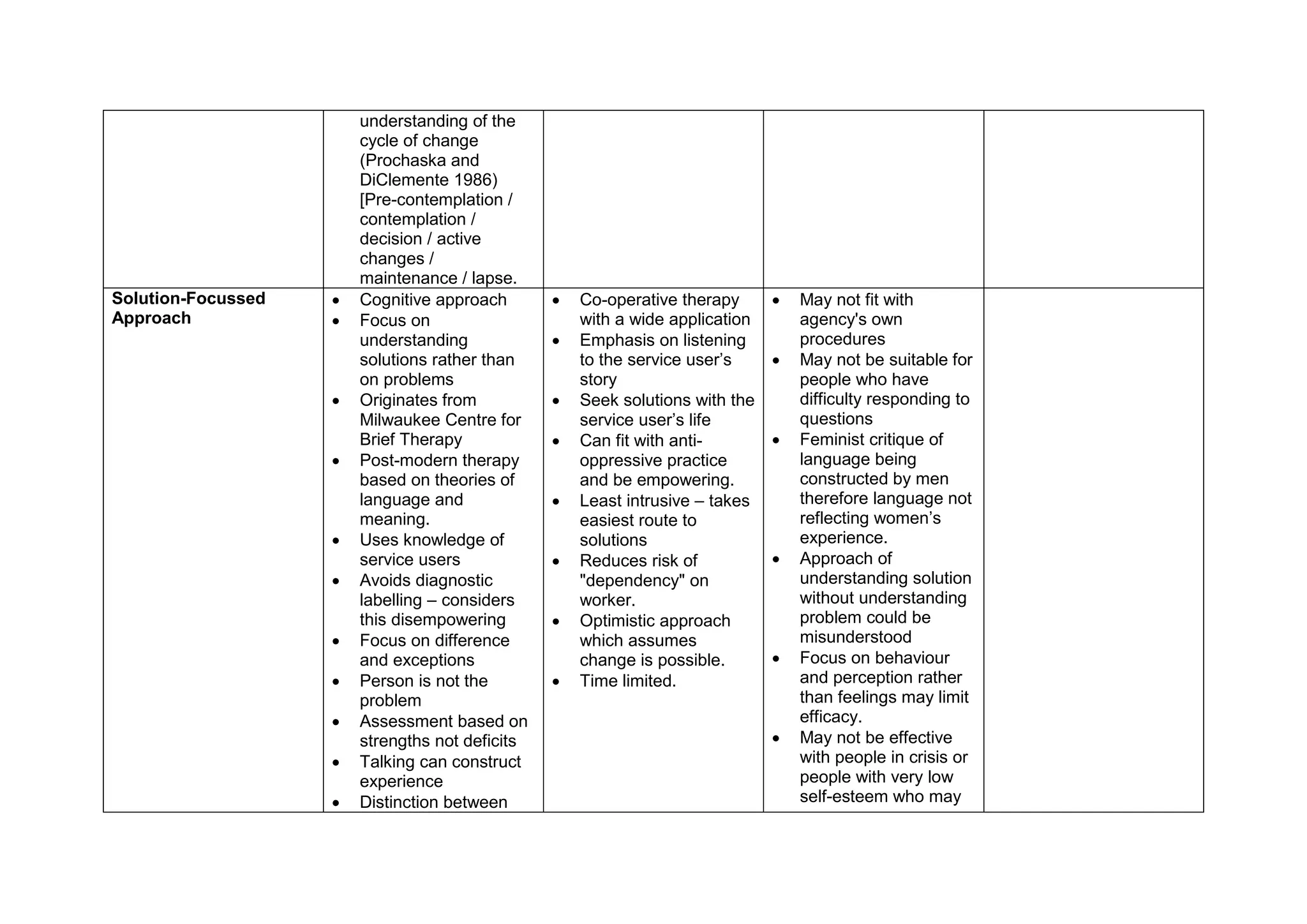
understanding of the
cycle of change
(Prochaska and
DiClemente 1986)
[Pre-contemplation /
contemplation /
decision / active
changes /
maintenance / lapse.
Solution-Focussed
Approach
 Cognitive approach
 Focus on
understanding
solutions rather than
on problems
 Originates from
Milwaukee Centre for
Brief Therapy
 Post-modern therapy
based on theories of
language and
meaning.
 Uses knowledge of
service users
 Avoids diagnostic
labelling – considers
this disempowering
 Focus on difference
and exceptions
 Person is not the
problem
 Assessment based on
strengths not deficits
 Talking can construct
experience
 Distinction between
 Co-operative therapy
with a wide application
 Emphasis on listening
to the service user’s
story
 Seek solutions with the
service user’s life
 Can fit with anti-
oppressive practice
and be empowering.
 Least intrusive – takes
easiest route to
solutions
 Reduces risk of
"dependency" on
worker.
 Optimistic approach
which assumes
change is possible.
 Time limited.
 May not fit with
agency's own
procedures
 May not be suitable for
people who have
difficulty responding to
questions
 Feminist critique of
language being
constructed by men
therefore language not
reflecting women’s
experience.
 Approach of
understanding solution
without understanding
problem could be
misunderstood
 Focus on behaviour
and perception rather
than feelings may limit
efficacy.
 May not be effective
with people in crisis or
people with very low
self-esteem who may
“problems” and
“unhappy situations.”
Problems can be
addressed, “unhappy
situations” have to be
coped with.
 Encourages sense of
“personal agency.”
not accept that they
have strengths and
skills.
Person Centred
Approach
(nb different to Person-
Centred Care)
 Based on the work of
Carl Rogers
 Sets out the principles
of empathy,
congruence and
unconditional positive
regard as necessary in
the helping
relationship.
 Non-directive
approach
 Based on the idea that
everyone has the
capacity to develop
and grow.
 Allows people to find
their own way in their
own time.
 Values all forms of
experience.
 Resists temptation to
criticise people.
 Emphasis on building
an equal and
meaningful working
relationship with
service users.
 Widely applicable
across service user
groups.
 Affirms the dignity and
worth of all people
 Role of SW may not
allow for non-directive
approach. Not a time-
limited approach.
 Difficult to apply if
service user not
motivated to engage.
 Focuses on individual
change rather than
societal factors,
although allows
individuals to express
their own goals which
may not be the agenda
of mainstream society.
Psychosocial Model  Based on the idea that
people have inner
worlds and outer
realities.
 Certain events remind
us of past events we
 Can help with
recurring emotional
problems
 Way of understanding
seemingly "irrational"
behaviour
 Focussed on a
medical model of
individual pathology.
Tends to ignore issues
of power and
oppression.
have tried to block out.
 Events can take on
greater emotional
significance.
 People develop in a
series of stages and
"faulty personality
development" in
childhood can affect
our responses later in
life.
 Draws on "personality
theory" – id, ego,
superego and looks at
defence mechanisms.
 Considers "defence
mechanisms" we
deploy to protect the
ego.
 Emphasises the
importance of self-
awareness.
 Influenced a listening,
accepting attitude in
social workers
 People can be
empowered by insight
into what is going on
within themselves and
between themselves
and the outside world.
 Social workers act as
"mini-psychoanalysts"
– use of clinical jargon.
 Tendency to focus on
cause and effect.
 Can lead to service
users being labelled –
"inadequate",
"narcissistic",
"manipulative",
"resistant" and can
lead to victim blaming.
 May not be culturally
appropriate – based
on valuing self-growth
and self-awareness
which are not norms
shared across all
cultures.
Recovery Model  Model used in Mental
Health services which
emphasises recovery
rather than illness.
 Recovery does not
necessarily mean
being "symptom-free"
but regaining a sense
of control and purpose
 Not being defined by a
label or diagnosis.
 Recognises strengths
of the individual.
 Open to possibilities
for the future – return
to employment or
 Individuals viewed as
experts in their own
situation.
 Positive approach
which attempts to give
control back to the
person.
 Can challenge
authority of medical
profession and thus
not be accepted /
implemented in some
MH services.
 Currently mainly used
in MH services – but
could have broader
applicability.
education.
Narrative Approach  SW encourages the
person to describe
their life in their own
words.
 Opportunity to tell their
story, an in the
process define identity.
 SW can support the
person to feel in
control of the narrative
and draw their
attention to the
possibility of a different
narrative for the future.
 Can help people
understand the
pressures they have
faced and the impact
of discrimination and
oppression.
 Can help people make
sense of change and
adjust to new
situations.
 SWs may see the
discussion as
"rambling" or "off the
point" and try to cut off
the person's narrative.
 The person or their
family may ask for a
"solution" and not see
the value in the
approach.
Key References
Coulshed, V; Social Work Practice; 2nd
ed (1991) Macmillan, Basingstoke and London.
Lindsay, T (ed) ; Social Work Intervention; (2009) Learning Matters Ltd, Exeter.
Maclean, S and Harrison, R: Social Work Theory;(2008); Kirwan Maclean Associates, Rugeley.
Milner, J and O’Byrne; P: Assessment in Social Work; (1998) Macmillan; London and Basingstoke.
Payne, M; Modern Social Work Theory; 3rd
ed (2005) Palgrave Macmillan, Basingstoke & New York.
Trevithick, P; Social Work Skills, A Practice Handbook; 1st
ed (2000) OU Press, Buckingham & Philadelphia

Social Work Theory and Methods Comparison Table.pdf

  • 1.
    Social Work Theoryand Methods Comparison Table Theory Key Concepts Advantages Limitations Situations where this may be useful Systems Theory  People are not isolated individuals but operate as part of wider networks or "systems"  Systems may be informal (e.g. family or friends), formal (e.g. clubs, support groups) or public (schools, hospitals)  Difficulties may arise if there is a lack of fit between the person and the systems they operate within.  Systems can be employed to support the service user to achieve change.  Emphasis on changing environments rather than individuals.  Focus on patterns rather than "cause and effect" – allows for different ways of getting to the desired outcome.  Sees worker as part of a system of change rather than solely responsible – may lend itself to multi- disciplinary work.  Does not explain why things happen or give guidance about how to act to bring about change.  May overemphasise "bigger picture" at the expense of details.  Values maintenance and integration over conflict – may not explicitly challenge inequality. Does not encourage challenge of oppressive systems. Ecological Approach  Germain and Gitterman – "Life model" (1980 / 1996) - people are interdependent with each other and their environment – each influences the other over time.  People move through their own unique life course and may  Acknowledgement of interrelationship between person and environment.  Consideration of a range of resources to support people – both internal and external.  As above.
  • 2.
    encounter "stressors" – someof which may make them feel they cannot cope.  People employ coping mechanisms and draw on resources in the environment, social networks and inner resources. Task Centred Approach  Brief work within explicit time limits  Collaborative approach between worker and service user – based on a contract.  Systematic work  Includes some behavioural ideas but mainly a cognitive approach  Usual to take action to get what you want  Action guided by beliefs about self and world  Time-limits help motivate service users  People may “get stuck” if they have to deal with a certain issue over and over  Problems defined as “unsatisfied wants"  Clear and straightforward  Short timescale may help people feel more committed  Well supported by research  Service users supported to take control of own life.  Can increase service user's coping skills to deal with issues in the future.  Strengths based approach which assumes that service users can overcome problems with the right support.  Not effective where there are longer-term psychological issues  Not effective where service user doesn’t accept the right of the agency to be involved.  May oversimplify issues people face  Some people may be too overwhelmed by the issues they face to have the energy to address them.  Does not really address power differentials between service user and worker.  May not address structural issues of power and oppression
  • 3.
    Crisis Intervention Brief intervention – deals with immediate issues rather than longer term problems  Based on ego- psychology and cognitive-behavioural models – serious events have an impact on the way people think about themselves and their emotional reactions  Assumes we live in “steady state” – able to cope with change  Crises upset the steady state and provide opportunity to improve skills / risk of failure  Period of disorganised thinking / behaving  Crises can reawaken unresolved issues from the past but offer a chance to correct non-adjustment to past events.  Help people to deal with major events or life transitions  Can incorporate other theories – solution- focussed / cognitive- behavioural  Time-limited and task- focussed.  May not help people who experience “continual crises”  Does not address issues around poverty or social exclusion Cognitive-behavioural approach / Rational Emotive Behaviour Therapy  Rather than being an "insight based therapy" it uses techniques from behaviourism,  Many empirical studies to suggest effectiveness (although evidence  Directive approach  Starts from the assumption of deficit, ie the service user is
  • 4.
    social learning theory andcognitive theory.  Based on the assumption that our thoughts, beliefs, images and attitudes influence our behaviour and if these are changed, our behaviour will change.  "Self-talk" reinforces irrational thinking.  Involves identifying and reframing unhelpful beliefs. Worker teaches service user to challenge own beliefs.  Can involve modifying behaviour using a system of rewards.  Use of ABC system – activating event – belief – consequence and Ellis (1962) extends to DEF – Dispute beliefs, replace beliefs with Effective rational belief, describe the Feelings which will be the result. around degree of effectiveness is disputed.)  Can be used to support service users to increase their problem solving skills and coping skills.  Effective over a wide range of issues. lacking something.  Requires a high level of knowledge and skill to apply.  Focussed on the presenting issues rather than addressing causes.  "Much behaviour may be perceived to be emotionally driven and irrational, when it represents.. a rational response to very upsetting and disturbing experiences. (Lindsay, 2009)  Doesn't take account of socio-economic factors. Motivational Interviewing  Applied form of CBT, developed by Miller and Rollnick (1991,  Accepts change must come from intrinsic motivation and cannot  Usage and research around effectiveness have been largely
  • 5.
    2002) defined as"a person-centred directive method for enhancing an intrinsic motivation to change by exploring and resolving ambivalence."  Worker adopts an empathic and non- confrontational approach but worker is directive.  Worker is alert to language person uses and looks for language of change.  Worker provides education / information about situation the service user is in (e.g. effects of smoking / drinking alcohol / taking drugs etc)  Worker encourages service user to list benefits and costs of lifestyle and alternative lifestyles  Explore barriers to goals  Reframe past events – focus on more positive aspects.  Supported by an be forced upon people.  Supports people to explore their ambivalence around change.  Accepts that people may "lapse" but this is part of learning process. around addictive behaviours
  • 6.
    understanding of the cycleof change (Prochaska and DiClemente 1986) [Pre-contemplation / contemplation / decision / active changes / maintenance / lapse. Solution-Focussed Approach  Cognitive approach  Focus on understanding solutions rather than on problems  Originates from Milwaukee Centre for Brief Therapy  Post-modern therapy based on theories of language and meaning.  Uses knowledge of service users  Avoids diagnostic labelling – considers this disempowering  Focus on difference and exceptions  Person is not the problem  Assessment based on strengths not deficits  Talking can construct experience  Distinction between  Co-operative therapy with a wide application  Emphasis on listening to the service user’s story  Seek solutions with the service user’s life  Can fit with anti- oppressive practice and be empowering.  Least intrusive – takes easiest route to solutions  Reduces risk of "dependency" on worker.  Optimistic approach which assumes change is possible.  Time limited.  May not fit with agency's own procedures  May not be suitable for people who have difficulty responding to questions  Feminist critique of language being constructed by men therefore language not reflecting women’s experience.  Approach of understanding solution without understanding problem could be misunderstood  Focus on behaviour and perception rather than feelings may limit efficacy.  May not be effective with people in crisis or people with very low self-esteem who may
  • 7.
    “problems” and “unhappy situations.” Problemscan be addressed, “unhappy situations” have to be coped with.  Encourages sense of “personal agency.” not accept that they have strengths and skills. Person Centred Approach (nb different to Person- Centred Care)  Based on the work of Carl Rogers  Sets out the principles of empathy, congruence and unconditional positive regard as necessary in the helping relationship.  Non-directive approach  Based on the idea that everyone has the capacity to develop and grow.  Allows people to find their own way in their own time.  Values all forms of experience.  Resists temptation to criticise people.  Emphasis on building an equal and meaningful working relationship with service users.  Widely applicable across service user groups.  Affirms the dignity and worth of all people  Role of SW may not allow for non-directive approach. Not a time- limited approach.  Difficult to apply if service user not motivated to engage.  Focuses on individual change rather than societal factors, although allows individuals to express their own goals which may not be the agenda of mainstream society. Psychosocial Model  Based on the idea that people have inner worlds and outer realities.  Certain events remind us of past events we  Can help with recurring emotional problems  Way of understanding seemingly "irrational" behaviour  Focussed on a medical model of individual pathology. Tends to ignore issues of power and oppression.
  • 8.
    have tried toblock out.  Events can take on greater emotional significance.  People develop in a series of stages and "faulty personality development" in childhood can affect our responses later in life.  Draws on "personality theory" – id, ego, superego and looks at defence mechanisms.  Considers "defence mechanisms" we deploy to protect the ego.  Emphasises the importance of self- awareness.  Influenced a listening, accepting attitude in social workers  People can be empowered by insight into what is going on within themselves and between themselves and the outside world.  Social workers act as "mini-psychoanalysts" – use of clinical jargon.  Tendency to focus on cause and effect.  Can lead to service users being labelled – "inadequate", "narcissistic", "manipulative", "resistant" and can lead to victim blaming.  May not be culturally appropriate – based on valuing self-growth and self-awareness which are not norms shared across all cultures. Recovery Model  Model used in Mental Health services which emphasises recovery rather than illness.  Recovery does not necessarily mean being "symptom-free" but regaining a sense of control and purpose  Not being defined by a label or diagnosis.  Recognises strengths of the individual.  Open to possibilities for the future – return to employment or  Individuals viewed as experts in their own situation.  Positive approach which attempts to give control back to the person.  Can challenge authority of medical profession and thus not be accepted / implemented in some MH services.  Currently mainly used in MH services – but could have broader applicability.
  • 9.
    education. Narrative Approach SW encourages the person to describe their life in their own words.  Opportunity to tell their story, an in the process define identity.  SW can support the person to feel in control of the narrative and draw their attention to the possibility of a different narrative for the future.  Can help people understand the pressures they have faced and the impact of discrimination and oppression.  Can help people make sense of change and adjust to new situations.  SWs may see the discussion as "rambling" or "off the point" and try to cut off the person's narrative.  The person or their family may ask for a "solution" and not see the value in the approach. Key References Coulshed, V; Social Work Practice; 2nd ed (1991) Macmillan, Basingstoke and London. Lindsay, T (ed) ; Social Work Intervention; (2009) Learning Matters Ltd, Exeter. Maclean, S and Harrison, R: Social Work Theory;(2008); Kirwan Maclean Associates, Rugeley. Milner, J and O’Byrne; P: Assessment in Social Work; (1998) Macmillan; London and Basingstoke. Payne, M; Modern Social Work Theory; 3rd ed (2005) Palgrave Macmillan, Basingstoke & New York. Trevithick, P; Social Work Skills, A Practice Handbook; 1st ed (2000) OU Press, Buckingham & Philadelphia