Social Studies Skills and Methods Evaluating Information
Learning Targets: A.  Understand uses of Propaganda and Bias B.  Analyze Reliability of Sources C.  Determine the Credibility of Sources considering 1.  reputation of writer 2.  agreement with other sources 3.  recognition of stereotypes 4.  accuracy and consistency 5.  circumstances
 
 
Credibility of Information Look for the author’s qualifications and their reputation. Does the source agree with other sources?—Proof! Watch for  stereotyping -a commonly held idea or image of a person or group based on generalizations that are often negative and not necessarily true. Biases Racial, gender, and age-related stereotyping are the most commonly seen biases Point of view
Accuracy and Consistency How up-to-date is the information? How complete is the information in the source? Look for references, footnotes, bibliography, etc. Question consistency if you come across contradictions within a source
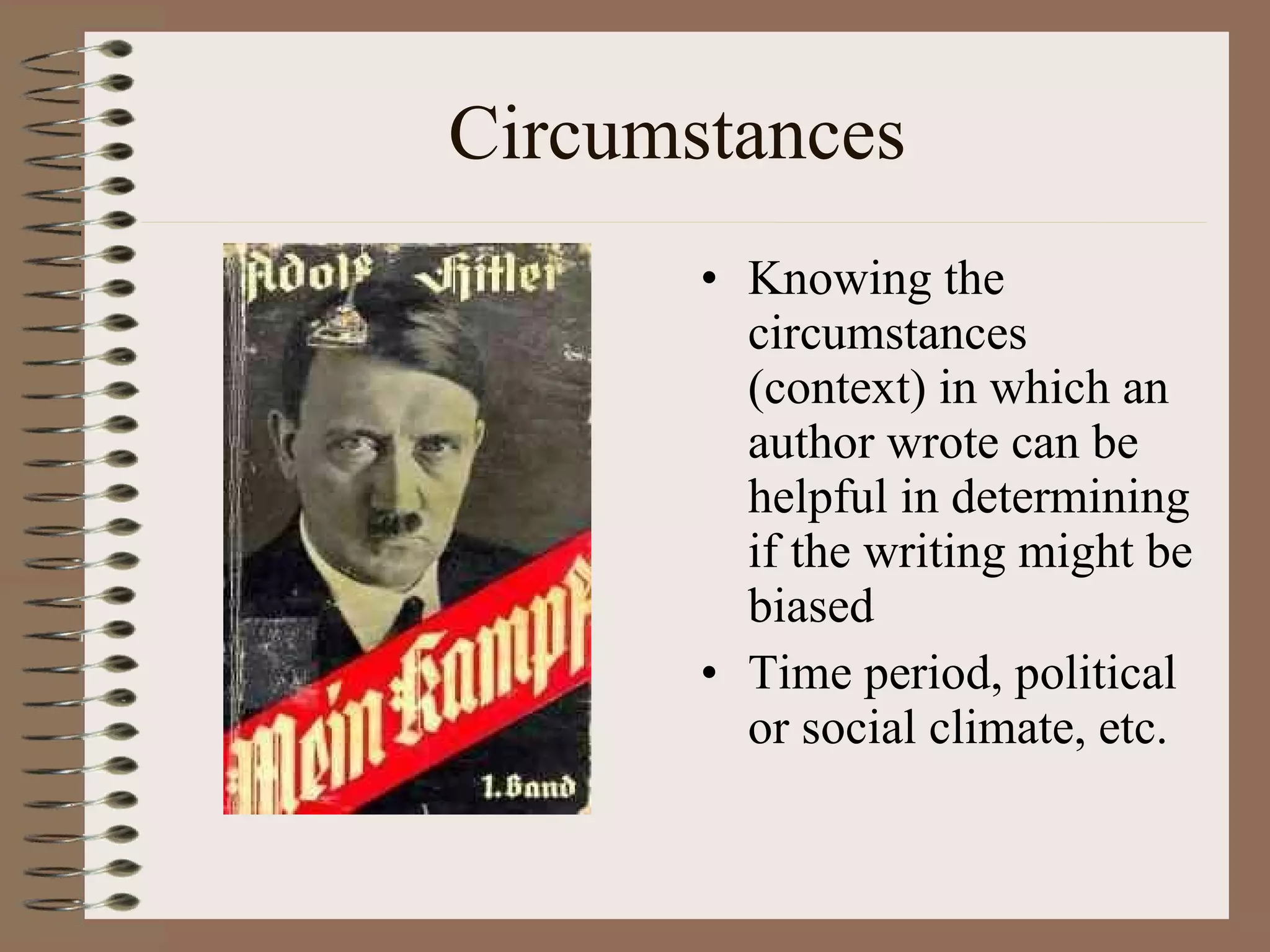
Circumstances Knowing the circumstances (context) in which an author wrote can be helpful in determining if the writing might be biased Time period, political or social climate, etc.
Analyzing and Critiquing Evidence Primary Source Secondary Source Controversial statements Conclusions Emotions vs. Evidence Citations Supported Thesis
Analyzing Evidence Pg. 163 Read the following paragraphs about handgun control. Is Handgun Control Discriminatory? If You Don’t Have It, You Can’t Use It.
News Activity!!!! Find 1 article-must be more than 10 paragraphs long Underline/highlight in BLUE-Facts Underline/highlight in RED-Bias Underline/highlight in YELLOW-Unsure! See chalkboard for student response questions!

Social Studies Skills And Methods

  • 1.
    Social Studies Skillsand Methods Evaluating Information
  • 2.
    Learning Targets: A. Understand uses of Propaganda and Bias B. Analyze Reliability of Sources C. Determine the Credibility of Sources considering 1. reputation of writer 2. agreement with other sources 3. recognition of stereotypes 4. accuracy and consistency 5. circumstances
  • 3.
  • 4.
  • 5.
    Credibility of InformationLook for the author’s qualifications and their reputation. Does the source agree with other sources?—Proof! Watch for stereotyping -a commonly held idea or image of a person or group based on generalizations that are often negative and not necessarily true. Biases Racial, gender, and age-related stereotyping are the most commonly seen biases Point of view
  • 6.
    Accuracy and ConsistencyHow up-to-date is the information? How complete is the information in the source? Look for references, footnotes, bibliography, etc. Question consistency if you come across contradictions within a source
  • 7.
    Circumstances Knowing thecircumstances (context) in which an author wrote can be helpful in determining if the writing might be biased Time period, political or social climate, etc.
  • 8.
    Analyzing and CritiquingEvidence Primary Source Secondary Source Controversial statements Conclusions Emotions vs. Evidence Citations Supported Thesis
  • 9.
    Analyzing Evidence Pg.163 Read the following paragraphs about handgun control. Is Handgun Control Discriminatory? If You Don’t Have It, You Can’t Use It.
  • 10.
    News Activity!!!! Find1 article-must be more than 10 paragraphs long Underline/highlight in BLUE-Facts Underline/highlight in RED-Bias Underline/highlight in YELLOW-Unsure! See chalkboard for student response questions!