Social Media Monitoring Process and Guidelines.
1/23 Confidential & Proprietary. For internal use only. Do not distribute.
Social Media Monitoring Training and
Guidelines for “Company Name”
Document Reference: XXX-112701
Created on: DD/MM/YYYY
Revised on: DD/MM/YYYY
Revision #: Draft
Distribution: First and Last Name
First and Last Name
First and Last Name
First and Last Name
First and Last Name
First and Last Name
First and Last Name
First and Last Name
Table of Contents
Preamble .............................................................2
Glossary ..............................................................2
Roles and Responsibilities.....................................5
Moderation – Getting Started .................................7
Alert Process Flow..............................................10
Moderation – Standard Procedure .......................11
Moderation – Escalation Process.........................12
Engaging With Our Audiences .............................14
Content and Engagement Plan ............................19
APPENDIXES ....................................................21
Appendix S – Subject Matter Experts List.............21
Supporting Information ........................................22
Quick Guide (Phase 1)........................................23
Social Media Monitoring Process and Guidelines.
2/23 Confidential & Proprietary. For internal use only. Do not distribute.
Preamble
The aim of this document is to provide the “Company Name” Social Media standard process and guidelines to
efficiently monitor and engage with social media audience and provide the necessary information and guidance to
our team members to be successful in their efforts. This document is intended to be a “living document” – it
evolves and changes as the technologies and methods of social media do. It is and will be updated frequently to
reflect best practices and learning from our teams and our experiences/engagement with our audiences.
Supporting resources are available as appendixes at the end of this document. To report inaccuracy within this
document or provide feedback/comments, email socialcorp@yourcompany.com
Glossary
Understanding the new terms that are used within this document. Who and what is affected by each one of them.
Alerts
An alert is the action of reporting a matter that is encountered in the social media sphere whether it is
happening on our social pages or on any other social media platform not owned by “Company Name”.
There are four alert categories identified:
 General  Positive [green]  Sensitive [orange]  Urgent [red]
Any “Company Name” employee and/or approved social media moderators can set an alert. A process –
including escalation – has been designed for each alert category (detailed later in this document).
Audience
The audience is considered to be the visitors that we have on our social media platforms. It can be
composed of four different categories:
 A potential “Prospect” (prospect): is a visitor who may or may not be a recognized member of our
platforms. They might be looking for information about “Company Name”, engage with our brand,
inquires about “Product/Service” in general or from existing audience.
 A “Lead” is a current “Company Name” “Prospect” that has joined a “Company Name” social media
platform and is either identified by moderator or expresses their status.
 A Customer is identified as a “Company Name” client who does engage on social media platforms and
has identified themselves as such.
 A Lurker is a visitor that is more likely to never engage in any form with our brand and is simply
browsing.
Depending on which social platform we are present on; additional terms might be used to refer and or
describe our audiences. For example, we can use the terms “fan”; “active users” to describe a particular
segment of our audience.
Social Media Monitoring Process and Guidelines.
3/23 Confidential & Proprietary. For internal use only. Do not distribute.
Engagement (participation)
Engagement refers to any activity our audience takes towards our brands across any social media platforms
including but not limited to forums, blogs, social networks, chat room, UGC sites etc.
It can occur between audience members without “Company Name” being involved. .There are two
categories of engagement:
 Unsolicited might include but not limited to: comments, feedback, criticism, download asset,
share/spread/buzz, posting, become fan [like], start groups, upload picture, video etc.
 Solicited would be similar to the above with the main difference being that the audience is encouraged
to take an action by “Company Name”. Example may vary but can include the following: participation to
vote, comment on an entry, take a survey or poll, invite friend, enter contest etc.
Moderator
A moderator is the team member that performs daily check across the social media universe and report and
log alerts following a pre-defined process. The moderator has the responsibility to reach out to the
communities, assess and recommend additional platforms as they arise. They are vital in ensuring that we
build and maintain exceptional relationships with our audiences.
Pre-Moderation
Pre moderation happens when we encourage the audience to participate in for example a contest where
they are asked to submit a piece of content [UGC] and / or comment on various topics and postings.
In order to keep control over what our audience might submit and to ensure compliance with legal
requirements and general ethics, there is a need to be able to preview and pre approve any form of content /
participation that our audience will submit. Approved content will be posted within 24 hours. Non-approved
content will trigger an email from our moderator or comment/private chat [depending on the platform] to
either request to resubmit according to ethic, laws etc. or to inform them that we will not post their entry and
explain why. Always offer to resubmit [when applicable].
Moderation
The act of reviewing entries/ submissions of all kinds on a daily basis, interact with the audience and follow
protocol to flag and report potential alerts.
SMT
The Social Media Team is comprised of social media leader, tech lead and lead moderators responsible for
the strategy, development, process and administration of all related social media initiatives.
SME
Subject Matter Experts are the persons identified as the first point of contact for each category. It ranges
from “Prospect” compliance, to admissions to tech lead. Each SME has the same role but within their area
of expertise. It is important to maintain a constant communication with the SMEs and to engage them.
Social Media Monitoring Process and Guidelines.
4/23 Confidential & Proprietary. For internal use only. Do not distribute.
Response
A response is the compilation of information that the moderator gathered from the identified SME and that is
posted and or published after an alert has been submitted. The response can come from the moderators,
PR or SME.
Engaging by commenting or replying to post when an alert is not necessary is not considered as a response
but as “engagement”.
Owner
Owner is the person, “Prospect”, alumni or general public who submits the content.
UGC
UGC stands for User Generated Content. UGC are pieces of content that the audience willingly posts to our
social media platform. i.e. upload video to our YouTube channel or a photo to the graduation section of our
FB page etc.
Entry/Submission
Entry/submissions are referred to as any form of digital communication including but not limited to, blog
entry, posting, comment, UGC, text message, press release, messaging etc.
Social Media Profiles
Social Profiles are the accounts that “Company Name” currently own (and will own in the future) on
several platforms across the www including YouTube, Facebook and Twitter.
The profiles are consistent and categorized by brand. Information provided is relevant to the specific brand.
Only Social Media team is allowed to approve the creation of new accounts on existing and new platforms.
For question, email fbsupport@your”Company Name”.com
Influencers
Influencers are also referenced to as “evangelists” or “advocates” depending on the industry and social
platform. They are more often successful bloggers that embrace “A” brand and have enough followers and
audience to influence what their readers think, buy, share etc.
Professional bloggers tend to request payment for their efforts. “Company Name” is not planning on hiring
bloggers but we recommend developing relationships with them whenever possible.
Our most valuable influencers are and will be our “Prospect”s and alumni will be identified and approached
in the course of the interaction with “Company Name” when applicable. “Company Name” influencers will
not be rewarded for their “advocacy”.
Social Media Monitoring Process and Guidelines.
5/23 Confidential & Proprietary. For internal use only. Do not distribute.
Roles and Responsibilities
SMT
It is the responsibility of the SMT to seek guidance from SME on specific subjects to optimize
implementation success. The SMT is also responsible for maintaining and developing our overall strategy
across the SM universe and for increasing the level of engagement of our audience.
SME
An SME is the first point of contact for a specific alert category within a department. The designated person
is responsible for supporting the moderator in responding to alerts based on his/her expertise. A list of the
SME members is available later in this document – APPENDIX S.
Moderator
A moderator is the gate keeper and the voice between the audience and “Company Name”.
Responsibilities include but are not limited to:
 Running daily checks across the social media sphere including “Company Name” and non “Company
Name” owned social pages/platforms;
 Identifying potential threats and react appropriately following the approved “Company Name” social
media monitoring process and guidelines in a timely manner including logging all alerts, and their
resolution.
 The moderator is also responsible for responding to entries when applicable, maintaining and building
conversations with our audience to increase engagement.
The daily tasks include gathering information from other departments and asses if “news worthy”,
communicate with campuses, advertising managers and PR to gather “field” information and marketing
campaigns / events that can be published and/or “promoted” through the social media channels. The
moderator will, in addition, execute pre moderation process and associated tasks when applicable, to review
entries generated through UGC and approve content prior to posting or delete and communicate to content
owner as appropriate as long as engaging with potential influencers and building relationships.
Public Relations
The public relations team is responsible for:
 Reviewing submitted alerts and for drafting response when necessary.
 Sharing information that come from the field and any other form of news such as press releases, articles
etc. that are identified as being of value to our audience.
 Selecting blogging and micro blogging platforms that are relevant to our audience and to submit and
manage valuable content to effectively manage reputation and to support marketing efforts.
The management and moderation of twitter and corporate blog are the responsibility of the PR team and
follow a different process.
The PR team is also responsible for providing feedback on proposed strategy when applicable to ensure
smooth launch. PR is responsible for managing escalated alerts that are relevant to reputation and draft
response for the moderator.
Social Media Monitoring Process and Guidelines.
6/23 Confidential & Proprietary. For internal use only. Do not distribute.
Legal
Legal is responsible for reviewing alerts that have been escalated to them and for drafting appropriate
response when applicable and / or guidance on steps that would need to be taken to efficiently deal with the
alert. The legal contact is capable of redirecting the alert to the appropriate counsel should the matter
require a specific expertise.
It is the responsibility of legal to ensure that alerts received are taken seriously and looked at as they
arrive to avoid any potential complication.
The Legal and PR SMEs will always be copied on communication when a red alert is identified to ensure
prompt, relevant and professional response is drafted and communicated when the situation arises.
Tech Lead
Tech Lead is the person in charge of the implementation and maintenance of our social media platforms and
THE ONLY TEAM MEMBER AUTHORIZED TO DEVELOP, EDIT OR DELETE ANY CODE, PAGES OR
OTHER TECHNICAL RELATED ITEMS.
The tech lead reports to the marketing department and has a deep understanding of the new social media
trends along with a set of skills that allow the development and management of our social media presence
without breaking or disrupting the code that could impact not only our audience but the marketing efforts
deployed on any platform thus, jeopardize the expected results.
The tech lead owns the Google analytics account currently being used to measure, assess and optimize our
presence and traffic from social media platform. The tech lead will provide a weekly report on the results.
The Tech Lead is also responsible for working closely with the SM strategist for the creation of new profiles
across various platforms and to ensure features and functionalities proposed are compliant with the platform
capabilities.
It is also important that the tech lead communicates regularly with the “Company Name” IT team to stay
current with new implementations, edits and features affecting our current corporate websites to identify,
assess and implement / integrate with our social platforms presence when applicable.
The Tech Lead will also help is setting up the metrics and reporting and will run daily checks to ensure our
tracking codes are working efficiently.
Note: Google analytics is being used as a temporary solution. Code might be altered at a later date to
remain consistent with our website analytical solutions.
Social Media Monitoring Process and Guidelines.
7/23 Confidential & Proprietary. For internal use only. Do not distribute.
Moderation – Getting Started
Introduction
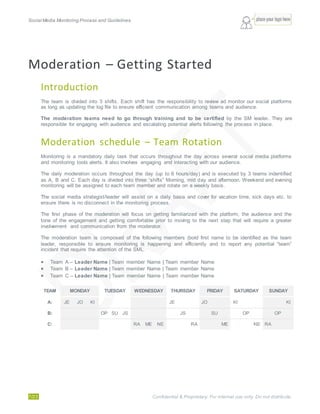
The team is divided into 3 shifts. Each shift has the responsibility to review ad monitor our social platforms
as long as updating the log file to ensure efficient communication among teams and audience.
The moderation teams need to go through training and to be certified by the SM leader. They are
responsible for engaging with audience and escalating potential alerts following the process in place.
Moderation schedule – Team Rotation
Monitoring is a mandatory daily task that occurs throughout the day across several social media platforms
and monitoring tools alerts. It also involves engaging and interacting with our audience.
The daily moderation occurs throughout the day (up to 6 hours/day) and is executed by 3 teams indentified
as A, B and C. Each day is divided into three “shifts” Morning, mid day and afternoon. Weekend and evening
monitoring will be assigned to each team member and rotate on a weekly basis.
The social media strategist/leader will assist on a daily basis and cover for vacation time, sick days etc. to
ensure there is no disconnect in the monitoring process.
The first phase of the moderation will focus on getting familiarized with the platform, the audience and the
tone of the engagement and getting comfortable prior to moving to the next step that will require a greater
involvement and communication from the moderator.
The moderation team is composed of the following members (bold first name to be identified as the team
leader, responsible to ensure monitoring is happening and efficiently and to report any potential “team”
incident that require the attention of the SML.
 Team A – Leader Name | Team member Name | Team member Name
 Team B – Leader Name | Team member Name | Team member Name
 Team C – Leader Name | Team member Name | Team member Name
TEAM MONDAY TUESDAY WEDNESDAY THURSDAY FRIDAY SATURDAY SUNDAY
A: JE JO KI JE JO KI KI
B: OP SU JS JS SU OP OP
C: RA ME NE RA ME NE RA
Social Media Monitoring Process and Guidelines.
8/23 Confidential & Proprietary. For internal use only. Do not distribute.
Practical Guidelines
What a moderator needs to monitor?
 Brand mentions
 Programs / Services
(career services, financial aid etc.)
 Topics / subjects
 Comments / views
 Social Networks
 Language and terms used to refer to our brands
 Campus mentions
 People mentions (corporate, campus etc.)
 Journalists / bloggers
 Forums, discussion boards and chat room
 Sales pitch submissions (third party offers
aimed directly at our “Prospect”s)
 Competition integration
What does a moderator do?
 Check log file to identify action items still opened / new entries from other “shifts” that need follow up
 Follow up on non closed action items and take next step (contact SME to get status, engage with
owner etc.)
 Review comments and posts on social platforms
 During the course of the monitoring, engage potential influencers and take conversation to the next
level to assess viability of developing further relationship with advocates.
 Log Alerts and follow up when applicable [please refer to monitoring process guidelines]
 Check social mailbox and respond to participants on social media platforms. Review content
submissions and approve [make sure it does not violate our terms for acceptable content – if any
doubt, involve legal or talk to the SMT]. Submit content to technical lead upon approval for
implementation > once live, engage audience to post comments, share or upload their own.
 Prior to the end of “shift”, update log file and ensure to highlight items that require urgent attention.
 Review social media inbox and submitted content. Upon approval, submit content to the tech lead
for upload to the social platform.
Moderator’s etiquette
The number one rule when responding to all criticism, even the negative type, is to always stay positive and
maintain PMA (positive mental attitude). Adding more negativity to the conversation by letting ourselves be
drawn into a fight with someone in our audience can only reflect poorly on us.
Always remember that for any challenge, there is a solution. If not sure on what to respond or the tone of the
response, contact the SMT for guidance. Moderators and all other employees have the obligation to
identify themselves as “Company Name” employees
 Positive comment/submission – Someone submits a nice note or UGC content about “Company
Name”. This entry should be shared with PR and marketing that will evaluate if it’s worth to contact the
“owner” and to take further action. This is the type of comment we want to share not only at a corporate
level but also across the web to increase reputation, loyalty and recognition of excellence.
 A positive comment requires participation from “Company Name”. The first step is to acknowledge
the content submitted and its owner to encourage further participation and trigger additional
engagement across the audience.
Social Media Monitoring Process and Guidelines.
9/23 Confidential & Proprietary. For internal use only. Do not distribute.
 When relevant, contact campus to obtain additional information to foster further discussions with the
content owner and the social media audience and when possible, leverage from content submitted
to raise awareness and start potential buzz. [for example if specific compliment about the campus,
an event or a teacher, then we would ask the teacher and/or campus to join in the conversation or
send info about the topic]
 Legitimate issue – Someone has an issue and has expressed exactly what’s wrong. This type of
feedback is negative in the sense that it paints our brands in a negative way, but could be helpful in
exposing real challenges that need to be dealt with.
 When dealing with a legitimate issue, a response is necessary. Acknowledge the issue and escalate
appropriately. Always follow up to close the loop. A direct response from SME representative might
be necessary.
 Constructive Criticism – Even more helpful is when the comment comes with a suggestion attached.
Many people will use social media to suggest ways in which we can improve our offerings/way we do
things etc. While this type of feedback may point out our flaws, and is thus negative, it can be extremely
helpful to receive.
 Constructive Criticism requires a response. There will be times when we won’t want to implement
the suggestion we would be receiving but we’ll build loyalty and trust by responding to criticism with
a positive message.
It is strongly encouraged to thank those who took the time to provide suggestion or point out our
flaws and continue communication to show that we listen and take action (when relevant).
 Valid Attack – While the attack itself may not be merited, the reason that triggered it does have merit in
this type of negative feedback. Essentially if we did something judge wrong, and someone is angry.
 Valid Attacks are more complicated because they’re more likely to feel personal. We should always
try to keep in mind that this type of feedback, as harsh as it may be, has a basis in a real problem. It
is best to respond promptly and with a positive vibe (e.g., thank the commentator for the feedback
and assure them that steps are being taken to correct the issue or mitigate their problem – Always
follow up when necessary and close the loop.
 Malicious Attack – The difference between trolling/Spam and a valid attack are that they have no
justifiable reason for being aggressive towards our brand.
Also in this category are spammers, who will use a negative comment about our brands (whether true or
not) to promote a competing service and diminish our social credibility and to leverage from the
disruption they would have caused.
 It is most of the time better not to respond to Trolling or Spam as this type of feedback isn’t really
feedback at all but a direct attack.
 Sales pitch submissions – Service providers and/or competition that are trying to sale their product
and/or services to our audience through our social media platforms.
 Those entries should be removed automatically and the “owner” banned from our community. Those
entries are conflicting with our offering and damage our credibility and relationship with our
audiences by offering services and products that have not been endorsed by our brands.
Please refer to the Moderation – Standard Procedure for more information about monitor and escalation process.
Social Media Monitoring Process and Guidelines.
10/23 Confidential & Proprietary. For internal use only. Do not distribute.
Alert Process Flow
Moderators > Daily monitoring/pre-
monitoring to identify potential alerts
& engage with audience.
Manual & semi
automated
After review, the moderator flags a
piece of content and logs and alert
that triggers a series of actions.
POSITIVE
GENERAL
SENSITIVE URGENT
Respond / comment
on post
Track & continue
conversation as
necessary.
Continue daily
monitoring.
• Log entry
• Draft
acknowledgement
• Measure / log
engagement
• Share with
departments or
business units for
further action if
applicable.
KHEC platform
Respond / comment
on post. Track &
continue the
conversation as
necessary.
If new platform,
send to Social
Media team
Unknown platform
Assess platform
Social media team to discuss potential for
profile creation & to recruit advocate and
create if assessed as valuable.
SME + clients/prospects
complaints
Review entry and identify “owner”
Work with relevant experts to draft
response.
• Log entry
• Redirect to the relevant SME
• Log entry
• Categorized and redirect the
request to the relevant SME
and/or department leader.
If no category match > SM team.
If a public
response or via
social media is
needed due to
potential
reputation
damage, contact
PR and SM team.
Post response
and/or contact
“owner” via email /
phone if available.
If alert cannot be
resolved, escalate
to critical.
PR to draft and publish “public” response
and update log file. Work with student
complaints when applicable.
• Send immediate
notification to SM
team, student
complaints, legal and
PR and all SME that
might be affected by
the entry. - Log entry
PR and SME team
identify keywords
such as “threats,
lawsuit, class action
etc” and draft
response to be
published as they see
as most appropriate.
PR to follow up and
report on action taken
and to make
recommendation
regarding entry
(delete, spread
response to SM
channels etc.)
Employee > Ad hoc
Review and triage of posts by moderators
Social Media Monitoring Process and Guidelines.
11/23 Confidential & Proprietary. For internal use only. Do not distribute.
Moderation – Standard Procedure
The moderator as described in the roles and responsibilities section will act as the “gate keeper and voice” of our
brands and as such, conducts daily monitoring. During the course of the monitoring, our moderators will be
dealing with all sorts of positive attitude, dilemmas, and controversy from our audience.
The evaluation protocol requires the moderator to evaluate if submissions are a candidate for potential threat
using the following criteria and to identify actionable submissions:
1) Does the submission need a response from SME? If yes,
2) Is the comment or attack valid?
3) Is the submission is in breach with the “COMPANY NAME” social Networking Policy?
4) Does the submission generate traction?
5) Tone of voice / nature of associated assets if any
To ensure that our communication and online existence delivers value to our audience, there is a need to keep a
safe and clean presence. To that effect, the moderators will comply with the following standard procedure.
IDENTIFY THE NATURE OF THE CONTENT
 General submission that does not require
involvement from a SME. Includes generic
communication / information sharing,
engaging with content, entry submissions,
says or share positive comment and or
content etc.
a) Assess value of submission and follow escalation process
b) Engage with the owner to keep start building conversation
when appropriate through the original channel (email,
comment, post etc.)
c) Continue monitoring and report to SMT on any positive
outcome
 Does not contain any alarming content but
requires further action such as responding
to a specific question that cannot be
answered by the moderator or audience
report inaccurate information found on
page and ask for edit that cannot be
performed by the moderator.
a) Log entry
b) Follow escalation process
c) Acknowledge receipt to the “owner”
d) Check completion of edit
e) Respond to the owner when completed
f) Close action on log file
 Does contain direct and indirect attacks,
accusations, negative post, defamatory
content, financial information, legal info.,
company secrets, sales pitch etc.
a) Log entry
b) Assess if valid attack. If entry assessed to be coming from
troller/spam, remove the entry.
c) Identify level of alert and follow escalation process.
 Does contain discrimination (including age,
sex, race, color, creed, religion, ethnicity,
sexual orientation, gender identity, national
origin, citizenship, disability, or marital
status or any other legally recognized
protected basis under federal, state, or
local laws, regulations or ordinances).
a) Log entry
b) Remove submission, ban and inform the owner
c) Follow escalation process
d) Update and close the Log entry upon completion
 Does contain content that can damage
and/or jeopardize our reputation or those of
our “Prospect”s and alumni.
a) Log entry
b) Remove the submission and notify the owner
c) Monitor closely and follow incremental comments/posts
generated by the original submission
d) Assess alert level and follow escalation process.
Social Media Monitoring Process and Guidelines.
12/23 Confidential & Proprietary. For internal use only. Do not distribute.
 Does contain request for information
regarding education, campus, program etc.
a) Log entry
b) Forward to relevant SME o contact owner directly or draft
response
c) If outside of our “Company Name” SM platforms, contact
SME, to gather information and contact owner directly. As
per legal, we can only contact the owner once to drive
them closer to their local campus and deliver information
they asked for.
Moderation – Escalation Process
This section describes the process and guidelines of the escalation process for submissions flagged as an alert.
All submissions identified as actionable will be classified by Alert Level and be dealt with following a process.
GENERAL: General Alerts are questions that
are directly asked and submitted that required
to be answered. They do not aim at damaging
our brands reputation. Some moderators will
have the ability to respond directly to certain
kind of questions.
A training and script with approved Q&A will be
provided to selected moderators.
 Log entry (creates ticket)
 Identify adequate SME and send request for answer form
if the question cannot be answered by the moderator
 SME to draft response and contact the owner directly. The
SME can also ask the moderator to communicate the
response to the owner via social media.
 Moderator to log question and answer to Q&A ,library
 Close ticket.
POSITIVE: Constructive feedback,
suggestions, positive comments and or upload,
valuable opportunities, stories and or other
content sharing.
 Gathering and sharing – Led by the SMT
 Log all positive submissions into the log file
 Forward submission log link to the relevant business
units and work on next actions when appropriate.
 Respond to the owner and engage conversation.
 Contact relevant party if follow up implementation of
submissions is approved.
 Close ticket
 Monitor and report – Led by moderator
 Follow community reaction on new implementation
and impact if applicable.
SENSITIVE: General concerns from the
audience that are not relevant legal issues. It
might include financial aid, campus or
teachers, admissions, career services.
 Redirect submission – Led by moderator
 Moderator to identified and send request for action to
the relevant SME(s). Request 4 action includes all
information that can be gathered about the
submission including but not limited to (owner details,
links, content, location, URL “Prospect” or not – yes,
include campus in reply team etc.)
 Draft response – SMT and SME to review alert and draft
response. If reply requires the posting on social media,
contact moderator.
 If matter cannot be resolved, escalate to Urgent
 Moderator to log action and close ticket.
 Monitor and report – Led by moderator
 Follow activity, impact and reactions among audience.
Social Media Monitoring Process and Guidelines.
13/23 Confidential & Proprietary. For internal use only. Do not distribute.
URGENT: Highly public sensitive issues about
company secrets, law suit, strategies,
accreditation, GAO references and or
regulatory matters, defamatory comments or
postings, reputation risk.
Note: Report of abuse across our SM platforms
should follow the same course of action.
 Create the reply team – Led by PR
 Legal and PR immediately form a response team and
identify the SME whom expertise is needed to draft
the response including legal team member if relevant
 Draft response – Led by PR and action team – Seek legal
advice if necessary
 PR to work with moderator to post response when
applicable
 PR to alert moderator upon completion
 Moderator to log action and close ticket.
 Monitor and report – Led by PR and moderator
 Follow activity, impact and reactions among audience
after posting response. Assess if further action are
required. If yes, PR to gather reply team o draft
response and reopen ticket in log file
 Add to monthly log report
How to log an alert?
All alerts identified as such are logged in the Log Entry file accessible here. Alerts can be escalated at a
corporate level if necessary and legal review and approval will be requested on replies and next actions
when relevant.
The status of the alert will be logged by the moderator prior to the end of the “shift” to allow proper follow up
by the next team if appropriate. An email address for facebook is set and accessible by all moderation teams
to facilitate communication between moderations teams and SME teams.
It is essential to capture the log number in the subject line of the email to ensure that communication is
not lost or confusing for everyone. The mailbox is sorted by subject/log number, making easier for the team
members to follow up and take necessary action in a timely manner.
In case of an emergency after normal hours - For emergency alerts out of working hours or for
unforeseen circumstances, email alert1@your”Company Name”.com. The email is distributed to the
leaders of the social media team as long as the PR SME for immediate attention.
“PROSPECT” ONLY ALERTS
All “Prospect” complaints must be logged and automatically communicated to the Director of “Prospect”
Relations and comply with their existing “Prospect” complaint process. Please refer to the “Prospect”
complaint process for more information or contact the Director of “Prospect” Relations if you need more
information.
THE FOLLOW UP WITH THE “OWNER” AND COURSE OF ACTION WILL BE DECIDED BY THE SME
TEAM AND LED BY “PROSPECT”S’ COMPLAINTS.
Social Media Monitoring Process and Guidelines.
14/23 Confidential & Proprietary. For internal use only. Do not distribute.
How to submit a Social Media Requests [SMR]
There are different kinds of requests that can be made.
 Add a new member to the social media team  Update SME list
 Submit idea/feedback  Suggest new social media platform to assess
 Functionalities/feature  Content change
 Create a new profile  Training for new campus representative
 Social page for campus
We strongly encourage each and every member of the social media team and employees
to report a bug or broken link to the tech lead – socialsupport@your”Company Name”.com.
All requests for training, adding a new moderator, new SME or any other identified role to the team must be
sent to the SML for review. Upon approval, the new team member will be trained when required.
Engaging With Our Audiences
Principles of a conversation
To ensure that our audiences get the most value out of our social communications and benefit from our
monitoring best practices and experimentation of content types that work best with each channel, we
developed a communications schedule and best practices guidelines that will be the base for our
moderators’ interaction with the audience.
Moderator’s Ethic: The moderator pledges to follow the ethic guidelines listed below and to comply with our
core values:
Be authentic; do not lie about who you are and what you are here for. Identify yourself. If you are facing a
question that you cannot answer, be honest, say it and let the audience know that you’ll get back to them
with further information. Always follow up and close your open conversations.
The objective is to develop trust and position us as the experts they can rely on and trust, whatever the
subject they are interested in discussing is.
Be Consistent; portray an excited and enthusiastic personality with a friendly and helpful approach. The
tone of voice must be engaging and simple while remaining professional and reliable. The use of the first
name is encouraged and slang words should not be used in any circumstances. This approach will help
build stronger relationships with our audience and develop trust.
Listen to the audience; don’t dismiss a conversation because you are bothered. Each one of our engaged
fan / follower or lurker deserves the same amount of interest and reciprocity from us
Respond to comments and questions; it is the responsibility of the moderator to respond to a post,
comment and or questions within the next 30 minutes maximum.
Always acknowledge the receipt of the communication and address it on the social platform. For
submissions that require to follow the “alert” process, please refer to the “Social Media Monitoring Process
and Guidelines” document.
Social Media Monitoring Process and Guidelines.
15/23 Confidential & Proprietary. For internal use only. Do not distribute.
Conversing naturally with fans/followers; should a comment/post be identified as a potential viral piece or
WOM value, start engaging with the participant and drive the conversation towards a positive and engaging
way. Always identify yourself and use your first name and invite other members of the audience to “share
their 2 cents”. Entice audience to provide feedback, ideas, feedback.
Content quality; when developing and maintaining our social engagement moderators have to provide
content that focuses more on quality than quantity. While listening to our audience, build and develop
additional content that answers their needs and wants, entice our audience to verbalize and vocalize what
they are looking for or submit subject topics to be discussed.
Spamming; when conversing with the audience and unless it is requested as a “reply” to a post, moderators
should not overuse external links. All requests need to be discussed with the SMT and to assess relevancy.
Marketing will however use external links as necessary to advertize specific events or campaigns. Those
won’t be included in general communications with the audience that remains “private” between audience
and moderators.
Tactics for a conversation
Shared knowledge and audience; moderators need to communicate among themselves and other business
units to share learning and gather content that is relevant to our audience. The SME are the main point of
contact for content and alerts. A subject discussed within one platform might be relevant to another brand
and be used as a trigger to either build on to increase exposure or minimize impact before it happens.
Facebook tactics
One of our objectives is to give “Company Name” a recognized and respected voice and personality
through the use of social media, offering a way for users to engage and talk back to us while developing
loyalty and trust.
The Facebook page is also used to showcase a “behind-the-scenes” look at “Company Name”, including
videos and photos of activities and events, “Prospect”s’ stories and interactive engagement. Audience-
relevant news and information is also posted and or shared.
 Engage followers: Quickly answer questions and provide direction to resources, as well as “speak”
actively with fans and provide feedback, comments or general conversation. Do not EVER take or
continue the conversation on the personal page [or blog or any other SM platform] of any of our
audience member [prospects, “Prospect”s and or alumni].
 Photo/video posting: Facebook is a media-rich site, and as such, we can make use of the various
video- and photo-sharing abilities on our pages. Videos and photos shared are either uploaded or
unique to the Facebook page or linked from other sites. The moderator is responsible for reviewing
submitted content and ultimately approve for release to the pages.
 Custom tabs: Custom tabs (different sections of the page) are developed and used to highlight
particular information. The tabs also called apps are used as landing pages for new visitors, as well as
areas to collect similar information into one resource. The moderator can drive traffic to those pages
during conversations for the visitors to find the information they are looking for.
 Highlight news/activities/events: Share information and links for upcoming events and activities or
news related to the audience, as well as share information post event.
 Highlight trends/topics: Portions of hot topics that are relevant to the audience are promoted and
shared, linking to resources and news. The moderator needs to work with the tech expert and SEM to
identify content to be posted. New content should be posted on a weekly basis across all tabs.
Social Media Monitoring Process and Guidelines.
16/23 Confidential & Proprietary. For internal use only. Do not distribute.
 Brand cross-promotion: Special attention is paid to share news and resources from other business
units to strengthen the focus on our tag line ““Prospect” firsts”.
 Community page interaction: As community pages relevant to us are identified, attention is paid to
using keywords that pushes the content out to those community pages. Moderator will use the
discussion board tool to drive “negative” conversation out of the wall. A friendly invite should be
communicated to the “owner” of the post.
Twitter tactics
As a general rule, posts follow a “rule of thirds” — one-third retweets (re-posting of someone else’s post),
one-third links (often direct to our websites or news) and one-third interaction with other accounts.
Through posting and tone of voice, the account is given a personality, or voice, so followers know a person
is behind the account and can be engaged.
 Engage followers: Effort is made to quickly answer questions and provide direction to resources, as well
as actively “talk” with followers and provide feedback, comments or general conversation.
 Brand cross-promotion: Special attention is paid to re-tweet news and comments from other “Company
Name” accounts, to strengthen the focus on other department Twitter accounts when applicable.
 Highlight news/activities/events: Share information and links for upcoming events and activities or news
related to the audience and redirect traffic to relevant social media page where the event is advertized
 Re-tweeting/link sharing: Links and updates of followers are re-tweeted and shared. This helps keep the
account active, and builds relationships and brand recognition with followers.
 Push media mentions: Links to stories are shared to promote the brand in third-party outlets and
additional social media platforms including blogs and forums.
 Follow trends: Using Twitter is an excellent way to follow trends and topical conversations to help guide
content and news resources. Use searches and hashtags to find relevant posts. Follow influencers that
complement our brands/offerings.
Videos tactics
The moderator will upload new videos to our video channels – currently YouTube only but need to extend to
Vimeo and daily motion.
Not all videos will be uploaded our accounts based on legal feedback. Some videos, such as an event
behind-the-scenes video, may be uploaded and promoted on just Facebook or similar platforms, depending
on intended goals and audience for the video.
Staff videos: Videos shot by staff in the field, such as with a Flip video camera, can be uploaded directly to
Facebook pages or to YouTube where it can be linked to or embedded on any Web page (– a formal
request will be required as only the administrator of the channel should upload content to a channel).
IMPORTANT NOTE
All content that is submitted through social media as part of a campaign, a contest or a voluntary submission
will go through a review and approval process prior to being released to the www. Each submission will
need to be accompanied by a “release form” when required [i.e. Scholarship competition). It is the
responsibility of the moderator to identify, highlight and report any potential submission that can/could be
considered as “non acceptable”.
Social Media Monitoring Process and Guidelines.
17/23 Confidential & Proprietary. For internal use only. Do not distribute.
Tone and structure of a conversation
Should focus on the audience and deliver a pleasant and professional experience. Please refer to the
“guiding principles” section of this document. The communication and conversations should not only be
focused on our audience needs and want but also reflect our values and professionalism while providing
information that are relevant to them. This applicable to the 3 categories we are engaging with:
 Prospects
 “Prospect”s
 Alumni
A combination of “corporate” and “social” topics must be maintained throughout time to ensure consistency
in message and audience satisfaction. In addition to the “tone” guidelines mentioned earlier in this
document, it is important that the moderators understand that they represent “Company Name” and what
we stand for.
As mentioned earlier, a personal approach is important and we need to reinforce the use of first name not
only for the moderator to identify him/herself but also for the “owner” to personalize the conversation.
EXAMPLE (LIVE!): A response to a “Prospect” was written as “The campus is looking into this matter for
you.” What the moderator should have done is to tailor the response as follows “Hi <first name>, sorry to
hear about that. Let me check this for you. I’ll be in touch shortly. <First Name (“Company Name”
moderator)>
Often, the moderator will have to use his/her own judgment when engaging with the audience. It is strongly
recommended that in case of any doubt as o how to reply to a post or engage with the audience, the
moderator contact the SEM immediately.
Scripts “shell” for conversation Topics
The response should always be personal and signed with your first name when appropriate from a facebook
“Company Name” profile page. Contests will be run among moderators to see which one makes more
friends within a two months period. The reward is to be defined. The contest might be combined with
audience to build teams – relationships and loyalty.
These scripts are to be used as guidelines and can’t be copied/pasted for all conversations/responses. One
of the objectives of our social media presence is to build relationships with our audiences. Using “canned”
responses will only fuel frustration and negative feedback.
Introducing yourself as a moderator
Hi <First name>, my name is <first and last> and I am here to answer your question.
Nice post about being a graduate or stating a new job/internship
Congratulations <first name>! This is a great achievement. We would definitely love you to share your
experience with us and your fellow “Prospect”s. You can post your graduation photos here or submit your
story to our bulletin board. I am looking forward to hearing from you and your next successes.
News and announcement
Announcement: Hi everyone, this message addresses to all “Prospect”s from the <campus name and
city>. Then the announcement such as school closed, class postponed etc. If you need additional
information, please feel free to send me a message. Thanks. <First Name>
Social Media Monitoring Process and Guidelines.
18/23 Confidential & Proprietary. For internal use only. Do not distribute.
News: Hi all, we just heard that <event/news> details about it. Let me know if you would like to know more
[or other call to action such as: sending a note to a teacher [Japan event for example], death of teacher send
condolences etc.].
Request for a link/video/asset/info
Hi <first name>. I’ll see what I can do and get back to you. I might contact you separately to get more details
so I can pin point the location of the <video>. I’ll be in touch. <First Name>.
FOLLOW UP CONVERSATION: GOT IT > Hi <first name>, as promised, I looked for the <asset>. I
managed to find it. Here is the link to view it on our facebook page [if video for example]. Enjoy. All, take the
time to have a look at it, it’s pretty cool. <First Name> DIDN’T GET IT: Hi <First Name>, I checked for the
<video/info> and unfortunately couldn’t locate it. Sorry. I’ll continue to ask around and let you know if I hear
anything. If you find it in the meantime, I would appreciate if you could share with us. Thanks. <First Name>.
Attack on “Company Name”/Program and or specific campus / complaint
Hi <First Name>, I just read your post and was wondering if you would be willing to share a little more
information with me. As you know, I work for “Company Name” and would like to make sure that your
concern is addressed properly. Is there a time day I can call you? I am looking forward to hearing from you.
<First Name>.
Response to several attacks on the same subject from several people
Hi all, I wanted to let you all know that I communicated your concern to <campus/corporate/etc.>. We are
looking at the challenge and will address shortly. In the meantime, if you have specific details and
information that can help us to further investigate this topic, please feel free to fill out our anonymous
feedback form. You can find it here. I will post an update as soon as I have more info to share. Keep in
touch. <First Name>.
Information request about program/campus
Hi <first name>, you can find information about programs on our program page on facebook. Here is the link
<link>. You can also visit your local campus website. You can use the digital map to find it. It is located here
<link>. Let me know if you need additional info. <First Name>.
Social Media Monitoring Process and Guidelines.
19/23 Confidential & Proprietary. For internal use only. Do not distribute.
Content and Engagement Plan
The following schedule provides guidance as to the frequency and type of content that we’ll be posting. It will help
to facilitate the acquisition of content in a timely manner.
The intent is to consistently optimize this schedule based on our findings, audience needs and wants and our
business objectives. The update of this schedule can only be implemented upon approval from the Social Media
strategist and the VP of the Marketing Department.
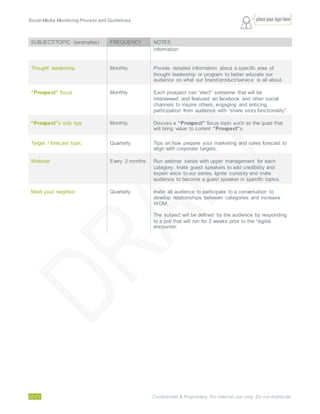
SUBJECT/TOPIC (examples) FREQUENCY NOTES
Monitoring Daily 6 hours per day – 3 teams
Announcement As it happens On-going / entice engagement
Company highlight 1 week post
graduation.
Advertize best graduation picture, story etc.
Contests/Competitions Quarterly First to launch on MM/YYYY
Events Weekly On-going
Polls Weekly Based on feedback from audience
Cause Quarterly Join a cause and make some noise
Industry news Daily Update resources and use RSS feeds
Tips Weekly Tips on what matters to our audience
Hot Stuff Weekly What we find on the web that could interest our audience.
Discounts, scholarship etc…
Audience/Persona focus Monthly
(when possible)
Engage with a specific client and tell his/her story and
entice audience to send feedback/comments
Video Bi-monthly Upload and promote videos on all channels and invite to
comment/provide feedback on
Your 2 cents Bi-monthly Invite audience to submit topics they would like to discuss
and participate to "live" conversation about that subject on
facebook.
Community building Monthly Send "wanted" invitation for clients and prospects to
connect or reconnect with other clients and “Prospect”s
Bulletin board Bi-monthly Invite audience to share and promote local/personal
content on bulletin board / feature new comers.
FAQS Weekly Update FAQ on facebook pages, website and other SM
Awards Quarterly Name your favorite toll/service and tell us why. Link with
Social Media Monitoring Process and Guidelines.
20/23 Confidential & Proprietary. For internal use only. Do not distribute.
SUBJECT/TOPIC (examples) FREQUENCY NOTES
information
Thought leadership Monthly Provide detailed information about a specific area of
thought leadership or program to better educate our
audience on what our brand/product/service is all about.
“Prospect” focus Monthly Each prospect can “elect” someone that will be
interviewed and featured on facebook and other social
channels to inspire others, engaging and enticing
participation from audience with “share story functionality”.
“Prospect”s only tips Monthly Discuss a “Prospect” focus topic such as the quad that
will bring value to current “Prospect”s.
Target / forecast topic Quarterly Tips on how prepare your marketing and sales forecast to
align with corporate targets.
Webinar Every 2 months Run webinar series with upper management for each
category. Invite guest speakers to add credibility and
expert voice to our series. Ignite curiosity and invite
audience to become a guest speaker in specific topics.
Meet your neighbor Quarterly Invite all audience to participate to a conversation to
develop relationships between categories and increase
WOM.
The subject will be defined by the audience by responding
to a poll that will run for 2 weeks prior to the “digital
encounter:
Social Media Monitoring Process and Guidelines.
21/23 Confidential & Proprietary. For internal use only. Do not distribute.
APPENDIXES
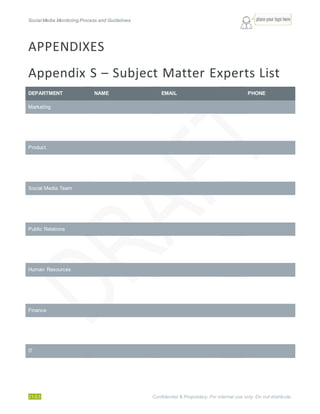
Appendix S – Subject Matter Experts List
DEPARTMENT NAME EMAIL PHONE
Marketing
Product
Social Media Team
Public Relations
Human Resources
Finance
IT
Social Media Monitoring Process and Guidelines.
22/23 Confidential & Proprietary. For internal use only. Do not distribute.
Supporting Information
Social Media Requests
Each team member can send a request to the SMT team. Requests can include but are not limited to:
addition of new pages, suggestions, bug report, feedback, new member, propose new feature, add content,
among other requests. The request will be reviewed carefully and a member of the SMT will respond within
the next 24 hours maximum depending on the emergency of the request.
In some instances, you can contact the relevant team member directly. Below is a links of email addresses
to use for specific occasions.
Contact List
 To report a bug, send feedback, request enhancement, email SMsupport@your”Company Name”.com
 To send an alert, email SMalert@your”Company Name”.com
 To add and or update current page and apps, email SMupdate@your”Company Name”.com
 For inquiries that do not correlate with the above, email SMSMT@your”Company Name”.com
Log file
To log a file, go to your ”Company Name”.com and follow the guidelines.
For more information, please contact the tech leader email the tech lead as this tool is being developed and
will not be accessible for the initial moderation phase. The log file includes information such as:
 Alert ID
 Subject
 Priority level [green, yellow, red
 Creation date
 Revision date
 SME
 Alert information. For example: link to post, website, profile information of owner, etc.
 Status and next steps
 Owner
 Open date
 Close date
A log entry example can be found online at www.socialmedia.your”Company Name”.com.
Social Media Monitoring Process and Guidelines.
23/23 Confidential & Proprietary. For internal use only. Do not distribute.
Quick Guide (Phase 1)
WHAT DO I NEED TO MONITOR?
 “Company Name” (facebook)
 “Company Name” (twitter)
 “Company Name” (google+)
 “Company Name” (linkedin)
 “Company Name” (Pinterest)
 “Company Name” (youtub)
 Etc…
WHAT DO I NEED TO DO AS A MODERATOR?
 Create an account with your “Company Name” email address and use the “Company Name”
200px profile image
 Create “reports” that will be delivered to the facebook@your”Company Name”.com mailbox
 Check your reports in the from social mention and engage appropriately
 Review all entries on mailbox and engage as necessary
 Keep one of your monitor always opened on facebook.
 Check every 5 minutes during your “shift” the entry
 Engage with audience – use your common sense
 Escalate alerts right away – do not wait (follow the escalation process)
 Ask your leader when you are unsure on how to respond to a post
 Log alerts and save file in repository folder
 Upload approved videos on youtube
IMPORTANT NOTES
 Before submitting your response, make sure to type it first in your word application and run a spell check
to ensure you are not making spelling or grammatical mistakes
 Follow the process for escalating an alert and for the tone of your communication
 Talk to the tech lead to request deletion of an entry (admin will be added in the future]
 Leader to set up alerts with Socialmention.com and Google alerts.

Social media guidelines-sample

  • 1.
    Social Media MonitoringProcess and Guidelines. 1/23 Confidential & Proprietary. For internal use only. Do not distribute. Social Media Monitoring Training and Guidelines for “Company Name” Document Reference: XXX-112701 Created on: DD/MM/YYYY Revised on: DD/MM/YYYY Revision #: Draft Distribution: First and Last Name First and Last Name First and Last Name First and Last Name First and Last Name First and Last Name First and Last Name First and Last Name Table of Contents Preamble .............................................................2 Glossary ..............................................................2 Roles and Responsibilities.....................................5 Moderation – Getting Started .................................7 Alert Process Flow..............................................10 Moderation – Standard Procedure .......................11 Moderation – Escalation Process.........................12 Engaging With Our Audiences .............................14 Content and Engagement Plan ............................19 APPENDIXES ....................................................21 Appendix S – Subject Matter Experts List.............21 Supporting Information ........................................22 Quick Guide (Phase 1)........................................23
  • 2.
    Social Media MonitoringProcess and Guidelines. 2/23 Confidential & Proprietary. For internal use only. Do not distribute. Preamble The aim of this document is to provide the “Company Name” Social Media standard process and guidelines to efficiently monitor and engage with social media audience and provide the necessary information and guidance to our team members to be successful in their efforts. This document is intended to be a “living document” – it evolves and changes as the technologies and methods of social media do. It is and will be updated frequently to reflect best practices and learning from our teams and our experiences/engagement with our audiences. Supporting resources are available as appendixes at the end of this document. To report inaccuracy within this document or provide feedback/comments, email socialcorp@yourcompany.com Glossary Understanding the new terms that are used within this document. Who and what is affected by each one of them. Alerts An alert is the action of reporting a matter that is encountered in the social media sphere whether it is happening on our social pages or on any other social media platform not owned by “Company Name”. There are four alert categories identified:  General  Positive [green]  Sensitive [orange]  Urgent [red] Any “Company Name” employee and/or approved social media moderators can set an alert. A process – including escalation – has been designed for each alert category (detailed later in this document). Audience The audience is considered to be the visitors that we have on our social media platforms. It can be composed of four different categories:  A potential “Prospect” (prospect): is a visitor who may or may not be a recognized member of our platforms. They might be looking for information about “Company Name”, engage with our brand, inquires about “Product/Service” in general or from existing audience.  A “Lead” is a current “Company Name” “Prospect” that has joined a “Company Name” social media platform and is either identified by moderator or expresses their status.  A Customer is identified as a “Company Name” client who does engage on social media platforms and has identified themselves as such.  A Lurker is a visitor that is more likely to never engage in any form with our brand and is simply browsing. Depending on which social platform we are present on; additional terms might be used to refer and or describe our audiences. For example, we can use the terms “fan”; “active users” to describe a particular segment of our audience.
  • 3.
    Social Media MonitoringProcess and Guidelines. 3/23 Confidential & Proprietary. For internal use only. Do not distribute. Engagement (participation) Engagement refers to any activity our audience takes towards our brands across any social media platforms including but not limited to forums, blogs, social networks, chat room, UGC sites etc. It can occur between audience members without “Company Name” being involved. .There are two categories of engagement:  Unsolicited might include but not limited to: comments, feedback, criticism, download asset, share/spread/buzz, posting, become fan [like], start groups, upload picture, video etc.  Solicited would be similar to the above with the main difference being that the audience is encouraged to take an action by “Company Name”. Example may vary but can include the following: participation to vote, comment on an entry, take a survey or poll, invite friend, enter contest etc. Moderator A moderator is the team member that performs daily check across the social media universe and report and log alerts following a pre-defined process. The moderator has the responsibility to reach out to the communities, assess and recommend additional platforms as they arise. They are vital in ensuring that we build and maintain exceptional relationships with our audiences. Pre-Moderation Pre moderation happens when we encourage the audience to participate in for example a contest where they are asked to submit a piece of content [UGC] and / or comment on various topics and postings. In order to keep control over what our audience might submit and to ensure compliance with legal requirements and general ethics, there is a need to be able to preview and pre approve any form of content / participation that our audience will submit. Approved content will be posted within 24 hours. Non-approved content will trigger an email from our moderator or comment/private chat [depending on the platform] to either request to resubmit according to ethic, laws etc. or to inform them that we will not post their entry and explain why. Always offer to resubmit [when applicable]. Moderation The act of reviewing entries/ submissions of all kinds on a daily basis, interact with the audience and follow protocol to flag and report potential alerts. SMT The Social Media Team is comprised of social media leader, tech lead and lead moderators responsible for the strategy, development, process and administration of all related social media initiatives. SME Subject Matter Experts are the persons identified as the first point of contact for each category. It ranges from “Prospect” compliance, to admissions to tech lead. Each SME has the same role but within their area of expertise. It is important to maintain a constant communication with the SMEs and to engage them.
  • 4.
    Social Media MonitoringProcess and Guidelines. 4/23 Confidential & Proprietary. For internal use only. Do not distribute. Response A response is the compilation of information that the moderator gathered from the identified SME and that is posted and or published after an alert has been submitted. The response can come from the moderators, PR or SME. Engaging by commenting or replying to post when an alert is not necessary is not considered as a response but as “engagement”. Owner Owner is the person, “Prospect”, alumni or general public who submits the content. UGC UGC stands for User Generated Content. UGC are pieces of content that the audience willingly posts to our social media platform. i.e. upload video to our YouTube channel or a photo to the graduation section of our FB page etc. Entry/Submission Entry/submissions are referred to as any form of digital communication including but not limited to, blog entry, posting, comment, UGC, text message, press release, messaging etc. Social Media Profiles Social Profiles are the accounts that “Company Name” currently own (and will own in the future) on several platforms across the www including YouTube, Facebook and Twitter. The profiles are consistent and categorized by brand. Information provided is relevant to the specific brand. Only Social Media team is allowed to approve the creation of new accounts on existing and new platforms. For question, email fbsupport@your”Company Name”.com Influencers Influencers are also referenced to as “evangelists” or “advocates” depending on the industry and social platform. They are more often successful bloggers that embrace “A” brand and have enough followers and audience to influence what their readers think, buy, share etc. Professional bloggers tend to request payment for their efforts. “Company Name” is not planning on hiring bloggers but we recommend developing relationships with them whenever possible. Our most valuable influencers are and will be our “Prospect”s and alumni will be identified and approached in the course of the interaction with “Company Name” when applicable. “Company Name” influencers will not be rewarded for their “advocacy”.
  • 5.
    Social Media MonitoringProcess and Guidelines. 5/23 Confidential & Proprietary. For internal use only. Do not distribute. Roles and Responsibilities SMT It is the responsibility of the SMT to seek guidance from SME on specific subjects to optimize implementation success. The SMT is also responsible for maintaining and developing our overall strategy across the SM universe and for increasing the level of engagement of our audience. SME An SME is the first point of contact for a specific alert category within a department. The designated person is responsible for supporting the moderator in responding to alerts based on his/her expertise. A list of the SME members is available later in this document – APPENDIX S. Moderator A moderator is the gate keeper and the voice between the audience and “Company Name”. Responsibilities include but are not limited to:  Running daily checks across the social media sphere including “Company Name” and non “Company Name” owned social pages/platforms;  Identifying potential threats and react appropriately following the approved “Company Name” social media monitoring process and guidelines in a timely manner including logging all alerts, and their resolution.  The moderator is also responsible for responding to entries when applicable, maintaining and building conversations with our audience to increase engagement. The daily tasks include gathering information from other departments and asses if “news worthy”, communicate with campuses, advertising managers and PR to gather “field” information and marketing campaigns / events that can be published and/or “promoted” through the social media channels. The moderator will, in addition, execute pre moderation process and associated tasks when applicable, to review entries generated through UGC and approve content prior to posting or delete and communicate to content owner as appropriate as long as engaging with potential influencers and building relationships. Public Relations The public relations team is responsible for:  Reviewing submitted alerts and for drafting response when necessary.  Sharing information that come from the field and any other form of news such as press releases, articles etc. that are identified as being of value to our audience.  Selecting blogging and micro blogging platforms that are relevant to our audience and to submit and manage valuable content to effectively manage reputation and to support marketing efforts. The management and moderation of twitter and corporate blog are the responsibility of the PR team and follow a different process. The PR team is also responsible for providing feedback on proposed strategy when applicable to ensure smooth launch. PR is responsible for managing escalated alerts that are relevant to reputation and draft response for the moderator.
  • 6.
    Social Media MonitoringProcess and Guidelines. 6/23 Confidential & Proprietary. For internal use only. Do not distribute. Legal Legal is responsible for reviewing alerts that have been escalated to them and for drafting appropriate response when applicable and / or guidance on steps that would need to be taken to efficiently deal with the alert. The legal contact is capable of redirecting the alert to the appropriate counsel should the matter require a specific expertise. It is the responsibility of legal to ensure that alerts received are taken seriously and looked at as they arrive to avoid any potential complication. The Legal and PR SMEs will always be copied on communication when a red alert is identified to ensure prompt, relevant and professional response is drafted and communicated when the situation arises. Tech Lead Tech Lead is the person in charge of the implementation and maintenance of our social media platforms and THE ONLY TEAM MEMBER AUTHORIZED TO DEVELOP, EDIT OR DELETE ANY CODE, PAGES OR OTHER TECHNICAL RELATED ITEMS. The tech lead reports to the marketing department and has a deep understanding of the new social media trends along with a set of skills that allow the development and management of our social media presence without breaking or disrupting the code that could impact not only our audience but the marketing efforts deployed on any platform thus, jeopardize the expected results. The tech lead owns the Google analytics account currently being used to measure, assess and optimize our presence and traffic from social media platform. The tech lead will provide a weekly report on the results. The Tech Lead is also responsible for working closely with the SM strategist for the creation of new profiles across various platforms and to ensure features and functionalities proposed are compliant with the platform capabilities. It is also important that the tech lead communicates regularly with the “Company Name” IT team to stay current with new implementations, edits and features affecting our current corporate websites to identify, assess and implement / integrate with our social platforms presence when applicable. The Tech Lead will also help is setting up the metrics and reporting and will run daily checks to ensure our tracking codes are working efficiently. Note: Google analytics is being used as a temporary solution. Code might be altered at a later date to remain consistent with our website analytical solutions.
  • 7.
    Social Media MonitoringProcess and Guidelines. 7/23 Confidential & Proprietary. For internal use only. Do not distribute. Moderation – Getting Started Introduction The team is divided into 3 shifts. Each shift has the responsibility to review ad monitor our social platforms as long as updating the log file to ensure efficient communication among teams and audience. The moderation teams need to go through training and to be certified by the SM leader. They are responsible for engaging with audience and escalating potential alerts following the process in place. Moderation schedule – Team Rotation Monitoring is a mandatory daily task that occurs throughout the day across several social media platforms and monitoring tools alerts. It also involves engaging and interacting with our audience. The daily moderation occurs throughout the day (up to 6 hours/day) and is executed by 3 teams indentified as A, B and C. Each day is divided into three “shifts” Morning, mid day and afternoon. Weekend and evening monitoring will be assigned to each team member and rotate on a weekly basis. The social media strategist/leader will assist on a daily basis and cover for vacation time, sick days etc. to ensure there is no disconnect in the monitoring process. The first phase of the moderation will focus on getting familiarized with the platform, the audience and the tone of the engagement and getting comfortable prior to moving to the next step that will require a greater involvement and communication from the moderator. The moderation team is composed of the following members (bold first name to be identified as the team leader, responsible to ensure monitoring is happening and efficiently and to report any potential “team” incident that require the attention of the SML.  Team A – Leader Name | Team member Name | Team member Name  Team B – Leader Name | Team member Name | Team member Name  Team C – Leader Name | Team member Name | Team member Name TEAM MONDAY TUESDAY WEDNESDAY THURSDAY FRIDAY SATURDAY SUNDAY A: JE JO KI JE JO KI KI B: OP SU JS JS SU OP OP C: RA ME NE RA ME NE RA
  • 8.
    Social Media MonitoringProcess and Guidelines. 8/23 Confidential & Proprietary. For internal use only. Do not distribute. Practical Guidelines What a moderator needs to monitor?  Brand mentions  Programs / Services (career services, financial aid etc.)  Topics / subjects  Comments / views  Social Networks  Language and terms used to refer to our brands  Campus mentions  People mentions (corporate, campus etc.)  Journalists / bloggers  Forums, discussion boards and chat room  Sales pitch submissions (third party offers aimed directly at our “Prospect”s)  Competition integration What does a moderator do?  Check log file to identify action items still opened / new entries from other “shifts” that need follow up  Follow up on non closed action items and take next step (contact SME to get status, engage with owner etc.)  Review comments and posts on social platforms  During the course of the monitoring, engage potential influencers and take conversation to the next level to assess viability of developing further relationship with advocates.  Log Alerts and follow up when applicable [please refer to monitoring process guidelines]  Check social mailbox and respond to participants on social media platforms. Review content submissions and approve [make sure it does not violate our terms for acceptable content – if any doubt, involve legal or talk to the SMT]. Submit content to technical lead upon approval for implementation > once live, engage audience to post comments, share or upload their own.  Prior to the end of “shift”, update log file and ensure to highlight items that require urgent attention.  Review social media inbox and submitted content. Upon approval, submit content to the tech lead for upload to the social platform. Moderator’s etiquette The number one rule when responding to all criticism, even the negative type, is to always stay positive and maintain PMA (positive mental attitude). Adding more negativity to the conversation by letting ourselves be drawn into a fight with someone in our audience can only reflect poorly on us. Always remember that for any challenge, there is a solution. If not sure on what to respond or the tone of the response, contact the SMT for guidance. Moderators and all other employees have the obligation to identify themselves as “Company Name” employees  Positive comment/submission – Someone submits a nice note or UGC content about “Company Name”. This entry should be shared with PR and marketing that will evaluate if it’s worth to contact the “owner” and to take further action. This is the type of comment we want to share not only at a corporate level but also across the web to increase reputation, loyalty and recognition of excellence.  A positive comment requires participation from “Company Name”. The first step is to acknowledge the content submitted and its owner to encourage further participation and trigger additional engagement across the audience.
  • 9.
    Social Media MonitoringProcess and Guidelines. 9/23 Confidential & Proprietary. For internal use only. Do not distribute.  When relevant, contact campus to obtain additional information to foster further discussions with the content owner and the social media audience and when possible, leverage from content submitted to raise awareness and start potential buzz. [for example if specific compliment about the campus, an event or a teacher, then we would ask the teacher and/or campus to join in the conversation or send info about the topic]  Legitimate issue – Someone has an issue and has expressed exactly what’s wrong. This type of feedback is negative in the sense that it paints our brands in a negative way, but could be helpful in exposing real challenges that need to be dealt with.  When dealing with a legitimate issue, a response is necessary. Acknowledge the issue and escalate appropriately. Always follow up to close the loop. A direct response from SME representative might be necessary.  Constructive Criticism – Even more helpful is when the comment comes with a suggestion attached. Many people will use social media to suggest ways in which we can improve our offerings/way we do things etc. While this type of feedback may point out our flaws, and is thus negative, it can be extremely helpful to receive.  Constructive Criticism requires a response. There will be times when we won’t want to implement the suggestion we would be receiving but we’ll build loyalty and trust by responding to criticism with a positive message. It is strongly encouraged to thank those who took the time to provide suggestion or point out our flaws and continue communication to show that we listen and take action (when relevant).  Valid Attack – While the attack itself may not be merited, the reason that triggered it does have merit in this type of negative feedback. Essentially if we did something judge wrong, and someone is angry.  Valid Attacks are more complicated because they’re more likely to feel personal. We should always try to keep in mind that this type of feedback, as harsh as it may be, has a basis in a real problem. It is best to respond promptly and with a positive vibe (e.g., thank the commentator for the feedback and assure them that steps are being taken to correct the issue or mitigate their problem – Always follow up when necessary and close the loop.  Malicious Attack – The difference between trolling/Spam and a valid attack are that they have no justifiable reason for being aggressive towards our brand. Also in this category are spammers, who will use a negative comment about our brands (whether true or not) to promote a competing service and diminish our social credibility and to leverage from the disruption they would have caused.  It is most of the time better not to respond to Trolling or Spam as this type of feedback isn’t really feedback at all but a direct attack.  Sales pitch submissions – Service providers and/or competition that are trying to sale their product and/or services to our audience through our social media platforms.  Those entries should be removed automatically and the “owner” banned from our community. Those entries are conflicting with our offering and damage our credibility and relationship with our audiences by offering services and products that have not been endorsed by our brands. Please refer to the Moderation – Standard Procedure for more information about monitor and escalation process.
  • 10.
    Social Media MonitoringProcess and Guidelines. 10/23 Confidential & Proprietary. For internal use only. Do not distribute. Alert Process Flow Moderators > Daily monitoring/pre- monitoring to identify potential alerts & engage with audience. Manual & semi automated After review, the moderator flags a piece of content and logs and alert that triggers a series of actions. POSITIVE GENERAL SENSITIVE URGENT Respond / comment on post Track & continue conversation as necessary. Continue daily monitoring. • Log entry • Draft acknowledgement • Measure / log engagement • Share with departments or business units for further action if applicable. KHEC platform Respond / comment on post. Track & continue the conversation as necessary. If new platform, send to Social Media team Unknown platform Assess platform Social media team to discuss potential for profile creation & to recruit advocate and create if assessed as valuable. SME + clients/prospects complaints Review entry and identify “owner” Work with relevant experts to draft response. • Log entry • Redirect to the relevant SME • Log entry • Categorized and redirect the request to the relevant SME and/or department leader. If no category match > SM team. If a public response or via social media is needed due to potential reputation damage, contact PR and SM team. Post response and/or contact “owner” via email / phone if available. If alert cannot be resolved, escalate to critical. PR to draft and publish “public” response and update log file. Work with student complaints when applicable. • Send immediate notification to SM team, student complaints, legal and PR and all SME that might be affected by the entry. - Log entry PR and SME team identify keywords such as “threats, lawsuit, class action etc” and draft response to be published as they see as most appropriate. PR to follow up and report on action taken and to make recommendation regarding entry (delete, spread response to SM channels etc.) Employee > Ad hoc Review and triage of posts by moderators
  • 11.
    Social Media MonitoringProcess and Guidelines. 11/23 Confidential & Proprietary. For internal use only. Do not distribute. Moderation – Standard Procedure The moderator as described in the roles and responsibilities section will act as the “gate keeper and voice” of our brands and as such, conducts daily monitoring. During the course of the monitoring, our moderators will be dealing with all sorts of positive attitude, dilemmas, and controversy from our audience. The evaluation protocol requires the moderator to evaluate if submissions are a candidate for potential threat using the following criteria and to identify actionable submissions: 1) Does the submission need a response from SME? If yes, 2) Is the comment or attack valid? 3) Is the submission is in breach with the “COMPANY NAME” social Networking Policy? 4) Does the submission generate traction? 5) Tone of voice / nature of associated assets if any To ensure that our communication and online existence delivers value to our audience, there is a need to keep a safe and clean presence. To that effect, the moderators will comply with the following standard procedure. IDENTIFY THE NATURE OF THE CONTENT  General submission that does not require involvement from a SME. Includes generic communication / information sharing, engaging with content, entry submissions, says or share positive comment and or content etc. a) Assess value of submission and follow escalation process b) Engage with the owner to keep start building conversation when appropriate through the original channel (email, comment, post etc.) c) Continue monitoring and report to SMT on any positive outcome  Does not contain any alarming content but requires further action such as responding to a specific question that cannot be answered by the moderator or audience report inaccurate information found on page and ask for edit that cannot be performed by the moderator. a) Log entry b) Follow escalation process c) Acknowledge receipt to the “owner” d) Check completion of edit e) Respond to the owner when completed f) Close action on log file  Does contain direct and indirect attacks, accusations, negative post, defamatory content, financial information, legal info., company secrets, sales pitch etc. a) Log entry b) Assess if valid attack. If entry assessed to be coming from troller/spam, remove the entry. c) Identify level of alert and follow escalation process.  Does contain discrimination (including age, sex, race, color, creed, religion, ethnicity, sexual orientation, gender identity, national origin, citizenship, disability, or marital status or any other legally recognized protected basis under federal, state, or local laws, regulations or ordinances). a) Log entry b) Remove submission, ban and inform the owner c) Follow escalation process d) Update and close the Log entry upon completion  Does contain content that can damage and/or jeopardize our reputation or those of our “Prospect”s and alumni. a) Log entry b) Remove the submission and notify the owner c) Monitor closely and follow incremental comments/posts generated by the original submission d) Assess alert level and follow escalation process.
  • 12.
    Social Media MonitoringProcess and Guidelines. 12/23 Confidential & Proprietary. For internal use only. Do not distribute.  Does contain request for information regarding education, campus, program etc. a) Log entry b) Forward to relevant SME o contact owner directly or draft response c) If outside of our “Company Name” SM platforms, contact SME, to gather information and contact owner directly. As per legal, we can only contact the owner once to drive them closer to their local campus and deliver information they asked for. Moderation – Escalation Process This section describes the process and guidelines of the escalation process for submissions flagged as an alert. All submissions identified as actionable will be classified by Alert Level and be dealt with following a process. GENERAL: General Alerts are questions that are directly asked and submitted that required to be answered. They do not aim at damaging our brands reputation. Some moderators will have the ability to respond directly to certain kind of questions. A training and script with approved Q&A will be provided to selected moderators.  Log entry (creates ticket)  Identify adequate SME and send request for answer form if the question cannot be answered by the moderator  SME to draft response and contact the owner directly. The SME can also ask the moderator to communicate the response to the owner via social media.  Moderator to log question and answer to Q&A ,library  Close ticket. POSITIVE: Constructive feedback, suggestions, positive comments and or upload, valuable opportunities, stories and or other content sharing.  Gathering and sharing – Led by the SMT  Log all positive submissions into the log file  Forward submission log link to the relevant business units and work on next actions when appropriate.  Respond to the owner and engage conversation.  Contact relevant party if follow up implementation of submissions is approved.  Close ticket  Monitor and report – Led by moderator  Follow community reaction on new implementation and impact if applicable. SENSITIVE: General concerns from the audience that are not relevant legal issues. It might include financial aid, campus or teachers, admissions, career services.  Redirect submission – Led by moderator  Moderator to identified and send request for action to the relevant SME(s). Request 4 action includes all information that can be gathered about the submission including but not limited to (owner details, links, content, location, URL “Prospect” or not – yes, include campus in reply team etc.)  Draft response – SMT and SME to review alert and draft response. If reply requires the posting on social media, contact moderator.  If matter cannot be resolved, escalate to Urgent  Moderator to log action and close ticket.  Monitor and report – Led by moderator  Follow activity, impact and reactions among audience.
  • 13.
    Social Media MonitoringProcess and Guidelines. 13/23 Confidential & Proprietary. For internal use only. Do not distribute. URGENT: Highly public sensitive issues about company secrets, law suit, strategies, accreditation, GAO references and or regulatory matters, defamatory comments or postings, reputation risk. Note: Report of abuse across our SM platforms should follow the same course of action.  Create the reply team – Led by PR  Legal and PR immediately form a response team and identify the SME whom expertise is needed to draft the response including legal team member if relevant  Draft response – Led by PR and action team – Seek legal advice if necessary  PR to work with moderator to post response when applicable  PR to alert moderator upon completion  Moderator to log action and close ticket.  Monitor and report – Led by PR and moderator  Follow activity, impact and reactions among audience after posting response. Assess if further action are required. If yes, PR to gather reply team o draft response and reopen ticket in log file  Add to monthly log report How to log an alert? All alerts identified as such are logged in the Log Entry file accessible here. Alerts can be escalated at a corporate level if necessary and legal review and approval will be requested on replies and next actions when relevant. The status of the alert will be logged by the moderator prior to the end of the “shift” to allow proper follow up by the next team if appropriate. An email address for facebook is set and accessible by all moderation teams to facilitate communication between moderations teams and SME teams. It is essential to capture the log number in the subject line of the email to ensure that communication is not lost or confusing for everyone. The mailbox is sorted by subject/log number, making easier for the team members to follow up and take necessary action in a timely manner. In case of an emergency after normal hours - For emergency alerts out of working hours or for unforeseen circumstances, email alert1@your”Company Name”.com. The email is distributed to the leaders of the social media team as long as the PR SME for immediate attention. “PROSPECT” ONLY ALERTS All “Prospect” complaints must be logged and automatically communicated to the Director of “Prospect” Relations and comply with their existing “Prospect” complaint process. Please refer to the “Prospect” complaint process for more information or contact the Director of “Prospect” Relations if you need more information. THE FOLLOW UP WITH THE “OWNER” AND COURSE OF ACTION WILL BE DECIDED BY THE SME TEAM AND LED BY “PROSPECT”S’ COMPLAINTS.
  • 14.
    Social Media MonitoringProcess and Guidelines. 14/23 Confidential & Proprietary. For internal use only. Do not distribute. How to submit a Social Media Requests [SMR] There are different kinds of requests that can be made.  Add a new member to the social media team  Update SME list  Submit idea/feedback  Suggest new social media platform to assess  Functionalities/feature  Content change  Create a new profile  Training for new campus representative  Social page for campus We strongly encourage each and every member of the social media team and employees to report a bug or broken link to the tech lead – socialsupport@your”Company Name”.com. All requests for training, adding a new moderator, new SME or any other identified role to the team must be sent to the SML for review. Upon approval, the new team member will be trained when required. Engaging With Our Audiences Principles of a conversation To ensure that our audiences get the most value out of our social communications and benefit from our monitoring best practices and experimentation of content types that work best with each channel, we developed a communications schedule and best practices guidelines that will be the base for our moderators’ interaction with the audience. Moderator’s Ethic: The moderator pledges to follow the ethic guidelines listed below and to comply with our core values: Be authentic; do not lie about who you are and what you are here for. Identify yourself. If you are facing a question that you cannot answer, be honest, say it and let the audience know that you’ll get back to them with further information. Always follow up and close your open conversations. The objective is to develop trust and position us as the experts they can rely on and trust, whatever the subject they are interested in discussing is. Be Consistent; portray an excited and enthusiastic personality with a friendly and helpful approach. The tone of voice must be engaging and simple while remaining professional and reliable. The use of the first name is encouraged and slang words should not be used in any circumstances. This approach will help build stronger relationships with our audience and develop trust. Listen to the audience; don’t dismiss a conversation because you are bothered. Each one of our engaged fan / follower or lurker deserves the same amount of interest and reciprocity from us Respond to comments and questions; it is the responsibility of the moderator to respond to a post, comment and or questions within the next 30 minutes maximum. Always acknowledge the receipt of the communication and address it on the social platform. For submissions that require to follow the “alert” process, please refer to the “Social Media Monitoring Process and Guidelines” document.
  • 15.
    Social Media MonitoringProcess and Guidelines. 15/23 Confidential & Proprietary. For internal use only. Do not distribute. Conversing naturally with fans/followers; should a comment/post be identified as a potential viral piece or WOM value, start engaging with the participant and drive the conversation towards a positive and engaging way. Always identify yourself and use your first name and invite other members of the audience to “share their 2 cents”. Entice audience to provide feedback, ideas, feedback. Content quality; when developing and maintaining our social engagement moderators have to provide content that focuses more on quality than quantity. While listening to our audience, build and develop additional content that answers their needs and wants, entice our audience to verbalize and vocalize what they are looking for or submit subject topics to be discussed. Spamming; when conversing with the audience and unless it is requested as a “reply” to a post, moderators should not overuse external links. All requests need to be discussed with the SMT and to assess relevancy. Marketing will however use external links as necessary to advertize specific events or campaigns. Those won’t be included in general communications with the audience that remains “private” between audience and moderators. Tactics for a conversation Shared knowledge and audience; moderators need to communicate among themselves and other business units to share learning and gather content that is relevant to our audience. The SME are the main point of contact for content and alerts. A subject discussed within one platform might be relevant to another brand and be used as a trigger to either build on to increase exposure or minimize impact before it happens. Facebook tactics One of our objectives is to give “Company Name” a recognized and respected voice and personality through the use of social media, offering a way for users to engage and talk back to us while developing loyalty and trust. The Facebook page is also used to showcase a “behind-the-scenes” look at “Company Name”, including videos and photos of activities and events, “Prospect”s’ stories and interactive engagement. Audience- relevant news and information is also posted and or shared.  Engage followers: Quickly answer questions and provide direction to resources, as well as “speak” actively with fans and provide feedback, comments or general conversation. Do not EVER take or continue the conversation on the personal page [or blog or any other SM platform] of any of our audience member [prospects, “Prospect”s and or alumni].  Photo/video posting: Facebook is a media-rich site, and as such, we can make use of the various video- and photo-sharing abilities on our pages. Videos and photos shared are either uploaded or unique to the Facebook page or linked from other sites. The moderator is responsible for reviewing submitted content and ultimately approve for release to the pages.  Custom tabs: Custom tabs (different sections of the page) are developed and used to highlight particular information. The tabs also called apps are used as landing pages for new visitors, as well as areas to collect similar information into one resource. The moderator can drive traffic to those pages during conversations for the visitors to find the information they are looking for.  Highlight news/activities/events: Share information and links for upcoming events and activities or news related to the audience, as well as share information post event.  Highlight trends/topics: Portions of hot topics that are relevant to the audience are promoted and shared, linking to resources and news. The moderator needs to work with the tech expert and SEM to identify content to be posted. New content should be posted on a weekly basis across all tabs.
  • 16.
    Social Media MonitoringProcess and Guidelines. 16/23 Confidential & Proprietary. For internal use only. Do not distribute.  Brand cross-promotion: Special attention is paid to share news and resources from other business units to strengthen the focus on our tag line ““Prospect” firsts”.  Community page interaction: As community pages relevant to us are identified, attention is paid to using keywords that pushes the content out to those community pages. Moderator will use the discussion board tool to drive “negative” conversation out of the wall. A friendly invite should be communicated to the “owner” of the post. Twitter tactics As a general rule, posts follow a “rule of thirds” — one-third retweets (re-posting of someone else’s post), one-third links (often direct to our websites or news) and one-third interaction with other accounts. Through posting and tone of voice, the account is given a personality, or voice, so followers know a person is behind the account and can be engaged.  Engage followers: Effort is made to quickly answer questions and provide direction to resources, as well as actively “talk” with followers and provide feedback, comments or general conversation.  Brand cross-promotion: Special attention is paid to re-tweet news and comments from other “Company Name” accounts, to strengthen the focus on other department Twitter accounts when applicable.  Highlight news/activities/events: Share information and links for upcoming events and activities or news related to the audience and redirect traffic to relevant social media page where the event is advertized  Re-tweeting/link sharing: Links and updates of followers are re-tweeted and shared. This helps keep the account active, and builds relationships and brand recognition with followers.  Push media mentions: Links to stories are shared to promote the brand in third-party outlets and additional social media platforms including blogs and forums.  Follow trends: Using Twitter is an excellent way to follow trends and topical conversations to help guide content and news resources. Use searches and hashtags to find relevant posts. Follow influencers that complement our brands/offerings. Videos tactics The moderator will upload new videos to our video channels – currently YouTube only but need to extend to Vimeo and daily motion. Not all videos will be uploaded our accounts based on legal feedback. Some videos, such as an event behind-the-scenes video, may be uploaded and promoted on just Facebook or similar platforms, depending on intended goals and audience for the video. Staff videos: Videos shot by staff in the field, such as with a Flip video camera, can be uploaded directly to Facebook pages or to YouTube where it can be linked to or embedded on any Web page (– a formal request will be required as only the administrator of the channel should upload content to a channel). IMPORTANT NOTE All content that is submitted through social media as part of a campaign, a contest or a voluntary submission will go through a review and approval process prior to being released to the www. Each submission will need to be accompanied by a “release form” when required [i.e. Scholarship competition). It is the responsibility of the moderator to identify, highlight and report any potential submission that can/could be considered as “non acceptable”.
  • 17.
    Social Media MonitoringProcess and Guidelines. 17/23 Confidential & Proprietary. For internal use only. Do not distribute. Tone and structure of a conversation Should focus on the audience and deliver a pleasant and professional experience. Please refer to the “guiding principles” section of this document. The communication and conversations should not only be focused on our audience needs and want but also reflect our values and professionalism while providing information that are relevant to them. This applicable to the 3 categories we are engaging with:  Prospects  “Prospect”s  Alumni A combination of “corporate” and “social” topics must be maintained throughout time to ensure consistency in message and audience satisfaction. In addition to the “tone” guidelines mentioned earlier in this document, it is important that the moderators understand that they represent “Company Name” and what we stand for. As mentioned earlier, a personal approach is important and we need to reinforce the use of first name not only for the moderator to identify him/herself but also for the “owner” to personalize the conversation. EXAMPLE (LIVE!): A response to a “Prospect” was written as “The campus is looking into this matter for you.” What the moderator should have done is to tailor the response as follows “Hi <first name>, sorry to hear about that. Let me check this for you. I’ll be in touch shortly. <First Name (“Company Name” moderator)> Often, the moderator will have to use his/her own judgment when engaging with the audience. It is strongly recommended that in case of any doubt as o how to reply to a post or engage with the audience, the moderator contact the SEM immediately. Scripts “shell” for conversation Topics The response should always be personal and signed with your first name when appropriate from a facebook “Company Name” profile page. Contests will be run among moderators to see which one makes more friends within a two months period. The reward is to be defined. The contest might be combined with audience to build teams – relationships and loyalty. These scripts are to be used as guidelines and can’t be copied/pasted for all conversations/responses. One of the objectives of our social media presence is to build relationships with our audiences. Using “canned” responses will only fuel frustration and negative feedback. Introducing yourself as a moderator Hi <First name>, my name is <first and last> and I am here to answer your question. Nice post about being a graduate or stating a new job/internship Congratulations <first name>! This is a great achievement. We would definitely love you to share your experience with us and your fellow “Prospect”s. You can post your graduation photos here or submit your story to our bulletin board. I am looking forward to hearing from you and your next successes. News and announcement Announcement: Hi everyone, this message addresses to all “Prospect”s from the <campus name and city>. Then the announcement such as school closed, class postponed etc. If you need additional information, please feel free to send me a message. Thanks. <First Name>
  • 18.
    Social Media MonitoringProcess and Guidelines. 18/23 Confidential & Proprietary. For internal use only. Do not distribute. News: Hi all, we just heard that <event/news> details about it. Let me know if you would like to know more [or other call to action such as: sending a note to a teacher [Japan event for example], death of teacher send condolences etc.]. Request for a link/video/asset/info Hi <first name>. I’ll see what I can do and get back to you. I might contact you separately to get more details so I can pin point the location of the <video>. I’ll be in touch. <First Name>. FOLLOW UP CONVERSATION: GOT IT > Hi <first name>, as promised, I looked for the <asset>. I managed to find it. Here is the link to view it on our facebook page [if video for example]. Enjoy. All, take the time to have a look at it, it’s pretty cool. <First Name> DIDN’T GET IT: Hi <First Name>, I checked for the <video/info> and unfortunately couldn’t locate it. Sorry. I’ll continue to ask around and let you know if I hear anything. If you find it in the meantime, I would appreciate if you could share with us. Thanks. <First Name>. Attack on “Company Name”/Program and or specific campus / complaint Hi <First Name>, I just read your post and was wondering if you would be willing to share a little more information with me. As you know, I work for “Company Name” and would like to make sure that your concern is addressed properly. Is there a time day I can call you? I am looking forward to hearing from you. <First Name>. Response to several attacks on the same subject from several people Hi all, I wanted to let you all know that I communicated your concern to <campus/corporate/etc.>. We are looking at the challenge and will address shortly. In the meantime, if you have specific details and information that can help us to further investigate this topic, please feel free to fill out our anonymous feedback form. You can find it here. I will post an update as soon as I have more info to share. Keep in touch. <First Name>. Information request about program/campus Hi <first name>, you can find information about programs on our program page on facebook. Here is the link <link>. You can also visit your local campus website. You can use the digital map to find it. It is located here <link>. Let me know if you need additional info. <First Name>.
  • 19.
    Social Media MonitoringProcess and Guidelines. 19/23 Confidential & Proprietary. For internal use only. Do not distribute. Content and Engagement Plan The following schedule provides guidance as to the frequency and type of content that we’ll be posting. It will help to facilitate the acquisition of content in a timely manner. The intent is to consistently optimize this schedule based on our findings, audience needs and wants and our business objectives. The update of this schedule can only be implemented upon approval from the Social Media strategist and the VP of the Marketing Department. SUBJECT/TOPIC (examples) FREQUENCY NOTES Monitoring Daily 6 hours per day – 3 teams Announcement As it happens On-going / entice engagement Company highlight 1 week post graduation. Advertize best graduation picture, story etc. Contests/Competitions Quarterly First to launch on MM/YYYY Events Weekly On-going Polls Weekly Based on feedback from audience Cause Quarterly Join a cause and make some noise Industry news Daily Update resources and use RSS feeds Tips Weekly Tips on what matters to our audience Hot Stuff Weekly What we find on the web that could interest our audience. Discounts, scholarship etc… Audience/Persona focus Monthly (when possible) Engage with a specific client and tell his/her story and entice audience to send feedback/comments Video Bi-monthly Upload and promote videos on all channels and invite to comment/provide feedback on Your 2 cents Bi-monthly Invite audience to submit topics they would like to discuss and participate to "live" conversation about that subject on facebook. Community building Monthly Send "wanted" invitation for clients and prospects to connect or reconnect with other clients and “Prospect”s Bulletin board Bi-monthly Invite audience to share and promote local/personal content on bulletin board / feature new comers. FAQS Weekly Update FAQ on facebook pages, website and other SM Awards Quarterly Name your favorite toll/service and tell us why. Link with
  • 20.
    Social Media MonitoringProcess and Guidelines. 20/23 Confidential & Proprietary. For internal use only. Do not distribute. SUBJECT/TOPIC (examples) FREQUENCY NOTES information Thought leadership Monthly Provide detailed information about a specific area of thought leadership or program to better educate our audience on what our brand/product/service is all about. “Prospect” focus Monthly Each prospect can “elect” someone that will be interviewed and featured on facebook and other social channels to inspire others, engaging and enticing participation from audience with “share story functionality”. “Prospect”s only tips Monthly Discuss a “Prospect” focus topic such as the quad that will bring value to current “Prospect”s. Target / forecast topic Quarterly Tips on how prepare your marketing and sales forecast to align with corporate targets. Webinar Every 2 months Run webinar series with upper management for each category. Invite guest speakers to add credibility and expert voice to our series. Ignite curiosity and invite audience to become a guest speaker in specific topics. Meet your neighbor Quarterly Invite all audience to participate to a conversation to develop relationships between categories and increase WOM. The subject will be defined by the audience by responding to a poll that will run for 2 weeks prior to the “digital encounter:
  • 21.
    Social Media MonitoringProcess and Guidelines. 21/23 Confidential & Proprietary. For internal use only. Do not distribute. APPENDIXES Appendix S – Subject Matter Experts List DEPARTMENT NAME EMAIL PHONE Marketing Product Social Media Team Public Relations Human Resources Finance IT
  • 22.
    Social Media MonitoringProcess and Guidelines. 22/23 Confidential & Proprietary. For internal use only. Do not distribute. Supporting Information Social Media Requests Each team member can send a request to the SMT team. Requests can include but are not limited to: addition of new pages, suggestions, bug report, feedback, new member, propose new feature, add content, among other requests. The request will be reviewed carefully and a member of the SMT will respond within the next 24 hours maximum depending on the emergency of the request. In some instances, you can contact the relevant team member directly. Below is a links of email addresses to use for specific occasions. Contact List  To report a bug, send feedback, request enhancement, email SMsupport@your”Company Name”.com  To send an alert, email SMalert@your”Company Name”.com  To add and or update current page and apps, email SMupdate@your”Company Name”.com  For inquiries that do not correlate with the above, email SMSMT@your”Company Name”.com Log file To log a file, go to your ”Company Name”.com and follow the guidelines. For more information, please contact the tech leader email the tech lead as this tool is being developed and will not be accessible for the initial moderation phase. The log file includes information such as:  Alert ID  Subject  Priority level [green, yellow, red  Creation date  Revision date  SME  Alert information. For example: link to post, website, profile information of owner, etc.  Status and next steps  Owner  Open date  Close date A log entry example can be found online at www.socialmedia.your”Company Name”.com.
  • 23.
    Social Media MonitoringProcess and Guidelines. 23/23 Confidential & Proprietary. For internal use only. Do not distribute. Quick Guide (Phase 1) WHAT DO I NEED TO MONITOR?  “Company Name” (facebook)  “Company Name” (twitter)  “Company Name” (google+)  “Company Name” (linkedin)  “Company Name” (Pinterest)  “Company Name” (youtub)  Etc… WHAT DO I NEED TO DO AS A MODERATOR?  Create an account with your “Company Name” email address and use the “Company Name” 200px profile image  Create “reports” that will be delivered to the facebook@your”Company Name”.com mailbox  Check your reports in the from social mention and engage appropriately  Review all entries on mailbox and engage as necessary  Keep one of your monitor always opened on facebook.  Check every 5 minutes during your “shift” the entry  Engage with audience – use your common sense  Escalate alerts right away – do not wait (follow the escalation process)  Ask your leader when you are unsure on how to respond to a post  Log alerts and save file in repository folder  Upload approved videos on youtube IMPORTANT NOTES  Before submitting your response, make sure to type it first in your word application and run a spell check to ensure you are not making spelling or grammatical mistakes  Follow the process for escalating an alert and for the tone of your communication  Talk to the tech lead to request deletion of an entry (admin will be added in the future]  Leader to set up alerts with Socialmention.com and Google alerts.