Social Media for BusinessPractical considerations, Tools and StrategiesPresented byRichard Colback
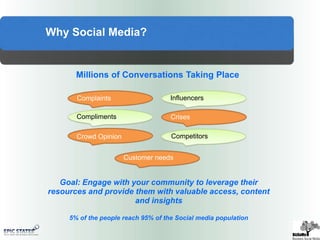
Why Social Media?Millions of Conversations Taking PlaceInfluencersComplaintsComplimentsCrisesCompetitorsCrowd OpinionCustomer needsGoal: Engage with your community to leverage their resources and provide them with valuable access, content and insights5% of the people reach 95% of the Social media population
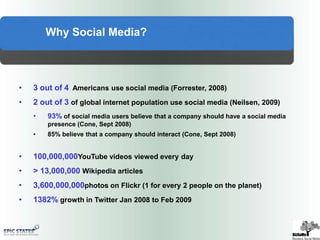
Why Social Media?3 out of 4  Americans use social media (Forrester, 2008)
2 out of 3 of global internet population use social media (Neilsen, 2009)
93% of social media users believe that a company should have a social media presence (Cone, Sept 2008)
85% believe that a company should interact (Cone, Sept 2008)
100,000,000YouTube videos viewed every day
> 13,000,000 Wikipedia articles
3,600,000,000photos on Flickr (1 for every 2 people on the planet)
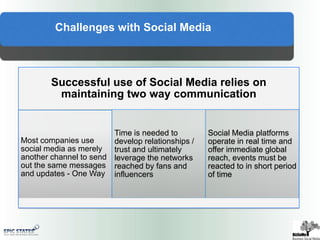
1382% growth in Twitter Jan 2008 to Feb 2009Challenges with Social Media
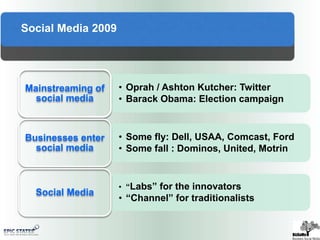
Social Media 2009
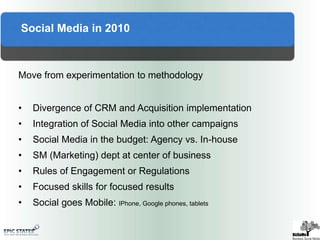
Social Media in 2010Move from experimentation to methodologyDivergence of CRM and Acquisition implementation
Integration of Social Media into other campaigns
Social Media in the budget: Agency vs. In-house
SM (Marketing) dept at center of business
Rules of Engagement or Regulations
Focused skills for focused results
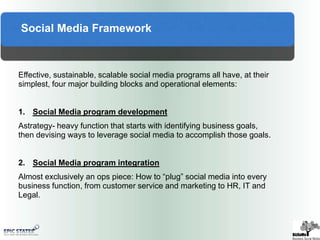
Social goes Mobile: IPhone, Google phones, tablets Social Media FrameworkEffective, sustainable, scalable social media programs all have, at their simplest, four major building blocks and operational elements:1.	Social Media program developmentAstrategy- heavy function that starts with identifying business goals, then devising ways to leverage social media to accomplish those goals. 2.	Social Media program integrationAlmost exclusively an ops piece: How to “plug” social media into every business function, from customer service and marketing to HR, IT and Legal.
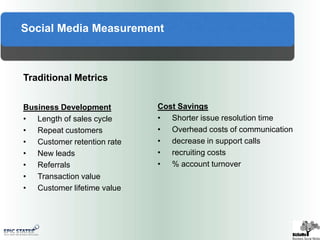
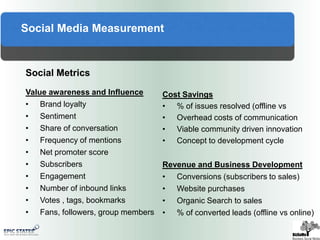
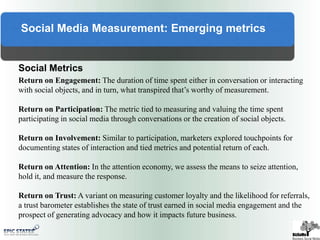
Social Media Program Framework3.	Social Media program management The execution of the program itself.  Some examples of management functions are community management, online reputation management, keyword and conversation monitoring, content management, campaign management, etc.4.	Social Media program measurementA function of marketing in 2010 that includes not only the actual measurement, but also calculation and analysis (the latter being very unique functions within measurement).
Social Media StrategyDefining a clear strategy can help reach social media goals, including:- Sales- Registrations- Referrals- Links- Votes- Reduction in costs - Decrease in customer issues- Lead generation- Conversion- Reduced sale cycles- Inbound activity
Social StrategyManagementDefine the initial objectivesFind a championOutline employee policiesCreate a social business dashboard  MarketingIdentify existing communitiesCreate a marketing plan Develop individual channel strategies 
Social StrategyContent and communityIdentify existing communitiesDevelop community strategies and programs  TechnologyDevelop community strategies and programs Develop your platform strategy CommunicationPublish an action plan 
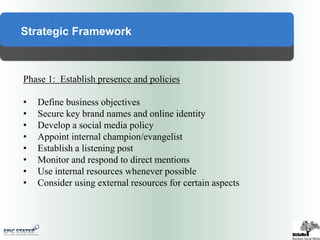
Strategic FrameworkPhase 1:  Establish presence and policies Define business objectives
Secure key brand names and online identity
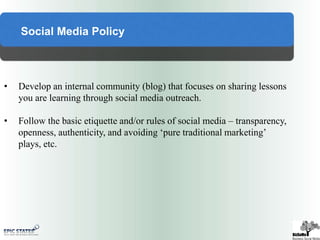
Develop a social media policy
Appoint internal champion/evangelist
Establish a listening post
Monitor and respond to direct mentions
Use internal resources whenever possible
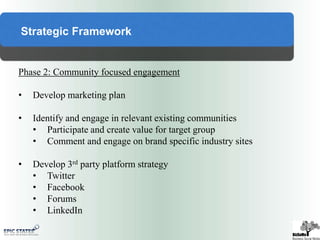
Consider using external resources for certain aspectsStrategic FrameworkPhase 2: Community focused engagementDevelop marketing plan
Identify and engage in relevant existing communities

BizSoMe seminar

  • 1.
    Social Media forBusinessPractical considerations, Tools and StrategiesPresented byRichard Colback
  • 2.
    Why Social Media?Millionsof Conversations Taking PlaceInfluencersComplaintsComplimentsCrisesCompetitorsCrowd OpinionCustomer needsGoal: Engage with your community to leverage their resources and provide them with valuable access, content and insights5% of the people reach 95% of the Social media population
  • 3.
    Why Social Media?3out of 4 Americans use social media (Forrester, 2008)
  • 4.
    2 out of3 of global internet population use social media (Neilsen, 2009)
  • 5.
    93% of socialmedia users believe that a company should have a social media presence (Cone, Sept 2008)
  • 6.
    85% believe thata company should interact (Cone, Sept 2008)
  • 7.
  • 8.
  • 9.
    3,600,000,000photos on Flickr(1 for every 2 people on the planet)
  • 10.
    1382% growth inTwitter Jan 2008 to Feb 2009Challenges with Social Media
  • 11.
  • 12.
    Social Media in2010Move from experimentation to methodologyDivergence of CRM and Acquisition implementation
  • 13.
    Integration of SocialMedia into other campaigns
  • 14.
    Social Media inthe budget: Agency vs. In-house
  • 15.
    SM (Marketing) deptat center of business
  • 16.
    Rules of Engagementor Regulations
  • 17.
    Focused skills forfocused results
  • 18.
    Social goes Mobile:IPhone, Google phones, tablets Social Media FrameworkEffective, sustainable, scalable social media programs all have, at their simplest, four major building blocks and operational elements:1. Social Media program developmentAstrategy- heavy function that starts with identifying business goals, then devising ways to leverage social media to accomplish those goals. 2. Social Media program integrationAlmost exclusively an ops piece: How to “plug” social media into every business function, from customer service and marketing to HR, IT and Legal.
  • 19.
    Social Media ProgramFramework3. Social Media program management The execution of the program itself. Some examples of management functions are community management, online reputation management, keyword and conversation monitoring, content management, campaign management, etc.4. Social Media program measurementA function of marketing in 2010 that includes not only the actual measurement, but also calculation and analysis (the latter being very unique functions within measurement).
  • 20.
    Social Media StrategyDefininga clear strategy can help reach social media goals, including:- Sales- Registrations- Referrals- Links- Votes- Reduction in costs - Decrease in customer issues- Lead generation- Conversion- Reduced sale cycles- Inbound activity
  • 21.
    Social StrategyManagementDefine theinitial objectivesFind a championOutline employee policiesCreate a social business dashboard  MarketingIdentify existing communitiesCreate a marketing plan Develop individual channel strategies 
  • 22.
    Social StrategyContent andcommunityIdentify existing communitiesDevelop community strategies and programs  TechnologyDevelop community strategies and programs Develop your platform strategy CommunicationPublish an action plan 
  • 23.
    Strategic FrameworkPhase 1: Establish presence and policies Define business objectives
  • 24.
    Secure key brandnames and online identity
  • 25.
    Develop a socialmedia policy
  • 26.
  • 27.
  • 28.
    Monitor and respondto direct mentions
  • 29.
    Use internal resourceswhenever possible
  • 30.
    Consider using externalresources for certain aspectsStrategic FrameworkPhase 2: Community focused engagementDevelop marketing plan
  • 31.
    Identify and engagein relevant existing communities