BY
BONITA ABAKAH
& SUE JUNG
Social Media Ch.10
Role of Metrics in Social Media Marketing
Programs
Marketers use metrics to measure in ways to
compare results that relates to specific marketing
objectives. It allows us to determine which strategies
have been successful if at all and which have failed.
Without this, it would be hard to assess the
effectiveness when it comes to campaigns
Metrics
Advertisers can measure
Reach - the number of people exposed to the message
Frequency - the average number of times someone is exposed
Site stickiness - the ability of a site to draw repeat visits and to
keep people on a site
Relative pull - a comparison of how well different creative
executions generate a response of creative advertising
Clickthroughs - the number of people exposed to an online ad
or link who actually click on it
Sales conversions - the number of people who click through
who go on to purchase the product
Viewthroughs - the number of people who are exposed and do
not click through, but who later visit the brand’s website
Engagement
Counting the quantity of interactions consumers
have with a brand doesn’t tell us much about the
quality of these touchpoints. We need to know the
degree of engagement people feel during and after
the interaction, and how these exposures influenced
their feelings about the brand.
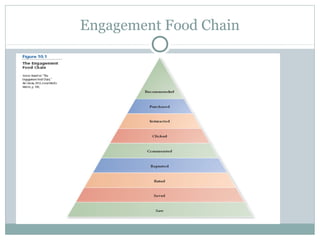
Engagement Food Chain
The Data Approach
It’s a four (4) step process which allows to clearly specify what
the program should accomplish for the organization and
confirm if the plan succeeds. If it doesn’t work out as hoped,
then it just means that new plan must be cooked up by having
to modify what has already been set out on the plan sheet.
Ultimately, social media will have to answer to the same
masters as other kinds of traditional media—the bean
counters that need to see value for their money. The
investment in social media marketing will require
justification. Strategists will want to understand what’s
working and what isn’t in order to decide if a campaign needs
fixing or if it’s worth continuing at all
The Data Approach
The measurement plan is organized according to a
four-step process known as the DATA approach.
Define: Define the results that the program is
designed to promote.
Assess: Assess the costs of the program and the
potential value of the results.
Track: Track the actual results and link those
results to the program.
Adjust: Adjust the program based on results to
optimize future outcomes
Characteristics the Most Commonly Used Social
Media Metrics Share
One of the ways that it’s measured is through use of
social media –
 Such as fan pages on Facebook. It is all measured
through the interaction activities and the metrics that are
counted for through all numbers of followers and fans,
comments, likes, recommendations and reviews, and
amount of shared content.
Another type of interaction through social media is called
“Return metrics”, which focuses on outcomes,
 such as financials, which directly or indirectly supports the success
of the brand.
 Investment measures, cost reduction measures, and other
performance metrics are also all included for the return.
How to Calculate Social Media ROI
ROI is a measure of profitability, and it captures how
effective a company is in having to use capital in order to
generate profits.
 In order to determine ROI, a financial value is assigned
to a resource that used for executing a strategy,
measuring financial outcomes, and calculating the ratio
between inputs and outcomes.
When even having to try and figure out how much
income hase been generated from investments in
activities, it’s all tried to be measured in what’s known as
Social Media Return On Investment (SMROI).
Assessing the Costs and Benefits of a Social
Media Marketing Program
Social media marketing programs have potential to
provide both direct and indirect benefits to
organizations.
 In some applications, the returns will be direct and fairly
easy to measure due to a campaign that will cause
consumers to buy the product.
 Those that are indirect may only be evident in long term,
and those include buzz-building and awareness
campaigns that motivate people to talk to one another
about a brand or to seek out more information about it.
Tracking Social Media Results
Forward tracking requires the analyst to develop
tracking mechanism prior to launching activity
and/or campaign. It is the most accurate approach
because it enables the account team to develop a
mechanism to track exactly the data desired.
Coincident tracking starts while the activity or
campaign is going on, and this method relies on data
that’s gathered at the pint of interaction if not the
point of sale.
Tracking Social Media Results
There’s also the Reverse tracking, which is
conducted after the activity or campaign has come to
a full stop.
 This method is also used for residual data and may
include primary data collection, such as surveys to
assess the effects of the campaign.
Evaluation and Measurement Process:
Ways to Start Measuring
Content consumption: Who is interacting with and
consuming the brand-generated and consumer-
generated content?
Content augmentation: Who is adding to or changing
your content by continuing the conversation with
response posts?
Content sharing: At what rate are those exposed to
the brand messages sharing the content with others
using Share tools?
…continued
Content loyalty: How many consumers have
subscribed to branded content with RSS feeds or by
registering for site access?
Content conversations: Who is discussing the brand?
Content engagement: Is the number of friends to
brand profiles growing?
Case Study
IKEA Facebook Showroom - http://youtu.be/0TYy_3786bo

Social media ch. 10

  • 1.
    BY BONITA ABAKAH & SUEJUNG Social Media Ch.10
  • 2.
    Role of Metricsin Social Media Marketing Programs Marketers use metrics to measure in ways to compare results that relates to specific marketing objectives. It allows us to determine which strategies have been successful if at all and which have failed. Without this, it would be hard to assess the effectiveness when it comes to campaigns
  • 3.
    Metrics Advertisers can measure Reach- the number of people exposed to the message Frequency - the average number of times someone is exposed Site stickiness - the ability of a site to draw repeat visits and to keep people on a site Relative pull - a comparison of how well different creative executions generate a response of creative advertising Clickthroughs - the number of people exposed to an online ad or link who actually click on it Sales conversions - the number of people who click through who go on to purchase the product Viewthroughs - the number of people who are exposed and do not click through, but who later visit the brand’s website
  • 4.
    Engagement Counting the quantityof interactions consumers have with a brand doesn’t tell us much about the quality of these touchpoints. We need to know the degree of engagement people feel during and after the interaction, and how these exposures influenced their feelings about the brand.
  • 5.
  • 6.
    The Data Approach It’sa four (4) step process which allows to clearly specify what the program should accomplish for the organization and confirm if the plan succeeds. If it doesn’t work out as hoped, then it just means that new plan must be cooked up by having to modify what has already been set out on the plan sheet. Ultimately, social media will have to answer to the same masters as other kinds of traditional media—the bean counters that need to see value for their money. The investment in social media marketing will require justification. Strategists will want to understand what’s working and what isn’t in order to decide if a campaign needs fixing or if it’s worth continuing at all
  • 7.
    The Data Approach Themeasurement plan is organized according to a four-step process known as the DATA approach. Define: Define the results that the program is designed to promote. Assess: Assess the costs of the program and the potential value of the results. Track: Track the actual results and link those results to the program. Adjust: Adjust the program based on results to optimize future outcomes
  • 8.
    Characteristics the MostCommonly Used Social Media Metrics Share One of the ways that it’s measured is through use of social media –  Such as fan pages on Facebook. It is all measured through the interaction activities and the metrics that are counted for through all numbers of followers and fans, comments, likes, recommendations and reviews, and amount of shared content. Another type of interaction through social media is called “Return metrics”, which focuses on outcomes,  such as financials, which directly or indirectly supports the success of the brand.  Investment measures, cost reduction measures, and other performance metrics are also all included for the return.
  • 9.
    How to CalculateSocial Media ROI ROI is a measure of profitability, and it captures how effective a company is in having to use capital in order to generate profits.  In order to determine ROI, a financial value is assigned to a resource that used for executing a strategy, measuring financial outcomes, and calculating the ratio between inputs and outcomes. When even having to try and figure out how much income hase been generated from investments in activities, it’s all tried to be measured in what’s known as Social Media Return On Investment (SMROI).
  • 10.
    Assessing the Costsand Benefits of a Social Media Marketing Program Social media marketing programs have potential to provide both direct and indirect benefits to organizations.  In some applications, the returns will be direct and fairly easy to measure due to a campaign that will cause consumers to buy the product.  Those that are indirect may only be evident in long term, and those include buzz-building and awareness campaigns that motivate people to talk to one another about a brand or to seek out more information about it.
  • 11.
    Tracking Social MediaResults Forward tracking requires the analyst to develop tracking mechanism prior to launching activity and/or campaign. It is the most accurate approach because it enables the account team to develop a mechanism to track exactly the data desired. Coincident tracking starts while the activity or campaign is going on, and this method relies on data that’s gathered at the pint of interaction if not the point of sale.
  • 12.
    Tracking Social MediaResults There’s also the Reverse tracking, which is conducted after the activity or campaign has come to a full stop.  This method is also used for residual data and may include primary data collection, such as surveys to assess the effects of the campaign.
  • 13.
    Evaluation and MeasurementProcess: Ways to Start Measuring Content consumption: Who is interacting with and consuming the brand-generated and consumer- generated content? Content augmentation: Who is adding to or changing your content by continuing the conversation with response posts? Content sharing: At what rate are those exposed to the brand messages sharing the content with others using Share tools?
  • 14.
    …continued Content loyalty: Howmany consumers have subscribed to branded content with RSS feeds or by registering for site access? Content conversations: Who is discussing the brand? Content engagement: Is the number of friends to brand profiles growing?
  • 15.
    Case Study IKEA FacebookShowroom - http://youtu.be/0TYy_3786bo