© author(s) of these slides including research results from the KOM research network and TU Darmstadt; otherwise it is specified at the respective slide 
31-Oct-14 
Dr.-Ing. Johannes Konert 
Dr.-Ing. Christoph Rensing KOM - Multimedia Communications Lab 
Template Teaching v.3.4 
KnowShare__3_SocialDesignPatterns_GraphTheory__2014.10.31__v1.1.pptx 
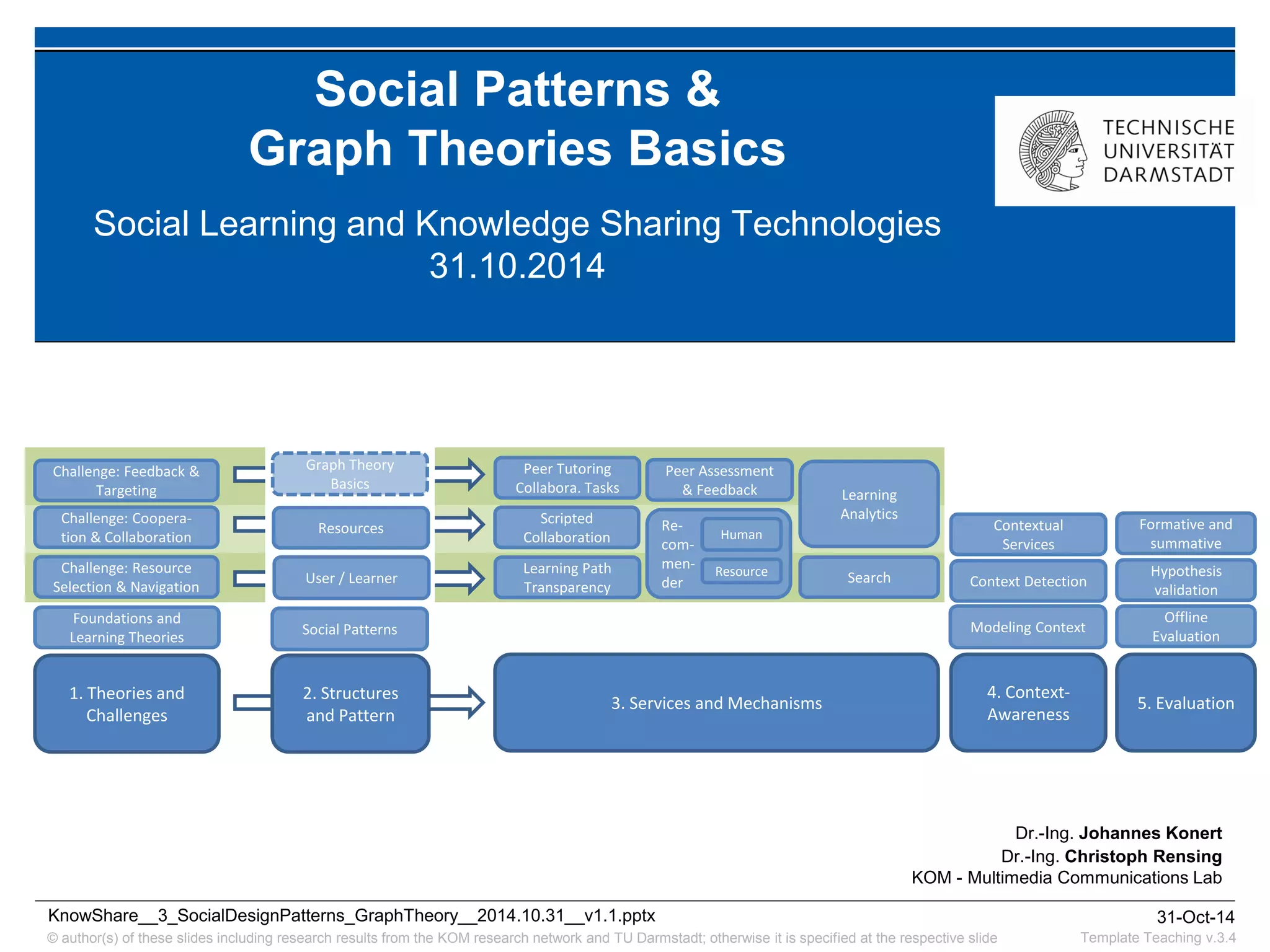
Social Patterns & Graph Theories Basics 
Social Learning and Knowledge Sharing Technologies 
31.10.2014 
1. Theories and Challenges 
2. Structures and Pattern 
Modeling Context 
4. Context- Awareness 
Search 
Context Detection 
3. Services and Mechanisms 
Peer Tutoring Collabora. Tasks 
Contextual Services 
5. Evaluation 
Foundations and Learning Theories 
Challenge: Resource Selection & Navigation 
Challenge: Coopera- tion & Collaboration 
Challenge: Feedback & Targeting 
Peer Assessment & Feedback 
Learning Analytics 
Learning Path Transparency 
Offline Evaluation 
Hypothesis validation 
Formative and summative 
Resources 
Social Patterns 
Graph Theory Basics 
Scripted Collaboration 
Re- com- men- der 
Human 
Resource 
User / Learner
KOM – Multimedia Communications Lab 
2 
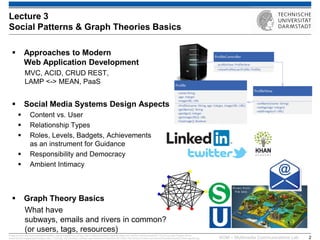
Approaches to Modern Web Application Development MVC, ACID, CRUD REST, LAMP <-> MEAN, PaaS 
Social Media Systems Design Aspects 
Content vs. User 
Relationship Types 
Roles, Levels, Badgets, Achievements as an instrument for Guidance 
Responsibility and Democracy 
Ambient Intimacy 
Graph Theory Basics What have subways, emails and rivers in common? (or users, tags, resources) 
Image sources: http://www.seawaterfoundation.org/siteImages/rivers_art.jpg,, http://vnfa8y5n3zndutm1.zippykid.netdna-cdn.com/wp-content/uploads/2011/12/url7.jpg, http://images.all-free- download.com/images/graphiclarge/s_bahn_71263.jpg, http://de.roblox.com/item.aspx?seoname=U-Bahn&id=28172595, http://faculty.kutztown.edu/rieksts/225/graphs/tripartite_files/image002.jpg, 
Lecture 3 Social Patterns & Graph Theories Basics
KOM – Multimedia Communications Lab 
3 
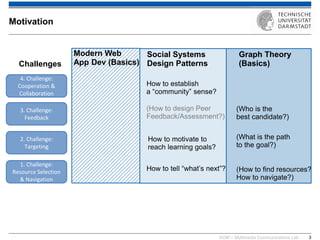
Motivation 
1. Challenge: Resource Selection & Navigation 
4. Challenge: Cooperation & Collaboration 
2. Challenge: Targeting 
(How to find resources? How to navigate?) 
How to motivate to reach learning goals? 
Modern Web App Dev (Basics) 
Social Systems Design Patterns 
Graph Theory (Basics) 
3. Challenge: Feedback 
(How to design Peer Feedback/Assessment?) 
(What is the path to the goal?) 
(Who is the best candidate?) 
How to establish a “community” sense? 
Challenges 
How to tell “what’s next”?
KOM – Multimedia Communications Lab 
4 
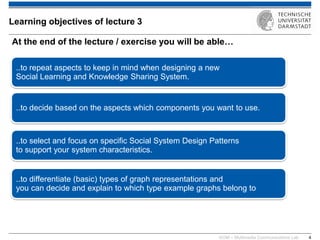
At the end of the lecture / exercise you will be able… 
Learning objectives of lecture 3 
..to repeat aspects to keep in mind when designing a new Social Learning and Knowledge Sharing System. 
..to decide based on the aspects which components you want to use. 
..to select and focus on specific Social System Design Patterns to support your system characteristics. 
..to differentiate (basic) types of graph representations and you can decide and explain to which type example graphs belong to
KOM – Multimedia Communications Lab 
5 
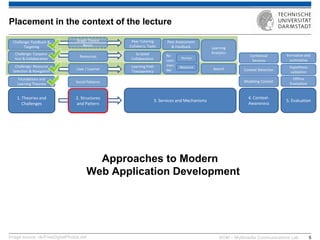
Approaches to Modern Web Application Development 
Image source: ok/FreeDigitalPhotos.net 
Placement in the context of the lecture 
1. Theories and Challenges 
2. Structures and Pattern 
Modeling Context 
4. Context- Awareness 
Search 
Context Detection 
3. Services and Mechanisms 
Peer Tutoring Collabora. Tasks 
Contextual Services 
5. Evaluation 
Foundations and Learning Theories 
Challenge: Resource Selection & Navigation 
Challenge: Coopera- tion & Collaboration 
Challenge: Feedback & Targeting 
Peer Assessment & Feedback 
Learning Analytics 
Learning Path Transparency 
Offline Evaluation 
Hypothesis validation 
Formative and summative 
Resources 
Social Patterns 
Graph Theory Basics 
Scripted Collaboration 
Re- com- men- der 
Human 
Resource 
User / Learner
KOM – Multimedia Communications Lab 
6 
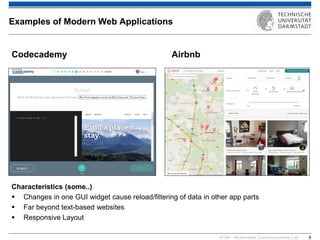
Codecademy Airbnb 
Examples of Modern Web Applications 
Characteristics (some..) 
Changes in one GUI widget cause reload/filtering of data in other app parts 
Far beyond text-based websites 
Responsive Layout
KOM – Multimedia Communications Lab 
7 
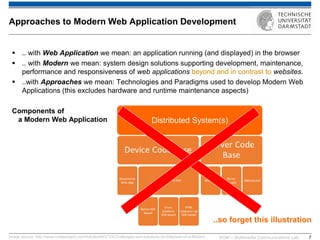
.. with Web Application we mean: an application running (and displayed) in the browser 
.. with Modern we mean: system design solutions supporting development, maintenance, performance and responsiveness of web applications beyond and in contrast to websites. 
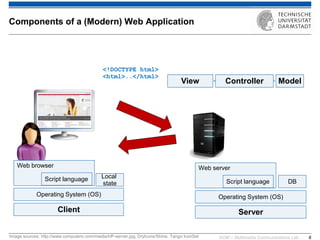
..with Approaches we mean: Technologies and Paradigms used to develop Modern Web Applications (this excludes hardware and runtime maintenance aspects) Components of a Modern Web Application 
Image source: http://www.codeproject.com/Articles/645753/Challenges-and-solutions-Architecture-of-a-Modern 
Approaches to Modern Web Application Development 
Distributed System(s) 
..so forget this illustration
KOM – Multimedia Communications Lab 
8 
Web server 
Components of a (Modern) Web Application 
Image sources: http://www.computero.com/media/HP-server.jpg, DryIcons/Shine, Tango IconSet 
Server 
Client 
Operating System (OS) 
Script language 
DB 
Operating System (OS) 
Model 
Controller 
<!DOCTYPE html> <html>..</html> 
View 
Web browser 
Script language 
Local state
KOM – Multimedia Communications Lab 
10 
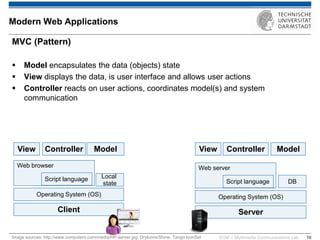
MVC (Pattern) 
Model encapsulates the data (objects) state 
View displays the data, is user interface and allows user actions 
Controller reacts on user actions, coordinates model(s) and system communication 
Modern Web Applications 
Image sources: http://www.computero.com/media/HP-server.jpg, DryIcons/Shine, Tango IconSet 
Web server 
Server 
Client 
Operating System (OS) 
Script language 
DB 
Operating System (OS) 
Web browser 
Script language 
Local state 
Model 
Controller 
View 
Model 
Controller 
View
KOM – Multimedia Communications Lab 
11 
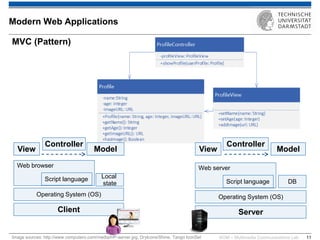
MVC (Pattern) 
Modern Web Applications 
Image sources: http://www.computero.com/media/HP-server.jpg, DryIcons/Shine, Tango IconSet 
Web server 
Server 
Client 
Operating System (OS) 
Script language 
DB 
Operating System (OS) 
Web browser 
Script language 
Local state 
Model 
Controller 
View 
Model 
Controller 
View
KOM – Multimedia Communications Lab 
12 
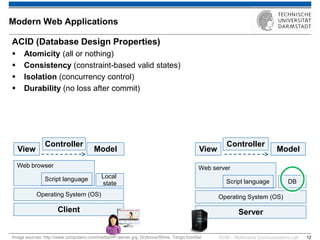
ACID (Database Design Properties) 
Atomicity (all or nothing) 
Consistency (constraint-based valid states) 
Isolation (concurrency control) 
Durability (no loss after commit) 
Modern Web Applications 
Image sources: http://www.computero.com/media/HP-server.jpg, DryIcons/Shine, Tango IconSet 
Web server 
Server 
Client 
Operating System (OS) 
Script language 
DB 
Operating System (OS) 
Web browser 
Script language 
Local state 
Model 
Controller 
View 
Model 
Controller 
View
KOM – Multimedia Communications Lab 
13 
CRUD (Persistent Storage [Interface] Properties) 
Modern Web Applications 
Image sources: http://www.computero.com/media/HP-server.jpg, DryIcons/Shine, Tango IconSet 
Web server 
Server 
Client 
Operating System (OS) 
Script language 
DB 
Operating System (OS) 
Web browser 
Script language 
Local state 
Model 
Controller 
View 
Model 
Controller 
View 
Operation 
SQL 
HTTP 
Create 
INSERT 
PUT / POST 
Read (Retrieve) 
SELECT 
GET 
Update (Modify) 
UPDATE 
PUT / PATCH 
Delete (Destroy) 
DELETE 
DELETE 
Web Service / API
KOM – Multimedia Communications Lab 
14 
REST (Property) 
Representational state transfer 
Stateless server & cachable responses 
uniform ressource and service addresses 
Alternative representations (?) 
Interface-based operations (identify, create, modify, delete) New aspects: 
Hypermedia as state transition machine 
Using many HTTP methods 
Modern Web Applications 
Image sources: http://www.computero.com/media/HP-server.jpg, DryIcons/Shine, Tango IconSet 
Web server 
Server 
Client 
Operating System (OS) 
Script language 
DB 
Operating System (OS) 
Web browser 
Script language 
Local state 
Model 
Controller 
View 
Model 
Controller 
View 
Web Service / API 
HTTP-based example: http://www.airbnb.com/places 
public class MyPlaces { 
@GET 
@Produces(MediaType.TEXT_PLAIN) 
public String getIt() { 
return "Darmstadt, Frankfurt, München"; 
} 
@GET 
@Produces(MediaType.APPLICATION_JSON) 
public String getIt() { 
return "{ ‘places‘: [‘Darmstadt‘,‘Frankfurt‘,‘München‘]}"; 
} 
}
KOM – Multimedia Communications Lab 
15 
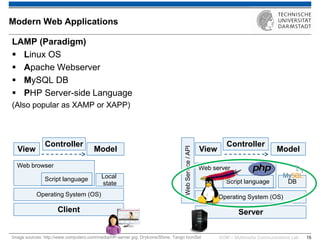
LAMP (Paradigm) 
Linux OS 
Apache Webserver 
MySQL DB 
PHP Server-side Language (Also popular as XAMP or XAPP) 
Modern Web Applications 
Image sources: http://www.computero.com/media/HP-server.jpg, DryIcons/Shine, Tango IconSet 
Web server 
Server 
Client 
Operating System (OS) 
Script language 
DB 
Operating System (OS) 
Web browser 
Script language 
Local state 
Model 
Controller 
View 
Model 
Controller 
View 
Web Service / API
KOM – Multimedia Communications Lab 
16 
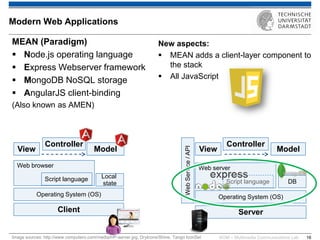
MEAN (Paradigm) 
Node.js operating language 
Express Webserver framework 
MongoDB NoSQL storage 
AngularJS client-binding (Also known as AMEN) 
Modern Web Applications 
Image sources: http://www.computero.com/media/HP-server.jpg, DryIcons/Shine, Tango IconSet 
Web server 
Server 
Client 
Operating System (OS) 
Script language 
DB 
Operating System (OS) 
Web browser 
Script language 
Local state 
Model 
Controller 
View 
Model 
Controller 
View 
Web Service / API 
New aspects: 
MEAN adds a client-layer component to the stack 
All JavaScript
KOM – Multimedia Communications Lab 
17 
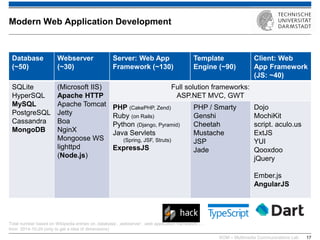
Total number based on Wikipedia entries on ‚database‘, ‚webserver‘, ‚web application framework‘,… from 2014-10-29 (only to get a idea of dimensions) 
Modern Web Application Development 
Database (~50) 
Webserver (~30) 
Server: Web App Framework (~130) 
Template Engine (~90) 
Client: Web App Framework (JS: ~40) 
SQLite 
HyperSQL 
MySQL 
PostgreSQL 
Cassandra 
MongoDB 
(Microsoft IIS) 
Apache HTTP 
Apache Tomcat 
Jetty 
Boa 
NginX Mongoose WS 
lighttpd 
(Node.js) 
Full solution frameworks: ASP.NET MVC, GWT 
PHP (CakePHP, Zend) 
Ruby (on Rails) 
Python (Django, Pyramid) 
Java Servlets (Spring, JSF, Struts) 
ExpressJS 
PHP / Smarty 
Genshi 
Cheetah 
Mustache 
JSP 
Jade 
Dojo 
MochiKit 
script. aculo.us 
ExtJS 
YUI 
Qooxdoo 
jQuery 
Ember.js 
AngularJS
KOM – Multimedia Communications Lab 
18 
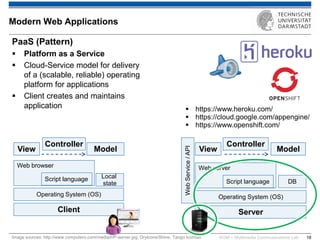
PaaS (Pattern) 
Platform as a Service 
Cloud-Service model for delivery of a (scalable, reliable) operating platform for applications 
Client creates and maintains application 
Modern Web Applications 
Image sources: http://www.computero.com/media/HP-server.jpg, DryIcons/Shine, Tango IconSet 
Web server 
Server 
Client 
Operating System (OS) 
DB 
Operating System (OS) 
Web browser 
Script language 
Local state 
Model 
Controller 
View 
Model 
Controller 
View 
Web Service / API 
Script language 
https://www.heroku.com/ 
https://cloud.google.com/appengine/ 
https://www.openshift.com/
KOM – Multimedia Communications Lab 
19 
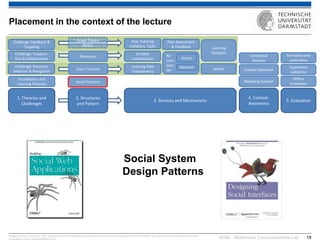
Social System Design Patterns 
Image and book reference: http://www.amazon.com/Designing-Social-Interfaces-Principles-Experience/dp/0596154925, http://www.amazon.com/Building-Social- Applications-Gavin-Bell/dp/0596518757/ 
Placement in the context of the lecture 
1. Theories and Challenges 
2. Structures and Pattern 
Modeling Context 
4. Context- Awareness 
Search 
Context Detection 
3. Services and Mechanisms 
Peer Tutoring Collabora. Tasks 
Contextual Services 
5. Evaluation 
Foundations and Learning Theories 
Challenge: Resource Selection & Navigation 
Challenge: Coopera- tion & Collaboration 
Challenge: Feedback & Targeting 
Peer Assessment & Feedback 
Learning Analytics 
Learning Path Transparency 
Offline Evaluation 
Hypothesis validation 
Formative and summative 
Resources 
Social Patterns 
Graph Theory Basics 
Scripted Collaboration 
Re- com- men- der 
Human 
Resource 
User / Learner
KOM – Multimedia Communications Lab 
20 
“The main issue with designing and maintaining a social web application is not the technology, it’s the psychology as people and their activities are the core of the application.” 
The quote is no citation of other authors, but written by JK based on [Crumlish et al 2009] and [Bell 2009] 
The main issue
KOM – Multimedia Communications Lab 
21 
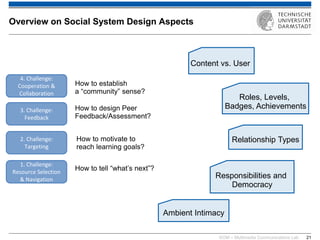
Overview on Social System Design Aspects 
1. Challenge: Resource Selection & Navigation 
4. Challenge: Cooperation & Collaboration 
2. Challenge: Targeting 
3. Challenge: Feedback 
How to motivate to reach learning goals? 
How to design Peer Feedback/Assessment? 
How to establish a “community” sense? 
How to tell “what’s next”? 
Content vs. User 
Roles, Levels, Badges, Achievements 
Responsibilities and Democracy 
Relationship Types 
Ambient Intimacy
KOM – Multimedia Communications Lab 
22 
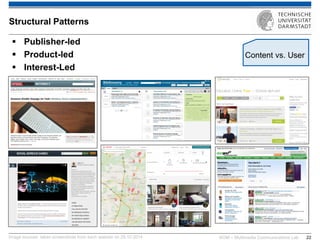
Publisher-led 
Product-led 
Interest-Led 
Image sources: taken screenshots from each website on 29.10.2014 
Structural Patterns 
Content vs. User
KOM – Multimedia Communications Lab 
23 
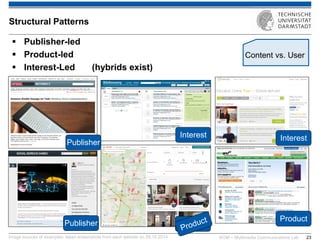
Publisher-led 
Product-led 
Interest-Led (hybrids exist) 
Image sources of examples: taken screenshots from each website on 29.10.2014 
Structural Patterns 
Content vs. User 
Publisher 
Publisher 
Interest 
Interest 
Interest 
Product
KOM – Multimedia Communications Lab 
24 
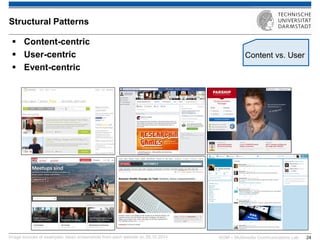
Content-centric 
User-centric 
Event-centric 
Image sources of examples: taken screenshots from each website on 29.10.2014 
Structural Patterns 
Content vs. User
KOM – Multimedia Communications Lab 
25 
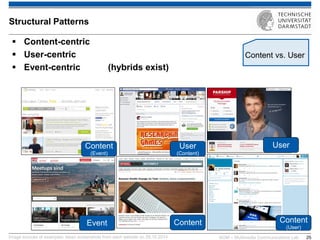
Content-centric 
User-centric 
Event-centric (hybrids exist) 
Image sources of examples: taken screenshots from each website on 29.10.2014 
Structural Patterns 
Content vs. User 
Content (Event) 
Content 
Event 
Content (User) 
User (Content) 
User
KOM – Multimedia Communications Lab 
26 
Publisher 
Product 
Interest 
Content 
Media Syndication 
Customer Exchange 
Learning/Sharing 
Event 
Marketing 
Franchise 
Gathering/Exchange 
User 
VIP Promotion 
Grouping 
Friendship 
Illustration by J.Konert, no specific reference for these dimensions, but see [Bell2009, p. 123ff] for aspects 
Structural Patterns 
Most interesting for Social Learning and Knowledge Sharing are 
Interest-led 
Content-centered 
Content vs. User
KOM – Multimedia Communications Lab 
27 
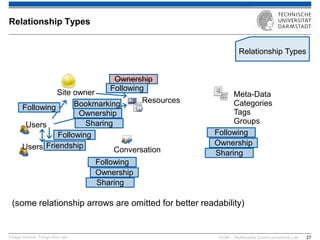
(some relationship arrows are omitted for better readability) 
Image source: Tango Icon set, 
Relationship Types 
Relationship Types 
Site owner 
Users 
Users 
Resources 
Conversation 
Meta-Data Categories Tags 
Groups 
Friendship 
Following 
Following 
Bookmarking 
Following 
Ownership 
Ownership 
Sharing 
Sharing 
Following 
Ownership 
Sharing 
Ownership 
Following
KOM – Multimedia Communications Lab 
28 
Technically 
Symmetric relationships 
Discovery of people/groups 
Request, Acknowledgement, Decline, Ignore, Remove 
Asymmetric relationships 
Follow (Fan), Unfollow, Bookmark 
Filter 
Structure and Content creation 
Group creation, deletion, handover ownership 
Content creation, deletion, (remaining after account deletion) 
Tagging 
Privacy and Visibility settings for user-data, content, structures 
Search and Recommendation (PULL, PUSH) 
Administration (reporting, deletion, reasoning, explanation) [see later slides] 
See [Crumlish et al, 2009], p.354-379 for further details. * read http://socialseriousgames.de/post/5437302687/social-serious-gaming-chi-2011-impressions for further details 
Relationship Types 
Make content and profile creation easy, syndicate and recommend this technically and allow structure to emerge later on 
[cf. Crumlish et al., p378] 
Symmetric 
Asymmetric
KOM – Multimedia Communications Lab 
29 
What is reputation? It’s the general opinion (judgment) (more technically, a social evaluation) of (and by) the public (or a group or only a person) towards an entity (person, organization, object or group of entities) – as distinct and different from the background (others) – concerning the likelihood of the entity to behave in a certain way in the future [under certain circumstances]. It is a ubiquitous, spontaneous and highly efficient mechanism of social control. [Crumlish et al. 2009, p. 153], citing Ted Nadeau “Reputation 2.0” Good. So let’s give people something that helps for reputation. Consider 
Cooperativeness vs. Competitiveness 
Comparability 
Quality vs. Quantity 
Honor User Loyalty and Progress 
Roles, Levels, Badges, Achievements
KOM – Multimedia Communications Lab 
30 
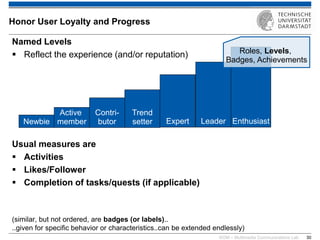
Named Levels 
Reflect the experience (and/or reputation) Usual measures are 
Activities 
Likes/Follower 
Completion of tasks/quests (if applicable) (similar, but not ordered, are badges (or labels).. ..given for specific behavior or characteristics..can be extended endlessly) 
Honor User Loyalty and Progress 
Newbie 
Active member 
Contri- butor 
Trend setter 
Expert 
Leader 
Enthusiast 
Roles, Levels, Badges, Achievements
KOM – Multimedia Communications Lab 
31 
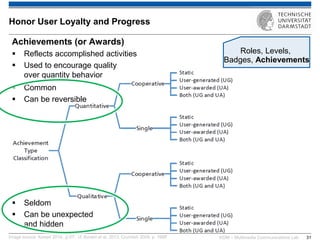
Achievements (or Awards) 
Reflects accomplished activities 
Used to encourage quality over quantity behavior 
Common 
Can be reversible 
Seldom 
Can be unexpected and hidden 
Image source: Konert 2014, .p 67; cf. Konert et al. 2013, Crumlish 2009, p. 166ff 
Honor User Loyalty and Progress 
Roles, Levels, Badges, Achievements
KOM – Multimedia Communications Lab 
32 
Image source: https://s3.amazonaws.com/codecademy-blog/assets/intro-new-profile/whole_page.jpg 
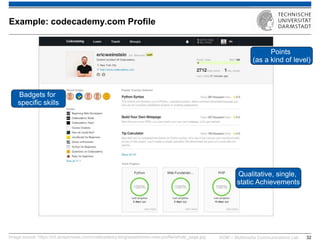
Example: codecademy.com Profile 
Qualitative, single, static Achievements 
Badgets for specific skills 
Points (as a kind of level)
KOM – Multimedia Communications Lab 
33 
A Social Web Application should 
offer a unique, protected identity (by email or OpenID etc.) 
offer privacy settings (reasonable defaults, private, protected, public profile and activities) 
enforce community guidelines (code of conduct) 
grow organically (managed by owner and community) 
provide tools for collective governance (reports, privileges, isolation, timed bans, ..) 
allow collaborative filtering (votes, tagging) 
never forget that all data belongs to the users (and that this implies rights to it) 
Cf. [Bell, 2009, p. 209-224], [Crumlish et al, 2009, p. 383-397]; image taken from https://info.yahoo.com/legal/sg/yahoo/comms/ 
Responsibilities 
Responsibilities and Democracy
KOM – Multimedia Communications Lab 
34 
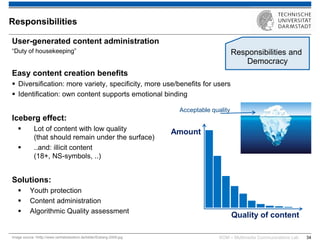
User-generated content administration “Duty of housekeeping” Easy content creation benefits 
Diversification: more variety, specificity, more use/benefits for users 
Identification: own content supports emotional binding Iceberg effect: 
Lot of content with low quality (that should remain under the surface) 
..and: illicit content (18+, NS-symbols, ..) Solutions: 
Youth protection 
Content administration 
Algorithmic Quality assessment 
Responsibilities 
Quality of content 
Amount 
Acceptable quality 
Image source: hhttp://www.vertriebslexikon.de/bilder/Eisberg-2009.jpg 
Responsibilities and Democracy
KOM – Multimedia Communications Lab 
35 
Responsibilities 
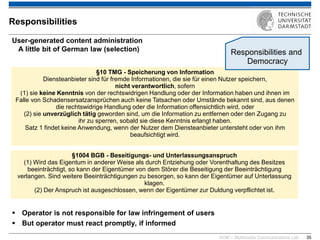
User-generated content administration A little bit of German law (selection) 
Operator is not responsible for law infringement of users 
But operator must react promptly, if informed 
§10 TMG - Speicherung von Information 
Diensteanbieter sind für fremde Informationen, die sie für einen Nutzer speichern, nicht verantwortlich, sofern 
(1) sie keine Kenntnis von der rechtswidrigen Handlung oder der Information haben und ihnen im Falle von Schadensersatzansprüchen auch keine Tatsachen oder Umstände bekannt sind, aus denen 
die rechtswidrige Handlung oder die Information offensichtlich wird, oder (2) sie unverzüglich tätig geworden sind, um die Information zu entfernen oder den Zugang zu 
ihr zu sperren, sobald sie diese Kenntnis erlangt haben. 
Satz 1 findet keine Anwendung, wenn der Nutzer dem Diensteanbieter untersteht oder von ihm 
beaufsichtigt wird. 
§1004 BGB - Beseitigungs- und Unterlassungsanspruch (1) Wird das Eigentum in anderer Weise als durch Entziehung oder Vorenthaltung des Besitzes beeinträchtigt, so kann der Eigentümer von dem Störer die Beseitigung der Beeinträchtigung verlangen. Sind weitere Beeinträchtigungen zu besorgen, so kann der Eigentümer auf Unterlassung klagen. (2) Der Anspruch ist ausgeschlossen, wenn der Eigentümer zur Duldung verpflichtet ist. 
Responsibilities and Democracy
KOM – Multimedia Communications Lab 
36 
Responsibility of Content Administration 
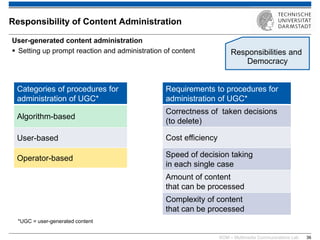
User-generated content administration 
Setting up prompt reaction and administration of content 
Categories of procedures for administration of UGC* 
Algorithm-based 
User-based 
Operator-based 
Requirements to procedures for administration of UGC* 
Correctness of taken decisions (to delete) 
Cost efficiency 
Speed of decision taking in each single case 
Amount of content that can be processed 
Complexity of content that can be processed 
*UGC = user-generated content 
Responsibilities and Democracy
KOM – Multimedia Communications Lab 
38 
Responsibility of Content Administration 
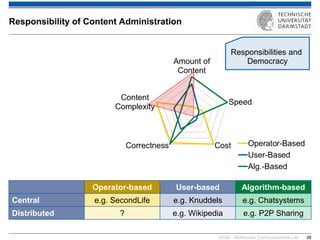
Operator-based 
User-based 
Algorithm-based 
Central 
e.g. SecondLife 
e.g. Knuddels 
e.g. Chatsystems 
Distributed 
? 
e.g. Wikipedia 
e.g. P2P Sharing 
Responsibilities and Democracy
KOM – Multimedia Communications Lab 
39 
Responsibility of Content Administration 
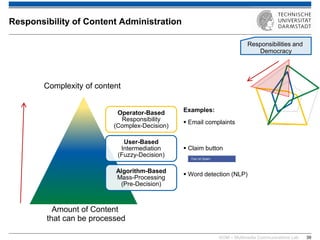
Operator-Based Responsibility (Complex-Decision) 
User-Based Intermediation (Fuzzy-Decision) 
Algorithm-Based Mass-Processing (Pre-Decision) 
Complexity of content 
Amount of Content that can be processed 
Examples: 
 Email complaints 
 Claim button 
 Word detection (NLP) 
Responsibilities and Democracy
KOM – Multimedia Communications Lab 
40 
Ambient Intimacy 
Key aspect for social learning success (beside serendipity) 
“..is about being able to keep in touch with people with a level of regularity and intimacy that you wouldn’t usually have access to, because time and space conspire to make it impossible.” * 
Removing cold ambience and the feeling of being with others using the application may dramatically increase app stickiness and in the context of SLKST the learning success (as it is mainly about self-regulation, continuity and connecting people by content). 
Image sources: own facebook profile feed and video as listed above. * quote from http://www.reboot.dk/page/1236/en ; cf. [Crumlish et al 2009, p.135-152] 
Ambient Intimacy 
See Video for Interview with Twitter founder Evan Williams of Obvious http://www.technologyreview.com/video/416292/twitter-and-ambient-intimacy/
KOM – Multimedia Communications Lab 
43 
GRAPH THEORY 
1. Theories and Challenges 
2. Structures and Pattern 
Modeling Context 
4. Context- Awareness 
Search 
Context Detection 
3. Services and Mechanisms 
Peer Tutoring Collabora. Tasks 
Contextual Services 
5. Evaluation 
Foundations and Learning Theories 
Challenge: Resource Selection & Navigation 
Challenge: Coopera- tion & Collaboration 
Challenge: Feedback & Targeting 
Peer Assessment & Feedback 
Learning Analytics 
Learning Path Transparency 
Offline Evaluation 
Hypothesis validation 
Formative and summative 
Resources 
Social Patterns 
Graph Theory Basics 
Scripted Collaboration 
Re- com- men- der 
Human 
Resource 
User / Learner
KOM – Multimedia Communications Lab 
45 
A Graph G is a pair of sets (Vertexes and Edges) 퐺=(푉,퐸),푉=푥1,…,푥푛,퐸⊆푉2,푉 ∩퐸=∅ 
Vertexes of a Graph are 푉퐺, Edges are 퐸(퐺) 
Number of vertextes 푉=푛=|퐺| is called the order of G 
Number of Edges 퐸=푚=퐺 
Two vertexes 푥푖,푥푗∈푉(퐺) are adjacent, if 푥푖,푥푗∈퐸퐺. Two edges are adjacent if they have an end in common. 
The degree 푑푥=|퐸푥| of 푥 is the number of edges at 푥 
A path is a non-empty (sub)graph 푃=(푉,퐸) of the form 푉=푥0,푥1,…,푥푘,퐸={푥0푥1,푥1푥2,…,푥푘−1푥푘} where 푥푖 distinct. 퐸 is the length of P 
A tree is a graph where any two vertexes are connected by exactly one unique path Restrictions: This lecture only treats nontrivial, finite graphs and mostly simple graphs, i.e. 퐕>ퟎ,푮 known and <∞ , no loops, no double edges 
This and following slides are based on [Diestel2006] 
Graphs Defined 
푥1 
푥2 
푥3 
푥4 
푥5
KOM – Multimedia Communications Lab 
46 
Vertexes represent users* 
Edges represent relations (friendships) ** Metrics of interest 
Which users belong closely to each other? 
Which users spread information? 
Which users are popular (trendsetting)? 
A directed graph (or digraph) 퐷=(푉,퐴) is with V a finite, nonempty set of vertices and A a set of ordered pairs of distinct elements of V called arcs, 퐴={(푥푖,푥푗)} with 푖≠푗,푥푖,푥푗∈푉 meaning directed arcs from 푥푖 to 푥푗 
In-degree 푑−푥 of a vertex x is the number of arcs into x. Out-degree equally defined for out-going arcs from x. 
Image source: jscreationzs / FreeDigitalPhotos.net ; [[Oellermann, 2013, p.7] 
Social Network Graphs 
* Could be as well locations, resources, etc.., but is less common 
** could be anything else like “exchanged emails”, “have been at the same spot”, “have a goal in common”. It is very usual to define the edges to the needs of your analysis
KOM – Multimedia Communications Lab 
47 
Metrics of interest 
Which users belong closely to each other? 
Which users spread information? 
Which users are popular (trendsetting)? 
Image source: jscreationzs / FreeDigitalPhotos.net ; [INSNA,2014] 
Social Network Graphs 
Range (diversity) 
Number of links to different others (others are defined as different to the extent that they are not themselves linked to each other, or represent different groups or statuses) 
(Tie) strength 
Amount of time, emotional intensity, intimacy, and reciprocal services (frequency and multiplexity are also often used as a measure of strength) of a specific link. 
Centrality 
Extent to which an actor is central to a network. Various measures (including degree, closeness, and betweeness) have been used as indicators of centrality. Some measures of centrality weight an actor's links to others by the centrality of those others. 
Closeness 
Extent to which an actor is close to, or can easily reach all the other actors in the network. Usually measured by averaging the path distances (direct and indirect links) to all others. A direct link is counted as 1, indirect links receive proportionately less weight (e.g. 1/(number of hops)). 
Betweeness 
Extent to which an actor mediates, or falls between any other two actors on the shortest path between those actors. Usually averaged across all possible pairs in the network. 
Prestige 
Based on asymmetric relationships, prestigious actors are the object rather than the source of relations. Measures similar to centrality are calculated by accounting for the direction of the relationship (i.e. in-degree). Prestige can then be defined e.g. as in-degree / out-degree
KOM – Multimedia Communications Lab 
48 
Representation 
Adjacency matrix 
For our finite simple graphs a adjacency matrix is a matrix with zeros on its diagonal and ones (1) for each edge connecting 푥푖 and 푥푗. The matrix is always symmetric if the graph is undirected. 
A= 0 10 101 01 100 10 111 11 000 01 00, algorithmically you store an 2-dimensional array A[i][j]. 
Adjacency list 
Storage of all neighbors of the vertexes as a list, e.g. 
퐴=푥2,푥4,푥1,푥3,푥4,푥2,푥4,푥5,푥1,푥2,푥3,푥3, algorithmically you store as well a 2-dimensional array 
Which way is more efficient? 
 Depends on sparsity and operations 
(Social Network) Graphs 
푥1 
푥2 
푥3 
푥4 
푥5
KOM – Multimedia Communications Lab 
49 
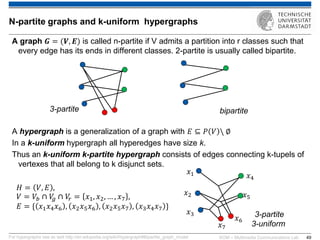
A graph 푮=(푽,푬) is called n-partite if V admits a partition into r classes such that every edge has its ends in different classes. 2-partite is usually called bipartite. 
A hypergraph is a generalization of a graph with 퐸⊆푃푉 ∅ 
In a k-uniform hypergraph all hyperedges have size k. 
Thus an k-uniform k-partite hypergraph consists of edges connecting k-tupels of vertexes that all belong to k disjunct sets. 
For hypergraphs see as well http://en.wikipedia.org/wiki/Hypergraph#Bipartite_graph_model 
N-partite graphs and k-uniform hypergraphs 
푥1 
푥2 
푥3 
푥4 
푥5 
푥6 
푥7 
bipartite 
3-partite 
3-partite 
3-uniform 
퐻=푉,퐸, 
푉=푉푏∩푉푔∩푉푟=푥1,푥2,…,푥7, 
퐸={푥1푥4푥6,푥2푥5푥6,푥2푥5푥7,푥3푥4푥7}
KOM – Multimedia Communications Lab 
50 
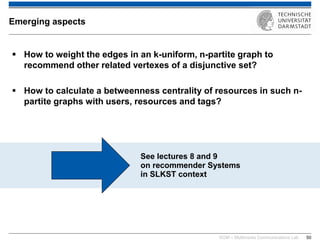
How to weight the edges in an k-uniform, n-partite graph to recommend other related vertexes of a disjunctive set? 
How to calculate a betweenness centrality of resources in such n- partite graphs with users, resources and tags? 
Emerging aspects 
See lectures 8 and 9 on recommender Systems in SLKST context
KOM – Multimedia Communications Lab 
51 
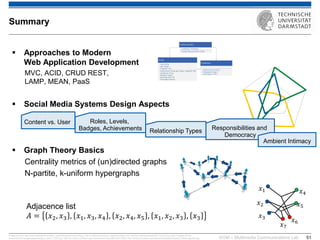
Approaches to Modern Web Application Development MVC, ACID, CRUD REST, LAMP, MEAN, PaaS 
Social Media Systems Design Aspects 
Graph Theory Basics Centrality metrics of (un)directed graphs N-partite, k-uniform hypergraphs 
Image sources: http://www.seawaterfoundation.org/siteImages/rivers_art.jpg,, http://vnfa8y5n3zndutm1.zippykid.netdna-cdn.com/wp-content/uploads/2011/12/url7.jpg, http://images.all-free- download.com/images/graphiclarge/s_bahn_71263.jpg, http://de.roblox.com/item.aspx?seoname=U-Bahn&id=28172595, http://faculty.kutztown.edu/rieksts/225/graphs/tripartite_files/image002.jpg, 
Summary 
Content vs. User 
Roles, Levels, Badges, Achievements 
Relationship Types 
푥1 
푥2 
푥3 
푥4 
푥5 
푥6 
푥7 
Adjacence list 퐴=푥2,푥3,푥1,푥3,푥4,푥2,푥4,푥5,푥1,푥2,푥3,푥3 
Responsibilities and Democracy 
Ambient Intimacy
KOM – Multimedia Communications Lab 
52 
Task1 (2p) 
Designing the relation of system design aspects and 3 systems as a graph (connecting social System Design Patterns with Graph Theory) Task 2 (2p) A new (fictive) SLKS system is described 
Define and describe 6 types of relationships 
How would you implement a reputation/progress system if you have to choose one pattern? 
How do you handle content administration? A bonus challenge is included (task 1) 
About the Exercise 3
KOM – Multimedia Communications Lab 
53 
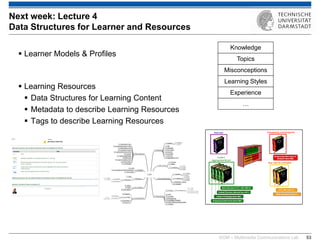
Learner Models & Profiles 
Learning Resources 
Data Structures for Learning Content 
Metadata to describe Learning Resources 
Tags to describe Learning Resources 
Next week: Lecture 4 Data Structures for Learner and Resources 
Knowledge 
Topics 
Misconceptions 
Learning Styles 
Experience 
…
KOM – Multimedia Communications Lab 
54 
Thank you for your attention, questions, feedback or hints. 
Endslide 
km-teaching@KOM.tu-da…. .de 
km-teaching@KOM.tu-da…. .de
KOM – Multimedia Communications Lab 
55 
REST, see JAX-RS specs and https://jersey.java.net/documentation/latest/getting-started.html 
Crumlish, C.; Malone, E.: Designing Social Interfaces: Principles, Patterns, and Practices for Improving the User Experience (Animal Guide) (p. 520). Sebastopol, USA: O’Reilly Media, 2009. Letzter Zugriff von http://www.amazon.com/Designing-Social-Interfaces-Principles-Experience/dp/0596154925 
Bell, G.: Building Social Web Applications. Bell, Gavin . Sebastopol: O’Reilly Books, 2009. Letzter Zugriff 29.10.2014 von http://www.amazon.com/Building-Social-Applications-Gavin-Bell/dp/0596518757 
Konert, J.; Gerwien, N.; Göbel, S.; Steinmetz, R. Bringing Game Achievements and Community Achievements Together. In Proceedings of the 7th European Conference on Game Based Learning (ECGBL) 2013, pages 319–328, Porto Portugal, 2013. Academic Publishing International. ISBN 978-1- 909507-63-0. 
Konert, J.: Interactive Multimedia Learning: Using Social Media for Peer Education in Single-Player Educational Games (p. 220). Darmstadt, Germany: Springer, 2014. Letzter Zugriff von http://www.springer.com/engineering/signals/book/978-3-319-10255-9 
Diestel, R.: Graph Theory (Graduate Texts in Mathematics) (3rd ed.). Springer, 2006. Letzter Zugriff 30.10.2014 von http://www.amazon.de/Graph-Theory-Graduate-Texts-Mathematics/dp/3540261834/ 
Oellermann, O. R.: Topics in Structural Graph Theory. (L. W. Beinecke & R. J. Wilson, Hrsg.). Cambridge, MA, USA: Cambridge University Press, 2013. 
INSNA, International Network for Social Network Analysis, 2004. SNA Measures. , p.1. Available at: https://www.socialtext.net/data/workspaces/insna- socnet/attachments/index_of_sna_measures:20041202193540/original/Index of SNA Measures.xls. 
Wikipedia, Hypergraphs, Letzer Zugriff 30.10.2014 von http://en.wikipedia.org/wiki/Hypergraph#Bipartite_graph_model 
References (order of occurance)
KOM – Multimedia Communications Lab 
56 
REST, see JAX-RS specs and https://jersey.java.net/documentation/latest/getting-started.html 
Crumlish, C.; Malone, E.: Designing Social Interfaces: Principles, Patterns, and Practices for Improving the User Experience (Animal Guide) (p. 520). Sebastopol, USA: O’Reilly Media, 2009. Letzter Zugriff von http://www.amazon.com/Designing-Social-Interfaces-Principles-Experience/dp/0596154925 
Bell, G.: Building Social Web Applications. Bell, Gavin . Sebastopol: O’Reilly Books, 2009. Letzter Zugriff 29.10.2014 von http://www.amazon.com/Building-Social-Applications-Gavin-Bell/dp/0596518757 
Diestel, R.: Graph Theory (Graduate Texts in Mathematics) (3rd ed.). Springer, 2006. Letzter Zugriff 30.10.2014 von http://www.amazon.de/Graph-Theory-Graduate-Texts-Mathematics/dp/3540261834/ 
Further Readings
KOM – Multimedia Communications Lab 
57 
Directly named on the corresponding slides 
Image Sources

Social Learning and Knowledge Sharing Technologies Lecture Slides about Social Patterns & Graph Theories

  • 1.
    © author(s) ofthese slides including research results from the KOM research network and TU Darmstadt; otherwise it is specified at the respective slide 31-Oct-14 Dr.-Ing. Johannes Konert Dr.-Ing. Christoph Rensing KOM - Multimedia Communications Lab Template Teaching v.3.4 KnowShare__3_SocialDesignPatterns_GraphTheory__2014.10.31__v1.1.pptx Social Patterns & Graph Theories Basics Social Learning and Knowledge Sharing Technologies 31.10.2014 1. Theories and Challenges 2. Structures and Pattern Modeling Context 4. Context- Awareness Search Context Detection 3. Services and Mechanisms Peer Tutoring Collabora. Tasks Contextual Services 5. Evaluation Foundations and Learning Theories Challenge: Resource Selection & Navigation Challenge: Coopera- tion & Collaboration Challenge: Feedback & Targeting Peer Assessment & Feedback Learning Analytics Learning Path Transparency Offline Evaluation Hypothesis validation Formative and summative Resources Social Patterns Graph Theory Basics Scripted Collaboration Re- com- men- der Human Resource User / Learner
  • 2.
    KOM – MultimediaCommunications Lab 2 Approaches to Modern Web Application Development MVC, ACID, CRUD REST, LAMP <-> MEAN, PaaS Social Media Systems Design Aspects Content vs. User Relationship Types Roles, Levels, Badgets, Achievements as an instrument for Guidance Responsibility and Democracy Ambient Intimacy Graph Theory Basics What have subways, emails and rivers in common? (or users, tags, resources) Image sources: http://www.seawaterfoundation.org/siteImages/rivers_art.jpg,, http://vnfa8y5n3zndutm1.zippykid.netdna-cdn.com/wp-content/uploads/2011/12/url7.jpg, http://images.all-free- download.com/images/graphiclarge/s_bahn_71263.jpg, http://de.roblox.com/item.aspx?seoname=U-Bahn&id=28172595, http://faculty.kutztown.edu/rieksts/225/graphs/tripartite_files/image002.jpg, Lecture 3 Social Patterns & Graph Theories Basics
  • 3.
    KOM – MultimediaCommunications Lab 3 Motivation 1. Challenge: Resource Selection & Navigation 4. Challenge: Cooperation & Collaboration 2. Challenge: Targeting (How to find resources? How to navigate?) How to motivate to reach learning goals? Modern Web App Dev (Basics) Social Systems Design Patterns Graph Theory (Basics) 3. Challenge: Feedback (How to design Peer Feedback/Assessment?) (What is the path to the goal?) (Who is the best candidate?) How to establish a “community” sense? Challenges How to tell “what’s next”?
  • 4.
    KOM – MultimediaCommunications Lab 4 At the end of the lecture / exercise you will be able… Learning objectives of lecture 3 ..to repeat aspects to keep in mind when designing a new Social Learning and Knowledge Sharing System. ..to decide based on the aspects which components you want to use. ..to select and focus on specific Social System Design Patterns to support your system characteristics. ..to differentiate (basic) types of graph representations and you can decide and explain to which type example graphs belong to
  • 5.
    KOM – MultimediaCommunications Lab 5 Approaches to Modern Web Application Development Image source: ok/FreeDigitalPhotos.net Placement in the context of the lecture 1. Theories and Challenges 2. Structures and Pattern Modeling Context 4. Context- Awareness Search Context Detection 3. Services and Mechanisms Peer Tutoring Collabora. Tasks Contextual Services 5. Evaluation Foundations and Learning Theories Challenge: Resource Selection & Navigation Challenge: Coopera- tion & Collaboration Challenge: Feedback & Targeting Peer Assessment & Feedback Learning Analytics Learning Path Transparency Offline Evaluation Hypothesis validation Formative and summative Resources Social Patterns Graph Theory Basics Scripted Collaboration Re- com- men- der Human Resource User / Learner
  • 6.
    KOM – MultimediaCommunications Lab 6 Codecademy Airbnb Examples of Modern Web Applications Characteristics (some..) Changes in one GUI widget cause reload/filtering of data in other app parts Far beyond text-based websites Responsive Layout
  • 7.
    KOM – MultimediaCommunications Lab 7 .. with Web Application we mean: an application running (and displayed) in the browser .. with Modern we mean: system design solutions supporting development, maintenance, performance and responsiveness of web applications beyond and in contrast to websites. ..with Approaches we mean: Technologies and Paradigms used to develop Modern Web Applications (this excludes hardware and runtime maintenance aspects) Components of a Modern Web Application Image source: http://www.codeproject.com/Articles/645753/Challenges-and-solutions-Architecture-of-a-Modern Approaches to Modern Web Application Development Distributed System(s) ..so forget this illustration
  • 8.
    KOM – MultimediaCommunications Lab 8 Web server Components of a (Modern) Web Application Image sources: http://www.computero.com/media/HP-server.jpg, DryIcons/Shine, Tango IconSet Server Client Operating System (OS) Script language DB Operating System (OS) Model Controller <!DOCTYPE html> <html>..</html> View Web browser Script language Local state
  • 9.
    KOM – MultimediaCommunications Lab 10 MVC (Pattern) Model encapsulates the data (objects) state View displays the data, is user interface and allows user actions Controller reacts on user actions, coordinates model(s) and system communication Modern Web Applications Image sources: http://www.computero.com/media/HP-server.jpg, DryIcons/Shine, Tango IconSet Web server Server Client Operating System (OS) Script language DB Operating System (OS) Web browser Script language Local state Model Controller View Model Controller View
  • 10.
    KOM – MultimediaCommunications Lab 11 MVC (Pattern) Modern Web Applications Image sources: http://www.computero.com/media/HP-server.jpg, DryIcons/Shine, Tango IconSet Web server Server Client Operating System (OS) Script language DB Operating System (OS) Web browser Script language Local state Model Controller View Model Controller View
  • 11.
    KOM – MultimediaCommunications Lab 12 ACID (Database Design Properties) Atomicity (all or nothing) Consistency (constraint-based valid states) Isolation (concurrency control) Durability (no loss after commit) Modern Web Applications Image sources: http://www.computero.com/media/HP-server.jpg, DryIcons/Shine, Tango IconSet Web server Server Client Operating System (OS) Script language DB Operating System (OS) Web browser Script language Local state Model Controller View Model Controller View
  • 12.
    KOM – MultimediaCommunications Lab 13 CRUD (Persistent Storage [Interface] Properties) Modern Web Applications Image sources: http://www.computero.com/media/HP-server.jpg, DryIcons/Shine, Tango IconSet Web server Server Client Operating System (OS) Script language DB Operating System (OS) Web browser Script language Local state Model Controller View Model Controller View Operation SQL HTTP Create INSERT PUT / POST Read (Retrieve) SELECT GET Update (Modify) UPDATE PUT / PATCH Delete (Destroy) DELETE DELETE Web Service / API
  • 13.
    KOM – MultimediaCommunications Lab 14 REST (Property) Representational state transfer Stateless server & cachable responses uniform ressource and service addresses Alternative representations (?) Interface-based operations (identify, create, modify, delete) New aspects: Hypermedia as state transition machine Using many HTTP methods Modern Web Applications Image sources: http://www.computero.com/media/HP-server.jpg, DryIcons/Shine, Tango IconSet Web server Server Client Operating System (OS) Script language DB Operating System (OS) Web browser Script language Local state Model Controller View Model Controller View Web Service / API HTTP-based example: http://www.airbnb.com/places public class MyPlaces { @GET @Produces(MediaType.TEXT_PLAIN) public String getIt() { return "Darmstadt, Frankfurt, München"; } @GET @Produces(MediaType.APPLICATION_JSON) public String getIt() { return "{ ‘places‘: [‘Darmstadt‘,‘Frankfurt‘,‘München‘]}"; } }
  • 14.
    KOM – MultimediaCommunications Lab 15 LAMP (Paradigm) Linux OS Apache Webserver MySQL DB PHP Server-side Language (Also popular as XAMP or XAPP) Modern Web Applications Image sources: http://www.computero.com/media/HP-server.jpg, DryIcons/Shine, Tango IconSet Web server Server Client Operating System (OS) Script language DB Operating System (OS) Web browser Script language Local state Model Controller View Model Controller View Web Service / API
  • 15.
    KOM – MultimediaCommunications Lab 16 MEAN (Paradigm) Node.js operating language Express Webserver framework MongoDB NoSQL storage AngularJS client-binding (Also known as AMEN) Modern Web Applications Image sources: http://www.computero.com/media/HP-server.jpg, DryIcons/Shine, Tango IconSet Web server Server Client Operating System (OS) Script language DB Operating System (OS) Web browser Script language Local state Model Controller View Model Controller View Web Service / API New aspects: MEAN adds a client-layer component to the stack All JavaScript
  • 16.
    KOM – MultimediaCommunications Lab 17 Total number based on Wikipedia entries on ‚database‘, ‚webserver‘, ‚web application framework‘,… from 2014-10-29 (only to get a idea of dimensions) Modern Web Application Development Database (~50) Webserver (~30) Server: Web App Framework (~130) Template Engine (~90) Client: Web App Framework (JS: ~40) SQLite HyperSQL MySQL PostgreSQL Cassandra MongoDB (Microsoft IIS) Apache HTTP Apache Tomcat Jetty Boa NginX Mongoose WS lighttpd (Node.js) Full solution frameworks: ASP.NET MVC, GWT PHP (CakePHP, Zend) Ruby (on Rails) Python (Django, Pyramid) Java Servlets (Spring, JSF, Struts) ExpressJS PHP / Smarty Genshi Cheetah Mustache JSP Jade Dojo MochiKit script. aculo.us ExtJS YUI Qooxdoo jQuery Ember.js AngularJS
  • 17.
    KOM – MultimediaCommunications Lab 18 PaaS (Pattern) Platform as a Service Cloud-Service model for delivery of a (scalable, reliable) operating platform for applications Client creates and maintains application Modern Web Applications Image sources: http://www.computero.com/media/HP-server.jpg, DryIcons/Shine, Tango IconSet Web server Server Client Operating System (OS) DB Operating System (OS) Web browser Script language Local state Model Controller View Model Controller View Web Service / API Script language https://www.heroku.com/ https://cloud.google.com/appengine/ https://www.openshift.com/
  • 18.
    KOM – MultimediaCommunications Lab 19 Social System Design Patterns Image and book reference: http://www.amazon.com/Designing-Social-Interfaces-Principles-Experience/dp/0596154925, http://www.amazon.com/Building-Social- Applications-Gavin-Bell/dp/0596518757/ Placement in the context of the lecture 1. Theories and Challenges 2. Structures and Pattern Modeling Context 4. Context- Awareness Search Context Detection 3. Services and Mechanisms Peer Tutoring Collabora. Tasks Contextual Services 5. Evaluation Foundations and Learning Theories Challenge: Resource Selection & Navigation Challenge: Coopera- tion & Collaboration Challenge: Feedback & Targeting Peer Assessment & Feedback Learning Analytics Learning Path Transparency Offline Evaluation Hypothesis validation Formative and summative Resources Social Patterns Graph Theory Basics Scripted Collaboration Re- com- men- der Human Resource User / Learner
  • 19.
    KOM – MultimediaCommunications Lab 20 “The main issue with designing and maintaining a social web application is not the technology, it’s the psychology as people and their activities are the core of the application.” The quote is no citation of other authors, but written by JK based on [Crumlish et al 2009] and [Bell 2009] The main issue
  • 20.
    KOM – MultimediaCommunications Lab 21 Overview on Social System Design Aspects 1. Challenge: Resource Selection & Navigation 4. Challenge: Cooperation & Collaboration 2. Challenge: Targeting 3. Challenge: Feedback How to motivate to reach learning goals? How to design Peer Feedback/Assessment? How to establish a “community” sense? How to tell “what’s next”? Content vs. User Roles, Levels, Badges, Achievements Responsibilities and Democracy Relationship Types Ambient Intimacy
  • 21.
    KOM – MultimediaCommunications Lab 22 Publisher-led Product-led Interest-Led Image sources: taken screenshots from each website on 29.10.2014 Structural Patterns Content vs. User
  • 22.
    KOM – MultimediaCommunications Lab 23 Publisher-led Product-led Interest-Led (hybrids exist) Image sources of examples: taken screenshots from each website on 29.10.2014 Structural Patterns Content vs. User Publisher Publisher Interest Interest Interest Product
  • 23.
    KOM – MultimediaCommunications Lab 24 Content-centric User-centric Event-centric Image sources of examples: taken screenshots from each website on 29.10.2014 Structural Patterns Content vs. User
  • 24.
    KOM – MultimediaCommunications Lab 25 Content-centric User-centric Event-centric (hybrids exist) Image sources of examples: taken screenshots from each website on 29.10.2014 Structural Patterns Content vs. User Content (Event) Content Event Content (User) User (Content) User
  • 25.
    KOM – MultimediaCommunications Lab 26 Publisher Product Interest Content Media Syndication Customer Exchange Learning/Sharing Event Marketing Franchise Gathering/Exchange User VIP Promotion Grouping Friendship Illustration by J.Konert, no specific reference for these dimensions, but see [Bell2009, p. 123ff] for aspects Structural Patterns Most interesting for Social Learning and Knowledge Sharing are Interest-led Content-centered Content vs. User
  • 26.
    KOM – MultimediaCommunications Lab 27 (some relationship arrows are omitted for better readability) Image source: Tango Icon set, Relationship Types Relationship Types Site owner Users Users Resources Conversation Meta-Data Categories Tags Groups Friendship Following Following Bookmarking Following Ownership Ownership Sharing Sharing Following Ownership Sharing Ownership Following
  • 27.
    KOM – MultimediaCommunications Lab 28 Technically Symmetric relationships Discovery of people/groups Request, Acknowledgement, Decline, Ignore, Remove Asymmetric relationships Follow (Fan), Unfollow, Bookmark Filter Structure and Content creation Group creation, deletion, handover ownership Content creation, deletion, (remaining after account deletion) Tagging Privacy and Visibility settings for user-data, content, structures Search and Recommendation (PULL, PUSH) Administration (reporting, deletion, reasoning, explanation) [see later slides] See [Crumlish et al, 2009], p.354-379 for further details. * read http://socialseriousgames.de/post/5437302687/social-serious-gaming-chi-2011-impressions for further details Relationship Types Make content and profile creation easy, syndicate and recommend this technically and allow structure to emerge later on [cf. Crumlish et al., p378] Symmetric Asymmetric
  • 28.
    KOM – MultimediaCommunications Lab 29 What is reputation? It’s the general opinion (judgment) (more technically, a social evaluation) of (and by) the public (or a group or only a person) towards an entity (person, organization, object or group of entities) – as distinct and different from the background (others) – concerning the likelihood of the entity to behave in a certain way in the future [under certain circumstances]. It is a ubiquitous, spontaneous and highly efficient mechanism of social control. [Crumlish et al. 2009, p. 153], citing Ted Nadeau “Reputation 2.0” Good. So let’s give people something that helps for reputation. Consider Cooperativeness vs. Competitiveness Comparability Quality vs. Quantity Honor User Loyalty and Progress Roles, Levels, Badges, Achievements
  • 29.
    KOM – MultimediaCommunications Lab 30 Named Levels Reflect the experience (and/or reputation) Usual measures are Activities Likes/Follower Completion of tasks/quests (if applicable) (similar, but not ordered, are badges (or labels).. ..given for specific behavior or characteristics..can be extended endlessly) Honor User Loyalty and Progress Newbie Active member Contri- butor Trend setter Expert Leader Enthusiast Roles, Levels, Badges, Achievements
  • 30.
    KOM – MultimediaCommunications Lab 31 Achievements (or Awards) Reflects accomplished activities Used to encourage quality over quantity behavior Common Can be reversible Seldom Can be unexpected and hidden Image source: Konert 2014, .p 67; cf. Konert et al. 2013, Crumlish 2009, p. 166ff Honor User Loyalty and Progress Roles, Levels, Badges, Achievements
  • 31.
    KOM – MultimediaCommunications Lab 32 Image source: https://s3.amazonaws.com/codecademy-blog/assets/intro-new-profile/whole_page.jpg Example: codecademy.com Profile Qualitative, single, static Achievements Badgets for specific skills Points (as a kind of level)
  • 32.
    KOM – MultimediaCommunications Lab 33 A Social Web Application should offer a unique, protected identity (by email or OpenID etc.) offer privacy settings (reasonable defaults, private, protected, public profile and activities) enforce community guidelines (code of conduct) grow organically (managed by owner and community) provide tools for collective governance (reports, privileges, isolation, timed bans, ..) allow collaborative filtering (votes, tagging) never forget that all data belongs to the users (and that this implies rights to it) Cf. [Bell, 2009, p. 209-224], [Crumlish et al, 2009, p. 383-397]; image taken from https://info.yahoo.com/legal/sg/yahoo/comms/ Responsibilities Responsibilities and Democracy
  • 33.
    KOM – MultimediaCommunications Lab 34 User-generated content administration “Duty of housekeeping” Easy content creation benefits Diversification: more variety, specificity, more use/benefits for users Identification: own content supports emotional binding Iceberg effect: Lot of content with low quality (that should remain under the surface) ..and: illicit content (18+, NS-symbols, ..) Solutions: Youth protection Content administration Algorithmic Quality assessment Responsibilities Quality of content Amount Acceptable quality Image source: hhttp://www.vertriebslexikon.de/bilder/Eisberg-2009.jpg Responsibilities and Democracy
  • 34.
    KOM – MultimediaCommunications Lab 35 Responsibilities User-generated content administration A little bit of German law (selection) Operator is not responsible for law infringement of users But operator must react promptly, if informed §10 TMG - Speicherung von Information Diensteanbieter sind für fremde Informationen, die sie für einen Nutzer speichern, nicht verantwortlich, sofern (1) sie keine Kenntnis von der rechtswidrigen Handlung oder der Information haben und ihnen im Falle von Schadensersatzansprüchen auch keine Tatsachen oder Umstände bekannt sind, aus denen die rechtswidrige Handlung oder die Information offensichtlich wird, oder (2) sie unverzüglich tätig geworden sind, um die Information zu entfernen oder den Zugang zu ihr zu sperren, sobald sie diese Kenntnis erlangt haben. Satz 1 findet keine Anwendung, wenn der Nutzer dem Diensteanbieter untersteht oder von ihm beaufsichtigt wird. §1004 BGB - Beseitigungs- und Unterlassungsanspruch (1) Wird das Eigentum in anderer Weise als durch Entziehung oder Vorenthaltung des Besitzes beeinträchtigt, so kann der Eigentümer von dem Störer die Beseitigung der Beeinträchtigung verlangen. Sind weitere Beeinträchtigungen zu besorgen, so kann der Eigentümer auf Unterlassung klagen. (2) Der Anspruch ist ausgeschlossen, wenn der Eigentümer zur Duldung verpflichtet ist. Responsibilities and Democracy
  • 35.
    KOM – MultimediaCommunications Lab 36 Responsibility of Content Administration User-generated content administration Setting up prompt reaction and administration of content Categories of procedures for administration of UGC* Algorithm-based User-based Operator-based Requirements to procedures for administration of UGC* Correctness of taken decisions (to delete) Cost efficiency Speed of decision taking in each single case Amount of content that can be processed Complexity of content that can be processed *UGC = user-generated content Responsibilities and Democracy
  • 36.
    KOM – MultimediaCommunications Lab 38 Responsibility of Content Administration Operator-based User-based Algorithm-based Central e.g. SecondLife e.g. Knuddels e.g. Chatsystems Distributed ? e.g. Wikipedia e.g. P2P Sharing Responsibilities and Democracy
  • 37.
    KOM – MultimediaCommunications Lab 39 Responsibility of Content Administration Operator-Based Responsibility (Complex-Decision) User-Based Intermediation (Fuzzy-Decision) Algorithm-Based Mass-Processing (Pre-Decision) Complexity of content Amount of Content that can be processed Examples:  Email complaints  Claim button  Word detection (NLP) Responsibilities and Democracy
  • 38.
    KOM – MultimediaCommunications Lab 40 Ambient Intimacy Key aspect for social learning success (beside serendipity) “..is about being able to keep in touch with people with a level of regularity and intimacy that you wouldn’t usually have access to, because time and space conspire to make it impossible.” * Removing cold ambience and the feeling of being with others using the application may dramatically increase app stickiness and in the context of SLKST the learning success (as it is mainly about self-regulation, continuity and connecting people by content). Image sources: own facebook profile feed and video as listed above. * quote from http://www.reboot.dk/page/1236/en ; cf. [Crumlish et al 2009, p.135-152] Ambient Intimacy See Video for Interview with Twitter founder Evan Williams of Obvious http://www.technologyreview.com/video/416292/twitter-and-ambient-intimacy/
  • 39.
    KOM – MultimediaCommunications Lab 43 GRAPH THEORY 1. Theories and Challenges 2. Structures and Pattern Modeling Context 4. Context- Awareness Search Context Detection 3. Services and Mechanisms Peer Tutoring Collabora. Tasks Contextual Services 5. Evaluation Foundations and Learning Theories Challenge: Resource Selection & Navigation Challenge: Coopera- tion & Collaboration Challenge: Feedback & Targeting Peer Assessment & Feedback Learning Analytics Learning Path Transparency Offline Evaluation Hypothesis validation Formative and summative Resources Social Patterns Graph Theory Basics Scripted Collaboration Re- com- men- der Human Resource User / Learner
  • 40.
    KOM – MultimediaCommunications Lab 45 A Graph G is a pair of sets (Vertexes and Edges) 퐺=(푉,퐸),푉=푥1,…,푥푛,퐸⊆푉2,푉 ∩퐸=∅ Vertexes of a Graph are 푉퐺, Edges are 퐸(퐺) Number of vertextes 푉=푛=|퐺| is called the order of G Number of Edges 퐸=푚=퐺 Two vertexes 푥푖,푥푗∈푉(퐺) are adjacent, if 푥푖,푥푗∈퐸퐺. Two edges are adjacent if they have an end in common. The degree 푑푥=|퐸푥| of 푥 is the number of edges at 푥 A path is a non-empty (sub)graph 푃=(푉,퐸) of the form 푉=푥0,푥1,…,푥푘,퐸={푥0푥1,푥1푥2,…,푥푘−1푥푘} where 푥푖 distinct. 퐸 is the length of P A tree is a graph where any two vertexes are connected by exactly one unique path Restrictions: This lecture only treats nontrivial, finite graphs and mostly simple graphs, i.e. 퐕>ퟎ,푮 known and <∞ , no loops, no double edges This and following slides are based on [Diestel2006] Graphs Defined 푥1 푥2 푥3 푥4 푥5
  • 41.
    KOM – MultimediaCommunications Lab 46 Vertexes represent users* Edges represent relations (friendships) ** Metrics of interest Which users belong closely to each other? Which users spread information? Which users are popular (trendsetting)? A directed graph (or digraph) 퐷=(푉,퐴) is with V a finite, nonempty set of vertices and A a set of ordered pairs of distinct elements of V called arcs, 퐴={(푥푖,푥푗)} with 푖≠푗,푥푖,푥푗∈푉 meaning directed arcs from 푥푖 to 푥푗 In-degree 푑−푥 of a vertex x is the number of arcs into x. Out-degree equally defined for out-going arcs from x. Image source: jscreationzs / FreeDigitalPhotos.net ; [[Oellermann, 2013, p.7] Social Network Graphs * Could be as well locations, resources, etc.., but is less common ** could be anything else like “exchanged emails”, “have been at the same spot”, “have a goal in common”. It is very usual to define the edges to the needs of your analysis
  • 42.
    KOM – MultimediaCommunications Lab 47 Metrics of interest Which users belong closely to each other? Which users spread information? Which users are popular (trendsetting)? Image source: jscreationzs / FreeDigitalPhotos.net ; [INSNA,2014] Social Network Graphs Range (diversity) Number of links to different others (others are defined as different to the extent that they are not themselves linked to each other, or represent different groups or statuses) (Tie) strength Amount of time, emotional intensity, intimacy, and reciprocal services (frequency and multiplexity are also often used as a measure of strength) of a specific link. Centrality Extent to which an actor is central to a network. Various measures (including degree, closeness, and betweeness) have been used as indicators of centrality. Some measures of centrality weight an actor's links to others by the centrality of those others. Closeness Extent to which an actor is close to, or can easily reach all the other actors in the network. Usually measured by averaging the path distances (direct and indirect links) to all others. A direct link is counted as 1, indirect links receive proportionately less weight (e.g. 1/(number of hops)). Betweeness Extent to which an actor mediates, or falls between any other two actors on the shortest path between those actors. Usually averaged across all possible pairs in the network. Prestige Based on asymmetric relationships, prestigious actors are the object rather than the source of relations. Measures similar to centrality are calculated by accounting for the direction of the relationship (i.e. in-degree). Prestige can then be defined e.g. as in-degree / out-degree
  • 43.
    KOM – MultimediaCommunications Lab 48 Representation Adjacency matrix For our finite simple graphs a adjacency matrix is a matrix with zeros on its diagonal and ones (1) for each edge connecting 푥푖 and 푥푗. The matrix is always symmetric if the graph is undirected. A= 0 10 101 01 100 10 111 11 000 01 00, algorithmically you store an 2-dimensional array A[i][j]. Adjacency list Storage of all neighbors of the vertexes as a list, e.g. 퐴=푥2,푥4,푥1,푥3,푥4,푥2,푥4,푥5,푥1,푥2,푥3,푥3, algorithmically you store as well a 2-dimensional array Which way is more efficient?  Depends on sparsity and operations (Social Network) Graphs 푥1 푥2 푥3 푥4 푥5
  • 44.
    KOM – MultimediaCommunications Lab 49 A graph 푮=(푽,푬) is called n-partite if V admits a partition into r classes such that every edge has its ends in different classes. 2-partite is usually called bipartite. A hypergraph is a generalization of a graph with 퐸⊆푃푉 ∅ In a k-uniform hypergraph all hyperedges have size k. Thus an k-uniform k-partite hypergraph consists of edges connecting k-tupels of vertexes that all belong to k disjunct sets. For hypergraphs see as well http://en.wikipedia.org/wiki/Hypergraph#Bipartite_graph_model N-partite graphs and k-uniform hypergraphs 푥1 푥2 푥3 푥4 푥5 푥6 푥7 bipartite 3-partite 3-partite 3-uniform 퐻=푉,퐸, 푉=푉푏∩푉푔∩푉푟=푥1,푥2,…,푥7, 퐸={푥1푥4푥6,푥2푥5푥6,푥2푥5푥7,푥3푥4푥7}
  • 45.
    KOM – MultimediaCommunications Lab 50 How to weight the edges in an k-uniform, n-partite graph to recommend other related vertexes of a disjunctive set? How to calculate a betweenness centrality of resources in such n- partite graphs with users, resources and tags? Emerging aspects See lectures 8 and 9 on recommender Systems in SLKST context
  • 46.
    KOM – MultimediaCommunications Lab 51 Approaches to Modern Web Application Development MVC, ACID, CRUD REST, LAMP, MEAN, PaaS Social Media Systems Design Aspects Graph Theory Basics Centrality metrics of (un)directed graphs N-partite, k-uniform hypergraphs Image sources: http://www.seawaterfoundation.org/siteImages/rivers_art.jpg,, http://vnfa8y5n3zndutm1.zippykid.netdna-cdn.com/wp-content/uploads/2011/12/url7.jpg, http://images.all-free- download.com/images/graphiclarge/s_bahn_71263.jpg, http://de.roblox.com/item.aspx?seoname=U-Bahn&id=28172595, http://faculty.kutztown.edu/rieksts/225/graphs/tripartite_files/image002.jpg, Summary Content vs. User Roles, Levels, Badges, Achievements Relationship Types 푥1 푥2 푥3 푥4 푥5 푥6 푥7 Adjacence list 퐴=푥2,푥3,푥1,푥3,푥4,푥2,푥4,푥5,푥1,푥2,푥3,푥3 Responsibilities and Democracy Ambient Intimacy
  • 47.
    KOM – MultimediaCommunications Lab 52 Task1 (2p) Designing the relation of system design aspects and 3 systems as a graph (connecting social System Design Patterns with Graph Theory) Task 2 (2p) A new (fictive) SLKS system is described Define and describe 6 types of relationships How would you implement a reputation/progress system if you have to choose one pattern? How do you handle content administration? A bonus challenge is included (task 1) About the Exercise 3
  • 48.
    KOM – MultimediaCommunications Lab 53 Learner Models & Profiles Learning Resources Data Structures for Learning Content Metadata to describe Learning Resources Tags to describe Learning Resources Next week: Lecture 4 Data Structures for Learner and Resources Knowledge Topics Misconceptions Learning Styles Experience …
  • 49.
    KOM – MultimediaCommunications Lab 54 Thank you for your attention, questions, feedback or hints. Endslide km-teaching@KOM.tu-da…. .de km-teaching@KOM.tu-da…. .de
  • 50.
    KOM – MultimediaCommunications Lab 55 REST, see JAX-RS specs and https://jersey.java.net/documentation/latest/getting-started.html Crumlish, C.; Malone, E.: Designing Social Interfaces: Principles, Patterns, and Practices for Improving the User Experience (Animal Guide) (p. 520). Sebastopol, USA: O’Reilly Media, 2009. Letzter Zugriff von http://www.amazon.com/Designing-Social-Interfaces-Principles-Experience/dp/0596154925 Bell, G.: Building Social Web Applications. Bell, Gavin . Sebastopol: O’Reilly Books, 2009. Letzter Zugriff 29.10.2014 von http://www.amazon.com/Building-Social-Applications-Gavin-Bell/dp/0596518757 Konert, J.; Gerwien, N.; Göbel, S.; Steinmetz, R. Bringing Game Achievements and Community Achievements Together. In Proceedings of the 7th European Conference on Game Based Learning (ECGBL) 2013, pages 319–328, Porto Portugal, 2013. Academic Publishing International. ISBN 978-1- 909507-63-0. Konert, J.: Interactive Multimedia Learning: Using Social Media for Peer Education in Single-Player Educational Games (p. 220). Darmstadt, Germany: Springer, 2014. Letzter Zugriff von http://www.springer.com/engineering/signals/book/978-3-319-10255-9 Diestel, R.: Graph Theory (Graduate Texts in Mathematics) (3rd ed.). Springer, 2006. Letzter Zugriff 30.10.2014 von http://www.amazon.de/Graph-Theory-Graduate-Texts-Mathematics/dp/3540261834/ Oellermann, O. R.: Topics in Structural Graph Theory. (L. W. Beinecke & R. J. Wilson, Hrsg.). Cambridge, MA, USA: Cambridge University Press, 2013. INSNA, International Network for Social Network Analysis, 2004. SNA Measures. , p.1. Available at: https://www.socialtext.net/data/workspaces/insna- socnet/attachments/index_of_sna_measures:20041202193540/original/Index of SNA Measures.xls. Wikipedia, Hypergraphs, Letzer Zugriff 30.10.2014 von http://en.wikipedia.org/wiki/Hypergraph#Bipartite_graph_model References (order of occurance)
  • 51.
    KOM – MultimediaCommunications Lab 56 REST, see JAX-RS specs and https://jersey.java.net/documentation/latest/getting-started.html Crumlish, C.; Malone, E.: Designing Social Interfaces: Principles, Patterns, and Practices for Improving the User Experience (Animal Guide) (p. 520). Sebastopol, USA: O’Reilly Media, 2009. Letzter Zugriff von http://www.amazon.com/Designing-Social-Interfaces-Principles-Experience/dp/0596154925 Bell, G.: Building Social Web Applications. Bell, Gavin . Sebastopol: O’Reilly Books, 2009. Letzter Zugriff 29.10.2014 von http://www.amazon.com/Building-Social-Applications-Gavin-Bell/dp/0596518757 Diestel, R.: Graph Theory (Graduate Texts in Mathematics) (3rd ed.). Springer, 2006. Letzter Zugriff 30.10.2014 von http://www.amazon.de/Graph-Theory-Graduate-Texts-Mathematics/dp/3540261834/ Further Readings
  • 52.
    KOM – MultimediaCommunications Lab 57 Directly named on the corresponding slides Image Sources