

CHANGE LABS
Taking Bold Risks, but not Alone
TEAM /
Derek Alton . alton.derek@gmail.com
Lisa Joy Trick . lisajoytrick@gmail.com
Jonathan Glencross . jonathan.glencross@gmail.com
Mike Klassen . mike.dw.klassen@gmail.com
credit: Jeff Barnum - jeffbarnum.com/visual/power-and-love
BIG vs SMALL
Gov as a…
leader / enabler/
convener / co-creator
How can Canadian governments
retain the strengths of traditional,
risk-averse, consistent
institutions...
...innovative, collaborative,
and dynamic, finding new
approaches to move the
needle on the complex, system
level problems we face?
while becoming...
"I understand you're concerned about risk.
There’s a giant Mack truck coming your way.
It’s a big risk if you keep standing here. I have a
tool, that will tell you which side of the fucking
street to run to."
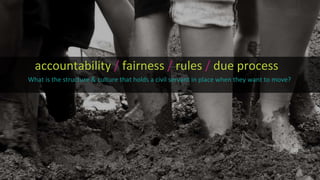
accountability / fairness / rules / due process
What is the structure & culture that holds a civil servant in place when they want to move?
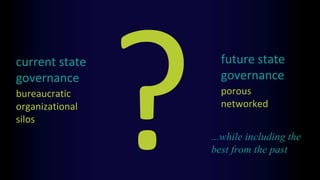
current state
governance
future state
governance
bureaucratic
organizational
silos
porous
networked
...while including the
best from the past
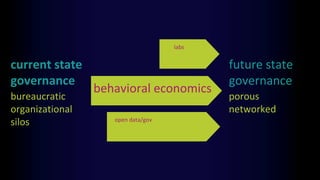
current state
governance
future state
governance
bureaucratic
organizational
silos
porous
networked
behavioral economics
open data/gov
labs
That senior decision makers are willing to invest a little bit of money... and time...
is a symptom that they recognize the current governance model is not good
enough. It can be improved, reinvented.
Public managers need an ongoing process of questioning problems and
approaches that’s not just about radical new ideas, but about questioning the
current limits to implementing innovation.
challenging the status quo...
synthesis from our interview with Christian Bason
...with labs
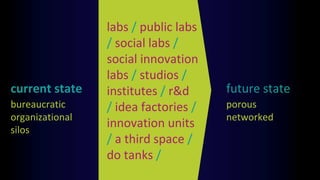
current state future state
bureaucratic
organizational
silos
porous
networked
labs / public labs
/ social labs /
social innovation
labs / studios /
institutes / r&d
/ idea factories /
innovation units
/ a third space /
do tanks /
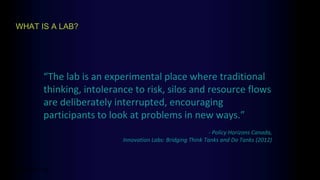
WHAT IS A LAB?
think > do
“The lab is an experimental place where traditional
thinking, intolerance to risk, silos and resource flows
are deliberately interrupted, encouraging
participants to look at problems in new ways.”
- Policy Horizons Canada,
Innovation Labs: Bridging Think Tanks and Do Tanks (2012)
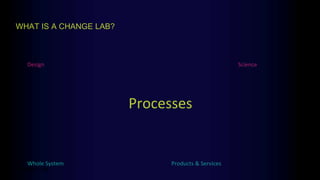
Processes
WHAT IS A CHANGE LAB?
think > do
Whole System Products & Services
Design Science
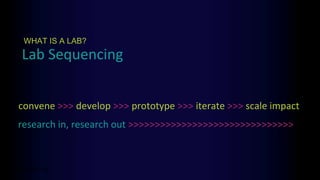
convene >>> develop >>> prototype >>> iterate >>> scale impact
Lab Sequencing
WHAT IS A LAB?
think > do
research in, research out >>>>>>>>>>>>>>>>>>>>>>>>>>>>>>>
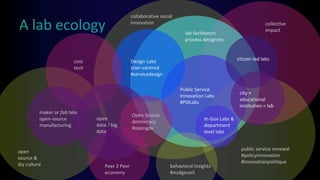
A lab ecology
collaborative social
innovation
open
source &
diy culture Peer 2 Peer
economy
collective
impact
civic
tech
In-Gov Labs &
department
level labs
open
data / big
data
Public Service
Innovation Labs
#PSILabs
citizen-led labs
public service renewal
#policyinnovation
#innovationpolitique
lab facilitators
process designers
Design Labs
User-centred
#servicedesign
Open Source
democracy
#opengov
city +
educational
institution = lab
behavioral insights
#nudgeunit
maker or fab labs
open-source
manufacturing
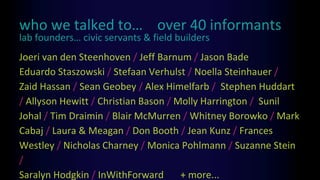
who we talked to… over 40 informants
Joeri van den Steenhoven / Jeff Barnum / Jason Bade
Eduardo Staszowski / Stefaan Verhulst / Noella Steinhauer /
Zaid Hassan / Sean Geobey / Alex Himelfarb / Stephen Huddart
/ Allyson Hewitt / Christian Bason / Molly Harrington / Sunil
Johal / Tim Draimin / Blair McMurren / Whitney Borowko / Mark
Cabaj / Laura & Meagan / Don Booth / Jean Kunz / Frances
Westley / Nicholas Charney / Monica Pohlmann / Suzanne Stein
/
Saralyn Hodgkin / InWithForward + more...
lab founders… civic servants & field builders
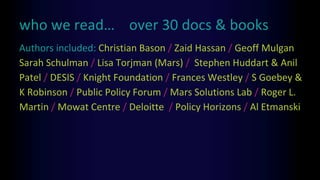
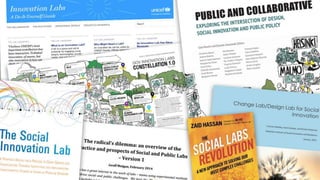
who we read… over 30 docs & books
Authors included: Christian Bason / Zaid Hassan / Geoff Mulgan
Sarah Schulman / Lisa Torjman (Mars) / Stephen Huddart & Anil
Patel / DESIS / Knight Foundation / Frances Westley / S Goebey &
K Robinson / Public Policy Forum / Mars Solutions Lab / Roger L.
Martin / Mowat Centre / Deloitte / Policy Horizons / Al Etmanski
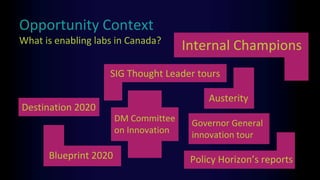
Opportunity Context
What is enabling labs in Canada?
SIG Thought Leader tours
Policy Horizon’s reports
DM Committee
on Innovation
Austerity
Blueprint 2020
Governor General
innovation tour
Destination 2020
Internal Champions
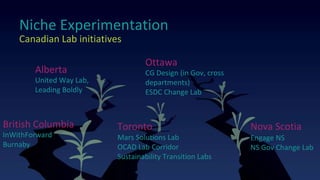
Niche Experimentation
Alberta
Canadian Lab initiatives
Ottawa
Nova Scotia
CG Design (in Gov, cross
departments)
ESDC Change Lab
Engage NS
NS Gov Change Lab
United Way Lab,
Leading Boldly
Toronto
Mars Solutions Lab
OCAD Lab Corridor
Sustainability Transition Labs
British Columbia
InWithForward
Burnaby
Knowledge Products
Capitalizing on opportunities by increasing salience
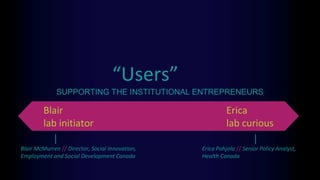
“Users”
Erica
lab curious
SUPPORTING THE INSTITUTIONAL ENTREPRENEURS
Blair
lab initiator
Blair McMurren // Director, Social Innovation,
Employment and Social Development Canada
Erica Pohjola // Senior Policy Analyst,
Health Canada
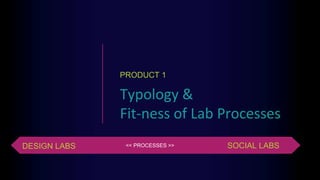
Typology &
Fit-ness of Lab Processes
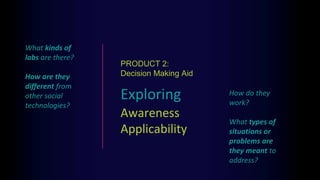
PRODUCT 1
DESIGN LABS SOCIAL LABS<< PROCESSES >>
Exploring
Awareness
Applicability
PRODUCT 2:
Decision Making Aid
What kinds of
labs are there?
How are they
different from
other social
technologies?
How do they
work?
What types of
situations or
problems are
they meant to
address?
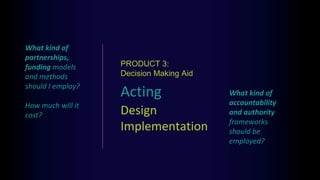
Acting
Design
Implementation
PRODUCT 3:
Decision Making Aid
What kind of
partnerships,
funding models
and methods
should I employ?
How much will it
cost?
What kind of
accountability
and authority
frameworks
should be
employed?
Implementation
Getting the Screwdriver into the Hands of the Builders
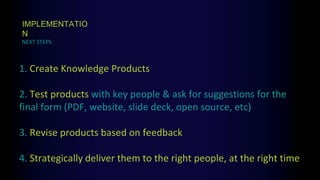
1. Create Knowledge Products
2. Test products with key people & ask for suggestions for the
final form (PDF, website, slide deck, open source, etc)
3. Revise products based on feedback
4. Strategically deliver them to the right people, at the right time
NEXT STEPS
IMPLEMENTATIO
N
CHANGE LABS / Taking Bold Risks, but not Alone
THANK YOU

Change Labs: Taking Bold Risks, But not Alone

  • 1.
    CHANGE LABS Taking BoldRisks, but not Alone
  • 2.
    TEAM / Derek Alton. alton.derek@gmail.com Lisa Joy Trick . lisajoytrick@gmail.com Jonathan Glencross . jonathan.glencross@gmail.com Mike Klassen . mike.dw.klassen@gmail.com
  • 3.
    credit: Jeff Barnum- jeffbarnum.com/visual/power-and-love
  • 4.
  • 5.
    Gov as a… leader/ enabler/ convener / co-creator
  • 6.
    How can Canadiangovernments retain the strengths of traditional, risk-averse, consistent institutions... ...innovative, collaborative, and dynamic, finding new approaches to move the needle on the complex, system level problems we face? while becoming...
  • 7.
    "I understand you'reconcerned about risk. There’s a giant Mack truck coming your way. It’s a big risk if you keep standing here. I have a tool, that will tell you which side of the fucking street to run to."
  • 9.
    accountability / fairness/ rules / due process What is the structure & culture that holds a civil servant in place when they want to move?
  • 10.
  • 11.
  • 12.
    That senior decisionmakers are willing to invest a little bit of money... and time... is a symptom that they recognize the current governance model is not good enough. It can be improved, reinvented. Public managers need an ongoing process of questioning problems and approaches that’s not just about radical new ideas, but about questioning the current limits to implementing innovation. challenging the status quo... synthesis from our interview with Christian Bason ...with labs
  • 13.
    current state futurestate bureaucratic organizational silos porous networked labs / public labs / social labs / social innovation labs / studios / institutes / r&d / idea factories / innovation units / a third space / do tanks /
  • 14.
    WHAT IS ALAB? think > do “The lab is an experimental place where traditional thinking, intolerance to risk, silos and resource flows are deliberately interrupted, encouraging participants to look at problems in new ways.” - Policy Horizons Canada, Innovation Labs: Bridging Think Tanks and Do Tanks (2012)
  • 15.
    Processes WHAT IS ACHANGE LAB? think > do Whole System Products & Services Design Science
  • 16.
    convene >>> develop>>> prototype >>> iterate >>> scale impact Lab Sequencing WHAT IS A LAB? think > do research in, research out >>>>>>>>>>>>>>>>>>>>>>>>>>>>>>>
  • 17.
    A lab ecology collaborativesocial innovation open source & diy culture Peer 2 Peer economy collective impact civic tech In-Gov Labs & department level labs open data / big data Public Service Innovation Labs #PSILabs citizen-led labs public service renewal #policyinnovation #innovationpolitique lab facilitators process designers Design Labs User-centred #servicedesign Open Source democracy #opengov city + educational institution = lab behavioral insights #nudgeunit maker or fab labs open-source manufacturing
  • 18.
    who we talkedto… over 40 informants Joeri van den Steenhoven / Jeff Barnum / Jason Bade Eduardo Staszowski / Stefaan Verhulst / Noella Steinhauer / Zaid Hassan / Sean Geobey / Alex Himelfarb / Stephen Huddart / Allyson Hewitt / Christian Bason / Molly Harrington / Sunil Johal / Tim Draimin / Blair McMurren / Whitney Borowko / Mark Cabaj / Laura & Meagan / Don Booth / Jean Kunz / Frances Westley / Nicholas Charney / Monica Pohlmann / Suzanne Stein / Saralyn Hodgkin / InWithForward + more... lab founders… civic servants & field builders
  • 19.
    who we read…over 30 docs & books Authors included: Christian Bason / Zaid Hassan / Geoff Mulgan Sarah Schulman / Lisa Torjman (Mars) / Stephen Huddart & Anil Patel / DESIS / Knight Foundation / Frances Westley / S Goebey & K Robinson / Public Policy Forum / Mars Solutions Lab / Roger L. Martin / Mowat Centre / Deloitte / Policy Horizons / Al Etmanski
  • 20.
    Opportunity Context What isenabling labs in Canada? SIG Thought Leader tours Policy Horizon’s reports DM Committee on Innovation Austerity Blueprint 2020 Governor General innovation tour Destination 2020 Internal Champions
  • 21.
    Niche Experimentation Alberta Canadian Labinitiatives Ottawa Nova Scotia CG Design (in Gov, cross departments) ESDC Change Lab Engage NS NS Gov Change Lab United Way Lab, Leading Boldly Toronto Mars Solutions Lab OCAD Lab Corridor Sustainability Transition Labs British Columbia InWithForward Burnaby
  • 22.
    Knowledge Products Capitalizing onopportunities by increasing salience
  • 23.
    “Users” Erica lab curious SUPPORTING THEINSTITUTIONAL ENTREPRENEURS Blair lab initiator Blair McMurren // Director, Social Innovation, Employment and Social Development Canada Erica Pohjola // Senior Policy Analyst, Health Canada
  • 25.
    Typology & Fit-ness ofLab Processes PRODUCT 1 DESIGN LABS SOCIAL LABS<< PROCESSES >>
  • 26.
    Exploring Awareness Applicability PRODUCT 2: Decision MakingAid What kinds of labs are there? How are they different from other social technologies? How do they work? What types of situations or problems are they meant to address?
  • 27.
    Acting Design Implementation PRODUCT 3: Decision MakingAid What kind of partnerships, funding models and methods should I employ? How much will it cost? What kind of accountability and authority frameworks should be employed?
  • 28.
    Implementation Getting the Screwdriverinto the Hands of the Builders
  • 29.
    1. Create KnowledgeProducts 2. Test products with key people & ask for suggestions for the final form (PDF, website, slide deck, open source, etc) 3. Revise products based on feedback 4. Strategically deliver them to the right people, at the right time NEXT STEPS IMPLEMENTATIO N
  • 30.
    CHANGE LABS /Taking Bold Risks, but not Alone THANK YOU

Editor's Notes

  • #2 JON
  • #3 JON
  • #4 Presenter: JON - be open, what does it do for you? Adam K. Power & Love - ”what do we do with this?”
  • #5 Presenter: ERICA
  • #6 Presenter: ERICA
  • #7 Presenter: ERICA later... Lisa: insert horns graphic finesse it, make it easier
  • #8 Presenter: ERICA
  • #9 Presenter: ERICA problems: Climate change; aging population (health, pension, hospice); housing/transit Illustration of mack truck and bureaucrat in the cement… but it’s not just gonna hit you… it’s going to hit everyone truck graphic - not solving wicked problems can’t flex the budget, adapt, Don Booth quote
  • #10 1) Civic Servants - Stuck in the cement.... accountability, fairness, following rules and process… hard to be flexible. Structure and culture hold you in place even when you want to get outta the way built for situation vehicle
  • #11 Presenter: ERICA arrows/bridges animate in This is the bridge - casting a large net shifting the form of government
  • #12 Presenter: MIKE arrows/bridges animate in bridges: clusters of innovations shifting the form of government ...alternative innovations/options we considered. Two driving criteria: do they brdige us towards a new form of governance? do they address roots of complex/wicked problems?
  • #13 a lab process is built for a specific situation or challenge, helping you move forward on complex problems.
  • #14 Presenter: MIKE This is the bridge - casting a large net KEY POINT: if we are talking about an experimental space where tradiational thinking, silos, are deliberately interrupted - it can take many different forms! And everyone has a different name for it; and they are all unique. “A lab by any other name would smell as sweet”
  • #16 Pink: paradigms Blue: applications
  • #17 Traditional social technologies fail utterly on complex problems. How is a workshop going to influence climate change? Labs use a suite of carefully sequenced processes, to lead groups of people through a journey that changes their thinking… examples of some of the Convene: bring together stakeholders from different sectors, include end users. Develop: use design thinking, user journeys to deeply understand what is being experienced Prototype: be willing to take a half-formed idea, and test it before investing large resources Iteration: try, fail, change, repeat. KEY POINT: labs can very significantly in which phases they include - sometimes because of the expertise of their team/organization; sometimes because of the nature of the problem they are trying to solve. Quote from Joeri… trying to fiddle with the wires that drive/underly wicked problems.
  • #18 Presenter: MIKE Clean it up - make “labs” highlighed - adjacent possibles - interconnectivity, overlapping “doorways” - stepping stones, Our place: “we’re just here observing what’s happening” - Supply of skills - The potential for “social labs” increases with couple with other new fields - with the new generation of maker labs - creating an ecology
  • #19 Presenter: MIKE So what did we actually do? We asked the system “what’s going on here, and how can we enable/help?” First set: talk to the directors of labs themselves: Joeri, Jeff, Eduardo, Stefaan, Zaid, Christian… start to understand how they differ, how they work, why they are the way they are. Next set: talk to the ‘field builders’ within Canada - people like Frances, Allyson, Tim Draiman, Stephen Huddart - to get a pulse on where there is possibility in Canada. Third, most exciting set: ‘internal champions within government’ who are actively pursuing labs in their departments or ministries. Who we’ve talked to and how we’ve come to the understanding Checking knowledge gap, iterated
  • #20 Presenter: MIKE Who we’ve talked to and how we’ve come to the understanding Inteview
  • #21 Presenter: MIKE pink > clear opportunities (fractal image of allison replicated) blue > ?? opportunities (they are being framed that way at least) NOW: This is the TIME: the field is exploding, good timing, word is being co-opted? its a good time to create an interventions _ _ _ note for later: Our exploration of the labs space, a 2 (3 including field builders) pronged approach. Our assumptions about what we might learn/discover were ‘talk to experts and learn about what they’re doing’… but as we went we found out… ‘right here, right now there is major momentum in Canada’
  • #22 Presenter: JON
  • #23 Presenter: JON Products connect information - making it salient, framing it. * discuss the strategy to distribute these to the right people at the right time in the right way
  • #24 Presenter: JON Spectrum of Users/Audience - how
  • #25 Current stuff is long (books and LONG reports) Need brief, visual, updated - easily customized to their purposes (open source, multiple forms)
  • #26 Product #3: Typology + Fitness of labs
  • #27 A practical tool that helps people in government clarify their thinking and decisions about labs. It will focus on the kinds of questions civil servants are already asking. It will speak to the spectrum of awareness from those who are just starting to think about labs (I have heard about labs--what are they? Are they right for me? How would I know?) all the way through to those ready to implement (I am ready to implement a lab--how do I do it? What kind of people do I need? Will it work at my scale? What factors do I need to consider?) It will provide concise information to aid decision-making, as well as hyperlinks to resources for those seeking more detail. Phase 1: Awareness What is a lab? (various definitions that people are currently working with) What kinds of labs are there? How are they different from other social technologies? Phase 2: Applicability How do labs work? How do they relate to my work? Who do they involve? What types of situations or problems are they meant to address?
  • #28 Phase 3: Design What kind of lab is right for me? What domain or problem should the lab focus on? What kind of partnerships, funding models and methods should I employ? How much will it cost? How much staff does it require? Phase 4: Implementation How will it fit with existing institutional policy and decision making landscape? What kind of accountability and authority frameworks should be employed?
  • #31 JON