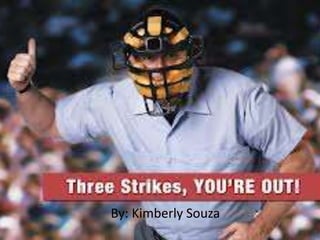
By: Kimberly Souza
Origin of the Law
• The, “Three Strikes You’re Out” law was
  founded in 1993 by Gov. Pete Wilson (R-CA),
  after the abduction and murder of 12 year old,
  Polly Klaas.
• The law imposes life sentences for criminals
  convicted of 3 crimes, with the last strike
  typically being violent or serious felonies.
• Once Gov. Wilson initiated the law, other
  states started to follow.
Imprisonment
• The USA has the highest rate of imprisonment
  of any major nation.
• Even without 3 strikes legislation, California is
  already the nation’s biggest jailer, with 1 out
  of 8 prisoners occupying its cells.
• The 3 next largest state prison systems, New
  York, Texas, and Florida, experienced only half
  the growth of California.
Mandatory Sentencing?
• Before 1977, California had a system of
  indeterminate prison sentencing for felony
  offenders.
• Felonies such as: Second-Degree Murder, Rape,
  Robbery, and Kidnapping, a convict may receive
  a sentence of 1-25 years, or even 1 year, to life.
• Objective: To tailor sentences to behavior, to
  confine the most dangerous convicts longer, and
  to provide incentives for self-improvement.
Prison Population

• The federal prison population, through
  mandated and determinate sentences, has
  tripled in the past decade
• Under current policy, it will rise by 50% by the
  century’s turn, with drug offenders accounting
  for 60% of the additional prisoners.
• Out of 90,000 federal prison inmates, 1/5 are
  low-level drug offenders with no current or prior
  violence, or previous prison time.
Pros and Cons

PROS:
• 3 Strikes Law keeps recidivist criminals off the
  streets for longer periods, preventing them
  from committing additional crimes, and
  harming society.
• Most of the crime nowadays is committed by
  repeat offenders, the 3 Strikes Law is a way to
  ensure justice is done, even if the system,
  otherwise fails miserably.
Pros and Cons
CONS:
• The law adds more criminals, to an already crowded
  and expensive prison system (it is expensive to keep a
  person in jail for life, prisons are overflowing from the
  massive growth in their populations, adding more
  prisoners, some, who don’t deserve to be there.)
• An arrest of someone with two convictions, almost
  guarantees the cost and time of a trial; if a two-time
  convicted felon is once again arrested, it’s pretty much
  guaranteed he will push for a trial, this will only add
  more time and expense to an already over burdened
  court system.
Solutions!
• According to “The F.A.C.T.S Organization,” (Families to
  Amend California’s 3 Strikes) The most effective way
  to reduce the severity of the 3 Strikes Law is to get a
  proposition to amend the law on a California ballot.
  Annette Summers of F.A.C.T.S informed us that the
  most effective way to go about doing this is to make
  sure that the proposition is on the ballot during the
  vote for Governor or Senator. This way, more voters
  will turn out, and there is a better chance of it
  passing. The proposition to amend the 3 Strikes Law
  would include: policies that would allow strikers to be
  given another chance. The governmental
  organization F.A.C.T.S. has many proposals that would
  improve the current 3 Strikes Law.
More Solutions
• The F.A.C.T.S Organization wants to make sure that
  felons don’t acquire a second or third strike for any
  crime that is not serious or violent in strikers that
  have been sentenced to 25 years to life in prison
  under the 3 Strikes Law for non-violent, or non-
  serious crimes are not re-tried under the
  circumstances of the amended 3 Strikes Law.
• Only crimes committed after the law was passed in
  1994 should be counted as strikes. Offenses
  acquired, as a juvenile, should not be able to count
  as a strike. Convictions older than 10 years should
  expire, this would be called a, “Wash-out.” These are
  the most effective measures that need to be taken in
  order for the 3 Strikes Law to be fair to strikers.
This presentation
is dedicated to my
   brother Richie
       Peña.
Soci. 102 final presentation

Soci. 102 final presentation

  • 1.
  • 2.
    Origin of theLaw • The, “Three Strikes You’re Out” law was founded in 1993 by Gov. Pete Wilson (R-CA), after the abduction and murder of 12 year old, Polly Klaas. • The law imposes life sentences for criminals convicted of 3 crimes, with the last strike typically being violent or serious felonies. • Once Gov. Wilson initiated the law, other states started to follow.
  • 3.
    Imprisonment • The USAhas the highest rate of imprisonment of any major nation. • Even without 3 strikes legislation, California is already the nation’s biggest jailer, with 1 out of 8 prisoners occupying its cells. • The 3 next largest state prison systems, New York, Texas, and Florida, experienced only half the growth of California.
  • 4.
    Mandatory Sentencing? • Before1977, California had a system of indeterminate prison sentencing for felony offenders. • Felonies such as: Second-Degree Murder, Rape, Robbery, and Kidnapping, a convict may receive a sentence of 1-25 years, or even 1 year, to life. • Objective: To tailor sentences to behavior, to confine the most dangerous convicts longer, and to provide incentives for self-improvement.
  • 5.
    Prison Population • Thefederal prison population, through mandated and determinate sentences, has tripled in the past decade • Under current policy, it will rise by 50% by the century’s turn, with drug offenders accounting for 60% of the additional prisoners. • Out of 90,000 federal prison inmates, 1/5 are low-level drug offenders with no current or prior violence, or previous prison time.
  • 9.
    Pros and Cons PROS: •3 Strikes Law keeps recidivist criminals off the streets for longer periods, preventing them from committing additional crimes, and harming society. • Most of the crime nowadays is committed by repeat offenders, the 3 Strikes Law is a way to ensure justice is done, even if the system, otherwise fails miserably.
  • 10.
    Pros and Cons CONS: •The law adds more criminals, to an already crowded and expensive prison system (it is expensive to keep a person in jail for life, prisons are overflowing from the massive growth in their populations, adding more prisoners, some, who don’t deserve to be there.) • An arrest of someone with two convictions, almost guarantees the cost and time of a trial; if a two-time convicted felon is once again arrested, it’s pretty much guaranteed he will push for a trial, this will only add more time and expense to an already over burdened court system.
  • 11.
  • 12.
    • According to“The F.A.C.T.S Organization,” (Families to Amend California’s 3 Strikes) The most effective way to reduce the severity of the 3 Strikes Law is to get a proposition to amend the law on a California ballot. Annette Summers of F.A.C.T.S informed us that the most effective way to go about doing this is to make sure that the proposition is on the ballot during the vote for Governor or Senator. This way, more voters will turn out, and there is a better chance of it passing. The proposition to amend the 3 Strikes Law would include: policies that would allow strikers to be given another chance. The governmental organization F.A.C.T.S. has many proposals that would improve the current 3 Strikes Law.
  • 13.
    More Solutions • TheF.A.C.T.S Organization wants to make sure that felons don’t acquire a second or third strike for any crime that is not serious or violent in strikers that have been sentenced to 25 years to life in prison under the 3 Strikes Law for non-violent, or non- serious crimes are not re-tried under the circumstances of the amended 3 Strikes Law. • Only crimes committed after the law was passed in 1994 should be counted as strikes. Offenses acquired, as a juvenile, should not be able to count as a strike. Convictions older than 10 years should expire, this would be called a, “Wash-out.” These are the most effective measures that need to be taken in order for the 3 Strikes Law to be fair to strikers.
  • 14.
    This presentation is dedicatedto my brother Richie Peña.