WWW.AMERICANPROGRESS.ORG 
One Strike and You’re Out 
How We Can Eliminate Barriers to Economic Security and Mobility 
for People with Criminal Records 
By Rebecca Vallas and Sharon Dietrich December 2014
One Strike and You’re Out 
How We Can Eliminate Barriers to Economic Security 
and Mobility for People with Criminal Records 
By Rebecca Vallas and Sharon Dietrich December 2014
1 Introduction and summary 
4 Background 
9 Barriers to employment 
16 Barriers to housing 
22 Barriers to public assistance 
26 Barriers to education and training 
29 Barriers to economic security and financial empowerment 
34 Recommendations 
49 Conclusion 
51 Appendix A 
65 Appendix B 
67 About the authors & acknowledgments 
68 Endnotes 
Contents
1 Center for American Progress | One Strike and You’re Out 
Introduction and summary 
Between 70 million and 100 million Americans—or as many as one in three— 
have a criminal record.1 Many have only minor offenses, such as misdemeanors and 
nonserious infractions; others have only arrests without conviction. Nonetheless, 
because of the rise of technology and the ease of accessing data via the Internet— 
in conjunction with federal and state policy decisions—having even a minor 
criminal history now carries lifelong barriers that can block successful re-entry 
and participation in society. This has broad implications—not only for the 
millions of individuals who are prevented from moving on with their lives and 
becoming productive citizens but also for their families, communities, and the 
national economy. 
Today, a criminal record serves as both a direct cause and consequence of poverty. 
It is a cause because having a criminal record can present obstacles to employment, 
housing, public assistance, education, family reunification, and more; convictions 
can result in monetary debts as well. It is a consequence due to the growing 
criminalization of poverty and homelessness. One recent study finds that our nation’s 
poverty rate would have dropped by 20 percent between 1980 and 2004 if not for 
mass incarceration and the subsequent criminal records that haunt people for 
years after they have paid their debt to society.2 Failure to address this link as part 
of a larger anti-poverty agenda risks missing a major piece of the puzzle. 
It is important to note that communities of color—and particularly men of color— 
are disproportionately affected, and high-poverty, disadvantaged communities 
generate a disproportionate share of Americans behind bars. As Michelle Alexander 
argues in her book The New Jim Crow, mass incarceration and its direct and collateral 
consequences have effectively replaced intentional racism as a form of 21st century 
structural racism.3 Indeed, research shows that mass incarceration and its effects 
have been significant drivers of racial inequality in the United States, particularly 
during the past three to four decades.4
2 Center for American Progress | One Strike and You’re Out 
Moreover, the challenges associated with having a criminal record come at great 
cost to the U.S. economy. Estimates put the cost of employment losses among 
people with criminal records at as much as $65 billion per year in terms of gross 
domestic product.5 That’s in addition to our nation’s skyrocketing expenditures for 
mass incarceration, which today total more than $80 billion annually.6 
The lifelong consequences of having a criminal record—and the stigma that 
accompanies one—stand in stark contrast to research on “redemption” that 
documents that once an individual with a prior nonviolent conviction has stayed 
crime free for three to four years, that person’s risk of recidivism is no different from 
the risk of arrest for the general population.7 Put differently, people are treated as 
criminals long after they pose any significant risk of committing further crimes— 
making it difficult for many to move on with their lives and achieve basic economic 
security, let alone have a shot at upward mobility. 
The United States must therefore craft policies to ensure that Americans with 
criminal records have a fair shot at making a decent living, providing for their 
families, and joining the middle class. This will benefit not only the tens of millions 
of individuals who face closed doors due to a criminal record but also their families, 
their communities, and the economy as a whole. 
President Barack Obama’s administration has been a leader on this important issue. 
For example, the Bureau of Justice Administration’s Justice Reinvestment Initiative 
has assisted states and cities across the country in reducing correctional spending 
and reinvesting the savings in strategies to support re-entry and reduce recidivism.8 
The Federal Interagency Reentry Council, established in 2011 by Attorney General 
Eric Holder, has brought 20 federal agencies together to coordinate and advance 
effective re-entry policies.9 And the president’s My Brother’s Keeper initiative has 
charged communities across the country with implementing strategies to close 
opportunity gaps for boys and young men of color and to ensure that “all young 
people … can reach their full potential, regardless of who are they are, where they 
come from, or the circumstances into which they are born.”10 Additionally, states 
and cities across the country have enacted policies to alleviate the barriers associated 
with having a criminal history. 
While these are positive steps, further action is needed at all levels of government. 
This report offers a road map for the administration and federal agencies, Congress, 
states and localities, employers, and colleges and universities to ensure that a criminal 
record no longer presents an intractable barrier to economic security and mobility.
3 Center for American Progress | One Strike and You’re Out 
Bipartisan momentum for criminal justice reform is growing, due in part to the 
enormous costs of mass incarceration, as well as an increased focus on evidence-based 
approaches to public safety. Policymakers and opinion leaders of all political 
stripes are calling for sentencing and prison reform, as well as policies that give 
people a second chance. Now is the time to find common ground and enact 
meaningful solutions to ensure that a criminal record does not consign an individual 
to a life of poverty.
4 Center for American Progress | One Strike and You’re Out 
Background 
The past four decades have seen an explosion in our nation’s prison population. 
Today, the United States incarcerates more of its citizens than any other country in 
the world.11 
The rise of mass incarceration and hyper-criminalization 
Currently, more than 1.5 million Americans are incarcerated in state and federal 
prisons, a figure that has quintupled since 1980.12 Adding in jails, the number of 
Americans who are behind bars rises to 2.2 million. The U.S. incarceration rate is 
more than six times the Organisation for Economic Co-Operation and 
Development average.13 
FIGURE 1 
Rise of mass incarceration 
The number of Americans behind bars in federal and state prisons has quintupled 
since 1980 
Source: Source: Analysis of Bureau of Justice Statistics data by The Sentencing Project, “Trends in U.S. Corrections” (2013), available at 
http://sentencingproject.org/doc/publications/inc_Trends_in_Corrections_Fact_sheet.pdf. 
0 
1925 1950 1975 2000 
1,000,000 
400,000 
1,400,000 
800,000 
200,000 
1,200,000 
600,000 
1,600,000 
2013 
1,574,700
5 Center for American Progress | One Strike and You’re Out 
In addition to leading the world in incarceration, the United States is also the global 
leader in arrests.14 Between 25 percent and 40 percent of American adults have been 
arrested by age 23.15 Men—and particularly men of color—are at particular risk: 
49 percent of black men and 44 percent of Hispanic men have been arrested by 
age 23.16 And the Federal Bureau of Investigation, or FBI, estimates that U.S. law 
enforcement has made more than one-quarter of a billion arrests in the past 20 years.17 
Many arrests never lead to conviction; for example, just half—and in some years, 
fewer than half—of adult misdemeanor arrests made in New York City from 2009 
to 2013 resulted in conviction.18 
Thus, a more apt phrase might be hyper-criminalization—given that many 
individuals who come into contact with the criminal justice system end up with 
criminal records without doing any time in prison, either through arrest without 
conviction or sentences for probation or other forms of community supervision. 
Changes in sentencing laws and policy, not crime rates, drove this rise in mass 
incarceration and hyper-criminalization. Federal policies such as the Sentencing 
Reform Act of 1984 and state policies such as three-strikes laws were significant 
drivers. Sentencing policies with their roots in the War on Drugs—such as harsh, 
mandatory minimum sentences—also played a major role.19 
The impact on communities of color is particularly staggering. People of color make 
up more than 60 percent of the population behind bars.20 Black men are incarcerated 
at a rate six times higher than that of white men, and Latino men at a rate 2.5 times 
higher than that of white men.21 A black man in his 20s or 30s is more likely to be 
in jail or prison than employed; on any given day, 10 percent of black men in their 
30s are incarcerated.22 
Lesbian, gay, bisexual, and transgender, or LGBT, individuals and people living 
with HIV are also disproportionately affected by mass incarceration and hyper-criminalization. 
According to recent survey data, 5 percent report having been 
incarcerated, and 73 percent report having come into face-to-face contact with the 
police during the previous five years.23 
Mass incarceration and hyper-criminalization have come at tremendous cost to 
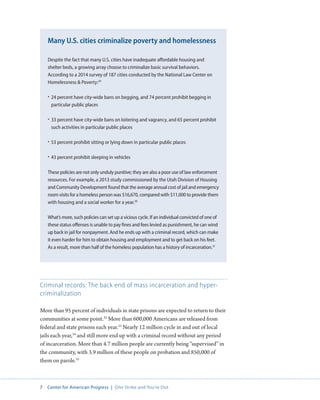
the American taxpayer. Total expenditures on corrections at the federal, state, and 
local levels exceeded $80 billion in 2010—a 350 percent increase over the past 30 
years in real terms.24 When combined with other crime-related expenditures— 
such as policing, legal, and judicial services—total spending rises to more than 
$260 billion annually.25 The lion’s share of these expenditures falls at the state and 
local levels, placing great fiscal burdens on states.
6 Center for American Progress | One Strike and You’re Out 
These trends have profound implications for families and society as well—so much 
so that in 2013, “Sesame Street” added a character with an incarcerated father.26 
More than half of adult inmates are parents of minor children: 2.6 million, or 1 in 
25 American children, had a parent in prison in 2012, up from 350,000 in 1980.27 
And more than one in four African American children born in 1990 have had a 
parent incarcerated during their childhood.28 
FIGURE 2 
Rising costs and a net loss 
Correctional expenditures have quadrupled over the past three decades 
* Employment losses due to criminal records resulted in as much as $65 billion in lost gross domestic product output in 2008. 
Sources: Author’s calculations are based on Bureau of the Census, Annual Survey of State Government Finances (U.S. Department of 
Commerce, 1982–2012), available at https://www.census.gov/govs/state/historical_data.html; Tracey Kyckelhahn, “State Corrections 
Expenditures, FY 1982-2010” (Washington: Bureau of Justice Statistics, 2014), available at http://www.bjs.gov/content/pub/pdf/sce-fy8210. 
pdf; Nathan James, “The Bureau of Prisons (BOP): Operations and Budget” (Washington: Congressional Research Service, 2014), 
available at http://fas.org/sgp/crs/misc/R42486.pdf. John Schmitt and Kris Warner, “Ex-oenders and the Labor Market” (Washington: 
Center for Economic and Policy Research, 2010), available at http://www.cepr.net/documents/publications/ex-oenders-2010-11.pdf. 
0 1990 2000 2010 
10 
20 
30 
40 
50 
60 
1982 
$15.86 
1982 
$1.02 
2012 
$48.44 
2012 
$6.64 
State 
Federal 
State and federal expenditures (in billions of dollars) 
GDP loss 
annually: 
$65 billion*
7 Center for American Progress | One Strike and You’re Out 
Criminal records: The back end of mass incarceration and hyper-criminalization 
More than 95 percent of individuals in state prisons are expected to return to their 
communities at some point.32 More than 600,000 Americans are released from 
federal and state prisons each year.33 Nearly 12 million cycle in and out of local 
jails each year,34 and still more end up with a criminal record without any period 
of incarceration. More than 4.7 million people are currently being “supervised” in 
the community, with 3.9 million of these people on probation and 850,000 of 
them on parole.35 
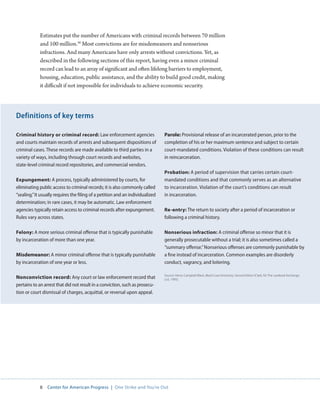
Despite the fact that many U.S. cities have inadequate affordable housing and 
shelter beds, a growing array choose to criminalize basic survival behaviors. 
According to a 2014 survey of 187 cities conducted by the National Law Center on 
Homelessness  Poverty:29 
• 24 percent have city-wide bans on begging, and 74 percent prohibit begging in 
particular public places 
• 33 percent have city-wide bans on loitering and vagrancy, and 65 percent prohibit 
such activities in particular public places 
• 53 percent prohibit sitting or lying down in particular public places 
• 43 percent prohibit sleeping in vehicles 
These policies are not only unduly punitive; they are also a poor use of law enforcement 
resources. For example, a 2013 study commissioned by the Utah Division of Housing 
and Community Development found that the average annual cost of jail and emergency 
room visits for a homeless person was $16,670, compared with $11,000 to provide them 
with housing and a social worker for a year.30 
What’s more, such policies can set up a vicious cycle. If an individual convicted of one of 
these status offenses is unable to pay fines and fees levied as punishment, he can wind 
up back in jail for nonpayment. And he ends up with a criminal record, which can make 
it even harder for him to obtain housing and employment and to get back on his feet. 
As a result, more than half of the homeless population has a history of incarceration.31 
Many U.S. cities criminalize poverty and homelessness
8 Center for American Progress | One Strike and You’re Out 
Criminal history or criminal record: Law enforcement agencies 
and courts maintain records of arrests and subsequent dispositions of 
criminal cases. These records are made available to third parties in a 
variety of ways, including through court records and websites, 
state-level criminal record repositories, and commercial vendors. 
Expungement: A process, typically administered by courts, for 
eliminating public access to criminal records; it is also commonly called 
“sealing.” It usually requires the filing of a petition and an individualized 
determination; in rare cases, it may be automatic. Law enforcement 
agencies typically retain access to criminal records after expungement. 
Rules vary across states. 
Felony: A more serious criminal offense that is typically punishable 
by incarceration of more than one year. 
Misdemeanor: A minor criminal offense that is typically punishable 
by incarceration of one year or less. 
Nonconviction record: Any court or law enforcement record that 
pertains to an arrest that did not result in a conviction, such as prosecu-tion 
or court dismissal of charges, acquittal, or reversal upon appeal. 
Parole: Provisional release of an incarcerated person, prior to the 
completion of his or her maximum sentence and subject to certain 
court-mandated conditions. Violation of these conditions can result 
in reincarceration. 
Probation: A period of supervision that carries certain court-mandated 
conditions and that commonly serves as an alternative 
to incarceration. Violation of the court’s conditions can result 
in incarceration. 
Re-entry: The return to society after a period of incarceration or 
following a criminal history. 
Nonserious infraction: A criminal offense so minor that it is 
generally prosecutable without a trial; it is also sometimes called a 
“summary offense.” Nonserious offenses are commonly punishable by 
a fine instead of incarceration. Common examples are disorderly 
conduct, vagrancy, and loitering. 
Source: Henry Campbell Black, Black’s Law Dictionary: Second Edition (Clark, NJ: The Lawbook Exchange, 
Ltd., 1995). 
Definitions of key terms 
Estimates put the number of Americans with criminal records between 70 million 
and 100 million.36 Most convictions are for misdemeanors and nonserious 
infractions. And many Americans have only arrests without convictions. Yet, as 
described in the following sections of this report, having even a minor criminal 
record can lead to an array of significant and often lifelong barriers to employment, 
housing, education, public assistance, and the ability to build good credit, making 
it difficult if not impossible for individuals to achieve economic security.
9 Center for American Progress | One Strike and You’re Out 
Barriers to employment 
A generation ago, access to the criminal record information of job applicants was 
unusual. Today, however, background checks are ubiquitous: An estimated 87 
percent of employers conduct criminal background checks on their applicants.37 
As a result, criminal records have become an intractable barrier to employment for 
tens of millions of Americans. 
“Since the time of my conviction, I have come to realize that one wrong decision can 
cause a lifetime of pain. I realize that society is not as forgiving and that because of 
my actions, I am not able to utilize the educational knowledge that I have gained … 
I have applied for and been offered many prominent job opportunities. However, 
when my criminal background comes back, I lose the chance and nothing I can say 
will make any difference.” — Ronald Lewis, Philadelphia, Pennsylvania38 
Employer rejections of people with criminal records cause deep 
and widespread joblessness and poverty 
A recent study by the National Institute of Justice confirmed that a criminal record 
is a powerful hiring disincentive.39 Job seekers currently on probation or parole or 
who have ever been incarcerated are most likely to be refused consideration for a 
position.40 And a majority of employers surveyed were unwilling to hire applicants 
who had served prison time.41 Most alarmingly, the study found that having any arrest 
during one’s life decreases employment opportunities more than any other employ-ment- 
related stigma, such as long-term unemployment, receipt of public assistance, 
or having a GED instead of a high school diploma.42 No criminal record is too old 
or too inconsequential to serve as a barrier to employment, including minor offenses 
graded below the level of misdemeanors and arrests without conviction.43
10 Center for American Progress | One Strike and You’re Out 
As a result, some 60 percent of formerly incarcerated individuals remain unemployed 
one year after their release.44 And for those who do find steady employment, a 
history of incarceration is associated with a substantial reduction in earnings. 
Formerly incarcerated men work nine fewer weeks per year and take home 40 
percent less pay annually, resulting in an average earnings loss of nearly $179,000 
by age 48.45 
Men of color are hit especially hard. Studies find that white male and female job 
seekers with records have better employment chances than black or Hispanic 
applicants with records.46 But regardless of race, a person who has been incarcerated 
has a lesser chance of getting an interview than does a job seeker with identical 
qualifications but no record.47 
Job seekers with records and their families are not the only ones who suffer. 
Paradoxically, employers are losing countless qualified and motivated workers as a 
result of applying overly broad criminal record exclusion policies. In addition, the 
significant public safety consequences that stem from the widespread unemployment 
of people with criminal records cannot be ignored, as postincarceration employment 
has powerful anti-recidivism effects.48 
Moreover, the impact on the national economy is substantial. Analysis by the 
Center for Economic Policy Research estimates that in 2008, the United States 
lost as many as 1.7 million workers due to employment barriers for people with 
criminal records—resulting in a staggering 0.9 percentage-point reduction in the 
nation’s employment rate.49 Its analysis estimates the resulting loss in gross 
domestic product to be as much as $65 billion per year. 
On the flip side, research indicates that removing barriers to employment for job 
seekers with criminal records would yield tremendous economic benefits through 
increased earnings, higher taxpayer revenues from employment, and avoided costs 
in reduced recidivism.50
11 Center for American Progress | One Strike and You’re Out 
Existing hiring protections must be improved 
While no federal law is targeted specifically to employer hiring policies based on 
criminal records, Title VII of the Civil Rights Act—the federal law that prohibits 
race discrimination in employment—plays an important role. It bars employer 
practices that have a racially disparate impact, unless those practices are job related 
and justified as a business necessity.52 Given that blacks and Hispanics are more 
likely than whites to be involved in the criminal justice system, legal precedent 
going back to the 1970s holds that employer rejections based on criminal records 
can violate Title VII.53 
The Equal Employment Opportunity Commission, or EEOC, which enforces 
Title VII, has released guidance on employer consideration of criminal records, 
going back to the 1980s, when U.S. Supreme Court Justice Clarence Thomas was 
the EEOC chair.54 These guidelines were updated and expanded in a bipartisan 
revision released in 2012.55 The 2012 guidance lays out important standards, 
including that arrests not leading to convictions generally cannot be considered; 
employer demands for clean records—meaning employer requirements that job 
candidates have no record as a condition of hire—are illegal; and that certain factors 
must be considered, such as the seriousness of the crime, the time that has elapsed 
since the conviction, and the nature of the job.56 The 2012 guidance also encourages 
individualized assessments of factors such as employment history, rehabilitation, 
and age at the time of conviction.57 The U.S. Department of Labor has issued similar 
guidance for federal contractors58 and the public workforce system.59 
“When I was released, the jail told me to get a 40 hour a week job. I am trying hard to 
get a 20 hour a week job. When I went in I had a job, but I had to start all over.” 
“It’s a challenge everywhere. When you come home from jail … [a] job can’t 
complete. 10-20 hour jobs. There are no 600 dollar apartments anymore. When you 
come home you aren’t an asset to your family, you are a liability. Food costs increase, 
housing, your kids, clothes. Odds are if you don’t find a job, you’ll go back to doing 
what you know. It’s easier to get a gun and drugs than a job.” 
– Comments shared during focus groups convened by Neighborhood Legal 
Services, Inc., Washington, D.C., November 201351
12 Center for American Progress | One Strike and You’re Out 
The EEOC’s 2012 guidance has been a crucial step forward in protecting workers 
with criminal records from unjust rejections. It has also sharpened employer 
awareness of the legal limitations on their use of background screening. However, 
enforcement can be a challenge because racially disparate impact must be proven 
in litigation. 
In a positive trend, several states, such as New York60 and Pennsylvania,61 have 
enacted “colorblind” laws that prohibit employer rejection based on a criminal 
record unless there is a nexus between the job seeker’s criminal record and the job 
being sought.62 The EEOC’s guidelines could and should be codified to apply to all 
job seekers regardless of race. In the meantime, increased education—for both 
employers and job seekers—about the EEOC’s guidance is essential.63 
In its 90-day progress report to the president, the My Brother’s Keeper 
Task Force lays out a comprehensive strategy to reduce opportunity 
gaps faced by boys and young men of color and to make sure that all 
young people have the chance to succeed.64 The report highlights the 
importance of fair-chance hiring to economic opportunity, stating: 
Our youth and communities suffer when hiring practices 
unnecessarily disqualify candidates based on past mistakes. 
We should implement reforms to promote successful 
reentry, including encouraging hiring practices, such as 
“Ban the Box,” which give[s] applicants a fair chance and 
allows employers the opportunity to judge individual job 
candidates on their merits as they reenter the workforce. 
To date, 13 states and 70 municipalities have enacted fair-chance 
hiring laws that incorporate a variety of practices that help level the 
playing field for people with criminal records.65 Six of these states and 
several major cities apply these policies to private and public 
employers.66 Common elements include: 
• Banning the box on job applications that asks about criminal 
records and postponing the background check until after an 
applicant is being seriously considered for hire 
• Prohibiting questions about arrests that did not lead to convictions 
• Permitting applicants to review their background checks for accuracy 
• Allowing applicants to provide evidence of rehabilitation 
• Providing balancing criteria for employer consideration of criminal 
records 
Early results of such policies have been promising. For instance, after 
adopting a fair-chance hiring policy, the city of Durham, North Carolina, 
has increased its percentage of new hires with criminal records from 
less than 2.5 percent in 2011 to 15.5 percent in 2014.67 Minneapolis, 
Minnesota, has seen similarly positive results: Banning the box on job 
applications resulted in more than half of job seekers with criminal 
records being hired.68 And in Atlanta, Georgia, a fair-chance hiring 
policy led to people with criminal records making up fully 10 percent 
of all city hires between March and October 2013.69 
Additionally, some private employers—such as Target Corporation, 
one of the nation’s largest employers—have removed criminal history 
questions from their job applications.70 
Fair-chance hiring policies increase employment of people with criminal records
13 Center for American Progress | One Strike and You’re Out 
Cleaning up a criminal record removes barriers to employment 
Cleaning up a criminal record—often called expungement or sealing—generally 
addresses most of the barriers discussed in this report, though elimination of 
employment barriers is the most frequently cited reason for record clearing. 
States vary widely as to which types of offenses may be expunged or sealed— 
and even as to the nomenclature used. While the vast majority of states permit 
nonconviction records and juvenile adjudications to be expunged, fewer states permit 
misdemeanor or lower convictions to be expunged, and fewer still permit felony 
convictions from being cleared.71 Generally, an individual seeking expungement 
must serve a waiting period without reoffending.72 The waiting period varies by 
state but tends to be longer the more serious the offense.73 
Expungements and similar remedies are seldom automatic. Typically, a person 
seeking to clear a record must file a petition and appear in court. Having a lawyer 
can be essential, yet the need far exceeds available resources,74 leaving many in 
need unable to clear their records due to lack of representation. 
In a positive trend, according to a 2014 Vera Institute of Justice review of states’ laws, 
23 states—ranging from Arkansas to Mississippi to California—broadened their 
expungement laws between 2009 and 2014.75 Reforms included extending eligibility 
to additional classes of offenses, reducing waiting periods, clarifying the effect of the 
expungement or sealing, and altering the burden of proof to facilitate expungement.76 
However, despite the exponential increase in federal criminal prosecutions that 
resulted from the War on Drugs, there is no general judicial mechanism to expunge 
federal cases. Not even federal nonconviction records, including acquittals, may be 
expunged.77 A presidential pardon process exists, but in recent years it has rarely 
been used and has been subject to criticism.78 Federal law thus lags far behind the 
states in this regard.
14 Center for American Progress | One Strike and You’re Out 
Accuracy of criminal record information provided to employers 
must be improved 
Understandably, employers and other users of background checks rely upon the 
information presented there. Often, however, that information is not accurate or 
up to date. 
In 2012, the Federal Bureau of Investigation released approximately 17 million 
background checks for employment purposes, a sixfold increase from the decade 
before.79 These reports are notoriously inaccurate: An estimated 600,000 job seekers 
received an inaccurate FBI check in 2012.80 Notably, FBI background checks 
frequently fail to provide the outcome of cases. The states have a role in causing 
this problem, as they often fail to provide case outcomes to the FBI, despite being 
required by law to do so within 120 days.81 Given that many cases do not result in 
convictions or are resolved on lesser charges, having a criminal record that has not 
been updated to reflect the outcome of charges can be highly prejudicial. 
Other public sources of criminal record information, such as state criminal record 
repositories and court records of criminal cases, often also contain inaccuracies. One 
particularly egregious type of inaccuracy is commonly referred to as criminal identity 
theft, in which a person is saddled with the criminal record of another person who 
has falsely used his or her name and other identifiers when arrested. Many states 
do not provide a mechanism to correct this problem, causing a lifetime of misery 
for the estimated 400,000 Americans per year who encounter this obstacle.82 
The commercial screening industry produces far more background checks than the 
FBI. One recent report found that three of the largest screeners alone produced 56 
million reports in a 12-month period.83 Commercial screeners’ background checks 
are frequently inaccurate or misleading, particularly when they simply report data 
from a computer run and do not review or verify it.84 Common errors include 
reporting mismatches of cases belonging to someone else, reporting expunged 
cases, and failure to report outcomes of old arrests.85 
The Fair Credit Reporting Act, or FCRA, governs background checks produced 
by commercial screeners. The FCRA’s legal standards can be read to prohibit the 
common errors of the commercial screeners. But the statute was enacted in 1970,86 
primarily to govern the generation and use of credit reports—and long before the 
rise of the industry that now sells background checks. Promulgating FCRA 
regulations that specifically govern criminal background checks would establish 
clear standards, which would enable both compliance by commercial screeners 
and enforcement through private litigation.
15 Center for American Progress | One Strike and You’re Out 
Sarah, 28 years old, is desperate to find a job to provide adequately for her daughter 
and herself. But her arrest record stands in the way of employment. 
In 2011, Sarah had moved out of the apartment that she shared with her boyfriend 
and friends. One day, her former boyfriend came to visit their daughter. Federal 
agents burst in to arrest her boyfriend for theft of information from credit cards, a 
federal offense. Sarah had no idea prior to that day that her boyfriend was involved 
in any such thing. The four people who had lived in the apartment were all arrested 
and charged, including Sarah and two other people she did not know; they had 
apparently worked with her former boyfriend in the scheme. 
The case finally went to trial in February 2012. Even before the trial ended, the judge 
entered an order of acquittal for Sarah because of the lack of evidence against 
her. The other defendants were convicted. 
That should have been the end of Sarah’s extremely bad luck. But it is not. Even 
though she was found not guilty, her arrest record has left her unable to find a job. 
She remains without the means to provide for herself and her daughter.87 
Sarah’s story
16 Center for American Progress | One Strike and You’re Out 
Barriers to housing 
Safe, decent, and affordable housing is foundational to the economic security of 
individuals and families. It also has powerful anti-recidivism effects for people 
with criminal histories. Yet many individuals are released from incarceration with 
no plans of where they will live, and close to one-third expect to go to homeless 
shelters upon release.88 And a minor criminal record—including even an arrest 
without conviction—can serve as an absolute obstacle to housing. Lack of stable 
housing can make every step of rebuilding one’s life—and, particularly, securing 
gainful employment—that much more difficult. What’s more, “one strike and 
you’re out” housing policies can stand in the way of family reunification. 
Barriers to public housing: One strike and you’re out 
Our nation’s two major housing assistance programs are the Section 8 Housing 
Choice Voucher Program and public housing. While both are federally funded 
and governed by federal law and policies, they are administered by local public 
housing authorities, or PHAs, which enjoy broad discretion in setting policy and 
screening prospective tenants for eligibility. 
Federal housing law includes a narrow, mandatory ban on access to public housing 
for people with certain types of convictions.89 But it also grants local housing 
authorities broad discretion to deny or evict on the basis of any type of “criminal 
activity.” Thus, federal law effectively provides a floor, which many PHAs opt to 
exceed by taking their discretionary authority to the extreme. For example, many 
local housing authorities will evict or deny housing to an individual or even to an 
entire household if one household member has an arrest without conviction or 
pending criminal charges.
17 Center for American Progress | One Strike and You’re Out 
As a consequence, public housing is out of reach for many people with criminal 
records. Additionally, many PHAs’ restrictive interpretation of the “one-strike” 
policy can also present a serious barrier to family reunification when a parent or 
family member returns home from incarceration. It can also lead to homelessness 
for entire families: When a family living in public housing permits a family 
member with a criminal record to stay with them, the entire family can end up 
being evicted. 
Federal law requires local PHAs to implement a lifetime ban on public housing for 
individuals who: 90 
1. Have been convicted of producing methamphetamine at a public housing 
property 
2. Are subject to a lifetime sex offender registry 
PHAs are also required to deny an application for public housing when any member 
of the household has been evicted from public housing due to “drug-related criminal 
activity” within the past three years.91 
Additionally, federal law gives PHAs discretion to evict or deny housing if any 
member of the household is or has been engaged in within “reasonable time” of 
application: 92 
1. Drug-related activity 
2. Violent criminal activity 
3. “Other criminal activity which may threaten the health, safety, or right to peaceful 
enjoyment of the premises by other residents or persons residing in the immedi-ate 
vicinity” or that of the owner or employees on public housing premises 
Many local PHAs construe “other criminal activity” extremely broadly, barring 
individuals from housing even based on an arrest without conviction. Furthermore, 
there is tremendous variation in local PHAs’ interpretation of reasonable time.
18 Center for American Progress | One Strike and You’re Out 
In a 2011 letter to PHAs, former Housing and Urban Development, or HUD, Secretary Shaun 
Donovan and former Assistant Secretary for Public and Indian Housing Sandra Henriquez 
encouraged authorities to reform overly restrictive policies and grant admission to people 
with criminal records “when appropriate.”93 They reiterated the importance of housing to 
re-entry: 
As President Obama recently made clear, this is an Administration that believes in 
the importance of second chances—that people who have paid their debt to 
society deserve the opportunity to become productive citizens and caring parents, 
to set the past aside and embrace the future. Part of that support means helping 
ex-offenders gain access to one of the most fundamental building blocks of a 
stable life—a place to live.94 
Some PHAs are beginning to reform their policies accordingly. For instance, in 2013, New 
Orleans’ housing authority reformed its policy to reduce discrimination on the basis of a 
criminal record. Under the new policy, the housing authority will consider each applicant’s 
case on an individual basis and assess the nature and gravity of the offense, as well as the 
time that has elapsed since, among other factors. In announcing the reforms, the housing 
authority stated: 
Other than the two federally required categories, no [housing] applicant will be 
automatically barred from receiving housing assistance because of his or her 
criminal background. … We are taking the necessary steps to … make sure that 
those with criminal activity in their past who now seek productive lifestyles have a 
shot at a new beginning.95 
Additionally, in 2013, New York City announced a pilot program to permit 150 returning 
citizens to enter public housing with their families or to rejoin their families in public 
housing, while working with social service providers to seek employment, participate in 
needed mental health and substance abuse counseling, and take other steps to rebuild their 
lives.96 While New York’s initiative is modest in size, it nonetheless constitutes a positive step 
forward. 
Local efforts to remove barriers to public housing for 
people with criminal records
19 Center for American Progress | One Strike and You’re Out 
Similar to Title VII, discussed previously in the employment context, the federal Fair 
Housing Act—enacted as Title VIII of the Civil Rights Act—prohibits housing 
discrimination on the basis of race, including practices that have a racially disparate 
impact. HUD, which enforces the Fair Housing Act, should issue guidance similar to 
the previously discussed EEOC guidance on employer consideration of criminal 
records, laying out clear standards for how and when PHAs and private landlords 
may consider a housing applicant or tenant’s criminal record. Mirroring the EEOC 
guidance, HUD guidance should include the stipulations that: 
1. Arrests not leading to convictions generally cannot be considered 
2. Landlords cannot require that tenants have no criminal history as a condition 
of housing 
3. Certain factors relevant to desistance from crime must be considered, such as 
the nature and seriousness of the crime, the time that has elapsed since the 
conviction, evidence of rehabilitation, letters of recommendation, and the 
person’s history as a tenant elsewhere 
Private housing is out of reach for many people with records 
A criminal record can serve as a major barrier to private housing as well. An estimated 
four out of five landlords employ background checks to screen out prospective 
tenants with criminal records.97 Many landlords utilize credit checks as well, 
presenting an additional barrier to housing for many people with criminal records.98 
Many landlords refuse to rent to individuals with criminal records based on concerns 
about public safety or the perception that tenants with criminal histories are less likely 
to meet rental obligations.99 Many tenant-screening websites fan the flames through 
fear-inducing warnings about landlords opening themselves up to potential lawsuits 
by renting to a tenant with a criminal history who may later harm another tenant.100 
However, a growing body of research finds that these concerns are misplaced. An 
array of studies finds that criminal history is not predictive of successful tenancy.101 
And as previously discussed, the likelihood of recidivism declines sharply over time. 
Additionally, concerns about potential “negligent renting” liability are overblown: In 
no state are landlords required to screen tenants for criminal history, and only one 
state appellate court has found potential liability for a landlord who rented to a 
tenant with a criminal history who subsequently caused harm to another tenant.102 
Moreover, stable housing is associated with reduced likelihood of recidivism.
20 Center for American Progress | One Strike and You’re Out 
As noted above, the Fair Housing Act provides limits on overly broad bans on 
people with criminal records because of the racially disparate impact. 
Unfortunately, application of the Fair Housing Act in the context of housing 
discrimination against people with criminal records lags well behind the application 
of Title VII in the employment context, discussed previously. In the absence of 
HUD guidance on landlord consideration of criminal records, enforcement has 
been virtually nonexistent. 
But in a positive step, some states have recently taken action to prohibit housing 
discrimination on the basis of a criminal record by enacting laws that do not 
require proof of racial discrimination and that establish specific rights. A recently 
enacted Oregon law provides a model. Under a statute that went into effect in 
January 2014, a landlord may not refuse to rent to a tenant on the basis of an arrest 
record or certain types of criminal convictions.103 Oregon’s law further provides 
that prospective tenants refused housing must be given a notice of adverse action 
stating the reason or reasons why they were denied housing. Additionally, the 
cities of San Francisco, California, and Newark, New Jersey, have also passed 
fair-chance housing policies.104
21 Center for American Progress | One Strike and You’re Out 
In October 2014, the first prominent lawsuit under the Fair Housing Act that alleged racially 
disparate impact based on a landlord’s policy of excluding people with criminal convictions 
from renting an apartment was filed by The Fortune Society, a New York City re-entry program, 
against the Sand Castle, a multibuilding apartment complex with more than 900 units.105 
The lawsuit alleges that the Sand Castle refused to provide housing for The Fortune Society’s 
clients because of a policy of automatically excluding any person with a conviction from 
living in its apartments. 
The Fortune Society provides comprehensive re-entry services to 5,000 clients per year. One 
of its primary tasks is to provide housing to its clients and their families. It operates a housing 
pipeline, in which re-entering people move from emergency housing to temporary housing 
and, finally, to permanent housing. The organization works with more than 100 landlords 
throughout the city and is constantly looking to develop more housing sites for its clients, a 
challenge in light of the cost and scarcity of housing in New York City. 
In May 2013, The Fortune Society negotiated leases for 25 of its clients to live in the Sand 
Castle. The complex was seen as a desirable placement because the rent was affordable, the 
neighborhood was safe and diverse, and public transportation was accessible. The 25 people 
lived in the complex without incident. 
However, the Sand Castle’s management had apparently been unaware that The Fortune 
Society was a service provider for re-entering people when it entered into the 25 leases. The 
lawsuit alleges that when the Sand Castle’s management company learned that The Fortune 
Society tenants had criminal records, it stated that the complex does not rent to people with 
criminal records and refused to provide any further apartments. Subsequent attempts by 
The Fortune Society to rent additional units for its clients were rebuffed for the same stated 
reason, even though there were vacancies. 
Because the Sand Castle refused to rent any further apartments to The Fortune Society’s 
clients, the program’s entire housing pipeline was disrupted. People could not move from 
temporary housing into permanent housing, nor could they move from emergency housing 
into temporary housing. Those who would have been able to move into emergency units 
were left homeless. 
The Fortune Society notes that the Sand Castle’s blanket ban on renting to people with 
criminal records would have affected some of the organization’s most successful former 
clients, including its senior vice president and a Manhattan Housing Court judge. 
This lawsuit will be closely watched. Depending on its outcome, it could pave the way for 
many more lawsuits alleging housing discrimination against people with criminal records in 
the future. 
Blanket ban on housing for people with criminal records 
disrupts re-entry
22 Center for American Progress | One Strike and You’re Out 
Barriers to public assistance 
When individuals are released from correctional facilities, they commonly are sent 
back into the community with a few dollars, a bus ticket, and a few days’ worth of 
needed medications.106 Many returning citizens have no housing to return to— 
and, as discussed previously, would risk family members’ eviction from public 
housing if they went to live with them. Given the great challenge of securing 
employment with a criminal record, finding a job is unlikely to happen overnight. 
Thus, many need to turn to public assistance in order to survive while seeking to 
transition to self-sufficiency. 
Lifetime ban on receiving public assistance leads to deprivation, 
hunger, and hardship and impedes re-entry 
In many U.S. states, even meager public assistance is out of reach for people with 
certain types of criminal records. The Personal Responsibility and Work Opportunity 
Reconciliation Act of 1996, or PRWORA, includes a lifetime ban on receiving 
federal public assistance for individuals with felony drug convictions.107 Under 
this provision, individuals who are otherwise eligible for Temporary Assistance 
for Needy Families, or TANF, or the Supplemental Nutrition Assistance Program, 
or SNAP—formerly known as food stamps—are disqualified from receiving these 
types of assistance for life if they were convicted of a felony drug offense. The law 
gives states the option to modify or waive the bans, and by 2001, eight states and 
the District of Columbia had opted out of the bans altogether, and another 20 had 
modified them.108 Several more have followed suit in the decade since. Yet the 
majority of states continue to enforce the lifetime ban in whole or in part for 
TANF, SNAP, or both. 
This outdated and harsh policy has serious consequences for individuals and families. 
It deprives struggling families of nutrition assistance and pushes them even deeper 
into poverty at precisely the moment when they are seeking to regain their footing. 
According to a recent study of people recently released from incarceration in
23 Center for American Progress | One Strike and You’re Out 
Texas, California, and Connecticut, levels of food insecurity among recently released 
individuals “mirror the magnitude of food insecurity in developing countries.”109 
Moreover, when people cannot meet their basic needs, they are more likely to turn 
to risky and illegal activities to survive. Researchers at the Yale School of Medicine 
found that women denied nutrition assistance due to the felony drug ban are at 
higher risk not only of food insecurity but also of turning to prostitution and other 
risky behaviors in order to obtain money for food.110 
Women are especially hard hit by the felony drug ban: Drug offenses accounted 
for half of the increase in the state female prison population between the mid-1980s 
and mid-1990s, compared with just one-third of the increase for men over the same 
period.111 According to The Sentencing Project, an estimated 180,000 women were 
subject to the TANF ban in 2013 in the 12 states with the most punitive policies.112 
Women of color are effectively at double jeopardy, as racial disparities in enforcement 
of drug laws put people of color at much greater risk of having a drug conviction. 
In addition to causing hunger and hardship, denying SNAP and TANF can prevent 
individuals from obtaining needed mental health and substance abuse treatment. 
Mental health and substance abuse programs, particularly residential treatment 
programs, often rely on funding from public assistance to pay individuals’ room 
and board.113 Without these funds, programs may be forced to turn people away, 
reduce services, or even close altogether. People returning from incarceration are 
especially likely to need these services: More than half of inmates in prisons and 
jails have mental health disorders, three-quarters of those returning from prison 
have a history of substance abuse, and nearly half of female inmates report a history 
of being physically or sexually abused.114 A growing body of evidence indicates 
that connecting returning citizens who have mental health and substance abuse 
disorders with needed treatment can lower recidivism.115
24 Center for American Progress | One Strike and You’re Out 
Connecting returning citizens with needed supports facilitates 
successful re-entry and reduces recidivism 
One way to ensure that returning citizens are able to access the supports and 
services they need is through “prerelease” application procedures, which enable 
federal and state agencies to connect incarcerated individuals with needed benefits 
such as Medicaid and SNAP in the months prior to release. Prerelease efforts 
typically involve collaboration by several state agencies—corrections agencies, 
mental health and substance abuse agencies, and the agencies that administer 
Medicaid and/or SNAP—as well as localities that operate jails. The prerelease 
model mitigates the problem of returning citizens re-entering their communities 
without the basics they need for successful re-entry—such as health insurance so 
they can obtain needed medications, mental health and substance abuse treatment, 
and nutrition assistance so they have the means to put food on the table.118 
A related but separate solution is how states treat individuals’ Medicaid coverage 
in the event of incarceration. As noted in a 2004 letter from the Department of 
Health and Human Services’ Centers for Medicare and Medicaid Services to state 
Medicaid directors, states do not have to terminate an individual’s Medicaid 
coverage upon incarceration; rather, they can suspend eligibility when an individual 
is incarcerated and reactivate it upon release, sparing the need for reapplication.119 
This practice is a win-win for both state budgets and individuals, as it allows states 
to save money associated with the churn of termination and new applications, 
California and Missouri are the two most recent states to join the ranks of those that 
have modified or opted out of the harsh felony drug bans on TANF and SNAP. In June 
2014, the California Legislature passed S.B. 1029, removing the lifetime ban on 
CALWORKs and CALFresh. The new policy will go into effect on April 1, 2015. Also in 
June 2014, Missouri Gov. Jay Nixon (R) signed S.B. 680 into law, modifying the state’s 
implementation of the federal lifetime ban on SNAP to permit people with felony 
drug convictions to qualify for SNAP while they participate in or after they complete 
an approved drug treatment program.116 Individuals determined not to need 
treatment must be in compliance with or have already completed the terms of their 
sentence. They must also pay for and pass a drug test.117 
California and Missouri mitigate harsh lifetime bans 
on basic assistance
25 Center for American Progress | One Strike and You’re Out 
while ensuring that incarcerated individuals have access to needed health coverage 
upon release. This approach holds promise for reducing the number of inmates 
who return to prison or jail by ensuring that they have necessary medical care and 
other crucial supportive services they need for successful re-entry, thus reducing 
state costs. At least 12 states currently have policies in place to suspend rather than 
terminate Medicaid coverage for inmates.120
26 Center for American Progress | One Strike and You’re Out 
Barriers to education and training 
Roughly two out of five prison and jail inmates lack a high school diploma or GED.121 
Among those who have a high school diploma or GED, an additional 46 percent 
lack postsecondary education.122 A 2003 study found that about 16 percent are 
below basic literacy levels, and 3 percent are completely illiterate in English.123 
Low levels of education and literacy make it difficult to compete in the labor market, 
even without a criminal record. Among non-Hispanic white and African American 
males, the employment rate fell from 96 percent in 1970 to 75 percent in 2011; 
during the same period, earnings for these groups dropped by more than 50 
percent.124 The difference in median earnings between an individual with a high 
school diploma and someone with a bachelor’s degree is more than $23,000 per 
year, a 70 percent increase.125 
Prison education and training programs increase employment and 
reduce recidivism 
A recent study by the RAND Corporation—the largest-ever analysis of correctional 
education—offers strong evidence that prison education and training programs 
reduce recidivism, increase employment, and yield cost savings126 The study found 
that inmates who participated in correctional education were 43 percent less likely 
to return to prison than those who did not.127 Employment rates after release were 
13 percent higher for inmates who participated in academic or vocational education 
programs and 28 percent higher for those who participated in vocational training. 
Furthermore, these programs were found to be highly cost effective: Every dollar 
spent on prison education was found to save $4 to $5 in incarceration costs during 
the next three years, when recidivism is most likely. 
Despite their cost effectiveness, prison education and training programs are relatively 
scarce. According to a recent report from the Government Accountability Office, 
the number of federal inmates on waiting lists to participate in basic literacy programs 
nearly equals the number participating in such programs.128 And in 1995, Congress 
removed access to Pell Grants for inmates—causing the number of postsecondary 
prison education programs to drop by more than 90 percent by 2005.129
27 Center for American Progress | One Strike and You’re Out 
Barriers to financial aid put higher education and training out of reach 
As noted above, since 1995, currently incarcerated individuals have been ineligible for 
Pell Grants, putting prison education and training out of reach for many inmates who 
wish to increase their employability and chances of successful re-entry. Additionally, 
formerly incarcerated individuals—and even those with criminal records who have 
never been incarcerated—can face barriers to education and training. 
In 1998, the Higher Education Act was amended to prohibit anyone with a 
misdemeanor or felony drug conviction from receiving federal financial aid.130 
Between 1998 and 2006, an estimated 200,000 students were denied financial aid 
under this provision.131 In a positive step, the ban was modified in 2006 to prohibit 
receipt of federal aid only when a drug offense occurs while the student is receiving 
aid.132 And more recently, the Free Application for Federal Student Aid, or 
FAFSA, has been amended to no longer ask about criminal convictions.133 
Federal law also includes a lifetime ban for individuals with felony drug convictions 
from receiving the American Opportunity Tax Credit, or AOTC. The AOTC 
serves as a complement to Pell Grants, providing qualifying students and families 
with a partially refundable tax credit of up to $2,500 per academic year to offset 
some of their educational expenses.134 
Given the rising cost of college tuition, a denial of federal financial aid can put college 
out of reach for many students. Research indicates that students denied federal 
financial aid due to drug convictions are significantly less likely to enroll in and 
less likely to graduate from college. Those who do enroll in college typically face a 
two-year or longer gap between high school graduation and college matriculation.135 
Due to disparities in arrests and sentencing—and, particularly, in enforcement of 
drug laws—students of color are disproportionately affected. In every year between 
1980 and 2007, African American adults were arrested for drug charges at rates 
between 2.8 and 5.5 times higher than that of white adults.136
28 Center for American Progress | One Strike and You’re Out 
College application process presents barriers to admission and enrollment 
In addition to barriers to financial aid, the college application process itself may 
serve as a barrier. A 2009 survey found that 66 percent of colleges ask about criminal 
history or conduct criminal background checks during the application process.138 
While not all colleges that collect this information consider it in the admissions 
process, less than half report having written policies in place for how to handle the 
criminal background information that is collected, and only 40 percent train 
admissions staff in how to interpret this information. For those that do consider it 
in admissions, a wide array of criminal records can be viewed negatively despite 
having little if any relevance to public safety, such as arrests that did not lead to 
conviction, drug and alcohol offenses, and low-level misdemeanor convictions. 
In recognition of the barriers that this can present to higher education, several 
New York colleges recently announced that under an agreement with the state 
Attorney General’s Office, they would be removing overly broad criminal history 
questions from their applications. Announcing the change, New York State Attorney 
General Eric Schneiderman stated that, “An arrest or police stop that did not result 
in a conviction, or a criminal record that was sealed or expunged, should not— 
indeed must not—be a standard question on a college application. Such a question 
can serve only to discourage New Yorkers from seeking a higher education.”139 
Under the agreement, a criminal conviction will be considered only if it “indicates 
that the individual poses a threat to public safety or property, or if the convictions 
are relevant to some aspect of the academic program or student responsibilities.”140 
Led by the Vera Institute of Justice and with support from several leading philanthropies, 
the Pathways Project is a five-year effort currently underway to provide three states 
with incentive funding and technical support to boost access to prison education. It 
also, through a prison-to-community continuum model, increases access to higher 
education and supportive re-entry services for individuals who have recently been 
released from incarceration. Education and training programs are designed to align 
with local labor-market trends. The participating states are Michigan, New Jersey, and 
North Carolina. The project is a partnership between colleges, prisons, parole and 
probation officials, local employers, and community leaders. The initiative is being 
evaluated by the RAND Corporation and the Vera Institute’s cost-benefit analysis 
unit, with the goal of building an “evidence-based case that creates momentum for 
systems change and spurs national replication and long-term public investment.”137 
Pathways from prison to postsecondary education
29 Center for American Progress | One Strike and You’re Out 
Barriers to economic security and 
financial empowerment 
Building savings, reducing debt, and having decent credit are vital to financial 
stability and upward economic mobility. Yet criminal justice fines and fees, as well 
as crushing child support arrearages, can hobble individuals’ chances at re-entry at 
precisely the moment when they are seeking to get back on their feet. 
Criminal justice debt keeps returning citizens from getting back on 
their feet 
In a growing nationwide trend, states and localities have increasingly shifted to a 
system of “offender-funded justice”—funding their law enforcement and court 
systems through fines and fees levied on individuals involved with the criminal 
justice system.141 In an example that has received significant recent attention, the 
city of Ferguson, Missouri, relied on rising municipal court fines to make up a 
whopping 20 percent of its $12.75 million budget in 2013.142 
Examples include various types of “user fees” that get tacked onto a conviction, 
public defender fees for defendants who exercise their right to counsel, and 
“pay-to-stay” fees to offset the costs of incarceration, among many, many others. 
Many states and localities assess late-payment fees, steep collection fees, and even 
fees for entering an installment payment plan. Total criminal justice debts can rise 
into the hundreds, thousands, and even tens of thousands of dollars.143 
These criminal justice debts act to compound the collateral consequences of a 
criminal record and transform punishment from a temporary experience into a 
long-term, even lifelong status. In many states, individuals are not eligible to clean 
up their criminal records until they have paid off all criminal debts.144 Outstanding 
criminal debt can also stand in the way of public assistance, housing, employment, 
and access to credit.145 Moreover, while debtor’s prison was long ago declared 
unconstitutional, missing a payment can be a path back to jail in many states.146
30 Center for American Progress | One Strike and You’re Out 
Unlike consumer debt, criminal debt is unlikely to be dischargeable in bankruptcy147 
and is frequently not subject to statutes of limitations.148 Inability to pay can result 
in late fees, interest fees, payment-plan fees, and steep collection fees, and criminal 
debt can be subject to collection tactics such as wage garnishment.149 
While these fees may seem a tempting source of revenue to states and localities 
seeking to close budget gaps, they are being levied on a population that is by and 
large unable to pay. Between 80 percent and 90 percent of criminal defendants in 
the United States are poor enough to qualify for a public defender, and between 
15 percent and 27 percent of people released from prison expect to go to a 
homeless shelter upon release.150 As noted previously, as many as 60 percent of 
formerly incarcerated individuals remain unemployed a year after release.151 A 
study of court clerks in Florida revealed that just 9 percent of criminal debts were 
expected to be collected.152 And a study in Washington state found that formerly 
incarcerated men face criminal debts that equal 36 percent to 60 percent of their 
annual incomes; even if they paid $100 per month—constituting 11 percent to 15 
percent of their monthly earnings—they would remain significantly indebted 10 
years later.153
31 Center for American Progress | One Strike and You’re Out 
Massachusetts: Impact analysis 
Massachusetts’ recent use of impact analysis prior to instituting a new 
jail fee demonstrates how a thorough analysis of a proposed criminal 
fee can be a win-win for state budgets, as well as for individuals who 
would face criminal debts. In 2010, the Massachusetts Legislature 
created a special commission to study the impact of a proposed jail fee. 
The commission considered factors such as expected revenue 
generation, the cost of administering the fees, the impact of the fees on 
inmates and on prisoner work programs, and waiver of the fees for 
indigent individuals. The commission ultimately concluded that such a 
fee would create a “host of negative and unintended consequences,” 
such as increased financial burdens on inmates and their families and 
additional obstacles to successful re-entry. Following the commission’s 
recommendation, the legislature decided not to impose the new fee.154 
Philadelphia: Write-off of uncollectible debt 
In 2010, the Philadelphia courts announced a city-wide effort to 
collect criminal justice debts back to the early 1970s, despite a long 
and widely known history of poor record keeping. One in five of the 
city’s residents were assessed as owing these debts, some of which 
were in the hundreds of thousands of dollars. According to city 
officials, 70 percent of those facing collections were low income, 
unemployed, elderly, disabled, and/or receiving public assistance155— 
and the city was described by advocates and the media as trying to 
get “blood from a stone.”156 After four years of widely criticized 
collection efforts, city and court officials ultimately announced in 
mid-2014 the cancellation of certain types of debts older than 2010.157 
Washington state: Waivers of interest 
In Washington state, interest on criminal debts accrues at the rate of 
12 percent per year even during incarceration.158 Criminal debts and 
crushing interest rates can place serious burdens on formerly 
incarcerated people: For example, one Washington state resident 
entered prison with $35,000 in debt and upon release found his debt 
had risen to more than $100,000. After observing these costly 
impacts, Columbia Legal Services partnered with the American Civil 
Liberties Union and the Washington Defender Association to 
advocate successfully for legislation to permit the waiver of interest 
accrued during incarceration. As a result of this legislation, formerly 
incarcerated Washingtonians can now petition for a waiver of the 
interest accrued on their nonrestitution criminal debts during their 
period of incarceration.159 
The Clapham Set: An alternative workforce-development model 
The Clapham Set, a pilot project operated in Suffolk County, Massa-chusetts, 
from 2008 to 2011, provides a model of a voluntary 
workforce-development program that supports successful re-entry 
and allows individuals to have their criminal debts lessened as a 
reward for completing the program. Founded by a former prosecu-tor— 
in partnership with the local courts and nonprofit re-entry 
service providers—the program helped young court-involved men 
develop resumes, complete job training, participate in job interviews, 
and attend mental health or substance abuse treatment. Participants 
who successfully completed the program received credit toward their 
outstanding criminal debts.160 
State and local best practices to alleviate crushing criminal justice debts
32 Center for American Progress | One Strike and You’re Out 
Child support enforcement can impede re-entry and weaken 
family ties 
Child support represents an important contribution to the well-being of children 
who no longer reside with both parents. However, unaffordable child support 
obligations can also serve as a major driver of postincarceration debt. More than 
half of incarcerated Americans are parents of minor children.161 Many enter with 
child support orders in place. While policies vary from state to state, incarceration 
is not a permissible basis for tolling child support orders in 21 states, meaning that 
a parent who is behind bars will accumulate sizable arrears—and interest—despite 
having little to no income with which to make payments while incarcerated.162 
Upon release, child support debts can be in the tens of thousands of dollars. For 
example, a Massachusetts study found that in 2004, the average parent entered 
prison with, on average, $10,543 in child support arrears. If those individuals 
remained incarcerated until their expected release date, each would accumulate, 
on average, an additional $20,461 in child support debt.163 Interest and penalty 
charges would add about $9,400 more, bringing total child support debt upon 
release to more than $40,000 for the average inmate. A study of Colorado inmates 
yielded similar findings and estimated that the average inmate would experience a 
63 percent increase in arrears while incarcerated.164 Incarcerated parents are likely 
to end up with similarly crushing debts in the other 19 states that do not toll child 
support orders for incarceration. 
Moreover, as noted previously, many inmates leaving prison have poor employment 
and earnings prospects and little to no savings, making it difficult if not impossible 
to ever dig out of the hole. In one example, according to the Urban Institute, two-thirds 
of Maryland inmates reported owing child support debt, and one-quarter 
reported that their average payments upon release exceeded their entire income.165 
Failure to secure a job—or one that pays well enough to afford to meet child support 
obligations—can lead to growing debt, more late-payment penalties, and the 
possibility of reincarceration for failure to pay.166 Thus, it comes as little surprise 
that states report that 30 percent to 40 percent of their hard-to-collect cases consist 
of noncustodial parents with criminal records and/or histories of incarceration.167 
States’ collection efforts can create great hardship and a lasting barrier to financial 
stability, let alone upward mobility, for the individuals being chased for debts. 
Additionally, in a perverse and unintended consequence, child support enforcement
33 Center for American Progress | One Strike and You’re Out 
Some states have recently created innovative programs to boost child support 
payments and help families save for their children’s future educational expenses. 
These efforts build on research that shows that even a small amount of college 
savings greatly increases the likelihood of college attendance, particularly among 
children from low-income families.171 
In 2012, Texas began an 18-month pilot program to use child support arrears 
payments—which are often received by the custodial parent in the form of a large 
lump sum—as an opportunity to both promote college savings and provide 
financial coaching for families.172 Through Texas’ Child Support for College program, 
or CS4C, parents who used a portion of the arrears payment to open a college 
savings account could receive a matching contribution from the state, as well as 
services from a professional financial planner.173 Kansas recently implemented a 
similar program called the Child Support Savings Initiative, or CSSI.174 For every dollar 
invested in the child’s CSSI account, the parent’s debt obligation to the state will be 
reduced by $2. 
In Virginia, a pilot program that began in four courts in 2008 has since expanded to 
31 courts around the state.175 The program targets noncustodial parents facing jail 
for nonpayment of child support and, instead of jail, connects them with employ-ment 
services and case management and ensures that their monthly child support 
order is adjusted to an affordable amount.176 According to the state, of the 2,736 
noncustodial parents who participated in the program as of July 2014, 1,000 
graduated, and the average monthly child support payment per graduate more than 
doubled.177 Recently added into the mix is Club Reinvent, a weekly support group 
that provides job hunting and other guidance; 85 of the approximately 150 men who 
have participated in Club Reinvent are reported to have found work.178 
State innovation to boost child support payments 
and upward mobility for children and families 
efforts can take a toll on family bonds and impede family reunification after release.168 
Importantly, a sizable share of child support debts is owed not to custodial parents 
but to state agencies as repayment for Temporary Assistance for Needy Families 
benefits or foster care services.169 
In recognition of the challenges that child support arrearages can pose to re-entry, 
the Department of Health and Human Services’ Office of Child Support 
Enforcement has released extensive guidance to states with best practices for 
alleviating the burden of child support arrearages.170
34 Center for American Progress | One Strike and You’re Out 
Recommendations 
Understanding that a criminal record can be a lifelong barrier to economic 
security and mobility—with adverse effects on families, communities, and our 
entire economy—we must craft policies to ensure that Americans with criminal 
records have a fair shot at a decent life for themselves and their families. 
A comprehensive solution: Provide a truly clean slate 
Enabling Americans with criminal records to obtain a clean slate upon rehabilitation 
would permit them to redeem themselves and move on with their lives after they 
pay their debt to society. Providing a clean slate also presents a strong incentive 
against recidivism, which is likely to reduce crime in our communities. To that end, 
a comprehensive solution that would address many of the barriers discussed in 
this report is the automatic sealing of minor records after rehabilitation has been 
demonstrated. Congress and the states should enact legislation to automatically 
seal low-level, nonviolent convictions after an individual has demonstrated his or 
her rehabilitation—meaning if he or she has not been rearrested within 10 years 
of conviction. Nonconviction records should be automatically sealed or expunged, 
at no charge to the individual and without their needing to apply or petition the 
court. Absent such legislation, state courts should follow New York’s lead and no 
longer disclose criminal history information for individuals who meet the criteria 
described above.179 Providing a clean slate is the single most powerful tool to 
resolve the obstacles documented in this report. 
Recommendations to increase employment opportunities for 
people with criminal records 
The following steps would go a long way toward improving the employment 
prospects of people with criminal records and giving them a fair shot to earn a 
decent living, support their families, and avoid recidivism.
35 Center for American Progress | One Strike and You’re Out 
Enact hiring protections that incorporate the Equal Employment 
Opportunity Commission’s standards for consideration of criminal records 
A fair hiring law should be enacted at the federal level. In the meantime, states and 
localities should follow the lead of New York, Pennsylvania, and other states that 
have enacted fair hiring laws that apply to all job seekers regardless of race. They 
should strive to incorporate the principles of the EEOC criminal record guidance: 
no consideration of arrest; no across-the-board exclusions of people with criminal 
records; evaluation of the time since conviction, the nature and gravity of the 
offense, and the nature of the job; and individualized assessment of each job 
seeker’s qualifications. 
Government should be a model employer 
Taken together, federal, state, and local government is by far the largest employer 
in the United States. In 2012, 22 million people were employed in all sectors of 
government, with more than 2.8 million in the federal government.180 The U.S. 
Postal Service alone is the second-largest civilian employer in the country, with 
more than half a million jobs dispersed throughout virtually every community.181 
The government should set out to be a model employer at every level. The federal 
government should take the lead by issuing a fair-chance hiring executive order 
that requires federal contractors to delay asking about criminal records until after a 
contingent offer has been made and to only consider job-related convictions,182 as 
well as a presidential memorandum to ensure that people who have records and 
have been rehabilitated get a fair shot at federal jobs.183 Additionally, the EEOC 
should issue guidance to federal agencies on how best to communicate with 
federal job applicants about equal opportunity procedures, such as the 45-day 
deadline to file a discrimination complaint.184 And all levels of government should 
implement fair-chance hiring criteria and require fair hiring by government 
contractors, training staff with hiring responsibilities and analyzing their hiring 
procedures for criminal record barriers. The sheer size of the public sector would 
permit a significant bang for the buck if these barriers were eliminated.
36 Center for American Progress | One Strike and You’re Out 
Create subsidized jobs for people with criminal records 
Finding employment is particularly difficult for people who have been recently 
convicted or who are re-entering the community from incarceration. Employers’ 
reluctance to hire these people is understandable, given that recidivism rates are 
highest for previously convicted people immediately after their return to the 
community, after which the probability of reoffending steadily declines. But 
employment is a strong antidote to recidivism and the best pathway out of 
poverty. Subsidized jobs thus offer a strategy to help people with criminal records 
reattach to the labor force and boost their earnings, reduce recidivism, and address 
unmet public service needs in carefully designed programs. The administration 
should release guidance that encourages state and local workforce development 
and criminal justice partners to create subsidized jobs programs and identifies 
which federal funds can be used for that purpose. States should leverage available 
funding sources such as Temporary Assistance for Needy Families and Workforce 
Innovation and Opportunity Act funds to create subsidized jobs programs and 
target people with criminal records as a priority population for job placement. 
Reform overly broad laws that restrict employment 
Federal law—and to a much larger extent, state laws—prohibit many qualified people 
with criminal records from working in a broad range of jobs. Some such laws prevent 
licensure, often after applicants have invested a great deal of time and money in 
training for a particular occupation. Others prohibit certain types of employers 
from hiring people with records. Such laws should be reviewed and tailored to 
exclude only those individuals who present heightened risk. A strong model is the 
statutory scheme adopted for Transportation Security Administration, or TSA, 
port workers, whose jobs raise national security implications. Replicable compo-nents 
of the policy include the provisions that only felony convictions within the 
last seven years are disqualifying, job seekers have the opportunity to seek a waiver 
of the disqualifying offense by providing evidence of rehabilitation, and job seekers 
have the opportunity to appeal the decision if TSA’s records are inaccurate.185 
Create a federal expungement mechanism 
Bipartisan legislation championed by Sens. Cory Booker (D-NJ) and Rand Paul 
(R-KY) would create a sealing mechanism for arrests and convictions of federal non-violent 
offenses.186 This proposal marks a long overdue and common-sense step. 
However, all federal arrests that do not lead to conviction should be eligible for sealing.
37 Center for American Progress | One Strike and You’re Out 
Expand opportunities for record clearing at the state and local levels 
This strategy has a multipronged approach, which includes both changes to the 
legal rules for when records can be cleared and more accessible procedures. 
• Expand the legal bases for record clearing. A clean slate—or at least a lesser 
one—is the surest way toward a better employment future. States that limit 
expungement or sealing to nonconvictions and juvenile adjudications should 
make convictions subject to clearing as well. States that do allow some convictions 
to be cleared should look to expand their list of offenses for which expungement 
can be sought, bearing in mind that periods of desistance from crime show 
rehabilitation from a criminal past. Indiana’s record-clearing statute, enacted in 
2013, is perhaps the broadest model currently in use: Nonconvictions are 
eligible for expungement after one year, and misdemeanors and less serious 
felonies are eligible after five years.187 
• Leverage diversion programs to permit record avoidance or clearing upon 
satisfaction of the conditions of sentencing. Diversion programs—for example, 
drug courts, mental health courts, veterans’ courts, and domestic violence 
courts—often target particular populations and are typically established at the 
state and local levels by either legislatures or courts. They can prevent a defen-dant 
from being convicted by deferring adjudication until completion of the 
terms of the sentence and thus typically allow individuals who comply with all 
necessary conditions to avoid a criminal record.188 
• Expand access to record-clearing remedies. Making expungement automatic 
where possible will ensure that people are not deprived of expungement simply 
because they cannot master the legal process or get legal representation. 
Connecticut law provides a model, permitting nonconvictions to be automatically 
erased.189 Alternatively, presumptions in favor of expungement could be 
implemented for nonconvictions and minor offenses.190 Resources for legal 
representation, such as funding for legal aid and expungement clinics, should 
also be increased so that expungement is not blocked solely because people 
cannot access the process or afford a lawyer.
38 Center for American Progress | One Strike and You’re Out 
Require accuracy of background checks 
Several recently introduced bills—such as those sponsored by Rep. Robert C. Scott 
(D-VA), Rep. Keith Ellison (D-MN), Sen. Booker, and Sen. Paul—would require 
the Federal Bureau of Investigation to track down missing dispositions of cases, as 
it does for gun checks under the Brady Handgun Violence Prevention Act.191 
Enactment of such legislation is long overdue. Moreover, the FBI should invest in 
making its reports more decipherable, something that many state databases have 
been able to do. The states must also do their part by complying with their 
regulatory obligation to provide outcomes of cases on a timely basis. Helping the 
FBI provide correct and up-to-date background checks by giving them the proper 
case outcomes should be seen as an initiative that promotes re-entry and is 
comparable to expanding expungements. 
Additionally, the Consumer Financial Protection Bureau, or CFPB, should 
promulgate Fair Credit Reporting Act regulations that govern commercial back-ground 
screeners. The CFPB has statutory authority to issue regulations under the 
FCRA. It should do so to bring visible and consistent standards to the uneven and 
generally unregulated product of the commercial screening industry. In the mean-time, 
the CFPB should issue clarifying guidance on the most common background 
checking errors in this industry. 
Recommendations to remove barriers to housing for people with 
criminal records 
The following steps would ensure that a criminal record is not a lifelong barrier to 
housing and that barriers to housing do not impede family reunification. 
End the ‘one-strike’ policy in public housing 
This overly broad and harsh policy should be repealed and replaced with a policy 
requiring individualized assessments, which would address safety concerns while 
removing the barriers that people with records face to accessing public housing, 
promoting family reunification, and preventing the family homelessness that can 
result from a family member with a record joining the household after returning 
home from incarceration.
39 Center for American Progress | One Strike and You’re Out 
The Department of Housing and Urban Development should release 
guidance limiting landlord consideration of criminal history 
HUD should release guidance192 similar to the EEOC guidance on employer 
consideration of criminal records, laying out clear standards for how and when 
public housing authorities and private landlords should consider housing applicants’ 
or tenants’ criminal history and requiring a notice of adverse action to prospective 
tenants denied housing. HUD should also release a model policy for PHAs. 
Local PHAs should reform overly broad admission and eviction policies 
Even absent reform to the one-strike policy or additional guidance from HUD, 
local PHAs need not and should not exceed the narrow mandatory bans they are 
required to implement. They should follow the lead of New Orleans and other 
localities that have heeded HUD’s repeated calls to reform their overly broad 
admission and eviction policies. As New York City has shown, pilot programs offer 
an opportunity for states and localities to explore strategies for removing barriers 
to housing for individuals with criminal records and their families. 
States and localities should adopt fair housing policies that prohibit 
landlords from discriminating on the basis of criminal history 
States and cities should follow Oregon’s lead by limiting the use of criminal history 
by private landlords, requiring individualized assessment in place of zero tolerance, 
and requiring that tenants denied housing be provided a notice of adverse action 
that states the reason or reasons for the denial. While policies that lay out specific 
rights are optimal, states may be able to issue regulations that construe their 
own fair-housing laws to limit discriminatory denials of housing without the 
need for legislation. 
Recommendations to remove barriers to public assistance 
The following recommendations would remove barriers to basic supports for 
people with criminal records and boost access to needed mental health and substance 
abuse treatment, which can play a key role in supporting successful re-entry.
40 Center for American Progress | One Strike and You’re Out 
End the felony drug ban for income and nutrition assistance 
Congress should repeal this harmful and outdated policy so that returning citizens 
and their families are able to meet their basic survival needs while they work to get 
back on their feet. In the meantime, states that have not already exercised their 
authority to opt out of or modify the bans should do so. 
Leverage prerelease application procedures to connect soon-to-be-released 
inmates with health insurance and other needed supports 
States that do not already have prerelease procedures in place should leverage this 
model to connect inmates with needed supports upon release to boost their 
chances at successful re-entry. Second Chance Act grants offer a funding source to 
support planning, capacity building, and other activities to get such programs up 
and running. 
Suspend Medicaid coverage instead of terminating it 
States should suspend Medicaid coverage, instead of terminating it, upon inmates’ 
incarceration to ensure that individuals have access to needed health coverage 
upon release, while reducing state costs associated with the churn of termination 
and reapplication. 
Strengthen the Earned Income Tax Credit, or EITC, for childless workers 
The benefits of the EITC largely miss workers without qualifying children. 
Strengthening the EITC for childless workers and noncustodial parents would be 
of tremendous benefit to workers with criminal records, who are more likely to 
work in low-wage jobs and to be noncustodial parents. 
Recommendations to remove barriers to education and training 
The following steps would boost access and remove barriers to education and training 
for people with criminal records, increasing their future employment and earnings.
41 Center for American Progress | One Strike and You’re Out 
Remove barriers to federal financial aid and tax credits 
The ban on federal financial aid for students with drug convictions can interrupt 
and even bring an end to students’ college attendance, jeopardizing their chances 
of securing a decent job and paving a path to economic security down the road. 
Similarly, the harsh lifetime ban on the American Opportunity Tax Credit for 
individuals with felony drug convictions puts a vital source of financial aid out of 
reach for current and prospective students who might not otherwise be able to 
afford to pursue higher education or training. Removing these bans would boost 
students’ chances of completing higher education and ensure that a bad decision 
at a young age does not stand in the way of economic security later in life. 
Invest in prison education and training 
Given strong evidence that prison education and training programs reduce 
recidivism, increase employment, and yield tremendous cost savings through 
reductions in reincarceration, increased investment in these programs for federal 
and state inmates would be a win-win for formerly incarcerated individuals and 
federal and state budgets. The Obama administration should propose increased 
investment for expansion of these types of programs at the federal and state levels. 
Additionally, states should explore and leverage Second Chance Act funds; the 
Byrne Memorial Justice Assistance Grant, or JAG, program; and other criminal 
justice grants as potential sources of funding to establish and expand prison 
education and training programs. 
Test Pell Grants for incarcerated individuals 
Prison education and training increase inmates’ employment rates upon release, 
substantially decrease recidivism, and yield tremendous cost savings in reduced 
incarceration. To test the effects of restoring Pell Grants for inmates, the Department 
of Education should exercise its experimental authority and implement pilots to 
explore the potential benefits of changing this policy.
42 Center for American Progress | One Strike and You’re Out 
Colleges and universities should limit consideration of criminal history 
Higher-educational institutions should review their admissions policies and practices 
to evaluate whether they are overly broad or exclusionary. Colleges and universities 
should remove criminal history questions from their applications and not ask about 
criminal history until after a conditional admission has been made. At that point, 
higher-educational institutions should follow New York’s lead by not considering 
arrests that did not lead to conviction and youthful infractions and only considering 
convictions if they indicate that the student poses a threat to public safety—or if 
the convictions have bearing on some aspect of the academic program or student 
responsibilities. Schools should develop clear policies on consideration of criminal 
records and train admissions staff in how to consider them. Students who are denied 
admission due to their criminal records should be informed of the reason and 
offered an opportunity to explain and provide further information. 
Recommendations to reform criminal justice debt policies 
The following recommendations would alleviate criminal justice debts as a barrier 
to re-entry and economic security. 
Issue guidance to states and localities on best practices for levying and 
collecting criminal justice debt 
Despite the emergence of several best practices, many states and localities persist 
in criminal justice debt policies that present serious barriers to re-entry. In 
collaboration with the CFPB, the Department of Justice, or DOJ, should release 
guidance that encourages states and localities to adopt best practices in levying 
and collecting criminal justice debt. 
In the meantime, the following are steps states and localities can take to reform 
their criminal justice debt policies. It is important to note that criminal justice 
fines and fees can and should be addressed separately from victim restitution.
43 Center for American Progress | One Strike and You’re Out 
Conduct impact analysis before adopting new fees 
States and localities should follow Massachusetts’ lead and conduct impact analysis 
to examine whether the costs and harms associated with implementing a new fee 
outweigh the benefits of revenue generation. 
Consider ability to pay 
At present, fees are often levied without regard for an individual’s ability to pay. 
States and localities should consider ability to pay both at the time fees are levied— 
to avoid assessing fees that will later be uncollectible—and when payments begin, 
which is typically the date of release from incarceration. Permitting individuals to 
pay in affordable installments will increase the likelihood of payment and also 
avoid great hardship to individuals and families, who often must choose between 
paying the gas bill and making a payment on criminal debt. States and localities 
should also allow debts to be placed on hold in circumstances of extreme hard-ship, 
such as job loss and illness. 
Implement statutes of limitation and write off uncollectible debt 
States should adopt statutes of limitation on criminal justice debts to prevent 
situations similar to what occurred in Philadelphia between 2011 and 2014 and 
should follow Philadelphia’s lead in writing off debt that is old and uncollectible 
and that causes great hardship to former defendants. 
Permit waiver of fees upon completion of re-entry programs 
The Clapham Set provides a model of a program that supports successful re-entry 
and allows individuals to have their criminal debts lessened as a reward for 
completing the program. States and localities should consider testing similar 
models for supporting re-entry.
44 Center for American Progress | One Strike and You’re Out 
Recommendations to reform child support policies 
States should take the following steps to reform their child support policies to boost 
collections and improve outcomes for formerly incarcerated parents and families. 
Prevent crushing debts from accruing during incarceration 
States that do not already should include incarceration as a permissible ground for 
tolling child support payments. They should also create easily accessible processes 
for incarcerated parents to modify their child support orders upon entry into a 
correctional facility. States should also suspend interest and penalties while a parent 
is incarcerated. Short of establishing incarceration as a basis for halting child 
support payments, Minnesota’s law provides a middle-ground option to allow 
courts to modify support orders retroactively based on incarceration.193 Additionally, 
corrections officials should identify incarcerated parents who have child support 
orders, and criminal justice agencies should provide informational presentations 
to parents—such as on how to modify an order—as part of prerelease programs. 
Keep child support orders affordable 
Child support enforcement agencies should strive to ensure that support orders 
are established and modified as needed so that they are affordable based on the 
parent’s actual current income. Orders that are unrealistic or beyond the parent’s 
ability to pay are not in the best interests of either the child or the parent. Currently 
22 states and the District of Columbia operate programs designed to ensure that 
orders reflect the parent’s current earnings and are modified when earnings 
change.194 States that do not already have such policies or programs in place 
should follow suit. 
Increase pass-through to custodial parents 
States should pass through a greater share of child support payments to custodial 
parents, rather than withholding most or all to offset TANF and child care assistance, 
to ensure that payments benefit the child. States should also forgive debts owed to 
the state for TANF and foster care payments as an incentive for the payment of 
ongoing support.195
45 Center for American Progress | One Strike and You’re Out 
Provide re-entry and employment supports to noncustodial parents 
States should follow Virginia’s lead by providing re-entry services and employment 
assistance for parents returning to their families and communities. Boosting 
employment and supporting family ties will result in higher child support payments, 
lower recidivism rates, and improved family outcomes. Additionally, states should 
leverage child support enforcement as an opportunity to help families build savings 
for their children’s education, as Kansas and Texas have done. 
Other recommendations 
The following are additional steps to remove barriers to economic mobility for 
people with criminal records. 
Implement smart-on-crime reforms to reduce incarceration 
Reducing incarceration at the federal level 
The Fair Sentencing Act of 2010 and the federal drug sentencing reforms adopted 
earlier this year by the U.S. Sentencing Commission serve as steps in the right 
direction. Congress should build upon these reforms by taking common-sense 
steps to reduce the number of low-level, nonviolent offenders in our federal 
prisons. Examples that have gained recent attention include: 
• Reviewing federal mandatory minimum penalties to ensure that they are not 
excessively severe and apply only to those offenders who warrant such punishment 
• Expanding the “safety valve” provision to give judges more flexibility to depart 
from federal mandatory minimum sentences 
• Expanding the use of alternatives to incarceration, such as community supervision 
and residential re-entry centers196 
• Expanding early release measures, such as reinstating parole for federal inmates, 
expanding good-time credit—early release for good behavior—and allowing 
courts to reduce sentences where appropriate, such as for elderly and terminally 
ill inmates197
46 Center for American Progress | One Strike and You’re Out 
Such reforms are likely to produce substantial cost savings; for instance, the 
Congressional Budget Office estimates that the bipartisan Smarter Sentencing Act 
sponsored by Sens. Mike Lee (R-UT) and Richard Durbin (D-IL) would save 
more than $4 billion over 10 years.198 
Reducing incarceration at the state level 
States should take steps to reduce their prison populations as well. While some 
states have seen reductions in incarceration in recent years, most states’ prison 
populations remain at historic heights after decades of exponential growth. 
Sentencing reform and other smart-on-crime steps to reduce incarceration offer 
an opportunity for states to realize significant cost savings, while maintaining and 
even enhancing public safety and improving the future outlook for their residents. 
States should consider options such as: 
• Reducing the length of sentences through reforms to three-strikes laws, manda-tory 
minimums, and other overly harsh policies 
• Reclassifying low-level felonies as misdemeanors, as California’s recently passed 
Proposition 47 does 
• Expanding the use of alternatives to incarceration for certain populations through 
drug and mental health courts, veterans’ courts, and other specialized diversion 
programs designed to connect low-level offenders with treatment and supportive 
services instead of prison199 and, in some cases, to avoid conviction altogether 
• Reviewing and reforming laws that target or disproportionately impact home-less 
people 
• Limiting the use of reincarceration as a penalty for technical violations of parole 
or probation when no new crime has been committed 
Additionally, all states should participate in the National Incident-Based Reporting 
System, or NIBRS, which provides comprehensive data that law enforcement and 
service providers can use for accountability and self-assessment.200 States should 
reinvest the savings from reduced incarceration into more productive investments 
such as mental health services, drug treatment, re-entry services and supports, and 
diversion programs.201
47 Center for American Progress | One Strike and You’re Out 
Leverage federal grants to move state and local incentives away from mass 
incarceration and toward successful re-entry 
All federal grants should be reviewed for opportunities to reorient state and local 
incentives. One notable example is the Byrne Memorial Justice Assistance Grant, 
or JAG program, which serves as the leading source of federal funding for state 
and local criminal justice activities. Congress should review and revise the program’s 
solicitation and performance measures to provide incentives to reduce incarceration 
and support re-entry. In the meantime, DOJ should exercise its authority to modify 
the program’s performance measures and replace them with measures tailored to 
reduce incarceration while improving public safety. Other federal grants should be 
reviewed for similar opportunities to reorient incentives and support re-entry. 
Reauthorize the Second Chance Act and fully fund DOJ’s Smart on 
Crime initiative 
Enacted in 2008, the Second Chance Act authorizes DOJ to award federal grants 
to government agencies and nonprofit organizations to provide services designed 
to reduce recidivism. Grants support activities and programs such as mentoring, 
substance abuse and mental health treatment, and demonstration programs, as 
well as re-entry courts specially designed to support reintegration after sentencing 
and technology career-training programs to train inmates for technology-based 
jobs before their release. 
President Obama’s fiscal year 2015 budget proposed $173 million for criminal 
justice reform, including targeted funding to support the Smart on Crime initiative— 
a package of reforms that promotes diversion programs—such as drug courts, 
mental health courts, and veterans’ courts—and other alternatives to incarceration 
for low-level drug offenders, as well as encourages increased investment in programs 
to support re-entry and reduce recidivism.202 Increased funding for Second 
Chance Act grants is a key part of the administration’s Smart on Crime initiative. 
Congress should fully fund this initiative, including boosting funding for Second 
Chance Act grants.
48 Center for American Progress | One Strike and You’re Out 
Increase federal funding for civil legal aid, and make legal aid a preferential 
partner in federal re-entry grants 
The administration should propose increased funding for civil legal aid in federal 
re-entry grants. Additionally, relevant agencies should give preference to applications 
that include civil legal aid as a partner in federal re-entry grants and should develop 
performance measures that assess whether primary contractors actually utilize 
their services to address the myriad problems people with criminal records face. 
Consider collateral consequences before issuing new federal policies 
In 2011, Attorney General Holder directed DOJ to consider whether any proposed 
policy would exacerbate the collateral consequences of a criminal record; if so, the 
policy must be justified and tailored as narrowly as possible.203 Other federal agencies 
should follow DOJ’s lead by adopting similar policies. 
Create inventories of collateral consequences 
In recent years, states across the country—such as Maryland, Ohio, New York, 
and California—as well as legal organizations such as the American Bar Association, 
have undertaken efforts to compile and inventory collateral consequences. Their 
goal is to ensure that defendants are appropriately notified of relevant collateral 
consequences at all stages of the criminal process and to review and alleviate those 
consequences to support successful re-entry.204 States that have not yet done so 
should undertake such efforts and utilize the information compiled to inform a 
thorough review of their laws and policies to avoid unnecessary obstacles to re-entry.
49 Center for American Progress | One Strike and You’re Out 
Conclusion 
Bipartisan momentum is building in support of criminal justice reform, due in part 
to the enormous costs of mass incarceration, as well as increasing interest in evidence-based 
approaches to public safety. Policymakers and opinion leaders of all political 
stripes have called for sentencing and prison reform, as well as policies to put second 
chances within reach.205 Former President Bill Clinton—who signed into law the 
Violent Crime Control and Law Enforcement Act of 1994—recently told a group 
of mayors and law enforcement officials that some criminal justice policies have 
gone too far and predicted that criminal justice reform would be a central issue in 
the 2016 presidential campaign.206 Now is the time for the federal government, 
Congress, and states and cities to work together to reform public policies to ensure 
Americans with criminal records have a fair shot at a second chance.
50 Center for American Progress | One Strike and You’re Out 
“There is an urgent need to address the astronomical growth in the prison population, with 
its huge costs in dollars and lost human potential. … The criminal justice system is broken, 
and conservatives must lead the way in fixing it.” – Newt Gingrich, former speaker of the 
U.S. House of Representatives207 
“Today, a vicious cycle of poverty, criminality, and incarceration traps too many Americans 
and weakens too many communities. And many aspects of our criminal justice system may 
actually exacerbate these problems, rather than alleviate them. … As a society, we pay 
much too high a price whenever our system fails to deliver outcomes that deter and punish 
crime, keep us safe, and ensure that those who have paid their debts have the chance to 
become productive citizens.” – Eric Holder, attorney general208 
“The biggest impediment to civil rights and employment in our country is a criminal record. 
Our current system is broken and has trapped tens of thousands of young men and women 
in a cycle of poverty and incarceration. Many of these young people could escape this trap if 
criminal justice were reformed, if records were expunged after time served, and if nonviolent 
crimes did not become a permanent blot preventing employment. ” – Sen. Rand Paul (R-KY)209 
“Today’s criminal justice system is big government on steroids, and the responsibility for 
taming its excesses falls to those committed to smaller government: conservatives.” 
— Grover Norquist, president of Americans for Tax Reform210 
“We basically took a shotgun to a problem that needed a .22 ... We took a shotgun to it and 
just sent everybody to jail for too long.” – Former President Bill Clinton211 
“We know from long experience that if [former prisoners] can’t find work, or a home, or help, 
they are much more likely to commit more crimes and return to prison. … America is the 
land of the second chance, and when the gates of the prison open, the path ahead should 
lead to a better life.” – Former President George W. Bush212 
“[T]here’s a big chunk of that prison population that is involved in nonviolent crimes. And it 
is having a disabling effect on communities. You have entire populations that are rendered 
incapable of getting a legitimate job because of a prison record. And it boggles up a huge 
amount of resources. If you look at state budgets, part of the reason that tuition has been 
rising in public universities across the country is because more and more resources were 
going into paying for prisons, and that left less money to provide to colleges and universi-ties. 
I think we have to figure out what are we doing right to make sure that that downward 
trend in violence continues, but also are there millions of lives out there that are being 
destroyed or distorted because we haven’t fully thought through our process?” – President 
Barack Obama213 
“The idea that we lock people up, throw them away, never give them a chance at redemp-tion, 
is not what America is about. Being able to give someone a second chance is very 
important.” – Gov. Rick Perry (R-TX)214 
Growing bipartisan support for criminal justice reform
51 Center for American Progress | One Strike and You’re Out 
Appendix A 
What the administration and federal agencies can do 
The federal government should be a model employer 
The Obama administration should issue a fair-chance hiring executive order that 
requires federal contractors to delay asking about criminal records until after a 
contingent offer has been made and to consider only job-related convictions. The 
administration should also offer a presidential memorandum to ensure that people 
with records who have been rehabilitated have a fair shot at federal jobs.215 
Additionally, the Equal Employment Opportunity Commission should issue 
guidance to federal agencies on how best to communicate with federal job 
applicants about equal opportunity procedures, such as the 45-day deadline to file 
a discrimination complaint. Federal agencies should train staff with hiring 
responsibilities and analyze their hiring procedures for criminal record barriers. 
Leverage federal grants to move state and local incentives away from mass 
incarceration and toward successful re-entry 
All federal grants should be reviewed for opportunities to reorient state and local 
incentives. One notable example is the Byrne Memorial Justice Assistance Grant 
program, which serves as the leading source of federal funding for state and local 
criminal justice activities. The Department of Justice should exercise its authority 
to modify the program’s performance measures and replace them with measures 
tailored to reduce incarceration while improving public safety. Other federal 
grants should be reviewed for similar opportunities to reorient incentives and 
support re-entry.
52 Center for American Progress | One Strike and You’re Out 
Support subsidized jobs for people with criminal records 
The Obama administration should release guidance that encourages state and 
local workforce development and criminal justice partners to create subsidized 
jobs programs, identifies which federal funds can be used for that purpose, and 
encourages people with criminal records to be targeted as a priority population. 
Increase federal funding for civil legal aid, and make legal aid a preferential 
partner in federal re-entry grants 
The Obama administration should propose increased funding for civil legal aid in 
federal re-entry grants. Additionally, relevant agencies should give preference to 
applications that include civil legal aid as a partner in federal re-entry grants and 
should develop performance measures that assess whether primary contractors 
actually utilize their services to address the myriad problems that people with 
criminal records face. 
The Consumer Financial Protection Bureau should issue regulations under 
the Fair Credit Reporting Act that govern background check companies 
The CFPB should promulgate FCRA regulations that govern commercial back-ground 
screeners to bring visible and consistent standards to the uneven and 
generally unregulated product of the commercial screening industry. In the 
meantime, the CFPB should issue clarifying guidance on the most common 
background checking errors in this industry. 
The Department of Housing and Urban Development should release 
guidance that limits landlord consideration of criminal history 
HUD should release guidance similar to the EEOC guidance on employer 
consideration of criminal records, laying out clear standards for how and when 
public housing authorities and private landlords should consider housing applicants’ 
or tenants’ criminal history and requiring a notice of adverse action to prospective 
tenants denied housing. HUD should also release a model policy for PHAs.
53 Center for American Progress | One Strike and You’re Out 
Expand prison education and training 
Given strong evidence that prison education and training programs reduce 
recidivism, increase employment, and yield tremendous cost savings through 
reductions in reincarceration, increased investment in these programs for federal 
and state inmates would be a win-win for formerly incarcerated individuals and 
federal and state budgets. The Obama administration should propose increased 
investment in expansion of these types of programs at the federal and state levels. 
The Department of Education should test restoration of Pell Grants for 
incarcerated students 
Prison education and training increase inmates’ employment rates upon release, 
substantially decrease recidivism, and save significant costs through reduced 
incarceration. The Department of Education should exercise its experimental 
authority and implement pilots to explore the potential effects of restoring Pell 
Grants for inmates. 
DOJ should issue guidance to states and localities on best practices for 
levying and collecting criminal justice debt 
Despite the emergence of several best practices, many states and localities persist in 
criminal justice debt policies that present serious barriers to re-entry. In collabora-tion 
with the CFPB, The Department of Justice should issue guidance to states 
and localities to adopt best practices in levying and collecting criminal justice debt. 
Federal agencies should consider collateral consequences before issuing 
new policies 
In 2011, Attorney General Holder directed DOJ to consider whether any proposed 
policy would exacerbate the collateral consequences of a criminal record; if so, the 
policy must be justified and tailored as narrowly as possible. Other federal agencies 
should follow DOJ’s lead by adopting similar policies.
54 Center for American Progress | One Strike and You’re Out 
What Congress can do 
Enact smart-on-crime reforms to reduce incarceration 
The Fair Sentencing Act and the federal drug sentencing reforms adopted earlier 
this year by the U.S. Sentencing Commission serve as steps in the right direction. 
Congress should build upon these reforms by taking common-sense steps to 
reduce the number of low-level nonviolent offenders in our federal prisons— 
reforms that are likely to produce substantial savings. 
Examples that have gained recent attention include: 
• Reviewing federal mandatory minimum penalties to ensure that they are not 
excessively severe and apply only to those offenders who warrant such punishment; 
expanding the safety valve provision to give judges more flexibility to depart 
from federal mandatory minimum sentences 
• Expanding the use of alternatives to incarceration, such as community supervision 
and residential re-entry centers 
• Expanding early-release measures, such as reinstating parole for federal inmates, 
expanding good-time credit—early release for good behavior—and allowing 
courts to reduce sentences where appropriate, such as for elderly and terminally 
ill inmates 
Reauthorize the Second Chance Act and fully fund the administration’s 
Smart on Crime initiative 
Congress should reauthorize the Second Chance Act, which authorizes DOJ to 
award federal grants to government agencies and nonprofit organizations to 
provide services designed to support re-entry and reduce recidivism. In addition, 
Congress should fully fund the administration’s Smart on Crime initiative—a 
package of reforms that promotes diversion programs—such as drug courts, 
mental health courts, and veterans’ courts—and other alternatives to incarceration 
for low-level drug offenders, as well as encourages increased investment in programs 
to support re-entry and reduce recidivism.
55 Center for American Progress | One Strike and You’re Out 
Leverage federal grants to move state and local incentives away from mass 
incarceration and toward successful re-entry 
All federal grants should be reviewed for opportunities to reorient state and local 
incentives. One notable example is the JAG program, which serves as the leading 
source of federal funding for state and local criminal justice activities. Congress 
should review and revise JAG’s and other federal grants’ solicitation and performance 
measures to provide incentives to reduce incarceration. 
Enact a federal fair-chance hiring law 
Congress should enact a fair-chance hiring law that includes features such as 
banning the box on job applications that asks about criminal records and delaying 
background checks until after a job seeker is being seriously considered for hire. 
The law should also incorporate the principles of the 2012 EEOC guidance on 
employer consideration of criminal records. Additionally, it should be designed to 
apply to all job seekers regardless of race, in order to protect all individuals with 
criminal records. 
Create a federal expungement mechanism 
Bipartisan legislation championed by Sens. Booker and Paul would create a sealing 
mechanism for arrests and convictions of federal nonviolent offenses. This 
proposal marks a long overdue and common-sense step. However, all federal 
arrests that do not lead to conviction should be eligible for sealing. 
Require accuracy of Federal Bureau of Investigation background checks 
Several recently introduced bills—such as those sponsored by Rep. Scott, Rep. 
Ellison, Sen. Booker, and Sen. Paul—would require the FBI to track down missing 
dispositions of cases, as it does for gun checks under the Brady Handgun Violence 
Prevention Act. Enactment of such legislation is long overdue. Moreover, the FBI 
should invest in making its reports more decipherable, something that many state 
databases have been able to do.
56 Center for American Progress | One Strike and You’re Out 
Reform overly broad laws that restrict employment 
The statutory scheme in the Transportation Security Administration’s port-worker 
program provides a strong model, including provisions that only felony convictions 
within the past seven years are disqualifying, job seekers have the opportunity to seek 
a waiver of the disqualifying offense by providing evidence of rehabilitation, and job 
seekers have the opportunity to appeal the decision if TSA’s records are inaccurate. 
End the ‘one-strike’ policy in public housing 
This overly broad and harsh policy should be repealed and replaced with a policy 
that requires individualized assessments, which would address safety concerns 
while removing the barriers that people with records face in accessing public 
housing, promoting family reunification, and preventing the family homelessness 
that can result from a family member with a record joining the household after 
returning home from incarceration. 
End the felony drug ban for income and nutrition assistance 
Congress should repeal this harmful and outdated policy so that returning citizens 
and their families are able to meet their basic survival needs while they work to get 
back on their feet. 
Remove barriers to federal financial aid and tax credits 
The ban on federal financial aid for students with drug convictions, and the 
lifetime ban on the American Opportunity Tax Credit for individuals with felony 
drug convictions, can put financial aid out of reach for students who might 
otherwise not be able to afford to pursue higher education or training. Removing 
these bans would boost students’ chances of completing higher education and 
ensure that a bad decision at a young age does not stand in the way of economic 
security later in life.
57 Center for American Progress | One Strike and You’re Out 
Strengthen the Earned Income Tax Credit for childless workers 
The benefits of the EITC largely miss workers without qualifying children. 
Strengthening the EITC for childless workers and noncustodial parents would be 
of tremendous benefit to workers with criminal records, who are more likely to 
work in low-wage jobs and to be noncustodial parents. 
What states and localities can do 
Implement smart-on-crime reforms to reduce incarceration 
Sentencing reform and other smart-on-crime steps to reduce incarceration offer 
an opportunity for states to realize significant cost savings, while maintaining and 
even enhancing public safety and improving the future outlook for their residents. 
States should consider options such as: 
• Reducing the length of sentences through reforms to three-strikes laws, 
mandatory minimums, and other overly harsh policies 
• Reclassifying low-level felonies as misdemeanors, as California’s recently passed 
Proposition 47 does 
• Expanding the use of alternatives to incarceration for certain populations 
through diversion programs designed to connect low-level offenders with 
treatment and supportive services instead of prison and, in some cases, to avoid 
conviction altogether 
• Reviewing and reforming laws that target or disproportionately impact home-less 
people 
• Limiting the use of reincarceration as a penalty for technical violations of parole 
or probation when no new crime has been committed 
Additionally, all states should participate in the National Incident-Based Reporting 
System, which provides comprehensive data that law enforcement and service 
providers can use for accountability and self-assessment. States should reinvest the 
savings from reduced incarceration into more-productive investments such as 
mental health services, drug treatment, re-entry services and supports, and 
diversion programs.
58 Center for American Progress | One Strike and You’re Out 
Create inventories of collateral consequences 
In recent years, states across the country, as well as legal organizations such as the 
American Bar Association, have undertaken efforts to compile and inventory 
collateral consequences for the purpose of ensuring that defendants are appropriately 
notified of relevant collateral consequences at all stages of the criminal process 
and to review and alleviate those consequences to support successful re-entry. 
States that have not yet done so should undertake such efforts and utilize the 
information compiled to inform a thorough review of their laws and policies to 
avoid unnecessary obstacles to re-entry. 
Implement fair-chance hiring policies 
States and localities should adopt fair-chance hiring laws that include such features 
as banning the box to delay background checks until a job seeker is being seriously 
considered for hire, as well as the principles of the 2012 EEOC guidance on 
employer consideration of criminal records. Colorblind fair-chance hiring laws 
have the broadest impact by helping all job seekers with criminal records regardless 
of race. Fair-chance hiring policies can be constructed to reach both private and 
public employers. 
Leverage subsidized jobs for people with criminal records 
Subsidized jobs offer a strategy to help people with criminal records reattach to 
the labor force, boost earnings for themselves and their families, reduce recidi-vism, 
and address unmet public service needs in carefully designed programs. 
States should leverage available funding sources such as Temporary Assistance for 
Needy Families and the Workforce Innovation and Opportunity Act to create 
subsidized jobs programs and target people with criminal records as a priority 
population for job placement.
59 Center for American Progress | One Strike and You’re Out 
Reform overly broad state laws that restrict employment of people with 
criminal records 
The statutory scheme in the TSA port-worker program provides a strong model, 
including the provisions that only felony convictions within the last seven years 
are disqualifying, job seekers have the opportunity to seek a waiver of the disquali-fying 
offense by providing evidence of rehabilitation, and job seekers have the 
opportunity to appeal the decision if TSA’s records are inaccurate. 
Expand access to record clearing 
States that limit expungement or sealing to nonconviction records and juvenile 
adjudications should join the majority of states that make at least some convictions 
subject to clearing as well. States that do allow some convictions to be cleared 
should look to expand their list of offenses for which expungement can be sought, 
bearing in mind that periods of desistance from crime show rehabilitation from a 
criminal past. States should strive to make record clearing automatic where 
possible to ensure that people are not deprived of expungement simply because 
they cannot master the legal process or get legal representation. Alternatively, 
presumptions in favor of expungement could be implemented for nonconvictions 
and minor offenses. 
Provide timely information on dispositions of arrests to the FBI 
While the FBI ultimately has responsibility to provide correct and up-to-date 
reports from its database, its results can only be as good as the data that the states 
provide to it. States are required by law to provide outcomes of all arrests to the 
FBI within 120 days, but very few comply with this obligation. States should come 
into compliance, recognizing that improving the accuracy of FBI records is an 
important re-entry goal. 
Reform overly broad public housing admission and eviction policies 
Even absent reform to the one-strike policy or additional guidance from HUD, 
local public housing authorities need not and should not exceed the mandatory 
ban they are required to implement in certain narrow circumstances. They should
60 Center for American Progress | One Strike and You’re Out 
heed HUD’s repeated calls to reform overly broad admission and eviction policies. 
As a middle ground, pilot programs offer an opportunity for states and localities 
to explore strategies for removing barriers to housing for individuals with criminal 
records and their families. 
Adopt fair housing policies that prohibit landlords from discriminating on 
the basis of criminal history 
States and cities should enact policies that limit the use of criminal history by private 
landlords, requiring individualized assessment in place of zero tolerance and 
requiring that tenants denied housing be provided a notice of adverse action stating 
the reason or reasons for the denial. While policies laying out specific rights are 
optimal, states may be able to issue regulations that construe their own fair-housing 
laws to limit discriminatory denials of housing without the need for legislation. 
Opt out of felony drug bans on public assistance 
While federal law imposes a harsh lifetime ban on TANF and the Supplemental 
Nutrition Assistance Program for people with felony drug convictions, states have 
the authority to modify or opt out of the ban entirely. States that have not already 
exercised this authority should eliminate or modify the bans to enable returning 
citizens and their families to access basic assistance while they get back on their feet. 
Leverage prerelease procedures to connect individuals with needed health 
insurance and public assistance upon release 
States that do not already have prerelease procedures in place should leverage this 
model to connect inmates with needed supports upon release to boost their chances 
at successful re-entry. Second Chance Act grants offer a funding source to support 
planning, capacity building, and other activities to get such programs up and running. 
Suspend Medicaid coverage instead of terminating it 
States that do not do so already should opt to suspend Medicaid coverage, not 
terminate it, upon inmates’ incarceration to ensure that individuals have access to 
needed health coverage upon release, while reducing state costs associated with 
the churn of termination and reapplication.
61 Center for American Progress | One Strike and You’re Out 
Invest in prison education and training 
Given strong evidence that prison education and training programs reduce 
recidivism, increase employment, and yield tremendous cost savings through 
reductions in reincarceration, increased investment in these programs for state 
inmates would be a win-win for formerly incarcerated individuals and state 
budgets. States should explore and leverage Second Chance Act, JAG, and other 
criminal justice grants as potential sources of funding to establish and expand 
prison education and training programs. 
Implement best practices in levying and collecting criminal debt 
• Conduct impact analysis before adopting new fees. States should conduct 
impact analysis to examine whether the costs and harms associated with 
implementing a new fee outweigh the benefit from revenue generation. 
• Consider ability to pay. At present, fees are typically levied without regard for 
an individual’s ability to pay. States and localities should consider ability to pay 
both at the time fees are levied—to avoid assessing fees that will later be 
uncollectible—and when payments begin, which is typically the date of release 
from incarceration. Permitting individuals to pay in affordable installments will 
increase the likelihood of payment and also avoid great hardship to individuals 
and families. States and localities should also allow debts to be placed on hold in 
circumstances of extreme hardship, such as job loss and illness. 
• Implement statutes of limitation and write off uncollectible debt. States 
should adopt statutes of limitation on criminal debts and write off debt that is 
old and uncollectible and causing great hardship to former defendants. 
• Permit waiver of fees upon completion of re-entry programs. States and 
localities should consider testing models to support re-entry that allow participants 
to have their criminal debts lessened as a reward for completing the program.
62 Center for American Progress | One Strike and You’re Out 
Adopt best practices in child support enforcement 
• Prevent crushing debts from accruing during incarceration. States that do not 
already should include incarceration as a permissible ground for tolling child 
support payments and create easily accessible processes for incarcerated parents 
to modify their child support orders upon entry into a correctional facility. 
States should also suspend interest and penalties while a parent is incarcerated. 
Short of establishing incarceration as a basis for halting child support payments, 
a middle-ground option is to allow courts to modify support orders retroac-tively 
based on incarceration. Additionally, corrections officials should identify 
incarcerated parents who have child support orders, and criminal justice 
agencies should provide informational presentations to parents—such as on 
how to modify an order—as part of prerelease programs. 
• Keep child support orders affordable. Child support enforcement agencies 
should strive to ensure that support orders are established and modified as 
needed so that they are affordable based on the parent’s actual current income. 
Orders that are unrealistic or beyond the parent’s ability to pay are not in the 
best interests of either the child or the parent. States that do not already should 
establish programs designed to ensure that orders reflect current earnings and 
are modified when earnings change. 
• Increase pass-through to custodial parents. States should pass through a 
greater share of child support payments to custodial parents rather than with-holding 
large portions to offset TANF and child care assistance to ensure that 
payments benefit the child. States should also forgive debts owed to the state for 
TANF and foster care payments as an incentive for payment of ongoing support. 
• Provide re-entry and employment supports to noncustodial parents. States 
should incorporate re-entry services and employment assistance into child 
support enforcement efforts. Boosting employment and supporting family ties 
will result in higher child support payments, lower recidivism rates, and 
improved family outcomes. Additionally, states should explore options to 
leverage child support enforcement as an opportunity to help families build 
savings for their children’s education.
63 Center for American Progress | One Strike and You’re Out 
What employers can do 
Eliminating people with criminal records from the hiring pool will disqualify some 
of the most qualified candidates. Moreover, background checks can be costly and 
inaccurate. The following are steps employers can take to be model employers and 
give job candidates with criminal records a fair shot. 
• Review background screening policies for conformance with the EEOC’s 2012 
guidance on employer consideration of criminal records 
• Ensure that hiring criteria are tailored to the risk actually presented by candidates 
with criminal records 
• Adopt best practices identified by the EEOC’s guidance, such as considering 
individual circumstances that have bearing on a job applicant’s suitability and 
adopting a ban-the-box approach that postpones consideration of a criminal 
record until later in the hiring process 
• Contract with commercial screeners that have procedures that ensure reliable 
results
64 Center for American Progress | One Strike and You’re Out 
What colleges and universities can do 
Higher-education institutions should review their admissions policies and practices 
to evaluate whether they are overly broad or exclusionary. The following steps would 
go a long way toward removing barriers to higher education for students with 
criminal records: 
• Remove criminal history questions from applications and delay asking about 
criminal history until after a conditional admission has been made. 
• Follow New York’s lead by not considering arrests that did not lead to conviction 
and youthful infractions and only considering convictions if they indicate that 
the student poses a threat to public safety or if they have bearing on some aspect 
of the academic program or student responsibilities. 
• Develop clear policies on consideration of criminal records and train admissions 
staff in how to consider them. 
• Inform students who are denied admission due to their criminal records of the 
reason or reasons and offer them an opportunity to explain and provide further 
information.
65 Center for American Progress | One Strike and You’re Out 
Appendix B 
The following list includes several resources related to the barriers to economic 
security and mobility that people with criminal records face. 
General 
Michelle Alexander, The New Jim Crow: Mass 
Incarceration in the Age of Colorblindness. 
Marc Mauer and Meda Chesney-Lind, eds., 
Invisible Punishment: The Collateral Conse-quences 
of Mass Imprisonment “National 
Inventory of the Collateral Consequences of 
Conviction,” available at http://www. 
abacollateralconsequences.org/. 
“Extension of Current Estimates of Redemp-tion 
Times: Robustness Testing, Out-of-State 
Arrests, and Racial Differences,” available at 
https://www.ncjrs.gov/app/publications/ 
abstract.aspx?ID=262174. 
Collateral Consequences Resource Center, 
available at http://ccresourcecenter.org/. 
“Reentry Council Snapshots and Additional 
Resources,” available at http://csgjusticecen-ter. 
org/nrrc/projects/firc/snapshots/. 
“Reentry Mythbusters,” available at http:// 
csgjusticecenter.org/nrrc/projects/ 
mythbusters/. 
Letter to state attorneys general, available at 
http://csgjusticecenter.org/wp-content/ 
uploads/2014/02/Reentry_Council_AG_ 
Letter.pdf. 
“What Works in Reentry Clearinghouse,” available 
at http://whatworks.csgjusticecenter.org. 
Margaret Colgate Love, Jenny Roberts, and 
Cecelia Klingele, Collateral Consequences of 
Criminal Convictions: Law, Policy and Practice, 
2012-2013 ed. 
Report to the President, available at http://www. 
whitehouse.gov/sites/default/files/ 
docs/053014_mbk_report.pdf. 
“Collateral Damage: America’s Failure to 
Forgive or Forget in the War on Crime,” 
available at http://www.nacdl.org/ 
restoration/roadmapreport/. 
“Fulfilling the Promise of My Brother’s Keeper,” 
available at http://www.piconetwork.org/ 
tools-resources/my-brothers-keeper-report. 
Reentry Net, available at http://www.reentry.net/. 
“Trends in Corrections,” available at http:// 
sentencingproject.org/doc/publications/ 
inc_Trends_in_Corrections_Fact_sheet.pdf. 
Employment 
“Criminal Stigma, Race, Gender, and Employ-ment: 
An Expanded Assessment of the 
Consequences of Imprisonment for 
Employment,” available at http://nicic.gov/ 
library/028063.
66 Center for American Progress | One Strike and You’re Out 
“Enforcement Guidance on the Consideration 
of Arrest and Conviction Records in 
Employment Decisions Under Title VII of 
the Civil Rights Act of 1964, as amended, 42 
U.S.C. § 2000e et seq.,” available at http:// 
www.eeoc.gov/laws/guidance/arrest_con-viction. 
cfm. 
“What Job Applicants and Employees Should 
Know,” available at http://www.eeoc.gov/ 
eeoc/publications/background_checks_em-ployees. 
cfm. 
“Background Checks: What Employers Need to 
Know,” available at http://www.eeoc.gov/ 
eeoc/publications/background_checks_em-ployers. 
cfm. 
“Ban the Box: A Fair Chance for a Stronger 
Economy,” available at http://www.nelp.org/ 
page/content/banthebox/. 
“Best Practices Standards: The Proper Use of 
Criminal Records in Hiring,” available at 
http://www.lac.org/doc_library/lac/ 
publications/Best_Practices_Standards_-_ 
The_Proper_Use_of_Criminal_Records_ 
in_Hiring.pdf. 
Housing 
Letter to public housing authorities, available at 
http://csgjusticecenter.org/documents/0000/ 
1130/HUD_letter.pdf. 
Public assistance 
“‘Some Days Are Harder Than Hard’: Welfare 
Reform and Women With Drug Convictions 
in Pennsylvania,” available at http://www. 
clasp.org/resources-and-publications/ 
files/0167.pdf. 
“Advocacy Toolkit: Opting Out of Federal Ban on 
Food Stamps and TANF,” available at http:// 
www.lac.org/toolkits/TANF/TANF.htm. 
“A Lifetime of Punishment: The Impact of the 
Felony Drug Ban on Welfare Benefits,” 
available at http://sentencingproject.org/ 
doc/publications/cc_A Lifetime of 
Punishment.pdf. 
Education 
“The Use of Criminal History Records in 
College Admissions Reconsidered,” available 
at http://www.communityalternatives.org/ 
pdf/Reconsidered-criminal-hist-recs-in-college- 
admissions.pdf. 
Education from the Inside Out Coalition, available 
at http://www.eiocoalition.org/#home. 
Debt 
“Courts Are Not Revenue Centers,” available at 
http://cosca.ncsc.org/~/media/Microsites/ 
Files/COSCA/Policy%20Papers/CourtsAre- 
NotRevenueCenters-Final.ashx. 
“Your Money, Your Goals,” available at http:// 
www.consumerfinance.gov/your-money-your- 
goals/. 
“Criminal Justice Debt: A Barrier to Reentry,” 
available at http://www.brennancenter.org/ 
publication/criminal-justice-debt-barrier-reentry. 
“The Debt Penalty: Exposing the Financial 
Barriers to Offender Reintegration,” available 
at http://justicefellowship.org/sites/default/ 
files/The%20Debt%20Penalty_John%20 
Jay_August%202014.pdf. 
“Building Debt While Doing Time: Child 
Support and Incarceration,” available at 
https://peerta.acf.hhs.gov/uploadedFiles/ 
BuildingDebt.pdf. 
“Child Support Toolkit  Training,” available at 
http://www.acf.hhs.gov/programs/css/ 
toolkit-training.
67 Center for American Progress | One Strike and You’re Out 
About the authors 
Rebecca Vallas is the Associate Director of the Poverty to Prosperity Program at 
the Center for American Progress, where she plays a leading role in anti-poverty 
policy development and analysis, with a particular focus on strengthening our 
nation’s income security programs. Previously, she worked as the deputy director 
for government affairs at the National Organization of Social Security Claimants’ 
Representatives and as an attorney and policy advocate at Community Legal 
Services in Philadelphia, Pennsylvania. 
Sharon Dietrich is the litigation director at Community Legal Services in 
Philadelphia, Pennsylvania, where she has represented low-income people 
individually and systemically in employment matters since 1987. Her work 
focuses on removing employment barriers, especially criminal records; preserving 
jobs; and helping workers access employment-related benefits. She is nationally 
known for work on unemployment insurance, criminal records as a barrier to 
employment, and anti-poverty strategies. 
Acknowledgments 
The authors wish to thank Greg Berman, Merf Elman, Maurice Emsellem, Jeremy 
Haile, Amy Hirsch, Christine Leonard, Marc Mauer, Amy Solomon, and Ram 
Subramanian. Additionally, the authors are enormously grateful to Tyler Cherry 
and Rachel West for their invaluable research support, as well as to Meghan Miller, 
Anne Paisley, and Lauren Vicary for their extremely helpful and patient editing.
68 Center for American Progress | One Strike and You’re Out 
Endnotes 
1 The Department of Justice reports that 100.5 million 
Americans have state criminal history records on file. 
Some organizations, such as the National Employment 
Law Project, or NELP, have contended that this figure 
may overestimate the number of people with criminal 
records, as individuals may have records in multiple 
states. NELP thus suggests reducing the DOJ figure by 
30 percent, which with 2012 data yields an estimate of 
70.3 million individuals with criminal records. However, 
NELP concedes that this figure is almost certainly an 
underestimation. For the DOJ data, see Bureau of 
Justice Statistics, Survey of State Criminal History 
Information Systems, 2012 (U.S. Department of Justice, 
2014), available at https://www.ncjrs.gov/pdffiles1/bjs/ 
grants/244563.pdf. For a discussion of NELP’s 
methodology that yields a more conservative estimate 
using 2008 data, see Michelle Natividad Rodriguez and 
Maurice Emsellem, “65 Million ‘Need Not Apply’: The 
Case For Reforming Criminal Background Checks For 
Employment” (New York: National Employment Law 
Project, 2011), available at http://www.nelp.org/page/-/ 
SCLP/2011/65_Million_Need_Not_Apply.pdf?nocdn=1. 
2 Robert H. DeFina and Lance Hannon, “The Impact of 
Mass Incarceration on Poverty,” Crime and Delinquency 
59 (4) (2013): 562–586, available at http://papers.ssrn. 
com/sol3/papers.cfm?abstract_id=1348049. 
3 Michelle Alexander, The New Jim Crow: Mass 
Incarceration in the Age of Colorblindness (New York: The 
New Press: 2010). 
4 Bruce Western, “The Impact of Incarceration on Wage 
Mobility and Inequality,” American Sociological Review 
67 (2012): 526–546, available at http://scholar.harvard. 
edu/brucewestern/files/western_asr.pdf. 
5 John Schmitt and Kris Warner, “Ex-offenders and the 
Labor Market” (Washington: Center for Economic and 
Policy Research, 2010), available at http://www.cepr. 
net/documents/publications/ex-offenders-2010-11.pdf. 
6 Melissa Kearney and Benjamin Harris, “Ten Facts About 
Crime and Incarceration in the United States” 
(Washington: The Hamilton Project, 2014), available at 
http://www.hamiltonproject.org/papers/ten_econom-ic_ 
facts_about_crime_and_incarceration_in_the_unit-ed_ 
states/. 
7 Alfred Blumstein and Kiminori Nakamura find that the 
risk of recidivism drops sharply over time. Specifically, 
they find that the risk of recidivism for individuals who 
have a prior conviction for a property offense drops to 
no different than the risk of arrest in the general 
population three to four years after the individual has 
remained crime free. Likewise, they find that the risk of 
recidivism for individuals with a drug conviction is no 
different than that of the general population after four 
years. For people with multiple convictions, they 
suggest a more conservative estimate of 10 years. See 
Alfred Blumstein and Kiminori Nakamura, “Redemption 
in the Presence of Widespread Criminal Background 
Checks,” Criminology 47 (2) (2009): 331. 
8 The Justice Reinvestment Initiative is a public-private 
partnership between the Bureau of Justice Administration 
and The Pew Charitable Trusts. It provides technical 
assistance to participating states and localities in 
evaluating the drivers of mass incarceration and 
identifying and implementing changes to reduce their 
prison populations while increasing public safety. 
According to the Urban Institute, changes implement-ed 
in 17 states as part of the Justice Reinvestment 
Initiative could yield as much as $4.7 billion in savings 
over 10 years. Nancy G. LaVigne and others, Justice 
Reinvestment State Assessment Report (Washington: 
Urban Institute, January 2014), available at http://www. 
urban.org/publications/412994.html. For more 
information on the initiative, see Bureau of Justice 
Administration, “What is JRI?”, available at https://www. 
bja.gov/programs/justicereinvestment/what_is_jri.html 
(last accessed November 2014). 
9 For more information on the Federal Interagency 
Reentry Council, see Council of State Governments 
Justice Center, “Federal Interagency Reentry Council,” 
available at http://csgjusticecenter.org/nrrc/projects/ 
firc/ (last accessed November 2014). 
10 For more information on My Brother’s Keeper, see The 
White House, “My Brother’s Keeper,” available at http:// 
www.whitehouse.gov/my-brothers-keeper (last 
accessed November 2014). 
11 The Sentencing Project, “Trends in U.S. Corrections” 
(2013), available at http://sentencingproject.org/doc/ 
publications/inc_Trends_in_Corrections_Fact_sheet.pdf. 
12 Ibid. 
13 Kearney and Harris, “Ten Facts About Crime and 
Incarceration in the United States.” 
14 Eisha Jain, “Arrests as Regulation,” Stanford Law Review 
(forthcoming). See also Michael Pinard, “Collateral 
Consequences of Criminal Convictions: Confronting 
Issues of Race and Dignity,” New York University Law 
Review 85 (2010): 457. 
15 Robert Brame and others, “Cumulative Prevalence of 
Arrest From Ages 8 to 23,”Pediatrics 129 (1) (2012): 
21–27, available at http://pediatrics.aappublications.org/ 
content/early/2011/12/14/peds.2010-3710.abstract. 
16 Robert Brame and others, “Demographic Patterns of 
Cumulative Arrest Prevalence by Ages 18 and 23,” Crime 
 Delinquency 60 (3) (2014): 471–486, available at 
http://cad.sagepub.com/content/early/2013/12/18/ 
0011128713514801.abstract. 
17 Gary Fields and John R. Emshwiller, “As Arrest Records 
Rise, Americans Find Consequences Can Last a 
Lifetime,” The Wall Street Journal, August 18, 2014, 
available at http://online.wsj.com/articles/as-arrest-records- 
rise-americans-find-consequences-can-last-a-lifetime- 
1408415402. 
18 New York State Division of Criminal Justice Services, 
“2009-2013 Dispositions of Adult Arrests, New York City 
Tables, Misdemeanors,” available at http://www. 
criminaljustice.ny.gov/crimnet/ojsa/dispos/nyc.pdf (last 
accessed November 2014). 
19 Steven Raphael and Michael A. Stoll, “Why Are So Many 
Americans in Prison?” In Raphael and Stoll, eds., Do 
Prisons Make Us Safer? The Benefits and Costs of the 
Prison Boom (New York: Russell Sage Foundation, 2009). 
20 The Sentencing Project, “Trends in U.S. Corrections.” 
21 Ibid. 
22 Ibid. 
23 Catherine Hanssens and others, “A Roadmap for 
Change” (New York: Center for Gender  Sexuality Law 
at Columbia Law School, 2014), available at http://web. 
law.columbia.edu/sites/default/files/microsites/gender-sexuality/ 
files/roadmap_for_change_full_report.pdf.
69 Center for American Progress | One Strike and You’re Out 
24 Kearney and Harris, “Ten Facts About Crime and 
Incarceration in the United States.” 
25 Ibid. 
26 Erik Ortiz, “Sesame Street introduces first-ever muppet 
with a parent in prison,” New York Daily News, June 19, 
2013, available at http://www.nydailynews.com/ 
entertainment/tv-movies/sesame-street-introduces-muppet- 
dad-jail-article-1.1376845. Sesame Workshop 
also published a guide for families. See Sesame Street, 
“Little Children Big Challenges: Incarceration: A Guide 
to Support Parents and Caregivers” (2013), available at 
http://www.sesamestreet.org/cms_services/services?ac-tion= 
downloaduid=784d4f44-425b-445a-842b- 
86b5088cbcc5. 
27 Bryan Sykes and Becky Pettit, “Mass Incarceration, 
Family Complexity, and the Reproduction of Childhood 
Disadvantage,” Annals of the American Academy of 
Political and Social Science 654 (1) (2014): 127–149, 
available at http://ann.sagepub.com/con-tent/ 
654/1/127.abstract. 
28 Christopher Wildeman and Bruce Western, “Incarcera-tion 
in Fragile Families,” The Future of Children 20 (2) 
(2010): 157–177, available at http://prisonstudiespro-ject. 
org/wp-content/uploads/2011/07/west_wild_in-carcfragfam2010. 
pdf. 
29 National Law Center on Homelessness and Poverty, “No 
Safe Place: The Criminalization of Homelessness in U.S. 
Cities” (2014), available at http://www.nlchp.org/ 
documents/No_Safe_Place. 
30 Ibid. 
31 Greg A. Greenberg and Robert A. Rosenheck, “Jail 
Incarceration, Homelessness, and Mental Health: A 
National Study,” Psychiatric Services 59 (2) (2008): 
170–177, available at http://pathprogram.samhsa.gov/ 
ResourceFiles/Greenberg.pdf. 
32 Timothy Hughes and Doris James Wilson, “Reentry 
Trends in the United States” (Washington: Bureau of 
Justice Statistics, 2002), available at bjs.ojp.usdoj.gov/ 
content/pub/pdf/reentry.pdf. 
33 Paul Guerino, Paige M. Harrison, and William J. Sabol, 
“Prisoners in 2010” (Washington: Bureau of Justice 
Statistics, 2011), available at http://www.bjs.gov/ 
content/pub/pdf/p10.pdf; E. Ann Carson and Daniela 
Golinelli, “Prisoners in 2012: Trends in Admissions and 
Releases, 1991–2012” (Washington: Bureau of Justice 
Statistics, 2013), p. 4, Table 2, available at http://www. 
bjs.gov/content/pub/pdf/p12tar9112.pdf. 
34 Todd D. Minton, “Jail Inmates at Midyear 2012 
- Statistical Tables” (Washington: Bureau of Justice 
Statistics, 2013), available at http://www.bjs.gov/ 
content/pub/pdf/jim12st.pdf. 
35 Laura M. Maruschak and Thomas P. Bonczar, “Probation 
and Parole in the United States, 2012,” Bureau of Justice 
Statistics (Revised April 2014), available at http://www. 
bjs.gov/content/pub/pdf/ppus12.pdf 
36 The Department of Justice reports that 100.5 million 
Americans have state criminal history records on file. 
Some organizations, such as the National Employment 
Law Project, or NELP, have contended that this figure 
may overestimate the number of people with criminal 
records, as individuals may have records in multiple 
states. NELP thus suggests reducing the DOJ figure by 
30 percent, which with 2012 data yields an estimate of 
70.3 million individuals with criminal records. However, 
NELP concedes that this figure is almost certainly an 
underestimation. For the DOJ data, see Bureau of 
Justice Statistics, Survey of State Criminal History 
Information Systems, 2012. For a discussion of NELP’s 
methodology that yields a more conservative estimate 
using 2008 data, see Rodriguez and Emsellem, “65 
Million ‘Need Not Apply’.” 
37 Society for Human Resource Management, 
“Background Checking—The Use of Criminal 
Background Checks in Hiring Decisions” (2012), p. 2, 
available at http://www.shrm.org/research/ 
surveyfindings/articles/pages/criminalbackground-check. 
aspx. Employers indicate that they conduct 
background checks in hiring to avoid negligent hiring 
claims, to enhance workplace safety, and to reduce 
workplace theft, among other reasons. However, many 
may use background screening simply to make quick 
and rough judgments in their applicant pools. See 
Scott H. Decker and others, “Criminal Stigma, Race, 
Gender, and Employment: An Expanded Assessment of 
the Consequences of Imprisonment for Employment” 
(Washington: National Institute of Corrections, 2014), p. 
52, available at http://nicic.gov/library/028063. 
38 Ronald Lewis, interview with author, Philadelphia, 
Pennsylvania, November 24, 2014. 
39 Decker and others, “Criminal Stigma, Race, Gender, and 
Employment.” 
40 Ibid. 
41 Ibid., p. 54. 
42 Ibid. 
43 Sharon M. Dietrich, “EEOC’s Criminal Record Guidance 
One Year Later: Lessons from the Community” 
(Washington: National Institute of Corrections, 2013), 
available at http://nicic.gov/library/027679. See also 
Decker and others, “Criminal Stigma, Race, Gender, and 
Employment,” p. 52; Fields and Emshwiller, “As Arrest 
Records Rise, Americans Find Consequences Can Last a 
Lifetime.” 
44 Joan Petersilia, “When Prisoners Return to the 
Community: Political, Economic and Social 
Consequences,” Sentencing  Corrections (9) (2000): 3, 
available at https://www.ncjrs.gov/pdffiles1/nij/184253. 
pdf. 
45 Western, “Collateral Costs.” 
46 Ibid., p. 40, 48. 
47 Ibid., p. 56. 
48 Blumstein and Nakamura, “Redemption in the Presence 
of Widespread Criminal Background Checks,” p. 331. 
49 Schmitt and Warner, “Ex-offenders and the Labor 
Market.” 
50 See, for example, Economy League of Greater 
Philadelphia, “Economic Benefits of Employing 
Formerly Incarcerated Individuals in Philadelphia” 
(2010), available at http://economyleague.org/files/ 
ExOffenders_-_Full_Report_FINAL_revised.pdf. 
51 Focus group conducted in November 2013 by Program 
of the District of Columbia for city-wide, community 
listening study. Transcript on file with authors. 
52 42 U.S.C. §2000e-2(k). 
53 See, for example, Green v. Missouri Pacific Railroad Co., 
523 F.2d 1290 (8th Cir. 1975), on appeal after remand, 
549 F.2d 1158 (8th Cir. 1977).
70 Center for American Progress | One Strike and You’re Out 
54 Equal Employment Opportunity Commission, “EEOC 
Policy Statement on the Issue of Conviction Records 
Under Title VII of the Civil Rights Act of 1964,” available 
at http://www.eeoc.gov/policy/docs/convict1.html (last 
accessed November 2014). 
55 Equal Employment Opportunity Commission, 
“Enforcement Guidance on the Consideration of Arrest 
and Conviction Records in Employment Decisions 
Under Title VII of the Civil Rights Act of 1964, as amended, 
42 U.S.C. § 2000e et seq.” (2012), available at http:// 
www.eeoc.gov/laws/guidance/arrest_conviction.cfm. 
56 Ibid., p. 15. 
57 Ibid., p. 18. 
58 Office of Federal Contract Compliance Programs, 
“Directive 2013-02,” available at http://www.dol.gov/ 
ofccp/regs/compliance/directives/dir306.htm (last 
accessed November, 2014). 
59 Employment and Training Administration, “Training 
and Employment Guidance Letter No. 31-11,” available 
at http://wdr.doleta.gov/directives/corr_doc. 
cfm?DOCN=9230 (last accessed November 2014). 
60 N.Y. Correct. Law §752. 
61 18 P.S. §9125(a). 
62 These policies are colorblind because they do not 
require a showing of disparate racial impact. See 
Margaret Love, Jenny Roberts, and Cecelia Klingele, 
Collateral Consequences of Criminal Convictions: Law, 
Policy and Practice, 2012-2013 ed. (Eagan, MN: Thomson 
West, 2013), p. §6:14. 
63 Far too many employers continue to turn away job 
seekers with even the most minimal or distant 
connections to the criminal justice system. People with 
criminal records, as well as employers, need to know 
that there are limits on employer discretion and 
remedies for violations. 
64 My Brother’s Keeper Task Force, Report to the President 
(Executive Office of the President, 2014), available at 
http://www.whitehouse.gov/sites/default/files/ 
docs/053014_mbk_report.pdf. 
65 National Employment Law Project, “‘Ban the Box’ Is a 
Fair Chance for Workers with Records” (2014), available 
at http://www.nelp.org/page/-/SCLP/2014/ 
NELP-Fair-Chance-Factsheet-0914.pdf?nocdn=1. 
66 National Employment Law Project, “Seizing the ‘Ban the 
Box’ Momentum to Advance a New Generation of Fair 
Chance Hiring Reforms” (2014), p. 4, available at http:// 
www.nelp.org/page/-/SCLP/2014/Seizing-Ban-the-Box- 
Momentum-Advance-New-Generation-Fair-Chance- 
Hiring-Reforms.pdf?nocdn=1. 
67 Southern Coalition for Social Justice, “The Benefits of 
Ban the Box: A Case Study of Durham, NC” (2014), 
available at http://www.southerncoalition.org/ 
wp-content/uploads/2014/10/BantheBox_WhitePa-per- 
2.pdf; National Employment Law Project, “Seizing 
the ‘Ban the Box’ Momentum to Advance a New 
Generation of Fair Chance Hiring Reforms.” 
68 National Employment Law Project, “Seizing the ‘Ban the 
Box’ Momentum to Advance a New Generation of Fair 
Chance Hiring Reforms.” 
69 Ibid. 
70 Brent Staples, “Target Bans the Box,” Taking Note, 
October 29, 2013, available at http://takingnote.blogs. 
nytimes.com/2013/10/29/target-bans-the-box/?_ 
php=true_type=blogs_r=1. 
71 Love and others, Collateral Consequences of Criminal 
Convictions. 
72 Ibid. “Reoffending” usually means a new conviction, but 
sometimes even an arrest will be disqualifying. 
73 Ibid. 
74 The need for civil legal aid generally far outstrips 
available resources. See Legal Services Corporation, 
“Documenting the Justice Gap in America: The Current 
Unmet Civil Legal Needs of Low-income Americans” 
(2009), available at http://www.lsc.gov/sites/default/ 
files/LSC/pdfs/documenting_the_justice_gap_in_ 
america_2009.pdf. Demand for expungements is no 
exception. See, for example, Meyli Chapin and others, A 
Cost-Benefit Analysis of Expungements in Santa Clara 
County (Stanford, CA: Stanford Public Policy Program, 
2013), p. 12, available at https://publicpolicy.stanford. 
edu/publications/cost-benefit-analysis-criminal-record-expungement- 
santa-clara-county. This source discusses 
a shortage of resources for expungements. 
75 Ram Subramanian and Rebecka Moreno, “Relief in 
Sight?: States Rethink the Collateral Consequences of 
Criminal Conviction, 2009-2014” (New York: Vera 
Institute of Justice, forthcoming), p. 13. 
76 Ibid. 
77 Love and others, Collateral Consequences of Criminal 
Convictions. 
78 Ibid. 
79 Madeline Neighly and Maurice Emsellem, “Wanted: 
Accurate FBI Background Checks for Employment” 
(New York: National Employment Law Project, 2013), p. 
8, available at http://www.nelp.org/page/-/SCLP/2013/ 
Report-Wanted-Accurate-FBI-Background-Checks- 
Employment.pdf?nocdn=1. 
80 Ibid., pp. 9–10. 
81 Ibid., pp. 11–13. 
82 Bureau of Justice Statistics/SEARCH National Focus 
Group, “Report of the BJS/SEARCH National Focus 
Group on Identity Theft Victimization and Criminal 
Record Repository Operations” (2005), available at 
http://www.search.org/files/pdf/NatFocusGrpIDTheft- 
Vic.pdf. 
83 The three companies referenced here are First 
Advantage, SterlingBackcheck, and HireRight. See Max 
Mihelich, “Special Report: More ‘Background’ Noise,” 
Workforce, September 11, 2014, available at http:// 
www.workforce.com/articles/20728-special-report-more- 
background-noise. 
84 Persis S. Yu and Sharon M. Dietrich, “Broken Records: 
How Errors by Criminal Background Checking 
Companies Harm Workers and Businesses” (Washing-ton: 
National Consumer Law Center, 2012), pp. 15–29, 
available at https://www.nclc.org/issues/broken-records. 
html. 
85 Ibid. 
86 15 USC § 1681 et seq. 
87 Name has been changed to protect privacy and 
confidentiality. Interview with author, Philadelphia, 
Pennsylvania, November 12, 2014. 
88 For congressional findings that support the Second 
Chance Act, see 42 U.S.C. 17501 (b)(14).
71 Center for American Progress | One Strike and You’re Out 
89 Office of Public and Indian Housing, “‘One-Strike And 
You’re Out’ Screening and Eviction Guidelines for Public 
Housing Authorities (HAs),” Memorandum to state and 
area coordinators, public housing directors, and public 
housing agencies, April 12, 1996, available at http://bit. 
ly/HUD_one_strike. 
90 119 U.S.C. 13663  1437n. 
91 24 C.F.R. 960.204(a). 
92 24 C.F.R. 982.553. 
93 Shaun Donovan and Sandra B. Henriquez, Letter to PHA 
executive directors, June 17, 2011, available at http:// 
csgjusticecenter.org/documents/0000/1130/HUD_let-ter. 
pdf. 
94 Ibid. 
95 David Baker, “HANO Adopts New Criminal Background 
Policy,” Louisiana Weekly, May 28, 2013, available at 
http://www.louisianaweekly.com/hano-adopts-new-criminal- 
background-policy/; Richard A. Webster, 
“HANO hires VERA to implement new criminal 
background check policy,” The Times-Picayune, April 17, 
2013, available at http://www.nola.com/politics/index. 
ssf/2013/04/hano_hires_vera_to_implement_n.html. 
96 Mireya Navarro, “Ban on Former Inmates in Public 
Housing Is Eased,” The New York Times, November 14, 
2013, available at http://www.nytimes. 
com/2013/11/15/nyregion/ban-on-former-inmates-in-public- 
housing-is-eased.html?_r=0. 
97 David Thacher, “The Rise of Criminal Background 
Screening in Rental Housing,” Law  Social Inquiry 33 (1) 
(2008): 5, 12. Single-family rental firms also commonly 
screen tenants based on criminal history, and, in some 
cases, applicants can be turned away based on a 
criminal conviction. See, for example, Invitation Homes 
Rentals, “Resident Selection Criteria,” available at http:// 
invitationhomesrentals.com/Chicagorentalcrite-ria11.2012. 
pdf/ (last accessed November 2014). 
98 McGregor Smyth, “What’s a Civil Lawyer to Do? 
Cross-Sector Collaboration in Re-entry: Building an 
Infrastructure for Change,” Clearinghouse Review 41 
(2007): 245–253, available at http://www.reentry.net/ 
ny/search/item.158662; Rebekah Diller, Alicia Bannon, 
and Mitali Nagrecha, “Criminal Justice Debt: A Barrier to 
Reentry” (New York: Brennan Center for Justice, 2010), 
available at http://www.brennancenter.org/ 
publication/criminal-justice-debt-barrier-reentry. 
99 Merf Elman and Anna Reosti, “No Crystal Ball – The Lack 
of Predictive Value of a Criminal Record in Residential 
Tenant Screening and What It Means for Premises 
Liability in Washington” (forthcoming); Thacher, “The 
Rise of Criminal Background Screening in Rental 
Housing.” 
100 Elman and Reosti, “No Crystal Ball.” One website reads, 
“Jury awards and litigation settlements for crimes such 
as assault and rape inside of a rental property can cost 
landlords hundreds of thousands of dollars, if not 
millions.” See FindLaw, “FAQ -- Landlord Responsibilities: 
Criminal Activities,” available at http://realestate.findlaw. 
com/landlord-tenant-law/faq-landlord-responsibili-ties- 
criminal-activities.html#sthash.7TjI8rVM.E43VBxgM. 
dpuf (last accessed November 2014). Another site 
suggests that landlords can reduce their liability for 
criminal attacks by “carefully screening possible tenants.” 
See LegalMatch, “Landlord Liability for Criminal Acts,” 
available at http://www.legalmatch.com/law-library/ 
article/landlord-liability-for-criminal-activity.html (last 
accessed November 2014). See also Heidi Lee Cain, 
“Housing Our Criminals: Finding Housing for the 
Ex-Offender in the Twenty-First Century,” Golden Gate 
Law Review 33 (131) (2003): 149–150. 
101 Elman and Reosti, “No Crystal Ball.” See also Marna 
Miller and Irene Ngugi, “Impacts of Housing Supports: 
Persons with Mental Illness and Ex-Offenders” (Olympia, 
WA: Washington State Institute for Public Policy, 2009). 
102 Elman and Reosti, “No Crystal Ball.” 
103 Oregon S.B. 91 was passed by the Oregon Legislature 
and signed into law by Gov. John Kitzhaber (D) in June 
2013 and took effect on January 1, 2014. Oregon State 
Legislature, Oregon Legislative Information, 2013 
Regular Session, “S.B. 91,” available at https://olis.leg. 
state.or.us/liz/2013R1/Measures/Overview/SB91. 
104 San Francisco Police Code, Article 49, Sections 
4901-4920 (enacted February 2014). 
105 The Fortune Society, Inc. v. Sandcastle Towers Housing 
Development Fund Corp. et. al., No. 1:14-cv-6410 (E.D.N.Y. 
filed October 2014); Mireya Navarro, “Lawsuit Says 
Rental Complex in Queens Excludes Ex-Offenders,” The 
New York Times, October 30, 2014, available at http:// 
www.nytimes.com/2014/10/31/nyregion/lawsuit-says-rental- 
complex-in-queens-excludes-ex-offenders.html. 
106 Some states provide inmates with a small sum of 
money—sometimes referred to as “release 
funds”—upon their release from prison. A review of 
state policies found that, on average, release funds 
amount to just $53, which is not enough to cover a full 
day of living expenses if the individual needs 
temporary lodging. See Douglas Evans, “The Debt 
Penalty: Exposing the Financial Barriers to Offender 
Reintegration” (New York: John Jay College of Criminal 
Justice, 2014). 
107 Personal Responsibility and Work Opportunity 
Reconciliation Act of 1996, H.R. 3734, 104th Cong. 2d 
sess. (Library of Congress Thomas, 1996), available at 
http://thomas.loc.gov/cgi-bin/query/z?c104:H.R.3734. 
ENR:. 
108 The Sentencing Project, “A Lifetime of Punishment.” 
109 Ibid. 
110 Ibid. 
111 Marc Mauer, Cathy Potler, and Richard Wolf, “Gender 
and Justice: Women, Drugs, and Sentencing Policy” 
(Washington: The Sentencing Project, 1999), available 
at http://www.sentencingproject.org/doc/publications/ 
dp_genderandjustice.pdf. 
112 The Sentencing Project, “A Lifetime of Punishment.” 
113 Ibid. 
114 Ibid.; Doris J. James and Lauren E. Glaze, “Mental Health 
Problems of Prison and Jail Inmates” (Washington: 
Bureau of Justice Statistics, 2006), available at http:// 
www.bjs.gov/content/pub/pdf/mhppji.pdf; Jennifer C. 
Karberg and Doris J. James, “Substance Dependence, 
Abuse, and Treatment of Jail Inmates, 2002” 
(Washington: Bureau of Justice Statistics, 2005), 
available at http://www.bjs.gov/content/pub/pdf/ 
sdatji02.pdf; Caroline Wolf Harlow, “Prior Abuse 
Reported by Inmates and Probationers” (Washington: 
Bureau of Justice Statistics, 1999), available at http:// 
www.bjs.gov/content/pub/pdf/parip.pdf. 
115 See Judy Solomon, “The Truth About Health Reform’s 
Medicaid Expansion and Inmates Leaving Jail” 
(Washington: Center on Budget and Policy Priorities, 
2014), available at http://www.cbpp.org/files/6-25- 
14health.pdf.
72 Center for American Progress | One Strike and You’re Out 
116 Individuals with felony drug convictions remain subject 
to the ban if they are convicted of a subsequent 
misdemeanor or felony drug offense within one year of 
their conviction or if they are convicted of two 
subsequent felony drug offenses. See Missouri S.B. 680, 
Section 208.247 (Regular Session, 2014); Arthur 
Delaney, “States Undo Food Stamp Felon Bans,” 
HuffPost Politics, June 23, 2014, available at http:// 
www.huffingtonpost.com/2014/06/23/food-stamps_ 
n_5515159.html. 
117 Missouri S.B. 680. 
118 For a detailed discussion of the rollout of prerelease 
Medicaid application procedures in Oregon, see 
Kamala Mallik-Kane and others, “Prison Inmates’ 
Prerelease Application for Medicaid: Take-up Rates in 
Oregon” (Washington: Urban Institute, 2014), available 
at http://www.urban.org/UploadedPDF/413199-prison-inmates- 
prerelease.pdf. 
119 For the letter to state Medicaid directors, see Glenn 
Stanton, Letter to state Medicaid directors, May 25, 
2004, available at http://www.medicaid.gov/ 
Medicaid-CHIP-Program-Information/By-Topics/ 
Long-Term-Services-and-Supports/Community-Living/ 
Downloads/Ending-Chronic-Homelessness-SMD-Letter. 
pdf. For more information on how states can leverage 
suspension of Medicaid for inmates, see Council of 
State Governments Justice Center, “Medicaid and 
Financing Health Care for Individuals Involved with the 
Criminal Justice System” (2013), available at http:// 
csgjusticecenter.org/wp-content/uploads/2013/12/ 
ACA-Medicaid-Expansion-Policy-Brief.pdf. 
120 Council of State Governments Justice Center, “Medicaid 
and Financing Health Care for Individuals Involved with 
the Criminal Justice System.” 
121 Caroline Wolf Harlow, “Education and Correctional 
Populations” (Washington: Bureau of Justice Statistics, 
2003), available at http://www.bjs.gov/content/pub/ 
pdf/ecp.pdf. 
122 Ibid. 
123 Elizabeth Greenberg, Eric Dunleavy, and Mark Kutner, 
“Literacy Behind Bars: Results From the 2003 National 
Assessment of Adult Literacy Prison Survey” 
(Washington: National Center for Education Statistics, 
2007), available at http://nces.ed.gov/ 
pubs2007/2007473_1.pdf. 
124 Rebecca Vallas, Melissa Boteach, and Shawn Fremstad, 
“Time for a 21st Century Social Contract,” Center for 
American Progress, August 11, 2014, available at 
https://www.americanprogress.org/issues/poverty/ 
news/2014/08/11/95391/time-for-a-21st-century-social- 
contract-3/; Adam Looney and Michael 
Greenstone, “What Is Happening to America’s 
Less-Skilled Workers? The Importance of Education and 
Training in Today’s Economy” (Washington: The 
Hamilton Project, 2011), available at http://www. 
hamiltonproject.org/papers/what_is_happening_to_ 
americas_less-skilled_workers_the_importance_of_e/. 
125 In 2013, weekly earnings for the median high school 
graduate were $651, compared with median earnings of 
$1,108 for a college graduate. See Bureau of Labor 
Statistics, “Earnings and unemployment rates by 
educational attainment,” available at http://www.bls.gov/ 
emp/ep_table_001.htm (last accessed November 2014). 
126 Lois M. Davis and others, “Evaluating the Effectiveness 
of Correctional Education” (Santa Monica, CA: RAND 
Corporation, 2013), available at https://www.bja.gov/ 
Publications/RAND_Correctional-Education-Meta- 
Analysis.pdf. 
127 Ibid. 
128 Government Accountability Office, “Bureau of Prisons: 
Growing Inmate Crowding Negatively Affects Inmates, 
Staff, and Infrastructure,” GAO-12-743, Report to 
Congressional Requesters, September 2012, available 
at http://www.gao.gov/assets/650/648123.pdf. 
129 Sarah Rosenberg, “Restoring Pell Grants to Prisoners: 
Great Policy, Bad Politics,” The Quick  the Ed, 
November 5, 2012, available at http://www. 
quickanded.com/2012/11/restoring-pell-grants-to-prisoners- 
great-policy-bad-politics.html/. 
130 The 1998 amendments provided that students convicted 
of possession of a controlled substance would be 
ineligible for federal financial aid for one year following 
their first offense, for two years following their second 
offense, and indefinitely following their third offense. 
Students convicted of sale of a controlled substance 
would be ineligible for two years following their first 
offense and indefinitely following their second offense. A 
student whose aid was suspended under this policy 
could regain eligibility for aid by completing an 
approved drug treatment program and passing two 
unannounced drug tests. See 1998 Amendments to the 
Higher Education Act of 1965, Public Law 105-244, 105th 
Cong. 2d sess. available at http://www2.ed.gov/policy/ 
highered/leg/hea98/sec483.html 105th Congress, 2nd 
Session, 1998/ (Government Printing Office: 1998), 
available at http://www.gpo.gov/fdsys/pkg/ 
PLAW-105publ244/pdf/PLAW-105publ244.pdf. 
131 Students for Sensible Drug Policy, “Harmful Drug Law Hits 
Home: How Many College Students In Each State Lost 
Financial Aid Due to Drug Convictions?” (2006), available 
at http://ssdp.org/assets/2013/05/State-By-State-Impact-of- 
the-Aid-Elimination-Penalty.pdf. 
132 Section 8021(c) of Public Law 109-171 amended the 
Higher Education Act to ban only students convicted of 
drug offenses while receiving aid. Under current law, 
students are ineligible for federal financial aid for one 
year following their first offense, for two years following 
their second offense, and indefinitely following their 
third offense. Students convicted of sale of a controlled 
substance are ineligible for two years following their 
first offense and indefinitely following their second 
offense. A student whose aid is suspended under this 
policy may regain eligibility for aid by completing an 
approved drug treatment program and passing two 
unannounced drug tests. See Office of National Drug 
Control Policy, FAFSA Facts (U.S. Department of 
Education), available at http://www.whitehouse.gov/ 
sites/default/files/ondcp/recovery/fafsa.pdf (last 
accessed November 2014); Center for Community 
Alternatives, “A Guide for Attorneys Representing 
College Applicants and Students During and After 
Criminal Proceedings” (2013), available at http://www. 
communityalternatives.org/pdf/publications/ 
Criminal-History-Screening-in-College-Admissions- 
AttorneyGuide-CCA-1-2013.pdf. 
133 Students may still be asked about criminal history if they 
filled out a FAFSA in the past and answered “yes” to the 
criminal history questions. Amy Solomon, interview with 
author, Washington, D.C., September 25, 2014. 
134 Internal Revenue Service, “American Opportunity Tax 
Credit: Questions and Answers,” available at http:// 
www.irs.gov/uac/American-Opportunity-Tax-Credit:- 
Questions-and-Answers (last accessed November 
2014); Rebecca Vallas, Melissa Boteach, and Rachel 
West, “Harnessing the EITC and Other Tax Credits to 
Boost Financial Stability and Economic Mobility” 
(Washington: Center for American Progress, 2014), 
available at http://cdn.americanprogress.org/ 
wp-content/uploads/2014/10/EITC-report10.8.pdf.
73 Center for American Progress | One Strike and You’re Out 
135 Michael F. Lovenheim and Emily G. Owens, “Does 
Federal Financial Aid Affect College Enrollment?” 
(Ithaca, NY: Cornell University, 2012), available at http:// 
www.human.cornell.edu/pam/people/upload/ 
Finaid-2-22-2012.pdf. 
136 Human Rights Watch, “Decades of Disparity: Drug 
Arrests and Race in the United States” (2009), available 
at http://www.hrw.org/en/node/81110/. 
137 Vera Institute of Justice, “Pathways from Prison to 
Postsecondary Education Project” (2014), available at 
http://www.vera.org/sites/default/files/overview-pathways- 
v3.pdf. 
138 Center for Community Alternatives, “The Use of 
Criminal History Records in College Admissions 
Reconsidered.” 
139 Ariel Kaminer, “3 New York Colleges to Drop Crime 
Queries for Applicants,” The New York Times, October 26, 
2014, available at http://www.nytimes.com/2014/10/ 
27/nyregion/three-new-york-colleges-will-omit-crimi-nal- 
record-question-for-applicants.html. 
140 Ibid. 
141 Carl Reynolds and Jeff Hall, “Courts Are Not Revenue 
Centers” (Williamsburg, VA: Conference of State Court 
Administrators, 2012), available at http://cosca.ncsc. 
org/~/media/Microsites/Files/COSCA/Policy%20Papers/ 
CourtsAreNotRevenueCenters-Final.ashx. 
142 Mike Maciag, “Skyrocketing Court Fines Are Major 
Revenue Generator for Ferguson,” Governing, August 
22, 2014, available at http://www.governing.com/ 
topics/public-justice-safety/gov-ferguson-missouri-court- 
fines-budget.html. 
143 Diller, Bannon, and Nagrecha, “Criminal Justice Debt”; 
Rebecca Vallas and Roopal Patel, “Sentenced to a Life of 
Criminal Debt: A Barrier to Reentry and Climbing out of 
Poverty,” Clearinghouse Review 46 (3–4) (2012): 131–141, 
available at http://povertylaw.org/sites/default/files/ 
files/webinars/criminaldebt/chr_vallas.pdf. 
144 For example, in Pennsylvania, the courts frequently 
refuse to perform the final steps of an expungement— 
the actual removal of the notations from an individual’s 
criminal history—if there is any money owed on 
criminal debts, even for cases other than the one for 
which expungement is being sought. 
145 Diller, Bannon, and Nagrecha, “Criminal Justice Debt”; 
Vallas and Patel, “Sentenced to a Life of Criminal Debt.” 
146 See American Civil Liberties Union, “In for a Penny: The 
Rise of America’s New Debtor’s Prisons” (2010), available 
at https://www.aclu.org/prisoners-rights-racial-justice/ 
penny-rise-americas-new-debtors-prisons. 
147 U.S.C. §§ 523(a)(19)(B)(iii). 
148 See, for example, 42 PA Cons. Stat. 9728 (2012). 
149 Diller, Bannon, and Nagrecha, “Criminal Justice Debt”; 
Vallas and Patel, “Sentenced to a Life of Criminal Debt.” 
150 Diller, Bannon, and Nagrecha, “Criminal Justice Debt.” 
151 Ibid. 
152 Rebekah Diller, “The Hidden Costs of Florida’s Criminal 
Justice Fees” (New York: Brennan Center for Justice, 
2010), available at http://www.brennancenter.org/sites/ 
default/files/legacy/Justice/FloridaFF.pdf. 
153 Alexes Harris, Heather Evans, and Katherine Beckett, 
“Drawing Blood from Stones: Legal Debt and Social 
Inequality in the Contemporary United States,” 
American Journal of Sociology 115 (6) (2010): 1753–1799, 
available at http://faculty.washington.edu/kbeckett/ 
articles/AJS.pdf. 
154 Special Commission to Study the Feasibility of 
Establishing Inmate Fees, “Inmate Fees as a Source of 
Revenue: Review of Challenges” (2011), available at 
http://www.mass.gov/eopss/docs/eops/inmate-fee-final- 
7-1-11.pdf;.Vallas and Patel, “Sentenced to a Life of 
Criminal Debt.” 
155 Supreme Court of Pennsylvania, “The Reform Initiative: 
First Judicial District Criminal Courts, Commonwealth 
of Pennsylvania, Interim Report” (2011), available at 
http://www.courts.phila.gov/pdf/report/ri/ 
The-Reform-Initiative-Interim-Report.pdf. 
156 Sharon Dietrich and Rebecca Vallas, “First Judicial 
District’s Collection of Legal Financial Obligations Has 
Caused Suffering and Hardship Among Philadelphia’s 
Poorest Residents” (Philadelphia, PA: Community Legal 
Services, 2011), available at http://clsphila.org/ 
learn-about-issues/first-judicial-district’s-collection-legal- 
financial-obligations-has-caused. 
157 Daniel Denvir, “Philly Courts Rein In Debt-Collection 
Campaign,” Philadelphia CityPaper, October 9, 2014, 
available at http://citypaper.net/news/philly-courts-reign- 
in-debt-collection-campaign/. 
158 Wash. Rev. Code 10.82.090, 4.56.110(4), 19.52.020 
(2011); Vallas and Patel, “Sentenced to a Life of Criminal 
Debt.” 
159 Vallas and Patel, “Sentenced to a Life of Criminal Debt.” 
160 Ibid. See also Tina Rosenberg, “Paying for Their Crimes, 
Again,” Opinionator, June 6, 2011, available at http:// 
opinionator.blogs.nytimes.com/2011/06/06/ 
paying-for-their-crimes-again/?_r=0. 
161 Lauren Glaze and Laura Maruschak, “Parents in Prison 
and Their Minor Children” (Washington: Bureau of 
Justice Statistics, 2008), available at http://www.bjs. 
gov/content/pub/pdf/pptmc.pdf. 
162 Jessica Pearson, “Building Debt While Doing Time: Child 
Support and Incarceration,” Judges Journal 43 (1) (2004): 
5–12, available at https://peerta.acf.hhs.gov/ 
uploadedFiles/BuildingDebt.pdf. 
163 Ibid. 
164 Ibid. 
165 Jeremy Travis, Elizabeth Cincotta McBride, and Amy 
Solomon, “Families Left Behind: The Hidden Costs of 
Incarceration and Reentry” (Washington: Urban 
Institute, 2003), available at http://www.urban.org/ 
UploadedPDF/310882_families_left_behind.pdf. 
166 For more information on how failure to pay child 
support can result in incarceration, see Office of Child 
Support Enforcement, Turner v. Rogers Guidance (U.S. 
Department of Health and Human Services, 2012), 
available at http://www.acf.hhs.gov/programs/css/ 
resource/turner-v-rogers-guidance. 
167 Administration for Children and Families, Section 1115 
Demonstration Grants--Projects in Support of the Prisoner 
Reentry Initiative (U.S. Department of Health and 
Human Services, 2009), available at http://www. 
indianahelpers.com/Newsletters_Flyers/HHS- 
2009-ACF-OCSE-FD-0013.pdf.
74 Center for American Progress | One Strike and You’re Out 
168 Travis, McBride, and Solomon, “Families Left Behind.” 
169 See Amy E. Hirsch and others, “Every Door Closed: 
Barriers Facing Parents With Criminal Records” 
(Washington and Philadelphia, PA: Center for Law and 
Social Policy and Community Legal Services, 2002), 
available at http://www.clasp.org/resources-and-publi-cations/ 
files/every_door_closed.pdf. 
170 See, for example, Office of Child Support Enforcement, 
Managing Child Support Arrears (U.S. Department of 
Health and Human Services, 2013), available at http:// 
www.acf.hhs.gov/programs/css/resource/managing-child- 
support-arrears. 
171 See, for example, William Elliott, Hyun-a Song, and 
Ilsung Nam, “Small-dollar children’s savings accounts 
and children’s college outcomes by income level,” 
Children and Youth Services Review 35 (3) (2013): 
572–585; William Elliott and Sondra Beverly, “Staying on 
Course: The Effects of Savings and Assets on the 
College Progress of Young Adults,” American Journal of 
Education 117 (3) (2011): 343–374; William Elliott and 
Sondra Beverly, “The Role of Savings and Wealth in 
Reducing ‘Wilt’ between Expectations and College 
Attendance,” Journal of Children and Poverty 17 (2) 
(2011): 165–185. 
172 Raise Texas, “Child Support for College (CS4C),” available 
at http://raisetexas.org/childsupportforcollegeinitia-tive/ 
(last accessed November 2014). 
173 Ibid. 
174 Kansas Department of Children and Families, “Child 
Support Savings Initiative Program Description” (2014), 
available at http://www.dcf.ks.gov/services/CSS/ 
Documents/CSSIProgramDescription.pdf. 
175 Tina Griego, “Locking up parents for not paying child 
support can be a modern-day ‘debtor’s prison,’” 
Storylines, September 26, 2014, available at http:// 
www.washingtonpost.com/news/storyline/ 
wp/2014/09/26/locking-up-parents-for-not-paying-child- 
support-can-be-a-modern-day-debtors-prison/. 
176 Ibid. 
177 Ibid. 
178 Ibid. 
179 Robert Gavin, “Lippman: Expunge non-violent 
convictions,” Times Union, February 11, 2014, available 
at http://www.timesunion.com/local/article/ 
Lippman-Expunge-non-violent-convictions-5223958. 
php. 
180 Lisa Jessie and Mary Tarleton, 2012 Census of 
Governments: Employment Summary Report 
(Washington: U.S. Bureau of the Census, 2014), 
available at http://www2.census.gov/govs/apes/2012_ 
summary_report.pdf 
181 Devin Leonard, “The U.S. Postal Service Nears Collapse,” 
Bloomberg Businessweek Magazine, May 26, 2011, 
available at http://www.businessweek.com/magazine/ 
content/11_23/b4231060885070.htm 
182 See PICO National Network, “Fulfilling the Promise of 
My Brother’s Keeper” (2014), available at http://www. 
piconetwork.org/tools-resources/document/ 
My-Brothers-Keeper-Report-1.pdf; National 
Employment Law Project, “Memorandum to the 
Domestic Policy Council” (2014). On file with authors. 
183 See National Employment Law Project, “Memorandum 
to the Domestic Policy Council.” 
184 The Equal Employment Opportunity Commission has 
issued guidance of this sort for federal employees but 
not federal job applicants. Equal Employment 
Opportunity Commission, “Preserving Access to the 
Legal System: A Practical Guide to Providing Employees 
with Adequate Information about Their Rights under 
Federal Equal Employment Opportunity (EEO) Laws 
and Regulations” (2014), available at http://www.eeoc. 
gov/federal/preserving_access.cfm. 
185 See National Employment Law Project, A Scorecard on 
the Post-9/11 Port Worker Background Checks: Model 
Worker Protections Provide a Lifeline for People of Color, 
While Major TSA Delays Leave Thousands Jobless During 
the Recession (New York: July 2009), available at http:// 
www.nelp.org/page/-/SCLP/PortWorkerBackground- 
Checks.pdf?nocdn=1 
186 The REDEEM Act, introduced by Sen. Cory Booker (D-NJ) 
and Sen. Rand Paul (R-KY), would, among other things, 
create a federal expungement mechanism. S. 2567, 
113th Congress, 2d. Sess. (2014), available at https:// 
www.congress.gov/bill/113th-congress/senate-bill/ 
2567. 
187 Ind. Code 35-38-9-1 et seq. 
188 For more information on problem-solving courts and 
other diversionary models, see Greg Berman and John 
Feinblatt, Good Courts: The Case for Problem Solving 
Justice (New York: The New Press, 2013). See also Greg 
Berman, Reducing Crime, Reducing Incarceration (New 
Orleans, LA: Quid Pro Quo Books, 2014). 
189 Connecticut General Statutes § 54-142a. 
190 Arkansas provides a model here, requiring expunge-ments 
of misdemeanors to be approved in the absence 
of “clear and convincing” evidence in opposition by the 
prosecution. Subramanian and Moreno, “Relief in 
Sight?” at 18. 
191 Rep. Robert Scott introduced the Fairness and Accuracy 
in Employment Background Checks Act of 2013, H.R. 
2865, 113th Congress, 1st Sess.; Rep. Keith Ellison 
introduced the Accurate Background Check Act of 
2013, H.R. 2999, 113th Congress, 1st Sess.; Sen. Cory 
Booker and Sen. Rand Paul introduced the REDEEM Act, 
S.B. 2567. 
192 The Federal Reentry Agency Housing “Reentry 
Mythbuster” on public housing is extremely helpful and 
clarifies public housing authorities’ obligations under 
federal law. HUD’s letter to PHAs that urges them to 
reform their overly restrictive admissions and eviction 
policies regarding criminal records is similarly helpful. 
However, formal HUD guidance that sets forth clear 
standards governing landlord consideration of criminal 
history, as well as a model policy for PHAs, is needed. 
For the Reentry Mythbuster, see Council of State 
Governments Justice Center, “Reentry Mythbuster!”, 
available at http://csgjusticecenter.org/wp-content/ 
uploads/2012/12/Reentry_Council_Mythbuster_Hous-ing. 
pdf (last accessed November 2014). For the letter, 
see Donovan and Henriquez, Letter to PHA executive 
directors. 
193 Another approach, taken by California, North Carolina 
and Oregon, for example, is to waive support payments 
during the time a parent is incarcerated and then to 
restore support payments to the pre-incarceration level 
60 days after release. These options are not optimal as 
they allow large debts to accumulate and require 
judicial action post-release to waive debts that accrued 
during the period of incarceration; however, they are 
preferable to no relief at all Pearson, “Building Debt 
While Doing Time.”
75 Center for American Progress | One Strike and You’re Out 
194 Office of Child Support Enforcement, “State Child Support 
Agencies with Programs to Ensure That Child Support 
Orders Reflect Current Earnings,” (2012), available at http:// 
www.acf.hhs.gov/programs/css/resource/state-child-support- 
agencies-with-programs-to-ensure-that-child-support 
(last accessed November 2014). 
195 State policies vary tremendously, but many states do 
offer “debt compromise” under certain circumstances. A 
listing of states and their policies can be found at Office 
of Child Support Enforcement, “State Child Support 
Agencies with Debt Compromise Policies” (2012) http:// 
www.acf.hhs.gov/programs/css/resource/state-child-support- 
agencies-with-debt-compromise-policies (last 
accessed November 2014). 
196 Residential re-entry centers, or RRCs—also known as 
“halfway houses”—offer a model for helping 
incarcerated individuals transition from prison to 
re-entry. Prerelease inmates can serve out the final 
months of their sentences at an RRC, while receiving 
employment services, substance abuse and mental 
health treatment if needed, and assistance in locating 
housing to which they can move upon release from the 
RRC. See Federal Bureau of Prisons, “About Our Facilities: 
Completing the transition,” available at http://www.bop. 
gov/about/facilities/residential_reentry_management_ 
centers.jsp (last accessed November 2014). 
197 Through good-time credit—also referred to as “sentenc-ing 
credits” or “good-conduct time”—federal inmates 
are able to earn up to 47 days off their sentences each 
year as a reward for good behavior. This policy 
encourages rehabilitation, shortens sentences, and 
saves taxpayer dollars. Good-time credit is especially 
important because federal inmates are not eligible for 
parole. For more information on good-time credit, see 
Families Against Mandatory Minimums, “‘Good Time 
Credit’ for Federal Prisoners,” available at http://famm. 
org/projects/federal/us-congress/good-time-credit-for-federal- 
prisoners (last accessed November 2014). 
198 Office of Sen. Mike Lee, “Release: Lee and Durbin: 
According to CBO, Smarter Sentencing Bill Would 
Reduce Prison Costs by More than $4 Billion,” Press 
release, September 15, 2014, available at http://www. 
lee.senate.gov/public/index.cfm/press-releases? 
ID=73491e5d-ff48-45bf-b820-bc6711fc8e4e. 
199 For more information on problem-solving courts and 
other diversionary models, see Greg Berman and John 
Feinblatt, Good Courts: The Case for Problem Solving 
Justice (New York: The New Press, 2013). See also Greg 
Berman, Reducing Crime, Reducing Incarceration (New 
Orleans, LA: Quid Pro Quo Books, 2014). 
200 For more information on NIBRS, see Federal Bureau of 
Investigation, “National Incident-Based Reporting 
System,” available at http://www.fbi.gov/about-us/cjis/ 
ucr/nibrs (last accessed November 2014). 
201 A ballot measure approved by California’s voters, 
Proposition 47, offers a model for how states can 
dedicate the savings from criminal justice reforms to 
other specific purposes. For a detailed discussion of 
how Proposition 47 will accomplish this—and, more 
generally, how states can reinvest savings from reduced 
incarceration into more-productive investments—see 
Michael Mitchell and Michael Leachman, “Changing 
Priorities: State Criminal Justice Reforms and 
Investments in Education” (Washington: Center on 
Budget and Policy Priorities, 2014), available at http:// 
www.cbpp.org/cms/?fa=viewid=4220. 
202 See Department of Justice, Smart on Crime: Reforming 
the Criminal Justice System for the 21st Century (2013), 
available at http://www.justice.gov/sites/default/files/ 
ag/legacy/2013/08/12/smart-on-crime.pdf. 
203 See Eric Holder, Letter to state attorneys general, April 
18, 2011, available at http://csgjusticecenter.org/ 
wp-content/uploads/2014/02/Reentry_Council_AG_ 
Letter.pdf. 
204 In 2009, the National Conference of Commissioners on 
Uniform State Laws authorized the Uniform Collateral 
Consequences of Conviction Act, which urges states to 
compile and inventory collateral consequences into a 
single document and to mitigate them where possible 
to support re-entry. See Subramanian and Moreno, 
“Relief in Sight.” 
205 Prominent examples include President Obama, Sen. 
Patrick Leahy (D-VT), Rep. John Conyers Jr. (D-MI), Rep. 
Robert Scott (D-VA), Sen. Cory Booker (D-NJ), Rep. Paul 
Ryan (R-WI), Sen. John Cornyn (R-TX), Gov. Rick Perry 
(R-TX), former Speaker of the House Newt Gingrich (R), 
and Americans for Tax Reform President Grover 
Norquist. 
206 Kasie Hunt, “Bill Clinton: Prison sentences to take center 
stage in 2016,” MSNBC, October 8, 2014, available at 
http://www.msnbc.com/msnbc/bill-clinton-prison-sentences- 
take-center-stage-2016. 
207 Newt Gingrich and Pat Nolan, “Prison reform: A smart 
way for states to save money and lives,” The Washington 
Post, January 7, 2011, available at http://www. 
washingtonpost.com/wp-dyn/content/arti-cle/ 
2011/01/06/AR2011010604386.html. 
208 Eric Holder, Remarks to the American Bar Association, 
August 12, 2013, available at http://www.justice.gov/ 
opa/speech/attorney-general-eric-holder-delivers-remarks- 
annual-meeting-american-bar-associations. 
209 Amanda Terkel, “Cory Booker and Rand Paul Team Up On 
Criminal Justice Reform,” HuffPost Politics, July 8, 2014, 
available at http://www.huffingtonpost.com/2014/07/08/ 
cory-booker-rand-paul_n_5566800.html. 
210 Grover Norquist, “Conservatives must police bottom 
line on criminal justice,” Orange County Register, 
February 18, 2011, available at http://www.ocregister. 
com/articles/prison-288870-government-criminal.html. 
211 Hunt, “Bill Clinton: Prison sentences to take center stage 
in 2016.” 
212 The White House, “The 2004 State of the Union Address: 
Complete Transcript of President Bush’s Speech to 
Congress and the Nation,” Press release, January 20, 
2004, available at http://whitehouse.georgewbush.org/ 
news/2004/012004-SOTU.asp. 
213 Michael Schrerer, “2012 Person of the Year: Barack 
Obama, the President,” Time, December 19, 2012, 
available at http://poy.time.com/2012/12/19/ 
person-of-the-year-barack-obama/5/. 
214 Alex Seitz-Wald and Elahe Izadi, “Criminal Justice 
Reform, Brought to You by CPAC,” National Journal, 
March 7, 2014, available at http://www.nationaljournal. 
com/domesticpolicy/criminal-justice-reform-brought-to- 
you-by-cpac-20140307. 
215 National Employment Law Project, “Memorandum to 
the Domestic Policy Council.”
The Center for American Progress is a nonpartisan research and educational institute dedicated to promoting a strong, just, and free America that ensures opportunity for all. We believe that Americans are bound together by a common commitment to these values and we aspire to ensure that our national policies reflect these values. We work to find progressive and pragmatic solutions to significant domestic and international problems and develop policy proposals that foster a government that is “of the people, by the people, and for the people.” 
1333 H STREET, NW, 10TH FLOOR, WASHINGTON, DC 20005 • TEL: 202-682-1611 • FAX: 202-682-1867 • WWW.AMERICANPROGRESS.ORG

VallasCriminalRecordsReport

  • 1.
    WWW.AMERICANPROGRESS.ORG One Strikeand You’re Out How We Can Eliminate Barriers to Economic Security and Mobility for People with Criminal Records By Rebecca Vallas and Sharon Dietrich December 2014
  • 2.
    One Strike andYou’re Out How We Can Eliminate Barriers to Economic Security and Mobility for People with Criminal Records By Rebecca Vallas and Sharon Dietrich December 2014
  • 3.
    1 Introduction andsummary 4 Background 9 Barriers to employment 16 Barriers to housing 22 Barriers to public assistance 26 Barriers to education and training 29 Barriers to economic security and financial empowerment 34 Recommendations 49 Conclusion 51 Appendix A 65 Appendix B 67 About the authors & acknowledgments 68 Endnotes Contents
  • 4.
    1 Center forAmerican Progress | One Strike and You’re Out Introduction and summary Between 70 million and 100 million Americans—or as many as one in three— have a criminal record.1 Many have only minor offenses, such as misdemeanors and nonserious infractions; others have only arrests without conviction. Nonetheless, because of the rise of technology and the ease of accessing data via the Internet— in conjunction with federal and state policy decisions—having even a minor criminal history now carries lifelong barriers that can block successful re-entry and participation in society. This has broad implications—not only for the millions of individuals who are prevented from moving on with their lives and becoming productive citizens but also for their families, communities, and the national economy. Today, a criminal record serves as both a direct cause and consequence of poverty. It is a cause because having a criminal record can present obstacles to employment, housing, public assistance, education, family reunification, and more; convictions can result in monetary debts as well. It is a consequence due to the growing criminalization of poverty and homelessness. One recent study finds that our nation’s poverty rate would have dropped by 20 percent between 1980 and 2004 if not for mass incarceration and the subsequent criminal records that haunt people for years after they have paid their debt to society.2 Failure to address this link as part of a larger anti-poverty agenda risks missing a major piece of the puzzle. It is important to note that communities of color—and particularly men of color— are disproportionately affected, and high-poverty, disadvantaged communities generate a disproportionate share of Americans behind bars. As Michelle Alexander argues in her book The New Jim Crow, mass incarceration and its direct and collateral consequences have effectively replaced intentional racism as a form of 21st century structural racism.3 Indeed, research shows that mass incarceration and its effects have been significant drivers of racial inequality in the United States, particularly during the past three to four decades.4
  • 5.
    2 Center forAmerican Progress | One Strike and You’re Out Moreover, the challenges associated with having a criminal record come at great cost to the U.S. economy. Estimates put the cost of employment losses among people with criminal records at as much as $65 billion per year in terms of gross domestic product.5 That’s in addition to our nation’s skyrocketing expenditures for mass incarceration, which today total more than $80 billion annually.6 The lifelong consequences of having a criminal record—and the stigma that accompanies one—stand in stark contrast to research on “redemption” that documents that once an individual with a prior nonviolent conviction has stayed crime free for three to four years, that person’s risk of recidivism is no different from the risk of arrest for the general population.7 Put differently, people are treated as criminals long after they pose any significant risk of committing further crimes— making it difficult for many to move on with their lives and achieve basic economic security, let alone have a shot at upward mobility. The United States must therefore craft policies to ensure that Americans with criminal records have a fair shot at making a decent living, providing for their families, and joining the middle class. This will benefit not only the tens of millions of individuals who face closed doors due to a criminal record but also their families, their communities, and the economy as a whole. President Barack Obama’s administration has been a leader on this important issue. For example, the Bureau of Justice Administration’s Justice Reinvestment Initiative has assisted states and cities across the country in reducing correctional spending and reinvesting the savings in strategies to support re-entry and reduce recidivism.8 The Federal Interagency Reentry Council, established in 2011 by Attorney General Eric Holder, has brought 20 federal agencies together to coordinate and advance effective re-entry policies.9 And the president’s My Brother’s Keeper initiative has charged communities across the country with implementing strategies to close opportunity gaps for boys and young men of color and to ensure that “all young people … can reach their full potential, regardless of who are they are, where they come from, or the circumstances into which they are born.”10 Additionally, states and cities across the country have enacted policies to alleviate the barriers associated with having a criminal history. While these are positive steps, further action is needed at all levels of government. This report offers a road map for the administration and federal agencies, Congress, states and localities, employers, and colleges and universities to ensure that a criminal record no longer presents an intractable barrier to economic security and mobility.
  • 6.
    3 Center forAmerican Progress | One Strike and You’re Out Bipartisan momentum for criminal justice reform is growing, due in part to the enormous costs of mass incarceration, as well as an increased focus on evidence-based approaches to public safety. Policymakers and opinion leaders of all political stripes are calling for sentencing and prison reform, as well as policies that give people a second chance. Now is the time to find common ground and enact meaningful solutions to ensure that a criminal record does not consign an individual to a life of poverty.
  • 7.
    4 Center forAmerican Progress | One Strike and You’re Out Background The past four decades have seen an explosion in our nation’s prison population. Today, the United States incarcerates more of its citizens than any other country in the world.11 The rise of mass incarceration and hyper-criminalization Currently, more than 1.5 million Americans are incarcerated in state and federal prisons, a figure that has quintupled since 1980.12 Adding in jails, the number of Americans who are behind bars rises to 2.2 million. The U.S. incarceration rate is more than six times the Organisation for Economic Co-Operation and Development average.13 FIGURE 1 Rise of mass incarceration The number of Americans behind bars in federal and state prisons has quintupled since 1980 Source: Source: Analysis of Bureau of Justice Statistics data by The Sentencing Project, “Trends in U.S. Corrections” (2013), available at http://sentencingproject.org/doc/publications/inc_Trends_in_Corrections_Fact_sheet.pdf. 0 1925 1950 1975 2000 1,000,000 400,000 1,400,000 800,000 200,000 1,200,000 600,000 1,600,000 2013 1,574,700
  • 8.
    5 Center forAmerican Progress | One Strike and You’re Out In addition to leading the world in incarceration, the United States is also the global leader in arrests.14 Between 25 percent and 40 percent of American adults have been arrested by age 23.15 Men—and particularly men of color—are at particular risk: 49 percent of black men and 44 percent of Hispanic men have been arrested by age 23.16 And the Federal Bureau of Investigation, or FBI, estimates that U.S. law enforcement has made more than one-quarter of a billion arrests in the past 20 years.17 Many arrests never lead to conviction; for example, just half—and in some years, fewer than half—of adult misdemeanor arrests made in New York City from 2009 to 2013 resulted in conviction.18 Thus, a more apt phrase might be hyper-criminalization—given that many individuals who come into contact with the criminal justice system end up with criminal records without doing any time in prison, either through arrest without conviction or sentences for probation or other forms of community supervision. Changes in sentencing laws and policy, not crime rates, drove this rise in mass incarceration and hyper-criminalization. Federal policies such as the Sentencing Reform Act of 1984 and state policies such as three-strikes laws were significant drivers. Sentencing policies with their roots in the War on Drugs—such as harsh, mandatory minimum sentences—also played a major role.19 The impact on communities of color is particularly staggering. People of color make up more than 60 percent of the population behind bars.20 Black men are incarcerated at a rate six times higher than that of white men, and Latino men at a rate 2.5 times higher than that of white men.21 A black man in his 20s or 30s is more likely to be in jail or prison than employed; on any given day, 10 percent of black men in their 30s are incarcerated.22 Lesbian, gay, bisexual, and transgender, or LGBT, individuals and people living with HIV are also disproportionately affected by mass incarceration and hyper-criminalization. According to recent survey data, 5 percent report having been incarcerated, and 73 percent report having come into face-to-face contact with the police during the previous five years.23 Mass incarceration and hyper-criminalization have come at tremendous cost to the American taxpayer. Total expenditures on corrections at the federal, state, and local levels exceeded $80 billion in 2010—a 350 percent increase over the past 30 years in real terms.24 When combined with other crime-related expenditures— such as policing, legal, and judicial services—total spending rises to more than $260 billion annually.25 The lion’s share of these expenditures falls at the state and local levels, placing great fiscal burdens on states.
  • 9.
    6 Center forAmerican Progress | One Strike and You’re Out These trends have profound implications for families and society as well—so much so that in 2013, “Sesame Street” added a character with an incarcerated father.26 More than half of adult inmates are parents of minor children: 2.6 million, or 1 in 25 American children, had a parent in prison in 2012, up from 350,000 in 1980.27 And more than one in four African American children born in 1990 have had a parent incarcerated during their childhood.28 FIGURE 2 Rising costs and a net loss Correctional expenditures have quadrupled over the past three decades * Employment losses due to criminal records resulted in as much as $65 billion in lost gross domestic product output in 2008. Sources: Author’s calculations are based on Bureau of the Census, Annual Survey of State Government Finances (U.S. Department of Commerce, 1982–2012), available at https://www.census.gov/govs/state/historical_data.html; Tracey Kyckelhahn, “State Corrections Expenditures, FY 1982-2010” (Washington: Bureau of Justice Statistics, 2014), available at http://www.bjs.gov/content/pub/pdf/sce-fy8210. pdf; Nathan James, “The Bureau of Prisons (BOP): Operations and Budget” (Washington: Congressional Research Service, 2014), available at http://fas.org/sgp/crs/misc/R42486.pdf. John Schmitt and Kris Warner, “Ex-oenders and the Labor Market” (Washington: Center for Economic and Policy Research, 2010), available at http://www.cepr.net/documents/publications/ex-oenders-2010-11.pdf. 0 1990 2000 2010 10 20 30 40 50 60 1982 $15.86 1982 $1.02 2012 $48.44 2012 $6.64 State Federal State and federal expenditures (in billions of dollars) GDP loss annually: $65 billion*
  • 10.
    7 Center forAmerican Progress | One Strike and You’re Out Criminal records: The back end of mass incarceration and hyper-criminalization More than 95 percent of individuals in state prisons are expected to return to their communities at some point.32 More than 600,000 Americans are released from federal and state prisons each year.33 Nearly 12 million cycle in and out of local jails each year,34 and still more end up with a criminal record without any period of incarceration. More than 4.7 million people are currently being “supervised” in the community, with 3.9 million of these people on probation and 850,000 of them on parole.35 Despite the fact that many U.S. cities have inadequate affordable housing and shelter beds, a growing array choose to criminalize basic survival behaviors. According to a 2014 survey of 187 cities conducted by the National Law Center on Homelessness Poverty:29 • 24 percent have city-wide bans on begging, and 74 percent prohibit begging in particular public places • 33 percent have city-wide bans on loitering and vagrancy, and 65 percent prohibit such activities in particular public places • 53 percent prohibit sitting or lying down in particular public places • 43 percent prohibit sleeping in vehicles These policies are not only unduly punitive; they are also a poor use of law enforcement resources. For example, a 2013 study commissioned by the Utah Division of Housing and Community Development found that the average annual cost of jail and emergency room visits for a homeless person was $16,670, compared with $11,000 to provide them with housing and a social worker for a year.30 What’s more, such policies can set up a vicious cycle. If an individual convicted of one of these status offenses is unable to pay fines and fees levied as punishment, he can wind up back in jail for nonpayment. And he ends up with a criminal record, which can make it even harder for him to obtain housing and employment and to get back on his feet. As a result, more than half of the homeless population has a history of incarceration.31 Many U.S. cities criminalize poverty and homelessness
  • 11.
    8 Center forAmerican Progress | One Strike and You’re Out Criminal history or criminal record: Law enforcement agencies and courts maintain records of arrests and subsequent dispositions of criminal cases. These records are made available to third parties in a variety of ways, including through court records and websites, state-level criminal record repositories, and commercial vendors. Expungement: A process, typically administered by courts, for eliminating public access to criminal records; it is also commonly called “sealing.” It usually requires the filing of a petition and an individualized determination; in rare cases, it may be automatic. Law enforcement agencies typically retain access to criminal records after expungement. Rules vary across states. Felony: A more serious criminal offense that is typically punishable by incarceration of more than one year. Misdemeanor: A minor criminal offense that is typically punishable by incarceration of one year or less. Nonconviction record: Any court or law enforcement record that pertains to an arrest that did not result in a conviction, such as prosecu-tion or court dismissal of charges, acquittal, or reversal upon appeal. Parole: Provisional release of an incarcerated person, prior to the completion of his or her maximum sentence and subject to certain court-mandated conditions. Violation of these conditions can result in reincarceration. Probation: A period of supervision that carries certain court-mandated conditions and that commonly serves as an alternative to incarceration. Violation of the court’s conditions can result in incarceration. Re-entry: The return to society after a period of incarceration or following a criminal history. Nonserious infraction: A criminal offense so minor that it is generally prosecutable without a trial; it is also sometimes called a “summary offense.” Nonserious offenses are commonly punishable by a fine instead of incarceration. Common examples are disorderly conduct, vagrancy, and loitering. Source: Henry Campbell Black, Black’s Law Dictionary: Second Edition (Clark, NJ: The Lawbook Exchange, Ltd., 1995). Definitions of key terms Estimates put the number of Americans with criminal records between 70 million and 100 million.36 Most convictions are for misdemeanors and nonserious infractions. And many Americans have only arrests without convictions. Yet, as described in the following sections of this report, having even a minor criminal record can lead to an array of significant and often lifelong barriers to employment, housing, education, public assistance, and the ability to build good credit, making it difficult if not impossible for individuals to achieve economic security.
  • 12.
    9 Center forAmerican Progress | One Strike and You’re Out Barriers to employment A generation ago, access to the criminal record information of job applicants was unusual. Today, however, background checks are ubiquitous: An estimated 87 percent of employers conduct criminal background checks on their applicants.37 As a result, criminal records have become an intractable barrier to employment for tens of millions of Americans. “Since the time of my conviction, I have come to realize that one wrong decision can cause a lifetime of pain. I realize that society is not as forgiving and that because of my actions, I am not able to utilize the educational knowledge that I have gained … I have applied for and been offered many prominent job opportunities. However, when my criminal background comes back, I lose the chance and nothing I can say will make any difference.” — Ronald Lewis, Philadelphia, Pennsylvania38 Employer rejections of people with criminal records cause deep and widespread joblessness and poverty A recent study by the National Institute of Justice confirmed that a criminal record is a powerful hiring disincentive.39 Job seekers currently on probation or parole or who have ever been incarcerated are most likely to be refused consideration for a position.40 And a majority of employers surveyed were unwilling to hire applicants who had served prison time.41 Most alarmingly, the study found that having any arrest during one’s life decreases employment opportunities more than any other employ-ment- related stigma, such as long-term unemployment, receipt of public assistance, or having a GED instead of a high school diploma.42 No criminal record is too old or too inconsequential to serve as a barrier to employment, including minor offenses graded below the level of misdemeanors and arrests without conviction.43
  • 13.
    10 Center forAmerican Progress | One Strike and You’re Out As a result, some 60 percent of formerly incarcerated individuals remain unemployed one year after their release.44 And for those who do find steady employment, a history of incarceration is associated with a substantial reduction in earnings. Formerly incarcerated men work nine fewer weeks per year and take home 40 percent less pay annually, resulting in an average earnings loss of nearly $179,000 by age 48.45 Men of color are hit especially hard. Studies find that white male and female job seekers with records have better employment chances than black or Hispanic applicants with records.46 But regardless of race, a person who has been incarcerated has a lesser chance of getting an interview than does a job seeker with identical qualifications but no record.47 Job seekers with records and their families are not the only ones who suffer. Paradoxically, employers are losing countless qualified and motivated workers as a result of applying overly broad criminal record exclusion policies. In addition, the significant public safety consequences that stem from the widespread unemployment of people with criminal records cannot be ignored, as postincarceration employment has powerful anti-recidivism effects.48 Moreover, the impact on the national economy is substantial. Analysis by the Center for Economic Policy Research estimates that in 2008, the United States lost as many as 1.7 million workers due to employment barriers for people with criminal records—resulting in a staggering 0.9 percentage-point reduction in the nation’s employment rate.49 Its analysis estimates the resulting loss in gross domestic product to be as much as $65 billion per year. On the flip side, research indicates that removing barriers to employment for job seekers with criminal records would yield tremendous economic benefits through increased earnings, higher taxpayer revenues from employment, and avoided costs in reduced recidivism.50
  • 14.
    11 Center forAmerican Progress | One Strike and You’re Out Existing hiring protections must be improved While no federal law is targeted specifically to employer hiring policies based on criminal records, Title VII of the Civil Rights Act—the federal law that prohibits race discrimination in employment—plays an important role. It bars employer practices that have a racially disparate impact, unless those practices are job related and justified as a business necessity.52 Given that blacks and Hispanics are more likely than whites to be involved in the criminal justice system, legal precedent going back to the 1970s holds that employer rejections based on criminal records can violate Title VII.53 The Equal Employment Opportunity Commission, or EEOC, which enforces Title VII, has released guidance on employer consideration of criminal records, going back to the 1980s, when U.S. Supreme Court Justice Clarence Thomas was the EEOC chair.54 These guidelines were updated and expanded in a bipartisan revision released in 2012.55 The 2012 guidance lays out important standards, including that arrests not leading to convictions generally cannot be considered; employer demands for clean records—meaning employer requirements that job candidates have no record as a condition of hire—are illegal; and that certain factors must be considered, such as the seriousness of the crime, the time that has elapsed since the conviction, and the nature of the job.56 The 2012 guidance also encourages individualized assessments of factors such as employment history, rehabilitation, and age at the time of conviction.57 The U.S. Department of Labor has issued similar guidance for federal contractors58 and the public workforce system.59 “When I was released, the jail told me to get a 40 hour a week job. I am trying hard to get a 20 hour a week job. When I went in I had a job, but I had to start all over.” “It’s a challenge everywhere. When you come home from jail … [a] job can’t complete. 10-20 hour jobs. There are no 600 dollar apartments anymore. When you come home you aren’t an asset to your family, you are a liability. Food costs increase, housing, your kids, clothes. Odds are if you don’t find a job, you’ll go back to doing what you know. It’s easier to get a gun and drugs than a job.” – Comments shared during focus groups convened by Neighborhood Legal Services, Inc., Washington, D.C., November 201351
  • 15.
    12 Center forAmerican Progress | One Strike and You’re Out The EEOC’s 2012 guidance has been a crucial step forward in protecting workers with criminal records from unjust rejections. It has also sharpened employer awareness of the legal limitations on their use of background screening. However, enforcement can be a challenge because racially disparate impact must be proven in litigation. In a positive trend, several states, such as New York60 and Pennsylvania,61 have enacted “colorblind” laws that prohibit employer rejection based on a criminal record unless there is a nexus between the job seeker’s criminal record and the job being sought.62 The EEOC’s guidelines could and should be codified to apply to all job seekers regardless of race. In the meantime, increased education—for both employers and job seekers—about the EEOC’s guidance is essential.63 In its 90-day progress report to the president, the My Brother’s Keeper Task Force lays out a comprehensive strategy to reduce opportunity gaps faced by boys and young men of color and to make sure that all young people have the chance to succeed.64 The report highlights the importance of fair-chance hiring to economic opportunity, stating: Our youth and communities suffer when hiring practices unnecessarily disqualify candidates based on past mistakes. We should implement reforms to promote successful reentry, including encouraging hiring practices, such as “Ban the Box,” which give[s] applicants a fair chance and allows employers the opportunity to judge individual job candidates on their merits as they reenter the workforce. To date, 13 states and 70 municipalities have enacted fair-chance hiring laws that incorporate a variety of practices that help level the playing field for people with criminal records.65 Six of these states and several major cities apply these policies to private and public employers.66 Common elements include: • Banning the box on job applications that asks about criminal records and postponing the background check until after an applicant is being seriously considered for hire • Prohibiting questions about arrests that did not lead to convictions • Permitting applicants to review their background checks for accuracy • Allowing applicants to provide evidence of rehabilitation • Providing balancing criteria for employer consideration of criminal records Early results of such policies have been promising. For instance, after adopting a fair-chance hiring policy, the city of Durham, North Carolina, has increased its percentage of new hires with criminal records from less than 2.5 percent in 2011 to 15.5 percent in 2014.67 Minneapolis, Minnesota, has seen similarly positive results: Banning the box on job applications resulted in more than half of job seekers with criminal records being hired.68 And in Atlanta, Georgia, a fair-chance hiring policy led to people with criminal records making up fully 10 percent of all city hires between March and October 2013.69 Additionally, some private employers—such as Target Corporation, one of the nation’s largest employers—have removed criminal history questions from their job applications.70 Fair-chance hiring policies increase employment of people with criminal records
  • 16.
    13 Center forAmerican Progress | One Strike and You’re Out Cleaning up a criminal record removes barriers to employment Cleaning up a criminal record—often called expungement or sealing—generally addresses most of the barriers discussed in this report, though elimination of employment barriers is the most frequently cited reason for record clearing. States vary widely as to which types of offenses may be expunged or sealed— and even as to the nomenclature used. While the vast majority of states permit nonconviction records and juvenile adjudications to be expunged, fewer states permit misdemeanor or lower convictions to be expunged, and fewer still permit felony convictions from being cleared.71 Generally, an individual seeking expungement must serve a waiting period without reoffending.72 The waiting period varies by state but tends to be longer the more serious the offense.73 Expungements and similar remedies are seldom automatic. Typically, a person seeking to clear a record must file a petition and appear in court. Having a lawyer can be essential, yet the need far exceeds available resources,74 leaving many in need unable to clear their records due to lack of representation. In a positive trend, according to a 2014 Vera Institute of Justice review of states’ laws, 23 states—ranging from Arkansas to Mississippi to California—broadened their expungement laws between 2009 and 2014.75 Reforms included extending eligibility to additional classes of offenses, reducing waiting periods, clarifying the effect of the expungement or sealing, and altering the burden of proof to facilitate expungement.76 However, despite the exponential increase in federal criminal prosecutions that resulted from the War on Drugs, there is no general judicial mechanism to expunge federal cases. Not even federal nonconviction records, including acquittals, may be expunged.77 A presidential pardon process exists, but in recent years it has rarely been used and has been subject to criticism.78 Federal law thus lags far behind the states in this regard.
  • 17.
    14 Center forAmerican Progress | One Strike and You’re Out Accuracy of criminal record information provided to employers must be improved Understandably, employers and other users of background checks rely upon the information presented there. Often, however, that information is not accurate or up to date. In 2012, the Federal Bureau of Investigation released approximately 17 million background checks for employment purposes, a sixfold increase from the decade before.79 These reports are notoriously inaccurate: An estimated 600,000 job seekers received an inaccurate FBI check in 2012.80 Notably, FBI background checks frequently fail to provide the outcome of cases. The states have a role in causing this problem, as they often fail to provide case outcomes to the FBI, despite being required by law to do so within 120 days.81 Given that many cases do not result in convictions or are resolved on lesser charges, having a criminal record that has not been updated to reflect the outcome of charges can be highly prejudicial. Other public sources of criminal record information, such as state criminal record repositories and court records of criminal cases, often also contain inaccuracies. One particularly egregious type of inaccuracy is commonly referred to as criminal identity theft, in which a person is saddled with the criminal record of another person who has falsely used his or her name and other identifiers when arrested. Many states do not provide a mechanism to correct this problem, causing a lifetime of misery for the estimated 400,000 Americans per year who encounter this obstacle.82 The commercial screening industry produces far more background checks than the FBI. One recent report found that three of the largest screeners alone produced 56 million reports in a 12-month period.83 Commercial screeners’ background checks are frequently inaccurate or misleading, particularly when they simply report data from a computer run and do not review or verify it.84 Common errors include reporting mismatches of cases belonging to someone else, reporting expunged cases, and failure to report outcomes of old arrests.85 The Fair Credit Reporting Act, or FCRA, governs background checks produced by commercial screeners. The FCRA’s legal standards can be read to prohibit the common errors of the commercial screeners. But the statute was enacted in 1970,86 primarily to govern the generation and use of credit reports—and long before the rise of the industry that now sells background checks. Promulgating FCRA regulations that specifically govern criminal background checks would establish clear standards, which would enable both compliance by commercial screeners and enforcement through private litigation.
  • 18.
    15 Center forAmerican Progress | One Strike and You’re Out Sarah, 28 years old, is desperate to find a job to provide adequately for her daughter and herself. But her arrest record stands in the way of employment. In 2011, Sarah had moved out of the apartment that she shared with her boyfriend and friends. One day, her former boyfriend came to visit their daughter. Federal agents burst in to arrest her boyfriend for theft of information from credit cards, a federal offense. Sarah had no idea prior to that day that her boyfriend was involved in any such thing. The four people who had lived in the apartment were all arrested and charged, including Sarah and two other people she did not know; they had apparently worked with her former boyfriend in the scheme. The case finally went to trial in February 2012. Even before the trial ended, the judge entered an order of acquittal for Sarah because of the lack of evidence against her. The other defendants were convicted. That should have been the end of Sarah’s extremely bad luck. But it is not. Even though she was found not guilty, her arrest record has left her unable to find a job. She remains without the means to provide for herself and her daughter.87 Sarah’s story
  • 19.
    16 Center forAmerican Progress | One Strike and You’re Out Barriers to housing Safe, decent, and affordable housing is foundational to the economic security of individuals and families. It also has powerful anti-recidivism effects for people with criminal histories. Yet many individuals are released from incarceration with no plans of where they will live, and close to one-third expect to go to homeless shelters upon release.88 And a minor criminal record—including even an arrest without conviction—can serve as an absolute obstacle to housing. Lack of stable housing can make every step of rebuilding one’s life—and, particularly, securing gainful employment—that much more difficult. What’s more, “one strike and you’re out” housing policies can stand in the way of family reunification. Barriers to public housing: One strike and you’re out Our nation’s two major housing assistance programs are the Section 8 Housing Choice Voucher Program and public housing. While both are federally funded and governed by federal law and policies, they are administered by local public housing authorities, or PHAs, which enjoy broad discretion in setting policy and screening prospective tenants for eligibility. Federal housing law includes a narrow, mandatory ban on access to public housing for people with certain types of convictions.89 But it also grants local housing authorities broad discretion to deny or evict on the basis of any type of “criminal activity.” Thus, federal law effectively provides a floor, which many PHAs opt to exceed by taking their discretionary authority to the extreme. For example, many local housing authorities will evict or deny housing to an individual or even to an entire household if one household member has an arrest without conviction or pending criminal charges.
  • 20.
    17 Center forAmerican Progress | One Strike and You’re Out As a consequence, public housing is out of reach for many people with criminal records. Additionally, many PHAs’ restrictive interpretation of the “one-strike” policy can also present a serious barrier to family reunification when a parent or family member returns home from incarceration. It can also lead to homelessness for entire families: When a family living in public housing permits a family member with a criminal record to stay with them, the entire family can end up being evicted. Federal law requires local PHAs to implement a lifetime ban on public housing for individuals who: 90 1. Have been convicted of producing methamphetamine at a public housing property 2. Are subject to a lifetime sex offender registry PHAs are also required to deny an application for public housing when any member of the household has been evicted from public housing due to “drug-related criminal activity” within the past three years.91 Additionally, federal law gives PHAs discretion to evict or deny housing if any member of the household is or has been engaged in within “reasonable time” of application: 92 1. Drug-related activity 2. Violent criminal activity 3. “Other criminal activity which may threaten the health, safety, or right to peaceful enjoyment of the premises by other residents or persons residing in the immedi-ate vicinity” or that of the owner or employees on public housing premises Many local PHAs construe “other criminal activity” extremely broadly, barring individuals from housing even based on an arrest without conviction. Furthermore, there is tremendous variation in local PHAs’ interpretation of reasonable time.
  • 21.
    18 Center forAmerican Progress | One Strike and You’re Out In a 2011 letter to PHAs, former Housing and Urban Development, or HUD, Secretary Shaun Donovan and former Assistant Secretary for Public and Indian Housing Sandra Henriquez encouraged authorities to reform overly restrictive policies and grant admission to people with criminal records “when appropriate.”93 They reiterated the importance of housing to re-entry: As President Obama recently made clear, this is an Administration that believes in the importance of second chances—that people who have paid their debt to society deserve the opportunity to become productive citizens and caring parents, to set the past aside and embrace the future. Part of that support means helping ex-offenders gain access to one of the most fundamental building blocks of a stable life—a place to live.94 Some PHAs are beginning to reform their policies accordingly. For instance, in 2013, New Orleans’ housing authority reformed its policy to reduce discrimination on the basis of a criminal record. Under the new policy, the housing authority will consider each applicant’s case on an individual basis and assess the nature and gravity of the offense, as well as the time that has elapsed since, among other factors. In announcing the reforms, the housing authority stated: Other than the two federally required categories, no [housing] applicant will be automatically barred from receiving housing assistance because of his or her criminal background. … We are taking the necessary steps to … make sure that those with criminal activity in their past who now seek productive lifestyles have a shot at a new beginning.95 Additionally, in 2013, New York City announced a pilot program to permit 150 returning citizens to enter public housing with their families or to rejoin their families in public housing, while working with social service providers to seek employment, participate in needed mental health and substance abuse counseling, and take other steps to rebuild their lives.96 While New York’s initiative is modest in size, it nonetheless constitutes a positive step forward. Local efforts to remove barriers to public housing for people with criminal records
  • 22.
    19 Center forAmerican Progress | One Strike and You’re Out Similar to Title VII, discussed previously in the employment context, the federal Fair Housing Act—enacted as Title VIII of the Civil Rights Act—prohibits housing discrimination on the basis of race, including practices that have a racially disparate impact. HUD, which enforces the Fair Housing Act, should issue guidance similar to the previously discussed EEOC guidance on employer consideration of criminal records, laying out clear standards for how and when PHAs and private landlords may consider a housing applicant or tenant’s criminal record. Mirroring the EEOC guidance, HUD guidance should include the stipulations that: 1. Arrests not leading to convictions generally cannot be considered 2. Landlords cannot require that tenants have no criminal history as a condition of housing 3. Certain factors relevant to desistance from crime must be considered, such as the nature and seriousness of the crime, the time that has elapsed since the conviction, evidence of rehabilitation, letters of recommendation, and the person’s history as a tenant elsewhere Private housing is out of reach for many people with records A criminal record can serve as a major barrier to private housing as well. An estimated four out of five landlords employ background checks to screen out prospective tenants with criminal records.97 Many landlords utilize credit checks as well, presenting an additional barrier to housing for many people with criminal records.98 Many landlords refuse to rent to individuals with criminal records based on concerns about public safety or the perception that tenants with criminal histories are less likely to meet rental obligations.99 Many tenant-screening websites fan the flames through fear-inducing warnings about landlords opening themselves up to potential lawsuits by renting to a tenant with a criminal history who may later harm another tenant.100 However, a growing body of research finds that these concerns are misplaced. An array of studies finds that criminal history is not predictive of successful tenancy.101 And as previously discussed, the likelihood of recidivism declines sharply over time. Additionally, concerns about potential “negligent renting” liability are overblown: In no state are landlords required to screen tenants for criminal history, and only one state appellate court has found potential liability for a landlord who rented to a tenant with a criminal history who subsequently caused harm to another tenant.102 Moreover, stable housing is associated with reduced likelihood of recidivism.
  • 23.
    20 Center forAmerican Progress | One Strike and You’re Out As noted above, the Fair Housing Act provides limits on overly broad bans on people with criminal records because of the racially disparate impact. Unfortunately, application of the Fair Housing Act in the context of housing discrimination against people with criminal records lags well behind the application of Title VII in the employment context, discussed previously. In the absence of HUD guidance on landlord consideration of criminal records, enforcement has been virtually nonexistent. But in a positive step, some states have recently taken action to prohibit housing discrimination on the basis of a criminal record by enacting laws that do not require proof of racial discrimination and that establish specific rights. A recently enacted Oregon law provides a model. Under a statute that went into effect in January 2014, a landlord may not refuse to rent to a tenant on the basis of an arrest record or certain types of criminal convictions.103 Oregon’s law further provides that prospective tenants refused housing must be given a notice of adverse action stating the reason or reasons why they were denied housing. Additionally, the cities of San Francisco, California, and Newark, New Jersey, have also passed fair-chance housing policies.104
  • 24.
    21 Center forAmerican Progress | One Strike and You’re Out In October 2014, the first prominent lawsuit under the Fair Housing Act that alleged racially disparate impact based on a landlord’s policy of excluding people with criminal convictions from renting an apartment was filed by The Fortune Society, a New York City re-entry program, against the Sand Castle, a multibuilding apartment complex with more than 900 units.105 The lawsuit alleges that the Sand Castle refused to provide housing for The Fortune Society’s clients because of a policy of automatically excluding any person with a conviction from living in its apartments. The Fortune Society provides comprehensive re-entry services to 5,000 clients per year. One of its primary tasks is to provide housing to its clients and their families. It operates a housing pipeline, in which re-entering people move from emergency housing to temporary housing and, finally, to permanent housing. The organization works with more than 100 landlords throughout the city and is constantly looking to develop more housing sites for its clients, a challenge in light of the cost and scarcity of housing in New York City. In May 2013, The Fortune Society negotiated leases for 25 of its clients to live in the Sand Castle. The complex was seen as a desirable placement because the rent was affordable, the neighborhood was safe and diverse, and public transportation was accessible. The 25 people lived in the complex without incident. However, the Sand Castle’s management had apparently been unaware that The Fortune Society was a service provider for re-entering people when it entered into the 25 leases. The lawsuit alleges that when the Sand Castle’s management company learned that The Fortune Society tenants had criminal records, it stated that the complex does not rent to people with criminal records and refused to provide any further apartments. Subsequent attempts by The Fortune Society to rent additional units for its clients were rebuffed for the same stated reason, even though there were vacancies. Because the Sand Castle refused to rent any further apartments to The Fortune Society’s clients, the program’s entire housing pipeline was disrupted. People could not move from temporary housing into permanent housing, nor could they move from emergency housing into temporary housing. Those who would have been able to move into emergency units were left homeless. The Fortune Society notes that the Sand Castle’s blanket ban on renting to people with criminal records would have affected some of the organization’s most successful former clients, including its senior vice president and a Manhattan Housing Court judge. This lawsuit will be closely watched. Depending on its outcome, it could pave the way for many more lawsuits alleging housing discrimination against people with criminal records in the future. Blanket ban on housing for people with criminal records disrupts re-entry
  • 25.
    22 Center forAmerican Progress | One Strike and You’re Out Barriers to public assistance When individuals are released from correctional facilities, they commonly are sent back into the community with a few dollars, a bus ticket, and a few days’ worth of needed medications.106 Many returning citizens have no housing to return to— and, as discussed previously, would risk family members’ eviction from public housing if they went to live with them. Given the great challenge of securing employment with a criminal record, finding a job is unlikely to happen overnight. Thus, many need to turn to public assistance in order to survive while seeking to transition to self-sufficiency. Lifetime ban on receiving public assistance leads to deprivation, hunger, and hardship and impedes re-entry In many U.S. states, even meager public assistance is out of reach for people with certain types of criminal records. The Personal Responsibility and Work Opportunity Reconciliation Act of 1996, or PRWORA, includes a lifetime ban on receiving federal public assistance for individuals with felony drug convictions.107 Under this provision, individuals who are otherwise eligible for Temporary Assistance for Needy Families, or TANF, or the Supplemental Nutrition Assistance Program, or SNAP—formerly known as food stamps—are disqualified from receiving these types of assistance for life if they were convicted of a felony drug offense. The law gives states the option to modify or waive the bans, and by 2001, eight states and the District of Columbia had opted out of the bans altogether, and another 20 had modified them.108 Several more have followed suit in the decade since. Yet the majority of states continue to enforce the lifetime ban in whole or in part for TANF, SNAP, or both. This outdated and harsh policy has serious consequences for individuals and families. It deprives struggling families of nutrition assistance and pushes them even deeper into poverty at precisely the moment when they are seeking to regain their footing. According to a recent study of people recently released from incarceration in
  • 26.
    23 Center forAmerican Progress | One Strike and You’re Out Texas, California, and Connecticut, levels of food insecurity among recently released individuals “mirror the magnitude of food insecurity in developing countries.”109 Moreover, when people cannot meet their basic needs, they are more likely to turn to risky and illegal activities to survive. Researchers at the Yale School of Medicine found that women denied nutrition assistance due to the felony drug ban are at higher risk not only of food insecurity but also of turning to prostitution and other risky behaviors in order to obtain money for food.110 Women are especially hard hit by the felony drug ban: Drug offenses accounted for half of the increase in the state female prison population between the mid-1980s and mid-1990s, compared with just one-third of the increase for men over the same period.111 According to The Sentencing Project, an estimated 180,000 women were subject to the TANF ban in 2013 in the 12 states with the most punitive policies.112 Women of color are effectively at double jeopardy, as racial disparities in enforcement of drug laws put people of color at much greater risk of having a drug conviction. In addition to causing hunger and hardship, denying SNAP and TANF can prevent individuals from obtaining needed mental health and substance abuse treatment. Mental health and substance abuse programs, particularly residential treatment programs, often rely on funding from public assistance to pay individuals’ room and board.113 Without these funds, programs may be forced to turn people away, reduce services, or even close altogether. People returning from incarceration are especially likely to need these services: More than half of inmates in prisons and jails have mental health disorders, three-quarters of those returning from prison have a history of substance abuse, and nearly half of female inmates report a history of being physically or sexually abused.114 A growing body of evidence indicates that connecting returning citizens who have mental health and substance abuse disorders with needed treatment can lower recidivism.115
  • 27.
    24 Center forAmerican Progress | One Strike and You’re Out Connecting returning citizens with needed supports facilitates successful re-entry and reduces recidivism One way to ensure that returning citizens are able to access the supports and services they need is through “prerelease” application procedures, which enable federal and state agencies to connect incarcerated individuals with needed benefits such as Medicaid and SNAP in the months prior to release. Prerelease efforts typically involve collaboration by several state agencies—corrections agencies, mental health and substance abuse agencies, and the agencies that administer Medicaid and/or SNAP—as well as localities that operate jails. The prerelease model mitigates the problem of returning citizens re-entering their communities without the basics they need for successful re-entry—such as health insurance so they can obtain needed medications, mental health and substance abuse treatment, and nutrition assistance so they have the means to put food on the table.118 A related but separate solution is how states treat individuals’ Medicaid coverage in the event of incarceration. As noted in a 2004 letter from the Department of Health and Human Services’ Centers for Medicare and Medicaid Services to state Medicaid directors, states do not have to terminate an individual’s Medicaid coverage upon incarceration; rather, they can suspend eligibility when an individual is incarcerated and reactivate it upon release, sparing the need for reapplication.119 This practice is a win-win for both state budgets and individuals, as it allows states to save money associated with the churn of termination and new applications, California and Missouri are the two most recent states to join the ranks of those that have modified or opted out of the harsh felony drug bans on TANF and SNAP. In June 2014, the California Legislature passed S.B. 1029, removing the lifetime ban on CALWORKs and CALFresh. The new policy will go into effect on April 1, 2015. Also in June 2014, Missouri Gov. Jay Nixon (R) signed S.B. 680 into law, modifying the state’s implementation of the federal lifetime ban on SNAP to permit people with felony drug convictions to qualify for SNAP while they participate in or after they complete an approved drug treatment program.116 Individuals determined not to need treatment must be in compliance with or have already completed the terms of their sentence. They must also pay for and pass a drug test.117 California and Missouri mitigate harsh lifetime bans on basic assistance
  • 28.
    25 Center forAmerican Progress | One Strike and You’re Out while ensuring that incarcerated individuals have access to needed health coverage upon release. This approach holds promise for reducing the number of inmates who return to prison or jail by ensuring that they have necessary medical care and other crucial supportive services they need for successful re-entry, thus reducing state costs. At least 12 states currently have policies in place to suspend rather than terminate Medicaid coverage for inmates.120
  • 29.
    26 Center forAmerican Progress | One Strike and You’re Out Barriers to education and training Roughly two out of five prison and jail inmates lack a high school diploma or GED.121 Among those who have a high school diploma or GED, an additional 46 percent lack postsecondary education.122 A 2003 study found that about 16 percent are below basic literacy levels, and 3 percent are completely illiterate in English.123 Low levels of education and literacy make it difficult to compete in the labor market, even without a criminal record. Among non-Hispanic white and African American males, the employment rate fell from 96 percent in 1970 to 75 percent in 2011; during the same period, earnings for these groups dropped by more than 50 percent.124 The difference in median earnings between an individual with a high school diploma and someone with a bachelor’s degree is more than $23,000 per year, a 70 percent increase.125 Prison education and training programs increase employment and reduce recidivism A recent study by the RAND Corporation—the largest-ever analysis of correctional education—offers strong evidence that prison education and training programs reduce recidivism, increase employment, and yield cost savings126 The study found that inmates who participated in correctional education were 43 percent less likely to return to prison than those who did not.127 Employment rates after release were 13 percent higher for inmates who participated in academic or vocational education programs and 28 percent higher for those who participated in vocational training. Furthermore, these programs were found to be highly cost effective: Every dollar spent on prison education was found to save $4 to $5 in incarceration costs during the next three years, when recidivism is most likely. Despite their cost effectiveness, prison education and training programs are relatively scarce. According to a recent report from the Government Accountability Office, the number of federal inmates on waiting lists to participate in basic literacy programs nearly equals the number participating in such programs.128 And in 1995, Congress removed access to Pell Grants for inmates—causing the number of postsecondary prison education programs to drop by more than 90 percent by 2005.129
  • 30.
    27 Center forAmerican Progress | One Strike and You’re Out Barriers to financial aid put higher education and training out of reach As noted above, since 1995, currently incarcerated individuals have been ineligible for Pell Grants, putting prison education and training out of reach for many inmates who wish to increase their employability and chances of successful re-entry. Additionally, formerly incarcerated individuals—and even those with criminal records who have never been incarcerated—can face barriers to education and training. In 1998, the Higher Education Act was amended to prohibit anyone with a misdemeanor or felony drug conviction from receiving federal financial aid.130 Between 1998 and 2006, an estimated 200,000 students were denied financial aid under this provision.131 In a positive step, the ban was modified in 2006 to prohibit receipt of federal aid only when a drug offense occurs while the student is receiving aid.132 And more recently, the Free Application for Federal Student Aid, or FAFSA, has been amended to no longer ask about criminal convictions.133 Federal law also includes a lifetime ban for individuals with felony drug convictions from receiving the American Opportunity Tax Credit, or AOTC. The AOTC serves as a complement to Pell Grants, providing qualifying students and families with a partially refundable tax credit of up to $2,500 per academic year to offset some of their educational expenses.134 Given the rising cost of college tuition, a denial of federal financial aid can put college out of reach for many students. Research indicates that students denied federal financial aid due to drug convictions are significantly less likely to enroll in and less likely to graduate from college. Those who do enroll in college typically face a two-year or longer gap between high school graduation and college matriculation.135 Due to disparities in arrests and sentencing—and, particularly, in enforcement of drug laws—students of color are disproportionately affected. In every year between 1980 and 2007, African American adults were arrested for drug charges at rates between 2.8 and 5.5 times higher than that of white adults.136
  • 31.
    28 Center forAmerican Progress | One Strike and You’re Out College application process presents barriers to admission and enrollment In addition to barriers to financial aid, the college application process itself may serve as a barrier. A 2009 survey found that 66 percent of colleges ask about criminal history or conduct criminal background checks during the application process.138 While not all colleges that collect this information consider it in the admissions process, less than half report having written policies in place for how to handle the criminal background information that is collected, and only 40 percent train admissions staff in how to interpret this information. For those that do consider it in admissions, a wide array of criminal records can be viewed negatively despite having little if any relevance to public safety, such as arrests that did not lead to conviction, drug and alcohol offenses, and low-level misdemeanor convictions. In recognition of the barriers that this can present to higher education, several New York colleges recently announced that under an agreement with the state Attorney General’s Office, they would be removing overly broad criminal history questions from their applications. Announcing the change, New York State Attorney General Eric Schneiderman stated that, “An arrest or police stop that did not result in a conviction, or a criminal record that was sealed or expunged, should not— indeed must not—be a standard question on a college application. Such a question can serve only to discourage New Yorkers from seeking a higher education.”139 Under the agreement, a criminal conviction will be considered only if it “indicates that the individual poses a threat to public safety or property, or if the convictions are relevant to some aspect of the academic program or student responsibilities.”140 Led by the Vera Institute of Justice and with support from several leading philanthropies, the Pathways Project is a five-year effort currently underway to provide three states with incentive funding and technical support to boost access to prison education. It also, through a prison-to-community continuum model, increases access to higher education and supportive re-entry services for individuals who have recently been released from incarceration. Education and training programs are designed to align with local labor-market trends. The participating states are Michigan, New Jersey, and North Carolina. The project is a partnership between colleges, prisons, parole and probation officials, local employers, and community leaders. The initiative is being evaluated by the RAND Corporation and the Vera Institute’s cost-benefit analysis unit, with the goal of building an “evidence-based case that creates momentum for systems change and spurs national replication and long-term public investment.”137 Pathways from prison to postsecondary education
  • 32.
    29 Center forAmerican Progress | One Strike and You’re Out Barriers to economic security and financial empowerment Building savings, reducing debt, and having decent credit are vital to financial stability and upward economic mobility. Yet criminal justice fines and fees, as well as crushing child support arrearages, can hobble individuals’ chances at re-entry at precisely the moment when they are seeking to get back on their feet. Criminal justice debt keeps returning citizens from getting back on their feet In a growing nationwide trend, states and localities have increasingly shifted to a system of “offender-funded justice”—funding their law enforcement and court systems through fines and fees levied on individuals involved with the criminal justice system.141 In an example that has received significant recent attention, the city of Ferguson, Missouri, relied on rising municipal court fines to make up a whopping 20 percent of its $12.75 million budget in 2013.142 Examples include various types of “user fees” that get tacked onto a conviction, public defender fees for defendants who exercise their right to counsel, and “pay-to-stay” fees to offset the costs of incarceration, among many, many others. Many states and localities assess late-payment fees, steep collection fees, and even fees for entering an installment payment plan. Total criminal justice debts can rise into the hundreds, thousands, and even tens of thousands of dollars.143 These criminal justice debts act to compound the collateral consequences of a criminal record and transform punishment from a temporary experience into a long-term, even lifelong status. In many states, individuals are not eligible to clean up their criminal records until they have paid off all criminal debts.144 Outstanding criminal debt can also stand in the way of public assistance, housing, employment, and access to credit.145 Moreover, while debtor’s prison was long ago declared unconstitutional, missing a payment can be a path back to jail in many states.146
  • 33.
    30 Center forAmerican Progress | One Strike and You’re Out Unlike consumer debt, criminal debt is unlikely to be dischargeable in bankruptcy147 and is frequently not subject to statutes of limitations.148 Inability to pay can result in late fees, interest fees, payment-plan fees, and steep collection fees, and criminal debt can be subject to collection tactics such as wage garnishment.149 While these fees may seem a tempting source of revenue to states and localities seeking to close budget gaps, they are being levied on a population that is by and large unable to pay. Between 80 percent and 90 percent of criminal defendants in the United States are poor enough to qualify for a public defender, and between 15 percent and 27 percent of people released from prison expect to go to a homeless shelter upon release.150 As noted previously, as many as 60 percent of formerly incarcerated individuals remain unemployed a year after release.151 A study of court clerks in Florida revealed that just 9 percent of criminal debts were expected to be collected.152 And a study in Washington state found that formerly incarcerated men face criminal debts that equal 36 percent to 60 percent of their annual incomes; even if they paid $100 per month—constituting 11 percent to 15 percent of their monthly earnings—they would remain significantly indebted 10 years later.153
  • 34.
    31 Center forAmerican Progress | One Strike and You’re Out Massachusetts: Impact analysis Massachusetts’ recent use of impact analysis prior to instituting a new jail fee demonstrates how a thorough analysis of a proposed criminal fee can be a win-win for state budgets, as well as for individuals who would face criminal debts. In 2010, the Massachusetts Legislature created a special commission to study the impact of a proposed jail fee. The commission considered factors such as expected revenue generation, the cost of administering the fees, the impact of the fees on inmates and on prisoner work programs, and waiver of the fees for indigent individuals. The commission ultimately concluded that such a fee would create a “host of negative and unintended consequences,” such as increased financial burdens on inmates and their families and additional obstacles to successful re-entry. Following the commission’s recommendation, the legislature decided not to impose the new fee.154 Philadelphia: Write-off of uncollectible debt In 2010, the Philadelphia courts announced a city-wide effort to collect criminal justice debts back to the early 1970s, despite a long and widely known history of poor record keeping. One in five of the city’s residents were assessed as owing these debts, some of which were in the hundreds of thousands of dollars. According to city officials, 70 percent of those facing collections were low income, unemployed, elderly, disabled, and/or receiving public assistance155— and the city was described by advocates and the media as trying to get “blood from a stone.”156 After four years of widely criticized collection efforts, city and court officials ultimately announced in mid-2014 the cancellation of certain types of debts older than 2010.157 Washington state: Waivers of interest In Washington state, interest on criminal debts accrues at the rate of 12 percent per year even during incarceration.158 Criminal debts and crushing interest rates can place serious burdens on formerly incarcerated people: For example, one Washington state resident entered prison with $35,000 in debt and upon release found his debt had risen to more than $100,000. After observing these costly impacts, Columbia Legal Services partnered with the American Civil Liberties Union and the Washington Defender Association to advocate successfully for legislation to permit the waiver of interest accrued during incarceration. As a result of this legislation, formerly incarcerated Washingtonians can now petition for a waiver of the interest accrued on their nonrestitution criminal debts during their period of incarceration.159 The Clapham Set: An alternative workforce-development model The Clapham Set, a pilot project operated in Suffolk County, Massa-chusetts, from 2008 to 2011, provides a model of a voluntary workforce-development program that supports successful re-entry and allows individuals to have their criminal debts lessened as a reward for completing the program. Founded by a former prosecu-tor— in partnership with the local courts and nonprofit re-entry service providers—the program helped young court-involved men develop resumes, complete job training, participate in job interviews, and attend mental health or substance abuse treatment. Participants who successfully completed the program received credit toward their outstanding criminal debts.160 State and local best practices to alleviate crushing criminal justice debts
  • 35.
    32 Center forAmerican Progress | One Strike and You’re Out Child support enforcement can impede re-entry and weaken family ties Child support represents an important contribution to the well-being of children who no longer reside with both parents. However, unaffordable child support obligations can also serve as a major driver of postincarceration debt. More than half of incarcerated Americans are parents of minor children.161 Many enter with child support orders in place. While policies vary from state to state, incarceration is not a permissible basis for tolling child support orders in 21 states, meaning that a parent who is behind bars will accumulate sizable arrears—and interest—despite having little to no income with which to make payments while incarcerated.162 Upon release, child support debts can be in the tens of thousands of dollars. For example, a Massachusetts study found that in 2004, the average parent entered prison with, on average, $10,543 in child support arrears. If those individuals remained incarcerated until their expected release date, each would accumulate, on average, an additional $20,461 in child support debt.163 Interest and penalty charges would add about $9,400 more, bringing total child support debt upon release to more than $40,000 for the average inmate. A study of Colorado inmates yielded similar findings and estimated that the average inmate would experience a 63 percent increase in arrears while incarcerated.164 Incarcerated parents are likely to end up with similarly crushing debts in the other 19 states that do not toll child support orders for incarceration. Moreover, as noted previously, many inmates leaving prison have poor employment and earnings prospects and little to no savings, making it difficult if not impossible to ever dig out of the hole. In one example, according to the Urban Institute, two-thirds of Maryland inmates reported owing child support debt, and one-quarter reported that their average payments upon release exceeded their entire income.165 Failure to secure a job—or one that pays well enough to afford to meet child support obligations—can lead to growing debt, more late-payment penalties, and the possibility of reincarceration for failure to pay.166 Thus, it comes as little surprise that states report that 30 percent to 40 percent of their hard-to-collect cases consist of noncustodial parents with criminal records and/or histories of incarceration.167 States’ collection efforts can create great hardship and a lasting barrier to financial stability, let alone upward mobility, for the individuals being chased for debts. Additionally, in a perverse and unintended consequence, child support enforcement
  • 36.
    33 Center forAmerican Progress | One Strike and You’re Out Some states have recently created innovative programs to boost child support payments and help families save for their children’s future educational expenses. These efforts build on research that shows that even a small amount of college savings greatly increases the likelihood of college attendance, particularly among children from low-income families.171 In 2012, Texas began an 18-month pilot program to use child support arrears payments—which are often received by the custodial parent in the form of a large lump sum—as an opportunity to both promote college savings and provide financial coaching for families.172 Through Texas’ Child Support for College program, or CS4C, parents who used a portion of the arrears payment to open a college savings account could receive a matching contribution from the state, as well as services from a professional financial planner.173 Kansas recently implemented a similar program called the Child Support Savings Initiative, or CSSI.174 For every dollar invested in the child’s CSSI account, the parent’s debt obligation to the state will be reduced by $2. In Virginia, a pilot program that began in four courts in 2008 has since expanded to 31 courts around the state.175 The program targets noncustodial parents facing jail for nonpayment of child support and, instead of jail, connects them with employ-ment services and case management and ensures that their monthly child support order is adjusted to an affordable amount.176 According to the state, of the 2,736 noncustodial parents who participated in the program as of July 2014, 1,000 graduated, and the average monthly child support payment per graduate more than doubled.177 Recently added into the mix is Club Reinvent, a weekly support group that provides job hunting and other guidance; 85 of the approximately 150 men who have participated in Club Reinvent are reported to have found work.178 State innovation to boost child support payments and upward mobility for children and families efforts can take a toll on family bonds and impede family reunification after release.168 Importantly, a sizable share of child support debts is owed not to custodial parents but to state agencies as repayment for Temporary Assistance for Needy Families benefits or foster care services.169 In recognition of the challenges that child support arrearages can pose to re-entry, the Department of Health and Human Services’ Office of Child Support Enforcement has released extensive guidance to states with best practices for alleviating the burden of child support arrearages.170
  • 37.
    34 Center forAmerican Progress | One Strike and You’re Out Recommendations Understanding that a criminal record can be a lifelong barrier to economic security and mobility—with adverse effects on families, communities, and our entire economy—we must craft policies to ensure that Americans with criminal records have a fair shot at a decent life for themselves and their families. A comprehensive solution: Provide a truly clean slate Enabling Americans with criminal records to obtain a clean slate upon rehabilitation would permit them to redeem themselves and move on with their lives after they pay their debt to society. Providing a clean slate also presents a strong incentive against recidivism, which is likely to reduce crime in our communities. To that end, a comprehensive solution that would address many of the barriers discussed in this report is the automatic sealing of minor records after rehabilitation has been demonstrated. Congress and the states should enact legislation to automatically seal low-level, nonviolent convictions after an individual has demonstrated his or her rehabilitation—meaning if he or she has not been rearrested within 10 years of conviction. Nonconviction records should be automatically sealed or expunged, at no charge to the individual and without their needing to apply or petition the court. Absent such legislation, state courts should follow New York’s lead and no longer disclose criminal history information for individuals who meet the criteria described above.179 Providing a clean slate is the single most powerful tool to resolve the obstacles documented in this report. Recommendations to increase employment opportunities for people with criminal records The following steps would go a long way toward improving the employment prospects of people with criminal records and giving them a fair shot to earn a decent living, support their families, and avoid recidivism.
  • 38.
    35 Center forAmerican Progress | One Strike and You’re Out Enact hiring protections that incorporate the Equal Employment Opportunity Commission’s standards for consideration of criminal records A fair hiring law should be enacted at the federal level. In the meantime, states and localities should follow the lead of New York, Pennsylvania, and other states that have enacted fair hiring laws that apply to all job seekers regardless of race. They should strive to incorporate the principles of the EEOC criminal record guidance: no consideration of arrest; no across-the-board exclusions of people with criminal records; evaluation of the time since conviction, the nature and gravity of the offense, and the nature of the job; and individualized assessment of each job seeker’s qualifications. Government should be a model employer Taken together, federal, state, and local government is by far the largest employer in the United States. In 2012, 22 million people were employed in all sectors of government, with more than 2.8 million in the federal government.180 The U.S. Postal Service alone is the second-largest civilian employer in the country, with more than half a million jobs dispersed throughout virtually every community.181 The government should set out to be a model employer at every level. The federal government should take the lead by issuing a fair-chance hiring executive order that requires federal contractors to delay asking about criminal records until after a contingent offer has been made and to only consider job-related convictions,182 as well as a presidential memorandum to ensure that people who have records and have been rehabilitated get a fair shot at federal jobs.183 Additionally, the EEOC should issue guidance to federal agencies on how best to communicate with federal job applicants about equal opportunity procedures, such as the 45-day deadline to file a discrimination complaint.184 And all levels of government should implement fair-chance hiring criteria and require fair hiring by government contractors, training staff with hiring responsibilities and analyzing their hiring procedures for criminal record barriers. The sheer size of the public sector would permit a significant bang for the buck if these barriers were eliminated.
  • 39.
    36 Center forAmerican Progress | One Strike and You’re Out Create subsidized jobs for people with criminal records Finding employment is particularly difficult for people who have been recently convicted or who are re-entering the community from incarceration. Employers’ reluctance to hire these people is understandable, given that recidivism rates are highest for previously convicted people immediately after their return to the community, after which the probability of reoffending steadily declines. But employment is a strong antidote to recidivism and the best pathway out of poverty. Subsidized jobs thus offer a strategy to help people with criminal records reattach to the labor force and boost their earnings, reduce recidivism, and address unmet public service needs in carefully designed programs. The administration should release guidance that encourages state and local workforce development and criminal justice partners to create subsidized jobs programs and identifies which federal funds can be used for that purpose. States should leverage available funding sources such as Temporary Assistance for Needy Families and Workforce Innovation and Opportunity Act funds to create subsidized jobs programs and target people with criminal records as a priority population for job placement. Reform overly broad laws that restrict employment Federal law—and to a much larger extent, state laws—prohibit many qualified people with criminal records from working in a broad range of jobs. Some such laws prevent licensure, often after applicants have invested a great deal of time and money in training for a particular occupation. Others prohibit certain types of employers from hiring people with records. Such laws should be reviewed and tailored to exclude only those individuals who present heightened risk. A strong model is the statutory scheme adopted for Transportation Security Administration, or TSA, port workers, whose jobs raise national security implications. Replicable compo-nents of the policy include the provisions that only felony convictions within the last seven years are disqualifying, job seekers have the opportunity to seek a waiver of the disqualifying offense by providing evidence of rehabilitation, and job seekers have the opportunity to appeal the decision if TSA’s records are inaccurate.185 Create a federal expungement mechanism Bipartisan legislation championed by Sens. Cory Booker (D-NJ) and Rand Paul (R-KY) would create a sealing mechanism for arrests and convictions of federal non-violent offenses.186 This proposal marks a long overdue and common-sense step. However, all federal arrests that do not lead to conviction should be eligible for sealing.
  • 40.
    37 Center forAmerican Progress | One Strike and You’re Out Expand opportunities for record clearing at the state and local levels This strategy has a multipronged approach, which includes both changes to the legal rules for when records can be cleared and more accessible procedures. • Expand the legal bases for record clearing. A clean slate—or at least a lesser one—is the surest way toward a better employment future. States that limit expungement or sealing to nonconvictions and juvenile adjudications should make convictions subject to clearing as well. States that do allow some convictions to be cleared should look to expand their list of offenses for which expungement can be sought, bearing in mind that periods of desistance from crime show rehabilitation from a criminal past. Indiana’s record-clearing statute, enacted in 2013, is perhaps the broadest model currently in use: Nonconvictions are eligible for expungement after one year, and misdemeanors and less serious felonies are eligible after five years.187 • Leverage diversion programs to permit record avoidance or clearing upon satisfaction of the conditions of sentencing. Diversion programs—for example, drug courts, mental health courts, veterans’ courts, and domestic violence courts—often target particular populations and are typically established at the state and local levels by either legislatures or courts. They can prevent a defen-dant from being convicted by deferring adjudication until completion of the terms of the sentence and thus typically allow individuals who comply with all necessary conditions to avoid a criminal record.188 • Expand access to record-clearing remedies. Making expungement automatic where possible will ensure that people are not deprived of expungement simply because they cannot master the legal process or get legal representation. Connecticut law provides a model, permitting nonconvictions to be automatically erased.189 Alternatively, presumptions in favor of expungement could be implemented for nonconvictions and minor offenses.190 Resources for legal representation, such as funding for legal aid and expungement clinics, should also be increased so that expungement is not blocked solely because people cannot access the process or afford a lawyer.
  • 41.
    38 Center forAmerican Progress | One Strike and You’re Out Require accuracy of background checks Several recently introduced bills—such as those sponsored by Rep. Robert C. Scott (D-VA), Rep. Keith Ellison (D-MN), Sen. Booker, and Sen. Paul—would require the Federal Bureau of Investigation to track down missing dispositions of cases, as it does for gun checks under the Brady Handgun Violence Prevention Act.191 Enactment of such legislation is long overdue. Moreover, the FBI should invest in making its reports more decipherable, something that many state databases have been able to do. The states must also do their part by complying with their regulatory obligation to provide outcomes of cases on a timely basis. Helping the FBI provide correct and up-to-date background checks by giving them the proper case outcomes should be seen as an initiative that promotes re-entry and is comparable to expanding expungements. Additionally, the Consumer Financial Protection Bureau, or CFPB, should promulgate Fair Credit Reporting Act regulations that govern commercial back-ground screeners. The CFPB has statutory authority to issue regulations under the FCRA. It should do so to bring visible and consistent standards to the uneven and generally unregulated product of the commercial screening industry. In the mean-time, the CFPB should issue clarifying guidance on the most common background checking errors in this industry. Recommendations to remove barriers to housing for people with criminal records The following steps would ensure that a criminal record is not a lifelong barrier to housing and that barriers to housing do not impede family reunification. End the ‘one-strike’ policy in public housing This overly broad and harsh policy should be repealed and replaced with a policy requiring individualized assessments, which would address safety concerns while removing the barriers that people with records face to accessing public housing, promoting family reunification, and preventing the family homelessness that can result from a family member with a record joining the household after returning home from incarceration.
  • 42.
    39 Center forAmerican Progress | One Strike and You’re Out The Department of Housing and Urban Development should release guidance limiting landlord consideration of criminal history HUD should release guidance192 similar to the EEOC guidance on employer consideration of criminal records, laying out clear standards for how and when public housing authorities and private landlords should consider housing applicants’ or tenants’ criminal history and requiring a notice of adverse action to prospective tenants denied housing. HUD should also release a model policy for PHAs. Local PHAs should reform overly broad admission and eviction policies Even absent reform to the one-strike policy or additional guidance from HUD, local PHAs need not and should not exceed the narrow mandatory bans they are required to implement. They should follow the lead of New Orleans and other localities that have heeded HUD’s repeated calls to reform their overly broad admission and eviction policies. As New York City has shown, pilot programs offer an opportunity for states and localities to explore strategies for removing barriers to housing for individuals with criminal records and their families. States and localities should adopt fair housing policies that prohibit landlords from discriminating on the basis of criminal history States and cities should follow Oregon’s lead by limiting the use of criminal history by private landlords, requiring individualized assessment in place of zero tolerance, and requiring that tenants denied housing be provided a notice of adverse action that states the reason or reasons for the denial. While policies that lay out specific rights are optimal, states may be able to issue regulations that construe their own fair-housing laws to limit discriminatory denials of housing without the need for legislation. Recommendations to remove barriers to public assistance The following recommendations would remove barriers to basic supports for people with criminal records and boost access to needed mental health and substance abuse treatment, which can play a key role in supporting successful re-entry.
  • 43.
    40 Center forAmerican Progress | One Strike and You’re Out End the felony drug ban for income and nutrition assistance Congress should repeal this harmful and outdated policy so that returning citizens and their families are able to meet their basic survival needs while they work to get back on their feet. In the meantime, states that have not already exercised their authority to opt out of or modify the bans should do so. Leverage prerelease application procedures to connect soon-to-be-released inmates with health insurance and other needed supports States that do not already have prerelease procedures in place should leverage this model to connect inmates with needed supports upon release to boost their chances at successful re-entry. Second Chance Act grants offer a funding source to support planning, capacity building, and other activities to get such programs up and running. Suspend Medicaid coverage instead of terminating it States should suspend Medicaid coverage, instead of terminating it, upon inmates’ incarceration to ensure that individuals have access to needed health coverage upon release, while reducing state costs associated with the churn of termination and reapplication. Strengthen the Earned Income Tax Credit, or EITC, for childless workers The benefits of the EITC largely miss workers without qualifying children. Strengthening the EITC for childless workers and noncustodial parents would be of tremendous benefit to workers with criminal records, who are more likely to work in low-wage jobs and to be noncustodial parents. Recommendations to remove barriers to education and training The following steps would boost access and remove barriers to education and training for people with criminal records, increasing their future employment and earnings.
  • 44.
    41 Center forAmerican Progress | One Strike and You’re Out Remove barriers to federal financial aid and tax credits The ban on federal financial aid for students with drug convictions can interrupt and even bring an end to students’ college attendance, jeopardizing their chances of securing a decent job and paving a path to economic security down the road. Similarly, the harsh lifetime ban on the American Opportunity Tax Credit for individuals with felony drug convictions puts a vital source of financial aid out of reach for current and prospective students who might not otherwise be able to afford to pursue higher education or training. Removing these bans would boost students’ chances of completing higher education and ensure that a bad decision at a young age does not stand in the way of economic security later in life. Invest in prison education and training Given strong evidence that prison education and training programs reduce recidivism, increase employment, and yield tremendous cost savings through reductions in reincarceration, increased investment in these programs for federal and state inmates would be a win-win for formerly incarcerated individuals and federal and state budgets. The Obama administration should propose increased investment for expansion of these types of programs at the federal and state levels. Additionally, states should explore and leverage Second Chance Act funds; the Byrne Memorial Justice Assistance Grant, or JAG, program; and other criminal justice grants as potential sources of funding to establish and expand prison education and training programs. Test Pell Grants for incarcerated individuals Prison education and training increase inmates’ employment rates upon release, substantially decrease recidivism, and yield tremendous cost savings in reduced incarceration. To test the effects of restoring Pell Grants for inmates, the Department of Education should exercise its experimental authority and implement pilots to explore the potential benefits of changing this policy.
  • 45.
    42 Center forAmerican Progress | One Strike and You’re Out Colleges and universities should limit consideration of criminal history Higher-educational institutions should review their admissions policies and practices to evaluate whether they are overly broad or exclusionary. Colleges and universities should remove criminal history questions from their applications and not ask about criminal history until after a conditional admission has been made. At that point, higher-educational institutions should follow New York’s lead by not considering arrests that did not lead to conviction and youthful infractions and only considering convictions if they indicate that the student poses a threat to public safety—or if the convictions have bearing on some aspect of the academic program or student responsibilities. Schools should develop clear policies on consideration of criminal records and train admissions staff in how to consider them. Students who are denied admission due to their criminal records should be informed of the reason and offered an opportunity to explain and provide further information. Recommendations to reform criminal justice debt policies The following recommendations would alleviate criminal justice debts as a barrier to re-entry and economic security. Issue guidance to states and localities on best practices for levying and collecting criminal justice debt Despite the emergence of several best practices, many states and localities persist in criminal justice debt policies that present serious barriers to re-entry. In collaboration with the CFPB, the Department of Justice, or DOJ, should release guidance that encourages states and localities to adopt best practices in levying and collecting criminal justice debt. In the meantime, the following are steps states and localities can take to reform their criminal justice debt policies. It is important to note that criminal justice fines and fees can and should be addressed separately from victim restitution.
  • 46.
    43 Center forAmerican Progress | One Strike and You’re Out Conduct impact analysis before adopting new fees States and localities should follow Massachusetts’ lead and conduct impact analysis to examine whether the costs and harms associated with implementing a new fee outweigh the benefits of revenue generation. Consider ability to pay At present, fees are often levied without regard for an individual’s ability to pay. States and localities should consider ability to pay both at the time fees are levied— to avoid assessing fees that will later be uncollectible—and when payments begin, which is typically the date of release from incarceration. Permitting individuals to pay in affordable installments will increase the likelihood of payment and also avoid great hardship to individuals and families, who often must choose between paying the gas bill and making a payment on criminal debt. States and localities should also allow debts to be placed on hold in circumstances of extreme hard-ship, such as job loss and illness. Implement statutes of limitation and write off uncollectible debt States should adopt statutes of limitation on criminal justice debts to prevent situations similar to what occurred in Philadelphia between 2011 and 2014 and should follow Philadelphia’s lead in writing off debt that is old and uncollectible and that causes great hardship to former defendants. Permit waiver of fees upon completion of re-entry programs The Clapham Set provides a model of a program that supports successful re-entry and allows individuals to have their criminal debts lessened as a reward for completing the program. States and localities should consider testing similar models for supporting re-entry.
  • 47.
    44 Center forAmerican Progress | One Strike and You’re Out Recommendations to reform child support policies States should take the following steps to reform their child support policies to boost collections and improve outcomes for formerly incarcerated parents and families. Prevent crushing debts from accruing during incarceration States that do not already should include incarceration as a permissible ground for tolling child support payments. They should also create easily accessible processes for incarcerated parents to modify their child support orders upon entry into a correctional facility. States should also suspend interest and penalties while a parent is incarcerated. Short of establishing incarceration as a basis for halting child support payments, Minnesota’s law provides a middle-ground option to allow courts to modify support orders retroactively based on incarceration.193 Additionally, corrections officials should identify incarcerated parents who have child support orders, and criminal justice agencies should provide informational presentations to parents—such as on how to modify an order—as part of prerelease programs. Keep child support orders affordable Child support enforcement agencies should strive to ensure that support orders are established and modified as needed so that they are affordable based on the parent’s actual current income. Orders that are unrealistic or beyond the parent’s ability to pay are not in the best interests of either the child or the parent. Currently 22 states and the District of Columbia operate programs designed to ensure that orders reflect the parent’s current earnings and are modified when earnings change.194 States that do not already have such policies or programs in place should follow suit. Increase pass-through to custodial parents States should pass through a greater share of child support payments to custodial parents, rather than withholding most or all to offset TANF and child care assistance, to ensure that payments benefit the child. States should also forgive debts owed to the state for TANF and foster care payments as an incentive for the payment of ongoing support.195
  • 48.
    45 Center forAmerican Progress | One Strike and You’re Out Provide re-entry and employment supports to noncustodial parents States should follow Virginia’s lead by providing re-entry services and employment assistance for parents returning to their families and communities. Boosting employment and supporting family ties will result in higher child support payments, lower recidivism rates, and improved family outcomes. Additionally, states should leverage child support enforcement as an opportunity to help families build savings for their children’s education, as Kansas and Texas have done. Other recommendations The following are additional steps to remove barriers to economic mobility for people with criminal records. Implement smart-on-crime reforms to reduce incarceration Reducing incarceration at the federal level The Fair Sentencing Act of 2010 and the federal drug sentencing reforms adopted earlier this year by the U.S. Sentencing Commission serve as steps in the right direction. Congress should build upon these reforms by taking common-sense steps to reduce the number of low-level, nonviolent offenders in our federal prisons. Examples that have gained recent attention include: • Reviewing federal mandatory minimum penalties to ensure that they are not excessively severe and apply only to those offenders who warrant such punishment • Expanding the “safety valve” provision to give judges more flexibility to depart from federal mandatory minimum sentences • Expanding the use of alternatives to incarceration, such as community supervision and residential re-entry centers196 • Expanding early release measures, such as reinstating parole for federal inmates, expanding good-time credit—early release for good behavior—and allowing courts to reduce sentences where appropriate, such as for elderly and terminally ill inmates197
  • 49.
    46 Center forAmerican Progress | One Strike and You’re Out Such reforms are likely to produce substantial cost savings; for instance, the Congressional Budget Office estimates that the bipartisan Smarter Sentencing Act sponsored by Sens. Mike Lee (R-UT) and Richard Durbin (D-IL) would save more than $4 billion over 10 years.198 Reducing incarceration at the state level States should take steps to reduce their prison populations as well. While some states have seen reductions in incarceration in recent years, most states’ prison populations remain at historic heights after decades of exponential growth. Sentencing reform and other smart-on-crime steps to reduce incarceration offer an opportunity for states to realize significant cost savings, while maintaining and even enhancing public safety and improving the future outlook for their residents. States should consider options such as: • Reducing the length of sentences through reforms to three-strikes laws, manda-tory minimums, and other overly harsh policies • Reclassifying low-level felonies as misdemeanors, as California’s recently passed Proposition 47 does • Expanding the use of alternatives to incarceration for certain populations through drug and mental health courts, veterans’ courts, and other specialized diversion programs designed to connect low-level offenders with treatment and supportive services instead of prison199 and, in some cases, to avoid conviction altogether • Reviewing and reforming laws that target or disproportionately impact home-less people • Limiting the use of reincarceration as a penalty for technical violations of parole or probation when no new crime has been committed Additionally, all states should participate in the National Incident-Based Reporting System, or NIBRS, which provides comprehensive data that law enforcement and service providers can use for accountability and self-assessment.200 States should reinvest the savings from reduced incarceration into more productive investments such as mental health services, drug treatment, re-entry services and supports, and diversion programs.201
  • 50.
    47 Center forAmerican Progress | One Strike and You’re Out Leverage federal grants to move state and local incentives away from mass incarceration and toward successful re-entry All federal grants should be reviewed for opportunities to reorient state and local incentives. One notable example is the Byrne Memorial Justice Assistance Grant, or JAG program, which serves as the leading source of federal funding for state and local criminal justice activities. Congress should review and revise the program’s solicitation and performance measures to provide incentives to reduce incarceration and support re-entry. In the meantime, DOJ should exercise its authority to modify the program’s performance measures and replace them with measures tailored to reduce incarceration while improving public safety. Other federal grants should be reviewed for similar opportunities to reorient incentives and support re-entry. Reauthorize the Second Chance Act and fully fund DOJ’s Smart on Crime initiative Enacted in 2008, the Second Chance Act authorizes DOJ to award federal grants to government agencies and nonprofit organizations to provide services designed to reduce recidivism. Grants support activities and programs such as mentoring, substance abuse and mental health treatment, and demonstration programs, as well as re-entry courts specially designed to support reintegration after sentencing and technology career-training programs to train inmates for technology-based jobs before their release. President Obama’s fiscal year 2015 budget proposed $173 million for criminal justice reform, including targeted funding to support the Smart on Crime initiative— a package of reforms that promotes diversion programs—such as drug courts, mental health courts, and veterans’ courts—and other alternatives to incarceration for low-level drug offenders, as well as encourages increased investment in programs to support re-entry and reduce recidivism.202 Increased funding for Second Chance Act grants is a key part of the administration’s Smart on Crime initiative. Congress should fully fund this initiative, including boosting funding for Second Chance Act grants.
  • 51.
    48 Center forAmerican Progress | One Strike and You’re Out Increase federal funding for civil legal aid, and make legal aid a preferential partner in federal re-entry grants The administration should propose increased funding for civil legal aid in federal re-entry grants. Additionally, relevant agencies should give preference to applications that include civil legal aid as a partner in federal re-entry grants and should develop performance measures that assess whether primary contractors actually utilize their services to address the myriad problems people with criminal records face. Consider collateral consequences before issuing new federal policies In 2011, Attorney General Holder directed DOJ to consider whether any proposed policy would exacerbate the collateral consequences of a criminal record; if so, the policy must be justified and tailored as narrowly as possible.203 Other federal agencies should follow DOJ’s lead by adopting similar policies. Create inventories of collateral consequences In recent years, states across the country—such as Maryland, Ohio, New York, and California—as well as legal organizations such as the American Bar Association, have undertaken efforts to compile and inventory collateral consequences. Their goal is to ensure that defendants are appropriately notified of relevant collateral consequences at all stages of the criminal process and to review and alleviate those consequences to support successful re-entry.204 States that have not yet done so should undertake such efforts and utilize the information compiled to inform a thorough review of their laws and policies to avoid unnecessary obstacles to re-entry.
  • 52.
    49 Center forAmerican Progress | One Strike and You’re Out Conclusion Bipartisan momentum is building in support of criminal justice reform, due in part to the enormous costs of mass incarceration, as well as increasing interest in evidence-based approaches to public safety. Policymakers and opinion leaders of all political stripes have called for sentencing and prison reform, as well as policies to put second chances within reach.205 Former President Bill Clinton—who signed into law the Violent Crime Control and Law Enforcement Act of 1994—recently told a group of mayors and law enforcement officials that some criminal justice policies have gone too far and predicted that criminal justice reform would be a central issue in the 2016 presidential campaign.206 Now is the time for the federal government, Congress, and states and cities to work together to reform public policies to ensure Americans with criminal records have a fair shot at a second chance.
  • 53.
    50 Center forAmerican Progress | One Strike and You’re Out “There is an urgent need to address the astronomical growth in the prison population, with its huge costs in dollars and lost human potential. … The criminal justice system is broken, and conservatives must lead the way in fixing it.” – Newt Gingrich, former speaker of the U.S. House of Representatives207 “Today, a vicious cycle of poverty, criminality, and incarceration traps too many Americans and weakens too many communities. And many aspects of our criminal justice system may actually exacerbate these problems, rather than alleviate them. … As a society, we pay much too high a price whenever our system fails to deliver outcomes that deter and punish crime, keep us safe, and ensure that those who have paid their debts have the chance to become productive citizens.” – Eric Holder, attorney general208 “The biggest impediment to civil rights and employment in our country is a criminal record. Our current system is broken and has trapped tens of thousands of young men and women in a cycle of poverty and incarceration. Many of these young people could escape this trap if criminal justice were reformed, if records were expunged after time served, and if nonviolent crimes did not become a permanent blot preventing employment. ” – Sen. Rand Paul (R-KY)209 “Today’s criminal justice system is big government on steroids, and the responsibility for taming its excesses falls to those committed to smaller government: conservatives.” — Grover Norquist, president of Americans for Tax Reform210 “We basically took a shotgun to a problem that needed a .22 ... We took a shotgun to it and just sent everybody to jail for too long.” – Former President Bill Clinton211 “We know from long experience that if [former prisoners] can’t find work, or a home, or help, they are much more likely to commit more crimes and return to prison. … America is the land of the second chance, and when the gates of the prison open, the path ahead should lead to a better life.” – Former President George W. Bush212 “[T]here’s a big chunk of that prison population that is involved in nonviolent crimes. And it is having a disabling effect on communities. You have entire populations that are rendered incapable of getting a legitimate job because of a prison record. And it boggles up a huge amount of resources. If you look at state budgets, part of the reason that tuition has been rising in public universities across the country is because more and more resources were going into paying for prisons, and that left less money to provide to colleges and universi-ties. I think we have to figure out what are we doing right to make sure that that downward trend in violence continues, but also are there millions of lives out there that are being destroyed or distorted because we haven’t fully thought through our process?” – President Barack Obama213 “The idea that we lock people up, throw them away, never give them a chance at redemp-tion, is not what America is about. Being able to give someone a second chance is very important.” – Gov. Rick Perry (R-TX)214 Growing bipartisan support for criminal justice reform
  • 54.
    51 Center forAmerican Progress | One Strike and You’re Out Appendix A What the administration and federal agencies can do The federal government should be a model employer The Obama administration should issue a fair-chance hiring executive order that requires federal contractors to delay asking about criminal records until after a contingent offer has been made and to consider only job-related convictions. The administration should also offer a presidential memorandum to ensure that people with records who have been rehabilitated have a fair shot at federal jobs.215 Additionally, the Equal Employment Opportunity Commission should issue guidance to federal agencies on how best to communicate with federal job applicants about equal opportunity procedures, such as the 45-day deadline to file a discrimination complaint. Federal agencies should train staff with hiring responsibilities and analyze their hiring procedures for criminal record barriers. Leverage federal grants to move state and local incentives away from mass incarceration and toward successful re-entry All federal grants should be reviewed for opportunities to reorient state and local incentives. One notable example is the Byrne Memorial Justice Assistance Grant program, which serves as the leading source of federal funding for state and local criminal justice activities. The Department of Justice should exercise its authority to modify the program’s performance measures and replace them with measures tailored to reduce incarceration while improving public safety. Other federal grants should be reviewed for similar opportunities to reorient incentives and support re-entry.
  • 55.
    52 Center forAmerican Progress | One Strike and You’re Out Support subsidized jobs for people with criminal records The Obama administration should release guidance that encourages state and local workforce development and criminal justice partners to create subsidized jobs programs, identifies which federal funds can be used for that purpose, and encourages people with criminal records to be targeted as a priority population. Increase federal funding for civil legal aid, and make legal aid a preferential partner in federal re-entry grants The Obama administration should propose increased funding for civil legal aid in federal re-entry grants. Additionally, relevant agencies should give preference to applications that include civil legal aid as a partner in federal re-entry grants and should develop performance measures that assess whether primary contractors actually utilize their services to address the myriad problems that people with criminal records face. The Consumer Financial Protection Bureau should issue regulations under the Fair Credit Reporting Act that govern background check companies The CFPB should promulgate FCRA regulations that govern commercial back-ground screeners to bring visible and consistent standards to the uneven and generally unregulated product of the commercial screening industry. In the meantime, the CFPB should issue clarifying guidance on the most common background checking errors in this industry. The Department of Housing and Urban Development should release guidance that limits landlord consideration of criminal history HUD should release guidance similar to the EEOC guidance on employer consideration of criminal records, laying out clear standards for how and when public housing authorities and private landlords should consider housing applicants’ or tenants’ criminal history and requiring a notice of adverse action to prospective tenants denied housing. HUD should also release a model policy for PHAs.
  • 56.
    53 Center forAmerican Progress | One Strike and You’re Out Expand prison education and training Given strong evidence that prison education and training programs reduce recidivism, increase employment, and yield tremendous cost savings through reductions in reincarceration, increased investment in these programs for federal and state inmates would be a win-win for formerly incarcerated individuals and federal and state budgets. The Obama administration should propose increased investment in expansion of these types of programs at the federal and state levels. The Department of Education should test restoration of Pell Grants for incarcerated students Prison education and training increase inmates’ employment rates upon release, substantially decrease recidivism, and save significant costs through reduced incarceration. The Department of Education should exercise its experimental authority and implement pilots to explore the potential effects of restoring Pell Grants for inmates. DOJ should issue guidance to states and localities on best practices for levying and collecting criminal justice debt Despite the emergence of several best practices, many states and localities persist in criminal justice debt policies that present serious barriers to re-entry. In collabora-tion with the CFPB, The Department of Justice should issue guidance to states and localities to adopt best practices in levying and collecting criminal justice debt. Federal agencies should consider collateral consequences before issuing new policies In 2011, Attorney General Holder directed DOJ to consider whether any proposed policy would exacerbate the collateral consequences of a criminal record; if so, the policy must be justified and tailored as narrowly as possible. Other federal agencies should follow DOJ’s lead by adopting similar policies.
  • 57.
    54 Center forAmerican Progress | One Strike and You’re Out What Congress can do Enact smart-on-crime reforms to reduce incarceration The Fair Sentencing Act and the federal drug sentencing reforms adopted earlier this year by the U.S. Sentencing Commission serve as steps in the right direction. Congress should build upon these reforms by taking common-sense steps to reduce the number of low-level nonviolent offenders in our federal prisons— reforms that are likely to produce substantial savings. Examples that have gained recent attention include: • Reviewing federal mandatory minimum penalties to ensure that they are not excessively severe and apply only to those offenders who warrant such punishment; expanding the safety valve provision to give judges more flexibility to depart from federal mandatory minimum sentences • Expanding the use of alternatives to incarceration, such as community supervision and residential re-entry centers • Expanding early-release measures, such as reinstating parole for federal inmates, expanding good-time credit—early release for good behavior—and allowing courts to reduce sentences where appropriate, such as for elderly and terminally ill inmates Reauthorize the Second Chance Act and fully fund the administration’s Smart on Crime initiative Congress should reauthorize the Second Chance Act, which authorizes DOJ to award federal grants to government agencies and nonprofit organizations to provide services designed to support re-entry and reduce recidivism. In addition, Congress should fully fund the administration’s Smart on Crime initiative—a package of reforms that promotes diversion programs—such as drug courts, mental health courts, and veterans’ courts—and other alternatives to incarceration for low-level drug offenders, as well as encourages increased investment in programs to support re-entry and reduce recidivism.
  • 58.
    55 Center forAmerican Progress | One Strike and You’re Out Leverage federal grants to move state and local incentives away from mass incarceration and toward successful re-entry All federal grants should be reviewed for opportunities to reorient state and local incentives. One notable example is the JAG program, which serves as the leading source of federal funding for state and local criminal justice activities. Congress should review and revise JAG’s and other federal grants’ solicitation and performance measures to provide incentives to reduce incarceration. Enact a federal fair-chance hiring law Congress should enact a fair-chance hiring law that includes features such as banning the box on job applications that asks about criminal records and delaying background checks until after a job seeker is being seriously considered for hire. The law should also incorporate the principles of the 2012 EEOC guidance on employer consideration of criminal records. Additionally, it should be designed to apply to all job seekers regardless of race, in order to protect all individuals with criminal records. Create a federal expungement mechanism Bipartisan legislation championed by Sens. Booker and Paul would create a sealing mechanism for arrests and convictions of federal nonviolent offenses. This proposal marks a long overdue and common-sense step. However, all federal arrests that do not lead to conviction should be eligible for sealing. Require accuracy of Federal Bureau of Investigation background checks Several recently introduced bills—such as those sponsored by Rep. Scott, Rep. Ellison, Sen. Booker, and Sen. Paul—would require the FBI to track down missing dispositions of cases, as it does for gun checks under the Brady Handgun Violence Prevention Act. Enactment of such legislation is long overdue. Moreover, the FBI should invest in making its reports more decipherable, something that many state databases have been able to do.
  • 59.
    56 Center forAmerican Progress | One Strike and You’re Out Reform overly broad laws that restrict employment The statutory scheme in the Transportation Security Administration’s port-worker program provides a strong model, including provisions that only felony convictions within the past seven years are disqualifying, job seekers have the opportunity to seek a waiver of the disqualifying offense by providing evidence of rehabilitation, and job seekers have the opportunity to appeal the decision if TSA’s records are inaccurate. End the ‘one-strike’ policy in public housing This overly broad and harsh policy should be repealed and replaced with a policy that requires individualized assessments, which would address safety concerns while removing the barriers that people with records face in accessing public housing, promoting family reunification, and preventing the family homelessness that can result from a family member with a record joining the household after returning home from incarceration. End the felony drug ban for income and nutrition assistance Congress should repeal this harmful and outdated policy so that returning citizens and their families are able to meet their basic survival needs while they work to get back on their feet. Remove barriers to federal financial aid and tax credits The ban on federal financial aid for students with drug convictions, and the lifetime ban on the American Opportunity Tax Credit for individuals with felony drug convictions, can put financial aid out of reach for students who might otherwise not be able to afford to pursue higher education or training. Removing these bans would boost students’ chances of completing higher education and ensure that a bad decision at a young age does not stand in the way of economic security later in life.
  • 60.
    57 Center forAmerican Progress | One Strike and You’re Out Strengthen the Earned Income Tax Credit for childless workers The benefits of the EITC largely miss workers without qualifying children. Strengthening the EITC for childless workers and noncustodial parents would be of tremendous benefit to workers with criminal records, who are more likely to work in low-wage jobs and to be noncustodial parents. What states and localities can do Implement smart-on-crime reforms to reduce incarceration Sentencing reform and other smart-on-crime steps to reduce incarceration offer an opportunity for states to realize significant cost savings, while maintaining and even enhancing public safety and improving the future outlook for their residents. States should consider options such as: • Reducing the length of sentences through reforms to three-strikes laws, mandatory minimums, and other overly harsh policies • Reclassifying low-level felonies as misdemeanors, as California’s recently passed Proposition 47 does • Expanding the use of alternatives to incarceration for certain populations through diversion programs designed to connect low-level offenders with treatment and supportive services instead of prison and, in some cases, to avoid conviction altogether • Reviewing and reforming laws that target or disproportionately impact home-less people • Limiting the use of reincarceration as a penalty for technical violations of parole or probation when no new crime has been committed Additionally, all states should participate in the National Incident-Based Reporting System, which provides comprehensive data that law enforcement and service providers can use for accountability and self-assessment. States should reinvest the savings from reduced incarceration into more-productive investments such as mental health services, drug treatment, re-entry services and supports, and diversion programs.
  • 61.
    58 Center forAmerican Progress | One Strike and You’re Out Create inventories of collateral consequences In recent years, states across the country, as well as legal organizations such as the American Bar Association, have undertaken efforts to compile and inventory collateral consequences for the purpose of ensuring that defendants are appropriately notified of relevant collateral consequences at all stages of the criminal process and to review and alleviate those consequences to support successful re-entry. States that have not yet done so should undertake such efforts and utilize the information compiled to inform a thorough review of their laws and policies to avoid unnecessary obstacles to re-entry. Implement fair-chance hiring policies States and localities should adopt fair-chance hiring laws that include such features as banning the box to delay background checks until a job seeker is being seriously considered for hire, as well as the principles of the 2012 EEOC guidance on employer consideration of criminal records. Colorblind fair-chance hiring laws have the broadest impact by helping all job seekers with criminal records regardless of race. Fair-chance hiring policies can be constructed to reach both private and public employers. Leverage subsidized jobs for people with criminal records Subsidized jobs offer a strategy to help people with criminal records reattach to the labor force, boost earnings for themselves and their families, reduce recidi-vism, and address unmet public service needs in carefully designed programs. States should leverage available funding sources such as Temporary Assistance for Needy Families and the Workforce Innovation and Opportunity Act to create subsidized jobs programs and target people with criminal records as a priority population for job placement.
  • 62.
    59 Center forAmerican Progress | One Strike and You’re Out Reform overly broad state laws that restrict employment of people with criminal records The statutory scheme in the TSA port-worker program provides a strong model, including the provisions that only felony convictions within the last seven years are disqualifying, job seekers have the opportunity to seek a waiver of the disquali-fying offense by providing evidence of rehabilitation, and job seekers have the opportunity to appeal the decision if TSA’s records are inaccurate. Expand access to record clearing States that limit expungement or sealing to nonconviction records and juvenile adjudications should join the majority of states that make at least some convictions subject to clearing as well. States that do allow some convictions to be cleared should look to expand their list of offenses for which expungement can be sought, bearing in mind that periods of desistance from crime show rehabilitation from a criminal past. States should strive to make record clearing automatic where possible to ensure that people are not deprived of expungement simply because they cannot master the legal process or get legal representation. Alternatively, presumptions in favor of expungement could be implemented for nonconvictions and minor offenses. Provide timely information on dispositions of arrests to the FBI While the FBI ultimately has responsibility to provide correct and up-to-date reports from its database, its results can only be as good as the data that the states provide to it. States are required by law to provide outcomes of all arrests to the FBI within 120 days, but very few comply with this obligation. States should come into compliance, recognizing that improving the accuracy of FBI records is an important re-entry goal. Reform overly broad public housing admission and eviction policies Even absent reform to the one-strike policy or additional guidance from HUD, local public housing authorities need not and should not exceed the mandatory ban they are required to implement in certain narrow circumstances. They should
  • 63.
    60 Center forAmerican Progress | One Strike and You’re Out heed HUD’s repeated calls to reform overly broad admission and eviction policies. As a middle ground, pilot programs offer an opportunity for states and localities to explore strategies for removing barriers to housing for individuals with criminal records and their families. Adopt fair housing policies that prohibit landlords from discriminating on the basis of criminal history States and cities should enact policies that limit the use of criminal history by private landlords, requiring individualized assessment in place of zero tolerance and requiring that tenants denied housing be provided a notice of adverse action stating the reason or reasons for the denial. While policies laying out specific rights are optimal, states may be able to issue regulations that construe their own fair-housing laws to limit discriminatory denials of housing without the need for legislation. Opt out of felony drug bans on public assistance While federal law imposes a harsh lifetime ban on TANF and the Supplemental Nutrition Assistance Program for people with felony drug convictions, states have the authority to modify or opt out of the ban entirely. States that have not already exercised this authority should eliminate or modify the bans to enable returning citizens and their families to access basic assistance while they get back on their feet. Leverage prerelease procedures to connect individuals with needed health insurance and public assistance upon release States that do not already have prerelease procedures in place should leverage this model to connect inmates with needed supports upon release to boost their chances at successful re-entry. Second Chance Act grants offer a funding source to support planning, capacity building, and other activities to get such programs up and running. Suspend Medicaid coverage instead of terminating it States that do not do so already should opt to suspend Medicaid coverage, not terminate it, upon inmates’ incarceration to ensure that individuals have access to needed health coverage upon release, while reducing state costs associated with the churn of termination and reapplication.
  • 64.
    61 Center forAmerican Progress | One Strike and You’re Out Invest in prison education and training Given strong evidence that prison education and training programs reduce recidivism, increase employment, and yield tremendous cost savings through reductions in reincarceration, increased investment in these programs for state inmates would be a win-win for formerly incarcerated individuals and state budgets. States should explore and leverage Second Chance Act, JAG, and other criminal justice grants as potential sources of funding to establish and expand prison education and training programs. Implement best practices in levying and collecting criminal debt • Conduct impact analysis before adopting new fees. States should conduct impact analysis to examine whether the costs and harms associated with implementing a new fee outweigh the benefit from revenue generation. • Consider ability to pay. At present, fees are typically levied without regard for an individual’s ability to pay. States and localities should consider ability to pay both at the time fees are levied—to avoid assessing fees that will later be uncollectible—and when payments begin, which is typically the date of release from incarceration. Permitting individuals to pay in affordable installments will increase the likelihood of payment and also avoid great hardship to individuals and families. States and localities should also allow debts to be placed on hold in circumstances of extreme hardship, such as job loss and illness. • Implement statutes of limitation and write off uncollectible debt. States should adopt statutes of limitation on criminal debts and write off debt that is old and uncollectible and causing great hardship to former defendants. • Permit waiver of fees upon completion of re-entry programs. States and localities should consider testing models to support re-entry that allow participants to have their criminal debts lessened as a reward for completing the program.
  • 65.
    62 Center forAmerican Progress | One Strike and You’re Out Adopt best practices in child support enforcement • Prevent crushing debts from accruing during incarceration. States that do not already should include incarceration as a permissible ground for tolling child support payments and create easily accessible processes for incarcerated parents to modify their child support orders upon entry into a correctional facility. States should also suspend interest and penalties while a parent is incarcerated. Short of establishing incarceration as a basis for halting child support payments, a middle-ground option is to allow courts to modify support orders retroac-tively based on incarceration. Additionally, corrections officials should identify incarcerated parents who have child support orders, and criminal justice agencies should provide informational presentations to parents—such as on how to modify an order—as part of prerelease programs. • Keep child support orders affordable. Child support enforcement agencies should strive to ensure that support orders are established and modified as needed so that they are affordable based on the parent’s actual current income. Orders that are unrealistic or beyond the parent’s ability to pay are not in the best interests of either the child or the parent. States that do not already should establish programs designed to ensure that orders reflect current earnings and are modified when earnings change. • Increase pass-through to custodial parents. States should pass through a greater share of child support payments to custodial parents rather than with-holding large portions to offset TANF and child care assistance to ensure that payments benefit the child. States should also forgive debts owed to the state for TANF and foster care payments as an incentive for payment of ongoing support. • Provide re-entry and employment supports to noncustodial parents. States should incorporate re-entry services and employment assistance into child support enforcement efforts. Boosting employment and supporting family ties will result in higher child support payments, lower recidivism rates, and improved family outcomes. Additionally, states should explore options to leverage child support enforcement as an opportunity to help families build savings for their children’s education.
  • 66.
    63 Center forAmerican Progress | One Strike and You’re Out What employers can do Eliminating people with criminal records from the hiring pool will disqualify some of the most qualified candidates. Moreover, background checks can be costly and inaccurate. The following are steps employers can take to be model employers and give job candidates with criminal records a fair shot. • Review background screening policies for conformance with the EEOC’s 2012 guidance on employer consideration of criminal records • Ensure that hiring criteria are tailored to the risk actually presented by candidates with criminal records • Adopt best practices identified by the EEOC’s guidance, such as considering individual circumstances that have bearing on a job applicant’s suitability and adopting a ban-the-box approach that postpones consideration of a criminal record until later in the hiring process • Contract with commercial screeners that have procedures that ensure reliable results
  • 67.
    64 Center forAmerican Progress | One Strike and You’re Out What colleges and universities can do Higher-education institutions should review their admissions policies and practices to evaluate whether they are overly broad or exclusionary. The following steps would go a long way toward removing barriers to higher education for students with criminal records: • Remove criminal history questions from applications and delay asking about criminal history until after a conditional admission has been made. • Follow New York’s lead by not considering arrests that did not lead to conviction and youthful infractions and only considering convictions if they indicate that the student poses a threat to public safety or if they have bearing on some aspect of the academic program or student responsibilities. • Develop clear policies on consideration of criminal records and train admissions staff in how to consider them. • Inform students who are denied admission due to their criminal records of the reason or reasons and offer them an opportunity to explain and provide further information.
  • 68.
    65 Center forAmerican Progress | One Strike and You’re Out Appendix B The following list includes several resources related to the barriers to economic security and mobility that people with criminal records face. General Michelle Alexander, The New Jim Crow: Mass Incarceration in the Age of Colorblindness. Marc Mauer and Meda Chesney-Lind, eds., Invisible Punishment: The Collateral Conse-quences of Mass Imprisonment “National Inventory of the Collateral Consequences of Conviction,” available at http://www. abacollateralconsequences.org/. “Extension of Current Estimates of Redemp-tion Times: Robustness Testing, Out-of-State Arrests, and Racial Differences,” available at https://www.ncjrs.gov/app/publications/ abstract.aspx?ID=262174. Collateral Consequences Resource Center, available at http://ccresourcecenter.org/. “Reentry Council Snapshots and Additional Resources,” available at http://csgjusticecen-ter. org/nrrc/projects/firc/snapshots/. “Reentry Mythbusters,” available at http:// csgjusticecenter.org/nrrc/projects/ mythbusters/. Letter to state attorneys general, available at http://csgjusticecenter.org/wp-content/ uploads/2014/02/Reentry_Council_AG_ Letter.pdf. “What Works in Reentry Clearinghouse,” available at http://whatworks.csgjusticecenter.org. Margaret Colgate Love, Jenny Roberts, and Cecelia Klingele, Collateral Consequences of Criminal Convictions: Law, Policy and Practice, 2012-2013 ed. Report to the President, available at http://www. whitehouse.gov/sites/default/files/ docs/053014_mbk_report.pdf. “Collateral Damage: America’s Failure to Forgive or Forget in the War on Crime,” available at http://www.nacdl.org/ restoration/roadmapreport/. “Fulfilling the Promise of My Brother’s Keeper,” available at http://www.piconetwork.org/ tools-resources/my-brothers-keeper-report. Reentry Net, available at http://www.reentry.net/. “Trends in Corrections,” available at http:// sentencingproject.org/doc/publications/ inc_Trends_in_Corrections_Fact_sheet.pdf. Employment “Criminal Stigma, Race, Gender, and Employ-ment: An Expanded Assessment of the Consequences of Imprisonment for Employment,” available at http://nicic.gov/ library/028063.
  • 69.
    66 Center forAmerican Progress | One Strike and You’re Out “Enforcement Guidance on the Consideration of Arrest and Conviction Records in Employment Decisions Under Title VII of the Civil Rights Act of 1964, as amended, 42 U.S.C. § 2000e et seq.,” available at http:// www.eeoc.gov/laws/guidance/arrest_con-viction. cfm. “What Job Applicants and Employees Should Know,” available at http://www.eeoc.gov/ eeoc/publications/background_checks_em-ployees. cfm. “Background Checks: What Employers Need to Know,” available at http://www.eeoc.gov/ eeoc/publications/background_checks_em-ployers. cfm. “Ban the Box: A Fair Chance for a Stronger Economy,” available at http://www.nelp.org/ page/content/banthebox/. “Best Practices Standards: The Proper Use of Criminal Records in Hiring,” available at http://www.lac.org/doc_library/lac/ publications/Best_Practices_Standards_-_ The_Proper_Use_of_Criminal_Records_ in_Hiring.pdf. Housing Letter to public housing authorities, available at http://csgjusticecenter.org/documents/0000/ 1130/HUD_letter.pdf. Public assistance “‘Some Days Are Harder Than Hard’: Welfare Reform and Women With Drug Convictions in Pennsylvania,” available at http://www. clasp.org/resources-and-publications/ files/0167.pdf. “Advocacy Toolkit: Opting Out of Federal Ban on Food Stamps and TANF,” available at http:// www.lac.org/toolkits/TANF/TANF.htm. “A Lifetime of Punishment: The Impact of the Felony Drug Ban on Welfare Benefits,” available at http://sentencingproject.org/ doc/publications/cc_A Lifetime of Punishment.pdf. Education “The Use of Criminal History Records in College Admissions Reconsidered,” available at http://www.communityalternatives.org/ pdf/Reconsidered-criminal-hist-recs-in-college- admissions.pdf. Education from the Inside Out Coalition, available at http://www.eiocoalition.org/#home. Debt “Courts Are Not Revenue Centers,” available at http://cosca.ncsc.org/~/media/Microsites/ Files/COSCA/Policy%20Papers/CourtsAre- NotRevenueCenters-Final.ashx. “Your Money, Your Goals,” available at http:// www.consumerfinance.gov/your-money-your- goals/. “Criminal Justice Debt: A Barrier to Reentry,” available at http://www.brennancenter.org/ publication/criminal-justice-debt-barrier-reentry. “The Debt Penalty: Exposing the Financial Barriers to Offender Reintegration,” available at http://justicefellowship.org/sites/default/ files/The%20Debt%20Penalty_John%20 Jay_August%202014.pdf. “Building Debt While Doing Time: Child Support and Incarceration,” available at https://peerta.acf.hhs.gov/uploadedFiles/ BuildingDebt.pdf. “Child Support Toolkit Training,” available at http://www.acf.hhs.gov/programs/css/ toolkit-training.
  • 70.
    67 Center forAmerican Progress | One Strike and You’re Out About the authors Rebecca Vallas is the Associate Director of the Poverty to Prosperity Program at the Center for American Progress, where she plays a leading role in anti-poverty policy development and analysis, with a particular focus on strengthening our nation’s income security programs. Previously, she worked as the deputy director for government affairs at the National Organization of Social Security Claimants’ Representatives and as an attorney and policy advocate at Community Legal Services in Philadelphia, Pennsylvania. Sharon Dietrich is the litigation director at Community Legal Services in Philadelphia, Pennsylvania, where she has represented low-income people individually and systemically in employment matters since 1987. Her work focuses on removing employment barriers, especially criminal records; preserving jobs; and helping workers access employment-related benefits. She is nationally known for work on unemployment insurance, criminal records as a barrier to employment, and anti-poverty strategies. Acknowledgments The authors wish to thank Greg Berman, Merf Elman, Maurice Emsellem, Jeremy Haile, Amy Hirsch, Christine Leonard, Marc Mauer, Amy Solomon, and Ram Subramanian. Additionally, the authors are enormously grateful to Tyler Cherry and Rachel West for their invaluable research support, as well as to Meghan Miller, Anne Paisley, and Lauren Vicary for their extremely helpful and patient editing.
  • 71.
    68 Center forAmerican Progress | One Strike and You’re Out Endnotes 1 The Department of Justice reports that 100.5 million Americans have state criminal history records on file. Some organizations, such as the National Employment Law Project, or NELP, have contended that this figure may overestimate the number of people with criminal records, as individuals may have records in multiple states. NELP thus suggests reducing the DOJ figure by 30 percent, which with 2012 data yields an estimate of 70.3 million individuals with criminal records. However, NELP concedes that this figure is almost certainly an underestimation. For the DOJ data, see Bureau of Justice Statistics, Survey of State Criminal History Information Systems, 2012 (U.S. Department of Justice, 2014), available at https://www.ncjrs.gov/pdffiles1/bjs/ grants/244563.pdf. For a discussion of NELP’s methodology that yields a more conservative estimate using 2008 data, see Michelle Natividad Rodriguez and Maurice Emsellem, “65 Million ‘Need Not Apply’: The Case For Reforming Criminal Background Checks For Employment” (New York: National Employment Law Project, 2011), available at http://www.nelp.org/page/-/ SCLP/2011/65_Million_Need_Not_Apply.pdf?nocdn=1. 2 Robert H. DeFina and Lance Hannon, “The Impact of Mass Incarceration on Poverty,” Crime and Delinquency 59 (4) (2013): 562–586, available at http://papers.ssrn. com/sol3/papers.cfm?abstract_id=1348049. 3 Michelle Alexander, The New Jim Crow: Mass Incarceration in the Age of Colorblindness (New York: The New Press: 2010). 4 Bruce Western, “The Impact of Incarceration on Wage Mobility and Inequality,” American Sociological Review 67 (2012): 526–546, available at http://scholar.harvard. edu/brucewestern/files/western_asr.pdf. 5 John Schmitt and Kris Warner, “Ex-offenders and the Labor Market” (Washington: Center for Economic and Policy Research, 2010), available at http://www.cepr. net/documents/publications/ex-offenders-2010-11.pdf. 6 Melissa Kearney and Benjamin Harris, “Ten Facts About Crime and Incarceration in the United States” (Washington: The Hamilton Project, 2014), available at http://www.hamiltonproject.org/papers/ten_econom-ic_ facts_about_crime_and_incarceration_in_the_unit-ed_ states/. 7 Alfred Blumstein and Kiminori Nakamura find that the risk of recidivism drops sharply over time. Specifically, they find that the risk of recidivism for individuals who have a prior conviction for a property offense drops to no different than the risk of arrest in the general population three to four years after the individual has remained crime free. Likewise, they find that the risk of recidivism for individuals with a drug conviction is no different than that of the general population after four years. For people with multiple convictions, they suggest a more conservative estimate of 10 years. See Alfred Blumstein and Kiminori Nakamura, “Redemption in the Presence of Widespread Criminal Background Checks,” Criminology 47 (2) (2009): 331. 8 The Justice Reinvestment Initiative is a public-private partnership between the Bureau of Justice Administration and The Pew Charitable Trusts. It provides technical assistance to participating states and localities in evaluating the drivers of mass incarceration and identifying and implementing changes to reduce their prison populations while increasing public safety. According to the Urban Institute, changes implement-ed in 17 states as part of the Justice Reinvestment Initiative could yield as much as $4.7 billion in savings over 10 years. Nancy G. LaVigne and others, Justice Reinvestment State Assessment Report (Washington: Urban Institute, January 2014), available at http://www. urban.org/publications/412994.html. For more information on the initiative, see Bureau of Justice Administration, “What is JRI?”, available at https://www. bja.gov/programs/justicereinvestment/what_is_jri.html (last accessed November 2014). 9 For more information on the Federal Interagency Reentry Council, see Council of State Governments Justice Center, “Federal Interagency Reentry Council,” available at http://csgjusticecenter.org/nrrc/projects/ firc/ (last accessed November 2014). 10 For more information on My Brother’s Keeper, see The White House, “My Brother’s Keeper,” available at http:// www.whitehouse.gov/my-brothers-keeper (last accessed November 2014). 11 The Sentencing Project, “Trends in U.S. Corrections” (2013), available at http://sentencingproject.org/doc/ publications/inc_Trends_in_Corrections_Fact_sheet.pdf. 12 Ibid. 13 Kearney and Harris, “Ten Facts About Crime and Incarceration in the United States.” 14 Eisha Jain, “Arrests as Regulation,” Stanford Law Review (forthcoming). See also Michael Pinard, “Collateral Consequences of Criminal Convictions: Confronting Issues of Race and Dignity,” New York University Law Review 85 (2010): 457. 15 Robert Brame and others, “Cumulative Prevalence of Arrest From Ages 8 to 23,”Pediatrics 129 (1) (2012): 21–27, available at http://pediatrics.aappublications.org/ content/early/2011/12/14/peds.2010-3710.abstract. 16 Robert Brame and others, “Demographic Patterns of Cumulative Arrest Prevalence by Ages 18 and 23,” Crime Delinquency 60 (3) (2014): 471–486, available at http://cad.sagepub.com/content/early/2013/12/18/ 0011128713514801.abstract. 17 Gary Fields and John R. Emshwiller, “As Arrest Records Rise, Americans Find Consequences Can Last a Lifetime,” The Wall Street Journal, August 18, 2014, available at http://online.wsj.com/articles/as-arrest-records- rise-americans-find-consequences-can-last-a-lifetime- 1408415402. 18 New York State Division of Criminal Justice Services, “2009-2013 Dispositions of Adult Arrests, New York City Tables, Misdemeanors,” available at http://www. criminaljustice.ny.gov/crimnet/ojsa/dispos/nyc.pdf (last accessed November 2014). 19 Steven Raphael and Michael A. Stoll, “Why Are So Many Americans in Prison?” In Raphael and Stoll, eds., Do Prisons Make Us Safer? The Benefits and Costs of the Prison Boom (New York: Russell Sage Foundation, 2009). 20 The Sentencing Project, “Trends in U.S. Corrections.” 21 Ibid. 22 Ibid. 23 Catherine Hanssens and others, “A Roadmap for Change” (New York: Center for Gender Sexuality Law at Columbia Law School, 2014), available at http://web. law.columbia.edu/sites/default/files/microsites/gender-sexuality/ files/roadmap_for_change_full_report.pdf.
  • 72.
    69 Center forAmerican Progress | One Strike and You’re Out 24 Kearney and Harris, “Ten Facts About Crime and Incarceration in the United States.” 25 Ibid. 26 Erik Ortiz, “Sesame Street introduces first-ever muppet with a parent in prison,” New York Daily News, June 19, 2013, available at http://www.nydailynews.com/ entertainment/tv-movies/sesame-street-introduces-muppet- dad-jail-article-1.1376845. Sesame Workshop also published a guide for families. See Sesame Street, “Little Children Big Challenges: Incarceration: A Guide to Support Parents and Caregivers” (2013), available at http://www.sesamestreet.org/cms_services/services?ac-tion= downloaduid=784d4f44-425b-445a-842b- 86b5088cbcc5. 27 Bryan Sykes and Becky Pettit, “Mass Incarceration, Family Complexity, and the Reproduction of Childhood Disadvantage,” Annals of the American Academy of Political and Social Science 654 (1) (2014): 127–149, available at http://ann.sagepub.com/con-tent/ 654/1/127.abstract. 28 Christopher Wildeman and Bruce Western, “Incarcera-tion in Fragile Families,” The Future of Children 20 (2) (2010): 157–177, available at http://prisonstudiespro-ject. org/wp-content/uploads/2011/07/west_wild_in-carcfragfam2010. pdf. 29 National Law Center on Homelessness and Poverty, “No Safe Place: The Criminalization of Homelessness in U.S. Cities” (2014), available at http://www.nlchp.org/ documents/No_Safe_Place. 30 Ibid. 31 Greg A. Greenberg and Robert A. Rosenheck, “Jail Incarceration, Homelessness, and Mental Health: A National Study,” Psychiatric Services 59 (2) (2008): 170–177, available at http://pathprogram.samhsa.gov/ ResourceFiles/Greenberg.pdf. 32 Timothy Hughes and Doris James Wilson, “Reentry Trends in the United States” (Washington: Bureau of Justice Statistics, 2002), available at bjs.ojp.usdoj.gov/ content/pub/pdf/reentry.pdf. 33 Paul Guerino, Paige M. Harrison, and William J. Sabol, “Prisoners in 2010” (Washington: Bureau of Justice Statistics, 2011), available at http://www.bjs.gov/ content/pub/pdf/p10.pdf; E. Ann Carson and Daniela Golinelli, “Prisoners in 2012: Trends in Admissions and Releases, 1991–2012” (Washington: Bureau of Justice Statistics, 2013), p. 4, Table 2, available at http://www. bjs.gov/content/pub/pdf/p12tar9112.pdf. 34 Todd D. Minton, “Jail Inmates at Midyear 2012 - Statistical Tables” (Washington: Bureau of Justice Statistics, 2013), available at http://www.bjs.gov/ content/pub/pdf/jim12st.pdf. 35 Laura M. Maruschak and Thomas P. Bonczar, “Probation and Parole in the United States, 2012,” Bureau of Justice Statistics (Revised April 2014), available at http://www. bjs.gov/content/pub/pdf/ppus12.pdf 36 The Department of Justice reports that 100.5 million Americans have state criminal history records on file. Some organizations, such as the National Employment Law Project, or NELP, have contended that this figure may overestimate the number of people with criminal records, as individuals may have records in multiple states. NELP thus suggests reducing the DOJ figure by 30 percent, which with 2012 data yields an estimate of 70.3 million individuals with criminal records. However, NELP concedes that this figure is almost certainly an underestimation. For the DOJ data, see Bureau of Justice Statistics, Survey of State Criminal History Information Systems, 2012. For a discussion of NELP’s methodology that yields a more conservative estimate using 2008 data, see Rodriguez and Emsellem, “65 Million ‘Need Not Apply’.” 37 Society for Human Resource Management, “Background Checking—The Use of Criminal Background Checks in Hiring Decisions” (2012), p. 2, available at http://www.shrm.org/research/ surveyfindings/articles/pages/criminalbackground-check. aspx. Employers indicate that they conduct background checks in hiring to avoid negligent hiring claims, to enhance workplace safety, and to reduce workplace theft, among other reasons. However, many may use background screening simply to make quick and rough judgments in their applicant pools. See Scott H. Decker and others, “Criminal Stigma, Race, Gender, and Employment: An Expanded Assessment of the Consequences of Imprisonment for Employment” (Washington: National Institute of Corrections, 2014), p. 52, available at http://nicic.gov/library/028063. 38 Ronald Lewis, interview with author, Philadelphia, Pennsylvania, November 24, 2014. 39 Decker and others, “Criminal Stigma, Race, Gender, and Employment.” 40 Ibid. 41 Ibid., p. 54. 42 Ibid. 43 Sharon M. Dietrich, “EEOC’s Criminal Record Guidance One Year Later: Lessons from the Community” (Washington: National Institute of Corrections, 2013), available at http://nicic.gov/library/027679. See also Decker and others, “Criminal Stigma, Race, Gender, and Employment,” p. 52; Fields and Emshwiller, “As Arrest Records Rise, Americans Find Consequences Can Last a Lifetime.” 44 Joan Petersilia, “When Prisoners Return to the Community: Political, Economic and Social Consequences,” Sentencing Corrections (9) (2000): 3, available at https://www.ncjrs.gov/pdffiles1/nij/184253. pdf. 45 Western, “Collateral Costs.” 46 Ibid., p. 40, 48. 47 Ibid., p. 56. 48 Blumstein and Nakamura, “Redemption in the Presence of Widespread Criminal Background Checks,” p. 331. 49 Schmitt and Warner, “Ex-offenders and the Labor Market.” 50 See, for example, Economy League of Greater Philadelphia, “Economic Benefits of Employing Formerly Incarcerated Individuals in Philadelphia” (2010), available at http://economyleague.org/files/ ExOffenders_-_Full_Report_FINAL_revised.pdf. 51 Focus group conducted in November 2013 by Program of the District of Columbia for city-wide, community listening study. Transcript on file with authors. 52 42 U.S.C. §2000e-2(k). 53 See, for example, Green v. Missouri Pacific Railroad Co., 523 F.2d 1290 (8th Cir. 1975), on appeal after remand, 549 F.2d 1158 (8th Cir. 1977).
  • 73.
    70 Center forAmerican Progress | One Strike and You’re Out 54 Equal Employment Opportunity Commission, “EEOC Policy Statement on the Issue of Conviction Records Under Title VII of the Civil Rights Act of 1964,” available at http://www.eeoc.gov/policy/docs/convict1.html (last accessed November 2014). 55 Equal Employment Opportunity Commission, “Enforcement Guidance on the Consideration of Arrest and Conviction Records in Employment Decisions Under Title VII of the Civil Rights Act of 1964, as amended, 42 U.S.C. § 2000e et seq.” (2012), available at http:// www.eeoc.gov/laws/guidance/arrest_conviction.cfm. 56 Ibid., p. 15. 57 Ibid., p. 18. 58 Office of Federal Contract Compliance Programs, “Directive 2013-02,” available at http://www.dol.gov/ ofccp/regs/compliance/directives/dir306.htm (last accessed November, 2014). 59 Employment and Training Administration, “Training and Employment Guidance Letter No. 31-11,” available at http://wdr.doleta.gov/directives/corr_doc. cfm?DOCN=9230 (last accessed November 2014). 60 N.Y. Correct. Law §752. 61 18 P.S. §9125(a). 62 These policies are colorblind because they do not require a showing of disparate racial impact. See Margaret Love, Jenny Roberts, and Cecelia Klingele, Collateral Consequences of Criminal Convictions: Law, Policy and Practice, 2012-2013 ed. (Eagan, MN: Thomson West, 2013), p. §6:14. 63 Far too many employers continue to turn away job seekers with even the most minimal or distant connections to the criminal justice system. People with criminal records, as well as employers, need to know that there are limits on employer discretion and remedies for violations. 64 My Brother’s Keeper Task Force, Report to the President (Executive Office of the President, 2014), available at http://www.whitehouse.gov/sites/default/files/ docs/053014_mbk_report.pdf. 65 National Employment Law Project, “‘Ban the Box’ Is a Fair Chance for Workers with Records” (2014), available at http://www.nelp.org/page/-/SCLP/2014/ NELP-Fair-Chance-Factsheet-0914.pdf?nocdn=1. 66 National Employment Law Project, “Seizing the ‘Ban the Box’ Momentum to Advance a New Generation of Fair Chance Hiring Reforms” (2014), p. 4, available at http:// www.nelp.org/page/-/SCLP/2014/Seizing-Ban-the-Box- Momentum-Advance-New-Generation-Fair-Chance- Hiring-Reforms.pdf?nocdn=1. 67 Southern Coalition for Social Justice, “The Benefits of Ban the Box: A Case Study of Durham, NC” (2014), available at http://www.southerncoalition.org/ wp-content/uploads/2014/10/BantheBox_WhitePa-per- 2.pdf; National Employment Law Project, “Seizing the ‘Ban the Box’ Momentum to Advance a New Generation of Fair Chance Hiring Reforms.” 68 National Employment Law Project, “Seizing the ‘Ban the Box’ Momentum to Advance a New Generation of Fair Chance Hiring Reforms.” 69 Ibid. 70 Brent Staples, “Target Bans the Box,” Taking Note, October 29, 2013, available at http://takingnote.blogs. nytimes.com/2013/10/29/target-bans-the-box/?_ php=true_type=blogs_r=1. 71 Love and others, Collateral Consequences of Criminal Convictions. 72 Ibid. “Reoffending” usually means a new conviction, but sometimes even an arrest will be disqualifying. 73 Ibid. 74 The need for civil legal aid generally far outstrips available resources. See Legal Services Corporation, “Documenting the Justice Gap in America: The Current Unmet Civil Legal Needs of Low-income Americans” (2009), available at http://www.lsc.gov/sites/default/ files/LSC/pdfs/documenting_the_justice_gap_in_ america_2009.pdf. Demand for expungements is no exception. See, for example, Meyli Chapin and others, A Cost-Benefit Analysis of Expungements in Santa Clara County (Stanford, CA: Stanford Public Policy Program, 2013), p. 12, available at https://publicpolicy.stanford. edu/publications/cost-benefit-analysis-criminal-record-expungement- santa-clara-county. This source discusses a shortage of resources for expungements. 75 Ram Subramanian and Rebecka Moreno, “Relief in Sight?: States Rethink the Collateral Consequences of Criminal Conviction, 2009-2014” (New York: Vera Institute of Justice, forthcoming), p. 13. 76 Ibid. 77 Love and others, Collateral Consequences of Criminal Convictions. 78 Ibid. 79 Madeline Neighly and Maurice Emsellem, “Wanted: Accurate FBI Background Checks for Employment” (New York: National Employment Law Project, 2013), p. 8, available at http://www.nelp.org/page/-/SCLP/2013/ Report-Wanted-Accurate-FBI-Background-Checks- Employment.pdf?nocdn=1. 80 Ibid., pp. 9–10. 81 Ibid., pp. 11–13. 82 Bureau of Justice Statistics/SEARCH National Focus Group, “Report of the BJS/SEARCH National Focus Group on Identity Theft Victimization and Criminal Record Repository Operations” (2005), available at http://www.search.org/files/pdf/NatFocusGrpIDTheft- Vic.pdf. 83 The three companies referenced here are First Advantage, SterlingBackcheck, and HireRight. See Max Mihelich, “Special Report: More ‘Background’ Noise,” Workforce, September 11, 2014, available at http:// www.workforce.com/articles/20728-special-report-more- background-noise. 84 Persis S. Yu and Sharon M. Dietrich, “Broken Records: How Errors by Criminal Background Checking Companies Harm Workers and Businesses” (Washing-ton: National Consumer Law Center, 2012), pp. 15–29, available at https://www.nclc.org/issues/broken-records. html. 85 Ibid. 86 15 USC § 1681 et seq. 87 Name has been changed to protect privacy and confidentiality. Interview with author, Philadelphia, Pennsylvania, November 12, 2014. 88 For congressional findings that support the Second Chance Act, see 42 U.S.C. 17501 (b)(14).
  • 74.
    71 Center forAmerican Progress | One Strike and You’re Out 89 Office of Public and Indian Housing, “‘One-Strike And You’re Out’ Screening and Eviction Guidelines for Public Housing Authorities (HAs),” Memorandum to state and area coordinators, public housing directors, and public housing agencies, April 12, 1996, available at http://bit. ly/HUD_one_strike. 90 119 U.S.C. 13663 1437n. 91 24 C.F.R. 960.204(a). 92 24 C.F.R. 982.553. 93 Shaun Donovan and Sandra B. Henriquez, Letter to PHA executive directors, June 17, 2011, available at http:// csgjusticecenter.org/documents/0000/1130/HUD_let-ter. pdf. 94 Ibid. 95 David Baker, “HANO Adopts New Criminal Background Policy,” Louisiana Weekly, May 28, 2013, available at http://www.louisianaweekly.com/hano-adopts-new-criminal- background-policy/; Richard A. Webster, “HANO hires VERA to implement new criminal background check policy,” The Times-Picayune, April 17, 2013, available at http://www.nola.com/politics/index. ssf/2013/04/hano_hires_vera_to_implement_n.html. 96 Mireya Navarro, “Ban on Former Inmates in Public Housing Is Eased,” The New York Times, November 14, 2013, available at http://www.nytimes. com/2013/11/15/nyregion/ban-on-former-inmates-in-public- housing-is-eased.html?_r=0. 97 David Thacher, “The Rise of Criminal Background Screening in Rental Housing,” Law Social Inquiry 33 (1) (2008): 5, 12. Single-family rental firms also commonly screen tenants based on criminal history, and, in some cases, applicants can be turned away based on a criminal conviction. See, for example, Invitation Homes Rentals, “Resident Selection Criteria,” available at http:// invitationhomesrentals.com/Chicagorentalcrite-ria11.2012. pdf/ (last accessed November 2014). 98 McGregor Smyth, “What’s a Civil Lawyer to Do? Cross-Sector Collaboration in Re-entry: Building an Infrastructure for Change,” Clearinghouse Review 41 (2007): 245–253, available at http://www.reentry.net/ ny/search/item.158662; Rebekah Diller, Alicia Bannon, and Mitali Nagrecha, “Criminal Justice Debt: A Barrier to Reentry” (New York: Brennan Center for Justice, 2010), available at http://www.brennancenter.org/ publication/criminal-justice-debt-barrier-reentry. 99 Merf Elman and Anna Reosti, “No Crystal Ball – The Lack of Predictive Value of a Criminal Record in Residential Tenant Screening and What It Means for Premises Liability in Washington” (forthcoming); Thacher, “The Rise of Criminal Background Screening in Rental Housing.” 100 Elman and Reosti, “No Crystal Ball.” One website reads, “Jury awards and litigation settlements for crimes such as assault and rape inside of a rental property can cost landlords hundreds of thousands of dollars, if not millions.” See FindLaw, “FAQ -- Landlord Responsibilities: Criminal Activities,” available at http://realestate.findlaw. com/landlord-tenant-law/faq-landlord-responsibili-ties- criminal-activities.html#sthash.7TjI8rVM.E43VBxgM. dpuf (last accessed November 2014). Another site suggests that landlords can reduce their liability for criminal attacks by “carefully screening possible tenants.” See LegalMatch, “Landlord Liability for Criminal Acts,” available at http://www.legalmatch.com/law-library/ article/landlord-liability-for-criminal-activity.html (last accessed November 2014). See also Heidi Lee Cain, “Housing Our Criminals: Finding Housing for the Ex-Offender in the Twenty-First Century,” Golden Gate Law Review 33 (131) (2003): 149–150. 101 Elman and Reosti, “No Crystal Ball.” See also Marna Miller and Irene Ngugi, “Impacts of Housing Supports: Persons with Mental Illness and Ex-Offenders” (Olympia, WA: Washington State Institute for Public Policy, 2009). 102 Elman and Reosti, “No Crystal Ball.” 103 Oregon S.B. 91 was passed by the Oregon Legislature and signed into law by Gov. John Kitzhaber (D) in June 2013 and took effect on January 1, 2014. Oregon State Legislature, Oregon Legislative Information, 2013 Regular Session, “S.B. 91,” available at https://olis.leg. state.or.us/liz/2013R1/Measures/Overview/SB91. 104 San Francisco Police Code, Article 49, Sections 4901-4920 (enacted February 2014). 105 The Fortune Society, Inc. v. Sandcastle Towers Housing Development Fund Corp. et. al., No. 1:14-cv-6410 (E.D.N.Y. filed October 2014); Mireya Navarro, “Lawsuit Says Rental Complex in Queens Excludes Ex-Offenders,” The New York Times, October 30, 2014, available at http:// www.nytimes.com/2014/10/31/nyregion/lawsuit-says-rental- complex-in-queens-excludes-ex-offenders.html. 106 Some states provide inmates with a small sum of money—sometimes referred to as “release funds”—upon their release from prison. A review of state policies found that, on average, release funds amount to just $53, which is not enough to cover a full day of living expenses if the individual needs temporary lodging. See Douglas Evans, “The Debt Penalty: Exposing the Financial Barriers to Offender Reintegration” (New York: John Jay College of Criminal Justice, 2014). 107 Personal Responsibility and Work Opportunity Reconciliation Act of 1996, H.R. 3734, 104th Cong. 2d sess. (Library of Congress Thomas, 1996), available at http://thomas.loc.gov/cgi-bin/query/z?c104:H.R.3734. ENR:. 108 The Sentencing Project, “A Lifetime of Punishment.” 109 Ibid. 110 Ibid. 111 Marc Mauer, Cathy Potler, and Richard Wolf, “Gender and Justice: Women, Drugs, and Sentencing Policy” (Washington: The Sentencing Project, 1999), available at http://www.sentencingproject.org/doc/publications/ dp_genderandjustice.pdf. 112 The Sentencing Project, “A Lifetime of Punishment.” 113 Ibid. 114 Ibid.; Doris J. James and Lauren E. Glaze, “Mental Health Problems of Prison and Jail Inmates” (Washington: Bureau of Justice Statistics, 2006), available at http:// www.bjs.gov/content/pub/pdf/mhppji.pdf; Jennifer C. Karberg and Doris J. James, “Substance Dependence, Abuse, and Treatment of Jail Inmates, 2002” (Washington: Bureau of Justice Statistics, 2005), available at http://www.bjs.gov/content/pub/pdf/ sdatji02.pdf; Caroline Wolf Harlow, “Prior Abuse Reported by Inmates and Probationers” (Washington: Bureau of Justice Statistics, 1999), available at http:// www.bjs.gov/content/pub/pdf/parip.pdf. 115 See Judy Solomon, “The Truth About Health Reform’s Medicaid Expansion and Inmates Leaving Jail” (Washington: Center on Budget and Policy Priorities, 2014), available at http://www.cbpp.org/files/6-25- 14health.pdf.
  • 75.
    72 Center forAmerican Progress | One Strike and You’re Out 116 Individuals with felony drug convictions remain subject to the ban if they are convicted of a subsequent misdemeanor or felony drug offense within one year of their conviction or if they are convicted of two subsequent felony drug offenses. See Missouri S.B. 680, Section 208.247 (Regular Session, 2014); Arthur Delaney, “States Undo Food Stamp Felon Bans,” HuffPost Politics, June 23, 2014, available at http:// www.huffingtonpost.com/2014/06/23/food-stamps_ n_5515159.html. 117 Missouri S.B. 680. 118 For a detailed discussion of the rollout of prerelease Medicaid application procedures in Oregon, see Kamala Mallik-Kane and others, “Prison Inmates’ Prerelease Application for Medicaid: Take-up Rates in Oregon” (Washington: Urban Institute, 2014), available at http://www.urban.org/UploadedPDF/413199-prison-inmates- prerelease.pdf. 119 For the letter to state Medicaid directors, see Glenn Stanton, Letter to state Medicaid directors, May 25, 2004, available at http://www.medicaid.gov/ Medicaid-CHIP-Program-Information/By-Topics/ Long-Term-Services-and-Supports/Community-Living/ Downloads/Ending-Chronic-Homelessness-SMD-Letter. pdf. For more information on how states can leverage suspension of Medicaid for inmates, see Council of State Governments Justice Center, “Medicaid and Financing Health Care for Individuals Involved with the Criminal Justice System” (2013), available at http:// csgjusticecenter.org/wp-content/uploads/2013/12/ ACA-Medicaid-Expansion-Policy-Brief.pdf. 120 Council of State Governments Justice Center, “Medicaid and Financing Health Care for Individuals Involved with the Criminal Justice System.” 121 Caroline Wolf Harlow, “Education and Correctional Populations” (Washington: Bureau of Justice Statistics, 2003), available at http://www.bjs.gov/content/pub/ pdf/ecp.pdf. 122 Ibid. 123 Elizabeth Greenberg, Eric Dunleavy, and Mark Kutner, “Literacy Behind Bars: Results From the 2003 National Assessment of Adult Literacy Prison Survey” (Washington: National Center for Education Statistics, 2007), available at http://nces.ed.gov/ pubs2007/2007473_1.pdf. 124 Rebecca Vallas, Melissa Boteach, and Shawn Fremstad, “Time for a 21st Century Social Contract,” Center for American Progress, August 11, 2014, available at https://www.americanprogress.org/issues/poverty/ news/2014/08/11/95391/time-for-a-21st-century-social- contract-3/; Adam Looney and Michael Greenstone, “What Is Happening to America’s Less-Skilled Workers? The Importance of Education and Training in Today’s Economy” (Washington: The Hamilton Project, 2011), available at http://www. hamiltonproject.org/papers/what_is_happening_to_ americas_less-skilled_workers_the_importance_of_e/. 125 In 2013, weekly earnings for the median high school graduate were $651, compared with median earnings of $1,108 for a college graduate. See Bureau of Labor Statistics, “Earnings and unemployment rates by educational attainment,” available at http://www.bls.gov/ emp/ep_table_001.htm (last accessed November 2014). 126 Lois M. Davis and others, “Evaluating the Effectiveness of Correctional Education” (Santa Monica, CA: RAND Corporation, 2013), available at https://www.bja.gov/ Publications/RAND_Correctional-Education-Meta- Analysis.pdf. 127 Ibid. 128 Government Accountability Office, “Bureau of Prisons: Growing Inmate Crowding Negatively Affects Inmates, Staff, and Infrastructure,” GAO-12-743, Report to Congressional Requesters, September 2012, available at http://www.gao.gov/assets/650/648123.pdf. 129 Sarah Rosenberg, “Restoring Pell Grants to Prisoners: Great Policy, Bad Politics,” The Quick the Ed, November 5, 2012, available at http://www. quickanded.com/2012/11/restoring-pell-grants-to-prisoners- great-policy-bad-politics.html/. 130 The 1998 amendments provided that students convicted of possession of a controlled substance would be ineligible for federal financial aid for one year following their first offense, for two years following their second offense, and indefinitely following their third offense. Students convicted of sale of a controlled substance would be ineligible for two years following their first offense and indefinitely following their second offense. A student whose aid was suspended under this policy could regain eligibility for aid by completing an approved drug treatment program and passing two unannounced drug tests. See 1998 Amendments to the Higher Education Act of 1965, Public Law 105-244, 105th Cong. 2d sess. available at http://www2.ed.gov/policy/ highered/leg/hea98/sec483.html 105th Congress, 2nd Session, 1998/ (Government Printing Office: 1998), available at http://www.gpo.gov/fdsys/pkg/ PLAW-105publ244/pdf/PLAW-105publ244.pdf. 131 Students for Sensible Drug Policy, “Harmful Drug Law Hits Home: How Many College Students In Each State Lost Financial Aid Due to Drug Convictions?” (2006), available at http://ssdp.org/assets/2013/05/State-By-State-Impact-of- the-Aid-Elimination-Penalty.pdf. 132 Section 8021(c) of Public Law 109-171 amended the Higher Education Act to ban only students convicted of drug offenses while receiving aid. Under current law, students are ineligible for federal financial aid for one year following their first offense, for two years following their second offense, and indefinitely following their third offense. Students convicted of sale of a controlled substance are ineligible for two years following their first offense and indefinitely following their second offense. A student whose aid is suspended under this policy may regain eligibility for aid by completing an approved drug treatment program and passing two unannounced drug tests. See Office of National Drug Control Policy, FAFSA Facts (U.S. Department of Education), available at http://www.whitehouse.gov/ sites/default/files/ondcp/recovery/fafsa.pdf (last accessed November 2014); Center for Community Alternatives, “A Guide for Attorneys Representing College Applicants and Students During and After Criminal Proceedings” (2013), available at http://www. communityalternatives.org/pdf/publications/ Criminal-History-Screening-in-College-Admissions- AttorneyGuide-CCA-1-2013.pdf. 133 Students may still be asked about criminal history if they filled out a FAFSA in the past and answered “yes” to the criminal history questions. Amy Solomon, interview with author, Washington, D.C., September 25, 2014. 134 Internal Revenue Service, “American Opportunity Tax Credit: Questions and Answers,” available at http:// www.irs.gov/uac/American-Opportunity-Tax-Credit:- Questions-and-Answers (last accessed November 2014); Rebecca Vallas, Melissa Boteach, and Rachel West, “Harnessing the EITC and Other Tax Credits to Boost Financial Stability and Economic Mobility” (Washington: Center for American Progress, 2014), available at http://cdn.americanprogress.org/ wp-content/uploads/2014/10/EITC-report10.8.pdf.
  • 76.
    73 Center forAmerican Progress | One Strike and You’re Out 135 Michael F. Lovenheim and Emily G. Owens, “Does Federal Financial Aid Affect College Enrollment?” (Ithaca, NY: Cornell University, 2012), available at http:// www.human.cornell.edu/pam/people/upload/ Finaid-2-22-2012.pdf. 136 Human Rights Watch, “Decades of Disparity: Drug Arrests and Race in the United States” (2009), available at http://www.hrw.org/en/node/81110/. 137 Vera Institute of Justice, “Pathways from Prison to Postsecondary Education Project” (2014), available at http://www.vera.org/sites/default/files/overview-pathways- v3.pdf. 138 Center for Community Alternatives, “The Use of Criminal History Records in College Admissions Reconsidered.” 139 Ariel Kaminer, “3 New York Colleges to Drop Crime Queries for Applicants,” The New York Times, October 26, 2014, available at http://www.nytimes.com/2014/10/ 27/nyregion/three-new-york-colleges-will-omit-crimi-nal- record-question-for-applicants.html. 140 Ibid. 141 Carl Reynolds and Jeff Hall, “Courts Are Not Revenue Centers” (Williamsburg, VA: Conference of State Court Administrators, 2012), available at http://cosca.ncsc. org/~/media/Microsites/Files/COSCA/Policy%20Papers/ CourtsAreNotRevenueCenters-Final.ashx. 142 Mike Maciag, “Skyrocketing Court Fines Are Major Revenue Generator for Ferguson,” Governing, August 22, 2014, available at http://www.governing.com/ topics/public-justice-safety/gov-ferguson-missouri-court- fines-budget.html. 143 Diller, Bannon, and Nagrecha, “Criminal Justice Debt”; Rebecca Vallas and Roopal Patel, “Sentenced to a Life of Criminal Debt: A Barrier to Reentry and Climbing out of Poverty,” Clearinghouse Review 46 (3–4) (2012): 131–141, available at http://povertylaw.org/sites/default/files/ files/webinars/criminaldebt/chr_vallas.pdf. 144 For example, in Pennsylvania, the courts frequently refuse to perform the final steps of an expungement— the actual removal of the notations from an individual’s criminal history—if there is any money owed on criminal debts, even for cases other than the one for which expungement is being sought. 145 Diller, Bannon, and Nagrecha, “Criminal Justice Debt”; Vallas and Patel, “Sentenced to a Life of Criminal Debt.” 146 See American Civil Liberties Union, “In for a Penny: The Rise of America’s New Debtor’s Prisons” (2010), available at https://www.aclu.org/prisoners-rights-racial-justice/ penny-rise-americas-new-debtors-prisons. 147 U.S.C. §§ 523(a)(19)(B)(iii). 148 See, for example, 42 PA Cons. Stat. 9728 (2012). 149 Diller, Bannon, and Nagrecha, “Criminal Justice Debt”; Vallas and Patel, “Sentenced to a Life of Criminal Debt.” 150 Diller, Bannon, and Nagrecha, “Criminal Justice Debt.” 151 Ibid. 152 Rebekah Diller, “The Hidden Costs of Florida’s Criminal Justice Fees” (New York: Brennan Center for Justice, 2010), available at http://www.brennancenter.org/sites/ default/files/legacy/Justice/FloridaFF.pdf. 153 Alexes Harris, Heather Evans, and Katherine Beckett, “Drawing Blood from Stones: Legal Debt and Social Inequality in the Contemporary United States,” American Journal of Sociology 115 (6) (2010): 1753–1799, available at http://faculty.washington.edu/kbeckett/ articles/AJS.pdf. 154 Special Commission to Study the Feasibility of Establishing Inmate Fees, “Inmate Fees as a Source of Revenue: Review of Challenges” (2011), available at http://www.mass.gov/eopss/docs/eops/inmate-fee-final- 7-1-11.pdf;.Vallas and Patel, “Sentenced to a Life of Criminal Debt.” 155 Supreme Court of Pennsylvania, “The Reform Initiative: First Judicial District Criminal Courts, Commonwealth of Pennsylvania, Interim Report” (2011), available at http://www.courts.phila.gov/pdf/report/ri/ The-Reform-Initiative-Interim-Report.pdf. 156 Sharon Dietrich and Rebecca Vallas, “First Judicial District’s Collection of Legal Financial Obligations Has Caused Suffering and Hardship Among Philadelphia’s Poorest Residents” (Philadelphia, PA: Community Legal Services, 2011), available at http://clsphila.org/ learn-about-issues/first-judicial-district’s-collection-legal- financial-obligations-has-caused. 157 Daniel Denvir, “Philly Courts Rein In Debt-Collection Campaign,” Philadelphia CityPaper, October 9, 2014, available at http://citypaper.net/news/philly-courts-reign- in-debt-collection-campaign/. 158 Wash. Rev. Code 10.82.090, 4.56.110(4), 19.52.020 (2011); Vallas and Patel, “Sentenced to a Life of Criminal Debt.” 159 Vallas and Patel, “Sentenced to a Life of Criminal Debt.” 160 Ibid. See also Tina Rosenberg, “Paying for Their Crimes, Again,” Opinionator, June 6, 2011, available at http:// opinionator.blogs.nytimes.com/2011/06/06/ paying-for-their-crimes-again/?_r=0. 161 Lauren Glaze and Laura Maruschak, “Parents in Prison and Their Minor Children” (Washington: Bureau of Justice Statistics, 2008), available at http://www.bjs. gov/content/pub/pdf/pptmc.pdf. 162 Jessica Pearson, “Building Debt While Doing Time: Child Support and Incarceration,” Judges Journal 43 (1) (2004): 5–12, available at https://peerta.acf.hhs.gov/ uploadedFiles/BuildingDebt.pdf. 163 Ibid. 164 Ibid. 165 Jeremy Travis, Elizabeth Cincotta McBride, and Amy Solomon, “Families Left Behind: The Hidden Costs of Incarceration and Reentry” (Washington: Urban Institute, 2003), available at http://www.urban.org/ UploadedPDF/310882_families_left_behind.pdf. 166 For more information on how failure to pay child support can result in incarceration, see Office of Child Support Enforcement, Turner v. Rogers Guidance (U.S. Department of Health and Human Services, 2012), available at http://www.acf.hhs.gov/programs/css/ resource/turner-v-rogers-guidance. 167 Administration for Children and Families, Section 1115 Demonstration Grants--Projects in Support of the Prisoner Reentry Initiative (U.S. Department of Health and Human Services, 2009), available at http://www. indianahelpers.com/Newsletters_Flyers/HHS- 2009-ACF-OCSE-FD-0013.pdf.
  • 77.
    74 Center forAmerican Progress | One Strike and You’re Out 168 Travis, McBride, and Solomon, “Families Left Behind.” 169 See Amy E. Hirsch and others, “Every Door Closed: Barriers Facing Parents With Criminal Records” (Washington and Philadelphia, PA: Center for Law and Social Policy and Community Legal Services, 2002), available at http://www.clasp.org/resources-and-publi-cations/ files/every_door_closed.pdf. 170 See, for example, Office of Child Support Enforcement, Managing Child Support Arrears (U.S. Department of Health and Human Services, 2013), available at http:// www.acf.hhs.gov/programs/css/resource/managing-child- support-arrears. 171 See, for example, William Elliott, Hyun-a Song, and Ilsung Nam, “Small-dollar children’s savings accounts and children’s college outcomes by income level,” Children and Youth Services Review 35 (3) (2013): 572–585; William Elliott and Sondra Beverly, “Staying on Course: The Effects of Savings and Assets on the College Progress of Young Adults,” American Journal of Education 117 (3) (2011): 343–374; William Elliott and Sondra Beverly, “The Role of Savings and Wealth in Reducing ‘Wilt’ between Expectations and College Attendance,” Journal of Children and Poverty 17 (2) (2011): 165–185. 172 Raise Texas, “Child Support for College (CS4C),” available at http://raisetexas.org/childsupportforcollegeinitia-tive/ (last accessed November 2014). 173 Ibid. 174 Kansas Department of Children and Families, “Child Support Savings Initiative Program Description” (2014), available at http://www.dcf.ks.gov/services/CSS/ Documents/CSSIProgramDescription.pdf. 175 Tina Griego, “Locking up parents for not paying child support can be a modern-day ‘debtor’s prison,’” Storylines, September 26, 2014, available at http:// www.washingtonpost.com/news/storyline/ wp/2014/09/26/locking-up-parents-for-not-paying-child- support-can-be-a-modern-day-debtors-prison/. 176 Ibid. 177 Ibid. 178 Ibid. 179 Robert Gavin, “Lippman: Expunge non-violent convictions,” Times Union, February 11, 2014, available at http://www.timesunion.com/local/article/ Lippman-Expunge-non-violent-convictions-5223958. php. 180 Lisa Jessie and Mary Tarleton, 2012 Census of Governments: Employment Summary Report (Washington: U.S. Bureau of the Census, 2014), available at http://www2.census.gov/govs/apes/2012_ summary_report.pdf 181 Devin Leonard, “The U.S. Postal Service Nears Collapse,” Bloomberg Businessweek Magazine, May 26, 2011, available at http://www.businessweek.com/magazine/ content/11_23/b4231060885070.htm 182 See PICO National Network, “Fulfilling the Promise of My Brother’s Keeper” (2014), available at http://www. piconetwork.org/tools-resources/document/ My-Brothers-Keeper-Report-1.pdf; National Employment Law Project, “Memorandum to the Domestic Policy Council” (2014). On file with authors. 183 See National Employment Law Project, “Memorandum to the Domestic Policy Council.” 184 The Equal Employment Opportunity Commission has issued guidance of this sort for federal employees but not federal job applicants. Equal Employment Opportunity Commission, “Preserving Access to the Legal System: A Practical Guide to Providing Employees with Adequate Information about Their Rights under Federal Equal Employment Opportunity (EEO) Laws and Regulations” (2014), available at http://www.eeoc. gov/federal/preserving_access.cfm. 185 See National Employment Law Project, A Scorecard on the Post-9/11 Port Worker Background Checks: Model Worker Protections Provide a Lifeline for People of Color, While Major TSA Delays Leave Thousands Jobless During the Recession (New York: July 2009), available at http:// www.nelp.org/page/-/SCLP/PortWorkerBackground- Checks.pdf?nocdn=1 186 The REDEEM Act, introduced by Sen. Cory Booker (D-NJ) and Sen. Rand Paul (R-KY), would, among other things, create a federal expungement mechanism. S. 2567, 113th Congress, 2d. Sess. (2014), available at https:// www.congress.gov/bill/113th-congress/senate-bill/ 2567. 187 Ind. Code 35-38-9-1 et seq. 188 For more information on problem-solving courts and other diversionary models, see Greg Berman and John Feinblatt, Good Courts: The Case for Problem Solving Justice (New York: The New Press, 2013). See also Greg Berman, Reducing Crime, Reducing Incarceration (New Orleans, LA: Quid Pro Quo Books, 2014). 189 Connecticut General Statutes § 54-142a. 190 Arkansas provides a model here, requiring expunge-ments of misdemeanors to be approved in the absence of “clear and convincing” evidence in opposition by the prosecution. Subramanian and Moreno, “Relief in Sight?” at 18. 191 Rep. Robert Scott introduced the Fairness and Accuracy in Employment Background Checks Act of 2013, H.R. 2865, 113th Congress, 1st Sess.; Rep. Keith Ellison introduced the Accurate Background Check Act of 2013, H.R. 2999, 113th Congress, 1st Sess.; Sen. Cory Booker and Sen. Rand Paul introduced the REDEEM Act, S.B. 2567. 192 The Federal Reentry Agency Housing “Reentry Mythbuster” on public housing is extremely helpful and clarifies public housing authorities’ obligations under federal law. HUD’s letter to PHAs that urges them to reform their overly restrictive admissions and eviction policies regarding criminal records is similarly helpful. However, formal HUD guidance that sets forth clear standards governing landlord consideration of criminal history, as well as a model policy for PHAs, is needed. For the Reentry Mythbuster, see Council of State Governments Justice Center, “Reentry Mythbuster!”, available at http://csgjusticecenter.org/wp-content/ uploads/2012/12/Reentry_Council_Mythbuster_Hous-ing. pdf (last accessed November 2014). For the letter, see Donovan and Henriquez, Letter to PHA executive directors. 193 Another approach, taken by California, North Carolina and Oregon, for example, is to waive support payments during the time a parent is incarcerated and then to restore support payments to the pre-incarceration level 60 days after release. These options are not optimal as they allow large debts to accumulate and require judicial action post-release to waive debts that accrued during the period of incarceration; however, they are preferable to no relief at all Pearson, “Building Debt While Doing Time.”
  • 78.
    75 Center forAmerican Progress | One Strike and You’re Out 194 Office of Child Support Enforcement, “State Child Support Agencies with Programs to Ensure That Child Support Orders Reflect Current Earnings,” (2012), available at http:// www.acf.hhs.gov/programs/css/resource/state-child-support- agencies-with-programs-to-ensure-that-child-support (last accessed November 2014). 195 State policies vary tremendously, but many states do offer “debt compromise” under certain circumstances. A listing of states and their policies can be found at Office of Child Support Enforcement, “State Child Support Agencies with Debt Compromise Policies” (2012) http:// www.acf.hhs.gov/programs/css/resource/state-child-support- agencies-with-debt-compromise-policies (last accessed November 2014). 196 Residential re-entry centers, or RRCs—also known as “halfway houses”—offer a model for helping incarcerated individuals transition from prison to re-entry. Prerelease inmates can serve out the final months of their sentences at an RRC, while receiving employment services, substance abuse and mental health treatment if needed, and assistance in locating housing to which they can move upon release from the RRC. See Federal Bureau of Prisons, “About Our Facilities: Completing the transition,” available at http://www.bop. gov/about/facilities/residential_reentry_management_ centers.jsp (last accessed November 2014). 197 Through good-time credit—also referred to as “sentenc-ing credits” or “good-conduct time”—federal inmates are able to earn up to 47 days off their sentences each year as a reward for good behavior. This policy encourages rehabilitation, shortens sentences, and saves taxpayer dollars. Good-time credit is especially important because federal inmates are not eligible for parole. For more information on good-time credit, see Families Against Mandatory Minimums, “‘Good Time Credit’ for Federal Prisoners,” available at http://famm. org/projects/federal/us-congress/good-time-credit-for-federal- prisoners (last accessed November 2014). 198 Office of Sen. Mike Lee, “Release: Lee and Durbin: According to CBO, Smarter Sentencing Bill Would Reduce Prison Costs by More than $4 Billion,” Press release, September 15, 2014, available at http://www. lee.senate.gov/public/index.cfm/press-releases? ID=73491e5d-ff48-45bf-b820-bc6711fc8e4e. 199 For more information on problem-solving courts and other diversionary models, see Greg Berman and John Feinblatt, Good Courts: The Case for Problem Solving Justice (New York: The New Press, 2013). See also Greg Berman, Reducing Crime, Reducing Incarceration (New Orleans, LA: Quid Pro Quo Books, 2014). 200 For more information on NIBRS, see Federal Bureau of Investigation, “National Incident-Based Reporting System,” available at http://www.fbi.gov/about-us/cjis/ ucr/nibrs (last accessed November 2014). 201 A ballot measure approved by California’s voters, Proposition 47, offers a model for how states can dedicate the savings from criminal justice reforms to other specific purposes. For a detailed discussion of how Proposition 47 will accomplish this—and, more generally, how states can reinvest savings from reduced incarceration into more-productive investments—see Michael Mitchell and Michael Leachman, “Changing Priorities: State Criminal Justice Reforms and Investments in Education” (Washington: Center on Budget and Policy Priorities, 2014), available at http:// www.cbpp.org/cms/?fa=viewid=4220. 202 See Department of Justice, Smart on Crime: Reforming the Criminal Justice System for the 21st Century (2013), available at http://www.justice.gov/sites/default/files/ ag/legacy/2013/08/12/smart-on-crime.pdf. 203 See Eric Holder, Letter to state attorneys general, April 18, 2011, available at http://csgjusticecenter.org/ wp-content/uploads/2014/02/Reentry_Council_AG_ Letter.pdf. 204 In 2009, the National Conference of Commissioners on Uniform State Laws authorized the Uniform Collateral Consequences of Conviction Act, which urges states to compile and inventory collateral consequences into a single document and to mitigate them where possible to support re-entry. See Subramanian and Moreno, “Relief in Sight.” 205 Prominent examples include President Obama, Sen. Patrick Leahy (D-VT), Rep. John Conyers Jr. (D-MI), Rep. Robert Scott (D-VA), Sen. Cory Booker (D-NJ), Rep. Paul Ryan (R-WI), Sen. John Cornyn (R-TX), Gov. Rick Perry (R-TX), former Speaker of the House Newt Gingrich (R), and Americans for Tax Reform President Grover Norquist. 206 Kasie Hunt, “Bill Clinton: Prison sentences to take center stage in 2016,” MSNBC, October 8, 2014, available at http://www.msnbc.com/msnbc/bill-clinton-prison-sentences- take-center-stage-2016. 207 Newt Gingrich and Pat Nolan, “Prison reform: A smart way for states to save money and lives,” The Washington Post, January 7, 2011, available at http://www. washingtonpost.com/wp-dyn/content/arti-cle/ 2011/01/06/AR2011010604386.html. 208 Eric Holder, Remarks to the American Bar Association, August 12, 2013, available at http://www.justice.gov/ opa/speech/attorney-general-eric-holder-delivers-remarks- annual-meeting-american-bar-associations. 209 Amanda Terkel, “Cory Booker and Rand Paul Team Up On Criminal Justice Reform,” HuffPost Politics, July 8, 2014, available at http://www.huffingtonpost.com/2014/07/08/ cory-booker-rand-paul_n_5566800.html. 210 Grover Norquist, “Conservatives must police bottom line on criminal justice,” Orange County Register, February 18, 2011, available at http://www.ocregister. com/articles/prison-288870-government-criminal.html. 211 Hunt, “Bill Clinton: Prison sentences to take center stage in 2016.” 212 The White House, “The 2004 State of the Union Address: Complete Transcript of President Bush’s Speech to Congress and the Nation,” Press release, January 20, 2004, available at http://whitehouse.georgewbush.org/ news/2004/012004-SOTU.asp. 213 Michael Schrerer, “2012 Person of the Year: Barack Obama, the President,” Time, December 19, 2012, available at http://poy.time.com/2012/12/19/ person-of-the-year-barack-obama/5/. 214 Alex Seitz-Wald and Elahe Izadi, “Criminal Justice Reform, Brought to You by CPAC,” National Journal, March 7, 2014, available at http://www.nationaljournal. com/domesticpolicy/criminal-justice-reform-brought-to- you-by-cpac-20140307. 215 National Employment Law Project, “Memorandum to the Domestic Policy Council.”
  • 79.
    The Center forAmerican Progress is a nonpartisan research and educational institute dedicated to promoting a strong, just, and free America that ensures opportunity for all. We believe that Americans are bound together by a common commitment to these values and we aspire to ensure that our national policies reflect these values. We work to find progressive and pragmatic solutions to significant domestic and international problems and develop policy proposals that foster a government that is “of the people, by the people, and for the people.” 1333 H STREET, NW, 10TH FLOOR, WASHINGTON, DC 20005 • TEL: 202-682-1611 • FAX: 202-682-1867 • WWW.AMERICANPROGRESS.ORG