Virtual International Authority
File
An Introduction
Cason Snow
2 DEC 2009
What if VIAF
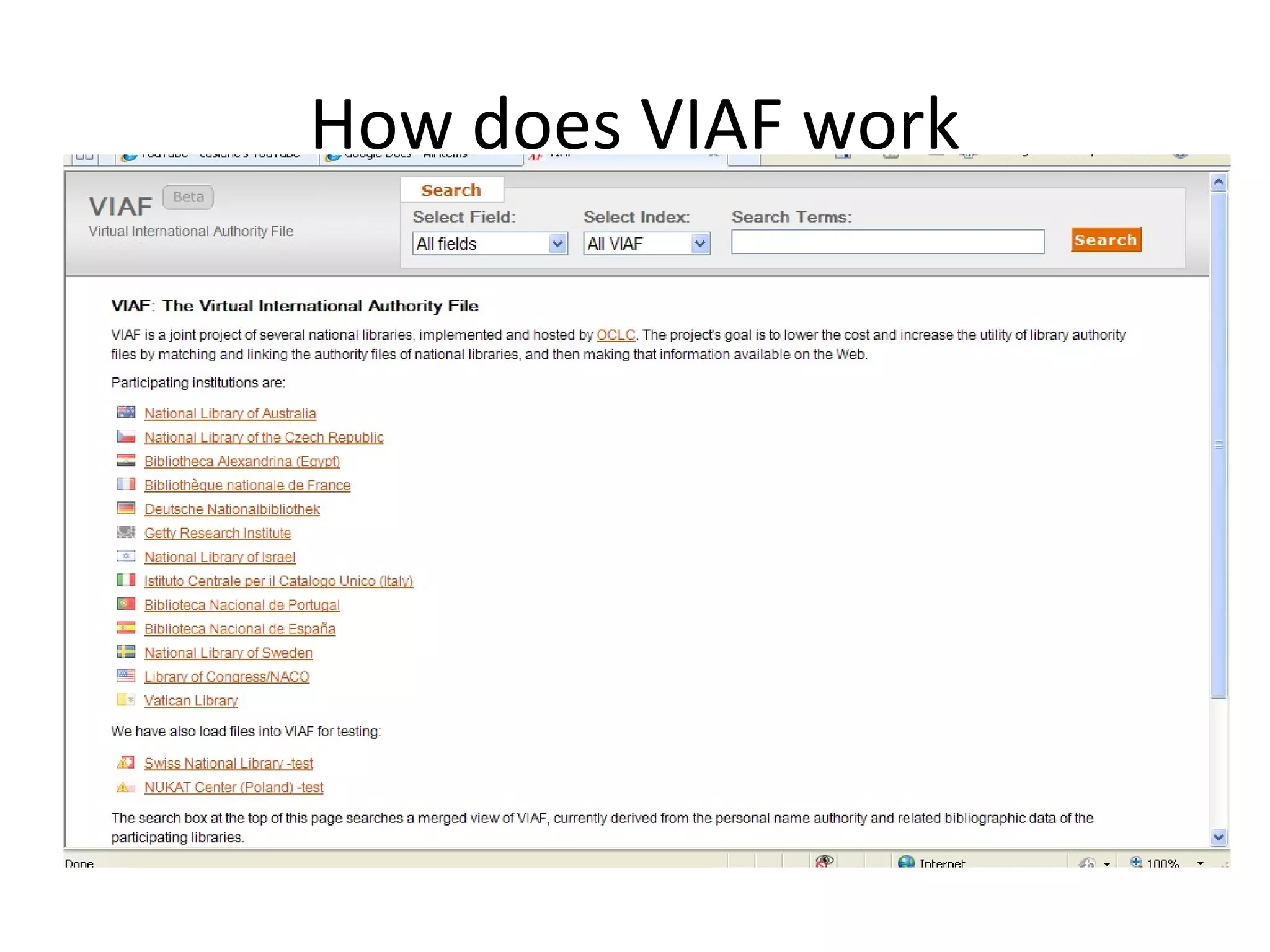
• VIAF is a joint project of national libraries
implemented by OCLC.
• Begun by OCLC, Library of congress, Deutsche
Nationalbibliothek, and the Bibliothèque
Nationale de France.
Who is VIAF
• OCLC is implementing this project.
– Conducting research
– Performing authority control
– Providing infrastructure
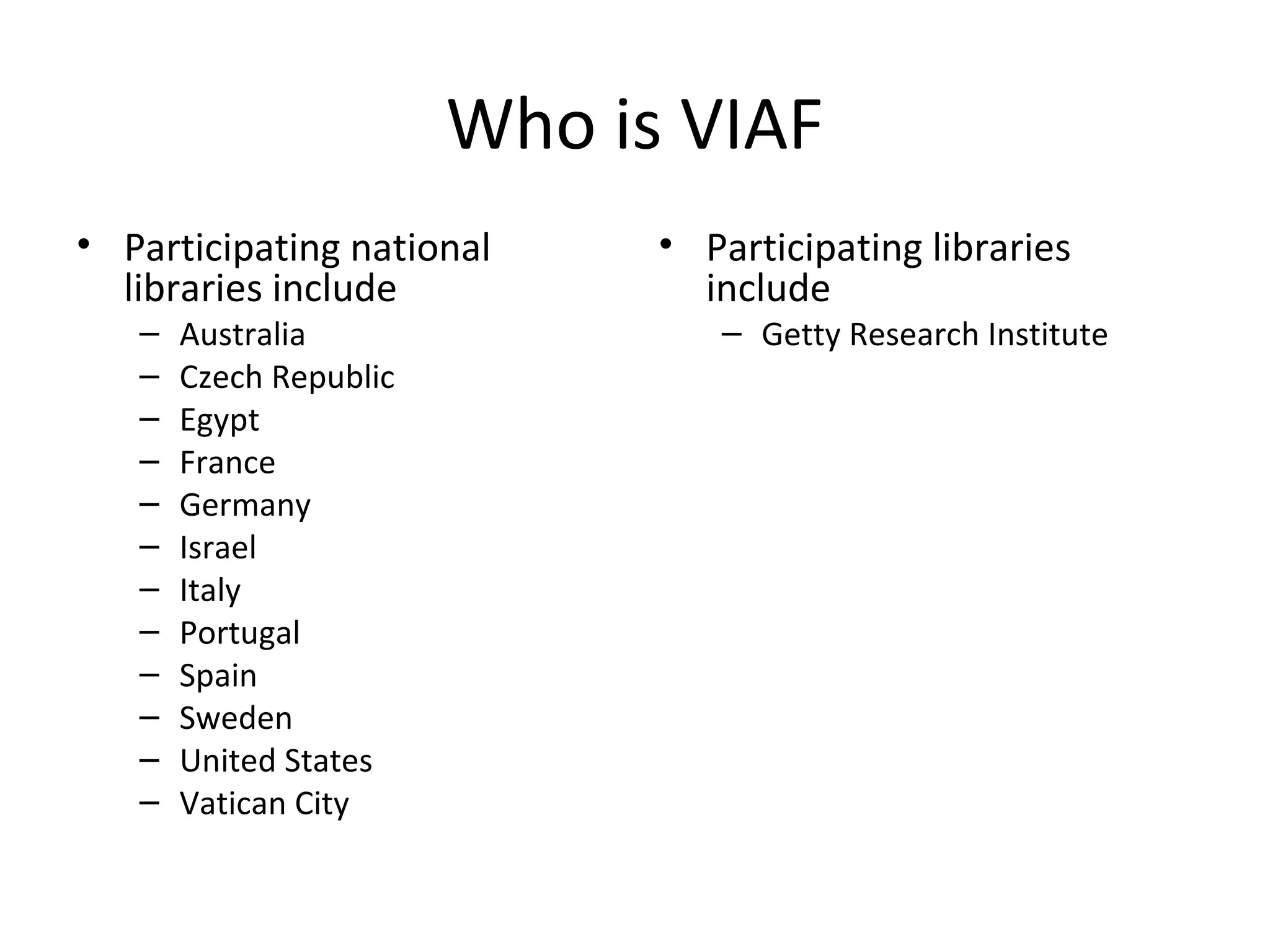
Who is VIAF
• Participating national
libraries include
– Australia
– Czech Republic
– Egypt
– France
– Germany
– Israel
– Italy
– Portugal
– Spain
– Sweden
– United States
– Vatican City
• Participating libraries
include
– Getty Research Institute
Who is VIAF
• Poland and Switzerland are being tested
• OCLC is in negotiations with
– Canada
– Japan
– Russia
• Finland may participate in the future
• Other European nations lack required
authority files
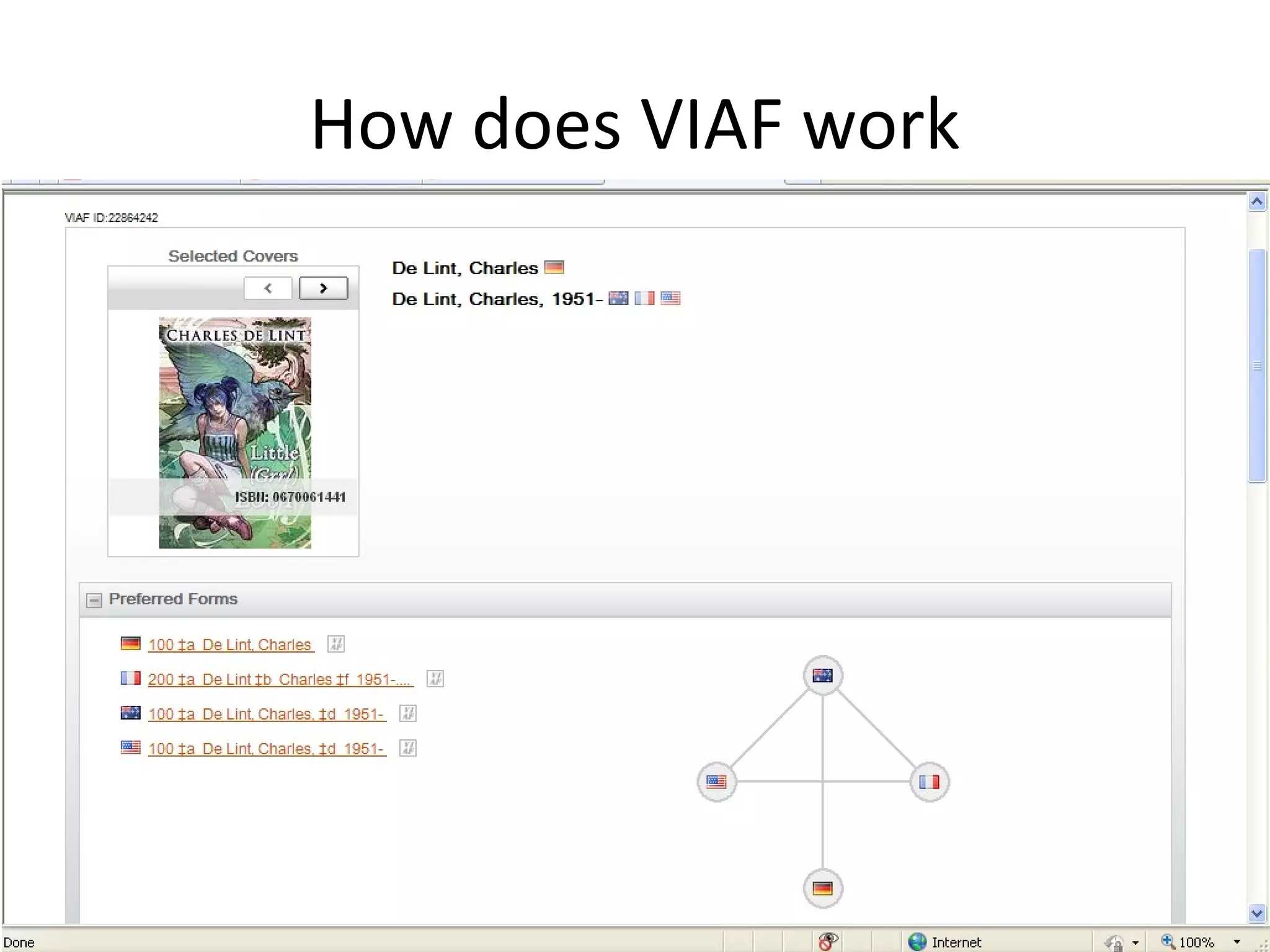
How does VIAF work
• The primary goal of VIAF is to provide
universal bibliographic control by linking name
authority files from across multiple data sets.
• Currently VIAF is working with personal names
in Romanized scripts, with a strong focus on
Europe.
How does VIAF work
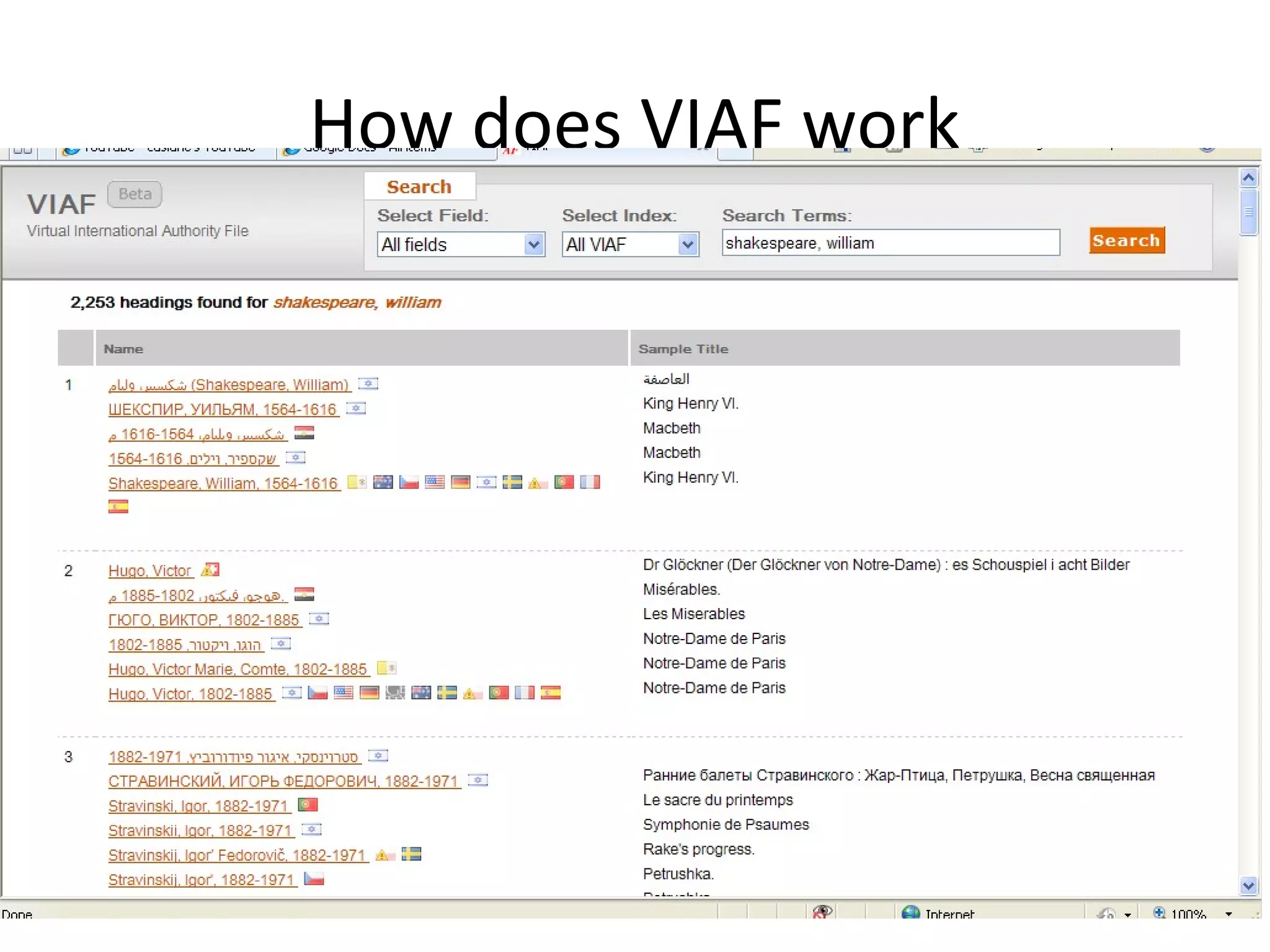
• All of the names in authority file are compiled
and then sent through matching process.
• Strong matches include
– Work in common
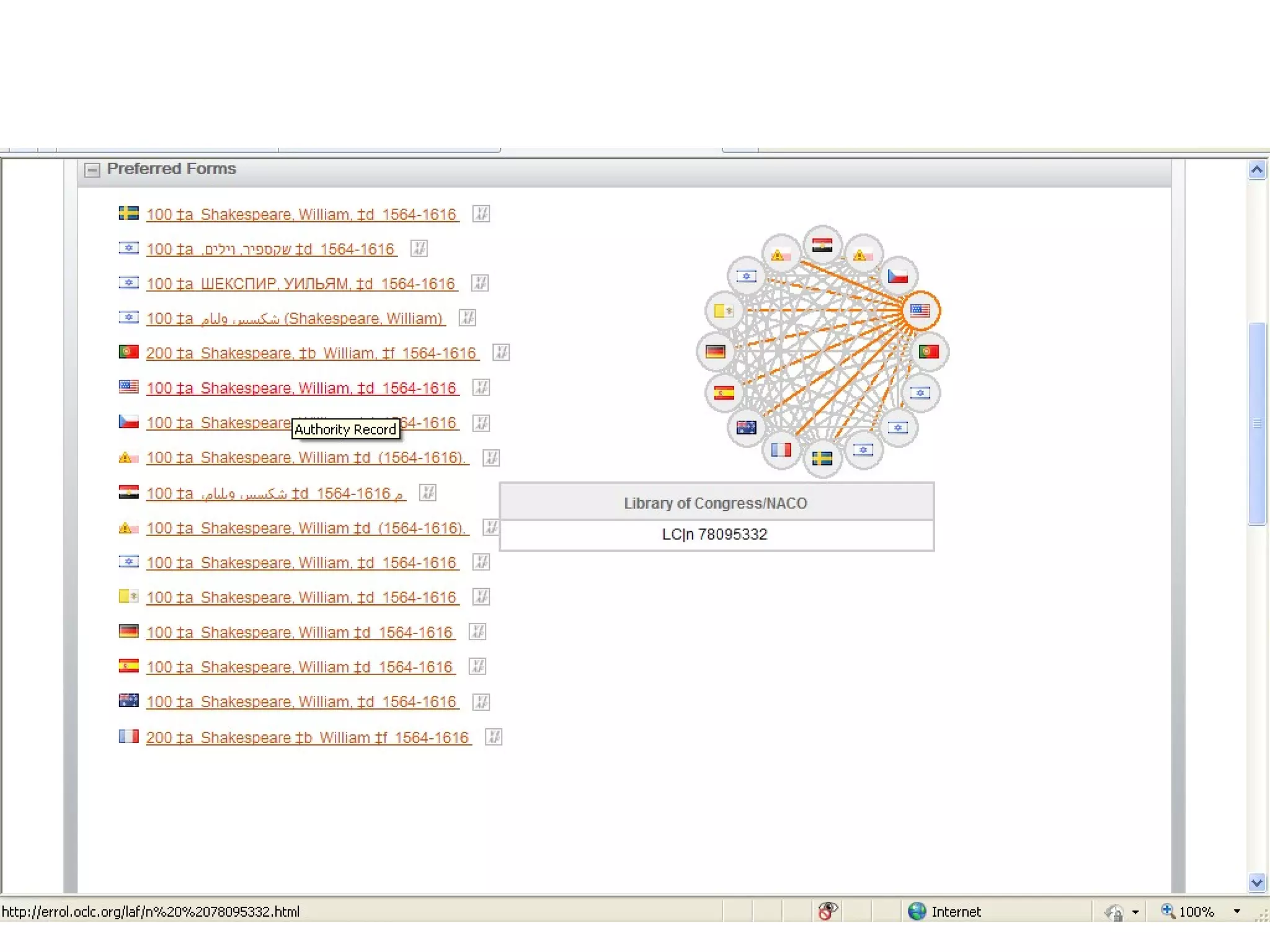
– Control numbers in authority record (LCCN)
– Exact bibliographic dates (birth and death)
– Joint authors
– Name as subject heading
• Cannot match simply name or name and one
date
How does VIAF work
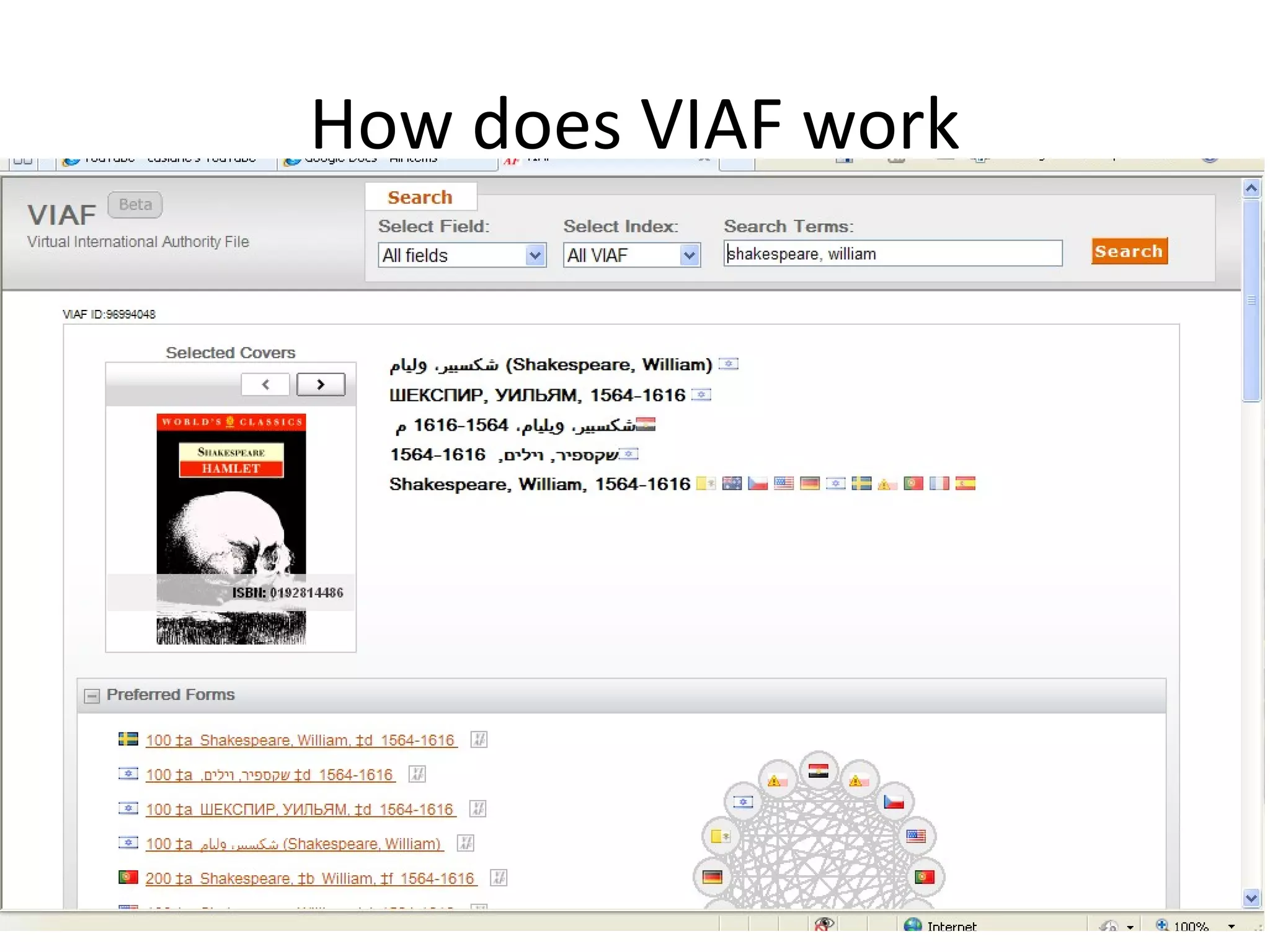
• Matching variations
– Same name, same person
– Same name, different people
– Different names, same person
• Dates provide one of the strongest matches
but they are not present in some national
authority files, e.g. Spain
How does VIAF work
How does VIAF work
How does VIAF work
How does VIAF work
How does VIAF work
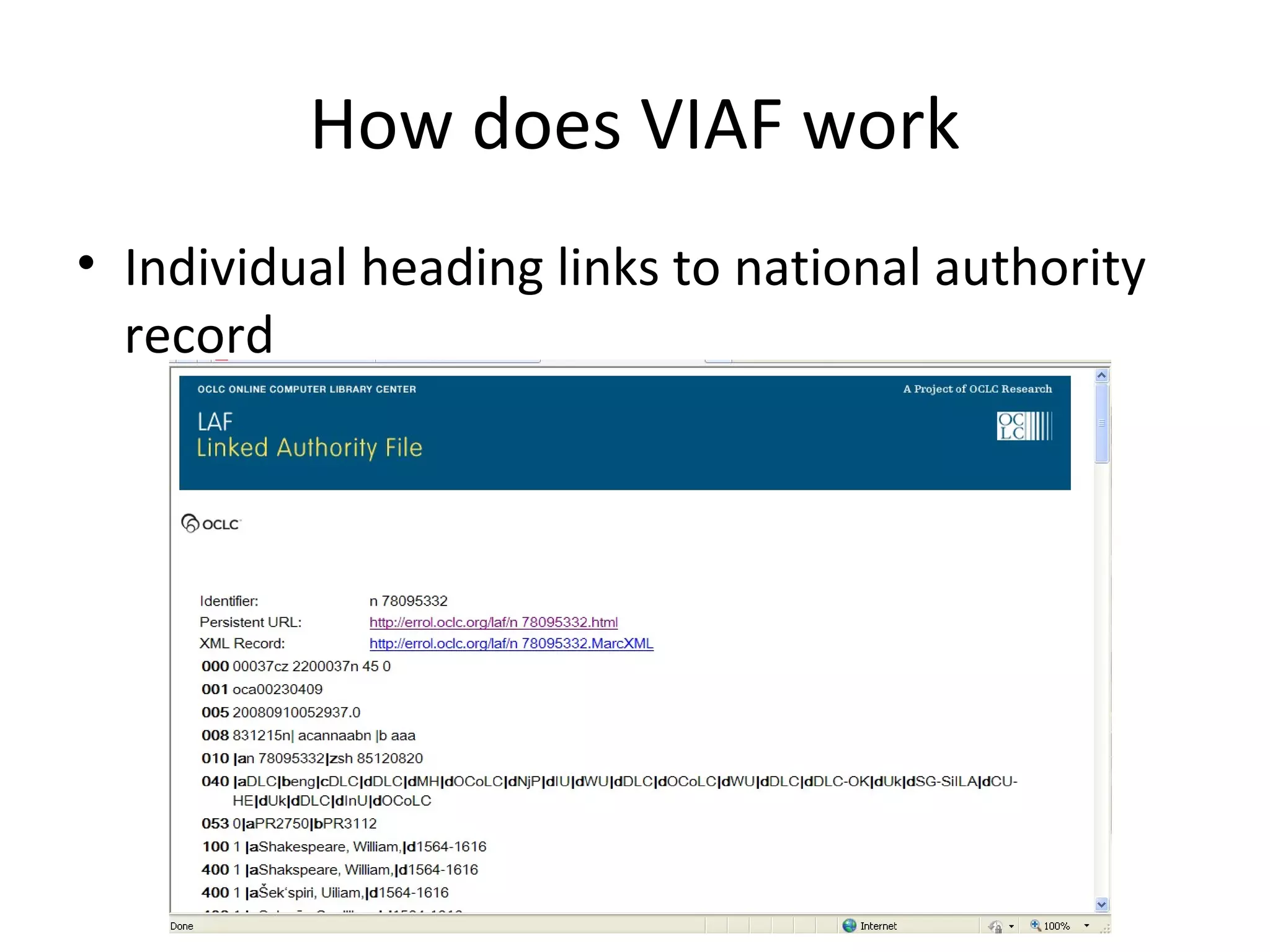
• Individual heading links to national authority
record
Future plans for VIAF
• Non European languages
– Have a small set with Israeli records
– First start with Romanized then move to non
Romanized
• Integrate with International Standard Name
Identifier (ISO 27729)
• Incorporate additional national and regional
authority files
• Add other authority types, e.g. geographical
Why have VIAF
• VIAF seeks to provide consistent guidelines for
the control of name authority records
• Does not impose one form of the name, it
provides suggested form, based on primary
language of the cataloger
Further Information on VIAF
• VIAF website: www.viaf.org
• OCLC’s VIAF webpage:
VIAF (Virtual International Authority File)

Snow viaf2009

  • 1.
    Virtual International Authority File AnIntroduction Cason Snow 2 DEC 2009
  • 2.
    What if VIAF •VIAF is a joint project of national libraries implemented by OCLC. • Begun by OCLC, Library of congress, Deutsche Nationalbibliothek, and the Bibliothèque Nationale de France.
  • 3.
    Who is VIAF •OCLC is implementing this project. – Conducting research – Performing authority control – Providing infrastructure
  • 4.
    Who is VIAF •Participating national libraries include – Australia – Czech Republic – Egypt – France – Germany – Israel – Italy – Portugal – Spain – Sweden – United States – Vatican City • Participating libraries include – Getty Research Institute
  • 5.
    Who is VIAF •Poland and Switzerland are being tested • OCLC is in negotiations with – Canada – Japan – Russia • Finland may participate in the future • Other European nations lack required authority files
  • 6.
    How does VIAFwork • The primary goal of VIAF is to provide universal bibliographic control by linking name authority files from across multiple data sets. • Currently VIAF is working with personal names in Romanized scripts, with a strong focus on Europe.
  • 7.
    How does VIAFwork • All of the names in authority file are compiled and then sent through matching process. • Strong matches include – Work in common – Control numbers in authority record (LCCN) – Exact bibliographic dates (birth and death) – Joint authors – Name as subject heading • Cannot match simply name or name and one date
  • 8.
    How does VIAFwork • Matching variations – Same name, same person – Same name, different people – Different names, same person • Dates provide one of the strongest matches but they are not present in some national authority files, e.g. Spain
  • 9.
  • 10.
  • 11.
  • 13.
  • 14.
    How does VIAFwork • Individual heading links to national authority record
  • 15.
    Future plans forVIAF • Non European languages – Have a small set with Israeli records – First start with Romanized then move to non Romanized • Integrate with International Standard Name Identifier (ISO 27729) • Incorporate additional national and regional authority files • Add other authority types, e.g. geographical
  • 16.
    Why have VIAF •VIAF seeks to provide consistent guidelines for the control of name authority records • Does not impose one form of the name, it provides suggested form, based on primary language of the cataloger
  • 17.
    Further Information onVIAF • VIAF website: www.viaf.org • OCLC’s VIAF webpage: VIAF (Virtual International Authority File)