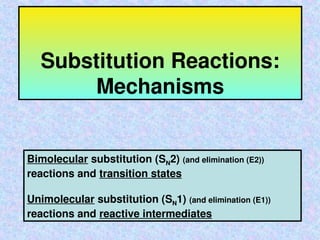
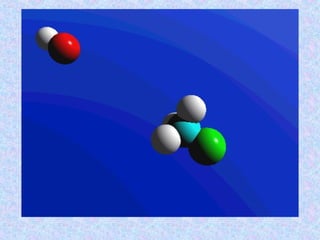
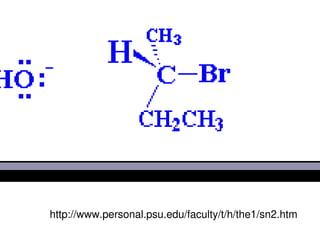
The SN2 ReactionMechanism
The SN1 Reaction Mechanism
Reaction Rates/Chirality in Determining the Mechanism
Transition States
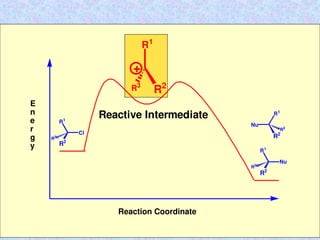
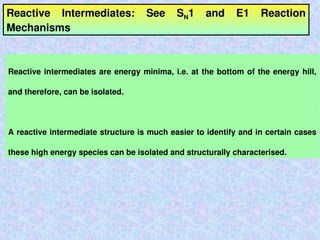
Reactive Intermediates
4.
Nucleophililic Substitution Reactionsat sp3
Carbons
It is found that there are two possible stereochemical outcomes, each described
by a different rate equation, and different stereochemical outcomes.
Descriptor Rate Equation Stereochemical
Outcome
SN2 rate = k[R-Hal][Nu] Inversion
SN1 rate = k[R-Hal] Racemisation
Stereochemistry
Rate
Equation
Nu
R
R'
"R
X
X
R
R'
"R
Nu
5.
Clearly, two differentreaction mechanisms must
be in operation.
It is the job of the chemists to fit the experimental
data to any proposed mechanism
6.
Reaction Mechanisms
The mechanismof a reaction consists of everything that happens as the
starting materials are converted into products.
In principle, therefore, writing (or drawing) the mechanism means describing
everything that happens in the course of the reaction.
However, providing an exact description of a reaction on paper is an
impossible goal.
Instead, a proposal for the mechanism of a reaction should include certain
types of information about the course of the reaction. Thus, the reaction
mechanism should:
[1] Account for the number of reaction steps as indicated by the
rate equation
[2] Account for reactive intermediates or transition states
[3] Account for any stereochemical relationships between
starting materials and products
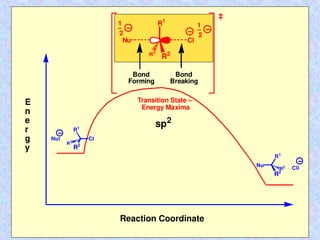
The SN2 ReactionMechanism
Cl
R1
R3
R2
Nu
Transition State –
Energy Maxima
Bond
Forming
2
1
–
2
1
–
sp2
Bond
Breaking
R1
R2
R3
Nu Cl
Inversion
of Configuration
Nucleophile attacks from behind the
C-Cl -bond.
This is where the *-antibonding
orbital of the C-Cl bond is situated.
Rate = k[R-Hal][Nu]
R
1
R
2
R3
Cl
Nu
sp3
Bimolecular
Process
Rate
Determinig
Step
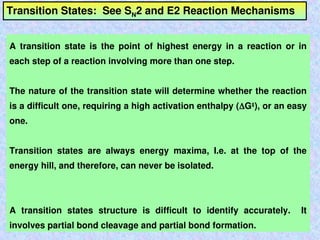
Transition States: SeeSN2 and E2 Reaction Mechanisms
A transition state is the point of highest energy in a reaction or in
each step of a reaction involving more than one step.
The nature of the transition state will determine whether the reaction
is a difficult one, requiring a high activation enthalpy (G‡
), or an easy
one.
Transition states are always energy maxima, I.e. at the top of the
energy hill, and therefore, can never be isolated.
A transition states structure is difficult to identify accurately. It
involves partial bond cleavage and partial bond formation.
13.
Transition States
A +B
E
n
e
r
g
y
Reaction Coordinate
A + B
C + D
[A.
B]‡
Transition
State
Energy
Maxima
Rate = k[A][B]
See SN2 and E2
Reaction Mechanisms
G‡
Go
The SN1 ReactionMechanism
R1
R2
R3
Nu
R1
R2
R3
Nu
Racemisation
of
Configuration
R1
R2
R3
Cl
sp3
Unimolecular
Process
Rate = k[R-Hal]
Rate
Determining
State
R1
R3
R2
Nu Cl
Reactive Intermediate –
Energy Minima
sp2
Nucleophile attacks from either side
of the carbocationic intermediate.
17.
Reactive Intermediates: SeeSN1 and E1 Reaction
Mechanisms
Reactive intermediates are energy minima, i.e. at the bottom of the energy hill,
and therefore, can be isolated.
A reactive intermediate structure is much easier to identify and in certain cases
these high energy species can be isolated and structurally characterised.
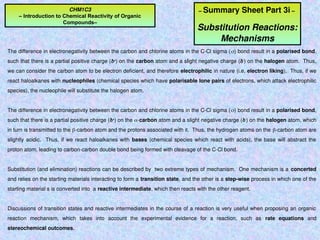
– Summary SheetPart 3i –
Substitution Reactions:
Mechanisms
The difference in electronegativity between the carbon and chlorine atoms in the C-Cl sigma () bond result in a polarised bond,
such that there is a partial positive charge (+
) on the carbon atom and a slight negative charge (-
) on the halogen atom. Thus,
we can consider the carbon atom to be electron deficient, and therefore electrophilic in nature (i.e. electron liking). Thus, if we
react haloalkanes with nucleophiles (chemical species which have polarisable lone pairs of electrons, which attack electrophilic
species), the nucleophile will substitute the halogen atom.
The difference in electronegativity between the carbon and chlorine atoms in the C-Cl sigma () bond result in a polarised bond,
such that there is a partial positive charge (+
) on the -carbon atom and a slight negative charge (-
) on the halogen atom, which
in turn is transmitted to the -carbon atom and the protons associated with it. Thus, the hydrogen atoms on the -carbon atom are
slightly acidic. Thus, if we react haloalkanes with bases (chemical species which react with acids), the base will abstract the
proton atom, leading to carbon-carbon double bond being formed with cleavage of the C-Cl bond.
Substitution (and elimination) reactions can be described by two extreme types of mechanism. One mechanism is a concerted
and relies on the starting materials interacting to form a transition state, and the other is a step-wise process in which one of the
starting material s is converted into a reactive intermediate, which then reacts with the other reagent.
Discussions of transition states and reactive intermediates in the course of a reaction is very useful when proposing an organic
reaction mechanism, which takes into account the experimental evidence for a reaction, such as rate equations and
stereochemical outcomes.
CHM1C3
– Introduction to Chemical Reactivity of Organic
Compounds–
22.
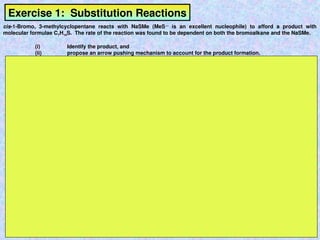
Exercise 1: SubstitutionReactions
cis-1-Bromo, 3-methylcyclopentane reacts with NaSMe (MeS—
is an excellent nucleophile) to afford a product with
molecular formulae C7H14S. The rate of the reaction was found to be dependent on both the bromoalkane and the NaSMe.
(i) Identify the product, and
(ii) propose an arrow pushing mechanism to account for the product formation.
23.
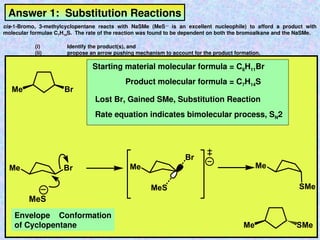
Answer 1: SubstitutionReactions
cis-1-Bromo, 3-methylcyclopentane reacts with NaSMe (MeS—
is an excellent nucleophile) to afford a product with
molecular formulae C7H14S. The rate of the reaction was found to be dependent on both the bromoalkane and the NaSMe.
(i) Identify the product(s), and
(ii) propose an arrow pushing mechanism to account for the product formation.
Br
Me
Me Br
MeS
Me
Br
MeS
Me
SMe
SMe
Me
Starting material molecular formula = C6H11Br
Product molecular formula = C7H14S
Lost Br, Gained SMe, Substitution Reaction
Rate equation indicates bimolecular process, SN2
Envelope Conformation
of Cyclopentane
24.
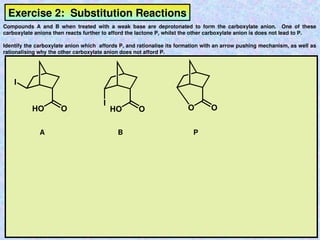
Exercise 2: SubstitutionReactions
Compounds A and B when treated with a weak base are deprotonated to form the carboxylate anion. One of these
carboxylate anions then reacts further to afford the lactone P, whilst the other carboxylate anion is does not lead to P.
Identify the carboxylate anion which affords P, and rationalise its formation with an arrow pushing mechanism, as well as
rationalising why the other carboxylate anion does not afford P.
I
I
HO O HO O O O
A B P
25.
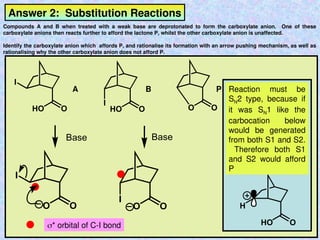
Answer 2: SubstitutionReactions
Compounds A and B when treated with a weak base are deprotonated to form the carboxylate anion. One of these
carboxylate anions then reacts further to afford the lactone P, whilst the other carboxylate anion is unaffected.
Identify the carboxylate anion which affords P, and rationalise its formation with an arrow pushing mechanism, as well as
rationalising why the other carboxylate anion does not afford P.
I
I
HO O HO O O O
I
I
O O O O
Base
Base
* orbital of C-I bond
A B P
HO O
H
Reaction must be
SN2 type, because if
it was SN1 like the
carbocation below
would be generated
from both S1 and S2.
Therefore both S1
and S2 would afford
P
![Substitution Reactions
R1
R
2
R3
Cl
Nu
R1
R2
R3
Nu
Inversion
of
Configuration
Racemisation
of
Configuration
R1
R2
R3
Nu
R1
R2
R3
Nu
Rate = k [R-Cl][Nu]
SN2
Rate = k [R-Cl]
SN1](https://image.slidesharecdn.com/134-ch-substitution-reactions-250524142909-5ebfe8dd/85/SN-2-AND-SN1-SUBSTITUTION-REACTION-PRESENTATION-1-320.jpg)
![Substitution Reactions
R1
R
2
R3
Cl
Nu
R1
R2
R3
Nu
Inversion
of
Configuration
Racemisation
of
Configuration
R1
R2
R3
Nu
R1
R2
R3
Nu
Rate = k [R-Cl][Nu]
SN2
Rate = k [R-Cl]
SN1](https://image.slidesharecdn.com/134-ch-substitution-reactions-250524142909-5ebfe8dd/75/SN-2-AND-SN1-SUBSTITUTION-REACTION-PRESENTATION-1-2048.jpg)
![Nucleophililic Substitution Reactions at sp3
Carbons
It is found that there are two possible stereochemical outcomes, each described
by a different rate equation, and different stereochemical outcomes.
Descriptor Rate Equation Stereochemical
Outcome
SN2 rate = k[R-Hal][Nu] Inversion
SN1 rate = k[R-Hal] Racemisation
Stereochemistry
Rate
Equation
Nu
R
R'
"R
X
X
R
R'
"R
Nu](https://image.slidesharecdn.com/134-ch-substitution-reactions-250524142909-5ebfe8dd/85/SN-2-AND-SN1-SUBSTITUTION-REACTION-PRESENTATION-4-320.jpg)
![Reaction Mechanisms
The mechanism of a reaction consists of everything that happens as the
starting materials are converted into products.
In principle, therefore, writing (or drawing) the mechanism means describing
everything that happens in the course of the reaction.
However, providing an exact description of a reaction on paper is an
impossible goal.
Instead, a proposal for the mechanism of a reaction should include certain
types of information about the course of the reaction. Thus, the reaction
mechanism should:
[1] Account for the number of reaction steps as indicated by the
rate equation
[2] Account for reactive intermediates or transition states
[3] Account for any stereochemical relationships between
starting materials and products](https://image.slidesharecdn.com/134-ch-substitution-reactions-250524142909-5ebfe8dd/85/SN-2-AND-SN1-SUBSTITUTION-REACTION-PRESENTATION-6-320.jpg)
![The SN2 Reaction Mechanism
Cl
R1
R3
R2
Nu
Transition State –
Energy Maxima
Bond
Forming
2
1
–
2
1
–
sp2
Bond
Breaking
R1
R2
R3
Nu Cl
Inversion
of Configuration
Nucleophile attacks from behind the
C-Cl -bond.
This is where the *-antibonding
orbital of the C-Cl bond is situated.
Rate = k[R-Hal][Nu]
R
1
R
2
R3
Cl
Nu
sp3
Bimolecular
Process
Rate
Determinig
Step](https://image.slidesharecdn.com/134-ch-substitution-reactions-250524142909-5ebfe8dd/85/SN-2-AND-SN1-SUBSTITUTION-REACTION-PRESENTATION-8-320.jpg)
![Transition States
A + B
E
n
e
r
g
y
Reaction Coordinate
A + B
C + D
[A.
B]‡
Transition
State
Energy
Maxima
Rate = k[A][B]
See SN2 and E2
Reaction Mechanisms
G‡
Go](https://image.slidesharecdn.com/134-ch-substitution-reactions-250524142909-5ebfe8dd/85/SN-2-AND-SN1-SUBSTITUTION-REACTION-PRESENTATION-13-320.jpg)
![The SN1 Reaction Mechanism
R1
R2
R3
Nu
R1
R2
R3
Nu
Racemisation
of
Configuration
R1
R2
R3
Cl
sp3
Unimolecular
Process
Rate = k[R-Hal]
Rate
Determining
State
R1
R3
R2
Nu Cl
Reactive Intermediate –
Energy Minima
sp2
Nucleophile attacks from either side
of the carbocationic intermediate.](https://image.slidesharecdn.com/134-ch-substitution-reactions-250524142909-5ebfe8dd/85/SN-2-AND-SN1-SUBSTITUTION-REACTION-PRESENTATION-16-320.jpg)
![Go
E
n
e
r
g
y
G‡ G‡
E
n
e
r
g
y
Reaction Coordinate
A + B
D + E
C + B
Reactive
Intermediate
Energy
Minima
Reactive Intermediates
Rate = k[A]
See SN1 and E1
Reaction Mechanisms
And Radical Chain
Reaction](https://image.slidesharecdn.com/134-ch-substitution-reactions-250524142909-5ebfe8dd/85/SN-2-AND-SN1-SUBSTITUTION-REACTION-PRESENTATION-18-320.jpg)