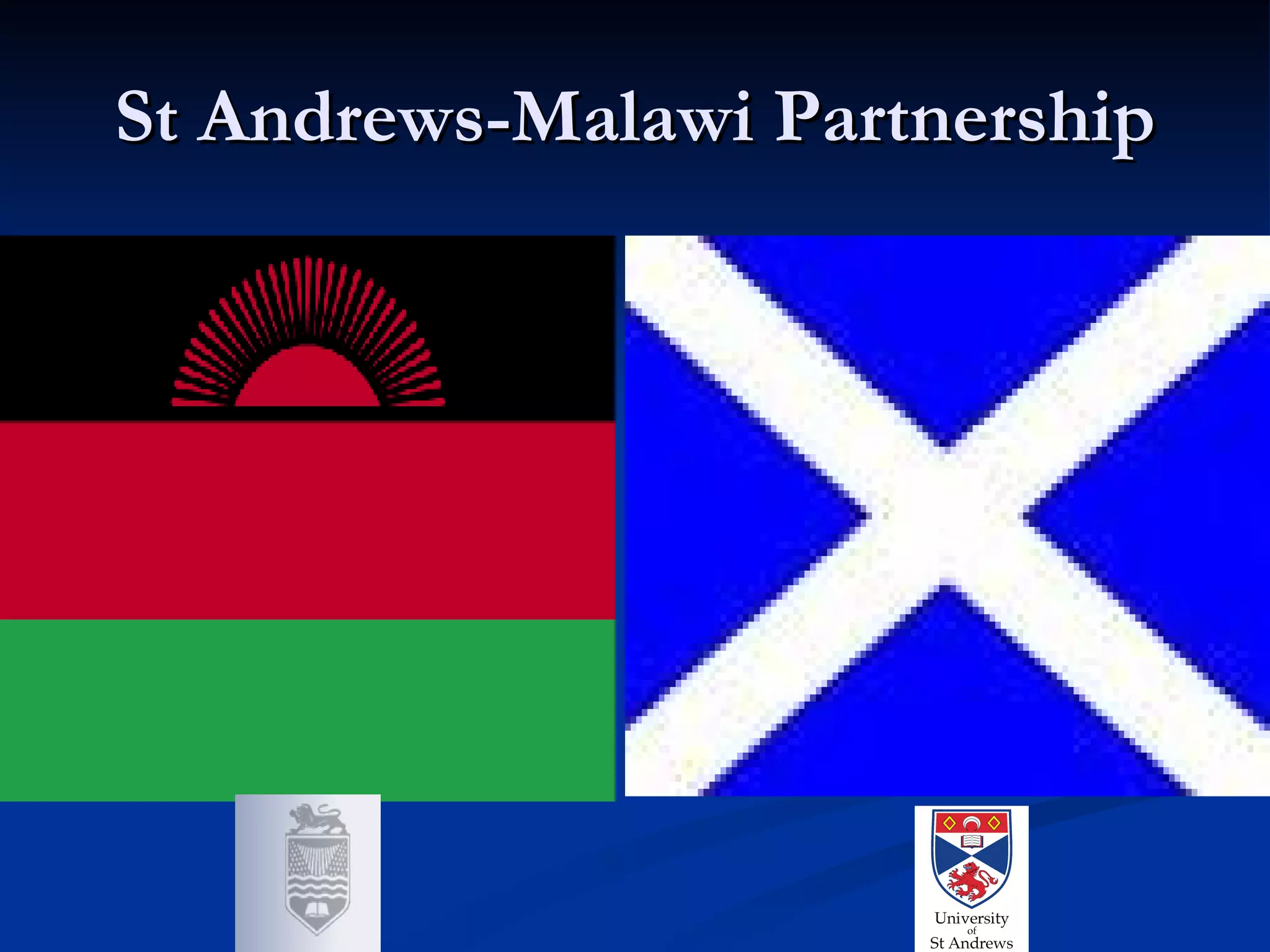
St Andrews-Malawi Partnership
 
 
Historical Connection Malawian doctors were originally sent to St Andrews to undertake their medical degrees Many of the senior clinical staff are St Andrews graduates Their degree programme was similar to St Andrews old curriculum Malawian health care professionals came to  St Andrews to do courses in health economics.
Memorandum of Understanding Consultation in relation to the curriculum review with particular reference to the effective integration of medical science and clinical undergraduate education.  Aid in capacity building to allow the College to significantly increase the number of entrants into this programme. Development  in the College of Medicine of a virtual learning environment  The delivery of support for the College of Medicine’s development and expansion of its ICT infrastructure
Memorandum of Understanding Student contact through the creation and maintenance of a blog and one-to-one email relationships designed to allow the sharing of experience of medical education, the provision of individual learning materials and social interaction An exchange programme.
 
New Undergraduate Curriculum St Andrews is collaborating with College of Medicine (COM) Blantyre to assist the College with a major review of the undergraduate medical curriculum.  The changes are driven by the need to modernize the curriculum content and its delivery, and significantly increase the number of medical students in training.  The Bute Medical School (BMS) has recently undergone its own major curriculum review and redesign for similar reasons and so is able to offer advice based on its own relevant experience.
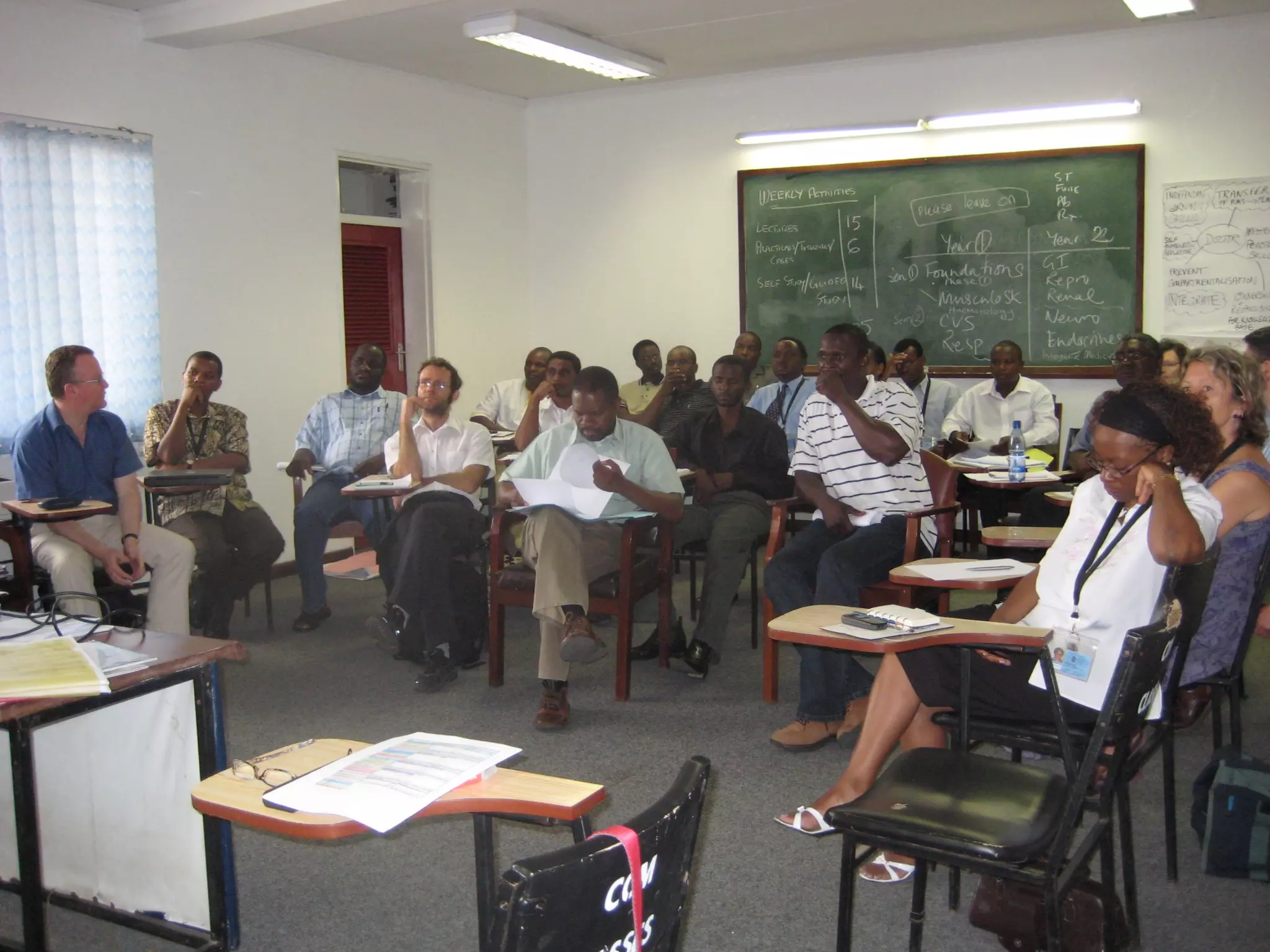
New Undergraduate Curriculum As a result of two joint conferences in Blantyre, the COM implemented a new, spiral curriculum in January 2009.  The content is organised in integrated modules in which the clinical context of basic medical science is established from the beginning.  The first turn of the curriculum spiral lays the foundation for a systems-based approach for the remainder of the first two years.  The content of the systems-based modules is presented in a recognized cycle of normal structure, followed by normal function, abnormal function and finally by treatment.  Assessments are based on published learning outcomes linked to all learning activities.  The aim is to create an integrated series of assessments that are valid, reliable and blueprinted to specific appropriate learning objectives.

SMP - St Andrews-Malawi Partnership, Simon Guild

  • 1.
  • 2.
  • 3.
  • 4.
    Historical Connection Malawiandoctors were originally sent to St Andrews to undertake their medical degrees Many of the senior clinical staff are St Andrews graduates Their degree programme was similar to St Andrews old curriculum Malawian health care professionals came to St Andrews to do courses in health economics.
  • 5.
    Memorandum of UnderstandingConsultation in relation to the curriculum review with particular reference to the effective integration of medical science and clinical undergraduate education. Aid in capacity building to allow the College to significantly increase the number of entrants into this programme. Development in the College of Medicine of a virtual learning environment The delivery of support for the College of Medicine’s development and expansion of its ICT infrastructure
  • 6.
    Memorandum of UnderstandingStudent contact through the creation and maintenance of a blog and one-to-one email relationships designed to allow the sharing of experience of medical education, the provision of individual learning materials and social interaction An exchange programme.
  • 7.
  • 8.
    New Undergraduate CurriculumSt Andrews is collaborating with College of Medicine (COM) Blantyre to assist the College with a major review of the undergraduate medical curriculum. The changes are driven by the need to modernize the curriculum content and its delivery, and significantly increase the number of medical students in training. The Bute Medical School (BMS) has recently undergone its own major curriculum review and redesign for similar reasons and so is able to offer advice based on its own relevant experience.
  • 9.
    New Undergraduate CurriculumAs a result of two joint conferences in Blantyre, the COM implemented a new, spiral curriculum in January 2009. The content is organised in integrated modules in which the clinical context of basic medical science is established from the beginning. The first turn of the curriculum spiral lays the foundation for a systems-based approach for the remainder of the first two years. The content of the systems-based modules is presented in a recognized cycle of normal structure, followed by normal function, abnormal function and finally by treatment. Assessments are based on published learning outcomes linked to all learning activities. The aim is to create an integrated series of assessments that are valid, reliable and blueprinted to specific appropriate learning objectives.