Strategic  Managers Block 1 : Lecture 3
Overview of Lecture This lecture will introduce you to who strategic managers are and how they do what they do. We shall try to get inside the role and overview the person.
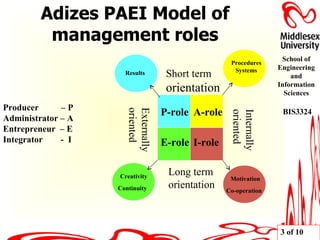
Adizes PAEI Model of management roles Producer  – P Administrator – A Entrepreneur  – E Integrator  -  I P-role A-role E-role I-role Results Procedures Systems Creativity Continuity   Motivation Co-operation   Short term orientation Long term orientation Internally oriented Externally oriented
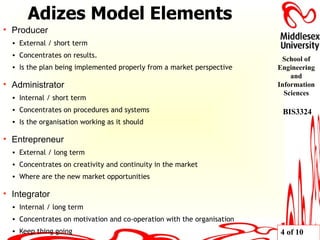
Producer External / short term Concentrates on results. Is the plan being implemented properly from a market perspective Administrator Internal / short term Concentrates on procedures and systems Is the organisation working as it should Entrepreneur External / long term Concentrates on creativity and continuity in the market Where are the new market opportunities Integrator Internal / long term Concentrates on motivation and co-operation with the organisation Keep thing going Adizes Model Elements
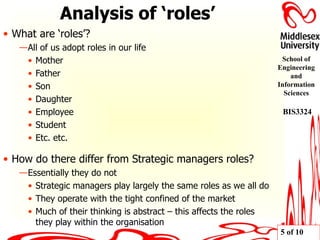
What are ‘roles’? All of us adopt roles in our life Mother Father Son  Daughter Employee Student Etc. etc. How do there differ from Strategic managers roles? Essentially they do not Strategic managers play largely the same roles as we all do They operate with the tight confined of the market Much of their thinking is abstract – this affects the roles they play within the organisation Analysis of ‘roles’
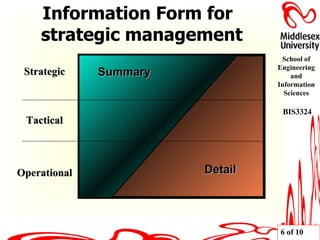
Information Form for strategic management Summary Detail Strategic Tactical Operational
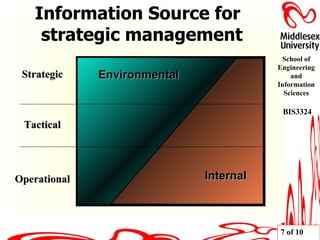
Information Source for strategic management Environmental Internal Strategic Tactical Operational
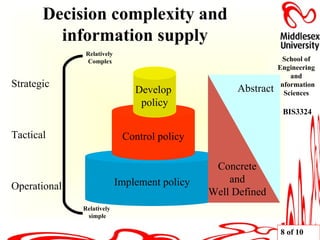
Decision complexity and information supply Implement policy Strategic Tactical Operational Control policy Develop  policy Abstract Concrete and Well Defined Relatively  simple Relatively  Complex
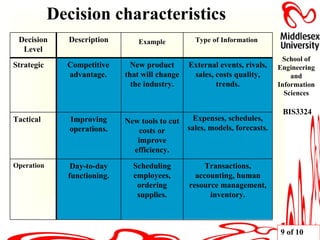
Decision characteristics Transactions, accounting, human resource management, inventory. Scheduling employees, ordering supplies. Day-to-day functioning. Operation Expenses, schedules, sales, models, forecasts. New tools to cut costs or improve efficiency. Improving operations. Tactical External events, rivals, sales, costs quality, trends. New product that will change the industry. Competitive advantage. Strategic Type   of   Information Example Description Decision Level
Next Week Block 1 : Lecture 4 Information and the Strategic Environment

Smis3

  • 1.
    Strategic ManagersBlock 1 : Lecture 3
  • 2.
    Overview of LectureThis lecture will introduce you to who strategic managers are and how they do what they do. We shall try to get inside the role and overview the person.
  • 3.
    Adizes PAEI Modelof management roles Producer – P Administrator – A Entrepreneur – E Integrator - I P-role A-role E-role I-role Results Procedures Systems Creativity Continuity Motivation Co-operation Short term orientation Long term orientation Internally oriented Externally oriented
  • 4.
    Producer External /short term Concentrates on results. Is the plan being implemented properly from a market perspective Administrator Internal / short term Concentrates on procedures and systems Is the organisation working as it should Entrepreneur External / long term Concentrates on creativity and continuity in the market Where are the new market opportunities Integrator Internal / long term Concentrates on motivation and co-operation with the organisation Keep thing going Adizes Model Elements
  • 5.
    What are ‘roles’?All of us adopt roles in our life Mother Father Son Daughter Employee Student Etc. etc. How do there differ from Strategic managers roles? Essentially they do not Strategic managers play largely the same roles as we all do They operate with the tight confined of the market Much of their thinking is abstract – this affects the roles they play within the organisation Analysis of ‘roles’
  • 6.
    Information Form forstrategic management Summary Detail Strategic Tactical Operational
  • 7.
    Information Source forstrategic management Environmental Internal Strategic Tactical Operational
  • 8.
    Decision complexity andinformation supply Implement policy Strategic Tactical Operational Control policy Develop policy Abstract Concrete and Well Defined Relatively simple Relatively Complex
  • 9.
    Decision characteristics Transactions,accounting, human resource management, inventory. Scheduling employees, ordering supplies. Day-to-day functioning. Operation Expenses, schedules, sales, models, forecasts. New tools to cut costs or improve efficiency. Improving operations. Tactical External events, rivals, sales, costs quality, trends. New product that will change the industry. Competitive advantage. Strategic Type of Information Example Description Decision Level
  • 10.
    Next Week Block1 : Lecture 4 Information and the Strategic Environment