Alejandro Fernández-Montes González
University of Sevilla. Spain
afdez@us.es
Energy-Saving Policies in
Grid-Computing
Grid-Computing
Energy-Saving policies,
Efficiency Comparison
Grid’5000, Simulation Software, On-off policies, Data Envelopment Analysis
Grid-
Computing
Smart scheduling for saving energy in grid computing
Fernández-Montes et. Al.
Expert Systems with applications.
http://dx.doi.org/10.1016/j.eswa.2012.02.115
152
164
185
201
218
240
251
72.6
116
126
134
144
156
169
181
194
207
218
0
50
100
150
200
250
0% 10% 20% 30% 40% 50% 60% 70% 80% 90% 100%
Power(Watts)
Performance
Comparison of Power Consumption
w2
w2
Data Center
3
• IT energy consumption 3%-5% of CO2 emissions.
• Manufacturers double electrical efficiency every 1,5
years.
Grid-
Computing
Smart scheduling for saving energy in grid computing
Fernández-Montes et. Al.
Expert Systems with applications.
http://dx.doi.org/10.1016/j.eswa.2012.02.115Data Center
4
• Data centers energy consumption growth 16%
avg. last decade.
19.7
50.5
81.5
67.2
35.4
76.2
130.2
92
0.53%
0.97%
1.50%
1.12%
0
50
100
150
200
250
2000 2005 Upper bound 2010 Lower bound 2010
BkWh
%world total
Infrastructure
Communications
Storage
High-end servers
Mid-range servers
Volume Servers
Grid-
Computing
Smart scheduling for saving energy in grid computing
Fernández-Montes et. Al.
Expert Systems with applications.
http://dx.doi.org/10.1016/j.eswa.2012.02.115Power Management Layers
5
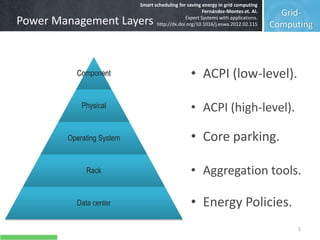
Component
Physical
Operating System
Rack
Data center
• ACPI (low-level).
• ACPI (high-level).
• Core parking.
• Aggregation tools.
• Energy Policies.
Grid-
Computing
Smart scheduling for saving energy in grid computing
Fernández-Montes et. Al.
Expert Systems with applications.
http://dx.doi.org/10.1016/j.eswa.2012.02.115Grid’5000
6
• deployed
over 9 France
locations.
• Designed to support
computational greedy
tasks.
• 8560 CPU-cores
(a.k.a. resources).
Grid-
Computing
Smart scheduling for saving energy in grid computing
Fernández-Montes et. Al.
Expert Systems with applications.
http://dx.doi.org/10.1016/j.eswa.2012.02.115Resources
7
• Each core of each CPU is considered as one
computational resource.
• Resource states and fixed power required are:
IDLE
[50W]
OFF
[5W]
BOOTING
[110W]
SHUTTING
[110W]
ON
[108W]
T booting
0
0
T shutting0
Grid-
Computing
Smart scheduling for saving energy in grid computing
Fernández-Montes et. Al.
Expert Systems with applications.
http://dx.doi.org/10.1016/j.eswa.2012.02.115Jobs
8
• Jobs are users’ tasks, deployed over a set of
resources.
• Two kinds of jobs:
o Submissions.
o Reservations.
• Three temporal points involved:
o Submission time.
o Start time.
o Stop time.
Grid-
Computing
Smart scheduling for saving energy in grid computing
Fernández-Montes et. Al.
Expert Systems with applications.
http://dx.doi.org/10.1016/j.eswa.2012.02.115Graphical representation
9
resources
time
r0
t0
r6
r5
r4
r3
r2
r1
t8t7t6t5t4t3t2t1 t10t9
Job_id
Start
time
Stop
time
Submission
time
Grid-
Computing
Smart scheduling for saving energy in grid computing
Fernández-Montes et. Al.
Expert Systems with applications.
http://dx.doi.org/10.1016/j.eswa.2012.02.115Scheduling Energy Policies
10
• Establish the managing of the states of grid
resources.
• What to do with each resource that finishes
the execution of a job:
o Leave On (idle).
o Shut resource down.
• Seven energy policies proposals are analyzed
and compared.
Off
Idle
Grid-
Computing
Smart scheduling for saving energy in grid computing
Fernández-Montes et. Al.
Expert Systems with applications.
http://dx.doi.org/10.1016/j.eswa.2012.02.1151. Always On
11
• Current Grid’5000 behaviour.
• Useful to compute current energy
consumption and to be compared with.
Grid-
Computing
Smart scheduling for saving energy in grid computing
Fernández-Montes et. Al.
Expert Systems with applications.
http://dx.doi.org/10.1016/j.eswa.2012.02.1152. Always Switch Off
12
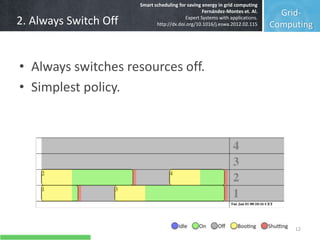
• Always switches resources off.
• Simplest policy.
Grid-
Computing
Smart scheduling for saving energy in grid computing
Fernández-Montes et. Al.
Expert Systems with applications.
http://dx.doi.org/10.1016/j.eswa.2012.02.1153. Load
13
• ‘Load’ is defined as the
percentage of
resources executing a
job.
• Depending on current
Grid’5000 load, leave
them on, or switch
them off.
• The threshold
percentage is
parameterized.
Grid-
Computing
Smart scheduling for saving energy in grid computing
Fernández-Montes et. Al.
Expert Systems with applications.
http://dx.doi.org/10.1016/j.eswa.2012.02.1154. Switch Off TS
14
• TS is defined as the minimum time that
ensures energy saving if a resource is switched
off between two jobs.
Ts =
Es - Poff *dtot + EOn®Off + EOff ®On
PIdle - Poff
[A.C. Orgerie, et. al, 2009]
Grid-
Computing
Smart scheduling for saving energy in grid computing
Fernández-Montes et. Al.
Expert Systems with applications.
http://dx.doi.org/10.1016/j.eswa.2012.02.1154. Switch Off TS
15
• Looks in the agenda for jobs that are going to
be run in a period less than TS.
• Computes number of resources that are going
to be needed and acts on resources.
• Only this energy policy looks up the agenda
for reservations already made.
Grid-
Computing
Smart scheduling for saving energy in grid computing
Fernández-Montes et. Al.
Expert Systems with applications.
http://dx.doi.org/10.1016/j.eswa.2012.02.1155. Random
16
• Leaves resources on or switch them off
randomly.
• If other policy is worse, suspect you are doing
something wrong.
Grid-
Computing
Smart scheduling for saving energy in grid computing
Fernández-Montes et. Al.
Expert Systems with applications.
http://dx.doi.org/10.1016/j.eswa.2012.02.1156. Exponential
17
• The exponential model describes time
between consecutive events.
• Every time a job finishes, the parameter (μ) of
the model is computed from the mean
duration between jobs .
• Hence, probability of arrival of new job in a
time less than Ts is given by
1-e
-Ts
m
Grid-
Computing
Smart scheduling for saving energy in grid computing
Fernández-Montes et. Al.
Expert Systems with applications.
http://dx.doi.org/10.1016/j.eswa.2012.02.1157. Gamma
18
• The gamma model describes time between
events
• The mean duration between jobs (Θ), and the
ratio of available resources and mean
resources (κ) are computed.
• Hence, probability of arrival of new job in a
time less than Ts is given by
g(k -1,q·Ts )
G(k -1)
Grid-
Computing
Smart scheduling for saving energy in grid computing
Fernández-Montes et. Al.
Expert Systems with applications.
http://dx.doi.org/10.1016/j.eswa.2012.02.115Arranging policies
19
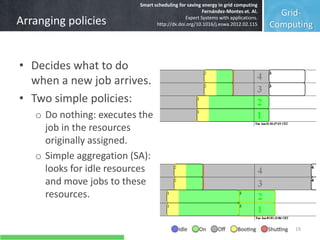
• Decides what to do
when a new job arrives.
• Two simple policies:
o Do nothing: executes the
job in the resources
originally assigned.
o Simple aggregation (SA):
looks for idle resources
and move jobs to these
resources.
Grid-
Computing
Smart scheduling for saving energy in grid computing
Fernández-Montes et. Al.
Expert Systems with applications.
http://dx.doi.org/10.1016/j.eswa.2012.02.115Experimentation
20
• Tested all combinations of Energy and
Arranging policies.
• Computed results:
o Energy consumed.
o Energy saved.
o Number of bootings and shuttings.
o Comparison between minimal and actual.
o Saved energy by booting-shutting.
Grid-
Computing
Smart scheduling for saving energy in grid computing
Fernández-Montes et. Al.
Expert Systems with applications.
http://dx.doi.org/10.1016/j.eswa.2012.02.115Experimentation
21
• Two periods of six months.
• Seven energy policies.
Configurable energy policies have been used with
various values.
• Two arranging policies.
• Add up to a total of 324 simulations.
Grid-
Computing
Smart scheduling for saving energy in grid computing
Fernández-Montes et. Al.
Expert Systems with applications.
http://dx.doi.org/10.1016/j.eswa.2012.02.115Grid’5000 Toolbox. Simulation software
22
Grid-
Computing
Smart scheduling for saving energy in grid computing
Fernández-Montes et. Al.
Expert Systems with applications.
http://dx.doi.org/10.1016/j.eswa.2012.02.115Grid’5000 Toolbox. Simulation software
23
‹#›
‹#›
Grid-
Computing
Smart scheduling for saving energy in grid computing
Fernández-Montes et. Al.
Expert Systems with applications.
http://dx.doi.org/10.1016/j.eswa.2012.02.115Results
• Best energy saving policy could save up to:
o 162,000€ per year for the whole Grid’5000
infrastructure.
o 318 tons of CO2.
o 1,163,286 kWh.
Madrid Barcelona
78 Ave
Madrid-Barcelona
61,314 Eurozone citizens
26
Alejandro Fernández-Montes González
University of Sevilla. Spain
afdez@us.es
Energy-Saving Policies in
Grid-Computing

Smart scheduling for saving energy in grid computing final

  • 1.
    Alejandro Fernández-Montes González Universityof Sevilla. Spain afdez@us.es Energy-Saving Policies in Grid-Computing
  • 2.
    Grid-Computing Energy-Saving policies, Efficiency Comparison Grid’5000,Simulation Software, On-off policies, Data Envelopment Analysis
  • 3.
    Grid- Computing Smart scheduling forsaving energy in grid computing Fernández-Montes et. Al. Expert Systems with applications. http://dx.doi.org/10.1016/j.eswa.2012.02.115 152 164 185 201 218 240 251 72.6 116 126 134 144 156 169 181 194 207 218 0 50 100 150 200 250 0% 10% 20% 30% 40% 50% 60% 70% 80% 90% 100% Power(Watts) Performance Comparison of Power Consumption w2 w2 Data Center 3 • IT energy consumption 3%-5% of CO2 emissions. • Manufacturers double electrical efficiency every 1,5 years.
  • 4.
    Grid- Computing Smart scheduling forsaving energy in grid computing Fernández-Montes et. Al. Expert Systems with applications. http://dx.doi.org/10.1016/j.eswa.2012.02.115Data Center 4 • Data centers energy consumption growth 16% avg. last decade. 19.7 50.5 81.5 67.2 35.4 76.2 130.2 92 0.53% 0.97% 1.50% 1.12% 0 50 100 150 200 250 2000 2005 Upper bound 2010 Lower bound 2010 BkWh %world total Infrastructure Communications Storage High-end servers Mid-range servers Volume Servers
  • 5.
    Grid- Computing Smart scheduling forsaving energy in grid computing Fernández-Montes et. Al. Expert Systems with applications. http://dx.doi.org/10.1016/j.eswa.2012.02.115Power Management Layers 5 Component Physical Operating System Rack Data center • ACPI (low-level). • ACPI (high-level). • Core parking. • Aggregation tools. • Energy Policies.
  • 6.
    Grid- Computing Smart scheduling forsaving energy in grid computing Fernández-Montes et. Al. Expert Systems with applications. http://dx.doi.org/10.1016/j.eswa.2012.02.115Grid’5000 6 • deployed over 9 France locations. • Designed to support computational greedy tasks. • 8560 CPU-cores (a.k.a. resources).
  • 7.
    Grid- Computing Smart scheduling forsaving energy in grid computing Fernández-Montes et. Al. Expert Systems with applications. http://dx.doi.org/10.1016/j.eswa.2012.02.115Resources 7 • Each core of each CPU is considered as one computational resource. • Resource states and fixed power required are: IDLE [50W] OFF [5W] BOOTING [110W] SHUTTING [110W] ON [108W] T booting 0 0 T shutting0
  • 8.
    Grid- Computing Smart scheduling forsaving energy in grid computing Fernández-Montes et. Al. Expert Systems with applications. http://dx.doi.org/10.1016/j.eswa.2012.02.115Jobs 8 • Jobs are users’ tasks, deployed over a set of resources. • Two kinds of jobs: o Submissions. o Reservations. • Three temporal points involved: o Submission time. o Start time. o Stop time.
  • 9.
    Grid- Computing Smart scheduling forsaving energy in grid computing Fernández-Montes et. Al. Expert Systems with applications. http://dx.doi.org/10.1016/j.eswa.2012.02.115Graphical representation 9 resources time r0 t0 r6 r5 r4 r3 r2 r1 t8t7t6t5t4t3t2t1 t10t9 Job_id Start time Stop time Submission time
  • 10.
    Grid- Computing Smart scheduling forsaving energy in grid computing Fernández-Montes et. Al. Expert Systems with applications. http://dx.doi.org/10.1016/j.eswa.2012.02.115Scheduling Energy Policies 10 • Establish the managing of the states of grid resources. • What to do with each resource that finishes the execution of a job: o Leave On (idle). o Shut resource down. • Seven energy policies proposals are analyzed and compared. Off Idle
  • 11.
    Grid- Computing Smart scheduling forsaving energy in grid computing Fernández-Montes et. Al. Expert Systems with applications. http://dx.doi.org/10.1016/j.eswa.2012.02.1151. Always On 11 • Current Grid’5000 behaviour. • Useful to compute current energy consumption and to be compared with.
  • 12.
    Grid- Computing Smart scheduling forsaving energy in grid computing Fernández-Montes et. Al. Expert Systems with applications. http://dx.doi.org/10.1016/j.eswa.2012.02.1152. Always Switch Off 12 • Always switches resources off. • Simplest policy.
  • 13.
    Grid- Computing Smart scheduling forsaving energy in grid computing Fernández-Montes et. Al. Expert Systems with applications. http://dx.doi.org/10.1016/j.eswa.2012.02.1153. Load 13 • ‘Load’ is defined as the percentage of resources executing a job. • Depending on current Grid’5000 load, leave them on, or switch them off. • The threshold percentage is parameterized.
  • 14.
    Grid- Computing Smart scheduling forsaving energy in grid computing Fernández-Montes et. Al. Expert Systems with applications. http://dx.doi.org/10.1016/j.eswa.2012.02.1154. Switch Off TS 14 • TS is defined as the minimum time that ensures energy saving if a resource is switched off between two jobs. Ts = Es - Poff *dtot + EOn®Off + EOff ®On PIdle - Poff [A.C. Orgerie, et. al, 2009]
  • 15.
    Grid- Computing Smart scheduling forsaving energy in grid computing Fernández-Montes et. Al. Expert Systems with applications. http://dx.doi.org/10.1016/j.eswa.2012.02.1154. Switch Off TS 15 • Looks in the agenda for jobs that are going to be run in a period less than TS. • Computes number of resources that are going to be needed and acts on resources. • Only this energy policy looks up the agenda for reservations already made.
  • 16.
    Grid- Computing Smart scheduling forsaving energy in grid computing Fernández-Montes et. Al. Expert Systems with applications. http://dx.doi.org/10.1016/j.eswa.2012.02.1155. Random 16 • Leaves resources on or switch them off randomly. • If other policy is worse, suspect you are doing something wrong.
  • 17.
    Grid- Computing Smart scheduling forsaving energy in grid computing Fernández-Montes et. Al. Expert Systems with applications. http://dx.doi.org/10.1016/j.eswa.2012.02.1156. Exponential 17 • The exponential model describes time between consecutive events. • Every time a job finishes, the parameter (μ) of the model is computed from the mean duration between jobs . • Hence, probability of arrival of new job in a time less than Ts is given by 1-e -Ts m
  • 18.
    Grid- Computing Smart scheduling forsaving energy in grid computing Fernández-Montes et. Al. Expert Systems with applications. http://dx.doi.org/10.1016/j.eswa.2012.02.1157. Gamma 18 • The gamma model describes time between events • The mean duration between jobs (Θ), and the ratio of available resources and mean resources (κ) are computed. • Hence, probability of arrival of new job in a time less than Ts is given by g(k -1,q·Ts ) G(k -1)
  • 19.
    Grid- Computing Smart scheduling forsaving energy in grid computing Fernández-Montes et. Al. Expert Systems with applications. http://dx.doi.org/10.1016/j.eswa.2012.02.115Arranging policies 19 • Decides what to do when a new job arrives. • Two simple policies: o Do nothing: executes the job in the resources originally assigned. o Simple aggregation (SA): looks for idle resources and move jobs to these resources.
  • 20.
    Grid- Computing Smart scheduling forsaving energy in grid computing Fernández-Montes et. Al. Expert Systems with applications. http://dx.doi.org/10.1016/j.eswa.2012.02.115Experimentation 20 • Tested all combinations of Energy and Arranging policies. • Computed results: o Energy consumed. o Energy saved. o Number of bootings and shuttings. o Comparison between minimal and actual. o Saved energy by booting-shutting.
  • 21.
    Grid- Computing Smart scheduling forsaving energy in grid computing Fernández-Montes et. Al. Expert Systems with applications. http://dx.doi.org/10.1016/j.eswa.2012.02.115Experimentation 21 • Two periods of six months. • Seven energy policies. Configurable energy policies have been used with various values. • Two arranging policies. • Add up to a total of 324 simulations.
  • 22.
    Grid- Computing Smart scheduling forsaving energy in grid computing Fernández-Montes et. Al. Expert Systems with applications. http://dx.doi.org/10.1016/j.eswa.2012.02.115Grid’5000 Toolbox. Simulation software 22
  • 23.
    Grid- Computing Smart scheduling forsaving energy in grid computing Fernández-Montes et. Al. Expert Systems with applications. http://dx.doi.org/10.1016/j.eswa.2012.02.115Grid’5000 Toolbox. Simulation software 23
  • 24.
  • 25.
  • 26.
    Grid- Computing Smart scheduling forsaving energy in grid computing Fernández-Montes et. Al. Expert Systems with applications. http://dx.doi.org/10.1016/j.eswa.2012.02.115Results • Best energy saving policy could save up to: o 162,000€ per year for the whole Grid’5000 infrastructure. o 318 tons of CO2. o 1,163,286 kWh. Madrid Barcelona 78 Ave Madrid-Barcelona 61,314 Eurozone citizens 26
  • 27.
    Alejandro Fernández-Montes González Universityof Sevilla. Spain afdez@us.es Energy-Saving Policies in Grid-Computing

Editor's Notes

  • #2 Here I concludethispresentation and I’m at yourdisposalforanswering as manyquestions as youmayhave.
  • #28 Here I concludethispresentation and I’m at yourdisposalforanswering as manyquestions as youmayhave.