Developing SMART Requirements January 06, 2010 by Harmony Brenner
Purpose SMART Concept – Background SMART Definition Applying SMART Principles Developing SMART Requirements Agenda
Developing SMART Requirements Purpose Purpose The presentation discusses in context these ideas: A requirement, at its most basic level, is a desired and predictable outcome; and Consistent methods for creating testable  requirements benefit the project bottom-line.
Developing SMART Requirements SMART Background SMART Concept – Background Benefits of using SMART requirements:  Budget and schedule advantages are gained;  Consensus is more quickly reached; and, Rework is decreased.
Developing SMART Requirements SMART Definition SMART Requirements – alternates in  (  ): S pecific; M easurable A ttainable (Achievable, Actionable, Appropriate) R ealistic (Relevant) T ime-Bound (Timely)
Developing SMART Requirements SMART Definition SMART Definition – Specific: Specific requirements are  precise  and: Are not open to interpretation; and Avoid absolutes (ex. – “all”, “never”, “always”).
Developing SMART Requirements SMART Definition SMART Definition – Specific (Poor): The document will contain all  customer information: Which document? What customer information? What format(s)?
Developing SMART Requirements SMART Definition SMART Definition – Specific (Improved): This requirement has improved precision: The Declaration document shall contain this customer information in a text block  in the top right corner of the first page: Customer Name Phone Email
Developing SMART Requirements SMART Definition SMART Definition – Measurable: Measurable requirements can be  verified as complete  and: Avoid undefined time periods / quantities; and, Avoid non-fact based measurements such as “best” or “optimal”.
Developing SMART Requirements SMART Definition SMART Definition – Measurable (Poor): The application shall function  quickly for end users: How quickly (seconds, minutes, hours)? Which application features are included? Which users are affected – guests, administrators, everyone?
Developing SMART Requirements SMART Definition SMART Definition – Measurable (Improved): This requirement has improved measurability: The application shall have response  times of 4.00 seconds or less for all features, and for all user roles, during business hours of 9 AM – 5 PM ET, Mondays – Fridays.
Developing SMART Requirements SMART Definition SMART Definition – Attainable: Attainable requirements are  able to be achieved given the existing environment  and are: Appropriate for project / limitations; and, Realistic to achieve within project parameters.
Developing SMART Requirements SMART Definition SMART Definition – Attainable (Poor): The monthly cycle will be run on the last Friday of the month, between  7 PM and 8 PM ET: Has this been verified to be possible? What if the cycle runs longer than 1 hour?
Developing SMART Requirements SMART Definition SMART Definition – Attainable (Improved): This requirement has improved attainability: The monthly cycle will be run on the  last Saturday of the month, starting at  7 AM and completing by 7 PM ET.
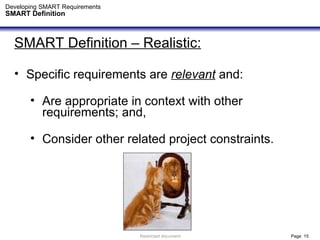
Developing SMART Requirements SMART Definition SMART Definition – Realistic: Specific requirements are  relevant  and: Are appropriate in context with other requirements; and, Consider other related project constraints.
Developing SMART Requirements SMART Definition SMART Definition – Realistic (Poor): The new website will generate over 1,000,000 hits within its first 12 hours of implementation: Is this likely / necessary to occur? Is there a better way to measure this outcome?
Developing SMART Requirements SMART Definition SMART Definition – Realistic (Improved): This requirement has improved relevance: The new website shall be ranked within the first results page on three (3)  major search engines (Google, Bing  and Yahoo) within its first 12 hours of implementation.
Developing SMART Requirements SMART Definition SMART Definition – Time-Bound: Time-Bound requirements are  timely  and: Clarify how quickly a requirement needs to  be finished, executed or implemented. Avoid vague time references such as “fast”, “quick” or “soon”.
Developing SMART Requirements SMART Definition SMART Definition – Time-Bound (Poor): System availability will be achieved soon after the cycle is completed: How soon (seconds, minutes, hours)?  What if the cycle is late?
Developing SMART Requirements SMART Definition SMART Definition – Time-Bound (Improved): This requirement has improved timeliness: System availability shall be achieved  after cycle completion and by no later  than 6 AM ET on Mondays – Fridays.
Developing SMART Requirements Questions Questions

SMART Requirements

  • 1.
    Developing SMART RequirementsJanuary 06, 2010 by Harmony Brenner
  • 2.
    Purpose SMART Concept– Background SMART Definition Applying SMART Principles Developing SMART Requirements Agenda
  • 3.
    Developing SMART RequirementsPurpose Purpose The presentation discusses in context these ideas: A requirement, at its most basic level, is a desired and predictable outcome; and Consistent methods for creating testable requirements benefit the project bottom-line.
  • 4.
    Developing SMART RequirementsSMART Background SMART Concept – Background Benefits of using SMART requirements: Budget and schedule advantages are gained; Consensus is more quickly reached; and, Rework is decreased.
  • 5.
    Developing SMART RequirementsSMART Definition SMART Requirements – alternates in ( ): S pecific; M easurable A ttainable (Achievable, Actionable, Appropriate) R ealistic (Relevant) T ime-Bound (Timely)
  • 6.
    Developing SMART RequirementsSMART Definition SMART Definition – Specific: Specific requirements are precise and: Are not open to interpretation; and Avoid absolutes (ex. – “all”, “never”, “always”).
  • 7.
    Developing SMART RequirementsSMART Definition SMART Definition – Specific (Poor): The document will contain all customer information: Which document? What customer information? What format(s)?
  • 8.
    Developing SMART RequirementsSMART Definition SMART Definition – Specific (Improved): This requirement has improved precision: The Declaration document shall contain this customer information in a text block in the top right corner of the first page: Customer Name Phone Email
  • 9.
    Developing SMART RequirementsSMART Definition SMART Definition – Measurable: Measurable requirements can be verified as complete and: Avoid undefined time periods / quantities; and, Avoid non-fact based measurements such as “best” or “optimal”.
  • 10.
    Developing SMART RequirementsSMART Definition SMART Definition – Measurable (Poor): The application shall function quickly for end users: How quickly (seconds, minutes, hours)? Which application features are included? Which users are affected – guests, administrators, everyone?
  • 11.
    Developing SMART RequirementsSMART Definition SMART Definition – Measurable (Improved): This requirement has improved measurability: The application shall have response times of 4.00 seconds or less for all features, and for all user roles, during business hours of 9 AM – 5 PM ET, Mondays – Fridays.
  • 12.
    Developing SMART RequirementsSMART Definition SMART Definition – Attainable: Attainable requirements are able to be achieved given the existing environment and are: Appropriate for project / limitations; and, Realistic to achieve within project parameters.
  • 13.
    Developing SMART RequirementsSMART Definition SMART Definition – Attainable (Poor): The monthly cycle will be run on the last Friday of the month, between 7 PM and 8 PM ET: Has this been verified to be possible? What if the cycle runs longer than 1 hour?
  • 14.
    Developing SMART RequirementsSMART Definition SMART Definition – Attainable (Improved): This requirement has improved attainability: The monthly cycle will be run on the last Saturday of the month, starting at 7 AM and completing by 7 PM ET.
  • 15.
    Developing SMART RequirementsSMART Definition SMART Definition – Realistic: Specific requirements are relevant and: Are appropriate in context with other requirements; and, Consider other related project constraints.
  • 16.
    Developing SMART RequirementsSMART Definition SMART Definition – Realistic (Poor): The new website will generate over 1,000,000 hits within its first 12 hours of implementation: Is this likely / necessary to occur? Is there a better way to measure this outcome?
  • 17.
    Developing SMART RequirementsSMART Definition SMART Definition – Realistic (Improved): This requirement has improved relevance: The new website shall be ranked within the first results page on three (3) major search engines (Google, Bing and Yahoo) within its first 12 hours of implementation.
  • 18.
    Developing SMART RequirementsSMART Definition SMART Definition – Time-Bound: Time-Bound requirements are timely and: Clarify how quickly a requirement needs to be finished, executed or implemented. Avoid vague time references such as “fast”, “quick” or “soon”.
  • 19.
    Developing SMART RequirementsSMART Definition SMART Definition – Time-Bound (Poor): System availability will be achieved soon after the cycle is completed: How soon (seconds, minutes, hours)? What if the cycle is late?
  • 20.
    Developing SMART RequirementsSMART Definition SMART Definition – Time-Bound (Improved): This requirement has improved timeliness: System availability shall be achieved after cycle completion and by no later than 6 AM ET on Mondays – Fridays.
  • 21.
    Developing SMART RequirementsQuestions Questions

Editor's Notes