Project : Water Regulation System
Presented by : BIN MD SABRI Megat Saiful Islam Adil
Smart City
Core infrastructure in a smart city (MoUD):
1) Adequate water supply.
2) Assured electricity supply.
3) Sanitation, including solid waste management.
4) Efficient urban mobility and public transport.
5) Affordable housing, especially for the poor.
6) Robust IT connectivity and digitalization.
7) Good governance, especially e-Governance and citizen participation.
8) Sustainable environment.
9) Safety and security of citizens, particularly women, children and the elderly.
10) Health and education.
2
Water Regulator
Objectives :
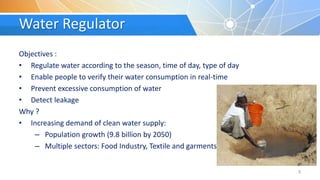
• Regulate water according to the season, time of day, type of day
• Enable people to verify their water consumption in real-time
• Prevent excessive consumption of water
• Detect leakage
Why ?
• Increasing demand of clean water supply:
– Population growth (9.8 billion by 2050)
– Multiple sectors: Food Industry, Textile and garments
3
Project Development
Theoretical Knowledges
• Automation
• Programming
• Regulation
4
Sensors
5
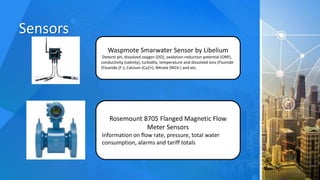
Waspmote Smarwater Sensor by Libelium
Detects pH, dissolved oxygen (DO), oxidation-reduction potential (ORP),
conductivity (salinity), turbidity, temperature and dissolved ions (Fluoride
(Fluoride (F-), Calcium (Ca2+), Nitrate (NO3-) and etc.
Rosemount 8705 Flanged Magnetic Flow
Meter Sensors
Information on flow rate, pressure, total water
consumption, alarms and tariff totals
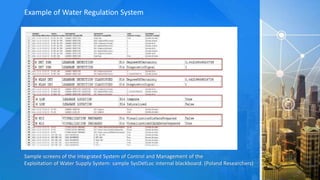
Sample screens of the Integrated System of Control and Management of the
Exploitation of Water Supply System: sample SysDetLoc internal blackboard. (Poland Researchers)
6
Example of Water Regulation System
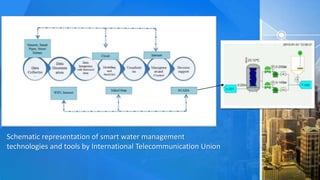
Schematic representation of smart water management
technologies and tools by International Telecommunication Union
7
Conclusion
8
Thank you for your attention

Smart city water regulation system

  • 1.
    Project : WaterRegulation System Presented by : BIN MD SABRI Megat Saiful Islam Adil
  • 2.
    Smart City Core infrastructurein a smart city (MoUD): 1) Adequate water supply. 2) Assured electricity supply. 3) Sanitation, including solid waste management. 4) Efficient urban mobility and public transport. 5) Affordable housing, especially for the poor. 6) Robust IT connectivity and digitalization. 7) Good governance, especially e-Governance and citizen participation. 8) Sustainable environment. 9) Safety and security of citizens, particularly women, children and the elderly. 10) Health and education. 2
  • 3.
    Water Regulator Objectives : •Regulate water according to the season, time of day, type of day • Enable people to verify their water consumption in real-time • Prevent excessive consumption of water • Detect leakage Why ? • Increasing demand of clean water supply: – Population growth (9.8 billion by 2050) – Multiple sectors: Food Industry, Textile and garments 3
  • 4.
    Project Development Theoretical Knowledges •Automation • Programming • Regulation 4
  • 5.
    Sensors 5 Waspmote Smarwater Sensorby Libelium Detects pH, dissolved oxygen (DO), oxidation-reduction potential (ORP), conductivity (salinity), turbidity, temperature and dissolved ions (Fluoride (Fluoride (F-), Calcium (Ca2+), Nitrate (NO3-) and etc. Rosemount 8705 Flanged Magnetic Flow Meter Sensors Information on flow rate, pressure, total water consumption, alarms and tariff totals
  • 6.
    Sample screens ofthe Integrated System of Control and Management of the Exploitation of Water Supply System: sample SysDetLoc internal blackboard. (Poland Researchers) 6 Example of Water Regulation System
  • 7.
    Schematic representation ofsmart water management technologies and tools by International Telecommunication Union 7
  • 8.