Download the full version and explore a variety of ebooks
or textbooks at https://ebookmass.com
Smart Cities and Artificial Intelligence:
Convergent Systems for Planning, Design, and
Operations 1st Edition Christopher Grant Kirwan
_____ Tap the link below to start your download _____
https://ebookmass.com/product/smart-cities-and-artificial-
intelligence-convergent-systems-for-planning-design-and-
operations-1st-edition-christopher-grant-kirwan/
Find ebooks or textbooks at ebookmass.com today!
We believe these products will be a great fit for you. Click
the link to download now, or visit ebookmass.com
to discover even more!
Artificial Intelligence-based Smart Power Systems 1st
Edition Sanjeevikumar Padmanaban
https://ebookmass.com/product/artificial-intelligence-based-smart-
power-systems-1st-edition-sanjeevikumar-padmanaban/
Artificial Intelligence in Urban Planning and Design:
Technologies, Implementation, and Impacts 1st Edition
Imdat As (Editor)
https://ebookmass.com/product/artificial-intelligence-in-urban-
planning-and-design-technologies-implementation-and-impacts-1st-
edition-imdat-as-editor/
Engineering Intelligent Systems: Systems Engineering and
Design with Artificial Intelligence, Visual Modeling
Barclay R. Brown
https://ebookmass.com/product/engineering-intelligent-systems-systems-
engineering-and-design-with-artificial-intelligence-visual-modeling-
barclay-r-brown/
Smart Cities Cybersecurity and Privacy Danda B. Rawat
https://ebookmass.com/product/smart-cities-cybersecurity-and-privacy-
danda-b-rawat/
Artificial Intelligence Hardware Design 1st Edition Albert
Chun-Chen Liu
https://ebookmass.com/product/artificial-intelligence-hardware-
design-1st-edition-albert-chun-chen-liu/
Artificial Intelligence, Game Theory and Mechanism Design
in International Politics Tshilidzi Marwala
https://ebookmass.com/product/artificial-intelligence-game-theory-and-
mechanism-design-in-international-politics-tshilidzi-marwala/
Deepwater drilling : well planning, design, engineering,
operations, and technology application Peter Aird
https://ebookmass.com/product/deepwater-drilling-well-planning-design-
engineering-operations-and-technology-application-peter-aird/
Smart Grids for Smart Cities, Volume 2 1st Edition O. V.
Gnana Swathika
https://ebookmass.com/product/smart-grids-for-smart-cities-
volume-2-1st-edition-o-v-gnana-swathika/
Artificial Intelligence for Dummies 2nd Edition John Paul
Mueller & Luca Massaron
https://ebookmass.com/product/artificial-intelligence-for-dummies-2nd-
edition-john-paul-mueller-luca-massaron/
Smart Cities
Series Editors
Tan Yigitcanlar
Queensland University of Technology, Brisbane, Australia
Nicos Komninos
URENIO Research, Faculty of Engineering, Aristotle University of
Thessaloniki, Thessaloniki, Greece
Mark Deakin
Edinburgh Napier University, Edinburgh, United Kingdom
Untangling Smart Cities (9780128154779)
Smart Cities and
Artificial Intelligence
Convergent Systems for Planning, Design, and
Operations
Christopher Grant Kirwan
Visiting Professor
Informatics Research Centre
Henley Business School
University of Reading
United Kingdom
Zhiyong Fu
Associate Dean
China-Italy Design Innovation Hub
Tsinghua University
China
Elsevier
Radarweg 29, PO Box 211, 1000 AE Amsterdam, Netherlands
The Boulevard, Langford Lane, Kidlington, Oxford OX5 1GB, United Kingdom
50 Hampshire Street, 5th Floor, Cambridge, MA 02139, United States
Copyright Ó 2020 Elsevier Inc. All rights reserved.
No part of this publication may be reproduced or transmitted in any form or by any means,
electronic or mechanical, including photocopying, recording, or any information storage
and retrieval system, without permission in writing from the publisher. Details on how to
seek permission, further information about the Publisher’s permissions policies and our
arrangements with organizations such as the Copyright Clearance Center and the Copyright
Licensing Agency, can be found at our website: www.elsevier.com/permissions.
This book and the individual contributions contained in it are protected under copyright by
the Publisher (other than as may be noted herein).
Notices
Knowledge and best practice in this field are constantly changing. As new research and
experience broaden our understanding, changes in research methods, professional prac-
tices, or medical treatment may become necessary.
Practitioners and researchers must always rely on their own experience and knowledge in
evaluating and using any information, methods, compounds, or experiments described
herein. In using such information or methods they should be mindful of their own safety
and the safety of others, including parties for whom they have a professional responsibility.
To the fullest extent of the law, neither the Publisher nor the authors, contributors, or
editors, assume any liability for any injury and/or damage to persons or property as a matter
of products liability, negligence or otherwise, or from any use or operation of any methods,
products, instructions, or ideas contained in the material herein.
Library of Congress Cataloging-in-Publication Data
A catalog record for this book is available from the Library of Congress
British Library Cataloguing-in-Publication Data
A catalogue record for this book is available from the British Library
ISBN: 978-0-12-817024-3
For information on all Elsevier publications visit our website at
https://www.elsevier.com/books-and-journals
Publisher: Joe Hayton
Acquisition Editor: Brian Romer
Editorial Project Manager: Michelle W Fisher
Production Project Manager: Selvaraj Raviraj
Cover Designer: Alan Studholme
Typeset by TNQ Technologies
Dedication
This book is dedicated to the
celebration of international
collaboration and friendship between
Christopher Grant Kirwan and
Dr. Zhiyong Fu initiated as part of an
academic exchange that has evolved for
over a decade. and to our families,
friends, colleagues, and students who
have supported us in shaping the vision
and material of this book.
A special dedication to the memory of
Constance and Ernest Kirwan, whose
creative, intellectual, and spiritual
direction has been instrumental.
Preface
There is a reason for convergence in the universe. We live in cycles, ebbs and
flows that modulate the rhythms of life evolving towards a state of singularity.
Nature is its own architecture with humans dwelling in the house of planet
Earth as a living organism, contributing, participating, affecting. As Alan Watts
stated in one of his monologues, we are just a bad case of dandruff on the planet.
The question is how disruptive is this condition and will we have enough sen-
sibility to reverse this current systemic malady even if benign to planetary
evolution. As Norbert Weiner described in The Human Use of Human Beings,
Earth has reached its peak in its lifecycle and is now in a state of pre-entropy. The
remedy for arresting this process is in the term he uses as resistance. Within our
own human lifecycle, resistance means effective measures to slow the inevitable
process of decline.
Beyond the biotechnical environmental challenges we are facing, the socio-
economic dimension of human sustainability and self-actualization is perhaps an
even greater obstacle that may prevent human advancement to a new level of
enlightenment. Without a better distribution of wealth and resources to all the
inhabitants of the planet, we will not succeed in achieving a higher state and we
will continue to accelerate our own demise as a human race.
Cities are the new space, playground over battleground, for the distribution of
global resources as the world’s population concentrates in cities. Ironically, we
have increased the density of populated areas and reduced the spatial footprint,
rather than inversely decentralizing people since we now have access to infor-
mation, markets and resources that can be obtained through digital networks.
This signifies a new world order that requires design solutions that solve specific
and global problems that cities create.
Convergence evolution explains how different species evolve with similar
traits. Technology is perhaps the unifying element that brings all cities to a
similar level of enablement and operational control. However, each city has
unique characteristics that embody the concept of city DNA, determining the rate
and type of technological absorption and administration that must be factored in.
The world is still divided with the current economic and trade systems that
polarize individual and collective interests, obstructing collaboration to solve
global challenges. The ability for governments, markets, and societies to develop
international standards and regulations to manage resources and design solutions
will be even more necessary as the planet is now hyperconnected. This leads to
xiii
the requirement of co-creation and co-design methods to align, integrate and
develop universally accepted solutions.
Hence, there is a need for us to develop and manage the system architecture
through a global collective intelligencedwith East and West convergent un-
derstanding of a shared design. This book represents such a collective design
process between two hemispheres, cultures, mindsets, political systems and
individual understandings. The collaboration over the past 10 years between the
authors is an indication of the attempt to obtain shared values, common interests,
and motivation to advance ideas and solutions to allow us to more effectively
manage the convergence process through transdisciplinary and transcultural
efforts.
The next stage in the evolutionary process is the ability for AI to accelerate
the development of solutions that will absolutely be necessary to resist planetary
entropy and the potential collapse of cultures and societies. We pursue a com-
bination of design thinking and machine learning, linking human and technology
in an integrated flow of data and problem-solving processes to achieve the most
optimal convergence state. The ideal outcome is a combination of human well-
being, balance of natural systems, and the optimization of technology. This is the
search for the obtainment of convergence, as the natural evolutionary process
that will again bring humans closer to being in harmony with nature. This entails
the formation of a collective intelligence network that will help cities to self-
regulate as part of Earth’s natural ecosystem, the ultimate goal and steady
state of convergence.
Along the path of convergence, many new combinations and hybrids will
attempt to determine and design sustainable directions including human machine
collaboration, new forms of human-machine behavior, and new patterns lan-
guages that move away from a human-centered focus to establishing a higher
evolutionary stage of humanemachineenature awareness.
We have positioned this book to appeal to a broad audience, ranging from
students to practitioners, through a combination of academic research and pro-
fessional methods in the emerging field of smart cities - still today a somewhat
elusive and catchall term. The evolving discourse surrounding smart cities has
represented both a marketing hype that has been slow to come to real substance
and at the same time a hyper accelerated demand for creative, technical expertise
and advancement across multiple industries and professions, all competing to
obtain a piece of the projected 1.5 trillion dollar pie.
Starting a new decade today, January 1st, 2020, building on the much
anticipated 2020 threshold embodying clear vision and future insight, we are
now firmly entrenched in the process of the convergence of technology, humans,
and nature in a way never before possible in human evolution. This process is
both necessary and part of the evolutionary medium that will allow humans to
manage the planetary resources and human impact in a more efficient and
harmonious manner.
January 1st, 2020
Christopher Grant Kirwan
xiv Preface
Acknowledgments
This book has been formed through a combination of professional and aca-
demic experience that has led us to defining a theory and practice of
convergence.
In the academic realm, this book expands and consolidates research and
projects beginning in 1996 and continuing through the present. This includes
numerous courses and special projects spanning Design and Technology, In-
formation Architecture, Interface Design, Urban Media, as well as Maker
Space workshops, year-end exhibitions, and graduate thesis projects. The
underlying aspects in all of these initiatives have been interdisciplinary, cross-
cultural collaboration, and co-design enabling tried and true and emerging
processes. This generative approach fosters the most optimal methods to better
understand contemporary challenges and design solutions in the crossover and
integration of design and technology and the physical and digital dimensions.
On the professional side, this book represents a diversified, multigenera-
tional design practice (based on the authors’ work experiences and back-
grounds) spanning product design, architecture, urban planning, graphic
design, interactive design, and new mediadrelated to the practice of the
development of sustainable global projects and with a special focus on smart
cities. The enterprises that the authors have established as professional prac-
tices and/or have worked with as consultants in the business of Smart Cities
and AI include Newwork International, AI Convergence, VITADIGI, Linkay
Technologies, IA New, Empire Asia Holding in London and Bangkok, and
other enterprises related to the design and development of Smart Cities and
Smart Nations.
Many students and faculty collaborators were involved in various parts of
the research and application of this book over the past two decades, from
Tsinghua University, Parsons School of Design, Henley Business School,
Harvard Graduate School of Design, collaboration with Stanford University,
Carnegie Mellon, MIT, KAIST, Seoul National University, and other in-
stitutions where the authors have taught and/or have established academic
research collaboration and partnerships, such as the Beijing Design Lab,
Service Design Lab, and Innohub.
Other individuals whom we would like to recognize for the guidance and
advice include Lady Susan Griffiths, Advisor, for her support in reviewing this
book throughout all phases, Edward S. Grant and Joseph Bezzone, Advisors, for
their strategic feedback, Tad Crawford, Publisher, Writer, for his instrumental
xv
technical advice and guidance, Sven Travis, Associate Professor, Parsons
School of Design, for our 25 years of media technology collaboration, Sahara
Kirwan for assisting in the initial documentation preparation and Sanah Kirwan
for ongoing encouragement.
Credits
The specific team brought together to assist the authors in the execution of this
book include the following:
Brent Cooperdresearcher, editor, and contributor
Meng Lindgraphic design and technical illustrations
Bika Armanddtechnical research, communication engineering, systems
architecture and integrationdcontributor Chapter 5
Stefan DobrevdAI research and innovation strategydcontributor Chapter 8
Huan Wangdresearch coordination and graphic design
Ling Chyi Chandresearch coordination
Jiru Zhaodresearch coordination
Jianhua Gudgraphic design and technical illustrations
Jeong Eun Songdgraphic design and technical illustrations
Songling Gaodgraphic design and technical illustrations.
Tommaso Guerzonidresearcher
Sahara Kirwanddocumentation administration and proofing
Miraal Moazzamdproofing
Tsinghua University Student Projects:
Xingjian Cuidtechnical illustration City DNA (Fig. 2.5)
Citizen Engagement (Fig. 6.4)
Junjie Yu, Ke Fang, Yin Li, Yechang Hu, Jieyun Yangdproject creators
“Co-Pulse”
Junjie Yudproject creator “Sub Scope”
Xu Lindproject creator “City Care”
xvi Acknowledgments
Introduction
Until very recently the worlds of Digital and Brick-and-Mortar have remained
divided along the lines of the old and new economies. Old economies were
based on resource development, industrial processes and human labor. New
economies operate on a higher level of abstraction, leveraging computing
power and venture capital, such as with Silicon Valley tech startups and
IPOs. This separation has influenced the business landscape of how real estate
development, infrastructure and cities have evolved. In the physical world, real
estate is limited to property market value. It is valued with respect to available
land and prices can be relativized on a per square meter basis. The digital
economy has no such spatial constraints and is scalable. As such, prices and
profits can be unmoored from a physical base.
Today we are finally seeing these two different worlds convergingdthe
abstract with the concretedbut not without a massive reconceptualization of
how we plan, design, and implement smart cities. Defining and building smart
cities aimed at the convergence of the virtual and the real will ensure harmo-
nious, sustainable solutions will be developed, allowing for adaptation and
change as technology, humans, and the physical environment evolve and are
impacted differently. This book provides a comprehensive approach to the
planning, design, and operations of smart cities and the significant roles Arti-
ficial Intelligence (AI) plays in the convergence of cities, technology, and
nature.
At this particular moment in time, perhaps one of the several major para-
digm shifts in human progress, we have a moment to pause before plunging
headlong into the new reality that is at our threshold: a reality led by new tech-
nologies that are already beginning to transform every aspect of our contem-
porary life as we understand and experience it. This new reality, if managed
ethically through privateepublicepeople partnerships, guiding the conver-
gence of technology with natural and social systems to form self-regulating
governance platforms, will potentially be the solution to what humanity has
constructed as our current demise, the overpopulation of cities, socioeconomic
inequality and injustice, exploitation of our natural resources and the destruc-
tion of earth’s ecosystems. As cities now make up more than 50% of the con-
centration of the world’s population and are absorbing an increasing share of
people, cities are presently the most important point of leverage to focus on as
it relates to the optimization of the earth resources through the application of
xvii
technologies to improve efficiencies for a more sustainable planet. Smart cit-
ies, therefore, are the key to bringing this all together.
In ancient times, humans were more connected to the natural world with
direct relational awareness of universal biorhythms. As we have evolved
with the use of technology, we have moved away from this direct connection
with nature and have lost the capability of sensing nature instinctually. In the
process of the mass migration and overpopulation of urban centers, humans
have exacerbated the interrelationship with nature and compromised earth’s
balance. The concepts put forth in this book, rooted in the theory of conver-
gence, attempt to explain how new technologies enabled by AI, in the present
and future stages of human development, can potentially bring us closer to
nature, assisting humans to understand and visualize the biorhythms and cor-
responding patterns of nature and our footprint and impact on the ecosystem.
In this new stage of development, AI will enable us to achieve a collective
intelligence that has the potential to create a critically needed interface
between humans and the natural world. This interface will be formed over
the next fifty years through a new hyper-accelerated stage of technology and
the convergence of human and machine that will significantly impact our rela-
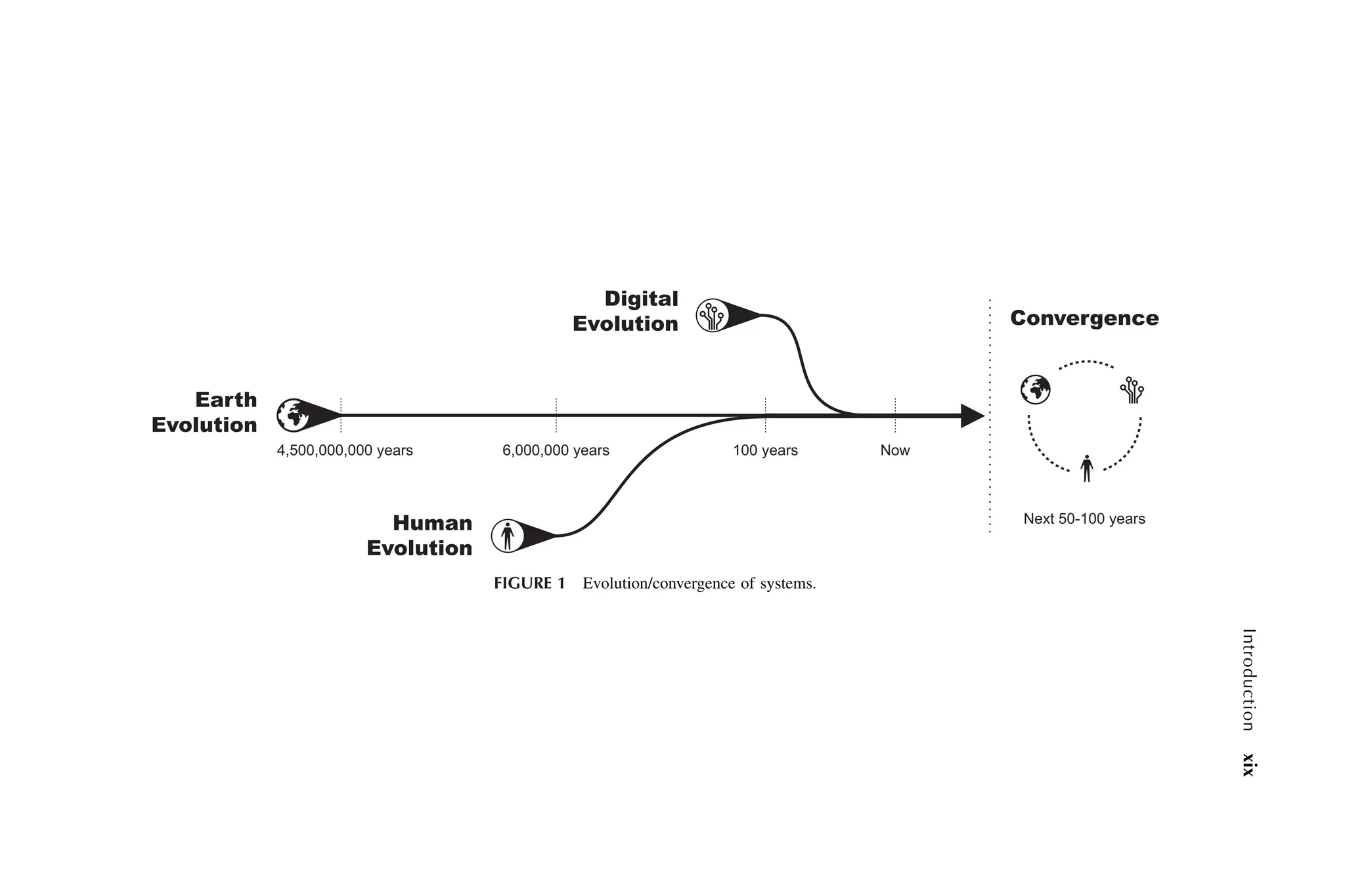
tionship with the planet and the natural world (see Fig. 1).
We now have the opportunity to reverse the anthropogenic damages done
to planet earth and its biosphere and to maintain “homeostasis,” which Norbert
Weiner described, in The Human Use of Human Beings, as the need to “resist
the general stream of corruption and decay.” Just as humans are now able to
apply preemptive measures to personal health management, AI and related
technologies provide us the necessary tools to better manage our natural re-
sources and address anomalies in planetary behaviors in real time. Through
the advancements identified as the Fourth Industrial Revolution (4IR) repre-
senting next generation ICT combined with ecosystem-based innovation, we
have established the basis of new technological processes that will allow us
to achieve a simultaneous balance of human well-being and environmental
sustainability.
In this regard, this book presents a positivistic point of view of how tech-
nology is playing a role in human evolution and evolution in general. It neither
takes a social anthropological or political approach nor a technocratic one. The
concepts presented in this book are a combination of scientific, technological,
and humanistic theory, driven by design thinking with a rationale that follows
the notion that convergence, within the natural evolution of systems, is inevi-
table. In this case, the evolutionary convergence of human civilization, the nat-
ural world, and the technologies made possible with the advancements in ICT,
AI, nanotechnology, biotechnology, design, cognitive science, and other
related fields.
As part of defining this point of view, the book draws from diverse fields of
knowledge and philosophies of the East and the West to achieve a more holis-
tic understanding of evolutionary processes. The schism between eastern and
xviii Introduction
xix
Introduction
Earth
Evolution
Human
Evolution
Digital
Evolution Convergence
4,500,000,000 years 6,000,000 years 100 years Now
Next 50-100 years
FIGURE 1 Evolution/convergence of systems.
western philosophy, science and medicine, which remains still to this day an
impediment to achieving a more enlightened human civilization, may finally
have an opportunity to reach a new dimension of interrelations with the ad-
vancements in technology. Thus, the worldly perspective presented in this
book may provide a new consciousness to support the process of convergence
incorporating both linear and nonlinear processes and in defining a greater
cross-cultural collective intelligence. Without a global partnership and a
coherent set of internationally recognized standards of city design, energy ef-
ficiency, environmental sustainability, labor relations, education, and human
rights, the potential for chaos and collapse will be even greater and will poten-
tially speed up our decline.
In a counterintuitive way, the evolution of technologydfrom the ability to
reorder material and social relations on a global scale to creating general AId
also brings about a realization that low-tech solutions will be, in the end, more
sustainable in some cases. A return to a natural, holistic approach to managing
resources and consuming less may allow humans and nature to achieve a better
balance. Nevertheless, it appears that advancements in technology will not
slow down anytime soon and embracing technology and steering it toward a
more universally equitable application is required in the long run to achieve
a unified operating systemdOS Planet Earth. As the natural world follows
ebbs and tides, so will the evolution of technology, requiring complexity to
lead us to simplicity.
In the theory of communication, semantic noise and psychological noise
are comprehension barriers between the transmitter and the receiver. The
sum of this noise can hold back discourse and drown out the best options.
In this way, the complexity of the future advanced technology is speaking to
us, but the signal-to-noise ratio makes it hard to hear, so it will require a ho-
listic shift that brings all things into a harmonious state of convergence, where
diverse systems become integrated in a unified state of being.
Convergence theory proposition
This book proposes the application of a new composite theory of how cities
adopt technology over a period of time based on diverse subtheories of conver-
gence, such as for evolution, society, science, media, nature, technology,
knowledge, organizations and globalization. One notion of how these intersect
at a higher level is the concept of the “smart city” as a “convergent socio-
cyber-physical complex,” which is optimally adaptive to itself, the state space,
and its members. The 4IR is a major theme in these convergences and the
development of the smart city. Additionally, in developing a proposed method-
ology for how cities can best integrate technology within the planning, design,
and operations of cities, the Convergence Theory for initial value problems is
co-opted and reinterpreted to develop a concept of Net Present Potential that
identifies and analyzes the underlying conditions of the state of the city
xx Introduction
(current physical, cultural and technological status). Solving initial value prob-
lems amounts to predicting the evolution of complex systems, and understand-
ing this process can help show how the Net Present Potential determines the
evolutionary process of adaptation and convergence of cities and technology.
The following explanation is provided to help understand the foundational the-
ories of our combined interpretation and application of convergence to illumi-
nate the evolutionary process of the merging together of diverse systems
including human, natural and technological.
In our Appendix, we explore six topics of convergence that informed our
theoretical and practical understanding. The basic concept comes from conver-
gent evolution, the observation of similar traits in different species, such as the
eyes, hair, organs, appendages, or wings, which did not evolve from a common
ancestor. They evolved the same function because it was so adaptive to a
particular environment. Convergence theories of society observe common fea-
tures and patterns across different cultures and states. Within science and tech-
nology, different techniques and tools are being combined to accelerate
innovation as well as integration with nature. This trend is converging in
Nanotech, Biotech, ICT and Cognitive Science (NBIC). There is also a conver-
gence of knowledge, technology, and society that is bringing together common
knowledge through consilience, networking and new forms of socialization.
Digital convergence has shown exponential growth in computing power ac-
cording to Moore’s law, as well as prolific social media connectivity and AI
assistance. Finally, organization convergence adopts more flexible strategies,
holistic ontologies, and best practices to overcome traditional hierarchies,
inequalities, path dependencies and pathologies.
Methods that are converging in smart city design include Living Labs,
Innovation Hubs, Design Thinking, Co-design and Citizen Centric Cities. Ma-
chine learning and Generative Design are converging and accelerating,
enhancing workflow and computational power and enabling designers to
work more intuitively. By setting certain parameters and letting AI do the
heavy lifting humans and technology are converging ever closer through the
smart design of their own environments. This idea and the table below consti-
tute our convergence methodology.
From this research, we intuited and designed six types of convergences that
fall into three categories. There is a convergence of nature, with convergent
evolution and scientific process convergence. There is a convergence on the
human level, where society converges through growth, interaction and social
systems, as well as general knowledge converging into collective intelligence;
lastly, technology convergence, where digital, ICT and AI systems converge.
These form our basic layers of analysis and align with our six dimensions
of convergence described in Chapter 1. There is simultaneous convergence
in all dimensions, and they are all converging with each other. However, bio-
logical evolution is slow, and technology evolves on an exponential curve that
quickly outpaces biology. Metaconvergence is the convergence of all of them,
xxi
Introduction
which is not linear, but accelerating and recursive because of the faster evolu-
tion of human culture and technology. The six theories and convergence and
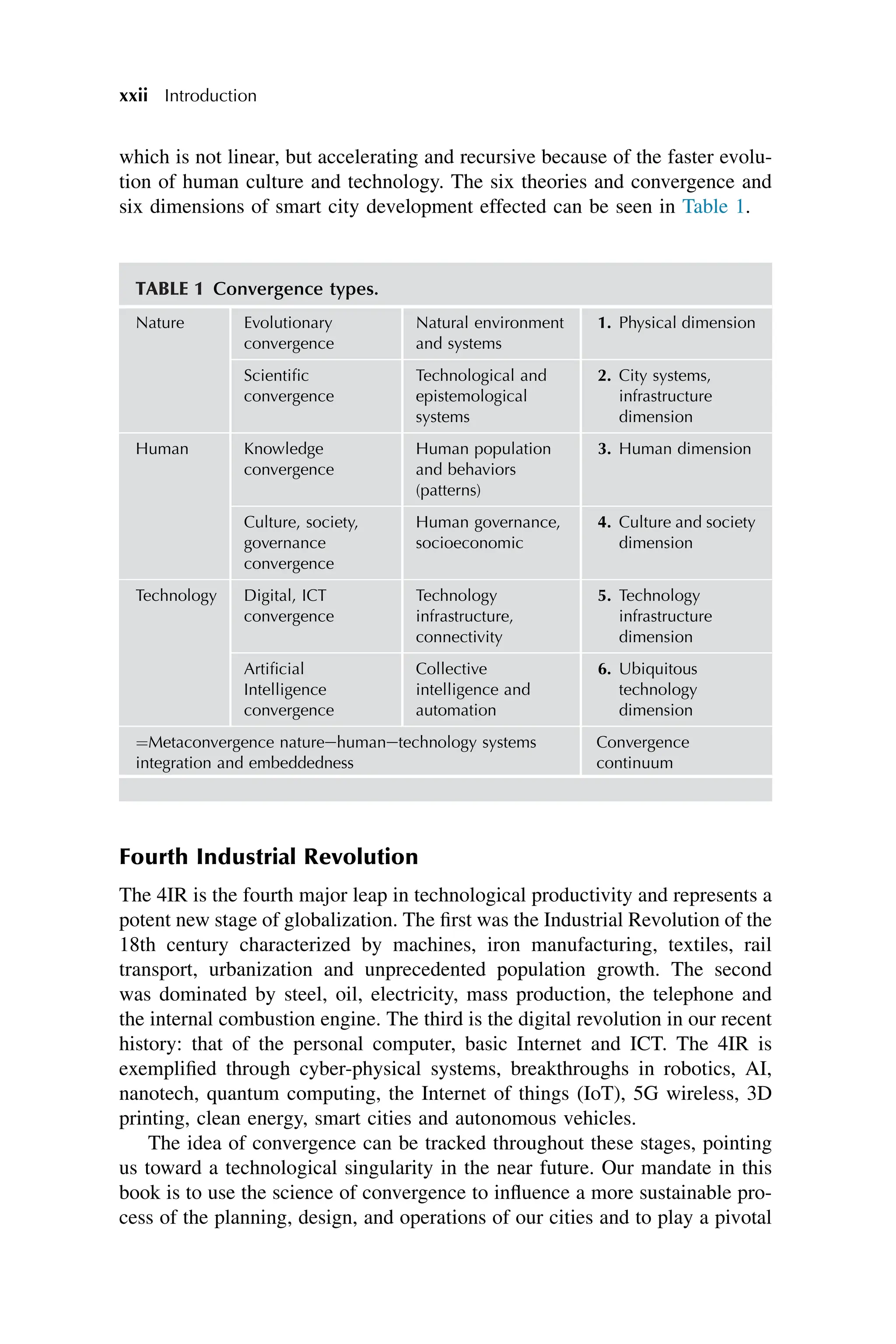
six dimensions of smart city development effected can be seen in Table 1.
Fourth Industrial Revolution
The 4IR is the fourth major leap in technological productivity and represents a
potent new stage of globalization. The first was the Industrial Revolution of the
18th century characterized by machines, iron manufacturing, textiles, rail
transport, urbanization and unprecedented population growth. The second
was dominated by steel, oil, electricity, mass production, the telephone and
the internal combustion engine. The third is the digital revolution in our recent
history: that of the personal computer, basic Internet and ICT. The 4IR is
exemplified through cyber-physical systems, breakthroughs in robotics, AI,
nanotech, quantum computing, the Internet of things (IoT), 5G wireless, 3D
printing, clean energy, smart cities and autonomous vehicles.
The idea of convergence can be tracked throughout these stages, pointing
us toward a technological singularity in the near future. Our mandate in this
book is to use the science of convergence to influence a more sustainable pro-
cess of the planning, design, and operations of our cities and to play a pivotal
xxii Introduction
TABLE 1 Convergence types.
Nature Evolutionary
convergence
Natural environment
and systems
1. Physical dimension
Scientific
convergence
Technological and
epistemological
systems
2. City systems,
infrastructure
dimension
Human Knowledge
convergence
Human population
and behaviors
(patterns)
3. Human dimension
Culture, society,
governance
convergence
Human governance,
socioeconomic
4. Culture and society
dimension
Technology Digital, ICT
convergence
Technology
infrastructure,
connectivity
5. Technology
infrastructure
dimension
Artificial
Intelligence
convergence
Collective
intelligence and
automation
6. Ubiquitous
technology
dimension
¼Metaconvergence natureehumanetechnology systems
integration and embeddedness
Convergence
continuum
xxiii
Introduction
role in bringing OS Planet Earth online. Understanding how convergence
works in the 4IR is critical for getting us through the current various ecolog-
ical, social and epistemic crises. The bureaucratic bottleneck choking out
progress will either be the cause of our extinction or the catalyst of our conver-
gence on metasolutions, thereby releasing the pressure valve to liberate
creative and productive forces to collaboratively build self-sustaining and
self-regulating smart cities.
The metamodern turn
The 4IR is one of the several distinct historical markers for the metamodern
era, circa the turn of the millennium, 2000, as described by Dutch cultural the-
orists Vermeullen and van den Akker. Other relevant markers include global
social movements, global financial crises, and the coining of the “anthropo-
cene” to mark the new period of humans as the dominant geological force
on the planet. Philosopher Hanzi Freinacht develops the concept of metamo-
dernism further into an active social and political philosophy, as well as a the-
ory of (co-)development. Our notion of metamodernism notes these cues but
has a deeper root in Albert Borgmann’s philosophy of technology and his defi-
nition of metamodernism. As metamodern theorist Brent Cooper explains in
his review, Borgmann used the term “metamodern” in an earlier formulation
but then switched to “postmodern realism” in Crossing the Postmodern Divide
(1992) for practical reasons. Nevertheless, we adhere to the spirit of his “meta-
modern” vision, which is needed now more than ever, as metamodernism in
the broader sense still aligned with Hanzi Freinacht, Vermeullen and van
den Akker and others.
In the 1992 edited volume New Worlds, New Technologies, New Issues,
Borgmann predictively described a bifurcation of postmodernism into
techno-social cultures of hypermodernism and metamodernism. While hyper-
modernism refers to pathological and dominant technoscience, metamodern-
ism refers to an alternative path where deep ecology and technology
converge in harmonious ways and people are sensitively attuned to the destruc-
tive impact mass consumption and financial capitalism have wrought. Natu-
rally, our book advocates for the latter forms of society and technological
implementation. The evolving frame of metamodernism gives a necessary his-
torical context to the technological singularity and the social and political
transformations that also must occur. Thus, following on Vermeulen and van
den Akker’s act of introducing the term as an “intervention,” this book hopes
for a “metamodern turn” in smart city literature as well as wider academia, as
the metamodern discourse is also indicative of the convergence of philosophy
itself and the converging oscillations between modern and postmodern forms
of art, culture, critique and technology. Now more than ever, there is a pressing
need to address the schism of postmodernism as Borgmann prescribed back in
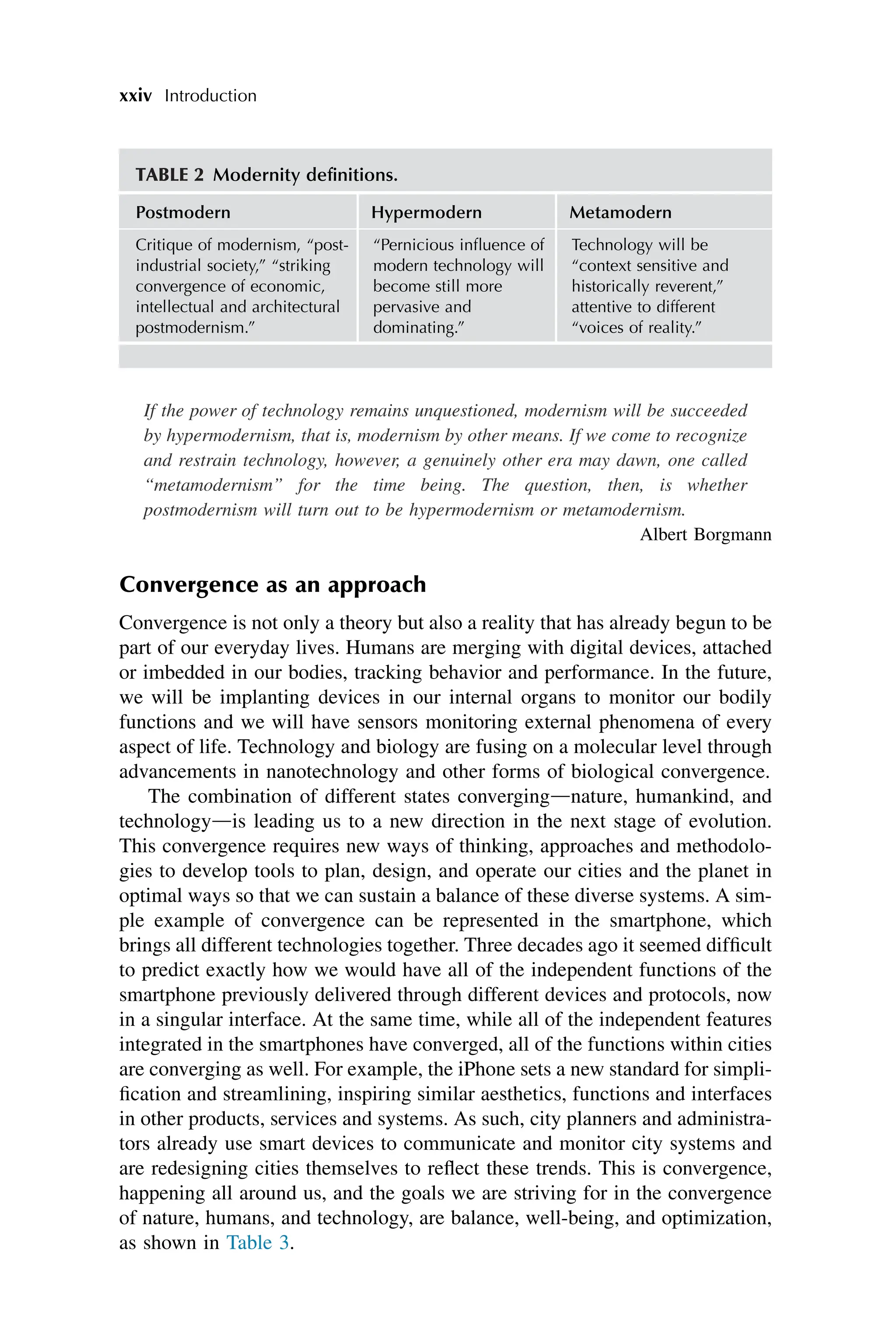
1992. Borgmann’s ideas of the postmodern, hypermodern and metamodern can
be seen juxtaposed in Table 2.
xxiv Introduction
If the power of technology remains unquestioned, modernism will be succeeded
by hypermodernism, that is, modernism by other means. If we come to recognize
and restrain technology, however, a genuinely other era may dawn, one called
“metamodernism” for the time being. The question, then, is whether
postmodernism will turn out to be hypermodernism or metamodernism.
Albert Borgmann
Convergence as an approach
Convergence is not only a theory but also a reality that has already begun to be
part of our everyday lives. Humans are merging with digital devices, attached
or imbedded in our bodies, tracking behavior and performance. In the future,
we will be implanting devices in our internal organs to monitor our bodily
functions and we will have sensors monitoring external phenomena of every
aspect of life. Technology and biology are fusing on a molecular level through
advancements in nanotechnology and other forms of biological convergence.
The combination of different states convergingdnature, humankind, and
technologydis leading us to a new direction in the next stage of evolution.
This convergence requires new ways of thinking, approaches and methodolo-
gies to develop tools to plan, design, and operate our cities and the planet in
optimal ways so that we can sustain a balance of these diverse systems. A sim-
ple example of convergence can be represented in the smartphone, which
brings all different technologies together. Three decades ago it seemed difficult
to predict exactly how we would have all of the independent functions of the
smartphone previously delivered through different devices and protocols, now
in a singular interface. At the same time, while all of the independent features
integrated in the smartphones have converged, all of the functions within cities
are converging as well. For example, the iPhone sets a new standard for simpli-
fication and streamlining, inspiring similar aesthetics, functions and interfaces
in other products, services and systems. As such, city planners and administra-
tors already use smart devices to communicate and monitor city systems and
are redesigning cities themselves to reflect these trends. This is convergence,
happening all around us, and the goals we are striving for in the convergence
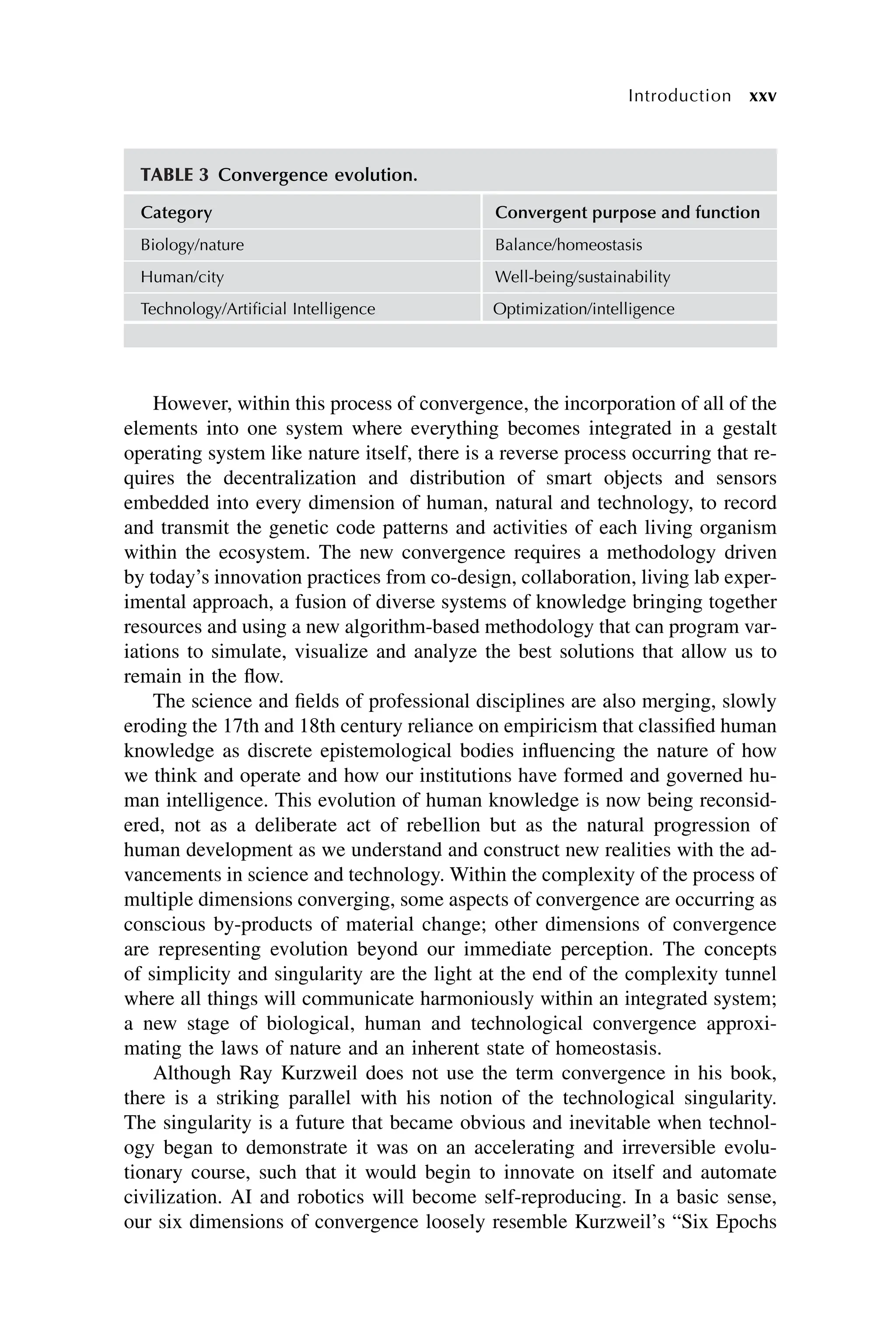
of nature, humans, and technology, are balance, well-being, and optimization,
as shown in Table 3.
TABLE 2 Modernity definitions.
Postmodern Hypermodern Metamodern
Critique of modernism, “post-
industrial society,” “striking
convergence of economic,
intellectual and architectural
postmodernism.”
“Pernicious influence of
modern technology will
become still more
pervasive and
dominating.”
Technology will be
“context sensitive and
historically reverent,”
attentive to different
“voices of reality.”
However, within this process of convergence, the incorporation of all of the
elements into one system where everything becomes integrated in a gestalt
operating system like nature itself, there is a reverse process occurring that re-
quires the decentralization and distribution of smart objects and sensors
embedded into every dimension of human, natural and technology, to record
and transmit the genetic code patterns and activities of each living organism
within the ecosystem. The new convergence requires a methodology driven
by today’s innovation practices from co-design, collaboration, living lab exper-
imental approach, a fusion of diverse systems of knowledge bringing together
resources and using a new algorithm-based methodology that can program var-
iations to simulate, visualize and analyze the best solutions that allow us to
remain in the flow.
The science and fields of professional disciplines are also merging, slowly
eroding the 17th and 18th century reliance on empiricism that classified human
knowledge as discrete epistemological bodies influencing the nature of how
we think and operate and how our institutions have formed and governed hu-
man intelligence. This evolution of human knowledge is now being reconsid-
ered, not as a deliberate act of rebellion but as the natural progression of
human development as we understand and construct new realities with the ad-
vancements in science and technology. Within the complexity of the process of
multiple dimensions converging, some aspects of convergence are occurring as
conscious by-products of material change; other dimensions of convergence
are representing evolution beyond our immediate perception. The concepts
of simplicity and singularity are the light at the end of the complexity tunnel
where all things will communicate harmoniously within an integrated system;
a new stage of biological, human and technological convergence approxi-
mating the laws of nature and an inherent state of homeostasis.
Although Ray Kurzweil does not use the term convergence in his book,
there is a striking parallel with his notion of the technological singularity.
The singularity is a future that became obvious and inevitable when technol-
ogy began to demonstrate it was on an accelerating and irreversible evolu-
tionary course, such that it would begin to innovate on itself and automate
civilization. AI and robotics will become self-reproducing. In a basic sense,
our six dimensions of convergence loosely resemble Kurzweil’s “Six Epochs
xxv
Introduction
TABLE 3 Convergence evolution.
Category Convergent purpose and function
Biology/nature Balance/homeostasis
Human/city Well-being/sustainability
Technology/Artificial Intelligence Optimization/intelligence
xxvi Introduction
of Evolution,” which explains stages of information in (1) atomic structures,
(2) DNA, (3) neural patterns, (4) hardware and software, (5) human-tech
merger, and (6) nature-tech merger. Similarly, in The Social Singularity,
Max Borders writes that AI, neuroscience, and collective intelligence will
converge.
If the process of the convergence of nature, human, and machine relies
partially on human input, then indeed the output will continue to incorporate
human error that will inevitably be factored in the evolution of the converging
system. If nature is perfect and the future of machine learning is based on
logic, our fallibility may be the remaining ingredient that retains the state of
imperfection. In the Japanese sense of beauty, the tension between harmony
and disharmony, like a beautiful improvisational jazz composition or the
asymmetry of the branches of a Bonsai tree, may be what keeps things in a
state of dynamic equilibrium.
Further reading
Allenby, B., 2007. The Convergence of Science, Technology, and Nature. GreenBiz. https://www.
greenbiz.com/blog/2007/04/01/convergence-science-technology-and-nature. (Accessed 20
January 2020).
Baldwin, R., 2016. The Great Convergence: Information Technology and the New Globalization.
Belknap Press.
Borders, M., 2018. The Social Singularity. Social Evolution.
Borgmann, Albert., 1992. In: Cutcliffe, Stephen H. (Ed.), “The Postmodern Economy.” New
Worlds, New Technologies, New Issues. Lehigh University Press.
Brio, M., et al., 2010. Convergence Theory for Initial Value Problems. Mathematics in Science and
Engineering 213 (C), 109e144. https://doi.org/10.1016/S0076-5392(10)21308-5. (Accessed
20 January 2020).
Chartres, B., Stepleman, R., 1972. A General Theory of Convergence for Numerical Methods.
SIAM Journal on Numerical Analysis 9 (3), 1972, pp. 476e492. JSTOR, http://www.jstor.org/
stable/2156145.
Cooper, B., 2019. Borgmannian Metamodernism. “The Abs-Tract Organization”. https://medium.
com/the-abs-tract-organization/borgmannian-metamodernism-8ed5e275f8ae. (Accessed 20
January 2020).
Deloitte Insights/Tech Trends, 2018. The Symphonic Enterprise.
Freinacht, H., 2017. The Listening Society: A Metamodern Guide to Politics, Book One. Meta-
moderna ApS.
Freinacht, H., 2019. Nordic Ideology: A Metamodern Guide to Politics, Book Two. Metamoderna
ApS.
Kurzweil, R., 2005. The Singularity is Near. Penguin Books.
Roco, M., et al., 2014. The Convergence of Knowledge, Technology, and Society. Springer Science
& Business Media.
Vermeullen, T., van den Akker, R., 2017. Metamodernism: Historicity, Affect, and Depth after
Postmodernism. Rowman and Littlefield.
Volkov, A., 2018. Smart City: Convergent Socio-Cyber-Physical Complex. MATEC Web of
Conferences 251, 03065. https://doi.org/10.1051/matecconf/201825103065. (Accessed 20
January 2020).
Watson, P., 1997. Convergence: The Idea of the Heart of Science. Simon and Schuster.
Description of each section
Descriptions overview
The book is divided in sections Approach, Architecture, and Application
giving equal space to these three dimensions representing the convergence
theories and methodologies integral in the planning, design and operations of
Smart Cities and Artificial Intelligence (AI).
Section 1
Approach
This section of the book covers our approach to the challenge of smart cities
and the role of technology and artificial intelligence on a broad scale. Chapters
1e3 are about the perspective and epistemology of the book, laying down the
basic definitions and premises about the evolution of smart cities based on
supporting convergence theories and system science. It is grounded in applied
methodologies related to more open-ended design fields to identify the po-
tential for systems and cities to be autopoietic or self-regulating.
Chapter 1 is about establishing theoretical foundations in the evolution of
systems and the application of convergence theories to the advancement of
cities and their ability to adapt and transform based on their unique DNA. The
theory of convergence introduced before is applied to smart cities to under-
stand the accelerating and intersecting trajectories of technology and social
organization. Some smart city case studies are explored to illustrate the notion
of city DNA, as a speculative measure of a city’s history, cultural code, and
socio-technical landscape. The six dimensions of the city are outlined in
further detail, explaining how all layers are connected and converging. The six
layers fall into three translocal spaces that intersect: the physical domain, the
human realm, and the technology sphere. All are convergent.
Chapter 2 looks at cities as socio-biological and metabolic systems, rooted
in diverse understandings of cities as living systems and the relation to human
xxvii
anatomy. It starts by recalling the history of organic and systemic thinking
about cities, from Thomas Hobbes to Niklas Luhmann. This includes discussion
of biomimicry and urban biology informing our design principles, down to
providing tables analogizing the system functions of the human body to that of
the city, the social body, and its needs and technologies. It then outlines the
concept of collective intelligence, the living wisdom emergent from informed
and educated citizens involved in sense-making and decision-making, and in-
tegrated with the technological landscape. City DNA is emphasized as the
ability for each city to identify its own uniqueness and integrate universal
standards with local needs accordingly. This brings into focus the role of
mapping and data collection as foundational mediums of smart city operations,
monitoring and coordinating the self-organization of the city and its inhabitants.
Chapter 3 enters into the normative, constructive, innovative, and genera-
tive aspects of smart city planning. It draws from diverse design practicese
Design Thinking, Co-Design and Generative Design, to develop new hybrid
methodologies to address a changing world, and adapt to new urban systems
and realities. Machine learning is brought forth as a tool to facilitate outcome-
based modeling, where the city is generatively designed based on its needs,
borrowing from the biomimetic approach introduced in the previous chapters.
All these are considered in light of the convergence design method that allows
us to now simulate the city in real-time, in public, and open-source ways.
Section 2
Architecture
The Architecture section ranges from macro city anatomy to micro user
experience. Chapters 4e6 look at the organizational structure, communication
spectrum and system behaviors of Smart Cities based on three major
elementsdoperating systems (OS), connectivity, and interface. The smart city
is in itself a self-forming and self-regulating system that evolves based on its
inherent characteristics and formal structure as a living, adapting system. The
smart city is a form of neural network interface linking multiple stakeholders
and diverse ontological frames of reference or UX. The concept of a smart city
information architecture represents different scales and functional typologies
that are integrated with the City OS and city-wide Interface.
Chapter 4 is about city OS, meaning how the city operating system is a
combination of top down, bottom up and middle ground influences. Establishing
xxviii Description of each section
the appropriate system architecture for each city requires an understanding of
the structure, relationships, rationale and intended outcomes of the system. This
is filtered into an aesthetic and intelligent interface, the face of the city as a
living lab. We propose a convergent OS where living systems, technical net-
works, and humane interfaces all interconnect and converge, organizing
together hierarchies of governance and infrastructure.
Chapter 5 is about connectivity. Connectivity is the medium for cities to
achieve a new ambient connectivity based on Artificial Intelligence (AI),
neural networks, and machine learning (ML). Connectivity evolves like the
city itself, based on different infrastructures through time, from rivers and
roads to wireless transmission. Communication technology is evolving along
more expansive lines now, becoming more invisible and real time. Connec-
tivity is built into urban architecture. AI and ML allow for more dynamic
utilization of different bandwidths. The ubiquitous connectivity allows the
convergent urban architecture to self-regulate.
Chapter 6 describes the evolving and adapting complex city interface.
Interface is what allows people and elements to interact in a new city-wide
collective intelligence platform. It posits the ultimate direction of a seamless
interface, merging nature and technology in urban architecture. Through this
trajectory of the book, there is a thematic ramping up of the technological
convergence, toward a totalistic interface and holistic information architecture.
Chapters 4e6 combined provide a gestalt view of the hybrid systems archi-
tecture that allows the AI driven smart city to be adaptable, sustainable and
self-regulating.
Section 3
Application
Chapters 7e9 cover the application of smart cities across the established
functional typologies identified in the City Mandala model as a continuous
wheel of interconnected yet independent functions as basis of the smart city
operations. The functions are presented through an evolutionary lens that
traces the development and trends of how technologies are reshaping the na-
ture of cities and the convergence of human, machine, and natural environment
as a new collective intelligence formation through the lenses of specific sce-
narios, functions, and business models.
xxix
Description of each section
Chapter 7 describes smart city functions based on evolutional (horizontal
timeebased) scenarios describing the relationship between objects
(resources), actions (coordinated input), and outcomes (higher state). We use
this analytical framework to present the directional relationship between the
elements found in each smart city function. The identified states represent the
highest level of the functional hierarchy (desired outcome or singularity)
needed to balance and support smart cities. The six functions of smart cities
(based on the Smart City Mandala) act as the building blocks of an integrated
universal city OS customizable to each city DNA. We then present various
scenarios for each of the functions through the lens of a process-oriented
systems-change framework, the multi-level perspective (MLP) model, and
the convergence of natureehumanemachine. This allows us to trace the
directional development and convergence that leads to the six states (inputs
and development stages).
Chapter 8 presents the key technologies necessary for the deployment and
development of Artificial Intelligence (AI) (cloud computing, 4G/5G, and Big
Data) across the six smart functions. A Scale Hierarchy framework is adopted
to present the macro-, meso-, and micro-levels of the smart city functions. A
Scope Hierarchy framework is applied to present three levels as well, of how
the applications fall into the context (macro convergence), content (application
themes), and component (micro convergence & strategy) dimensions across
the six smart functions. Presented in sets of three, these combinations allow us
to explore new levels of analytical complexity indicative of the broadest
application of the convergence of humans, machines, and nature in the context
of smart cities.
Chapter 9 explores the transforming landscape of business prospects and
new economic models related to smart cities and AI. It invokes some themes,
strategic implications, and the high-impact components for creating sustain-
able advantage in the era of AI-driven innovation and explores how these can
be embedded in the design language and business models of the future. AI
enabled Smart City applications show the niche opportunities for businesses to
collaborate more with other businesses and establish public-private models due
to the convergence of technology, and the codependency of users and citizens
as stakeholders in new commons-based forms of commerce and industry. The
convergence is noted in the context of competitive advantage and business
strategy, as well as the niche innovations of social movements and open-source
technology to challenge the incumbent market-driven paradigm. The lessons
learned in Chapters 7 and 8 help us build the bigger picture scope of Chapter 9.
xxx Description of each section
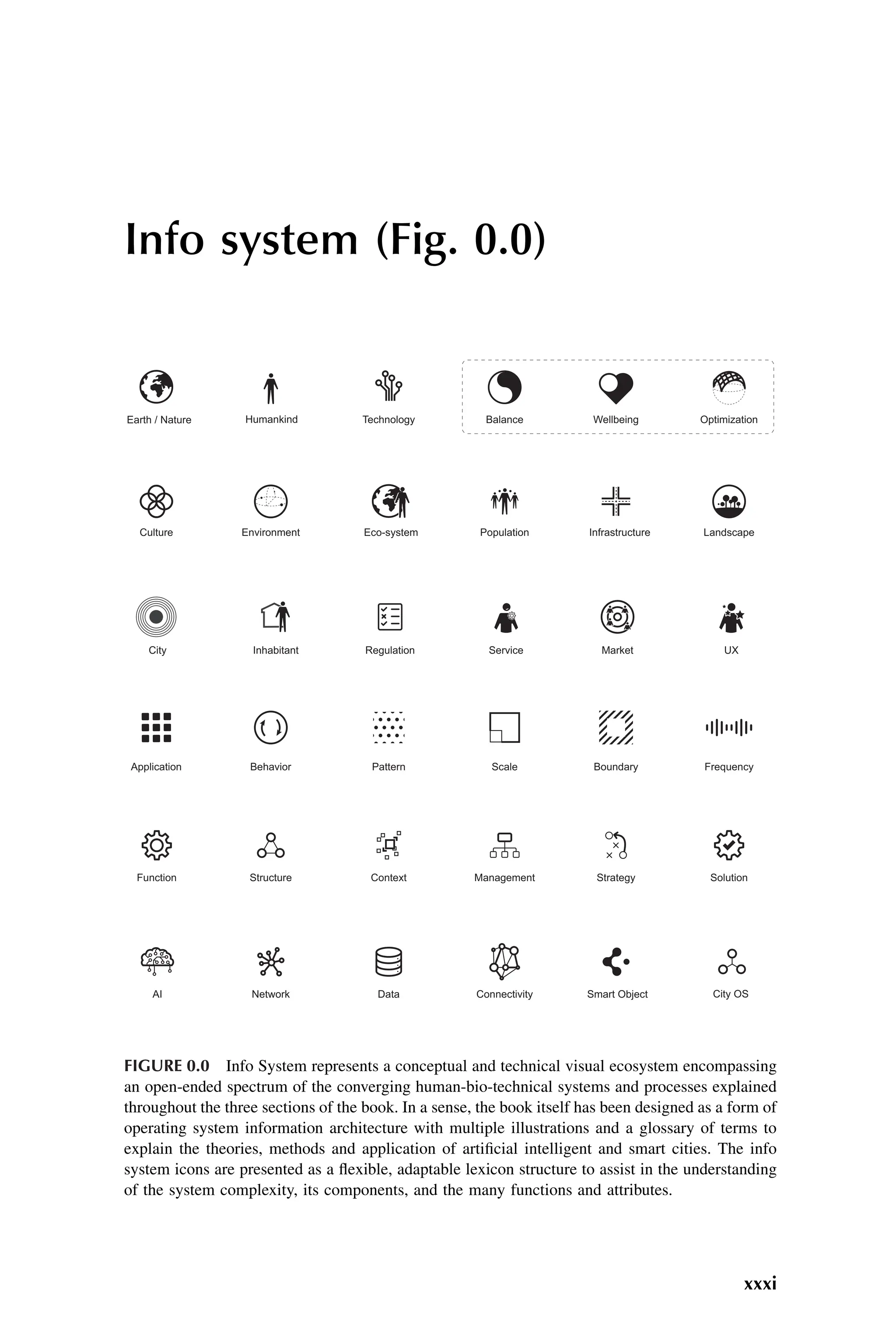
Info system (Fig. 0.0)
Behavior
Application Pattern Frequency
Scale Boundary
Eco-system
Environment Population Infrastructure Landscape
Culture
Structure Context Management Strategy Solution
Function
Network Data Smart Object
Connectivity
AI City OS
Humankind
Earth / Nature Technology Balance Wellbeing Optimization
City UX
Regulation Service Market
Inhabitant
FIGURE 0.0 Info System represents a conceptual and technical visual ecosystem encompassing
an open-ended spectrum of the converging human-bio-technical systems and processes explained
throughout the three sections of the book. In a sense, the book itself has been designed as a form of
operating system information architecture with multiple illustrations and a glossary of terms to
explain the theories, methods and application of artificial intelligent and smart cities. The info
system icons are presented as a flexible, adaptable lexicon structure to assist in the understanding
of the system complexity, its components, and the many functions and attributes.
xxxi
Chapter 1
Evolution of cities/technologies
Chapter outline
1.1 Overview of smart city concept
and context 2
1.2 The evolution and integration of
technology, AI, and cities 4
1.2.1 Evolutionary strategies 7
1.3 City DNA narratives 9
1.3.1 Beijingdthe radiating
megacity 10
1.3.2 Londondthe cosmopolitan
hub 11
1.3.3 New Yorkdthe media
metropolis 12
1.3.4 Dubaidthe iconic branded
city 13
1.3.5 Songdodthe new digital
city 14
1.3.6 Masdardthe new
sustainable city 15
1.3.7 NEOMdthe future city 16
1.3.7.1 Summary 17
1.4 The dimensions of the city and
potential for convergence 17
1.4.1 Physical/environment
dimension 18
1.4.1.1 The city as evolu-
tion of space, form
and hardware 18
1.4.2 City systems, infrastructure
dimension 19
1.4.2.1 The network of the
city, the spine, and
major organs 19
1.4.3 The human dimension 19
1.4.3.1 The city as a
manifestation of
human patterns
and constructs 19
1.4.4 Culture, society, and
governance dimension 19
1.4.4.1 The nuances of
human civiliza-
tion, behaviors,
activities, desires,
and relations 19
1.4.5 Digital infrastructure
dimension 20
1.4.5.1 The city as evolu-
tion of systems,
technologies, and
software 20
1.4.6 The ubiquitous dimension 20
1.4.6.1 The merging of
technology with
the natural envi-
ronment in the
form of imbedded
and ambient con-
nectivity 20
1.5 How convergence theory applies
to smart cities 21
1.6 Conclusion 22
References 23
Further reading 24
Smart Cities and Artificial Intelligence. https://doi.org/10.1016/B978-0-12-817024-3.00001-5
Copyright © 2020 Elsevier Inc. All rights reserved. 1
1.1 Overview of smart city concept and context
“Smart city” is now the popular concept driving cities around the world to a
new level of technology innovation and quality of life enhancement while
simultaneously a term being co-opted for the purpose of attracting investment
and stimulating new economic opportunities. This latter purpose is a critical
part of the establishment of a sustainable business ecosystem that can support
the requirements of the development of a smart city and the next generation of
urban growth. Investment is a necessary, but not sufficient, precondition for
establishing a smart city. The determination of what is required to make a city
smart originates in the unique characteristics of each individual city: its
geographic location, physical composition, inhabitants, workforce, govern-
ment structure and policies. The term “city DNA” is used in this book to
express this complex composition specific to each city.
Over the last several years as the definition of smart city has emerged,
numerous research initiatives, technical studies and reports have been published
to create a coherent etymological framework and taxonomy of smart cities. The
book Understanding Smart Cities: A Tool for Smart Government or an Indus-
trial Trick? (Anthopoulos, 2017) explains the evolution of the concepts and
terminology of smart cities, beginning with the earliest references to digital
cities beginning in the 1990s. Since then, multiple interpretations of smart cities
are fashioned based on the stages of technological advancements including the
Internet of things (IoT), smartphones and various tech fads that are codependent
in the sense of establishing a new language representing market-driven inno-
vation. “Smart city” discourse initiated around the requirements of ICT to
address urban conditions and adapt to local needs, and has been continuously
evolving and converging into more complex schematic representations.
In tracing the etymology of the term smart cities through different in-
carnations, we see that the way we use language to shape and style our social
reality obscures the more significant reality of the merging of the physical and
digital realms, the convergence of technology and everything else as an
evolutionary process. It may be right under our noses, but the scent is elusive.
Some true aspect of smart cities is masked by our linguistic comprehension of
it. In defining things, much perspective is gained but something is lost in
translation; this is akin to the concept of leaky abstractions in programming.
This book points to the process of convergence (beyond words) as the key to
understanding the evolution of smart cities and paths to adoption.
The importance of understanding the evolutionary process of how cities
adopt and integrate technologies to transform the nature of the city is critical
within the context of determining how and why technology is best utilized to
achieve the goals and requirements of each city to remain competitive and
cooperative within the global landscape. As introduced in the previous chapter,
the convergence theory applied to society in the context of smart cities
describes the nature of all systems to develop parallel or similar traits when
provided the same resources, opportunities and industrial or technological
systems. This deterministic view of the evolution of cities and societies
2 SECTION | I Approach
reinforces the hypothesis that all cities will arrive at a similar stage of tech-
nological development if presented with the same technological advance-
ments, leading to the lessening of the disparity between smart cities versus
those that are less developed. However, this theory presupposes that cities are
similar in terms of their initial starting point, which we elaborate further in this
chapter and define as the Net Present Potential.
To determine the potential for cities to achieve being defined as a smart
city, a major consideration is the historic context of development. It is this
criterion that differentiates the unique smart city strategy and implementation
plan that is required to achieve the goals of what is “smart.” Around the world,
the diverse types of cities and their stage of development, from historical cities
to new planned cities, influence which direction the smart city development
will take its course. This diversity has made it challenging for professionals
and those leading the development of smart cities to agree upon an established
language and approach. To solve this issue, initiatives are taking place inter-
nationally by diverse stakeholders and professionals to develop a universal
language including the establishment of ISO standards and best practices that
will eventually govern the development of smart cities.
Technology is evolving in teleonomic (undirected) and teleological (directed)
ways and converging on AI-driven, autonomous, self-regulating systems. Like-
wise, our societies and cities evolve in similar ways and by definition are “self-
organizing” given that no one person is omniscient. The ultimate goal is for
Artificial Intelligence (AI) to assist in the self-regulation of cities as living sys-
tems. If we think of traditional forms of city governance like the process of triage,
thenself-regulatingsmartcitiesuseAIandmachinelearningtomonitorsystemsin
real time and anticipate problems, thereby saving everyone with fewer resources.
Technology has had a clear “automation” function since the industrial revolution
and the assembly line was born. In the 21st century, automation is eliminating
the final sectors of physical labor and human work is increasingly abstract. The
autonomization of smart cities therefore recognizes the imperative to serve the
needs of the people who make it up.
“A city is a system of systems with a unique history and set in a specific envi-
ronmental and societal context. In order for it to flourish, all the key city actors
need to work together, utilizing all of their resources, to overcome the challenges
and grasp the opportunities that the city faces. The “smartness” of a city de-
scribes its ability to bring together all its resources, to effectively and seamlessly
achieve the goals and fulfil the purposes it has set itself.”
ISO/IEC 2015.
As cities developed over many centuries, the physical, socioeconomic
configuration has transformed in some cases drastically, while in others the form
of cities has expanded in a linear progression that has reflected the organic growth
of the city as a direct response to population increase and the need for expanded
land areas. In the recent TV documentary series Ancient Invisible Cities (BBC
Two, 2018), Istanbul is explored for its reconfigurations over the past 2000 years
from Roman outpost, to the seat of the Ottoman Turk empire, from Pagan to
Evolution of cities/technologies Chapter | 1 3
Roman to Christian to Islamic to today’s more secular multicultural city. As
explained through digital models and 3D visualization, including Virtual Reality
(VR), these massive transformations, as a result of shifts of empires, wars and
conquests, are expressed in the complex strata of urban archeology architects
define as palimpsest. Meaning the layers of architectural formal language written
over time, in this case representing the physical manifestation of Istanbul’s evo-
lution from ancient to modern times as a gateway between the East and the West.
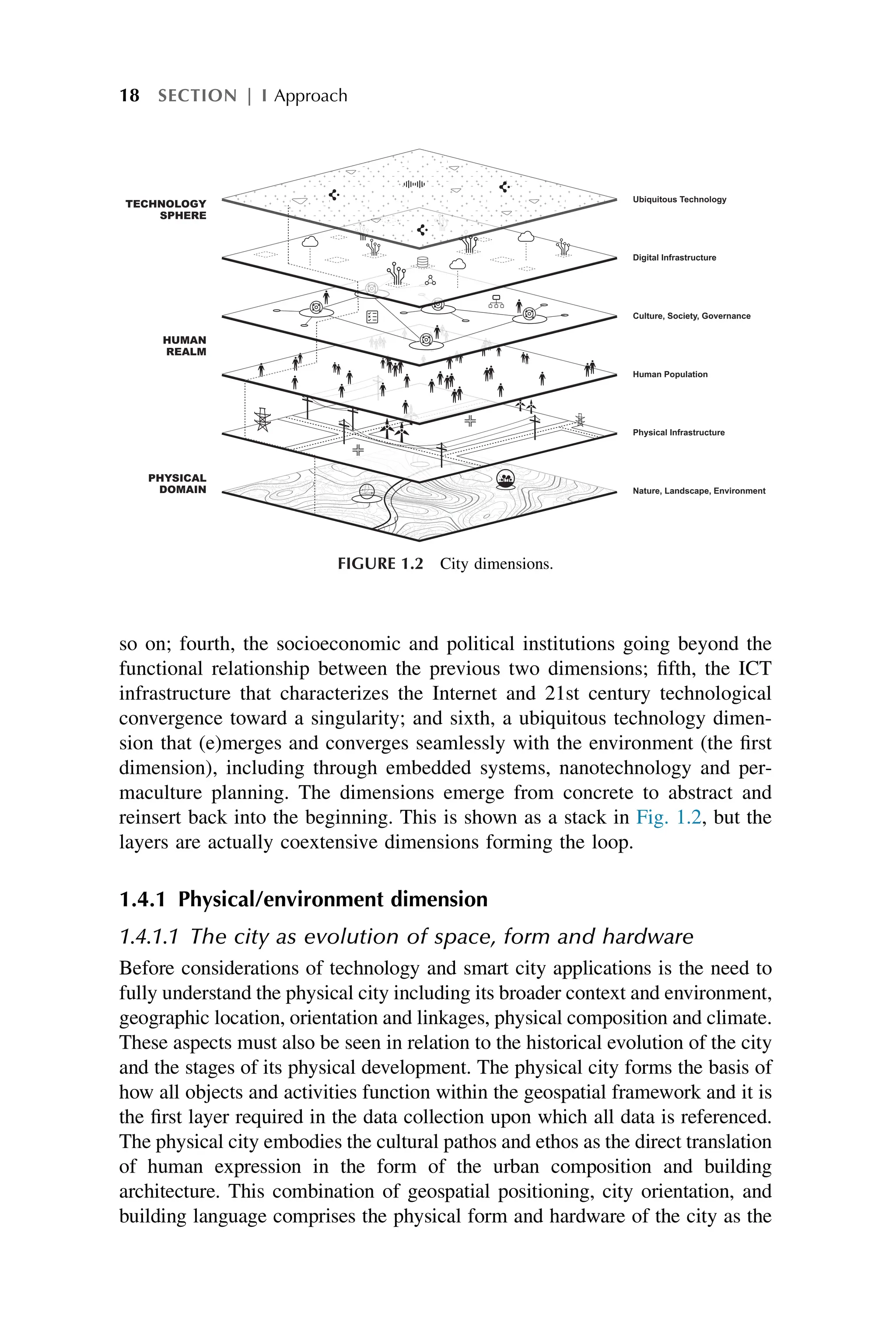
In Section 1.3 we develop our concept of six dimensions of the city, which
are both layered on top of and throughout each other, culminating in a
seamless continuum. These dimensions are based on the fact that the “first
distinctive characteristic of smart cities is the central role of technology,” as
described in the Angelidou paper Four European Smart City Strategies (2016).
Technology enables vast scales of knowledge and information to an increasing
number of people, ostensibly to make their own lives and social structures
more efficient. As technology gets cheaper and the urban geography gets
mapped extensively with sensors, the IoT emerges. Coupled with the rising
interest in personal data logging, city operations can also be monitored and
audited, so public authorities and citizens can make informed decisions and
solve problems. In short, the technology enhances city functions, thereby
rendering it smart. We develop our six dimensions to describe how technology
bookends the human experience, between nature and the technological sin-
gularity and looping through natureelow techehumansegovernanceehigh
techeubiquitous tech/reinsertion to nature.
1.2 The evolution and integration of technology, AI,
and cities
Everything evolves in the basic sense of change over time, but more specif-
ically cities evolve akin to living organisms changing through adaptation,
selection and emergence into higher and more extensive forms. Throughout
history we have seen empires rise and fall according to discernible patterns,
but now we are in an age of globalization and perpetual cities and must un-
derstand the evolution of cities and technology to achieve sustainability and
avoid systems collapse. The unique evolution of cities as manifested through
the combination of the development of physical urban form, societal structure
and cultural expression is the foundation of the city DNA and the substance by
which the technological dimension of the city will be integrated. How tech-
nology will contribute to the city DNA is a result of the ability of individual
cities to adopt and integrate technologies based on their unique characteristics,
opportunities and constraints within the process of convergence.
To explain the Net Present Potential of a city, we have co-opted the “initial
value problem” concept and applied this to the evolution of technologies for
the purpose of developing benchmarks to understand how each city will evolve
over time. This is based on the initial value status representing the combi-
nation of factors, including physical environment, population, culture, socio-
economic, political and historical characteristics. This combination is what we
4 SECTION | I Approach
have termed city DNA, explained in more detail in Chapter 2. Without un-
derstanding each cities’ DNA and historical development, it is not possible to
plan the appropriate smart city solutions. We must factor in its historical de-
velopments and how these will be influencing factors in the future adoption
and integration of technology within the specific culture, in the broadest sense,
of each city, hence Net Present Potential and city DNA.
An initial value problem (also called a Cauchy problem) refers to physics
equations that model systems based on a key variable used to predict the
unfolding of the system over time. Applied to the evolution of cities, the initial
value can help indicate what stage of technological development a city is at
and how best to integrate new technologies. For example, underdeveloped
cities can leapfrog ahead of older cities with developed infrastructure by
skipping an outdated stage of technology. Alternatively, developed cities can
often adapt new technologies and applications faster. Put another way, the
problem is how to determine the initial “value” or “potential” of
somethingdsay, a city, for our purposesdwhen it depends on how the
problem is understood. As technology converges in some places more than
others, we need a way to determine the prospects of a given city and what
stage it is at in its convergent evolution.
Why is the determination of the evolutionary characteristics important in
the adaptation of technology? Given the notion of the convergence of cities
and technology, the historical development of cities coupled with the
consideration of the Net Present Potential of cities provides a baseline to
evaluate how each specific city will develop uniquely through the application
of smart city technologies to serve the specific needs and cultural
requirements of that city. Simultaneously, this criterion offers the possibility
to understand how individual cities will develop in parallel with other cities
of similar characteristics. As time goes on, we anticipate more cities will
incorporate these concepts to have an increasingly clear sense of their city
DNA, for which machine learning algorithms will be applied to maintain and
develop the city as a self-regulating organism. Under our collective guidance,
cities will be programmed to constantly improve along prescribed
dimensions.
We are well into a 50 year Convergence window where nature, technology
and humans will deepen their connectivity and resilience. A complex study of
history allows us to predict and project this window of the future in terms of
key indicators of change such as climate change, renewable energy automa-
tion, AI, population stabilization and the implications for smart cities. Through
this process, the spirit of Deep Ecology, Deep Learning and Depth Psychology
can converge into a profound Collective Intelligence of compassionate humans
and environments that are aided by AI. The following graphic represents a
hypothetical evolution of the combination of the physical environment, human
population growth and technological advancements to illustrate the conver-
gence of these three independent states (Fig. 1.1).
Evolution of cities/technologies Chapter | 1 5
Excellerating Cycles of Innovation
Population Growth
Moore’s Law
400 Years 200 Years 100 Years 50 Years
TIMELINE
Convergence
50 Year Window of Convergence
DEEP LEARNING
SMART CONNECTED
OBJECTS
AUTONOMOUS
VEHICLES
ROBOTICS
AI
COLLECTIVE
INTELLIGENCE
1200 1600 2000 2050 2100
Innovation Cycles
1800
1400
Population
STRONG AI
AMBIENT
CONNECTIVITY
ARTIFICIAL
NEURAL NETWORKS
SMART CITIES
Computing increase in power
and decrease in relative cost
10 billion
people
6 billion
people
350 million
people
Moore Law
Exponential growth in intelligence
AI exceeding human capability
FIGURE 1.1 Timeline of converging systems.
6
SECTION
|
I
Approach
As an example of properties and prospects for city DNA, in the extensive
report “Comparative Study of Smart Cities in Europe and China 2014”
commissioned by a European UnioneChina collaboration, a multilayered
criterion was applied to evaluate and compare 30 cities in Europe and China to
determine the stages of development and unique characteristics of each city in
terms of technological adaptation and system integration. It also compared and
contrasted the impact of best practices for the development of global stan-
dards, policies and applications. The report gives us detailed snapshots of
characteristics that resemble city DNA. In the recommendations section, they
outline two principles of the “smart city staircase roadmap toward maturity.” It
advises “no isolated advances,” meaning that trying to improve particular
assessment metrics at the expense of others will likely be counterproductive. It
also advises against “leapfrogging” faster than the city can handle; however,
we unpack the notion and its positive implications in the next section.
1.2.1 Evolutionary strategies
Based on a composite of multiple theories related to technology evolution and
adoption, we have established the following technology development types.
Similar to the concept in technology adoption, certain cities approach and
adopt technologies differently than other cities based on each city DNA pro-
file. Below we describe six degrees of technological adaptation that open up
different strategies and can result in varied paths to smart city integration
(Tables 1.1).
Non-intervention strategies would be more common among smaller or
more peripheral cities, some of which get left behind overall national devel-
opment. Their industries would typically be oriented around regional oppor-
tunities and they can wait for the benefits from more concentrated centers of
innovation. Linear integration would follow a safe and predictable technology
adoption strategy, mostly following a set path of development. Dynamic
overtake is similar to leapfrogging, where there is opportunity to skip stages of
TABLE 1.1 Six degrees of technological adoption.
Non-
intervention
Linear
Integration
Dynamic
Overtake
Alternative
Bypass
Hyper-
accelerated
Future
Vision
No specific
adoption
strategy;
technology
will
naturally
come when
appropriate
Conventional
path; middle
of the road
strategy;
stable
planning
Skipping
inferior
technology
stages;
emerging
countries
with no
legacy
systems
Variation of
leapfrog; low-
tech approach;
unconventional
methods
Innovation hubs;
accelerators;
incubators; living
labs
Speculative;
high-risk,
high
investment
in novel
technologies
Evolution of cities/technologies Chapter | 1 7
advancement and at lower costs. Alternative bypass is a variation of leapfrog
but a low-tech version, such as slowing growth and reducing impact. This is
the case in cities with a highly developed civil society and cultural identity.
Scandinavian counties are an example of societies that are now in the process
of adapting alternative technological strategies to avoid the buy-in to a
consumption-driven culture. While technology is part of the everyday life and
is highly developed, Scandinavian cities are prioritizing quality of life and
environmental sustainability over rapid technological development.
Hyper-accelerated cities establish hubs of innovation to incubate new
technologies to provide rapid economic growth that underpins the techno-
logical evolution. Cities such as Songdo City, Masdar and NEOM are cities
developed with technology as the core feature of their ecosystems. As has
proven volatile, accelerated technological progress through new innovations
whose rapid application and diffusion cause an abrupt change in society is not
always successful. Future-vision cities are envisioned and analyzed for spec-
ulative opportunities. In the same way, market analysts and companies develop
economic strategies based on future derivatives, cities can potentially invest in
future technologies while waiting out a particular state of present technology.
In this approach, cities can gain a competitive advantage by-passing current
technology lifecycles and investment in today’s technologies. The technology
lifecycle is concerned with the time and cost of developing the technology, the
timeline of recovering cost and modes of making the technology yield a profit
proportionate to the costs and risks involved.
Emerging technologies are the focus of future-oriented cities, as they can
foster fast growth and coherence, but it comes with uncertainty and ambiguity.
A technology roadmap is a necessary plan to help identify and coordinate
emerging technologies, build consensus and mitigate unknown challenges or
risks. The technology acceptance model describes how users adopt new
technologies, influenced by a variety of factors, such as perceived usefulness
and ease of use. The technology adoption lifecycle looks at consumer strate-
gies from a more macro level, codifying demographic and psychological traits.
This reveals a bell curve distribution with “innovators” leading the pack,
followed by “early adopters.” The bulk of people fall into the “early majority”
and “late majority,” trailed by a smaller group of “laggards” that do not have
either access or interest. We can use these same notions to consider the range
of technological adoption strategies of smart cities.
The term leapfrogging comes from business and economics and is used
when radical innovations permit a smaller newer firm to leapfrog the larger
and more dominant firm. This concept applies to cities and countries just the
same as businesses. An underdeveloped city may have the opportunity to skip
inferior technologies. A village could go from no prior landline telephone
service to having WIFI because the former technology is redundant. All
countries have different competitive advantages based on resources and social
capital, but the concept of leapfrogging undermines that and gives potential
8 SECTION | I Approach
underdog cities greater opportunity to catch up. Leapfrogging also enables
cities and countries to skip harmful or polluting stages of development that
industrialized countries had to invent. Another example is the adoption of
clean energy (such as solar) directly rather than relying on fossil fuels. If the
only systems available are better than legacy systems, then the city will
accidently leapfrog, but the ideal is to have a common vision, committed elite,
relevant institutions and a labor market ready for rapid growth. Through the
convergence of knowledge and technological solutions, all smart cities glob-
ally can have access to the greatest means, thereby potentially allowing the
most impoverished cities to leapfrog rich and more established cities.
In cities where there is a concentration of technological production and
high-tech industries, as in the case historically with Tokyo (Japan) and Taipei
(Taiwan) or more recently with Seoul (South Korea) and Shenzhen (China),
the evolution and adaptation of technology has been accelerated due to the
accessibility of technology resources. The concept of early adopters can be
superimposed on the stage of technology adoption of cities, where cities that
have had the privilege of advanced technology developed alongside either with
a concentration of industries or academic research centers, resulting in more
linear growth. To the extent that it is both, technological development may be
accelerated. As per Ray Kurzweil’s Law of Accelerating Returns, the cities
with early technology adoption may have competitive advantages and may
undergo technological evolution in a linear progression. An analysis of the
history of technology shows that technological change is exponential, contrary
to the common sense ‘intuitive linear’ view. On the other hand, cities that have
adopted specific technologies early on may have already peaked in terms of
technological infrastructure development and have remained locked in a form
of dependency with legacy systems.
From non-intervention to future vision, various cities are taking approaches
within that broad spectrum. Different cities may be pursuing some mix of
strategies along different sectors as well. Urban narratives play a role in
shaping consumer demand and public support for the best approaches to
technology reform and smart city upgrades. This can be explored through
smart city case studies and looking at their city DNA.
1.3 City DNA narratives
From a long-term historical lens, cities have evolved in wildly different ways
and at different rates. Some explode in size, others grow slower, or become
very niche. Cities are typically established in a form of ecological and
geographical hotspot, and evolve from there. New resource-driven cities may
be prone to collapse into ghost towns, while old cities built in the most coveted
places stand the test of time. From a macro perspective, cities can be viewed
simply as clusters of humans working together, like cells making up living
nodes in a network, organizing, pulsing, and radiating together. People work
Evolution of cities/technologies Chapter | 1 9
and consume, moving themselves and materials throughout the world.
Infrastructure grows up around their common routes and the city comes to life.
They have convergent levels of different normative states d through
networking globally, they find common language and adopt best practices. In
these case study vignettes, we look at the unique DNA of several major smart
cities to understand opportunities for technological adoption and growth,
based on their diverse historical, geographical, socio-economic and techno-
logical profiles (Table 1.2).
1.3.1 Beijingdthe radiating megacity
Beijing, the capital city of the East built spanning millennia and the second
largest city in the world, behind Shanghai, has grown in a linear procession. Its
austere urban form is based on a concentric evolution originating for the cen-
trally positioned walled-in Forbidden City as the stage of the various dynastic
rulers, to the expanding “ring roads,” forming a rational network of urban cir-
culation of the present modern megacity, As China’s capital, it has a unique
responsibility to balance needs at the local, state, and global level, establishing
the character and identity of Beijing as one of timeless stability, while simul-
taneously directing an unprecedented feat of rapid economic transformation and
social advancement in human history. The city’s 20th century urban configu-
ration has been influenced by a combination of soviet-era military-style city
planning designed for national spectacles and large-scale mobilization sym-
bolically exerting its power on the world stage. The other influence draws from
the modernist concept of “The Functional City” with designated zones and
districts as elucidated by the Congrès internationaux d’architecture moderne
(CIAM) planning principles formalized in the European post war reconstruction
period. Due to its massive scale, Beijing’s urban space is not pedestrian in
nature like many other cities, so it must rely on efficient public transit systems
to move its citizens, goods and services between its 16 municipal districts.
Incorporating the complex history of China’s Great Leap Forward, the Cultural
Revolution, and Beijing’s formidable urban structure, the city is in a perpetual
state of balancing its ancient traditions with innovation and change. As part of
Beijing’s modern expression, the 2008 Olympics was a catalyst for the city’s
major infrastructure upgrade and setting the pace and tone for the new Beijing
that has emerged as a leading cosmopolitan city.
TABLE 1.2 City DNA narratives.
Beijing
The
radiating
megacity
London
The
cosmopolitan
hub
New York
The media
metropolis
Dubai
The
iconic
branded
city
Songdo
The
new
digital
city
Masdar
The new
sustainable
city
NEOM
The
future
city
10 SECTION | I Approach
city DNA; Beijing is Top-down/hyper-accelerated, setting the bar high for
rapid technological advancement, with China having put forth the goal of
surpassing the US as the most advanced technological country by 2050. As
part of the plan, the central government has initiated a massive, unparalleled
program for smart city development with over 300 smart city pilots. With this
objective, Beijing has in the last few years heavily promoted technological
development through innovation supported by its influential universities. It
seems there are innovation labs and co-working spaces both public and pri-
vately-run popping up all over the city, creating a new form of creative-class
hybrid workers and stimulating a frenzy of tech-sector entrepreneurs that
similarly surfaced in New York in the 90’s. With major tech company
successes including WeChat (Chinese name: W
eixı̀n), Tencent, Alibaba and
Baidu, Chinese society and citizens in Beijing have adopted new forms of
digital lifestyle and ecommerce services perhaps faster than any other country
or city in the world. The QR code embedded in the WeChat App was a key
component creating the interface between the physical and the digital realms
and has allowed an exponential growth for Chinese consumers to be plugged
in. The biggest challenge for Beijing and Chinese cities, is to balance growth
between a top-down, centrally controlled system and the power of a bottom-
up, massive consumer pull. With restrictions on access to global information
and more regulated information systems, Beijing will require the metaphorical
next stage of development d the 7th ring, as described in the author’s paper
Urban media: new complexities, new possibilitieseA manifesto (Kirwan and
Travis, 2011), to become the next dimension of expansion, evolving from
physical rings of transportation to digital rings of communication, both open
and closed, allowing Beijing to radiate beyond its physical constraints.
1.3.2 Londondthe cosmopolitan hub
London has been designated as the smartest city in the world, according to the
IESE Business School’s 2019 Cities in Motion Index (CIMI), with New York
in the number two position. The city also ranks first in human capital but in the
same report is 45th in social cohesion with its highly diverse population.
London is also a world center of finance and an enormous investor in the
technology sector, working closely with universities and research institutes, as
well as through smart public-private initiatives. Geographically, London is a
city of multiple villages that have merged over the last few centuries to form
its present megacity status. The city is an intricate urban tapestry, a living
museum combining old and new, from heritage sites to ultra-contemporary
architecture and a nexus of tourism. As the city grows and becomes denser,
London’s ecosystem is under pressure to maintain a balance with the envi-
ronment as a predominately green city. The Smart London Board keeps a keen
eye towards green innovation as a priority to achieve London’s goal of
becoming a zero-carbon city by 2050. London’s famed public transportation
Evolution of cities/technologies Chapter | 1 11
system (The Underground Tube and Double-decker Buses) is a critical
component in the urban metabolism/equilibrium equation. Through the efforts
of Transport for London, the city is able to flow through continual upgrades
making mobility more efficient and user friendly. Many civic initiatives,
including district based WiFi connectivity and bike sharing programs, are also
making the city more navigable and supporting mobility alternatives. To
ensure operational efficiency, safety and security, these urban systems are
highly monitored through extensive data capture via sensors and cameras and
at City Hall, the mayor uses an iPad wall to visualize the city performance data
in real time.
city DNA; London is a hybrid Top-down, Bottom-up/Linear Integration
approach to technological adoption. Predominantly a knowledge and service
economy, London has no choice but to place innovation at the center of its
evolution. It does so by leveraging its world-renowned universities and in-
stitutions in knowledge creation and information accessibility, making the city
a leader in human capital. London’s smart city economy is expressed through
transparent public access information systems and knowledge assets exem-
plified in the London Datastore, a free and open data-sharing portal. London
has also pursued innovation with a global orientation, networking with other
countries around the world and exporting technology expertise in many sec-
tors. London’s city-level initiatives are tackling climate change, taking action
where governments have failed to implement long-term sustainable policy
architecture. The city is optimized for mobility, with a comprehensive transit
system, shared bikes and walkable streets. London’s technological path is a
mixture of linear integration and hyper-accelerated. Its brand recognition as a
cosmopolitan global capital, has evolved from its previous identity as center of
the British Empire, to now becoming a global leader in smart cities and human
capital development. Brexit has created some social, political, and economic
turmoil, but smart cities advancement may actually be key to offering a path
forward through the UK’s challenges.
1.3.3 New Yorkdthe media metropolis
New York has a fabled geography and history as a key port of entry to the East
Coast and its five distinct boroughs. The importance of its position was real-
ized early by Dutch settlers who established New Amsterdam and soon after
by the English, renaming it New York as the center of the New World. It is also
the most populated city in the US with one of the highest densities. New
York’s history is complex and unique, shaped by various immigrant waves that
have culturally transplanted their roots in the city’s diverse neighborhoods
creating the melting pot synonymous with NYC and the American Dream
culture. As a pioneer in engineering at the end of the 19th Century, the modern
city has inherited more than a century-old infrastructure from previous
generations, much of which now needs major regeneration. To solve this
12 SECTION | I Approach
challenge, New York is slowly adopting novel upgrades to improve the urban
experience and quality of life for its inhabitants, such as greening of the city,
more public spaces, bicycle lanes and pedestrian zones. The contrast of
characteristic neighborhoods, dense skyscrapers, city subway lines, Central
Park, and consumer driven 24/7 hyper-urban lifestyle, exemplified by Wall
Street market behavior, has made New York one of the most featured locations
in popular culture, from films to photography, musicals, books, paintings and
experimental art. New York is a city of different identities and perceptions,
together making up a vibrant social tapestry and global brand.
city DNA; New York City is a Bottom-up/Non-Intervention model as the
pure capitalist arm of the western world, driven predominantly by the private
sector, big business and its own market behavior. This ethos is embodied in the
survival of the fittest motto “If you can make it in New York, you can make it
anywhere.” Due to New York being a city as an innovator or early adopter of
new systems, this has in some way put New York in a quagmire. The burden of
inheriting and maintaining both physical and digital legacy systems require
massive investment to upkeep these systems, while simultaneously fostering
self-preservation traits of corporations in order to recover their investments at
the expense of adopting new systems. This is further exacerbated without the
benefit (or non-benefit) of New York being a center of government (as does
Beijing, London, and Dubai), where the free radical and Laws of the Jungle
nature of the city makes all technological advancement driven by competitive
forces of the market and consumer behavior. In this regard, the media,
advertising and digital immersion culture reflects a totally unregulated com-
mercial reality driven by how consumer citizens interact with technology.
Sneaker stores stay open 24 hours a day and energy consumption is not
factored on efficiency of systems, but on consumption levels and return on
investment. Technology is therefore not about the optimization of systems, but
the exploitation of technology to achieve higher yields. The dichotomy
between old and hyper-new is what spins the DNA of NYC.
1.3.4 Dubaidthe iconic branded city
Dubai, a branded destination city, is a linear city-state situated along the coast
of the Persian Gulf as part of the United Arab Emirates. Born from a fusion of
nomadic desert and fishing village cultures, the city-state has evolved sym-
bolically and physically with Sheikh Zayed Road as the physical and symbolic
spine connecting the dispersed desert city districts and linking its neighbors
Abu Dhabi to the southwest and Sharjah to the northeast. Initially built
alongside a simple airstrip to bring people to the region, the city is now a full-
fledged aerotropolis with Emirates Airlines as one of the most successful
airlines in recent history, serving as a catalyst for Dubai’s miraculous success
as a global tourist destination and the envy of the world. Dubai’s marketing
Evolution of cities/technologies Chapter | 1 13
strategy is based on price competitive destination tourism, attracting people
from all over the world to bask in the warm dry weather, tolerant Arab society,
and visionary metropolis. Contrastingly, Dubai’s resident demographic is
segregated in three predominant groups: local Emirati, South Asians and
European expats. English is the neutral language and most social interaction
between Dubai’s inhabitants takes place through work environments, while
their social and cultural lives are divergent due to different habits, religion and
native languages. Unprecedented growth drove up property values and cost of
living until 2008 threatened to burst the dream bubble. Since then, Dubai’s
growth has stabilized allowing the potential to reflect on the balance between
preservation of the local cultural heritage, as well as continuing to create a new
sense of collective identity and a hyper-modern city.
city DNA; Dubai is an example of Top-down/Dynamic Overtake. Despite
the market crash in 2008 and the long and winding road back to recovery,
Sheikh Mohammed bin Rashid Al Maktoum, the revered leader of Dubai and
the visionary figurehead behind Dubai’s global brand recognition, has
continued to drive Dubai’s aggressive real estate development with award-
winning contemporary architecture, extreme engineering feats and construc-
tion innovation. This has included better, taller, more striking building forms
and smart building technologies, including the 830m-tall Burj Khalifa tower
that dominates the Dubai skyline and is the site for the world’s most dynamic
and large scale multidimensional, multimedia show (lasers, media, sound and
water). It seems almost every day a new iconic tower or building continues to
surface in architectural journals and online media. This continuous innovation
in the constructed environment at times seems like an ego-driven pursuit of
global recognition, but has actually been the fulcrum for accelerated devel-
opment, giving Dubai its leading edge as a global city. In this context the
adoption, application, and integration of technology play an accompanying
role in transforming Dubai as a smart city in the desert and the leading newly-
branded city.
1.3.5 Songdodthe new digital city
Songdo bills itself as the “smartest city” in the world, and it may very well be
in terms of integrated technology and urban design as a pioneering ubiquitous
city. The 1500-acre International Business District (IBDI), located an hour
from Seoul and adjacent to Incheon Airport, was built from scratch starting in
2001. Envisioned to be a low-carbon, high-tech utopia, the project set new
standards in sustainability, with innovative approaches to urban density, green
infrastructure, community planning and building performance. Designed by
the New York architectural firm Kohn Pedersen Fox (KPF), the new city has
been programmed to promote a high quality, balanced lifestyle with “live,
work, play” urban features comprised of themed cultural districts like
American Town, abundant parks and open space, efficient waste management,
14 SECTION | I Approach
and embedded smart systems throughout the buildings and streetscapes. As a
speculative private-sector real estate development, Songdo has taken time to
fill in as a complete city with some challenges including affordability and
market demand, with the district only partially populated. Nevertheless, the
city is active and slowly taking shape as an entirely new smart city experience
for its inhabitants.
city DNA; Songdo is a Hybrid/hyper-accelerated model born out of the
ascendance of South Korea and Seoul as a new capital of hardware and
software technology, surpassing Japan and Taiwan as a leader in chip
manufacturing, smart phones and the digital media revolution. Seoul needed a
new geographic area to expand on the island nation and created a new massive
city-region on reclaimed land in the sea near the new Incheon International
Airport, reinforcing the potential of creating a mega-aerotropolis region. The
achievement of smart is not only a factor of technological pervasiveness and
smart buildings, but also a factor of human adoption, absorption and prolif-
eration. As a predominately homogenous population of 52 million people with
one common language and culture, shared set of values, strong middle class
and a 98% literacy rate, the potential for one society to adopt and sustain a
common technological evolutionary framework may be the most advantageous
in South Korea, with Songdo being the brain child of the real estate and tech
industry symbiosis.
1.3.6 Masdardthe new sustainable city
Masdar (Arabic for “spring” or “source”) is a new city planned from scratch
with a mission to spark innovation and a technological revolution in the 21st
century and beyond, and to position Abu Dhabi and the UAE as pioneers in
new forms of renewable energy, green building design and manufacturing. As
an initiative financed by the government and rulers of Abu Dhabi to reinvest
funds underwritten by its 92-billion-barrel oil reserves, and with a forward-
looking strategy, Masdar would appear to be a viable platform to secure Abu
Dhabi’s economic stability for the infinite future. The plan was the most
ambitious in its time, begun more than a decade ago, bringing in the world’s
leading architects and engineers, and designed by the British architectural firm
Foster and Partners. The highly innovative urban design and technological
framework, including a zero-carbon footprint strategy, was a combination for
success. Unfortunately, the project was perhaps ahead of its time and the
entirely newly-fabricated city has not been able to scale up in an accelerated
way as the project was designed to accomplish. But, in other ways, it has
served as a new model of cities as centers of innovation and RD. Ironically
Masdar was born as a child of Dubai and Abu Dhabi, each able to grow from
humble beginnings to world icons within a short life-span of 50 years. As one
of most expensively designed city in the world, Masdar can hopefully continue
to serve as a living example of a bold, new model of a zero-carbon city vision
Evolution of cities/technologies Chapter | 1 15
that one day we will be able to achieve, learning from each incremental step
forward.
city DNA; Masdar is a Top-down/alternative bypass example rooted in the
research and development of new technologies as a catalyst for a new city like
a frontier space station. As an experimental smart city driven by the concept of
itself being a Living Lab, Masdar brings academic research, engineering, and
manufacturing together, and by partnering with leading universities and tech
companies, it creates a tech innovation hub and ecosystem as the core of the
city operations. As the first anchor university, The Masdar Institute of Science
and Technology, a graduate-level research university focused on alternative
energy, environmental sustainability, and clean technology in partnership with
MIT, has established a knowledge industry and technology IP footprint. One of
the major ideas of Masdar has been to use biomimicry to design the city as a
self-developing urban environment, where education, technology,
manufacturing, and social dynamics can thrive as a living eco-system.
1.3.7 NEOMdthe future city
NEOM (meaning “new future” in Arabic), the new energy city, is a planned
smart city in The Kingdom of Saudi Arabia (KSA), slated for completion in
2025 with an estimated budget of $500 billion. NEOM is conceived as a cross-
border city in the Tabuk Province of north-western Saudi Arabia near the Red
Sea and borders that KSA shares with Egypt and Jordan. The city and region
are intended to be a form of market showcase, incorporating smart city
technologies while doubling as a new travel destination. The innovative ideas
it promises include a vast renewable energy array (including solar, wind, and
smart grids), all-green transport, biotech, vertical farming and advanced
manufacturing. Hosting a major global forum in 2019 to jump start the project,
NEOM invited the world’s leading corporations, technology companies, ad-
visors and consultants to join the development of a new tech and energy
business ecosystem to solidify global industry partnerships and attract in-
vestment. NEOM has had a few challenges subsequent to its start, however the
project will likely continue to evolve in different directions as the new vision
of The Kingdom emerges under the leadership of Prince Mohammad Bin
Salman (MBS) and as the Middle East as a whole, appears to collectively be
committed to putting their oil investments into incubating new smart cities and
sustainable/renewable energy solutions to solidify wealth for future
generations.
city DNA; NEOM is a Top-down/Future Vision city and region. Its spec-
ulative future is balanced on long-term investment and short-term, tech mar-
ket-driven opportunism, making it both an attractive initiative and a high-risk
venture. Conceived as a new technological marketplace and special trade zone
strategically located at the Gulf of Aqaba in the Red Sea, NEOM can
potentially avoid the challenges of Masdar as an innovation-driven city.
16 SECTION | I Approach
Functioning as a geo-political and cultural bridge between the non-secular
world of the Middle East and secular worlds beyond, including an initiative to
create potential partnerships with Israel, and by building on the momentum of
a new era of modern reform, NEOM is a socio-economic driven city. Formed
as a company wholly owned by The Public Investment Fund (PIF), the sov-
ereign wealth fund of Saudi Arabia, NEOM adopts technology not as its
central strategy, but as a catalyst for the creation of a new economic model and
hub of global influence.
1.3.7.1 Summary
These case study vignettes demonstrate how different some of the world’s
megacities can be. Through the simplified urban narratives portrayed, each city
has a unique raison d’etre, a reason to be, that influences the way it will adopt
and integrate new technologies to reinforce its identity, its DNA. The stage of
historical development and the socio-economic landscape in each city in-
fluences the decisions of which technological solutions best apply.
1.4 The dimensions of the city and potential for
convergence
There are many different ways to model how smart cities and the world are
and/or should be coordinated and layered: ISO (International Standards Or-
ganization), ITU (International Telecommunications Union), City Protocol/
City Anatomy, the World Government Summit’s nine layers (Bridgwater,
2016) and GIS City Layers are a few useful examples. They all have their
strengths and weaknesses, and we choose not to compete or comment directly
on them. Rather, the six dimensions we present in this section are based on a
more intuitive approach of human development. They are less about particular
aspects of the smart city and more about the evolutionary process giving rise to
the whole of human reality, to tell a complete story from nature to technology
and back again. While other models may use the term layers, levels, domains,
or stages, we describe six dimensions that are coextensive. One emerges out of
the previous, but they occupy the same space and are nested within each other.
They are interrelated in the sense that each dimension overlaps and intersects
with all others. All are interdependent and therefore must find harmonious
coordination.
We propose six dimensions, presented sequentially, where the last
dimension connects back to the first forming a continuum: Physical, City
Infrastructure, Human, Governance, Digital Infrastructure and Ubiquitous
Technology. First, the base is “nature” itself, the bountiful earth, and providing
the ecosystems and all the minerals, timber, animals, and fuels therein; second,
concrete urban infrastructure, encompassing all basic services and structures;
third, the behavior and patterns of humans, their language, culture, beliefs and
Evolution of cities/technologies Chapter | 1 17
so on; fourth, the socioeconomic and political institutions going beyond the
functional relationship between the previous two dimensions; fifth, the ICT
infrastructure that characterizes the Internet and 21st century technological
convergence toward a singularity; and sixth, a ubiquitous technology dimen-
sion that (e)merges and converges seamlessly with the environment (the first
dimension), including through embedded systems, nanotechnology and per-
maculture planning. The dimensions emerge from concrete to abstract and
reinsert back into the beginning. This is shown as a stack in Fig. 1.2, but the
layers are actually coextensive dimensions forming the loop.
1.4.1 Physical/environment dimension
1.4.1.1 The city as evolution of space, form and hardware
Before considerations of technology and smart city applications is the need to
fully understand the physical city including its broader context and environment,
geographic location, orientation and linkages, physical composition and climate.
These aspects must also be seen in relation to the historical evolution of the city
and the stages of its physical development. The physical city forms the basis of
how all objects and activities function within the geospatial framework and it is
the first layer required in the data collection upon which all data is referenced.
The physical city embodies the cultural pathos and ethos as the direct translation
of human expression in the form of the urban composition and building
architecture. This combination of geospatial positioning, city orientation, and
building language comprises the physical form and hardware of the city as the
Ubiquitous Technology
Digital Infrastructure
Culture, Society, Governance
Human Population
Physical Infrastructure
TECHNOLOGY
SPHERE
HUMAN
REALM
PHYSICAL
DOMAIN Nature, Landscape, Environment
FIGURE 1.2 City dimensions.
18 SECTION | I Approach
base or first dimension. Through this foundational dimension, cities are seen to
manifest in strategic or niche regions, usually capitalizing on some convenient
port, hospitable climate, or proximity to resources.
1.4.2 City systems, infrastructure dimension
1.4.2.1 The network of the city, the spine, and major organs
The second dimension of the city is the physical infrastructure and utilities system
that supports the entire operations of the city, from road networks, utility pipelines
and telecommunication networks. It enables interaction with the nature and re-
sources of the first dimension, including utilities (water, power) and transportation
of materials and waste. Infrastructure and the physical city are intertwined and
have typically evolved over time in a symbiotic manner while not always working
in harmony with each other or the city as a whole. In the example of ancient Rome,
roads and aqueducts served as the first communications and transportation net-
works, networks being the operative term. From this acceleration of exchange,
modern cities emerged and wealth was generated to develop further technologies
and infrastructure. These networks of utilities and transportation parallel early
versions of cyberspace in that they give birth to emergent properties that quickly
transformed the nature of society and their own properties.
1.4.3 The human dimension
1.4.3.1 The city as a manifestation of human patterns and
constructs
The third dimension represents human activity in relationship to itself and all
other dimensions. In the 2017 book, Urban Being, the identity of each city is
characterized by the behavior of its inhabitants, but the lower dimensions of
the city constitute the potential expression at the human level. Human activ-
ities interact with both the physical environment while humans interact with
each other. In his influential book Pattern Language (Alexander, 1977), ar-
chitect Christopher Alexander describes how the dynamic forces of urban life
can be perceived as patterns which can be employed to establish the design
criteria or program for the planning of structures at any scaledfrom a small
structure to a larger city or metropolitan region.
1.4.4 Culture, society, and governance dimension
1.4.4.1 The nuances of human civilization, behaviors, activities,
desires, and relations
This dimension covers governance and political systems, typically where elected
representatives are obliged to serve the community. Furthermore, interaction
between citizens and city organizational structures are framed by the relationship
between governance and urbanism. As such, in this dimension, people are not just
Evolution of cities/technologies Chapter | 1 19
represented as humans but as citizens who play a role in governance. In various
ways, governments coordinate and guide the actions and outcomes of people
interacting in a top-down way, but bottom-up approaches and feedback enabled
through ICT are also necessary. This dimension includes laws, policies, and in-
stitutions at the local, international and global levels. Needless to say, there is
always room for improvement across the board and best practices should
converge.
Generally, there is a move toward open-source knowledge, much of which is
produced collectively. and open-source governance. Smart cities also attract the
right (smart) labor force for this reason; peoplewhowant to be a part of innovation
utilize technology in sustainable ways. A smart city is only smart as its most in-
tellectual people, and you cannot have competent governancewithout intelligence
at the human level of society first. As such, free open-access education is a pre-
requisite for any smart city. Non-governmental organizations and businesses also
play vital roles, determining whatdrives the urban economy. All these interactions
are enabled and mediated by ICT, or digital infrastructure, which is the next
dimension. As analogous to city anatomy, government processes can be modeled
as the Operating System of the human organism.
1.4.5 Digital infrastructure dimension
1.4.5.1 The city as evolution of systems, technologies, and
software
The fifth dimension is the digital infrastructure which is all the communica-
tions and computing power networked in a given city and globally, including
wireless and satellite technology bouncing information all over the world. This
dimension also includes the hardware we interface with, such as computers,
smartphones, televisions, radio, etc. By extension it includes software and
code, with their multitudes of layers of programming abstractions. As tech-
nology becomes cheaper, these systems become more widespread and ubiq-
uitous. Urban media also has a role to play in disseminating knowledge and
culture and renewing narratives that create community and city brand
identities. This helps create a host of reasons to attract smart citizens for work,
play, and investment. The case studies of New York, Dubai and Beijing show
the productive potential of new media to highlight their rich cultural identities
and marketing opportunities.
1.4.6 The ubiquitous dimension
1.4.6.1 The merging of technology with the natural environment
in the form of imbedded and ambient connectivity
Ubiquitous technology is increasingly everywhere and yet unseen. This final
dimension emerges after the others have evolved and developed to a new
threshold. It has been a historically slow process, but the gap has been
20 SECTION | I Approach
shrinking and the time between the last dimension and this one is a matter of
mere decades. The ubiquitous city is integrated top to bottom, embedded with
sensors to collect data to optimize city functions and human well-being.
Nanotechnology is a game changer in that it has the ability to mechanically
alter the fabric of our experienced reality at the micro scale, from medical
procedures to material construction and beyond.
Over the past 10 years, we see a pattern of technologies trending and
converging toward more holistic ICT tools and architecture across the domains
of Digital, Analytics, Cyber, Business of IT, Cloud and Core. This techno-
logical infrastructure gathers, organizes and analyzes vast quantities of in-
formation (hence ‘the world at your fingertips”). Useful data are spontaneously
accumulated by various tracking algorithms and metrics that people produce
and utilize. It is a confluence and convergence of technology that extends itself
through the IoT and into this final dimension.
1.5 How convergence theory applies to smart cities
“Smart city” is a convergent socio-cyber-physical complex, the management
parameters processes of which are optimally adaptive to their own state space. In
the popular science sense, a “smart city”is a city that is optimally flexible to
human beings and society. A “convergent socio-cyber-physical complex” is a
finite set of open convergence systems, including functional components
(elements, objects, computing resources integrated into the included physical
processes), and their relationships, human being and society, allocated in
accordance with a certain goals system on a specific time interval.
Smart City: Convergent Socio-Cyber-Physical Complex (2018), Andrey Volkov.
All cities evolve throughout their history and we can use the concepts of
City Anatomy (this chapter) and city DNA (Chapter 2) to understand their
unique character and to map smart systems throughout. As smart cities evolve,
technology and AI become increasingly integrated. Our criteria for under-
standing the viability over time is based on the Net Present Potential, which
includes considerations of environment, population, culture, socio-economics,
governance and history. The emergent total is what we call city DNA. A city’s
potential for smart city status is first determined by its historic stage of
development (including where there is none). The diversity of current versions
makes it difficult to abstract a common language and approach. Movements
toward a standard and universal language (such as ISO, ICU, City Protocol, or
GIS CIty Layers) are converging. For illustrative purposes, we invoke City
Protocol and its proxy City Anatomy to help discuss our own approach.
The City Protocol Agreement includes a model for smart cities called City
Anatomy, an analogy between cities and living systems that helps to map the
city systems and connections between them. City Anatomy conceives of an
“anatomy of urban habitat” with four main qualities: timeless, acultural,
Evolution of cities/technologies Chapter | 1 21
Other documents randomly have
different content
IV—HEALTH, HUMANITY AND PROCEDURE
What were already glaring national ills before the war will,
afterwards, be ills demanding the most immediate, sustained, and
resolute attention.
There exists in America a vehicle called the “rubber-neck” car, in
which the tourist is taken and shown the interesting features of the
neighbourhood. Before the political machine settles down again to
work, legislators, editors, business men, writers—we might all with
profit take a round trip and see again evils that our country has
never really faced in the past, but will have to face, and grievously
swollen at that, in the future. At the back of all lack of effort is lack
of realization. Statistics of national problems may foster an
impersonal and scientific attitude, but they do nothing to supply the
feeling from which alone comes driving force.
Take our slums! The powers vested in the State or in local bodies
for dealing with slum areas are obviously either not sufficient or not
sufficiently put to use. Not, of course, that any quick or light-hearted
transformation can be expected; the roots of this evil are too
tortuously coiled in economies and natural selfishness.
Still, just as realization of our country’s danger at the hands of
Germany has produced a marvellous crop of effort and sacrifice, so
realization of the equally distressing menace to the country from
within should produce something similar, when patriotic attention is
once more free, and time and strength at liberty, for fighting
dangers at home.
The housing problem desperately needs attention; but, though
much can be done, good gamblers cut their losses, and the adult
generation of the slums has got more or less to be cut, that greater
effort may be concentrated on the children.
The war has focussed attention on the need for arresting infant
mortality. Good! But there is little use in saving babies if you are not
going to feed them decently when they are out of swaddling clothes.
A big step forward has been taken of late years towards the feeding
of necessitous children, both at school and in crêches but many
more steps need to be taken. If this is not a State matter, then
nothing is. To neglect the nourishment of its children is at once the
paltriest economy, the least sagacious policy, and the worst
inhumanity of which a nation can be guilty. The old-fashioned idea
that children must go hungry or be fed so as to grow up rickety
because their parents (being “rotters” already) must not be rotted
further is a doctrine devoid both of common sense and compassion.
A nation either has a will towards a future, or it has none. If it has
none, for what are we fighting this most bloody war? What does our
honour matter, or our independence either? But the future of a
nation is its children. As they grow up, healthy, clean, hopeful,
efficient, so will our future be. As they grow up—half-fed, dirty, don’t
care, and ignorant—so will Britain! If to look after the children makes
worse paupers of the parents, well—let it! Have some courage. Do
not be hypnotized by a word, and, grasping the shadow, lose the
substance. Give the children blood in their little bodies, and hope in
their little brains. Any decent parent will be the better for that; the
indecent parent is a loss already, and must be cut. Working-class
mothers who neglect to feed their children better than themselves
are but exceptions, nor will a sounder system of State-help seriously
alter the deepest instinct of human nature. The heroism of British
soldiers in the trenches is no greater than the lifelong heroism of
British mothers in the slums struggling against want. This is a matter
that should not be left to the discretion of local bodies. Once the
principle has been admitted—and who can honestly deny that it has?
—the rest should be simply a question of fact medically certified not
here and there, but all over the country. Either it is justice and
wisdom to feed the children, or it is not, and the scruples, however
philosophical, of gentlemen prepared to watch other people’s
children go hungry should not any longer be indulged.
The estimated number of school children in England and Wales
being fed by the State in 1911-1912 was 230,000 out of a school
population of 5,357,367. The estimated number of this school
population showing signs of malnutrition is variously given at from
10 to 20 per cent. Taking it at 15 per cent., or 800,000 children, we
have more than half a million school children wanting meals and not
getting them. This is appalling. There is no other word for it. But
when the children under school age who need food and are not
getting it, are added to this number, the proportions of this national
folly and inhumanity stagger the brain. It does not yet seem to be
grasped that these children, who are fighting not only against
insufficiency of proper food, but against bad air and bad housing,
grow up with so much per cent. knocked off their national value. A
stitch in time is supposed to save nine. A pound spent on the age of
growth brings back many pounds from the age of stability. To those
few who ride the doctrine of Liberty to the death of national health it
may simply be said: So long as you have no hope of repealing
compulsory education, you have no right to let children receive it in
an unfit condition. Education and decent nourishment are
inseparable; and decent nourishment is as necessary in the years
that come before as in the years of schooling. No! In reality the
principle is now rooted, and, like other things, it’s all a question of
money. But a country with a capital of £16,000,000,000 and an
income of £2,100,000,000 cannot really afford to allow this state of
affairs to continue—especially after the gold-letting of this war. The
state our national finances will be in makes it all the more imperative
that we should have a well-nourished and efficient population, or we
shall never get out of the slough.
During this war our heroism has jibbed at Liquor. That jovial
monster looms nearly as large as ever. We shall have a National
Debt after the war of three or four thousand millions, perhaps more.
And yet the cheapest thing that could possibly be done, in the long
run, would be to increase it and buy up the Liquor Trade; achieve
that dream of Joseph Chamberlain, “the total and absolute
elimination of any idea of private gain in the retail sale of liquor”;
convert drink into food to the tune of some eighty millions a year;
and vastly diminish the number of children that require State
nourishment, and the number of underfed men and women. In
1911, £162,797,229 was the drink bill of the nation; of which it is
estimated that about £110,000,000 was spent by the working class.
The working classes are no more inclined to liquor than the rest of
the population, but they have obviously less to spare for the
indulgence of their inclination. With proper control of the liquor
traffic they will perhaps spend half what they spend now, extracting
therefrom just as much enjoyment, and most of the other half will
go into the bodies of themselves and their children in the form of
food.
Before the war one-tenth of our people were getting too little
food; two-tenths more just balanced on a knife-edge of bare
sufficiency. And the great majority of this third of our population
were too closely or too badly housed for health.
What is it going to be—after—unless our measures in regard to
food, to housing, and to drink, are heroic? For heroic measures we
shall need a keener sense of justice, a larger humanity, than we
have ever had. Though the war may conceivably not diminish
humane feeling in those who fight, it blunts the sensibilities of those
who do not see its horrors at first-hand. Tales of others’ sufferings
have become the daily fodder of the brain; narratives of death and
misery the companions of every hour. Alongside the brutalities and
agonies of the war, the injustice and cruelties of normal civil live
seem pale and tame. Man has only a certain capacity for feeling; one
expects callousness now towards civil inhumanities. But must that
callousness last after peace has come? If so, we are in a bad way.
What is it that our modern State is reaching after? Presumably
health, and balance. And what are these qualities built on, if not on
Justice? At the back of all social inhumanities will be found a lack of
reasonable freedom and opportunity for some people, and the
possession in other people of too much freedom and opportunity.
And for the swift redress of social cruelties, the thorough attainment
of social justice, we have at present not only to contend with human
nature, but with an admitted deficiency in our legislative machinery.
When the chief obstacle to laws is not the callousness of public
opinion, but a mere block on the lines of procedure, some drastic
change is due, a new departure wanted. Before the war many
measures of reform hung in the wind year after year, not because
there was no public feeling behind them, not even because there
were the usual political cleavages concerning them, but simply
because time could not be found in which to pass them. Of such
were: Measures for the feeding and education of children; the
control of drink; rural housing; improvement of slum areas;
furtherance of the minimum wage; reform of the Poor Law; of the
Divorce Law; of the disability that attends the needy in their access
to civil justice; of the imprisonment of poor persons for debt; of the
procedure in regard to pauper lunatics; of the prison system; of
provision for the blind; measures for the better treatment of animals.
All these and others hung in the wind; are they to go on hanging
those when the war is over? Wanted before, they will be wanted still
more badly then, because the general conditions of life will for some
years, perhaps many years, be harder; and economic pressure
fosters rough and unjust treatment.
Is it too early for a united effort, to think out, in readiness for
peace, a scheme of parliamentary procedure which shall afford time
for the serious and uninterrupted consideration of non-party
measures, and the furtherance of needed reforms?
Party no longer exists, but they who think it has gone for good
dwell in a fools’ paradise. As sure as fate it will spring up again,
because it is rooted in temperamental difference. But must it come
back with all its old cat-and-dog propensities, and waste of national
time? It will, unless some method be devised that will remove some
of party’s unhandsome opportunities and save it from itself.
Politicians alone know the difficulties, many and great, in the way of
a better procedure. Surely, while faction is in abeyance, Parliament
will set its wits to overcoming those difficulties, so that when the war
ends we may not witness again the tedious and distressful blocking
of so many needed measures that prevailed aforetime. Party was
made for the Country, not the Country for Party; and what was
tolerated with Job-like patience before this vast upheaval is not by
any means likely to be tolerated after. Needs will be more insistent;
the sense of reality much greater; the aspiration towards National
Health a live thing, because it will be so desperately necessary.
Reform of parliamentary procedure is obviously the prime
precedent for national reform. Shall not then the question be even
now given all the attention that can be spared to it? What better
moment—when men of all parties are filled with the one great
thought—Our Country!
V—A LAST WORD
One more word before these vapourings cease. The national task
in this war is still mighty enough to absorb all action, but not quite
all thought, for it is no spasmodic effort, meaning nothing to the
future. To carry the spirit of to-day into a long to-morrow, making of
our patriotism not a mere torrent soon spent and leaving an arid
plain, but a life-giving, even-flowing river—for that one must not lose
the sense of continuity; one must think ahead. More! One must
resolve—resolve that this new unity shall stand not only the strain of
war, but the greater strain of the coming Peace. After—will come the
test. Having guaranteed our country for the moment from
destructive powers without, shall we at once redeliver it to the
destructive powers within—go back to strife over Ireland, the
Suffrage, the Welsh Church, and the Second Chamber? Or,
preserving our new-found unity, settle generously and in a large
spirit those distressful matters, and pass on to the real work—to a
wider and freer view of Empire, to the right training of the nation,
the right feeding of the nation, to securing for each man, woman,
and child a solid foundation of health and hope; to the restoration of
the land and of our food supply; to clearance of mutual suspicions,
and the stablishing of a new trustfulness between Labour and
Capital; to the banishment of inhumanity; the freeing of the eyes of
Justice; and interment of the privileges of class?
Shall we go back to rolling in the troughs of a dirty sea or set
new sail and steer out with a true faith in our destiny as the Ship of
Freedom and Justice?
“When the devil was sick, the devil a saint would be,
But when the devil got well, the devil a saint was he!”
Is that to be our case? Let us not underrate the danger. At this
moment and until the war is over, we are full of patriotism and good-
will. We have to be. There’s the trouble. Once Peace comes, and the
unifying force of our common peril is over, what then? Is the old raw
party spirit to ramp among us again? If a man would discover what
danger there is of a return to every kind of disunity, let him take a
definite national question and see how much of his private interest
or conviction he is prepared to abate for the sake of the public good.
Mighty little! Are we to dissolve again into those “rascally Radicals”
and those “infernal Tories”; into “grinders of the poor” and
“discontented devils”; into “brutal men” and “hysterical females”
with all the other warring tribes of the Armageddon of Peace? Are
we to lose utterly the inspiring vision of our Country, in the
squabbles of domestic life? Some of that intense vision must go,
alas! But surely not all. And yet all will go unless we keep in mind
the thought that this war is not an end, but the means to an end,
which none of us will see, but all of us can further in time of peace
as well as in time of war—an end for whose attainment the blood
and treasure now spilled is but as a preliminary.
It will be heart-breaking if from this stupendous cataclysm no
lasting good to the world and to Britain can be brought forth. Its
horror, even now, few realize who are not at the front. One who was
many months on ambulance duty in the French lines wrote these
words:
“They talk of the war! Let them come close in! Let them
see lying around emaciated heads with no bodies within a
couple of hundred yards; let them see the bloody confusion
of heads and entrails and limbs which is showered around
when a trench is mined; let them see the heads with ears
and noses bitten off as if by mad dogs; let them see the
men driven insane by the sights and sounds of the
battlefield, who turn and rend their comrades and have to
be shot down by them; let them come where hundreds of
wounded men are lying on contested ground screaming the
whole night through (and not one in a million has ever
heard a man scream!) and then talk of the war!”
If from this horror, fought through and endured, as we believe,
for the future of our Land and the future of mankind, there is to
come no blessing, no advance to freedom and health and
justice. . . . What then? Nothing will be easier than to take up again
the peace life of Britain as it was, and worse than it was, because
coarsened by the passions of war, and embittered by the strain of a
greater economic stress. Nothing will be easier than to give rein to
the instincts of greed, pugnacity, and rancour, now hard held in by
sentiment and the common peril; to step back and walk blindly in a
country where all is faction; where class shuns class, and men and
women are bitterly opposed; where the youth of the nation is all the
time running to seed; where children go hungry and millions
throughout the land are miserably housed and fed; where the access
to justice is often still beyond the reach of the poor; where
helplessness is not yet a guarantee against ill-usage. Once the war
effort is over, nothing will be easier than—from a resolved and
united nation—to become a crowd pressing this way and that,
without view and without vision, seeking purse and place, or, at the
best, fulfilment of small factious policies.
No one can tell yet what will be the world-sequel of this war—
whether it will bring a long peace or other wars; the enlargement of
democracy or the hardening of autocratic rule; the United States of
Europe or a congery of distrustful Powers working for another “Day.”
Only one thing we know, that in our charge will be our own national
life, to make or to mar; to prepare against whatever fortune the
outer world shall brew, to prepare against the subtle march of
inward dissolution. Our future does not lie on the knees of the gods;
it lies in our own hands, and hearts, and brains, and the use that we
shall make of them.
Swift is the descent to hell, and no wings fly so fast thither as the
wings of material success. Shall we go that way? Or shall we, having
fixed our eyes on a goal far beyond the finish of this war, quietly,
resolutely in our conduct to the outer world and in our national life,
begin at once transmuting into deeds those words: Freedom, Health,
Justice for All?
As a man thinks and dreams, so does he act. It is time to think
and dream a little of the future, while the spirit of unity is on us, the
vision of our Country with us; so that, when we see again the face
of Peace, we may continue to act in unity, having in our hearts the
good of our Land, and in our eyes the vision of her, growing ever to
truer greatness and beauty.
THE ISLANDS OF THE BLESSED
(Read at a Conference on the National Life of the Allied
Countries, Stratford-on-Avon, August, 1916.)
I suppose there are Britons who have never seen the sea;
thousands, perhaps—unfortunate. But is there a Briton who has not
in some sort the feeling that he is a member of a great ship’s crew?
Is there one who never rejoices that his Land sails in space,
unboarded, untouched by other lands? It must be strange to be
native of a country where, strolling forth, one may pass into the
fields or woods of another race. In all that we are, have been, and
shall be, the sea comes first—the sea, sighing up quiet beaches,
thundering off headlands, the sea blue and smiling under our white
cliffs, or lashing the long sands, the sea out beyond foreshore and
green fields, or rolling in on wind-blown rocks and wastes. The sea
with its smile, and its frown, and its restless music; the grim, loyal,
protecting sea—our mother and our comrade, our mysterious friend!
The ancients dreamed of “the islands of the blessed”; we of
these green and misty isles almost, I think, believe that we inhabit
them.
A strange and abiding sense is love of Country! Though reason
may revolt, and life here be hard, ugly, thankless, though one may
even say, “I care no more for my own countrymen than for those of
other lands; I am a citizen of the world!” No use! A stealing love has
us fast bound; a web of who knows what memories of misty fields,
and scents of clover and turned earth; of summer evenings, when
sounds are far and clear; of long streets half-lighted, and town
sights, not beautiful but homely; of the skies we were born beneath,
and the roads we have trodden all our lives. What memories, too, of
names and tales, small visions all upside down perhaps, yet true and
warm to us because we listened and saw when we were no older
than foals at their dams’ heels. It is not our actual Country, but its
halo, that we love—the halo each one of us has made for it. There
are evenings under the moon, dewy mornings, late afternoons,
when over field and wood, over moor or park or town, unearthliness
hovers; so, over our native land hovers a glamour that burns
brighter when we are absent, and flames up in glory above her
when we see her driven or hard pressed. No man yet knows the
depths of our love for these islands of the blessed. May no man ever
know it!
And to each of us there will be some ingle-nook where the spirit
of our country most inhabits, where the fire of hearth and home
glows best, and draws us with its warmth from wanderings bodily or
spiritual. To know that in these isles no native-born but has a quiet
shrine, be it lovely, or devoid of earthly beauty, where he or she in
fancy worships the whole land, gives reality to the word Patriotism.
This love of country is so deep and sacred that we cannot utter
it; let us not forget that it is as deep and sacred to the natives of
other lands!
Looking back into the dark of history, how quaint is our origin—
offspring of invading robbers, wave after wave, for some two
thousand years before the Norman Conquest! If these be not in
truth the blessed islands that the ancients dreamed of, they seem to
have been sufficiently attractive. Who our Neolithic forerunners
were, whence they came, or whether they were here before our isles
cut loose from the mainland and set out on an endless voyage, we
shall never, I suppose, know. A strain of their blood, more than we
think perhaps, must still be alive within us; the rest of it is
freebooting fluid—Celts and Romans, Anglo-Saxons, Danes,
Normans, all robbers; blent at last—and in Ireland not yet quite
blent—to the observance of honour among thieves.
Ever since the sea brought us here—all but the Neolithic few—in
the long-ships of the past, what a slow, ceaseless fusing has gone to
the making of the modern Briton—that most singular among men! I
hold the theory—how far scientifically tenable I know not—that the
continued vitality of a race depends on two main conditions: the
presence of many strains of blood not too violently differing one
from the other, and the absence of too much sun. I hold that nations
may become too inbred; or may have the sap dried out of them by
heat. In Britain we cannot yet have reached the point of perfect
fusion—are not in danger for a long time of becoming too inbred.
Nor can the sun be called a desperate peril. We are “game,” as they
say, for centuries yet; unless——! For our besetting danger is
another.
How many of us realize that far beyond all other nations we are
town dwellers, subject to town blight? That is a new, an insidious,
malady, whose virulence we have hardly yet appreciated or had time
to study. Can it be arrested by homœopathy—or must sweeping
allopathic remedies be applied? Will town blight be cured by better
town conditions, and our gradual adaptation—or by going back to
the land? By both. But, if not by both within the next half-century,
then—I fear—by neither. Town blight has had as yet but two full
generations to lay its grip on us. We have time for its defeat if we
have courage and sense. But it is an enemy more deadly than the
Germans; not so easy to see and to fight against!
When children first discover gooseberries or other kindly fruits of
the earth, they eat too quickly and too much. We were the first
people to discover the means to “happiness” known as modern
industrialism. With huge appetite we set upon it, and are caught by
surfeit. I have heard this view of our case seriously countered—the
Cockney and the northern townsman are thought to be our most
vital types. Verily they have a pretty courage; but to such as are
light-hearted on this matter I would say: “Go, in summer, to some
seaside place where humble townsfolk have come to make holiday,
as healthy and little pallid as they ever are, and—watch. Then wing
off to some remote fishing village, or countryside where such
peasants as are left are not too badly off, and—watch. Then
summon your candour, and tell in which of your two fields of
observation you have seen more vigour of limb, beauty of face, or at
all events more freedom from petty distortions and a look of
dwindling.”
I cannot explain exactly what I mean by town blight. It is not
mere pallor or weakliness, but rather a loss of balance—a tendency
to jut here and be squashed in there; an over-narrowness of head;
an over-development of this feature at the expense of that; with a
look of living too fast, of giving out more than is taken in. The
modifications of the Briton through town life are countless, and all
the time subtly going on. I do not deny that there is much good,
too, in the transformation—the quickening of a temperament by no
means quick; a widening of sympathies in a character not too
sympathetic; the deepening of humaneness and the love of justice in
a nature with an old Adam in it of brutality. A frank humanitarian
and humanist, like myself, dwells cheerfully on that, for it does
seem, while other changes in human life are always arguable—such
as the increase of efficiency purchased by loss of breadth and
kindliness; economic gain by loss of health and balance; greater will-
power by loss of understanding and tolerance—that the increase of
humane instinct, with which is bound up the love of justice, is alone
sheer gain. Some, I know, think it bought at the expense of what is
called “virility.” To those I recommend a steady glimpse at the
modern British sailor. Of late years I have been reading accounts of
Arctic and Antarctic exploration. There is no better study for those
who doubt whether men can be brave and hard and at the same
time chivalrous and gentle. One returns from mental travel with
those heroes convinced that true humanity and gentleness and
justice actually depend on bravery and stoicism. Picked men, you
say! Well, go to the British Fleet, or the British Army—in a word, to
the British male population of robust age—and you will come back, I
believe, with the same general conviction—that where the truest
bravery is there also is humaneness—that these qualities grow
naturally twined together. All evidence from the war proves that the
Briton is as hard a fighter, and far better behaved, than he ever was.
Better behaviour under war conditions means nothing but increase
in each individual fighter, of just and humane instinct, and that sense
of personal responsibility which is the other main advantage coming
to us from town life. In towns a man finds his level, acquires the
corporate sense, sees himself as part of the civic whole, learns that
his own ills are shared by too many, to bear thinking of save with a
touch of humour and contempt. The British sailor whose shattered
arm was being dressed in the battle of Jutland well summed up what
I mean: “To hell with my arm, doctor; I want to get up there again
and give the boys a hand!” That would seem very much the spirit of
the modern town-bred British.
Now, is there anything which in some sort differentiates this
Britain of ours from other lands?
A country is such a huge conglomeration of types and qualities;
such a seething mass of energies! It seems sometimes as impossible
to thread one’s way to the heart of that maze as to fix the pattern of
a thousand gnats dancing in a sunlit lane! One turns eyes here,
there, follows this movement and that, thinks one has the clue, falls
back gaping. Is there any essence which sets the British soul apart,
as an oak is set apart from beech or lime tree? Can there, indeed, be
any single essence in a land where Iberian and Celt, Saxon and
Norseman, still quarrel in the blood? I think there is, and will hazard
an attempt to throw on the screen some faint shadow of the elusive
thing.
Take certain salient British characteristics: Our peculiar national
under-emphasis and stolidity; our want of imagination; that desire to
have things both ways—which is generally called our “hypocrisy”;
our turn of ironic humour; our bulldog grip; our lack of joie de vivre;
our snobbishness—dying, but dying very hard; our perpetual desire
for the moral in action or art; our regard for “good form”; our slow
dumb idealism, hand in hand with our profound distrust of ideas; our
propensity for grumbling under prosperity, and our cheeriness under
hardship; our passion for games, and our creed of “playing the
game”; our love of individual liberty—even our perversity and
crankiness. . . . Take them all, and consider whether there is not
some fundamental underlying instinct.
I believe that the mainspring of the British soul, concealed by a
layer of mental laziness from superficial scrutiny, is nothing but an
inveterate instinct for competition. The Briton is the most
competitive creature on the face of the earth—save possibly the
American of British descent. True—we would, as they phrase it on
the turf, make a race with a donkey, for our climate has certainly
sluggarded the circulation of our blood. None the less, we have a
perpetual secret itch for competition, so bone deep that most of us
do not even know of it. All through our lives we are playing a match.
When the Briton is not secretly pitting himself against somebody or
something, he can hardly be said to be alive. I do not think,
speaking racially, that he cares so much for what he gets by the
game as for the game itself and victory in it. He sets little store by
the perfection of his handiwork so long as it beats the handiwork of
others; or—and this is the saving grace—so long as in the
accomplishment he has defeated the slackness or cowardice in his
own nature—won the match within himself.
Let us turn them over one by one, those salient British
characteristics:
Stolidity! Under-emphasis! It is surely nothing but contempt of
fuss; and what is fuss but allowing too much importance to the task
or person you are up against? The instinct of competition forbids
that in the Briton; he is so competitive that he does not deign to let
people see that he is stretching himself.
Want of imagination! That is partly the mental laziness, no doubt,
engendered by our thick climate; but much of it, I think, is only the
subconscious refusal by our competitive natures to see too quickly
and clearly what we have before us, lest we be discouraged. A great
help—to have muddled through most of the battle before you are
aware of the size and length of it!
Our rather grim turn of humour! Is it not generally a jest at the
expense of a fate which thought it could set us down?
Our hypocrisy! One would not admit a physical defeat, but clench
the teeth and have at it again; then, how admit moral defeat?
Impossible! Face must be saved—instinctively again, unconsciously—
for the last thing we plead guilty to is our “hypocrisy.”
The bulldog grip—speaks for itself.
Our lack of joie de vivre! We are playing a match—we have no
chance or time to relax, to lie on our backs and let the sunlight
warm our faces. We have not time to give ourselves up to life; there
is so much to beat—we are playing a match.
Our veneration for rank of every kind! Snobbishness! This is
surely nothing but our recognition of the value of attainment;
acknowledgment of victories won, if not in the present, in the past;
tacit confession that we, too, want to win such victories.
Our craving for a moral! Well, what is a moral, if not the triumph
of what we call “good” over what we call “evil”? We crave that
triumph—not only in action, but also, I fear, in art. Art must not
merely excite within us impersonal emotion; it must be useful to us
in our match with life—a pity!
Our worship of “good form” is partly dread of that ridicule which
would be a proof of our having fallen short, and partly recognition by
a people who have long lived an exceptionally stable social life, that
this competitive instinct of ours, unchecked by rules, becomes a
nuisance to ourselves and others. In the same way, “playing the
game” is but the necessary check on our passion for a match.
Our inveterate dumb idealism is of course a primary constituent
element in the fighting nature; and our distrust of ideas a natural
lazy dread of being pushed on too fast by that idealism.
Our grumbling habits, when there is little or nothing to grumble
at, show, I think, that in slackness and prosperity we are really out
of our element; while our ironic cheerfulness under hardship—the
cry “Are we down-hearted? No-o!” proves that times of stress suit
our competitive temperament.
Our love of individual liberty! A man, the joy of whose life is
winning an event over himself or others, naturally desires the utmost
latitude for these perpetual contests. And so the Briton becomes “a
crank” more often than members of any other race.
One should never drive theory too far, but I seriously believe that
the foundation of the Briton’s soul is this dumb and utter refusal to
admit that he ever can be beaten, either by himself or any other. He
is concerned to win, rather than to understand or to enjoy. I do not
know whether this is admirable, but I am pretty sure that it is true.
And behind and beyond all the better reasons for pursuing this war
to a victorious end, there is always the inarticulate, intense,
instinctive feeling, that we must win the match, since to fail would
mean not only defeat by the Germans, but the defeat within us of
our will and of our own nature.
If I am right as to this essence of the British soul, what does it
signify to the world of our friends and enemies? It means, of course,
a rock on which our friends may build—it assures the fulfilment of all
pledges, and endurance till the day of victory; but it carries with it a
certain element of danger. Vice treads on the heels of Virtue in the
competitive soul. How far may our nature become a peril, not only
to ourselves, but to our Allies and the whole world?
Underneath all our resolution not to fall short of such measure of
victory as shall free the invaded lands, and prove to all that the over-
riding of a little harmless neutral country has not paid; underneath
this absolute resolve, which of us does not long for a real peace, an
end of a world that is like a powder magazine which malevolent or
foolish hands can fire at any moment? The difficulties that lie
between us and such a peace are very great; far be it from me to
minimize them, or blink the seeming impasse of the situation ahead.
When the end draws near, in every warring land the great dumb
mass-of-the-people’s only thought will be: “For God’s sake, have
done with it, and let us get back to life!” But, jutting out of this
mass, in each country, and especially in our own, there will be, on
the one hand, idealists and dreamers, a little band, seeing a vision
too visionary, telling of it to the wind; on the other, a far larger,
louder band of men of affairs, judging of matters with the immediate
eye, for immediate profit, or, as they will rather phrase it, for
permanent profit, under the waving flags of patriotism; of men
talking of a lasting peace and genuinely wishing for it—so long as it
does not mean foregoing anything, so long as they may let go no
advantage so dearly bought. Already the cry on both sides is for a
commercial war starting from the final battle. All that is stupendously
natural! But in this medley of demand, how will statesmen steer?
Will they, who have to remake the world, have a large vision, and
see that, vital before all else, is the seizing of a chance—that has
never come before and may never come again—to establish and set
going a Court of Nations, backed this time by real force? Will they
grasp the wisdom implicit in the feeling of the great dumb
multitudes: “For God’s sake have done with it, and let us live!”
We have not yet got to the moment on which the whole future
will hang. When we do, I fancy that this competitive soul of ours
may want too much to have things both ways. Whatever the terms
of the peace that comes, that peace will not last without a League of
Nations to guarantee it; and such a League we cannot have unless
impartiality be its backbone; unless we mean that it shall judge
justly, and enforce judgment without fear or favour; unless we are
willing to accept its judgments in all matters, and not merely when it
suits us. A man does not guarantee the health of his body just by
holding his neighbour down; and the true path to security and a
great future lies in the efforts we make to improve ourselves, rather
than in those we make to injure others. The freedom and fair
opportunity which are vital to a lasting peace need not bar us from
national preparedness, from intelligent effort to save ourselves and
our Allies from unfair commercial competition, need not prevent us
from assuring our safety and improving our corporate life. But they
do mean that we must keep free of a militarist and tyrannical spirit.
How far will our competitive British soul, when peace comes, be
proof against that virus? Are we, in the winning of military victory,
going quietly to accept moral defeat, letting our ideals turn turtle
and float with their keels to the stars? I wonder.
This League for Peace we talk of—that even statesmen talk of—
will not be born of violent minds, but out of level and long-
headedness, and the desire to benefit not only our own country, but
the world. It is an undertaking fraught with the most poignant
difficulty. If you imagine it fledged from birth, with wings full grown
—if you imagine a world disarmed, immediately responsive to law—it
is but an Utopian dream. The world will assuredly remain armed; at
a single stride one cannot step from hell to heaven. But armedness
need not prevent the nations from establishing procedure for the
delay of warlike action—a tribunal to which all disputes must be
referred; need not prevent them from pledging themselves to
forcible support of its decisions, from declaring commerce sacro-
sanct between members of the League, and punishing by blockade
and ostracism any nation that betrays its membership, or flouts a
decision, so that the sanctity of a nation’s commerce may in future
depend on that nation’s loyalty to other nations; nor need it prevent
States from taking the manufacture of war material out of private
hands. Only on the proved efficacy of such measures as these will
the disarmament of nations follow, slowly, surely, equally; for man
will then be acting, as he loves to act, not by rote and theory, but on
the evidence of facts.
Is all this a wild-cat notion, or a mere natural growth out of what
went before the war, and out of the terrific tragedy of the war itself
—a plan tentative and experimental, that may gradually force its way
to confidence, till the Court of Nations reaches the unquestioned
authority and permanence of each individual nation’s courts of
justice?
We of the Allied countries must surely long for such a plan; nor, I
think can any neutral nation which has watched and trembled at this
war be other than well-disposed towards it; and, whatever their
rulers and journalists may desire, the peoples of the Central Empires
will not wish to be left out. Yet when the time comes for peace
discussions one sees only too well the deadlock. The Allied nations,
if victorious, will not want a round table séance with their enemies
and a cosy settlement. The Central Empires will not wish to accept
forced membership of a League for Peace founded by their enemies,
in which—however mistakenly—they believe they will always be
outvoted. This vicious deadlock, however, is less real, I think, than it
seems. There are new forces at work; and if a League for Peace can
make even a lame and partial start, it may by these new forces soon
be fortified. After this war, deep-planted in the heart of every people,
whether fighting or looking on, will be the loathing of national
aggressiveness! Such a feeling has never existed before because
men have never before been so stirred, so injured, and so
frightened. We soon forget, of course, all save that of which we are
constantly reminded; but the aftermath of this war will be full of
startling revelations of the ruin it has caused; the world will reek
with reminder that so-called national aspirations cannot with
impunity be aggressively pursued; that so-called defensive wars
cannot be light-heartedly incepted. During the march of a war,
however terrible, the fascination of strife colours and subdues its
horror; its heroisms hypnotize, its rancours drug all reason, blur all
vision. But in the cold thinned blood of a maimed future, how
different it will all seem, how terrifically disproportionate!
Love of country has never before had such calls made on it; men
have never so suffered for their patriotism. That, too, must bring a
sweeping reaction, which will gradually force the hands of reluctant
Governments into adhesion to any scheme which promises relief
from a repetition of such agonies. And so, in spite of all the
difficulties, I believe some sort of League for Peace will come,
imperfect and experimental at first, but which, once founded, will
wax and grow strong, in the real—not merely pious—horror of war
which will follow this fearful carnival. Let it but hold together for a
few years, survive one or two serious trials, and I think no sane
nation will ever desire its dissolution.
Such a scheme will not come down to us from Heaven. From our
own brains and wills it must spring; from our sense of—shall we say
—the inconvenience of wars like this. If the killing and disablement
of some ten million men, the waste of some ten to twenty thousand
million pounds, persuades us to nothing but the leaving of the world
exactly as it was, as liable to these irruptions of death and misery—
then, better say with the Spanish poet, “Of all the misfortunes of
man, the greatest is to have been born.”
Even before the guns cease roaring, shall not our nine Allied
peoples agree informally among themselves upon the structure of a
League for Peace, and secure the sympathetic understanding of
America, and the other neutral countries, on whose wisdom and
good-will so much depends?
I, for one, would wish my Country foremost in pursuing this great
chance—wish that she might place all her power in the favouring
scale; I would wish to see her as ready to submit to the decisions of
an International Tribunal, as each one of us is ready as a matter of
course to submit to the decisions of our judges.
We in this green Britain of ours, still free of the invader’s foot,
can measure the value of freedom now, looking across to lands
waiting for deliverance. No country of Europe but has suffered,
during long centuries, outrage and trampling, siege and slaughter,
that we have been spared—saved by our sea. It is not irony that
calls these the islands of the blessed.
But Fortune is a jealous goddess; and offerings are due to her
who has given us an inviolate soil. I seem to see Fortune standing
apart, watching—wondering. “What have they made—what are they
going to make of their Land?” I seem to see Fortune thinking: “If I
grant them success once more, these islanders, are they great
enough to survive it? Under my smile the empires of the past one by
one went down—Assyria, Egypt, Persia, Rome, others of long, long
ago. Will this empire live, or will it too rot away, and sink?”
Those empires of the past fell through prosperity, through
inordinate pride, through luxury and slavery hand in hand. May
Fortune hold up a mirror to us, that we see ourselves as we are!
Freedom and Humanity are not mere words; nor is a people’s
greatness measured in acres or in pounds, in the number of its ships
on the sea, or of the rifles it can muster. A people’s greatness is in
the breadth and quality of its soul, in its fortitude, alertness, justice,
gentleness, within itself and to the world without; and in its faith
that man has his fate in his own hands.
As the individual, so the State; the aggregate of individual virtue
decides and shapes the lot of nations. May there be no slaves
among us and none who fatten upon slavery; no brutes among us
and none who cower under brutality! Let us not hold ourselves as
the elect in a blind patriotism, but have some vision of the world
beyond our shores, of its hopes and dreads and natural ambitions. A
narrow national spirit never served mankind!
Let the sea be our inspiration and our reminder! For, if it is our
fortification, the sea is also our link with all the world, and the
greatest force of untamed Nature. It seems to me that they who live
dependent on the sea should never be puffed up. Its changing
moods and salt winds, its wildness, beauty, desolation, the sudden
fates that lurk within it, that leap and clutch and draw away from us
our best; the great spaces of it beneath sun and stars—these are
constant, and to our souls should surely carry breadth, sweep out of
us the littleness of Imperial complacency. The sea is never chained,
and the eyes of sailors have in them a look that any man might
covet—a steady fronting of something inscrutable, shifting,
dangerous. They know the little worth of human strength, the need
of unity; they know that when a man slackens his watch, Fate leaps
upon him.
The ship of each nation sails a sea of incalculable currents and
uncharted channels. Sailing that sea, may we have the eyes of
sailors, lest our Fate leap upon us!
Who would not desire, rushing through the thick dark of the
future, to stand on the cliffs of vision—two hundred years, say,
hence—and view this world?
Will there then be this League for War, this cauldron where,
beneath the thin crust, a boiling lava bubbles, and at any minute
may break through and leap up, as now, jet high? Will there still be
reek and desolation, and man at the mercy of the machines he has
made; still be narrow national policies and rancours, and such
mutual fear, that no country dare be generous? Or will there be over
the whole world something of the glamour that each one of us now
sees hovering above his own country; and men and women—all—
feel they are natives of one land? Who dare say?
When the guns cease fire and all is still, from the woods and
fields and seas, from the skeleton towns of ravaged countries, the
wistful dead will rise, and with their eyes accuse us. In that hour we
shall have for answer only this: We fought for a better Future for
Mankind!
Did we? Do we? That is the great question. Is our gaze really
fixed on the far horizon? Or do we only dream it; and have the slain
no comfort in their untimely darkness; the maimed, the ruined, the
bereaved, no shred of consolation? Is it all to be for nothing but the
salving of national prides? And shall the Ironic Spirit fill the whole
world with his laughter?
Or shall the nations take the first step in that grand march of real
deliverance which will make the whole earth—at last—the islands of
the blessed?
THE WHITEFRIARS PRESS, LTD., LONDON AND TONBRIDGE.
BY THE SAME AUTHOR.
Issued by William Heinemann.
THE ISLAND PHARISEES.
THE MAN OF PROPERTY.
THE COUNTRY HOUSE.
FRATERNITY.
THE PATRICIAN.
THE DARK FLOWER.
THE FREELANDS.
A MOTLEY.
THE INN OF TRANQUILLITY.
THE LITTLE MAN AND OTHER SATIRES.
MOODS, SONGS, AND DOGGERELS.
MEMORIES.
Illustrated by Maud Earl.
Issued by other Publishers.
VILLA RUBEIN AND OTHER STORIES.
PLAYS: 3 vols.
A COMMENTARY.
Transcriber’s Notes:
The list of other works by the author has been moved from
the front of the book to the end. Spelling and hyphenation
have been left as in the original. A few obvious typesetting
and punctuation errors have been corrected without note.
[The end of A Sheaf by John Galsworthy]
*** END OF THE PROJECT GUTENBERG EBOOK A SHEAF ***
Updated editions will replace the previous one—the old editions
will be renamed.
Creating the works from print editions not protected by U.S.
copyright law means that no one owns a United States
copyright in these works, so the Foundation (and you!) can copy
and distribute it in the United States without permission and
without paying copyright royalties. Special rules, set forth in the
General Terms of Use part of this license, apply to copying and
distributing Project Gutenberg™ electronic works to protect the
PROJECT GUTENBERG™ concept and trademark. Project
Gutenberg is a registered trademark, and may not be used if
you charge for an eBook, except by following the terms of the
trademark license, including paying royalties for use of the
Project Gutenberg trademark. If you do not charge anything for
copies of this eBook, complying with the trademark license is
very easy. You may use this eBook for nearly any purpose such
as creation of derivative works, reports, performances and
research. Project Gutenberg eBooks may be modified and
printed and given away—you may do practically ANYTHING in
the United States with eBooks not protected by U.S. copyright
law. Redistribution is subject to the trademark license, especially
commercial redistribution.
START: FULL LICENSE
THE FULL PROJECT GUTENBERG LICENSE
PLEASE READ THIS BEFORE YOU DISTRIBUTE OR USE THIS WORK
To protect the Project Gutenberg™ mission of promoting the
free distribution of electronic works, by using or distributing this
work (or any other work associated in any way with the phrase
“Project Gutenberg”), you agree to comply with all the terms of
the Full Project Gutenberg™ License available with this file or
online at www.gutenberg.org/license.
Section 1. General Terms of Use and
Redistributing Project Gutenberg™
electronic works
1.A. By reading or using any part of this Project Gutenberg™
electronic work, you indicate that you have read, understand,
agree to and accept all the terms of this license and intellectual
property (trademark/copyright) agreement. If you do not agree
to abide by all the terms of this agreement, you must cease
using and return or destroy all copies of Project Gutenberg™
electronic works in your possession. If you paid a fee for
obtaining a copy of or access to a Project Gutenberg™
electronic work and you do not agree to be bound by the terms
of this agreement, you may obtain a refund from the person or
entity to whom you paid the fee as set forth in paragraph 1.E.8.
1.B. “Project Gutenberg” is a registered trademark. It may only
be used on or associated in any way with an electronic work by
people who agree to be bound by the terms of this agreement.
There are a few things that you can do with most Project
Gutenberg™ electronic works even without complying with the
full terms of this agreement. See paragraph 1.C below. There
are a lot of things you can do with Project Gutenberg™
electronic works if you follow the terms of this agreement and
help preserve free future access to Project Gutenberg™
electronic works. See paragraph 1.E below.
1.C. The Project Gutenberg Literary Archive Foundation (“the
Foundation” or PGLAF), owns a compilation copyright in the
collection of Project Gutenberg™ electronic works. Nearly all the
individual works in the collection are in the public domain in the
United States. If an individual work is unprotected by copyright
law in the United States and you are located in the United
States, we do not claim a right to prevent you from copying,
distributing, performing, displaying or creating derivative works
based on the work as long as all references to Project
Gutenberg are removed. Of course, we hope that you will
support the Project Gutenberg™ mission of promoting free
access to electronic works by freely sharing Project Gutenberg™
works in compliance with the terms of this agreement for
keeping the Project Gutenberg™ name associated with the
work. You can easily comply with the terms of this agreement
by keeping this work in the same format with its attached full
Project Gutenberg™ License when you share it without charge
with others.
1.D. The copyright laws of the place where you are located also
govern what you can do with this work. Copyright laws in most
countries are in a constant state of change. If you are outside
the United States, check the laws of your country in addition to
the terms of this agreement before downloading, copying,
displaying, performing, distributing or creating derivative works
based on this work or any other Project Gutenberg™ work. The
Foundation makes no representations concerning the copyright
status of any work in any country other than the United States.
1.E. Unless you have removed all references to Project
Gutenberg:
1.E.1. The following sentence, with active links to, or other
immediate access to, the full Project Gutenberg™ License must
appear prominently whenever any copy of a Project
Gutenberg™ work (any work on which the phrase “Project
Gutenberg” appears, or with which the phrase “Project
Gutenberg” is associated) is accessed, displayed, performed,
viewed, copied or distributed:
This eBook is for the use of anyone anywhere in the United
States and most other parts of the world at no cost and
with almost no restrictions whatsoever. You may copy it,
give it away or re-use it under the terms of the Project
Gutenberg License included with this eBook or online at
www.gutenberg.org. If you are not located in the United
States, you will have to check the laws of the country
where you are located before using this eBook.
1.E.2. If an individual Project Gutenberg™ electronic work is
derived from texts not protected by U.S. copyright law (does not
contain a notice indicating that it is posted with permission of
the copyright holder), the work can be copied and distributed to
anyone in the United States without paying any fees or charges.
If you are redistributing or providing access to a work with the
phrase “Project Gutenberg” associated with or appearing on the
work, you must comply either with the requirements of
paragraphs 1.E.1 through 1.E.7 or obtain permission for the use
of the work and the Project Gutenberg™ trademark as set forth
in paragraphs 1.E.8 or 1.E.9.
1.E.3. If an individual Project Gutenberg™ electronic work is
posted with the permission of the copyright holder, your use and
distribution must comply with both paragraphs 1.E.1 through
1.E.7 and any additional terms imposed by the copyright holder.
Additional terms will be linked to the Project Gutenberg™
License for all works posted with the permission of the copyright
holder found at the beginning of this work.
1.E.4. Do not unlink or detach or remove the full Project
Gutenberg™ License terms from this work, or any files
containing a part of this work or any other work associated with
Project Gutenberg™.
1.E.5. Do not copy, display, perform, distribute or redistribute
this electronic work, or any part of this electronic work, without
prominently displaying the sentence set forth in paragraph 1.E.1
with active links or immediate access to the full terms of the
Project Gutenberg™ License.
1.E.6. You may convert to and distribute this work in any binary,
compressed, marked up, nonproprietary or proprietary form,
including any word processing or hypertext form. However, if
you provide access to or distribute copies of a Project
Gutenberg™ work in a format other than “Plain Vanilla ASCII” or
other format used in the official version posted on the official
Project Gutenberg™ website (www.gutenberg.org), you must,
at no additional cost, fee or expense to the user, provide a copy,
a means of exporting a copy, or a means of obtaining a copy
upon request, of the work in its original “Plain Vanilla ASCII” or
other form. Any alternate format must include the full Project
Gutenberg™ License as specified in paragraph 1.E.1.
1.E.7. Do not charge a fee for access to, viewing, displaying,
performing, copying or distributing any Project Gutenberg™
works unless you comply with paragraph 1.E.8 or 1.E.9.
1.E.8. You may charge a reasonable fee for copies of or
providing access to or distributing Project Gutenberg™
electronic works provided that:
• You pay a royalty fee of 20% of the gross profits you derive
from the use of Project Gutenberg™ works calculated using the
method you already use to calculate your applicable taxes. The
fee is owed to the owner of the Project Gutenberg™ trademark,
but he has agreed to donate royalties under this paragraph to
the Project Gutenberg Literary Archive Foundation. Royalty
payments must be paid within 60 days following each date on
which you prepare (or are legally required to prepare) your
periodic tax returns. Royalty payments should be clearly marked
as such and sent to the Project Gutenberg Literary Archive
Foundation at the address specified in Section 4, “Information
about donations to the Project Gutenberg Literary Archive
Foundation.”
• You provide a full refund of any money paid by a user who
notifies you in writing (or by e-mail) within 30 days of receipt
that s/he does not agree to the terms of the full Project
Gutenberg™ License. You must require such a user to return or
destroy all copies of the works possessed in a physical medium
and discontinue all use of and all access to other copies of
Project Gutenberg™ works.
• You provide, in accordance with paragraph 1.F.3, a full refund of
any money paid for a work or a replacement copy, if a defect in
the electronic work is discovered and reported to you within 90
days of receipt of the work.
• You comply with all other terms of this agreement for free
distribution of Project Gutenberg™ works.
1.E.9. If you wish to charge a fee or distribute a Project
Gutenberg™ electronic work or group of works on different
terms than are set forth in this agreement, you must obtain
permission in writing from the Project Gutenberg Literary
Archive Foundation, the manager of the Project Gutenberg™
trademark. Contact the Foundation as set forth in Section 3
below.
1.F.
1.F.1. Project Gutenberg volunteers and employees expend
considerable effort to identify, do copyright research on,
transcribe and proofread works not protected by U.S. copyright
law in creating the Project Gutenberg™ collection. Despite these
efforts, Project Gutenberg™ electronic works, and the medium
on which they may be stored, may contain “Defects,” such as,
but not limited to, incomplete, inaccurate or corrupt data,
transcription errors, a copyright or other intellectual property
infringement, a defective or damaged disk or other medium, a
computer virus, or computer codes that damage or cannot be
read by your equipment.
1.F.2. LIMITED WARRANTY, DISCLAIMER OF DAMAGES - Except
for the “Right of Replacement or Refund” described in
paragraph 1.F.3, the Project Gutenberg Literary Archive
Foundation, the owner of the Project Gutenberg™ trademark,
and any other party distributing a Project Gutenberg™ electronic
work under this agreement, disclaim all liability to you for
damages, costs and expenses, including legal fees. YOU AGREE
THAT YOU HAVE NO REMEDIES FOR NEGLIGENCE, STRICT
LIABILITY, BREACH OF WARRANTY OR BREACH OF CONTRACT
EXCEPT THOSE PROVIDED IN PARAGRAPH 1.F.3. YOU AGREE
THAT THE FOUNDATION, THE TRADEMARK OWNER, AND ANY
DISTRIBUTOR UNDER THIS AGREEMENT WILL NOT BE LIABLE
TO YOU FOR ACTUAL, DIRECT, INDIRECT, CONSEQUENTIAL,
PUNITIVE OR INCIDENTAL DAMAGES EVEN IF YOU GIVE
NOTICE OF THE POSSIBILITY OF SUCH DAMAGE.
1.F.3. LIMITED RIGHT OF REPLACEMENT OR REFUND - If you
discover a defect in this electronic work within 90 days of
receiving it, you can receive a refund of the money (if any) you
paid for it by sending a written explanation to the person you
received the work from. If you received the work on a physical
medium, you must return the medium with your written
explanation. The person or entity that provided you with the
defective work may elect to provide a replacement copy in lieu
of a refund. If you received the work electronically, the person
or entity providing it to you may choose to give you a second
opportunity to receive the work electronically in lieu of a refund.
If the second copy is also defective, you may demand a refund
in writing without further opportunities to fix the problem.
1.F.4. Except for the limited right of replacement or refund set
forth in paragraph 1.F.3, this work is provided to you ‘AS-IS’,
WITH NO OTHER WARRANTIES OF ANY KIND, EXPRESS OR
IMPLIED, INCLUDING BUT NOT LIMITED TO WARRANTIES OF
MERCHANTABILITY OR FITNESS FOR ANY PURPOSE.
1.F.5. Some states do not allow disclaimers of certain implied
warranties or the exclusion or limitation of certain types of
damages. If any disclaimer or limitation set forth in this
agreement violates the law of the state applicable to this
agreement, the agreement shall be interpreted to make the
maximum disclaimer or limitation permitted by the applicable
state law. The invalidity or unenforceability of any provision of
this agreement shall not void the remaining provisions.
1.F.6. INDEMNITY - You agree to indemnify and hold the
Foundation, the trademark owner, any agent or employee of the
Foundation, anyone providing copies of Project Gutenberg™
electronic works in accordance with this agreement, and any
volunteers associated with the production, promotion and
distribution of Project Gutenberg™ electronic works, harmless
from all liability, costs and expenses, including legal fees, that
arise directly or indirectly from any of the following which you
do or cause to occur: (a) distribution of this or any Project
Gutenberg™ work, (b) alteration, modification, or additions or
deletions to any Project Gutenberg™ work, and (c) any Defect
you cause.
Section 2. Information about the Mission
of Project Gutenberg™
Welcome to our website – the perfect destination for book lovers and
knowledge seekers. We believe that every book holds a new world,
offering opportunities for learning, discovery, and personal growth.
That’s why we are dedicated to bringing you a diverse collection of
books, ranging from classic literature and specialized publications to
self-development guides and children's books.
More than just a book-buying platform, we strive to be a bridge
connecting you with timeless cultural and intellectual values. With an
elegant, user-friendly interface and a smart search system, you can
quickly find the books that best suit your interests. Additionally,
our special promotions and home delivery services help you save time
and fully enjoy the joy of reading.
Join us on a journey of knowledge exploration, passion nurturing, and
personal growth every day!
ebookmasss.com

Smart Cities and Artificial Intelligence: Convergent Systems for Planning, Design, and Operations 1st Edition Christopher Grant Kirwan
  • 1.
    Download the fullversion and explore a variety of ebooks or textbooks at https://ebookmass.com Smart Cities and Artificial Intelligence: Convergent Systems for Planning, Design, and Operations 1st Edition Christopher Grant Kirwan _____ Tap the link below to start your download _____ https://ebookmass.com/product/smart-cities-and-artificial- intelligence-convergent-systems-for-planning-design-and- operations-1st-edition-christopher-grant-kirwan/ Find ebooks or textbooks at ebookmass.com today!
  • 2.
    We believe theseproducts will be a great fit for you. Click the link to download now, or visit ebookmass.com to discover even more! Artificial Intelligence-based Smart Power Systems 1st Edition Sanjeevikumar Padmanaban https://ebookmass.com/product/artificial-intelligence-based-smart- power-systems-1st-edition-sanjeevikumar-padmanaban/ Artificial Intelligence in Urban Planning and Design: Technologies, Implementation, and Impacts 1st Edition Imdat As (Editor) https://ebookmass.com/product/artificial-intelligence-in-urban- planning-and-design-technologies-implementation-and-impacts-1st- edition-imdat-as-editor/ Engineering Intelligent Systems: Systems Engineering and Design with Artificial Intelligence, Visual Modeling Barclay R. Brown https://ebookmass.com/product/engineering-intelligent-systems-systems- engineering-and-design-with-artificial-intelligence-visual-modeling- barclay-r-brown/ Smart Cities Cybersecurity and Privacy Danda B. Rawat https://ebookmass.com/product/smart-cities-cybersecurity-and-privacy- danda-b-rawat/
  • 3.
    Artificial Intelligence HardwareDesign 1st Edition Albert Chun-Chen Liu https://ebookmass.com/product/artificial-intelligence-hardware- design-1st-edition-albert-chun-chen-liu/ Artificial Intelligence, Game Theory and Mechanism Design in International Politics Tshilidzi Marwala https://ebookmass.com/product/artificial-intelligence-game-theory-and- mechanism-design-in-international-politics-tshilidzi-marwala/ Deepwater drilling : well planning, design, engineering, operations, and technology application Peter Aird https://ebookmass.com/product/deepwater-drilling-well-planning-design- engineering-operations-and-technology-application-peter-aird/ Smart Grids for Smart Cities, Volume 2 1st Edition O. V. Gnana Swathika https://ebookmass.com/product/smart-grids-for-smart-cities- volume-2-1st-edition-o-v-gnana-swathika/ Artificial Intelligence for Dummies 2nd Edition John Paul Mueller & Luca Massaron https://ebookmass.com/product/artificial-intelligence-for-dummies-2nd- edition-john-paul-mueller-luca-massaron/
  • 6.
    Smart Cities Series Editors TanYigitcanlar Queensland University of Technology, Brisbane, Australia Nicos Komninos URENIO Research, Faculty of Engineering, Aristotle University of Thessaloniki, Thessaloniki, Greece Mark Deakin Edinburgh Napier University, Edinburgh, United Kingdom Untangling Smart Cities (9780128154779)
  • 7.
    Smart Cities and ArtificialIntelligence Convergent Systems for Planning, Design, and Operations Christopher Grant Kirwan Visiting Professor Informatics Research Centre Henley Business School University of Reading United Kingdom Zhiyong Fu Associate Dean China-Italy Design Innovation Hub Tsinghua University China
  • 8.
    Elsevier Radarweg 29, POBox 211, 1000 AE Amsterdam, Netherlands The Boulevard, Langford Lane, Kidlington, Oxford OX5 1GB, United Kingdom 50 Hampshire Street, 5th Floor, Cambridge, MA 02139, United States Copyright Ó 2020 Elsevier Inc. All rights reserved. No part of this publication may be reproduced or transmitted in any form or by any means, electronic or mechanical, including photocopying, recording, or any information storage and retrieval system, without permission in writing from the publisher. Details on how to seek permission, further information about the Publisher’s permissions policies and our arrangements with organizations such as the Copyright Clearance Center and the Copyright Licensing Agency, can be found at our website: www.elsevier.com/permissions. This book and the individual contributions contained in it are protected under copyright by the Publisher (other than as may be noted herein). Notices Knowledge and best practice in this field are constantly changing. As new research and experience broaden our understanding, changes in research methods, professional prac- tices, or medical treatment may become necessary. Practitioners and researchers must always rely on their own experience and knowledge in evaluating and using any information, methods, compounds, or experiments described herein. In using such information or methods they should be mindful of their own safety and the safety of others, including parties for whom they have a professional responsibility. To the fullest extent of the law, neither the Publisher nor the authors, contributors, or editors, assume any liability for any injury and/or damage to persons or property as a matter of products liability, negligence or otherwise, or from any use or operation of any methods, products, instructions, or ideas contained in the material herein. Library of Congress Cataloging-in-Publication Data A catalog record for this book is available from the Library of Congress British Library Cataloguing-in-Publication Data A catalogue record for this book is available from the British Library ISBN: 978-0-12-817024-3 For information on all Elsevier publications visit our website at https://www.elsevier.com/books-and-journals Publisher: Joe Hayton Acquisition Editor: Brian Romer Editorial Project Manager: Michelle W Fisher Production Project Manager: Selvaraj Raviraj Cover Designer: Alan Studholme Typeset by TNQ Technologies
  • 9.
    Dedication This book isdedicated to the celebration of international collaboration and friendship between Christopher Grant Kirwan and Dr. Zhiyong Fu initiated as part of an academic exchange that has evolved for over a decade. and to our families, friends, colleagues, and students who have supported us in shaping the vision and material of this book. A special dedication to the memory of Constance and Ernest Kirwan, whose creative, intellectual, and spiritual direction has been instrumental.
  • 10.
    Preface There is areason for convergence in the universe. We live in cycles, ebbs and flows that modulate the rhythms of life evolving towards a state of singularity. Nature is its own architecture with humans dwelling in the house of planet Earth as a living organism, contributing, participating, affecting. As Alan Watts stated in one of his monologues, we are just a bad case of dandruff on the planet. The question is how disruptive is this condition and will we have enough sen- sibility to reverse this current systemic malady even if benign to planetary evolution. As Norbert Weiner described in The Human Use of Human Beings, Earth has reached its peak in its lifecycle and is now in a state of pre-entropy. The remedy for arresting this process is in the term he uses as resistance. Within our own human lifecycle, resistance means effective measures to slow the inevitable process of decline. Beyond the biotechnical environmental challenges we are facing, the socio- economic dimension of human sustainability and self-actualization is perhaps an even greater obstacle that may prevent human advancement to a new level of enlightenment. Without a better distribution of wealth and resources to all the inhabitants of the planet, we will not succeed in achieving a higher state and we will continue to accelerate our own demise as a human race. Cities are the new space, playground over battleground, for the distribution of global resources as the world’s population concentrates in cities. Ironically, we have increased the density of populated areas and reduced the spatial footprint, rather than inversely decentralizing people since we now have access to infor- mation, markets and resources that can be obtained through digital networks. This signifies a new world order that requires design solutions that solve specific and global problems that cities create. Convergence evolution explains how different species evolve with similar traits. Technology is perhaps the unifying element that brings all cities to a similar level of enablement and operational control. However, each city has unique characteristics that embody the concept of city DNA, determining the rate and type of technological absorption and administration that must be factored in. The world is still divided with the current economic and trade systems that polarize individual and collective interests, obstructing collaboration to solve global challenges. The ability for governments, markets, and societies to develop international standards and regulations to manage resources and design solutions will be even more necessary as the planet is now hyperconnected. This leads to xiii
  • 11.
    the requirement ofco-creation and co-design methods to align, integrate and develop universally accepted solutions. Hence, there is a need for us to develop and manage the system architecture through a global collective intelligencedwith East and West convergent un- derstanding of a shared design. This book represents such a collective design process between two hemispheres, cultures, mindsets, political systems and individual understandings. The collaboration over the past 10 years between the authors is an indication of the attempt to obtain shared values, common interests, and motivation to advance ideas and solutions to allow us to more effectively manage the convergence process through transdisciplinary and transcultural efforts. The next stage in the evolutionary process is the ability for AI to accelerate the development of solutions that will absolutely be necessary to resist planetary entropy and the potential collapse of cultures and societies. We pursue a com- bination of design thinking and machine learning, linking human and technology in an integrated flow of data and problem-solving processes to achieve the most optimal convergence state. The ideal outcome is a combination of human well- being, balance of natural systems, and the optimization of technology. This is the search for the obtainment of convergence, as the natural evolutionary process that will again bring humans closer to being in harmony with nature. This entails the formation of a collective intelligence network that will help cities to self- regulate as part of Earth’s natural ecosystem, the ultimate goal and steady state of convergence. Along the path of convergence, many new combinations and hybrids will attempt to determine and design sustainable directions including human machine collaboration, new forms of human-machine behavior, and new patterns lan- guages that move away from a human-centered focus to establishing a higher evolutionary stage of humanemachineenature awareness. We have positioned this book to appeal to a broad audience, ranging from students to practitioners, through a combination of academic research and pro- fessional methods in the emerging field of smart cities - still today a somewhat elusive and catchall term. The evolving discourse surrounding smart cities has represented both a marketing hype that has been slow to come to real substance and at the same time a hyper accelerated demand for creative, technical expertise and advancement across multiple industries and professions, all competing to obtain a piece of the projected 1.5 trillion dollar pie. Starting a new decade today, January 1st, 2020, building on the much anticipated 2020 threshold embodying clear vision and future insight, we are now firmly entrenched in the process of the convergence of technology, humans, and nature in a way never before possible in human evolution. This process is both necessary and part of the evolutionary medium that will allow humans to manage the planetary resources and human impact in a more efficient and harmonious manner. January 1st, 2020 Christopher Grant Kirwan xiv Preface
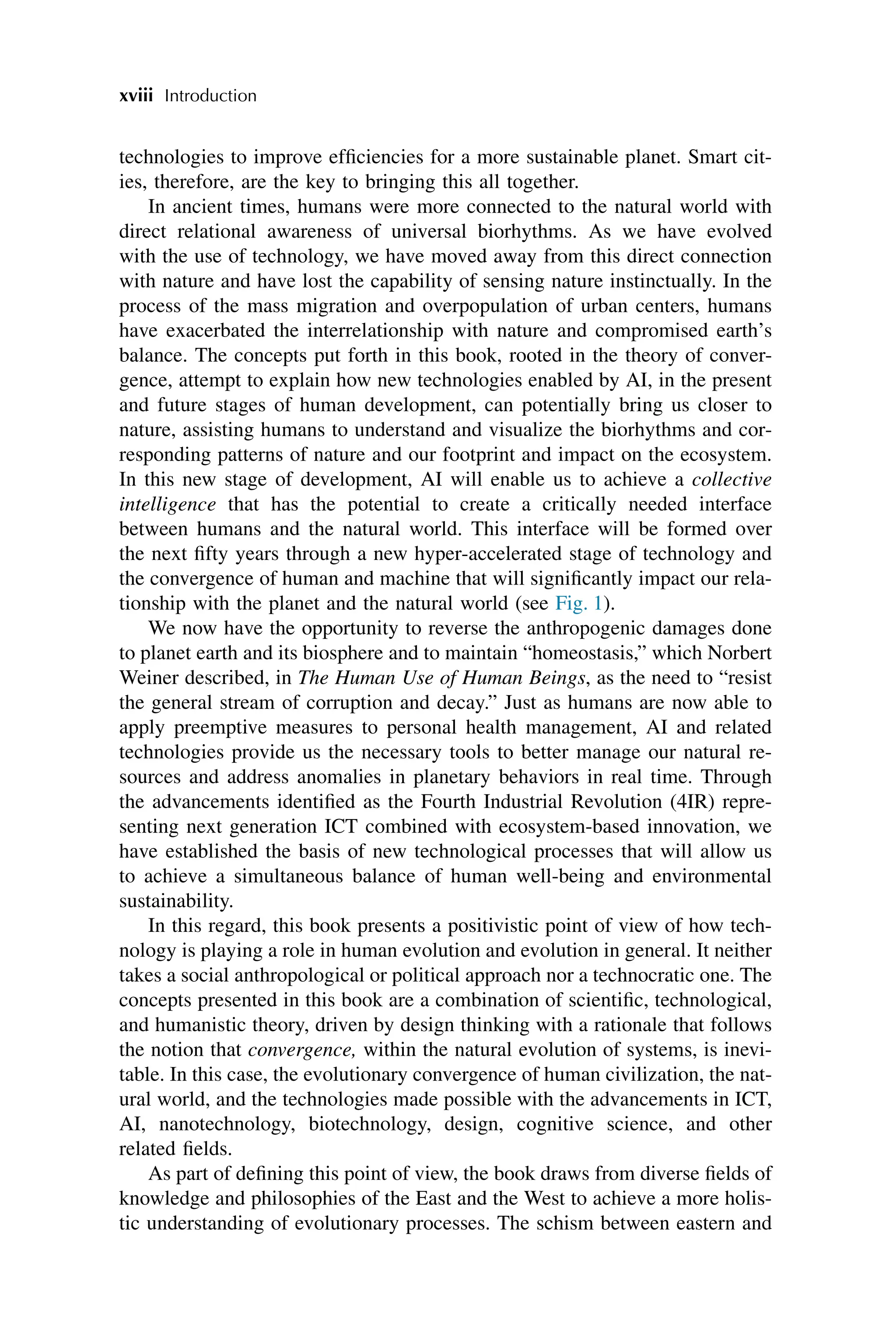
  • 12.
    Acknowledgments This book hasbeen formed through a combination of professional and aca- demic experience that has led us to defining a theory and practice of convergence. In the academic realm, this book expands and consolidates research and projects beginning in 1996 and continuing through the present. This includes numerous courses and special projects spanning Design and Technology, In- formation Architecture, Interface Design, Urban Media, as well as Maker Space workshops, year-end exhibitions, and graduate thesis projects. The underlying aspects in all of these initiatives have been interdisciplinary, cross- cultural collaboration, and co-design enabling tried and true and emerging processes. This generative approach fosters the most optimal methods to better understand contemporary challenges and design solutions in the crossover and integration of design and technology and the physical and digital dimensions. On the professional side, this book represents a diversified, multigenera- tional design practice (based on the authors’ work experiences and back- grounds) spanning product design, architecture, urban planning, graphic design, interactive design, and new mediadrelated to the practice of the development of sustainable global projects and with a special focus on smart cities. The enterprises that the authors have established as professional prac- tices and/or have worked with as consultants in the business of Smart Cities and AI include Newwork International, AI Convergence, VITADIGI, Linkay Technologies, IA New, Empire Asia Holding in London and Bangkok, and other enterprises related to the design and development of Smart Cities and Smart Nations. Many students and faculty collaborators were involved in various parts of the research and application of this book over the past two decades, from Tsinghua University, Parsons School of Design, Henley Business School, Harvard Graduate School of Design, collaboration with Stanford University, Carnegie Mellon, MIT, KAIST, Seoul National University, and other in- stitutions where the authors have taught and/or have established academic research collaboration and partnerships, such as the Beijing Design Lab, Service Design Lab, and Innohub. Other individuals whom we would like to recognize for the guidance and advice include Lady Susan Griffiths, Advisor, for her support in reviewing this book throughout all phases, Edward S. Grant and Joseph Bezzone, Advisors, for their strategic feedback, Tad Crawford, Publisher, Writer, for his instrumental xv
  • 13.
    technical advice andguidance, Sven Travis, Associate Professor, Parsons School of Design, for our 25 years of media technology collaboration, Sahara Kirwan for assisting in the initial documentation preparation and Sanah Kirwan for ongoing encouragement. Credits The specific team brought together to assist the authors in the execution of this book include the following: Brent Cooperdresearcher, editor, and contributor Meng Lindgraphic design and technical illustrations Bika Armanddtechnical research, communication engineering, systems architecture and integrationdcontributor Chapter 5 Stefan DobrevdAI research and innovation strategydcontributor Chapter 8 Huan Wangdresearch coordination and graphic design Ling Chyi Chandresearch coordination Jiru Zhaodresearch coordination Jianhua Gudgraphic design and technical illustrations Jeong Eun Songdgraphic design and technical illustrations Songling Gaodgraphic design and technical illustrations. Tommaso Guerzonidresearcher Sahara Kirwanddocumentation administration and proofing Miraal Moazzamdproofing Tsinghua University Student Projects: Xingjian Cuidtechnical illustration City DNA (Fig. 2.5) Citizen Engagement (Fig. 6.4) Junjie Yu, Ke Fang, Yin Li, Yechang Hu, Jieyun Yangdproject creators “Co-Pulse” Junjie Yudproject creator “Sub Scope” Xu Lindproject creator “City Care” xvi Acknowledgments
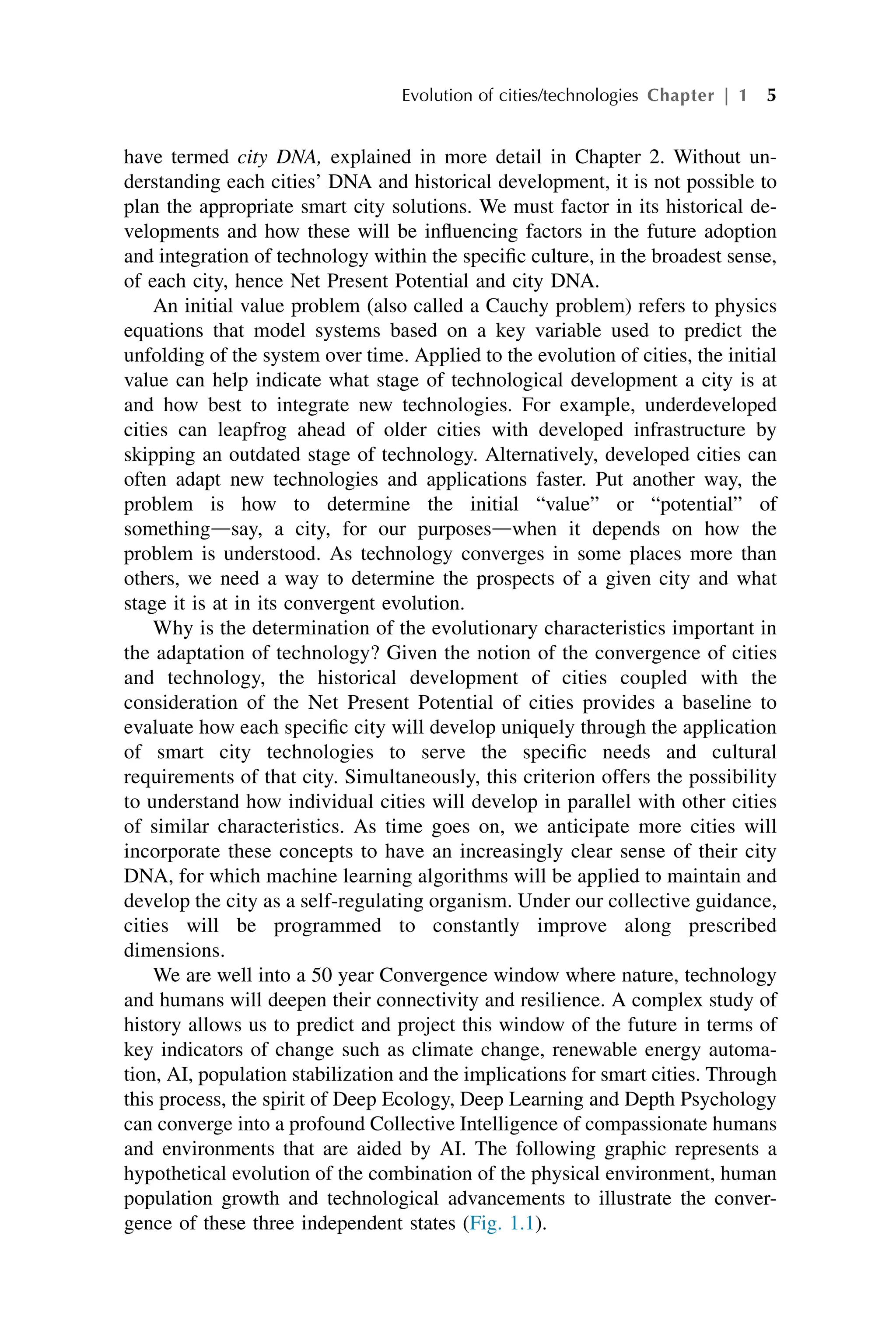
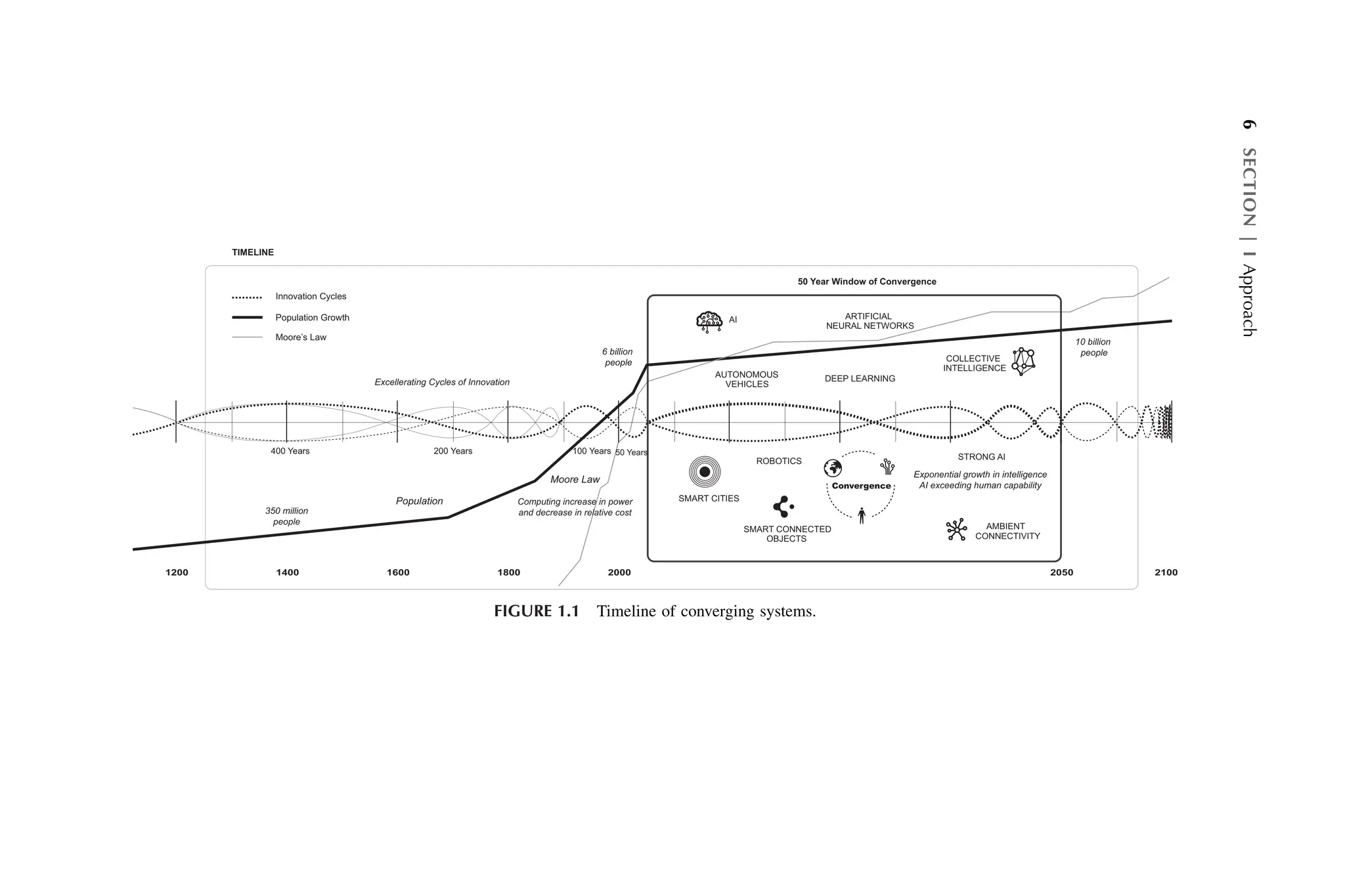
  • 14.
    Introduction Until very recentlythe worlds of Digital and Brick-and-Mortar have remained divided along the lines of the old and new economies. Old economies were based on resource development, industrial processes and human labor. New economies operate on a higher level of abstraction, leveraging computing power and venture capital, such as with Silicon Valley tech startups and IPOs. This separation has influenced the business landscape of how real estate development, infrastructure and cities have evolved. In the physical world, real estate is limited to property market value. It is valued with respect to available land and prices can be relativized on a per square meter basis. The digital economy has no such spatial constraints and is scalable. As such, prices and profits can be unmoored from a physical base. Today we are finally seeing these two different worlds convergingdthe abstract with the concretedbut not without a massive reconceptualization of how we plan, design, and implement smart cities. Defining and building smart cities aimed at the convergence of the virtual and the real will ensure harmo- nious, sustainable solutions will be developed, allowing for adaptation and change as technology, humans, and the physical environment evolve and are impacted differently. This book provides a comprehensive approach to the planning, design, and operations of smart cities and the significant roles Arti- ficial Intelligence (AI) plays in the convergence of cities, technology, and nature. At this particular moment in time, perhaps one of the several major para- digm shifts in human progress, we have a moment to pause before plunging headlong into the new reality that is at our threshold: a reality led by new tech- nologies that are already beginning to transform every aspect of our contem- porary life as we understand and experience it. This new reality, if managed ethically through privateepublicepeople partnerships, guiding the conver- gence of technology with natural and social systems to form self-regulating governance platforms, will potentially be the solution to what humanity has constructed as our current demise, the overpopulation of cities, socioeconomic inequality and injustice, exploitation of our natural resources and the destruc- tion of earth’s ecosystems. As cities now make up more than 50% of the con- centration of the world’s population and are absorbing an increasing share of people, cities are presently the most important point of leverage to focus on as it relates to the optimization of the earth resources through the application of xvii
  • 15.
    technologies to improveefficiencies for a more sustainable planet. Smart cit- ies, therefore, are the key to bringing this all together. In ancient times, humans were more connected to the natural world with direct relational awareness of universal biorhythms. As we have evolved with the use of technology, we have moved away from this direct connection with nature and have lost the capability of sensing nature instinctually. In the process of the mass migration and overpopulation of urban centers, humans have exacerbated the interrelationship with nature and compromised earth’s balance. The concepts put forth in this book, rooted in the theory of conver- gence, attempt to explain how new technologies enabled by AI, in the present and future stages of human development, can potentially bring us closer to nature, assisting humans to understand and visualize the biorhythms and cor- responding patterns of nature and our footprint and impact on the ecosystem. In this new stage of development, AI will enable us to achieve a collective intelligence that has the potential to create a critically needed interface between humans and the natural world. This interface will be formed over the next fifty years through a new hyper-accelerated stage of technology and the convergence of human and machine that will significantly impact our rela- tionship with the planet and the natural world (see Fig. 1). We now have the opportunity to reverse the anthropogenic damages done to planet earth and its biosphere and to maintain “homeostasis,” which Norbert Weiner described, in The Human Use of Human Beings, as the need to “resist the general stream of corruption and decay.” Just as humans are now able to apply preemptive measures to personal health management, AI and related technologies provide us the necessary tools to better manage our natural re- sources and address anomalies in planetary behaviors in real time. Through the advancements identified as the Fourth Industrial Revolution (4IR) repre- senting next generation ICT combined with ecosystem-based innovation, we have established the basis of new technological processes that will allow us to achieve a simultaneous balance of human well-being and environmental sustainability. In this regard, this book presents a positivistic point of view of how tech- nology is playing a role in human evolution and evolution in general. It neither takes a social anthropological or political approach nor a technocratic one. The concepts presented in this book are a combination of scientific, technological, and humanistic theory, driven by design thinking with a rationale that follows the notion that convergence, within the natural evolution of systems, is inevi- table. In this case, the evolutionary convergence of human civilization, the nat- ural world, and the technologies made possible with the advancements in ICT, AI, nanotechnology, biotechnology, design, cognitive science, and other related fields. As part of defining this point of view, the book draws from diverse fields of knowledge and philosophies of the East and the West to achieve a more holis- tic understanding of evolutionary processes. The schism between eastern and xviii Introduction
  • 16.
    xix Introduction Earth Evolution Human Evolution Digital Evolution Convergence 4,500,000,000 years6,000,000 years 100 years Now Next 50-100 years FIGURE 1 Evolution/convergence of systems.
  • 17.
    western philosophy, scienceand medicine, which remains still to this day an impediment to achieving a more enlightened human civilization, may finally have an opportunity to reach a new dimension of interrelations with the ad- vancements in technology. Thus, the worldly perspective presented in this book may provide a new consciousness to support the process of convergence incorporating both linear and nonlinear processes and in defining a greater cross-cultural collective intelligence. Without a global partnership and a coherent set of internationally recognized standards of city design, energy ef- ficiency, environmental sustainability, labor relations, education, and human rights, the potential for chaos and collapse will be even greater and will poten- tially speed up our decline. In a counterintuitive way, the evolution of technologydfrom the ability to reorder material and social relations on a global scale to creating general AId also brings about a realization that low-tech solutions will be, in the end, more sustainable in some cases. A return to a natural, holistic approach to managing resources and consuming less may allow humans and nature to achieve a better balance. Nevertheless, it appears that advancements in technology will not slow down anytime soon and embracing technology and steering it toward a more universally equitable application is required in the long run to achieve a unified operating systemdOS Planet Earth. As the natural world follows ebbs and tides, so will the evolution of technology, requiring complexity to lead us to simplicity. In the theory of communication, semantic noise and psychological noise are comprehension barriers between the transmitter and the receiver. The sum of this noise can hold back discourse and drown out the best options. In this way, the complexity of the future advanced technology is speaking to us, but the signal-to-noise ratio makes it hard to hear, so it will require a ho- listic shift that brings all things into a harmonious state of convergence, where diverse systems become integrated in a unified state of being. Convergence theory proposition This book proposes the application of a new composite theory of how cities adopt technology over a period of time based on diverse subtheories of conver- gence, such as for evolution, society, science, media, nature, technology, knowledge, organizations and globalization. One notion of how these intersect at a higher level is the concept of the “smart city” as a “convergent socio- cyber-physical complex,” which is optimally adaptive to itself, the state space, and its members. The 4IR is a major theme in these convergences and the development of the smart city. Additionally, in developing a proposed method- ology for how cities can best integrate technology within the planning, design, and operations of cities, the Convergence Theory for initial value problems is co-opted and reinterpreted to develop a concept of Net Present Potential that identifies and analyzes the underlying conditions of the state of the city xx Introduction
  • 18.
    (current physical, culturaland technological status). Solving initial value prob- lems amounts to predicting the evolution of complex systems, and understand- ing this process can help show how the Net Present Potential determines the evolutionary process of adaptation and convergence of cities and technology. The following explanation is provided to help understand the foundational the- ories of our combined interpretation and application of convergence to illumi- nate the evolutionary process of the merging together of diverse systems including human, natural and technological. In our Appendix, we explore six topics of convergence that informed our theoretical and practical understanding. The basic concept comes from conver- gent evolution, the observation of similar traits in different species, such as the eyes, hair, organs, appendages, or wings, which did not evolve from a common ancestor. They evolved the same function because it was so adaptive to a particular environment. Convergence theories of society observe common fea- tures and patterns across different cultures and states. Within science and tech- nology, different techniques and tools are being combined to accelerate innovation as well as integration with nature. This trend is converging in Nanotech, Biotech, ICT and Cognitive Science (NBIC). There is also a conver- gence of knowledge, technology, and society that is bringing together common knowledge through consilience, networking and new forms of socialization. Digital convergence has shown exponential growth in computing power ac- cording to Moore’s law, as well as prolific social media connectivity and AI assistance. Finally, organization convergence adopts more flexible strategies, holistic ontologies, and best practices to overcome traditional hierarchies, inequalities, path dependencies and pathologies. Methods that are converging in smart city design include Living Labs, Innovation Hubs, Design Thinking, Co-design and Citizen Centric Cities. Ma- chine learning and Generative Design are converging and accelerating, enhancing workflow and computational power and enabling designers to work more intuitively. By setting certain parameters and letting AI do the heavy lifting humans and technology are converging ever closer through the smart design of their own environments. This idea and the table below consti- tute our convergence methodology. From this research, we intuited and designed six types of convergences that fall into three categories. There is a convergence of nature, with convergent evolution and scientific process convergence. There is a convergence on the human level, where society converges through growth, interaction and social systems, as well as general knowledge converging into collective intelligence; lastly, technology convergence, where digital, ICT and AI systems converge. These form our basic layers of analysis and align with our six dimensions of convergence described in Chapter 1. There is simultaneous convergence in all dimensions, and they are all converging with each other. However, bio- logical evolution is slow, and technology evolves on an exponential curve that quickly outpaces biology. Metaconvergence is the convergence of all of them, xxi Introduction
  • 19.
    which is notlinear, but accelerating and recursive because of the faster evolu- tion of human culture and technology. The six theories and convergence and six dimensions of smart city development effected can be seen in Table 1. Fourth Industrial Revolution The 4IR is the fourth major leap in technological productivity and represents a potent new stage of globalization. The first was the Industrial Revolution of the 18th century characterized by machines, iron manufacturing, textiles, rail transport, urbanization and unprecedented population growth. The second was dominated by steel, oil, electricity, mass production, the telephone and the internal combustion engine. The third is the digital revolution in our recent history: that of the personal computer, basic Internet and ICT. The 4IR is exemplified through cyber-physical systems, breakthroughs in robotics, AI, nanotech, quantum computing, the Internet of things (IoT), 5G wireless, 3D printing, clean energy, smart cities and autonomous vehicles. The idea of convergence can be tracked throughout these stages, pointing us toward a technological singularity in the near future. Our mandate in this book is to use the science of convergence to influence a more sustainable pro- cess of the planning, design, and operations of our cities and to play a pivotal xxii Introduction TABLE 1 Convergence types. Nature Evolutionary convergence Natural environment and systems 1. Physical dimension Scientific convergence Technological and epistemological systems 2. City systems, infrastructure dimension Human Knowledge convergence Human population and behaviors (patterns) 3. Human dimension Culture, society, governance convergence Human governance, socioeconomic 4. Culture and society dimension Technology Digital, ICT convergence Technology infrastructure, connectivity 5. Technology infrastructure dimension Artificial Intelligence convergence Collective intelligence and automation 6. Ubiquitous technology dimension ¼Metaconvergence natureehumanetechnology systems integration and embeddedness Convergence continuum
  • 20.
    xxiii Introduction role in bringingOS Planet Earth online. Understanding how convergence works in the 4IR is critical for getting us through the current various ecolog- ical, social and epistemic crises. The bureaucratic bottleneck choking out progress will either be the cause of our extinction or the catalyst of our conver- gence on metasolutions, thereby releasing the pressure valve to liberate creative and productive forces to collaboratively build self-sustaining and self-regulating smart cities. The metamodern turn The 4IR is one of the several distinct historical markers for the metamodern era, circa the turn of the millennium, 2000, as described by Dutch cultural the- orists Vermeullen and van den Akker. Other relevant markers include global social movements, global financial crises, and the coining of the “anthropo- cene” to mark the new period of humans as the dominant geological force on the planet. Philosopher Hanzi Freinacht develops the concept of metamo- dernism further into an active social and political philosophy, as well as a the- ory of (co-)development. Our notion of metamodernism notes these cues but has a deeper root in Albert Borgmann’s philosophy of technology and his defi- nition of metamodernism. As metamodern theorist Brent Cooper explains in his review, Borgmann used the term “metamodern” in an earlier formulation but then switched to “postmodern realism” in Crossing the Postmodern Divide (1992) for practical reasons. Nevertheless, we adhere to the spirit of his “meta- modern” vision, which is needed now more than ever, as metamodernism in the broader sense still aligned with Hanzi Freinacht, Vermeullen and van den Akker and others. In the 1992 edited volume New Worlds, New Technologies, New Issues, Borgmann predictively described a bifurcation of postmodernism into techno-social cultures of hypermodernism and metamodernism. While hyper- modernism refers to pathological and dominant technoscience, metamodern- ism refers to an alternative path where deep ecology and technology converge in harmonious ways and people are sensitively attuned to the destruc- tive impact mass consumption and financial capitalism have wrought. Natu- rally, our book advocates for the latter forms of society and technological implementation. The evolving frame of metamodernism gives a necessary his- torical context to the technological singularity and the social and political transformations that also must occur. Thus, following on Vermeulen and van den Akker’s act of introducing the term as an “intervention,” this book hopes for a “metamodern turn” in smart city literature as well as wider academia, as the metamodern discourse is also indicative of the convergence of philosophy itself and the converging oscillations between modern and postmodern forms of art, culture, critique and technology. Now more than ever, there is a pressing need to address the schism of postmodernism as Borgmann prescribed back in 1992. Borgmann’s ideas of the postmodern, hypermodern and metamodern can be seen juxtaposed in Table 2.
  • 21.
    xxiv Introduction If thepower of technology remains unquestioned, modernism will be succeeded by hypermodernism, that is, modernism by other means. If we come to recognize and restrain technology, however, a genuinely other era may dawn, one called “metamodernism” for the time being. The question, then, is whether postmodernism will turn out to be hypermodernism or metamodernism. Albert Borgmann Convergence as an approach Convergence is not only a theory but also a reality that has already begun to be part of our everyday lives. Humans are merging with digital devices, attached or imbedded in our bodies, tracking behavior and performance. In the future, we will be implanting devices in our internal organs to monitor our bodily functions and we will have sensors monitoring external phenomena of every aspect of life. Technology and biology are fusing on a molecular level through advancements in nanotechnology and other forms of biological convergence. The combination of different states convergingdnature, humankind, and technologydis leading us to a new direction in the next stage of evolution. This convergence requires new ways of thinking, approaches and methodolo- gies to develop tools to plan, design, and operate our cities and the planet in optimal ways so that we can sustain a balance of these diverse systems. A sim- ple example of convergence can be represented in the smartphone, which brings all different technologies together. Three decades ago it seemed difficult to predict exactly how we would have all of the independent functions of the smartphone previously delivered through different devices and protocols, now in a singular interface. At the same time, while all of the independent features integrated in the smartphones have converged, all of the functions within cities are converging as well. For example, the iPhone sets a new standard for simpli- fication and streamlining, inspiring similar aesthetics, functions and interfaces in other products, services and systems. As such, city planners and administra- tors already use smart devices to communicate and monitor city systems and are redesigning cities themselves to reflect these trends. This is convergence, happening all around us, and the goals we are striving for in the convergence of nature, humans, and technology, are balance, well-being, and optimization, as shown in Table 3. TABLE 2 Modernity definitions. Postmodern Hypermodern Metamodern Critique of modernism, “post- industrial society,” “striking convergence of economic, intellectual and architectural postmodernism.” “Pernicious influence of modern technology will become still more pervasive and dominating.” Technology will be “context sensitive and historically reverent,” attentive to different “voices of reality.”
  • 22.
    However, within thisprocess of convergence, the incorporation of all of the elements into one system where everything becomes integrated in a gestalt operating system like nature itself, there is a reverse process occurring that re- quires the decentralization and distribution of smart objects and sensors embedded into every dimension of human, natural and technology, to record and transmit the genetic code patterns and activities of each living organism within the ecosystem. The new convergence requires a methodology driven by today’s innovation practices from co-design, collaboration, living lab exper- imental approach, a fusion of diverse systems of knowledge bringing together resources and using a new algorithm-based methodology that can program var- iations to simulate, visualize and analyze the best solutions that allow us to remain in the flow. The science and fields of professional disciplines are also merging, slowly eroding the 17th and 18th century reliance on empiricism that classified human knowledge as discrete epistemological bodies influencing the nature of how we think and operate and how our institutions have formed and governed hu- man intelligence. This evolution of human knowledge is now being reconsid- ered, not as a deliberate act of rebellion but as the natural progression of human development as we understand and construct new realities with the ad- vancements in science and technology. Within the complexity of the process of multiple dimensions converging, some aspects of convergence are occurring as conscious by-products of material change; other dimensions of convergence are representing evolution beyond our immediate perception. The concepts of simplicity and singularity are the light at the end of the complexity tunnel where all things will communicate harmoniously within an integrated system; a new stage of biological, human and technological convergence approxi- mating the laws of nature and an inherent state of homeostasis. Although Ray Kurzweil does not use the term convergence in his book, there is a striking parallel with his notion of the technological singularity. The singularity is a future that became obvious and inevitable when technol- ogy began to demonstrate it was on an accelerating and irreversible evolu- tionary course, such that it would begin to innovate on itself and automate civilization. AI and robotics will become self-reproducing. In a basic sense, our six dimensions of convergence loosely resemble Kurzweil’s “Six Epochs xxv Introduction TABLE 3 Convergence evolution. Category Convergent purpose and function Biology/nature Balance/homeostasis Human/city Well-being/sustainability Technology/Artificial Intelligence Optimization/intelligence
  • 23.
    xxvi Introduction of Evolution,”which explains stages of information in (1) atomic structures, (2) DNA, (3) neural patterns, (4) hardware and software, (5) human-tech merger, and (6) nature-tech merger. Similarly, in The Social Singularity, Max Borders writes that AI, neuroscience, and collective intelligence will converge. If the process of the convergence of nature, human, and machine relies partially on human input, then indeed the output will continue to incorporate human error that will inevitably be factored in the evolution of the converging system. If nature is perfect and the future of machine learning is based on logic, our fallibility may be the remaining ingredient that retains the state of imperfection. In the Japanese sense of beauty, the tension between harmony and disharmony, like a beautiful improvisational jazz composition or the asymmetry of the branches of a Bonsai tree, may be what keeps things in a state of dynamic equilibrium. Further reading Allenby, B., 2007. The Convergence of Science, Technology, and Nature. GreenBiz. https://www. greenbiz.com/blog/2007/04/01/convergence-science-technology-and-nature. (Accessed 20 January 2020). Baldwin, R., 2016. The Great Convergence: Information Technology and the New Globalization. Belknap Press. Borders, M., 2018. The Social Singularity. Social Evolution. Borgmann, Albert., 1992. In: Cutcliffe, Stephen H. (Ed.), “The Postmodern Economy.” New Worlds, New Technologies, New Issues. Lehigh University Press. Brio, M., et al., 2010. Convergence Theory for Initial Value Problems. Mathematics in Science and Engineering 213 (C), 109e144. https://doi.org/10.1016/S0076-5392(10)21308-5. (Accessed 20 January 2020). Chartres, B., Stepleman, R., 1972. A General Theory of Convergence for Numerical Methods. SIAM Journal on Numerical Analysis 9 (3), 1972, pp. 476e492. JSTOR, http://www.jstor.org/ stable/2156145. Cooper, B., 2019. Borgmannian Metamodernism. “The Abs-Tract Organization”. https://medium. com/the-abs-tract-organization/borgmannian-metamodernism-8ed5e275f8ae. (Accessed 20 January 2020). Deloitte Insights/Tech Trends, 2018. The Symphonic Enterprise. Freinacht, H., 2017. The Listening Society: A Metamodern Guide to Politics, Book One. Meta- moderna ApS. Freinacht, H., 2019. Nordic Ideology: A Metamodern Guide to Politics, Book Two. Metamoderna ApS. Kurzweil, R., 2005. The Singularity is Near. Penguin Books. Roco, M., et al., 2014. The Convergence of Knowledge, Technology, and Society. Springer Science & Business Media. Vermeullen, T., van den Akker, R., 2017. Metamodernism: Historicity, Affect, and Depth after Postmodernism. Rowman and Littlefield. Volkov, A., 2018. Smart City: Convergent Socio-Cyber-Physical Complex. MATEC Web of Conferences 251, 03065. https://doi.org/10.1051/matecconf/201825103065. (Accessed 20 January 2020). Watson, P., 1997. Convergence: The Idea of the Heart of Science. Simon and Schuster.
  • 24.
    Description of eachsection Descriptions overview The book is divided in sections Approach, Architecture, and Application giving equal space to these three dimensions representing the convergence theories and methodologies integral in the planning, design and operations of Smart Cities and Artificial Intelligence (AI). Section 1 Approach This section of the book covers our approach to the challenge of smart cities and the role of technology and artificial intelligence on a broad scale. Chapters 1e3 are about the perspective and epistemology of the book, laying down the basic definitions and premises about the evolution of smart cities based on supporting convergence theories and system science. It is grounded in applied methodologies related to more open-ended design fields to identify the po- tential for systems and cities to be autopoietic or self-regulating. Chapter 1 is about establishing theoretical foundations in the evolution of systems and the application of convergence theories to the advancement of cities and their ability to adapt and transform based on their unique DNA. The theory of convergence introduced before is applied to smart cities to under- stand the accelerating and intersecting trajectories of technology and social organization. Some smart city case studies are explored to illustrate the notion of city DNA, as a speculative measure of a city’s history, cultural code, and socio-technical landscape. The six dimensions of the city are outlined in further detail, explaining how all layers are connected and converging. The six layers fall into three translocal spaces that intersect: the physical domain, the human realm, and the technology sphere. All are convergent. Chapter 2 looks at cities as socio-biological and metabolic systems, rooted in diverse understandings of cities as living systems and the relation to human xxvii
  • 25.
    anatomy. It startsby recalling the history of organic and systemic thinking about cities, from Thomas Hobbes to Niklas Luhmann. This includes discussion of biomimicry and urban biology informing our design principles, down to providing tables analogizing the system functions of the human body to that of the city, the social body, and its needs and technologies. It then outlines the concept of collective intelligence, the living wisdom emergent from informed and educated citizens involved in sense-making and decision-making, and in- tegrated with the technological landscape. City DNA is emphasized as the ability for each city to identify its own uniqueness and integrate universal standards with local needs accordingly. This brings into focus the role of mapping and data collection as foundational mediums of smart city operations, monitoring and coordinating the self-organization of the city and its inhabitants. Chapter 3 enters into the normative, constructive, innovative, and genera- tive aspects of smart city planning. It draws from diverse design practicese Design Thinking, Co-Design and Generative Design, to develop new hybrid methodologies to address a changing world, and adapt to new urban systems and realities. Machine learning is brought forth as a tool to facilitate outcome- based modeling, where the city is generatively designed based on its needs, borrowing from the biomimetic approach introduced in the previous chapters. All these are considered in light of the convergence design method that allows us to now simulate the city in real-time, in public, and open-source ways. Section 2 Architecture The Architecture section ranges from macro city anatomy to micro user experience. Chapters 4e6 look at the organizational structure, communication spectrum and system behaviors of Smart Cities based on three major elementsdoperating systems (OS), connectivity, and interface. The smart city is in itself a self-forming and self-regulating system that evolves based on its inherent characteristics and formal structure as a living, adapting system. The smart city is a form of neural network interface linking multiple stakeholders and diverse ontological frames of reference or UX. The concept of a smart city information architecture represents different scales and functional typologies that are integrated with the City OS and city-wide Interface. Chapter 4 is about city OS, meaning how the city operating system is a combination of top down, bottom up and middle ground influences. Establishing xxviii Description of each section
  • 26.
    the appropriate systemarchitecture for each city requires an understanding of the structure, relationships, rationale and intended outcomes of the system. This is filtered into an aesthetic and intelligent interface, the face of the city as a living lab. We propose a convergent OS where living systems, technical net- works, and humane interfaces all interconnect and converge, organizing together hierarchies of governance and infrastructure. Chapter 5 is about connectivity. Connectivity is the medium for cities to achieve a new ambient connectivity based on Artificial Intelligence (AI), neural networks, and machine learning (ML). Connectivity evolves like the city itself, based on different infrastructures through time, from rivers and roads to wireless transmission. Communication technology is evolving along more expansive lines now, becoming more invisible and real time. Connec- tivity is built into urban architecture. AI and ML allow for more dynamic utilization of different bandwidths. The ubiquitous connectivity allows the convergent urban architecture to self-regulate. Chapter 6 describes the evolving and adapting complex city interface. Interface is what allows people and elements to interact in a new city-wide collective intelligence platform. It posits the ultimate direction of a seamless interface, merging nature and technology in urban architecture. Through this trajectory of the book, there is a thematic ramping up of the technological convergence, toward a totalistic interface and holistic information architecture. Chapters 4e6 combined provide a gestalt view of the hybrid systems archi- tecture that allows the AI driven smart city to be adaptable, sustainable and self-regulating. Section 3 Application Chapters 7e9 cover the application of smart cities across the established functional typologies identified in the City Mandala model as a continuous wheel of interconnected yet independent functions as basis of the smart city operations. The functions are presented through an evolutionary lens that traces the development and trends of how technologies are reshaping the na- ture of cities and the convergence of human, machine, and natural environment as a new collective intelligence formation through the lenses of specific sce- narios, functions, and business models. xxix Description of each section
  • 27.
    Chapter 7 describessmart city functions based on evolutional (horizontal timeebased) scenarios describing the relationship between objects (resources), actions (coordinated input), and outcomes (higher state). We use this analytical framework to present the directional relationship between the elements found in each smart city function. The identified states represent the highest level of the functional hierarchy (desired outcome or singularity) needed to balance and support smart cities. The six functions of smart cities (based on the Smart City Mandala) act as the building blocks of an integrated universal city OS customizable to each city DNA. We then present various scenarios for each of the functions through the lens of a process-oriented systems-change framework, the multi-level perspective (MLP) model, and the convergence of natureehumanemachine. This allows us to trace the directional development and convergence that leads to the six states (inputs and development stages). Chapter 8 presents the key technologies necessary for the deployment and development of Artificial Intelligence (AI) (cloud computing, 4G/5G, and Big Data) across the six smart functions. A Scale Hierarchy framework is adopted to present the macro-, meso-, and micro-levels of the smart city functions. A Scope Hierarchy framework is applied to present three levels as well, of how the applications fall into the context (macro convergence), content (application themes), and component (micro convergence & strategy) dimensions across the six smart functions. Presented in sets of three, these combinations allow us to explore new levels of analytical complexity indicative of the broadest application of the convergence of humans, machines, and nature in the context of smart cities. Chapter 9 explores the transforming landscape of business prospects and new economic models related to smart cities and AI. It invokes some themes, strategic implications, and the high-impact components for creating sustain- able advantage in the era of AI-driven innovation and explores how these can be embedded in the design language and business models of the future. AI enabled Smart City applications show the niche opportunities for businesses to collaborate more with other businesses and establish public-private models due to the convergence of technology, and the codependency of users and citizens as stakeholders in new commons-based forms of commerce and industry. The convergence is noted in the context of competitive advantage and business strategy, as well as the niche innovations of social movements and open-source technology to challenge the incumbent market-driven paradigm. The lessons learned in Chapters 7 and 8 help us build the bigger picture scope of Chapter 9. xxx Description of each section
  • 28.
    Info system (Fig.0.0) Behavior Application Pattern Frequency Scale Boundary Eco-system Environment Population Infrastructure Landscape Culture Structure Context Management Strategy Solution Function Network Data Smart Object Connectivity AI City OS Humankind Earth / Nature Technology Balance Wellbeing Optimization City UX Regulation Service Market Inhabitant FIGURE 0.0 Info System represents a conceptual and technical visual ecosystem encompassing an open-ended spectrum of the converging human-bio-technical systems and processes explained throughout the three sections of the book. In a sense, the book itself has been designed as a form of operating system information architecture with multiple illustrations and a glossary of terms to explain the theories, methods and application of artificial intelligent and smart cities. The info system icons are presented as a flexible, adaptable lexicon structure to assist in the understanding of the system complexity, its components, and the many functions and attributes. xxxi
  • 29.
    Chapter 1 Evolution ofcities/technologies Chapter outline 1.1 Overview of smart city concept and context 2 1.2 The evolution and integration of technology, AI, and cities 4 1.2.1 Evolutionary strategies 7 1.3 City DNA narratives 9 1.3.1 Beijingdthe radiating megacity 10 1.3.2 Londondthe cosmopolitan hub 11 1.3.3 New Yorkdthe media metropolis 12 1.3.4 Dubaidthe iconic branded city 13 1.3.5 Songdodthe new digital city 14 1.3.6 Masdardthe new sustainable city 15 1.3.7 NEOMdthe future city 16 1.3.7.1 Summary 17 1.4 The dimensions of the city and potential for convergence 17 1.4.1 Physical/environment dimension 18 1.4.1.1 The city as evolu- tion of space, form and hardware 18 1.4.2 City systems, infrastructure dimension 19 1.4.2.1 The network of the city, the spine, and major organs 19 1.4.3 The human dimension 19 1.4.3.1 The city as a manifestation of human patterns and constructs 19 1.4.4 Culture, society, and governance dimension 19 1.4.4.1 The nuances of human civiliza- tion, behaviors, activities, desires, and relations 19 1.4.5 Digital infrastructure dimension 20 1.4.5.1 The city as evolu- tion of systems, technologies, and software 20 1.4.6 The ubiquitous dimension 20 1.4.6.1 The merging of technology with the natural envi- ronment in the form of imbedded and ambient con- nectivity 20 1.5 How convergence theory applies to smart cities 21 1.6 Conclusion 22 References 23 Further reading 24 Smart Cities and Artificial Intelligence. https://doi.org/10.1016/B978-0-12-817024-3.00001-5 Copyright © 2020 Elsevier Inc. All rights reserved. 1
  • 30.
    1.1 Overview ofsmart city concept and context “Smart city” is now the popular concept driving cities around the world to a new level of technology innovation and quality of life enhancement while simultaneously a term being co-opted for the purpose of attracting investment and stimulating new economic opportunities. This latter purpose is a critical part of the establishment of a sustainable business ecosystem that can support the requirements of the development of a smart city and the next generation of urban growth. Investment is a necessary, but not sufficient, precondition for establishing a smart city. The determination of what is required to make a city smart originates in the unique characteristics of each individual city: its geographic location, physical composition, inhabitants, workforce, govern- ment structure and policies. The term “city DNA” is used in this book to express this complex composition specific to each city. Over the last several years as the definition of smart city has emerged, numerous research initiatives, technical studies and reports have been published to create a coherent etymological framework and taxonomy of smart cities. The book Understanding Smart Cities: A Tool for Smart Government or an Indus- trial Trick? (Anthopoulos, 2017) explains the evolution of the concepts and terminology of smart cities, beginning with the earliest references to digital cities beginning in the 1990s. Since then, multiple interpretations of smart cities are fashioned based on the stages of technological advancements including the Internet of things (IoT), smartphones and various tech fads that are codependent in the sense of establishing a new language representing market-driven inno- vation. “Smart city” discourse initiated around the requirements of ICT to address urban conditions and adapt to local needs, and has been continuously evolving and converging into more complex schematic representations. In tracing the etymology of the term smart cities through different in- carnations, we see that the way we use language to shape and style our social reality obscures the more significant reality of the merging of the physical and digital realms, the convergence of technology and everything else as an evolutionary process. It may be right under our noses, but the scent is elusive. Some true aspect of smart cities is masked by our linguistic comprehension of it. In defining things, much perspective is gained but something is lost in translation; this is akin to the concept of leaky abstractions in programming. This book points to the process of convergence (beyond words) as the key to understanding the evolution of smart cities and paths to adoption. The importance of understanding the evolutionary process of how cities adopt and integrate technologies to transform the nature of the city is critical within the context of determining how and why technology is best utilized to achieve the goals and requirements of each city to remain competitive and cooperative within the global landscape. As introduced in the previous chapter, the convergence theory applied to society in the context of smart cities describes the nature of all systems to develop parallel or similar traits when provided the same resources, opportunities and industrial or technological systems. This deterministic view of the evolution of cities and societies 2 SECTION | I Approach
  • 31.
    reinforces the hypothesisthat all cities will arrive at a similar stage of tech- nological development if presented with the same technological advance- ments, leading to the lessening of the disparity between smart cities versus those that are less developed. However, this theory presupposes that cities are similar in terms of their initial starting point, which we elaborate further in this chapter and define as the Net Present Potential. To determine the potential for cities to achieve being defined as a smart city, a major consideration is the historic context of development. It is this criterion that differentiates the unique smart city strategy and implementation plan that is required to achieve the goals of what is “smart.” Around the world, the diverse types of cities and their stage of development, from historical cities to new planned cities, influence which direction the smart city development will take its course. This diversity has made it challenging for professionals and those leading the development of smart cities to agree upon an established language and approach. To solve this issue, initiatives are taking place inter- nationally by diverse stakeholders and professionals to develop a universal language including the establishment of ISO standards and best practices that will eventually govern the development of smart cities. Technology is evolving in teleonomic (undirected) and teleological (directed) ways and converging on AI-driven, autonomous, self-regulating systems. Like- wise, our societies and cities evolve in similar ways and by definition are “self- organizing” given that no one person is omniscient. The ultimate goal is for Artificial Intelligence (AI) to assist in the self-regulation of cities as living sys- tems. If we think of traditional forms of city governance like the process of triage, thenself-regulatingsmartcitiesuseAIandmachinelearningtomonitorsystemsin real time and anticipate problems, thereby saving everyone with fewer resources. Technology has had a clear “automation” function since the industrial revolution and the assembly line was born. In the 21st century, automation is eliminating the final sectors of physical labor and human work is increasingly abstract. The autonomization of smart cities therefore recognizes the imperative to serve the needs of the people who make it up. “A city is a system of systems with a unique history and set in a specific envi- ronmental and societal context. In order for it to flourish, all the key city actors need to work together, utilizing all of their resources, to overcome the challenges and grasp the opportunities that the city faces. The “smartness” of a city de- scribes its ability to bring together all its resources, to effectively and seamlessly achieve the goals and fulfil the purposes it has set itself.” ISO/IEC 2015. As cities developed over many centuries, the physical, socioeconomic configuration has transformed in some cases drastically, while in others the form of cities has expanded in a linear progression that has reflected the organic growth of the city as a direct response to population increase and the need for expanded land areas. In the recent TV documentary series Ancient Invisible Cities (BBC Two, 2018), Istanbul is explored for its reconfigurations over the past 2000 years from Roman outpost, to the seat of the Ottoman Turk empire, from Pagan to Evolution of cities/technologies Chapter | 1 3
  • 32.
    Roman to Christianto Islamic to today’s more secular multicultural city. As explained through digital models and 3D visualization, including Virtual Reality (VR), these massive transformations, as a result of shifts of empires, wars and conquests, are expressed in the complex strata of urban archeology architects define as palimpsest. Meaning the layers of architectural formal language written over time, in this case representing the physical manifestation of Istanbul’s evo- lution from ancient to modern times as a gateway between the East and the West. In Section 1.3 we develop our concept of six dimensions of the city, which are both layered on top of and throughout each other, culminating in a seamless continuum. These dimensions are based on the fact that the “first distinctive characteristic of smart cities is the central role of technology,” as described in the Angelidou paper Four European Smart City Strategies (2016). Technology enables vast scales of knowledge and information to an increasing number of people, ostensibly to make their own lives and social structures more efficient. As technology gets cheaper and the urban geography gets mapped extensively with sensors, the IoT emerges. Coupled with the rising interest in personal data logging, city operations can also be monitored and audited, so public authorities and citizens can make informed decisions and solve problems. In short, the technology enhances city functions, thereby rendering it smart. We develop our six dimensions to describe how technology bookends the human experience, between nature and the technological sin- gularity and looping through natureelow techehumansegovernanceehigh techeubiquitous tech/reinsertion to nature. 1.2 The evolution and integration of technology, AI, and cities Everything evolves in the basic sense of change over time, but more specif- ically cities evolve akin to living organisms changing through adaptation, selection and emergence into higher and more extensive forms. Throughout history we have seen empires rise and fall according to discernible patterns, but now we are in an age of globalization and perpetual cities and must un- derstand the evolution of cities and technology to achieve sustainability and avoid systems collapse. The unique evolution of cities as manifested through the combination of the development of physical urban form, societal structure and cultural expression is the foundation of the city DNA and the substance by which the technological dimension of the city will be integrated. How tech- nology will contribute to the city DNA is a result of the ability of individual cities to adopt and integrate technologies based on their unique characteristics, opportunities and constraints within the process of convergence. To explain the Net Present Potential of a city, we have co-opted the “initial value problem” concept and applied this to the evolution of technologies for the purpose of developing benchmarks to understand how each city will evolve over time. This is based on the initial value status representing the combi- nation of factors, including physical environment, population, culture, socio- economic, political and historical characteristics. This combination is what we 4 SECTION | I Approach
  • 33.
    have termed cityDNA, explained in more detail in Chapter 2. Without un- derstanding each cities’ DNA and historical development, it is not possible to plan the appropriate smart city solutions. We must factor in its historical de- velopments and how these will be influencing factors in the future adoption and integration of technology within the specific culture, in the broadest sense, of each city, hence Net Present Potential and city DNA. An initial value problem (also called a Cauchy problem) refers to physics equations that model systems based on a key variable used to predict the unfolding of the system over time. Applied to the evolution of cities, the initial value can help indicate what stage of technological development a city is at and how best to integrate new technologies. For example, underdeveloped cities can leapfrog ahead of older cities with developed infrastructure by skipping an outdated stage of technology. Alternatively, developed cities can often adapt new technologies and applications faster. Put another way, the problem is how to determine the initial “value” or “potential” of somethingdsay, a city, for our purposesdwhen it depends on how the problem is understood. As technology converges in some places more than others, we need a way to determine the prospects of a given city and what stage it is at in its convergent evolution. Why is the determination of the evolutionary characteristics important in the adaptation of technology? Given the notion of the convergence of cities and technology, the historical development of cities coupled with the consideration of the Net Present Potential of cities provides a baseline to evaluate how each specific city will develop uniquely through the application of smart city technologies to serve the specific needs and cultural requirements of that city. Simultaneously, this criterion offers the possibility to understand how individual cities will develop in parallel with other cities of similar characteristics. As time goes on, we anticipate more cities will incorporate these concepts to have an increasingly clear sense of their city DNA, for which machine learning algorithms will be applied to maintain and develop the city as a self-regulating organism. Under our collective guidance, cities will be programmed to constantly improve along prescribed dimensions. We are well into a 50 year Convergence window where nature, technology and humans will deepen their connectivity and resilience. A complex study of history allows us to predict and project this window of the future in terms of key indicators of change such as climate change, renewable energy automa- tion, AI, population stabilization and the implications for smart cities. Through this process, the spirit of Deep Ecology, Deep Learning and Depth Psychology can converge into a profound Collective Intelligence of compassionate humans and environments that are aided by AI. The following graphic represents a hypothetical evolution of the combination of the physical environment, human population growth and technological advancements to illustrate the conver- gence of these three independent states (Fig. 1.1). Evolution of cities/technologies Chapter | 1 5
  • 34.
    Excellerating Cycles ofInnovation Population Growth Moore’s Law 400 Years 200 Years 100 Years 50 Years TIMELINE Convergence 50 Year Window of Convergence DEEP LEARNING SMART CONNECTED OBJECTS AUTONOMOUS VEHICLES ROBOTICS AI COLLECTIVE INTELLIGENCE 1200 1600 2000 2050 2100 Innovation Cycles 1800 1400 Population STRONG AI AMBIENT CONNECTIVITY ARTIFICIAL NEURAL NETWORKS SMART CITIES Computing increase in power and decrease in relative cost 10 billion people 6 billion people 350 million people Moore Law Exponential growth in intelligence AI exceeding human capability FIGURE 1.1 Timeline of converging systems. 6 SECTION | I Approach
  • 35.
    As an exampleof properties and prospects for city DNA, in the extensive report “Comparative Study of Smart Cities in Europe and China 2014” commissioned by a European UnioneChina collaboration, a multilayered criterion was applied to evaluate and compare 30 cities in Europe and China to determine the stages of development and unique characteristics of each city in terms of technological adaptation and system integration. It also compared and contrasted the impact of best practices for the development of global stan- dards, policies and applications. The report gives us detailed snapshots of characteristics that resemble city DNA. In the recommendations section, they outline two principles of the “smart city staircase roadmap toward maturity.” It advises “no isolated advances,” meaning that trying to improve particular assessment metrics at the expense of others will likely be counterproductive. It also advises against “leapfrogging” faster than the city can handle; however, we unpack the notion and its positive implications in the next section. 1.2.1 Evolutionary strategies Based on a composite of multiple theories related to technology evolution and adoption, we have established the following technology development types. Similar to the concept in technology adoption, certain cities approach and adopt technologies differently than other cities based on each city DNA pro- file. Below we describe six degrees of technological adaptation that open up different strategies and can result in varied paths to smart city integration (Tables 1.1). Non-intervention strategies would be more common among smaller or more peripheral cities, some of which get left behind overall national devel- opment. Their industries would typically be oriented around regional oppor- tunities and they can wait for the benefits from more concentrated centers of innovation. Linear integration would follow a safe and predictable technology adoption strategy, mostly following a set path of development. Dynamic overtake is similar to leapfrogging, where there is opportunity to skip stages of TABLE 1.1 Six degrees of technological adoption. Non- intervention Linear Integration Dynamic Overtake Alternative Bypass Hyper- accelerated Future Vision No specific adoption strategy; technology will naturally come when appropriate Conventional path; middle of the road strategy; stable planning Skipping inferior technology stages; emerging countries with no legacy systems Variation of leapfrog; low- tech approach; unconventional methods Innovation hubs; accelerators; incubators; living labs Speculative; high-risk, high investment in novel technologies Evolution of cities/technologies Chapter | 1 7
  • 36.
    advancement and atlower costs. Alternative bypass is a variation of leapfrog but a low-tech version, such as slowing growth and reducing impact. This is the case in cities with a highly developed civil society and cultural identity. Scandinavian counties are an example of societies that are now in the process of adapting alternative technological strategies to avoid the buy-in to a consumption-driven culture. While technology is part of the everyday life and is highly developed, Scandinavian cities are prioritizing quality of life and environmental sustainability over rapid technological development. Hyper-accelerated cities establish hubs of innovation to incubate new technologies to provide rapid economic growth that underpins the techno- logical evolution. Cities such as Songdo City, Masdar and NEOM are cities developed with technology as the core feature of their ecosystems. As has proven volatile, accelerated technological progress through new innovations whose rapid application and diffusion cause an abrupt change in society is not always successful. Future-vision cities are envisioned and analyzed for spec- ulative opportunities. In the same way, market analysts and companies develop economic strategies based on future derivatives, cities can potentially invest in future technologies while waiting out a particular state of present technology. In this approach, cities can gain a competitive advantage by-passing current technology lifecycles and investment in today’s technologies. The technology lifecycle is concerned with the time and cost of developing the technology, the timeline of recovering cost and modes of making the technology yield a profit proportionate to the costs and risks involved. Emerging technologies are the focus of future-oriented cities, as they can foster fast growth and coherence, but it comes with uncertainty and ambiguity. A technology roadmap is a necessary plan to help identify and coordinate emerging technologies, build consensus and mitigate unknown challenges or risks. The technology acceptance model describes how users adopt new technologies, influenced by a variety of factors, such as perceived usefulness and ease of use. The technology adoption lifecycle looks at consumer strate- gies from a more macro level, codifying demographic and psychological traits. This reveals a bell curve distribution with “innovators” leading the pack, followed by “early adopters.” The bulk of people fall into the “early majority” and “late majority,” trailed by a smaller group of “laggards” that do not have either access or interest. We can use these same notions to consider the range of technological adoption strategies of smart cities. The term leapfrogging comes from business and economics and is used when radical innovations permit a smaller newer firm to leapfrog the larger and more dominant firm. This concept applies to cities and countries just the same as businesses. An underdeveloped city may have the opportunity to skip inferior technologies. A village could go from no prior landline telephone service to having WIFI because the former technology is redundant. All countries have different competitive advantages based on resources and social capital, but the concept of leapfrogging undermines that and gives potential 8 SECTION | I Approach
  • 37.
    underdog cities greateropportunity to catch up. Leapfrogging also enables cities and countries to skip harmful or polluting stages of development that industrialized countries had to invent. Another example is the adoption of clean energy (such as solar) directly rather than relying on fossil fuels. If the only systems available are better than legacy systems, then the city will accidently leapfrog, but the ideal is to have a common vision, committed elite, relevant institutions and a labor market ready for rapid growth. Through the convergence of knowledge and technological solutions, all smart cities glob- ally can have access to the greatest means, thereby potentially allowing the most impoverished cities to leapfrog rich and more established cities. In cities where there is a concentration of technological production and high-tech industries, as in the case historically with Tokyo (Japan) and Taipei (Taiwan) or more recently with Seoul (South Korea) and Shenzhen (China), the evolution and adaptation of technology has been accelerated due to the accessibility of technology resources. The concept of early adopters can be superimposed on the stage of technology adoption of cities, where cities that have had the privilege of advanced technology developed alongside either with a concentration of industries or academic research centers, resulting in more linear growth. To the extent that it is both, technological development may be accelerated. As per Ray Kurzweil’s Law of Accelerating Returns, the cities with early technology adoption may have competitive advantages and may undergo technological evolution in a linear progression. An analysis of the history of technology shows that technological change is exponential, contrary to the common sense ‘intuitive linear’ view. On the other hand, cities that have adopted specific technologies early on may have already peaked in terms of technological infrastructure development and have remained locked in a form of dependency with legacy systems. From non-intervention to future vision, various cities are taking approaches within that broad spectrum. Different cities may be pursuing some mix of strategies along different sectors as well. Urban narratives play a role in shaping consumer demand and public support for the best approaches to technology reform and smart city upgrades. This can be explored through smart city case studies and looking at their city DNA. 1.3 City DNA narratives From a long-term historical lens, cities have evolved in wildly different ways and at different rates. Some explode in size, others grow slower, or become very niche. Cities are typically established in a form of ecological and geographical hotspot, and evolve from there. New resource-driven cities may be prone to collapse into ghost towns, while old cities built in the most coveted places stand the test of time. From a macro perspective, cities can be viewed simply as clusters of humans working together, like cells making up living nodes in a network, organizing, pulsing, and radiating together. People work Evolution of cities/technologies Chapter | 1 9
  • 38.
    and consume, movingthemselves and materials throughout the world. Infrastructure grows up around their common routes and the city comes to life. They have convergent levels of different normative states d through networking globally, they find common language and adopt best practices. In these case study vignettes, we look at the unique DNA of several major smart cities to understand opportunities for technological adoption and growth, based on their diverse historical, geographical, socio-economic and techno- logical profiles (Table 1.2). 1.3.1 Beijingdthe radiating megacity Beijing, the capital city of the East built spanning millennia and the second largest city in the world, behind Shanghai, has grown in a linear procession. Its austere urban form is based on a concentric evolution originating for the cen- trally positioned walled-in Forbidden City as the stage of the various dynastic rulers, to the expanding “ring roads,” forming a rational network of urban cir- culation of the present modern megacity, As China’s capital, it has a unique responsibility to balance needs at the local, state, and global level, establishing the character and identity of Beijing as one of timeless stability, while simul- taneously directing an unprecedented feat of rapid economic transformation and social advancement in human history. The city’s 20th century urban configu- ration has been influenced by a combination of soviet-era military-style city planning designed for national spectacles and large-scale mobilization sym- bolically exerting its power on the world stage. The other influence draws from the modernist concept of “The Functional City” with designated zones and districts as elucidated by the Congrès internationaux d’architecture moderne (CIAM) planning principles formalized in the European post war reconstruction period. Due to its massive scale, Beijing’s urban space is not pedestrian in nature like many other cities, so it must rely on efficient public transit systems to move its citizens, goods and services between its 16 municipal districts. Incorporating the complex history of China’s Great Leap Forward, the Cultural Revolution, and Beijing’s formidable urban structure, the city is in a perpetual state of balancing its ancient traditions with innovation and change. As part of Beijing’s modern expression, the 2008 Olympics was a catalyst for the city’s major infrastructure upgrade and setting the pace and tone for the new Beijing that has emerged as a leading cosmopolitan city. TABLE 1.2 City DNA narratives. Beijing The radiating megacity London The cosmopolitan hub New York The media metropolis Dubai The iconic branded city Songdo The new digital city Masdar The new sustainable city NEOM The future city 10 SECTION | I Approach
  • 39.
    city DNA; Beijingis Top-down/hyper-accelerated, setting the bar high for rapid technological advancement, with China having put forth the goal of surpassing the US as the most advanced technological country by 2050. As part of the plan, the central government has initiated a massive, unparalleled program for smart city development with over 300 smart city pilots. With this objective, Beijing has in the last few years heavily promoted technological development through innovation supported by its influential universities. It seems there are innovation labs and co-working spaces both public and pri- vately-run popping up all over the city, creating a new form of creative-class hybrid workers and stimulating a frenzy of tech-sector entrepreneurs that similarly surfaced in New York in the 90’s. With major tech company successes including WeChat (Chinese name: W eixı̀n), Tencent, Alibaba and Baidu, Chinese society and citizens in Beijing have adopted new forms of digital lifestyle and ecommerce services perhaps faster than any other country or city in the world. The QR code embedded in the WeChat App was a key component creating the interface between the physical and the digital realms and has allowed an exponential growth for Chinese consumers to be plugged in. The biggest challenge for Beijing and Chinese cities, is to balance growth between a top-down, centrally controlled system and the power of a bottom- up, massive consumer pull. With restrictions on access to global information and more regulated information systems, Beijing will require the metaphorical next stage of development d the 7th ring, as described in the author’s paper Urban media: new complexities, new possibilitieseA manifesto (Kirwan and Travis, 2011), to become the next dimension of expansion, evolving from physical rings of transportation to digital rings of communication, both open and closed, allowing Beijing to radiate beyond its physical constraints. 1.3.2 Londondthe cosmopolitan hub London has been designated as the smartest city in the world, according to the IESE Business School’s 2019 Cities in Motion Index (CIMI), with New York in the number two position. The city also ranks first in human capital but in the same report is 45th in social cohesion with its highly diverse population. London is also a world center of finance and an enormous investor in the technology sector, working closely with universities and research institutes, as well as through smart public-private initiatives. Geographically, London is a city of multiple villages that have merged over the last few centuries to form its present megacity status. The city is an intricate urban tapestry, a living museum combining old and new, from heritage sites to ultra-contemporary architecture and a nexus of tourism. As the city grows and becomes denser, London’s ecosystem is under pressure to maintain a balance with the envi- ronment as a predominately green city. The Smart London Board keeps a keen eye towards green innovation as a priority to achieve London’s goal of becoming a zero-carbon city by 2050. London’s famed public transportation Evolution of cities/technologies Chapter | 1 11
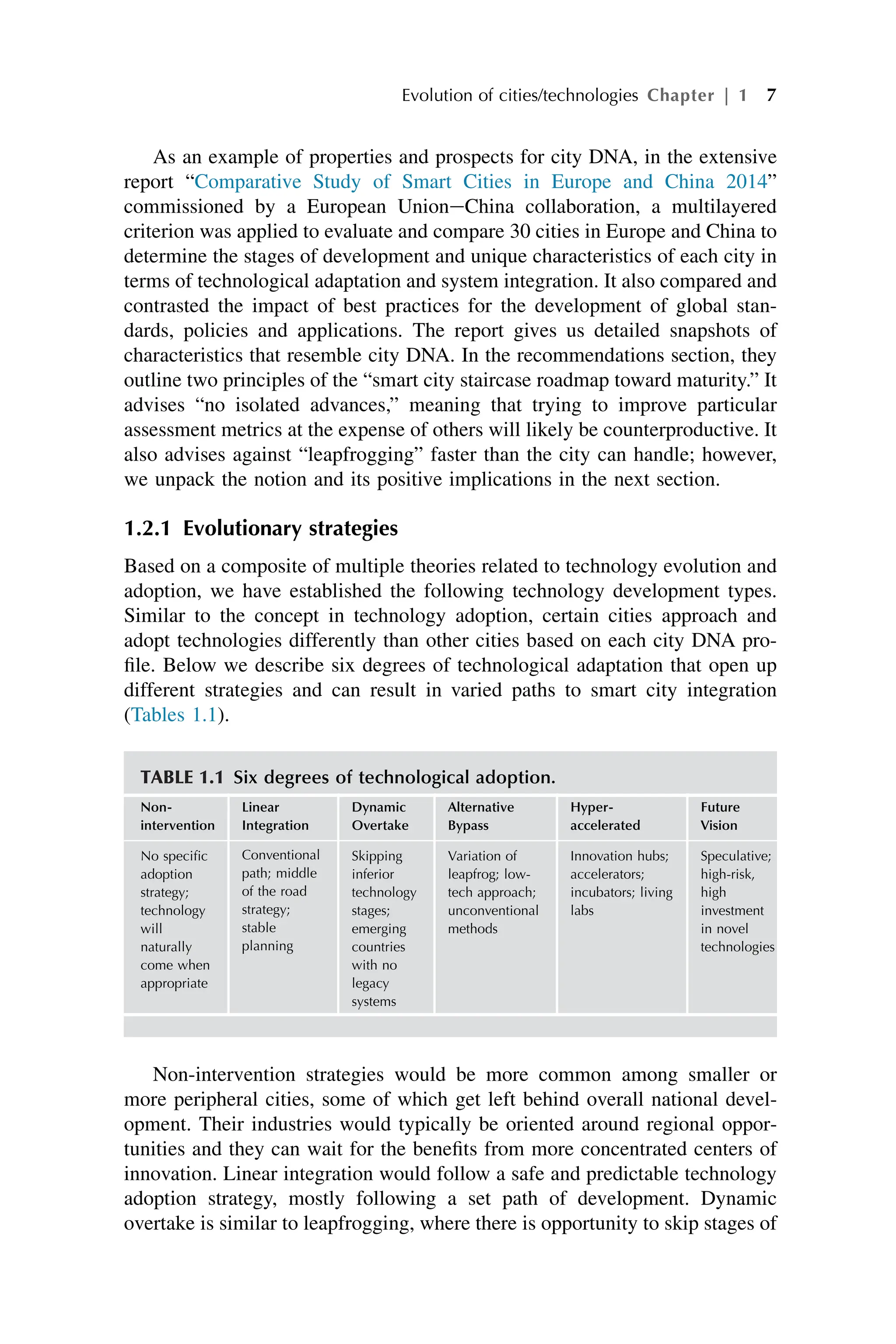
  • 40.
    system (The UndergroundTube and Double-decker Buses) is a critical component in the urban metabolism/equilibrium equation. Through the efforts of Transport for London, the city is able to flow through continual upgrades making mobility more efficient and user friendly. Many civic initiatives, including district based WiFi connectivity and bike sharing programs, are also making the city more navigable and supporting mobility alternatives. To ensure operational efficiency, safety and security, these urban systems are highly monitored through extensive data capture via sensors and cameras and at City Hall, the mayor uses an iPad wall to visualize the city performance data in real time. city DNA; London is a hybrid Top-down, Bottom-up/Linear Integration approach to technological adoption. Predominantly a knowledge and service economy, London has no choice but to place innovation at the center of its evolution. It does so by leveraging its world-renowned universities and in- stitutions in knowledge creation and information accessibility, making the city a leader in human capital. London’s smart city economy is expressed through transparent public access information systems and knowledge assets exem- plified in the London Datastore, a free and open data-sharing portal. London has also pursued innovation with a global orientation, networking with other countries around the world and exporting technology expertise in many sec- tors. London’s city-level initiatives are tackling climate change, taking action where governments have failed to implement long-term sustainable policy architecture. The city is optimized for mobility, with a comprehensive transit system, shared bikes and walkable streets. London’s technological path is a mixture of linear integration and hyper-accelerated. Its brand recognition as a cosmopolitan global capital, has evolved from its previous identity as center of the British Empire, to now becoming a global leader in smart cities and human capital development. Brexit has created some social, political, and economic turmoil, but smart cities advancement may actually be key to offering a path forward through the UK’s challenges. 1.3.3 New Yorkdthe media metropolis New York has a fabled geography and history as a key port of entry to the East Coast and its five distinct boroughs. The importance of its position was real- ized early by Dutch settlers who established New Amsterdam and soon after by the English, renaming it New York as the center of the New World. It is also the most populated city in the US with one of the highest densities. New York’s history is complex and unique, shaped by various immigrant waves that have culturally transplanted their roots in the city’s diverse neighborhoods creating the melting pot synonymous with NYC and the American Dream culture. As a pioneer in engineering at the end of the 19th Century, the modern city has inherited more than a century-old infrastructure from previous generations, much of which now needs major regeneration. To solve this 12 SECTION | I Approach
  • 41.
    challenge, New Yorkis slowly adopting novel upgrades to improve the urban experience and quality of life for its inhabitants, such as greening of the city, more public spaces, bicycle lanes and pedestrian zones. The contrast of characteristic neighborhoods, dense skyscrapers, city subway lines, Central Park, and consumer driven 24/7 hyper-urban lifestyle, exemplified by Wall Street market behavior, has made New York one of the most featured locations in popular culture, from films to photography, musicals, books, paintings and experimental art. New York is a city of different identities and perceptions, together making up a vibrant social tapestry and global brand. city DNA; New York City is a Bottom-up/Non-Intervention model as the pure capitalist arm of the western world, driven predominantly by the private sector, big business and its own market behavior. This ethos is embodied in the survival of the fittest motto “If you can make it in New York, you can make it anywhere.” Due to New York being a city as an innovator or early adopter of new systems, this has in some way put New York in a quagmire. The burden of inheriting and maintaining both physical and digital legacy systems require massive investment to upkeep these systems, while simultaneously fostering self-preservation traits of corporations in order to recover their investments at the expense of adopting new systems. This is further exacerbated without the benefit (or non-benefit) of New York being a center of government (as does Beijing, London, and Dubai), where the free radical and Laws of the Jungle nature of the city makes all technological advancement driven by competitive forces of the market and consumer behavior. In this regard, the media, advertising and digital immersion culture reflects a totally unregulated com- mercial reality driven by how consumer citizens interact with technology. Sneaker stores stay open 24 hours a day and energy consumption is not factored on efficiency of systems, but on consumption levels and return on investment. Technology is therefore not about the optimization of systems, but the exploitation of technology to achieve higher yields. The dichotomy between old and hyper-new is what spins the DNA of NYC. 1.3.4 Dubaidthe iconic branded city Dubai, a branded destination city, is a linear city-state situated along the coast of the Persian Gulf as part of the United Arab Emirates. Born from a fusion of nomadic desert and fishing village cultures, the city-state has evolved sym- bolically and physically with Sheikh Zayed Road as the physical and symbolic spine connecting the dispersed desert city districts and linking its neighbors Abu Dhabi to the southwest and Sharjah to the northeast. Initially built alongside a simple airstrip to bring people to the region, the city is now a full- fledged aerotropolis with Emirates Airlines as one of the most successful airlines in recent history, serving as a catalyst for Dubai’s miraculous success as a global tourist destination and the envy of the world. Dubai’s marketing Evolution of cities/technologies Chapter | 1 13
  • 42.
    strategy is basedon price competitive destination tourism, attracting people from all over the world to bask in the warm dry weather, tolerant Arab society, and visionary metropolis. Contrastingly, Dubai’s resident demographic is segregated in three predominant groups: local Emirati, South Asians and European expats. English is the neutral language and most social interaction between Dubai’s inhabitants takes place through work environments, while their social and cultural lives are divergent due to different habits, religion and native languages. Unprecedented growth drove up property values and cost of living until 2008 threatened to burst the dream bubble. Since then, Dubai’s growth has stabilized allowing the potential to reflect on the balance between preservation of the local cultural heritage, as well as continuing to create a new sense of collective identity and a hyper-modern city. city DNA; Dubai is an example of Top-down/Dynamic Overtake. Despite the market crash in 2008 and the long and winding road back to recovery, Sheikh Mohammed bin Rashid Al Maktoum, the revered leader of Dubai and the visionary figurehead behind Dubai’s global brand recognition, has continued to drive Dubai’s aggressive real estate development with award- winning contemporary architecture, extreme engineering feats and construc- tion innovation. This has included better, taller, more striking building forms and smart building technologies, including the 830m-tall Burj Khalifa tower that dominates the Dubai skyline and is the site for the world’s most dynamic and large scale multidimensional, multimedia show (lasers, media, sound and water). It seems almost every day a new iconic tower or building continues to surface in architectural journals and online media. This continuous innovation in the constructed environment at times seems like an ego-driven pursuit of global recognition, but has actually been the fulcrum for accelerated devel- opment, giving Dubai its leading edge as a global city. In this context the adoption, application, and integration of technology play an accompanying role in transforming Dubai as a smart city in the desert and the leading newly- branded city. 1.3.5 Songdodthe new digital city Songdo bills itself as the “smartest city” in the world, and it may very well be in terms of integrated technology and urban design as a pioneering ubiquitous city. The 1500-acre International Business District (IBDI), located an hour from Seoul and adjacent to Incheon Airport, was built from scratch starting in 2001. Envisioned to be a low-carbon, high-tech utopia, the project set new standards in sustainability, with innovative approaches to urban density, green infrastructure, community planning and building performance. Designed by the New York architectural firm Kohn Pedersen Fox (KPF), the new city has been programmed to promote a high quality, balanced lifestyle with “live, work, play” urban features comprised of themed cultural districts like American Town, abundant parks and open space, efficient waste management, 14 SECTION | I Approach
  • 43.
    and embedded smartsystems throughout the buildings and streetscapes. As a speculative private-sector real estate development, Songdo has taken time to fill in as a complete city with some challenges including affordability and market demand, with the district only partially populated. Nevertheless, the city is active and slowly taking shape as an entirely new smart city experience for its inhabitants. city DNA; Songdo is a Hybrid/hyper-accelerated model born out of the ascendance of South Korea and Seoul as a new capital of hardware and software technology, surpassing Japan and Taiwan as a leader in chip manufacturing, smart phones and the digital media revolution. Seoul needed a new geographic area to expand on the island nation and created a new massive city-region on reclaimed land in the sea near the new Incheon International Airport, reinforcing the potential of creating a mega-aerotropolis region. The achievement of smart is not only a factor of technological pervasiveness and smart buildings, but also a factor of human adoption, absorption and prolif- eration. As a predominately homogenous population of 52 million people with one common language and culture, shared set of values, strong middle class and a 98% literacy rate, the potential for one society to adopt and sustain a common technological evolutionary framework may be the most advantageous in South Korea, with Songdo being the brain child of the real estate and tech industry symbiosis. 1.3.6 Masdardthe new sustainable city Masdar (Arabic for “spring” or “source”) is a new city planned from scratch with a mission to spark innovation and a technological revolution in the 21st century and beyond, and to position Abu Dhabi and the UAE as pioneers in new forms of renewable energy, green building design and manufacturing. As an initiative financed by the government and rulers of Abu Dhabi to reinvest funds underwritten by its 92-billion-barrel oil reserves, and with a forward- looking strategy, Masdar would appear to be a viable platform to secure Abu Dhabi’s economic stability for the infinite future. The plan was the most ambitious in its time, begun more than a decade ago, bringing in the world’s leading architects and engineers, and designed by the British architectural firm Foster and Partners. The highly innovative urban design and technological framework, including a zero-carbon footprint strategy, was a combination for success. Unfortunately, the project was perhaps ahead of its time and the entirely newly-fabricated city has not been able to scale up in an accelerated way as the project was designed to accomplish. But, in other ways, it has served as a new model of cities as centers of innovation and RD. Ironically Masdar was born as a child of Dubai and Abu Dhabi, each able to grow from humble beginnings to world icons within a short life-span of 50 years. As one of most expensively designed city in the world, Masdar can hopefully continue to serve as a living example of a bold, new model of a zero-carbon city vision Evolution of cities/technologies Chapter | 1 15
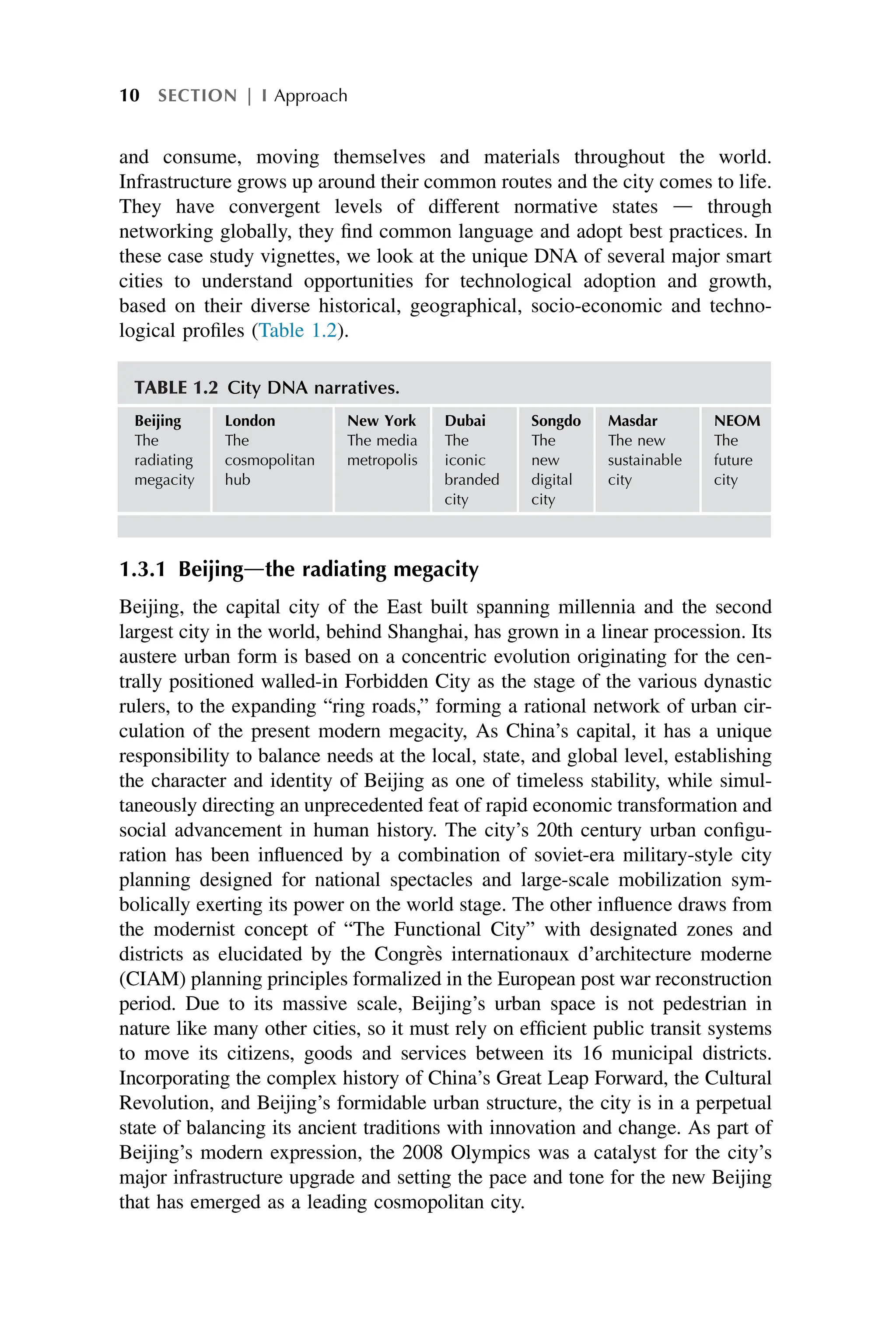
  • 44.
    that one daywe will be able to achieve, learning from each incremental step forward. city DNA; Masdar is a Top-down/alternative bypass example rooted in the research and development of new technologies as a catalyst for a new city like a frontier space station. As an experimental smart city driven by the concept of itself being a Living Lab, Masdar brings academic research, engineering, and manufacturing together, and by partnering with leading universities and tech companies, it creates a tech innovation hub and ecosystem as the core of the city operations. As the first anchor university, The Masdar Institute of Science and Technology, a graduate-level research university focused on alternative energy, environmental sustainability, and clean technology in partnership with MIT, has established a knowledge industry and technology IP footprint. One of the major ideas of Masdar has been to use biomimicry to design the city as a self-developing urban environment, where education, technology, manufacturing, and social dynamics can thrive as a living eco-system. 1.3.7 NEOMdthe future city NEOM (meaning “new future” in Arabic), the new energy city, is a planned smart city in The Kingdom of Saudi Arabia (KSA), slated for completion in 2025 with an estimated budget of $500 billion. NEOM is conceived as a cross- border city in the Tabuk Province of north-western Saudi Arabia near the Red Sea and borders that KSA shares with Egypt and Jordan. The city and region are intended to be a form of market showcase, incorporating smart city technologies while doubling as a new travel destination. The innovative ideas it promises include a vast renewable energy array (including solar, wind, and smart grids), all-green transport, biotech, vertical farming and advanced manufacturing. Hosting a major global forum in 2019 to jump start the project, NEOM invited the world’s leading corporations, technology companies, ad- visors and consultants to join the development of a new tech and energy business ecosystem to solidify global industry partnerships and attract in- vestment. NEOM has had a few challenges subsequent to its start, however the project will likely continue to evolve in different directions as the new vision of The Kingdom emerges under the leadership of Prince Mohammad Bin Salman (MBS) and as the Middle East as a whole, appears to collectively be committed to putting their oil investments into incubating new smart cities and sustainable/renewable energy solutions to solidify wealth for future generations. city DNA; NEOM is a Top-down/Future Vision city and region. Its spec- ulative future is balanced on long-term investment and short-term, tech mar- ket-driven opportunism, making it both an attractive initiative and a high-risk venture. Conceived as a new technological marketplace and special trade zone strategically located at the Gulf of Aqaba in the Red Sea, NEOM can potentially avoid the challenges of Masdar as an innovation-driven city. 16 SECTION | I Approach
  • 45.
    Functioning as ageo-political and cultural bridge between the non-secular world of the Middle East and secular worlds beyond, including an initiative to create potential partnerships with Israel, and by building on the momentum of a new era of modern reform, NEOM is a socio-economic driven city. Formed as a company wholly owned by The Public Investment Fund (PIF), the sov- ereign wealth fund of Saudi Arabia, NEOM adopts technology not as its central strategy, but as a catalyst for the creation of a new economic model and hub of global influence. 1.3.7.1 Summary These case study vignettes demonstrate how different some of the world’s megacities can be. Through the simplified urban narratives portrayed, each city has a unique raison d’etre, a reason to be, that influences the way it will adopt and integrate new technologies to reinforce its identity, its DNA. The stage of historical development and the socio-economic landscape in each city in- fluences the decisions of which technological solutions best apply. 1.4 The dimensions of the city and potential for convergence There are many different ways to model how smart cities and the world are and/or should be coordinated and layered: ISO (International Standards Or- ganization), ITU (International Telecommunications Union), City Protocol/ City Anatomy, the World Government Summit’s nine layers (Bridgwater, 2016) and GIS City Layers are a few useful examples. They all have their strengths and weaknesses, and we choose not to compete or comment directly on them. Rather, the six dimensions we present in this section are based on a more intuitive approach of human development. They are less about particular aspects of the smart city and more about the evolutionary process giving rise to the whole of human reality, to tell a complete story from nature to technology and back again. While other models may use the term layers, levels, domains, or stages, we describe six dimensions that are coextensive. One emerges out of the previous, but they occupy the same space and are nested within each other. They are interrelated in the sense that each dimension overlaps and intersects with all others. All are interdependent and therefore must find harmonious coordination. We propose six dimensions, presented sequentially, where the last dimension connects back to the first forming a continuum: Physical, City Infrastructure, Human, Governance, Digital Infrastructure and Ubiquitous Technology. First, the base is “nature” itself, the bountiful earth, and providing the ecosystems and all the minerals, timber, animals, and fuels therein; second, concrete urban infrastructure, encompassing all basic services and structures; third, the behavior and patterns of humans, their language, culture, beliefs and Evolution of cities/technologies Chapter | 1 17
  • 46.
    so on; fourth,the socioeconomic and political institutions going beyond the functional relationship between the previous two dimensions; fifth, the ICT infrastructure that characterizes the Internet and 21st century technological convergence toward a singularity; and sixth, a ubiquitous technology dimen- sion that (e)merges and converges seamlessly with the environment (the first dimension), including through embedded systems, nanotechnology and per- maculture planning. The dimensions emerge from concrete to abstract and reinsert back into the beginning. This is shown as a stack in Fig. 1.2, but the layers are actually coextensive dimensions forming the loop. 1.4.1 Physical/environment dimension 1.4.1.1 The city as evolution of space, form and hardware Before considerations of technology and smart city applications is the need to fully understand the physical city including its broader context and environment, geographic location, orientation and linkages, physical composition and climate. These aspects must also be seen in relation to the historical evolution of the city and the stages of its physical development. The physical city forms the basis of how all objects and activities function within the geospatial framework and it is the first layer required in the data collection upon which all data is referenced. The physical city embodies the cultural pathos and ethos as the direct translation of human expression in the form of the urban composition and building architecture. This combination of geospatial positioning, city orientation, and building language comprises the physical form and hardware of the city as the Ubiquitous Technology Digital Infrastructure Culture, Society, Governance Human Population Physical Infrastructure TECHNOLOGY SPHERE HUMAN REALM PHYSICAL DOMAIN Nature, Landscape, Environment FIGURE 1.2 City dimensions. 18 SECTION | I Approach
  • 47.
    base or firstdimension. Through this foundational dimension, cities are seen to manifest in strategic or niche regions, usually capitalizing on some convenient port, hospitable climate, or proximity to resources. 1.4.2 City systems, infrastructure dimension 1.4.2.1 The network of the city, the spine, and major organs The second dimension of the city is the physical infrastructure and utilities system that supports the entire operations of the city, from road networks, utility pipelines and telecommunication networks. It enables interaction with the nature and re- sources of the first dimension, including utilities (water, power) and transportation of materials and waste. Infrastructure and the physical city are intertwined and have typically evolved over time in a symbiotic manner while not always working in harmony with each other or the city as a whole. In the example of ancient Rome, roads and aqueducts served as the first communications and transportation net- works, networks being the operative term. From this acceleration of exchange, modern cities emerged and wealth was generated to develop further technologies and infrastructure. These networks of utilities and transportation parallel early versions of cyberspace in that they give birth to emergent properties that quickly transformed the nature of society and their own properties. 1.4.3 The human dimension 1.4.3.1 The city as a manifestation of human patterns and constructs The third dimension represents human activity in relationship to itself and all other dimensions. In the 2017 book, Urban Being, the identity of each city is characterized by the behavior of its inhabitants, but the lower dimensions of the city constitute the potential expression at the human level. Human activ- ities interact with both the physical environment while humans interact with each other. In his influential book Pattern Language (Alexander, 1977), ar- chitect Christopher Alexander describes how the dynamic forces of urban life can be perceived as patterns which can be employed to establish the design criteria or program for the planning of structures at any scaledfrom a small structure to a larger city or metropolitan region. 1.4.4 Culture, society, and governance dimension 1.4.4.1 The nuances of human civilization, behaviors, activities, desires, and relations This dimension covers governance and political systems, typically where elected representatives are obliged to serve the community. Furthermore, interaction between citizens and city organizational structures are framed by the relationship between governance and urbanism. As such, in this dimension, people are not just Evolution of cities/technologies Chapter | 1 19
  • 48.
    represented as humansbut as citizens who play a role in governance. In various ways, governments coordinate and guide the actions and outcomes of people interacting in a top-down way, but bottom-up approaches and feedback enabled through ICT are also necessary. This dimension includes laws, policies, and in- stitutions at the local, international and global levels. Needless to say, there is always room for improvement across the board and best practices should converge. Generally, there is a move toward open-source knowledge, much of which is produced collectively. and open-source governance. Smart cities also attract the right (smart) labor force for this reason; peoplewhowant to be a part of innovation utilize technology in sustainable ways. A smart city is only smart as its most in- tellectual people, and you cannot have competent governancewithout intelligence at the human level of society first. As such, free open-access education is a pre- requisite for any smart city. Non-governmental organizations and businesses also play vital roles, determining whatdrives the urban economy. All these interactions are enabled and mediated by ICT, or digital infrastructure, which is the next dimension. As analogous to city anatomy, government processes can be modeled as the Operating System of the human organism. 1.4.5 Digital infrastructure dimension 1.4.5.1 The city as evolution of systems, technologies, and software The fifth dimension is the digital infrastructure which is all the communica- tions and computing power networked in a given city and globally, including wireless and satellite technology bouncing information all over the world. This dimension also includes the hardware we interface with, such as computers, smartphones, televisions, radio, etc. By extension it includes software and code, with their multitudes of layers of programming abstractions. As tech- nology becomes cheaper, these systems become more widespread and ubiq- uitous. Urban media also has a role to play in disseminating knowledge and culture and renewing narratives that create community and city brand identities. This helps create a host of reasons to attract smart citizens for work, play, and investment. The case studies of New York, Dubai and Beijing show the productive potential of new media to highlight their rich cultural identities and marketing opportunities. 1.4.6 The ubiquitous dimension 1.4.6.1 The merging of technology with the natural environment in the form of imbedded and ambient connectivity Ubiquitous technology is increasingly everywhere and yet unseen. This final dimension emerges after the others have evolved and developed to a new threshold. It has been a historically slow process, but the gap has been 20 SECTION | I Approach
  • 49.
    shrinking and thetime between the last dimension and this one is a matter of mere decades. The ubiquitous city is integrated top to bottom, embedded with sensors to collect data to optimize city functions and human well-being. Nanotechnology is a game changer in that it has the ability to mechanically alter the fabric of our experienced reality at the micro scale, from medical procedures to material construction and beyond. Over the past 10 years, we see a pattern of technologies trending and converging toward more holistic ICT tools and architecture across the domains of Digital, Analytics, Cyber, Business of IT, Cloud and Core. This techno- logical infrastructure gathers, organizes and analyzes vast quantities of in- formation (hence ‘the world at your fingertips”). Useful data are spontaneously accumulated by various tracking algorithms and metrics that people produce and utilize. It is a confluence and convergence of technology that extends itself through the IoT and into this final dimension. 1.5 How convergence theory applies to smart cities “Smart city” is a convergent socio-cyber-physical complex, the management parameters processes of which are optimally adaptive to their own state space. In the popular science sense, a “smart city”is a city that is optimally flexible to human beings and society. A “convergent socio-cyber-physical complex” is a finite set of open convergence systems, including functional components (elements, objects, computing resources integrated into the included physical processes), and their relationships, human being and society, allocated in accordance with a certain goals system on a specific time interval. Smart City: Convergent Socio-Cyber-Physical Complex (2018), Andrey Volkov. All cities evolve throughout their history and we can use the concepts of City Anatomy (this chapter) and city DNA (Chapter 2) to understand their unique character and to map smart systems throughout. As smart cities evolve, technology and AI become increasingly integrated. Our criteria for under- standing the viability over time is based on the Net Present Potential, which includes considerations of environment, population, culture, socio-economics, governance and history. The emergent total is what we call city DNA. A city’s potential for smart city status is first determined by its historic stage of development (including where there is none). The diversity of current versions makes it difficult to abstract a common language and approach. Movements toward a standard and universal language (such as ISO, ICU, City Protocol, or GIS CIty Layers) are converging. For illustrative purposes, we invoke City Protocol and its proxy City Anatomy to help discuss our own approach. The City Protocol Agreement includes a model for smart cities called City Anatomy, an analogy between cities and living systems that helps to map the city systems and connections between them. City Anatomy conceives of an “anatomy of urban habitat” with four main qualities: timeless, acultural, Evolution of cities/technologies Chapter | 1 21
  • 50.
    Other documents randomlyhave different content
  • 51.
    IV—HEALTH, HUMANITY ANDPROCEDURE What were already glaring national ills before the war will, afterwards, be ills demanding the most immediate, sustained, and resolute attention. There exists in America a vehicle called the “rubber-neck” car, in which the tourist is taken and shown the interesting features of the neighbourhood. Before the political machine settles down again to work, legislators, editors, business men, writers—we might all with profit take a round trip and see again evils that our country has never really faced in the past, but will have to face, and grievously swollen at that, in the future. At the back of all lack of effort is lack of realization. Statistics of national problems may foster an impersonal and scientific attitude, but they do nothing to supply the feeling from which alone comes driving force. Take our slums! The powers vested in the State or in local bodies for dealing with slum areas are obviously either not sufficient or not sufficiently put to use. Not, of course, that any quick or light-hearted transformation can be expected; the roots of this evil are too tortuously coiled in economies and natural selfishness. Still, just as realization of our country’s danger at the hands of Germany has produced a marvellous crop of effort and sacrifice, so realization of the equally distressing menace to the country from within should produce something similar, when patriotic attention is once more free, and time and strength at liberty, for fighting dangers at home. The housing problem desperately needs attention; but, though much can be done, good gamblers cut their losses, and the adult generation of the slums has got more or less to be cut, that greater effort may be concentrated on the children. The war has focussed attention on the need for arresting infant mortality. Good! But there is little use in saving babies if you are not going to feed them decently when they are out of swaddling clothes.
  • 52.
    A big stepforward has been taken of late years towards the feeding of necessitous children, both at school and in crêches but many more steps need to be taken. If this is not a State matter, then nothing is. To neglect the nourishment of its children is at once the paltriest economy, the least sagacious policy, and the worst inhumanity of which a nation can be guilty. The old-fashioned idea that children must go hungry or be fed so as to grow up rickety because their parents (being “rotters” already) must not be rotted further is a doctrine devoid both of common sense and compassion. A nation either has a will towards a future, or it has none. If it has none, for what are we fighting this most bloody war? What does our honour matter, or our independence either? But the future of a nation is its children. As they grow up, healthy, clean, hopeful, efficient, so will our future be. As they grow up—half-fed, dirty, don’t care, and ignorant—so will Britain! If to look after the children makes worse paupers of the parents, well—let it! Have some courage. Do not be hypnotized by a word, and, grasping the shadow, lose the substance. Give the children blood in their little bodies, and hope in their little brains. Any decent parent will be the better for that; the indecent parent is a loss already, and must be cut. Working-class mothers who neglect to feed their children better than themselves are but exceptions, nor will a sounder system of State-help seriously alter the deepest instinct of human nature. The heroism of British soldiers in the trenches is no greater than the lifelong heroism of British mothers in the slums struggling against want. This is a matter that should not be left to the discretion of local bodies. Once the principle has been admitted—and who can honestly deny that it has? —the rest should be simply a question of fact medically certified not here and there, but all over the country. Either it is justice and wisdom to feed the children, or it is not, and the scruples, however philosophical, of gentlemen prepared to watch other people’s children go hungry should not any longer be indulged. The estimated number of school children in England and Wales being fed by the State in 1911-1912 was 230,000 out of a school population of 5,357,367. The estimated number of this school
  • 53.
    population showing signsof malnutrition is variously given at from 10 to 20 per cent. Taking it at 15 per cent., or 800,000 children, we have more than half a million school children wanting meals and not getting them. This is appalling. There is no other word for it. But when the children under school age who need food and are not getting it, are added to this number, the proportions of this national folly and inhumanity stagger the brain. It does not yet seem to be grasped that these children, who are fighting not only against insufficiency of proper food, but against bad air and bad housing, grow up with so much per cent. knocked off their national value. A stitch in time is supposed to save nine. A pound spent on the age of growth brings back many pounds from the age of stability. To those few who ride the doctrine of Liberty to the death of national health it may simply be said: So long as you have no hope of repealing compulsory education, you have no right to let children receive it in an unfit condition. Education and decent nourishment are inseparable; and decent nourishment is as necessary in the years that come before as in the years of schooling. No! In reality the principle is now rooted, and, like other things, it’s all a question of money. But a country with a capital of £16,000,000,000 and an income of £2,100,000,000 cannot really afford to allow this state of affairs to continue—especially after the gold-letting of this war. The state our national finances will be in makes it all the more imperative that we should have a well-nourished and efficient population, or we shall never get out of the slough. During this war our heroism has jibbed at Liquor. That jovial monster looms nearly as large as ever. We shall have a National Debt after the war of three or four thousand millions, perhaps more. And yet the cheapest thing that could possibly be done, in the long run, would be to increase it and buy up the Liquor Trade; achieve that dream of Joseph Chamberlain, “the total and absolute elimination of any idea of private gain in the retail sale of liquor”; convert drink into food to the tune of some eighty millions a year; and vastly diminish the number of children that require State nourishment, and the number of underfed men and women. In
  • 54.
    1911, £162,797,229 wasthe drink bill of the nation; of which it is estimated that about £110,000,000 was spent by the working class. The working classes are no more inclined to liquor than the rest of the population, but they have obviously less to spare for the indulgence of their inclination. With proper control of the liquor traffic they will perhaps spend half what they spend now, extracting therefrom just as much enjoyment, and most of the other half will go into the bodies of themselves and their children in the form of food. Before the war one-tenth of our people were getting too little food; two-tenths more just balanced on a knife-edge of bare sufficiency. And the great majority of this third of our population were too closely or too badly housed for health. What is it going to be—after—unless our measures in regard to food, to housing, and to drink, are heroic? For heroic measures we shall need a keener sense of justice, a larger humanity, than we have ever had. Though the war may conceivably not diminish humane feeling in those who fight, it blunts the sensibilities of those who do not see its horrors at first-hand. Tales of others’ sufferings have become the daily fodder of the brain; narratives of death and misery the companions of every hour. Alongside the brutalities and agonies of the war, the injustice and cruelties of normal civil live seem pale and tame. Man has only a certain capacity for feeling; one expects callousness now towards civil inhumanities. But must that callousness last after peace has come? If so, we are in a bad way. What is it that our modern State is reaching after? Presumably health, and balance. And what are these qualities built on, if not on Justice? At the back of all social inhumanities will be found a lack of reasonable freedom and opportunity for some people, and the possession in other people of too much freedom and opportunity. And for the swift redress of social cruelties, the thorough attainment of social justice, we have at present not only to contend with human nature, but with an admitted deficiency in our legislative machinery. When the chief obstacle to laws is not the callousness of public opinion, but a mere block on the lines of procedure, some drastic
  • 55.
    change is due,a new departure wanted. Before the war many measures of reform hung in the wind year after year, not because there was no public feeling behind them, not even because there were the usual political cleavages concerning them, but simply because time could not be found in which to pass them. Of such were: Measures for the feeding and education of children; the control of drink; rural housing; improvement of slum areas; furtherance of the minimum wage; reform of the Poor Law; of the Divorce Law; of the disability that attends the needy in their access to civil justice; of the imprisonment of poor persons for debt; of the procedure in regard to pauper lunatics; of the prison system; of provision for the blind; measures for the better treatment of animals. All these and others hung in the wind; are they to go on hanging those when the war is over? Wanted before, they will be wanted still more badly then, because the general conditions of life will for some years, perhaps many years, be harder; and economic pressure fosters rough and unjust treatment. Is it too early for a united effort, to think out, in readiness for peace, a scheme of parliamentary procedure which shall afford time for the serious and uninterrupted consideration of non-party measures, and the furtherance of needed reforms? Party no longer exists, but they who think it has gone for good dwell in a fools’ paradise. As sure as fate it will spring up again, because it is rooted in temperamental difference. But must it come back with all its old cat-and-dog propensities, and waste of national time? It will, unless some method be devised that will remove some of party’s unhandsome opportunities and save it from itself. Politicians alone know the difficulties, many and great, in the way of a better procedure. Surely, while faction is in abeyance, Parliament will set its wits to overcoming those difficulties, so that when the war ends we may not witness again the tedious and distressful blocking of so many needed measures that prevailed aforetime. Party was made for the Country, not the Country for Party; and what was tolerated with Job-like patience before this vast upheaval is not by any means likely to be tolerated after. Needs will be more insistent;
  • 56.
    the sense ofreality much greater; the aspiration towards National Health a live thing, because it will be so desperately necessary. Reform of parliamentary procedure is obviously the prime precedent for national reform. Shall not then the question be even now given all the attention that can be spared to it? What better moment—when men of all parties are filled with the one great thought—Our Country!
  • 57.
    V—A LAST WORD Onemore word before these vapourings cease. The national task in this war is still mighty enough to absorb all action, but not quite all thought, for it is no spasmodic effort, meaning nothing to the future. To carry the spirit of to-day into a long to-morrow, making of our patriotism not a mere torrent soon spent and leaving an arid plain, but a life-giving, even-flowing river—for that one must not lose the sense of continuity; one must think ahead. More! One must resolve—resolve that this new unity shall stand not only the strain of war, but the greater strain of the coming Peace. After—will come the test. Having guaranteed our country for the moment from destructive powers without, shall we at once redeliver it to the destructive powers within—go back to strife over Ireland, the Suffrage, the Welsh Church, and the Second Chamber? Or, preserving our new-found unity, settle generously and in a large spirit those distressful matters, and pass on to the real work—to a wider and freer view of Empire, to the right training of the nation, the right feeding of the nation, to securing for each man, woman, and child a solid foundation of health and hope; to the restoration of the land and of our food supply; to clearance of mutual suspicions, and the stablishing of a new trustfulness between Labour and Capital; to the banishment of inhumanity; the freeing of the eyes of Justice; and interment of the privileges of class? Shall we go back to rolling in the troughs of a dirty sea or set new sail and steer out with a true faith in our destiny as the Ship of Freedom and Justice? “When the devil was sick, the devil a saint would be, But when the devil got well, the devil a saint was he!” Is that to be our case? Let us not underrate the danger. At this moment and until the war is over, we are full of patriotism and good- will. We have to be. There’s the trouble. Once Peace comes, and the
  • 58.
    unifying force ofour common peril is over, what then? Is the old raw party spirit to ramp among us again? If a man would discover what danger there is of a return to every kind of disunity, let him take a definite national question and see how much of his private interest or conviction he is prepared to abate for the sake of the public good. Mighty little! Are we to dissolve again into those “rascally Radicals” and those “infernal Tories”; into “grinders of the poor” and “discontented devils”; into “brutal men” and “hysterical females” with all the other warring tribes of the Armageddon of Peace? Are we to lose utterly the inspiring vision of our Country, in the squabbles of domestic life? Some of that intense vision must go, alas! But surely not all. And yet all will go unless we keep in mind the thought that this war is not an end, but the means to an end, which none of us will see, but all of us can further in time of peace as well as in time of war—an end for whose attainment the blood and treasure now spilled is but as a preliminary. It will be heart-breaking if from this stupendous cataclysm no lasting good to the world and to Britain can be brought forth. Its horror, even now, few realize who are not at the front. One who was many months on ambulance duty in the French lines wrote these words: “They talk of the war! Let them come close in! Let them see lying around emaciated heads with no bodies within a couple of hundred yards; let them see the bloody confusion of heads and entrails and limbs which is showered around when a trench is mined; let them see the heads with ears and noses bitten off as if by mad dogs; let them see the men driven insane by the sights and sounds of the battlefield, who turn and rend their comrades and have to be shot down by them; let them come where hundreds of wounded men are lying on contested ground screaming the whole night through (and not one in a million has ever heard a man scream!) and then talk of the war!”
  • 59.
    If from thishorror, fought through and endured, as we believe, for the future of our Land and the future of mankind, there is to come no blessing, no advance to freedom and health and justice. . . . What then? Nothing will be easier than to take up again the peace life of Britain as it was, and worse than it was, because coarsened by the passions of war, and embittered by the strain of a greater economic stress. Nothing will be easier than to give rein to the instincts of greed, pugnacity, and rancour, now hard held in by sentiment and the common peril; to step back and walk blindly in a country where all is faction; where class shuns class, and men and women are bitterly opposed; where the youth of the nation is all the time running to seed; where children go hungry and millions throughout the land are miserably housed and fed; where the access to justice is often still beyond the reach of the poor; where helplessness is not yet a guarantee against ill-usage. Once the war effort is over, nothing will be easier than—from a resolved and united nation—to become a crowd pressing this way and that, without view and without vision, seeking purse and place, or, at the best, fulfilment of small factious policies. No one can tell yet what will be the world-sequel of this war— whether it will bring a long peace or other wars; the enlargement of democracy or the hardening of autocratic rule; the United States of Europe or a congery of distrustful Powers working for another “Day.” Only one thing we know, that in our charge will be our own national life, to make or to mar; to prepare against whatever fortune the outer world shall brew, to prepare against the subtle march of inward dissolution. Our future does not lie on the knees of the gods; it lies in our own hands, and hearts, and brains, and the use that we shall make of them. Swift is the descent to hell, and no wings fly so fast thither as the wings of material success. Shall we go that way? Or shall we, having fixed our eyes on a goal far beyond the finish of this war, quietly, resolutely in our conduct to the outer world and in our national life, begin at once transmuting into deeds those words: Freedom, Health, Justice for All?
  • 60.
    As a manthinks and dreams, so does he act. It is time to think and dream a little of the future, while the spirit of unity is on us, the vision of our Country with us; so that, when we see again the face of Peace, we may continue to act in unity, having in our hearts the good of our Land, and in our eyes the vision of her, growing ever to truer greatness and beauty.
  • 61.
    THE ISLANDS OFTHE BLESSED (Read at a Conference on the National Life of the Allied Countries, Stratford-on-Avon, August, 1916.) I suppose there are Britons who have never seen the sea; thousands, perhaps—unfortunate. But is there a Briton who has not in some sort the feeling that he is a member of a great ship’s crew? Is there one who never rejoices that his Land sails in space, unboarded, untouched by other lands? It must be strange to be native of a country where, strolling forth, one may pass into the fields or woods of another race. In all that we are, have been, and shall be, the sea comes first—the sea, sighing up quiet beaches, thundering off headlands, the sea blue and smiling under our white cliffs, or lashing the long sands, the sea out beyond foreshore and green fields, or rolling in on wind-blown rocks and wastes. The sea with its smile, and its frown, and its restless music; the grim, loyal, protecting sea—our mother and our comrade, our mysterious friend! The ancients dreamed of “the islands of the blessed”; we of these green and misty isles almost, I think, believe that we inhabit them. A strange and abiding sense is love of Country! Though reason may revolt, and life here be hard, ugly, thankless, though one may even say, “I care no more for my own countrymen than for those of other lands; I am a citizen of the world!” No use! A stealing love has us fast bound; a web of who knows what memories of misty fields, and scents of clover and turned earth; of summer evenings, when sounds are far and clear; of long streets half-lighted, and town sights, not beautiful but homely; of the skies we were born beneath, and the roads we have trodden all our lives. What memories, too, of names and tales, small visions all upside down perhaps, yet true and warm to us because we listened and saw when we were no older than foals at their dams’ heels. It is not our actual Country, but its
  • 62.
    halo, that welove—the halo each one of us has made for it. There are evenings under the moon, dewy mornings, late afternoons, when over field and wood, over moor or park or town, unearthliness hovers; so, over our native land hovers a glamour that burns brighter when we are absent, and flames up in glory above her when we see her driven or hard pressed. No man yet knows the depths of our love for these islands of the blessed. May no man ever know it! And to each of us there will be some ingle-nook where the spirit of our country most inhabits, where the fire of hearth and home glows best, and draws us with its warmth from wanderings bodily or spiritual. To know that in these isles no native-born but has a quiet shrine, be it lovely, or devoid of earthly beauty, where he or she in fancy worships the whole land, gives reality to the word Patriotism. This love of country is so deep and sacred that we cannot utter it; let us not forget that it is as deep and sacred to the natives of other lands! Looking back into the dark of history, how quaint is our origin— offspring of invading robbers, wave after wave, for some two thousand years before the Norman Conquest! If these be not in truth the blessed islands that the ancients dreamed of, they seem to have been sufficiently attractive. Who our Neolithic forerunners were, whence they came, or whether they were here before our isles cut loose from the mainland and set out on an endless voyage, we shall never, I suppose, know. A strain of their blood, more than we think perhaps, must still be alive within us; the rest of it is freebooting fluid—Celts and Romans, Anglo-Saxons, Danes, Normans, all robbers; blent at last—and in Ireland not yet quite blent—to the observance of honour among thieves. Ever since the sea brought us here—all but the Neolithic few—in the long-ships of the past, what a slow, ceaseless fusing has gone to the making of the modern Briton—that most singular among men! I hold the theory—how far scientifically tenable I know not—that the continued vitality of a race depends on two main conditions: the presence of many strains of blood not too violently differing one
  • 63.
    from the other,and the absence of too much sun. I hold that nations may become too inbred; or may have the sap dried out of them by heat. In Britain we cannot yet have reached the point of perfect fusion—are not in danger for a long time of becoming too inbred. Nor can the sun be called a desperate peril. We are “game,” as they say, for centuries yet; unless——! For our besetting danger is another. How many of us realize that far beyond all other nations we are town dwellers, subject to town blight? That is a new, an insidious, malady, whose virulence we have hardly yet appreciated or had time to study. Can it be arrested by homœopathy—or must sweeping allopathic remedies be applied? Will town blight be cured by better town conditions, and our gradual adaptation—or by going back to the land? By both. But, if not by both within the next half-century, then—I fear—by neither. Town blight has had as yet but two full generations to lay its grip on us. We have time for its defeat if we have courage and sense. But it is an enemy more deadly than the Germans; not so easy to see and to fight against! When children first discover gooseberries or other kindly fruits of the earth, they eat too quickly and too much. We were the first people to discover the means to “happiness” known as modern industrialism. With huge appetite we set upon it, and are caught by surfeit. I have heard this view of our case seriously countered—the Cockney and the northern townsman are thought to be our most vital types. Verily they have a pretty courage; but to such as are light-hearted on this matter I would say: “Go, in summer, to some seaside place where humble townsfolk have come to make holiday, as healthy and little pallid as they ever are, and—watch. Then wing off to some remote fishing village, or countryside where such peasants as are left are not too badly off, and—watch. Then summon your candour, and tell in which of your two fields of observation you have seen more vigour of limb, beauty of face, or at all events more freedom from petty distortions and a look of dwindling.”
  • 64.
    I cannot explainexactly what I mean by town blight. It is not mere pallor or weakliness, but rather a loss of balance—a tendency to jut here and be squashed in there; an over-narrowness of head; an over-development of this feature at the expense of that; with a look of living too fast, of giving out more than is taken in. The modifications of the Briton through town life are countless, and all the time subtly going on. I do not deny that there is much good, too, in the transformation—the quickening of a temperament by no means quick; a widening of sympathies in a character not too sympathetic; the deepening of humaneness and the love of justice in a nature with an old Adam in it of brutality. A frank humanitarian and humanist, like myself, dwells cheerfully on that, for it does seem, while other changes in human life are always arguable—such as the increase of efficiency purchased by loss of breadth and kindliness; economic gain by loss of health and balance; greater will- power by loss of understanding and tolerance—that the increase of humane instinct, with which is bound up the love of justice, is alone sheer gain. Some, I know, think it bought at the expense of what is called “virility.” To those I recommend a steady glimpse at the modern British sailor. Of late years I have been reading accounts of Arctic and Antarctic exploration. There is no better study for those who doubt whether men can be brave and hard and at the same time chivalrous and gentle. One returns from mental travel with those heroes convinced that true humanity and gentleness and justice actually depend on bravery and stoicism. Picked men, you say! Well, go to the British Fleet, or the British Army—in a word, to the British male population of robust age—and you will come back, I believe, with the same general conviction—that where the truest bravery is there also is humaneness—that these qualities grow naturally twined together. All evidence from the war proves that the Briton is as hard a fighter, and far better behaved, than he ever was. Better behaviour under war conditions means nothing but increase in each individual fighter, of just and humane instinct, and that sense of personal responsibility which is the other main advantage coming to us from town life. In towns a man finds his level, acquires the corporate sense, sees himself as part of the civic whole, learns that
  • 65.
    his own illsare shared by too many, to bear thinking of save with a touch of humour and contempt. The British sailor whose shattered arm was being dressed in the battle of Jutland well summed up what I mean: “To hell with my arm, doctor; I want to get up there again and give the boys a hand!” That would seem very much the spirit of the modern town-bred British. Now, is there anything which in some sort differentiates this Britain of ours from other lands? A country is such a huge conglomeration of types and qualities; such a seething mass of energies! It seems sometimes as impossible to thread one’s way to the heart of that maze as to fix the pattern of a thousand gnats dancing in a sunlit lane! One turns eyes here, there, follows this movement and that, thinks one has the clue, falls back gaping. Is there any essence which sets the British soul apart, as an oak is set apart from beech or lime tree? Can there, indeed, be any single essence in a land where Iberian and Celt, Saxon and Norseman, still quarrel in the blood? I think there is, and will hazard an attempt to throw on the screen some faint shadow of the elusive thing. Take certain salient British characteristics: Our peculiar national under-emphasis and stolidity; our want of imagination; that desire to have things both ways—which is generally called our “hypocrisy”; our turn of ironic humour; our bulldog grip; our lack of joie de vivre; our snobbishness—dying, but dying very hard; our perpetual desire for the moral in action or art; our regard for “good form”; our slow dumb idealism, hand in hand with our profound distrust of ideas; our propensity for grumbling under prosperity, and our cheeriness under hardship; our passion for games, and our creed of “playing the game”; our love of individual liberty—even our perversity and crankiness. . . . Take them all, and consider whether there is not some fundamental underlying instinct. I believe that the mainspring of the British soul, concealed by a layer of mental laziness from superficial scrutiny, is nothing but an inveterate instinct for competition. The Briton is the most competitive creature on the face of the earth—save possibly the
  • 66.
    American of Britishdescent. True—we would, as they phrase it on the turf, make a race with a donkey, for our climate has certainly sluggarded the circulation of our blood. None the less, we have a perpetual secret itch for competition, so bone deep that most of us do not even know of it. All through our lives we are playing a match. When the Briton is not secretly pitting himself against somebody or something, he can hardly be said to be alive. I do not think, speaking racially, that he cares so much for what he gets by the game as for the game itself and victory in it. He sets little store by the perfection of his handiwork so long as it beats the handiwork of others; or—and this is the saving grace—so long as in the accomplishment he has defeated the slackness or cowardice in his own nature—won the match within himself. Let us turn them over one by one, those salient British characteristics: Stolidity! Under-emphasis! It is surely nothing but contempt of fuss; and what is fuss but allowing too much importance to the task or person you are up against? The instinct of competition forbids that in the Briton; he is so competitive that he does not deign to let people see that he is stretching himself. Want of imagination! That is partly the mental laziness, no doubt, engendered by our thick climate; but much of it, I think, is only the subconscious refusal by our competitive natures to see too quickly and clearly what we have before us, lest we be discouraged. A great help—to have muddled through most of the battle before you are aware of the size and length of it! Our rather grim turn of humour! Is it not generally a jest at the expense of a fate which thought it could set us down? Our hypocrisy! One would not admit a physical defeat, but clench the teeth and have at it again; then, how admit moral defeat? Impossible! Face must be saved—instinctively again, unconsciously— for the last thing we plead guilty to is our “hypocrisy.” The bulldog grip—speaks for itself.
  • 67.
    Our lack ofjoie de vivre! We are playing a match—we have no chance or time to relax, to lie on our backs and let the sunlight warm our faces. We have not time to give ourselves up to life; there is so much to beat—we are playing a match. Our veneration for rank of every kind! Snobbishness! This is surely nothing but our recognition of the value of attainment; acknowledgment of victories won, if not in the present, in the past; tacit confession that we, too, want to win such victories. Our craving for a moral! Well, what is a moral, if not the triumph of what we call “good” over what we call “evil”? We crave that triumph—not only in action, but also, I fear, in art. Art must not merely excite within us impersonal emotion; it must be useful to us in our match with life—a pity! Our worship of “good form” is partly dread of that ridicule which would be a proof of our having fallen short, and partly recognition by a people who have long lived an exceptionally stable social life, that this competitive instinct of ours, unchecked by rules, becomes a nuisance to ourselves and others. In the same way, “playing the game” is but the necessary check on our passion for a match. Our inveterate dumb idealism is of course a primary constituent element in the fighting nature; and our distrust of ideas a natural lazy dread of being pushed on too fast by that idealism. Our grumbling habits, when there is little or nothing to grumble at, show, I think, that in slackness and prosperity we are really out of our element; while our ironic cheerfulness under hardship—the cry “Are we down-hearted? No-o!” proves that times of stress suit our competitive temperament. Our love of individual liberty! A man, the joy of whose life is winning an event over himself or others, naturally desires the utmost latitude for these perpetual contests. And so the Briton becomes “a crank” more often than members of any other race. One should never drive theory too far, but I seriously believe that the foundation of the Briton’s soul is this dumb and utter refusal to admit that he ever can be beaten, either by himself or any other. He
  • 68.
    is concerned towin, rather than to understand or to enjoy. I do not know whether this is admirable, but I am pretty sure that it is true. And behind and beyond all the better reasons for pursuing this war to a victorious end, there is always the inarticulate, intense, instinctive feeling, that we must win the match, since to fail would mean not only defeat by the Germans, but the defeat within us of our will and of our own nature. If I am right as to this essence of the British soul, what does it signify to the world of our friends and enemies? It means, of course, a rock on which our friends may build—it assures the fulfilment of all pledges, and endurance till the day of victory; but it carries with it a certain element of danger. Vice treads on the heels of Virtue in the competitive soul. How far may our nature become a peril, not only to ourselves, but to our Allies and the whole world? Underneath all our resolution not to fall short of such measure of victory as shall free the invaded lands, and prove to all that the over- riding of a little harmless neutral country has not paid; underneath this absolute resolve, which of us does not long for a real peace, an end of a world that is like a powder magazine which malevolent or foolish hands can fire at any moment? The difficulties that lie between us and such a peace are very great; far be it from me to minimize them, or blink the seeming impasse of the situation ahead. When the end draws near, in every warring land the great dumb mass-of-the-people’s only thought will be: “For God’s sake, have done with it, and let us get back to life!” But, jutting out of this mass, in each country, and especially in our own, there will be, on the one hand, idealists and dreamers, a little band, seeing a vision too visionary, telling of it to the wind; on the other, a far larger, louder band of men of affairs, judging of matters with the immediate eye, for immediate profit, or, as they will rather phrase it, for permanent profit, under the waving flags of patriotism; of men talking of a lasting peace and genuinely wishing for it—so long as it does not mean foregoing anything, so long as they may let go no advantage so dearly bought. Already the cry on both sides is for a commercial war starting from the final battle. All that is stupendously
  • 69.
    natural! But inthis medley of demand, how will statesmen steer? Will they, who have to remake the world, have a large vision, and see that, vital before all else, is the seizing of a chance—that has never come before and may never come again—to establish and set going a Court of Nations, backed this time by real force? Will they grasp the wisdom implicit in the feeling of the great dumb multitudes: “For God’s sake have done with it, and let us live!” We have not yet got to the moment on which the whole future will hang. When we do, I fancy that this competitive soul of ours may want too much to have things both ways. Whatever the terms of the peace that comes, that peace will not last without a League of Nations to guarantee it; and such a League we cannot have unless impartiality be its backbone; unless we mean that it shall judge justly, and enforce judgment without fear or favour; unless we are willing to accept its judgments in all matters, and not merely when it suits us. A man does not guarantee the health of his body just by holding his neighbour down; and the true path to security and a great future lies in the efforts we make to improve ourselves, rather than in those we make to injure others. The freedom and fair opportunity which are vital to a lasting peace need not bar us from national preparedness, from intelligent effort to save ourselves and our Allies from unfair commercial competition, need not prevent us from assuring our safety and improving our corporate life. But they do mean that we must keep free of a militarist and tyrannical spirit. How far will our competitive British soul, when peace comes, be proof against that virus? Are we, in the winning of military victory, going quietly to accept moral defeat, letting our ideals turn turtle and float with their keels to the stars? I wonder. This League for Peace we talk of—that even statesmen talk of— will not be born of violent minds, but out of level and long- headedness, and the desire to benefit not only our own country, but the world. It is an undertaking fraught with the most poignant difficulty. If you imagine it fledged from birth, with wings full grown —if you imagine a world disarmed, immediately responsive to law—it is but an Utopian dream. The world will assuredly remain armed; at
  • 70.
    a single strideone cannot step from hell to heaven. But armedness need not prevent the nations from establishing procedure for the delay of warlike action—a tribunal to which all disputes must be referred; need not prevent them from pledging themselves to forcible support of its decisions, from declaring commerce sacro- sanct between members of the League, and punishing by blockade and ostracism any nation that betrays its membership, or flouts a decision, so that the sanctity of a nation’s commerce may in future depend on that nation’s loyalty to other nations; nor need it prevent States from taking the manufacture of war material out of private hands. Only on the proved efficacy of such measures as these will the disarmament of nations follow, slowly, surely, equally; for man will then be acting, as he loves to act, not by rote and theory, but on the evidence of facts. Is all this a wild-cat notion, or a mere natural growth out of what went before the war, and out of the terrific tragedy of the war itself —a plan tentative and experimental, that may gradually force its way to confidence, till the Court of Nations reaches the unquestioned authority and permanence of each individual nation’s courts of justice? We of the Allied countries must surely long for such a plan; nor, I think can any neutral nation which has watched and trembled at this war be other than well-disposed towards it; and, whatever their rulers and journalists may desire, the peoples of the Central Empires will not wish to be left out. Yet when the time comes for peace discussions one sees only too well the deadlock. The Allied nations, if victorious, will not want a round table séance with their enemies and a cosy settlement. The Central Empires will not wish to accept forced membership of a League for Peace founded by their enemies, in which—however mistakenly—they believe they will always be outvoted. This vicious deadlock, however, is less real, I think, than it seems. There are new forces at work; and if a League for Peace can make even a lame and partial start, it may by these new forces soon be fortified. After this war, deep-planted in the heart of every people, whether fighting or looking on, will be the loathing of national
  • 71.
    aggressiveness! Such afeeling has never existed before because men have never before been so stirred, so injured, and so frightened. We soon forget, of course, all save that of which we are constantly reminded; but the aftermath of this war will be full of startling revelations of the ruin it has caused; the world will reek with reminder that so-called national aspirations cannot with impunity be aggressively pursued; that so-called defensive wars cannot be light-heartedly incepted. During the march of a war, however terrible, the fascination of strife colours and subdues its horror; its heroisms hypnotize, its rancours drug all reason, blur all vision. But in the cold thinned blood of a maimed future, how different it will all seem, how terrifically disproportionate! Love of country has never before had such calls made on it; men have never so suffered for their patriotism. That, too, must bring a sweeping reaction, which will gradually force the hands of reluctant Governments into adhesion to any scheme which promises relief from a repetition of such agonies. And so, in spite of all the difficulties, I believe some sort of League for Peace will come, imperfect and experimental at first, but which, once founded, will wax and grow strong, in the real—not merely pious—horror of war which will follow this fearful carnival. Let it but hold together for a few years, survive one or two serious trials, and I think no sane nation will ever desire its dissolution. Such a scheme will not come down to us from Heaven. From our own brains and wills it must spring; from our sense of—shall we say —the inconvenience of wars like this. If the killing and disablement of some ten million men, the waste of some ten to twenty thousand million pounds, persuades us to nothing but the leaving of the world exactly as it was, as liable to these irruptions of death and misery— then, better say with the Spanish poet, “Of all the misfortunes of man, the greatest is to have been born.” Even before the guns cease roaring, shall not our nine Allied peoples agree informally among themselves upon the structure of a League for Peace, and secure the sympathetic understanding of
  • 72.
    America, and theother neutral countries, on whose wisdom and good-will so much depends? I, for one, would wish my Country foremost in pursuing this great chance—wish that she might place all her power in the favouring scale; I would wish to see her as ready to submit to the decisions of an International Tribunal, as each one of us is ready as a matter of course to submit to the decisions of our judges. We in this green Britain of ours, still free of the invader’s foot, can measure the value of freedom now, looking across to lands waiting for deliverance. No country of Europe but has suffered, during long centuries, outrage and trampling, siege and slaughter, that we have been spared—saved by our sea. It is not irony that calls these the islands of the blessed. But Fortune is a jealous goddess; and offerings are due to her who has given us an inviolate soil. I seem to see Fortune standing apart, watching—wondering. “What have they made—what are they going to make of their Land?” I seem to see Fortune thinking: “If I grant them success once more, these islanders, are they great enough to survive it? Under my smile the empires of the past one by one went down—Assyria, Egypt, Persia, Rome, others of long, long ago. Will this empire live, or will it too rot away, and sink?” Those empires of the past fell through prosperity, through inordinate pride, through luxury and slavery hand in hand. May Fortune hold up a mirror to us, that we see ourselves as we are! Freedom and Humanity are not mere words; nor is a people’s greatness measured in acres or in pounds, in the number of its ships on the sea, or of the rifles it can muster. A people’s greatness is in the breadth and quality of its soul, in its fortitude, alertness, justice, gentleness, within itself and to the world without; and in its faith that man has his fate in his own hands. As the individual, so the State; the aggregate of individual virtue decides and shapes the lot of nations. May there be no slaves among us and none who fatten upon slavery; no brutes among us and none who cower under brutality! Let us not hold ourselves as
  • 73.
    the elect ina blind patriotism, but have some vision of the world beyond our shores, of its hopes and dreads and natural ambitions. A narrow national spirit never served mankind! Let the sea be our inspiration and our reminder! For, if it is our fortification, the sea is also our link with all the world, and the greatest force of untamed Nature. It seems to me that they who live dependent on the sea should never be puffed up. Its changing moods and salt winds, its wildness, beauty, desolation, the sudden fates that lurk within it, that leap and clutch and draw away from us our best; the great spaces of it beneath sun and stars—these are constant, and to our souls should surely carry breadth, sweep out of us the littleness of Imperial complacency. The sea is never chained, and the eyes of sailors have in them a look that any man might covet—a steady fronting of something inscrutable, shifting, dangerous. They know the little worth of human strength, the need of unity; they know that when a man slackens his watch, Fate leaps upon him. The ship of each nation sails a sea of incalculable currents and uncharted channels. Sailing that sea, may we have the eyes of sailors, lest our Fate leap upon us! Who would not desire, rushing through the thick dark of the future, to stand on the cliffs of vision—two hundred years, say, hence—and view this world? Will there then be this League for War, this cauldron where, beneath the thin crust, a boiling lava bubbles, and at any minute may break through and leap up, as now, jet high? Will there still be reek and desolation, and man at the mercy of the machines he has made; still be narrow national policies and rancours, and such mutual fear, that no country dare be generous? Or will there be over the whole world something of the glamour that each one of us now sees hovering above his own country; and men and women—all— feel they are natives of one land? Who dare say? When the guns cease fire and all is still, from the woods and fields and seas, from the skeleton towns of ravaged countries, the
  • 74.
    wistful dead willrise, and with their eyes accuse us. In that hour we shall have for answer only this: We fought for a better Future for Mankind! Did we? Do we? That is the great question. Is our gaze really fixed on the far horizon? Or do we only dream it; and have the slain no comfort in their untimely darkness; the maimed, the ruined, the bereaved, no shred of consolation? Is it all to be for nothing but the salving of national prides? And shall the Ironic Spirit fill the whole world with his laughter? Or shall the nations take the first step in that grand march of real deliverance which will make the whole earth—at last—the islands of the blessed? THE WHITEFRIARS PRESS, LTD., LONDON AND TONBRIDGE. BY THE SAME AUTHOR. Issued by William Heinemann. THE ISLAND PHARISEES. THE MAN OF PROPERTY. THE COUNTRY HOUSE. FRATERNITY. THE PATRICIAN. THE DARK FLOWER. THE FREELANDS. A MOTLEY. THE INN OF TRANQUILLITY.
  • 75.
    THE LITTLE MANAND OTHER SATIRES. MOODS, SONGS, AND DOGGERELS. MEMORIES. Illustrated by Maud Earl. Issued by other Publishers. VILLA RUBEIN AND OTHER STORIES. PLAYS: 3 vols. A COMMENTARY. Transcriber’s Notes: The list of other works by the author has been moved from the front of the book to the end. Spelling and hyphenation have been left as in the original. A few obvious typesetting and punctuation errors have been corrected without note. [The end of A Sheaf by John Galsworthy]
  • 76.
    *** END OFTHE PROJECT GUTENBERG EBOOK A SHEAF *** Updated editions will replace the previous one—the old editions will be renamed. Creating the works from print editions not protected by U.S. copyright law means that no one owns a United States copyright in these works, so the Foundation (and you!) can copy and distribute it in the United States without permission and without paying copyright royalties. Special rules, set forth in the General Terms of Use part of this license, apply to copying and distributing Project Gutenberg™ electronic works to protect the PROJECT GUTENBERG™ concept and trademark. Project Gutenberg is a registered trademark, and may not be used if you charge for an eBook, except by following the terms of the trademark license, including paying royalties for use of the Project Gutenberg trademark. If you do not charge anything for copies of this eBook, complying with the trademark license is very easy. You may use this eBook for nearly any purpose such as creation of derivative works, reports, performances and research. Project Gutenberg eBooks may be modified and printed and given away—you may do practically ANYTHING in the United States with eBooks not protected by U.S. copyright law. Redistribution is subject to the trademark license, especially commercial redistribution. START: FULL LICENSE
  • 77.
    THE FULL PROJECTGUTENBERG LICENSE
  • 78.
    PLEASE READ THISBEFORE YOU DISTRIBUTE OR USE THIS WORK To protect the Project Gutenberg™ mission of promoting the free distribution of electronic works, by using or distributing this work (or any other work associated in any way with the phrase “Project Gutenberg”), you agree to comply with all the terms of the Full Project Gutenberg™ License available with this file or online at www.gutenberg.org/license. Section 1. General Terms of Use and Redistributing Project Gutenberg™ electronic works 1.A. By reading or using any part of this Project Gutenberg™ electronic work, you indicate that you have read, understand, agree to and accept all the terms of this license and intellectual property (trademark/copyright) agreement. If you do not agree to abide by all the terms of this agreement, you must cease using and return or destroy all copies of Project Gutenberg™ electronic works in your possession. If you paid a fee for obtaining a copy of or access to a Project Gutenberg™ electronic work and you do not agree to be bound by the terms of this agreement, you may obtain a refund from the person or entity to whom you paid the fee as set forth in paragraph 1.E.8. 1.B. “Project Gutenberg” is a registered trademark. It may only be used on or associated in any way with an electronic work by people who agree to be bound by the terms of this agreement. There are a few things that you can do with most Project Gutenberg™ electronic works even without complying with the full terms of this agreement. See paragraph 1.C below. There are a lot of things you can do with Project Gutenberg™ electronic works if you follow the terms of this agreement and help preserve free future access to Project Gutenberg™ electronic works. See paragraph 1.E below.
  • 79.
    1.C. The ProjectGutenberg Literary Archive Foundation (“the Foundation” or PGLAF), owns a compilation copyright in the collection of Project Gutenberg™ electronic works. Nearly all the individual works in the collection are in the public domain in the United States. If an individual work is unprotected by copyright law in the United States and you are located in the United States, we do not claim a right to prevent you from copying, distributing, performing, displaying or creating derivative works based on the work as long as all references to Project Gutenberg are removed. Of course, we hope that you will support the Project Gutenberg™ mission of promoting free access to electronic works by freely sharing Project Gutenberg™ works in compliance with the terms of this agreement for keeping the Project Gutenberg™ name associated with the work. You can easily comply with the terms of this agreement by keeping this work in the same format with its attached full Project Gutenberg™ License when you share it without charge with others. 1.D. The copyright laws of the place where you are located also govern what you can do with this work. Copyright laws in most countries are in a constant state of change. If you are outside the United States, check the laws of your country in addition to the terms of this agreement before downloading, copying, displaying, performing, distributing or creating derivative works based on this work or any other Project Gutenberg™ work. The Foundation makes no representations concerning the copyright status of any work in any country other than the United States. 1.E. Unless you have removed all references to Project Gutenberg: 1.E.1. The following sentence, with active links to, or other immediate access to, the full Project Gutenberg™ License must appear prominently whenever any copy of a Project Gutenberg™ work (any work on which the phrase “Project
  • 80.
    Gutenberg” appears, orwith which the phrase “Project Gutenberg” is associated) is accessed, displayed, performed, viewed, copied or distributed: This eBook is for the use of anyone anywhere in the United States and most other parts of the world at no cost and with almost no restrictions whatsoever. You may copy it, give it away or re-use it under the terms of the Project Gutenberg License included with this eBook or online at www.gutenberg.org. If you are not located in the United States, you will have to check the laws of the country where you are located before using this eBook. 1.E.2. If an individual Project Gutenberg™ electronic work is derived from texts not protected by U.S. copyright law (does not contain a notice indicating that it is posted with permission of the copyright holder), the work can be copied and distributed to anyone in the United States without paying any fees or charges. If you are redistributing or providing access to a work with the phrase “Project Gutenberg” associated with or appearing on the work, you must comply either with the requirements of paragraphs 1.E.1 through 1.E.7 or obtain permission for the use of the work and the Project Gutenberg™ trademark as set forth in paragraphs 1.E.8 or 1.E.9. 1.E.3. If an individual Project Gutenberg™ electronic work is posted with the permission of the copyright holder, your use and distribution must comply with both paragraphs 1.E.1 through 1.E.7 and any additional terms imposed by the copyright holder. Additional terms will be linked to the Project Gutenberg™ License for all works posted with the permission of the copyright holder found at the beginning of this work. 1.E.4. Do not unlink or detach or remove the full Project Gutenberg™ License terms from this work, or any files
  • 81.
    containing a partof this work or any other work associated with Project Gutenberg™. 1.E.5. Do not copy, display, perform, distribute or redistribute this electronic work, or any part of this electronic work, without prominently displaying the sentence set forth in paragraph 1.E.1 with active links or immediate access to the full terms of the Project Gutenberg™ License. 1.E.6. You may convert to and distribute this work in any binary, compressed, marked up, nonproprietary or proprietary form, including any word processing or hypertext form. However, if you provide access to or distribute copies of a Project Gutenberg™ work in a format other than “Plain Vanilla ASCII” or other format used in the official version posted on the official Project Gutenberg™ website (www.gutenberg.org), you must, at no additional cost, fee or expense to the user, provide a copy, a means of exporting a copy, or a means of obtaining a copy upon request, of the work in its original “Plain Vanilla ASCII” or other form. Any alternate format must include the full Project Gutenberg™ License as specified in paragraph 1.E.1. 1.E.7. Do not charge a fee for access to, viewing, displaying, performing, copying or distributing any Project Gutenberg™ works unless you comply with paragraph 1.E.8 or 1.E.9. 1.E.8. You may charge a reasonable fee for copies of or providing access to or distributing Project Gutenberg™ electronic works provided that: • You pay a royalty fee of 20% of the gross profits you derive from the use of Project Gutenberg™ works calculated using the method you already use to calculate your applicable taxes. The fee is owed to the owner of the Project Gutenberg™ trademark, but he has agreed to donate royalties under this paragraph to the Project Gutenberg Literary Archive Foundation. Royalty
  • 82.
    payments must bepaid within 60 days following each date on which you prepare (or are legally required to prepare) your periodic tax returns. Royalty payments should be clearly marked as such and sent to the Project Gutenberg Literary Archive Foundation at the address specified in Section 4, “Information about donations to the Project Gutenberg Literary Archive Foundation.” • You provide a full refund of any money paid by a user who notifies you in writing (or by e-mail) within 30 days of receipt that s/he does not agree to the terms of the full Project Gutenberg™ License. You must require such a user to return or destroy all copies of the works possessed in a physical medium and discontinue all use of and all access to other copies of Project Gutenberg™ works. • You provide, in accordance with paragraph 1.F.3, a full refund of any money paid for a work or a replacement copy, if a defect in the electronic work is discovered and reported to you within 90 days of receipt of the work. • You comply with all other terms of this agreement for free distribution of Project Gutenberg™ works. 1.E.9. If you wish to charge a fee or distribute a Project Gutenberg™ electronic work or group of works on different terms than are set forth in this agreement, you must obtain permission in writing from the Project Gutenberg Literary Archive Foundation, the manager of the Project Gutenberg™ trademark. Contact the Foundation as set forth in Section 3 below. 1.F. 1.F.1. Project Gutenberg volunteers and employees expend considerable effort to identify, do copyright research on, transcribe and proofread works not protected by U.S. copyright
  • 83.
    law in creatingthe Project Gutenberg™ collection. Despite these efforts, Project Gutenberg™ electronic works, and the medium on which they may be stored, may contain “Defects,” such as, but not limited to, incomplete, inaccurate or corrupt data, transcription errors, a copyright or other intellectual property infringement, a defective or damaged disk or other medium, a computer virus, or computer codes that damage or cannot be read by your equipment. 1.F.2. LIMITED WARRANTY, DISCLAIMER OF DAMAGES - Except for the “Right of Replacement or Refund” described in paragraph 1.F.3, the Project Gutenberg Literary Archive Foundation, the owner of the Project Gutenberg™ trademark, and any other party distributing a Project Gutenberg™ electronic work under this agreement, disclaim all liability to you for damages, costs and expenses, including legal fees. YOU AGREE THAT YOU HAVE NO REMEDIES FOR NEGLIGENCE, STRICT LIABILITY, BREACH OF WARRANTY OR BREACH OF CONTRACT EXCEPT THOSE PROVIDED IN PARAGRAPH 1.F.3. YOU AGREE THAT THE FOUNDATION, THE TRADEMARK OWNER, AND ANY DISTRIBUTOR UNDER THIS AGREEMENT WILL NOT BE LIABLE TO YOU FOR ACTUAL, DIRECT, INDIRECT, CONSEQUENTIAL, PUNITIVE OR INCIDENTAL DAMAGES EVEN IF YOU GIVE NOTICE OF THE POSSIBILITY OF SUCH DAMAGE. 1.F.3. LIMITED RIGHT OF REPLACEMENT OR REFUND - If you discover a defect in this electronic work within 90 days of receiving it, you can receive a refund of the money (if any) you paid for it by sending a written explanation to the person you received the work from. If you received the work on a physical medium, you must return the medium with your written explanation. The person or entity that provided you with the defective work may elect to provide a replacement copy in lieu of a refund. If you received the work electronically, the person or entity providing it to you may choose to give you a second opportunity to receive the work electronically in lieu of a refund.
  • 84.
    If the secondcopy is also defective, you may demand a refund in writing without further opportunities to fix the problem. 1.F.4. Except for the limited right of replacement or refund set forth in paragraph 1.F.3, this work is provided to you ‘AS-IS’, WITH NO OTHER WARRANTIES OF ANY KIND, EXPRESS OR IMPLIED, INCLUDING BUT NOT LIMITED TO WARRANTIES OF MERCHANTABILITY OR FITNESS FOR ANY PURPOSE. 1.F.5. Some states do not allow disclaimers of certain implied warranties or the exclusion or limitation of certain types of damages. If any disclaimer or limitation set forth in this agreement violates the law of the state applicable to this agreement, the agreement shall be interpreted to make the maximum disclaimer or limitation permitted by the applicable state law. The invalidity or unenforceability of any provision of this agreement shall not void the remaining provisions. 1.F.6. INDEMNITY - You agree to indemnify and hold the Foundation, the trademark owner, any agent or employee of the Foundation, anyone providing copies of Project Gutenberg™ electronic works in accordance with this agreement, and any volunteers associated with the production, promotion and distribution of Project Gutenberg™ electronic works, harmless from all liability, costs and expenses, including legal fees, that arise directly or indirectly from any of the following which you do or cause to occur: (a) distribution of this or any Project Gutenberg™ work, (b) alteration, modification, or additions or deletions to any Project Gutenberg™ work, and (c) any Defect you cause. Section 2. Information about the Mission of Project Gutenberg™
  • 85.
    Welcome to ourwebsite – the perfect destination for book lovers and knowledge seekers. We believe that every book holds a new world, offering opportunities for learning, discovery, and personal growth. That’s why we are dedicated to bringing you a diverse collection of books, ranging from classic literature and specialized publications to self-development guides and children's books. More than just a book-buying platform, we strive to be a bridge connecting you with timeless cultural and intellectual values. With an elegant, user-friendly interface and a smart search system, you can quickly find the books that best suit your interests. Additionally, our special promotions and home delivery services help you save time and fully enjoy the joy of reading. Join us on a journey of knowledge exploration, passion nurturing, and personal growth every day! ebookmasss.com