JERUSALEM COLLEGE
OF
ENGINEERING
(An autonomous college affiliated to Anna
university
PROBLEM STATEMENTS
This project is essential as it offers a transformative approach to
building technology, enabling efficient resource management,
enhanced operational functionality, and sustainability within smart
buildings. By developing intelligent structures that leverage hardware,
software, sensors, and the IoT, it addresses critical challenges such as
energy management and access control. This innovative approach not
only optimizes resource usage but also reduces costs, manages risks,
and promotes a sustainable future, making it imperative for advancing
building technology and addressing global environmental concerns.
AIM AND OBJECTIVE OF THE PROJECT
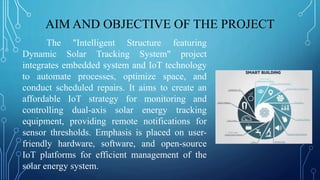
The "Intelligent Structure featuring
Dynamic Solar Tracking System" project
integrates embedded system and IoT technology
to automate processes, optimize space, and
conduct scheduled repairs. It aims to create an
affordable IoT strategy for monitoring and
controlling dual-axis solar energy tracking
equipment, providing remote notifications for
sensor thresholds. Emphasis is placed on user-
friendly hardware, software, and open-source
IoT platforms for efficient management of the
solar energy system.
SMART BUILDING TECHNOLOGY
This project examines intelligent
structures in smart building technology,
utilizing hardware, software, sensors, and
smart appliances for automated tasks like
energy management and access control. It
distinguishes intelligent structures from
green buildings, emphasizing the broader
concept of smart buildings, optimizing
resource usage and facilitating access to
smart power grids. Furthermore, it explores
the IoT's role in enhancing energy
efficiency, reducing costs, and promoting
sustainability within smart buildings.
SN0 TITLE
LITERATURE SURVEY
AUTHOR YEAR CORE
TECHNOLOG
Y
1.
2.
3.
4.
5.
“Design and Implementation of
Intelligent Solar Tracking System
Based on IOT”
“Smart Building Energy Management
Integrating IOT and Bigdata “
“Rain Detection System Using
Arduino and Rain sensor”
“Integration of IOT-
Enabled Smart Solar
Tracker With Smart
Building Energy
Management System”
Smart Solar Energy
Harvesting ,
Utilization and
Management Using IOT
Li, y,, & jiang
Yogesh.S ,
Sreedhar.T.M
Ms. G.T..Bharathy
FUNCTIONAL REQUIRMENTS
1. Remote Operation: The system should enable remote
operation of the solar energy tracking equipment
Through IoT platform.
2. Data Transmission: It should allow the transmission of
various data such as solar energy readings and system
status to the IoT platform.
3. User Interface: It should provide a user-friendly
interface for both hardware and software components,
allowing easy monitoring and control.
NON FUNCTIONAL REQUIREMENTS
1.Maintainability: The system should be easy to maintain, allowing
for timely updates, repairs, and enhancements.
2. Cost-effectiveness: It should be cost-effective, considering both
initial implementation costs and long-term operational expenses.
3. Compatibility: Compatibility with a variety of hardware and
software components should be ensured for flexibility and ease of
integration.
SUSTAINABILITY
1.Energy Efficiency Which Optimizes solar
energy capture, reducing reliance on non-
renewable sources.
2. Preserves resources and cuts carbon
emissions by maximizing solar energy use.
3. Allows easy integration of additional
features for future enhancement.
4. Enhances energy efficiency through
automated building operations.
TECHNOLOGICAL IMPACT
This project is highly technological,
leveraging advancements in IoT,
embedded systems, hardware, software,
and network protocols. It incorporates
dynamic solar tracking, remote
monitoring, and notification features,
demonstrating sophisticated
technological integration. Additionally,
its use of user-friendly hardware,
software, and an online open-source
IoT platform highlights a
comprehensive technological approach.
FUTURE OPPORTUNITIES
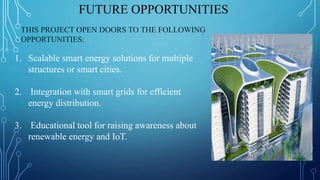
1. Scalable smart energy solutions for multiple
structures or smart cities.
2. Integration with smart grids for efficient
energy distribution.
3. Educational tool for raising awareness about
renewable energy and IoT.
THIS PROJECT OPEN DOORS TO THE FOLLOWING
OPPORTUNITIES:
FUTURE OPPORTUNITIES
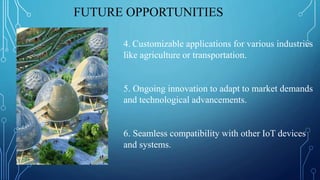
4. Customizable applications for various industries
like agriculture or transportation.
5. Ongoing innovation to adapt to market demands
and technological advancements.
6. Seamless compatibility with other IoT devices
and systems.
BENEFITS OF THE PROJECT
- Smart buildings incorporate hardware, software, sensors, and smart
appliances for automated activities such as energy management, access
control, and illumination regulation.-
- They differ from green buildings, which focus on sustainability and
environmental management, by integrating technology for efficient
resource utilization.
- Smart buildings enable access to smart power grids, other buildings, and
global environments, leveraging information outside their windows and
walls.-
- Benefits of smart buildings include enhanced resource
utilization, lower capital and operating costs, risk detection and
management, and data-driven decision-making for efficient
operations and sustainability.
- Smart buildings integrate technology to make economical and
efficient use of resources while providing safe and pleasant
environments for occupants
- They facilitate the integration of future technological
advancements such as artificial intelligence and augmented
reality.
BENEFITS OF THE PROJECT
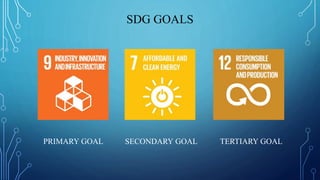
SDG GOALS
PRIMARY GOAL SECONDARY GOAL TERTIARY GOAL
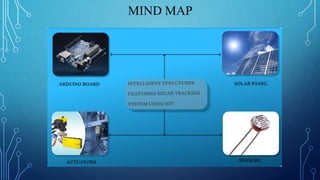
MIND MAP
CONCLUSION
in conclusion, the abstract showcases the benefits of
IoT technology, particularly in monitoring and
controlling solar energy tracking systems within
intelligent structures. It emphasizes affordability,
remote management capabilities, and the potential for
automation in workplace operations, highlighting the
convenience and efficiency offered by these innovative
solutions.
REFERENCES
1. Li, Y., & Jiang, X. (2021). "Design and Implementation of Intelligent
Solar Tracking System Based on IoT." In 2021 IEEE 3rd International
Conference on Electronics Technology (ICET), pp. 257-260.
2. Lu, Y., Yang, C., Li, X., & Yang, J. (2019). "Smart building energy
management integrating IoT and big data." Energy Procedia, 158, 3445- 3450.
3. Hasan, M. M., Al-Gayem, Q. N., & Hassan, M. M. (2020). "Integration of IoT-
Enabled Smart Solar Tracker with Smart Building Energy Management System."
IEEE Access, 8, 112041- 112051.
REFERENCES
4. Bharathy, "Arduino Based Radar System for Short Range Applications",
International Journal of Scientific Research in Science, Engineering and Technology
(IJSRSET), Online ISSN: 2394- 4099, Print ISSN : 2395-1990, Volume 9 Issue 8, pp.
38-47, November-December 2021. DOI: 10.32628/IJSRSET21984
5. Ahmed, S., Uddin, M. Z., Al-Fuqaha, A., Rayes, A., & Ahmed, E. (2019). "Smart
Solar Energy Harvesting, Utilization, and Management System Using Internet of
Things (IoT) for Residential Applications." IEEE Internet of Things Journal, 6(1),
1501-1511.
6. Ma, J., Zhang, Y., & Gao, H. (2019). "Design and Implementation of Solar
Tracking System Based on IoT." In 2019 5th International Conference on
Control, Automation and Robotics (ICCAR), pp. 389-393.
THANK YOU

smart building , sensors , actuators.pptx

  • 1.
    JERUSALEM COLLEGE OF ENGINEERING (An autonomouscollege affiliated to Anna university
  • 3.
    PROBLEM STATEMENTS This projectis essential as it offers a transformative approach to building technology, enabling efficient resource management, enhanced operational functionality, and sustainability within smart buildings. By developing intelligent structures that leverage hardware, software, sensors, and the IoT, it addresses critical challenges such as energy management and access control. This innovative approach not only optimizes resource usage but also reduces costs, manages risks, and promotes a sustainable future, making it imperative for advancing building technology and addressing global environmental concerns.
  • 4.
    AIM AND OBJECTIVEOF THE PROJECT The "Intelligent Structure featuring Dynamic Solar Tracking System" project integrates embedded system and IoT technology to automate processes, optimize space, and conduct scheduled repairs. It aims to create an affordable IoT strategy for monitoring and controlling dual-axis solar energy tracking equipment, providing remote notifications for sensor thresholds. Emphasis is placed on user- friendly hardware, software, and open-source IoT platforms for efficient management of the solar energy system.
  • 5.
    SMART BUILDING TECHNOLOGY Thisproject examines intelligent structures in smart building technology, utilizing hardware, software, sensors, and smart appliances for automated tasks like energy management and access control. It distinguishes intelligent structures from green buildings, emphasizing the broader concept of smart buildings, optimizing resource usage and facilitating access to smart power grids. Furthermore, it explores the IoT's role in enhancing energy efficiency, reducing costs, and promoting sustainability within smart buildings.
  • 6.
    SN0 TITLE LITERATURE SURVEY AUTHORYEAR CORE TECHNOLOG Y 1. 2. 3. 4. 5. “Design and Implementation of Intelligent Solar Tracking System Based on IOT” “Smart Building Energy Management Integrating IOT and Bigdata “ “Rain Detection System Using Arduino and Rain sensor” “Integration of IOT- Enabled Smart Solar Tracker With Smart Building Energy Management System” Smart Solar Energy Harvesting , Utilization and Management Using IOT Li, y,, & jiang Yogesh.S , Sreedhar.T.M Ms. G.T..Bharathy
  • 7.
    FUNCTIONAL REQUIRMENTS 1. RemoteOperation: The system should enable remote operation of the solar energy tracking equipment Through IoT platform. 2. Data Transmission: It should allow the transmission of various data such as solar energy readings and system status to the IoT platform. 3. User Interface: It should provide a user-friendly interface for both hardware and software components, allowing easy monitoring and control.
  • 8.
    NON FUNCTIONAL REQUIREMENTS 1.Maintainability:The system should be easy to maintain, allowing for timely updates, repairs, and enhancements. 2. Cost-effectiveness: It should be cost-effective, considering both initial implementation costs and long-term operational expenses. 3. Compatibility: Compatibility with a variety of hardware and software components should be ensured for flexibility and ease of integration.
  • 9.
    SUSTAINABILITY 1.Energy Efficiency WhichOptimizes solar energy capture, reducing reliance on non- renewable sources. 2. Preserves resources and cuts carbon emissions by maximizing solar energy use. 3. Allows easy integration of additional features for future enhancement. 4. Enhances energy efficiency through automated building operations.
  • 10.
    TECHNOLOGICAL IMPACT This projectis highly technological, leveraging advancements in IoT, embedded systems, hardware, software, and network protocols. It incorporates dynamic solar tracking, remote monitoring, and notification features, demonstrating sophisticated technological integration. Additionally, its use of user-friendly hardware, software, and an online open-source IoT platform highlights a comprehensive technological approach.
  • 11.
    FUTURE OPPORTUNITIES 1. Scalablesmart energy solutions for multiple structures or smart cities. 2. Integration with smart grids for efficient energy distribution. 3. Educational tool for raising awareness about renewable energy and IoT. THIS PROJECT OPEN DOORS TO THE FOLLOWING OPPORTUNITIES:
  • 12.
    FUTURE OPPORTUNITIES 4. Customizableapplications for various industries like agriculture or transportation. 5. Ongoing innovation to adapt to market demands and technological advancements. 6. Seamless compatibility with other IoT devices and systems.
  • 13.
    BENEFITS OF THEPROJECT - Smart buildings incorporate hardware, software, sensors, and smart appliances for automated activities such as energy management, access control, and illumination regulation.- - They differ from green buildings, which focus on sustainability and environmental management, by integrating technology for efficient resource utilization. - Smart buildings enable access to smart power grids, other buildings, and global environments, leveraging information outside their windows and walls.-
  • 14.
    - Benefits ofsmart buildings include enhanced resource utilization, lower capital and operating costs, risk detection and management, and data-driven decision-making for efficient operations and sustainability. - Smart buildings integrate technology to make economical and efficient use of resources while providing safe and pleasant environments for occupants - They facilitate the integration of future technological advancements such as artificial intelligence and augmented reality. BENEFITS OF THE PROJECT
  • 15.
    SDG GOALS PRIMARY GOALSECONDARY GOAL TERTIARY GOAL
  • 16.
  • 17.
    CONCLUSION in conclusion, theabstract showcases the benefits of IoT technology, particularly in monitoring and controlling solar energy tracking systems within intelligent structures. It emphasizes affordability, remote management capabilities, and the potential for automation in workplace operations, highlighting the convenience and efficiency offered by these innovative solutions.
  • 18.
    REFERENCES 1. Li, Y.,& Jiang, X. (2021). "Design and Implementation of Intelligent Solar Tracking System Based on IoT." In 2021 IEEE 3rd International Conference on Electronics Technology (ICET), pp. 257-260. 2. Lu, Y., Yang, C., Li, X., & Yang, J. (2019). "Smart building energy management integrating IoT and big data." Energy Procedia, 158, 3445- 3450. 3. Hasan, M. M., Al-Gayem, Q. N., & Hassan, M. M. (2020). "Integration of IoT- Enabled Smart Solar Tracker with Smart Building Energy Management System." IEEE Access, 8, 112041- 112051.
  • 19.
    REFERENCES 4. Bharathy, "ArduinoBased Radar System for Short Range Applications", International Journal of Scientific Research in Science, Engineering and Technology (IJSRSET), Online ISSN: 2394- 4099, Print ISSN : 2395-1990, Volume 9 Issue 8, pp. 38-47, November-December 2021. DOI: 10.32628/IJSRSET21984 5. Ahmed, S., Uddin, M. Z., Al-Fuqaha, A., Rayes, A., & Ahmed, E. (2019). "Smart Solar Energy Harvesting, Utilization, and Management System Using Internet of Things (IoT) for Residential Applications." IEEE Internet of Things Journal, 6(1), 1501-1511. 6. Ma, J., Zhang, Y., & Gao, H. (2019). "Design and Implementation of Solar Tracking System Based on IoT." In 2019 5th International Conference on Control, Automation and Robotics (ICCAR), pp. 389-393.
  • 20.