z
Small Business Development
for Creative-Types
Growing your creative business
Presenter:
Miriam Robeson,
Attorney
February 28, 2024
z
Why Be a Business?
 It will help you make money
 It will help you focus
 It will help you comply with legal and tax regulations
 It will give you more credibility
 It will show you weaknesses in your business
Five Reasons to “Step Up” the
Business Side of Your Art
z Making Your Art
Work For You
 Business Plans
 Business Formalities
 Business Accounting
 Tax and your business
 Legal considerations
 Small Business Development
 Creative Cooperatives
What We Will Discuss...
z
When Should You ‘Become’ a Business?
 Desire and Determination
 You enjoy your art and can spend all day (every day) developing
products and skills
 You are willing to treat your art activities “like a business.”
 Dollars and Sense (Cents)
 You can create enough art (and sell at a price) to support yourself
(and family)
 You can sell your art for more than it costs (time and supplies –
including a fair value for your time)
 Art Takes Over
 You spend all your time in search of “more-- better--bigger” ways
to create and display your art
 You find public venues for your art (display and sell)
When Can You Quit Your “Day Job?”
z Getting Started
 Trial Run, Ease In, or Dive In?
 50% of Small Biz fail in the first 5
years.
 Are you ready to be both Art and
Business?
Start-up Basics
Top 10 Start-up Steps
Top 7 Reasons Why Poor Businesses Fail
z
BUSINESS PLANS
Fail to plan = Plan to fail
z Business Plan
◦ The important elements of your business plan
 Vision Statement (Who You Are)
 The Players (Customers)
 Business Concept (What’s the Point?)
 Finances and feasibility (What does it cost to get where I want to go?)
 Success Matrix (How will you know when you have arrived?)
What is it?
Why should Artists have a business plan?
z Business Plan
 You need a Business Plan if...
 You are running a business (not a hobby)
 You are applying for a loan (lenders require it)
 You are looking for investors (investors want it)
 You are working with partners (everyone knows the plan)
 If you run into trouble (legal, financial, etc.)
Why do I need one?
Top 10 Business Plan Tips
z
BUSINESS FORMALITIES
Government Compliance
z
Business Formalities
 Protect yourself and your business
 Business Entity (Corp, LLC, formal partnership)
 Tax ID number (NOT your SS#!!)
 State and Federal paperwork
 Existence, taxes, creative protection
 Business Relationships Paperwork
 Contracts for lease of space, use of equipment,
display of art (gallery space), sub- contracted work
Paperwork = Credibility
z
Business Formalities
 Sole Proprietor – Easiest entity - least protection
 Corporation – Formal entity - greatest protection
 Limited Liability Company (LLC) - greatest
flexibility
 Partnership – working with others
 Consult a professional!
What Kind of Business Are You?
z
SMALL BUSINESS
ACCOUNTING,
TAXES, AND THE LAW
Money • Money • Money
z Small Business Finances
 Keep business income and expenses separate from personal
 Separate checking, credit card account
 Separate vendor / customer accounts
 Keep stuff!
 Receipts, invoices, contracts (scanner is OK)
 Computer Bookkeeping program
 Quicken – Quickbooks – Google/Excel Spreadsheet
 Enter ALL income and expenses
Tracking the $$
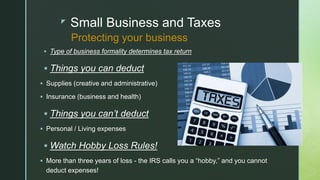
z Small Business and Taxes
 Type of business formality determines tax return
 Things you can deduct
 Supplies (creative and administrative)
 Insurance (business and health)
 Things you can’t deduct
 Personal / Living expenses
 Watch Hobby Loss Rules!
 More than three years of loss - the IRS calls you a “hobby,” and you cannot
deduct expenses!
Protecting your business
z
Small Business Taxes
 Sales Tax Paid to the State– what is it, when do you
collect?
 7% - more than 30 days - “in the business of”
 Sales Tax You Pay for Purchases – what’s exempt? –
“Direct production of”
 Employment Tax – when do you have “employees”?
 Income Tax – Estimated Payments required
 110% of current income tax obligation
 100% of previous year’s tax obligation
Taxes You Pay - Taxes You Collect
z
Small Business Taxes
 Home Office/Studio – dedicated space
 Utilities (heat, light, phone) – pro-rata share
 Insurance – business insurance, pro-rata share of
casualty insurance on home
 Automobile – travel to/from events, exhibits
 2024 IRS Mileage Rate = 67¢ per mile *or* actual expenses
 Meals and Entertainment – 50% rule for meals - actual
costs for lodging, travel
 Art Supplies and Equipment
 “Consumables” = immediately deductible
 Equipment with useful life = depreciate
 What Do You Want to Deduct?
Deductions, Deductions, We Love Deductions!
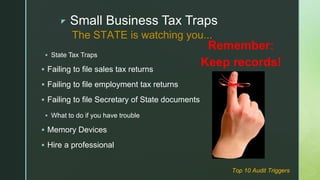
z Small Business Tax Traps
 State Tax Traps
 Failing to file sales tax returns
 Failing to file employment tax returns
 Failing to file Secretary of State documents
 What to do if you have trouble
 Memory Devices
 Hire a professional
The STATE is watching you...
Remember:
Keep records!
Top 10 Audit Triggers
z
Small Business LAW
 Personal Risks
 Personal assets at risk from business practices
 Financial Issues
 Liability Issues
 Business Risks
 What is your business worth?
 Protect your business reputation
 Work Product – See Intellectual Property
Legal Risks
z When You Don’t Own What you
Create: Work For Hire
 “Work For Hire” is owned by the hiring agent under
three conditions:
 (1) Meet “Commissioned Works” definition in the law:
 Contribution to a larger work, such as a magazine
 A part of a motion picture or audiovisual work
 A compilation of existing works
 Instructional texts or graphic works
 A translation of an existing work
 Supplementary works, such as a graph for a book
 An atlas
Sample Work for Hire Agreement
z When You Don’t Own What you
Create: Work For Hire (con’t)
 Work For Hire belongs entirely to hiring agent IF:
 (2) If the creator is an employee and the work was created
on company time or with company resources;
 (3) If the creator specifically relinquishes all rights prior to
commencement of work.
Sample License Agreement
z
Contracts: Protecting Your Work
 Contracts = Professional = Credibility = Protection of the
relationship
 Contracts set expectations
 What – When - Where – How Much
 Rights – Responsibilities
 Timeline for payment and performance
 Ownership of work product
 Contracts help manage conflict
 Always have a contract
 Always start with YOUR contract
z Releases – Use of private likeness
 Types of Releases
 Model Release
 Minor Release
 Property Release
 When do you need a release?
 If the subject is recognizable
 If the subject is used for commercial purposes
Sample Model Release
When you want to use someone else’s image
z Releases – When Not Needed
 Public Places
 Images taken from the street of publically visible property
 Public buildings (visible to the public, located in public)
 When is a release not needed?
 Educational purposes
 Editorial illustration
 Non-commercial purposes
z
SMALL BUSINESS
DEVELOPMENT
Grow Your Business
z
Small Business Development
Financing growth - Know why you need $$$
 Investors - want to see profit
 Patrons - want to see your art
 Business (loans) - want $$ + interest
Planning to Grow Your Small Business
z
Small Business Development
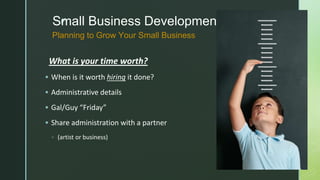
What is your time worth?
 When is it worth hiring it done?
 Administrative details
 Gal/Guy “Friday”
 Share administration with a partner
◦ (artist or business)
Planning to Grow Your Small Business
z Small Business Practices
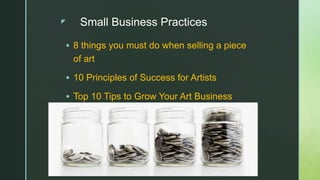
 8 things you must do when selling a piece
of art
 10 Principles of Success for Artists
 Top 10 Tips to Grow Your Art Business
z
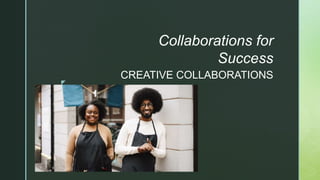
CREATIVE COLLABORATIONS
Collaborations for
Success
z
Creative Cooperatives
 Sharing a business - increase profitability
 Like Kind of Art
 Compatible Kind of Art
 Diverse Kind of Art
 Mixing Art and “Other”
 Investment Limits – when is enough too much?
Art Teams that Succeed
z
Creative Cooperatives
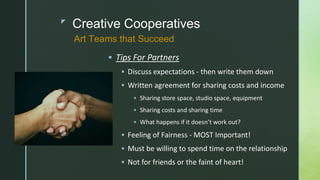
 Tips For Partners
 Discuss expectations - then write them down
 Written agreement for sharing costs and income
 Sharing store space, studio space, equipment
 Sharing costs and sharing time
 What happens if it doesn’t work out?
 Feeling of Fairness - MOST Important!
 Must be willing to spend time on the relationship
 Not for friends or the faint of heart!
Art Teams that Succeed
z
Employees
 Employees increase business complications
 Employment taxes and rules
 Full time and part time
 Over time and benefits
 Training Employees to read your mind
 Can you succeed without help?
 Employees allow you to be in two places at once
 Employees can be hired for business management
 What is the “marginal benefit” of an employee?
Do I Need Employees? What Do I do with Them?
z Employee or Independent Contractor?
 Tax issues for you
 IF YOU are an independent contractor
 You have to pay your own taxes
 You are hired for your expertise and product, not to
put in time
 IF you HIRE an independent contractor
 Make sure you report on IRS 1099-NEC
 Make sure they aren’t “really” an employee
z
How to Succeed at (Art) Business
 Make a Plan - stick with the plan
 Formalize Your Business - act like a business,
not a hobby
 Keep up with the paperwork
 Keep up with taxes (and keep receipts!)
 Watch and protect your rights
 Watch copyright issues
 Enter partnerships with eyes wide open
 Don’t forget to MAKE ART!
Plan, Work, Time, and Art
z
Resources for Small Business
 US Small Business Administration
 www.sba.gov
 Indiana Small Business Development Corporation
● https://isbdc.org/locations/hoosier-heartland-indiana-sbdc/
 Google is our Friend
Finding Help for what you need
z
Thank you for your attention!
Questions? Answers?
You can find this presentation
www.lawlatte.com
“Law Basics for Artists”
You can find Miriam at:
Miriam@robeson-law.com

Small business for Creative Types 2024.pptx

  • 1.
    z Small Business Development forCreative-Types Growing your creative business Presenter: Miriam Robeson, Attorney February 28, 2024
  • 2.
    z Why Be aBusiness?  It will help you make money  It will help you focus  It will help you comply with legal and tax regulations  It will give you more credibility  It will show you weaknesses in your business Five Reasons to “Step Up” the Business Side of Your Art
  • 3.
    z Making YourArt Work For You  Business Plans  Business Formalities  Business Accounting  Tax and your business  Legal considerations  Small Business Development  Creative Cooperatives What We Will Discuss...
  • 4.
    z When Should You‘Become’ a Business?  Desire and Determination  You enjoy your art and can spend all day (every day) developing products and skills  You are willing to treat your art activities “like a business.”  Dollars and Sense (Cents)  You can create enough art (and sell at a price) to support yourself (and family)  You can sell your art for more than it costs (time and supplies – including a fair value for your time)  Art Takes Over  You spend all your time in search of “more-- better--bigger” ways to create and display your art  You find public venues for your art (display and sell) When Can You Quit Your “Day Job?”
  • 5.
    z Getting Started Trial Run, Ease In, or Dive In?  50% of Small Biz fail in the first 5 years.  Are you ready to be both Art and Business? Start-up Basics Top 10 Start-up Steps Top 7 Reasons Why Poor Businesses Fail
  • 6.
    z BUSINESS PLANS Fail toplan = Plan to fail
  • 7.
    z Business Plan ◦The important elements of your business plan  Vision Statement (Who You Are)  The Players (Customers)  Business Concept (What’s the Point?)  Finances and feasibility (What does it cost to get where I want to go?)  Success Matrix (How will you know when you have arrived?) What is it? Why should Artists have a business plan?
  • 8.
    z Business Plan You need a Business Plan if...  You are running a business (not a hobby)  You are applying for a loan (lenders require it)  You are looking for investors (investors want it)  You are working with partners (everyone knows the plan)  If you run into trouble (legal, financial, etc.) Why do I need one? Top 10 Business Plan Tips
  • 9.
  • 10.
    z Business Formalities  Protectyourself and your business  Business Entity (Corp, LLC, formal partnership)  Tax ID number (NOT your SS#!!)  State and Federal paperwork  Existence, taxes, creative protection  Business Relationships Paperwork  Contracts for lease of space, use of equipment, display of art (gallery space), sub- contracted work Paperwork = Credibility
  • 11.
    z Business Formalities  SoleProprietor – Easiest entity - least protection  Corporation – Formal entity - greatest protection  Limited Liability Company (LLC) - greatest flexibility  Partnership – working with others  Consult a professional! What Kind of Business Are You?
  • 12.
    z SMALL BUSINESS ACCOUNTING, TAXES, ANDTHE LAW Money • Money • Money
  • 13.
    z Small BusinessFinances  Keep business income and expenses separate from personal  Separate checking, credit card account  Separate vendor / customer accounts  Keep stuff!  Receipts, invoices, contracts (scanner is OK)  Computer Bookkeeping program  Quicken – Quickbooks – Google/Excel Spreadsheet  Enter ALL income and expenses Tracking the $$
  • 14.
    z Small Businessand Taxes  Type of business formality determines tax return  Things you can deduct  Supplies (creative and administrative)  Insurance (business and health)  Things you can’t deduct  Personal / Living expenses  Watch Hobby Loss Rules!  More than three years of loss - the IRS calls you a “hobby,” and you cannot deduct expenses! Protecting your business
  • 15.
    z Small Business Taxes Sales Tax Paid to the State– what is it, when do you collect?  7% - more than 30 days - “in the business of”  Sales Tax You Pay for Purchases – what’s exempt? – “Direct production of”  Employment Tax – when do you have “employees”?  Income Tax – Estimated Payments required  110% of current income tax obligation  100% of previous year’s tax obligation Taxes You Pay - Taxes You Collect
  • 16.
    z Small Business Taxes Home Office/Studio – dedicated space  Utilities (heat, light, phone) – pro-rata share  Insurance – business insurance, pro-rata share of casualty insurance on home  Automobile – travel to/from events, exhibits  2024 IRS Mileage Rate = 67¢ per mile *or* actual expenses  Meals and Entertainment – 50% rule for meals - actual costs for lodging, travel  Art Supplies and Equipment  “Consumables” = immediately deductible  Equipment with useful life = depreciate  What Do You Want to Deduct? Deductions, Deductions, We Love Deductions!
  • 17.
    z Small BusinessTax Traps  State Tax Traps  Failing to file sales tax returns  Failing to file employment tax returns  Failing to file Secretary of State documents  What to do if you have trouble  Memory Devices  Hire a professional The STATE is watching you... Remember: Keep records! Top 10 Audit Triggers
  • 18.
    z Small Business LAW Personal Risks  Personal assets at risk from business practices  Financial Issues  Liability Issues  Business Risks  What is your business worth?  Protect your business reputation  Work Product – See Intellectual Property Legal Risks
  • 19.
    z When YouDon’t Own What you Create: Work For Hire  “Work For Hire” is owned by the hiring agent under three conditions:  (1) Meet “Commissioned Works” definition in the law:  Contribution to a larger work, such as a magazine  A part of a motion picture or audiovisual work  A compilation of existing works  Instructional texts or graphic works  A translation of an existing work  Supplementary works, such as a graph for a book  An atlas Sample Work for Hire Agreement
  • 20.
    z When YouDon’t Own What you Create: Work For Hire (con’t)  Work For Hire belongs entirely to hiring agent IF:  (2) If the creator is an employee and the work was created on company time or with company resources;  (3) If the creator specifically relinquishes all rights prior to commencement of work. Sample License Agreement
  • 21.
    z Contracts: Protecting YourWork  Contracts = Professional = Credibility = Protection of the relationship  Contracts set expectations  What – When - Where – How Much  Rights – Responsibilities  Timeline for payment and performance  Ownership of work product  Contracts help manage conflict  Always have a contract  Always start with YOUR contract
  • 22.
    z Releases –Use of private likeness  Types of Releases  Model Release  Minor Release  Property Release  When do you need a release?  If the subject is recognizable  If the subject is used for commercial purposes Sample Model Release When you want to use someone else’s image
  • 23.
    z Releases –When Not Needed  Public Places  Images taken from the street of publically visible property  Public buildings (visible to the public, located in public)  When is a release not needed?  Educational purposes  Editorial illustration  Non-commercial purposes
  • 24.
  • 25.
    z Small Business Development Financinggrowth - Know why you need $$$  Investors - want to see profit  Patrons - want to see your art  Business (loans) - want $$ + interest Planning to Grow Your Small Business
  • 26.
    z Small Business Development Whatis your time worth?  When is it worth hiring it done?  Administrative details  Gal/Guy “Friday”  Share administration with a partner ◦ (artist or business) Planning to Grow Your Small Business
  • 27.
    z Small BusinessPractices  8 things you must do when selling a piece of art  10 Principles of Success for Artists  Top 10 Tips to Grow Your Art Business
  • 28.
  • 29.
    z Creative Cooperatives  Sharinga business - increase profitability  Like Kind of Art  Compatible Kind of Art  Diverse Kind of Art  Mixing Art and “Other”  Investment Limits – when is enough too much? Art Teams that Succeed
  • 30.
    z Creative Cooperatives  TipsFor Partners  Discuss expectations - then write them down  Written agreement for sharing costs and income  Sharing store space, studio space, equipment  Sharing costs and sharing time  What happens if it doesn’t work out?  Feeling of Fairness - MOST Important!  Must be willing to spend time on the relationship  Not for friends or the faint of heart! Art Teams that Succeed
  • 31.
    z Employees  Employees increasebusiness complications  Employment taxes and rules  Full time and part time  Over time and benefits  Training Employees to read your mind  Can you succeed without help?  Employees allow you to be in two places at once  Employees can be hired for business management  What is the “marginal benefit” of an employee? Do I Need Employees? What Do I do with Them?
  • 32.
    z Employee orIndependent Contractor?  Tax issues for you  IF YOU are an independent contractor  You have to pay your own taxes  You are hired for your expertise and product, not to put in time  IF you HIRE an independent contractor  Make sure you report on IRS 1099-NEC  Make sure they aren’t “really” an employee
  • 33.
    z How to Succeedat (Art) Business  Make a Plan - stick with the plan  Formalize Your Business - act like a business, not a hobby  Keep up with the paperwork  Keep up with taxes (and keep receipts!)  Watch and protect your rights  Watch copyright issues  Enter partnerships with eyes wide open  Don’t forget to MAKE ART! Plan, Work, Time, and Art
  • 34.
    z Resources for SmallBusiness  US Small Business Administration  www.sba.gov  Indiana Small Business Development Corporation ● https://isbdc.org/locations/hoosier-heartland-indiana-sbdc/  Google is our Friend Finding Help for what you need
  • 35.
    z Thank you foryour attention! Questions? Answers? You can find this presentation www.lawlatte.com “Law Basics for Artists” You can find Miriam at: Miriam@robeson-law.com