





We Got Your BAC(K)!
Helping Children with Autism
and their Caregivers
By VJ003 - Felicia, May Anne, Yi Qing, Basil & Saffanah
Imagine a
scenario . . .
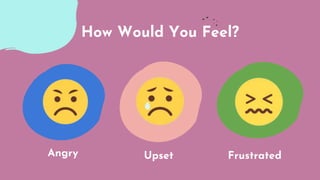
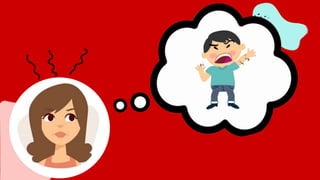
Angry Upset Frustrated
How Would You Feel?
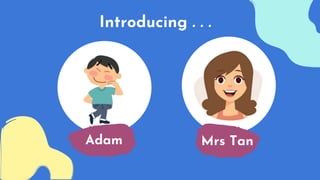
Adam
Introducing . . .
Mrs Tan
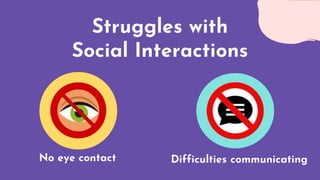
Struggles with
Social Interactions
No eye contact Difficulties communicating
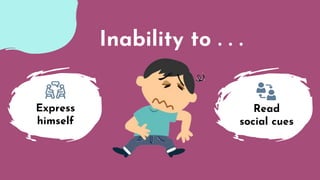
Inability to . . .
Read
social cues
Express
himself
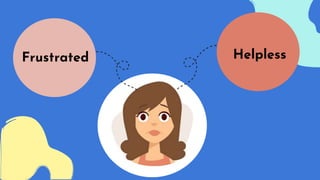
Frustrated Helpless
BLUEBEE PALS
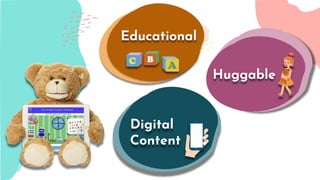
Educational
Huggable
Digital
Content
Endless
entertainment & an
education with a
narrative
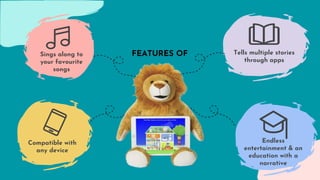
Tells multiple stories
through apps
Compatible with
any device
Sings along to
your favourite
songs
FEATURES OF
Adam
Do you still remember . . .
Mrs Tan
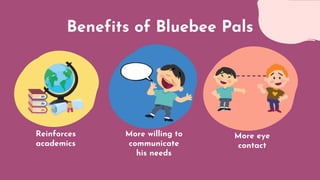
Benefits of Bluebee Pals
Reinforces
academics
More eye
contact
More willing to
communicate
his needs
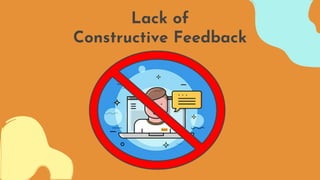
Lack of
Constructive Feedback
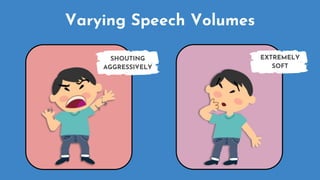
SHOUTING
AGGRESSIVELY
EXTREMELY
SOFT
Varying Speech Volumes
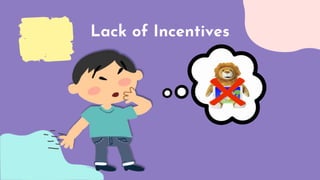
Lack of Incentives
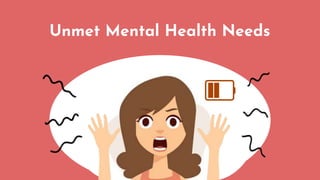
Unmet Mental Health Needs
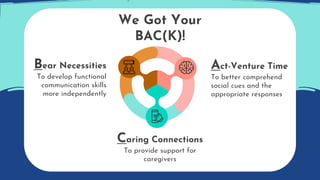
We Got Your
BAC(K)!
Act-Venture Time
To better comprehend
social cues and the
appropriate responses
Caring Connections
To provide support for
caregivers
Bear Necessities
To develop functional
communication skills
more independently
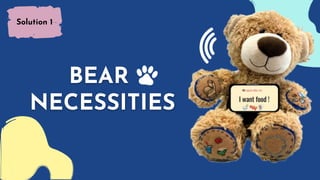
BEAR
NECESSITIES
Solution 1
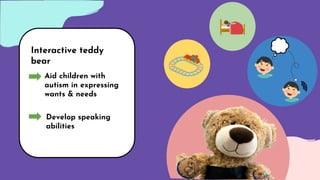
Interactive teddy
bear
Aid children with
autism in expressing
wants & needs
Develop speaking
abilities
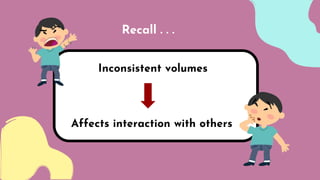
Inconsistent volumes
Recall . . .
Affects interaction with others
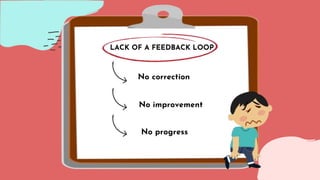
LACK OF A FEEDBACK LOOP
No correction
No improvement
No progress
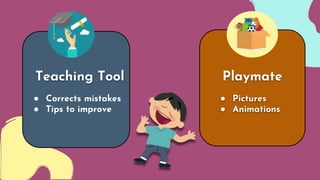
Teaching Tool Playmate
● Corrects mistakes
● Tips to improve
● Pictures
● Animations
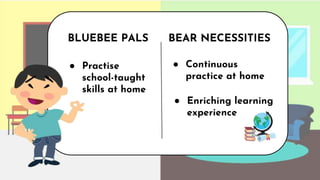
● Practise
school-taught
skills at home
BLUEBEE PALS BEAR NECESSITIES
● Continuous
practice at home
● Enriching learning
experience
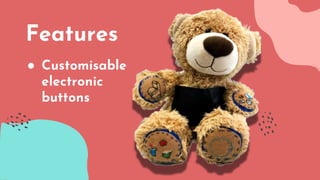
Features
● Customisable
electronic
buttons
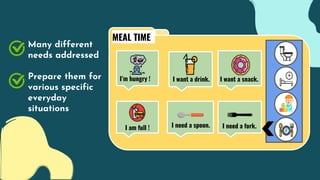
I’m hungry !
I am full !
MEAL TIME
I want a drink. I want a snack.
I need a spoon. I need a fork.
Many different
needs addressed
Prepare them for
various specific
everyday
situations
1
2
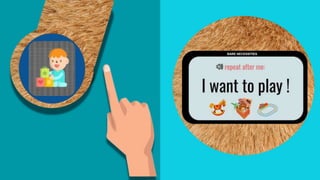
I want to play !
3 4
Louder please !
Softer please !
Reward System
● Motivation to learn
● Can accumulate
points to earn prizes
● Awarded points if he
successfully repeats the
phrase
+
Useful communication skills
Improved interactions with peers
Solution 2
ACT-VENTURE
TIME
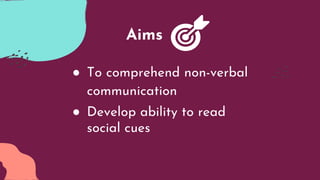
● To comprehend non-verbal
communication
● Develop ability to read
social cues
Aims
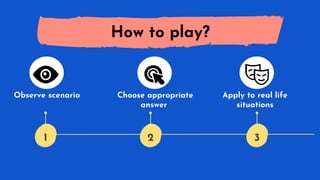
1 2 3
Observe scenario Choose appropriate
answer
Apply to real life
situations
How to play?
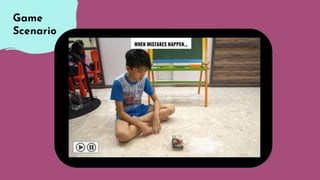
Game
Scenario
WHEN MISTAKES HAPPEN...
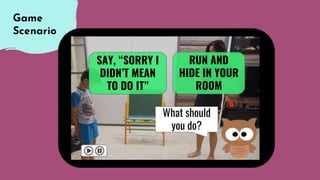
Game
Scenario
RUN AND
HIDE IN YOUR
ROOM
SAY, “SORRY I
DIDN’T MEAN
TO DO IT”
What should
you do?
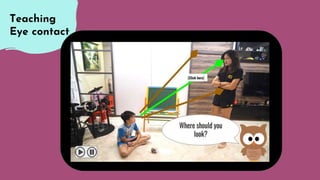
Teaching
Eye contact
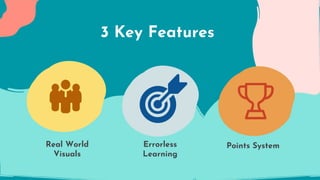
Real World
Visuals
Errorless
Learning
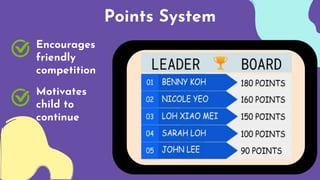
Points System
3 Key Features
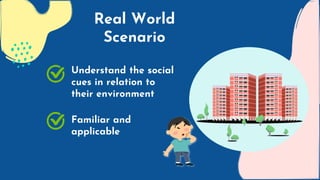
Real World
Scenario
Understand the social
cues in relation to
their environment
Familiar and
applicable
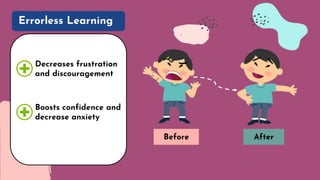
Errorless Learning
Decreases frustration
and discouragement
Boosts confidence and
decrease anxiety
Before After
Encourages
friendly
competition
Motivates
child to
continue
Points System
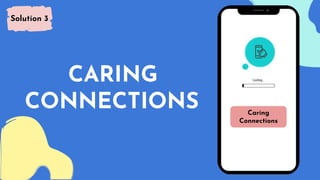
CARING
CONNECTIONS Caring
Connections
Solution 3
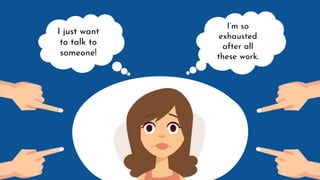
I just want
to talk to
someone!
I’m so
exhausted
after all
these work.
Aim Improve the mental well-being of caregivers
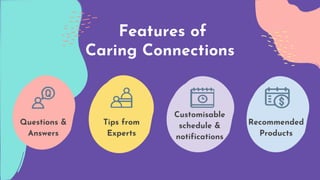
Questions &
Answers
Tips from
Experts
Customisable
schedule &
notifications
Features of
Caring Connections
Recommended
Products
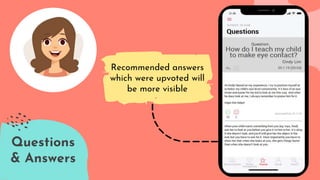
Questions
& Answers
Recommended answers
which were upvoted will
be more visible
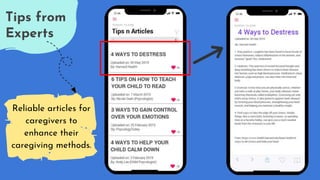
Tips from
Experts
Reliable articles for
caregivers to
enhance their
caregiving methods.
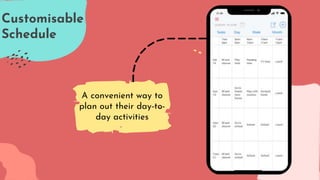
Customisable
Schedule
A convenient way to
plan out their day-to-
day activities
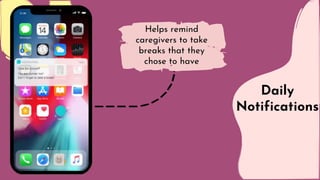
Daily
Notifications
Helps remind
caregivers to take
breaks that they
chose to have
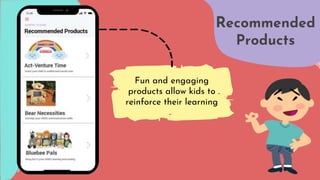
Recommended
Products
Fun and engaging
products allow kids to
reinforce their learning
CARING
CONNECTIONS
Thank You!

Slides vj003.ppt

Editor's Notes

  • #2 GooD morning assessors anD fellow Victorians, I am Felicia and I will be your firsT speaker for today. These are my group mates: May Anne, Yi Qing, Basil and Saffanah. Today, our grouP will be sharing more abouT our project titled “We got your back” that aims to help children with autism and their caregivers.
  • #3 Before I begin, I woulD liKe all of you to imagine a scenario. WhaT if I told you thaT, no matter whaT you said, no one will be able to understand you. You wouldn’t be able to tell others how you felT, what you neeDED, and what you thought. If you were in class and wanted to asK a question, you couldn’t raise your hand and do so. If you were to walk to your friends, excited to share a piece of news with them, your friends would simply ignore you and walk away from you.
  • #4 How would you feel? I’m sure many of you woulD feel angry, upset and frustrated if faced with such a situation. And thaT is how children with autism feel on a day to day basis.
  • #5 With these emotions in minD, I would now liKe to introduce you to (CLICK) Adam and (CLICK) Mrs Tan. Adam was diagnoseD with autism at age 5 anD ever since then, life has noT been easy for him and his mother Mrs Tan. Mrs Tan has trieD ways and means to helP Adam improve his social anD communication skills. By sending him to therapiSTS and psychologiSTS, Mrs Tan hopes to make Adam’s life easier and better.
  • #6 However, progress with the professionals has been slow anD Adam still struggles with social interactions. (CLICK) For example, when talking to his peers, Adam does noT maintain eye contacT. InsteaD of looking people in the eye, he starts looking at the ceiling or at the ground at simply not at the people he is talking to. As a result many of his peers deem him as disinterested or rude, which ends up affecting his ability to make friends. He also faces (CLICK) difficulties communicating as he often left noT knowing whaT to say or when to say certain things.
  • #7 As such, Adam’s inability to (CLICK) express himself well (CLICK) and reaD social cues thus results in daily life struggles of both Adam anD Mrs Tan
  • #8 Sometimes, when Mrs Tan gets angry at Adam, Adam fails to see her anger anD ends up furTHer infuriating her with his words. On oTHer occasions, when in public, and Adam needs something, he doesn’t know how to say so, and insteaD starts screaming and shouting.
  • #9 WhaT makes matters worse is that, Mrs Tan does not know how to furTher helP her son. She is hence leFT feeling (CLICK) frustrateD and (CLICK) helpless over the problems she and her child faces. Mrs Tan is also extremely worried that as Adam grows up, their problems will only get bigger and bigger if he does not improve his social skills.
  • #10 Hence, Mrs Tan wishes there was just more ways she could help Adam and herself. She wishes that she could bring learning out of classrooms such that she is able to personally coach her son. She also hopes that there were ways for her to relieve her stress that comes along with the long hours she puts in into taking care of Adam. I have just introduced you to some of the struggles that Adam and Mrs Tan faces in their day-to-day lives. With that, I will now pass the time to my groupmate, May Anne who will be elaborating on a current innovation, Bluebee Pals and our framework of solutions. Thank you.
  • #11 Thank you Felicia. Good morning assessors// and fellow Victorians//, my name is May Anne// and I am your second speaker for today. I’ll be sharing with you// our current innovation that we chose to focus on// and our framework of solutions. Our current innovation is Bluebee Pals. It was inspired by children with autism// aged three to seven// who had difficulties in their cognitive and communication skills.
  • #12 Hence, Bluebee Pals aims to address this// by being an (CLICK) educational// (CLICK) huggable plush learning companion// that is combined with a wide range of (CLICK) online digital content.
  • #13 But how exactly does this work? I’m sure when we were younger, most of us would have a soft toy// and we’ve had that moment when we just wished// that our soft toys could interact with us in one way or another. Well, Bluebee Pals does make our childhood dream come true! (CLICK)
  • #14 Here are some of the main features of Bluebee Pals! Its technology allows Bluebee Pal's mouth and head to move (CLICK) while singing along to your favourite songs, and it is able (CLICK) to tell multiple stories through different applications. Furthermore, the Bluebee Pals Learning App// is (CLICK) compatible with any digital device// and can be connected to a Bluebee Pal. Hence, Bluebee Pals helps to (CLICK) provide endless entertainment// and an education with a narrative// for children with autism.
  • #15 Now, do you still remember (CLICK) Adam and (CLICK) Mrs Tan from Felicia’s story? Well, I hope you do! Mrs Tan had decided to adopt Bluebee Pals// as a learning tool for Adam. She saw its benefits// through Adam’s improved behaviour// and was extremely delighted!
  • #16 Here are the benefits of Bluebee Pals. Bluebee Pals is an (CLICK) effective supplement to reinforce academics// that Adam had learnt in school at home. For instance, Adam started singing the “Alphabet Song” when initially, he had difficulty in remembering all the letters! Furthermore, Mrs Tan observed that not only was Adam (CLICK) more willing to communicate with her// about his needs, but also, he was less distracted// and (CLICK) made more eye contact with her.
  • #17 However, problems started to arise after some time. Mrs Tan finds that Bluebee Pals (CLICK) does not have an avenue// to offer constructive feedback// on how Adam can improve his behaviour.
  • #18 For instance, Adam is unaware of his varying speech volumes. Sometimes, when interacting with Mrs Tan, Adam will be (CLICK) shouting aggressively// but on other occasions, Adam will be (CLICK) extremely soft// and Mrs Tan is unable to hear him clearly.
  • #19 In addition, Adam easily loses interest in Bluebee Pals as it lacks an incentive to be used. Hence, he was less inclined// to use Bluebee Pals to learn, and not wanting to learn more beyond his interests.
  • #20 Taking care of Adam had taken a toll on Mrs Tan. She feels that she is not provided// with a platform for her to destress. Even though there are current networking workshops// provided by organisations// that focus on autism, she often lacks time to attend them// as she feels extremely lethargic. As such, her unmet mental health needs// might affect her well-being// and jeopardize her family dynamics.
  • #21 Based on these learning points// from Adam and Mrs Tan, we have come up with a framework of solutions// to address these issues. Our framework goes by the phrase (CLICK) “We got your BAC(K)!”. It consists of three interlinked approaches. B stands for// (CLICK) Bear Necessities and it focuses on developing the functional communication skills of children with autism more independently. A is for// (CLICK) Act-Venture Time// and it used to help children with autism comprehend social cues and the appropriate responses better. Lastly, C// is for (CLICK) Caring Connections which aims to provides support// and information to caregivers, better managing their stress. I’ve just introduced the basis for our project as well as our framework of solutions. So now, I’ll hand my time to Yi Qing, who will be walking us through our first solution, Bear Necessities.
  • #22 Thank you May Anne. // Good morning assessors // and fellow victorians, // my name is Yi Qing // and I will be your third speaker today. // I will be sharing more about our first solution, Bear Necessities. click
  • #23 Bear Necessities // is an interactive teddy bear (click) that helps children with autism express their wants and needs, (click) developing their speaking skills at the same time.
  • #24 As we saw earlier, Bluebee Pals has been a huge help in Adam’s development. Click However, remember how May Anne mentioned his inconsistent volumes? If left untreated, click it could pose a big problem in Adam’s interaction with others. Not to mention how other children using Bluebee Pals could be facing the same issue as we speak. click
  • #25 This is because of the lack of feedback given in Bluebee Pals. (click) Without someone to constantly correct him // (click) and point out areas to improve, (click) // we fear that Adam may never progress // from this frustrating stage.
  • #26 // But don’t fret! // click In Bear Necessities, // the teddy bear itself will correct his mistakes click and explain how to improve. Click This is achieved through fun pictures and animations. // It’s like having your own teacher and playmate all in one! So, we promise you that autistic children and caregivers will have nothing to worry about! click
  • #27 That being said, there are certainly plus points Bluebee pals has that we hope Bear Necessities will further enhance. (click) Bluebee pals ensures that children like Adam can practise what is learnt in school at home. (click) Bear necessities will add on to this, by ensuring continuous practice at home. (click) This will give Adam a more enriching learning experience.
  • #28 So how exactly does Bear Necessities work? Firstly, there will be different electronic buttons to represent various needs which the children can press when they have a certain desire. Click As seen in the prototype I’m holding right now, we have simulated the electronic buttons with cloth buttons. For example, this button (press button: “I need space”) represents the child’s need for time alone when he or she feels overwhelmed. While this button, (press button: “I want food”) can be pressed when the child is hungry click
  • #29 These buttons can be customised according to what the caregiver wishes the child to learn. This can be seen in the picture shown, with categories ranging from meal times to using the washroom. Click This means that many different needs can be addressed, click preparing them for any specific situation throughout the day! click
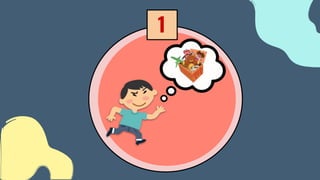
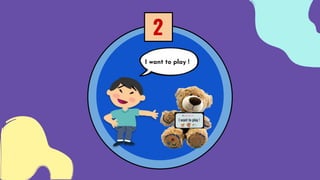
  • #30 Let me give you a scenario of how Adam can use the bear. When Adam has a certain desire, (click) like playtime. click
  • #31 Adam can press the button with the toys icon click , which will cause the bear to say (speaker to press the button) “I want to play”. click
  • #32 After that, click Adam will have to repeat the phrase in order to get his playtime. click
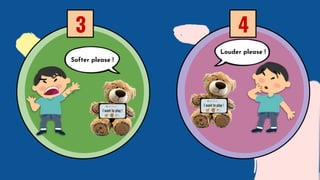
  • #33 This is where the bear’s teaching mechanism comes in. If Adam accidentally says it too loudly, the bear will go, click “Softer please!” whereas if Adam says it too softly, click the bear will then say “Louder please!”. This way, Adam will be able to learn and improve from his mistake on the spot!
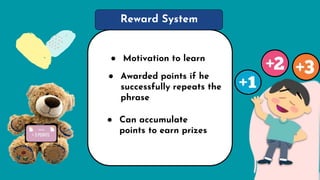
  • #34 Worried Adam may not want to learn? Fear not! There will also be a reward system to motivate him. click Just like how all of us look forward to a good break while studying, autistic children can look forward to the prizes they can earn through Bear Necessities. Click He will be awarded points based on his performance. If Adam successfully repeats the phrase with the correct tone and volume on the first try, click he will earn 3 points! His 2nd try will earn him click 2 points and his third and following tries click will earn him 1 point. Click After collecting a certain number of points, Mrs Tan can choose to reward Adam with anything she finds most appealing and suitable. This way, children like Adam will be inspired to learn more outside their interests! click
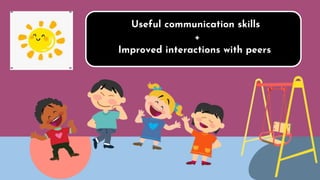
  • #35 In a nutshell, Bear Necessities will give children with autism a fun innovative way to learn useful communication skills, click which can improve their interactions with others. The worries Mrs Tan once had will now be a thing of the past! As such, Bear Necessities is the first solution that is part of our framework, We Got Your BAC(K)! Up next, Basil will be sharing about our second solution, Act-Venture Time. Basil please.
  • #36  Thank you Yi Qing. Good morning assessors// and fellow victorians,// I am Basil,// and I will be your fourth speaker for today. Do you remember how Adam’s inability to read social cues, led to him further infuriating his mother // whenever she got angry at him? Well, this is just one of the many difficulties that children with autism face when interacting with others. (CLICK)
  • #37 Therefore, Act-Venture Time forms the A in our “We got your Back” framework. Act-Venture Time// is a video game, // that aims to help children with autism learn to comprehend non-verbal communication with ease // and to develop their ability to read social cues. (CLICK)
  • #38 Allow me to bring you on an Act-Venture. Learning how to play the game// only takes 3 simple steps! Firstly, // the child with autism, such as Adam, // will have an avatar in the game and he will observe the various scenarios played out at home and in school. Secondly,// Adam will be presented with two options and he will be prompted// to choose the most appropriate answer to the situation. Lastly,// he will imitate the appropriate actions learnt in the game // and hopefully apply them to his daily life. Act-Venture Time will reinforce Adam’s learning through repetition of many similar scenarios. (CLICK)
  • #39 Let me take you through an example. Adam would observe this scenario,// which is of his character who had just spilt his cup of milk on to the floor.
  • #40 His sister sees this and reacts by frowning, and crossing her arms in the background. Two options will then appear on the screen. The first option Adam can choose is to say “sorry I didn’t mean to do it, // or he could choose the second option, which is to to run // and hide in his room. (CLICK) Given these two options, Adam would have to make a decision based on the social cues displayed. If he chose the option to apologise, he will be awarded 10 points and the game will move on to the next scenario. However, if Adam were to choose to run and hide, Mr Owl will then explain the rationale behind why he should not do so and prompt the user to try again.
  • #41 While playing the scenario, // Adam will also be taught// on how to maintain eye contact when interacting with others,// which is a common learning disability // for children with autism. The game // naturally helps Adam // maintain the flow of conversation, // helping him to focus on the interactions itself. Our game indeed helps keep an EYE out for them. (CLICK)
  • #42 Now, I will share with you the three reasons why Act-Venture Time is capable of making a positive impact,namely through real world scenarios, errorless learning, and a point system. *click*
  • #43 The game prominently features the use of real world scenarios in a uniquely Singaporean context. This helps Adam relate the game back to his own surroundings, // making it familiar // and applicable for him to react whenever a similar situation arises. (CLICK)
  • #44 On top of that, Act-venture Time uses the concept of Errorless Learning, which means that there are NO wrong answers! I am sure most of you sitting here do not like getting things wrong, // whether it is a question in tutorial, // or playing a game right? Children with autism are not different in this aspect, and may feel sad from criticism. Our game is able to decrease user frustration // and boosts their confidence level to tackle the questions in the game. (CLICK) With this feature, it changes Adam from being frustrated,// as he used to be criticised over his every answer, (CLICK) // into a cheerful boy who is motivated to learn! (CLICK)
  • #45 Lastly, our game contains a points system, which will award points // based on the number of appropriate answers chosen by the child. This greatly motivates them to continue playing the game // and correct their mistakes. Friendly competition within users // is also promoted through a leader board// as they try to win// each other through gaining a greater// number of points. Additionally, parents such as Mrs Tan, can consider rewarding their children with gifts or playtime when their child has attained a targeted score set for him. So far, we have talked about how Act-venture time helps to teach non verbal communication skills to Adam. Our next speaker will talk about how using our third solution, Caring Connections can complement Bear Necessities and Act- venture Time, by helping parents of children with autism. I shall now pass my time over to Saffanah, who will be sharing more on our Third solution. Take it away Saffanah! (CLICK)
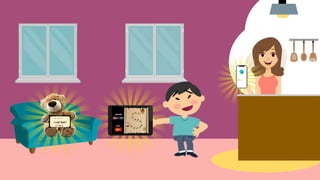
  • #48 Now, you might be wondering what that last video was about. That is a sneak peek of how Caring Connections works! Good morning assessors and fellow Victorians. I’m Saffanah and I will be your final speaker for today. I’ll be talking about our third solution, Caring Connections. After listening to my group members, you might have realised how autism is a diagnosis that instantly changes the lives of young children. However, we are often unaware of the state of their caregivers.
  • #49 To illustrate this, let’s jump back to the story of Mrs Tan and Adam. (CLICK) Mrs Tan had a really hard time taking care of Adam.
  • #50 (CLICK) She was not able to talk to anyone about her problems and was neglected by everyone around her. As May Anne mentioned, (CLICK) Mrs Tan was extremely tired to even attend social networking sessions provided by organisations. All she wanted was just to seek help, gain support and guidance.
  • #51 Now, (CLICK) imagine a situation where you cannot share your problems with anyone and you get ignored? It’s frustrating isn’t it?
  • #52 This is where Caring Connections comes in! Caring Connections aims to improve the mental well-being of caregivers by providing on-the-spot support and care for them through various features.
  • #53  They are (CLICK) forum-based questions and answers, (CLICK) tips from experts, (CLICK) customisable schedule and notifications and (CLICK) recommended products.
  • #54 As seen in the video, you will be welcomed to our home page which also acts as a questions and answers forum. This forum allows caregivers to ask any questions related to caregiving and supporting their child. This helps to form a community of caregivers of children with autism who share similar problems. Recommended answers which were upvoted will be more easily visible for future users. Thus, caregivers can learn and benefit from one another.
  • #55 Secondly, to further enhance the Q & A forum, there will be a tips and articles page. Tips contributed by experts in this field will help provide emotional and practical support for caregivers of children with autism. The guidance from these reliable tips and articles will give the assurance and confidence to caregivers to carry out their role more effectively. (CLICK) For example, if the user wants to find out different ways to destress, the user can find credible information on that topic from professionals themselves.
  • #56 Next, the app has a customisable schedule and daily notifications option as seen in the video. Caregivers like Mrs Tan lacked time management and often did not take enough breaks to rewind and relax. Therefore, caregivers can use this schedule to note and view their tasks for the day. This will make them feel productive while still enabling them to take some time off to relax. Before I continue, I’m sure many of you have forgotten to take small breaks during your busy schedules.
  • #57 Similarly, Mrs Tan was often found to have missed her break timings as she was always caught up with more work. (CLICK) The daily notifications option builds up on the schedule by reminding users to take the breaks that they chose to have.
  • #58 Lastly, we included a ‘Recommended Products’ page to advertise and convince caregivers to consider giving our solutions a try. The products shown in the slide complement the children’s current therapy methods allowing them to learn in a more fun and engaging way. And thus, Caring Connections forms up the last solution of our framework.
  • #59 Let’s recap on what we have spoken today. (CLICK) Bear Necessities aims to enable children with autism express their needs while (CLICK) Act-Venture Time helps these children understand social cues and its responses. Finally, (CLICK) Caring Connections aims to improve the mental well-being of caregivers. We hope that our solutions will offer people in similar circumstances as Mrs Tan and Adam a glimmer of light, hope and a brighter future. We will continue to make a difference in the lives of children with autism and their caregivers.
  • #60 Thank you!