s k y l n c e
presented by
SociaL MeDia for NoNProfitS
WHAT THE C-SUITE SHOULD KNOW
“Social media is online media that starts conversations,
encourages people to pass it on to others, and finds ways
to travel on its own.”
-Idealware, The Nonprofit Social Media Decision Guide
isn’t all about sharing stuff about this guy...
isn’t all about sharing stuff about this
Social media
Really.
Instead, people use social media to talk about other
things like...
this.
this.
this.
and this.
You know,
stuff that really matters.
According to Silicon Alley Insider...
600,000,000
119,000,000
total active users on facebook
total active users on twitter
“Millennials expect organizations to have the same fluency
with social media, the same comfort working beyond the
organization’s institutional walls as they do.”
-Beth Kanter, Co-author of “The Networked Nonprofit”
“Social Media is an ingredient,
not an entrée.”
-Jay Baer, Convince & Convert
“Nothing an organization
does is free.”
-Olivier Blanchard, Brandbuilder Marketing
“I heard it was free!”
“Actually, it’s not.”
Well, there are
Time costs w/ staff:
•	 planning
•	 executing
•	 managing
and...
Tech costs:
Even some tools have
financial fees depending
on what you want to do,
measure, or analyze.
“Sorry, just being honest.”
depends on the breadth of your goals.
The amount of resources you invest into social media
The big question:
What is the ROI of social media?
That’s like asking:
What is the ROI of social media?
email? the telephone?
“So, then...
Can social media drive
nonprofit revenue?”
First...
Let’s see how the for-profit
sector used social media.
Dunkin’ Donuts ran a
contest via Facebook that
generated 130,000+
submissions and 174,000
votes.
= increase of
offline sales
#1
Lenovo reduced call-
center activity by 20%
by leveraging their online
support community.
= cost savings
+better relationships
#2
Dell sold $3 million
in products through
their Dell Outlet Twitter
account.
That was in
2009.
#3
“What about
nonprofits?”
“ahem!?”
In 2008, The Save
Darfur Coalition used a
Facebook page to raise
more than $75k from its
1 million members.
= increased
donations
#1
#2 The National Wildlife
Federation used blogs and
Twitter to promote their new
initiative, Greenhour.org.
After 8 months, the results?
Website views doubled
from 8k to 16k
Email list doubled
from 2.5k to 5k
Two points:
•	Both FPO and NPO can deal with ROI.
•	They had clear goals from the beginning.
Organizations will not share the exact same goals...
Everyone’s strategies and tactics will differ.
Your adoption of social media
should align with
your business goals.
Your adoption of social media
should align with
your mission’s goals.
And a third point:
•	It doesn’t always have
to be about ROI.
Another way of looking at it...
What problem are you trying to solve?
Your activities are like waypoints of the broader
mission...
Can social media
help us along the way?
Non-financial outcomes
using social media:
•	 build rapport w/ stakeholders
•	 Net new volunteers
•	 build advocacy with audiences
Financial outcomes
using social media:
•	 save on traditional media (print, broadcast, etc.)
•	 net new donations
•	 net new memberships
What technical advantages does social media have over
traditional media?
•	wealth of data
•	rate of reach
•	multiplicity of information
“But!
if so many nonprofits are using it,
what’s the problem?”
Meanwhile,
on a misty mountain top...
zen kitty
zen kitty
zen kitty
and current problems
with nonprofit social media
Dear Zen Kitty of social media wisdom,
I want my organization to use social media, but I
want to ensure that we do it right. What are some
common pitfalls I must avoid?
“hmmmmmm....”
“There are 3 you must know...”
1.
Not tying social media into your
nonprofit’s core objectives.
Experimentation is good!
when guided by a solid communications strategy.
No general sends
out troops without a
good reason why.
Think about it like this:
“So, why are we doing
this again?”
“Dunno, the boss just said get
out there and start engagin’.”
Wrong.
Get concrete with goals or you’ll waste
your staff’s energy, time, and money.
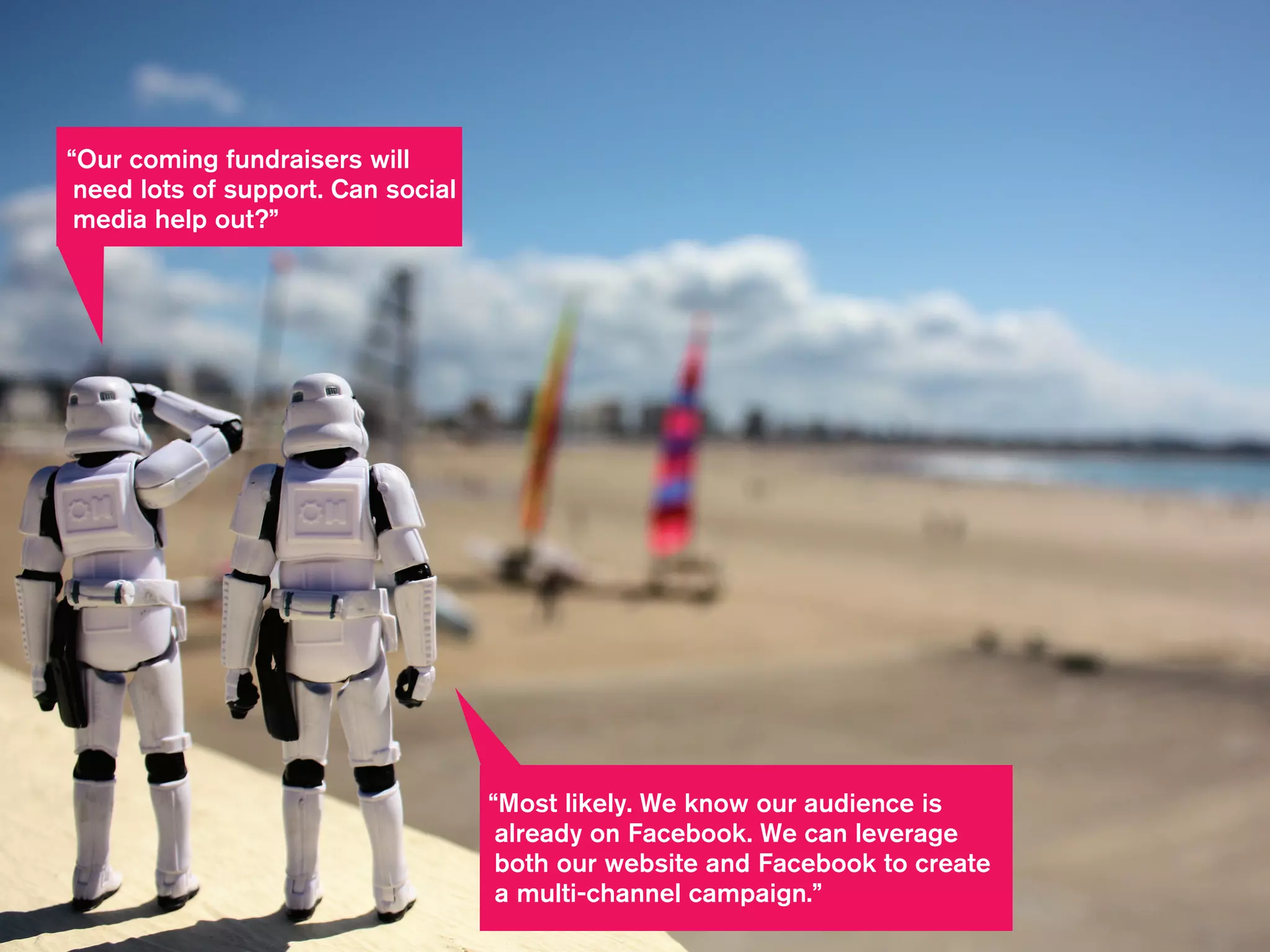
“Most likely. We know our audience is
already on Facebook. We can leverage
both our website and Facebook to create
a multi-channel campaign.”
“Our coming fundraisers will
need lots of support. Can social
media help out?”
“Our coming fundraisers will
need lots of support. Can social
media help out?”
“Most likely. We know our audience is
already on Facebook. We can leverage
both our website and Facebook to create
a multi-channel campaign.”
“Our coming fundraisers will
need lots of support. Can social
media help out?”
“Most likely. We know our audience is
already on Facebook. We can leverage
both our website and Facebook to create
a multi-channel campaign.”
•	You can focus your resources.
•	You’ll know what tools make sense.
•	You’ll know what metrics you need to
measure success.
Much better.
2.
Not establishing a measurement
practice.
Why measure?
•	track progress
A metric only tells a part of the story.
So many metrics. The secret?
Measure what matters.
•	track progress
•	gather actionable insight
actionable insight =
better decision-making
•	track progress
•	gather actionable insight
•	justify your resources
3.
100% push marketing
Aside from “business” functions, social media can
humanize and harmonize.
Don’t always talk about yourself.
Social media is still
just another channel.
Push vs. Pull
10% Push
90% Pull
“What do we talk about?”
Listen first.
Fastest way to learn how to engage your peeps?
See how other nonprofits are
doing it.
Thank you!
omg,
“Don’t mention it.”
Other issues worth addressing...
pr
marketing
pr
marketing
customer service
brand
management
crisis management
pr
marketing
customer service
brand
management
crisis management
pr
marketing
marketing
customer service
brand
management
crisis management
Social media is a part of your
existing
communications
strategy
risk
risk
risk
reward
reward
reward
vs
Flickr Photo Credits:
by eschipul
mrdestructicity
by the NOAA
by Steve Punter
by the IFRC
by Darkroom Productions
by rick
by x-ray delta one
by Eric Constantineau
by Univ of Iowa
by will biscuits
by Stéfan
by Stéfan
by Stéfan
by Stéfan
by milopeng
by i eated a cookie
by vernhart
by halfdos
Movie Screenshot Credits:
InfoGFX Credits:
Dr. Strangelove. Dir. Stanley Kubrick. With Peter Sellers, George C. Scott
Sterling Hayden, Keenan Wynn, Slim Pickens. Hawk Films, 1964.
Global Map of Social Networking 2011 by Trendstream.net
Twitterverse by Brian Solis and jess3
Social Media Landscape of 2011 by Fred Cavazza
www.skylance.org
Skylance leads wayward nonprofits & social enterprises into marketing and operational
sustainability. We help them communicate better and execute missions more efficiently.
end.

Social Media for Nonprofits