Dr. M.
Anusha.,M.S
Assistant Professor
Dept of General Surgery
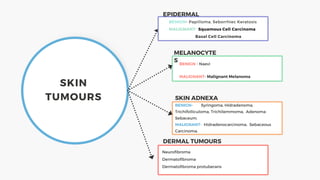
BENIGN- Papilloma, Seborrhiec Keratosis
MALIGNANT- Squamous Cell Carcinoma
Basal Cell Carcinoma
EPIDERMAL
SKIN
TUMOURS
BENIGN - Naevi
MALIGNANT- Malignant Melanoma
MELANOCYTE
S
BENIGN- Syringoma, Hidradenoma,
Trichifolliculoma, Trichilemmoma, Adenoma
Sebaceum.
MALIGNANT- Hidradenocarcinoma, Sebaceous
Carcinoma.
SKIN ADNEXA
Neurofibroma
Dermatofibroma
Dermatofibroma protuberans
DERMAL TUMOURS
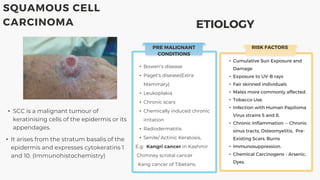
• Cumulative Sun Exposure and
Damage
• Exposure to UV-B rays
• Fair skinned individuals
• Males more commonly affected.
• Tobacco Use.
• Infection with Human Papiloma
Virus strains 5 and 6.
• Chronic Inflammation -- Chronic
sinus tracts, Osteomyelitis, Pre-
Existing Scars, Burns
• Immunosuppression.
• Chemical Carcinogens - Arsenic,
Dyes.
RISK FACTORS
PRE MALIGNANT
CONDITIONS
• Bowen's disease
• Paget's disease(Extra
Mammary)
• Leukoplakia
• Chronic scars
• Chemically induced chronic
irritation
• Radiodermatitis
• Senile/ Actinic Keratosis,
E.g: Kangri cancer in Kashmir
Chimney scrotal cancer
Kang cancer of Tibetans.
SQUAMOUS CELL
CARCINOMA
• SCC is a malignant tumour of
keratinising cells of the epidermis or its
appendages.
• It arises from the stratum basalis of the
epidermis and expresses cytokeratins 1
and 10. (Immunohistochemistry)
ETIOLOGY
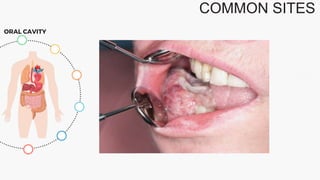
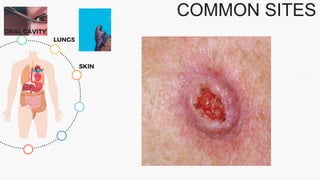
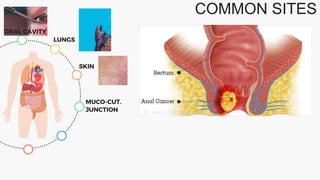
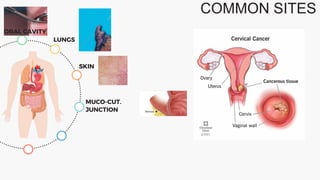
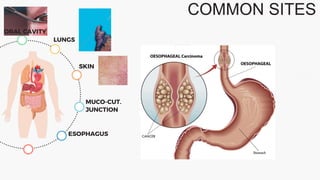
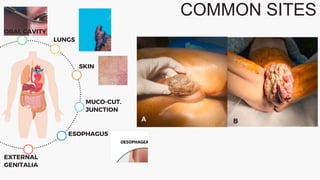
COMMON SITES
ORAL CAVITY
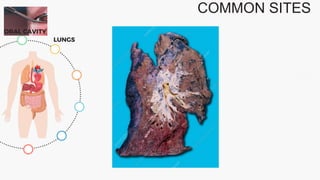
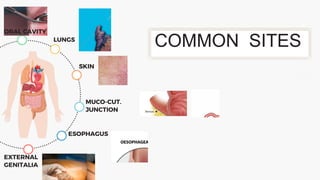
COMMON SITES
ORAL CAVITY
LUNGS
COMMON SITES
ORAL CAVITY
LUNGS
SKIN
COMMON SITES
ORAL CAVITY
LUNGS
SKIN
MUCO-CUT.
JUNCTION
COMMON SITES
ORAL CAVITY
LUNGS
SKIN
MUCO-CUT.
JUNCTION
COMMON SITES
ORAL CAVITY
LUNGS
SKIN
MUCO-CUT.
JUNCTION
ESOPHAGUS
COMMON SITES
ORAL CAVITY
LUNGS
SKIN
MUCO-CUT.
JUNCTION
ESOPHAGUS
EXTERNAL
GENITALIA
EXTERNAL
GENITALIA
COMMON SITES
ORAL CAVITY
LUNGS
SKIN
MUCO-CUT.
JUNCTION
ESOPHAGUS
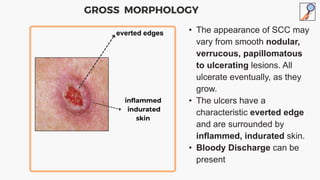
• The appearance of SCC may
vary from smooth nodular,
verrucous, papillomatous
to ulcerating lesions. All
ulcerate eventually, as they
grow.
• The ulcers have a
characteristic everted edge
and are surrounded by
inflammed, indurated skin.
• Bloody Discharge can be
present
GROSS MORPHOLOGY
everted edges
inflammed
indurated
skin
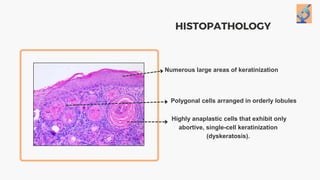
HISTOPATHOLOGY
Numerous large areas of keratinization
Polygonal cells arranged in orderly lobules
Highly anaplastic cells that exhibit only
abortive, single-cell keratinization
(dyskeratosis).
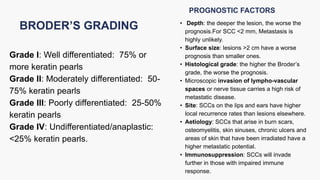
Grade I: Well differentiated: 75% or
more keratin pearls
Grade II: Moderately differentiated: 50-
75% keratin pearls
Grade Ill: Poorly differentiated: 25-50%
keratin pearls
Grade IV: Undifferentiated/anaplastic:
<25% keratin pearls.
BRODER’S GRADING
PROGNOSTIC FACTORS
• Depth: the deeper the lesion, the worse the
prognosis.For SCC <2 mm, Metastasis is
highly unlikely.
• Surface size: lesions >2 cm have a worse
prognosis than smaller ones.
• Histological grade: the higher the Broder’s
grade, the worse the prognosis.
• Microscopic invasion of lympho-vascular
spaces or nerve tissue carries a high risk of
metastatic disease.
• Site: SCCs on the lips and ears have higher
local recurrence rates than lesions elsewhere.
• Aetiology: SCCs that arise in burn scars,
osteomyelitis, skin sinuses, chronic ulcers and
areas of skin that have been irradiated have a
higher metastatic potential.
• Immunosuppression: SCCs will invade
further in those with impaired immune
response.
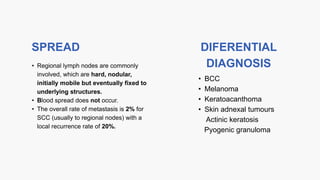
• Regional lymph nodes are commonly
involved, which are hard, nodular,
initially mobile but eventually fixed to
underlying structures.
• Blood spread does not occur.
• The overall rate of metastasis is 2% for
SCC (usually to regional nodes) with a
local recurrence rate of 20%.
SPREAD DIFERENTIAL
DIAGNOSIS
• BCC
• Melanoma
• Keratoacanthoma
• Skin adnexal tumours
Actinic keratosis
Pyogenic granuloma
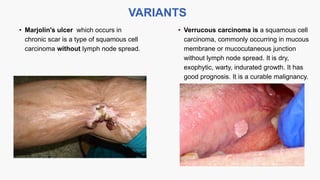
• Marjolin's ulcer which occurs in
chronic scar is a type of squamous cell
carcinoma without lymph node spread.
VARIANTS
• Verrucous carcinoma is a squamous cell
carcinoma, commonly occurring in mucous
membrane or mucocutaneous junction
without lymph node spread. It is dry,
exophytic, warty, indurated growth. It has
good prognosis. It is a curable malignancy.
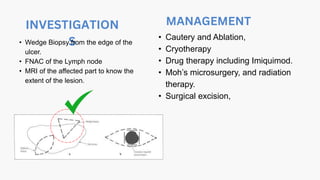
INVESTIGATION
S
MANAGEMENT
• Wedge Biopsy from the edge of the
ulcer.
• FNAC of the Lymph node
• MRI of the affected part to know the
extent of the lesion.
• Cautery and Ablation,
• Cryotherapy
• Drug therapy including Imiquimod.
• Moh’s microsurgery, and radiation
therapy.
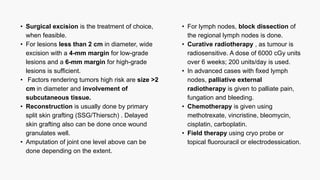
• Surgical excision,
• Surgical excision is the treatment of choice,
when feasible.
• For lesions less than 2 cm in diameter, wide
excision with a 4-mm margin for low-grade
lesions and a 6-mm margin for high-grade
lesions is sufficient.
• Factors rendering tumors high risk are size >2
cm in diameter and involvement of
subcutaneous tissue.
• Reconstruction is usually done by primary
split skin grafting (SSG/Thiersch) . Delayed
skin grafting also can be done once wound
granulates well.
• Amputation of joint one level above can be
done depending on the extent.
• For lymph nodes, block dissection of
the regional lymph nodes is done.
• Curative radiotherapy , as tumour is
radiosensitive. A dose of 6000 cGy units
over 6 weeks; 200 units/day is used.
• In advanced cases with fixed lymph
nodes, palliative external
radiotherapy is given to palliate pain,
fungation and bleeding.
• Chemotherapy is given using
methotrexate, vincristine, bleomycin,
cisplatin, carboplatin.
• Field therapy using cryo probe or
topical fluorouracil or electrodessication.
Moh’s microsurgery (Microscopically
Oriented Histographic Surgery)
• Moh’s microsurgery is indicated for lesions
at sites
• where cosmesis or function preservation is
critical, for poorly
• differentiated tumors, for invasive lesions,
and for verrucous
• carcinomas.
• is indicated for lesions
• Sites where cosmesis or function
preservation is critical.
• For poorly differentiated tumors
• For invasive lesions
• For verrucous carcinomas.

Skin Tumours- Squamous Cell Carcinoma Presentation

  • 1.
  • 2.
    BENIGN- Papilloma, SeborrhiecKeratosis MALIGNANT- Squamous Cell Carcinoma Basal Cell Carcinoma EPIDERMAL SKIN TUMOURS BENIGN - Naevi MALIGNANT- Malignant Melanoma MELANOCYTE S BENIGN- Syringoma, Hidradenoma, Trichifolliculoma, Trichilemmoma, Adenoma Sebaceum. MALIGNANT- Hidradenocarcinoma, Sebaceous Carcinoma. SKIN ADNEXA Neurofibroma Dermatofibroma Dermatofibroma protuberans DERMAL TUMOURS
  • 3.
    • Cumulative SunExposure and Damage • Exposure to UV-B rays • Fair skinned individuals • Males more commonly affected. • Tobacco Use. • Infection with Human Papiloma Virus strains 5 and 6. • Chronic Inflammation -- Chronic sinus tracts, Osteomyelitis, Pre- Existing Scars, Burns • Immunosuppression. • Chemical Carcinogens - Arsenic, Dyes. RISK FACTORS PRE MALIGNANT CONDITIONS • Bowen's disease • Paget's disease(Extra Mammary) • Leukoplakia • Chronic scars • Chemically induced chronic irritation • Radiodermatitis • Senile/ Actinic Keratosis, E.g: Kangri cancer in Kashmir Chimney scrotal cancer Kang cancer of Tibetans. SQUAMOUS CELL CARCINOMA • SCC is a malignant tumour of keratinising cells of the epidermis or its appendages. • It arises from the stratum basalis of the epidermis and expresses cytokeratins 1 and 10. (Immunohistochemistry) ETIOLOGY
  • 4.
  • 5.
  • 6.
  • 7.
  • 8.
  • 9.
  • 10.
  • 11.
  • 12.
    • The appearanceof SCC may vary from smooth nodular, verrucous, papillomatous to ulcerating lesions. All ulcerate eventually, as they grow. • The ulcers have a characteristic everted edge and are surrounded by inflammed, indurated skin. • Bloody Discharge can be present GROSS MORPHOLOGY everted edges inflammed indurated skin
  • 13.
    HISTOPATHOLOGY Numerous large areasof keratinization Polygonal cells arranged in orderly lobules Highly anaplastic cells that exhibit only abortive, single-cell keratinization (dyskeratosis).
  • 14.
    Grade I: Welldifferentiated: 75% or more keratin pearls Grade II: Moderately differentiated: 50- 75% keratin pearls Grade Ill: Poorly differentiated: 25-50% keratin pearls Grade IV: Undifferentiated/anaplastic: <25% keratin pearls. BRODER’S GRADING PROGNOSTIC FACTORS • Depth: the deeper the lesion, the worse the prognosis.For SCC <2 mm, Metastasis is highly unlikely. • Surface size: lesions >2 cm have a worse prognosis than smaller ones. • Histological grade: the higher the Broder’s grade, the worse the prognosis. • Microscopic invasion of lympho-vascular spaces or nerve tissue carries a high risk of metastatic disease. • Site: SCCs on the lips and ears have higher local recurrence rates than lesions elsewhere. • Aetiology: SCCs that arise in burn scars, osteomyelitis, skin sinuses, chronic ulcers and areas of skin that have been irradiated have a higher metastatic potential. • Immunosuppression: SCCs will invade further in those with impaired immune response.
  • 15.
    • Regional lymphnodes are commonly involved, which are hard, nodular, initially mobile but eventually fixed to underlying structures. • Blood spread does not occur. • The overall rate of metastasis is 2% for SCC (usually to regional nodes) with a local recurrence rate of 20%. SPREAD DIFERENTIAL DIAGNOSIS • BCC • Melanoma • Keratoacanthoma • Skin adnexal tumours Actinic keratosis Pyogenic granuloma
  • 16.
    • Marjolin's ulcerwhich occurs in chronic scar is a type of squamous cell carcinoma without lymph node spread. VARIANTS • Verrucous carcinoma is a squamous cell carcinoma, commonly occurring in mucous membrane or mucocutaneous junction without lymph node spread. It is dry, exophytic, warty, indurated growth. It has good prognosis. It is a curable malignancy.
  • 17.
    INVESTIGATION S MANAGEMENT • Wedge Biopsyfrom the edge of the ulcer. • FNAC of the Lymph node • MRI of the affected part to know the extent of the lesion. • Cautery and Ablation, • Cryotherapy • Drug therapy including Imiquimod. • Moh’s microsurgery, and radiation therapy. • Surgical excision,
  • 18.
    • Surgical excisionis the treatment of choice, when feasible. • For lesions less than 2 cm in diameter, wide excision with a 4-mm margin for low-grade lesions and a 6-mm margin for high-grade lesions is sufficient. • Factors rendering tumors high risk are size >2 cm in diameter and involvement of subcutaneous tissue. • Reconstruction is usually done by primary split skin grafting (SSG/Thiersch) . Delayed skin grafting also can be done once wound granulates well. • Amputation of joint one level above can be done depending on the extent. • For lymph nodes, block dissection of the regional lymph nodes is done. • Curative radiotherapy , as tumour is radiosensitive. A dose of 6000 cGy units over 6 weeks; 200 units/day is used. • In advanced cases with fixed lymph nodes, palliative external radiotherapy is given to palliate pain, fungation and bleeding. • Chemotherapy is given using methotrexate, vincristine, bleomycin, cisplatin, carboplatin. • Field therapy using cryo probe or topical fluorouracil or electrodessication.
  • 19.
    Moh’s microsurgery (Microscopically OrientedHistographic Surgery) • Moh’s microsurgery is indicated for lesions at sites • where cosmesis or function preservation is critical, for poorly • differentiated tumors, for invasive lesions, and for verrucous • carcinomas. • is indicated for lesions • Sites where cosmesis or function preservation is critical. • For poorly differentiated tumors • For invasive lesions • For verrucous carcinomas.