Skill development and important area
The National Democratic Institute
PREFACE – SOME EXERCISES
• Introductions
• Ground Rules
• Ice Breaker Exercise
OBJECTIVE
OBJECTIVE
• To understand the
political context
and opportunities
for women within
this environment
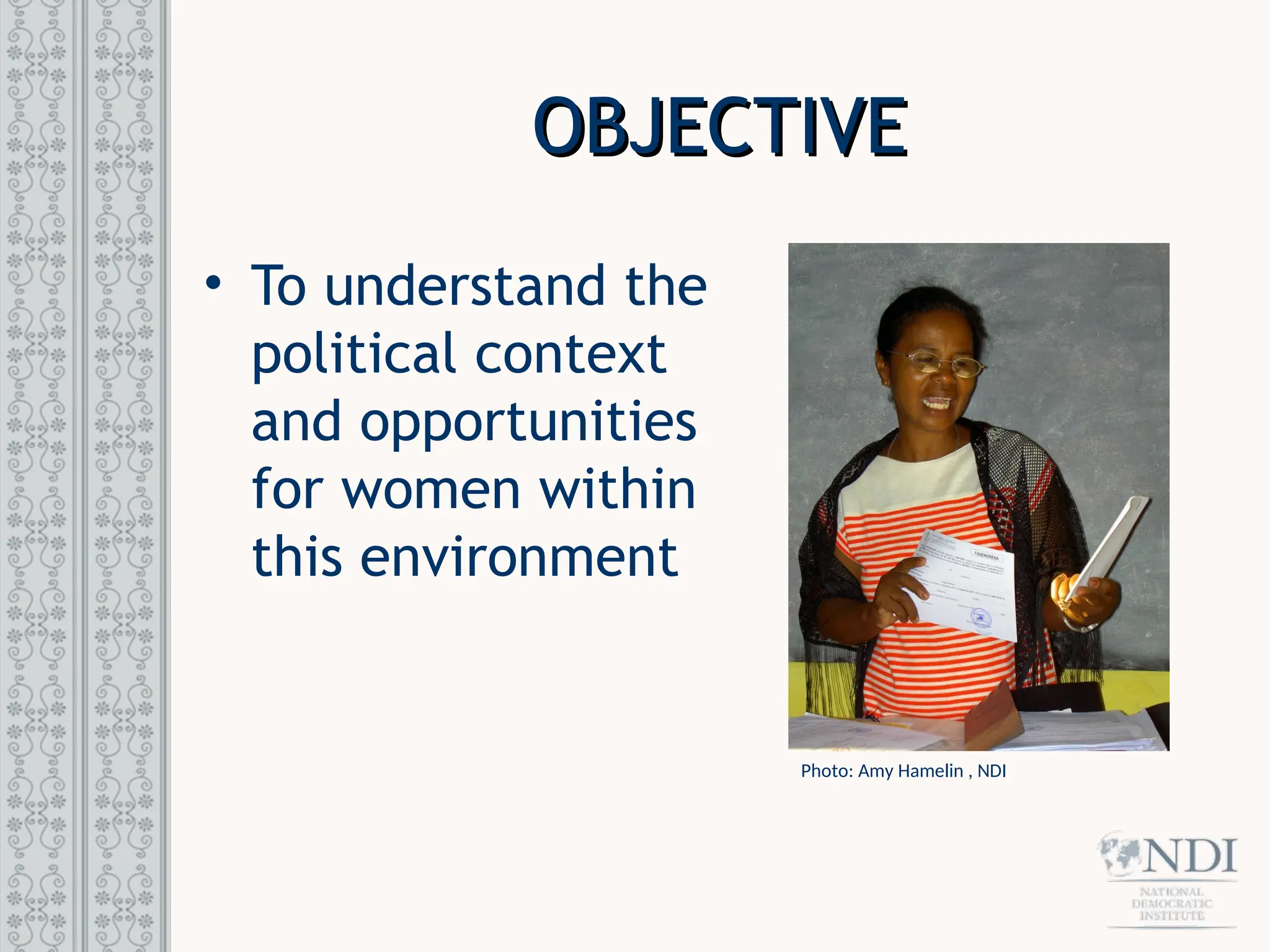
Photo: Amy Hamelin , NDI
POLITICAL CONTEXT TOPICS
• Political actors and institutions
• Status of women in politics
• Access points and opportunities for
women in politics
POLITICAL ACTORS
POLITICAL ACTORS
• Media
• Private sector
• Government
• Political parties
• Civil society and international NGOs
• Academia
• Institutions
MEDIA
MEDIA
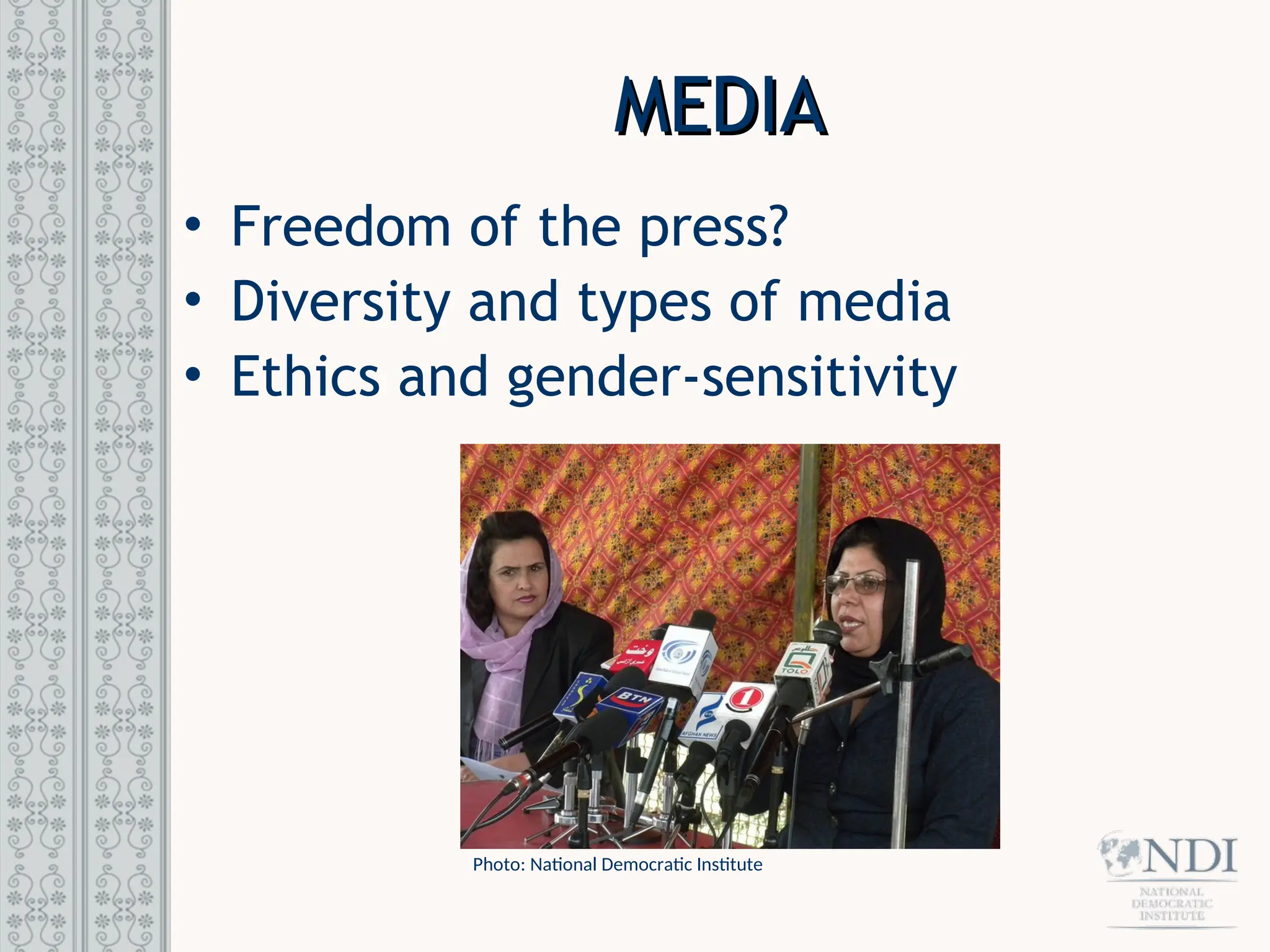
• Freedom of the press?
• Diversity and types of media
• Ethics and gender-sensitivity
Photo: National Democratic Institute
MEDIA
MEDIA
• Reports political developments
• Covers elections and candidates
• Opinion-editorials can influence public
• Informs the public
GOVERNMENT
GOVERNMENT
• Daily administration of the state
• Provide basic services to citizens
• Implement policies of party/platform
POLITICAL PARTIES AND
COALITIONS
COALITIONS
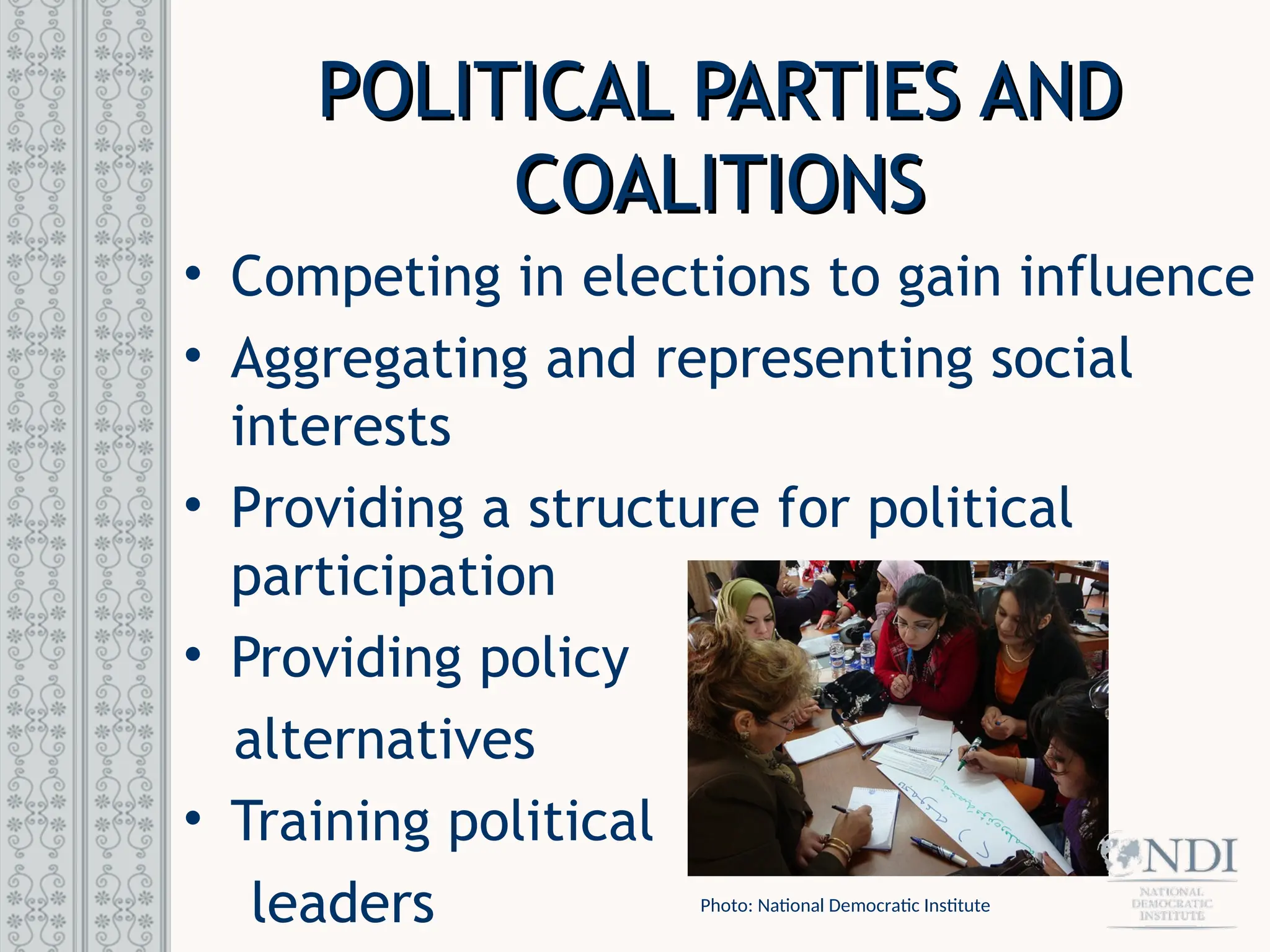
• Competing in elections to gain influence
• Aggregating and representing social
interests
• Providing a structure for political
participation
• Providing policy
alternatives
• Training political
leaders Photo: National Democratic Institute
WOMEN IN POLITICAL PARTIES
• Importance of women as party members
and leaders
• Benefits to the party
• Women’s wings
Photo: Amy Hamelin, NDI
CIVIL SOCIETY
CIVIL SOCIETY
• Advocacy
• Citizen participation
• Bridge between the
public and government
• Government
monitoring
• Voter and civic
education
• Service provision
Photo: National Democratic Institute
WOMEN IN CIVIL SOCIETY
Women as agents of change
Photo: NDI
OTHER POLITICAL ACTORS
• Private sector
• Academia
• Religious leaders
• Regional/international
organizations
• Institutions
WOMEN IN POLITICS
WOMEN IN POLITICS
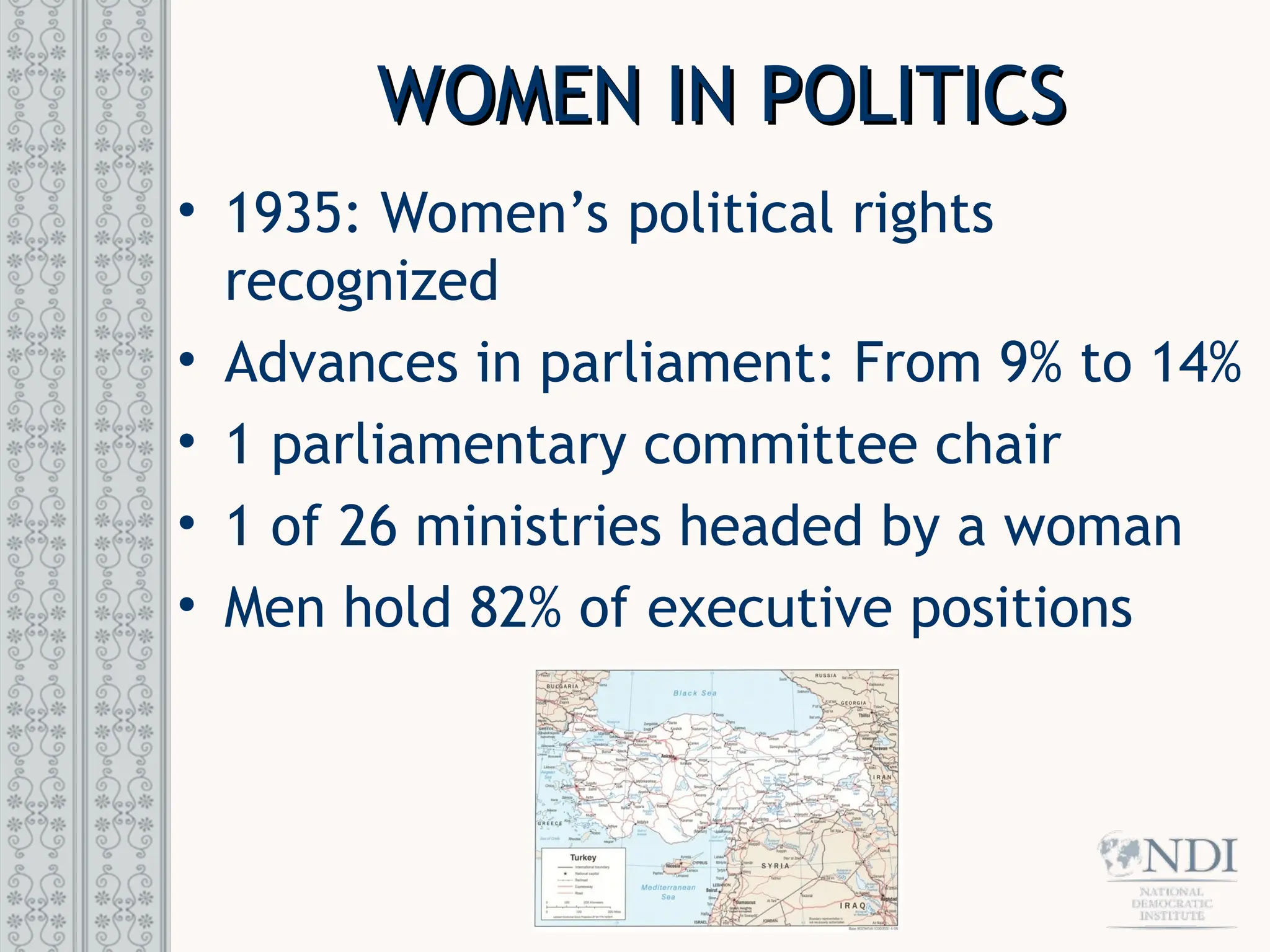
• 1935: Women’s political rights
recognized
• Advances in parliament: From 9% to 14%
• 1 parliamentary committee chair
• 1 of 26 ministries headed by a woman
• Men hold 82% of executive positions
EXERCISE
EXERCISE
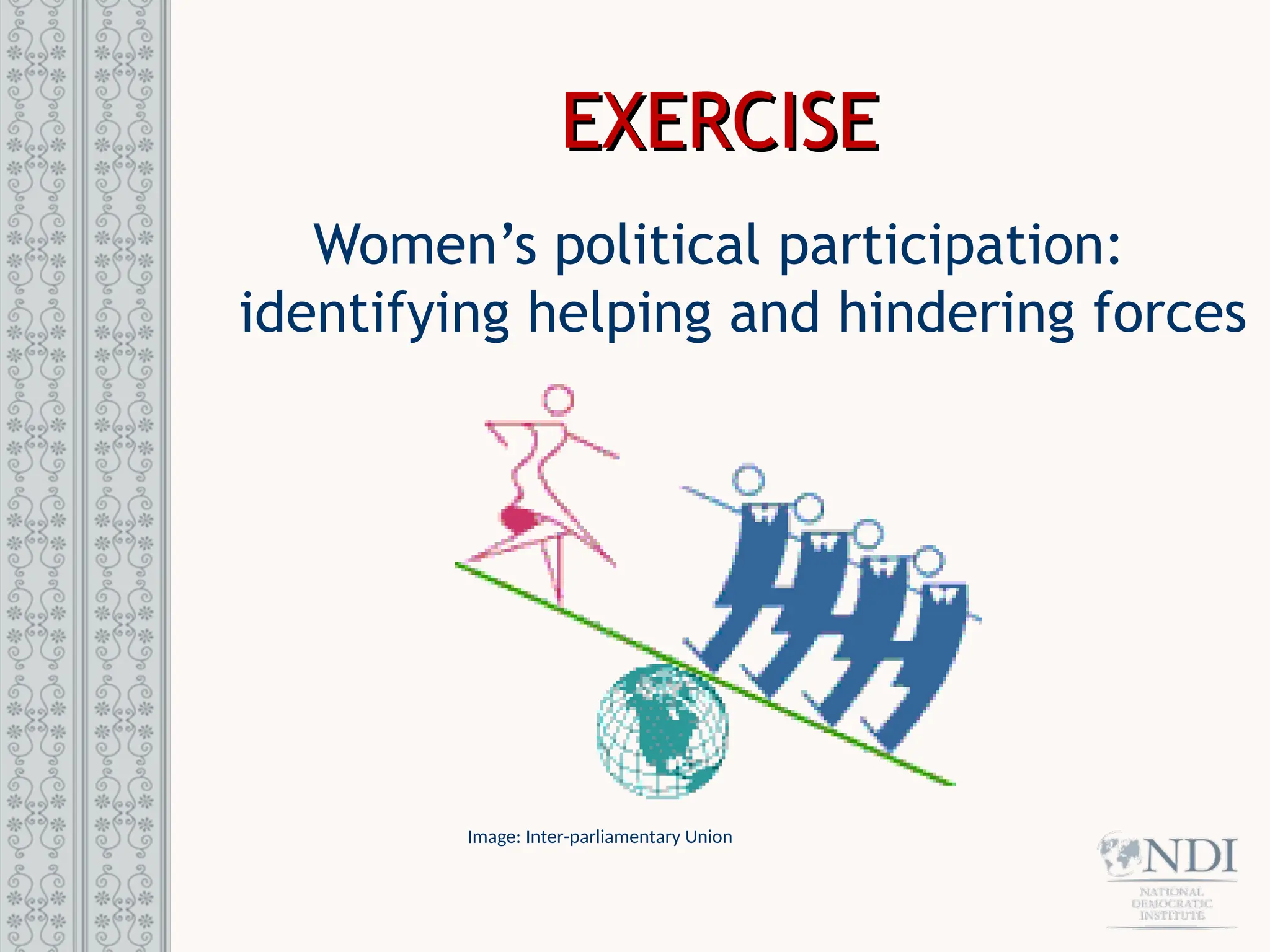
Women’s political participation:
identifying helping and hindering forces
Image: Inter-parliamentary Union
MINIMUM CONDITIONS FOR
POLITICAL PARTICIPATION
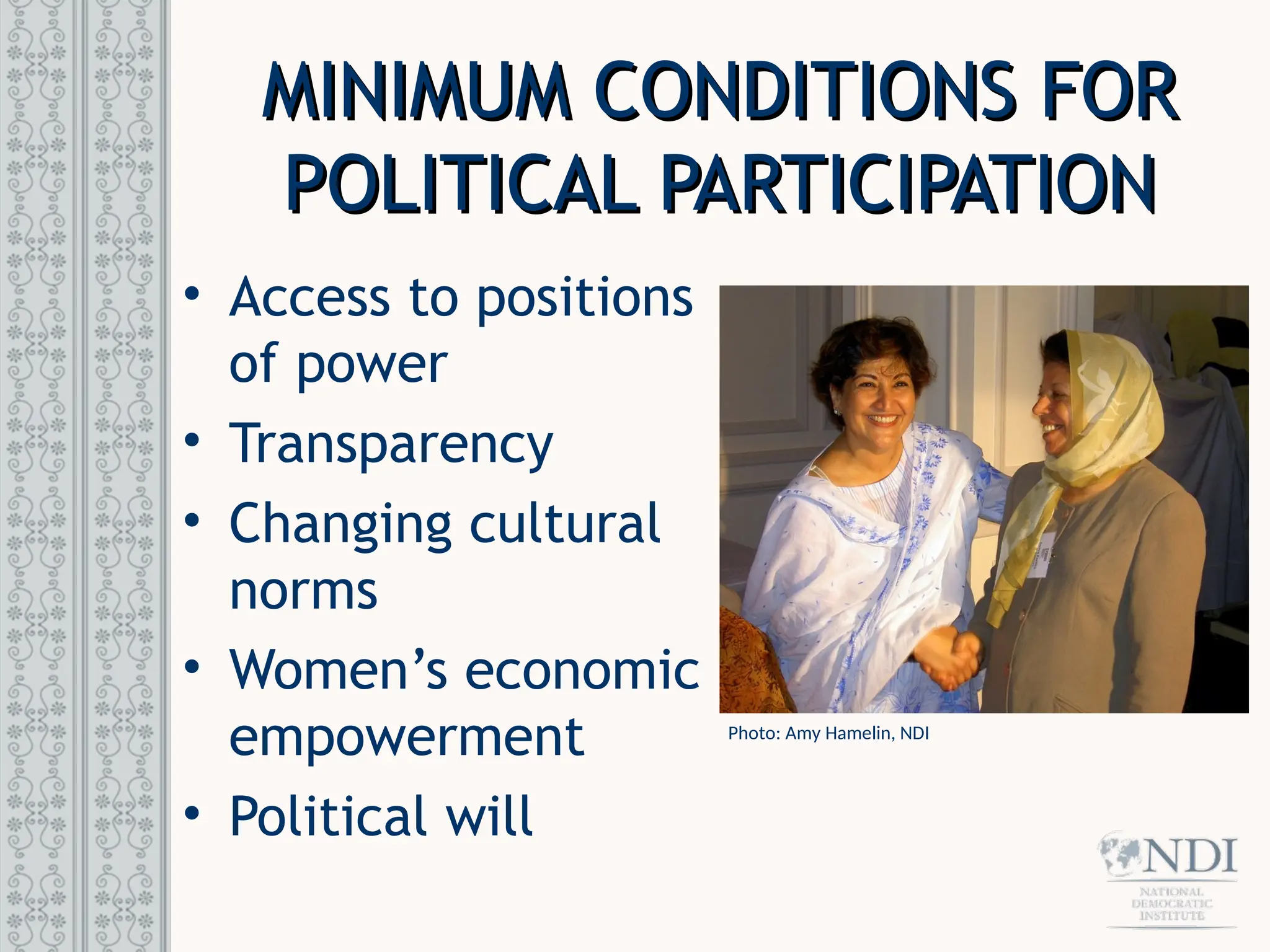
• Access to positions
of power
• Transparency
• Changing cultural
norms
• Women’s economic
empowerment
• Political will
Photo: Amy Hamelin, NDI
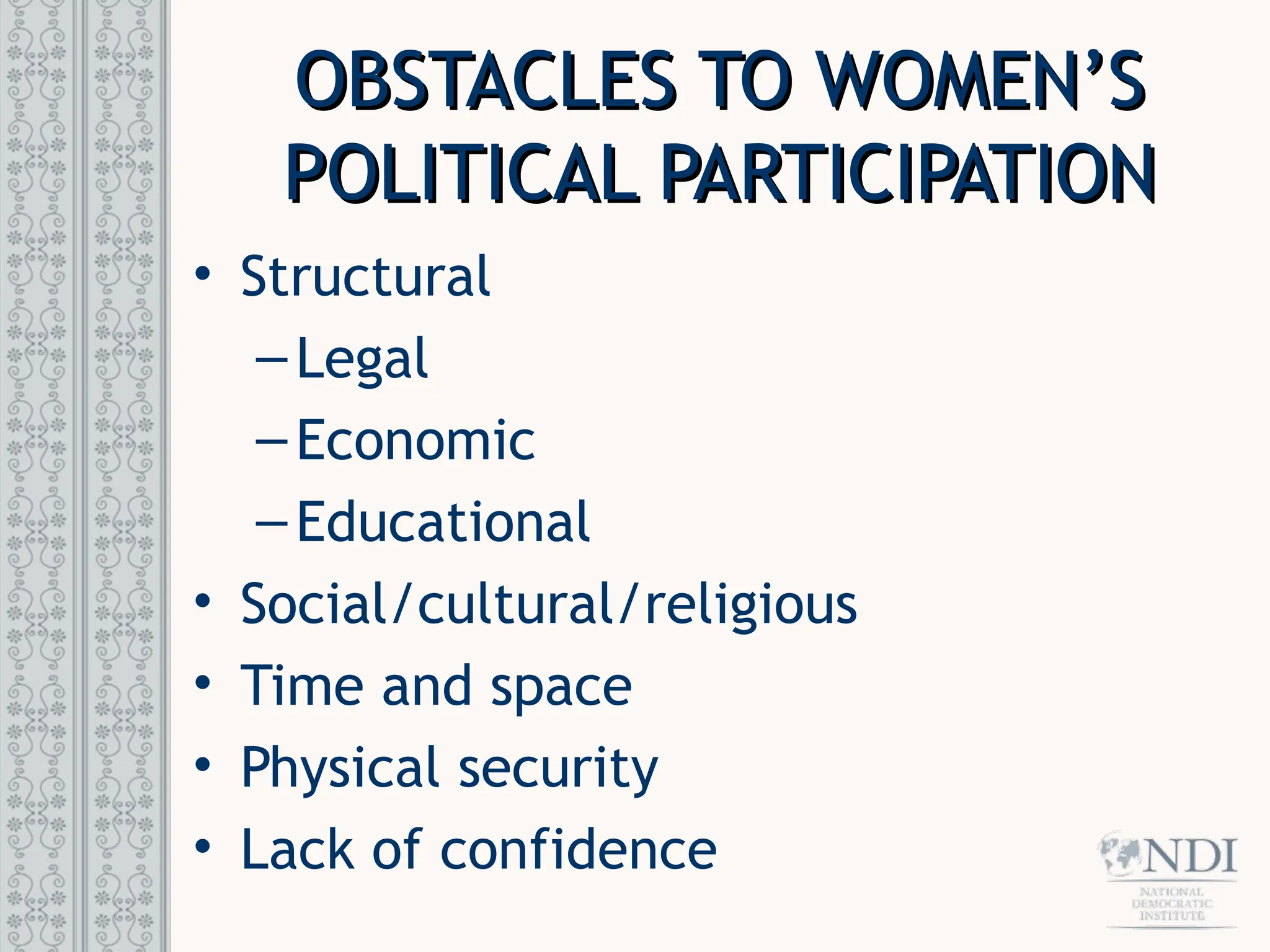
OBSTACLES TO WOMEN’S
POLITICAL PARTICIPATION
• Structural
–Legal
–Economic
–Educational
• Social/cultural/religious
• Time and space
• Physical security
• Lack of confidence
MOBILIZING WOMEN FOR
CHANGE: MECHANISMS
CHANGE: MECHANISMS
• Women’s parliamentary caucuses
• Women’s wings within political parties
• Civil society organizations
• Cross-sector groups
Photo: NDI
POLITICAL CONTEXT
POLITICAL CONTEXT REVIEW
REVIEW
• Roles of political actors
• Status of women in politics
• Access points and opportunities for
women in politics
 Questions?
 Feedback?

Skill development among Important areas.ppt

  • 1.
    Skill development andimportant area The National Democratic Institute
  • 2.
    PREFACE – SOMEEXERCISES PREFACE – SOME EXERCISES • Introductions • Ground Rules • Ice Breaker Exercise
  • 3.
    OBJECTIVE OBJECTIVE • To understandthe political context and opportunities for women within this environment Photo: Amy Hamelin , NDI
  • 4.
    POLITICAL CONTEXT TOPICS POLITICALCONTEXT TOPICS • Political actors and institutions • Status of women in politics • Access points and opportunities for women in politics
  • 5.
    POLITICAL ACTORS POLITICAL ACTORS •Media • Private sector • Government • Political parties • Civil society and international NGOs • Academia • Institutions
  • 6.
    MEDIA MEDIA • Freedom ofthe press? • Diversity and types of media • Ethics and gender-sensitivity Photo: National Democratic Institute
  • 7.
    MEDIA MEDIA • Reports politicaldevelopments • Covers elections and candidates • Opinion-editorials can influence public • Informs the public
  • 8.
    GOVERNMENT GOVERNMENT • Daily administrationof the state • Provide basic services to citizens • Implement policies of party/platform
  • 9.
    POLITICAL PARTIES AND POLITICALPARTIES AND COALITIONS COALITIONS • Competing in elections to gain influence • Aggregating and representing social interests • Providing a structure for political participation • Providing policy alternatives • Training political leaders Photo: National Democratic Institute
  • 10.
    WOMEN IN POLITICALPARTIES WOMEN IN POLITICAL PARTIES • Importance of women as party members and leaders • Benefits to the party • Women’s wings Photo: Amy Hamelin, NDI
  • 11.
    CIVIL SOCIETY CIVIL SOCIETY •Advocacy • Citizen participation • Bridge between the public and government • Government monitoring • Voter and civic education • Service provision Photo: National Democratic Institute
  • 12.
    WOMEN IN CIVILSOCIETY WOMEN IN CIVIL SOCIETY Women as agents of change Photo: NDI
  • 13.
    OTHER POLITICAL ACTORS OTHERPOLITICAL ACTORS • Private sector • Academia • Religious leaders • Regional/international organizations • Institutions
  • 14.
    WOMEN IN POLITICS WOMENIN POLITICS • 1935: Women’s political rights recognized • Advances in parliament: From 9% to 14% • 1 parliamentary committee chair • 1 of 26 ministries headed by a woman • Men hold 82% of executive positions
  • 15.
    EXERCISE EXERCISE Women’s political participation: identifyinghelping and hindering forces Image: Inter-parliamentary Union
  • 16.
    MINIMUM CONDITIONS FOR MINIMUMCONDITIONS FOR POLITICAL PARTICIPATION POLITICAL PARTICIPATION • Access to positions of power • Transparency • Changing cultural norms • Women’s economic empowerment • Political will Photo: Amy Hamelin, NDI
  • 17.
    OBSTACLES TO WOMEN’S OBSTACLESTO WOMEN’S POLITICAL PARTICIPATION POLITICAL PARTICIPATION • Structural –Legal –Economic –Educational • Social/cultural/religious • Time and space • Physical security • Lack of confidence
  • 18.
    MOBILIZING WOMEN FOR MOBILIZINGWOMEN FOR CHANGE: MECHANISMS CHANGE: MECHANISMS • Women’s parliamentary caucuses • Women’s wings within political parties • Civil society organizations • Cross-sector groups Photo: NDI
  • 19.
    POLITICAL CONTEXT POLITICAL CONTEXTREVIEW REVIEW • Roles of political actors • Status of women in politics • Access points and opportunities for women in politics  Questions?  Feedback?

Editor's Notes

  • #1 See the Trainer’s Guide for overall guidance on using this presentation. The Trainer’s Guide serves as a companion resource and outlines the objectives of the session and materials needed as well as provides additional guidance on conducting the training session. Please note that the Guide includes complete instructions on how to facilitate some of the exercises referenced in this PowerPoint presentation and additional information on the content of certain slides.   Please adapt the PowerPoint presentation, exercises, examples and handouts in advance of your workshop. They have been created for a global audience and need to be adapted to better suit the local context, the background of your participants and their level of experience. Terms, images and examples from the participants’ country or region should be used as much as possible so that they are relevant and contextually appropriate.  This presentation and guide were developed by Susan Kemp. NDI would also like to acknowledge those who contributed including Amy Hamelin, Caroline Hubbard, Susan Markham, Allison Muehlenbeck, Crystal Rosario and Rebecca Turkington.
  • #2 SLIDE CONTENT: To begin the session, introduce yourself and other staff, trainers and resource persons. Provide the participants an opportunity to introduce themselves and establish ground rules for the training. TRAINER NOTE: It will be important to establish a rapport among participants. If this is the first presentation of a training workshop, be sure to build in time for participants to get to know one another and establish ground rules for their interaction and participation. Guidance on ice breakers and ground rules can be found in the “Training and Facilitation” folder. You might also establish ground rules by asking participants to give suggestions and agreeing as a group. You can write the rules on a flip chart and hang it on the wall for reference during the training session.
  • #3 SLIDE CONTENT: The objective for this session is to: To understand the political context and opportunities for women within this environment TRAINER NOTE: Provide an overview of the session’s objectives so that participants understand its purpose and have realistic expectations about what to expect. You may also wish to ask participants what expectations they have for the session. What do they hope to get out of it? You can then relate their expectations to the objectives and suggest how unrelated expectations might be met in other ways.
  • #4 SLIDE CONTENT: The topics we will cover today include: Political actors and institutions (civil society, parties, media, private sector, academia, international organizations, etc.) Status of women in politics Access points and opportunities for women in politics TRAINER NOTE: Give the participants a brief overview of the topics to be covered so they have a sense of where you are heading in the presentation. Summarize the main concepts that will be addressed.
  • #5 SLIDE CONTENT: Part of understanding the political context is identifying who the political actors are as well as their role and influence in the process. These can include: Media Private sector Government Political parties Civil society Regional and international organizations Academia Institutions TRAINER NOTE: The following slides will cover these political actors in more detail. Adapt this and the subsequent slides to reflect the primary political actors in the target context.
  • #6 SLIDE CONTENT: The role of the media is an important aspect of understanding the political context. The extent to which the country has a strong, independent media can influence the amount of political discourse and opposing viewpoints in the media. What type of media is most used by the public (in other words, which has the most influence on public opinion/awareness raising)? Other considerations include the professionalism of the media (do they have standards of ethics) and gender-sensitive reporting. TRAINER NOTE: Adapt this slide so the situation of the media in the target country is reflected. It may be useful to discuss the main media outlets and the type of media most used in the country.
  • #7 SLIDE CONTENT: The media’s role includes: Reporting political developments and activities Coverage of the elections and candidates’ campaigns Influencing opinion through op-eds and other opinion pieces - can bring attention to an issue, etc. Informs the public - a way to circulate information on elections, policy developments, advocacy campaigns, party work, etc. TRAINER NOTE: Adapt this slide so the situation of the media in the target country is reflected. See additional guidance on working with the media in the communications module.
  • #8 SLIDE CONTENT: Officials elected/ appointed to government have certain policies to implement – those policies and programs that they (or their party) were elected on. It is important to understand where the power lies in a government. It there a strong or a weak parliament? Is the power concentrated in the Executive branch? Is the system decentralized? What is the political context in which the government is operating (strong mandate, coalition/faction infighting, etc.)? These all impact the functioning and influence of the government and the overall political context. TRAINER NOTE: See Government Structures presentation in this module for more details on the role of different levels of government and different types of political systems as well as the Women and Government module. Facilitate a conversation on the role of government in the target country. Which aspects are effective and which are not?
  • #9 SLIDE CONTENT: Parties can play a large role in the political environment of a country. In some cases, parties are not yet developed and there can be so many that their role is more limited. In such a context, parties can also struggle with differentiating themselves from others and identifying clear ideological stances. In other contexts, political parties are more developed and wield significant influence over the political process. Parties fulfill a number of interrelated functions central to the democratic process of governance, including: Competing in elections to gain influence over government institutions Aggregating and representing social interests Providing a structure for political participation Providing policy alternatives Vetting and training political leaders who will assume a role in governing society. TRAINER NOTE: Adapt this slide based on the context. The electoral system can be an important aspect of this as well, as their may be one main party in power or a coalition (which may be strong or fractured). Ask participants to think about the political parties in their country. Ask them to what extent parties are able to fulfill these roles?
  • #10 SLIDE CONTENT: Part of understanding the role of parties in the political context is looking the extent to which women are involved in political parties, both as members and as leaders. Parties offer citizens meaningful choices in governance, avenues for political participation, and opportunities to shape their country’s future. To be truly representative, parties must reflect the diversity of the population including women. Parties benefit from including women as members and leaders. For example: A party platform that addresses issues of particular interest to women will be able to convert women as supporters and more easily deliver their vote. Women can contribute significantly as organizers for all aspects of a campaign. If a woman is enthusiastic about a party, she may influence her husband and voting-age children. In countries with a quota, it is imperative for parties to recruit and train women candidates. Women in high profile party positions will attract other women. Women’s wings can be an effective mechanism for increasing women’s political participation by: Advocating within the party on issues of particular concern to women and influence the party platform and policies. Promoting women’s leadership and training throughout the party at the local and national levels. Lobbying for internal party reform, including policies conducive to women’s leadership. Mobilizing women voters and support for the party and its candidates during elections. TRAINER NOTE: Guide the participants in a brief discussion about the role of women in political parties in their country. Are women active in parties? If not, why not? If so, what roles do they play? Do women have access to leadership positions?
  • #11 SLIDE CONTENT: Likewise, a functioning civil society is an important aspect of democracy and a key political actor. Civil society can play a variety of roles including: Advocacy Mobilizing citizens to participate in politics Link between public and government Monitoring government performance Voter and civic education Service provision TRAINER NOTE: Discuss to what extent civil society is active in the target country. Are there many civil society organizations (CSOs)? To what extent do they work together? Work with the government or political parties? To what extent are they independent of the government? Are there many organizations working on political issues? Women in politics? Adapt this slide so that it is relevant to the context.
  • #12 SLIDE CONTENT: Making democracy work requires informed and active citizens who understand how to voice their interests, act collectively and hold public officials accountable. Whether advocating for specific policies, providing expertise on poverty issues, monitoring the implementation of a policy, or raising awareness about needs, both men and women can contribute to their government’s willingness and ability to work on behalf of its citizens. When women have a vocal role as activists and issue advocates, their inclusion guarantees that a wide spectrum of voices will more accurately represent a broader range of citizens’ concerns. Women often deem politics a place for men, and as a result, women are found in more robust numbers in the civic sector. Civic groups often provide a more welcoming environment for women, and this is where women have more frequently demonstrated their leadership. They have successfully tackled issues related to security, jobs, human rights and physical well-being. Women’s voices as advocates for democratic reform have strengthened civil society, and women have proven themselves to be change agents when their voice is present. TRAINER NOTE: Ask participants to reflect on the role of women in civil society in their country. Are women active? In what sectors of civil society? If they aren’t active, what do you think is preventing them from getting involved, or having influence?
  • #13 SLIDE CONTENT: Other political actors can include the private sector, academia, religious leaders and community or tribal leaders. Institutions also play a role in the overall political context. TRAINER NOTE: Discuss the role of these actors and of institutions in the country - which are influential, and it what circumstances?
  • #14 SLIDE CONTENT: The status of women in politics also helps us understand the political context. TRAINER NOTE: Prior to the workshop, you should create a slide that provides basic information on women’s political participation in the target country (or countries) at all levels. Facilitate a discussion on the status of women in politics. How is the country doing when it comes to promoting women’s political participation? Why do participants think the country is doing well/poorly? See Gender, Women and Politics for more on global trends for women in politics for comparison.
  • #15 SLIDE CONTENT: What barriers do women face as they try to engage in politics in the political context of the country? At the same time, what factors or forces facilitate the participation of women in your country? Let’s go through an exercise which will help us to better understand the situation here and consider strategies for removing or minimizing the barriers and taking advantage of current opportunities. TRAINER NOTE: This exercise is lengthy but can provide interesting insights into women’s political participation. If you are short on time you might consider doing the exercise but only focusing on the barriers to women’s participation rather than also covering opportunities and supporting factors. Keep in mind that only focusing on the negatives may be somewhat disheartening for participants. Thinking through opportunities and devising new strategies for success can be empowering. EXERCISE: Women’s Political Participation: Identifying Helping and Hindering Forces See the Trainer’s Guide for complete instructions on how to conduct this exercise.
  • #16 SLIDE CONTENT: While no ideal environment currently exists to jumpstart the advancement of women’s political participation, there are certain conditions that make it easier: Access to positions of power: Political leadership is often centralized among a small, elite group and based on personal relationships and networks. Women’s historical absence from the political system can present significant barriers, thus support to creating opportunities for advancement, networks, and ensuring women’s legal rights helps to develop a pathway to political power. Transparency: The lack of openness in political decision-making and undemocratic internal processes can be a challenge for women. This can be mitigated through legislation or modifications to party by-laws to reform these processes as well as efforts to change perceptions that prevent women’s participation. Cultural norms: Cultural norms can discourage women from political participation. Citizens must be willing to accept new ideas about gender roles in society. Awareness needs to be raised of gender inequality and the ways in which stereotypical gender roles create formal and informal barriers. Male political leaders’ support is also a key ingredient to a climate that supports women’s participation. Women’s economic empowerment: The ability of women to attain financial autonomy or access to economic resources is also necessary for their greater participation in political life. Women’s lower economic status and relative poverty are substantial hurdles to overcome. Formal and informal costs of standing for election often hinder women’s participation. Political will: Support from existing leadership is key to achieving change. Outreach and buy-in from male party leaders, parliamentarians, and other decision makers is essential. Political will helps to facilitate the implementation and enforcement of new policies.
  • #17 SLIDE CONTENT: Barriers to women’s political participation can include: Structural: For example, women may face legal challenges in registering to vote if they are unable to secure copies of the identification documents required to do so. Women face economic barriers since engaging in politics, particularly running for office, requires funding. Women often lack economic security and/or independence. As we noted earlier, women are more likely to be illiterate and feel that, as such, they are not qualified to engage in politics. Social, cultural and religious barriers: For example, due to the way gender roles are defined in many societies, women may be excluded from formal and informal networks necessary for advancing in politics. There may be negative perceptions of politics as a dirty business only suitable for men. Some try to use religion as an excuse suggesting that one faith or another does not allow women to participate in politics. Time and space: Women have multiple responsibilities as wives and mothers and often have little free time. Women may have limits to their mobility such as household responsibilities that don’t take them out of the home as often, lack of access to areas men typically congregate to engage in political discussions, and less access to transportation. Women in more conservative environments may not be able to travel without a chaperone. Safety: Women may have concerns about their safety as they may be threatened for their political beliefs or put themselves at greater risk as they travel to participate in political events. Lack of confidence: A major barrier that women often face is a lack of confidence in their leadership ability. TRAINER NOTE: If you conducted the Helping and Hindering Forces exercise with participants, they are likely to have identified many of the barriers listed above but may have described or organized them in different ways. Go over the list, drawing connections to barriers that participants identified.
  • #18 SLIDE CONTENT: Women’s active participation in public life has a positive impact on communities, legislatures, political parties and citizen’s daily lives. When they work together, women can have a profound and positive impact on their communities. There are a number of mechanisms that can be used to mobilize women for change and as entry points for women in politics. Women’s parliamentary caucuses: Women can form a parliamentary caucus to introduce legislation that addresses priority issues for the achievement of gender equality. Women’s wings within political parties: Women’s wings within political parties can be another mechanism for promoting reform. Civil society organizations: Women’s organizations around the world have been at the forefront of change in their communities. Cross-sector groups: Groups that include representatives from civil society organizations and women activists from different political parties can work together to address women’s concerns at the local or national levels. TRAINER NOTE: Ask participants what mechanisms are commonly used in their country. Is there a women’s caucus in the parliament? Are they effective? Do women in parliament work together with civil society women? Are there other partnerships that could or should be explored? What other political actors can be cultivated as allies? For additional information and materials on how women can engage in change, see the Advocacy and Women and Government and Gender, Women and Politics modules. 
  • #19 SLIDE CONTENT: Today we’ve discussed the need for and some of the key facts related to the political context and entry points for women: Roles and responsibilities of elected/political leaders and other political actors, including constituency, government (elected officials and administration), political parties and coalitions, civil society, others, media religious leaders, academia, etc. Status of women in politics Access points and opportunities for women in politics (and how these paths may differ from men) Are there any questions? TRAINER NOTE: Summarize the main points covered. Focus on areas of particular interest to the group or areas that raised a lot of questions during the workshop. Address any particular areas about which the group had questions and allow time for final questions, feedback and evaluation of the workshop. HANDOUT: Evaluation form