What is
the
skeletal
system?
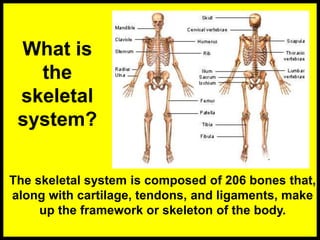
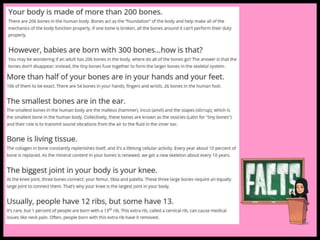
The skeletal system is composed of 206 bones that,
along with cartilage, tendons, and ligaments, make
up the framework or skeleton of the body.
What is
the
skeletal
system?
The skeletal system is divided into the axial
skeleton and the appendicular skeleton.
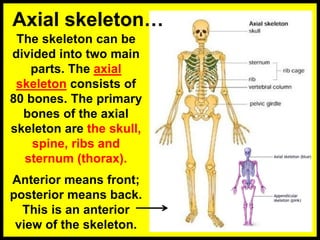
The skeleton can be
divided into two main
parts. The axial
skeleton consists of
80 bones. The primary
bones of the axial
skeleton are the skull,
spine, ribs and
sternum (thorax).
Anterior means front;
posterior means back.
This is an anterior
view of the skeleton.
Axial skeleton…
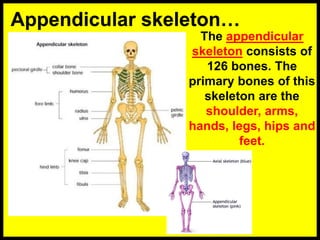
The appendicular
skeleton consists of
126 bones. The
primary bones of this
skeleton are the
shoulder, arms,
hands, legs, hips and
feet.
Appendicular skeleton…
Functions of
bones…
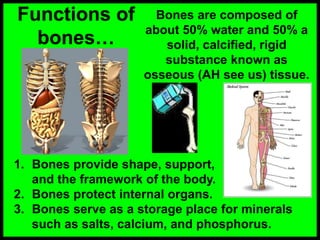
Bones are composed of
about 50% water and 50% a
solid, calcified, rigid
substance known as
osseous (AH see us) tissue.
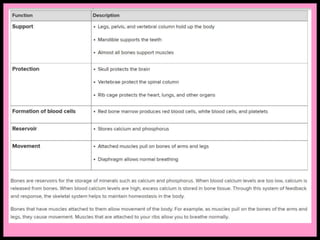
1. Bones provide shape, support,
and the framework of the body.
2. Bones protect internal organs.
3. Bones serve as a storage place for minerals
such as salts, calcium, and phosphorus.
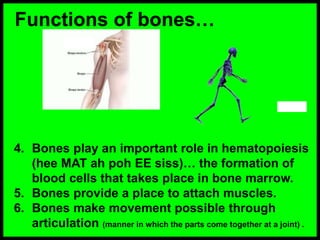
4. Bones play an important role in hematopoiesis
(hee MAT ah poh EE siss)… the formation of
blood cells that takes place in bone marrow.
5. Bones provide a place to attach muscles.
6. Bones make movement possible through
articulation (manner in which the parts come together at a joint) .
Functions of bones…
Classifications of
bones by shape…
Bones can be
classified by shape.
4 of those
classifications are:
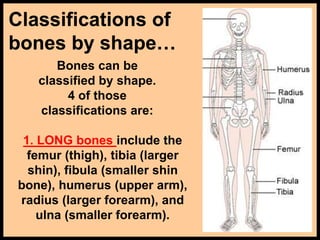
1. LONG bones include the
femur (thigh), tibia (larger
shin), fibula (smaller shin
bone), humerus (upper arm),
radius (larger forearm), and
ulna (smaller forearm).
Classifications of bones by shape…
Bones can be classified by shape.
4 of those classifications are:
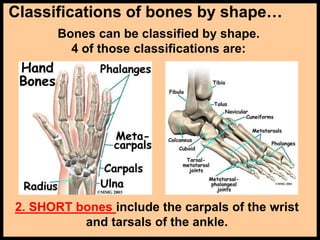
2. SHORT bones include the carpals of the wrist
and tarsals of the ankle.
Classifications of bones by shape…
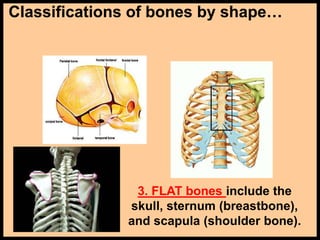
3. FLAT bones include the
skull, sternum (breastbone),
and scapula (shoulder bone).
Classifications of bones by shape…
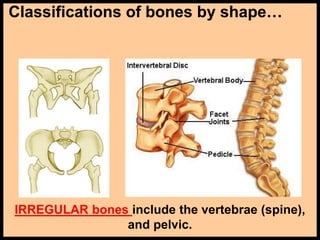
IRREGULAR bones include the vertebrae (spine),
and pelvic.
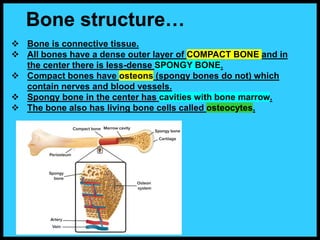
 Bone is connective tissue.
 All bones have a dense outer layer of COMPACT BONE and in
the center there is less-dense SPONGY BONE.
 Compact bones have osteons (spongy bones do not) which
contain nerves and blood vessels.
 Spongy bone in the center has cavities with bone marrow.
 The bone also has living bone cells called osteocytes.
Bone structure…
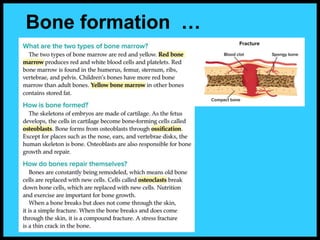
Bone formation …
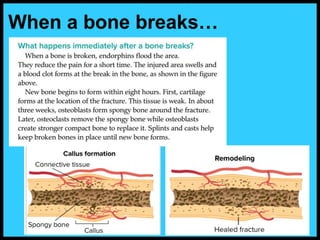
When a bone breaks…
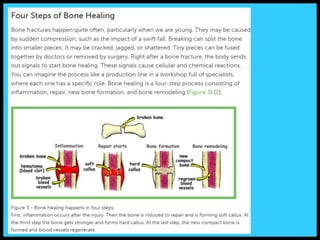
When a bone breaks…
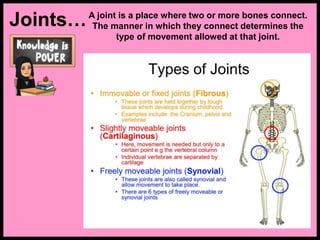
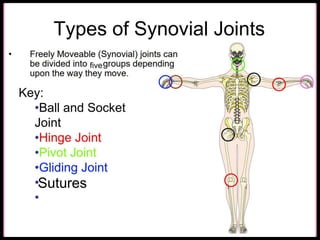
Joints…A joint is a place where two or more bones connect.
The manner in which they connect determines the
type of movement allowed at that joint.
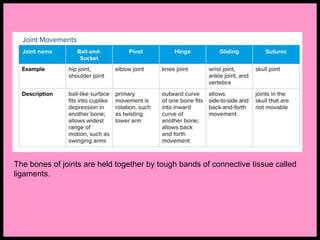
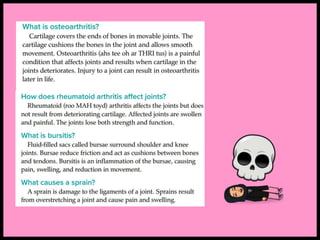
The bones of joints are held together by tough bands of connective tissue called
ligaments.
The bones of joints are held together by tough bands of connective tissue called
ligaments.
Sutures
five
Skeletal system.pptx

Skeletal system.pptx

  • 1.
    What is the skeletal system? The skeletalsystem is composed of 206 bones that, along with cartilage, tendons, and ligaments, make up the framework or skeleton of the body.
  • 2.
    What is the skeletal system? The skeletalsystem is divided into the axial skeleton and the appendicular skeleton.
  • 3.
    The skeleton canbe divided into two main parts. The axial skeleton consists of 80 bones. The primary bones of the axial skeleton are the skull, spine, ribs and sternum (thorax). Anterior means front; posterior means back. This is an anterior view of the skeleton. Axial skeleton…
  • 4.
    The appendicular skeleton consistsof 126 bones. The primary bones of this skeleton are the shoulder, arms, hands, legs, hips and feet. Appendicular skeleton…
  • 5.
    Functions of bones… Bones arecomposed of about 50% water and 50% a solid, calcified, rigid substance known as osseous (AH see us) tissue. 1. Bones provide shape, support, and the framework of the body. 2. Bones protect internal organs. 3. Bones serve as a storage place for minerals such as salts, calcium, and phosphorus.
  • 6.
    4. Bones playan important role in hematopoiesis (hee MAT ah poh EE siss)… the formation of blood cells that takes place in bone marrow. 5. Bones provide a place to attach muscles. 6. Bones make movement possible through articulation (manner in which the parts come together at a joint) . Functions of bones…
  • 7.
    Classifications of bones byshape… Bones can be classified by shape. 4 of those classifications are: 1. LONG bones include the femur (thigh), tibia (larger shin), fibula (smaller shin bone), humerus (upper arm), radius (larger forearm), and ulna (smaller forearm).
  • 8.
    Classifications of bonesby shape… Bones can be classified by shape. 4 of those classifications are: 2. SHORT bones include the carpals of the wrist and tarsals of the ankle.
  • 9.
    Classifications of bonesby shape… 3. FLAT bones include the skull, sternum (breastbone), and scapula (shoulder bone).
  • 10.
    Classifications of bonesby shape… IRREGULAR bones include the vertebrae (spine), and pelvic.
  • 11.
     Bone isconnective tissue.  All bones have a dense outer layer of COMPACT BONE and in the center there is less-dense SPONGY BONE.  Compact bones have osteons (spongy bones do not) which contain nerves and blood vessels.  Spongy bone in the center has cavities with bone marrow.  The bone also has living bone cells called osteocytes. Bone structure…
  • 12.
  • 13.
    When a bonebreaks…
  • 14.
    When a bonebreaks…
  • 15.
    Joints…A joint isa place where two or more bones connect. The manner in which they connect determines the type of movement allowed at that joint.
  • 16.
    The bones ofjoints are held together by tough bands of connective tissue called ligaments.
  • 17.
    The bones ofjoints are held together by tough bands of connective tissue called ligaments. Sutures five