Open Source
User Foundations
Prof. Dr. Dirk Riehle, M.B.A.
Friedrich-Alexander Universität
Open Up Business Day – 2014-02-14
Open Source User Foundations

© 2014 Dirk Riehle - All Rights Reserved

1
Open Source User Foundations

An open source user foundation is a non-profit organization that is managing the
development of non-differentiating open source software.
[DR]
Open Source User Foundations
© 2014 Dirk Riehle - All Rights Reserved

2
Problems with Vendor Lock-in
●

High license fees
●

●

Limited innovation
●

●

because only one company, the vendor, is innovating

Limited customization resources
●

●

because of switching costs / lack of competition

because for the vendor the customer is only one of many

Increased dependent-project risks
●

because the vendor may go out of business

Open Source User Foundations
© 2014 Dirk Riehle - All Rights Reserved

3
Motivation for User Consortia
●

Lower license fees
●

●

Broader and faster innovation
●

●

because of a broader ecosystem driving innovation

Faster and cheaper customization
●

●

because of ensured competition, limited switching costs

because of broader competition, available resources

Lower dependent project risks
●

because the consortium maintains the software

Open Source User Foundations
© 2014 Dirk Riehle - All Rights Reserved

4
Motivation for Open Source Foundations
●

Defined and well-understood legal framework delivers
●

●

more legal predictability in the courts

●

more trust and ease-of-operation

●

●

faster and cheaper operation of foundations

lower risk of competitive exclusion lawsuits

Defined and well-understood development processes
●

lower costs through broadly available skills

●

higher likelihood of development success

Open Source User Foundations
© 2014 Dirk Riehle - All Rights Reserved

5
Examples of Open Source User Foundations

Open Source User Foundations
© 2014 Dirk Riehle - All Rights Reserved

6
The Kuali Foundation

Open Source User Foundations
© 2014 Dirk Riehle - All Rights Reserved

7
Motivation for Kuali Foundation [1] [2]
●

According to [1] higher ed administrators were dissatisfied with
●

●

lacking performance (fit-to-needs)

●

●

high costs (license, implementation)
opportunity to influence development

According to [2] open source is a good approach because of
●

●

marketplace dominance (monopolization in limited market)

●

[1]
[2]

rising demand (requires ability to influence)

●

●

modest resource growth (requires keeping costs down)

growing distance between users and software developers

Open source enables shared value creation [1] [2]

Open Source User Foundations
Courant, P.; Griffiths, R. (2006). Software and Collaboration in Higher Education: A Study of Open Source Software. July 26, 2006.
Wheeler, B. (2007). Open Source 2010: Reflections on 2007. EDUCAUSE Jan/Feb 2007, 49pp. © 2014 Dirk Riehle - All Rights Reserved

8
The Kuali Foundation Time-Line
●

In early 2000, Indiana University faced a legacy ERP replacement
●

In 2002, a gated collaborative approach with partners failed

●

Decided to develop Kuali Financial System using open source approach

●

In 2005, received Mellon Foundation grant for development

●

In 2006, with many new University partners, created foundation

●

In 2006, adapted MIT Coeus to Kuali Coeus, received grant

●

In 2007, started Kuali Student, using another US$ 2.5m grant

●

In 2009, for multiple projects, started Kuali Rice infrastructure

●

Since then, various other projects have been set on their way

●

The Kuali Foundation manages “community source” development
Open Source User Foundations
© 2014 Dirk Riehle - All Rights Reserved

9
More About the Kuali Foundation
●

Core Values (from Bylaws)
●

●

Kuali Foundation projects and communities are functionally driven

●

Kuali Foundation projects are community source

●

Investors and partners in Kuali Foundation projects determine priorities

●

●

Kuali Foundation software is open

Kuali Foundation projects value community diversity

Foundation Membership
●

Basic membership is open to any party that shares values, pays dues
–

As of 2014-02-08, 66 higher education institutions, 11 commercial members
●

●

Commercial members are mostly service companies

Members can advance to become partners, contribute to development

Open Source User Foundations
© 2014 Dirk Riehle - All Rights Reserved

10
Community Open Source Ecosystem
Commercial Products and Services

CP1
P1

CP2
P1

...

CPn
P1

Community Open Source

CS

Open Source User Foundations
© 2014 Dirk Riehle - All Rights Reserved

11
Kuali Software Ecosystem
●

General Kuali implementation services
●

●

Specialized higher education services
●

●

HTC Global Services, The Meher Group, Navigator Management Services,
opencollab Collaborative Software Solutions, Polus Solutions, rSmart, Sigma
Systems, Vivantech

EBSCO, eThority

All of these companies...
●

are members of the Kuali Foundation

●

generate revenue from products and services

●

contribute incremental modifications back to projects

Open Source User Foundations
© 2014 Dirk Riehle - All Rights Reserved

12
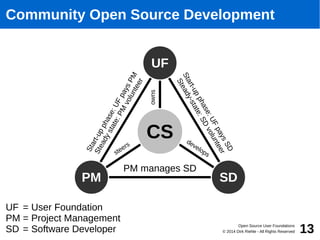
Community Open Source Development

rs
ee
st

PM
UF = User Foundation
PM = Project Management
SD = Software Developer

owns

CS

D
sS
ay eer
F p unt
: U vol
se
ha : SD
p p ate
rt-u y-st
Sta ad
Ste

Sta
Ste rt-up
ad ph
y s as
tat e:
e: UF
PM p
vo ays
lun PM
tee
r

UF

de
ve
lop
s

PM manages SD

SD

Open Source User Foundations
© 2014 Dirk Riehle - All Rights Reserved

13
Commercial Product Provision

pa
ys

for

CP

collaborate

cu
s to
mi
ze
s

on

SU

CP

ti
za
mi
sto
cu

SU = Customer
SV = Software Vendor
CF = Consulting Firm

or

SV

s
lop
e
ev
d

f
ys
pa

uses

SU

lice
ns
e

SU

CF

Open Source User Foundations
© 2014 Dirk Riehle - All Rights Reserved

14
distributions

Innovation and Commoditization

innov
a
commercial +
community distributions

community
distributions

ati
on

n
ro

f

single-vendor
commercial +
community
projects

r
tie

community
projects

r
tie

odit
iz

fr
on

com m

tion

single products
Open Source User Foundations
© 2014 Dirk Riehle - All Rights Reserved

15
Lessons from Kuali's 10 Year History
●

Getting started lessons
●

●

●

Open source rather than closed collaboration
Some internal funding, a lot of external grants

Ecosystem lessons
●

Almost exclusively services companies

●

Products are not extensions but integrations

Open Source User Foundations
© 2014 Dirk Riehle - All Rights Reserved

16
Designing User Foundations

1. Vision + Mission
2. Scope / Opportunity
3. Business Model

Open Source User Foundations
© 2014 Dirk Riehle - All Rights Reserved

17
Blueprint for User Foundations
1. General

4. Organization Governance
1.

1.

Vision

2.

Beneficiaries

1.

Natural member careers

1.

Project agenda

3.

Incorporation

2.

Juristic member levels

2.

Project management

4.

Membership

Board

3.

Decision process

1.

Membership

4.

Project tooling

2.

Decision process

5.

Intervention rights

2.

2. Philosophy
1.

Exploitation

2.

Transparency

5. Project Governance 1/2
1.

3. Intellectual Property
1.
2.

Patent handling

3.

Source code

4.

Other rights

5.

[1]

Artifact license

Foundation membership

5. Project Governance 2/2
1.

Software development

6. Financing

Project membership

1.

Of organization

1.

Project members

2.

Of Projects

2.

Member roles

3.

Member role acquisition

4.

Member role binding

Warranties

7. Operations
1.

Of infrastructure

2.

Of foundation processes

18

Open Source User Foundations
Riehle, Dirk; Berschneider, Sebastian (2012). A Model of Open Source Developer Foundations. In Proceedings of the 8th International
© 2014 Dirk Riehle - All Rights Reserved
Conference on Open Source Systems (OSS 2012). Springer Verlag, 2012, 15-28.
Thank you! Questions?
dirk.riehle@fau.de – http://osr.cs.fau.de
dirk@riehle.org – http://dirkriehle.com – @dirkriehle

Open Source User Foundations

DR

© 2014 Dirk Riehle - All Rights Reserved

19
1. General Category
1. Vision

4. Membership

Vision of organization

2. Beneficiaries

●

Natural persons

●

●

Juristic persons, for example,
–

Software vendors

●

For public benefit

–

Consulting firms

●

For member benefit

–

User firms

3. Incorporation
●

No explicit incorporation

●

Incorporation, for example, as
–

United States: 501(c)3 or 501(c)6

–

Germany: e.V. or gemein. GmbH

Open Source User Foundations
© 2014 Dirk Riehle - All Rights Reserved

20
2. Philosophy
1. Exploitation
●

Community property
–

●

Partial community property
–

●

Implies reciprocal license
Implies weak reciprocal license

Proprietary exploitation
–

2. Transparency
●

Open project model

●

Closed project model, e.g.
–

Completeness of artifacts

–

Completeness of history

–

Availability in time

Implies permissive license

Open Source User Foundations
© 2014 Dirk Riehle - All Rights Reserved

21
3. Intellectual Property
1. Artifact license

4. Other rights

●

Reciprocal license

●

Trademarks

●

Weak reciprocal license

●

Domains

●

Permissive license

5. Warranties
2. Patent handling
●

Patent license

●

●

Required from contributors

●

Explicitly none to user

Patent retaliation

3. Source code
●

No copyright transfer

●

Contributor agreement
–

With copyright transfer

–

With relicensing rights grant
Open Source User Foundations
© 2014 Dirk Riehle - All Rights Reserved

22
4. Organization Governance
1. Foundation membership
1. Natural member careers

2. Board
1. Membership

–

Career stages, for example,

–

Who may be a member?

–

How to get appointed?

–

When to leave; tenure?

–

User, contributor, committer,
PMC member, PMC leader,
foundation member, board
member (Apache)
Advancement process
●

●

How to advance?

2. Decision process
–

How are decisions made?

2. Juristic member levels
–

By type of organization

–

By desired influence, for example,
●

Associate, solution,
enterprise, strategic
members (Eclipse)

Open Source User Foundations
© 2014 Dirk Riehle - All Rights Reserved

23
5. Project Governance
1. Project membership
1. Project members
–

Always natural person, even if
they represent a company

2. Member roles
–

●

User, contributor, committer
PMC member, PMC leader

3. Member role acquisition
Decision making process, for
example, committer election

4. Member role binding
–

1. Project agenda
–

Defines purpose, scope of project

2. Project management
–

Defines development process

Typically one of
●

–

2. Software development

Typically tied to natural person,
not employer

3. Decision process
–

Defines how decisions are made

4. Project tooling
–

Defines development tool setup

5. Intervention rights
–

Defines board rights to intervene
Open Source User Foundations
© 2014 Dirk Riehle - All Rights Reserved

24
6. Financing
1. Financing of organization
●

Through members
–

Commensurate with level

●

Through public grants

●

Through sponsorships

●

Through for-profit subsidiary

2. Financing of projects
●

Through members

●

Through organization funds

Open Source User Foundations
© 2014 Dirk Riehle - All Rights Reserved

25
7. Operations
1. Project Infrastructure
●

Operated by
–

Foundation itself

–

Foundation members

–

On a by-project base

2. Foundation processes
●

Operated by
–

Employees

–

Volunteers

Open Source User Foundations
© 2014 Dirk Riehle - All Rights Reserved

26
Cost
Structure

Customer
Relationships

Channels

Customer
Segments

Value
Propositions

Key
Key
Re-sourc
Activities
es

Key Partners

Business Model Canvas

Revenue
Streams

Open Source User Foundations
© 2014 Dirk Riehle - All Rights Reserved

27

The Business of Open Source User Foundations

  • 1.
    Open Source User Foundations Prof.Dr. Dirk Riehle, M.B.A. Friedrich-Alexander Universität Open Up Business Day – 2014-02-14 Open Source User Foundations © 2014 Dirk Riehle - All Rights Reserved 1
  • 2.
    Open Source UserFoundations An open source user foundation is a non-profit organization that is managing the development of non-differentiating open source software. [DR] Open Source User Foundations © 2014 Dirk Riehle - All Rights Reserved 2
  • 3.
    Problems with VendorLock-in ● High license fees ● ● Limited innovation ● ● because only one company, the vendor, is innovating Limited customization resources ● ● because of switching costs / lack of competition because for the vendor the customer is only one of many Increased dependent-project risks ● because the vendor may go out of business Open Source User Foundations © 2014 Dirk Riehle - All Rights Reserved 3
  • 4.
    Motivation for UserConsortia ● Lower license fees ● ● Broader and faster innovation ● ● because of a broader ecosystem driving innovation Faster and cheaper customization ● ● because of ensured competition, limited switching costs because of broader competition, available resources Lower dependent project risks ● because the consortium maintains the software Open Source User Foundations © 2014 Dirk Riehle - All Rights Reserved 4
  • 5.
    Motivation for OpenSource Foundations ● Defined and well-understood legal framework delivers ● ● more legal predictability in the courts ● more trust and ease-of-operation ● ● faster and cheaper operation of foundations lower risk of competitive exclusion lawsuits Defined and well-understood development processes ● lower costs through broadly available skills ● higher likelihood of development success Open Source User Foundations © 2014 Dirk Riehle - All Rights Reserved 5
  • 6.
    Examples of OpenSource User Foundations Open Source User Foundations © 2014 Dirk Riehle - All Rights Reserved 6
  • 7.
    The Kuali Foundation OpenSource User Foundations © 2014 Dirk Riehle - All Rights Reserved 7
  • 8.
    Motivation for KualiFoundation [1] [2] ● According to [1] higher ed administrators were dissatisfied with ● ● lacking performance (fit-to-needs) ● ● high costs (license, implementation) opportunity to influence development According to [2] open source is a good approach because of ● ● marketplace dominance (monopolization in limited market) ● [1] [2] rising demand (requires ability to influence) ● ● modest resource growth (requires keeping costs down) growing distance between users and software developers Open source enables shared value creation [1] [2] Open Source User Foundations Courant, P.; Griffiths, R. (2006). Software and Collaboration in Higher Education: A Study of Open Source Software. July 26, 2006. Wheeler, B. (2007). Open Source 2010: Reflections on 2007. EDUCAUSE Jan/Feb 2007, 49pp. © 2014 Dirk Riehle - All Rights Reserved 8
  • 9.
    The Kuali FoundationTime-Line ● In early 2000, Indiana University faced a legacy ERP replacement ● In 2002, a gated collaborative approach with partners failed ● Decided to develop Kuali Financial System using open source approach ● In 2005, received Mellon Foundation grant for development ● In 2006, with many new University partners, created foundation ● In 2006, adapted MIT Coeus to Kuali Coeus, received grant ● In 2007, started Kuali Student, using another US$ 2.5m grant ● In 2009, for multiple projects, started Kuali Rice infrastructure ● Since then, various other projects have been set on their way ● The Kuali Foundation manages “community source” development Open Source User Foundations © 2014 Dirk Riehle - All Rights Reserved 9
  • 10.
    More About theKuali Foundation ● Core Values (from Bylaws) ● ● Kuali Foundation projects and communities are functionally driven ● Kuali Foundation projects are community source ● Investors and partners in Kuali Foundation projects determine priorities ● ● Kuali Foundation software is open Kuali Foundation projects value community diversity Foundation Membership ● Basic membership is open to any party that shares values, pays dues – As of 2014-02-08, 66 higher education institutions, 11 commercial members ● ● Commercial members are mostly service companies Members can advance to become partners, contribute to development Open Source User Foundations © 2014 Dirk Riehle - All Rights Reserved 10
  • 11.
    Community Open SourceEcosystem Commercial Products and Services CP1 P1 CP2 P1 ... CPn P1 Community Open Source CS Open Source User Foundations © 2014 Dirk Riehle - All Rights Reserved 11
  • 12.
    Kuali Software Ecosystem ● GeneralKuali implementation services ● ● Specialized higher education services ● ● HTC Global Services, The Meher Group, Navigator Management Services, opencollab Collaborative Software Solutions, Polus Solutions, rSmart, Sigma Systems, Vivantech EBSCO, eThority All of these companies... ● are members of the Kuali Foundation ● generate revenue from products and services ● contribute incremental modifications back to projects Open Source User Foundations © 2014 Dirk Riehle - All Rights Reserved 12
  • 13.
    Community Open SourceDevelopment rs ee st PM UF = User Foundation PM = Project Management SD = Software Developer owns CS D sS ay eer F p unt : U vol se ha : SD p p ate rt-u y-st Sta ad Ste Sta Ste rt-up ad ph y s as tat e: e: UF PM p vo ays lun PM tee r UF de ve lop s PM manages SD SD Open Source User Foundations © 2014 Dirk Riehle - All Rights Reserved 13
  • 14.
    Commercial Product Provision pa ys for CP collaborate cu sto mi ze s on SU CP ti za mi sto cu SU = Customer SV = Software Vendor CF = Consulting Firm or SV s lop e ev d f ys pa uses SU lice ns e SU CF Open Source User Foundations © 2014 Dirk Riehle - All Rights Reserved 14
  • 15.
    distributions Innovation and Commoditization innov a commercial+ community distributions community distributions ati on n ro f single-vendor commercial + community projects r tie community projects r tie odit iz fr on com m tion single products Open Source User Foundations © 2014 Dirk Riehle - All Rights Reserved 15
  • 16.
    Lessons from Kuali's10 Year History ● Getting started lessons ● ● ● Open source rather than closed collaboration Some internal funding, a lot of external grants Ecosystem lessons ● Almost exclusively services companies ● Products are not extensions but integrations Open Source User Foundations © 2014 Dirk Riehle - All Rights Reserved 16
  • 17.
    Designing User Foundations 1.Vision + Mission 2. Scope / Opportunity 3. Business Model Open Source User Foundations © 2014 Dirk Riehle - All Rights Reserved 17
  • 18.
    Blueprint for UserFoundations 1. General 4. Organization Governance 1. 1. Vision 2. Beneficiaries 1. Natural member careers 1. Project agenda 3. Incorporation 2. Juristic member levels 2. Project management 4. Membership Board 3. Decision process 1. Membership 4. Project tooling 2. Decision process 5. Intervention rights 2. 2. Philosophy 1. Exploitation 2. Transparency 5. Project Governance 1/2 1. 3. Intellectual Property 1. 2. Patent handling 3. Source code 4. Other rights 5. [1] Artifact license Foundation membership 5. Project Governance 2/2 1. Software development 6. Financing Project membership 1. Of organization 1. Project members 2. Of Projects 2. Member roles 3. Member role acquisition 4. Member role binding Warranties 7. Operations 1. Of infrastructure 2. Of foundation processes 18 Open Source User Foundations Riehle, Dirk; Berschneider, Sebastian (2012). A Model of Open Source Developer Foundations. In Proceedings of the 8th International © 2014 Dirk Riehle - All Rights Reserved Conference on Open Source Systems (OSS 2012). Springer Verlag, 2012, 15-28.
  • 19.
    Thank you! Questions? dirk.riehle@fau.de– http://osr.cs.fau.de dirk@riehle.org – http://dirkriehle.com – @dirkriehle Open Source User Foundations DR © 2014 Dirk Riehle - All Rights Reserved 19
  • 20.
    1. General Category 1.Vision 4. Membership Vision of organization 2. Beneficiaries ● Natural persons ● ● Juristic persons, for example, – Software vendors ● For public benefit – Consulting firms ● For member benefit – User firms 3. Incorporation ● No explicit incorporation ● Incorporation, for example, as – United States: 501(c)3 or 501(c)6 – Germany: e.V. or gemein. GmbH Open Source User Foundations © 2014 Dirk Riehle - All Rights Reserved 20
  • 21.
    2. Philosophy 1. Exploitation ● Communityproperty – ● Partial community property – ● Implies reciprocal license Implies weak reciprocal license Proprietary exploitation – 2. Transparency ● Open project model ● Closed project model, e.g. – Completeness of artifacts – Completeness of history – Availability in time Implies permissive license Open Source User Foundations © 2014 Dirk Riehle - All Rights Reserved 21
  • 22.
    3. Intellectual Property 1.Artifact license 4. Other rights ● Reciprocal license ● Trademarks ● Weak reciprocal license ● Domains ● Permissive license 5. Warranties 2. Patent handling ● Patent license ● ● Required from contributors ● Explicitly none to user Patent retaliation 3. Source code ● No copyright transfer ● Contributor agreement – With copyright transfer – With relicensing rights grant Open Source User Foundations © 2014 Dirk Riehle - All Rights Reserved 22
  • 23.
    4. Organization Governance 1.Foundation membership 1. Natural member careers 2. Board 1. Membership – Career stages, for example, – Who may be a member? – How to get appointed? – When to leave; tenure? – User, contributor, committer, PMC member, PMC leader, foundation member, board member (Apache) Advancement process ● ● How to advance? 2. Decision process – How are decisions made? 2. Juristic member levels – By type of organization – By desired influence, for example, ● Associate, solution, enterprise, strategic members (Eclipse) Open Source User Foundations © 2014 Dirk Riehle - All Rights Reserved 23
  • 24.
    5. Project Governance 1.Project membership 1. Project members – Always natural person, even if they represent a company 2. Member roles – ● User, contributor, committer PMC member, PMC leader 3. Member role acquisition Decision making process, for example, committer election 4. Member role binding – 1. Project agenda – Defines purpose, scope of project 2. Project management – Defines development process Typically one of ● – 2. Software development Typically tied to natural person, not employer 3. Decision process – Defines how decisions are made 4. Project tooling – Defines development tool setup 5. Intervention rights – Defines board rights to intervene Open Source User Foundations © 2014 Dirk Riehle - All Rights Reserved 24
  • 25.
    6. Financing 1. Financingof organization ● Through members – Commensurate with level ● Through public grants ● Through sponsorships ● Through for-profit subsidiary 2. Financing of projects ● Through members ● Through organization funds Open Source User Foundations © 2014 Dirk Riehle - All Rights Reserved 25
  • 26.
    7. Operations 1. ProjectInfrastructure ● Operated by – Foundation itself – Foundation members – On a by-project base 2. Foundation processes ● Operated by – Employees – Volunteers Open Source User Foundations © 2014 Dirk Riehle - All Rights Reserved 26
  • 27.
    Cost Structure Customer Relationships Channels Customer Segments Value Propositions Key Key Re-sourc Activities es Key Partners Business ModelCanvas Revenue Streams Open Source User Foundations © 2014 Dirk Riehle - All Rights Reserved 27