
Arnaud Porterie - @icecrime
Building software: the lessons
from Open Source
Arnaud Porterie - @icecrime
VP Engineering - Vente Privée
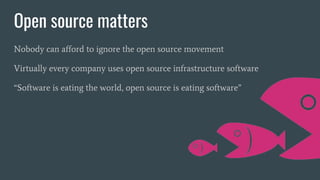
Open source matters
Nobody can afford to ignore the open source movement
Virtually every company uses open source infrastructure software
“Software is eating the world, open source is eating software”
Kubernetes
# of commits per month - 6 months moving average
Kafka
# of commits per month - 6 months moving average
Linux
# of commits per month - 6 months moving average
The open source world seems
to be doing something right
Leveraging open source code in your company
Contributing to open source as a company
Open sourcing company’s code
What this talk is not about
What this talk is about
Taking inspiration from open source in the way we
build software in-house software
Alternative title
How my role as VP Engineering today is
influenced by my previous experience
managing a large scale open source project
(they said it was too long ¯_(ツ)_/¯)
Arnaud Porterie - @icecrime
A primer on open source
project organization
Users
● File issues, report bugs, ask for features
● Influence the project by voicing their opinions
Participants in an Open Source project
Contributors
● Send patches, fix bugs, write documentation
● Often are also users of the project
● Influence the project by submitting modifications
Participants in an Open Source project
Maintainers
● Guardians of the temple
○ Responsible for the overall health of the project
○ Quality of the code
○ Project scalability
○ Project testing and release cycle
○ Culture of the community
● Typically are also contributors of the project
● Influence the project by deciding what goes in
Participants in an Open Source project
● Read the contributing guide (usually CONTRIBUTING.md)
● Discuss with maintainers
○ Explain the need
○ Explain how you intend to implement it
● Produce the contribution
● Submit a Pull Request (GitHub)
● Patch gets merged when two maintainers give their LGTM
Typical contribution process
Upstreams Downstreams
Managing dependencies
Code flow
In Open Source, your dependencies (upstreams) don’t work for you
● What you need to be done you contribute yourself
As a maintainer, you play nice with those who depend on you (downstreams)
● When they come in to file an issue or contribute a patch, be helpful
Managing dependencies
Arnaud Porterie - @icecrime
The elements of healthy
open source
Healthy open source
An open codebase with identified maintainers is not enough
● A healthy open source community fosters collective intelligence
● Not a coincidence but a deliberate act of designing a community
Under the right circumstances, groups are remarkably intelligent, and are
often smarter than the smartest people in them.
The Wisdom of Crowds, James Surowiecki
Patterns of a wise crowd
Culture & Empire - Pieter Hintjens
ISBN-13: 978-1492999775
Patterns of a wise crowd
● Strong mission: a formulation of the single main problem to solve
● Free-entry: strangers may walk in and get involved
● Strong protocols: a set of rules to collaborate properly
● Fair authority: a scalable authority to enforce the rules
● Transparency: all activity takes place in the open
● …
Patterns of a wise crowd
Successful online communities expose those patterns
For an open source project, it’s a matter of survival
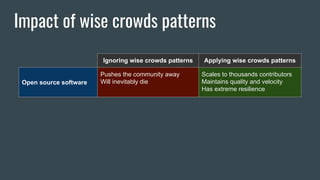
Impact of wise crowds patterns
Ignoring wise crowds patterns Applying wise crowds patterns
Open source software
Pushes the community away
Will inevitably die
Scales to thousands contributors
Maintains quality and velocity
Has extreme resilience
Impact of wise crowds patterns
Ignoring wise crowds patterns Applying wise crowds patterns
Open source software
Pushes the community away
Will inevitably die
Scales to thousands contributors
Maintains quality and velocity
Has extreme resilience
Closed source software
? ?
Arnaud Porterie - @icecrime
Looking back at the enterprise
Is the enterprise enabling wise crowds?
● No universal answer: there are as many organizations as there are companies
● The traditional enterprise optimizes for control and predictability
○ Contrary to open source, applying the patterns is not a matter of survival
● Some of the common organizational pitfalls are clear wise crowds antipatterns
with immediate impact on the software it produces
“Application teams” commonly yield
● Lack of a strong mission expressed in user terms
● Arcane undocumented maintenance knowledge
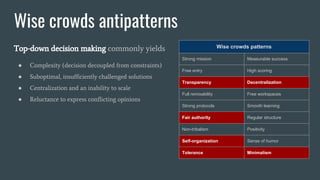
Wise crowds antipatterns
Wise crowds patterns
Strong mission Measurable success
Free entry High scoring
Transparency Decentralization
Full remixability Free workspaces
Strong protocols Smooth learning
Fair authority Regular structure
Non-tribalism Positivity
Self-organization Sense of humor
Tolerance Minimalism
Organizational silos commonly yield
● Strong sense of ownership
● Membership model / “us and them” situations
● Heterogeneous structures between departments
Wise crowds antipatterns
Wise crowds patterns
Strong mission Measurable success
Free entry High scoring
Transparency Decentralization
Full remixability Free workspaces
Strong protocols Smooth learning
Fair authority Regular structure
Non-tribalism Positivity
Self-organization Sense of humor
Tolerance Minimalism
Top-down decision making commonly yields
● Complexity (decision decoupled from constraints)
● Suboptimal, insufficiently challenged solutions
● Centralization and an inability to scale
● Reluctance to express conflicting opinions
Wise crowds antipatterns
Wise crowds patterns
Strong mission Measurable success
Free entry High scoring
Transparency Decentralization
Full remixability Free workspaces
Strong protocols Smooth learning
Fair authority Regular structure
Non-tribalism Positivity
Self-organization Sense of humor
Tolerance Minimalism
Impact of wise crowds patterns
Ignoring wise crowds patterns Applying wise crowds patterns
Open source software
Pushes the community away
Will inevitably die
Scales to thousands contributors
Maintains quality and velocity
Has extreme resilience
Closed source software
Relies on tribal knowledge
Produces lower quality output
Tends to build castles over cities ?
Can we raise the “collective intelligence score”
of an enterprise by importing patterns of the
open source world?
Arnaud Porterie - @icecrime
Inner source & practical
implementation
Inner source
https://en.wikipedia.org/wiki/Inner_source
Inner source is the use of open source software development best practices
and the establishment of an open source-like culture within organizations.
The organization may still develop proprietary software, but internally opens
up its development. The term was coined by Tim O'Reilly in 2000.
Impact on teams dynamics
Distinguishing maintainer and contributor roles
● Alters the sense of ownership
○ Maintainers “own” the quality, coherence, and sustainability of the project
○ The organization collectively “owns” the code
● Contributors becomes an open group (free entry principle)
○ Anyone can walk in and participate
● Maintainers also becomes an open group! (fair authority principle)
○ Constructive participation to the project must be rewarded
Impact on teams dynamics
Encouraging cross-teams contributions
● Puts the collective goal above individual ownership considerations
● Raises the bar for best practices, particularly on documentation and testing
● Gives individual teams more control of their destiny
● Keeps the development effort where the need exists versus where its implemented
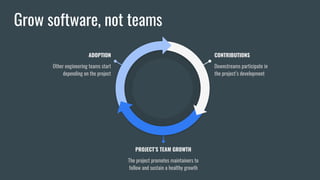
ADOPTION
Other engineering teams start
depending on the project
CONTRIBUTIONS
Downstreams participate in
the project’s development
PROJECT’S TEAM GROWTH
The project promotes maintainers to
follow and sustain a healthy growth
Grow software, not teams
Impact on teams dynamics
More importantly
● Creates a community where people collaborate and learn from each other
● Creates a environment where engineers aren’t confined to a single codebase
Inspired by Joel Spolsky’s “The Joel Test: 12 Steps to Better Code”
https://www.joelonsoftware.com/2000/08/09/the-joel-test-12-steps-to-better-code/
A practical checklist for
implementing inner source
● Pick a single source manager for the entire organization
○ Preferably choose a stack-agnostic solution
○ Preferably choose a solution that supports managing and publishing documentation
○ Typically GitHub or GitLab (GitHub may be better if you plan on open sourcing later)
● Potentially a cultural barrier to cross
1. Does everyone in the organization have access to all of
the codebase by default?
● Openness has little value without discoverability
● Choose a physical organization the team is familiar with
○ Don’t follow the organization chart, it will likely change over time
○ Ideally follow a reasonably stable functional layout (e.g., domain / product / component)
● Allows individual pieces to become “stepping stones” for others to build upon
2. Is the codebase structured or documented in a way that
makes it easy to explore?
● Think of the single main problem your project is solving for the users
○ This is crucial to constrain the scope
○ NB: “continuing to exist” is not a mission
● Typically formulated in a README.md at the root of the repository
3. Do individual projects have a documented mission?
● Low barrier of entry is key for a welcoming project
○ Anyone should be able to build, test, run with very few steps
○ Future hires to the team will thank you
● Typically formulated in a CONTRIBUTING.md at the root of the repository
4. Do individual projects have a documented and
straightforward contribution process?
● If there’s two processes, you can be sure that one of them is obsolete
○ Spoiler: it’s the one used by people external to the project
● Applies to
○ Coding guidelines
○ Contributions expectation
○ SLA for patch review (recommandation: use FIFO is most cases)
○ Testing (are maintainers relying on a dedicated QA team?)
● Don’t blame external contributors for not knowing your undocumented rules
5. Are all contributors treated equally (i.e., teams /
maintainers follow a different process)?
● Organise your company communications for transparency & discoverability
○ Encourage conversations to be public by default
○ Make the channels easy to discover (e.g., use a common format for teams)
● Document design and architecture decisions
○ Can be markdown files in git, or simply issue comments
6. Is there an open discussion platform where decisions are
taken and can be challenged?
● Good rules
○ Are collectively defined and managed as code
○ Start small, and grow in scope as we learn from experience
○ Foster collaboration while leaving space for self-organization
■ For example: to enforce the previously mentioned items of the checklist
● Who is the “fair authority” inside your organization?
○ Ideally a group of highly respected technical leaders (preferrably IC over managers)
7. Is there a set of commonly agreed upon rules enforced
by a fair authority?
Inner source: a checklist
1. Does everyone in the organization have access to all of the codebase by default?
2. Is the codebase structured or documented in a way that makes it easy to explore?
3. Do individual projects have a documented mission?
4. Do individual projects have a documented and straightforward contribution process?
5. Are all contributors treated equally (i.e., teams / maintainers follow a different process)?
6. Is there an open discussion platform where decisions are taken and can be challenged?
7. Is there a set of commonly agreed upon rules enforced by a fair authority?
Final words
Ignoring wise crowds patterns Applying wise crowds patterns
Open source software
Pushes the community away
Will inevitably die
Scales to thousands contributors
Maintains quality and velocity
Has extreme resilience
Closed source software
Relies on tribal knowledge
Produces lower quality output
Tends to build castles over cities
Allows to scale wisely
Puts group’s interest over teams
Raises the bar for best practices
Final words
Open source communities have repeatedly shown a capacity to produce high
quality sustainable software by carefully designing for collective intelligence
These recipes apply to the enterprise, but it’s a matter of culture
● Requiring full support from leadership
● Immune to whatever tool you may throw at it
Arnaud Porterie - @icecrime
Thank you!

Building software: the lessons from open source

  • 1.
    Arnaud Porterie -@icecrime Building software: the lessons from Open Source Arnaud Porterie - @icecrime VP Engineering - Vente Privée
  • 2.
    Open source matters Nobodycan afford to ignore the open source movement Virtually every company uses open source infrastructure software “Software is eating the world, open source is eating software”
  • 3.
    Kubernetes # of commitsper month - 6 months moving average
  • 4.
    Kafka # of commitsper month - 6 months moving average
  • 5.
    Linux # of commitsper month - 6 months moving average
  • 6.
    The open sourceworld seems to be doing something right
  • 7.
    Leveraging open sourcecode in your company Contributing to open source as a company Open sourcing company’s code What this talk is not about
  • 8.
    What this talkis about Taking inspiration from open source in the way we build software in-house software
  • 9.
    Alternative title How myrole as VP Engineering today is influenced by my previous experience managing a large scale open source project (they said it was too long ¯_(ツ)_/¯)
  • 10.
    Arnaud Porterie -@icecrime A primer on open source project organization
  • 11.
    Users ● File issues,report bugs, ask for features ● Influence the project by voicing their opinions Participants in an Open Source project
  • 12.
    Contributors ● Send patches,fix bugs, write documentation ● Often are also users of the project ● Influence the project by submitting modifications Participants in an Open Source project
  • 13.
    Maintainers ● Guardians ofthe temple ○ Responsible for the overall health of the project ○ Quality of the code ○ Project scalability ○ Project testing and release cycle ○ Culture of the community ● Typically are also contributors of the project ● Influence the project by deciding what goes in Participants in an Open Source project
  • 14.
    ● Read thecontributing guide (usually CONTRIBUTING.md) ● Discuss with maintainers ○ Explain the need ○ Explain how you intend to implement it ● Produce the contribution ● Submit a Pull Request (GitHub) ● Patch gets merged when two maintainers give their LGTM Typical contribution process
  • 15.
  • 16.
    In Open Source,your dependencies (upstreams) don’t work for you ● What you need to be done you contribute yourself As a maintainer, you play nice with those who depend on you (downstreams) ● When they come in to file an issue or contribute a patch, be helpful Managing dependencies
  • 17.
    Arnaud Porterie -@icecrime The elements of healthy open source
  • 18.
    Healthy open source Anopen codebase with identified maintainers is not enough ● A healthy open source community fosters collective intelligence ● Not a coincidence but a deliberate act of designing a community Under the right circumstances, groups are remarkably intelligent, and are often smarter than the smartest people in them. The Wisdom of Crowds, James Surowiecki
  • 19.
    Patterns of awise crowd Culture & Empire - Pieter Hintjens ISBN-13: 978-1492999775
  • 20.
    Patterns of awise crowd
  • 21.
    Patterns of awise crowd ● Strong mission: a formulation of the single main problem to solve ● Free-entry: strangers may walk in and get involved ● Strong protocols: a set of rules to collaborate properly ● Fair authority: a scalable authority to enforce the rules ● Transparency: all activity takes place in the open ● …
  • 22.
    Patterns of awise crowd Successful online communities expose those patterns For an open source project, it’s a matter of survival
  • 23.
    Impact of wisecrowds patterns Ignoring wise crowds patterns Applying wise crowds patterns Open source software Pushes the community away Will inevitably die Scales to thousands contributors Maintains quality and velocity Has extreme resilience
  • 24.
    Impact of wisecrowds patterns Ignoring wise crowds patterns Applying wise crowds patterns Open source software Pushes the community away Will inevitably die Scales to thousands contributors Maintains quality and velocity Has extreme resilience Closed source software ? ?
  • 25.
    Arnaud Porterie -@icecrime Looking back at the enterprise
  • 26.
    Is the enterpriseenabling wise crowds? ● No universal answer: there are as many organizations as there are companies ● The traditional enterprise optimizes for control and predictability ○ Contrary to open source, applying the patterns is not a matter of survival ● Some of the common organizational pitfalls are clear wise crowds antipatterns with immediate impact on the software it produces
  • 27.
    “Application teams” commonlyyield ● Lack of a strong mission expressed in user terms ● Arcane undocumented maintenance knowledge Wise crowds antipatterns Wise crowds patterns Strong mission Measurable success Free entry High scoring Transparency Decentralization Full remixability Free workspaces Strong protocols Smooth learning Fair authority Regular structure Non-tribalism Positivity Self-organization Sense of humor Tolerance Minimalism
  • 28.
    Organizational silos commonlyyield ● Strong sense of ownership ● Membership model / “us and them” situations ● Heterogeneous structures between departments Wise crowds antipatterns Wise crowds patterns Strong mission Measurable success Free entry High scoring Transparency Decentralization Full remixability Free workspaces Strong protocols Smooth learning Fair authority Regular structure Non-tribalism Positivity Self-organization Sense of humor Tolerance Minimalism
  • 29.
    Top-down decision makingcommonly yields ● Complexity (decision decoupled from constraints) ● Suboptimal, insufficiently challenged solutions ● Centralization and an inability to scale ● Reluctance to express conflicting opinions Wise crowds antipatterns Wise crowds patterns Strong mission Measurable success Free entry High scoring Transparency Decentralization Full remixability Free workspaces Strong protocols Smooth learning Fair authority Regular structure Non-tribalism Positivity Self-organization Sense of humor Tolerance Minimalism
  • 30.
    Impact of wisecrowds patterns Ignoring wise crowds patterns Applying wise crowds patterns Open source software Pushes the community away Will inevitably die Scales to thousands contributors Maintains quality and velocity Has extreme resilience Closed source software Relies on tribal knowledge Produces lower quality output Tends to build castles over cities ?
  • 31.
    Can we raisethe “collective intelligence score” of an enterprise by importing patterns of the open source world?
  • 32.
    Arnaud Porterie -@icecrime Inner source & practical implementation
  • 33.
    Inner source https://en.wikipedia.org/wiki/Inner_source Inner sourceis the use of open source software development best practices and the establishment of an open source-like culture within organizations. The organization may still develop proprietary software, but internally opens up its development. The term was coined by Tim O'Reilly in 2000.
  • 34.
    Impact on teamsdynamics Distinguishing maintainer and contributor roles ● Alters the sense of ownership ○ Maintainers “own” the quality, coherence, and sustainability of the project ○ The organization collectively “owns” the code ● Contributors becomes an open group (free entry principle) ○ Anyone can walk in and participate ● Maintainers also becomes an open group! (fair authority principle) ○ Constructive participation to the project must be rewarded
  • 35.
    Impact on teamsdynamics Encouraging cross-teams contributions ● Puts the collective goal above individual ownership considerations ● Raises the bar for best practices, particularly on documentation and testing ● Gives individual teams more control of their destiny ● Keeps the development effort where the need exists versus where its implemented
  • 36.
    ADOPTION Other engineering teamsstart depending on the project CONTRIBUTIONS Downstreams participate in the project’s development PROJECT’S TEAM GROWTH The project promotes maintainers to follow and sustain a healthy growth Grow software, not teams
  • 37.
    Impact on teamsdynamics More importantly ● Creates a community where people collaborate and learn from each other ● Creates a environment where engineers aren’t confined to a single codebase
  • 38.
    Inspired by JoelSpolsky’s “The Joel Test: 12 Steps to Better Code” https://www.joelonsoftware.com/2000/08/09/the-joel-test-12-steps-to-better-code/ A practical checklist for implementing inner source
  • 39.
    ● Pick asingle source manager for the entire organization ○ Preferably choose a stack-agnostic solution ○ Preferably choose a solution that supports managing and publishing documentation ○ Typically GitHub or GitLab (GitHub may be better if you plan on open sourcing later) ● Potentially a cultural barrier to cross 1. Does everyone in the organization have access to all of the codebase by default?
  • 40.
    ● Openness haslittle value without discoverability ● Choose a physical organization the team is familiar with ○ Don’t follow the organization chart, it will likely change over time ○ Ideally follow a reasonably stable functional layout (e.g., domain / product / component) ● Allows individual pieces to become “stepping stones” for others to build upon 2. Is the codebase structured or documented in a way that makes it easy to explore?
  • 41.
    ● Think ofthe single main problem your project is solving for the users ○ This is crucial to constrain the scope ○ NB: “continuing to exist” is not a mission ● Typically formulated in a README.md at the root of the repository 3. Do individual projects have a documented mission?
  • 42.
    ● Low barrierof entry is key for a welcoming project ○ Anyone should be able to build, test, run with very few steps ○ Future hires to the team will thank you ● Typically formulated in a CONTRIBUTING.md at the root of the repository 4. Do individual projects have a documented and straightforward contribution process?
  • 43.
    ● If there’stwo processes, you can be sure that one of them is obsolete ○ Spoiler: it’s the one used by people external to the project ● Applies to ○ Coding guidelines ○ Contributions expectation ○ SLA for patch review (recommandation: use FIFO is most cases) ○ Testing (are maintainers relying on a dedicated QA team?) ● Don’t blame external contributors for not knowing your undocumented rules 5. Are all contributors treated equally (i.e., teams / maintainers follow a different process)?
  • 44.
    ● Organise yourcompany communications for transparency & discoverability ○ Encourage conversations to be public by default ○ Make the channels easy to discover (e.g., use a common format for teams) ● Document design and architecture decisions ○ Can be markdown files in git, or simply issue comments 6. Is there an open discussion platform where decisions are taken and can be challenged?
  • 45.
    ● Good rules ○Are collectively defined and managed as code ○ Start small, and grow in scope as we learn from experience ○ Foster collaboration while leaving space for self-organization ■ For example: to enforce the previously mentioned items of the checklist ● Who is the “fair authority” inside your organization? ○ Ideally a group of highly respected technical leaders (preferrably IC over managers) 7. Is there a set of commonly agreed upon rules enforced by a fair authority?
  • 46.
    Inner source: achecklist 1. Does everyone in the organization have access to all of the codebase by default? 2. Is the codebase structured or documented in a way that makes it easy to explore? 3. Do individual projects have a documented mission? 4. Do individual projects have a documented and straightforward contribution process? 5. Are all contributors treated equally (i.e., teams / maintainers follow a different process)? 6. Is there an open discussion platform where decisions are taken and can be challenged? 7. Is there a set of commonly agreed upon rules enforced by a fair authority?
  • 47.
    Final words Ignoring wisecrowds patterns Applying wise crowds patterns Open source software Pushes the community away Will inevitably die Scales to thousands contributors Maintains quality and velocity Has extreme resilience Closed source software Relies on tribal knowledge Produces lower quality output Tends to build castles over cities Allows to scale wisely Puts group’s interest over teams Raises the bar for best practices
  • 48.
    Final words Open sourcecommunities have repeatedly shown a capacity to produce high quality sustainable software by carefully designing for collective intelligence These recipes apply to the enterprise, but it’s a matter of culture ● Requiring full support from leadership ● Immune to whatever tool you may throw at it
  • 49.
    Arnaud Porterie -@icecrime Thank you!