Department of Pathology and Forensic Medicine
Topic : Atherosclerosis
Submitted by: Ashique Ahamed
Submitted to : Ma’am Gulnaz
Shymkent 2024
Content
• Introduction
• Mechanism
• Symptoms of Atherosclerosis
• Risk factors for Atherosclerosis
• Treatment
• References
• Conclusion
Introduction
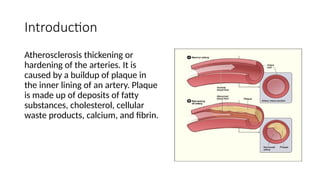
Atherosclerosis thickening or
hardening of the arteries. It is
caused by a buildup of plaque in
the inner lining of an artery. Plaque
is made up of deposits of fatty
substances, cholesterol, cellular
waste products, calcium, and fibrin.
• Atherosclerosis mainly affects certain areas of the arteries.
• Non-laminar, or turbulent, blood flow
• (for example, in arterial tree branches) leads to endothelial dysfunction and
suppresses endothelial formation of nitric oxide, a potent vasodilator and an anti-
inflammatory factor.
• This blood flow also stimulates endothelial cells to produce adhesion molecules
that attract and bind inflammatory cells.
• Risk factors for atherosclerosis (such as dyslipidemia, diabetes mellitus, smoking,
hypertension), oxidative stress factors (eg, superoxide radicals), angiotensin II and
systemic infection also inhibit the release of nitric oxide and stimulate the
formation of adhesion molecules, pro-inflammatory cytokines, hemotaxis
proteins and vasoconstrictors substances;
Atherosclerosis: The most common form, characterized by plaque
buildup due to cholesterol, inflammation, and other factors.
Arteriolosclerosis: Thickening and stiffening of smaller arteries, often
linked to high blood pressure and kidney disease.
• Monckeberg sclerosis: Stiffening due to calcium deposits, more
common in older adults and less likely to obstruct blood flow.
Mechanism
• After rupture of the plaque, its contents enter circulating blood and
trigger the formation of a thrombus; macrophages also stimulate
thrombus formation due to the production of a tissue factor that
promotes the formation of thrombin in vivo. Eventually, events can
develop according to one of five scenarios:
• 1) the organization of a thrombus and its incorporation into a plaque,
which leads to a change in the structure of its surface and rapid
growth;
2) rapid growth of the thrombus before complete occlusion of the
blood vessel, leading to acute ischemia of the corresponding organ;
3) the development of embolism by a thrombus or parts thereof;
4) filling the plaque with blood, increasing it in size with rapid occlusion
of the vessel;
5) development of embolism with plaque contents (other than
thrombotic masses), leading to occlusion of more distal vessels.
• Plaque stability depends on many factors, including its composition
(the ratio of lipid content, inflammatory cells, smooth muscle cells,
connective tissue and thrombus), wall tension (tire extension),
magnitude, location of the nucleus and the location of the plaque
with respect to the linear blood flow.
Symptoms of atherosclerosis
Atherosclerosis usually doesn’t cause any symptoms until blood supply to an organ
is reduced. When this happens, symptoms vary, depending on the specific organ
involved:
Heart — Symptoms include the chest pain of angina and shortness of breath,
sweating, nausea, dizziness or light-headedness, breathlessness or palpitations.
Brain — When atherosclerosis narrows brain arteries, it can cause dizziness or
confusion; weakness or paralysis on one side of the body; sudden, severe
numbness in any part of the body; visual disturbance, including sudden loss of
vision; difficulty walking, including staggering or veering; coordination problems in
the arms and hands; and slurred speech or inability to speak. If symptoms
completely disappear within an hour or a bit longer, the episode is called a
transient ischemic attack (TIA). When atherosclerosis completely blocks the brain
arteries and/or the above symptoms last longer, it’s generally called a stroke.
Symptoms
Abdomen — When atherosclerosis narrows the arteries to the
intestines, there may be dull or cramping pain in the middle of the
abdomen, usually beginning 15 to 30 minutes after a meal. Sudden
complete blockage of an intestinal artery often causes severe abdominal
pain, sometimes with vomiting, bloody stool and abdominal swelling.
• Legs — Narrowing of the leg arteries from atherosclerosis is known as
peripheral artery disease. It can cause cramping pain in the leg
muscles, especially during exercise. If narrowing is severe, there may
be pain at rest, cold toes and feet, pale or bluish skin and hair loss on
the legs.
Risk factors for atherosclerosis
This syndrome includes obesity, atherogenic dyslipidemia, hypertension, insulin
resistance, a predisposition to thrombosis and general inflammatory reactions.
Insulin resistance is not a synonym for metabolic syndrome, but a possible key link
in its etiology.
• Causes
• Blood pressure that is too high
• High Cholesterol levels
• High blood triglycerides, a form of fat (lipid).
• Tobacco use (smoking and other forms)
• Obesity, diabetes, or insulin resistance
• Inflammation caused by an unknown cause or disorders including arthritis, lupus,
psoriasis, or inflammatory bowel disease.
Risk factors :
Atherosclerosis is the hardening of the arteries over time. Aside from age, the
following factors may raise your risk of atherosclerosis:
High Blood pressure
High Cholesterol levels
High C-reactive protein (CRP)
Diabetes
Obesity
Apnea (sleep deprivation)
Tobacco usage, including smoking and chewing
A family history of heart disease
Lack of physical activity
• Unhealthy eating habits
Treatment of atherosclerosis
• Treatment of atherosclerosis involves active elimination of risk factors for
preventing the formation of new plaques and reducing existing ones.
• Recent studies indicate that LDL should be <70 mg / dL for an existing
disease or a high risk of cardiovascular disease
• Changes in lifestyle include diet, cessation of smoking and regular physical
activity. Often, drugs are needed to treat dyslipidemia, AH and diabetes
mellitus.
• These lifestyle changes and medicines directly or indirectly improve
endothelial function, reduce inflammation and improve the clinical outcome.
• Anti-platelet drugs are effective in all patients.
• Antiplatelet drugs : Acetylsalicylic acid is used most widely. It is
prescribed for secondary prevention and recommended for primary
prevention of coronary artery atherosclerosis in high-risk patients (for
example, patients with or without diabetes with atherosclerosis,
patients with a risk of heart disease in the next 10 years, exceeding
20%)
• Diet : Increasing the amount of carbohydrates to compensate for the
reduction of saturated fats in the diet increases the concentration of
triglycerides
• Fruits and vegetables probably reduce the risk of atherosclerosis of the
coronary arteries, but this effect is the result of the intake of
flavonoids or the reduction in the amount of saturated fat with an
increase in the proportion of plant fiber, as well as vitamins
Conclusion
• While arteriosclerosis presents a substantial health threat, it’s not an
inevitable sentence.
• Understanding the different forms, risks, and management options
empowers individuals to take control.
• Embracing a healthy lifestyle, seeking early detection, and staying
informed about ongoing research paves the way for a brighter future,
free from the limitations of hardened arteries. By working together,
we can navigate this complex disease and ensure healthier hearts for
all.
References
• https://www.drugs.com/health-guide/atherosclerosis.html
• https://m.iliveok.com/health/atherosclerosis-treatment_111351i1594
9.html
• https://www.medicoverhospitals.in/diseases/atherosclerosis/
THANK YOU

SIW4, Pathphysio, Ashique, on the topic Atherosclerosis

  • 1.
    Department of Pathologyand Forensic Medicine Topic : Atherosclerosis Submitted by: Ashique Ahamed Submitted to : Ma’am Gulnaz Shymkent 2024
  • 2.
    Content • Introduction • Mechanism •Symptoms of Atherosclerosis • Risk factors for Atherosclerosis • Treatment • References • Conclusion
  • 3.
    Introduction Atherosclerosis thickening or hardeningof the arteries. It is caused by a buildup of plaque in the inner lining of an artery. Plaque is made up of deposits of fatty substances, cholesterol, cellular waste products, calcium, and fibrin.
  • 4.
    • Atherosclerosis mainlyaffects certain areas of the arteries. • Non-laminar, or turbulent, blood flow • (for example, in arterial tree branches) leads to endothelial dysfunction and suppresses endothelial formation of nitric oxide, a potent vasodilator and an anti- inflammatory factor. • This blood flow also stimulates endothelial cells to produce adhesion molecules that attract and bind inflammatory cells. • Risk factors for atherosclerosis (such as dyslipidemia, diabetes mellitus, smoking, hypertension), oxidative stress factors (eg, superoxide radicals), angiotensin II and systemic infection also inhibit the release of nitric oxide and stimulate the formation of adhesion molecules, pro-inflammatory cytokines, hemotaxis proteins and vasoconstrictors substances;
  • 5.
    Atherosclerosis: The mostcommon form, characterized by plaque buildup due to cholesterol, inflammation, and other factors. Arteriolosclerosis: Thickening and stiffening of smaller arteries, often linked to high blood pressure and kidney disease. • Monckeberg sclerosis: Stiffening due to calcium deposits, more common in older adults and less likely to obstruct blood flow.
  • 6.
    Mechanism • After ruptureof the plaque, its contents enter circulating blood and trigger the formation of a thrombus; macrophages also stimulate thrombus formation due to the production of a tissue factor that promotes the formation of thrombin in vivo. Eventually, events can develop according to one of five scenarios: • 1) the organization of a thrombus and its incorporation into a plaque, which leads to a change in the structure of its surface and rapid growth; 2) rapid growth of the thrombus before complete occlusion of the blood vessel, leading to acute ischemia of the corresponding organ;
  • 7.
    3) the developmentof embolism by a thrombus or parts thereof; 4) filling the plaque with blood, increasing it in size with rapid occlusion of the vessel; 5) development of embolism with plaque contents (other than thrombotic masses), leading to occlusion of more distal vessels. • Plaque stability depends on many factors, including its composition (the ratio of lipid content, inflammatory cells, smooth muscle cells, connective tissue and thrombus), wall tension (tire extension), magnitude, location of the nucleus and the location of the plaque with respect to the linear blood flow.
  • 8.
    Symptoms of atherosclerosis Atherosclerosisusually doesn’t cause any symptoms until blood supply to an organ is reduced. When this happens, symptoms vary, depending on the specific organ involved: Heart — Symptoms include the chest pain of angina and shortness of breath, sweating, nausea, dizziness or light-headedness, breathlessness or palpitations. Brain — When atherosclerosis narrows brain arteries, it can cause dizziness or confusion; weakness or paralysis on one side of the body; sudden, severe numbness in any part of the body; visual disturbance, including sudden loss of vision; difficulty walking, including staggering or veering; coordination problems in the arms and hands; and slurred speech or inability to speak. If symptoms completely disappear within an hour or a bit longer, the episode is called a transient ischemic attack (TIA). When atherosclerosis completely blocks the brain arteries and/or the above symptoms last longer, it’s generally called a stroke.
  • 9.
    Symptoms Abdomen — Whenatherosclerosis narrows the arteries to the intestines, there may be dull or cramping pain in the middle of the abdomen, usually beginning 15 to 30 minutes after a meal. Sudden complete blockage of an intestinal artery often causes severe abdominal pain, sometimes with vomiting, bloody stool and abdominal swelling. • Legs — Narrowing of the leg arteries from atherosclerosis is known as peripheral artery disease. It can cause cramping pain in the leg muscles, especially during exercise. If narrowing is severe, there may be pain at rest, cold toes and feet, pale or bluish skin and hair loss on the legs.
  • 10.
    Risk factors foratherosclerosis This syndrome includes obesity, atherogenic dyslipidemia, hypertension, insulin resistance, a predisposition to thrombosis and general inflammatory reactions. Insulin resistance is not a synonym for metabolic syndrome, but a possible key link in its etiology. • Causes • Blood pressure that is too high • High Cholesterol levels • High blood triglycerides, a form of fat (lipid). • Tobacco use (smoking and other forms) • Obesity, diabetes, or insulin resistance • Inflammation caused by an unknown cause or disorders including arthritis, lupus, psoriasis, or inflammatory bowel disease.
  • 11.
    Risk factors : Atherosclerosisis the hardening of the arteries over time. Aside from age, the following factors may raise your risk of atherosclerosis: High Blood pressure High Cholesterol levels High C-reactive protein (CRP) Diabetes Obesity Apnea (sleep deprivation) Tobacco usage, including smoking and chewing A family history of heart disease Lack of physical activity • Unhealthy eating habits
  • 12.
    Treatment of atherosclerosis •Treatment of atherosclerosis involves active elimination of risk factors for preventing the formation of new plaques and reducing existing ones. • Recent studies indicate that LDL should be <70 mg / dL for an existing disease or a high risk of cardiovascular disease • Changes in lifestyle include diet, cessation of smoking and regular physical activity. Often, drugs are needed to treat dyslipidemia, AH and diabetes mellitus. • These lifestyle changes and medicines directly or indirectly improve endothelial function, reduce inflammation and improve the clinical outcome. • Anti-platelet drugs are effective in all patients.
  • 13.
    • Antiplatelet drugs: Acetylsalicylic acid is used most widely. It is prescribed for secondary prevention and recommended for primary prevention of coronary artery atherosclerosis in high-risk patients (for example, patients with or without diabetes with atherosclerosis, patients with a risk of heart disease in the next 10 years, exceeding 20%) • Diet : Increasing the amount of carbohydrates to compensate for the reduction of saturated fats in the diet increases the concentration of triglycerides • Fruits and vegetables probably reduce the risk of atherosclerosis of the coronary arteries, but this effect is the result of the intake of flavonoids or the reduction in the amount of saturated fat with an increase in the proportion of plant fiber, as well as vitamins
  • 14.
    Conclusion • While arteriosclerosispresents a substantial health threat, it’s not an inevitable sentence. • Understanding the different forms, risks, and management options empowers individuals to take control. • Embracing a healthy lifestyle, seeking early detection, and staying informed about ongoing research paves the way for a brighter future, free from the limitations of hardened arteries. By working together, we can navigate this complex disease and ensure healthier hearts for all.
  • 15.
  • 16.