SISTINE
CHAPEL
BY:
ESHA NOREEN
SOFIA ISLAM
GEOGRAPHY 4TH
CONTENTS:
SISTINE
CHAPEL
01
HISTORY &
ARCHITECTURE
02
THE CEILING
FRESCOES
03
THE LAST
JUDGEMENT
04
OTHER
FRESCOES
05
SIGNIFICANCE
06
SISTINE CHAPEL
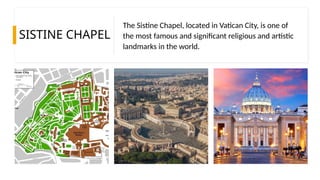
The Sistine Chapel, located in Vatican City, is one of
the most famous and significant religious and artistic
landmarks in the world.
SISTINE CHAPEL
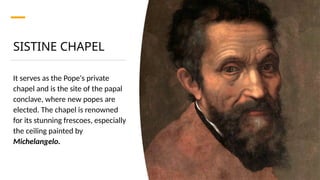
It serves as the Pope's private
chapel and is the site of the papal
conclave, where new popes are
elected. The chapel is renowned
for its stunning frescoes, especially
the ceiling painted by
Michelangelo.
HISTORY &
ARCHITECTURE
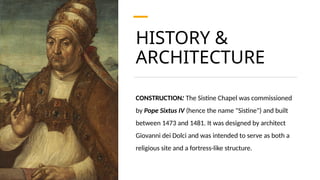
CONSTRUCTION: The Sistine Chapel was commissioned
by Pope Sixtus IV (hence the name "Sistine") and built
between 1473 and 1481. It was designed by architect
Giovanni dei Dolci and was intended to serve as both a
religious site and a fortress-like structure.
HISTORY &
ARCHITECTURE
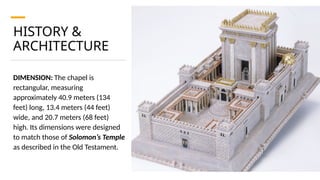
DIMENSION: The chapel is
rectangular, measuring
approximately 40.9 meters (134
feet) long, 13.4 meters (44 feet)
wide, and 20.7 meters (68 feet)
high. Its dimensions were designed
to match those of Solomon’s Temple
as described in the Old Testament.
THE CEILING
FRESCOES
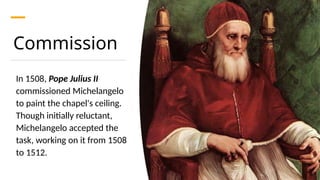
Commission
In 1508, Pope Julius II
commissioned Michelangelo
to paint the chapel's ceiling.
Though initially reluctant,
Michelangelo accepted the
task, working on it from 1508
to 1512.
THE
ARTWORK
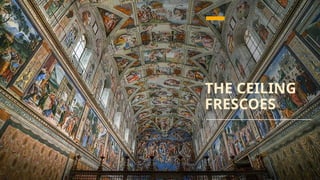
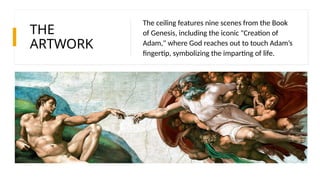
The ceiling features nine scenes from the Book
of Genesis, including the iconic "Creation of
Adam," where God reaches out to touch Adam’s
fingertip, symbolizing the imparting of life.
DESIGN AND
TECHNIQUE
Michelangelo painted the
ceiling frescoes while lying on
his back on scaffolding. The
work is remarkable for its
dynamic compositions,
anatomical precision, and
complex use of perspective.
THE LAST
JUDGEMEN
T
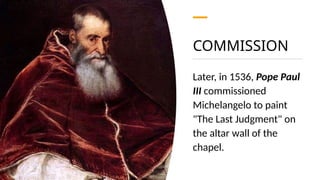
COMMISSION
Later, in 1536, Pope Paul
III commissioned
Michelangelo to paint
"The Last Judgment" on
the altar wall of the
chapel.
DESCRIPTION
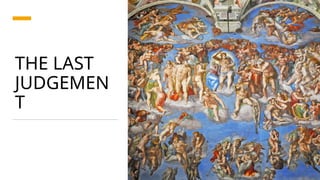
• Completed in 1541, this massive
fresco depicts the second coming of
christ and the final judgment of
souls. The composition is filled with
powerful figures, including christ, the
virgin mary, saints, angels, and the
damned. The work is notable for its
intense emotion and dramatic
energy.
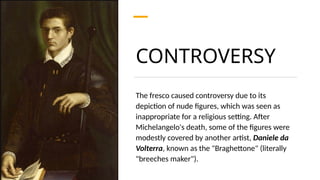
CONTROVERSY
The fresco caused controversy due to its
depiction of nude figures, which was seen as
inappropriate for a religious setting. After
Michelangelo's death, some of the figures were
modestly covered by another artist, Daniele da
Volterra, known as the "Braghettone" (literally
"breeches maker").
OTHER FRESCOES
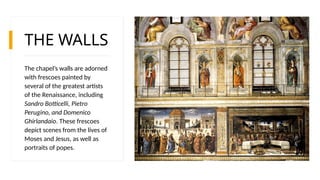
THE WALLS
The chapel’s walls are adorned
with frescoes painted by
several of the greatest artists
of the Renaissance, including
Sandro Botticelli, Pietro
Perugino, and Domenico
Ghirlandaio. These frescoes
depict scenes from the lives of
Moses and Jesus, as well as
portraits of popes.
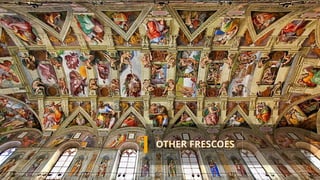
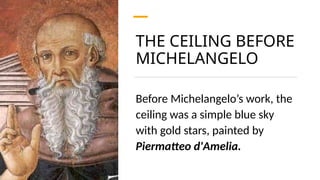
THE CEILING BEFORE
MICHELANGELO
Before Michelangelo’s work, the
ceiling was a simple blue sky
with gold stars, painted by
Piermatteo d'Amelia.
SIGNIFICANCE
•Religious Importance: The
Sistine Chapel remains a
central site for significant
Catholic ceremonies,
including the conclave to
elect a new pope. The
chapel's religious
significance is matched by its
cultural and artistic impact.
SIGNIFICANCE
•Artistic Legacy: The Sistine
Chapel's frescoes represent
the pinnacle of Renaissance
art. Michelangelo's work, in
particular, has had a
profound influence on
Western art, setting new
standards for artistic
excellence and innovation.
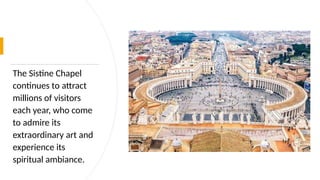
The Sistine Chapel
continues to attract
millions of visitors
each year, who come
to admire its
extraordinary art and
experience its
spiritual ambiance.
Sistine Chapel Sistine Chapel Sistine Chapel .pptx

Sistine Chapel Sistine Chapel Sistine Chapel .pptx

  • 1.
  • 2.
  • 3.
    SISTINE CHAPEL The SistineChapel, located in Vatican City, is one of the most famous and significant religious and artistic landmarks in the world.
  • 4.
    SISTINE CHAPEL It servesas the Pope's private chapel and is the site of the papal conclave, where new popes are elected. The chapel is renowned for its stunning frescoes, especially the ceiling painted by Michelangelo.
  • 5.
    HISTORY & ARCHITECTURE CONSTRUCTION: TheSistine Chapel was commissioned by Pope Sixtus IV (hence the name "Sistine") and built between 1473 and 1481. It was designed by architect Giovanni dei Dolci and was intended to serve as both a religious site and a fortress-like structure.
  • 6.
    HISTORY & ARCHITECTURE DIMENSION: Thechapel is rectangular, measuring approximately 40.9 meters (134 feet) long, 13.4 meters (44 feet) wide, and 20.7 meters (68 feet) high. Its dimensions were designed to match those of Solomon’s Temple as described in the Old Testament.
  • 7.
  • 8.
    Commission In 1508, PopeJulius II commissioned Michelangelo to paint the chapel's ceiling. Though initially reluctant, Michelangelo accepted the task, working on it from 1508 to 1512.
  • 9.
    THE ARTWORK The ceiling featuresnine scenes from the Book of Genesis, including the iconic "Creation of Adam," where God reaches out to touch Adam’s fingertip, symbolizing the imparting of life.
  • 10.
    DESIGN AND TECHNIQUE Michelangelo paintedthe ceiling frescoes while lying on his back on scaffolding. The work is remarkable for its dynamic compositions, anatomical precision, and complex use of perspective.
  • 11.
  • 12.
    COMMISSION Later, in 1536,Pope Paul III commissioned Michelangelo to paint "The Last Judgment" on the altar wall of the chapel.
  • 13.
    DESCRIPTION • Completed in1541, this massive fresco depicts the second coming of christ and the final judgment of souls. The composition is filled with powerful figures, including christ, the virgin mary, saints, angels, and the damned. The work is notable for its intense emotion and dramatic energy.
  • 14.
    CONTROVERSY The fresco causedcontroversy due to its depiction of nude figures, which was seen as inappropriate for a religious setting. After Michelangelo's death, some of the figures were modestly covered by another artist, Daniele da Volterra, known as the "Braghettone" (literally "breeches maker").
  • 15.
  • 16.
    THE WALLS The chapel’swalls are adorned with frescoes painted by several of the greatest artists of the Renaissance, including Sandro Botticelli, Pietro Perugino, and Domenico Ghirlandaio. These frescoes depict scenes from the lives of Moses and Jesus, as well as portraits of popes.
  • 17.
    THE CEILING BEFORE MICHELANGELO BeforeMichelangelo’s work, the ceiling was a simple blue sky with gold stars, painted by Piermatteo d'Amelia.
  • 18.
    SIGNIFICANCE •Religious Importance: The SistineChapel remains a central site for significant Catholic ceremonies, including the conclave to elect a new pope. The chapel's religious significance is matched by its cultural and artistic impact.
  • 19.
    SIGNIFICANCE •Artistic Legacy: TheSistine Chapel's frescoes represent the pinnacle of Renaissance art. Michelangelo's work, in particular, has had a profound influence on Western art, setting new standards for artistic excellence and innovation.
  • 20.
    The Sistine Chapel continuesto attract millions of visitors each year, who come to admire its extraordinary art and experience its spiritual ambiance.