
Standards In Practice™
It's a Process
Essential Questions
 What does rigor look like in your personal or school's
instructional practices?
 What is the importance of teachers doing the
assignments the students are asked to do?
 What does "demonstrating proficiency" of content
standards look like?
3
Problem
 D-STEP scores on South Dakota Content
Reading Standards within Indicators R.3 and
R.5 have been consistently low in 2009 and
2010.
Source: SD DOE Reading Up (2010).
Hypotheses
 Assessment questions are poorly written and they
are not aligned to our SD content standards.
 The rigor at which the standards are addressed in
classroom is not meeting the rigor of questioning on
assessment.
South Dakota Content Standards in Practice
 50% of the questions on the DSTEP are written at
or above the taxonomy level indicated in the
standards
 SD Content Reading Standard - 3.R.5.3
(Application) Students can collect information
from two reference materials.
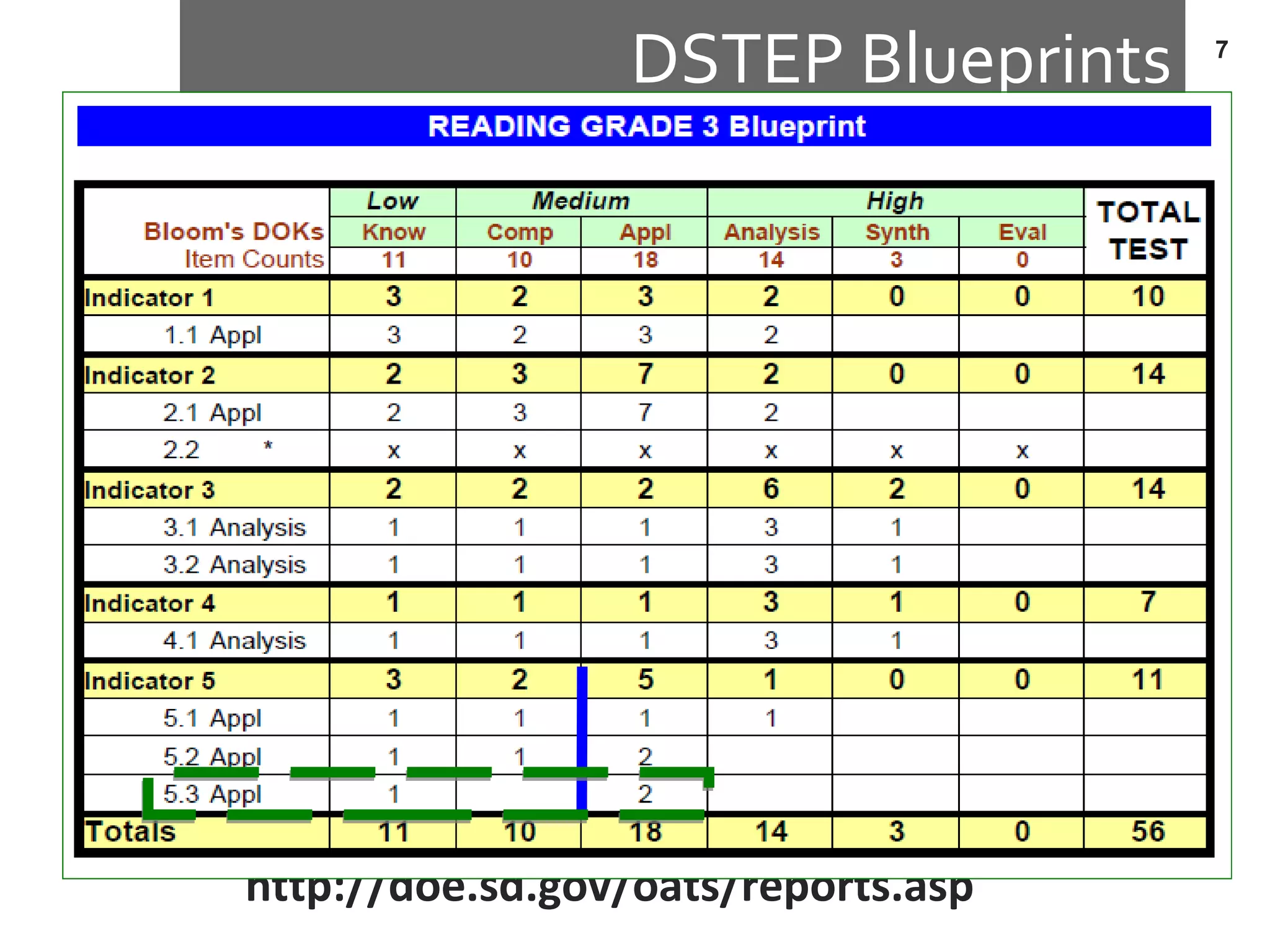
DSTEP Blueprints
http://doe.sd.gov/oats/reports.asp
7
8
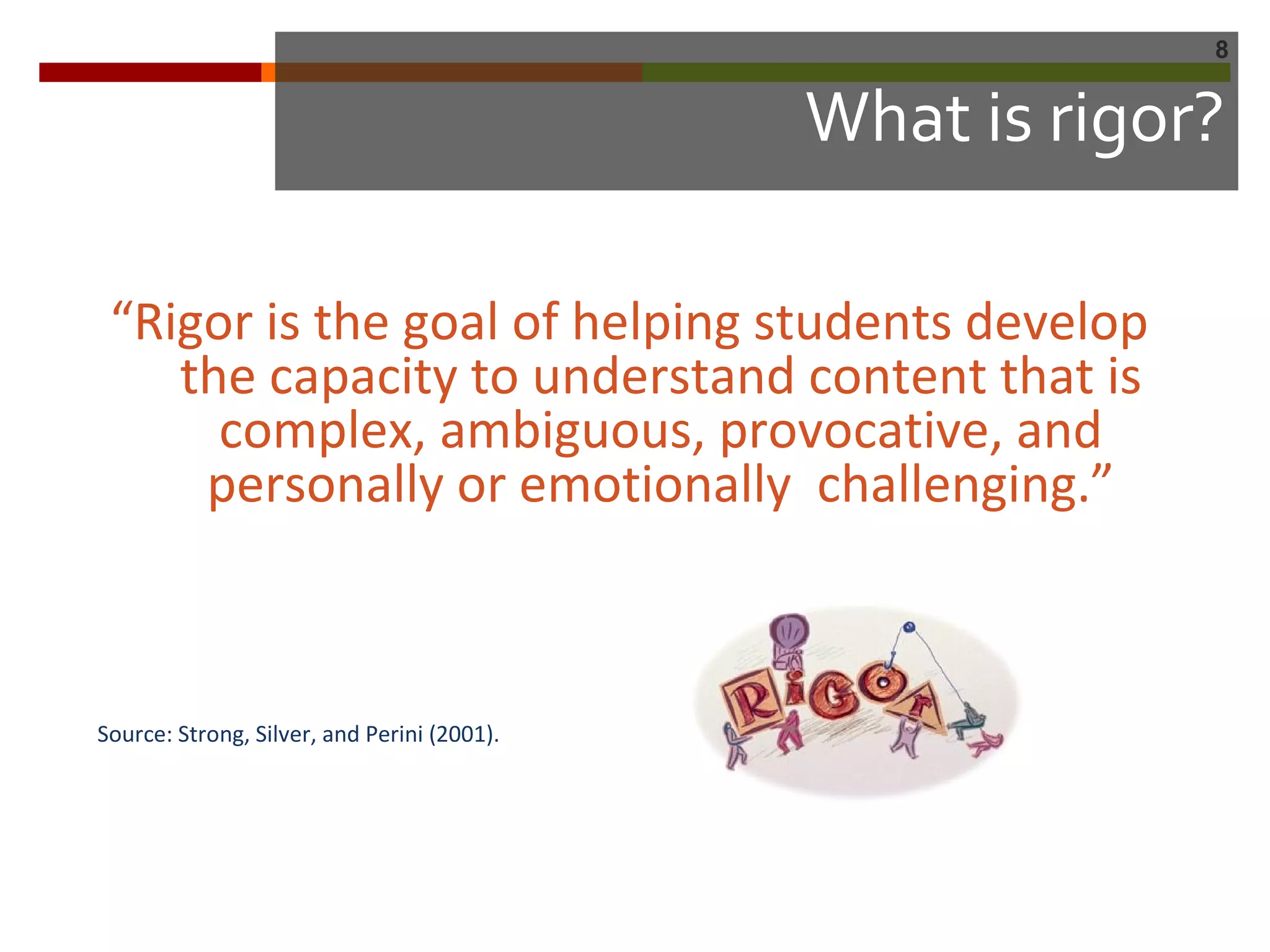
What is rigor?
“Rigor is the goal of helping students develop
the capacity to understand content that is
complex, ambiguous, provocative, and
personally or emotionally challenging.”
Source: Strong, Silver, and Perini (2001).
9
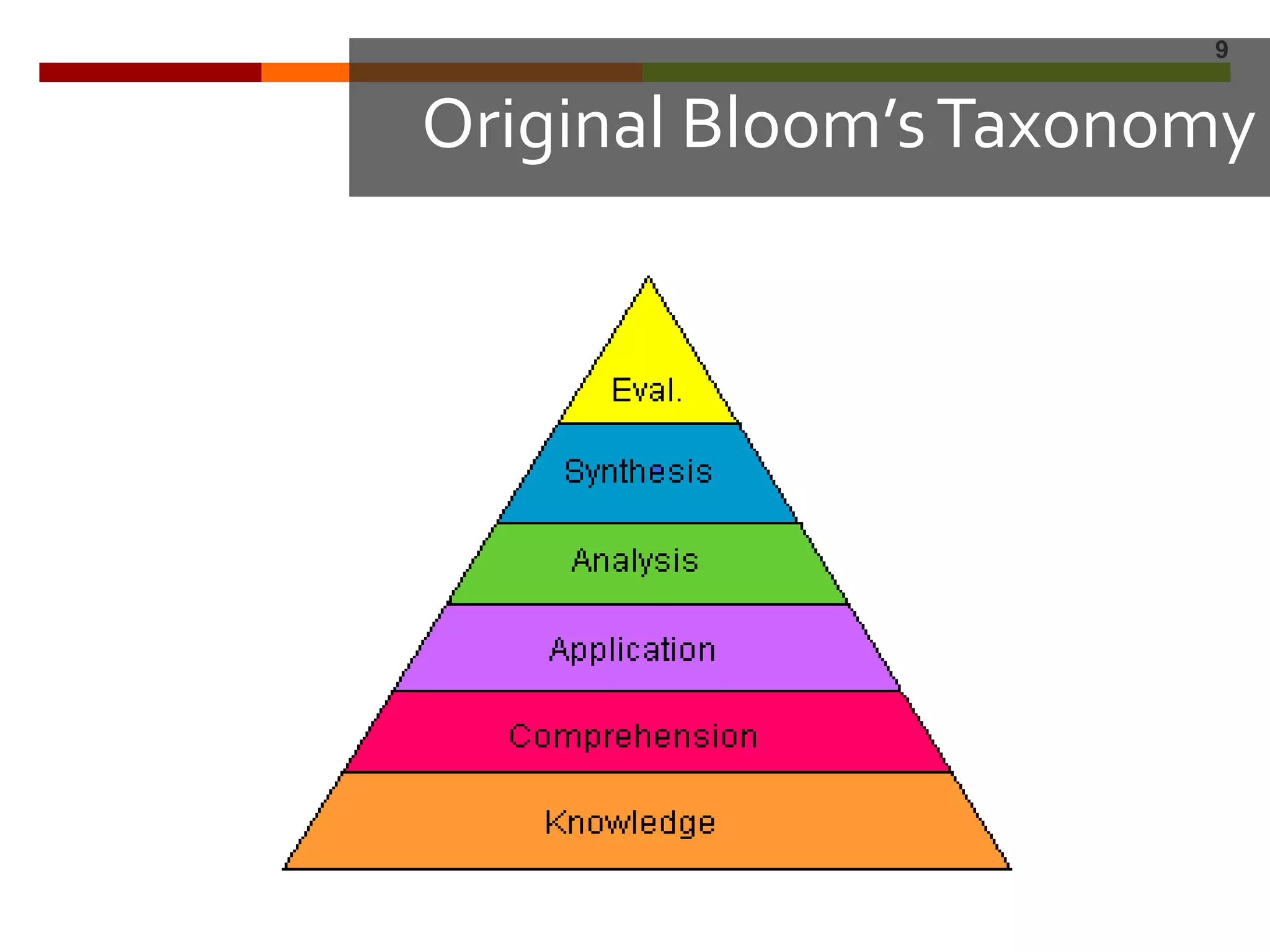
Original Bloom’sTaxonomy
10
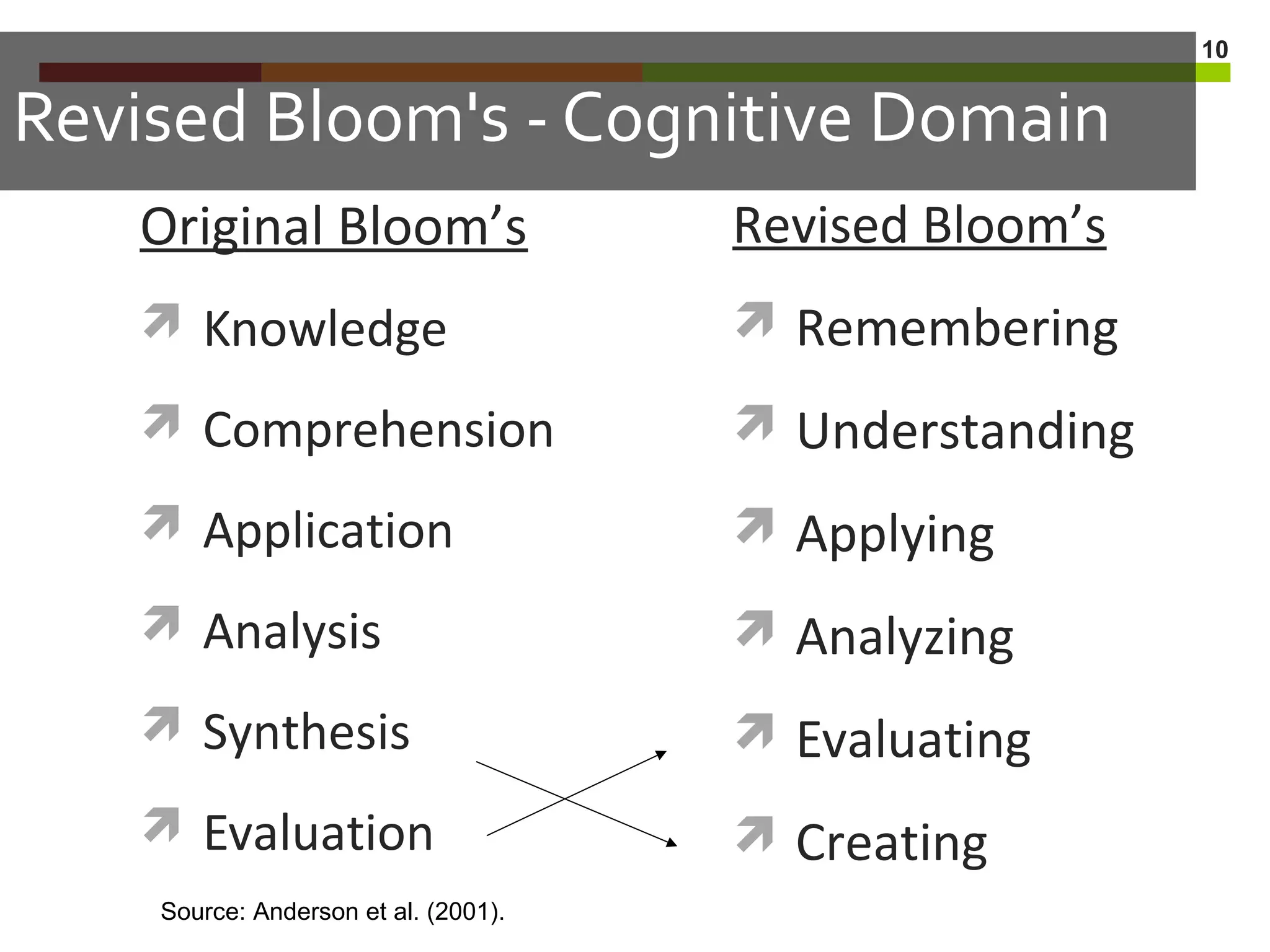
Revised Bloom's - Cognitive Domain
Original Bloom’s
 Knowledge
 Comprehension
 Application
 Analysis
 Synthesis
 Evaluation
Revised Bloom’s
 Remembering
 Understanding
 Applying
 Analyzing
 Evaluating
 Creating
Source: Anderson et al. (2001).
11
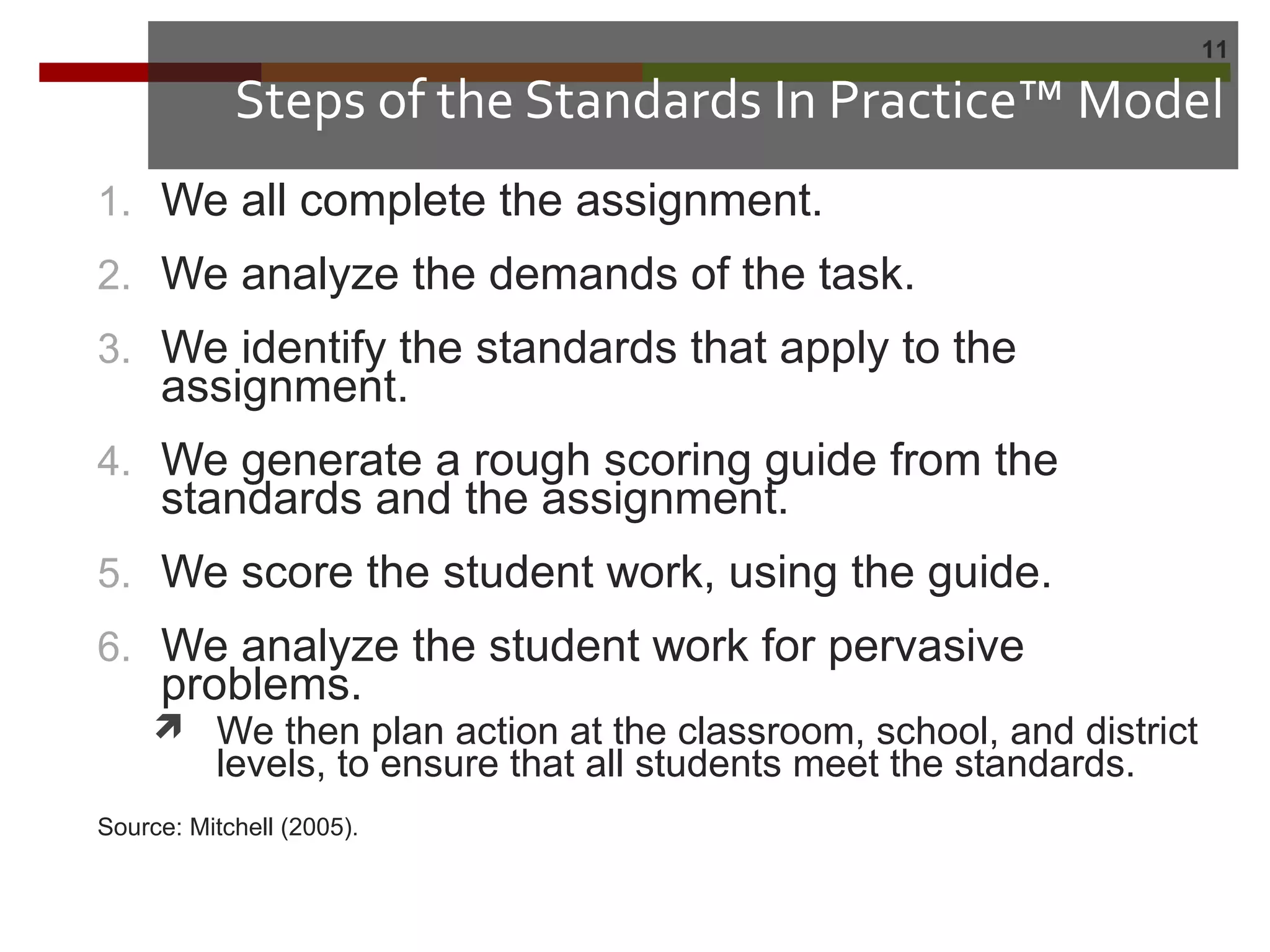
Steps of the Standards In Practice™ Model
1. We all complete the assignment.
2. We analyze the demands of the task.
3. We identify the standards that apply to the
assignment.
4. We generate a rough scoring guide from the
standards and the assignment.
5. We score the student work, using the guide.
6. We analyze the student work for pervasive
problems.
 We then plan action at the classroom, school, and district
levels, to ensure that all students meet the standards.
Source: Mitchell (2005).
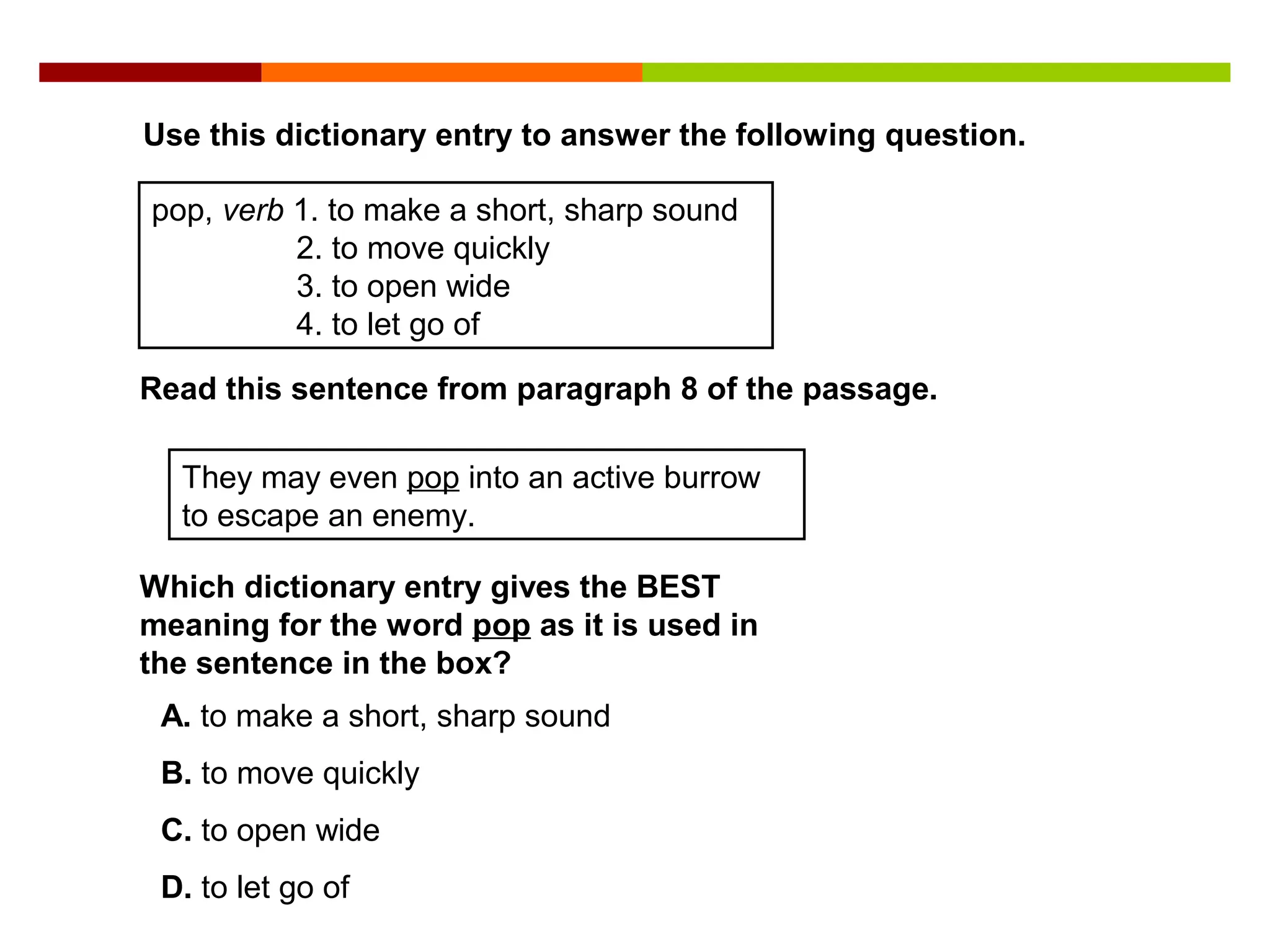
Use this dictionary entry to answer the following question.
pop, verb 1. to make a short, sharp sound
2. to move quickly
3. to open wide
4. to let go of
Read this sentence from paragraph 8 of the passage.
They may even pop into an active burrow
to escape an enemy.
Which dictionary entry gives the BEST
meaning for the word pop as it is used in
the sentence in the box?
A. to make a short, sharp sound
B. to move quickly
C. to open wide
D. to let go of
SIP™ Steps
1. Do the assignment - individually
2. Analyze demands of task (Skills):
 comprehension, analyzing, evaluating,
inferring...
1. Identify Standard/s
 3.R.5.3 Students can collect information from
two reference materials.
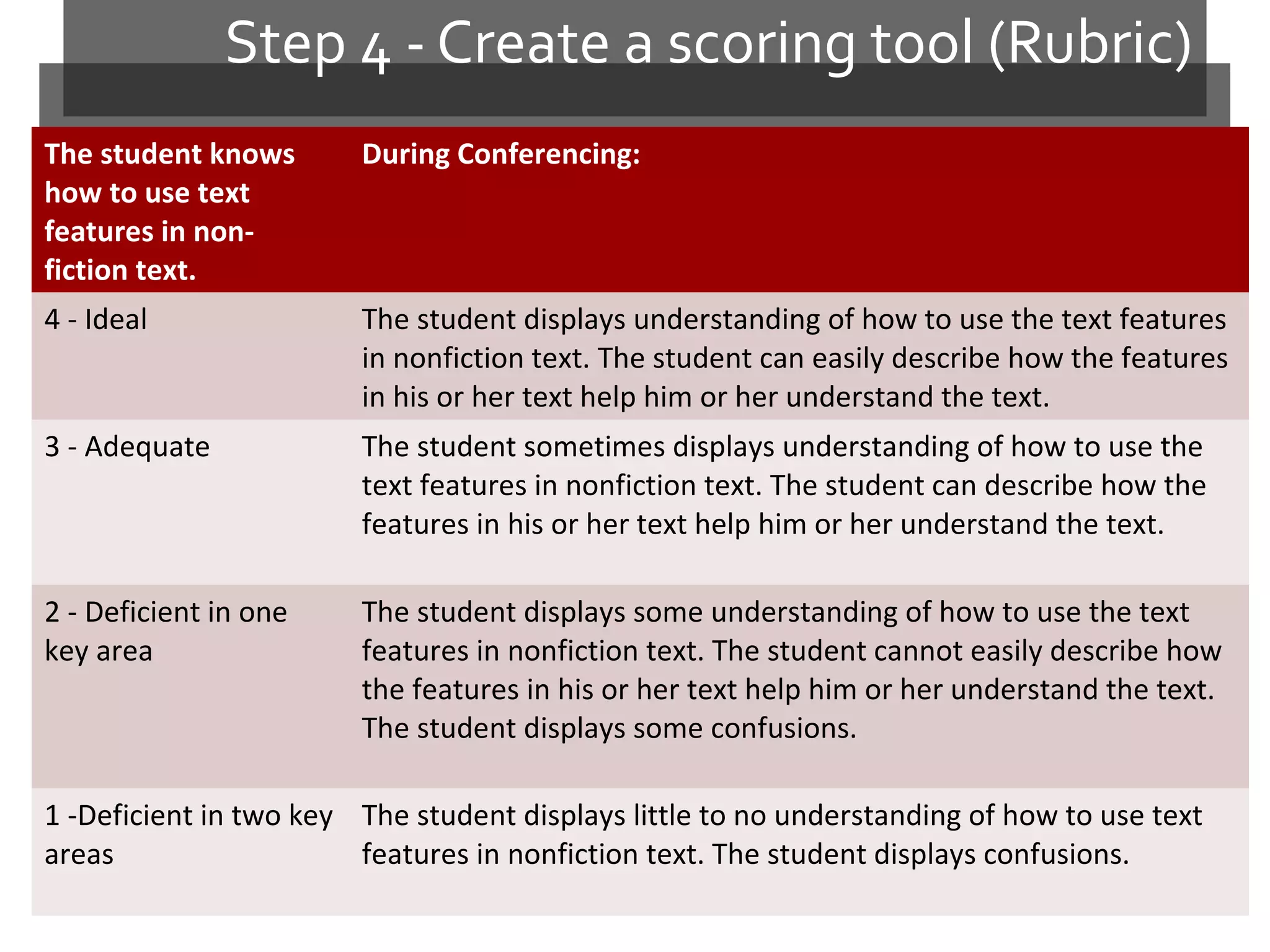
The student knows
how to use text
features in non-
fiction text.
During Conferencing:
4 - Ideal The student displays understanding of how to use the text features
in nonfiction text. The student can easily describe how the features
in his or her text help him or her understand the text.
3 - Adequate The student sometimes displays understanding of how to use the
text features in nonfiction text. The student can describe how the
features in his or her text help him or her understand the text.
2 - Deficient in one
key area
The student displays some understanding of how to use the text
features in nonfiction text. The student cannot easily describe how
the features in his or her text help him or her understand the text.
The student displays some confusions.
1 -Deficient in two key
areas
The student displays little to no understanding of how to use text
features in nonfiction text. The student displays confusions.
Step 4 - Create a scoring tool (Rubric)
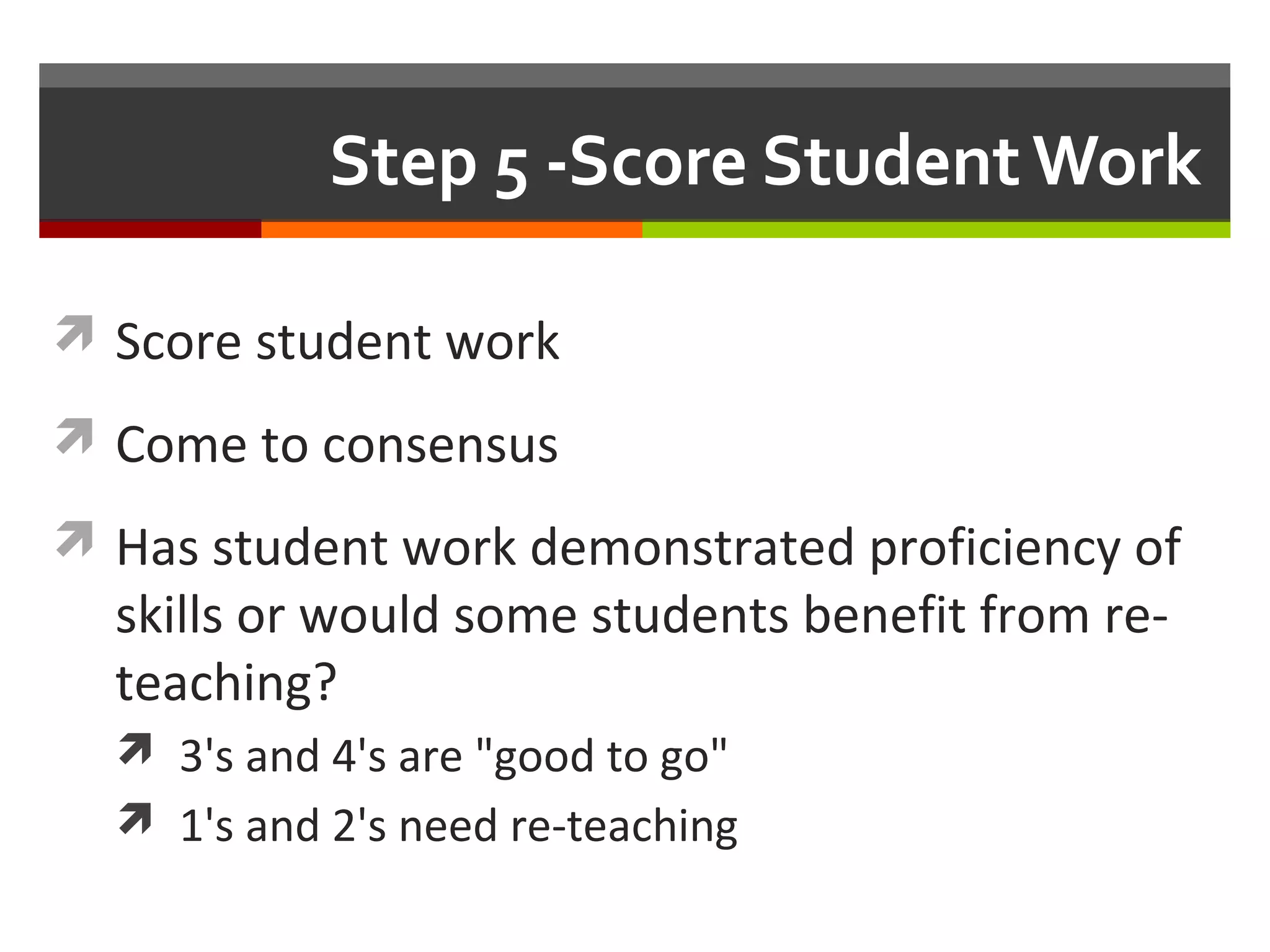
Step 5 -Score Student Work
 Score student work
 Come to consensus
 Has student work demonstrated proficiency of
skills or would some students benefit from re-
teaching?
 3's and 4's are "good to go"
 1's and 2's need re-teaching
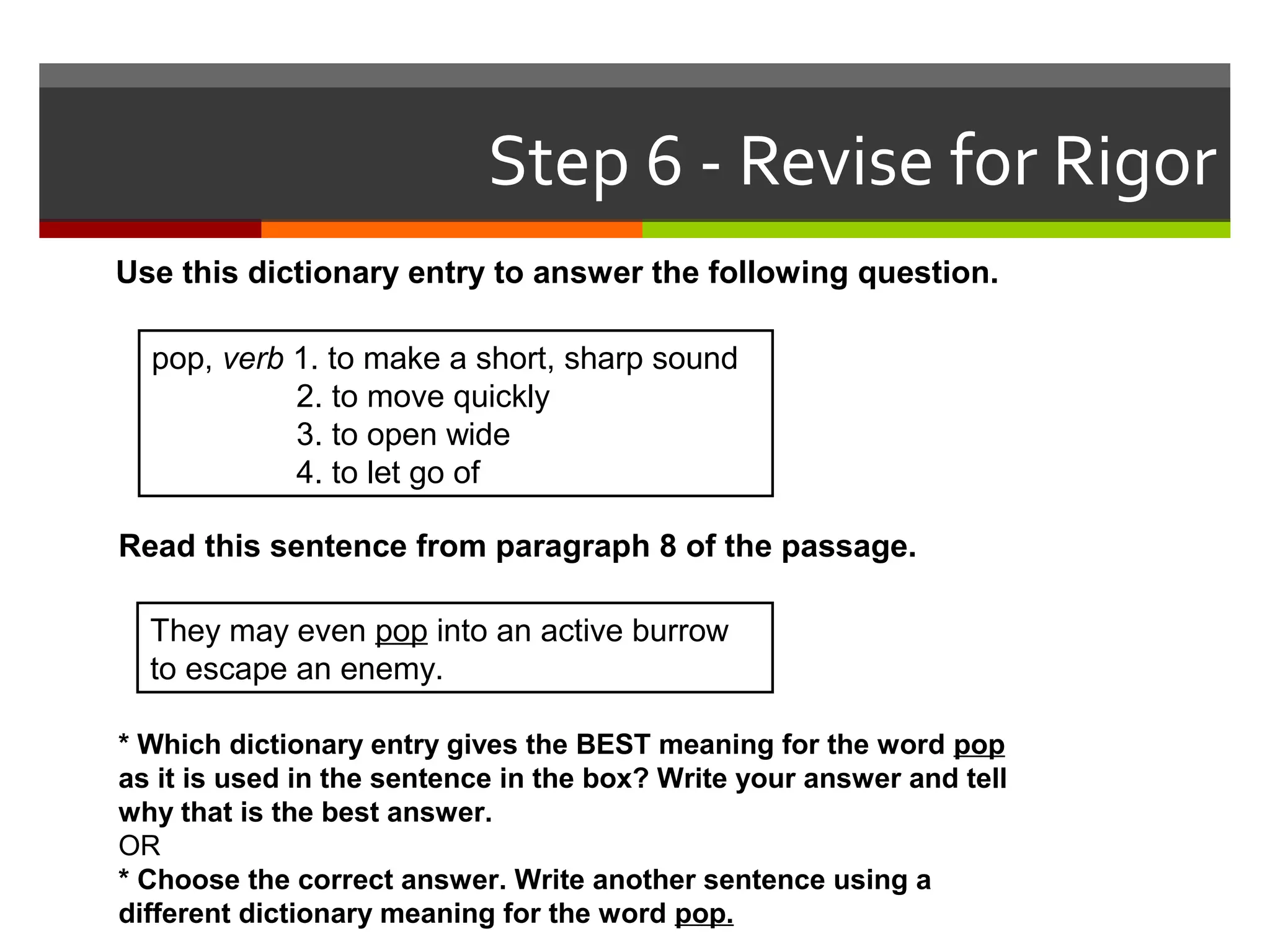
Use this dictionary entry to answer the following question.
pop, verb 1. to make a short, sharp sound
2. to move quickly
3. to open wide
4. to let go of
Read this sentence from paragraph 8 of the passage.
They may even pop into an active burrow
to escape an enemy.
* Which dictionary entry gives the BEST meaning for the word pop
as it is used in the sentence in the box? Write your answer and tell
why that is the best answer.
OR
* Choose the correct answer. Write another sentence using a
different dictionary meaning for the word pop.
Step 6 - Revise for Rigor
Standards in Practice™ In Review
1. Problem -
• SD content standards, D-STEP results
1. Rigor
• Bloom's Taxonomy
1. SIP™ Model
• 6 steps
How will you train your “fleas” to jump beyond
the lid?
 What does rigor look like in your personal or school's
instructional practices?
 What is the importance of teachers doing the
assignments the students are asked to do?
 What does "demonstrating proficiency" of content
standards look like?
Resources
 Anderson, L.W. and Krathwahl, D.R. (2001). A taxonomy of learning,
teaching, and assessing: a revision of bloom's taxonomy of education.
Boston, MA: Allyn & Bacon.
 Mitchell, R. (2005). Building a better assignment. The Journal of Staff
Development, 26 (1), 42-47.
 South Dakota Department of Education. (2010). DSTEP blue prints.
Retrieved from http://www.doe.sd.gov/oats/reports.asp
 South Dakota Department of Education. (2010). Reading up. Retrieved
from http://doe.sd.gov/readingup/index.asp
 Strong, R.W., Silver, H.F., and Perini, M.J. (2001). Teaching what matters
most: standards and strategies for raising student achievement.
Alexandria, VA: ASCD.

Sip

  • 1.
  • 2.
    Essential Questions  Whatdoes rigor look like in your personal or school's instructional practices?  What is the importance of teachers doing the assignments the students are asked to do?  What does "demonstrating proficiency" of content standards look like?
  • 3.
  • 4.
    Problem  D-STEP scoreson South Dakota Content Reading Standards within Indicators R.3 and R.5 have been consistently low in 2009 and 2010. Source: SD DOE Reading Up (2010).
  • 5.
    Hypotheses  Assessment questionsare poorly written and they are not aligned to our SD content standards.  The rigor at which the standards are addressed in classroom is not meeting the rigor of questioning on assessment.
  • 6.
    South Dakota ContentStandards in Practice  50% of the questions on the DSTEP are written at or above the taxonomy level indicated in the standards  SD Content Reading Standard - 3.R.5.3 (Application) Students can collect information from two reference materials.
  • 7.
  • 8.
    8 What is rigor? “Rigoris the goal of helping students develop the capacity to understand content that is complex, ambiguous, provocative, and personally or emotionally challenging.” Source: Strong, Silver, and Perini (2001).
  • 9.
  • 10.
    10 Revised Bloom's -Cognitive Domain Original Bloom’s  Knowledge  Comprehension  Application  Analysis  Synthesis  Evaluation Revised Bloom’s  Remembering  Understanding  Applying  Analyzing  Evaluating  Creating Source: Anderson et al. (2001).
  • 11.
    11 Steps of theStandards In Practice™ Model 1. We all complete the assignment. 2. We analyze the demands of the task. 3. We identify the standards that apply to the assignment. 4. We generate a rough scoring guide from the standards and the assignment. 5. We score the student work, using the guide. 6. We analyze the student work for pervasive problems.  We then plan action at the classroom, school, and district levels, to ensure that all students meet the standards. Source: Mitchell (2005).
  • 12.
    Use this dictionaryentry to answer the following question. pop, verb 1. to make a short, sharp sound 2. to move quickly 3. to open wide 4. to let go of Read this sentence from paragraph 8 of the passage. They may even pop into an active burrow to escape an enemy. Which dictionary entry gives the BEST meaning for the word pop as it is used in the sentence in the box? A. to make a short, sharp sound B. to move quickly C. to open wide D. to let go of
  • 13.
    SIP™ Steps 1. Dothe assignment - individually 2. Analyze demands of task (Skills):  comprehension, analyzing, evaluating, inferring... 1. Identify Standard/s  3.R.5.3 Students can collect information from two reference materials.
  • 14.
    The student knows howto use text features in non- fiction text. During Conferencing: 4 - Ideal The student displays understanding of how to use the text features in nonfiction text. The student can easily describe how the features in his or her text help him or her understand the text. 3 - Adequate The student sometimes displays understanding of how to use the text features in nonfiction text. The student can describe how the features in his or her text help him or her understand the text. 2 - Deficient in one key area The student displays some understanding of how to use the text features in nonfiction text. The student cannot easily describe how the features in his or her text help him or her understand the text. The student displays some confusions. 1 -Deficient in two key areas The student displays little to no understanding of how to use text features in nonfiction text. The student displays confusions. Step 4 - Create a scoring tool (Rubric)
  • 15.
    Step 5 -ScoreStudent Work  Score student work  Come to consensus  Has student work demonstrated proficiency of skills or would some students benefit from re- teaching?  3's and 4's are "good to go"  1's and 2's need re-teaching
  • 16.
    Use this dictionaryentry to answer the following question. pop, verb 1. to make a short, sharp sound 2. to move quickly 3. to open wide 4. to let go of Read this sentence from paragraph 8 of the passage. They may even pop into an active burrow to escape an enemy. * Which dictionary entry gives the BEST meaning for the word pop as it is used in the sentence in the box? Write your answer and tell why that is the best answer. OR * Choose the correct answer. Write another sentence using a different dictionary meaning for the word pop. Step 6 - Revise for Rigor
  • 17.
    Standards in Practice™In Review 1. Problem - • SD content standards, D-STEP results 1. Rigor • Bloom's Taxonomy 1. SIP™ Model • 6 steps
  • 18.
    How will youtrain your “fleas” to jump beyond the lid?  What does rigor look like in your personal or school's instructional practices?  What is the importance of teachers doing the assignments the students are asked to do?  What does "demonstrating proficiency" of content standards look like?
  • 19.
    Resources  Anderson, L.W.and Krathwahl, D.R. (2001). A taxonomy of learning, teaching, and assessing: a revision of bloom's taxonomy of education. Boston, MA: Allyn & Bacon.  Mitchell, R. (2005). Building a better assignment. The Journal of Staff Development, 26 (1), 42-47.  South Dakota Department of Education. (2010). DSTEP blue prints. Retrieved from http://www.doe.sd.gov/oats/reports.asp  South Dakota Department of Education. (2010). Reading up. Retrieved from http://doe.sd.gov/readingup/index.asp  Strong, R.W., Silver, H.F., and Perini, M.J. (2001). Teaching what matters most: standards and strategies for raising student achievement. Alexandria, VA: ASCD.

Editor's Notes

  • #8 DSTEP Blueprints are visual reminder of the rigor at which our students are assessed. 50% of the questions on the DSTEP are written at or above the taxonomy level indicated in the standards. Also – remember DSTEP is based on Old Blooms.
  • #9 Teaching What Matters Most: Standards and Strategies for Raising Student Achievement by Richard W. Strong, Harvey F. Silver and Matthew J. Perini, ASCD, 2001. According to Strong, Silver, and Perini, “Rigor is the goal of helping students develop the capacity to understand content that is complex, ambiguous, provocative, and personally or emotionally challenging.”Rigor is keeping the students always working slightly above their ability, giving them the help they need to grow. A student doesn’t learn if they are always working in their comfort level; likewise none of us can learn if the material is so far beyond us we have no foothold. Rigor should mean challenging the student to stretch himself/herself, which can be accomplished in all different kinds of courses. Complex – interacting and overlapping ideas – cellular respiration, structure of an ecosystem, causes of depressions or recessions Ambiguous – modern poetry, primary documents, and statistics, stuff that’s packed with multiple meanings that must be examined and sorted into patterns for significance – the House at Pooh Corner Provocative – conceptually challenging, dealing with dilemmas, engaging students in identifying problems – Bridge to Terabithia Personally or emotionally challenging – novels of Toni Morrison or Lois Lowry, the facts of Shay’s Rebellion. How might they personally challenge students and their sense of how the world works? If you asked a group of educators if schools should be rigorous, you would most likely get an enthusiastic YES. However, if you probed more deeply, you would probably find that there was NO widespread agreement on what that means. Paradigm shift: I teach _________ to I teach students how to learn ____________. There would be even less agreement on what needs to be done to ensure rigor. You may share what the future looks like in regard to the Reauthorization of ESEA/NCLB (Elementary and Secondary Education Act – the act that was in process b/4 NCLB, now Federal Department of Education is returning to ESEA).
  • #10 Apply Bloom’s theory of developing higher levels of though processes to everyday classroom reading. This is the taxonomy our STATE STANDARDS are written to. RIGOR DOES NOT MEAN TEACHING UP THE PYRAMID – Applying AND Understanding can be as rigorous as Evaluation. DSTEP – builds on the levels of Bloom’s – most questions are asked at a level higher than stated.
  • #11 Change from nouns to verbs. This is 21st century skill based – standards revisions and lesson building is/will be based on the NEW Bloom’s Since Bloom we have learned more about how children learn, about how the brain works. During the 1990’s Lorin Anderson, a former student of Benjamin Bloom –Changes were made based on 50 + years of history using original taxonomy and research on learning conducted by cognitive psychologists. The names of the 6 major categories were changed from noun to verb forms.
  • #12 Handout F – the Steps and the Steps with explanation of process. We will be “doing” this for the rest to the day. You as teachers will refer to this when you utilize the process at your schools. It’s important that we actually do the work we assign our students. That helps us see ways they might be thinking about the assignment – ways they may interpret what you want them to do. Often times interpretation is the reason lessons don’t go the way you intended. We will determine which skills are needed to complete the task We will determine which standard/s apply to the assignment Generation of a rubric – this can be the most rigorous piece of the Standards in Practice process Use the rubric to score student work Add rigor to the assignment
  • #13 3.R.5.3 at the analysis/evaluation level
  • #14 Assignment written at the analysis/evaluation level
  • #15 Features The student will know how to use text features in nonfiction text Always During conferencing, the student displays understanding of how to use the text features in nonfiction text. The student can easily describe how the features in his or her text help him or her understand the text. Sometimes During conferencing, the student sometimes displays understanding of how to use the text features in nonfiction text. At times, the student can describe how the features in his or her text help him or her understand the text. The student displays some confusions. Rarely/Never During conferencing, the student rarely/never displays understanding of how to use the text features in nonfiction text. The student cannot easily describe how the features in his or her text help him or her understand the text. The student displays confusions.
  • #17 3.R.5.3 at the analysis/evaluation level