Single Axis Solar Tracking
Using Arduino
Group Members
 Prashant Shrimal 191113268
 Abhishek Gupta 191113043
 Vidit Singhal 191113237
 Ayush Rusia 191113238
 Krishna Gupta 191113263
Objective
The aim of our projects is to utilize the maximum solar energy through solar panel. For this a
digital based automatic sun tracking system is proposed. This project helps the solar power
generating equipment to get the maximum sunlight automatically thereby increasing the
efficiency of the system. The solar panel tracks the sun from east to west automatically for
maximum intensity of light.
What is Solar Tracking
 A Solar tracker is a device used for orienting a solar photovoltaic panel or lens
towards the sun by using the solar or light sensors connected with the machine
(ex: stepper motor, servo motor, gas filled piston).
Need of Solar Tracking
 Increase Solar Panel Output
 Maximum efficency of the panel
 Maximize Power per unit Area
 Able to grab the energy through out the day
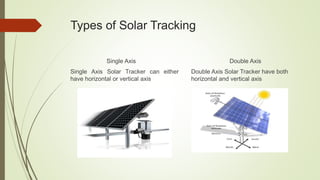
Types of Solar Tracking
Single Axis
Single Axis Solar Tracker can either
have horizontal or vertical axis
Double Axis
Double Axis Solar Tracker have both
horizontal and vertical axis
Advantages of Solar Tracker
 Simple
 Low cost
 Eco-Friendly
 We can monitor directly using PC
 Tracking accuracy is more
 Reduce the usage of power from power grid
Working Principle
 Auto-tracking control system composed of PLC, sensors, signal processing units,
PV cells, electromagnetic and mechanical motion control modules and power
supply systems.
 Panel detects the sun light strength to sensors
 The sensors output is given to the PLC which compares it and produces an
equivalent output so as to rotate the motor and align the panel in the direction of
sun
Components
• Arduino
• Servo motor sg90
• LDR sensor
• Resistor 10k
• Jumper wire
• Solar panel
Arduino
• Arduino is an open-source hardware
and software company, project, and
user community that designs and
manufactures single-board
microcontrollers and microcontroller
kits for building digital devices.
• Arduino board designs use a variety
of microprocessors and controllers.
Servo Motor SG90
• Servo motors are high torque motors
which are commonly used in robotics
and several other applications due to
the fact that it’s easy to control their
rotation.
• Servo motors have a geared output
shaft which can be electrically
controlled to turn one (1) degree at a
time.
LDR Sensor Resistor 10K
Jumper Wire
• Jumper wires are simply wires that
have connector pins at each end,
allowing them to be used to connect
two points to each other without
soldering.
• Jumper wires are typically used with
breadboards and other prototyping
tools in order to make it easy to
change a circuit as needed
Solar Panel
• solar panel is an assembly of
photovoltaic solar cells mounted in a
(usually rectangular) frame.
• Solar panels capture sunlight as a
source of radiant energy, which is
converted into electric energy in the
form of direct current (DC) electricity.
Circuit Diagram
Flow Chart
Code

Single Axis Solar Tracking.pptx

  • 1.
    Single Axis SolarTracking Using Arduino
  • 2.
    Group Members  PrashantShrimal 191113268  Abhishek Gupta 191113043  Vidit Singhal 191113237  Ayush Rusia 191113238  Krishna Gupta 191113263
  • 3.
    Objective The aim ofour projects is to utilize the maximum solar energy through solar panel. For this a digital based automatic sun tracking system is proposed. This project helps the solar power generating equipment to get the maximum sunlight automatically thereby increasing the efficiency of the system. The solar panel tracks the sun from east to west automatically for maximum intensity of light.
  • 4.
    What is SolarTracking  A Solar tracker is a device used for orienting a solar photovoltaic panel or lens towards the sun by using the solar or light sensors connected with the machine (ex: stepper motor, servo motor, gas filled piston).
  • 5.
    Need of SolarTracking  Increase Solar Panel Output  Maximum efficency of the panel  Maximize Power per unit Area  Able to grab the energy through out the day
  • 6.
    Types of SolarTracking Single Axis Single Axis Solar Tracker can either have horizontal or vertical axis Double Axis Double Axis Solar Tracker have both horizontal and vertical axis
  • 7.
    Advantages of SolarTracker  Simple  Low cost  Eco-Friendly  We can monitor directly using PC  Tracking accuracy is more  Reduce the usage of power from power grid
  • 8.
    Working Principle  Auto-trackingcontrol system composed of PLC, sensors, signal processing units, PV cells, electromagnetic and mechanical motion control modules and power supply systems.  Panel detects the sun light strength to sensors  The sensors output is given to the PLC which compares it and produces an equivalent output so as to rotate the motor and align the panel in the direction of sun
  • 9.
    Components • Arduino • Servomotor sg90 • LDR sensor • Resistor 10k • Jumper wire • Solar panel
  • 10.
    Arduino • Arduino isan open-source hardware and software company, project, and user community that designs and manufactures single-board microcontrollers and microcontroller kits for building digital devices. • Arduino board designs use a variety of microprocessors and controllers.
  • 11.
    Servo Motor SG90 •Servo motors are high torque motors which are commonly used in robotics and several other applications due to the fact that it’s easy to control their rotation. • Servo motors have a geared output shaft which can be electrically controlled to turn one (1) degree at a time.
  • 12.
  • 13.
    Jumper Wire • Jumperwires are simply wires that have connector pins at each end, allowing them to be used to connect two points to each other without soldering. • Jumper wires are typically used with breadboards and other prototyping tools in order to make it easy to change a circuit as needed
  • 14.
    Solar Panel • solarpanel is an assembly of photovoltaic solar cells mounted in a (usually rectangular) frame. • Solar panels capture sunlight as a source of radiant energy, which is converted into electric energy in the form of direct current (DC) electricity.
  • 15.
  • 16.
  • 17.