


O- & N(A)-Level Mathematics
Teaching and Learning
Syllabus
This document contains general information about the secondary mathematics
curriculum and the content for O & N(A) Mathematics at Secondary 1 and 2 only.
The syllabuses will be implemented level by level from 2013. The content for
Secondary 3/4 will be updated accordingly.
© Copyright 2012 Curriculum Planning and Development Division.
This publication is not for sale. For restricted circulation only. All rights
reserved. No part of this publication may be reproduced without the
prior permission of the Ministry of Education, Singapore.
First Edition: April 2012.
Year of Implementation: from 2013
O- & N(A)-Level Mathematics 2
Learning Mathematics
A 21st
Century Necessity
Learning mathematics is a key fundamental in every education system that
aims to prepare its citizens for a productive life in the 21st
century.
As a nation, the development of a highly-skilled and well-educated manpower
is critical to support an innovation- and technology-driven economy. A strong
grounding in mathematics and a talent pool in mathematics are essential to support
the wide range of value-added economic activities and innovations. Many countries
are paying attention to the quality of their mathematics education. The growing
interest in TIMSS and PISA speaks of the global interest and importance placed on
mathematics education.
At the individual level, mathematics underpins many aspects of our everyday
activities, from making sense of information in the newspaper to making informed
decisions about personal finances. It supports learning in many fields of study,
whether it is in the sciences or in business. A good understanding of basic
mathematics is essential wherever calculations, measurements, graphical
interpretations and statistical analysis are necessary. The learning of mathematics
also provides an excellent vehicle to train the mind, and to develop the capacity to
think logically, abstractly, critically and creatively. These are important 21st
century
competencies that we must imbue in our students, so that they can lead a productive
life and be life-long learners.
Students have different starting points. Not all will have the same interests
and natural abilities to learn mathematics. Some will find it enjoyable; others will find
it challenging. Some will find the theorems and results intriguing; others will find the
formulae and rules bewildering. It is therefore important for the mathematics
curriculum to provide differentiated pathways and choices to support every learner in
order to maximise their potential. The curriculum must engage the 21st
century
learners, who are digital natives comfortable with the use of technologies and who
work and think differently. The learning of mathematics must take into cognisance
the new generation of learners, the innovations in pedagogies as well as the
affordances of technologies.
It is the goal of the national mathematics curriculum to ensure that all students
will achieve a level of mastery of mathematics that will serve them well in their lives,
and for those who have the interest and ability, to pursue mathematics at the highest
possible level. Mathematics is an important subject in our national curriculum.
Students begin to learn mathematics from the day they start formal schooling, and
minimally up to the end of secondary education. This gives every child at least 10
years of meaningful mathematics education.
O- & N(A)-Level Mathematics 3
About this document
This document provides an overview of the curriculum. It explains the design
of the curriculum from the primary to the pre-university level, and provides details of
the O- & N(A)-Level Mathematics syllabuses, including the aims, content, outcomes
and the approaches to teaching and learning.
This document comprises 5 chapters as described below.
Chapter 1 provides an overview of the curriculum review, the goals and aims of the
different syllabuses of the entire mathematics curriculum (primary to pre-university)
as well as the syllabus design considerations across the levels.
Chapter 2 elaborates on the Mathematics Framework which centres around
mathematical problem solving. The framework serves as a guide for mathematics
teaching, learning and assessment across the levels.
Chapter 3 focuses on the process of teaching and learning so as to bring about
engaged learning in mathematics. It highlights the principles of teaching and phases
of learning as well as the learning experiences to influence the way teachers teach
and students learn so that the aims of the curriculum can be met. The role of
assessment and how it can be integrated to support learning in the classroom is also
highlighted in this chapter.
Chapter 4 details the O-Level Mathematics syllabus in terms of its aims, syllabus
organisation, mathematical processes, content and learning experiences.
Chapter 5 details the N(A)-Level Mathematics syllabus in terms of its aims, syllabus
organisation, mathematical processes, content and learning experiences.
O- & N(A)-Level Mathematics 4
Contents
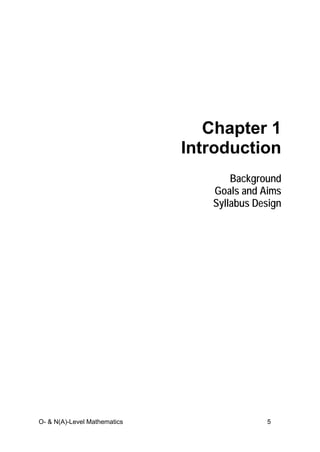
Chapter 1 Introduction 5
Background 6
Goals and Aims 7
Syllabus Design 9
Chapter 2 Mathematics Framework 13
Problem Solving 14
Chapter 3 Teaching, Learning and Assessment 19
Learning Experiences 20
Teaching and Learning 21
Assessment in the Classroom 26
Chapter 4 O-Level Mathematics Syllabus 29
Aims of Syllabus 30
Syllabus Organisation 30
Mathematical Process Strand 31
Content and Learning Experiences by Level 34
Chapter 5 N(A)-Level Mathematics Syllabus 41
Aims of Syllabus 42
Syllabus Organisation 42
Mathematical Process Strand 43
Content and Learning Experiences by Level 45
O- & N(A)-Level Mathematics 5
Chapter 1
Introduction
Background
Goals and Aims
Syllabus Design
O- & N(A)-Level Mathematics 6
Background
Staying Relevant and Forward-Looking
As in all previous reviews, the 2010 full-term review aims to update the
syllabuses so that they continue to meet the needs of our students, build a strong
foundation in mathematics, and make improvement in the school mathematics
education. It takes into consideration the analyses of students’ performances in
national examinations as well as international studies such as TIMSS and PISA. This
review also takes on board the curriculum-wide recommendations from envisaging
studies into the overall Singapore curriculum such as seeking a better balance
between content and skills, creating opportunities to develop 21st
century
competencies, promoting self-directed and collaborative learning through ICT-based
lessons, and developing assessment to support learning.
It is clear at the start of the review that there is more to be considered than
just focusing on the content. While there is a need to constantly review what
students learn, the changes in content will not be the key lever. In fact, little has been
changed in the content as this has stabilised over the years. Instead, more focus has
now been given to skills and competencies that will make a better 21st
century
learner – the process of learning becomes more important than just what is to be
taught and remembered. The syllabuses are therefore written with the view that not
only will it inform teachers on what to teach, it will also influence the way teachers
teach and students learn. One key feature of this set of syllabuses is the explication
of learning experiences, besides the learning outcomes. This gives guidance to
teachers on the opportunities that students should be given as part of their learning.
Ultimately, how students learn matters.
Curriculum review and design is ongoing work. The quality of the curriculum is
as much in its design as it is in its implementation. Teachers, who are the frontline of
curriculum delivery, must believe in the value of the changes. Support, resources
and training will be provided to build capacity in our teachers. All these will be part of
the continuous effort to deliver the best mathematics curriculum for the students.
The O- & N(A)-Level Mathematics syllabuses will be implemented level by
level starting from Secondary One in 2013. The implementation schedule is as
follows:
Year 2013 2014 2015 2016
Level Sec 1 Sec 2 Sec 3 Sec 4
This online syllabus document will be updated yearly according to the
implementation schedule.
O- & N(A)-Level Mathematics 7
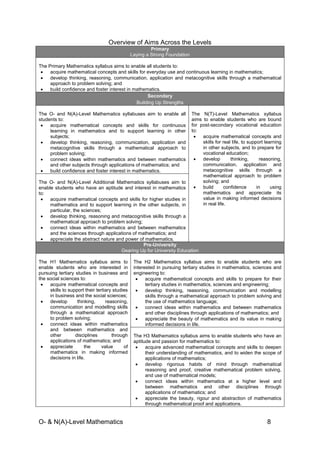
Goals and Aims
Different Syllabuses, Different Aims
The overarching goal of the mathematics curriculum is to ensure that all
students will achieve a level of mastery of mathematics that will serve them well in
life, and for those who have the interest and ability, to pursue mathematics at the
highest possible level.
The broad aims of mathematics education in Singapore are to enable students to:
• acquire and apply mathematical concepts and skills;
• develop cognitive and metacognitive skills through a mathematical approach
to problem solving; and
• develop positive attitudes towards mathematics.
The mathematics curriculum comprises a set of syllabuses spanning 12 years,
from primary to pre-university, and is compulsory up to the end of secondary
education. Each syllabus has its own specific set of aims to guide the design and
implementation of the syllabus. The aims also influence the choice of content, skills
as well as contexts to meet the specific needs of the students at the given level or
course. Each syllabus expands on the three broad aims of mathematics education
differently to cater for the different needs and abilities of the students (see table of
aims on the next page).
What does it mean to teachers?
Understanding the aims of the syllabus helps teachers stay focused on the
larger outcomes of learning and guides teachers when they embark on the school-
based curriculum innovations and customisations.
O- & N(A)-Level Mathematics 8
Overview of Aims Across the Levels
Primary
Laying a Strong Foundation
The Primary Mathematics syllabus aims to enable all students to:
• acquire mathematical concepts and skills for everyday use and continuous learning in mathematics;
• develop thinking, reasoning, communication, application and metacognitive skills through a mathematical
approach to problem solving; and
• build confidence and foster interest in mathematics.
Secondary
Building Up Strengths
The O- and N(A)-Level Mathematics syllabuses aim to enable all
students to:
• acquire mathematical concepts and skills for continuous
learning in mathematics and to support learning in other
subjects;
• develop thinking, reasoning, communication, application and
metacognitive skills through a mathematical approach to
problem solving;
• connect ideas within mathematics and between mathematics
and other subjects through applications of mathematics; and
• build confidence and foster interest in mathematics.
The N(T)-Level Mathematics syllabus
aims to enable students who are bound
for post-secondary vocational education
to:
• acquire mathematical concepts and
skills for real life, to support learning
in other subjects, and to prepare for
vocational education;
• develop thinking, reasoning,
communication, application and
metacognitive skills through a
mathematical approach to problem
solving; and
• build confidence in using
mathematics and appreciate its
value in making informed decisions
in real life.
The O- and N(A)-Level Additional Mathematics syllabuses aim to
enable students who have an aptitude and interest in mathematics
to:
• acquire mathematical concepts and skills for higher studies in
mathematics and to support learning in the other subjects, in
particular, the sciences;
• develop thinking, reasoning and metacognitive skills through a
mathematical approach to problem solving;
• connect ideas within mathematics and between mathematics
and the sciences through applications of mathematics; and
• appreciate the abstract nature and power of mathematics.
Pre-University
Gearing Up for University Education
The H1 Mathematics syllabus aims to
enable students who are interested in
pursuing tertiary studies in business and
the social sciences to:
• acquire mathematical concepts and
skills to support their tertiary studies
in business and the social sciences;
• develop thinking, reasoning,
communication and modelling skills
through a mathematical approach
to problem solving;
• connect ideas within mathematics
and between mathematics and
other disciplines through
applications of mathematics; and
• appreciate the value of
mathematics in making informed
decisions in life.
The H2 Mathematics syllabus aims to enable students who are
interested in pursuing tertiary studies in mathematics, sciences and
engineering to:
• acquire mathematical concepts and skills to prepare for their
tertiary studies in mathematics, sciences and engineering;
• develop thinking, reasoning, communication and modelling
skills through a mathematical approach to problem solving and
the use of mathematics language;
• connect ideas within mathematics and between mathematics
and other disciplines through applications of mathematics; and
• appreciate the beauty of mathematics and its value in making
informed decisions in life.
The H3 Mathematics syllabus aims to enable students who have an
aptitude and passion for mathematics to:
• acquire advanced mathematical concepts and skills to deepen
their understanding of mathematics, and to widen the scope of
applications of mathematics;
• develop rigorous habits of mind through mathematical
reasoning and proof, creative mathematical problem solving,
and use of mathematical models;
• connect ideas within mathematics at a higher level and
between mathematics and other disciplines through
applications of mathematics; and
• appreciate the beauty, rigour and abstraction of mathematics
through mathematical proof and applications.
O- & N(A)-Level Mathematics 9
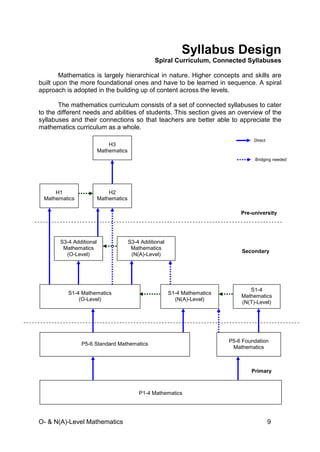
Syllabus Design
Spiral Curriculum, Connected Syllabuses
Mathematics is largely hierarchical in nature. Higher concepts and skills are
built upon the more foundational ones and have to be learned in sequence. A spiral
approach is adopted in the building up of content across the levels.
The mathematics curriculum consists of a set of connected syllabuses to cater
to the different needs and abilities of students. This section gives an overview of the
syllabuses and their connections so that teachers are better able to appreciate the
mathematics curriculum as a whole.
S1-4 Mathematics
(O-Level)
S1-4 Mathematics
(N(A)-Level)
S1-4
Mathematics
(N(T)-Level)
P1-4 Mathematics
P5-6 Standard Mathematics
P5-6 Foundation
Mathematics
Primary
S3-4 Additional
Mathematics
(O-Level)
S3-4 Additional
Mathematics
(N(A)-Level)
Secondary
H1
Mathematics
H2
Mathematics
H3
Mathematics
Pre-university
Direct
Bridging needed
O- & N(A)-Level Mathematics 10
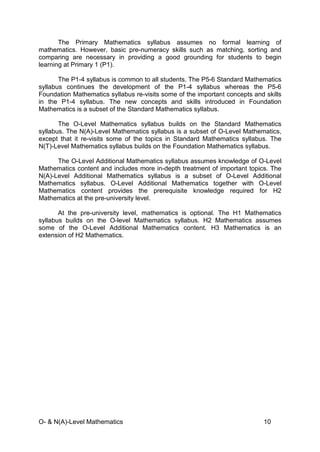
The Primary Mathematics syllabus assumes no formal learning of
mathematics. However, basic pre-numeracy skills such as matching, sorting and
comparing are necessary in providing a good grounding for students to begin
learning at Primary 1 (P1).
The P1-4 syllabus is common to all students. The P5-6 Standard Mathematics
syllabus continues the development of the P1-4 syllabus whereas the P5-6
Foundation Mathematics syllabus re-visits some of the important concepts and skills
in the P1-4 syllabus. The new concepts and skills introduced in Foundation
Mathematics is a subset of the Standard Mathematics syllabus.
The O-Level Mathematics syllabus builds on the Standard Mathematics
syllabus. The N(A)-Level Mathematics syllabus is a subset of O-Level Mathematics,
except that it re-visits some of the topics in Standard Mathematics syllabus. The
N(T)-Level Mathematics syllabus builds on the Foundation Mathematics syllabus.
The O-Level Additional Mathematics syllabus assumes knowledge of O-Level
Mathematics content and includes more in-depth treatment of important topics. The
N(A)-Level Additional Mathematics syllabus is a subset of O-Level Additional
Mathematics syllabus. O-Level Additional Mathematics together with O-Level
Mathematics content provides the prerequisite knowledge required for H2
Mathematics at the pre-university level.
At the pre-university level, mathematics is optional. The H1 Mathematics
syllabus builds on the O-level Mathematics syllabus. H2 Mathematics assumes
some of the O-Level Additional Mathematics content. H3 Mathematics is an
extension of H2 Mathematics.
O- & N(A)-Level Mathematics 11
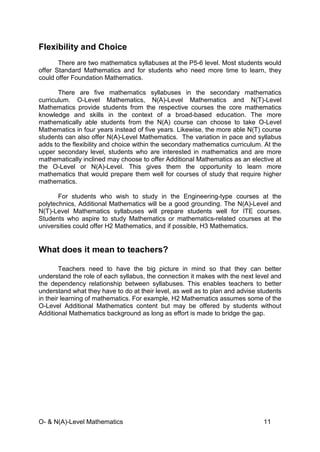
Flexibility and Choice
There are two mathematics syllabuses at the P5-6 level. Most students would
offer Standard Mathematics and for students who need more time to learn, they
could offer Foundation Mathematics.
There are five mathematics syllabuses in the secondary mathematics
curriculum. O-Level Mathematics, N(A)-Level Mathematics and N(T)-Level
Mathematics provide students from the respective courses the core mathematics
knowledge and skills in the context of a broad-based education. The more
mathematically able students from the N(A) course can choose to take O-Level
Mathematics in four years instead of five years. Likewise, the more able N(T) course
students can also offer N(A)-Level Mathematics. The variation in pace and syllabus
adds to the flexibility and choice within the secondary mathematics curriculum. At the
upper secondary level, students who are interested in mathematics and are more
mathematically inclined may choose to offer Additional Mathematics as an elective at
the O-Level or N(A)-Level. This gives them the opportunity to learn more
mathematics that would prepare them well for courses of study that require higher
mathematics.
For students who wish to study in the Engineering-type courses at the
polytechnics, Additional Mathematics will be a good grounding. The N(A)-Level and
N(T)-Level Mathematics syllabuses will prepare students well for ITE courses.
Students who aspire to study Mathematics or mathematics-related courses at the
universities could offer H2 Mathematics, and if possible, H3 Mathematics.
What does it mean to teachers?
Teachers need to have the big picture in mind so that they can better
understand the role of each syllabus, the connection it makes with the next level and
the dependency relationship between syllabuses. This enables teachers to better
understand what they have to do at their level, as well as to plan and advise students
in their learning of mathematics. For example, H2 Mathematics assumes some of the
O-Level Additional Mathematics content but may be offered by students without
Additional Mathematics background as long as effort is made to bridge the gap.
O- & N(A)-Level Mathematics 13
Chapter 2
Mathematics Framework
Problem Solving
O- & N(A)-Level Mathematics 14
Problem Solving
Concepts, Skills, Processes, Metacognition, Attitudes
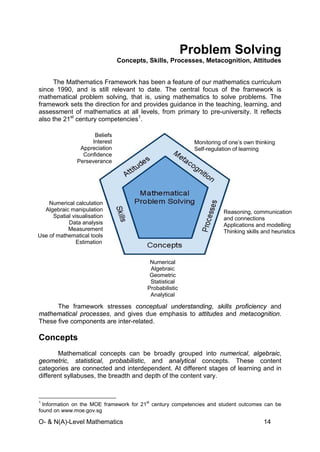
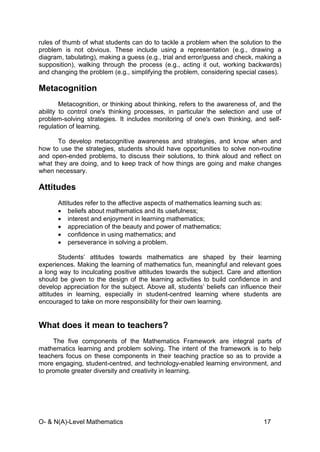
The Mathematics Framework has been a feature of our mathematics curriculum
since 1990, and is still relevant to date. The central focus of the framework is
mathematical problem solving, that is, using mathematics to solve problems. The
framework sets the direction for and provides guidance in the teaching, learning, and
assessment of mathematics at all levels, from primary to pre-university. It reflects
also the 21st
century competencies1
.
The framework stresses conceptual understanding, skills proficiency and
mathematical processes, and gives due emphasis to attitudes and metacognition.
These five components are inter-related.
Concepts
Mathematical concepts can be broadly grouped into numerical, algebraic,
geometric, statistical, probabilistic, and analytical concepts. These content
categories are connected and interdependent. At different stages of learning and in
different syllabuses, the breadth and depth of the content vary.
1
Information on the MOE framework for 21
st
century competencies and student outcomes can be
found on www.moe.gov.sg
Numerical calculation
Algebraic manipulation
Spatial visualisation
Data analysis
Measurement
Use of mathematical tools
Estimation
Numerical
Algebraic
Geometric
Statistical
Probabilistic
Analytical
Reasoning, communication
and connections
Applications and modelling
Thinking skills and heuristics
Monitoring of one’s own thinking
Self-regulation of learning
Beliefs
Interest
Appreciation
Confidence
Perseverance
O- & N(A)-Level Mathematics 15
To develop a deep understanding of mathematical concepts, and to make
sense of various mathematical ideas as well as their connections and applications,
students should be exposed to a variety of learning experiences including hands-on
activities and use of technological aids to help them relate abstract mathematical
concepts with concrete experiences.
Skills
Mathematical skills refer to numerical calculation, algebraic manipulation,
spatial visualisation, data analysis, measurement, use of mathematical tools, and
estimation. The skills are specific to mathematics and are important in the learning
and application of mathematics. In today’s classroom, these skills also include the
abilities to use spreadsheets and other software to learn and do mathematics.
To develop proficiencies in mathematics skills, students should have
opportunities to use and practise the skills. These skills should be taught with an
understanding of the underlying mathematical principles and not merely as
procedures.
Processes
Mathematical processes refer to the process skills involved in the process of
acquiring and applying mathematical knowledge. These include reasoning,
communication and connections, applications and modelling, and thinking skills and
heuristics that are important in mathematics and beyond.
In the context of mathematics, reasoning, communication and connections
take on special meanings:
• Mathematical reasoning refers to the ability to analyse mathematical
situations and construct logical arguments. It is a habit of mind that can be
developed through application of mathematics in different contexts.
• Communication refers to the ability to use mathematical language to
express mathematical ideas and arguments precisely, concisely and
logically. It helps students develop their understanding of mathematics and
sharpen their mathematical thinking.
• Connections refer to the ability to see and make linkages among
mathematical ideas, between mathematics and other subjects, and
between mathematics and the real world. This helps students make sense
of what they learn in mathematics.
Applications and modelling allow students to connect mathematics that they
have learnt to the real world, enhance understanding of key mathematical concepts
and methods as well as develop mathematical competencies. Students should have
opportunities to apply mathematical problem-solving and reasoning skills to tackle a
variety of problems, including open-ended and real-world problems. Mathematical
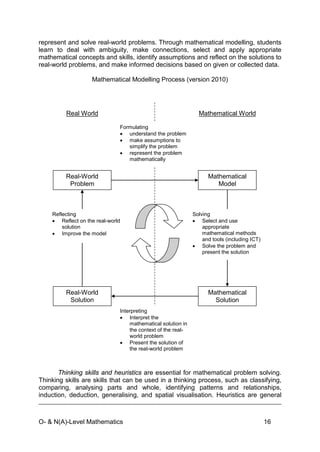
modelling is the process of formulating and improving a mathematical model2
2
A mathematical model is a mathematical representation or idealisation of a real-world situation. It
can be as complicated as a system of equations or as simple as a geometrical figure. As the word
“model” suggests, it shares characteristics of the real-world situation that it seeks to represent.
to
O- & N(A)-Level Mathematics 16
represent and solve real-world problems. Through mathematical modelling, students
learn to deal with ambiguity, make connections, select and apply appropriate
mathematical concepts and skills, identify assumptions and reflect on the solutions to
real-world problems, and make informed decisions based on given or collected data.
Mathematical Modelling Process (version 2010)
Thinking skills and heuristics are essential for mathematical problem solving.
Thinking skills are skills that can be used in a thinking process, such as classifying,
comparing, analysing parts and whole, identifying patterns and relationships,
induction, deduction, generalising, and spatial visualisation. Heuristics are general
Real World Mathematical World
Real-World
Problem
Mathematical
Model
Formulating
• understand the problem
• make assumptions to
simplify the problem
• represent the problem
mathematically
Mathematical
Solution
Solving
• Select and use
appropriate
mathematical methods
and tools (including ICT)
• Solve the problem and
present the solution
Real-World
Solution
Interpreting
• Interpret the
mathematical solution in
the context of the real-
world problem
• Present the solution of
the real-world problem
Reflecting
• Reflect on the real-world
solution
• Improve the model
O- & N(A)-Level Mathematics 17
rules of thumb of what students can do to tackle a problem when the solution to the
problem is not obvious. These include using a representation (e.g., drawing a
diagram, tabulating), making a guess (e.g., trial and error/guess and check, making a
supposition), walking through the process (e.g., acting it out, working backwards)
and changing the problem (e.g., simplifying the problem, considering special cases).
Metacognition
Metacognition, or thinking about thinking, refers to the awareness of, and the
ability to control one's thinking processes, in particular the selection and use of
problem-solving strategies. It includes monitoring of one's own thinking, and self-
regulation of learning.
To develop metacognitive awareness and strategies, and know when and
how to use the strategies, students should have opportunities to solve non-routine
and open-ended problems, to discuss their solutions, to think aloud and reflect on
what they are doing, and to keep track of how things are going and make changes
when necessary.
Attitudes
Attitudes refer to the affective aspects of mathematics learning such as:
• beliefs about mathematics and its usefulness;
• interest and enjoyment in learning mathematics;
• appreciation of the beauty and power of mathematics;
• confidence in using mathematics; and
• perseverance in solving a problem.
Students’ attitudes towards mathematics are shaped by their learning
experiences. Making the learning of mathematics fun, meaningful and relevant goes
a long way to inculcating positive attitudes towards the subject. Care and attention
should be given to the design of the learning activities to build confidence in and
develop appreciation for the subject. Above all, students’ beliefs can influence their
attitudes in learning, especially in student-centred learning where students are
encouraged to take on more responsibility for their own learning.
What does it mean to teachers?
The five components of the Mathematics Framework are integral parts of
mathematics learning and problem solving. The intent of the framework is to help
teachers focus on these components in their teaching practice so as to provide a
more engaging, student-centred, and technology-enabled learning environment, and
to promote greater diversity and creativity in learning.
O- & N(A)-Level Mathematics 19
Chapter 3
Teaching, Learning
and Assessment
Learning Experiences
Teaching and Learning
Assessment in the Classroom
O- & N(A)-Level Mathematics 20
Learning Experiences
It matters how students learn
Learning mathematics is more than just learning concepts and skills. Equally
important are the cognitive and metacognitive process skills. These processes are
learned through carefully constructed learning experiences. For example, to
encourage students to be inquisitive, the learning experiences must include
opportunities where students discover mathematical results on their own. To support
the development of collaborative and communication skills, students must be given
opportunities to work together on a problem and present their ideas using
appropriate mathematical language and methods. To develop habits of self-directed
learning, students must be given opportunities to set learning goals and work
towards them purposefully. A classroom, rich with these opportunities, will provide
the platform for students to develop these 21st
century competencies.
Learning experiences are stated in the mathematics syllabuses to influence
the ways teachers teach and students learn so that the curriculum objectives can be
achieved. These statements expressed in the form “students should have
opportunities to …” remind teachers of the student-centric nature of these
experiences. They describe actions that students will perform and activities that
students will go through, with the opportunities created and guidance rendered by
teachers. The descriptions are sufficiently specific to provide guidance yet broad
enough to give flexibility to the teachers.
For each topic, the learning experiences focus on the mathematical processes
and skills that are integral parts of learning of that topic. There are also generic
learning experiences that focus on the development of good learning habits and
skills such as:
Students should have opportunities to:
• take notes and organise information meaningfully;
• practise basic mathematical skills to achieve mastery;
• use feedback from assessment to improve learning;
• solve novel problems using a repertoire of heuristics;
• discuss, articulate and explain ideas to develop reasoning skills; and
• carry out a modelling project.
These learning experiences, whether they are topical or generic, are not
exhaustive. Teachers are encouraged to do more to make learning meaningful and
effective.
O- & N(A)-Level Mathematics 21
Teaching and Learning
Principles of Teaching and Phases of Learning
This section outlines three principles of mathematics teaching and the three
phases of mathematics learning in the classrooms.
Principles of Teaching
Principle 1
Teaching is for learning; learning is for understanding; understanding is for reasoning
and applying and, ultimately problem solving.
Teaching is an interactive process that is focused on students’ learning. In this
process, teachers use a range of teaching approaches to engage students in
learning; students provide teachers with feedback on what they have learnt through
assessment; and teachers in turn provide feedback to students and make decisions
about instructions to improve learning.
The learning of mathematics should focus on understanding, not just recall of
facts or reproduction of procedures. Understanding is necessary for deep learning
and mastery. Only with understanding can students be able to reason
mathematically and apply mathematics to solve a range of problems. After all,
problem solving is the focus of the mathematics curriculum.
Principle 2
Teaching should build on students’ knowledge; take cognisance of students’
interests and experiences; and engage them in active and reflective learning.
Mathematics is a hierarchical subject. Without understanding of pre-requisite
knowledge, foundation will be weak and learning will be shallow. It is important for
teachers to check on students’ understanding before introducing new concepts and
skills.
Teachers need to be aware of their students’ interests and abilities so as to
develop learning tasks that are stimulating and challenging. This is important in order
to engage students in active and reflective learning where students participate and
take ownership of the learning.
Principle 3
Teaching should connect learning to the real world, harness ICT tools and
emphasise 21st
century competencies.
There are many applications of mathematics in the real world. Students
should have an understanding and appreciation of these applications and how
mathematics is used to model and solve problems in real-world contexts. In this way,
students will see the meaning and relevance of mathematics.
O- & N(A)-Level Mathematics 22
Teachers should consider the affordances of ICT to help students learn. ICT
tools can help students understand mathematical concepts through visualisations,
simulations and representations. They can also support exploration and
experimentation and extend the range of problems accessible to students. The ability
to use ICT tools is part of the 21st
century competencies. It is also important to
design learning in ways that promote the development of other 21st
century
competencies such as working collaboratively and thinking critically about the
mathematical solution.
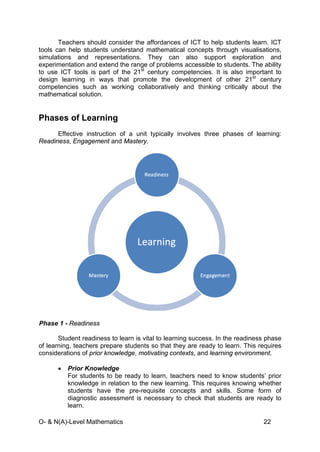
Phases of Learning
Effective instruction of a unit typically involves three phases of learning:
Readiness, Engagement and Mastery.
Phase 1 - Readiness
Student readiness to learn is vital to learning success. In the readiness phase
of learning, teachers prepare students so that they are ready to learn. This requires
considerations of prior knowledge, motivating contexts, and learning environment.
• Prior Knowledge
For students to be ready to learn, teachers need to know students’ prior
knowledge in relation to the new learning. This requires knowing whether
students have the pre-requisite concepts and skills. Some form of
diagnostic assessment is necessary to check that students are ready to
learn.
O- & N(A)-Level Mathematics 23
• Motivating Contexts
For students to be ready to learn, teachers need to provide motivating
contexts for learning. These contexts should be developmentally
appropriate. For example, younger students may like contexts such as
stories and songs, and play-based activities such as games, whereas
older students may appreciate contexts related to everyday life so that
they can see the relevance and meaningfulness of mathematics. For the
more advanced students, applications in other disciplines can serve as
motivation for learning.
• Learning Environment
Shared rules help promote respectful and emotionally-safe interactions
between teacher and students and among students that are necessary for
productive and purposeful learning. Established procedures for organising
students and managing resources will also facilitate a smooth start and
transitions during lessons.
Phase 2 - Engagement
This is the main phase of learning where teachers use a repertoire of
pedagogies to engage students in learning new concepts and skills. Three
pedagogical approaches form the spine that supports most of the mathematics
instruction in the classroom. They are not mutually exclusive and could be used in
different parts of a lesson or unit. For example, the lesson or unit could start with an
activity, followed by teacher-led inquiry and end with direct instruction.
• Activity-based Learning
This approach is about learning by doing. It is particularly effective for
teaching mathematical concepts and skills at primary and lower secondary
levels, but is also effective at higher levels. Students engage in activities to
explore and learn mathematical concepts and skills, individually or in
groups. They could use manipulatives or other resources to construct
meanings and understandings. From concrete manipulatives and
experiences, students are guided to uncover abstract mathematical
concepts or results.
For example, students use the virtual balance in AlgeToolsTM
to learn the
concept of equations involving negative numbers, construct numerical and
algebraic equations, and learn the process of solving linear equations by
manipulating algebra discs on the virtual balance. During the activity,
students communicate and share their understanding using concrete and
pictorial representations. The role of the teacher is that of a facilitator who
guides students through the concrete, pictorial and abstract levels of
understanding by providing appropriate scaffolding and feedback.
• Teacher-directed Inquiry
This approach is about learning through guided inquiry. Instead of giving
the answers, teachers lead students to explore, investigate and find
answers on their own. Students learn to focus on specific questions and
O- & N(A)-Level Mathematics 24
ideas and are engaged in communicating, explaining and reflecting on
their answers. They also learn to pose questions, process information and
data and seek appropriate methods and solutions. This enhances the
development of mathematical processes and 21st
century competencies.
For example, students work together on a learning task in an ICT-enabled
environment with guiding questions to investigate properties of geometric
figures. They discuss and share their observations and findings, make
conjectures regarding geometric properties and relationships, and justify
them. The role of the teacher is that of a facilitator who asks questions to
probe students’ thinking, and guides students through the process of
inquiry by directing them to specific questions and information to
investigate, providing individual scaffolding, and challenging the abler
students to extend and deepen their learning. Students are encouraged to
communicate using appropriate mathematical language. The teacher also
assesses students’ understanding, identifies gaps and misconceptions,
and reinforces key concepts through continuous interactive assessments.
• Direct Instruction
This approach is about explicit teaching. Teachers introduce, explain and
demonstrate new concepts and skills. Direct instruction is most effective
when students are told what they will be learning and what they are
expected to be able to do. This helps them focus on the learning goals.
Teachers draw connections, pose questions, emphasise key concepts,
and role-model thinking. Holding students’ attention is critical. Stimuli such
as videos, graphic images, real-world contexts, and even humour, aid in
maintaining a high level of attention.
For example, in teaching problem solving, the teacher demonstrates how
to use Polya’s four-step problem-solving strategy3
and models thinking
aloud to make visible the thinking processes. The teacher probes students’
conceptual understanding, corrects their misconceptions, and guides them
in the process of solving problems. During lesson closure, the teacher
reviews the key learning points of the lesson to consolidate the learning.
Phase 3 - Mastery
This is the final phase of learning where teachers help students consolidate
and extend their learning. The mastery approaches include:
• Motivated Practice
Students need practice to achieve mastery. Practice can be motivating
and fun. Practice must include repetition and variation to achieve
proficiency and flexibility. Structuring practice in the form of games is one
good strategy to make practice motivating and fun, while allowing for
3
G. Polya, "How to Solve It", 2nd Ed., Princeton University Press, 1957.
O- & N(A)-Level Mathematics 25
repetition and variation. There should be a range of activities, from simple
recall of facts to application of concepts.
• Reflective Review
It is important that students consolidate and deepen their learning through
tasks that allow them to reflect on their learning. This is a good habit that
needs to be cultivated from an early age and it supports the development
of metacognition. Summarising their learning using concept maps, writing
journals to reflect on their learning and making connections between
mathematical ideas and between mathematics and other subjects should
be encouraged. Sharing such reflections through blogs makes learning
social.
• Extended Learning
Students who are mathematically inclined should have opportunities to
extend their learning. These can be in the form of more challenging tasks
that stretch their thinking and deepen their understanding.
O- & N(A)-Level Mathematics 26
Assessment in the Classroom
Supporting Teaching and Learning in Mathematics
Role of assessment
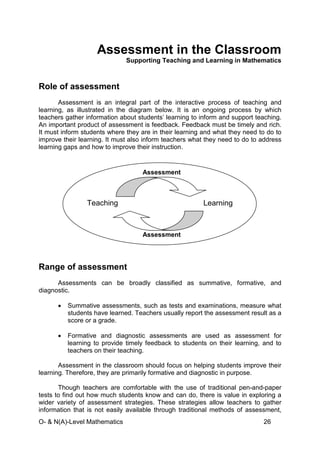
Assessment is an integral part of the interactive process of teaching and
learning, as illustrated in the diagram below. It is an ongoing process by which
teachers gather information about students’ learning to inform and support teaching.
An important product of assessment is feedback. Feedback must be timely and rich.
It must inform students where they are in their learning and what they need to do to
improve their learning. It must also inform teachers what they need to do to address
learning gaps and how to improve their instruction.
Range of assessment
Assessments can be broadly classified as summative, formative, and
diagnostic.
• Summative assessments, such as tests and examinations, measure what
students have learned. Teachers usually report the assessment result as a
score or a grade.
• Formative and diagnostic assessments are used as assessment for
learning to provide timely feedback to students on their learning, and to
teachers on their teaching.
Assessment in the classroom should focus on helping students improve their
learning. Therefore, they are primarily formative and diagnostic in purpose.
Though teachers are comfortable with the use of traditional pen-and-paper
tests to find out how much students know and can do, there is value in exploring a
wider variety of assessment strategies. These strategies allow teachers to gather
information that is not easily available through traditional methods of assessment,
Teaching Learning
Assessment
Assessment
O- & N(A)-Level Mathematics 27
but are nevertheless valuable in supporting learning. Ultimately, the choice of
assessment strategies must be guided by its purpose, that is, it must be fit-for-
purpose.
Integrating assessment with instruction
It is important that teachers know what and when to assess student learning,
and how to embed the assessment in the learning process. Assessment can be
integrated into classroom discourse and activities using different assessment
strategies. For example, teachers may watch students solve problems and get them
to explain their strategies. Teachers may also engage students in assessing their
own work and reflecting on their own learning and how to improve it. Both moment-
by-moment assessment and planned assessment should be considered.
Effective questioning can scaffold learning and probe understanding. It
creates teachable moments for teachers to correct a misconception, reinforce a point
or expand on an idea. The questions can be open-ended to encourage students to
consider alternative approaches. Sufficient wait-time is necessary so that students
can formulate their thoughts, communicate and share their ideas, and hear the ideas
of others. In the process, students learn to articulate their thinking and deepen their
understanding, and develop confidence in talking about mathematics and using it.
Teachers can assess students’ thinking and understanding, and provide useful
feedback to improve their learning.
Teachers can integrate performance assessments into the instructional
process to provide additional learning experiences for students. This type of
assessment requires students to apply their knowledge and skills in context, and the
focus is on mathematical processes rather than on mathematics content. A rubric is
useful to show teachers what to look for in students’ work, but more importantly, it
shows what is expected of students in terms of processes and quality of work. The
rubric also provides a structured means of giving qualitative feedback. Teachers may
allow students to assess their own performances so that they can reflect on their
work and make improvements.
Assessment for learning calls for new ways of assessment in the classroom. It
involves a change in teachers’ roles and in the expectations of students. By
integrating assessment and instruction, students will be more engaged in and will
take greater ownership of their learning.
O-Level Mathematics 29
Chapter 4
O-Level Mathematics
Syllabus
Aims of Syllabus
Syllabus Organisation
Content and Learning Experiences by Level
O-Level Mathematics 30
Aims of Syllabus
The O-Level Mathematics syllabus aims to enable all students to:
• acquire mathematical concepts and skills for continuous learning in
mathematics and to support learning in other subjects;
• develop thinking, reasoning, communication, application and metacognitive
skills through a mathematical approach to problem-solving;
• connect ideas within mathematics and between mathematics and other
subjects through applications of mathematics; and
• build confidence and foster interest in mathematics.
Syllabus Organisation
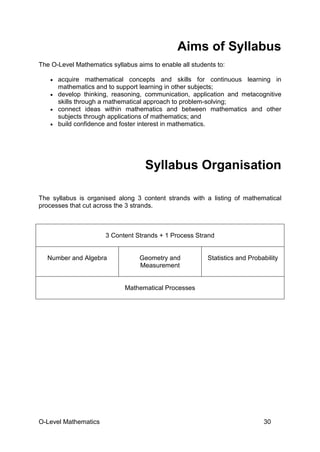
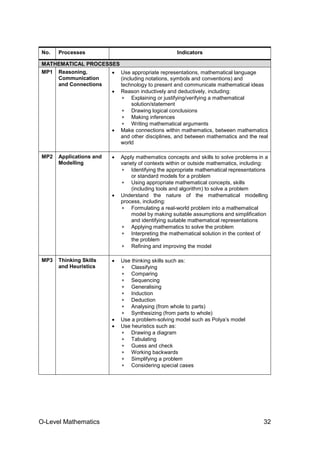
The syllabus is organised along 3 content strands with a listing of mathematical
processes that cut across the 3 strands.
3 Content Strands + 1 Process Strand
Number and Algebra Geometry and
Measurement
Statistics and Probability
Mathematical Processes
O-Level Mathematics 31
Strand: Mathematical Processes
Mathematical processes refer to the process skills involved in the process of
acquiring and applying mathematical knowledge. This includes reasoning,
communication and connections, applications and modelling, and thinking skills and
heuristics that are important in mathematical problem solving and beyond.
At the secondary level, students gradually move from inductive arguments to
deductive arguments and justifications (e.g. to justify a mathematical statement using
a short chain of logical reasoning or to disprove a statement by a counter example).
They will continue to make connections among mathematical ideas, and between
mathematics and the real world. They should be able to read and critique arguments
that are supported by mathematics.
Greater attention will be given to applications and modelling at the secondary level,
as students become more mature and aware of their immediate environment and
phenomenon. Besides learning standard mathematical models, students should,
under teacher guidance, develop an awareness and understanding of the
mathematical modelling process. They work on real-world problems either
individually or in groups. They would need to understand the real-world situation,
make assumptions about the situation, devise a mathematical model to solve the
problem, and interpret the solution in the context of the situation. The process of
mathematical modelling widens and deepens students’ understanding of
mathematics, and helps them develop important 21st
century skills, including
collaboration, creativity, communication and critical thinking.
The teaching of process skills should be deliberate and yet integrated with the
learning of concepts and skills. Students should be exposed to problem solving
approaches such as the Polya’s model and the steps in a modelling process in class.
Teachers could “think aloud” to give attention to these processes and make them
visible to students. Students should be given opportunities to work in groups and use
ICT tools for modelling tasks. ICT tools empower students to work on problems
which would otherwise require more advanced mathematics or computations that are
too tedious and repetitive. Through practice, students will develop habits and
strategies that will help them be better and more independent learners.
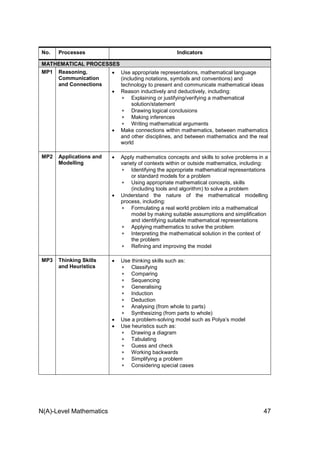
O-Level Mathematics 32
No. Processes Indicators
MATHEMATICAL PROCESSES
MP1 Reasoning,
Communication
and Connections
• Use appropriate representations, mathematical language
(including notations, symbols and conventions) and
technology to present and communicate mathematical ideas
• Reason inductively and deductively, including:
∗ Explaining or justifying/verifying a mathematical
solution/statement
∗ Drawing logical conclusions
∗ Making inferences
∗ Writing mathematical arguments
• Make connections within mathematics, between mathematics
and other disciplines, and between mathematics and the real
world
MP2 Applications and
Modelling
• Apply mathematics concepts and skills to solve problems in a
variety of contexts within or outside mathematics, including:
∗ Identifying the appropriate mathematical representations
or standard models for a problem
∗ Using appropriate mathematical concepts, skills
(including tools and algorithm) to solve a problem
• Understand the nature of the mathematical modelling
process, including:
∗ Formulating a real-world problem into a mathematical
model by making suitable assumptions and simplification
and identifying suitable mathematical representations
∗ Applying mathematics to solve the problem
∗ Interpreting the mathematical solution in the context of
the problem
∗ Refining and improving the model
MP3 Thinking Skills
and Heuristics
• Use thinking skills such as:
∗ Classifying
∗ Comparing
∗ Sequencing
∗ Generalising
∗ Induction
∗ Deduction
∗ Analysing (from whole to parts)
∗ Synthesizing (from parts to whole)
• Use a problem-solving model such as Polya’s model
• Use heuristics such as:
∗ Drawing a diagram
∗ Tabulating
∗ Guess and check
∗ Working backwards
∗ Simplifying a problem
∗ Considering special cases
O-Level Mathematics 33
Content & Learning Experiences
by Level
In this section, the content is listed by levels and learning experiences statements
are included.
The learning experiences for the O-Level Mathematics syllabus should provide
opportunities for students to:
• enhance conceptual understanding through use of various mathematical tools
including ICT tools;
• apply concepts and skills learnt in real-world context;
• communicate their reasoning and connections through various mathematical
tasks and activities; and
• build confidence and foster interest in mathematics.
O-Level Mathematics 34
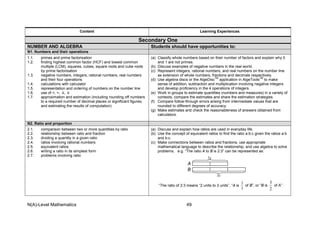
Content Learning Experiences
Secondary One
NUMBER AND ALGEBRA Students should have opportunities to:
N1. Numbers and their operations
1.1. primes and prime factorisation
1.2. finding highest common factor (HCF) and lowest common
multiple (LCM), squares, cubes, square roots and cube roots
by prime factorisation
1.3. negative numbers, integers, rational numbers, real numbers
and their four operations
1.4. calculations with calculator
1.5. representation and ordering of numbers on the number line
1.6. use of <, >, ≤, ≥
1.7. approximation and estimation (including rounding off numbers
to a required number of decimal places or significant figures,
and estimating the results of computation)
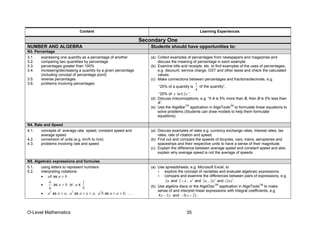
(a) Classify whole numbers based on their number of factors and explain why 0
and 1 are not primes.
(b) Discuss examples of negative numbers in the real world.
(c) Represent integers, rational numbers and real numbers on the number line as
extension of whole numbers, fractions and decimals respectively.
(d) Use algebra discs or the AlgeDisc
TM
application in AlgeTools
TM
to make
sense of addition, subtraction and multiplication involving negative integers
and develop proficiency in the 4 operations of integers.
(e) Work in groups to estimate quantities (numbers and measures) in a variety of
contexts, compare the estimates and share the estimation strategies.
(f) Compare follow-through errors arising from intermediate values that are
rounded to different degrees of accuracy.
(g) Make estimates and check the reasonableness of answers obtained by
calculators.
N2. Ratio and proportion
2.1. ratios involving rational numbers
2.2. writing a ratio in its simplest form
2.3. problems involving ratio
(a) Discuss and explain how ratios are used in everyday life.
(b) Use the concept of equivalent ratios to find the ratio a:b:c given the ratios a:b
and b:c.
(c) Make connections between ratios and fractions, use appropriate
mathematical language to describe the relationship, and use algebra to solve
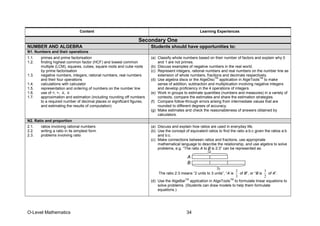
problems, e.g. “The ratio A to B is 2:3” can be represented as:
The ratio 2:3 means “2 units to 3 units”, “A is
3
2
of B”, or “B is
2
3
of A”.
(d) Use the AlgeBar
TM
application in AlgeTools
TM
to formulate linear equations to
solve problems. (Students can draw models to help them formulate
equations.)
A
B
2x
3x
O-Level Mathematics 35
Content Learning Experiences
Secondary One
NUMBER AND ALGEBRA Students should have opportunities to:
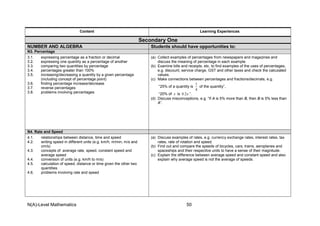
N3. Percentage
3.1. expressing one quantity as a percentage of another
3.2. comparing two quantities by percentage
3.3. percentages greater than 100%
3.4. increasing/decreasing a quantity by a given percentage
(including concept of percentage point)
3.5. reverse percentages
3.6. problems involving percentages
(a) Collect examples of percentages from newspapers and magazines and
discuss the meaning of percentage in each example.
(b) Examine bills and receipts, etc. to find examples of the uses of percentages,
e.g. discount, service charge, GST and other taxes and check the calculated
values.
(c) Make connections between percentages and fractions/decimals, e.g.
“25% of a quantity is
4
1
of the quantity”,
“20% of x is x2.0 ”.
(d) Discuss misconceptions, e.g. “If A is 5% more than B, then B is 5% less than
A”.
(e) Use the AlgeBar
TM
application in AlgeTools
TM
to formulate linear equations to
solve problems (Students can draw models to help them formulate
equations).
N4. Rate and Speed
4.1. concepts of average rate, speed, constant speed and
average speed
4.2. conversion of units (e.g. km/h to m/s)
4.3. problems involving rate and speed
(a) Discuss examples of rates e.g. currency exchange rates, interest rates, tax
rates, rate of rotation and speed.
(b) Find out and compare the speeds of bicycles, cars, trains, aeroplanes and
spaceships and their respective units to have a sense of their magnitude.
(c) Explain the difference between average speed and constant speed and also
explain why average speed is not the average of speeds.
N5. Algebraic expressions and formulae
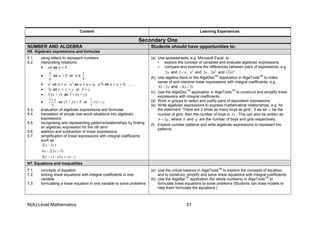
5.1. using letters to represent numbers
5.2. interpreting notations:
• ab as a × b
•
a
b
as a ÷ b or a x
1
b
• a2
as a × a, a3
as a × a × a, a2
b as a × a × b, . . .
(a) Use spreadsheets, e.g. Microsoft Excel, to
∗ explore the concept of variables and evaluate algebraic expressions.
∗ compare and examine the differences between pairs of expressions, e.g.
2n and 2 n+ , 2
n and 2n , 2
2n and 2
(2 )n .
(b) Use algebra discs or the AlgeDisc
TM
application in AlgeTools
TM
to make
sense of and interpret linear expressions with integral coefficients, e.g.
4 3x y− and 3( 2)x− − .
O-Level Mathematics 36
Content Learning Experiences
Secondary One
NUMBER AND ALGEBRA Students should have opportunities to:
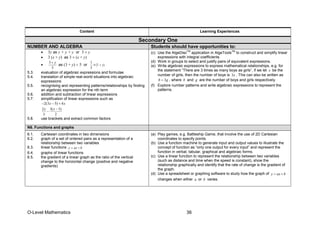
• 3y as y + y + y or 3 × y
• 3 (x + y) as 3 × (x + y)
•
3
5
y+
as (3 + y) ÷ 5 or
1
5
×(3 )y+
5.3. evaluation of algebraic expressions and formulae
5.4. translation of simple real-world situations into algebraic
expressions
5.5. recognising and representing patterns/relationships by finding
an algebraic expression for the nth term
5.6. addition and subtraction of linear expressions
5.7. simplification of linear expressions such as
2(3 5) 4x x− − +
2
)5(3
3
2 −
−
xx
5.8. use brackets and extract common factors
(c) Use the AlgeDisc
TM
application in AlgeTools
TM
to construct and simplify linear
expressions with integral coefficients.
(d) Work in groups to select and justify pairs of equivalent expressions.
(e) Write algebraic expressions to express mathematical relationships, e.g. for
the statement “There are 3 times as many boys as girls”, if we let x be the
number of girls, then the number of boys is x3 . This can also be written as
gb 3= , where b and g are the number of boys and girls respectively.
(f) Explore number patterns and write algebraic expressions to represent the
patterns.
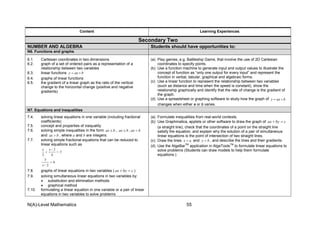
N6. Functions and graphs
6.1. Cartesian coordinates in two dimensions
6.2. graph of a set of ordered pairs as a representation of a
relationship between two variables
6.3. linear functions y ax b= +
6.4. graphs of linear functions
6.5. the gradient of a linear graph as the ratio of the vertical
change to the horizontal change (positive and negative
gradients)
(a) Play games, e.g. Battleship Game, that involve the use of 2D Cartesian
coordinates to specify points.
(b) Use a function machine to generate input and output values to illustrate the
concept of function as “only one output for every input” and represent the
function in verbal, tabular, graphical and algebraic forms.
(c) Use a linear function to represent the relationship between two variables
(such as distance and time when the speed is constant), show the
relationship graphically and identify that the rate of change is the gradient of
the graph.
(d) Use a spreadsheet or graphing software to study how the graph of y ax b= +
changes when either a or b varies.
O-Level Mathematics 37
Content Learning Experiences
Secondary One
NUMBER AND ALGEBRA Students should have opportunities to:
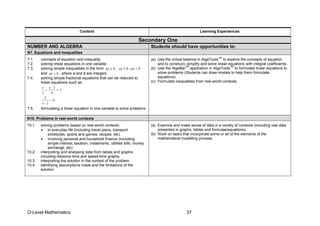
N7. Equations and inequalities
7.1. concepts of equation and inequality
7.2. solving linear equations in one variable
7.3. solving simple inequalities in the form ax b≤ , ax b≥ , ax b<
and ax b> , where a and b are integers
7.4. solving simple fractional equations that can be reduced to
linear equations such as
2
3
3 4
x x −
+ =
3
6
2x
=
−
7.5. formulating a linear equation in one variable to solve problems
(a) Use the virtual balance in AlgeTools
TM
to explore the concepts of equation
and to construct, simplify and solve linear equations with integral coefficients..
(b) Use the AlgeBar
TM
application in AlgeTools
TM
to formulate linear equations to
solve problems (Students can draw models to help them formulate
equations).
(c) Formulate inequalities from real-world contexts.
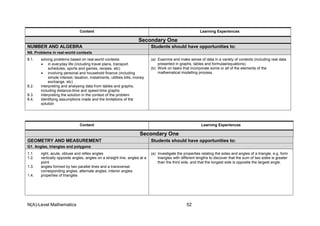
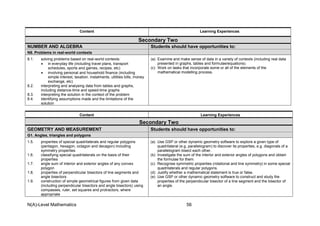
N10. Problems in real-world contexts
10.1. solving problems based on real-world contexts:
• in everyday life (including travel plans, transport
schedules, sports and games, recipes, etc)
• involving personal and household finance (including
simple interest, taxation, instalments, utilities bills, money
exchange, etc)
10.2. interpreting and analysing data from tables and graphs,
including distance-time and speed-time graphs
10.3. interpreting the solution in the context of the problem
10.4. identifying assumptions made and the limitations of the
solution
(a) Examine and make sense of data in a variety of contexts (including real data
presented in graphs, tables and formulae/equations).
(b) Work on tasks that incorporate some or all of the elements of the
mathematical modelling process.
O-Level Mathematics 38
Content Learning Experiences
Secondary One
GEOMETRY AND MEASUREMENT Students should have opportunities to:
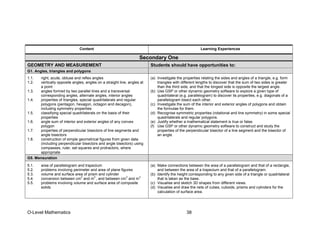
G1. Angles, triangles and polygons
1.1. right, acute, obtuse and reflex angles
1.2. vertically opposite angles, angles on a straight line, angles at
a point
1.3. angles formed by two parallel lines and a transversal:
corresponding angles, alternate angles, interior angles
1.4. properties of triangles, special quadrilaterals and regular
polygons (pentagon, hexagon, octagon and decagon),
including symmetry properties
1.5. classifying special quadrilaterals on the basis of their
properties
1.6. angle sum of interior and exterior angles of any convex
polygon
1.7. properties of perpendicular bisectors of line segments and
angle bisectors
1.8. construction of simple geometrical figures from given data
(including perpendicular bisectors and angle bisectors) using
compasses, ruler, set squares and protractors, where
appropriate
(a) Investigate the properties relating the sides and angles of a triangle, e.g. form
triangles with different lengths to discover that the sum of two sides is greater
than the third side, and that the longest side is opposite the largest angle.
(b) Use GSP or other dynamic geometry software to explore a given type of
quadrilateral (e.g. parallelogram) to discover its properties, e.g. diagonals of a
parallelogram bisect each other.
(c) Investigate the sum of the interior and exterior angles of polygons and obtain
the formulae for them.
(d) Recognise symmetric properties (rotational and line symmetry) in some special
quadrilaterals and regular polygons.
(e) Justify whether a mathematical statement is true or false.
(f) Use GSP or other dynamic geometry software to construct and study the
properties of the perpendicular bisector of a line segment and the bisector of
an angle.
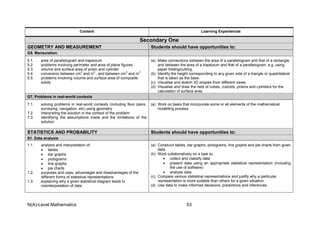
G5. Mensuration
5.1. area of parallelogram and trapezium
5.2. problems involving perimeter and area of plane figures
5.3. volume and surface area of prism and cylinder
5.4. conversion between cm
2
and m
2
, and between cm
3
and m
3
5.5. problems involving volume and surface area of composite
solids
(a) Make connections between the area of a parallelogram and that of a rectangle,
and between the area of a trapezium and that of a parallelogram.
(b) Identify the height corresponding to any given side of a triangle or quadrilateral
that is taken as the base.
(c) Visualise and sketch 3D shapes from different views.
(d) Visualise and draw the nets of cubes, cuboids, prisms and cylinders for the
calculation of surface area.
O-Level Mathematics 39
Content Learning Experiences
Secondary One
GEOMETRY AND MEASUREMENT Students should have opportunities to:
G8. Problems in real-world contexts
8.1. solving problems in real-world contexts (including floor plans,
surveying, navigation, etc) using geometry
8.2. interpreting the solution in the context of the problem
8.3. identifying the assumptions made and the limitations of the
solution
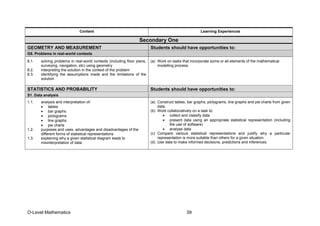
(a) Work on tasks that incorporate some or all elements of the mathematical
modelling process.
STATISTICS AND PROBABILITY Students should have opportunities to:
S1. Data analysis
1.1. analysis and interpretation of:
• tables
• bar graphs
• pictograms
• line graphs
• pie charts
1.2. purposes and uses, advantages and disadvantages of the
different forms of statistical representations
1.3. explaining why a given statistical diagram leads to
misinterpretation of data
(a) Construct tables, bar graphs, pictograms, line graphs and pie charts from given
data.
(b) Work collaboratively on a task to:
• collect and classify data
• present data using an appropriate statistical representation (including
the use of software)
• analyse data
(c) Compare various statistical representations and justify why a particular
representation is more suitable than others for a given situation.
(d) Use data to make informed decisions, predictions and inferences.
O-Level Mathematics 40
Content Learning Experiences
Secondary Two
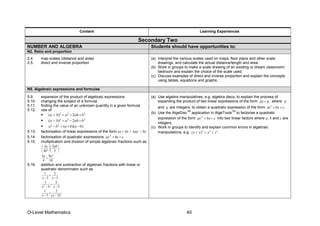
NUMBER AND ALGEBRA Students should have opportunities to:
N2. Ratio and proportion
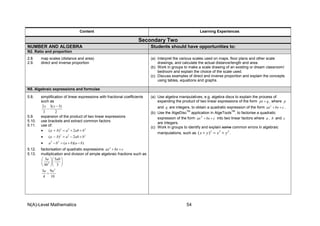
2.4. map scales (distance and area)
2.5. direct and inverse proportion
(a) Interpret the various scales used on maps, floor plans and other scale
drawings, and calculate the actual distance/length and area.
(b) Work in groups to make a scale drawing of an existing or dream classroom/
bedroom and explain the choice of the scale used.
(c) Discuss examples of direct and inverse proportion and explain the concepts
using tables, equations and graphs.
N5. Algebraic expressions and formulae
5.9. expansion of the product of algebraic expressions
5.10. changing the subject of a formula
5.11. finding the value of an unknown quantity in a given formula
5.12. use of:
• 2 2 2
( ) 2a b a ab b+ = + +
• 2 2 2
( ) 2a b a ab b− = − +
• 2 2
( )( )a b a b a b− = + −
5.13. factorisation of linear expressions of the form ax+ bx + kay + by
5.14. factorisation of quadratic expressions cbxax ++2
5.15. multiplication and division of simple algebraic fractions such as
2
3 5
34
a ab
b
  
  
  
2
3 9
4 10
a a
÷
5.16. addition and subtraction of algebraic fractions with linear or
quadratic denominator such as
1 2
2 3x x
+
− −
2
1 2
39 xx
+
−−
2
1 2
3 ( 3)x x
+
− −
(a) Use algebra manipulatives, e.g. algebra discs, to explain the process of
expanding the product of two linear expressions of the form px q+ , where p
and q are integers, to obtain a quadratic expression of the form 2
ax bx c+ + .
(b) Use the AlgeDisc
TM
application in AlgeTools
TM
to factorise a quadratic
expression of the form cbxax ++2
into two linear factors where a, b and c are
integers.
(c) Work in groups to identify and explain common errors in algebraic
manipulations, e.g. 2 2 2
( )x y x y+ = + .
O-Level Mathematics 41
Content Learning Experiences
Secondary Two
NUMBER AND ALGEBRA Students should have opportunities to:
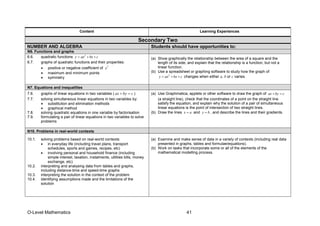
N6. Functions and graphs
6.6. quadratic functions 2
y ax bx c= + +
6.7. graphs of quadratic functions and their properties:
• positive or negative coefficient of
2
x
• maximum and minimum points
• symmetry
(a) Show graphically the relationship between the area of a square and the
length of its side, and explain that the relationship is a function, but not a
linear function.
(b) Use a spreadsheet or graphing software to study how the graph of
2
y ax bx c= + + changes when either a, b or c varies.
N7. Equations and inequalities
7.6. graphs of linear equations in two variables ( ax by c+ =)
7.7. solving simultaneous linear equations in two variables by:
• substitution and elimination methods
• graphical method
7.8. solving quadratic equations in one variable by factorisation
7.9. formulating a pair of linear equations in two variables to solve
problems
(a) Use Graphmatica, applets or other software to draw the graph of ax by c+ =
(a straight line), check that the coordinates of a point on the straight line
satisfy the equation, and explain why the solution of a pair of simultaneous
linear equations is the point of intersection of two straight lines.
(b) Draw the lines ax = and by = , and describe the lines and their gradients.
N10. Problems in real-world contexts
10.1. solving problems based on real-world contexts:
• in everyday life (including travel plans, transport
schedules, sports and games, recipes, etc)
• involving personal and household finance (including
simple interest, taxation, instalments, utilities bills, money
exchange, etc)
10.2. interpreting and analysing data from tables and graphs,
including distance-time and speed-time graphs
10.3. interpreting the solution in the context of the problem
10.4. identifying assumptions made and the limitations of the
solution
(a) Examine and make sense of data in a variety of contexts (including real data
presented in graphs, tables and formulae/equations).
(b) Work on tasks that incorporate some or all of the elements of the
mathematical modelling process.
Content Learning Experiences
Secondary Two
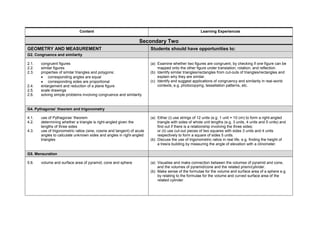
GEOMETRY AND MEASUREMENT Students should have opportunities to:
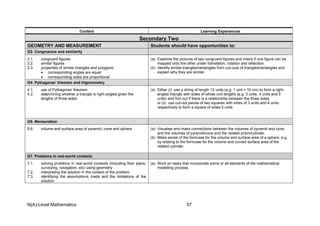
G2. Congruence and similarity
2.1. congruent figures
2.2. similar figures
2.3. properties of similar triangles and polygons:
• corresponding angles are equal
• corresponding sides are proportional
2.4. enlargement and reduction of a plane figure
2.5. scale drawings
2.6. solving simple problems involving congruence and similarity
(a) Examine whether two figures are congruent, by checking if one figure can be
mapped onto the other figure under translation, rotation, and reflection.
(b) Identify similar triangles/rectangles from cut-outs of triangles/rectangles and
explain why they are similar.
(c) Identify and suggest applications of congruency and similarity in real-world
contexts, e.g. photocopying, tessellation patterns, etc.
G4. Pythagoras’ theorem and trigonometry
4.1. use of Pythagoras’ theorem
4.2. determining whether a triangle is right-angled given the
lengths of three sides
4.3. use of trigonometric ratios (sine, cosine and tangent) of acute
angles to calculate unknown sides and angles in right-angled
triangles
(a) Either (i) use strings of 12 units (e.g. 1 unit = 10 cm) to form a right-angled
triangle with sides of whole unit lengths (e.g. 3 units, 4 units and 5 units) and
find out if there is a relationship involving the three sides;
or (ii) use cut-out pieces of two squares with sides 3 units and 4 units
respectively to form a square of sides 5 units.
(b) Discuss the use of trigonometric ratios in real life, e.g. finding the height of
a tree/a building by measuring the angle of elevation with a clinometer.
G5. Mensuration
5.6. volume and surface area of pyramid, cone and sphere (a) Visualise and make connection between the volumes of pyramid and cone,
and the volumes of pyramid/cone and the related prism/cylinder.
(b) Make sense of the formulae for the volume and surface area of a sphere e.g.
by relating to the formulae for the volume and curved surface area of the
related cylinder.
Content Learning Experiences
Secondary Two
GEOMETRY AND MEASUREMENT Students should have opportunities to:
G8. Problems in real-world contexts
8.1. solving problems in real-world contexts (including floor plans,
surveying, navigation, etc) using geometry
8.2. interpreting the solution in the context of the problem
8.3. identifying the assumptions made and the limitations of the
solution
(a) Work on tasks that incorporate some or all elements of the mathematical
modelling process.
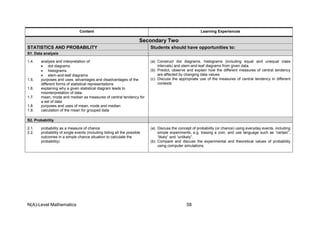
STATISTICS AND PROBABILITY Students should have opportunities to:
S1. Data analysis
1.4. analysis and interpretation of:
• dot diagrams
• histograms
• stem-and-leaf diagrams
1.5. purposes and uses, advantages and disadvantages of the
different forms of statistical representations
1.6. explaining why a given statistical diagram leads to
misinterpretation of data
1.7. mean, mode and median as measures of central tendency for
a set of data
1.8. purposes and use of mean, mode and median
1.9. calculation of the mean for grouped data
(a) Construct dot diagrams, histograms (including equal and unequal class
intervals) and stem-and-leaf diagrams from given data.
(b) Predict, observe and explain how the different measures of central tendency
are affected by extreme data values (or outliers).
(c) Discuss the appropriate use of the measures of central tendency in different
contexts.
S2. Probability
2.1. probability as a measure of chance
2.2. probability of single events (including listing all the possible
outcomes in a simple chance situation to calculate the
probability)
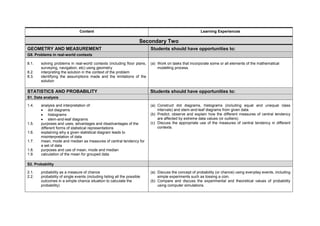
(a) Discuss the concept of probability (or chance) using everyday events, including
simple experiments such as tossing a coin.
(b) Compare and discuss the experimental and theoretical values of probability
using computer simulations.
N(A)-Level Mathematics 44
Chapter 5
N(A)-Level Mathematics
Syllabus
Aims of Syllabus
Syllabus Organisation
Content by Strand
Content and Learning Experiences by Level
N(A)-Level Mathematics 45
Aims of Syllabus
The N(A)-Level Mathematics syllabus aims to enable all students to:
• acquire mathematical concepts and skills for continuous learning in
mathematics and to support learning in other subjects;
• develop thinking, reasoning, communication, application and metacognitive
skills through a mathematical approach to problem-solving;
• connect ideas within mathematics and between mathematics and other
subjects through applications of mathematics; and
• build confidence and foster interest in mathematics.
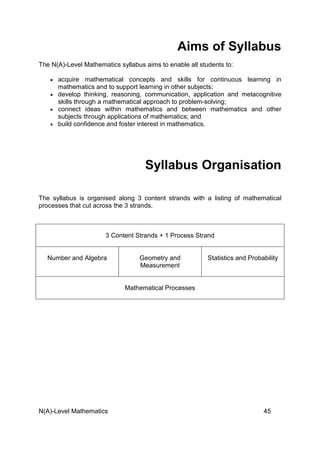
Syllabus Organisation
The syllabus is organised along 3 content strands with a listing of mathematical
processes that cut across the 3 strands.
3 Content Strands + 1 Process Strand
Number and Algebra Geometry and
Measurement
Statistics and Probability
Mathematical Processes
N(A)-Level Mathematics 46
Strand: Mathematical Processes
Mathematical processes refer to the process skills involved in the process of
acquiring and applying mathematical knowledge. This includes reasoning,
communication and connections, applications and modelling, and thinking skills and
heuristics that are important in mathematical problem solving and beyond.
At the secondary level, students gradually move from inductive arguments to
deductive arguments and justifications (e.g. to justify a mathematical statement using
a short chain of logical reasoning or to disprove a statement by a counter example).
They will continue to make connections among mathematical ideas, and between
mathematics and the real world. They should be able to read and critique arguments
that are supported by mathematics.
Greater attention will be given to applications and modelling at the secondary level,
as students become more mature and aware of their immediate environment and
phenomenon. Besides learning standard mathematical models, students should,
under teacher guidance, develop an awareness and understanding of the
mathematical modelling process. They work on real-world problems either
individually or in groups. They would need to understand the real-world situation,
make assumptions about the situation, devise a mathematical model to solve the
problem, and interpret the solution in the context of the situation. The process of
mathematical modelling widens and deepens students’ understanding of
mathematics, and helps them develop important 21st
century skills, including
collaboration, creativity, communication and critical thinking.
The teaching of process skills should be deliberate and yet integrated with the
learning of concepts and skills. Students should be exposed to problem solving
approaches such as the Polya’s model and the steps in a modelling process in class.
Teachers could “think aloud” to give attention to these processes and make them
visible to students. Students should be given opportunities to work in groups and use
ICT tools for modelling tasks. ICT tools empower students to work on problems
which would otherwise require more advanced mathematics or computations that are
too tedious and repetitive. Through practice, students will develop habits and
strategies that will help them be better and more independent learners.
N(A)-Level Mathematics 47
No. Processes Indicators
MATHEMATICAL PROCESSES
MP1 Reasoning,
Communication
and Connections
• Use appropriate representations, mathematical language
(including notations, symbols and conventions) and
technology to present and communicate mathematical ideas
• Reason inductively and deductively, including:
∗ Explaining or justifying/verifying a mathematical
solution/statement
∗ Drawing logical conclusions
∗ Making inferences
∗ Writing mathematical arguments
• Make connections within mathematics, between mathematics
and other disciplines, and between mathematics and the real
world
MP2 Applications and
Modelling
• Apply mathematics concepts and skills to solve problems in a
variety of contexts within or outside mathematics, including:
∗ Identifying the appropriate mathematical representations
or standard models for a problem
∗ Using appropriate mathematical concepts, skills
(including tools and algorithm) to solve a problem
• Understand the nature of the mathematical modelling
process, including:
∗ Formulating a real world problem into a mathematical
model by making suitable assumptions and simplification
and identifying suitable mathematical representations
∗ Applying mathematics to solve the problem
∗ Interpreting the mathematical solution in the context of
the problem
∗ Refining and improving the model
MP3 Thinking Skills
and Heuristics
• Use thinking skills such as:
∗ Classifying
∗ Comparing
∗ Sequencing
∗ Generalising
∗ Induction
∗ Deduction
∗ Analysing (from whole to parts)
∗ Synthesizing (from parts to whole)
• Use a problem-solving model such as Polya’s model
• Use heuristics such as:
∗ Drawing a diagram
∗ Tabulating
∗ Guess and check
∗ Working backwards
∗ Simplifying a problem
∗ Considering special cases
N(A)-Level Mathematics 48
Content & Learning Experiences
by Level
In this section, the content is listed by levels and learning experiences statements
are included.
The learning experiences for the N(A)-Level Mathematics syllabus should provide
opportunities for students to:
• enhance conceptual understanding through use of various mathematical tools
including ICT tools;
• apply concepts and skills learnt in real-world context;
• communicate their reasoning and connections through various mathematical
tasks and activities; and
• build confidence and foster interest in mathematics.
N(A)-Level Mathematics 49
Content Learning Experiences
Secondary One
NUMBER AND ALGEBRA Students should have opportunities to:
N1. Numbers and their operations
1.1. primes and prime factorisation
1.2. finding highest common factor (HCF) and lowest common
multiple (LCM), squares, cubes, square roots and cube roots
by prime factorisation
1.3. negative numbers, integers, rational numbers, real numbers
and their four operations
1.4. calculations with calculator
1.5. representation and ordering of numbers on the number line
1.6. use of <, >, ≤, ≥
1.7. approximation and estimation (including rounding off numbers
to a required number of decimal places or significant figures,
and estimating the results of computation)
(a) Classify whole numbers based on their number of factors and explain why 0
and 1 are not primes.
(b) Discuss examples of negative numbers in the real world.
(c) Represent integers, rational numbers, and real numbers on the number line
as extension of whole numbers, fractions and decimals respectively.
(d) Use algebra discs or the AlgeDisc
TM
application in AlgeTools
TM
to make
sense of addition, subtraction and multiplication involving negative integers
and develop proficiency in the 4 operations of integers.
(e) Work in groups to estimate quantities (numbers and measures) in a variety of
contexts, compare the estimates and share the estimation strategies.
(f) Compare follow-through errors arising from intermediate values that are
rounded to different degrees of accuracy.
(g) Make estimates and check the reasonableness of answers obtained from
calculators.
N2. Ratio and proportion
2.1. comparison between two or more quantities by ratio
2.2. relationship between ratio and fraction
2.3. dividing a quantity in a given ratio
2.4. ratios involving rational numbers
2.5. equivalent ratios
2.6. writing a ratio in its simplest form
2.7. problems involving ratio
(a) Discuss and explain how ratios are used in everyday life.
(b) Use the concept of equivalent ratios to find the ratio a:b:c given the ratios a:b
and b:c.
(c) Make connections between ratios and fractions, use appropriate
mathematical language to describe the relationship, and use algebra to solve
problems, e.g. “The ratio A to B is 2:3” can be represented as:
“The ratio of 2:3 means “2 units to 3 units”, “A is
3
2
of B”, or “B is
3
2
of A”.
A
B
2x
3x
N(A)-Level Mathematics 50
Content Learning Experiences
Secondary One
NUMBER AND ALGEBRA Students should have opportunities to:
N3. Percentage
3.1. expressing percentage as a fraction or decimal
3.2. expressing one quantity as a percentage of another
3.3. comparing two quantities by percentage
3.4. percentages greater than 100%
3.5. increasing/decreasing a quantity by a given percentage
(including concept of percentage point)
3.6. finding percentage increase/decrease
3.7. reverse percentages
3.8. problems involving percentages
(a) Collect examples of percentages from newspapers and magazines and
discuss the meaning of percentage in each example.
(b) Examine bills and receipts, etc. to find examples of the uses of percentages,
e.g. discount, service charge, GST and other taxes and check the calculated
values.
(c) Make connections between percentages and fractions/decimals, e.g.
“25% of a quantity is
4
1
of the quantity”,
“20% of x is x2.0 ”.
(d) Discuss misconceptions, e.g. “If A is 5% more than B, then B is 5% less than
A”.
N4. Rate and Speed
4.1. relationships between distance, time and speed
4.2. writing speed in different units (e.g. km/h, m/min, m/s and
cm/s)
4.3. concepts of average rate, speed, constant speed and
average speed
4.4. conversion of units (e.g. km/h to m/s)
4.5. calculation of speed, distance or time given the other two
quantities
4.6. problems involving rate and speed
(a) Discuss examples of rates, e.g. currency exchange rates, interest rates, tax
rates, rate of rotation and speed.
(b) Find out and compare the speeds of bicycles, cars, trains, aeroplanes and
spaceships and their respective units to have a sense of their magnitude.
(c) Explain the difference between average speed and constant speed and also
explain why average speed is not the average of speeds.
N(A)-Level Mathematics 51
Content Learning Experiences
Secondary One
NUMBER AND ALGEBRA Students should have opportunities to:
N5. Algebraic expressions and formulae
5.1. using letters to represent numbers
5.2. interpreting notations:
• ab as a × b
•
a
b
as a ÷ b or a x
1
b
• a2
as a × a, a3
as a × a × a, a2
b as a × a × b, . . .
• 3y as y + y + y or 3 × y
• 3 (x + y) as 3 × (x + y)
•
3
5
y+
as (3 + y) ÷ 5 or
1
5
×(3 )y+
5.3. evaluation of algebraic expressions and formulae
5.4. translation of simple real-world situations into algebraic
expressions
5.5. recognising and representing patterns/relationships by finding
an algebraic expression for the nth term
5.6. addition and subtraction of linear expressions
5.7. simplification of linear expressions with integral coefficients
such as
2( 3 )x y−
4 2(3 5)x x− −
3( ) (2 )x y y x y− − + −
(a) Use spreadsheets, e.g. Microsoft Excel, to
∗ explore the concept of variables and evaluate algebraic expressions.
∗ compare and examine the differences between pairs of expressions, e.g.
2n and 2 n+ , 2
n and 2n , 2
2n and 2
(2 )n .
(b) Use algebra discs or the AlgeDisc
TM
application in AlgeTools
TM
to make
sense of and interpret linear expressions with integral coefficients, e.g.
yx 34 − and )2(3 −− x .
(c) Use the AlgeDisc
TM
application in AlgeTools
TM
to construct and simplify linear
expressions with integral coefficients.
(d) Work in groups to select and justify pairs of equivalent expressions.
(e) Write algebraic expressions to express mathematical relationships, e.g. for
the statement “There are 3 times as many boys as girls”, if we let x be the
number of girls, then the number of boys is x3 . This can also be written as
gb 3= , where b and g are the number of boys and girls respectively.
(f) Explore number patterns and write algebraic expressions to represent the
patterns.
N7. Equations and inequalities
7.1. concepts of equation
7.2. solving linear equations with integral coefficients in one
variable
7.3. formulating a linear equation in one variable to solve problems
(a) Use the virtual balance in AlgeTools
TM
to explore the concepts of equation,
and to construct, simplify and solve linear equations with integral coefficients.
(b) Use the AlgeBar
TM
application (for whole numbers) in AlgeTools
TM
to
formulate linear equations to solve problems (Students can draw models to
help them formulate the equations.)
N(A)-Level Mathematics 52
Content Learning Experiences
Secondary One
NUMBER AND ALGEBRA Students should have opportunities to:
N8. Problems in real-world contexts
8.1. solving problems based on real-world contexts:
• in everyday life (including travel plans, transport
schedules, sports and games, recipes, etc)
• involving personal and household finance (including
simple interest, taxation, instalments, utilities bills, money
exchange, etc)
8.2. interpreting and analysing data from tables and graphs,
including distance-time and speed-time graphs
8.3. interpreting the solution in the context of the problem
8.4. identifying assumptions made and the limitations of the
solution
(a) Examine and make sense of data in a variety of contexts (including real data
presented in graphs, tables and formulae/equations).
(b) Work on tasks that incorporate some or all of the elements of the
mathematical modelling process.
Content Learning Experiences
Secondary One
GEOMETRY AND MEASUREMENT Students should have opportunities to:
G1. Angles, triangles and polygons
1.1. right, acute, obtuse and reflex angles
1.2. vertically opposite angles, angles on a straight line, angles at a
point
1.3. angles formed by two parallel lines and a transversal:
corresponding angles, alternate angles, interior angles
1.4. properties of triangles
(a) Investigate the properties relating the sides and angles of a triangle, e.g. form
triangles with different lengths to discover that the sum of two sides is greater
than the third side, and that the longest side is opposite the largest angle.
N(A)-Level Mathematics 53
Content Learning Experiences
Secondary One
GEOMETRY AND MEASUREMENT Students should have opportunities to:
G5. Mensuration
5.1. area of parallelogram and trapezium
5.2. problems involving perimeter and area of plane figures
5.3. volume and surface area of prism and cylinder
5.4. conversion between cm
2
and m
2
, and between cm
3
and m
3
5.5. problems involving volume and surface area of composite
solids
(a) Make connections between the area of a parallelogram and that of a rectangle,
and between the area of a trapezium and that of a parallelogram, e.g. using
paper folding/cutting.
(b) Identify the height corresponding to any given side of a triangle or quadrilateral
that is taken as the base.
(c) Visualise and sketch 3D shapes from different views.
(d) Visualise and draw the nets of cubes, cuboids, prisms and cylinders for the
calculation of surface area.
G7. Problems in real-world contexts
7.1. solving problems in real-world contexts (including floor plans,
surveying, navigation, etc) using geometry
7.2. interpreting the solution in the context of the problem
7.3. identifying the assumptions made and the limitations of the
solution
(a) Work on tasks that incorporate some or all elements of the mathematical
modelling process.
STATISTICS AND PROBABILITY Students should have opportunities to:
S1. Data analysis
1.1. analysis and interpretation of:
• tables
• bar graphs
• pictograms
• line graphs
• pie charts
1.2. purposes and uses, advantages and disadvantages of the
different forms of statistical representations
1.3. explaining why a given statistical diagram leads to
misinterpretation of data
(a) Construct tables, bar graphs, pictograms, line graphs and pie charts from given
data.
(b) Work collaboratively on a task to:
• collect and classify data
• present data using an appropriate statistical representation (including
the use of software)
• analyse data
(c) Compare various statistical representations and justify why a particular
representation is more suitable than others for a given situation.
(d) Use data to make informed decisions, predictions and inferences.
N(A)-Level Mathematics 54
Content Learning Experiences
Secondary Two
NUMBER AND ALGEBRA Students should have opportunities to:
N2. Ratio and proportion
2.8. map scales (distance and area)
2.9. direct and inverse proportion
(a) Interpret the various scales used on maps, floor plans and other scale
drawings, and calculate the actual distance/length and area.
(b) Work in groups to make a scale drawing of an existing or dream classroom/
bedroom and explain the choice of the scale used.
(c) Discuss examples of direct and inverse proportion and explain the concepts
using tables, equations and graphs.
N5. Algebraic expressions and formulae
5.8. simplification of linear expressions with fractional coefficients
such as
2 3( 5)
3 2
x x −
−
5.9. expansion of the product of two linear expressions
5.10. use brackets and extract common factors
5.11. use of:
• 2 2 2
( ) 2a b a ab b+ = + +
• 2 2 2
( ) 2a b a ab b− = − +
• 2 2
( )( )a b a b a b− = + −
5.12. factorisation of quadratic expressions 2
ax bx c+ +
5.13. multiplication and division of simple algebraic fractions such as
2
3 5
34
a ab
b
  
  
  
2
3 9
4 10
a a
÷
(a) Use algebra manipulatives, e.g. algebra discs to explain the process of
expanding the product of two linear expressions of the form px q+ , where p
and q are integers, to obtain a quadratic expression of the form 2
ax bx c+ + .
(b) Use the AlgeDisc
TM
application in AlgeTools
TM
, to factorise a quadratic
expression of the form cbxax ++2
into two linear factors where a , b and c
are integers.
(c) Work in groups to identify and explain some common errors in algebraic
manipulations, such as
2 2 2
( )x y x y+ = + .
N(A)-Level Mathematics 55
Content Learning Experiences
Secondary Two
NUMBER AND ALGEBRA Students should have opportunities to:
N6. Functions and graphs
6.1. Cartesian coordinates in two dimensions
6.2. graph of a set of ordered pairs as a representation of a
relationship between two variables
6.3. linear functions y ax b= +
6.4. graphs of linear functions
6.5. the gradient of a linear graph as the ratio of the vertical
change to the horizontal change (positive and negative
gradients)
(a) Play games, e.g. Battleship Game, that involve the use of 2D Cartesian
coordinates to specify points.
(b) Use a function machine to generate input and output values to illustrate the
concept of function as “only one output for every input” and represent the
function in verbal, tabular, graphical and algebraic forms.
(c) Use a linear function to represent the relationship between two variables
(such as distance and time when the speed is constant), show the
relationship graphically and identify that the rate of change is the gradient of
the graph.
(d) Use a spreadsheet or graphing software to study how the graph of y ax b= +
changes when either a or b varies.
N7. Equations and inequalities
7.4. solving linear equations in one variable (including fractional
coefficients)
7.5. concept and properties of inequality
7.6. solving simple inequalities in the form ax b≤ , ax b≥ , ax b<
and ax b> , where a and b are integers.
7.7. solving simple fractional equations that can be reduced to
linear equations such as
2
3
3 4
x x −
+ =
3
6
2x
=
−
7.8. graphs of linear equations in two variables ( ax by c+ =)
7.9. solving simultaneous linear equations in two variables by:
• substitution and elimination methods
• graphical method
7.10. formulating a linear equation in one variable or a pair of linear
equations in two variables to solve problems
(a) Formulate inequalities from real-world contexts.
(b) Use Graphmatica, applets or other software to draw the graph of ax by c+ =
(a straight line), check that the coordinates of a point on the straight line
satisfy the equation, and explain why the solution of a pair of simultaneous
linear equations is the point of intersection of two straight lines.
(c) Draw the lines ax = and by = , and describe the lines and their gradients.
(d) Use the AlgeBar
TM
application in AlgeTools
TM
to formulate linear equations to
solve problems (Students can draw models to help them formulate
equations.)
N(A)-Level Mathematics 56
Content Learning Experiences
Secondary Two
NUMBER AND ALGEBRA Students should have opportunities to:
N8. Problems in real-world contexts
8.1. solving problems based on real-world contexts:
• in everyday life (including travel plans, transport
schedules, sports and games, recipes, etc)
• involving personal and household finance (including
simple interest, taxation, instalments, utilities bills, money
exchange, etc)
8.2. interpreting and analysing data from tables and graphs,
including distance-time and speed-time graphs
8.3. interpreting the solution in the context of the problem
8.4. identifying assumptions made and the limitations of the
solution
(a) Examine and make sense of data in a variety of contexts (including real data
presented in graphs, tables and formulae/equations).
(c) Work on tasks that incorporate some or all of the elements of the
mathematical modelling process.
Content Learning Experiences
Secondary Two
GEOMETRY AND MEASUREMENT Students should have opportunities to:
G1. Angles, triangles and polygons
1.5. properties of special quadrilaterals and regular polygons
(pentagon, hexagon, octagon and decagon) including
symmetry properties
1.6. classifying special quadrilaterals on the basis of their
properties
1.7. angle sum of interior and exterior angles of any convex
polygon
1.8. properties of perpendicular bisectors of line segments and
angle bisectors
1.9. construction of simple geometrical figures from given data
(including perpendicular bisectors and angle bisectors) using
compasses, ruler, set squares and protractors, where
appropriate
(a) Use GSP or other dynamic geometry software to explore a given type of
quadrilateral (e.g. parallelogram) to discover its properties, e.g. diagonals of a
parallelogram bisect each other.
(b) Investigate the sum of the interior and exterior angles of polygons and obtain
the formulae for them.
(c) Recognise symmetric properties (rotational and line symmetry) in some special
quadrilaterals and regular polygons.
(d) Justify whether a mathematical statement is true or false.
(e) Use GSP or other dynamic geometry software to construct and study the
properties of the perpendicular bisector of a line segment and the bisector of
an angle.
N(A)-Level Mathematics 57
Content Learning Experiences
Secondary Two
GEOMETRY AND MEASUREMENT Students should have opportunities to:
G2. Congruence and similarity
2.1. congruent figures
2.2. similar figures
2.3. properties of similar triangles and polygons:
• corresponding angles are equal
• corresponding sides are proportional
(a) Examine the pictures of two congruent figures and check if one figure can be
mapped onto the other under translation, rotation and reflection.
(b) Identify similar triangles/rectangles from cut-outs of triangles/rectangles and
explain why they are similar.
G4. Pythagoras’ theorem and trigonometry
4.1. use of Pythagoras’ theorem
4.2. determining whether a triangle is right-angled given the
lengths of three sides
(a) Either (i) use a string of length 12 units (e.g. 1 unit = 10 cm) to form a right-
angled triangle with sides of whole-unit lengths (e.g. 3 units, 4 units and 5
units) and find out if there is a relationship between the three sides;
or (ii) use cut-out pieces of two squares with sides of 3 units and 4 units
respectively to form a square of sides 5 units.
G5. Mensuration
5.6. volume and surface area of pyramid, cone and sphere (a) Visualise and make connections between the volumes of pyramid and cone,
and the volumes of pyramid/cone and the related prism/cylinder.
(b) Make sense of the formulae for the volume and surface area of a sphere, e.g.
by relating to the formulae for the volume and curved surface area of the
related cylinder.
G7. Problems in real-world contexts
7.1. solving problems in real-world contexts (including floor plans,
surveying, navigation, etc) using geometry
7.2. interpreting the solution in the context of the problem
7.3. identifying the assumptions made and the limitations of the
solution
(a) Work on tasks that incorporate some or all elements of the mathematical
modelling process.
N(A)-Level Mathematics 58
Content Learning Experiences
Secondary Two
STATISTICS AND PROBABILITY Students should have opportunities to:
S1. Data analysis
1.4. analysis and interpretation of:
• dot diagrams
• histograms
• stem-and-leaf diagrams
1.5. purposes and uses, advantages and disadvantages of the
different forms of statistical representations
1.6. explaining why a given statistical diagram leads to
misinterpretation of data
1.7. mean, mode and median as measures of central tendency for
a set of data
1.8. purposes and uses of mean, mode and median
1.9. calculation of the mean for grouped data
(a) Construct dot diagrams, histograms (including equal and unequal class
intervals) and stem-and-leaf diagrams from given data.
(b) Predict, observe and explain how the different measures of central tendency
are affected by changing data values.
(c) Discuss the appropriate use of the measures of central tendency in different
contexts.
S2. Probability
2.1. probability as a measure of chance
2.2. probability of single events (including listing all the possible
outcomes in a simple chance situation to calculate the
probability)
(a) Discuss the concept of probability (or chance) using everyday events, including
simple experiments, e.g. tossing a coin, and use language such as “certain”,
“likely” and “unlikely”.
(b) Compare and discuss the experimental and theoretical values of probability
using computer simulations.

Singapore GCE O Level Mathematics Syllabus

  • 1.
    O- & N(A)-LevelMathematics Teaching and Learning Syllabus This document contains general information about the secondary mathematics curriculum and the content for O & N(A) Mathematics at Secondary 1 and 2 only. The syllabuses will be implemented level by level from 2013. The content for Secondary 3/4 will be updated accordingly. © Copyright 2012 Curriculum Planning and Development Division. This publication is not for sale. For restricted circulation only. All rights reserved. No part of this publication may be reproduced without the prior permission of the Ministry of Education, Singapore. First Edition: April 2012. Year of Implementation: from 2013
  • 2.
    O- & N(A)-LevelMathematics 2 Learning Mathematics A 21st Century Necessity Learning mathematics is a key fundamental in every education system that aims to prepare its citizens for a productive life in the 21st century. As a nation, the development of a highly-skilled and well-educated manpower is critical to support an innovation- and technology-driven economy. A strong grounding in mathematics and a talent pool in mathematics are essential to support the wide range of value-added economic activities and innovations. Many countries are paying attention to the quality of their mathematics education. The growing interest in TIMSS and PISA speaks of the global interest and importance placed on mathematics education. At the individual level, mathematics underpins many aspects of our everyday activities, from making sense of information in the newspaper to making informed decisions about personal finances. It supports learning in many fields of study, whether it is in the sciences or in business. A good understanding of basic mathematics is essential wherever calculations, measurements, graphical interpretations and statistical analysis are necessary. The learning of mathematics also provides an excellent vehicle to train the mind, and to develop the capacity to think logically, abstractly, critically and creatively. These are important 21st century competencies that we must imbue in our students, so that they can lead a productive life and be life-long learners. Students have different starting points. Not all will have the same interests and natural abilities to learn mathematics. Some will find it enjoyable; others will find it challenging. Some will find the theorems and results intriguing; others will find the formulae and rules bewildering. It is therefore important for the mathematics curriculum to provide differentiated pathways and choices to support every learner in order to maximise their potential. The curriculum must engage the 21st century learners, who are digital natives comfortable with the use of technologies and who work and think differently. The learning of mathematics must take into cognisance the new generation of learners, the innovations in pedagogies as well as the affordances of technologies. It is the goal of the national mathematics curriculum to ensure that all students will achieve a level of mastery of mathematics that will serve them well in their lives, and for those who have the interest and ability, to pursue mathematics at the highest possible level. Mathematics is an important subject in our national curriculum. Students begin to learn mathematics from the day they start formal schooling, and minimally up to the end of secondary education. This gives every child at least 10 years of meaningful mathematics education.
  • 3.
    O- & N(A)-LevelMathematics 3 About this document This document provides an overview of the curriculum. It explains the design of the curriculum from the primary to the pre-university level, and provides details of the O- & N(A)-Level Mathematics syllabuses, including the aims, content, outcomes and the approaches to teaching and learning. This document comprises 5 chapters as described below. Chapter 1 provides an overview of the curriculum review, the goals and aims of the different syllabuses of the entire mathematics curriculum (primary to pre-university) as well as the syllabus design considerations across the levels. Chapter 2 elaborates on the Mathematics Framework which centres around mathematical problem solving. The framework serves as a guide for mathematics teaching, learning and assessment across the levels. Chapter 3 focuses on the process of teaching and learning so as to bring about engaged learning in mathematics. It highlights the principles of teaching and phases of learning as well as the learning experiences to influence the way teachers teach and students learn so that the aims of the curriculum can be met. The role of assessment and how it can be integrated to support learning in the classroom is also highlighted in this chapter. Chapter 4 details the O-Level Mathematics syllabus in terms of its aims, syllabus organisation, mathematical processes, content and learning experiences. Chapter 5 details the N(A)-Level Mathematics syllabus in terms of its aims, syllabus organisation, mathematical processes, content and learning experiences.
  • 4.
    O- & N(A)-LevelMathematics 4 Contents Chapter 1 Introduction 5 Background 6 Goals and Aims 7 Syllabus Design 9 Chapter 2 Mathematics Framework 13 Problem Solving 14 Chapter 3 Teaching, Learning and Assessment 19 Learning Experiences 20 Teaching and Learning 21 Assessment in the Classroom 26 Chapter 4 O-Level Mathematics Syllabus 29 Aims of Syllabus 30 Syllabus Organisation 30 Mathematical Process Strand 31 Content and Learning Experiences by Level 34 Chapter 5 N(A)-Level Mathematics Syllabus 41 Aims of Syllabus 42 Syllabus Organisation 42 Mathematical Process Strand 43 Content and Learning Experiences by Level 45
  • 5.
    O- & N(A)-LevelMathematics 5 Chapter 1 Introduction Background Goals and Aims Syllabus Design
  • 6.
    O- & N(A)-LevelMathematics 6 Background Staying Relevant and Forward-Looking As in all previous reviews, the 2010 full-term review aims to update the syllabuses so that they continue to meet the needs of our students, build a strong foundation in mathematics, and make improvement in the school mathematics education. It takes into consideration the analyses of students’ performances in national examinations as well as international studies such as TIMSS and PISA. This review also takes on board the curriculum-wide recommendations from envisaging studies into the overall Singapore curriculum such as seeking a better balance between content and skills, creating opportunities to develop 21st century competencies, promoting self-directed and collaborative learning through ICT-based lessons, and developing assessment to support learning. It is clear at the start of the review that there is more to be considered than just focusing on the content. While there is a need to constantly review what students learn, the changes in content will not be the key lever. In fact, little has been changed in the content as this has stabilised over the years. Instead, more focus has now been given to skills and competencies that will make a better 21st century learner – the process of learning becomes more important than just what is to be taught and remembered. The syllabuses are therefore written with the view that not only will it inform teachers on what to teach, it will also influence the way teachers teach and students learn. One key feature of this set of syllabuses is the explication of learning experiences, besides the learning outcomes. This gives guidance to teachers on the opportunities that students should be given as part of their learning. Ultimately, how students learn matters. Curriculum review and design is ongoing work. The quality of the curriculum is as much in its design as it is in its implementation. Teachers, who are the frontline of curriculum delivery, must believe in the value of the changes. Support, resources and training will be provided to build capacity in our teachers. All these will be part of the continuous effort to deliver the best mathematics curriculum for the students. The O- & N(A)-Level Mathematics syllabuses will be implemented level by level starting from Secondary One in 2013. The implementation schedule is as follows: Year 2013 2014 2015 2016 Level Sec 1 Sec 2 Sec 3 Sec 4 This online syllabus document will be updated yearly according to the implementation schedule.
  • 7.
    O- & N(A)-LevelMathematics 7 Goals and Aims Different Syllabuses, Different Aims The overarching goal of the mathematics curriculum is to ensure that all students will achieve a level of mastery of mathematics that will serve them well in life, and for those who have the interest and ability, to pursue mathematics at the highest possible level. The broad aims of mathematics education in Singapore are to enable students to: • acquire and apply mathematical concepts and skills; • develop cognitive and metacognitive skills through a mathematical approach to problem solving; and • develop positive attitudes towards mathematics. The mathematics curriculum comprises a set of syllabuses spanning 12 years, from primary to pre-university, and is compulsory up to the end of secondary education. Each syllabus has its own specific set of aims to guide the design and implementation of the syllabus. The aims also influence the choice of content, skills as well as contexts to meet the specific needs of the students at the given level or course. Each syllabus expands on the three broad aims of mathematics education differently to cater for the different needs and abilities of the students (see table of aims on the next page). What does it mean to teachers? Understanding the aims of the syllabus helps teachers stay focused on the larger outcomes of learning and guides teachers when they embark on the school- based curriculum innovations and customisations.
  • 8.
    O- & N(A)-LevelMathematics 8 Overview of Aims Across the Levels Primary Laying a Strong Foundation The Primary Mathematics syllabus aims to enable all students to: • acquire mathematical concepts and skills for everyday use and continuous learning in mathematics; • develop thinking, reasoning, communication, application and metacognitive skills through a mathematical approach to problem solving; and • build confidence and foster interest in mathematics. Secondary Building Up Strengths The O- and N(A)-Level Mathematics syllabuses aim to enable all students to: • acquire mathematical concepts and skills for continuous learning in mathematics and to support learning in other subjects; • develop thinking, reasoning, communication, application and metacognitive skills through a mathematical approach to problem solving; • connect ideas within mathematics and between mathematics and other subjects through applications of mathematics; and • build confidence and foster interest in mathematics. The N(T)-Level Mathematics syllabus aims to enable students who are bound for post-secondary vocational education to: • acquire mathematical concepts and skills for real life, to support learning in other subjects, and to prepare for vocational education; • develop thinking, reasoning, communication, application and metacognitive skills through a mathematical approach to problem solving; and • build confidence in using mathematics and appreciate its value in making informed decisions in real life. The O- and N(A)-Level Additional Mathematics syllabuses aim to enable students who have an aptitude and interest in mathematics to: • acquire mathematical concepts and skills for higher studies in mathematics and to support learning in the other subjects, in particular, the sciences; • develop thinking, reasoning and metacognitive skills through a mathematical approach to problem solving; • connect ideas within mathematics and between mathematics and the sciences through applications of mathematics; and • appreciate the abstract nature and power of mathematics. Pre-University Gearing Up for University Education The H1 Mathematics syllabus aims to enable students who are interested in pursuing tertiary studies in business and the social sciences to: • acquire mathematical concepts and skills to support their tertiary studies in business and the social sciences; • develop thinking, reasoning, communication and modelling skills through a mathematical approach to problem solving; • connect ideas within mathematics and between mathematics and other disciplines through applications of mathematics; and • appreciate the value of mathematics in making informed decisions in life. The H2 Mathematics syllabus aims to enable students who are interested in pursuing tertiary studies in mathematics, sciences and engineering to: • acquire mathematical concepts and skills to prepare for their tertiary studies in mathematics, sciences and engineering; • develop thinking, reasoning, communication and modelling skills through a mathematical approach to problem solving and the use of mathematics language; • connect ideas within mathematics and between mathematics and other disciplines through applications of mathematics; and • appreciate the beauty of mathematics and its value in making informed decisions in life. The H3 Mathematics syllabus aims to enable students who have an aptitude and passion for mathematics to: • acquire advanced mathematical concepts and skills to deepen their understanding of mathematics, and to widen the scope of applications of mathematics; • develop rigorous habits of mind through mathematical reasoning and proof, creative mathematical problem solving, and use of mathematical models; • connect ideas within mathematics at a higher level and between mathematics and other disciplines through applications of mathematics; and • appreciate the beauty, rigour and abstraction of mathematics through mathematical proof and applications.
  • 9.
    O- & N(A)-LevelMathematics 9 Syllabus Design Spiral Curriculum, Connected Syllabuses Mathematics is largely hierarchical in nature. Higher concepts and skills are built upon the more foundational ones and have to be learned in sequence. A spiral approach is adopted in the building up of content across the levels. The mathematics curriculum consists of a set of connected syllabuses to cater to the different needs and abilities of students. This section gives an overview of the syllabuses and their connections so that teachers are better able to appreciate the mathematics curriculum as a whole. S1-4 Mathematics (O-Level) S1-4 Mathematics (N(A)-Level) S1-4 Mathematics (N(T)-Level) P1-4 Mathematics P5-6 Standard Mathematics P5-6 Foundation Mathematics Primary S3-4 Additional Mathematics (O-Level) S3-4 Additional Mathematics (N(A)-Level) Secondary H1 Mathematics H2 Mathematics H3 Mathematics Pre-university Direct Bridging needed
  • 10.
    O- & N(A)-LevelMathematics 10 The Primary Mathematics syllabus assumes no formal learning of mathematics. However, basic pre-numeracy skills such as matching, sorting and comparing are necessary in providing a good grounding for students to begin learning at Primary 1 (P1). The P1-4 syllabus is common to all students. The P5-6 Standard Mathematics syllabus continues the development of the P1-4 syllabus whereas the P5-6 Foundation Mathematics syllabus re-visits some of the important concepts and skills in the P1-4 syllabus. The new concepts and skills introduced in Foundation Mathematics is a subset of the Standard Mathematics syllabus. The O-Level Mathematics syllabus builds on the Standard Mathematics syllabus. The N(A)-Level Mathematics syllabus is a subset of O-Level Mathematics, except that it re-visits some of the topics in Standard Mathematics syllabus. The N(T)-Level Mathematics syllabus builds on the Foundation Mathematics syllabus. The O-Level Additional Mathematics syllabus assumes knowledge of O-Level Mathematics content and includes more in-depth treatment of important topics. The N(A)-Level Additional Mathematics syllabus is a subset of O-Level Additional Mathematics syllabus. O-Level Additional Mathematics together with O-Level Mathematics content provides the prerequisite knowledge required for H2 Mathematics at the pre-university level. At the pre-university level, mathematics is optional. The H1 Mathematics syllabus builds on the O-level Mathematics syllabus. H2 Mathematics assumes some of the O-Level Additional Mathematics content. H3 Mathematics is an extension of H2 Mathematics.
  • 11.
    O- & N(A)-LevelMathematics 11 Flexibility and Choice There are two mathematics syllabuses at the P5-6 level. Most students would offer Standard Mathematics and for students who need more time to learn, they could offer Foundation Mathematics. There are five mathematics syllabuses in the secondary mathematics curriculum. O-Level Mathematics, N(A)-Level Mathematics and N(T)-Level Mathematics provide students from the respective courses the core mathematics knowledge and skills in the context of a broad-based education. The more mathematically able students from the N(A) course can choose to take O-Level Mathematics in four years instead of five years. Likewise, the more able N(T) course students can also offer N(A)-Level Mathematics. The variation in pace and syllabus adds to the flexibility and choice within the secondary mathematics curriculum. At the upper secondary level, students who are interested in mathematics and are more mathematically inclined may choose to offer Additional Mathematics as an elective at the O-Level or N(A)-Level. This gives them the opportunity to learn more mathematics that would prepare them well for courses of study that require higher mathematics. For students who wish to study in the Engineering-type courses at the polytechnics, Additional Mathematics will be a good grounding. The N(A)-Level and N(T)-Level Mathematics syllabuses will prepare students well for ITE courses. Students who aspire to study Mathematics or mathematics-related courses at the universities could offer H2 Mathematics, and if possible, H3 Mathematics. What does it mean to teachers? Teachers need to have the big picture in mind so that they can better understand the role of each syllabus, the connection it makes with the next level and the dependency relationship between syllabuses. This enables teachers to better understand what they have to do at their level, as well as to plan and advise students in their learning of mathematics. For example, H2 Mathematics assumes some of the O-Level Additional Mathematics content but may be offered by students without Additional Mathematics background as long as effort is made to bridge the gap.
  • 13.
    O- & N(A)-LevelMathematics 13 Chapter 2 Mathematics Framework Problem Solving
  • 14.
    O- & N(A)-LevelMathematics 14 Problem Solving Concepts, Skills, Processes, Metacognition, Attitudes The Mathematics Framework has been a feature of our mathematics curriculum since 1990, and is still relevant to date. The central focus of the framework is mathematical problem solving, that is, using mathematics to solve problems. The framework sets the direction for and provides guidance in the teaching, learning, and assessment of mathematics at all levels, from primary to pre-university. It reflects also the 21st century competencies1 . The framework stresses conceptual understanding, skills proficiency and mathematical processes, and gives due emphasis to attitudes and metacognition. These five components are inter-related. Concepts Mathematical concepts can be broadly grouped into numerical, algebraic, geometric, statistical, probabilistic, and analytical concepts. These content categories are connected and interdependent. At different stages of learning and in different syllabuses, the breadth and depth of the content vary. 1 Information on the MOE framework for 21 st century competencies and student outcomes can be found on www.moe.gov.sg Numerical calculation Algebraic manipulation Spatial visualisation Data analysis Measurement Use of mathematical tools Estimation Numerical Algebraic Geometric Statistical Probabilistic Analytical Reasoning, communication and connections Applications and modelling Thinking skills and heuristics Monitoring of one’s own thinking Self-regulation of learning Beliefs Interest Appreciation Confidence Perseverance
  • 15.
    O- & N(A)-LevelMathematics 15 To develop a deep understanding of mathematical concepts, and to make sense of various mathematical ideas as well as their connections and applications, students should be exposed to a variety of learning experiences including hands-on activities and use of technological aids to help them relate abstract mathematical concepts with concrete experiences. Skills Mathematical skills refer to numerical calculation, algebraic manipulation, spatial visualisation, data analysis, measurement, use of mathematical tools, and estimation. The skills are specific to mathematics and are important in the learning and application of mathematics. In today’s classroom, these skills also include the abilities to use spreadsheets and other software to learn and do mathematics. To develop proficiencies in mathematics skills, students should have opportunities to use and practise the skills. These skills should be taught with an understanding of the underlying mathematical principles and not merely as procedures. Processes Mathematical processes refer to the process skills involved in the process of acquiring and applying mathematical knowledge. These include reasoning, communication and connections, applications and modelling, and thinking skills and heuristics that are important in mathematics and beyond. In the context of mathematics, reasoning, communication and connections take on special meanings: • Mathematical reasoning refers to the ability to analyse mathematical situations and construct logical arguments. It is a habit of mind that can be developed through application of mathematics in different contexts. • Communication refers to the ability to use mathematical language to express mathematical ideas and arguments precisely, concisely and logically. It helps students develop their understanding of mathematics and sharpen their mathematical thinking. • Connections refer to the ability to see and make linkages among mathematical ideas, between mathematics and other subjects, and between mathematics and the real world. This helps students make sense of what they learn in mathematics. Applications and modelling allow students to connect mathematics that they have learnt to the real world, enhance understanding of key mathematical concepts and methods as well as develop mathematical competencies. Students should have opportunities to apply mathematical problem-solving and reasoning skills to tackle a variety of problems, including open-ended and real-world problems. Mathematical modelling is the process of formulating and improving a mathematical model2 2 A mathematical model is a mathematical representation or idealisation of a real-world situation. It can be as complicated as a system of equations or as simple as a geometrical figure. As the word “model” suggests, it shares characteristics of the real-world situation that it seeks to represent. to
  • 16.
    O- & N(A)-LevelMathematics 16 represent and solve real-world problems. Through mathematical modelling, students learn to deal with ambiguity, make connections, select and apply appropriate mathematical concepts and skills, identify assumptions and reflect on the solutions to real-world problems, and make informed decisions based on given or collected data. Mathematical Modelling Process (version 2010) Thinking skills and heuristics are essential for mathematical problem solving. Thinking skills are skills that can be used in a thinking process, such as classifying, comparing, analysing parts and whole, identifying patterns and relationships, induction, deduction, generalising, and spatial visualisation. Heuristics are general Real World Mathematical World Real-World Problem Mathematical Model Formulating • understand the problem • make assumptions to simplify the problem • represent the problem mathematically Mathematical Solution Solving • Select and use appropriate mathematical methods and tools (including ICT) • Solve the problem and present the solution Real-World Solution Interpreting • Interpret the mathematical solution in the context of the real- world problem • Present the solution of the real-world problem Reflecting • Reflect on the real-world solution • Improve the model
  • 17.
    O- & N(A)-LevelMathematics 17 rules of thumb of what students can do to tackle a problem when the solution to the problem is not obvious. These include using a representation (e.g., drawing a diagram, tabulating), making a guess (e.g., trial and error/guess and check, making a supposition), walking through the process (e.g., acting it out, working backwards) and changing the problem (e.g., simplifying the problem, considering special cases). Metacognition Metacognition, or thinking about thinking, refers to the awareness of, and the ability to control one's thinking processes, in particular the selection and use of problem-solving strategies. It includes monitoring of one's own thinking, and self- regulation of learning. To develop metacognitive awareness and strategies, and know when and how to use the strategies, students should have opportunities to solve non-routine and open-ended problems, to discuss their solutions, to think aloud and reflect on what they are doing, and to keep track of how things are going and make changes when necessary. Attitudes Attitudes refer to the affective aspects of mathematics learning such as: • beliefs about mathematics and its usefulness; • interest and enjoyment in learning mathematics; • appreciation of the beauty and power of mathematics; • confidence in using mathematics; and • perseverance in solving a problem. Students’ attitudes towards mathematics are shaped by their learning experiences. Making the learning of mathematics fun, meaningful and relevant goes a long way to inculcating positive attitudes towards the subject. Care and attention should be given to the design of the learning activities to build confidence in and develop appreciation for the subject. Above all, students’ beliefs can influence their attitudes in learning, especially in student-centred learning where students are encouraged to take on more responsibility for their own learning. What does it mean to teachers? The five components of the Mathematics Framework are integral parts of mathematics learning and problem solving. The intent of the framework is to help teachers focus on these components in their teaching practice so as to provide a more engaging, student-centred, and technology-enabled learning environment, and to promote greater diversity and creativity in learning.
  • 19.
    O- & N(A)-LevelMathematics 19 Chapter 3 Teaching, Learning and Assessment Learning Experiences Teaching and Learning Assessment in the Classroom
  • 20.
    O- & N(A)-LevelMathematics 20 Learning Experiences It matters how students learn Learning mathematics is more than just learning concepts and skills. Equally important are the cognitive and metacognitive process skills. These processes are learned through carefully constructed learning experiences. For example, to encourage students to be inquisitive, the learning experiences must include opportunities where students discover mathematical results on their own. To support the development of collaborative and communication skills, students must be given opportunities to work together on a problem and present their ideas using appropriate mathematical language and methods. To develop habits of self-directed learning, students must be given opportunities to set learning goals and work towards them purposefully. A classroom, rich with these opportunities, will provide the platform for students to develop these 21st century competencies. Learning experiences are stated in the mathematics syllabuses to influence the ways teachers teach and students learn so that the curriculum objectives can be achieved. These statements expressed in the form “students should have opportunities to …” remind teachers of the student-centric nature of these experiences. They describe actions that students will perform and activities that students will go through, with the opportunities created and guidance rendered by teachers. The descriptions are sufficiently specific to provide guidance yet broad enough to give flexibility to the teachers. For each topic, the learning experiences focus on the mathematical processes and skills that are integral parts of learning of that topic. There are also generic learning experiences that focus on the development of good learning habits and skills such as: Students should have opportunities to: • take notes and organise information meaningfully; • practise basic mathematical skills to achieve mastery; • use feedback from assessment to improve learning; • solve novel problems using a repertoire of heuristics; • discuss, articulate and explain ideas to develop reasoning skills; and • carry out a modelling project. These learning experiences, whether they are topical or generic, are not exhaustive. Teachers are encouraged to do more to make learning meaningful and effective.
  • 21.
    O- & N(A)-LevelMathematics 21 Teaching and Learning Principles of Teaching and Phases of Learning This section outlines three principles of mathematics teaching and the three phases of mathematics learning in the classrooms. Principles of Teaching Principle 1 Teaching is for learning; learning is for understanding; understanding is for reasoning and applying and, ultimately problem solving. Teaching is an interactive process that is focused on students’ learning. In this process, teachers use a range of teaching approaches to engage students in learning; students provide teachers with feedback on what they have learnt through assessment; and teachers in turn provide feedback to students and make decisions about instructions to improve learning. The learning of mathematics should focus on understanding, not just recall of facts or reproduction of procedures. Understanding is necessary for deep learning and mastery. Only with understanding can students be able to reason mathematically and apply mathematics to solve a range of problems. After all, problem solving is the focus of the mathematics curriculum. Principle 2 Teaching should build on students’ knowledge; take cognisance of students’ interests and experiences; and engage them in active and reflective learning. Mathematics is a hierarchical subject. Without understanding of pre-requisite knowledge, foundation will be weak and learning will be shallow. It is important for teachers to check on students’ understanding before introducing new concepts and skills. Teachers need to be aware of their students’ interests and abilities so as to develop learning tasks that are stimulating and challenging. This is important in order to engage students in active and reflective learning where students participate and take ownership of the learning. Principle 3 Teaching should connect learning to the real world, harness ICT tools and emphasise 21st century competencies. There are many applications of mathematics in the real world. Students should have an understanding and appreciation of these applications and how mathematics is used to model and solve problems in real-world contexts. In this way, students will see the meaning and relevance of mathematics.
  • 22.
    O- & N(A)-LevelMathematics 22 Teachers should consider the affordances of ICT to help students learn. ICT tools can help students understand mathematical concepts through visualisations, simulations and representations. They can also support exploration and experimentation and extend the range of problems accessible to students. The ability to use ICT tools is part of the 21st century competencies. It is also important to design learning in ways that promote the development of other 21st century competencies such as working collaboratively and thinking critically about the mathematical solution. Phases of Learning Effective instruction of a unit typically involves three phases of learning: Readiness, Engagement and Mastery. Phase 1 - Readiness Student readiness to learn is vital to learning success. In the readiness phase of learning, teachers prepare students so that they are ready to learn. This requires considerations of prior knowledge, motivating contexts, and learning environment. • Prior Knowledge For students to be ready to learn, teachers need to know students’ prior knowledge in relation to the new learning. This requires knowing whether students have the pre-requisite concepts and skills. Some form of diagnostic assessment is necessary to check that students are ready to learn.
  • 23.
    O- & N(A)-LevelMathematics 23 • Motivating Contexts For students to be ready to learn, teachers need to provide motivating contexts for learning. These contexts should be developmentally appropriate. For example, younger students may like contexts such as stories and songs, and play-based activities such as games, whereas older students may appreciate contexts related to everyday life so that they can see the relevance and meaningfulness of mathematics. For the more advanced students, applications in other disciplines can serve as motivation for learning. • Learning Environment Shared rules help promote respectful and emotionally-safe interactions between teacher and students and among students that are necessary for productive and purposeful learning. Established procedures for organising students and managing resources will also facilitate a smooth start and transitions during lessons. Phase 2 - Engagement This is the main phase of learning where teachers use a repertoire of pedagogies to engage students in learning new concepts and skills. Three pedagogical approaches form the spine that supports most of the mathematics instruction in the classroom. They are not mutually exclusive and could be used in different parts of a lesson or unit. For example, the lesson or unit could start with an activity, followed by teacher-led inquiry and end with direct instruction. • Activity-based Learning This approach is about learning by doing. It is particularly effective for teaching mathematical concepts and skills at primary and lower secondary levels, but is also effective at higher levels. Students engage in activities to explore and learn mathematical concepts and skills, individually or in groups. They could use manipulatives or other resources to construct meanings and understandings. From concrete manipulatives and experiences, students are guided to uncover abstract mathematical concepts or results. For example, students use the virtual balance in AlgeToolsTM to learn the concept of equations involving negative numbers, construct numerical and algebraic equations, and learn the process of solving linear equations by manipulating algebra discs on the virtual balance. During the activity, students communicate and share their understanding using concrete and pictorial representations. The role of the teacher is that of a facilitator who guides students through the concrete, pictorial and abstract levels of understanding by providing appropriate scaffolding and feedback. • Teacher-directed Inquiry This approach is about learning through guided inquiry. Instead of giving the answers, teachers lead students to explore, investigate and find answers on their own. Students learn to focus on specific questions and
  • 24.
    O- & N(A)-LevelMathematics 24 ideas and are engaged in communicating, explaining and reflecting on their answers. They also learn to pose questions, process information and data and seek appropriate methods and solutions. This enhances the development of mathematical processes and 21st century competencies. For example, students work together on a learning task in an ICT-enabled environment with guiding questions to investigate properties of geometric figures. They discuss and share their observations and findings, make conjectures regarding geometric properties and relationships, and justify them. The role of the teacher is that of a facilitator who asks questions to probe students’ thinking, and guides students through the process of inquiry by directing them to specific questions and information to investigate, providing individual scaffolding, and challenging the abler students to extend and deepen their learning. Students are encouraged to communicate using appropriate mathematical language. The teacher also assesses students’ understanding, identifies gaps and misconceptions, and reinforces key concepts through continuous interactive assessments. • Direct Instruction This approach is about explicit teaching. Teachers introduce, explain and demonstrate new concepts and skills. Direct instruction is most effective when students are told what they will be learning and what they are expected to be able to do. This helps them focus on the learning goals. Teachers draw connections, pose questions, emphasise key concepts, and role-model thinking. Holding students’ attention is critical. Stimuli such as videos, graphic images, real-world contexts, and even humour, aid in maintaining a high level of attention. For example, in teaching problem solving, the teacher demonstrates how to use Polya’s four-step problem-solving strategy3 and models thinking aloud to make visible the thinking processes. The teacher probes students’ conceptual understanding, corrects their misconceptions, and guides them in the process of solving problems. During lesson closure, the teacher reviews the key learning points of the lesson to consolidate the learning. Phase 3 - Mastery This is the final phase of learning where teachers help students consolidate and extend their learning. The mastery approaches include: • Motivated Practice Students need practice to achieve mastery. Practice can be motivating and fun. Practice must include repetition and variation to achieve proficiency and flexibility. Structuring practice in the form of games is one good strategy to make practice motivating and fun, while allowing for 3 G. Polya, "How to Solve It", 2nd Ed., Princeton University Press, 1957.
  • 25.
    O- & N(A)-LevelMathematics 25 repetition and variation. There should be a range of activities, from simple recall of facts to application of concepts. • Reflective Review It is important that students consolidate and deepen their learning through tasks that allow them to reflect on their learning. This is a good habit that needs to be cultivated from an early age and it supports the development of metacognition. Summarising their learning using concept maps, writing journals to reflect on their learning and making connections between mathematical ideas and between mathematics and other subjects should be encouraged. Sharing such reflections through blogs makes learning social. • Extended Learning Students who are mathematically inclined should have opportunities to extend their learning. These can be in the form of more challenging tasks that stretch their thinking and deepen their understanding.
  • 26.
    O- & N(A)-LevelMathematics 26 Assessment in the Classroom Supporting Teaching and Learning in Mathematics Role of assessment Assessment is an integral part of the interactive process of teaching and learning, as illustrated in the diagram below. It is an ongoing process by which teachers gather information about students’ learning to inform and support teaching. An important product of assessment is feedback. Feedback must be timely and rich. It must inform students where they are in their learning and what they need to do to improve their learning. It must also inform teachers what they need to do to address learning gaps and how to improve their instruction. Range of assessment Assessments can be broadly classified as summative, formative, and diagnostic. • Summative assessments, such as tests and examinations, measure what students have learned. Teachers usually report the assessment result as a score or a grade. • Formative and diagnostic assessments are used as assessment for learning to provide timely feedback to students on their learning, and to teachers on their teaching. Assessment in the classroom should focus on helping students improve their learning. Therefore, they are primarily formative and diagnostic in purpose. Though teachers are comfortable with the use of traditional pen-and-paper tests to find out how much students know and can do, there is value in exploring a wider variety of assessment strategies. These strategies allow teachers to gather information that is not easily available through traditional methods of assessment, Teaching Learning Assessment Assessment
  • 27.
    O- & N(A)-LevelMathematics 27 but are nevertheless valuable in supporting learning. Ultimately, the choice of assessment strategies must be guided by its purpose, that is, it must be fit-for- purpose. Integrating assessment with instruction It is important that teachers know what and when to assess student learning, and how to embed the assessment in the learning process. Assessment can be integrated into classroom discourse and activities using different assessment strategies. For example, teachers may watch students solve problems and get them to explain their strategies. Teachers may also engage students in assessing their own work and reflecting on their own learning and how to improve it. Both moment- by-moment assessment and planned assessment should be considered. Effective questioning can scaffold learning and probe understanding. It creates teachable moments for teachers to correct a misconception, reinforce a point or expand on an idea. The questions can be open-ended to encourage students to consider alternative approaches. Sufficient wait-time is necessary so that students can formulate their thoughts, communicate and share their ideas, and hear the ideas of others. In the process, students learn to articulate their thinking and deepen their understanding, and develop confidence in talking about mathematics and using it. Teachers can assess students’ thinking and understanding, and provide useful feedback to improve their learning. Teachers can integrate performance assessments into the instructional process to provide additional learning experiences for students. This type of assessment requires students to apply their knowledge and skills in context, and the focus is on mathematical processes rather than on mathematics content. A rubric is useful to show teachers what to look for in students’ work, but more importantly, it shows what is expected of students in terms of processes and quality of work. The rubric also provides a structured means of giving qualitative feedback. Teachers may allow students to assess their own performances so that they can reflect on their work and make improvements. Assessment for learning calls for new ways of assessment in the classroom. It involves a change in teachers’ roles and in the expectations of students. By integrating assessment and instruction, students will be more engaged in and will take greater ownership of their learning.
  • 29.
    O-Level Mathematics 29 Chapter4 O-Level Mathematics Syllabus Aims of Syllabus Syllabus Organisation Content and Learning Experiences by Level
  • 30.
    O-Level Mathematics 30 Aimsof Syllabus The O-Level Mathematics syllabus aims to enable all students to: • acquire mathematical concepts and skills for continuous learning in mathematics and to support learning in other subjects; • develop thinking, reasoning, communication, application and metacognitive skills through a mathematical approach to problem-solving; • connect ideas within mathematics and between mathematics and other subjects through applications of mathematics; and • build confidence and foster interest in mathematics. Syllabus Organisation The syllabus is organised along 3 content strands with a listing of mathematical processes that cut across the 3 strands. 3 Content Strands + 1 Process Strand Number and Algebra Geometry and Measurement Statistics and Probability Mathematical Processes
  • 31.
    O-Level Mathematics 31 Strand:Mathematical Processes Mathematical processes refer to the process skills involved in the process of acquiring and applying mathematical knowledge. This includes reasoning, communication and connections, applications and modelling, and thinking skills and heuristics that are important in mathematical problem solving and beyond. At the secondary level, students gradually move from inductive arguments to deductive arguments and justifications (e.g. to justify a mathematical statement using a short chain of logical reasoning or to disprove a statement by a counter example). They will continue to make connections among mathematical ideas, and between mathematics and the real world. They should be able to read and critique arguments that are supported by mathematics. Greater attention will be given to applications and modelling at the secondary level, as students become more mature and aware of their immediate environment and phenomenon. Besides learning standard mathematical models, students should, under teacher guidance, develop an awareness and understanding of the mathematical modelling process. They work on real-world problems either individually or in groups. They would need to understand the real-world situation, make assumptions about the situation, devise a mathematical model to solve the problem, and interpret the solution in the context of the situation. The process of mathematical modelling widens and deepens students’ understanding of mathematics, and helps them develop important 21st century skills, including collaboration, creativity, communication and critical thinking. The teaching of process skills should be deliberate and yet integrated with the learning of concepts and skills. Students should be exposed to problem solving approaches such as the Polya’s model and the steps in a modelling process in class. Teachers could “think aloud” to give attention to these processes and make them visible to students. Students should be given opportunities to work in groups and use ICT tools for modelling tasks. ICT tools empower students to work on problems which would otherwise require more advanced mathematics or computations that are too tedious and repetitive. Through practice, students will develop habits and strategies that will help them be better and more independent learners.
  • 32.
    O-Level Mathematics 32 No.Processes Indicators MATHEMATICAL PROCESSES MP1 Reasoning, Communication and Connections • Use appropriate representations, mathematical language (including notations, symbols and conventions) and technology to present and communicate mathematical ideas • Reason inductively and deductively, including: ∗ Explaining or justifying/verifying a mathematical solution/statement ∗ Drawing logical conclusions ∗ Making inferences ∗ Writing mathematical arguments • Make connections within mathematics, between mathematics and other disciplines, and between mathematics and the real world MP2 Applications and Modelling • Apply mathematics concepts and skills to solve problems in a variety of contexts within or outside mathematics, including: ∗ Identifying the appropriate mathematical representations or standard models for a problem ∗ Using appropriate mathematical concepts, skills (including tools and algorithm) to solve a problem • Understand the nature of the mathematical modelling process, including: ∗ Formulating a real-world problem into a mathematical model by making suitable assumptions and simplification and identifying suitable mathematical representations ∗ Applying mathematics to solve the problem ∗ Interpreting the mathematical solution in the context of the problem ∗ Refining and improving the model MP3 Thinking Skills and Heuristics • Use thinking skills such as: ∗ Classifying ∗ Comparing ∗ Sequencing ∗ Generalising ∗ Induction ∗ Deduction ∗ Analysing (from whole to parts) ∗ Synthesizing (from parts to whole) • Use a problem-solving model such as Polya’s model • Use heuristics such as: ∗ Drawing a diagram ∗ Tabulating ∗ Guess and check ∗ Working backwards ∗ Simplifying a problem ∗ Considering special cases
  • 33.
    O-Level Mathematics 33 Content& Learning Experiences by Level In this section, the content is listed by levels and learning experiences statements are included. The learning experiences for the O-Level Mathematics syllabus should provide opportunities for students to: • enhance conceptual understanding through use of various mathematical tools including ICT tools; • apply concepts and skills learnt in real-world context; • communicate their reasoning and connections through various mathematical tasks and activities; and • build confidence and foster interest in mathematics.
  • 34.
    O-Level Mathematics 34 ContentLearning Experiences Secondary One NUMBER AND ALGEBRA Students should have opportunities to: N1. Numbers and their operations 1.1. primes and prime factorisation 1.2. finding highest common factor (HCF) and lowest common multiple (LCM), squares, cubes, square roots and cube roots by prime factorisation 1.3. negative numbers, integers, rational numbers, real numbers and their four operations 1.4. calculations with calculator 1.5. representation and ordering of numbers on the number line 1.6. use of <, >, ≤, ≥ 1.7. approximation and estimation (including rounding off numbers to a required number of decimal places or significant figures, and estimating the results of computation) (a) Classify whole numbers based on their number of factors and explain why 0 and 1 are not primes. (b) Discuss examples of negative numbers in the real world. (c) Represent integers, rational numbers and real numbers on the number line as extension of whole numbers, fractions and decimals respectively. (d) Use algebra discs or the AlgeDisc TM application in AlgeTools TM to make sense of addition, subtraction and multiplication involving negative integers and develop proficiency in the 4 operations of integers. (e) Work in groups to estimate quantities (numbers and measures) in a variety of contexts, compare the estimates and share the estimation strategies. (f) Compare follow-through errors arising from intermediate values that are rounded to different degrees of accuracy. (g) Make estimates and check the reasonableness of answers obtained by calculators. N2. Ratio and proportion 2.1. ratios involving rational numbers 2.2. writing a ratio in its simplest form 2.3. problems involving ratio (a) Discuss and explain how ratios are used in everyday life. (b) Use the concept of equivalent ratios to find the ratio a:b:c given the ratios a:b and b:c. (c) Make connections between ratios and fractions, use appropriate mathematical language to describe the relationship, and use algebra to solve problems, e.g. “The ratio A to B is 2:3” can be represented as: The ratio 2:3 means “2 units to 3 units”, “A is 3 2 of B”, or “B is 2 3 of A”. (d) Use the AlgeBar TM application in AlgeTools TM to formulate linear equations to solve problems. (Students can draw models to help them formulate equations.) A B 2x 3x
  • 35.
    O-Level Mathematics 35 ContentLearning Experiences Secondary One NUMBER AND ALGEBRA Students should have opportunities to: N3. Percentage 3.1. expressing one quantity as a percentage of another 3.2. comparing two quantities by percentage 3.3. percentages greater than 100% 3.4. increasing/decreasing a quantity by a given percentage (including concept of percentage point) 3.5. reverse percentages 3.6. problems involving percentages (a) Collect examples of percentages from newspapers and magazines and discuss the meaning of percentage in each example. (b) Examine bills and receipts, etc. to find examples of the uses of percentages, e.g. discount, service charge, GST and other taxes and check the calculated values. (c) Make connections between percentages and fractions/decimals, e.g. “25% of a quantity is 4 1 of the quantity”, “20% of x is x2.0 ”. (d) Discuss misconceptions, e.g. “If A is 5% more than B, then B is 5% less than A”. (e) Use the AlgeBar TM application in AlgeTools TM to formulate linear equations to solve problems (Students can draw models to help them formulate equations). N4. Rate and Speed 4.1. concepts of average rate, speed, constant speed and average speed 4.2. conversion of units (e.g. km/h to m/s) 4.3. problems involving rate and speed (a) Discuss examples of rates e.g. currency exchange rates, interest rates, tax rates, rate of rotation and speed. (b) Find out and compare the speeds of bicycles, cars, trains, aeroplanes and spaceships and their respective units to have a sense of their magnitude. (c) Explain the difference between average speed and constant speed and also explain why average speed is not the average of speeds. N5. Algebraic expressions and formulae 5.1. using letters to represent numbers 5.2. interpreting notations: • ab as a × b • a b as a ÷ b or a x 1 b • a2 as a × a, a3 as a × a × a, a2 b as a × a × b, . . . (a) Use spreadsheets, e.g. Microsoft Excel, to ∗ explore the concept of variables and evaluate algebraic expressions. ∗ compare and examine the differences between pairs of expressions, e.g. 2n and 2 n+ , 2 n and 2n , 2 2n and 2 (2 )n . (b) Use algebra discs or the AlgeDisc TM application in AlgeTools TM to make sense of and interpret linear expressions with integral coefficients, e.g. 4 3x y− and 3( 2)x− − .
  • 36.
    O-Level Mathematics 36 ContentLearning Experiences Secondary One NUMBER AND ALGEBRA Students should have opportunities to: • 3y as y + y + y or 3 × y • 3 (x + y) as 3 × (x + y) • 3 5 y+ as (3 + y) ÷ 5 or 1 5 ×(3 )y+ 5.3. evaluation of algebraic expressions and formulae 5.4. translation of simple real-world situations into algebraic expressions 5.5. recognising and representing patterns/relationships by finding an algebraic expression for the nth term 5.6. addition and subtraction of linear expressions 5.7. simplification of linear expressions such as 2(3 5) 4x x− − + 2 )5(3 3 2 − − xx 5.8. use brackets and extract common factors (c) Use the AlgeDisc TM application in AlgeTools TM to construct and simplify linear expressions with integral coefficients. (d) Work in groups to select and justify pairs of equivalent expressions. (e) Write algebraic expressions to express mathematical relationships, e.g. for the statement “There are 3 times as many boys as girls”, if we let x be the number of girls, then the number of boys is x3 . This can also be written as gb 3= , where b and g are the number of boys and girls respectively. (f) Explore number patterns and write algebraic expressions to represent the patterns. N6. Functions and graphs 6.1. Cartesian coordinates in two dimensions 6.2. graph of a set of ordered pairs as a representation of a relationship between two variables 6.3. linear functions y ax b= + 6.4. graphs of linear functions 6.5. the gradient of a linear graph as the ratio of the vertical change to the horizontal change (positive and negative gradients) (a) Play games, e.g. Battleship Game, that involve the use of 2D Cartesian coordinates to specify points. (b) Use a function machine to generate input and output values to illustrate the concept of function as “only one output for every input” and represent the function in verbal, tabular, graphical and algebraic forms. (c) Use a linear function to represent the relationship between two variables (such as distance and time when the speed is constant), show the relationship graphically and identify that the rate of change is the gradient of the graph. (d) Use a spreadsheet or graphing software to study how the graph of y ax b= + changes when either a or b varies.
  • 37.
    O-Level Mathematics 37 ContentLearning Experiences Secondary One NUMBER AND ALGEBRA Students should have opportunities to: N7. Equations and inequalities 7.1. concepts of equation and inequality 7.2. solving linear equations in one variable 7.3. solving simple inequalities in the form ax b≤ , ax b≥ , ax b< and ax b> , where a and b are integers 7.4. solving simple fractional equations that can be reduced to linear equations such as 2 3 3 4 x x − + = 3 6 2x = − 7.5. formulating a linear equation in one variable to solve problems (a) Use the virtual balance in AlgeTools TM to explore the concepts of equation and to construct, simplify and solve linear equations with integral coefficients.. (b) Use the AlgeBar TM application in AlgeTools TM to formulate linear equations to solve problems (Students can draw models to help them formulate equations). (c) Formulate inequalities from real-world contexts. N10. Problems in real-world contexts 10.1. solving problems based on real-world contexts: • in everyday life (including travel plans, transport schedules, sports and games, recipes, etc) • involving personal and household finance (including simple interest, taxation, instalments, utilities bills, money exchange, etc) 10.2. interpreting and analysing data from tables and graphs, including distance-time and speed-time graphs 10.3. interpreting the solution in the context of the problem 10.4. identifying assumptions made and the limitations of the solution (a) Examine and make sense of data in a variety of contexts (including real data presented in graphs, tables and formulae/equations). (b) Work on tasks that incorporate some or all of the elements of the mathematical modelling process.
  • 38.
    O-Level Mathematics 38 ContentLearning Experiences Secondary One GEOMETRY AND MEASUREMENT Students should have opportunities to: G1. Angles, triangles and polygons 1.1. right, acute, obtuse and reflex angles 1.2. vertically opposite angles, angles on a straight line, angles at a point 1.3. angles formed by two parallel lines and a transversal: corresponding angles, alternate angles, interior angles 1.4. properties of triangles, special quadrilaterals and regular polygons (pentagon, hexagon, octagon and decagon), including symmetry properties 1.5. classifying special quadrilaterals on the basis of their properties 1.6. angle sum of interior and exterior angles of any convex polygon 1.7. properties of perpendicular bisectors of line segments and angle bisectors 1.8. construction of simple geometrical figures from given data (including perpendicular bisectors and angle bisectors) using compasses, ruler, set squares and protractors, where appropriate (a) Investigate the properties relating the sides and angles of a triangle, e.g. form triangles with different lengths to discover that the sum of two sides is greater than the third side, and that the longest side is opposite the largest angle. (b) Use GSP or other dynamic geometry software to explore a given type of quadrilateral (e.g. parallelogram) to discover its properties, e.g. diagonals of a parallelogram bisect each other. (c) Investigate the sum of the interior and exterior angles of polygons and obtain the formulae for them. (d) Recognise symmetric properties (rotational and line symmetry) in some special quadrilaterals and regular polygons. (e) Justify whether a mathematical statement is true or false. (f) Use GSP or other dynamic geometry software to construct and study the properties of the perpendicular bisector of a line segment and the bisector of an angle. G5. Mensuration 5.1. area of parallelogram and trapezium 5.2. problems involving perimeter and area of plane figures 5.3. volume and surface area of prism and cylinder 5.4. conversion between cm 2 and m 2 , and between cm 3 and m 3 5.5. problems involving volume and surface area of composite solids (a) Make connections between the area of a parallelogram and that of a rectangle, and between the area of a trapezium and that of a parallelogram. (b) Identify the height corresponding to any given side of a triangle or quadrilateral that is taken as the base. (c) Visualise and sketch 3D shapes from different views. (d) Visualise and draw the nets of cubes, cuboids, prisms and cylinders for the calculation of surface area.
  • 39.
    O-Level Mathematics 39 ContentLearning Experiences Secondary One GEOMETRY AND MEASUREMENT Students should have opportunities to: G8. Problems in real-world contexts 8.1. solving problems in real-world contexts (including floor plans, surveying, navigation, etc) using geometry 8.2. interpreting the solution in the context of the problem 8.3. identifying the assumptions made and the limitations of the solution (a) Work on tasks that incorporate some or all elements of the mathematical modelling process. STATISTICS AND PROBABILITY Students should have opportunities to: S1. Data analysis 1.1. analysis and interpretation of: • tables • bar graphs • pictograms • line graphs • pie charts 1.2. purposes and uses, advantages and disadvantages of the different forms of statistical representations 1.3. explaining why a given statistical diagram leads to misinterpretation of data (a) Construct tables, bar graphs, pictograms, line graphs and pie charts from given data. (b) Work collaboratively on a task to: • collect and classify data • present data using an appropriate statistical representation (including the use of software) • analyse data (c) Compare various statistical representations and justify why a particular representation is more suitable than others for a given situation. (d) Use data to make informed decisions, predictions and inferences.
  • 40.
    O-Level Mathematics 40 ContentLearning Experiences Secondary Two NUMBER AND ALGEBRA Students should have opportunities to: N2. Ratio and proportion 2.4. map scales (distance and area) 2.5. direct and inverse proportion (a) Interpret the various scales used on maps, floor plans and other scale drawings, and calculate the actual distance/length and area. (b) Work in groups to make a scale drawing of an existing or dream classroom/ bedroom and explain the choice of the scale used. (c) Discuss examples of direct and inverse proportion and explain the concepts using tables, equations and graphs. N5. Algebraic expressions and formulae 5.9. expansion of the product of algebraic expressions 5.10. changing the subject of a formula 5.11. finding the value of an unknown quantity in a given formula 5.12. use of: • 2 2 2 ( ) 2a b a ab b+ = + + • 2 2 2 ( ) 2a b a ab b− = − + • 2 2 ( )( )a b a b a b− = + − 5.13. factorisation of linear expressions of the form ax+ bx + kay + by 5.14. factorisation of quadratic expressions cbxax ++2 5.15. multiplication and division of simple algebraic fractions such as 2 3 5 34 a ab b          2 3 9 4 10 a a ÷ 5.16. addition and subtraction of algebraic fractions with linear or quadratic denominator such as 1 2 2 3x x + − − 2 1 2 39 xx + −− 2 1 2 3 ( 3)x x + − − (a) Use algebra manipulatives, e.g. algebra discs, to explain the process of expanding the product of two linear expressions of the form px q+ , where p and q are integers, to obtain a quadratic expression of the form 2 ax bx c+ + . (b) Use the AlgeDisc TM application in AlgeTools TM to factorise a quadratic expression of the form cbxax ++2 into two linear factors where a, b and c are integers. (c) Work in groups to identify and explain common errors in algebraic manipulations, e.g. 2 2 2 ( )x y x y+ = + .
  • 41.
    O-Level Mathematics 41 ContentLearning Experiences Secondary Two NUMBER AND ALGEBRA Students should have opportunities to: N6. Functions and graphs 6.6. quadratic functions 2 y ax bx c= + + 6.7. graphs of quadratic functions and their properties: • positive or negative coefficient of 2 x • maximum and minimum points • symmetry (a) Show graphically the relationship between the area of a square and the length of its side, and explain that the relationship is a function, but not a linear function. (b) Use a spreadsheet or graphing software to study how the graph of 2 y ax bx c= + + changes when either a, b or c varies. N7. Equations and inequalities 7.6. graphs of linear equations in two variables ( ax by c+ =) 7.7. solving simultaneous linear equations in two variables by: • substitution and elimination methods • graphical method 7.8. solving quadratic equations in one variable by factorisation 7.9. formulating a pair of linear equations in two variables to solve problems (a) Use Graphmatica, applets or other software to draw the graph of ax by c+ = (a straight line), check that the coordinates of a point on the straight line satisfy the equation, and explain why the solution of a pair of simultaneous linear equations is the point of intersection of two straight lines. (b) Draw the lines ax = and by = , and describe the lines and their gradients. N10. Problems in real-world contexts 10.1. solving problems based on real-world contexts: • in everyday life (including travel plans, transport schedules, sports and games, recipes, etc) • involving personal and household finance (including simple interest, taxation, instalments, utilities bills, money exchange, etc) 10.2. interpreting and analysing data from tables and graphs, including distance-time and speed-time graphs 10.3. interpreting the solution in the context of the problem 10.4. identifying assumptions made and the limitations of the solution (a) Examine and make sense of data in a variety of contexts (including real data presented in graphs, tables and formulae/equations). (b) Work on tasks that incorporate some or all of the elements of the mathematical modelling process.
  • 42.
    Content Learning Experiences SecondaryTwo GEOMETRY AND MEASUREMENT Students should have opportunities to: G2. Congruence and similarity 2.1. congruent figures 2.2. similar figures 2.3. properties of similar triangles and polygons: • corresponding angles are equal • corresponding sides are proportional 2.4. enlargement and reduction of a plane figure 2.5. scale drawings 2.6. solving simple problems involving congruence and similarity (a) Examine whether two figures are congruent, by checking if one figure can be mapped onto the other figure under translation, rotation, and reflection. (b) Identify similar triangles/rectangles from cut-outs of triangles/rectangles and explain why they are similar. (c) Identify and suggest applications of congruency and similarity in real-world contexts, e.g. photocopying, tessellation patterns, etc. G4. Pythagoras’ theorem and trigonometry 4.1. use of Pythagoras’ theorem 4.2. determining whether a triangle is right-angled given the lengths of three sides 4.3. use of trigonometric ratios (sine, cosine and tangent) of acute angles to calculate unknown sides and angles in right-angled triangles (a) Either (i) use strings of 12 units (e.g. 1 unit = 10 cm) to form a right-angled triangle with sides of whole unit lengths (e.g. 3 units, 4 units and 5 units) and find out if there is a relationship involving the three sides; or (ii) use cut-out pieces of two squares with sides 3 units and 4 units respectively to form a square of sides 5 units. (b) Discuss the use of trigonometric ratios in real life, e.g. finding the height of a tree/a building by measuring the angle of elevation with a clinometer. G5. Mensuration 5.6. volume and surface area of pyramid, cone and sphere (a) Visualise and make connection between the volumes of pyramid and cone, and the volumes of pyramid/cone and the related prism/cylinder. (b) Make sense of the formulae for the volume and surface area of a sphere e.g. by relating to the formulae for the volume and curved surface area of the related cylinder.
  • 43.
    Content Learning Experiences SecondaryTwo GEOMETRY AND MEASUREMENT Students should have opportunities to: G8. Problems in real-world contexts 8.1. solving problems in real-world contexts (including floor plans, surveying, navigation, etc) using geometry 8.2. interpreting the solution in the context of the problem 8.3. identifying the assumptions made and the limitations of the solution (a) Work on tasks that incorporate some or all elements of the mathematical modelling process. STATISTICS AND PROBABILITY Students should have opportunities to: S1. Data analysis 1.4. analysis and interpretation of: • dot diagrams • histograms • stem-and-leaf diagrams 1.5. purposes and uses, advantages and disadvantages of the different forms of statistical representations 1.6. explaining why a given statistical diagram leads to misinterpretation of data 1.7. mean, mode and median as measures of central tendency for a set of data 1.8. purposes and use of mean, mode and median 1.9. calculation of the mean for grouped data (a) Construct dot diagrams, histograms (including equal and unequal class intervals) and stem-and-leaf diagrams from given data. (b) Predict, observe and explain how the different measures of central tendency are affected by extreme data values (or outliers). (c) Discuss the appropriate use of the measures of central tendency in different contexts. S2. Probability 2.1. probability as a measure of chance 2.2. probability of single events (including listing all the possible outcomes in a simple chance situation to calculate the probability) (a) Discuss the concept of probability (or chance) using everyday events, including simple experiments such as tossing a coin. (b) Compare and discuss the experimental and theoretical values of probability using computer simulations.
  • 44.
    N(A)-Level Mathematics 44 Chapter5 N(A)-Level Mathematics Syllabus Aims of Syllabus Syllabus Organisation Content by Strand Content and Learning Experiences by Level
  • 45.
    N(A)-Level Mathematics 45 Aimsof Syllabus The N(A)-Level Mathematics syllabus aims to enable all students to: • acquire mathematical concepts and skills for continuous learning in mathematics and to support learning in other subjects; • develop thinking, reasoning, communication, application and metacognitive skills through a mathematical approach to problem-solving; • connect ideas within mathematics and between mathematics and other subjects through applications of mathematics; and • build confidence and foster interest in mathematics. Syllabus Organisation The syllabus is organised along 3 content strands with a listing of mathematical processes that cut across the 3 strands. 3 Content Strands + 1 Process Strand Number and Algebra Geometry and Measurement Statistics and Probability Mathematical Processes
  • 46.
    N(A)-Level Mathematics 46 Strand:Mathematical Processes Mathematical processes refer to the process skills involved in the process of acquiring and applying mathematical knowledge. This includes reasoning, communication and connections, applications and modelling, and thinking skills and heuristics that are important in mathematical problem solving and beyond. At the secondary level, students gradually move from inductive arguments to deductive arguments and justifications (e.g. to justify a mathematical statement using a short chain of logical reasoning or to disprove a statement by a counter example). They will continue to make connections among mathematical ideas, and between mathematics and the real world. They should be able to read and critique arguments that are supported by mathematics. Greater attention will be given to applications and modelling at the secondary level, as students become more mature and aware of their immediate environment and phenomenon. Besides learning standard mathematical models, students should, under teacher guidance, develop an awareness and understanding of the mathematical modelling process. They work on real-world problems either individually or in groups. They would need to understand the real-world situation, make assumptions about the situation, devise a mathematical model to solve the problem, and interpret the solution in the context of the situation. The process of mathematical modelling widens and deepens students’ understanding of mathematics, and helps them develop important 21st century skills, including collaboration, creativity, communication and critical thinking. The teaching of process skills should be deliberate and yet integrated with the learning of concepts and skills. Students should be exposed to problem solving approaches such as the Polya’s model and the steps in a modelling process in class. Teachers could “think aloud” to give attention to these processes and make them visible to students. Students should be given opportunities to work in groups and use ICT tools for modelling tasks. ICT tools empower students to work on problems which would otherwise require more advanced mathematics or computations that are too tedious and repetitive. Through practice, students will develop habits and strategies that will help them be better and more independent learners.
  • 47.
    N(A)-Level Mathematics 47 No.Processes Indicators MATHEMATICAL PROCESSES MP1 Reasoning, Communication and Connections • Use appropriate representations, mathematical language (including notations, symbols and conventions) and technology to present and communicate mathematical ideas • Reason inductively and deductively, including: ∗ Explaining or justifying/verifying a mathematical solution/statement ∗ Drawing logical conclusions ∗ Making inferences ∗ Writing mathematical arguments • Make connections within mathematics, between mathematics and other disciplines, and between mathematics and the real world MP2 Applications and Modelling • Apply mathematics concepts and skills to solve problems in a variety of contexts within or outside mathematics, including: ∗ Identifying the appropriate mathematical representations or standard models for a problem ∗ Using appropriate mathematical concepts, skills (including tools and algorithm) to solve a problem • Understand the nature of the mathematical modelling process, including: ∗ Formulating a real world problem into a mathematical model by making suitable assumptions and simplification and identifying suitable mathematical representations ∗ Applying mathematics to solve the problem ∗ Interpreting the mathematical solution in the context of the problem ∗ Refining and improving the model MP3 Thinking Skills and Heuristics • Use thinking skills such as: ∗ Classifying ∗ Comparing ∗ Sequencing ∗ Generalising ∗ Induction ∗ Deduction ∗ Analysing (from whole to parts) ∗ Synthesizing (from parts to whole) • Use a problem-solving model such as Polya’s model • Use heuristics such as: ∗ Drawing a diagram ∗ Tabulating ∗ Guess and check ∗ Working backwards ∗ Simplifying a problem ∗ Considering special cases
  • 48.
    N(A)-Level Mathematics 48 Content& Learning Experiences by Level In this section, the content is listed by levels and learning experiences statements are included. The learning experiences for the N(A)-Level Mathematics syllabus should provide opportunities for students to: • enhance conceptual understanding through use of various mathematical tools including ICT tools; • apply concepts and skills learnt in real-world context; • communicate their reasoning and connections through various mathematical tasks and activities; and • build confidence and foster interest in mathematics.
  • 49.
    N(A)-Level Mathematics 49 ContentLearning Experiences Secondary One NUMBER AND ALGEBRA Students should have opportunities to: N1. Numbers and their operations 1.1. primes and prime factorisation 1.2. finding highest common factor (HCF) and lowest common multiple (LCM), squares, cubes, square roots and cube roots by prime factorisation 1.3. negative numbers, integers, rational numbers, real numbers and their four operations 1.4. calculations with calculator 1.5. representation and ordering of numbers on the number line 1.6. use of <, >, ≤, ≥ 1.7. approximation and estimation (including rounding off numbers to a required number of decimal places or significant figures, and estimating the results of computation) (a) Classify whole numbers based on their number of factors and explain why 0 and 1 are not primes. (b) Discuss examples of negative numbers in the real world. (c) Represent integers, rational numbers, and real numbers on the number line as extension of whole numbers, fractions and decimals respectively. (d) Use algebra discs or the AlgeDisc TM application in AlgeTools TM to make sense of addition, subtraction and multiplication involving negative integers and develop proficiency in the 4 operations of integers. (e) Work in groups to estimate quantities (numbers and measures) in a variety of contexts, compare the estimates and share the estimation strategies. (f) Compare follow-through errors arising from intermediate values that are rounded to different degrees of accuracy. (g) Make estimates and check the reasonableness of answers obtained from calculators. N2. Ratio and proportion 2.1. comparison between two or more quantities by ratio 2.2. relationship between ratio and fraction 2.3. dividing a quantity in a given ratio 2.4. ratios involving rational numbers 2.5. equivalent ratios 2.6. writing a ratio in its simplest form 2.7. problems involving ratio (a) Discuss and explain how ratios are used in everyday life. (b) Use the concept of equivalent ratios to find the ratio a:b:c given the ratios a:b and b:c. (c) Make connections between ratios and fractions, use appropriate mathematical language to describe the relationship, and use algebra to solve problems, e.g. “The ratio A to B is 2:3” can be represented as: “The ratio of 2:3 means “2 units to 3 units”, “A is 3 2 of B”, or “B is 3 2 of A”. A B 2x 3x
  • 50.
    N(A)-Level Mathematics 50 ContentLearning Experiences Secondary One NUMBER AND ALGEBRA Students should have opportunities to: N3. Percentage 3.1. expressing percentage as a fraction or decimal 3.2. expressing one quantity as a percentage of another 3.3. comparing two quantities by percentage 3.4. percentages greater than 100% 3.5. increasing/decreasing a quantity by a given percentage (including concept of percentage point) 3.6. finding percentage increase/decrease 3.7. reverse percentages 3.8. problems involving percentages (a) Collect examples of percentages from newspapers and magazines and discuss the meaning of percentage in each example. (b) Examine bills and receipts, etc. to find examples of the uses of percentages, e.g. discount, service charge, GST and other taxes and check the calculated values. (c) Make connections between percentages and fractions/decimals, e.g. “25% of a quantity is 4 1 of the quantity”, “20% of x is x2.0 ”. (d) Discuss misconceptions, e.g. “If A is 5% more than B, then B is 5% less than A”. N4. Rate and Speed 4.1. relationships between distance, time and speed 4.2. writing speed in different units (e.g. km/h, m/min, m/s and cm/s) 4.3. concepts of average rate, speed, constant speed and average speed 4.4. conversion of units (e.g. km/h to m/s) 4.5. calculation of speed, distance or time given the other two quantities 4.6. problems involving rate and speed (a) Discuss examples of rates, e.g. currency exchange rates, interest rates, tax rates, rate of rotation and speed. (b) Find out and compare the speeds of bicycles, cars, trains, aeroplanes and spaceships and their respective units to have a sense of their magnitude. (c) Explain the difference between average speed and constant speed and also explain why average speed is not the average of speeds.
  • 51.
    N(A)-Level Mathematics 51 ContentLearning Experiences Secondary One NUMBER AND ALGEBRA Students should have opportunities to: N5. Algebraic expressions and formulae 5.1. using letters to represent numbers 5.2. interpreting notations: • ab as a × b • a b as a ÷ b or a x 1 b • a2 as a × a, a3 as a × a × a, a2 b as a × a × b, . . . • 3y as y + y + y or 3 × y • 3 (x + y) as 3 × (x + y) • 3 5 y+ as (3 + y) ÷ 5 or 1 5 ×(3 )y+ 5.3. evaluation of algebraic expressions and formulae 5.4. translation of simple real-world situations into algebraic expressions 5.5. recognising and representing patterns/relationships by finding an algebraic expression for the nth term 5.6. addition and subtraction of linear expressions 5.7. simplification of linear expressions with integral coefficients such as 2( 3 )x y− 4 2(3 5)x x− − 3( ) (2 )x y y x y− − + − (a) Use spreadsheets, e.g. Microsoft Excel, to ∗ explore the concept of variables and evaluate algebraic expressions. ∗ compare and examine the differences between pairs of expressions, e.g. 2n and 2 n+ , 2 n and 2n , 2 2n and 2 (2 )n . (b) Use algebra discs or the AlgeDisc TM application in AlgeTools TM to make sense of and interpret linear expressions with integral coefficients, e.g. yx 34 − and )2(3 −− x . (c) Use the AlgeDisc TM application in AlgeTools TM to construct and simplify linear expressions with integral coefficients. (d) Work in groups to select and justify pairs of equivalent expressions. (e) Write algebraic expressions to express mathematical relationships, e.g. for the statement “There are 3 times as many boys as girls”, if we let x be the number of girls, then the number of boys is x3 . This can also be written as gb 3= , where b and g are the number of boys and girls respectively. (f) Explore number patterns and write algebraic expressions to represent the patterns. N7. Equations and inequalities 7.1. concepts of equation 7.2. solving linear equations with integral coefficients in one variable 7.3. formulating a linear equation in one variable to solve problems (a) Use the virtual balance in AlgeTools TM to explore the concepts of equation, and to construct, simplify and solve linear equations with integral coefficients. (b) Use the AlgeBar TM application (for whole numbers) in AlgeTools TM to formulate linear equations to solve problems (Students can draw models to help them formulate the equations.)
  • 52.
    N(A)-Level Mathematics 52 ContentLearning Experiences Secondary One NUMBER AND ALGEBRA Students should have opportunities to: N8. Problems in real-world contexts 8.1. solving problems based on real-world contexts: • in everyday life (including travel plans, transport schedules, sports and games, recipes, etc) • involving personal and household finance (including simple interest, taxation, instalments, utilities bills, money exchange, etc) 8.2. interpreting and analysing data from tables and graphs, including distance-time and speed-time graphs 8.3. interpreting the solution in the context of the problem 8.4. identifying assumptions made and the limitations of the solution (a) Examine and make sense of data in a variety of contexts (including real data presented in graphs, tables and formulae/equations). (b) Work on tasks that incorporate some or all of the elements of the mathematical modelling process. Content Learning Experiences Secondary One GEOMETRY AND MEASUREMENT Students should have opportunities to: G1. Angles, triangles and polygons 1.1. right, acute, obtuse and reflex angles 1.2. vertically opposite angles, angles on a straight line, angles at a point 1.3. angles formed by two parallel lines and a transversal: corresponding angles, alternate angles, interior angles 1.4. properties of triangles (a) Investigate the properties relating the sides and angles of a triangle, e.g. form triangles with different lengths to discover that the sum of two sides is greater than the third side, and that the longest side is opposite the largest angle.
  • 53.
    N(A)-Level Mathematics 53 ContentLearning Experiences Secondary One GEOMETRY AND MEASUREMENT Students should have opportunities to: G5. Mensuration 5.1. area of parallelogram and trapezium 5.2. problems involving perimeter and area of plane figures 5.3. volume and surface area of prism and cylinder 5.4. conversion between cm 2 and m 2 , and between cm 3 and m 3 5.5. problems involving volume and surface area of composite solids (a) Make connections between the area of a parallelogram and that of a rectangle, and between the area of a trapezium and that of a parallelogram, e.g. using paper folding/cutting. (b) Identify the height corresponding to any given side of a triangle or quadrilateral that is taken as the base. (c) Visualise and sketch 3D shapes from different views. (d) Visualise and draw the nets of cubes, cuboids, prisms and cylinders for the calculation of surface area. G7. Problems in real-world contexts 7.1. solving problems in real-world contexts (including floor plans, surveying, navigation, etc) using geometry 7.2. interpreting the solution in the context of the problem 7.3. identifying the assumptions made and the limitations of the solution (a) Work on tasks that incorporate some or all elements of the mathematical modelling process. STATISTICS AND PROBABILITY Students should have opportunities to: S1. Data analysis 1.1. analysis and interpretation of: • tables • bar graphs • pictograms • line graphs • pie charts 1.2. purposes and uses, advantages and disadvantages of the different forms of statistical representations 1.3. explaining why a given statistical diagram leads to misinterpretation of data (a) Construct tables, bar graphs, pictograms, line graphs and pie charts from given data. (b) Work collaboratively on a task to: • collect and classify data • present data using an appropriate statistical representation (including the use of software) • analyse data (c) Compare various statistical representations and justify why a particular representation is more suitable than others for a given situation. (d) Use data to make informed decisions, predictions and inferences.
  • 54.
    N(A)-Level Mathematics 54 ContentLearning Experiences Secondary Two NUMBER AND ALGEBRA Students should have opportunities to: N2. Ratio and proportion 2.8. map scales (distance and area) 2.9. direct and inverse proportion (a) Interpret the various scales used on maps, floor plans and other scale drawings, and calculate the actual distance/length and area. (b) Work in groups to make a scale drawing of an existing or dream classroom/ bedroom and explain the choice of the scale used. (c) Discuss examples of direct and inverse proportion and explain the concepts using tables, equations and graphs. N5. Algebraic expressions and formulae 5.8. simplification of linear expressions with fractional coefficients such as 2 3( 5) 3 2 x x − − 5.9. expansion of the product of two linear expressions 5.10. use brackets and extract common factors 5.11. use of: • 2 2 2 ( ) 2a b a ab b+ = + + • 2 2 2 ( ) 2a b a ab b− = − + • 2 2 ( )( )a b a b a b− = + − 5.12. factorisation of quadratic expressions 2 ax bx c+ + 5.13. multiplication and division of simple algebraic fractions such as 2 3 5 34 a ab b          2 3 9 4 10 a a ÷ (a) Use algebra manipulatives, e.g. algebra discs to explain the process of expanding the product of two linear expressions of the form px q+ , where p and q are integers, to obtain a quadratic expression of the form 2 ax bx c+ + . (b) Use the AlgeDisc TM application in AlgeTools TM , to factorise a quadratic expression of the form cbxax ++2 into two linear factors where a , b and c are integers. (c) Work in groups to identify and explain some common errors in algebraic manipulations, such as 2 2 2 ( )x y x y+ = + .
  • 55.
    N(A)-Level Mathematics 55 ContentLearning Experiences Secondary Two NUMBER AND ALGEBRA Students should have opportunities to: N6. Functions and graphs 6.1. Cartesian coordinates in two dimensions 6.2. graph of a set of ordered pairs as a representation of a relationship between two variables 6.3. linear functions y ax b= + 6.4. graphs of linear functions 6.5. the gradient of a linear graph as the ratio of the vertical change to the horizontal change (positive and negative gradients) (a) Play games, e.g. Battleship Game, that involve the use of 2D Cartesian coordinates to specify points. (b) Use a function machine to generate input and output values to illustrate the concept of function as “only one output for every input” and represent the function in verbal, tabular, graphical and algebraic forms. (c) Use a linear function to represent the relationship between two variables (such as distance and time when the speed is constant), show the relationship graphically and identify that the rate of change is the gradient of the graph. (d) Use a spreadsheet or graphing software to study how the graph of y ax b= + changes when either a or b varies. N7. Equations and inequalities 7.4. solving linear equations in one variable (including fractional coefficients) 7.5. concept and properties of inequality 7.6. solving simple inequalities in the form ax b≤ , ax b≥ , ax b< and ax b> , where a and b are integers. 7.7. solving simple fractional equations that can be reduced to linear equations such as 2 3 3 4 x x − + = 3 6 2x = − 7.8. graphs of linear equations in two variables ( ax by c+ =) 7.9. solving simultaneous linear equations in two variables by: • substitution and elimination methods • graphical method 7.10. formulating a linear equation in one variable or a pair of linear equations in two variables to solve problems (a) Formulate inequalities from real-world contexts. (b) Use Graphmatica, applets or other software to draw the graph of ax by c+ = (a straight line), check that the coordinates of a point on the straight line satisfy the equation, and explain why the solution of a pair of simultaneous linear equations is the point of intersection of two straight lines. (c) Draw the lines ax = and by = , and describe the lines and their gradients. (d) Use the AlgeBar TM application in AlgeTools TM to formulate linear equations to solve problems (Students can draw models to help them formulate equations.)
  • 56.
    N(A)-Level Mathematics 56 ContentLearning Experiences Secondary Two NUMBER AND ALGEBRA Students should have opportunities to: N8. Problems in real-world contexts 8.1. solving problems based on real-world contexts: • in everyday life (including travel plans, transport schedules, sports and games, recipes, etc) • involving personal and household finance (including simple interest, taxation, instalments, utilities bills, money exchange, etc) 8.2. interpreting and analysing data from tables and graphs, including distance-time and speed-time graphs 8.3. interpreting the solution in the context of the problem 8.4. identifying assumptions made and the limitations of the solution (a) Examine and make sense of data in a variety of contexts (including real data presented in graphs, tables and formulae/equations). (c) Work on tasks that incorporate some or all of the elements of the mathematical modelling process. Content Learning Experiences Secondary Two GEOMETRY AND MEASUREMENT Students should have opportunities to: G1. Angles, triangles and polygons 1.5. properties of special quadrilaterals and regular polygons (pentagon, hexagon, octagon and decagon) including symmetry properties 1.6. classifying special quadrilaterals on the basis of their properties 1.7. angle sum of interior and exterior angles of any convex polygon 1.8. properties of perpendicular bisectors of line segments and angle bisectors 1.9. construction of simple geometrical figures from given data (including perpendicular bisectors and angle bisectors) using compasses, ruler, set squares and protractors, where appropriate (a) Use GSP or other dynamic geometry software to explore a given type of quadrilateral (e.g. parallelogram) to discover its properties, e.g. diagonals of a parallelogram bisect each other. (b) Investigate the sum of the interior and exterior angles of polygons and obtain the formulae for them. (c) Recognise symmetric properties (rotational and line symmetry) in some special quadrilaterals and regular polygons. (d) Justify whether a mathematical statement is true or false. (e) Use GSP or other dynamic geometry software to construct and study the properties of the perpendicular bisector of a line segment and the bisector of an angle.
  • 57.
    N(A)-Level Mathematics 57 ContentLearning Experiences Secondary Two GEOMETRY AND MEASUREMENT Students should have opportunities to: G2. Congruence and similarity 2.1. congruent figures 2.2. similar figures 2.3. properties of similar triangles and polygons: • corresponding angles are equal • corresponding sides are proportional (a) Examine the pictures of two congruent figures and check if one figure can be mapped onto the other under translation, rotation and reflection. (b) Identify similar triangles/rectangles from cut-outs of triangles/rectangles and explain why they are similar. G4. Pythagoras’ theorem and trigonometry 4.1. use of Pythagoras’ theorem 4.2. determining whether a triangle is right-angled given the lengths of three sides (a) Either (i) use a string of length 12 units (e.g. 1 unit = 10 cm) to form a right- angled triangle with sides of whole-unit lengths (e.g. 3 units, 4 units and 5 units) and find out if there is a relationship between the three sides; or (ii) use cut-out pieces of two squares with sides of 3 units and 4 units respectively to form a square of sides 5 units. G5. Mensuration 5.6. volume and surface area of pyramid, cone and sphere (a) Visualise and make connections between the volumes of pyramid and cone, and the volumes of pyramid/cone and the related prism/cylinder. (b) Make sense of the formulae for the volume and surface area of a sphere, e.g. by relating to the formulae for the volume and curved surface area of the related cylinder. G7. Problems in real-world contexts 7.1. solving problems in real-world contexts (including floor plans, surveying, navigation, etc) using geometry 7.2. interpreting the solution in the context of the problem 7.3. identifying the assumptions made and the limitations of the solution (a) Work on tasks that incorporate some or all elements of the mathematical modelling process.
  • 58.
    N(A)-Level Mathematics 58 ContentLearning Experiences Secondary Two STATISTICS AND PROBABILITY Students should have opportunities to: S1. Data analysis 1.4. analysis and interpretation of: • dot diagrams • histograms • stem-and-leaf diagrams 1.5. purposes and uses, advantages and disadvantages of the different forms of statistical representations 1.6. explaining why a given statistical diagram leads to misinterpretation of data 1.7. mean, mode and median as measures of central tendency for a set of data 1.8. purposes and uses of mean, mode and median 1.9. calculation of the mean for grouped data (a) Construct dot diagrams, histograms (including equal and unequal class intervals) and stem-and-leaf diagrams from given data. (b) Predict, observe and explain how the different measures of central tendency are affected by changing data values. (c) Discuss the appropriate use of the measures of central tendency in different contexts. S2. Probability 2.1. probability as a measure of chance 2.2. probability of single events (including listing all the possible outcomes in a simple chance situation to calculate the probability) (a) Discuss the concept of probability (or chance) using everyday events, including simple experiments, e.g. tossing a coin, and use language such as “certain”, “likely” and “unlikely”. (b) Compare and discuss the experimental and theoretical values of probability using computer simulations.