www.sitasummit.aero | 11 
The 2014 Air Transport IT Summit | The Highlights 
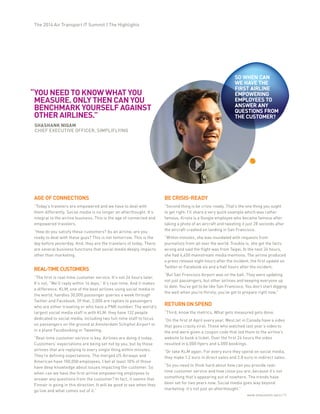
“ YOU NEED TO KNOW WHAT YOU 
MEASURE. ONLY THEN CAN YOU 
BENCHMARK YOURSELF AGAINST 
OTHER AIRLINES.” 
SHASHANK NIGAM 
CHIEF EXECUTIVE OFFICER, SIMPLIFLYING 
So when can 
we have the 
first airline 
empowering 
employees to 
answer any 
questions from 
the customer? 
AGE OF CONNECTIONS 
“Today’s travelers are empowered and we have to deal with 
them differently. Social media is no longer an afterthought. It’s 
integral to the airline business. This is the age of connected and 
empowered travelers. 
“How do you satisfy these customers? As an airline, are you 
ready to deal with these guys? This is not tomorrow. This is the 
day before yesterday. And, they are the travelers of today. There 
are several business functions that social media deeply impacts 
other than marketing. 
“Critically, the new terminal at GRU 
REAL-TIME CUSTOMERS 
“The first is real-time customer service. It’s not 24 hours later. 
It’s not, “We’ll reply within 14 days.” It’s real-time. And it makes 
a difference. KLM, one of the best airlines using social media in 
the world, handles 30,000 passenger queries a week through 
Twitter and Facebook. Of that, 2,000 are replies to passengers 
who are either traveling or who have a PNR number. The world’s 
largest social media staff is with KLM: they have 132 people 
dedicated to social media, including two full-time staff to focus 
on passengers on the ground at Amsterdam Schiphol Airport or 
in a plane Facebooking or Tweeting. 
“Real-time customer service is key. Airlines are doing it today. 
Customers’ expectations are being set not by you, but by those 
airlines that are replying to every single thing within minutes. 
They’re defining expectations. The merged US Airways and 
American have 100,000 employees. I bet at least 10% of those 
have deep knowledge about issues impacting the customer. So 
when can we have the first airline empowering employees to 
answer any questions from the customer? In fact, it seems that 
Finnair is going in this direction. It will be good to see when they 
go live and what comes out of it.” 
BE CRISIS-READY 
“Second thing is be crisis-ready. That’s the one thing you ought 
to get right. I’ll share a very quick example which was rather 
famous. Krista is a Google employee who became famous after 
taking a photo of an aircraft and tweeting it just 28 seconds after 
the aircraft crashed on landing in San Francisco. 
“Within minutes, she was inundated with requests from 
journalists from all over the world. Trouble is, she got the facts 
wrong and said the flight was from Taipei. In the next 24 hours, 
she had 4,450 mainstream media mentions. The airline produced 
a press release eight hours after the incident, the first update on 
Twitter or Facebook six and a half hours after the incident. 
“But San Francisco Airport was on the ball. They were updating 
not just passengers, but other airlines and keeping everyone up 
to date. You’ve got to be like San Francisco. You don’t start digging 
the well when you’re thirsty; you‘ve got to prepare right now.” 
RETURN ON SPEND 
“Third, know the metrics. What gets measured gets done. 
“On the first of April every year, WestJet in Canada have a video 
that goes crazily viral. Those who watched last year’s video to 
the end were given a coupon code that led them to the airline’s 
website to book a ticket. Over the first 24 hours the video 
resulted in 6,000 flyers and 4,000 bookings. 
“Or take KLM again. For every euro they spend on social media, 
they make 1.2 euro in direct sales and 2.8 euro in indirect sales. 
“So you need to think hard about how can you provide real-time 
customer service and how close you are, because it’s not 
something that’s appearing out of nowhere. The trends have 
been set for two years now. Social media goes way beyond 
marketing: it’s not just an afterthought.”

SimpliFlying Featured: Air Transport IT Summit Highlights

  • 1.
    www.sitasummit.aero | 11 The 2014 Air Transport IT Summit | The Highlights “ YOU NEED TO KNOW WHAT YOU MEASURE. ONLY THEN CAN YOU BENCHMARK YOURSELF AGAINST OTHER AIRLINES.” SHASHANK NIGAM CHIEF EXECUTIVE OFFICER, SIMPLIFLYING So when can we have the first airline empowering employees to answer any questions from the customer? AGE OF CONNECTIONS “Today’s travelers are empowered and we have to deal with them differently. Social media is no longer an afterthought. It’s integral to the airline business. This is the age of connected and empowered travelers. “How do you satisfy these customers? As an airline, are you ready to deal with these guys? This is not tomorrow. This is the day before yesterday. And, they are the travelers of today. There are several business functions that social media deeply impacts other than marketing. “Critically, the new terminal at GRU REAL-TIME CUSTOMERS “The first is real-time customer service. It’s not 24 hours later. It’s not, “We’ll reply within 14 days.” It’s real-time. And it makes a difference. KLM, one of the best airlines using social media in the world, handles 30,000 passenger queries a week through Twitter and Facebook. Of that, 2,000 are replies to passengers who are either traveling or who have a PNR number. The world’s largest social media staff is with KLM: they have 132 people dedicated to social media, including two full-time staff to focus on passengers on the ground at Amsterdam Schiphol Airport or in a plane Facebooking or Tweeting. “Real-time customer service is key. Airlines are doing it today. Customers’ expectations are being set not by you, but by those airlines that are replying to every single thing within minutes. They’re defining expectations. The merged US Airways and American have 100,000 employees. I bet at least 10% of those have deep knowledge about issues impacting the customer. So when can we have the first airline empowering employees to answer any questions from the customer? In fact, it seems that Finnair is going in this direction. It will be good to see when they go live and what comes out of it.” BE CRISIS-READY “Second thing is be crisis-ready. That’s the one thing you ought to get right. I’ll share a very quick example which was rather famous. Krista is a Google employee who became famous after taking a photo of an aircraft and tweeting it just 28 seconds after the aircraft crashed on landing in San Francisco. “Within minutes, she was inundated with requests from journalists from all over the world. Trouble is, she got the facts wrong and said the flight was from Taipei. In the next 24 hours, she had 4,450 mainstream media mentions. The airline produced a press release eight hours after the incident, the first update on Twitter or Facebook six and a half hours after the incident. “But San Francisco Airport was on the ball. They were updating not just passengers, but other airlines and keeping everyone up to date. You’ve got to be like San Francisco. You don’t start digging the well when you’re thirsty; you‘ve got to prepare right now.” RETURN ON SPEND “Third, know the metrics. What gets measured gets done. “On the first of April every year, WestJet in Canada have a video that goes crazily viral. Those who watched last year’s video to the end were given a coupon code that led them to the airline’s website to book a ticket. Over the first 24 hours the video resulted in 6,000 flyers and 4,000 bookings. “Or take KLM again. For every euro they spend on social media, they make 1.2 euro in direct sales and 2.8 euro in indirect sales. “So you need to think hard about how can you provide real-time customer service and how close you are, because it’s not something that’s appearing out of nowhere. The trends have been set for two years now. Social media goes way beyond marketing: it’s not just an afterthought.”