Different Theories Of
Genocide
Rinita Mazumdar, Ph.D.
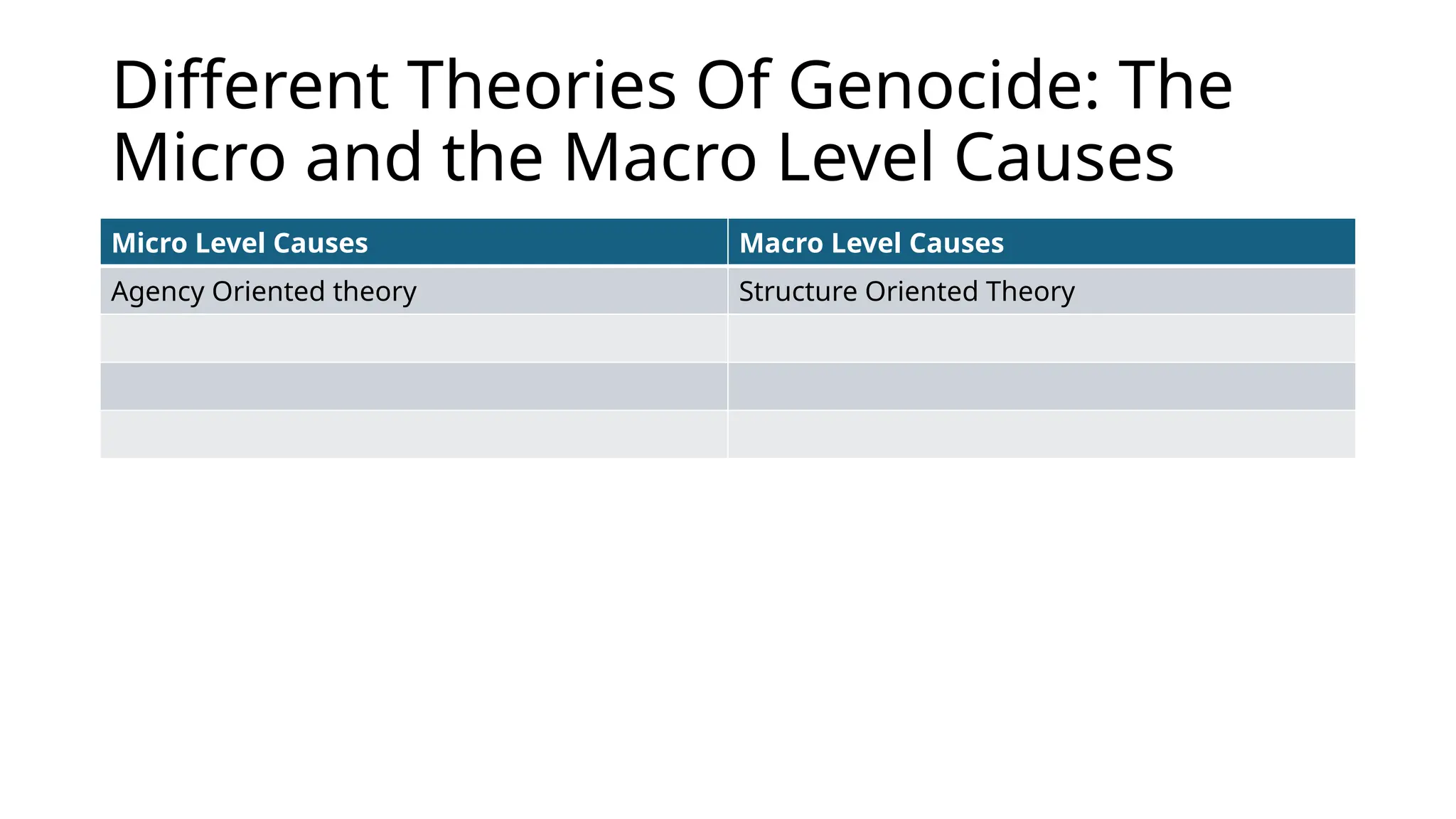
Different Theories Of Genocide: The
Micro and the Macro Level Causes
Micro Level Causes Macro Level Causes
Agency Oriented theory Structure Oriented Theory
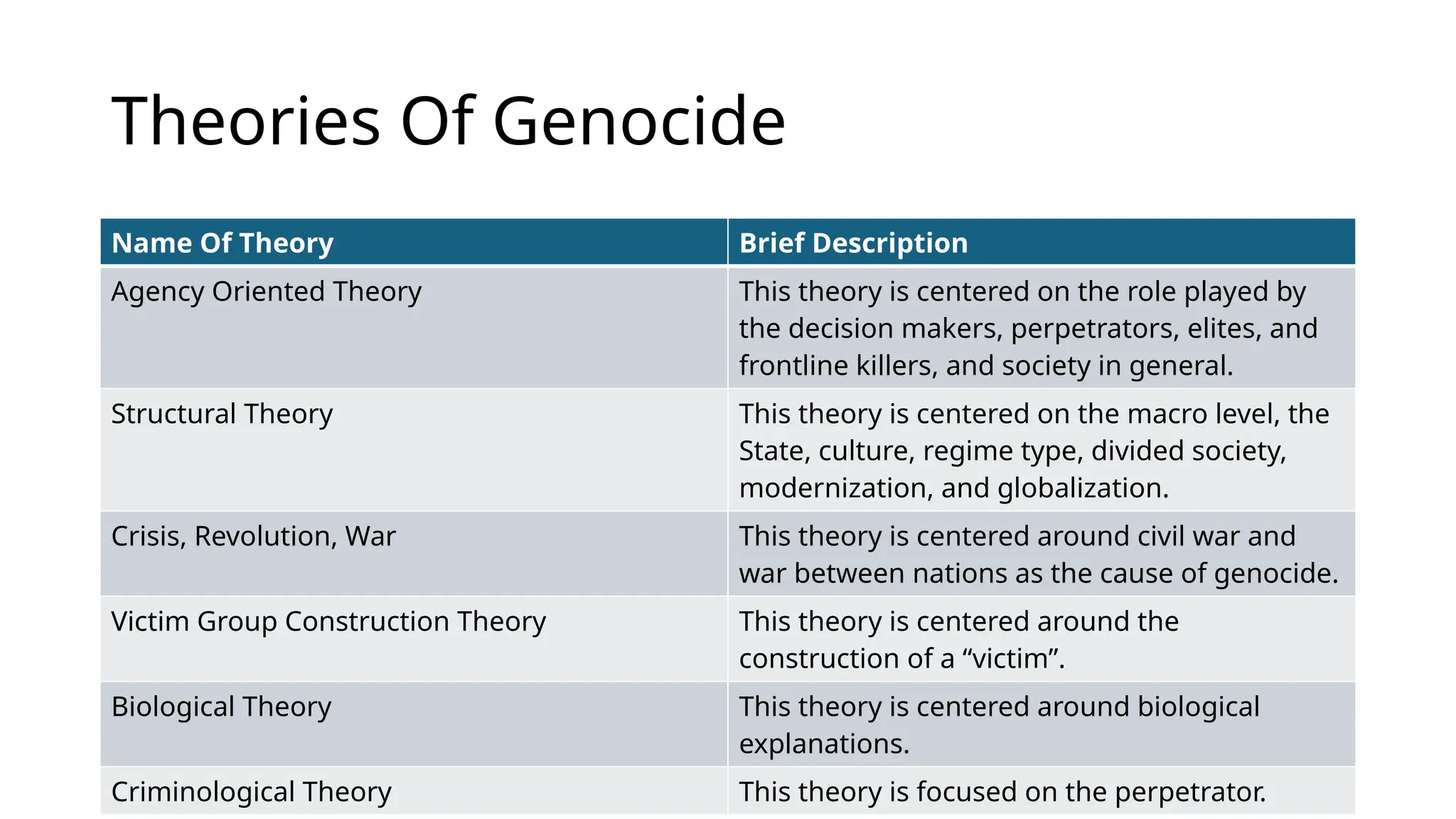
Theories Of Genocide
Name Of Theory Brief Description
Agency Oriented Theory This theory is centered on the role played by
the decision makers, perpetrators, elites, and
frontline killers, and society in general.
Structural Theory This theory is centered on the macro level, the
State, culture, regime type, divided society,
modernization, and globalization.
Crisis, Revolution, War This theory is centered around civil war and
war between nations as the cause of genocide.
Victim Group Construction Theory This theory is centered around the
construction of a “victim”.
Biological Theory This theory is centered around biological
explanations.
Criminological Theory This theory is focused on the perpetrator.
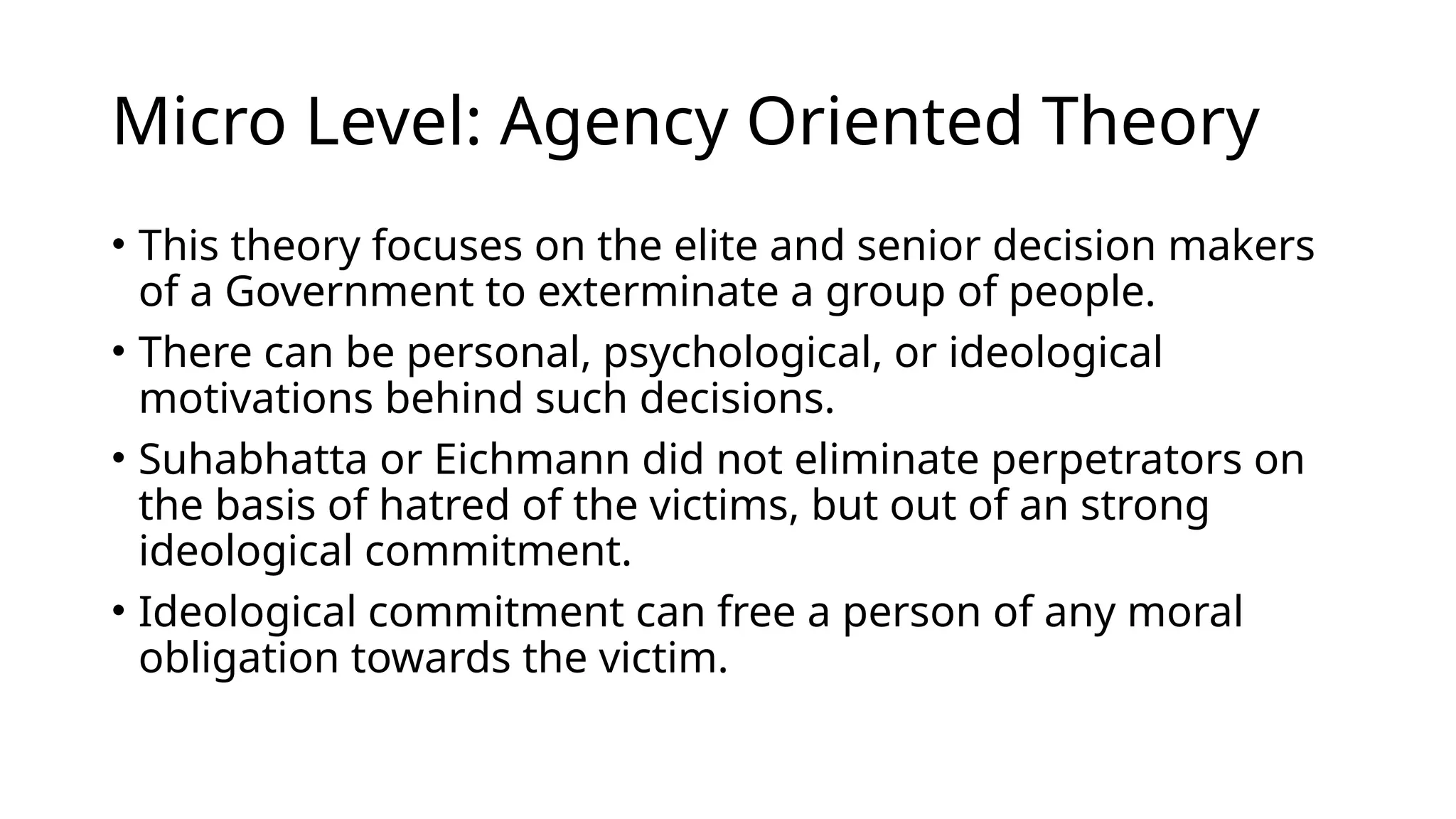
Micro Level: Agency Oriented Theory
• This theory focuses on the elite and senior decision makers
of a Government to exterminate a group of people.
• There can be personal, psychological, or ideological
motivations behind such decisions.
• Suhabhatta or Eichmann did not eliminate perpetrators on
the basis of hatred of the victims, but out of an strong
ideological commitment.
• Ideological commitment can free a person of any moral
obligation towards the victim.
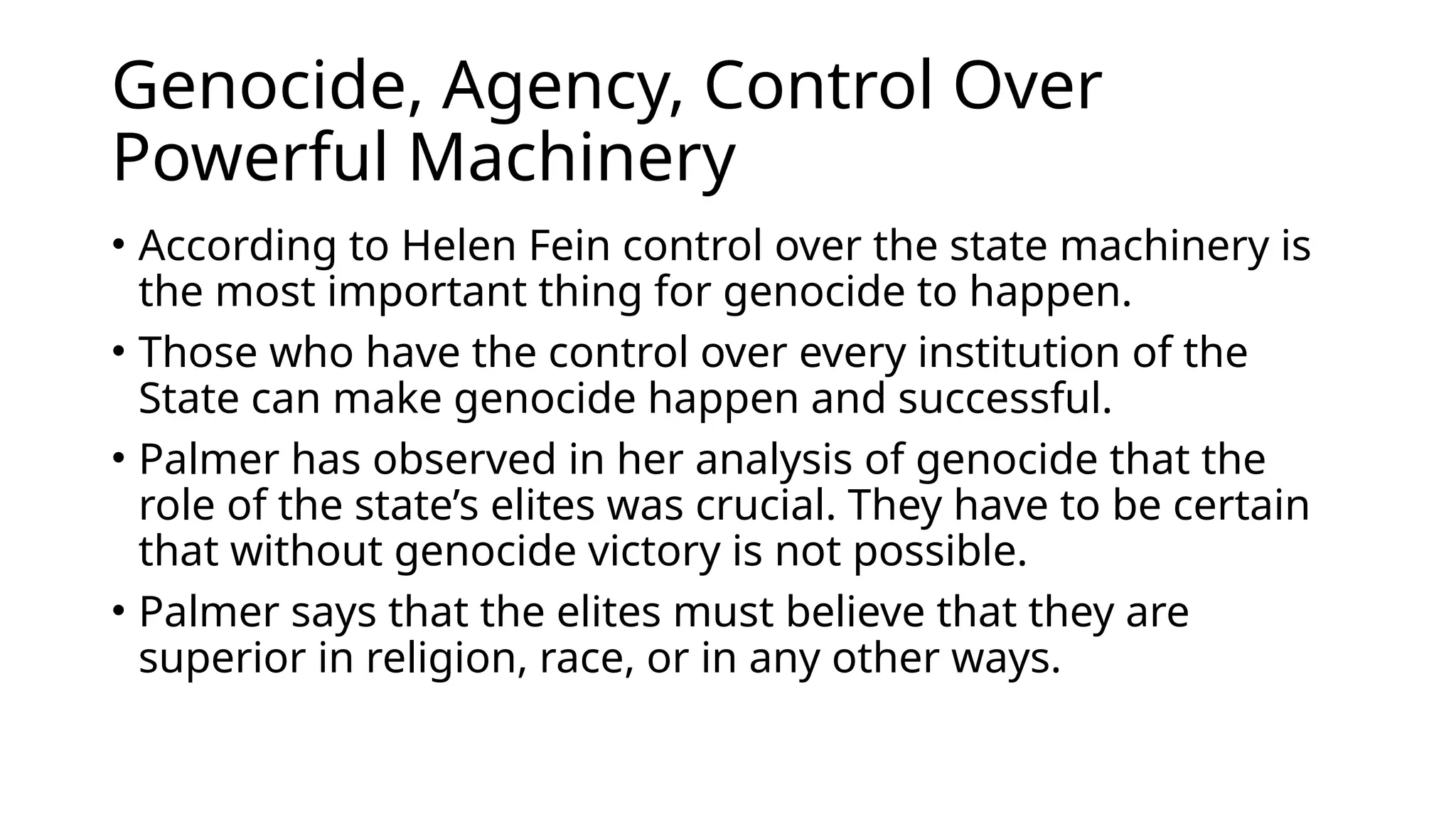
Genocide, Agency, Control Over
Powerful Machinery
• According to Helen Fein control over the state machinery is
the most important thing for genocide to happen.
• Those who have the control over every institution of the
State can make genocide happen and successful.
• Palmer has observed in her analysis of genocide that the
role of the state’s elites was crucial. They have to be certain
that without genocide victory is not possible.
• Palmer says that the elites must believe that they are
superior in religion, race, or in any other ways.
Why Does The Common Man Get
Involved in Genocide: Neutralization
Techniques
• Alexander Alvarez shows how common people get involved
in genocide via neutralization techniques.
• Here are five neutralization techniques:
Names Descriptions
Denial of Responsibility The criminal says that he was
a victim of circumstances
under which he was
compelled to commit the
crime.
Denial Of Injury The criminal says that his
actions did not harm anyone.
Denial of the victim The perpetrator puts forth the
Society
• A genocide occurs in a society. The perpetrators, the victims, the
bystanders and others live in society. The bystanders and others
tacitly permit the advancement of genocide.
• Ervin Staub in his theory says that the structure of a theory is
important vis a vis genocide. When difficult life events occur in a
disorganized society it leads to genocide. He is of a firm opinion
that if external or internal bystanders intervene it has a
significant effect on the possibility and success of genocide.
• According to the theory of Michael Freeman the perpetration of
genocide become convenient if the society is in agreement and
that only genocide can solve a problem.
Macro Level: Structural Theories:
Culture, Regime Type, Divided Society
Structural Features How It May Lead To Genocide
P. Christian Scherrer says that genocide is the
result of cultural aspects within the state.
Ethnicity and colonization are the two main
cultural aspects leading to genocide. The
dominant force behind genocide is
ethnicization of the state.
Erwin Staub adds to this by saying that some
cultures may feel they are superior and if they
feel that the superiority is threatened,
genocide may be the result.
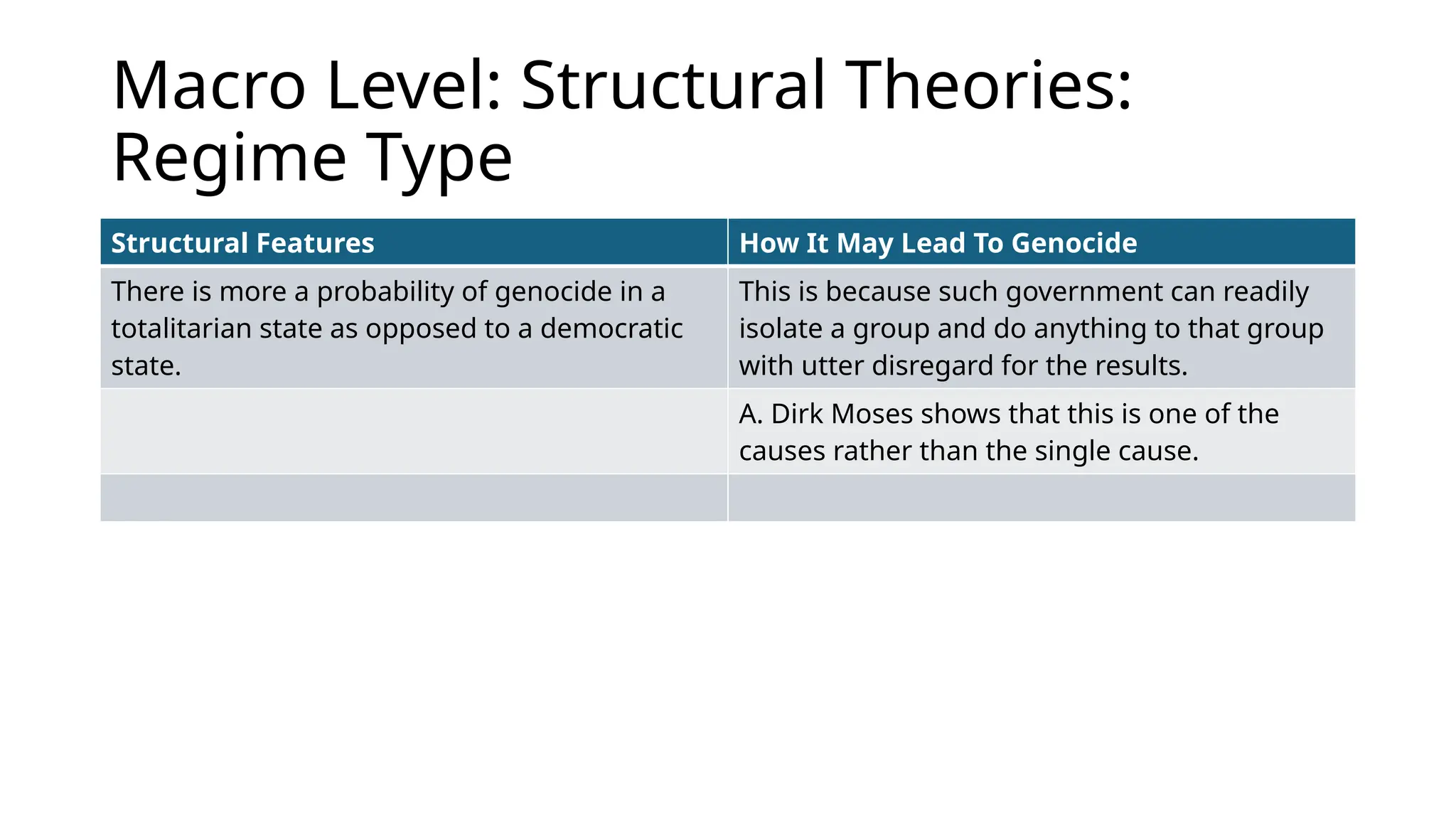
Macro Level: Structural Theories:
Regime Type
Structural Features How It May Lead To Genocide
There is more a probability of genocide in a
totalitarian state as opposed to a democratic
state.
This is because such government can readily
isolate a group and do anything to that group
with utter disregard for the results.
A. Dirk Moses shows that this is one of the
causes rather than the single cause.
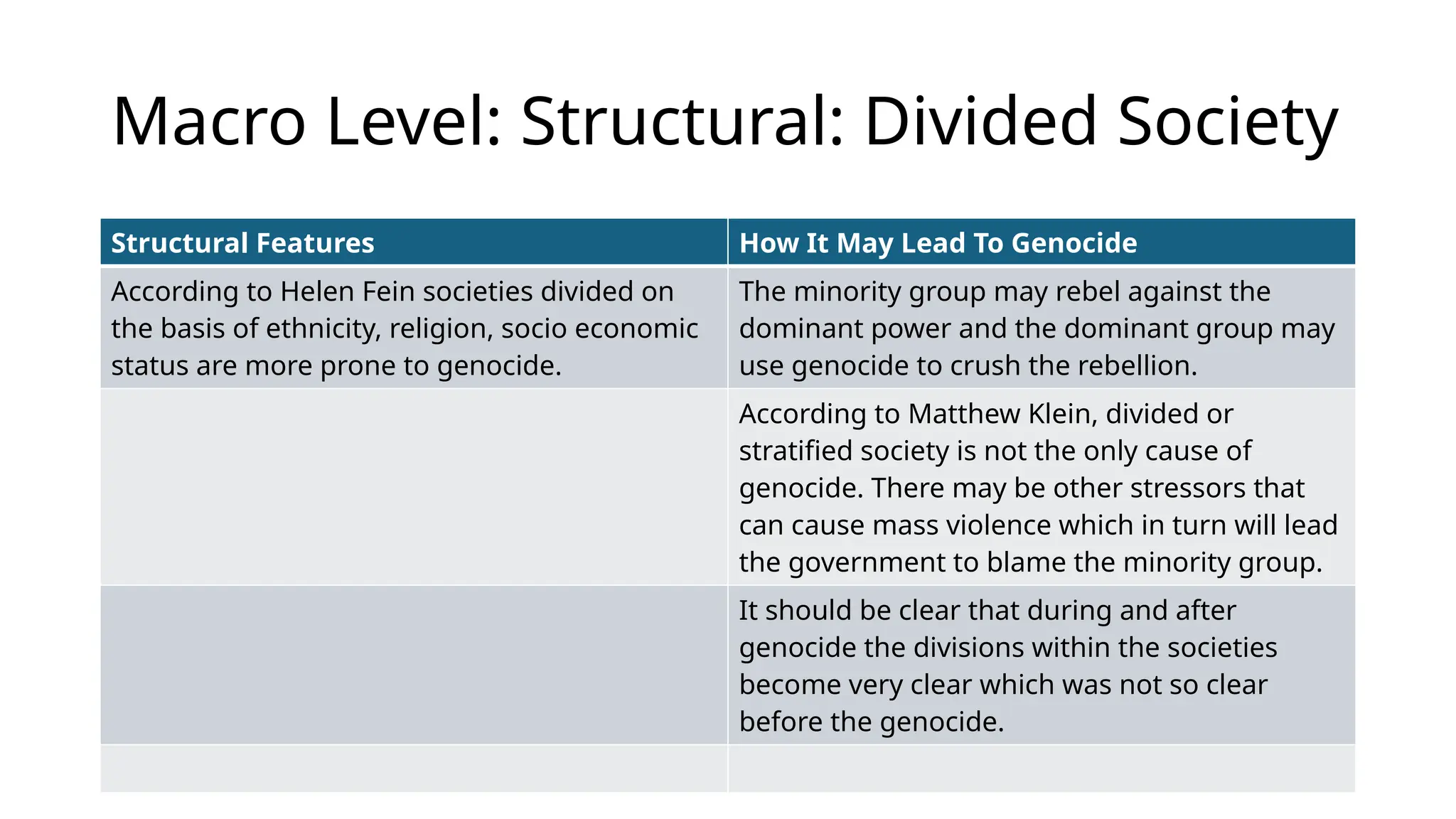
Macro Level: Structural: Divided Society
Structural Features How It May Lead To Genocide
According to Helen Fein societies divided on
the basis of ethnicity, religion, socio economic
status are more prone to genocide.
The minority group may rebel against the
dominant power and the dominant group may
use genocide to crush the rebellion.
According to Matthew Klein, divided or
stratified society is not the only cause of
genocide. There may be other stressors that
can cause mass violence which in turn will lead
the government to blame the minority group.
It should be clear that during and after
genocide the divisions within the societies
become very clear which was not so clear
before the genocide.
Macro Level: Structural Theories:
Modernity
Structure How It Affects Genocide
Modernity According to Thomas Cushman due to rapid
modernization in the 20th
century there has
been more episodes of genocide than before
and these have run parallel to the process of
modernization.
Various aspects of modernity such as quick
communication, a large number of
intellectuals, new and more sophisticated
weapons and more international political
negotiations has led to more episodes of
genocides. All these can be used to prevent
genocide also, but no one used them.
Globalization According to A. Dirk Moses, globalization
requires some states to increase the pace of
Crisis, Revolution, War
• Matthew Krain saw civil war as the most efficient predictor
of genocide. Civil war and war between nations increased
the possibilities of genocide especially when decolonization
and civil war happened together.
• R. J. Rummel says that war may be a cover up for a state that
tried to perpetuate genocide.
• War may also make the victim group more and more
insecure.
• Helen Fein underlines a complex link between genocide and
war. More use of aggression leads to more and more
continuation of it.
Macro Level: Structural: Profound
Social Change and Genocide
• Ernesto Verdeja’s says that a profound social change is a
pre- condition for genocide.
• These changes can come in the form of war, revolution,
coup or any major social change.
• Verdeja’s theory is important for it can lead to the
prevention of genocide instead of analyzing the causes after
it had happened.
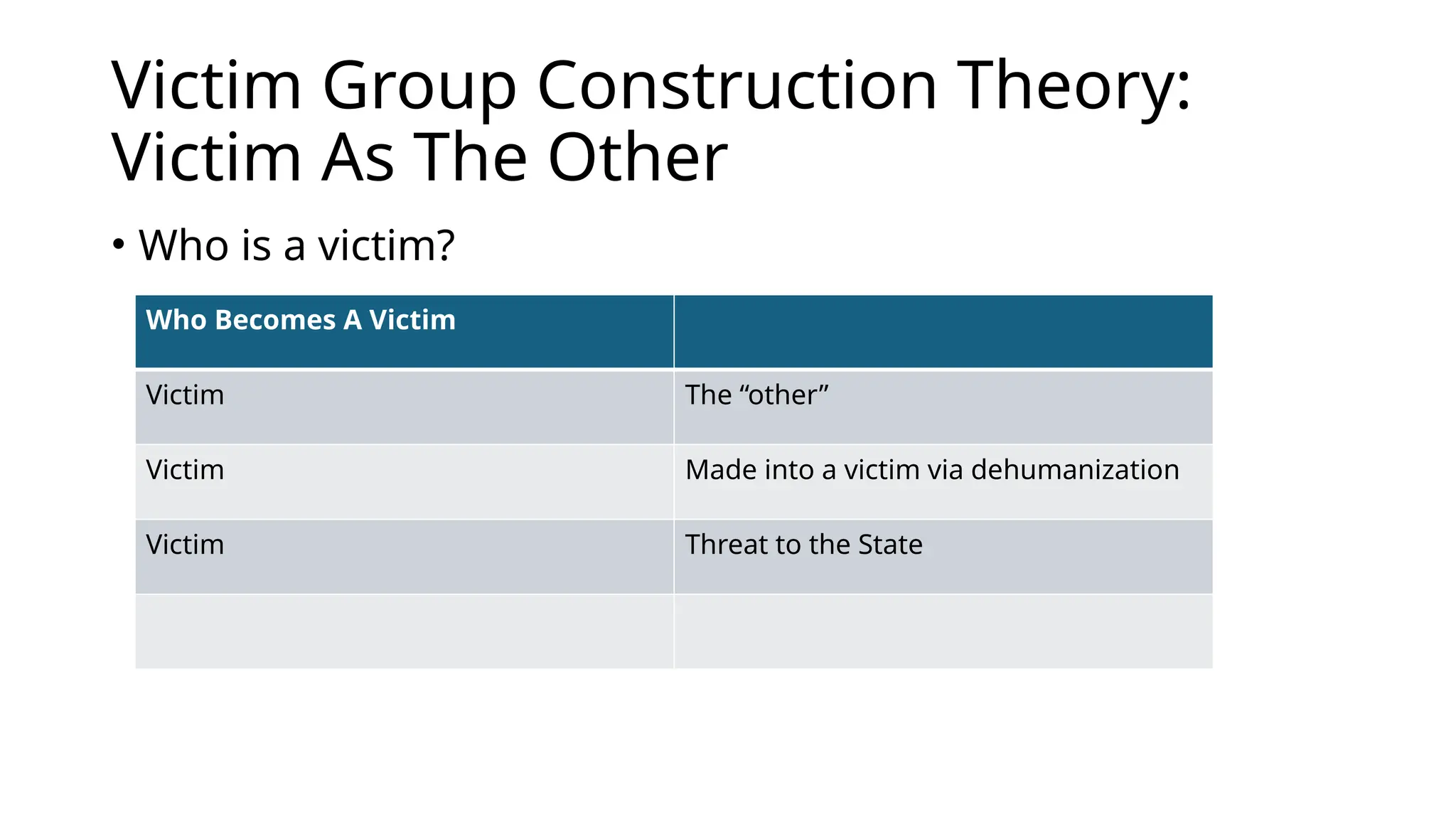
Victim Group Construction Theory:
Victim As The Other
• Who is a victim?
Who Becomes A Victim
Victim The “other”
Victim Made into a victim via dehumanization
Victim Threat to the State
Victim Construction: Othering, De
humanization, Threat To The State
Victim Construction How It Is Done
“Othering” A distinction is made between the groups in
terms of and “in group” and an “out group”,
othering occurs.
When a group is classified as “other”, it is easy
to remove it from the sphere of moral
obligation.
When a state does that nobody can save the
othered victim group from being exterminated
Allison Palmer says that Armenians and Jews
were integrated into their community. Then
came a point when they were classified as the
“other” and the began the process of genocide.
Their acceptance in the broader society began
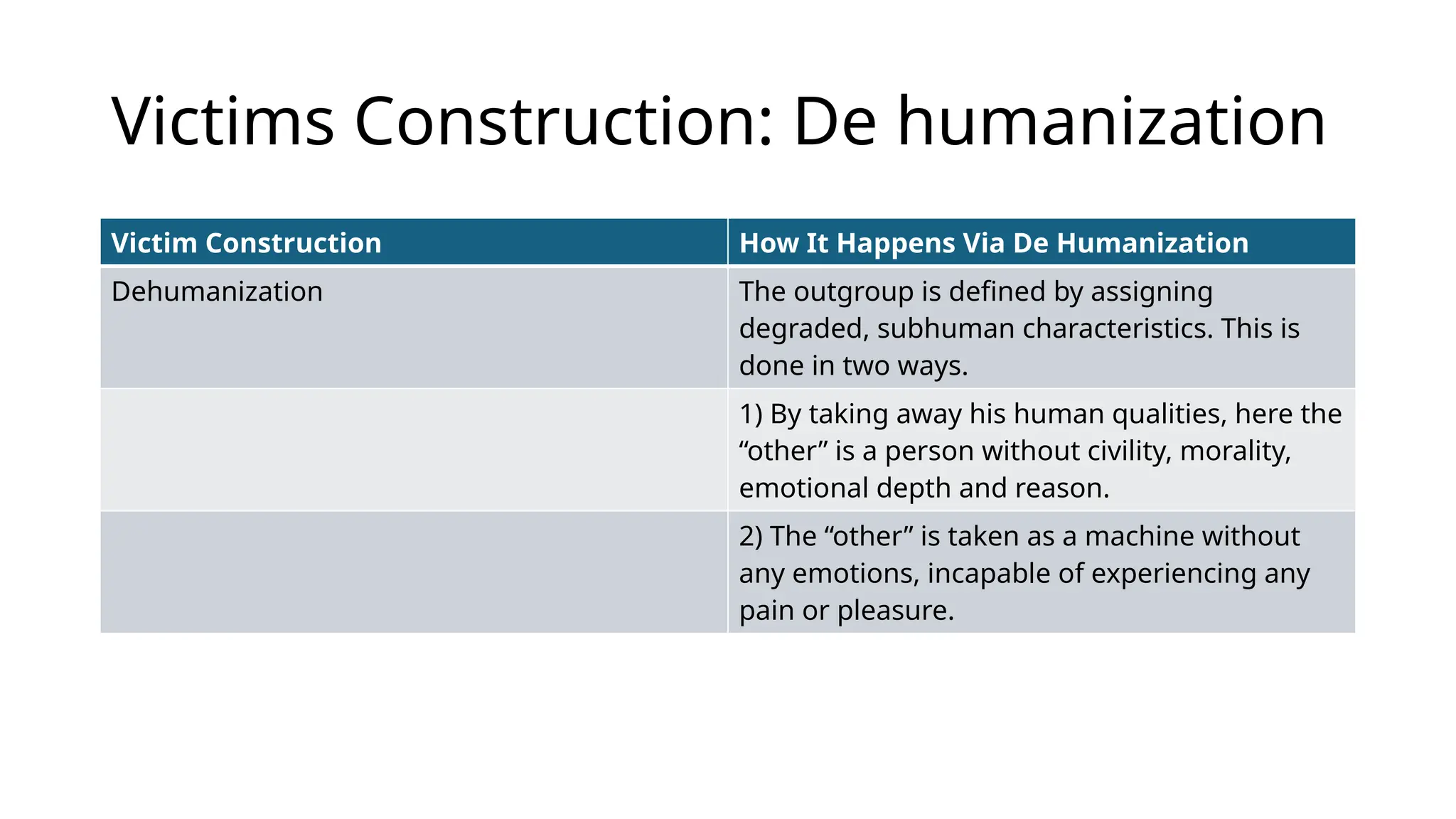
Victims Construction: De humanization
Victim Construction How It Happens Via De Humanization
Dehumanization The outgroup is defined by assigning
degraded, subhuman characteristics. This is
done in two ways.
1) By taking away his human qualities, here the
“other” is a person without civility, morality,
emotional depth and reason.
2) The “other” is taken as a machine without
any emotions, incapable of experiencing any
pain or pleasure.
Erwin Staub’s Theory and Rhiannon
Neilson’s Theory on De humanization
• Erwin Staub’s theory of genocide draws attention to an element of
devaluation, a human tendency that serves as a basis on doing
harm.
• This devaluation makes people view the outgroup as a bunch of
objects that can be acted upon with almost no risk of retaliation.
• Rhiannon S. Neilson has suggested “Toxification” as a more precise
early warning sign for genocide. Toxification is an extreme way of
dehumanization. She says that toxification is the cognitive
perception of the target group as fundamentally lethal to the
survival of the perpetrator. The target group is not inhuman or
inferior, but a toxic presence that must be cauterized and destroyed.
Victim Construction: Threat To State
Victim Construction How Is It Constructed
Threat To The State The threat has to be eradicated.
The State makes people afraid, which turns
into hatred.
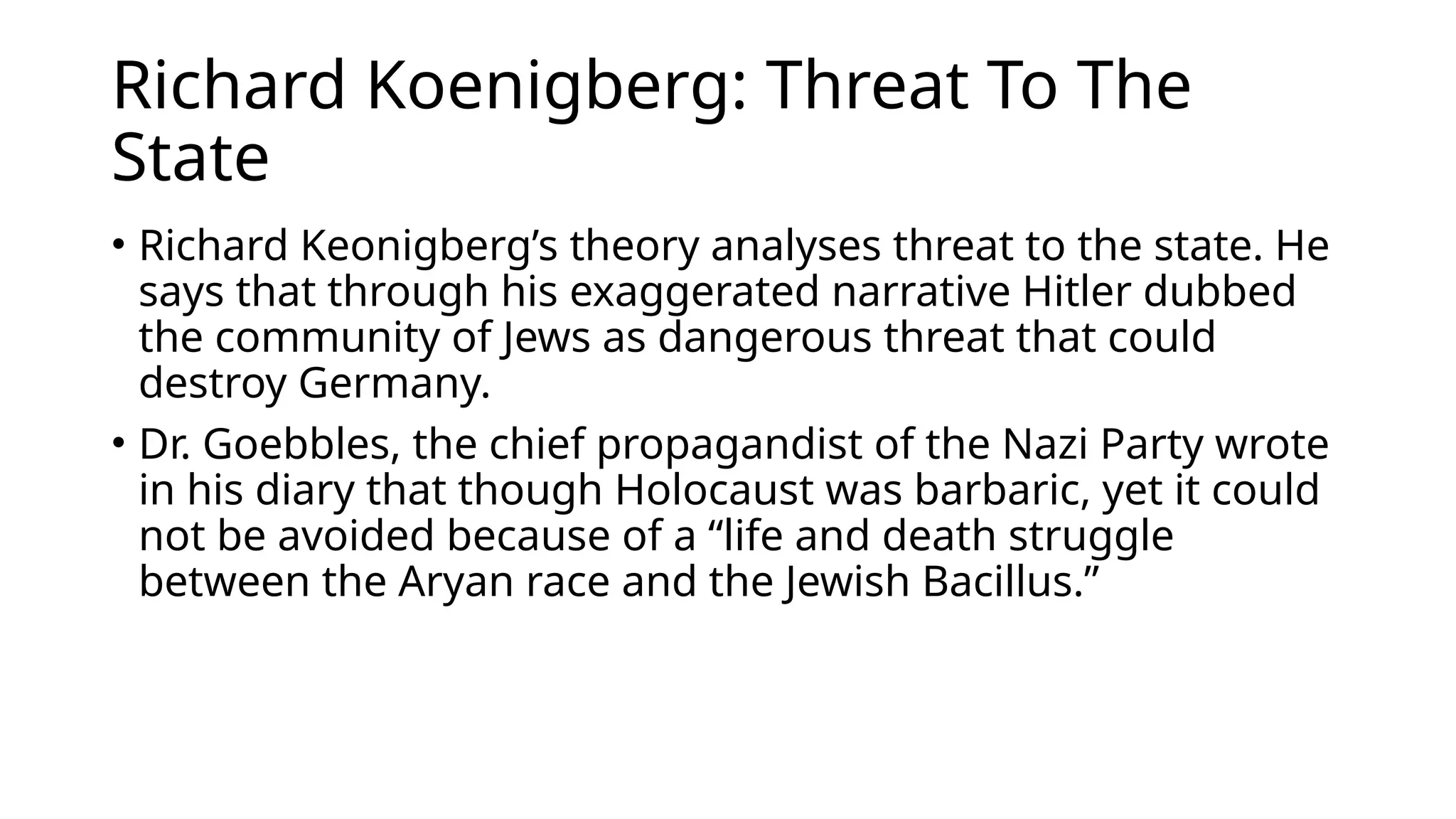
Richard Koenigberg: Threat To The
State
• Richard Keonigberg’s theory analyses threat to the state. He
says that through his exaggerated narrative Hitler dubbed
the community of Jews as dangerous threat that could
destroy Germany.
• Dr. Goebbles, the chief propagandist of the Nazi Party wrote
in his diary that though Holocaust was barbaric, yet it could
not be avoided because of a “life and death struggle
between the Aryan race and the Jewish Bacillus.”
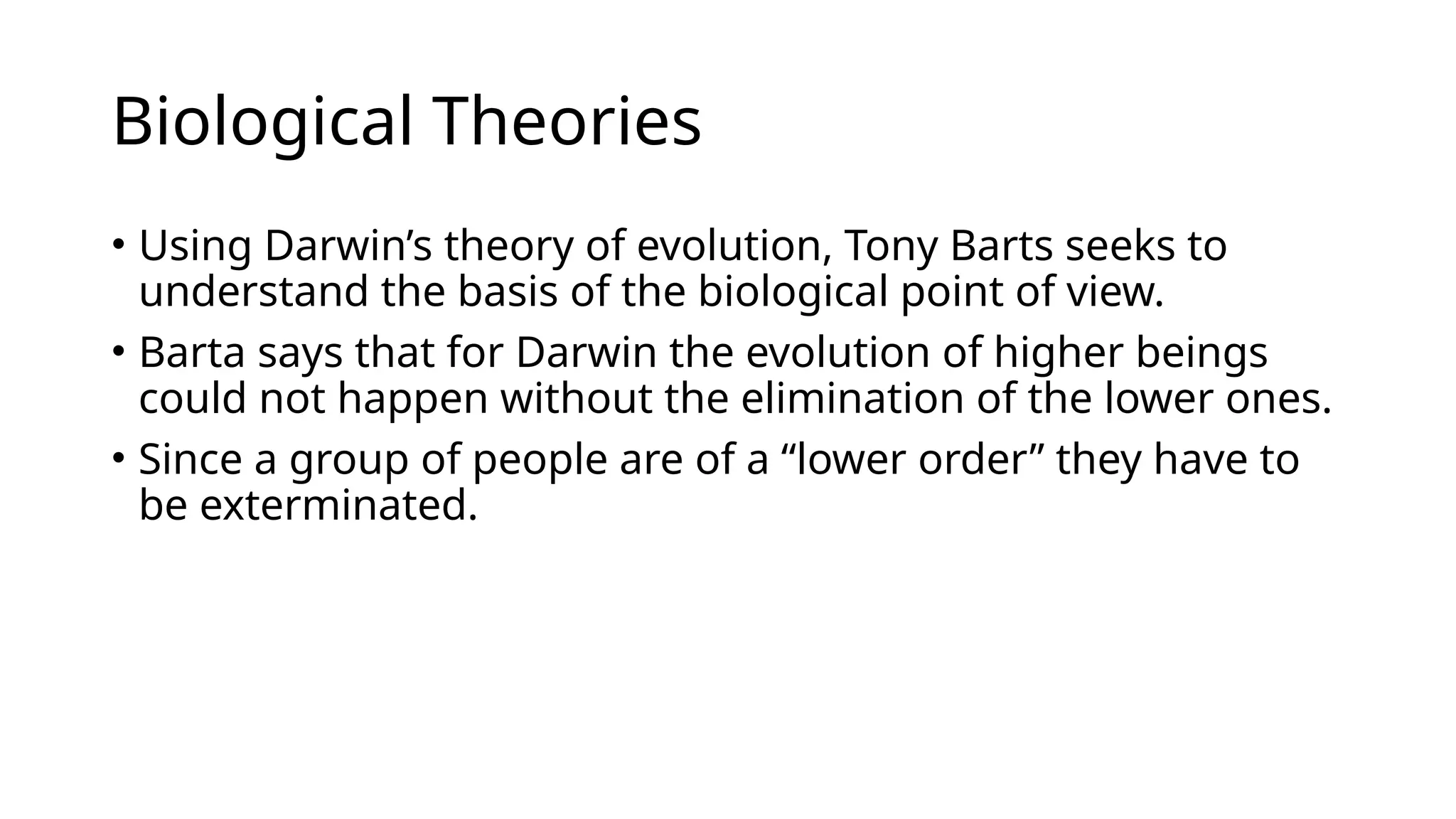
Biological Theories
• Using Darwin’s theory of evolution, Tony Barts seeks to
understand the basis of the biological point of view.
• Barta says that for Darwin the evolution of higher beings
could not happen without the elimination of the lower ones.
• Since a group of people are of a “lower order” they have to
be exterminated.
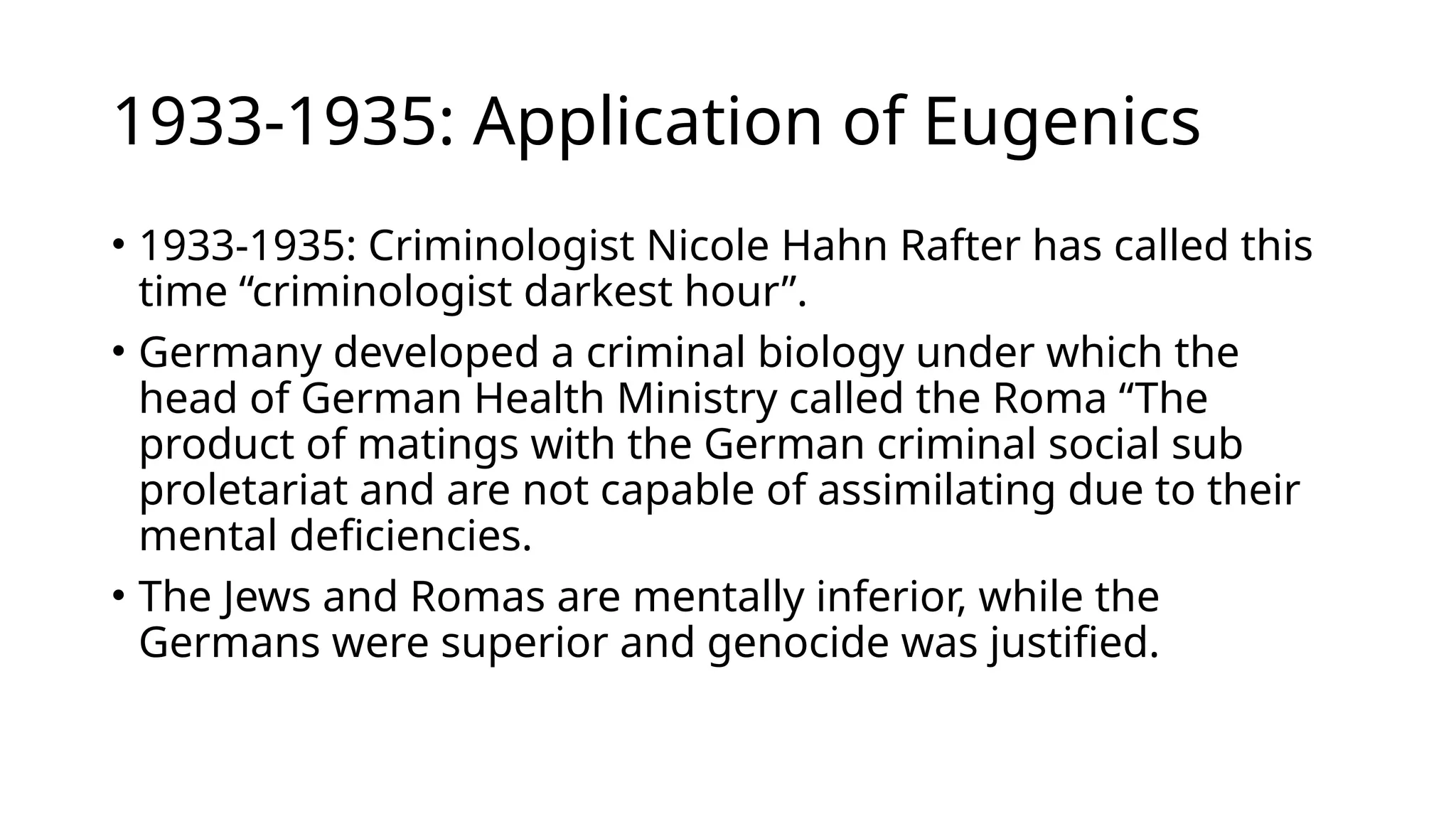
1933-1935: Application of Eugenics
• 1933-1935: Criminologist Nicole Hahn Rafter has called this
time “criminologist darkest hour”.
• Germany developed a criminal biology under which the
head of German Health Ministry called the Roma “The
product of matings with the German criminal social sub
proletariat and are not capable of assimilating due to their
mental deficiencies.
• The Jews and Romas are mentally inferior, while the
Germans were superior and genocide was justified.
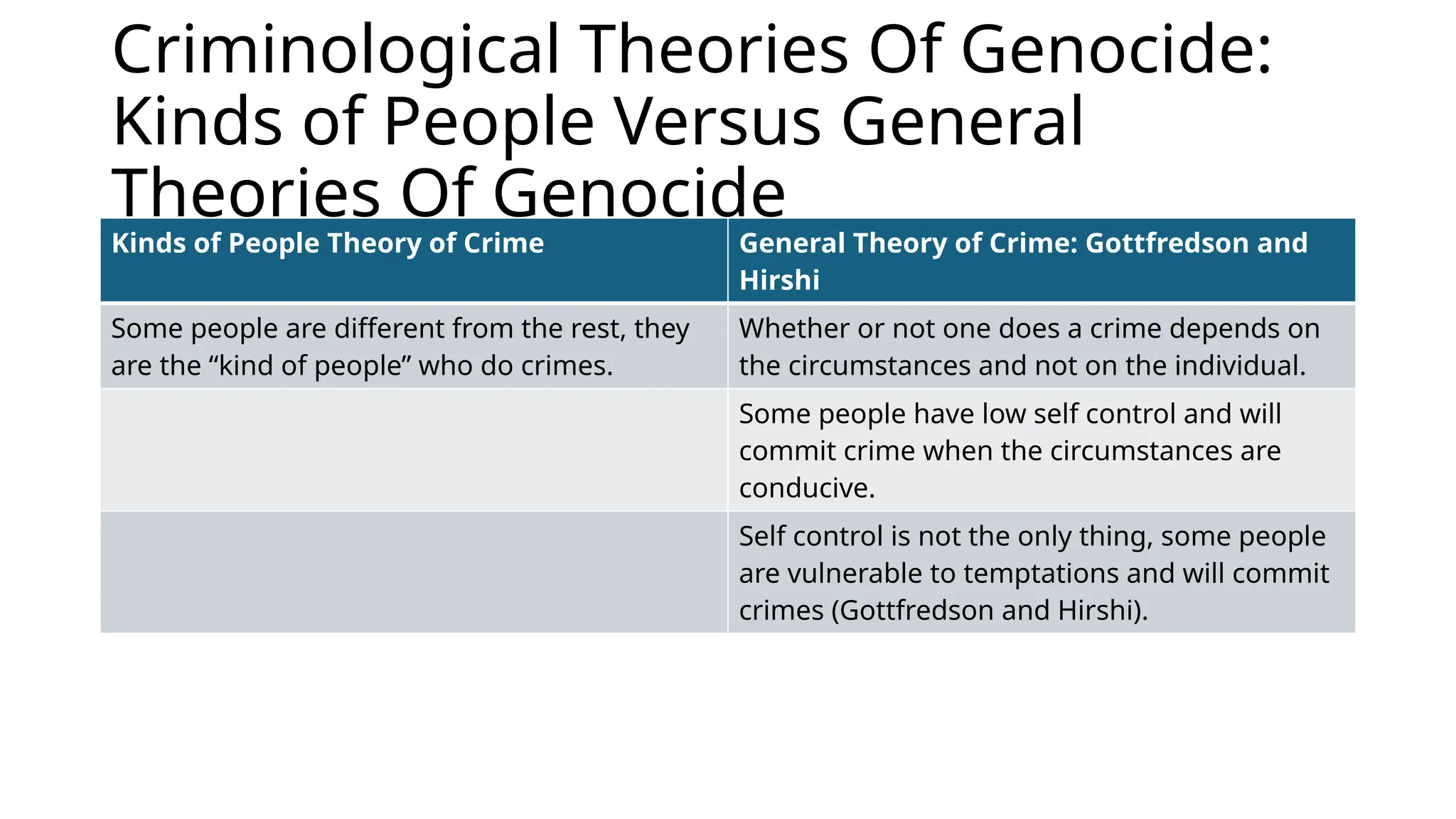
Criminological Theories Of Genocide:
Kinds of People Versus General
Theories Of Genocide
Kinds of People Theory of Crime General Theory of Crime: Gottfredson and
Hirshi
Some people are different from the rest, they
are the “kind of people” who do crimes.
Whether or not one does a crime depends on
the circumstances and not on the individual.
Some people have low self control and will
commit crime when the circumstances are
conducive.
Self control is not the only thing, some people
are vulnerable to temptations and will commit
crimes (Gottfredson and Hirshi).
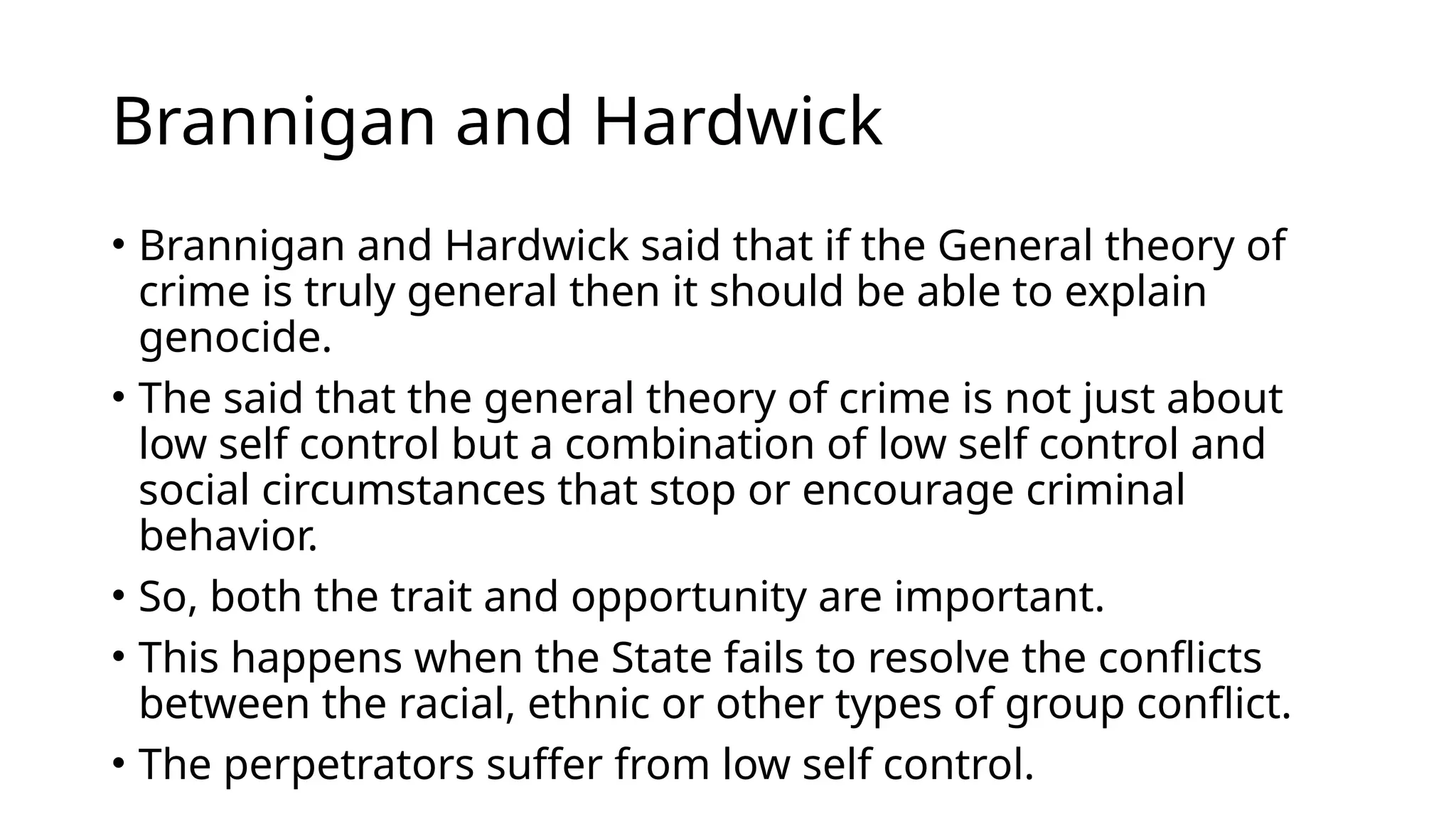
Brannigan and Hardwick
• Brannigan and Hardwick said that if the General theory of
crime is truly general then it should be able to explain
genocide.
• The said that the general theory of crime is not just about
low self control but a combination of low self control and
social circumstances that stop or encourage criminal
behavior.
• So, both the trait and opportunity are important.
• This happens when the State fails to resolve the conflicts
between the racial, ethnic or other types of group conflict.
• The perpetrators suffer from low self control.
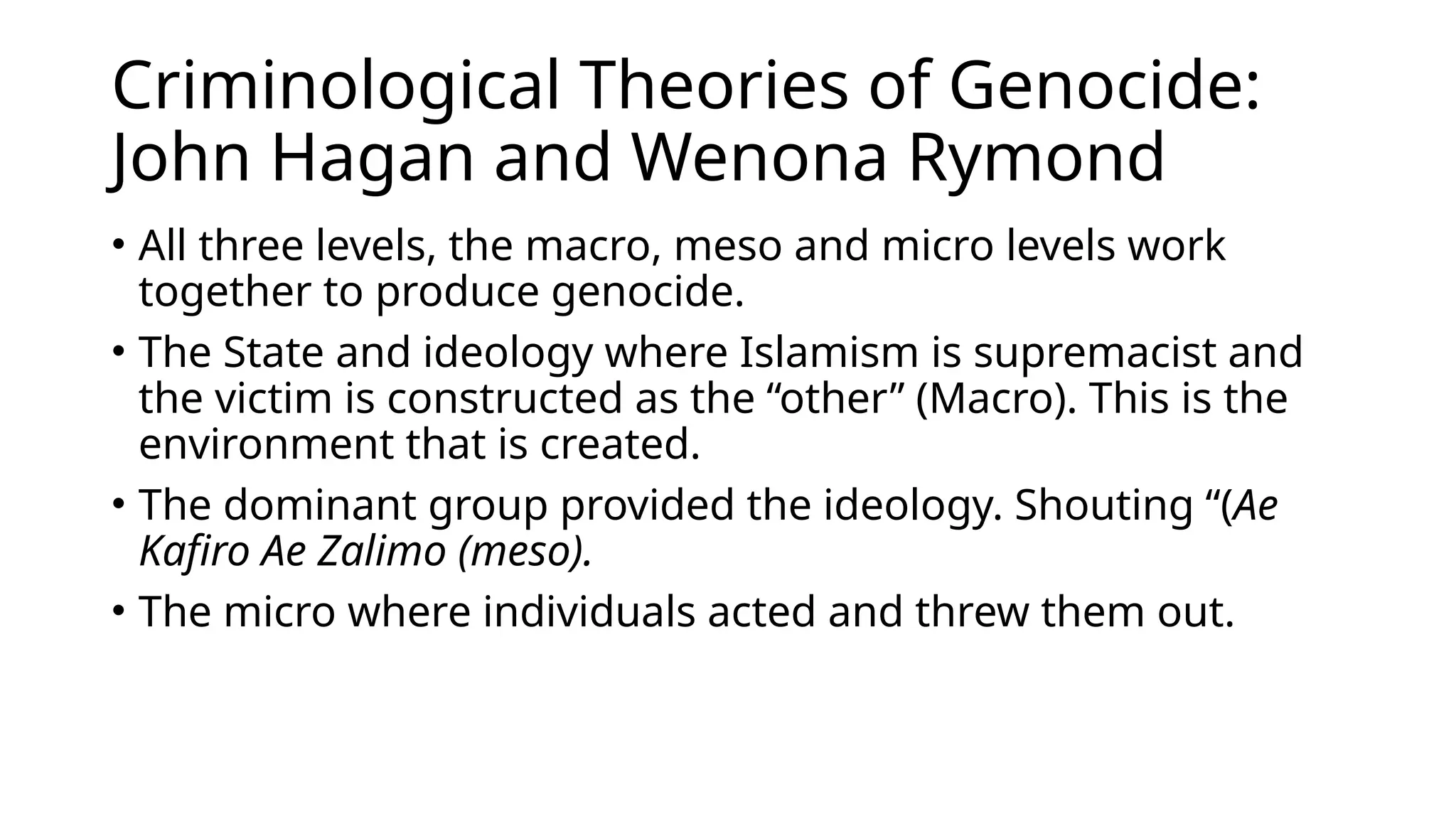
Criminological Theories of Genocide:
John Hagan and Wenona Rymond
• All three levels, the macro, meso and micro levels work
together to produce genocide.
• The State and ideology where Islamism is supremacist and
the victim is constructed as the “other” (Macro). This is the
environment that is created.
• The dominant group provided the ideology. Shouting “(Ae
Kafiro Ae Zalimo (meso).
• The micro where individuals acted and threw them out.
Criminological Theories of Genocide: John
Hagan and Wenona Rymond

Different Theories Of Genocide Revised.pptx

  • 1.
  • 2.
    Different Theories OfGenocide: The Micro and the Macro Level Causes Micro Level Causes Macro Level Causes Agency Oriented theory Structure Oriented Theory
  • 3.
    Theories Of Genocide NameOf Theory Brief Description Agency Oriented Theory This theory is centered on the role played by the decision makers, perpetrators, elites, and frontline killers, and society in general. Structural Theory This theory is centered on the macro level, the State, culture, regime type, divided society, modernization, and globalization. Crisis, Revolution, War This theory is centered around civil war and war between nations as the cause of genocide. Victim Group Construction Theory This theory is centered around the construction of a “victim”. Biological Theory This theory is centered around biological explanations. Criminological Theory This theory is focused on the perpetrator.
  • 4.
    Micro Level: AgencyOriented Theory • This theory focuses on the elite and senior decision makers of a Government to exterminate a group of people. • There can be personal, psychological, or ideological motivations behind such decisions. • Suhabhatta or Eichmann did not eliminate perpetrators on the basis of hatred of the victims, but out of an strong ideological commitment. • Ideological commitment can free a person of any moral obligation towards the victim.
  • 5.
    Genocide, Agency, ControlOver Powerful Machinery • According to Helen Fein control over the state machinery is the most important thing for genocide to happen. • Those who have the control over every institution of the State can make genocide happen and successful. • Palmer has observed in her analysis of genocide that the role of the state’s elites was crucial. They have to be certain that without genocide victory is not possible. • Palmer says that the elites must believe that they are superior in religion, race, or in any other ways.
  • 6.
    Why Does TheCommon Man Get Involved in Genocide: Neutralization Techniques • Alexander Alvarez shows how common people get involved in genocide via neutralization techniques. • Here are five neutralization techniques: Names Descriptions Denial of Responsibility The criminal says that he was a victim of circumstances under which he was compelled to commit the crime. Denial Of Injury The criminal says that his actions did not harm anyone. Denial of the victim The perpetrator puts forth the
  • 7.
    Society • A genocideoccurs in a society. The perpetrators, the victims, the bystanders and others live in society. The bystanders and others tacitly permit the advancement of genocide. • Ervin Staub in his theory says that the structure of a theory is important vis a vis genocide. When difficult life events occur in a disorganized society it leads to genocide. He is of a firm opinion that if external or internal bystanders intervene it has a significant effect on the possibility and success of genocide. • According to the theory of Michael Freeman the perpetration of genocide become convenient if the society is in agreement and that only genocide can solve a problem.
  • 8.
    Macro Level: StructuralTheories: Culture, Regime Type, Divided Society Structural Features How It May Lead To Genocide P. Christian Scherrer says that genocide is the result of cultural aspects within the state. Ethnicity and colonization are the two main cultural aspects leading to genocide. The dominant force behind genocide is ethnicization of the state. Erwin Staub adds to this by saying that some cultures may feel they are superior and if they feel that the superiority is threatened, genocide may be the result.
  • 9.
    Macro Level: StructuralTheories: Regime Type Structural Features How It May Lead To Genocide There is more a probability of genocide in a totalitarian state as opposed to a democratic state. This is because such government can readily isolate a group and do anything to that group with utter disregard for the results. A. Dirk Moses shows that this is one of the causes rather than the single cause.
  • 10.
    Macro Level: Structural:Divided Society Structural Features How It May Lead To Genocide According to Helen Fein societies divided on the basis of ethnicity, religion, socio economic status are more prone to genocide. The minority group may rebel against the dominant power and the dominant group may use genocide to crush the rebellion. According to Matthew Klein, divided or stratified society is not the only cause of genocide. There may be other stressors that can cause mass violence which in turn will lead the government to blame the minority group. It should be clear that during and after genocide the divisions within the societies become very clear which was not so clear before the genocide.
  • 11.
    Macro Level: StructuralTheories: Modernity Structure How It Affects Genocide Modernity According to Thomas Cushman due to rapid modernization in the 20th century there has been more episodes of genocide than before and these have run parallel to the process of modernization. Various aspects of modernity such as quick communication, a large number of intellectuals, new and more sophisticated weapons and more international political negotiations has led to more episodes of genocides. All these can be used to prevent genocide also, but no one used them. Globalization According to A. Dirk Moses, globalization requires some states to increase the pace of
  • 12.
    Crisis, Revolution, War •Matthew Krain saw civil war as the most efficient predictor of genocide. Civil war and war between nations increased the possibilities of genocide especially when decolonization and civil war happened together. • R. J. Rummel says that war may be a cover up for a state that tried to perpetuate genocide. • War may also make the victim group more and more insecure. • Helen Fein underlines a complex link between genocide and war. More use of aggression leads to more and more continuation of it.
  • 13.
    Macro Level: Structural:Profound Social Change and Genocide • Ernesto Verdeja’s says that a profound social change is a pre- condition for genocide. • These changes can come in the form of war, revolution, coup or any major social change. • Verdeja’s theory is important for it can lead to the prevention of genocide instead of analyzing the causes after it had happened.
  • 14.
    Victim Group ConstructionTheory: Victim As The Other • Who is a victim? Who Becomes A Victim Victim The “other” Victim Made into a victim via dehumanization Victim Threat to the State
  • 15.
    Victim Construction: Othering,De humanization, Threat To The State Victim Construction How It Is Done “Othering” A distinction is made between the groups in terms of and “in group” and an “out group”, othering occurs. When a group is classified as “other”, it is easy to remove it from the sphere of moral obligation. When a state does that nobody can save the othered victim group from being exterminated Allison Palmer says that Armenians and Jews were integrated into their community. Then came a point when they were classified as the “other” and the began the process of genocide. Their acceptance in the broader society began
  • 16.
    Victims Construction: Dehumanization Victim Construction How It Happens Via De Humanization Dehumanization The outgroup is defined by assigning degraded, subhuman characteristics. This is done in two ways. 1) By taking away his human qualities, here the “other” is a person without civility, morality, emotional depth and reason. 2) The “other” is taken as a machine without any emotions, incapable of experiencing any pain or pleasure.
  • 17.
    Erwin Staub’s Theoryand Rhiannon Neilson’s Theory on De humanization • Erwin Staub’s theory of genocide draws attention to an element of devaluation, a human tendency that serves as a basis on doing harm. • This devaluation makes people view the outgroup as a bunch of objects that can be acted upon with almost no risk of retaliation. • Rhiannon S. Neilson has suggested “Toxification” as a more precise early warning sign for genocide. Toxification is an extreme way of dehumanization. She says that toxification is the cognitive perception of the target group as fundamentally lethal to the survival of the perpetrator. The target group is not inhuman or inferior, but a toxic presence that must be cauterized and destroyed.
  • 18.
    Victim Construction: ThreatTo State Victim Construction How Is It Constructed Threat To The State The threat has to be eradicated. The State makes people afraid, which turns into hatred.
  • 19.
    Richard Koenigberg: ThreatTo The State • Richard Keonigberg’s theory analyses threat to the state. He says that through his exaggerated narrative Hitler dubbed the community of Jews as dangerous threat that could destroy Germany. • Dr. Goebbles, the chief propagandist of the Nazi Party wrote in his diary that though Holocaust was barbaric, yet it could not be avoided because of a “life and death struggle between the Aryan race and the Jewish Bacillus.”
  • 20.
    Biological Theories • UsingDarwin’s theory of evolution, Tony Barts seeks to understand the basis of the biological point of view. • Barta says that for Darwin the evolution of higher beings could not happen without the elimination of the lower ones. • Since a group of people are of a “lower order” they have to be exterminated.
  • 21.
    1933-1935: Application ofEugenics • 1933-1935: Criminologist Nicole Hahn Rafter has called this time “criminologist darkest hour”. • Germany developed a criminal biology under which the head of German Health Ministry called the Roma “The product of matings with the German criminal social sub proletariat and are not capable of assimilating due to their mental deficiencies. • The Jews and Romas are mentally inferior, while the Germans were superior and genocide was justified.
  • 22.
    Criminological Theories OfGenocide: Kinds of People Versus General Theories Of Genocide Kinds of People Theory of Crime General Theory of Crime: Gottfredson and Hirshi Some people are different from the rest, they are the “kind of people” who do crimes. Whether or not one does a crime depends on the circumstances and not on the individual. Some people have low self control and will commit crime when the circumstances are conducive. Self control is not the only thing, some people are vulnerable to temptations and will commit crimes (Gottfredson and Hirshi).
  • 23.
    Brannigan and Hardwick •Brannigan and Hardwick said that if the General theory of crime is truly general then it should be able to explain genocide. • The said that the general theory of crime is not just about low self control but a combination of low self control and social circumstances that stop or encourage criminal behavior. • So, both the trait and opportunity are important. • This happens when the State fails to resolve the conflicts between the racial, ethnic or other types of group conflict. • The perpetrators suffer from low self control.
  • 24.
    Criminological Theories ofGenocide: John Hagan and Wenona Rymond • All three levels, the macro, meso and micro levels work together to produce genocide. • The State and ideology where Islamism is supremacist and the victim is constructed as the “other” (Macro). This is the environment that is created. • The dominant group provided the ideology. Shouting “(Ae Kafiro Ae Zalimo (meso). • The micro where individuals acted and threw them out.
  • 25.
    Criminological Theories ofGenocide: John Hagan and Wenona Rymond