SSiimmppllee PPaasstt TTeennssee 
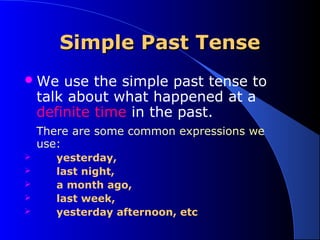
We use the simple past tense to 
talk about what happened at a 
definite time in the past. 
There are some common expressions we 
use: 
 yesterday, 
 last night, 
 a month ago, 
 last week, 
 yesterday afternoon, etc
RReegguullaarr VVeerrbbss ((規則動詞)) 
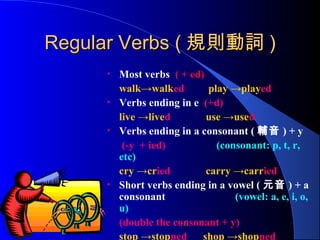
• Most verbs ( + ed) 
walk→walked play →played 
• Verbs ending in e (+d) 
live →lived use →used 
• Verbs ending in a consonant ( 輔音) + y 
(-y + ied) (consonant: p, t, r, 
etc) 
cry →cried carry →carried 
• Short verbs ending in a vowel ( 元音) + a 
consonant (vowel: a, e, i, o, 
u) 
(double the consonant + y) 
stop →stopped shop →shopped
IIrrrreegguullaarr VVeerrbbss ((不規則動詞)) 
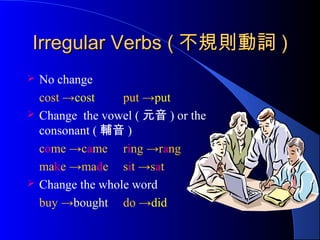
 No change 
cost →cost put →put 
 Change the vowel (元音) or the 
consonant (輔音) 
come →came ring →rang 
make →made sit →sat 
 Change the whole word 
buy →bought do →did
NNeeggaattiivvee SSeenntteenncceess 
((否定句)) 
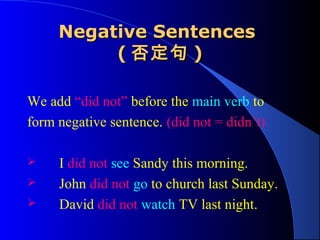
We add “did not” before the main verb to 
form negative sentence. (did not = didn’t) 
 I did not see Sandy this morning. 
 John did not go to church last Sunday. 
 David did not watch TV last night.
QQuueessttiioonnss 
We add “Did” before the subject (主語) 
and put a “ ? ” at the end to form 
question. 
 Did you have breakfast this morning? 
 Did you wash the dishes last night? 
 Did you bring the umbrella?
TThhee VVeerrbb ““ttoo bbee”” 
Statements: 
 “I / He / She / It” was very good. 
 “You / We / They” were very smart. 
Questions: 
Was “I / he / she / it” very good? 
Were “you / we / they” very smart? 
Negative sentences: 
 “I / He / She / It” was not very good. 
 “You / We / They” were not very smart.
Movie 
Did you watch this advertisement before?
TThhaannkk yyoouu vveerryy mmuucchh!! 
Goodbye!

Simple past tense

  • 1.
    SSiimmppllee PPaasstt TTeennssee We use the simple past tense to talk about what happened at a definite time in the past. There are some common expressions we use:  yesterday,  last night,  a month ago,  last week,  yesterday afternoon, etc
  • 2.
    RReegguullaarr VVeerrbbss ((規則動詞)) • Most verbs ( + ed) walk→walked play →played • Verbs ending in e (+d) live →lived use →used • Verbs ending in a consonant ( 輔音) + y (-y + ied) (consonant: p, t, r, etc) cry →cried carry →carried • Short verbs ending in a vowel ( 元音) + a consonant (vowel: a, e, i, o, u) (double the consonant + y) stop →stopped shop →shopped
  • 3.
    IIrrrreegguullaarr VVeerrbbss ((不規則動詞))  No change cost →cost put →put  Change the vowel (元音) or the consonant (輔音) come →came ring →rang make →made sit →sat  Change the whole word buy →bought do →did
  • 4.
    NNeeggaattiivvee SSeenntteenncceess ((否定句)) We add “did not” before the main verb to form negative sentence. (did not = didn’t)  I did not see Sandy this morning.  John did not go to church last Sunday.  David did not watch TV last night.
  • 5.
    QQuueessttiioonnss We add“Did” before the subject (主語) and put a “ ? ” at the end to form question.  Did you have breakfast this morning?  Did you wash the dishes last night?  Did you bring the umbrella?
  • 6.
    TThhee VVeerrbb ““ttoobbee”” Statements:  “I / He / She / It” was very good.  “You / We / They” were very smart. Questions: Was “I / he / she / it” very good? Were “you / we / they” very smart? Negative sentences:  “I / He / She / It” was not very good.  “You / We / They” were not very smart.
  • 7.
    Movie Did youwatch this advertisement before?
  • 8.
    TThhaannkk yyoouu vveerryymmuucchh!! Goodbye!