What’s the difference?
thewritersaide.net
PAST (noun) = elapsed time; the time before
the present
Old Mr. Johnson seems stuck in the past.
She is still quite ashamed of her past.
It is important that we learn from the past.
thewritersaide.net
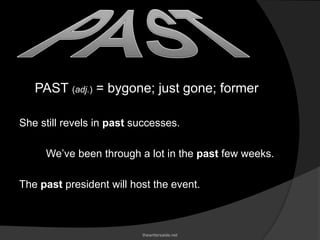
PAST (adj.) = bygone; just gone; former
She still revels in past successes.
We’ve been through a lot in the past few weeks.
The past president will host the event.
thewritersaide.net
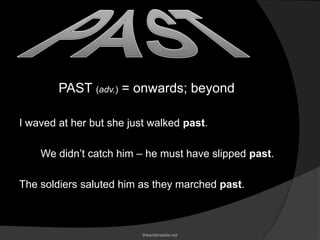
PAST (adv.) = onwards; beyond
I waved at her but she just walked past.
We didn’t catch him – he must have slipped past.
The soldiers saluted him as they marched past.
thewritersaide.net
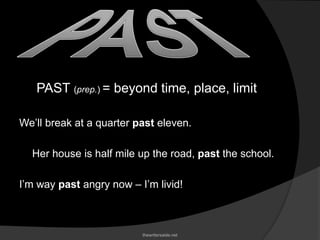
PAST (prep.) = beyond time, place, limit
We’ll break at a quarter past eleven.
Her house is half mile up the road, past the school.
I’m way past angry now – I’m livid!
thewritersaide.net
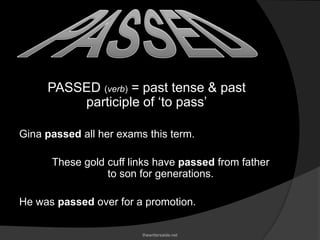
PASSED (verb) = past tense & past
participle of ‘to pass’
Gina passed all her exams this term.
These gold cuff links have passed from father
to son for generations.
He was passed over for a promotion.
thewritersaide.net
thewritersaide.net
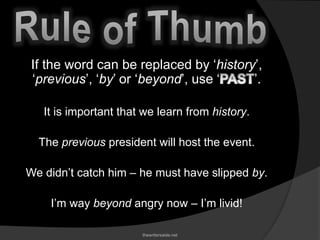
If the word can be replaced by ‘history’,
‘previous’, ‘by’ or ‘beyond’, use ‘ ’.
It is important that we learn from history.
The previous president will host the event.
We didn’t catch him – he must have slipped by.
I’m way beyond angry now – I’m livid!
thewritersaide.net
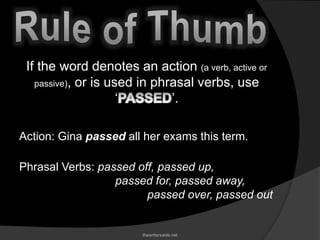
If the word denotes an action (a verb, active or
passive), or is used in phrasal verbs, use
‘ ’.
Action: Gina passed all her exams this term.
Phrasal Verbs: passed off, passed up,
passed for, passed away,
passed over, passed out
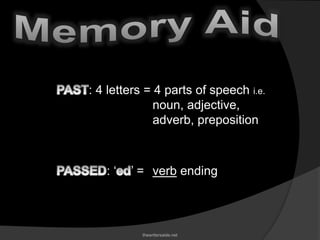
: 4 letters = 4 parts of speech i.e.
noun, adjective,
adverb, preposition
: ‘ ’ = verb ending
thewritersaide.net
www.thewritersaide.net
thewritersaide.net

Past v. Passed

  • 1.
  • 2.
    PAST (noun) =elapsed time; the time before the present Old Mr. Johnson seems stuck in the past. She is still quite ashamed of her past. It is important that we learn from the past. thewritersaide.net
  • 3.
    PAST (adj.) =bygone; just gone; former She still revels in past successes. We’ve been through a lot in the past few weeks. The past president will host the event. thewritersaide.net
  • 4.
    PAST (adv.) =onwards; beyond I waved at her but she just walked past. We didn’t catch him – he must have slipped past. The soldiers saluted him as they marched past. thewritersaide.net
  • 5.
    PAST (prep.) =beyond time, place, limit We’ll break at a quarter past eleven. Her house is half mile up the road, past the school. I’m way past angry now – I’m livid! thewritersaide.net
  • 6.
    PASSED (verb) =past tense & past participle of ‘to pass’ Gina passed all her exams this term. These gold cuff links have passed from father to son for generations. He was passed over for a promotion. thewritersaide.net
  • 7.
    thewritersaide.net If the wordcan be replaced by ‘history’, ‘previous’, ‘by’ or ‘beyond’, use ‘ ’. It is important that we learn from history. The previous president will host the event. We didn’t catch him – he must have slipped by. I’m way beyond angry now – I’m livid!
  • 8.
    thewritersaide.net If the worddenotes an action (a verb, active or passive), or is used in phrasal verbs, use ‘ ’. Action: Gina passed all her exams this term. Phrasal Verbs: passed off, passed up, passed for, passed away, passed over, passed out
  • 9.
    : 4 letters= 4 parts of speech i.e. noun, adjective, adverb, preposition : ‘ ’ = verb ending thewritersaide.net
  • 10.