SIMPLE PAST
Sección: 1B
Albenis Salazar
CI: 27.202.128
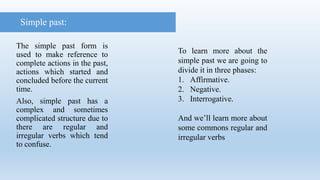
Simple past:
The simple past form is
used to make reference to
complete actions in the past,
actions which started and
concluded before the current
time.
Also, simple past has a
complex and sometimes
complicated structure due to
there are regular and
irregular verbs which tend
to confuse.
To learn more about the
simple past we are going to
divide it in three phases:
1. Affirmative.
2. Negative.
3. Interrogative.
And we’ll learn more about
some commons regular and
irregular verbs
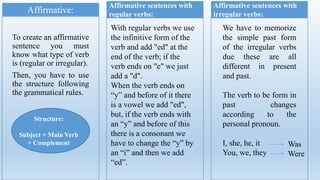
To create an affirmative
sentence you must
know what type of verb
is (regular or irregular).
Then, you have to use
the structure following
the grammatical rules.
Affirmative:
Structure:
Subject + Main Verb
+ Complement
Affirmative sentences with
regular verbs:
With regular verbs we use
the infinitive form of the
verb and add "ed" at the
end of the verb; if the
verb ends on "e" we just
add a "d".
When the verb ends on
“y” and before of it there
is a vowel we add "ed",
but, if the verb ends with
an “y” and before of this
there is a consonant we
have to change the “y” by
an “i” and then we add
“ed”.
Affirmative sentences with
irregular verbs:
We have to memorize
the simple past form
of the irregular verbs
due these are all
different in present
and past.
The verb to be form in
past changes
according to the
personal pronoun.
I, she, he, it
You, we, they
Was
Were
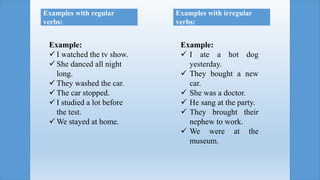
Example:
 I ate a hot dog
yesterday.
 They bought a new
car.
 She was a doctor.
 He sang at the party.
 They brought their
nephew to work.
 We were at the
museum.
Example:
 I watched the tv show.
 She danced all night
long.
 They washed the car.
 The car stopped.
 I studied a lot before
the test.
 We stayed at home.
Examples with regular
verbs:
Examples with irregular
verbs:
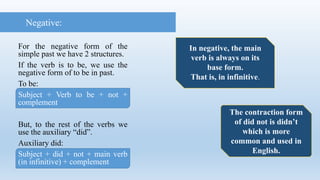
For the negative form of the
simple past we have 2 structures.
If the verb is to be, we use the
negative form of to be in past.
To be:
Subject + Verb to be + not +
complement
But, to the rest of the verbs we
use the auxiliary “did”.
Auxiliary did:
Subject + did + not + main verb
(in infinitive) + complement
Negative:
The contraction form
of did not is didn’t
which is more
common and used in
English.
In negative, the main
verb is always on its
base form.
That is, in infinitive.
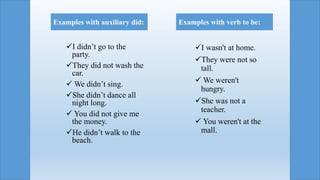
I didn’t go to the
party.
They did not wash the
car.
 We didn’t sing.
She didn’t dance all
night long.
 You did not give me
the money.
He didn’t walk to the
beach.
I wasn't at home.
They were not so
tall.
 We weren't
hungry.
She was not a
teacher.
 You weren't at the
mall.
Examples with auxiliary did: Examples with verb to be:
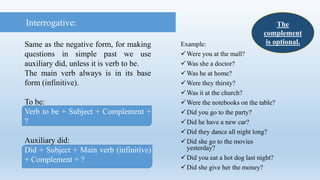
Interrogative:
Same as the negative form, for making
questions in simple past we use
auxiliary did, unless it is verb to be.
The main verb always is in its base
form (infinitive).
To be:
Verb to be + Subject + Complement +
?
Auxiliary did:
Did + Subject + Main verb (infinitive)
+ Complement + ?
The
complement
is optional.Example:
Were you at the mall?
Was she a doctor?
Was he at home?
Were they thirsty?
Was it at the church?
Were the notebooks on the table?
Did you go to the party?
Did he have a new car?
Did they dance all night long?
Did she go to the movies
yesterday?
Did you eat a hot dog last night?
Did she give her the money?
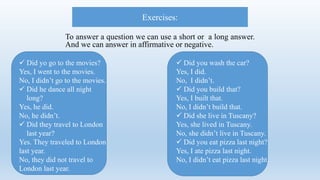
To answer a question we can use a short or a long answer.
And we can answer in affirmative or negative.
Exercises:
 Did yo go to the movies?
Yes, I went to the movies.
No, I didn’t go to the movies.
 Did he dance all night
long?
Yes, he did.
No, he didn’t.
 Did they travel to London
last year?
Yes. They traveled to London
last year.
No, they did not travel to
London last year.
 Did you wash the car?
Yes, I did.
No, I didn’t.
 Did you build that?
Yes, I built that.
No, I didn’t build that.
 Did she live in Tuscany?
Yes, she lived in Tuscany.
No, she didn’t live in Tuscany.
 Did you eat pizza last night?
Yes, I ate pizza last night.
No, I didn’t eat pizza last night.
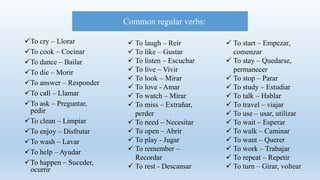
To cry – Llorar
To cook – Cocinar
To dance – Bailar
To die – Morir
To answer – Responder
To call – Llamar
To ask – Preguntar,
pedir
To clean – Limpiar
To enjoy – Disfrutar
To wash – Lavar
To help – Ayudar
To happen – Suceder,
ocurrir
Common regular verbs:
 To laugh – Reír
 To like – Gustar
 To listen – Escuchar
 To live – Vivir
 To look – Mirar
 To love - Amar
 To watch – Mirar
 To miss – Extrañar,
perder
 To need – Necesitar
 To open – Abrir
 To play - Jugar
 To remember –
Recordar
 To rest - Descansar
 To start – Empezar,
comenzar
 To stay – Quedarse,
permanecer
 To stop – Parar
 To study – Estudiar
 To talk – Hablar
 To travel – viajar
 To use – usar, utilizar
 To wait – Esperar
 To walk – Caminar
 To want – Querer
 To work – Trabajar
 To repeat – Repetir
 To turn – Girar, voltear
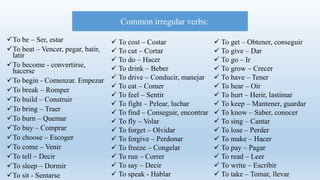
To be – Ser, estar
To beat – Vencer, pegar, batir,
latir
To become - convertirse,
hacerse
To begin - Comenzar. Empezar
To break – Romper
To build – Construir
To bring – Traer
To burn – Quemar
To buy – Comprar
To choose – Escoger
To come – Venir
To tell – Decir
To sleep – Dormir
To sit - Sentarse
Common irregular verbs:
 To cost – Costar
 To cut – Cortar
 To do – Hacer
 To drink – Beber
 To drive – Conducir, manejar
 To eat – Comer
 To feel – Sentir
 To fight – Pelear, luchar
 To find – Conseguir, encontrar
 To fly – Volar
 To forget – Olvidar
 To forgive – Perdonar
 To freeze – Congelar
 To run – Correr
 To say – Decir
 To speak - Hablar
 To get – Obtener, conseguir
 To give – Dar
 To go – Ir
 To grow – Crecer
 To have – Tener
 To hear – Oír
 To hurt – Herir, lastimar
 To keep – Mantener, guardar
 To know – Saber, conocer
 To sing – Cantar
 To lose – Perder
 To make – Hacer
 To pay – Pagar
 To read – Leer
 To write – Escribir
 To take – Tomar, llevar
THANK YOU

Simple past

  • 1.
    SIMPLE PAST Sección: 1B AlbenisSalazar CI: 27.202.128
  • 2.
    Simple past: The simplepast form is used to make reference to complete actions in the past, actions which started and concluded before the current time. Also, simple past has a complex and sometimes complicated structure due to there are regular and irregular verbs which tend to confuse. To learn more about the simple past we are going to divide it in three phases: 1. Affirmative. 2. Negative. 3. Interrogative. And we’ll learn more about some commons regular and irregular verbs
  • 3.
    To create anaffirmative sentence you must know what type of verb is (regular or irregular). Then, you have to use the structure following the grammatical rules. Affirmative: Structure: Subject + Main Verb + Complement Affirmative sentences with regular verbs: With regular verbs we use the infinitive form of the verb and add "ed" at the end of the verb; if the verb ends on "e" we just add a "d". When the verb ends on “y” and before of it there is a vowel we add "ed", but, if the verb ends with an “y” and before of this there is a consonant we have to change the “y” by an “i” and then we add “ed”. Affirmative sentences with irregular verbs: We have to memorize the simple past form of the irregular verbs due these are all different in present and past. The verb to be form in past changes according to the personal pronoun. I, she, he, it You, we, they Was Were
  • 4.
    Example:  I atea hot dog yesterday.  They bought a new car.  She was a doctor.  He sang at the party.  They brought their nephew to work.  We were at the museum. Example:  I watched the tv show.  She danced all night long.  They washed the car.  The car stopped.  I studied a lot before the test.  We stayed at home. Examples with regular verbs: Examples with irregular verbs:
  • 5.
    For the negativeform of the simple past we have 2 structures. If the verb is to be, we use the negative form of to be in past. To be: Subject + Verb to be + not + complement But, to the rest of the verbs we use the auxiliary “did”. Auxiliary did: Subject + did + not + main verb (in infinitive) + complement Negative: The contraction form of did not is didn’t which is more common and used in English. In negative, the main verb is always on its base form. That is, in infinitive.
  • 6.
    I didn’t goto the party. They did not wash the car.  We didn’t sing. She didn’t dance all night long.  You did not give me the money. He didn’t walk to the beach. I wasn't at home. They were not so tall.  We weren't hungry. She was not a teacher.  You weren't at the mall. Examples with auxiliary did: Examples with verb to be:
  • 7.
    Interrogative: Same as thenegative form, for making questions in simple past we use auxiliary did, unless it is verb to be. The main verb always is in its base form (infinitive). To be: Verb to be + Subject + Complement + ? Auxiliary did: Did + Subject + Main verb (infinitive) + Complement + ? The complement is optional.Example: Were you at the mall? Was she a doctor? Was he at home? Were they thirsty? Was it at the church? Were the notebooks on the table? Did you go to the party? Did he have a new car? Did they dance all night long? Did she go to the movies yesterday? Did you eat a hot dog last night? Did she give her the money?
  • 8.
    To answer aquestion we can use a short or a long answer. And we can answer in affirmative or negative. Exercises:  Did yo go to the movies? Yes, I went to the movies. No, I didn’t go to the movies.  Did he dance all night long? Yes, he did. No, he didn’t.  Did they travel to London last year? Yes. They traveled to London last year. No, they did not travel to London last year.  Did you wash the car? Yes, I did. No, I didn’t.  Did you build that? Yes, I built that. No, I didn’t build that.  Did she live in Tuscany? Yes, she lived in Tuscany. No, she didn’t live in Tuscany.  Did you eat pizza last night? Yes, I ate pizza last night. No, I didn’t eat pizza last night.
  • 9.
    To cry –Llorar To cook – Cocinar To dance – Bailar To die – Morir To answer – Responder To call – Llamar To ask – Preguntar, pedir To clean – Limpiar To enjoy – Disfrutar To wash – Lavar To help – Ayudar To happen – Suceder, ocurrir Common regular verbs:  To laugh – Reír  To like – Gustar  To listen – Escuchar  To live – Vivir  To look – Mirar  To love - Amar  To watch – Mirar  To miss – Extrañar, perder  To need – Necesitar  To open – Abrir  To play - Jugar  To remember – Recordar  To rest - Descansar  To start – Empezar, comenzar  To stay – Quedarse, permanecer  To stop – Parar  To study – Estudiar  To talk – Hablar  To travel – viajar  To use – usar, utilizar  To wait – Esperar  To walk – Caminar  To want – Querer  To work – Trabajar  To repeat – Repetir  To turn – Girar, voltear
  • 10.
    To be –Ser, estar To beat – Vencer, pegar, batir, latir To become - convertirse, hacerse To begin - Comenzar. Empezar To break – Romper To build – Construir To bring – Traer To burn – Quemar To buy – Comprar To choose – Escoger To come – Venir To tell – Decir To sleep – Dormir To sit - Sentarse Common irregular verbs:  To cost – Costar  To cut – Cortar  To do – Hacer  To drink – Beber  To drive – Conducir, manejar  To eat – Comer  To feel – Sentir  To fight – Pelear, luchar  To find – Conseguir, encontrar  To fly – Volar  To forget – Olvidar  To forgive – Perdonar  To freeze – Congelar  To run – Correr  To say – Decir  To speak - Hablar  To get – Obtener, conseguir  To give – Dar  To go – Ir  To grow – Crecer  To have – Tener  To hear – Oír  To hurt – Herir, lastimar  To keep – Mantener, guardar  To know – Saber, conocer  To sing – Cantar  To lose – Perder  To make – Hacer  To pay – Pagar  To read – Leer  To write – Escribir  To take – Tomar, llevar
  • 11.