SPEECH INTELLIGIBILITY INDEX MODEL:
A Key Aspect to a Child’s Development of Speech and Language
Mentor: Melissa Jay Katelyn Zumpf
Dr. Jacob Oleson Colorado College North Central College
January 24, 2015
Outline
1. Importance of the study
2. Introduction to hearing
3. Methods for imputation
4. Construction of SII Model
5. Analysis of Imputations
6. Concluding Remarks
Importance
● The development of speech and language in children is
critically impacted by the child’s ability to hear
○ OCHL Grant
● It has been found that children with hearing loss, who
fail to seek proper help, have a delay in their speech
development
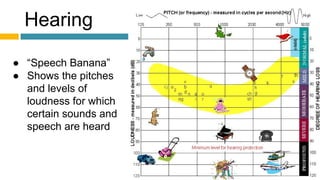
Hearing
● “Speech Banana”
● Shows the pitches
and levels of
loudness for which
certain sounds and
speech are heard
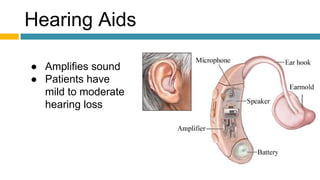
Hearing Aids
● Amplifies sound
● Patients have
mild to moderate
hearing loss
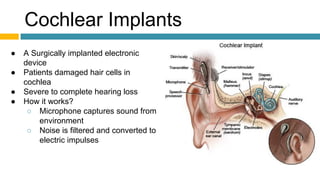
Cochlear Implants
● A Surgically implanted electronic
device
● Patients damaged hair cells in
cochlea
● Severe to complete hearing loss
● How it works?
○ Microphone captures sound from
environment
○ Noise is filtered and converted to
electric impulses
What is Speech Intelligibility Index?
● Measure between 0 and 1
○ 0: no understanding of speech
○ 1: speech information is audible and usable
(normal hearing)
● Unable to be measured in individuals with cochlear
implants
● No other way of obtaining this value
Goal of the Study
● Find a model that predicts “functional” Speech
Intelligibility Index (SII) for a child with a cochlear
implant
● Determine when hearing loss is identified, which
hearing corrective action approach would provide a
child with the most long term advantages:
-hearing aids or cochlear implants?
Data Set and Variables
● 77 Children, ages 7-9
○ 18 with Cochlear Implants (CI)
○ 59 with Hearing Aids (HA)
● 16 Variables
○ SII
○ Word Attack, Passage Score, Mother’s Education,
Pure-tone Average
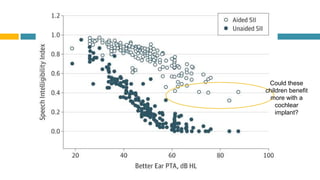
Could these
children benefit
more with a
cochlear
implant?
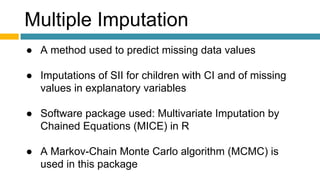
Multiple Imputation
● A method used to predict missing data values
● Imputations of SII for children with CI and of missing
values in explanatory variables
● Software package used: Multivariate Imputation by
Chained Equations (MICE) in R
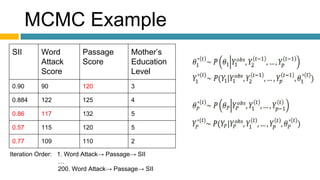
● A Markov-Chain Monte Carlo algorithm (MCMC) is
used in this package
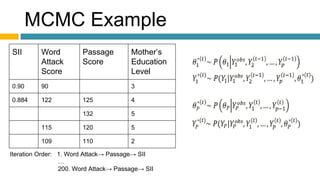
MCMC Example
SII Word
Attack
Score
Passage
Score
Mother’s
Education
Level
0.90 90 3
0.884 122 125 4
132 5
115 120 5
109 110 2
Iteration Order: 1. Word Attack→ Passage→ SII
…
200. Word Attack→ Passage→ SII
MCMC Example
SII Word
Attack
Score
Passage
Score
Mother’s
Education
Level
0.90 90 120 3
0.884 122 125 4
0.86 117 132 5
0.57 115 120 5
0.77 109 110 2
Iteration Order: 1. Word Attack→ Passage→ SII
…
200. Word Attack→ Passage→ SII
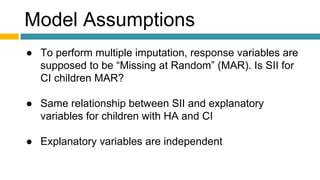
Model Assumptions
● To perform multiple imputation, response variables are
supposed to be “Missing at Random” (MAR). Is SII for
CI children MAR?
● Same relationship between SII and explanatory
variables for children with HA and CI
● Explanatory variables are independent
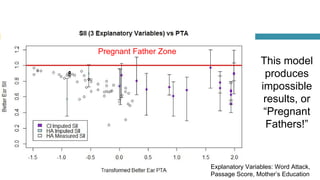
This model
produces
impossible
results, or
“Pregnant
Fathers!”
Pregnant Father Zone
Explanatory Variables: Word Attack,
Passage Score, Mother’s Education
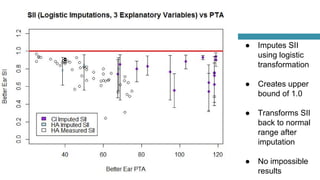
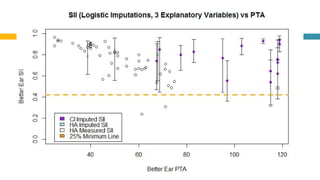
● Imputes SII
using logistic
transformation
● Creates upper
bound of 1.0
● Transforms SII
back to normal
range after
imputation
● No impossible
results
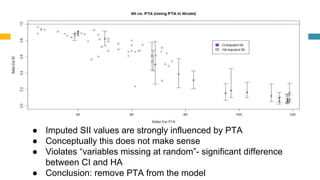
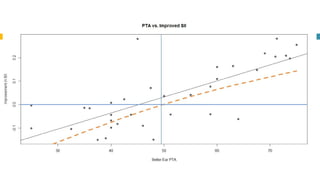
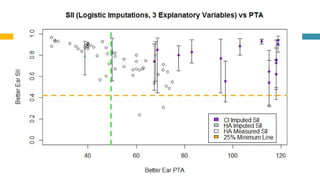
● Imputed SII values are strongly influenced by PTA
● Conceptually this does not make sense
● Violates “variables missing at random”- significant difference
between CI and HA
● Conclusion: remove PTA from the model
Our Final Imputation Model
● Impute Logistic SII (Response Variable)
● Explanatory variables: Word Attack, Passage Score,
Mother’s Education
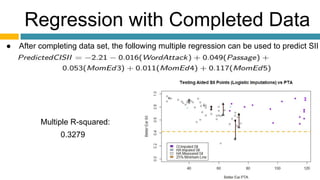
Regression with Completed Data
● After completing data set, the following multiple regression can be used to predict SII
Multiple R-squared:
0.3279
Conclusion
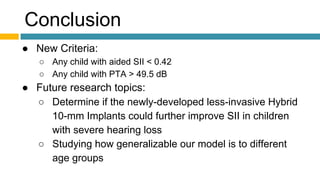
● New Criteria:
○ Any child with aided SII < 0.42
○ Any child with PTA > 49.5 dB
● Future research topics:
○ Determine if the newly-developed less-invasive Hybrid
10-mm Implants could further improve SII in children
with severe hearing loss
○ Studying how generalizable our model is to different
age groups
Acknowledgements
● We would like to thank our mentor, Dr. Jacob Oleson, for his
support and guidance throughout this research as well as:
Dr. Bruce Tomblin
Dr. Gideon Zamba
Terry Kirk
Melissa Pugh
Joe Moen
Entire Biostatistics Department
Home Institutions
References
Buuren, Stef, and Karin Groothuis-Oudshoorn. "MICE: Multivariate imputation by chained equations
in R." Journal of statistical software 45.3 (2011).
Gantz, Bruce J., Marlan R. Hansen, Christopher W. Turner, Jacob J. Oleson, Lina A. Reiss, and
Aaron J. Parkinson. "Hybrid 10 Clinical Trial." Audiology and Neurotology 14.1 (2009): 32-38.
Web.
Holte, Lenore, et al. "Factors influencing follow-up to newborn hearing screening for infants who are
hard of hearing." American Journal of Audiology 21.2 (2012): 163-174.
"The Speech Banana." Listening and Spoken Language Knowledge Center. Alexander Graham Bell
Association for the Deaf and Hard of Hearing, n.d. Web. 15 July 2014.
Tomblin, Bruce J., PhD, Jacob J. Oleson, PhD, Sophie E. Ambrose, PhD, and Elizabeth Walker,
PhD. "The Influence of Hearing Aids on the Speech and Language Development of Children With
Hearing Aids." American Medical Association (2014): 403-09. Print.
Questions?

SII presentation

  • 1.
    SPEECH INTELLIGIBILITY INDEXMODEL: A Key Aspect to a Child’s Development of Speech and Language Mentor: Melissa Jay Katelyn Zumpf Dr. Jacob Oleson Colorado College North Central College January 24, 2015
  • 2.
    Outline 1. Importance ofthe study 2. Introduction to hearing 3. Methods for imputation 4. Construction of SII Model 5. Analysis of Imputations 6. Concluding Remarks
  • 3.
    Importance ● The developmentof speech and language in children is critically impacted by the child’s ability to hear ○ OCHL Grant ● It has been found that children with hearing loss, who fail to seek proper help, have a delay in their speech development
  • 4.
    Hearing ● “Speech Banana” ●Shows the pitches and levels of loudness for which certain sounds and speech are heard
  • 5.
    Hearing Aids ● Amplifiessound ● Patients have mild to moderate hearing loss
  • 6.
    Cochlear Implants ● ASurgically implanted electronic device ● Patients damaged hair cells in cochlea ● Severe to complete hearing loss ● How it works? ○ Microphone captures sound from environment ○ Noise is filtered and converted to electric impulses
  • 7.
    What is SpeechIntelligibility Index? ● Measure between 0 and 1 ○ 0: no understanding of speech ○ 1: speech information is audible and usable (normal hearing) ● Unable to be measured in individuals with cochlear implants ● No other way of obtaining this value
  • 8.
    Goal of theStudy ● Find a model that predicts “functional” Speech Intelligibility Index (SII) for a child with a cochlear implant ● Determine when hearing loss is identified, which hearing corrective action approach would provide a child with the most long term advantages: -hearing aids or cochlear implants?
  • 9.
    Data Set andVariables ● 77 Children, ages 7-9 ○ 18 with Cochlear Implants (CI) ○ 59 with Hearing Aids (HA) ● 16 Variables ○ SII ○ Word Attack, Passage Score, Mother’s Education, Pure-tone Average
  • 10.
    Could these children benefit morewith a cochlear implant?
  • 11.
    Multiple Imputation ● Amethod used to predict missing data values ● Imputations of SII for children with CI and of missing values in explanatory variables ● Software package used: Multivariate Imputation by Chained Equations (MICE) in R ● A Markov-Chain Monte Carlo algorithm (MCMC) is used in this package
  • 12.
    MCMC Example SII Word Attack Score Passage Score Mother’s Education Level 0.9090 3 0.884 122 125 4 132 5 115 120 5 109 110 2 Iteration Order: 1. Word Attack→ Passage→ SII … 200. Word Attack→ Passage→ SII
  • 13.
    MCMC Example SII Word Attack Score Passage Score Mother’s Education Level 0.9090 120 3 0.884 122 125 4 0.86 117 132 5 0.57 115 120 5 0.77 109 110 2 Iteration Order: 1. Word Attack→ Passage→ SII … 200. Word Attack→ Passage→ SII
  • 14.
    Model Assumptions ● Toperform multiple imputation, response variables are supposed to be “Missing at Random” (MAR). Is SII for CI children MAR? ● Same relationship between SII and explanatory variables for children with HA and CI ● Explanatory variables are independent
  • 15.
    This model produces impossible results, or “Pregnant Fathers!” PregnantFather Zone Explanatory Variables: Word Attack, Passage Score, Mother’s Education
  • 16.
    ● Imputes SII usinglogistic transformation ● Creates upper bound of 1.0 ● Transforms SII back to normal range after imputation ● No impossible results
  • 17.
    ● Imputed SIIvalues are strongly influenced by PTA ● Conceptually this does not make sense ● Violates “variables missing at random”- significant difference between CI and HA ● Conclusion: remove PTA from the model
  • 18.
    Our Final ImputationModel ● Impute Logistic SII (Response Variable) ● Explanatory variables: Word Attack, Passage Score, Mother’s Education
  • 20.
    Regression with CompletedData ● After completing data set, the following multiple regression can be used to predict SII Multiple R-squared: 0.3279
  • 23.
    Conclusion ● New Criteria: ○Any child with aided SII < 0.42 ○ Any child with PTA > 49.5 dB ● Future research topics: ○ Determine if the newly-developed less-invasive Hybrid 10-mm Implants could further improve SII in children with severe hearing loss ○ Studying how generalizable our model is to different age groups
  • 24.
    Acknowledgements ● We wouldlike to thank our mentor, Dr. Jacob Oleson, for his support and guidance throughout this research as well as: Dr. Bruce Tomblin Dr. Gideon Zamba Terry Kirk Melissa Pugh Joe Moen Entire Biostatistics Department Home Institutions
  • 25.
    References Buuren, Stef, andKarin Groothuis-Oudshoorn. "MICE: Multivariate imputation by chained equations in R." Journal of statistical software 45.3 (2011). Gantz, Bruce J., Marlan R. Hansen, Christopher W. Turner, Jacob J. Oleson, Lina A. Reiss, and Aaron J. Parkinson. "Hybrid 10 Clinical Trial." Audiology and Neurotology 14.1 (2009): 32-38. Web. Holte, Lenore, et al. "Factors influencing follow-up to newborn hearing screening for infants who are hard of hearing." American Journal of Audiology 21.2 (2012): 163-174. "The Speech Banana." Listening and Spoken Language Knowledge Center. Alexander Graham Bell Association for the Deaf and Hard of Hearing, n.d. Web. 15 July 2014. Tomblin, Bruce J., PhD, Jacob J. Oleson, PhD, Sophie E. Ambrose, PhD, and Elizabeth Walker, PhD. "The Influence of Hearing Aids on the Speech and Language Development of Children With Hearing Aids." American Medical Association (2014): 403-09. Print.
  • 26.