A COMPARATIVE STUDY OF CAPTIONED VIDEO
AND FACE-TO-FACE INSTRUCTION IN TEACHING
ABSTRACT CONCEPTS TO THE HEARING
IMPAIRMENT STUDENTS
Research Done By
S.Anushiya
(Research Scholar- ADU)
A Brief Overview
30 samples
Two Experimental Group
Quasi Experimental Method
Independent Variable - gender, degree of hearing loss and type
of schooling
Dependent Variable - to find out the effectiveness of captioned
video assisted instruction in learning abstract concepts over face
to face interaction method for children with hearing impairment.
Tool – Activity book, Flash Cards, and Captioned Video Assisted
Instruction
Result- the captioned video assisted instruction increases and
accelerates the learning process.
INTRODUCTION
When working with a hearing impaired student, many
adaptations need to be made.
We do make curriculum adaptations (pictorial
representation for the complex words) for the students
with hearing impairment. This gives the student much
more accessibility to the classroom and the lessons
being taught.

Most of the curriculum adaptations are hardcopies and
they are available in the market. But in this aspect
many materials are originated in English Language
which is an exception to Hearing Impaired Students.
Advancement in Technology – Since we are in the era
of Technology.
It improves the attention span of the individual
He is able to learn the spellings without errors.
More over it also deals with the psychological aspect
of an individual; personally he attains a high self
esteem with the change in the pattern of teaching
and learning and also develops positive emotions.
Thus a a comparative study was made using captioned
Video and Face-to-Face Instruction in teaching abstract
concepts for the Hearing Impairment Students.
REVIEW OF LITERATURE
Antonysamy (1989)
Karpagakumaravel (1990 )

Idayarani (1991 )
Ummed (1995)
Rameshari (1996)
NEED FOR THE STUDY
The day may not be very far off when most Indian
classrooms have a computer. Everyday teaching
through computers can then become possible.

We would like to see some evidence that the use of
computers for teaching enhances learning in
demonstrable ways.
Most science teaching material available for use by
teachers was not able to accommodate the individual
with special needs.
OBJECTIVES
Identify the Hearing impaired children belonging to
secondary level.
To develop and validate video programmes in teaching
abstract concepts to Hearing Impaired students.
To develop a package related to abstract concepts, using
Captioned Videos and activity booklets.
To find out the effectiveness of Captioned Video in learning
abstract concepts over face to face interaction method.
To find out the difference between the study habits and
achievement of the students in acquiring abstract concepts
HYPOTHESIS
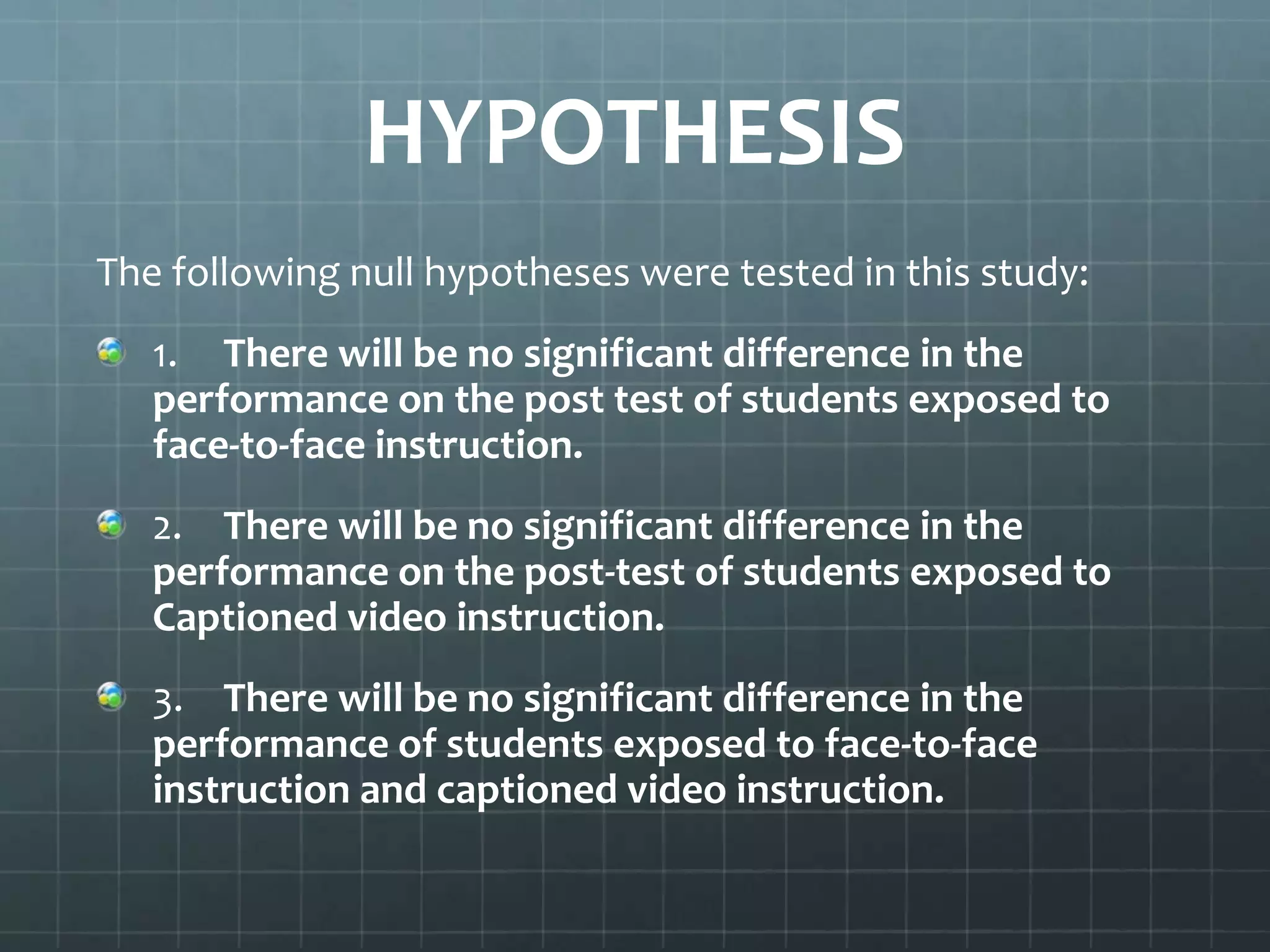
The following null hypotheses were tested in this study:
1. There will be no significant difference in the
performance on the post test of students exposed to
face-to-face instruction.
2. There will be no significant difference in the
performance on the post-test of students exposed to
Captioned video instruction.

3. There will be no significant difference in the
performance of students exposed to face-to-face
instruction and captioned video instruction.
SCOPE OF THE STUDY
Facilitates the use of technology in teaching and
learning environment.

Development of captioned video assisted instruction
enhances better comperhension of abstract concepts
and activites.
Adapts various methods to inculcate knowledge
development.
Assist in the comprehension of understanding feelings
and attributes through joyful learning and facilitates
self learning and self evaluation. Which in turn raises
the self esteem of the individual.
Assist the teacher to provide equal importance to
students with hearing impairment in a regular
classroom.
Enables the professionals to plan and develop various
programmes regarding adapted computer asiisted
instruction for teaching and learning of hearing
impaired students.
Enables the policy makers to include adapted computer
assisted intruction as one of the major aspect in
educational process for a student with hearing
impairment.
Serves as a guide for the researchers to undertake
further studies in adapted computer assisted
instruction for developing an advanced teching
learning material.
LIMITATION OF THE
STUDY
Subjects are be limited to 6th , 7th, 8th standard
students.
Selection of samples to only participants who give
permission for data collection.
Profound hearing loss sample were excluded from the
study because of lack of number of adequate sample.
METHODOLOGY
Quasi-experimental design
Samples are taken from the Special and Inclusive
schools.
A total sample of 30 students made up of 15 boys and
15 girls participated in the study.
Experimental group I was exposed to captioned video
instruction
Experimental group II was exposed to face-to-face
instruction
RESULTS AND DISCUSSION
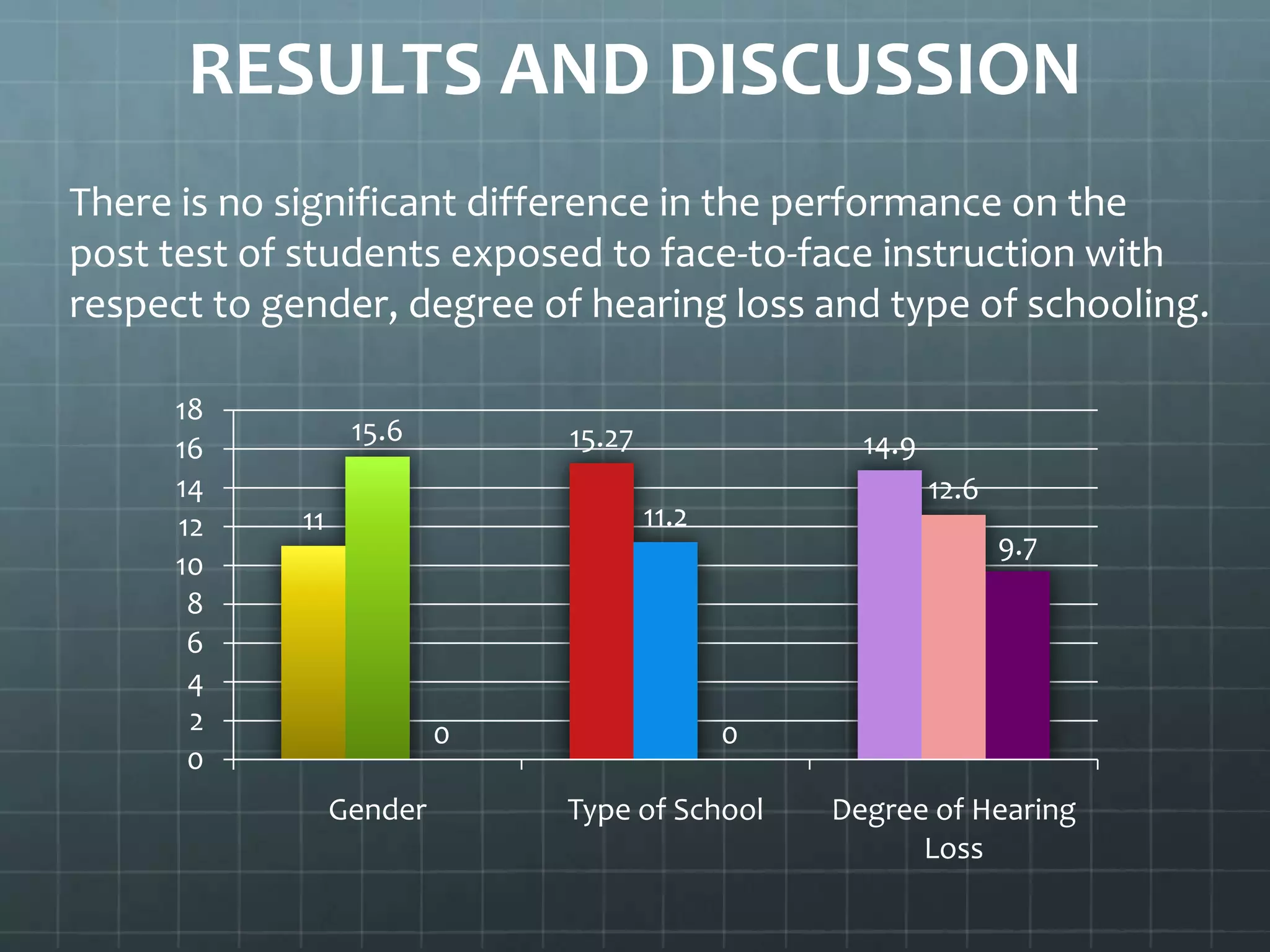
There is no significant difference in the performance on the
post test of students exposed to face-to-face instruction with
respect to gender, degree of hearing loss and type of schooling.
18
16
14
12
10
8
6
4
2
0

15.6

15.27

14.9
12.6

11.2

11

0
Gender

9.7

0
Type of School

Degree of Hearing
Loss
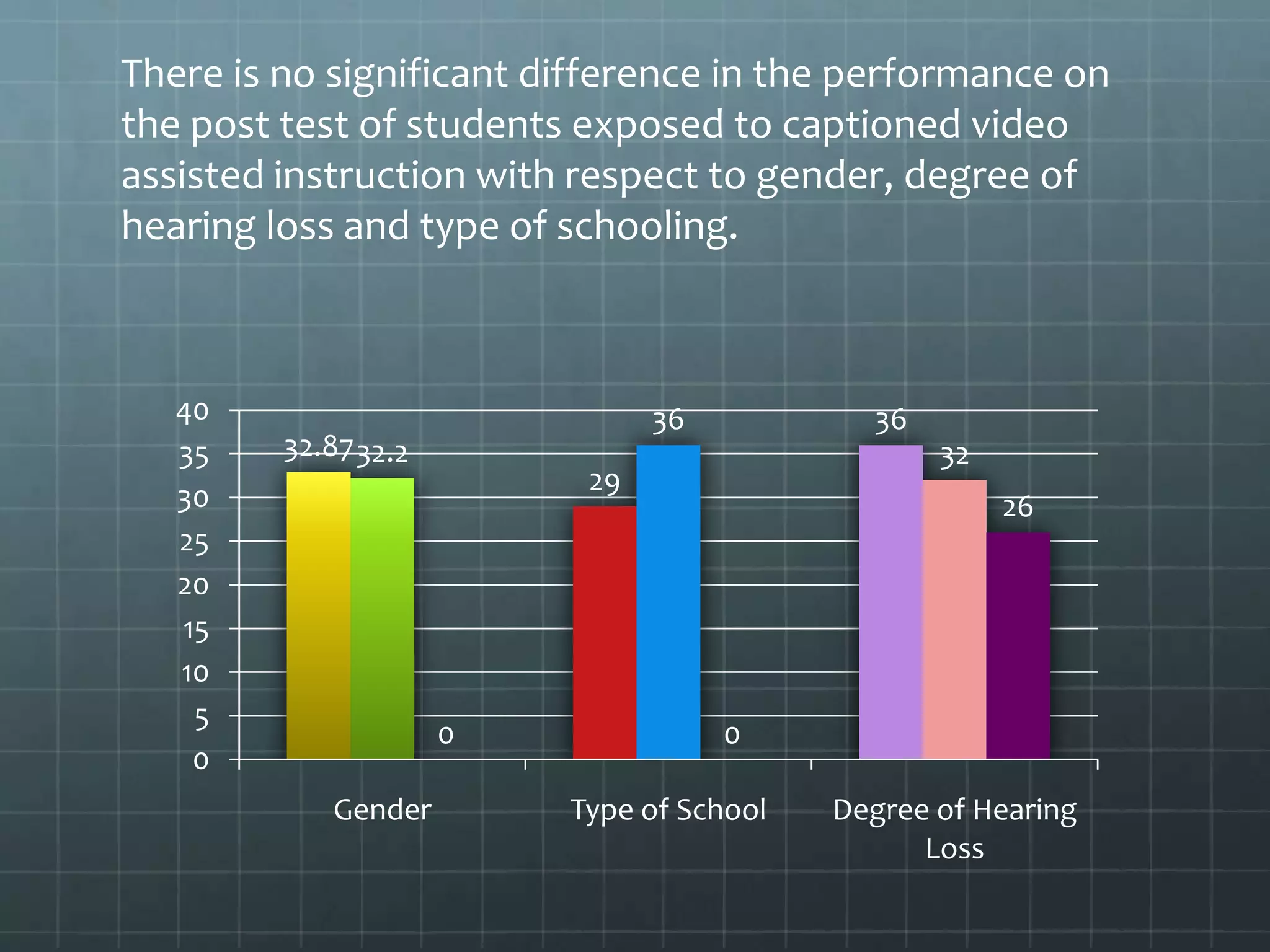
There is no significant difference in the performance on
the post test of students exposed to captioned video
assisted instruction with respect to gender, degree of
hearing loss and type of schooling.

40
35
30
25
20
15
10
5
0

36

32.87 32.2

32

29

0
Gender

36
26

0
Type of School

Degree of Hearing
Loss
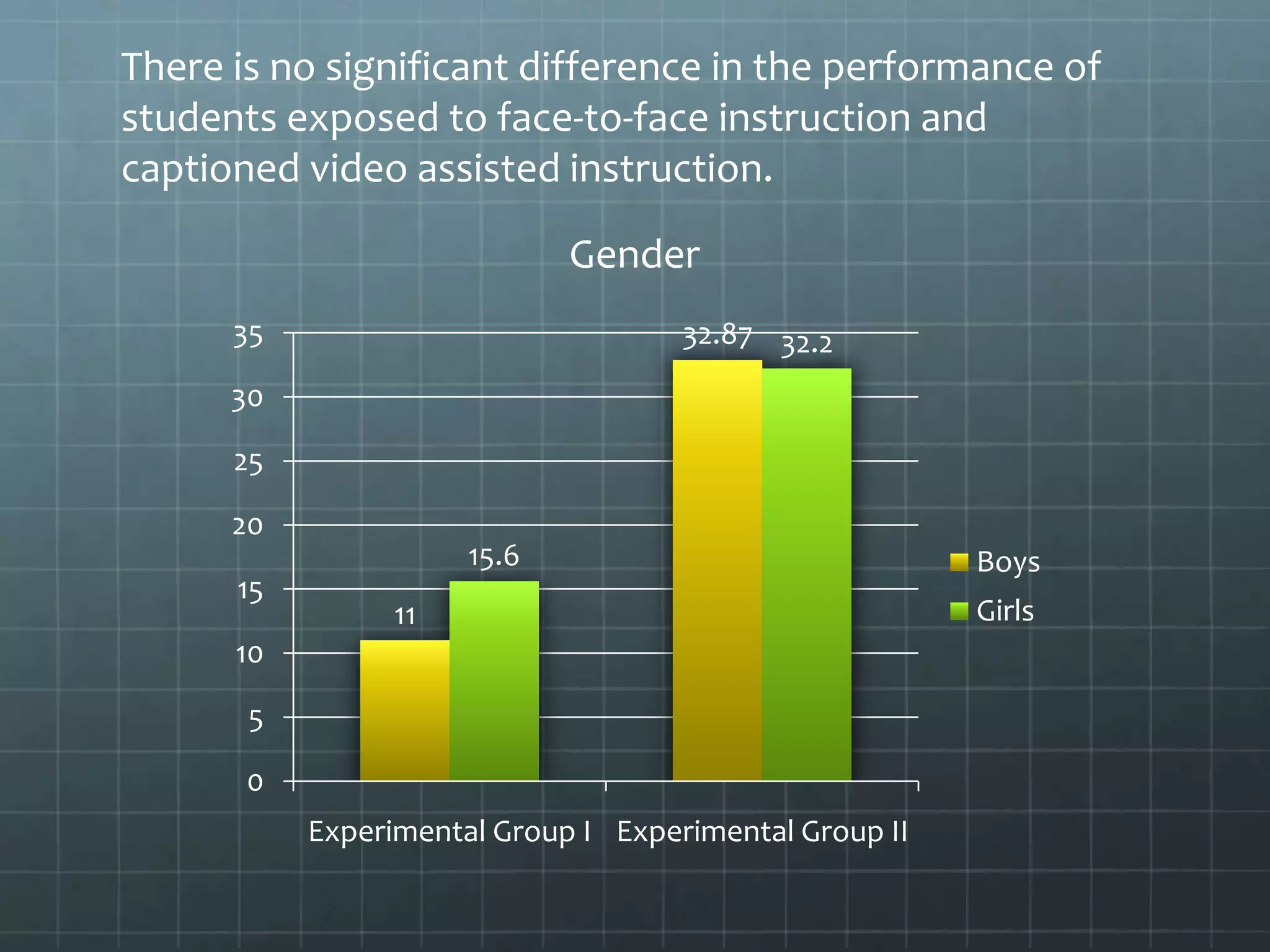
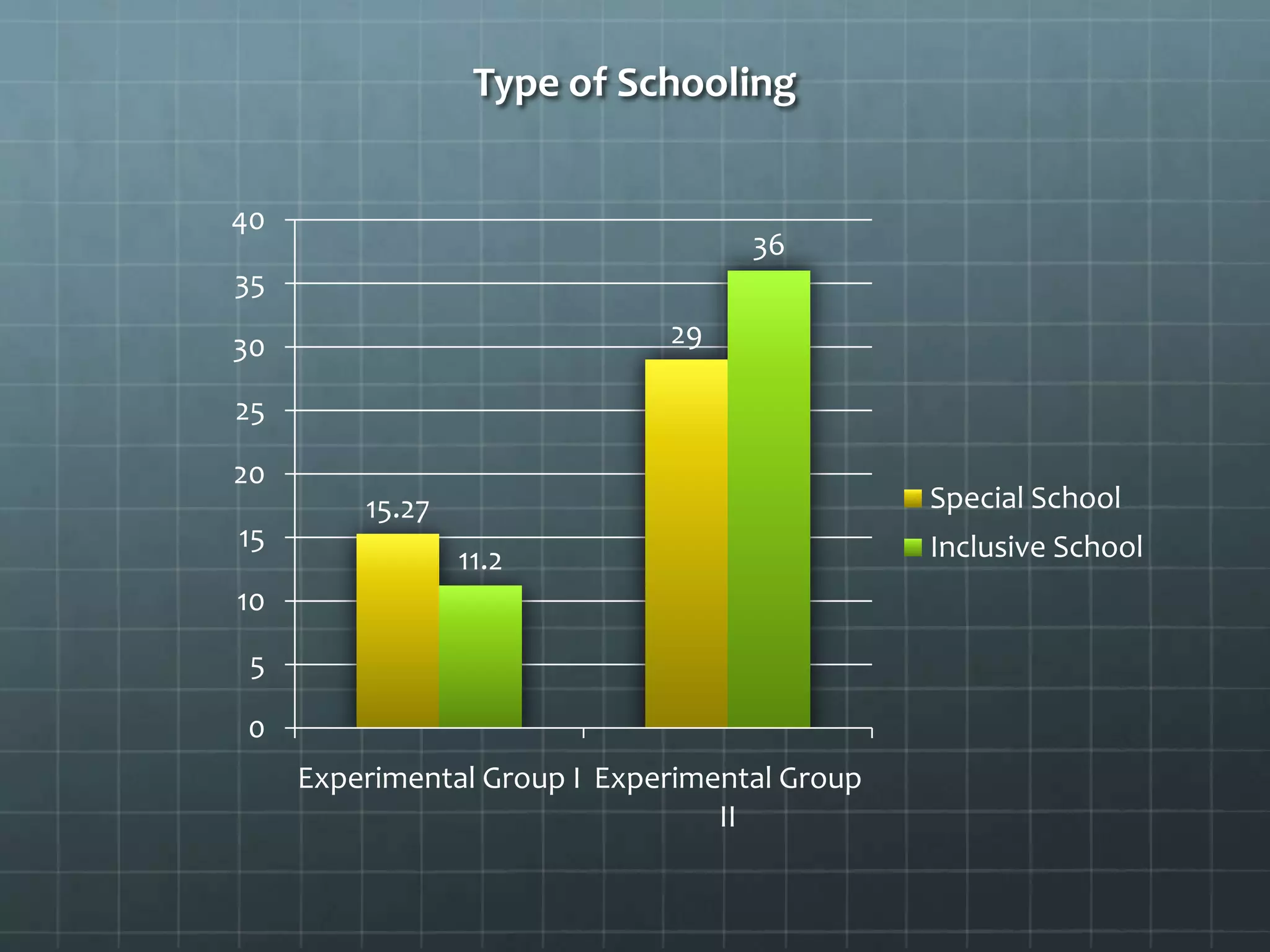
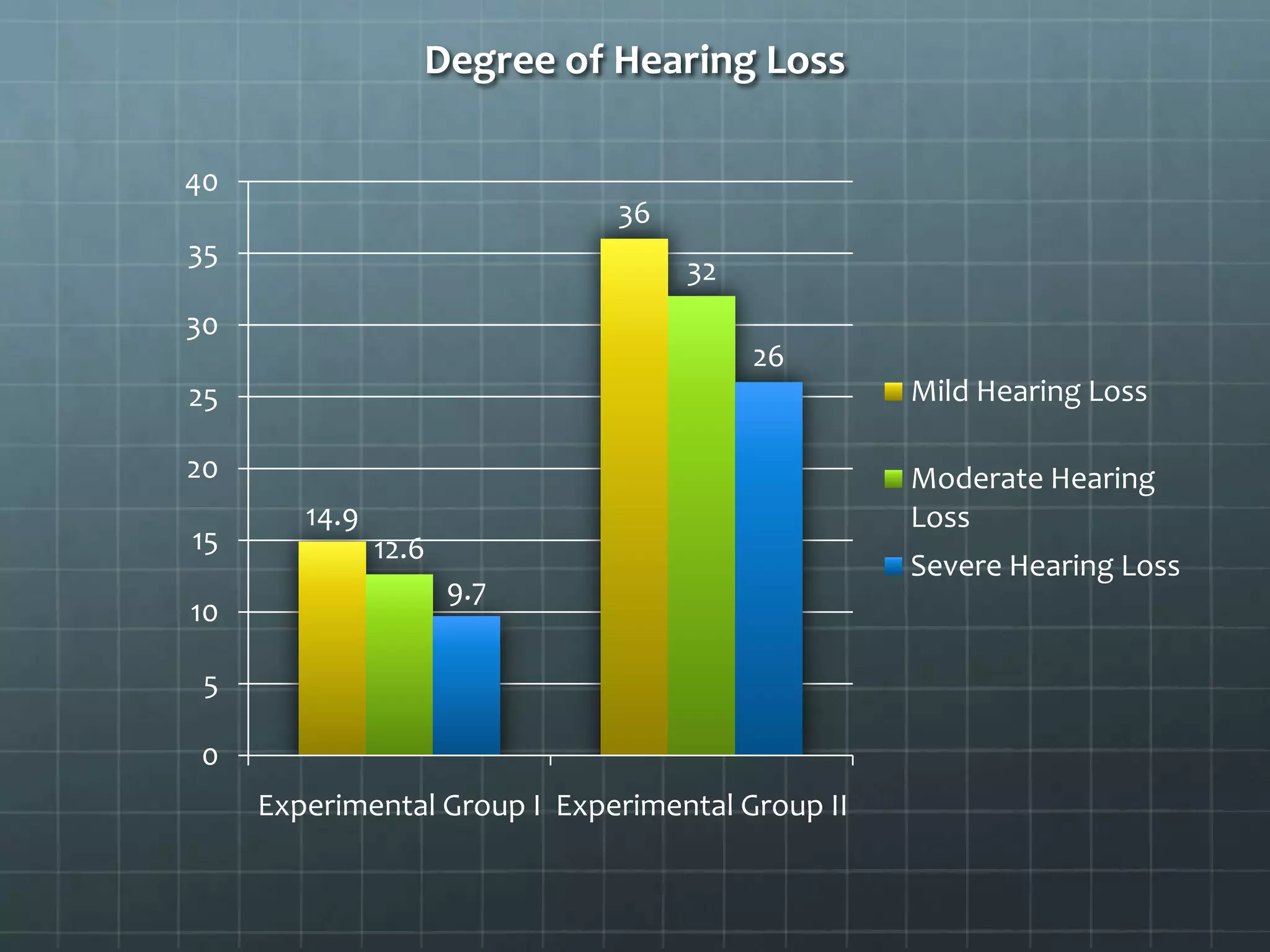
There is no significant difference in the performance of
students exposed to face-to-face instruction and
captioned video assisted instruction.
Gender
35

32.87 32.2

30
25
20
15

15.6
11

10
5

0
Experimental Group I Experimental Group II

Boys
Girls
Type of Schooling
40

36

35
29

30
25
20
15

Special School

15.27
11.2

10
5
0
Experimental Group I Experimental Group
II

Inclusive School
Degree of Hearing Loss
40
36
35

32

30
26

25

Mild Hearing Loss

20

Moderate Hearing
Loss

15
10

14.9

12.6
9.7

5
0
Experimental Group I Experimental Group II

Severe Hearing Loss
CONCLUSION
The study found that the learning outcomes of subjects
exposed to the two instructional strategies improved
significantly.

But Captioned Video Assisted instructional strategies is
effective in teaching abstract concepts to persons with
hearing impairment.
This implies that various instructional strategies
designed for persons with normal hearing could be
modified and gainfully used in instructing persons with
hearing impairment especially on teaching abstract
concepts.
REFERENCE
Andrews, J. F., & Jordan, D. L. (1998). Multimedia stories for deaf children. Teaching
Exceptional Children, 30(5), 28-33.
Bakken, J., Mastropieri, M., & Scruggs, T. (1997). Reading comprehension of
expository science material and students with learning disabilities: A comparison of
strategies. The Journal of Special Education, 31, 300-24.
Barker, L. P. (2003). Computer-assisted vocabulary acquisition: The CSLU vocabulary
tutor in oral-deaf education. Journal of Deaf Studies and Deaf Education, 8 (2), 187198.
Boulineau, T., Fore III, C., Hagen-burke, S., & Burke, M. D. (2004). Use of storymapping to increase the story-grammar text comprehension of elementary students
with learning disabilities. Learning Disabilities Quarterly, 27, 105-121.
Burke, J. (2003). The main idea organizer. Voices from the Middle, 10 (3), 52-53.
Chang, B. L. (1987). A study of the language ability of main-streamed students with
hearing impairment. Journal of Special Education Research, 3, 119-134. [in Chinese]
Chang, B. L. (1989). A study of the language ability of students with hearing
impairment. Journal of Special Education Research, 5, 165-204. [in Chinese]
Chi, B. S. (2000). An analysis of reading comprehension of students with hearing
impairment. Journal of Taiwan Education College, 14, 155-187. [in Chinese]

A COMPARATIVE STUDY OF CAPTIONED VIDEO AND FACE-TO-FACE INSTRUCTION IN TEACHING ABSTRACT CONCEPTS TO THE HEARING IMPAIRMENT STUDENTS

  • 1.
    A COMPARATIVE STUDYOF CAPTIONED VIDEO AND FACE-TO-FACE INSTRUCTION IN TEACHING ABSTRACT CONCEPTS TO THE HEARING IMPAIRMENT STUDENTS Research Done By S.Anushiya (Research Scholar- ADU)
  • 2.
    A Brief Overview 30samples Two Experimental Group Quasi Experimental Method Independent Variable - gender, degree of hearing loss and type of schooling Dependent Variable - to find out the effectiveness of captioned video assisted instruction in learning abstract concepts over face to face interaction method for children with hearing impairment. Tool – Activity book, Flash Cards, and Captioned Video Assisted Instruction Result- the captioned video assisted instruction increases and accelerates the learning process.
  • 3.
    INTRODUCTION When working witha hearing impaired student, many adaptations need to be made. We do make curriculum adaptations (pictorial representation for the complex words) for the students with hearing impairment. This gives the student much more accessibility to the classroom and the lessons being taught. Most of the curriculum adaptations are hardcopies and they are available in the market. But in this aspect many materials are originated in English Language which is an exception to Hearing Impaired Students.
  • 4.
    Advancement in Technology– Since we are in the era of Technology. It improves the attention span of the individual He is able to learn the spellings without errors. More over it also deals with the psychological aspect of an individual; personally he attains a high self esteem with the change in the pattern of teaching and learning and also develops positive emotions. Thus a a comparative study was made using captioned Video and Face-to-Face Instruction in teaching abstract concepts for the Hearing Impairment Students.
  • 5.
    REVIEW OF LITERATURE Antonysamy(1989) Karpagakumaravel (1990 ) Idayarani (1991 ) Ummed (1995) Rameshari (1996)
  • 6.
    NEED FOR THESTUDY The day may not be very far off when most Indian classrooms have a computer. Everyday teaching through computers can then become possible. We would like to see some evidence that the use of computers for teaching enhances learning in demonstrable ways. Most science teaching material available for use by teachers was not able to accommodate the individual with special needs.
  • 7.
    OBJECTIVES Identify the Hearingimpaired children belonging to secondary level. To develop and validate video programmes in teaching abstract concepts to Hearing Impaired students. To develop a package related to abstract concepts, using Captioned Videos and activity booklets. To find out the effectiveness of Captioned Video in learning abstract concepts over face to face interaction method. To find out the difference between the study habits and achievement of the students in acquiring abstract concepts
  • 8.
    HYPOTHESIS The following nullhypotheses were tested in this study: 1. There will be no significant difference in the performance on the post test of students exposed to face-to-face instruction. 2. There will be no significant difference in the performance on the post-test of students exposed to Captioned video instruction. 3. There will be no significant difference in the performance of students exposed to face-to-face instruction and captioned video instruction.
  • 9.
    SCOPE OF THESTUDY Facilitates the use of technology in teaching and learning environment. Development of captioned video assisted instruction enhances better comperhension of abstract concepts and activites. Adapts various methods to inculcate knowledge development. Assist in the comprehension of understanding feelings and attributes through joyful learning and facilitates self learning and self evaluation. Which in turn raises the self esteem of the individual.
  • 10.
    Assist the teacherto provide equal importance to students with hearing impairment in a regular classroom. Enables the professionals to plan and develop various programmes regarding adapted computer asiisted instruction for teaching and learning of hearing impaired students. Enables the policy makers to include adapted computer assisted intruction as one of the major aspect in educational process for a student with hearing impairment. Serves as a guide for the researchers to undertake further studies in adapted computer assisted instruction for developing an advanced teching learning material.
  • 11.
    LIMITATION OF THE STUDY Subjectsare be limited to 6th , 7th, 8th standard students. Selection of samples to only participants who give permission for data collection. Profound hearing loss sample were excluded from the study because of lack of number of adequate sample.
  • 12.
    METHODOLOGY Quasi-experimental design Samples aretaken from the Special and Inclusive schools. A total sample of 30 students made up of 15 boys and 15 girls participated in the study. Experimental group I was exposed to captioned video instruction Experimental group II was exposed to face-to-face instruction
  • 13.
    RESULTS AND DISCUSSION Thereis no significant difference in the performance on the post test of students exposed to face-to-face instruction with respect to gender, degree of hearing loss and type of schooling. 18 16 14 12 10 8 6 4 2 0 15.6 15.27 14.9 12.6 11.2 11 0 Gender 9.7 0 Type of School Degree of Hearing Loss
  • 14.
    There is nosignificant difference in the performance on the post test of students exposed to captioned video assisted instruction with respect to gender, degree of hearing loss and type of schooling. 40 35 30 25 20 15 10 5 0 36 32.87 32.2 32 29 0 Gender 36 26 0 Type of School Degree of Hearing Loss
  • 15.
    There is nosignificant difference in the performance of students exposed to face-to-face instruction and captioned video assisted instruction. Gender 35 32.87 32.2 30 25 20 15 15.6 11 10 5 0 Experimental Group I Experimental Group II Boys Girls
  • 16.
    Type of Schooling 40 36 35 29 30 25 20 15 SpecialSchool 15.27 11.2 10 5 0 Experimental Group I Experimental Group II Inclusive School
  • 17.
    Degree of HearingLoss 40 36 35 32 30 26 25 Mild Hearing Loss 20 Moderate Hearing Loss 15 10 14.9 12.6 9.7 5 0 Experimental Group I Experimental Group II Severe Hearing Loss
  • 18.
    CONCLUSION The study foundthat the learning outcomes of subjects exposed to the two instructional strategies improved significantly. But Captioned Video Assisted instructional strategies is effective in teaching abstract concepts to persons with hearing impairment. This implies that various instructional strategies designed for persons with normal hearing could be modified and gainfully used in instructing persons with hearing impairment especially on teaching abstract concepts.
  • 19.
    REFERENCE Andrews, J. F.,& Jordan, D. L. (1998). Multimedia stories for deaf children. Teaching Exceptional Children, 30(5), 28-33. Bakken, J., Mastropieri, M., & Scruggs, T. (1997). Reading comprehension of expository science material and students with learning disabilities: A comparison of strategies. The Journal of Special Education, 31, 300-24. Barker, L. P. (2003). Computer-assisted vocabulary acquisition: The CSLU vocabulary tutor in oral-deaf education. Journal of Deaf Studies and Deaf Education, 8 (2), 187198. Boulineau, T., Fore III, C., Hagen-burke, S., & Burke, M. D. (2004). Use of storymapping to increase the story-grammar text comprehension of elementary students with learning disabilities. Learning Disabilities Quarterly, 27, 105-121. Burke, J. (2003). The main idea organizer. Voices from the Middle, 10 (3), 52-53. Chang, B. L. (1987). A study of the language ability of main-streamed students with hearing impairment. Journal of Special Education Research, 3, 119-134. [in Chinese] Chang, B. L. (1989). A study of the language ability of students with hearing impairment. Journal of Special Education Research, 5, 165-204. [in Chinese] Chi, B. S. (2000). An analysis of reading comprehension of students with hearing impairment. Journal of Taiwan Education College, 14, 155-187. [in Chinese]