Signature Recognition System Using
Python With Conclusion
SlideMake.com
Introduction to Signature Recognition System
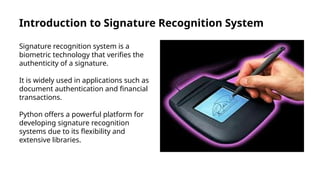
Signature recognition system is a
biometric technology that verifies the
authenticity of a signature.
It is widely used in applications such as
document authentication and financial
transactions.
Python offers a powerful platform for
developing signature recognition
systems due to its flexibility and
extensive libraries.
Importance of Signature Recognition
Enhances security and prevents fraud by
verifying the identity of the signer.
Provides a convenient and efficient way
to authorize transactions.
Can be integrated into various industries
such as banking, legal, and government
sectors.
Components of Signature Recognition System
Preprocessing: Cleans and enhances the
signature image for better analysis.
Feature Extraction: Extracts relevant
features from the signature for
recognition.
Classification: Uses machine learning
algorithms to classify and authenticate
the signature.
Preprocessing Techniques
Noise removal: Eliminates unwanted
elements from the signature image.
Binarization: Converts the signature
image into a binary format for easier
analysis.
Normalization: Standardizes the size and
orientation of the signature for
consistency.
Feature Extraction Methods
Histogram of Oriented Gradients (HOG):
Captures the shape and texture
information of the signature.
Local Binary Patterns (LBP): Describes
the local patterns within the signature
image.
Convolutional Neural Networks (CNN):
Extracts hierarchical features from the
signature data.
Classification Algorithms
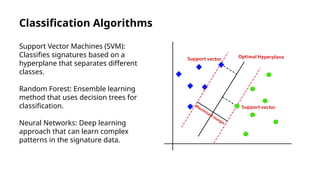
Support Vector Machines (SVM):
Classifies signatures based on a
hyperplane that separates different
classes.
Random Forest: Ensemble learning
method that uses decision trees for
classification.
Neural Networks: Deep learning
approach that can learn complex
patterns in the signature data.
Implementation in Python
Utilize libraries such as OpenCV and
scikit-learn for image processing and
machine learning tasks.
Develop a pipeline that includes
preprocessing, feature extraction, and
classification stages.
Train the model using a dataset of
genuine and forged signatures for
accurate recognition.
Evaluation Metrics
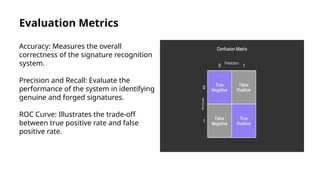
Accuracy: Measures the overall
correctness of the signature recognition
system.
Precision and Recall: Evaluate the
performance of the system in identifying
genuine and forged signatures.
ROC Curve: Illustrates the trade-off
between true positive rate and false
positive rate.
Challenges and Future Directions
Variability in signatures due to different
writing styles and conditions.
Continuous improvement of algorithms
and models for better accuracy and
robustness.
Integration of multi-modal biometric
systems for enhanced security and
authentication.
Conclusion
Signature recognition system using
Python offers a reliable and efficient
solution for verifying signatures.
By leveraging machine learning
algorithms and image processing
techniques, accurate authentication can
be achieved.
Continued research and development in
this field will lead to advancements in
biometric technology for secure
transactions and document verification.

Signature Recognition System Using Python With Conclusion.pptx

  • 1.
    Signature Recognition SystemUsing Python With Conclusion SlideMake.com
  • 2.
    Introduction to SignatureRecognition System Signature recognition system is a biometric technology that verifies the authenticity of a signature. It is widely used in applications such as document authentication and financial transactions. Python offers a powerful platform for developing signature recognition systems due to its flexibility and extensive libraries.
  • 3.
    Importance of SignatureRecognition Enhances security and prevents fraud by verifying the identity of the signer. Provides a convenient and efficient way to authorize transactions. Can be integrated into various industries such as banking, legal, and government sectors.
  • 4.
    Components of SignatureRecognition System Preprocessing: Cleans and enhances the signature image for better analysis. Feature Extraction: Extracts relevant features from the signature for recognition. Classification: Uses machine learning algorithms to classify and authenticate the signature.
  • 5.
    Preprocessing Techniques Noise removal:Eliminates unwanted elements from the signature image. Binarization: Converts the signature image into a binary format for easier analysis. Normalization: Standardizes the size and orientation of the signature for consistency.
  • 6.
    Feature Extraction Methods Histogramof Oriented Gradients (HOG): Captures the shape and texture information of the signature. Local Binary Patterns (LBP): Describes the local patterns within the signature image. Convolutional Neural Networks (CNN): Extracts hierarchical features from the signature data.
  • 7.
    Classification Algorithms Support VectorMachines (SVM): Classifies signatures based on a hyperplane that separates different classes. Random Forest: Ensemble learning method that uses decision trees for classification. Neural Networks: Deep learning approach that can learn complex patterns in the signature data.
  • 8.
    Implementation in Python Utilizelibraries such as OpenCV and scikit-learn for image processing and machine learning tasks. Develop a pipeline that includes preprocessing, feature extraction, and classification stages. Train the model using a dataset of genuine and forged signatures for accurate recognition.
  • 9.
    Evaluation Metrics Accuracy: Measuresthe overall correctness of the signature recognition system. Precision and Recall: Evaluate the performance of the system in identifying genuine and forged signatures. ROC Curve: Illustrates the trade-off between true positive rate and false positive rate.
  • 10.
    Challenges and FutureDirections Variability in signatures due to different writing styles and conditions. Continuous improvement of algorithms and models for better accuracy and robustness. Integration of multi-modal biometric systems for enhanced security and authentication.
  • 11.
    Conclusion Signature recognition systemusing Python offers a reliable and efficient solution for verifying signatures. By leveraging machine learning algorithms and image processing techniques, accurate authentication can be achieved. Continued research and development in this field will lead to advancements in biometric technology for secure transactions and document verification.

Editor's Notes

  • #2 Image source: https://ar.inspiredpencil.com/pictures-2023/signature-recognition-biometrics
  • #3 Image source: https://ar.inspiredpencil.com/pictures-2023/signature-recognition-biometrics
  • #4 Image source: https://www.researchgate.net/figure/Steps-of-signature-verification-system_fig3_335191144
  • #5 Image source: https://www.researchgate.net/figure/Figure-3-Preprocessing-steps_fig3_283103266
  • #6 Image source: https://www.researchgate.net/figure/Basic-flow-of-histogram-oriented-gradient-HOG-feature-extraction-algorithm-The_fig5_349457224
  • #7 Image source: https://ottima-power.com/es/support-vector-machine-algorithm-3/
  • #8 Image source: https://www.desertcart.fi/products/184578322-machine-learning-for-open-cv-4-intelligent-algorithms-for-building-image-processing-apps-using-open-cv-4-python-and-scikit-learn-2nd-edition
  • #9 Image source: https://txt.cohere.com/classification-eval-metrics/
  • #10 Image source: https://mircarie.com/considerations-in-implementing-digital-signatures/
  • #11 Image source: https://www.youtube.com/watch?v=LAMVN3YAgDE