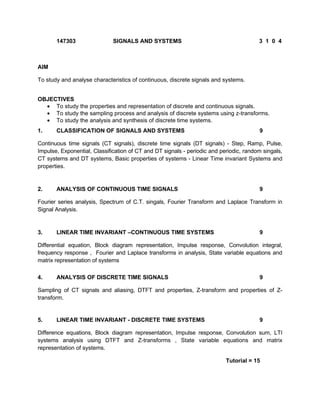
147303                 SIGNALS AND SYSTEMS                                       3 1 0 4


AIM

To study and analyse characteristics of continuous, discrete signals and systems.


OBJECTIVES
  • To study the properties and representation of discrete and continuous signals.
  • To study the sampling process and analysis of discrete systems using z-transforms.
  • To study the analysis and synthesis of discrete time systems.
1.     CLASSIFICATION OF SIGNALS AND SYSTEMS                                            9

Continuous time signals (CT signals), discrete time signals (DT signals) - Step, Ramp, Pulse,
Impulse, Exponential, Classification of CT and DT signals - periodic and periodic, random singals,
CT systems and DT systems, Basic properties of systems - Linear Time invariant Systems and
properties.


2.     ANALYSIS OF CONTINUOUS TIME SIGNALS                                              9

Fourier series analysis, Spectrum of C.T. singals, Fourier Transform and Laplace Transform in
Signal Analysis.


3.     LINEAR TIME INVARIANT –CONTINUOUS TIME SYSTEMS                                   9

Differential equation, Block diagram representation, Impulse response, Convolution integral,
frequency response , Fourier and Laplace transforms in analysis, State variable equations and
matrix representation of systems

4.     ANALYSIS OF DISCRETE TIME SIGNALS                                                9

Sampling of CT signals and aliasing, DTFT and properties, Z-transform and properties of Z-
transform.


5.     LINEAR TIME INVARIANT - DISCRETE TIME SYSTEMS                                    9

Difference equations, Block diagram representation, Impulse response, Convolution sum, LTI
systems analysis using DTFT and Z-transforms , State variable equations and matrix
representation of systems.

                                                                           Tutorial = 15
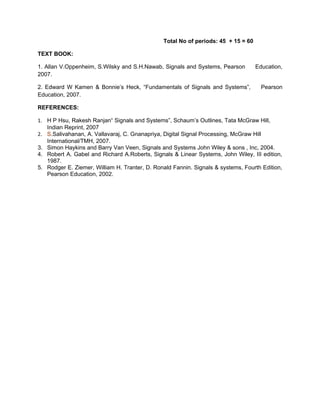
Total No of periods: 45 + 15 = 60

TEXT BOOK:

1. Allan V.Oppenheim, S.Wilsky and S.H.Nawab, Signals and Systems, Pearson         Education,
2007.

2. Edward W Kamen & Bonnie’s Heck, “Fundamentals of Signals and Systems”,            Pearson
Education, 2007.

REFERENCES:

1. H P Hsu, Rakesh Ranjan“ Signals and Systems”, Schaum’s Outlines, Tata McGraw Hill,
   Indian Reprint, 2007
2. S.Salivahanan, A. Vallavaraj, C. Gnanapriya, Digital Signal Processing, McGraw Hill
   International/TMH, 2007.
3. Simon Haykins and Barry Van Veen, Signals and Systems John Wiley & sons , Inc, 2004.
4. Robert A. Gabel and Richard A.Roberts, Signals & Linear Systems, John Wiley, III edition,
   1987.
5. Rodger E. Ziemer, William H. Tranter, D. Ronald Fannin. Signals & systems, Fourth Edition,
   Pearson Education, 2002.
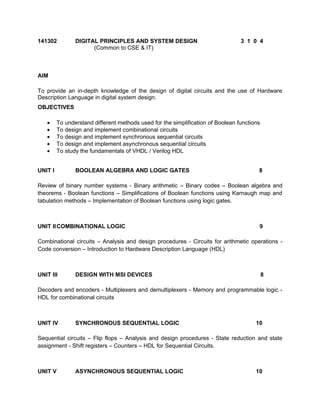
141302          DIGITAL PRINCIPLES AND SYSTEM DESIGN                             3 1 0 4
                      (Common to CSE & IT)


AIM

To provide an in-depth knowledge of the design of digital circuits and the use of Hardware
Description Language in digital system design.
OBJECTIVES

   •     To understand different methods used for the simplification of Boolean functions
   •     To design and implement combinational circuits
   •     To design and implement synchronous sequential circuits
   •     To design and implement asynchronous sequential circuits
   •     To study the fundamentals of VHDL / Verilog HDL


UNIT I          BOOLEAN ALGEBRA AND LOGIC GATES                                         8

Review of binary number systems - Binary arithmetic – Binary codes – Boolean algebra and
theorems - Boolean functions – Simplifications of Boolean functions using Karnaugh map and
tabulation methods – Implementation of Boolean functions using logic gates.


UNIT II COMBINATIONAL LOGIC                                                             9

Combinational circuits – Analysis and design procedures - Circuits for arithmetic operations -
Code conversion – Introduction to Hardware Description Language (HDL)


UNIT III        DESIGN WITH MSI DEVICES                                                     8

Decoders and encoders - Multiplexers and demultiplexers - Memory and programmable logic -
HDL for combinational circuits


UNIT IV         SYNCHRONOUS SEQUENTIAL LOGIC                                           10

Sequential circuits – Flip flops – Analysis and design procedures - State reduction and state
assignment - Shift registers – Counters – HDL for Sequential Circuits.


UNIT V          ASYNCHRONOUS SEQUENTIAL LOGIC                                          10
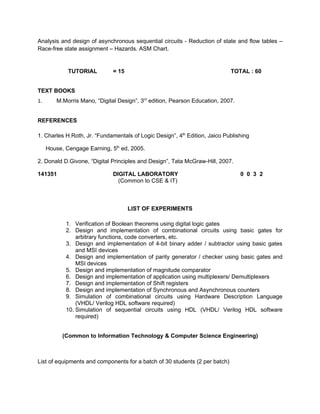
Analysis and design of asynchronous sequential circuits - Reduction of state and flow tables –
Race-free state assignment – Hazards. ASM Chart.


             TUTORIAL          = 15                                          TOTAL : 60


TEXT BOOKS
1.       M.Morris Mano, “Digital Design”, 3rd edition, Pearson Education, 2007.


REFERENCES

1. Charles H.Roth, Jr. “Fundamentals of Logic Design”, 4th Edition, Jaico Publishing

     House, Cengage Earning, 5th ed, 2005.

2. Donald D.Givone, “Digital Principles and Design”, Tata McGraw-Hill, 2007.

141351                         DIGITAL LABORATORY                                 0 0 3 2
                                 (Common to CSE & IT)


                                      LIST OF EXPERIMENTS

            1. Verification of Boolean theorems using digital logic gates
            2. Design and implementation of combinational circuits using basic gates for
                arbitrary functions, code converters, etc.
            3. Design and implementation of 4-bit binary adder / subtractor using basic gates
                and MSI devices
            4. Design and implementation of parity generator / checker using basic gates and
                MSI devices
            5. Design and implementation of magnitude comparator
            6. Design and implementation of application using multiplexers/ Demultiplexers
            7. Design and implementation of Shift registers
            8. Design and implementation of Synchronous and Asynchronous counters
            9. Simulation of combinational circuits using Hardware Description Language
                (VHDL/ Verilog HDL software required)
            10. Simulation of sequential circuits using HDL (VHDL/ Verilog HDL software
                required)


           (Common to Information Technology & Computer Science Engineering)


List of equipments and components for a batch of 30 students (2 per batch)
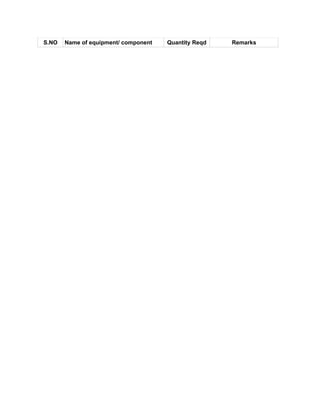
S.NO   Name of equipment/ component   Quantity Reqd   Remarks
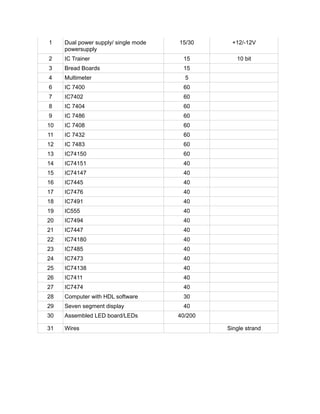
1    Dual power supply/ single mode   15/30     +12/-12V
     powersupply
2    IC Trainer                        15         10 bit
3    Bread Boards                      15
4    Multimeter                         5
6    IC 7400                           60
7    IC7402                            60
8    IC 7404                           60
9    IC 7486                           60
10   IC 7408                           60
11   IC 7432                           60
12   IC 7483                           60
13   IC74150                           60
14   IC74151                           40
15   IC74147                           40
16   IC7445                            40
17   IC7476                            40
18   IC7491                            40
19   IC555                             40
20   IC7494                            40
21   IC7447                            40
22   IC74180                           40
23   IC7485                            40
24   IC7473                            40
25   IC74138                           40
26   IC7411                            40
27   IC7474                            40
28   Computer with HDL software        30
29   Seven segment display             40
30   Assembled LED board/LEDs         40/200

31   Wires                                     Single strand

Attachments

  • 1.
    147303 SIGNALS AND SYSTEMS 3 1 0 4 AIM To study and analyse characteristics of continuous, discrete signals and systems. OBJECTIVES • To study the properties and representation of discrete and continuous signals. • To study the sampling process and analysis of discrete systems using z-transforms. • To study the analysis and synthesis of discrete time systems. 1. CLASSIFICATION OF SIGNALS AND SYSTEMS 9 Continuous time signals (CT signals), discrete time signals (DT signals) - Step, Ramp, Pulse, Impulse, Exponential, Classification of CT and DT signals - periodic and periodic, random singals, CT systems and DT systems, Basic properties of systems - Linear Time invariant Systems and properties. 2. ANALYSIS OF CONTINUOUS TIME SIGNALS 9 Fourier series analysis, Spectrum of C.T. singals, Fourier Transform and Laplace Transform in Signal Analysis. 3. LINEAR TIME INVARIANT –CONTINUOUS TIME SYSTEMS 9 Differential equation, Block diagram representation, Impulse response, Convolution integral, frequency response , Fourier and Laplace transforms in analysis, State variable equations and matrix representation of systems 4. ANALYSIS OF DISCRETE TIME SIGNALS 9 Sampling of CT signals and aliasing, DTFT and properties, Z-transform and properties of Z- transform. 5. LINEAR TIME INVARIANT - DISCRETE TIME SYSTEMS 9 Difference equations, Block diagram representation, Impulse response, Convolution sum, LTI systems analysis using DTFT and Z-transforms , State variable equations and matrix representation of systems. Tutorial = 15
  • 2.
    Total No ofperiods: 45 + 15 = 60 TEXT BOOK: 1. Allan V.Oppenheim, S.Wilsky and S.H.Nawab, Signals and Systems, Pearson Education, 2007. 2. Edward W Kamen & Bonnie’s Heck, “Fundamentals of Signals and Systems”, Pearson Education, 2007. REFERENCES: 1. H P Hsu, Rakesh Ranjan“ Signals and Systems”, Schaum’s Outlines, Tata McGraw Hill, Indian Reprint, 2007 2. S.Salivahanan, A. Vallavaraj, C. Gnanapriya, Digital Signal Processing, McGraw Hill International/TMH, 2007. 3. Simon Haykins and Barry Van Veen, Signals and Systems John Wiley & sons , Inc, 2004. 4. Robert A. Gabel and Richard A.Roberts, Signals & Linear Systems, John Wiley, III edition, 1987. 5. Rodger E. Ziemer, William H. Tranter, D. Ronald Fannin. Signals & systems, Fourth Edition, Pearson Education, 2002.
  • 3.
    141302 DIGITAL PRINCIPLES AND SYSTEM DESIGN 3 1 0 4 (Common to CSE & IT) AIM To provide an in-depth knowledge of the design of digital circuits and the use of Hardware Description Language in digital system design. OBJECTIVES • To understand different methods used for the simplification of Boolean functions • To design and implement combinational circuits • To design and implement synchronous sequential circuits • To design and implement asynchronous sequential circuits • To study the fundamentals of VHDL / Verilog HDL UNIT I BOOLEAN ALGEBRA AND LOGIC GATES 8 Review of binary number systems - Binary arithmetic – Binary codes – Boolean algebra and theorems - Boolean functions – Simplifications of Boolean functions using Karnaugh map and tabulation methods – Implementation of Boolean functions using logic gates. UNIT II COMBINATIONAL LOGIC 9 Combinational circuits – Analysis and design procedures - Circuits for arithmetic operations - Code conversion – Introduction to Hardware Description Language (HDL) UNIT III DESIGN WITH MSI DEVICES 8 Decoders and encoders - Multiplexers and demultiplexers - Memory and programmable logic - HDL for combinational circuits UNIT IV SYNCHRONOUS SEQUENTIAL LOGIC 10 Sequential circuits – Flip flops – Analysis and design procedures - State reduction and state assignment - Shift registers – Counters – HDL for Sequential Circuits. UNIT V ASYNCHRONOUS SEQUENTIAL LOGIC 10
  • 4.
    Analysis and designof asynchronous sequential circuits - Reduction of state and flow tables – Race-free state assignment – Hazards. ASM Chart. TUTORIAL = 15 TOTAL : 60 TEXT BOOKS 1. M.Morris Mano, “Digital Design”, 3rd edition, Pearson Education, 2007. REFERENCES 1. Charles H.Roth, Jr. “Fundamentals of Logic Design”, 4th Edition, Jaico Publishing House, Cengage Earning, 5th ed, 2005. 2. Donald D.Givone, “Digital Principles and Design”, Tata McGraw-Hill, 2007. 141351 DIGITAL LABORATORY 0 0 3 2 (Common to CSE & IT) LIST OF EXPERIMENTS 1. Verification of Boolean theorems using digital logic gates 2. Design and implementation of combinational circuits using basic gates for arbitrary functions, code converters, etc. 3. Design and implementation of 4-bit binary adder / subtractor using basic gates and MSI devices 4. Design and implementation of parity generator / checker using basic gates and MSI devices 5. Design and implementation of magnitude comparator 6. Design and implementation of application using multiplexers/ Demultiplexers 7. Design and implementation of Shift registers 8. Design and implementation of Synchronous and Asynchronous counters 9. Simulation of combinational circuits using Hardware Description Language (VHDL/ Verilog HDL software required) 10. Simulation of sequential circuits using HDL (VHDL/ Verilog HDL software required) (Common to Information Technology & Computer Science Engineering) List of equipments and components for a batch of 30 students (2 per batch)
  • 5.
    S.NO Name of equipment/ component Quantity Reqd Remarks
  • 6.
    1 Dual power supply/ single mode 15/30 +12/-12V powersupply 2 IC Trainer 15 10 bit 3 Bread Boards 15 4 Multimeter 5 6 IC 7400 60 7 IC7402 60 8 IC 7404 60 9 IC 7486 60 10 IC 7408 60 11 IC 7432 60 12 IC 7483 60 13 IC74150 60 14 IC74151 40 15 IC74147 40 16 IC7445 40 17 IC7476 40 18 IC7491 40 19 IC555 40 20 IC7494 40 21 IC7447 40 22 IC74180 40 23 IC7485 40 24 IC7473 40 25 IC74138 40 26 IC7411 40 27 IC7474 40 28 Computer with HDL software 30 29 Seven segment display 40 30 Assembled LED board/LEDs 40/200 31 Wires Single strand