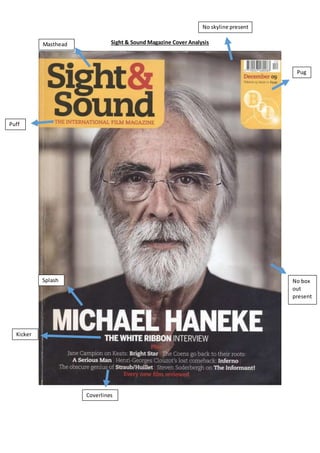
Sight & Sound Magazine Cover AnalysisMasthead
Puff
Pug
No skyline present
Coverlines
Splash
Kicker
No box
out
present
Sight& Soundis a monthlypublicationfromthe BFIthatbeganin 1932. It isaimedat a more
highbrowaudience whowishtoreadamore sophisticatedanalysisonfilm.Whilstmagazinessuchas
Total FilmorEmpire may focuson the more mainstreamreleases,Sight&Soundaimstocover some
more niche filmsonan international spectrum.Therefore,the maintargetaudienceforthis
publicationwouldbe menaged21-39 butcouldhave a slighterolder(mostly,butnotexclusively
male) secondarytargetaudience.
From examiningthe coverlinesof thisfrontcoveryoucan determine thatthe featuresinside itare
likelytobe in-depthdiscussionsandanalysesof filmsthatamainstream audience maynothave
heardof.For example,Jane Campionisthe directorof the filmBrightStarwhichisaboutthe love
life of the poetJohnKeats.Thisfilmisunlikelyto attracta mainstreamaudience andwill not
normallybe foundonthe coverof a mainstreamfilmmagazine.There isalsoasectiononthe French
directorsStrauband Hullietwhose filmsare more thoughtprovokingwithadeepermeaninginside.
It isclear fromthe style of these articlesthatSight& Soundattemptstobe a more thought
provokingpublicationthattakesamore academicapproach to examiningfilm.Thisismost
prominentwiththe mainfeature of the article beingonMichael Haneke whoisa German
screenwriteranddirector.Whilsthe isan extremelysuccessfulmanwhohasbeennominatedfor
twoOscars, he is notusuallyattributedasa directorfora commonaudience.The photographof
Haneke takesupmost of the cover andis usedto directlyaddress the audience.Whilstmanymay
not recognise him,hisgeneralappearance hasbeenmade tolooklike he isanintelligentman.The
use of a Sansfont withsimplythe name ‘Michael Haneke’keepsthe coverlookingsimplisticand
elegant.The textof ‘The White Ribbon’hasbeenboldedsothatthe audience isaware of what
Haneke will be discussinginhisinterview.Thiscreatesasymbioticrelationshipwiththe readeras
the encodedmessage of intelligence andsophisticationinthe coverisusuallymatchedbythe type
of personthatwouldreadthispublication.
Thiscover usesveryfewbuzzwordsinordertoentice apotential reader.Thisislikelydue tothe fact
that the readerwouldtypicallyalreadyhave aninterestinfilmandisunlikelytodevelopone justby
readingthispublication.However,the magazinedoesappeal toamore mainstreamaudience when
it states“everynewfilmreviewed”whichcaninclude popularreleases.The mastheadof this
magazine iskeptquite simpletomatchthe rest of the cover. The phrase “The International Film
Magazine”has potentiallybeenuse tosignifythatitreviewscinema,notjustthe UK and USA,but
fromcountriesall overthe world.Finally,the visualsof thiscoverhave beenputthroughafilter
(Sepia) tomake them lookmore oldfashioned.The picture isgrainedaroundthe edgesandthishas
beendone toreflectthe wisdomof Haneke.The coloursare notparticularlybrightandwouldnot
jumpout to an audience astheywere lookingona shelf.
Therefore,itisclearthatthiscover has beendesignedwiththe magazinescurrentaudience inmind,
rather thana mainstreamone.TheywaythatitpromotesHaneke andthe articlesinside would
appeal tosomeone withakeeninterestinfilmandnotyoureverydayreader,thatmightread
Empire or Total Film.

Sight & Sound Analysis

  • 1.
    Sight & SoundMagazine Cover AnalysisMasthead Puff Pug No skyline present Coverlines Splash Kicker No box out present
  • 2.
    Sight& Soundis amonthlypublicationfromthe BFIthatbeganin 1932. It isaimedat a more highbrowaudience whowishtoreadamore sophisticatedanalysisonfilm.Whilstmagazinessuchas Total FilmorEmpire may focuson the more mainstreamreleases,Sight&Soundaimstocover some more niche filmsonan international spectrum.Therefore,the maintargetaudienceforthis publicationwouldbe menaged21-39 butcouldhave a slighterolder(mostly,butnotexclusively male) secondarytargetaudience. From examiningthe coverlinesof thisfrontcoveryoucan determine thatthe featuresinside itare likelytobe in-depthdiscussionsandanalysesof filmsthatamainstream audience maynothave heardof.For example,Jane Campionisthe directorof the filmBrightStarwhichisaboutthe love life of the poetJohnKeats.Thisfilmisunlikelyto attracta mainstreamaudience andwill not normallybe foundonthe coverof a mainstreamfilmmagazine.There isalsoasectiononthe French directorsStrauband Hullietwhose filmsare more thoughtprovokingwithadeepermeaninginside. It isclear fromthe style of these articlesthatSight& Soundattemptstobe a more thought provokingpublicationthattakesamore academicapproach to examiningfilm.Thisismost prominentwiththe mainfeature of the article beingonMichael Haneke whoisa German screenwriteranddirector.Whilsthe isan extremelysuccessfulmanwhohasbeennominatedfor twoOscars, he is notusuallyattributedasa directorfora commonaudience.The photographof Haneke takesupmost of the cover andis usedto directlyaddress the audience.Whilstmanymay not recognise him,hisgeneralappearance hasbeenmade tolooklike he isanintelligentman.The use of a Sansfont withsimplythe name ‘Michael Haneke’keepsthe coverlookingsimplisticand elegant.The textof ‘The White Ribbon’hasbeenboldedsothatthe audience isaware of what Haneke will be discussinginhisinterview.Thiscreatesasymbioticrelationshipwiththe readeras the encodedmessage of intelligence andsophisticationinthe coverisusuallymatchedbythe type of personthatwouldreadthispublication. Thiscover usesveryfewbuzzwordsinordertoentice apotential reader.Thisislikelydue tothe fact that the readerwouldtypicallyalreadyhave aninterestinfilmandisunlikelytodevelopone justby readingthispublication.However,the magazinedoesappeal toamore mainstreamaudience when it states“everynewfilmreviewed”whichcaninclude popularreleases.The mastheadof this magazine iskeptquite simpletomatchthe rest of the cover. The phrase “The International Film Magazine”has potentiallybeenuse tosignifythatitreviewscinema,notjustthe UK and USA,but fromcountriesall overthe world.Finally,the visualsof thiscoverhave beenputthroughafilter (Sepia) tomake them lookmore oldfashioned.The picture isgrainedaroundthe edgesandthishas beendone toreflectthe wisdomof Haneke.The coloursare notparticularlybrightandwouldnot jumpout to an audience astheywere lookingona shelf. Therefore,itisclearthatthiscover has beendesignedwiththe magazinescurrentaudience inmind, rather thana mainstreamone.TheywaythatitpromotesHaneke andthe articlesinside would appeal tosomeone withakeeninterestinfilmandnotyoureverydayreader,thatmightread Empire or Total Film.