www.itee.uq.edu.au/research/co-innovation
Co-Innovation Research ITEE
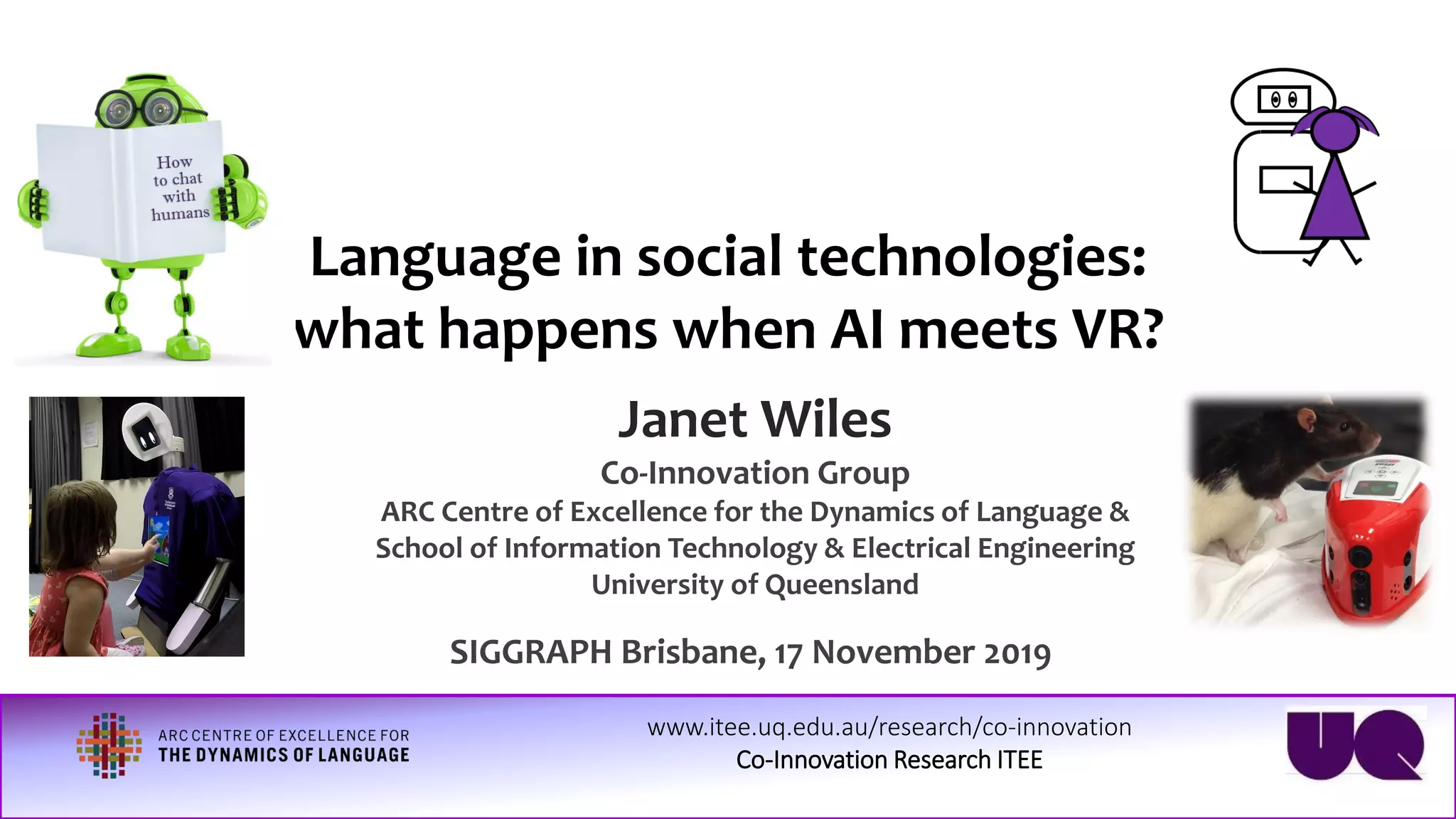
Language in social technologies:
what happens when AI meets VR?
Janet Wiles
Co-Innovation Group
ARC Centre of Excellence for the Dynamics of Language &
School of Information Technology & Electrical Engineering
University of Queensland
SIGGRAPH Brisbane, 17 November 2019
Overview
1. Robots learning language
Studies in grounding
2. Language in AI: the promise of VR/AR
Common ground: learning new words, words in context;
shared understanding; directing attention
3. VR and the brain
Conversation: checking back, interactions, speed
3
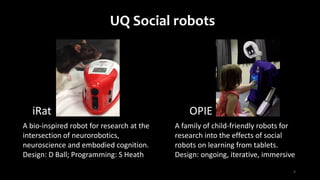
A family of child-friendly robots for
research into the effects of social
robots on learning from tablets.
Design: ongoing, iterative, immersive
UQ Social robots
A bio-inspired robot for research at the
intersection of neurorobotics,
neuroscience and embodied cognition.
Design: D Ball; Programming: S Heath
OPIEiRat
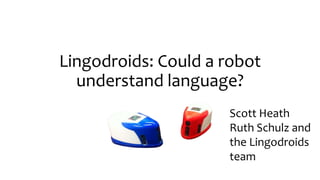
Lingodroids: Could a robot
understand language?
Scott Heath
Ruth Schulz and
the Lingodroids
team
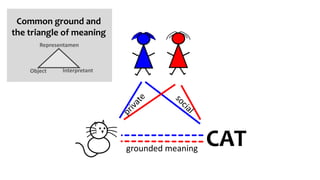
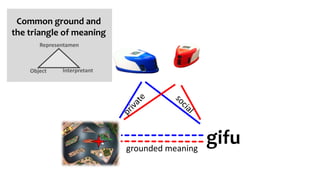
CATgrounded meaning
Common ground and
the triangle of meaning
Representamen
Object Interpretant
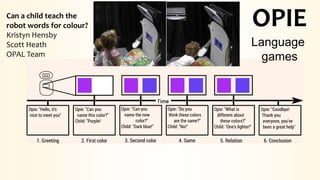
Can a child teach the
robot words for colour?
Kristyn Hensby
Scott Heath
OPAL Team
OPIE
Language
games
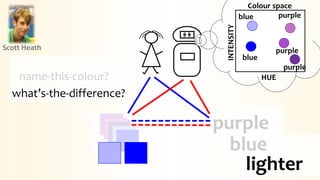
purple
purple
purple
purple
INTENSITY
HUE
blue
Colour space
blue
name-this-colour?
blue
what’s-the-difference?
Scott Heath
lighter
gifugrounded meaning
Common ground and
the triangle of meaning
Representamen
Object Interpretant
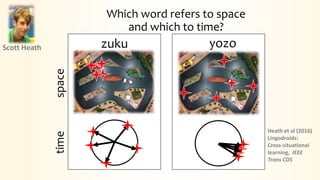
yozozuku
Which word refers to space
and which to time?
Scott Heath
spacetime
Heath et al (2016)
Lingodroids:
Cross-situational
learning, IEEE
Trans CDS
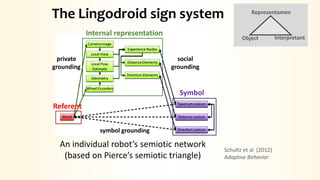
An individual robot’s semiotic network
(based on Pierce’s semiotic triangle)
The Lingodroid sign system
Internal representation
Symbol
Referent
social
grounding
symbol grounding
private
grounding
Schultz et al (2012)
Adaptive Behavior
Representamen
Object Interpretant
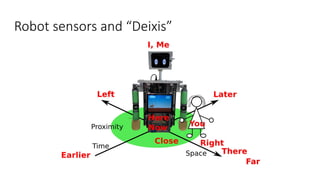
Robot sensors and “Deixis”
4/5
Insights from the Lingodroid studies
• The Lingodroids are embodied and enactive
• Words are not grounded in the direct perceptions of the
robots, but rather, in the integrated navigation system: the
nodes of the map, and the relational spaces of distance
and direction
Each word has a meaning as part of a wider network (extended)
• Common ground depends on shared culture
(understanding of the activity the robots are engaged in –
which game they are playing: where-are-we vs how-far)
Culture assigns meaning to activities which then becomes
encoded when the robots name common ground
Activities that involve common ground are intrinsically
embedded in culture
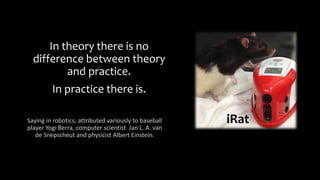
In theory there is no
difference between theory
and practice.
In practice there is.
Saying in robotics; attributed variously to baseball
player Yogi Berra, computer scientist Jan L. A. van
de Snepscheut and physicist Albert Einstein.
iRat
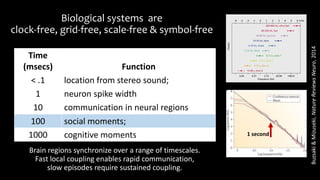
Biological systems are
clock-free, grid-free, scale-free & symbol-free
Brain regions synchronize over a range of timescales.
Fast local coupling enables rapid communication,
slow episodes require sustained coupling.
Buzsaki&Mizuseki,NatureReviewsNeuro,2014
1 second
Time
(msecs) Function
< .1 location from stereo sound;
1 neuron spike width
10 communication in neural regions
100 social moments;
1000 cognitive moments
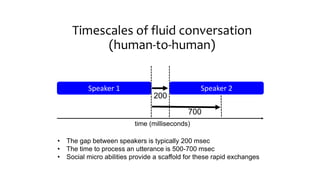
Timescales of fluid conversation
(human-to-human)
Speaker 1
200
time (milliseconds)
700
• The gap between speakers is typically 200 msec
• The time to process an utterance is 500-700 msec
• Social micro abilities provide a scaffold for these rapid exchanges
Speaker 2
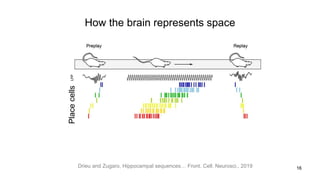
How the brain represents space
16Drieu and Zugaro, Hippocampal sequences… Front. Cell. Neurosci., 2019
Placecells
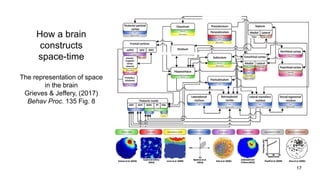
How a brain
constructs
space-time
The representation of space
in the brain
Grieves & Jeffery, (2017)
Behav Proc. 135 Fig. 8
17
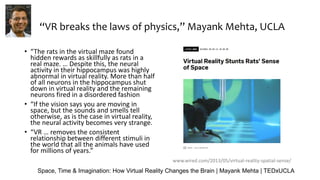
“VR breaks the laws of physics,” Mayank Mehta, UCLA
• “The rats in the virtual maze found
hidden rewards as skillfully as rats in a
real maze. … Despite this, the neural
activity in their hippocampus was highly
abnormal in virtual reality. More than half
of all neurons in the hippocampus shut
down in virtual reality and the remaining
neurons fired in a disordered fashion
• “If the vision says you are moving in
space, but the sounds and smells tell
otherwise, as is the case in virtual reality,
the neural activity becomes very strange.
• “VR … removes the consistent
relationship between different stimuli in
the world that all the animals have used
for millions of years.”
www.wired.com/2013/05/virtual-reality-spatial-sense/
Space, Time & Imagination: How Virtual Reality Changes the Brain | Mayank Mehta | TEDxUCLA
ITEE/Co-Innovation Group: Janet Wiles, Scott Heath, Jonathon Taufatofua, Nik Rybak, Josh Arnold,
Josh Riddell, Gautier Durantin, Ola Olsson, Carlos Ramirez, Andrew Back; Scott Frazier, Beth Cave,
Dylan, Alumni: Kris Rogers, Michael Smith, Rollsy Ponmattam Madassery, Lachlan Fitzpatrick,
Autumn Qiu Jing Chew, Nick Buckeridge, Hugh Raynor, Wilson Kong; ITEE/Robotics: Pauline Pounds;
ITEE/Interaction Design: Pete Worthy, Jason Weigel, Steve Viller, Ben Matthews, Marie Boden
School of Psychology Early Cognitive Development Centre: Kristyn Hensby, Virginia Slaughter, Mark
Nielsen, Tamara van der Zant
School of Communication and Arts/Discursis: Dan Angus, Yvonne Yu
Bond U+ITEE: Helen Chenery, Jacki Liddle, Brooke-Mai Whelan
Melbourne U: Jill Wigglesworth; Ngukurr language centre: Greg Dickson, Jackie van den Bos,
Angelina Joshua, Tamara Joshua, Grant Thompson, Jordan
UCSD Machine Perception Lab: Deborah Forster, Javier Movellan, Marian Bartlett,
Mohsen Malmir; HARLIE: David Ireland (CSIRO), Christina Atay, + Harlie team
computer scientists
mechatronics
electrical & software
engineers
roboticists
designers
psychologists
Speech pathologists
occupational
therapist
linguists
CoEDL Scholars
MPhil, PhD
THE SOCIAL TECHNOLOGIES TEAMS: LINGODROIDS, OPAL, HARLIE, DISCURSIS
j.wiles@uq.edu.au

Siggraph Asia 2019 VR & AI workshop-wiles-handout

  • 1.
    www.itee.uq.edu.au/research/co-innovation Co-Innovation Research ITEE Languagein social technologies: what happens when AI meets VR? Janet Wiles Co-Innovation Group ARC Centre of Excellence for the Dynamics of Language & School of Information Technology & Electrical Engineering University of Queensland SIGGRAPH Brisbane, 17 November 2019
  • 2.
    Overview 1. Robots learninglanguage Studies in grounding 2. Language in AI: the promise of VR/AR Common ground: learning new words, words in context; shared understanding; directing attention 3. VR and the brain Conversation: checking back, interactions, speed
  • 3.
    3 A family ofchild-friendly robots for research into the effects of social robots on learning from tablets. Design: ongoing, iterative, immersive UQ Social robots A bio-inspired robot for research at the intersection of neurorobotics, neuroscience and embodied cognition. Design: D Ball; Programming: S Heath OPIEiRat
  • 4.
    Lingodroids: Could arobot understand language? Scott Heath Ruth Schulz and the Lingodroids team
  • 5.
    CATgrounded meaning Common groundand the triangle of meaning Representamen Object Interpretant
  • 6.
    Can a childteach the robot words for colour? Kristyn Hensby Scott Heath OPAL Team OPIE Language games
  • 7.
  • 8.
    gifugrounded meaning Common groundand the triangle of meaning Representamen Object Interpretant
  • 9.
    yozozuku Which word refersto space and which to time? Scott Heath spacetime Heath et al (2016) Lingodroids: Cross-situational learning, IEEE Trans CDS
  • 10.
    An individual robot’ssemiotic network (based on Pierce’s semiotic triangle) The Lingodroid sign system Internal representation Symbol Referent social grounding symbol grounding private grounding Schultz et al (2012) Adaptive Behavior Representamen Object Interpretant
  • 11.
    Robot sensors and“Deixis” 4/5
  • 12.
    Insights from theLingodroid studies • The Lingodroids are embodied and enactive • Words are not grounded in the direct perceptions of the robots, but rather, in the integrated navigation system: the nodes of the map, and the relational spaces of distance and direction Each word has a meaning as part of a wider network (extended) • Common ground depends on shared culture (understanding of the activity the robots are engaged in – which game they are playing: where-are-we vs how-far) Culture assigns meaning to activities which then becomes encoded when the robots name common ground Activities that involve common ground are intrinsically embedded in culture
  • 13.
    In theory thereis no difference between theory and practice. In practice there is. Saying in robotics; attributed variously to baseball player Yogi Berra, computer scientist Jan L. A. van de Snepscheut and physicist Albert Einstein. iRat
  • 14.
    Biological systems are clock-free,grid-free, scale-free & symbol-free Brain regions synchronize over a range of timescales. Fast local coupling enables rapid communication, slow episodes require sustained coupling. Buzsaki&Mizuseki,NatureReviewsNeuro,2014 1 second Time (msecs) Function < .1 location from stereo sound; 1 neuron spike width 10 communication in neural regions 100 social moments; 1000 cognitive moments
  • 15.
    Timescales of fluidconversation (human-to-human) Speaker 1 200 time (milliseconds) 700 • The gap between speakers is typically 200 msec • The time to process an utterance is 500-700 msec • Social micro abilities provide a scaffold for these rapid exchanges Speaker 2
  • 16.
    How the brainrepresents space 16Drieu and Zugaro, Hippocampal sequences… Front. Cell. Neurosci., 2019 Placecells
  • 17.
    How a brain constructs space-time Therepresentation of space in the brain Grieves & Jeffery, (2017) Behav Proc. 135 Fig. 8 17
  • 18.
    “VR breaks thelaws of physics,” Mayank Mehta, UCLA • “The rats in the virtual maze found hidden rewards as skillfully as rats in a real maze. … Despite this, the neural activity in their hippocampus was highly abnormal in virtual reality. More than half of all neurons in the hippocampus shut down in virtual reality and the remaining neurons fired in a disordered fashion • “If the vision says you are moving in space, but the sounds and smells tell otherwise, as is the case in virtual reality, the neural activity becomes very strange. • “VR … removes the consistent relationship between different stimuli in the world that all the animals have used for millions of years.” www.wired.com/2013/05/virtual-reality-spatial-sense/ Space, Time & Imagination: How Virtual Reality Changes the Brain | Mayank Mehta | TEDxUCLA
  • 19.
    ITEE/Co-Innovation Group: JanetWiles, Scott Heath, Jonathon Taufatofua, Nik Rybak, Josh Arnold, Josh Riddell, Gautier Durantin, Ola Olsson, Carlos Ramirez, Andrew Back; Scott Frazier, Beth Cave, Dylan, Alumni: Kris Rogers, Michael Smith, Rollsy Ponmattam Madassery, Lachlan Fitzpatrick, Autumn Qiu Jing Chew, Nick Buckeridge, Hugh Raynor, Wilson Kong; ITEE/Robotics: Pauline Pounds; ITEE/Interaction Design: Pete Worthy, Jason Weigel, Steve Viller, Ben Matthews, Marie Boden School of Psychology Early Cognitive Development Centre: Kristyn Hensby, Virginia Slaughter, Mark Nielsen, Tamara van der Zant School of Communication and Arts/Discursis: Dan Angus, Yvonne Yu Bond U+ITEE: Helen Chenery, Jacki Liddle, Brooke-Mai Whelan Melbourne U: Jill Wigglesworth; Ngukurr language centre: Greg Dickson, Jackie van den Bos, Angelina Joshua, Tamara Joshua, Grant Thompson, Jordan UCSD Machine Perception Lab: Deborah Forster, Javier Movellan, Marian Bartlett, Mohsen Malmir; HARLIE: David Ireland (CSIRO), Christina Atay, + Harlie team computer scientists mechatronics electrical & software engineers roboticists designers psychologists Speech pathologists occupational therapist linguists CoEDL Scholars MPhil, PhD THE SOCIAL TECHNOLOGIES TEAMS: LINGODROIDS, OPAL, HARLIE, DISCURSIS j.wiles@uq.edu.au