Siemens was founded in 1847 by Werner von Siemens in Berlin , Germany. It is Europe’s largest engineering company and 
they deal in the sector of mechanical engineered products. Siemens’ principal activities are in the fields of industry, energy, 
transportation and healthcare. 
It is organized into four main divisions: Industry, Energy, Healthcare, and Infrastructure & Cities. Siemens and its subsidiaries 
employ around 360,000 people across nearly 190 countries. Their main competitors are ABB Ltd, Schneider Electric and General 
Electric Company. Siemens has always forged mutually beneficial partnerships with suppliers who reflect their commitment 
towards customers in terms of quality, delivery and cost. 
The Siemens Group in India comprises of 13 companies, providing direct employment to over 19,000 persons. Currently, the 
group has 21 manufacturing plants, a wide network of Sales and Service offices across the country as well as over 500 channel 
partners. Siemens participates, organizes and associates with a number of events each year. These include industry trade fairs 
& exhibitions, road shows, award functions and other events. These events highlight their business, products / solutions, new 
initiatives and the commitment towards energy efficiency, sustainable cities, industrial productivity and affordable / personalized 
healthcare. 
The first telegraphic line was laid between London and Kolkata dates back to the year 1867. Simens major projects in India include 
Gurgaon Metro South Extension project, installing power plants, providing Apollo Hospital in New Delhi with India’s first Biograph 
molecular magnetic resonance (mMR) system, technology and infrastructure for the Bangalore International Airport and many 
more. Its partners are TATA, ITC, P&G and several others. 
The office on Hosur Road is the Global Shared Services Delivery Centre India which caters as a back support office to the head 
office in Electronic City and has a BPO which runs 24*7. This particular office has a minimum of 700 employees at any given time. 
They have an in-house doctor facility and 1160 workstations throughout the office. 
They use their own technology for building construction, fire safety and security access system. Only the execution of the project 
is outsourced (eg: Synergy Systems). 
Siemens has its own team called SRE (Siemens Real Estate) that designs all their offices and spaces based on the Siemens 
Standards set by the team which includes a psychiatrist, a doctor, an ergonomist etc., to enhance employee productivity 
and utility of the area available. 
ABOUT SIEMENS 
1 2
SPACE ADJACENCY MATRIX 
(CORPORATE FLOOR) 
The space adjacency matrix tells us about how the floor is designed, which room is closer to the other whereas 
which rooms do not have connection. 
CORPORATE FLOOR PLAN 
3 4
BUBBLE DIAGRAM 
5 6
ZONING CIRCULATION PLAN 
7 8
The Siemens reception is 8570X4050mm in dimensions. Evryone who comes in registers and has to go through their security 
check(including electronics) after which he/she is permitted inside. The reception flooring is done with vitrified tiles and has 
planters for refreshing atmosphere. The place is well illuminated by the use of CFL bulbs with false ceieling and has an LCD in-stalled. 
The entire office is under survelliance. The space has seating arrangments for visitors(2 seater rexin sofas) and also has a 
magazine cum newspaper stand. It also has first aid box for emergency purposes. 
Reception 
AREAS 
The areas mentioned further are the areas that the corporate floor has. These cater to the different needs of the employees 
and makes sure that they have a suitable atmosphere to work in. 
The passage way connects all the rooms on the floor. The lobby 
is approximately 1.6 meters wide and has vetrified flooring. At a 
time only two people can walk comfortably, and it has planters 
on the side. The lobby near the cafetria also has seating as well 
as a display board. The front lobby is made aesthetically pleas-ing 
by putting in the GSSDCIN in different colors which makes 
the place look more appealing. The lobby is also well illumi-nated 
as it has windows which aren’t available in the working 
space. Apart from the windows usage is bulbs is also seen. 
Lobby 
9 10
Training room 
The office has two trainng rooms, with capacities 
of 23-30 people . The facilities in this room 
include a projector, projector screen, notice 
boards, desks, glass boards, desks for people to 
present with their wiring going under the flooring. 
The training room has glazed partition which 
reduces the sound to quite an extent. The training 
room is 5895X7800mm in dimension. It has 2 
doors and the lighing is motion sensored. The 
entire workspace(most of the office) has smoke 
detectors above and below the ceiling. Above so 
as to get an alarm if any of the wires have caught 
fire. 
The other training room has been provided 
with PC. 
Workspace 
Introduction: 
Bangalore’s siemens hosur branch is a BPO company, they handle all accounts, invoicing for all the other siemens branches. 
All the financing is done here. Their workspace is an open office where everyone has simiar work stations, only the managers 
get private cubicles. Each workstation i.e the cubicle is 85 sqft. These workstation are made up of aluminium material.Each 
workstation has 2 data ports, 2 voice ports, 2 power ports. They have 50 such workstation on the corporate floor. 
Most of the employees have their fixed workstations except for the employees working in the call center, they have shifts, some 
of them come in the morning and the rest come in the evening. One shift consists of 8 hours. So the workstations that are 
shared are in the ratio 1:5. the workspace of Siemens include the workstation for the employees, the managers cubicle and the 
discussion room. The entire office is color coded so that it becomes easy for the employee to work. 
Siemens have their own standards for the furniture in their company. The material, size, color everything is specified.The 
anthropometrics and ergonomics of the furniture and space is first reviwed by a set of doctors and only then is it approved. 
The workstation for the employees is spread on 
the entire floor. 
The flooring here is mostly vitrified tiles and the 
workstation also has a see through partition, 
whereas the floor in the call center is carpeted to 
reduce the noise level in the workspace. 
Siemens BPO Services India Pvt. Ltd. provides 
business process outsourcing and consulting 
services. 
As the entire office is closed and doesn’t have 
windows, AC ducts are provided after every 8 
feet(approx.) 
11 12
Cubicle 
The manger’s workspace which is a private space is where 
the manager works. It includes cabinets, a desk along with 3 
chairs. The cubicle is located along side the work station for 
the employees. They do not have a seperate room. Though this 
space isn’t shared by anyone.; like the employees sometimes 
have to share their workstation if they are working on the same 
software. 
The lighting in the workspace is put up after every 2 feet. They 
use the white cfl bulbs with high voltage so as to illuminate 
the entire space. There are different kinds of lighting in the 
same space which adds to the aesthetics of the space. The 
space, though doesnt have any windows is well circulated and 
spacious. 
Discuss Room 
The discussion room is a place which can be used by all 
the employees. There are two types of discussion room: 
one can accomodate 9 people whereas the other has a 
capacity of 6. The discussion rooms have one table with 
chairs around, projector, a projector screen, a pc, and 
they have glass boards to write. 
The discussion rooms are seperated from the workspace 
by gpsum partitions and one side has a glass partition. 
The doors of these rooms are 900X 2400mm with VP. 
The discussion rooms also have some planters to keep the 
atmosphere fresh. 
Conference Room 
The Siemens conference room is 
11075X5896mm in dimension. It is a well 
planned space. The conference room can be 
divided into two seperate areas with the use 
of a collapsable partition. It can accomodate 
20 people and has a lot of facilities. Apart from 
the LCD, projector, projector screen, glass 
boards, it includes casette ACs and CFLs plant-ed 
in the room. The room has a glass partition 
which allows a lot of light to enter in. The color 
palette of the room is also calm. The sound 
room also has glazed partition on one side 
whereas the block work on the other. 
13 14
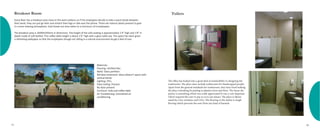
Breakout Room 
Every floor has a breakout area close to the work stations so if the employees decide to take a quick break between 
their work, they can just go their and stretch their legs or talk over the phone. There are interior plants present to give 
it a more relaxing atmosphere. Each break out area caters to a minimum of 6 employees. 
The breakout area is 1839X5350mm in dimension. The height of the sofa seating is approximately 1’4” high and 1’8” in 
depth made of soft leather. The coffee table height is about 1’6” high with a glass table top. The space has been given 
a refreshing wallpaper so that the employees though not sitting in a natural environment do get a feel of one. 
Materials: 
Flooring: vitrified tiles 
Walls: Glass partition 
Window treatment: Glass (doesn’t open) with 
vertical blinds 
Lighting: CFLs 
False Ceiling: Present 
No door present 
Furniture: Sofa and coffee table 
Air Conditioning: Centralised air 
conditioning 
Toilets 
The office has looked into a great deal of sustainibility in designing the 
washrooms. The place does include washrooms for handicapped people. 
Apart from the general standards for washrooms, they have tried making 
the place refreshing by putting in planters here and there. The tissue dis-penser 
is something which was really appreciated It was a coin dispenser 
which required the user to pay so as to use tissues. The place is illumi-nated 
by a few windows and CFLs. The flooring in the toilets is rough 
florring which prevents the user from any kind of hazards. 
15 16
Cafeteria 
The Siemens cafeteria is a huge space in the office since it has to cater to alomost 110 people at a time. The first dloor is the 
only floor to have a cafeteria and the people from the 5th and 6th floor come in to have their food here. The cafeteria is the 
only space to have open windows in the entire office along with plants. It is situated near the atrium. People can sit around 
the space onlooking the atrium. The cafetria is provided with an LCD along with projector and porjector screen. They have 
sound system covering the entire space. the furniture includes chairs and tables with laminated table table tops. Apart from 
the catereres who come in with the food they also have a stall that sells juices and small snacks. They have a buffet system for 
the employees and the caterers come in for breakfast, lunch, snacks, dinner, mid-night snacks and mid-night brunch for the 
employees who work on shifts. 
The space is well mainted and clean. 
Server room 
The server room is primarily used for storing the data generated by the entire office. The data rooms on the fifth and sixth 
floor are connected to the main server room on the first floor using fibre optic cables. 
The uninterrupted power supply room on the first floor caters as a 24*7 back up power supply for the whole office. 
Materials: 
Flooring: vitrified tiles 
Walls: Gypsum partition 
Window treatment: Glass (doesn’t open) with vertical blinds 
Lighting: CFLs 
False Ceiling: Present 
Door: wooden with a small glass panel at eye level 
Furniture: Shelves made of metal or metal alloys (maybe stainless steel) 
Air Conditioning: Cassette AC provision in addition to the 
centralised air conditioning. 
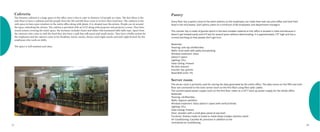
Pantry 
Every floor has a pantry close to the work stations so the employees can make their own tea and coffee and heat their 
food in the microwave. Each pantry caters to a minimum of 60 employees and department managers. 
The counter top is made of granite which is the best suitable material as this office is located in India and because it 
doesn’t get heated easily and it’ll last for several years without deteriorating. It is approximately 1’9” high and has a 
curved overhang so that people don’t get hurt. 
Materials: 
Flooring: anti slip vitrified tiles 
Walls: brick walls with patty and painting. 
Window treatment: Glass 
(doesn’t open) 
Lighting: CFLs 
False Ceiling: Present 
No door present 
Counter top: granite 
Base/Wall Units: Ply 
17 18
Conclusion 
Poonam Masne (PDP 301): 
Space-Area-Environs are a rare and expensive commodity. The prices are 
skyrocketing and the availability scarce. 
In this scenario I got a golden chance to learn how to plan spaces. 
The scheme of the office at Siemens was what I worked on. Specifically the 
Fields of my case study were the reception, cafeteria , training room and 
toilets. All of these places need extreme planning and cautioned approach as 
these places are the interacting platforms for the company. 
Though as simple as it looks as you stride in through the gate, the anatomy 
of the plan and the thought process behind it is mind boggling. With such 
an enthusiastic team and I would like to thank my faculty for their helpful 
assistance . The way my thought process has been metamorphosed at a 
better level, will help me in my future prospects of designing with an added 
experience and informed approach. 
Pallavi Raut (PDP 301): 
Personally I liked the visit to the Siemens office; it was enlightening on how 
things worked in an office. Overall I found the space very compact, but 
according to the availability of space it was well designed. Some of the things 
that I personally don’t feel comfortable were that there was no particular 
open space like a balcony where we could take in outside atmosphere and 
feel relaxed. I liked the provision of a massage chair in the recreational 
room because after working on PCs for long a lot of strain does come on our 
shoulders and backs. From what we saw I think the space functioned very well 
and every activity was well planned out. 
Palak Sarda (PDP 301): 
Planning of a good space is where a space is utilised to the fullest. When we 
got a chance to study one of the really good companies, I understood that 
they try and use every inch of the space. Trying to make it how the space is 
supposed to function and work is a really important point. The way the furni-ture 
is put can make your space look clustered or spacious, organised or ugly. 
There were some areas which gave in a lot of insight as to why a particular ma-terial 
is used or area is designed; but there were some areas which i thought 
would have made the place much more easier and appelaing to work within. 
Like the absence of windows or any openings and being in the air conditioned 
room can become clautrophobic, whereas making the entire office color coded 
adds in a lot of color as well as makes it easier for the employees to work. The 
lighting, the conference rooms, the discussion rooms all were a great source of 
learning since observing a place is much better than just reading about it. 
Ameeshi Goenka (PDP 301): 
The space was well designed for its function but i felt it ould have been more 
ergonomically right. I feel every floor of an office space should have an open 
balcony for the employees for fresh air while working. Personally i learnt a 
lot about materials used in space designing. The layers of a gypsum partition, 
aluminium fixture at the workstation and cubicles, the use of smoke detectors 
above and below the false ceiling are some of the things that caught my 
attention. 
19 20

Siemens book

  • 2.
    Siemens was foundedin 1847 by Werner von Siemens in Berlin , Germany. It is Europe’s largest engineering company and they deal in the sector of mechanical engineered products. Siemens’ principal activities are in the fields of industry, energy, transportation and healthcare. It is organized into four main divisions: Industry, Energy, Healthcare, and Infrastructure & Cities. Siemens and its subsidiaries employ around 360,000 people across nearly 190 countries. Their main competitors are ABB Ltd, Schneider Electric and General Electric Company. Siemens has always forged mutually beneficial partnerships with suppliers who reflect their commitment towards customers in terms of quality, delivery and cost. The Siemens Group in India comprises of 13 companies, providing direct employment to over 19,000 persons. Currently, the group has 21 manufacturing plants, a wide network of Sales and Service offices across the country as well as over 500 channel partners. Siemens participates, organizes and associates with a number of events each year. These include industry trade fairs & exhibitions, road shows, award functions and other events. These events highlight their business, products / solutions, new initiatives and the commitment towards energy efficiency, sustainable cities, industrial productivity and affordable / personalized healthcare. The first telegraphic line was laid between London and Kolkata dates back to the year 1867. Simens major projects in India include Gurgaon Metro South Extension project, installing power plants, providing Apollo Hospital in New Delhi with India’s first Biograph molecular magnetic resonance (mMR) system, technology and infrastructure for the Bangalore International Airport and many more. Its partners are TATA, ITC, P&G and several others. The office on Hosur Road is the Global Shared Services Delivery Centre India which caters as a back support office to the head office in Electronic City and has a BPO which runs 24*7. This particular office has a minimum of 700 employees at any given time. They have an in-house doctor facility and 1160 workstations throughout the office. They use their own technology for building construction, fire safety and security access system. Only the execution of the project is outsourced (eg: Synergy Systems). Siemens has its own team called SRE (Siemens Real Estate) that designs all their offices and spaces based on the Siemens Standards set by the team which includes a psychiatrist, a doctor, an ergonomist etc., to enhance employee productivity and utility of the area available. ABOUT SIEMENS 1 2
  • 3.
    SPACE ADJACENCY MATRIX (CORPORATE FLOOR) The space adjacency matrix tells us about how the floor is designed, which room is closer to the other whereas which rooms do not have connection. CORPORATE FLOOR PLAN 3 4
  • 4.
  • 5.
  • 6.
    The Siemens receptionis 8570X4050mm in dimensions. Evryone who comes in registers and has to go through their security check(including electronics) after which he/she is permitted inside. The reception flooring is done with vitrified tiles and has planters for refreshing atmosphere. The place is well illuminated by the use of CFL bulbs with false ceieling and has an LCD in-stalled. The entire office is under survelliance. The space has seating arrangments for visitors(2 seater rexin sofas) and also has a magazine cum newspaper stand. It also has first aid box for emergency purposes. Reception AREAS The areas mentioned further are the areas that the corporate floor has. These cater to the different needs of the employees and makes sure that they have a suitable atmosphere to work in. The passage way connects all the rooms on the floor. The lobby is approximately 1.6 meters wide and has vetrified flooring. At a time only two people can walk comfortably, and it has planters on the side. The lobby near the cafetria also has seating as well as a display board. The front lobby is made aesthetically pleas-ing by putting in the GSSDCIN in different colors which makes the place look more appealing. The lobby is also well illumi-nated as it has windows which aren’t available in the working space. Apart from the windows usage is bulbs is also seen. Lobby 9 10
  • 7.
    Training room Theoffice has two trainng rooms, with capacities of 23-30 people . The facilities in this room include a projector, projector screen, notice boards, desks, glass boards, desks for people to present with their wiring going under the flooring. The training room has glazed partition which reduces the sound to quite an extent. The training room is 5895X7800mm in dimension. It has 2 doors and the lighing is motion sensored. The entire workspace(most of the office) has smoke detectors above and below the ceiling. Above so as to get an alarm if any of the wires have caught fire. The other training room has been provided with PC. Workspace Introduction: Bangalore’s siemens hosur branch is a BPO company, they handle all accounts, invoicing for all the other siemens branches. All the financing is done here. Their workspace is an open office where everyone has simiar work stations, only the managers get private cubicles. Each workstation i.e the cubicle is 85 sqft. These workstation are made up of aluminium material.Each workstation has 2 data ports, 2 voice ports, 2 power ports. They have 50 such workstation on the corporate floor. Most of the employees have their fixed workstations except for the employees working in the call center, they have shifts, some of them come in the morning and the rest come in the evening. One shift consists of 8 hours. So the workstations that are shared are in the ratio 1:5. the workspace of Siemens include the workstation for the employees, the managers cubicle and the discussion room. The entire office is color coded so that it becomes easy for the employee to work. Siemens have their own standards for the furniture in their company. The material, size, color everything is specified.The anthropometrics and ergonomics of the furniture and space is first reviwed by a set of doctors and only then is it approved. The workstation for the employees is spread on the entire floor. The flooring here is mostly vitrified tiles and the workstation also has a see through partition, whereas the floor in the call center is carpeted to reduce the noise level in the workspace. Siemens BPO Services India Pvt. Ltd. provides business process outsourcing and consulting services. As the entire office is closed and doesn’t have windows, AC ducts are provided after every 8 feet(approx.) 11 12
  • 8.
    Cubicle The manger’sworkspace which is a private space is where the manager works. It includes cabinets, a desk along with 3 chairs. The cubicle is located along side the work station for the employees. They do not have a seperate room. Though this space isn’t shared by anyone.; like the employees sometimes have to share their workstation if they are working on the same software. The lighting in the workspace is put up after every 2 feet. They use the white cfl bulbs with high voltage so as to illuminate the entire space. There are different kinds of lighting in the same space which adds to the aesthetics of the space. The space, though doesnt have any windows is well circulated and spacious. Discuss Room The discussion room is a place which can be used by all the employees. There are two types of discussion room: one can accomodate 9 people whereas the other has a capacity of 6. The discussion rooms have one table with chairs around, projector, a projector screen, a pc, and they have glass boards to write. The discussion rooms are seperated from the workspace by gpsum partitions and one side has a glass partition. The doors of these rooms are 900X 2400mm with VP. The discussion rooms also have some planters to keep the atmosphere fresh. Conference Room The Siemens conference room is 11075X5896mm in dimension. It is a well planned space. The conference room can be divided into two seperate areas with the use of a collapsable partition. It can accomodate 20 people and has a lot of facilities. Apart from the LCD, projector, projector screen, glass boards, it includes casette ACs and CFLs plant-ed in the room. The room has a glass partition which allows a lot of light to enter in. The color palette of the room is also calm. The sound room also has glazed partition on one side whereas the block work on the other. 13 14
  • 9.
    Breakout Room Everyfloor has a breakout area close to the work stations so if the employees decide to take a quick break between their work, they can just go their and stretch their legs or talk over the phone. There are interior plants present to give it a more relaxing atmosphere. Each break out area caters to a minimum of 6 employees. The breakout area is 1839X5350mm in dimension. The height of the sofa seating is approximately 1’4” high and 1’8” in depth made of soft leather. The coffee table height is about 1’6” high with a glass table top. The space has been given a refreshing wallpaper so that the employees though not sitting in a natural environment do get a feel of one. Materials: Flooring: vitrified tiles Walls: Glass partition Window treatment: Glass (doesn’t open) with vertical blinds Lighting: CFLs False Ceiling: Present No door present Furniture: Sofa and coffee table Air Conditioning: Centralised air conditioning Toilets The office has looked into a great deal of sustainibility in designing the washrooms. The place does include washrooms for handicapped people. Apart from the general standards for washrooms, they have tried making the place refreshing by putting in planters here and there. The tissue dis-penser is something which was really appreciated It was a coin dispenser which required the user to pay so as to use tissues. The place is illumi-nated by a few windows and CFLs. The flooring in the toilets is rough florring which prevents the user from any kind of hazards. 15 16
  • 10.
    Cafeteria The Siemenscafeteria is a huge space in the office since it has to cater to alomost 110 people at a time. The first dloor is the only floor to have a cafeteria and the people from the 5th and 6th floor come in to have their food here. The cafeteria is the only space to have open windows in the entire office along with plants. It is situated near the atrium. People can sit around the space onlooking the atrium. The cafetria is provided with an LCD along with projector and porjector screen. They have sound system covering the entire space. the furniture includes chairs and tables with laminated table table tops. Apart from the catereres who come in with the food they also have a stall that sells juices and small snacks. They have a buffet system for the employees and the caterers come in for breakfast, lunch, snacks, dinner, mid-night snacks and mid-night brunch for the employees who work on shifts. The space is well mainted and clean. Server room The server room is primarily used for storing the data generated by the entire office. The data rooms on the fifth and sixth floor are connected to the main server room on the first floor using fibre optic cables. The uninterrupted power supply room on the first floor caters as a 24*7 back up power supply for the whole office. Materials: Flooring: vitrified tiles Walls: Gypsum partition Window treatment: Glass (doesn’t open) with vertical blinds Lighting: CFLs False Ceiling: Present Door: wooden with a small glass panel at eye level Furniture: Shelves made of metal or metal alloys (maybe stainless steel) Air Conditioning: Cassette AC provision in addition to the centralised air conditioning. Pantry Every floor has a pantry close to the work stations so the employees can make their own tea and coffee and heat their food in the microwave. Each pantry caters to a minimum of 60 employees and department managers. The counter top is made of granite which is the best suitable material as this office is located in India and because it doesn’t get heated easily and it’ll last for several years without deteriorating. It is approximately 1’9” high and has a curved overhang so that people don’t get hurt. Materials: Flooring: anti slip vitrified tiles Walls: brick walls with patty and painting. Window treatment: Glass (doesn’t open) Lighting: CFLs False Ceiling: Present No door present Counter top: granite Base/Wall Units: Ply 17 18
  • 11.
    Conclusion Poonam Masne(PDP 301): Space-Area-Environs are a rare and expensive commodity. The prices are skyrocketing and the availability scarce. In this scenario I got a golden chance to learn how to plan spaces. The scheme of the office at Siemens was what I worked on. Specifically the Fields of my case study were the reception, cafeteria , training room and toilets. All of these places need extreme planning and cautioned approach as these places are the interacting platforms for the company. Though as simple as it looks as you stride in through the gate, the anatomy of the plan and the thought process behind it is mind boggling. With such an enthusiastic team and I would like to thank my faculty for their helpful assistance . The way my thought process has been metamorphosed at a better level, will help me in my future prospects of designing with an added experience and informed approach. Pallavi Raut (PDP 301): Personally I liked the visit to the Siemens office; it was enlightening on how things worked in an office. Overall I found the space very compact, but according to the availability of space it was well designed. Some of the things that I personally don’t feel comfortable were that there was no particular open space like a balcony where we could take in outside atmosphere and feel relaxed. I liked the provision of a massage chair in the recreational room because after working on PCs for long a lot of strain does come on our shoulders and backs. From what we saw I think the space functioned very well and every activity was well planned out. Palak Sarda (PDP 301): Planning of a good space is where a space is utilised to the fullest. When we got a chance to study one of the really good companies, I understood that they try and use every inch of the space. Trying to make it how the space is supposed to function and work is a really important point. The way the furni-ture is put can make your space look clustered or spacious, organised or ugly. There were some areas which gave in a lot of insight as to why a particular ma-terial is used or area is designed; but there were some areas which i thought would have made the place much more easier and appelaing to work within. Like the absence of windows or any openings and being in the air conditioned room can become clautrophobic, whereas making the entire office color coded adds in a lot of color as well as makes it easier for the employees to work. The lighting, the conference rooms, the discussion rooms all were a great source of learning since observing a place is much better than just reading about it. Ameeshi Goenka (PDP 301): The space was well designed for its function but i felt it ould have been more ergonomically right. I feel every floor of an office space should have an open balcony for the employees for fresh air while working. Personally i learnt a lot about materials used in space designing. The layers of a gypsum partition, aluminium fixture at the workstation and cubicles, the use of smoke detectors above and below the false ceiling are some of the things that caught my attention. 19 20