Recovering resources, creating opportunities 
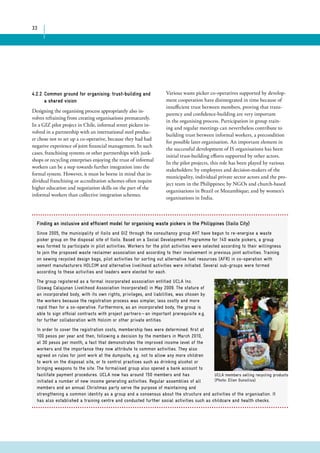
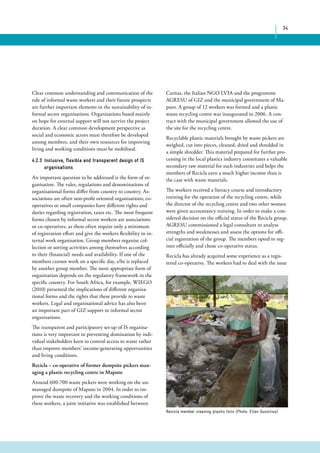
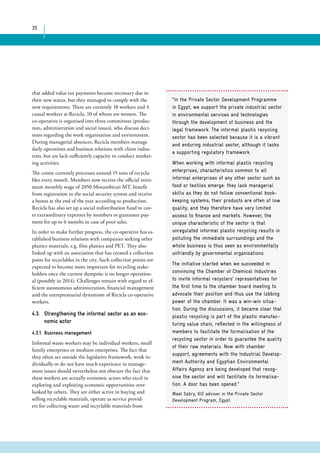
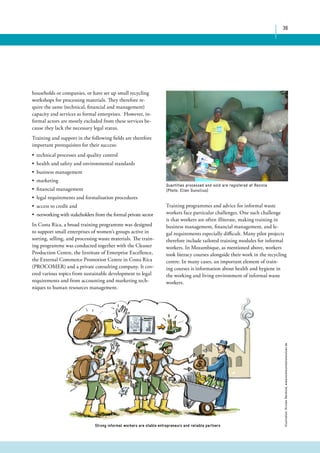
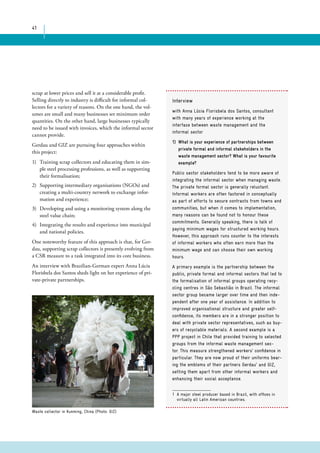
Integrating the informal sector into solid waste management
Imprint 
The Deutsche Gesellschaft für Internationale Zusammenarbeit (GIZ) GmbH was 
formed on 1 January 2011. It brings together the long-standing expertise of DED, 
GTZ and InWEnt. For further information, go to www.giz.de. 
Articles written by named authors do not necessarily reflect the views of the 
editors. 
Published by: 
Deutsche Gesellschaft für 
Internationale Zusammenarbeit (GIZ) GmbH 
Postfach 5180 
65726 Eschborn / Germany 
T +49 61 96 79-0 
F +49 61 96 79-11 15 
E info@giz.de 
I www.giz.de 
Sector Project Recycling Partnerships 
Responsible: 
Sandra Spies 
Authors: 
Ellen Gunsilius, Sandra Spies, Sofía García-Cortés, Martin Medina, Sonia Dias, Anne 
Scheinberg, Wael Sabry, Nader Abdel-Hady, Ana-Lucia Florisbela dos Santos, Silvio 
Ruiz. 
Editors: 
Ellen Gunsilius, Sandra Spies, Sofía García-Cortés 
Contact person at the Federal Ministry for Economic Cooperation and Development: 
Franz Marré 
Illustrations: 
© Kirsten Reinhold, www.kommunikationslotsen.de 
Photos: 
©GIZ Leslie Tuttle (cover), ©GIZ Enrico Fabian (back cover), ©GIZ 
Layout: 
Roger Krichbaum, GIZ 
Printed by: 
Aksoy Print, Eppelheim 
Eschborn, March 2011
i 
Contents 
List of Abbreviations ii 
Preface 1 
Executive Summary 2 
1 Introduction 4 
2 The informal sector in a modern, integrated, sustainable waste management system 5 
3 The informal sector – a driving force for recycling management 8 
3.1 Definition of the informal sector 8 
3.2 Working conditions of the informal sector 13 
3.2.1 Child labour 13 
3.2.2 Income 14 
3.2.3 Social aspects and stigmatisation 16 
3.2.4 Health and safety 17 
3.3 Importance and contributions of the informal sector 19 
3.3.1 Social benefits of integrating informal waste management activities 19 
3.3.2 Potential contributions to the resource economy 22 
3.3.3 Potential contributions to climate protection 24 
4 Integrating the informal sector: approaches, examples, impacts 25 
4.1 Policy making for the informal sector 25 
4.1.1 Action learning and scenario modelling 25 
4.1.2 Integration of IS in waste management planning 27 
4.1.3 Feeding pilot experiences into national policies and legislation 30 
4.2 Strengthening the organisational capacities of the informal sector 30 
4.2.1 Benefits of organisation 32 
4.2.2 Common ground for organising: trust-building and a shared vision 33 
4.2.3 Inclusive, flexible and transparent design of IS organisations 34 
4.3. Strengthening the informal sector as an economic actor 35 
4.3.1. Business management 35 
4.3.2 Diversification of activities and technical specialisation 37 
4.3.3. Formalisation 38 
4.4 Partnerships between the informal and formal private sectors 39 
4.5. Some recommendations for measures to integrate the informal waste sector 44 
5 Conclusions and Outlook 45 
References 47
ii 
List of Abbreviations 
AFR Alternative fuel resources 
ANR Asociación Nacional de Recicladores Colombia 
ARB Asociación de Recicladores de Bogotá 
ASMARE Waste pickers’ association of Belo Horizonte 
BMZ Bundesministerium für wirtschaftliche Zusammenarbeit und Entwicklung 
(Federal Ministry for Economic Cooperation and Development) 
CSD Commission on Sustainable Development 
CSR Corporate social responsibility 
CWG Collaborative Working Group on Solid Waste Management in Low and Middle Income Countries 
EU European Union 
EWA E-Waste Agency India 
GHG Greenhouse Gas 
GIZ Deutsche Gesellschaft für Internationale Zusammenarbeit 
GTZ Deutsche Gesellschaft für Technische Zusammenarbeit 
ILO International Labour Organization 
IS Informal Sector 
ISP Informal service providers 
IWS Informal waste sector 
ILO International Labour Organization 
JICA Japan International Cooperation Agency 
KfW Kreditanstalt für Wiederaufbau (German Financial Cooperation) 
KKPKP Kagad Kach Patra Kashtakari Panchayat (waste picker union in Pune) 
LAPWN Latin American and Caribbean Network of Waste Pickers 
MBO Membership-based organisation 
MDGs Millennium Development Goals 
MNCR National Movement of Waste Pickers in Brazil 
NGO Non-governmental Organisation 
PNAD Brasilian National Household Sample Survey 
SWM Solid Waste Management 
SEWA Self-employed women’s association 
PFD Process Flow Diagram 
PNAD National Household Survey Brazil 
PROCOMER External Commerce Promotion Centre in Costa Rica 
RAIS Annual Listing of Social Information 
SIMA Small Industries Modernisation Association Egypt 
SME Small and Medium Enterprises 
UCLA Uswag Calahunan Livelihood Association, Iloilo 
UNEP Unites Nations Environment Program 
WARM Work Adjustment for Recycling and Managing Waste 
WIEGO Women in Informal Employment Globalising and Organising
1 
management system adapted to the conditions in low-and 
middle-income countries can thus not only contrib-ute 
to a green economy and to resource efficiency, but 
also to the achievement of the Millennium Development 
Goals (MDGs). 
The experiences presented in this report show that the in-tegration 
of informal workers in solid waste management 
systems is possible and that it can contribute significantly 
to development objectives. Therefore, it is important that 
the current and potential contribution of the informal 
workers be analysed in processes of reforming solid waste 
management systems. They should be taken into account 
in waste management planning, designing infrastructure 
and establishing partnerships for efficient waste manage-ment. 
German international cooperation’s experiences can 
offer helpful indications for approaches and measures that 
facilitate a successful and sustainable integration of infor-mal 
stakeholders in integrated solid waste management. 
Franz Marré 
Federal Ministry for Economic Cooperation and Devel-opment 
(BMZ) 
Head of Division 313: Water, Energy, Urban Develop-ment, 
Geo-Sector 
Preface 
The Solid Waste Management sector has recently been 
re-discovered from a resource management perspective. 
In times of decreasing availability and increasing prices 
for raw materials, the “anthropogenic resources” con-tained 
in waste, become economically interesting. Pri-vate 
enterprises increasingly see waste as a commodity 
to which they seek to secure access. In various countries, 
discussions about recovering resources from landfill sites 
and out-of-use buildings and equipment, also described 
as “urban mining”, have arisen. The approach to solid 
waste management in German development cooperation 
follows the lines of the “waste hierarchy”: reduce, reuse, 
recycle, recover energy and dispose of waste reflects the 
order of the priorities. This approach is an important el-ement 
of a more sustainable economy which is not pri-marily 
based on the exploitation of natural resources, but 
on an efficient use of resources and their recovery in the 
productive cycle. The recently published UNEP Green 
economy Report highlights solid waste management as 
one important sector on the way to a green economy. 
The informal waste sector, especially vibrant in low- and 
middle income countries, can teach us a lot about this 
perspective. It recovers much larger amounts than the 
formal sector. These actors, despite their marginalised 
position and their simple equipment, often recover up to 
one third of the waste in a self-financing way. However 
recycling rates are needed. One way to improve resource 
and energy efficiency in industrial production is the in-formal 
sector integration. But this sector can only devel-op 
its full potential for recovering resources from waste 
if it is recognised, integrated and supported to establish 
more efficient processes. 
Not only resource recovery, but also many other basic 
developmental goals can be served by establishing part-nerships 
with informal waste collectors and recyclers. 
By recovering more resources from waste and dispos-ing 
of less waste, environmental harm can be reduced. 
Improved equipment and processes can reduce health 
risks to which informal workers and also surrounding 
populations are exposed to. These workers often be-long 
to the poorest parts of the population. Organising 
and integrating the informal workers into existing solid 
waste management systems can secure employment and 
improve their income opportunities. A circular waste
2 
When the potential benefit of informal sector integration 
is recognised, the question arises how best to realise this 
integration. Chapter 4 presents approaches to informal 
sector integration based on GIZ pilot project’s experienc-es 
and other organisations’ activities. Municipalities, in-formal 
sector organisations and development cooperation 
organisations such as GIZ have acquired experiences dur-ing 
the past years about success factors for integration ap-proaches 
to make integration models sustainable. A mix 
of several approaches seems to be most promising. It com-prises 
first taking into account the informal waste sector 
in policy making and solid waste management planning. 
This can be facilitated by approaches such as action re-search 
establishing the impact of the informal sector and 
the development of scenarios about informal sector inte-gration, 
developing impact hypotheses on informal sector 
integration in planning processes and through an adapta-tion 
of infrastructure design as to make resource recovery 
through informal workers possible. GIZ pursued this ap-proach 
in successful projects in Mozambique, Costa Rica 
and the Philippines. 
Another important element for successful integration 
is the establishment of stable organisational structures. 
Co-operatives, small enterprises and networks in Brazil, 
India, and other countries show that the organisations 
were the first step to get informal workers out of social 
marginalisation, improved their economic efficiency and 
thus their position in the economic value chain and made 
partnerships with municipalities and other stakeholders 
possible. 
The focus on entrepreneurial spirit and strengthening the 
informal sector as an economic actor is a key topic for the 
support to the informal waste sector. Due to its low social 
status and low education, they need particular training 
and information, on health issues as well as management 
methods and technical expertise to upgrade their recovery 
activities and be able to conclude business contracts. But 
support activities should not be limited to improve the so-cial 
conditions of informal waste workers, but be aimed at 
establishing business activities that are economically via-ble 
over the longer term. This is important to prevent that 
informal workers’ co-operatives cease operation once the 
external support comes to an end. 
Executive Summary 
Informal stakeholders are active in solid waste collection 
and recovery all over the world, sometimes for centuries 
already. They work as waste collectors, collectors of recy-clable 
materials in the streets or as waste pickers on trans-fer 
stations and dumpsites. 
The present publication summarises the results of the 
GIZ Sector Project “Recycling Partnerships”, which ana-lysed 
the effects and integration potential of informal ac-tivities 
into solid waste management (SWM) on behalf of 
BMZ. After a short introduction, the role of the informal 
sector in a new, integrated solid waste management is de-scribed 
in chapter 2. 
Chapter 3 presents the activities, working conditions and 
significance of this sector. It is shown that informal waste 
workers often represent a significant portion of the urban 
population in low and middle-income countries and that 
they constitute an important element in the value chain 
of resources by recovering valuable materials from waste. 
Their work is characterised by low entry barriers, low or-ganisation 
levels, and irregular income situation. Working 
conditions are often bad, exposure to health risks is high, 
child labour is common, and there is a high vulnerability 
to unfair business relations due to the precarious income 
conditions of the workers. Informal actors are mostly not 
officially recognised or charged with solid waste manage-ment, 
and are often ignored or restricted by responsible 
authorities for solid waste management. 
The informal workers in SWM have a different vision of 
solid waste than formal service providers, as their primary 
interest is to recover valuable materials, and not to collect 
and dispose of waste to reduce health hazards and as a 
service. Therefore, informal actors contribute significantly 
to recovery and recycling of waste in a self-financing sys-tem. 
The integration of the informal sector into formal 
solid waste management systems can contribute to reduce 
overall system costs, to support the local industry by pro-viding 
low-cost materials and to create new jobs. On the 
other hand, it can reduce negative environmental and cli-mate 
impacts from solid waste management through im-proved 
resource recovery and reduced disposal. And final-ly, 
it can help to generate income and improve working 
conditions for poor populations who often do not have 
other economic opportunities.
3 
Finally, partnerships among the private sector, between 
formal and informal actors, become more and more im-portant. 
Many private enterprises perceive the opportu-nities 
stemming from the use of waste as a (material or 
energetic) resource and realise that they can benefit from 
partnerships with the informal sector in order to improve 
the value chains related to materials from waste. Some 
successful examples for a more organized resource recov-ery 
through informal stakeholders have been initiated 
by GIZ, for example the cement producer Holcim or the 
steel producer Gerdau. 
Chapter 5 draws a number of conclusions from these ex-periences, 
stressing the need for taking into account the 
informal waste sector at international, national and lo-cal 
level, as well as the potential contributions of partner-ships 
between public, formal private and informal private 
stakeholders for a green economy.
4 
1 Introduction 
Waste pickers, catadores, pepenadores, chiffonniers, 
récupérateurs, scavengers ... all these are names for 
people who make a living on waste in an informal 
way. Informal means that they have no contract, no 
regular income, rather simple equipment to work 
with, little recognition and high vulnerability. It is 
estimated that up to 2% of the urban population in 
low- and middle-income countries work in the in-formal 
waste sector. Informal workers in solid waste 
management (SWM) are often ignored or seen as 
hindrances to efficient waste management process-es. 
It is little known that these informal actors often 
contribute significantly to resource recovery and re-cycling 
of waste materials and can thus have a very 
positive impact on waste management systems, espe-cially 
in low and middle income countries. 
The present publication is the result of the GIZ Sec-tor 
Project “Recycling Partnerships”, carried out on 
behalf of BMZ, which analysed the effects and in-tegration 
potential of informal activities in SWM 
between October 2003 and March 2011. The sector 
project conducted studies and disseminated infor-mation 
about informal waste management activities, 
facilitated partnerships between stakeholders and 
supported pilot projects designed to integrate the in-formal 
sector. Experiences from countries that have a 
long history of informal sector involvement in waste 
management, like Brazil, India and Egypt have been 
analysed. In addition, the sector project supported 
pilot activities like trainings, the inclusion of infor-mal 
stakeholders in planning processing or the setup 
of new recycling activities. 
The publication aims to outline the role of the in-formal 
waste management and recycling sectors as 
well as successful approaches of integrating infor-mal 
workers into official solid waste management 
systems. 
The publication is a collaborative effort including 
contributions from various researchers and practi-tioners 
with particular expertise in informal waste 
management activities and presentations in which 
informal workers describe their experience and prior-ities. 
We thank all those who contributed their expe-riences 
and their expertise for this report. 
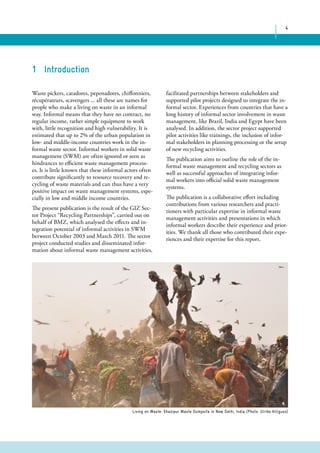
Living on Waste: Ghazipur Waste Dumpsite in New Delhi, India (Photo: Ulrike Killguss)
5 
2 The informal sector in a modern, integrated, sustainable waste 
management system 
The GIZ study on economic aspects of the informal sec-tor 
in 2006 and 2007 (Scheinberg, Simpson, Gupt et al., 
2010, see also chapter 3.2.2 and 4.1.1) set off a kind of 
global chain reaction on the need for ways to understand 
and benchmark waste management systems in low- and 
middle-income countries. The study was created in part 
to respond to the question: what is really the future of 
waste management in low- and middle-income countries? 
Is it only to strive to be a poor shadow or an imperfect 
copy of the system in place in the North? Or do we have 
a chance to really understand the strengths of the private 
informal and formal sector actors in these countries, and 
to analyse the unseen and poorly understood processes by 
which informal entrepreneurs actually keep their cities’ 
waste systems operating. 
In most developed countries the origin of the recycling 
industry is to some extent related to the origins of solid 
waste management (see, for example, Melosi 1981). Ur-banisation 
in the 19th century provided livelihoods for 
rag-pickers, night soil and ash collectors, and other urban 
gleaners, who could remove unhealthy waste materials 
and commercialise them by selling them into the grow-ing 
industrial and agricultural value chains. In the late 
1800s, under the influence of political panic associated 
with large-scale cholera epidemics, this activity became 
increasingly focused on maintaining sanitary conditions, 
and solid waste management gained the public works fo-cus 
which it maintains to this day. 
This increasing professionalisation of solid waste man-agement 
in the 20th century resulted in separating the 
development of solid waste management systems from re-cycling 
activities (Strasser 1999, Wilson 2007). Environ-mental 
insights stimulated engineers in large European 
and North American cities to refine a range of new tech-nical 
approaches to disposal which moved the two disci-plines 
even further apart (Wilson 2007; Scheinberg, Wil-son 
and Rodic 2010). While for most of the 20th century 
recycling systems operated as part of the industrial sup-ply 
chain, they moved further and further away from the 
public service of waste management (Scheinberg, 2003; 
Gille, 2007; Weinberg, Pellow and Schnaiberg, 2007). 
The post-Earth Day discipline of environmental manage-ment 
and resource conservation stimulated a new solid 
waste modernisation process which began to bring the 
two disciplines back together. Resource conservation in 
particular served to turn the attention of waste manag-ers 
in the direction of recycling. Thus it can be said that 
modernisation of waste management represents a re-turn 
to an improved – and updated – version of an older 
paradigm. The waste systems which had evolved to have 
a single technical idea – remove waste from populated 
areas and dump it on or bury it in some unused or far-away 
ground – are shifting towards deconstructing waste 
streams and looking for appropriate intermediate or final 
destinations for all the different components, according 
to their sources, value, and physical nature (Scheinberg 
2003, Scheinberg, Wilson and Rodic 2010, Saarikoski 
2006). 
In developed countries the main public sector motivation 
for a renewed interest in recycling is its value for environ-mental 
protection and resource conservation. The further 
integration of recycling into municipal solid waste man-agement 
– often referred to as ‘Integrated Solid Waste 
Management’ – significantly raises the importance of 
keeping materials out of disposal and directing them to 
valorisation, that is, to diversion from disposal into the 
industrial value chain for reuse and recycling, and the ag-ricultural 
value chain for composting and related uses. In 
high-income countries, recycling increasingly has become 
not only a practical strategy in response to rising dispos-al 
costs and growing waste streams of increasing toxicity 
and complexity, but also a symbolic antidote to ‘over-con-sumption’ 
and the throw-away society (Pellow, Schnai-berg 
and Weinberg 2000). 
In low- and middle-income countries recycling can be 
distinguished from solid waste management in that it is 
not a service of cleaning or removal, but a largely private 
economic activity based on valorisation and trading, with 
strong direct links to the industrial sector and hundreds 
of years of history (Scheinberg 2003; Gille 2007; Melo-si 
1981; Strasser 1999). Specifically, private recycling has 
little or no relationship to the primary activity in waste 
By Anne Scheinberg, WASTE
6 
management (and sanitation), which is removing waste 
(or excreta, both ‘economic bads’) and minimising their 
nuisance, environmental or health impacts (Cointreau 
1989; Scheinberg, Wilson and Rodic 2010). 
In contrast, recycling in not-yet-modernised solid waste 
systems has the opposite goal: to extract any remaining 
economic or use value from the ‘economic goods’ that 
end up in the waste stream, to prevent their removal and 
disposal, and to ‘valorise’ or commercialise them through 
aggregating quantities, removing contamination, sorting 
by grade or type, storage, transport, and marketing. Re-cent 
research for UN-Habitat (Scheinberg, Wilson and 
Rodic 2010) suggests that informal recycling may already 
be recovering 15-35 percent of generated waste in cities 
in low-and middle-income countries (Scheinberg, Wilson 
and Rodic 2010)1. In these cities, recycling forms the live-lihood 
of hundreds, sometimes thousands of individual 
and family-based entrepreneurs, who form the base of the 
recycling supply chain pyramid (Chaturvedi 2008, IFC 
2008, Simpson-Hebert, Mitrovic and Zajic, 2005). 
1 Based on research in 20 high-, middle, and low-income coun-tries 
for UN-Habitat in 2010, and the six cities reported on 
in this study. The range is large and depends, among other 
things, on how cities divide the waste stream between house-hold 
(hh) waste, commercial and industrial waste; construc-tion 
and demolition waste; agricultural waste, and other 
streams. Moreover, cities measure amounts of waste at differ-ent 
points and in different ways; these percents follow the cit-ies’ 
own claims and ways of measuring. 
Over the past two decades we see a modernisation pro-cess 
entering urban centres in low- and middle-income 
countries, where practices and systems of integrated solid 
waste management common in Europe, Australia, North 
America, and Japan are introduced as global best prac-tice 
into the formal waste sector. Modernisation and its 
globally driven ideals make it more and more difficult for 
informal entrepreneurs to have access to waste materials 
that they can valorise and live from. The global commons 
into which the waste materials are disposed is shrinking. 
Cities in the process of modernisation assign rights to re-cyclables 
to their formal private sector partners as a way 
of offsetting the costs of operating their modern, over-priced 
waste systems. They look for ‘buyers’ for ‘their re-cyclables,’ 
not thinking that these recyclables are already 
claimed through the informal base of the pyramid that is 
the recycling value chain. 
In the informal sector study, Waste and its partners be-gan 
by modelling informal and formal systems sepa-rately, 
to begin to understand how formal waste systems 
driven by a modernisation agenda might interfere with 
and threaten the largely informal recycling systems in the 
urban centres in low and middle-income countries. They 
found, first of all, that separating informal and formal 
on the one hand, and waste and recycling on the other, is 
simply not possible. The systems cross each other in every 
possible way, and are so thoroughly interwoven that any 
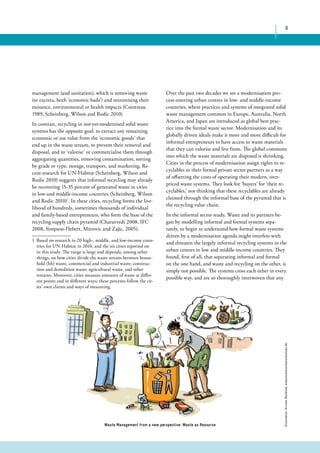
Waste Management from a new perspective: Waste as Resource 
Illustration: Kirsten Reinhold, www.kommunikationslotsen.de
7 
intervention anywhere in the system will affect all parts 
of it. Solid waste management is not a set of unconnect-ed 
parts, it is a highly dynamic system with deep connec-tions 
between parts. 
Thus the introduction of EcoRom formal recycling in 
Cluj-Napoca, Romania, the only European city in the 
study, could have two or more results. Under EU pressure 
to reach recycling targets, EcoRom, a national agency, 
could seek to maximise revenues by bypassing the in-formal 
door to door system and reduce the quality and 
quantity of recyclable materials accessible to the informal 
community living in the slum called “Dallas.” At the oth-er 
end of the spectrum, it could co-operate with the infor-mal 
sector and support their activities, which maintains 
levels of recycling but does not improve the waste system 
nor does it put money into the municipality. What the 
study told them is that the first alternative, while it seems 
institutionally simpler, is actually quite shockingly expen-sive, 
because without broad public involvement in sepa-rating 
at the source, it captures only a small quantity of 
materials, making the cost per ton very high. In contrast, 
the informal systems cost little per ton, move quite a lot 
of materials, but fail to address issues of working condi-tions, 
child labour, and rent-seeking behaviour of private 
companies and the police who prey on informal entrepre-neurs. 
A truly modern way of thinking seeks above all to 
combine these two approaches, so that the experience and 
knowledge and efficiency of the informals contribute to 
the effectiveness and marketing access of the formal sys-tem. 
In low- and middle-income countries, this kind of 
hybrid “integration” approach has significant economic 
and social benefits. The ideal is a mixed, pluralistic com-bination 
of high- and low-technology treatment and col-lection, 
private, public, formal, and informal actors, and 
local and global practices. 
Analysing the paths of materials in process flow diagrams 
(PFD) reveals transactions and relations between different 
stakeholders, and relations between formal and informal 
systems. Information on mixing and parallelism are im-portant 
entry points for improvements. The Lusaka PFD 
shows that what appears to be a 30% loss of Lusaka’s 
waste (to be seen at the lower left part of the PFD) does 
not in fact leak into the environment, but is collected by 
informal service providers – most of whom bring it to the 
formal dumpsite at Chunga. Understanding this fact was 
“Words and labels can be important in 
governmental perceptions. For example, 
the PFD for Lusaka shifted the perception 
of key stakeholders. They changed from 
calling the ISPs in that city “illegal col-lectors” 
to “unregistered informal collec-tors”. 
This was reported to have played a 
role in shifting perceptions, and stimulat-ing 
informal recognition and more fa-vourable 
policies.” 
Scheinberg, Wilson, Gupt, 2010 Annex 6, Lusaka City Report, and 
the Addition Scenario Workbook 
a by-product of Lusaka’s participation in the study, and 
influenced the city’s attitude towards – and recognition of 
– the Lusaka informal service providers (ISPs). 
[...] Since the main period of field work in the study, sev-eral 
of the cities have contributed insights from the study 
to the national policies on the informal sector. Quezon 
City’s researchers at the Solid Waste Association of the 
Philippines pushed through a law requiring the integra-tion 
of informal recyclers in waste systems. The study 
contributed to informal integration initiatives and modi-fication 
of existing plans in favour of more integration 
and better protection of waste pickers in Lima, Peru, 
Pune, India and Lusaka, Zambia. After years of being 
ignored by their governorate, the Cairo Zabbaleen – in 
spite of the setbacks of privatisation in 2002 and the loss 
of their swine in 2008 – have achieved some measure of 
recognition, and are using opportunities to seize the lead 
in introducing source separation. As this publication went 
to press, the Zabbaleen seized the opportunity to become 
the clean-up crew for the ‘Egyptian Revolution’ in the 
Tahrir Square in Cairo – and also to educate their coun-trymen 
and women on source separation. 
There cannot be sustainable, fair, or even effective mod-ernisation 
of the waste management sector in South cities 
without the informal sector. While those who started the 
sector project suspected this, the informal study has now 
produced real information that backs this up.
8 
3 The informal sector – a driving force for recycling management 
3.1 Definition of the informal sector 
The Informal Waste Sector 
By Dr. Martin Medina, researcher specialised on the infor-mal 
waste sector 
Informal economic activity has been the focus of 
intense debate among scholars for nearly four 
decades. Hart (1973) is credited with coining the term 
‘informal’ referring to the income-generating activi-ties 
of the urban poor in Ghana. According to Hart, 
the distinction between formal and informal income 
opportunities relied essentially on that between wage 
earning and self-employment. However, subsequent 
studies conducted in several countries have shown 
that some workers are employed by informal 
businesses. Also, Hart did not offer criteria by which 
the self-employed in the informal sector can be 
distinguished from those in the formal sector (Davies, 
1979). 
Empirical studies have demonstrated the importance 
of the informal sector in the economies of developing 
countries. In the late 1990s, informal employment 
accounted for 48% of non-agricultural employment in 
North Africa, 51% in Latin America, 65% in Asia, and 
72% in sub-Saharan Africa. If agricultural employ-ment 
is included, the percentages rise, in India and 
many sub-Saharan African countries, beyond 90% 
(WIEGO, 2000). Economic crises have a direct impact 
on the informal economy: the urban informal employ-ment 
in Mexico declined slightly from 37.4% of the 
labor force in 1950 to 35.8% in 1980 as the country’s 
economy grew. However, in 1995, as a result of the 
economic crisis and the Mexican peso devaluation, 
informal sector occupations employed 18 million 
Mexicans, or 51% of the labor force. Thus, 50% or 
more of the urban working population in developing 
countries labors in the informal sector (Zúñiga, 2003). 
In the second half of the 1990s many scholars 
started to use the term “informal economy” instead of 
“informal sector” to refer to a broader concept that 
includes enterprises as well as employment in 
developing, transition, and advanced developed 
economies. 
The ILO defines informal waste workers as “individu-als 
or small and micro-enterprises that intervene in 
waste management without being registered and 
without being formally charged with providing waste 
management services.” The World Bank has estimated 
that up to 2% of the urban population in developing 
countries makes a living in the informal waste sector 
(IWS for short). Thus, the IWS provides an income to 
at least 15 million people worldwide. The IWS has an 
economic impact of several billion US $ a year 
(Medina, 2007). 
Main Activities 
The IWS includes the following categories of activi-ties 
related to solid wastes: 
1) Informal waste collection – In some areas, often 
low-income neighborhoods not served by municipal 
waste collection service, entrepreneurs provide 
this service. Informal collectors charge a pick up 
fee to residents. Collectors use pushcarts, donkey 
carts, horse carts and motorized vehicles to 
transport the waste. Sometimes collectors recover 
the recyclables in the waste and sell them for 
reuse or recycling. In some cities, informal waste 
collectors serve a significant part of the popula-tion. 
Male, capital of the Maldives, lacks municipal 
waste collection, and informal collectors provide 
this service to most of the population in the city. 
By combining waste collection and recovery of 
recyclables, people engaged in this can earn high 
incomes. In Ciudad Nezahualcoyotl, near Mexico 
City, informal collectors earn five times the 
minimum wage, which is more than factory 
workers (Medina, 2005). 
2) Informal recovery of recyclables – This is the most 
common activity in which people recover materials 
from waste for reuse or recycling. In English-speaking 
areas they are known as scavengers, 
waste pickers, rag pickers, salvagers, reclaimers, 
or other terms. Many other words are used to 
denote this activity, depending on the country and 
language. Recovery activities occur in any area
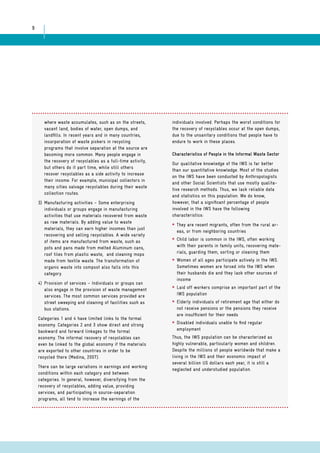
9 
where waste accumulates, such as on the streets, 
vacant land, bodies of water, open dumps, and 
landfills. In recent years and in many countries, 
incorporation of waste pickers in recycling 
programs that involve separation at the source are 
becoming more common. Many people engage in 
the recovery of recyclables as a full-time activity, 
but others do it part time, while still others 
recover recyclables as a side activity to increase 
their income. For example, municipal collectors in 
many cities salvage recyclables during their waste 
collection routes. 
3) Manufacturing activities – Some enterprising 
individuals or groups engage in manufacturing 
activities that use materials recovered from waste 
as raw materials. By adding value to waste 
materials, they can earn higher incomes than just 
recovering and selling recyclables. A wide variety 
of items are manufactured from waste, such as 
pots and pans made from melted Aluminum cans, 
roof tiles from plastic waste, and cleaning mops 
made from textile waste. The transformation of 
organic waste into compost also falls into this 
category. 
4) Provision of services – Individuals or groups can 
also engage in the provision of waste management 
services. The most common services provided are 
street sweeping and cleaning of facilities such as 
bus stations. 
Categories 1 and 4 have limited links to the formal 
economy. Categories 2 and 3 show direct and strong 
backward and forward linkages to the formal 
economy. The informal recovery of recyclables can 
even be linked to the global economy if the materials 
are exported to other countries in order to be 
recycled there (Medina, 2007). 
There can be large variations in earnings and working 
conditions within each category and between 
categories. In general, however, diversifying from the 
recovery of recyclables, adding value, providing 
services, and participating in source-separation 
programs, all tend to increase the earnings of the 
individuals involved. Perhaps the worst conditions for 
the recovery of recyclables occur at the open dumps, 
due to the unsanitary conditions that people have to 
endure to work in these places. 
Characteristics of People in the Informal Waste Sector 
Our qualitative knowledge of the IWS is far better 
than our quantitative knowledge. Most of the studies 
on the IWS have been conducted by Anthropologists 
and other Social Scientists that use mostly qualita-tive 
research methods. Thus, we lack reliable data 
and statistics on this population. We do know, 
however, that a significant percentage of people 
involved in the IWS have the following 
characteristics: 
* They are recent migrants, often from the rural ar-eas, 
or from neighboring countries 
* Child labor is common in the IWS, often working 
with their parents in family units, recovering mate-rials, 
guarding them, sorting or cleaning them 
* Women of all ages participate actively in the IWS. 
Sometimes women are forced into the IWS when 
their husbands die and they lack other sources of 
income 
* Laid off workers comprise an important part of the 
IWS population 
* Elderly individuals of retirement age that either do 
not receive pensions or the pensions they receive 
are insufficient for their needs 
* Disabled individuals unable to find regular 
employment 
Thus, the IWS population can be characterized as 
highly vulnerable, particularly women and children. 
Despite the millions of people worldwide that make a 
living in the IWS and their economic impact of 
several billion US dollars each year, it is still a 
neglected and understudied population.
10 
The term “informal sector” is used here only in relation 
with activities which are connected to SWM. They are 
not formally charged with the provision of the services 
which they provide, and no contract exists between self-employed 
workers and enterprises of the informal sector 
and the local government. These enterprises are not reg-istered 
and they work without licenses. IS enterprises do 
not pay commercial, income or any other type of taxes 
and they do often not consider legislation on employment 
and environmental protection. 
Corresponding to the definition of ILO, the informal sec-tor 
shows the following basic characteristics: 
• Existence of no or very low entrance barriers; 
• use of local resources; 
• mainly family enterprises or self-employed individuals; 
• mainly small enterprises; 
• use of relatively labour-intensive and adapted, local 
technologies; 
• acquisition of required skills outside of the formal 
schooling system; 
• unregulated markets with high competition; 
• no access to (public) social security schemes and 
• low income and low level of organization (unions) 
These characteristics explain why, especially in the infor-mal 
waste management sector, the numbers of persons 
often grow significantly during economic crises. Low en-trance 
barriers make informal waste recovery seem to be 
one of the few possibilities when there are no other in-come 
opportunities for non-skilled workers. In Rosario in 
Argentina, for example, the number of informal workers 
rose by 10 during the economic crisis in 2001 (Spies, Flo-risbela 
dos Santos, Wehenpohl, 2005). 
According to the World Bank, informal activities can be 
divided into: 
1) Coping strategies (survival activities): casual/ tempo-rary 
jobs, unpaid jobs, multiple job holding; 
2) Unofficial earning strategies (illegality in business): (1) 
Unofficial business activities: tax evasion, avoidance of 
labor regulation and other government or institution-al 
regulations, no registration of the company; and (2) 
Underground activities: crime, corruption – activities 
not registered by statistical offices. 
This distinction is important as most of support activities, 
often motivated by social concerns, focus on the first cat-egory. 
But when the informal activities develop, unofficial 
businesses may become a more common interlocutor, and 
the cooperation may be more characterised by finding 
ways to formalise these businesses. On the other hand, 
the support of individuals pursuing coping strategies can 
lead to interference and conflicts with systems of crime 
and corruption. Organisations working with the informal 
waste sector thus have to clearly define their target group 
and strategies to reach this target group. 
The analysis of the IS in SWM and the formulation of 
promotion and integration policies require to define the 
boundaries of the SWM system. Use of recycled waste or 
feeding of recovered organic waste to pigs, are these ac-tivities 
part of the SWM system? There are no general-ly 
correct answers to these questions; the way of dealing 
with them and defining the boundaries of SWM system 
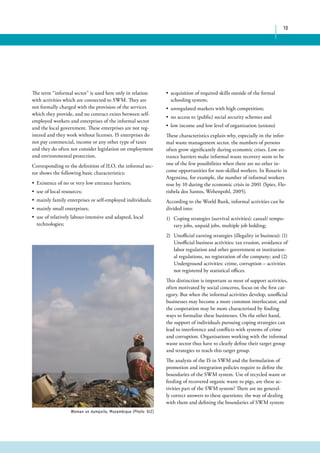
Woman on dumpsite, Mozambique (Photo: GIZ)
11 
depends on the objective of the analysis to be carried 
out and the policy to be formulated. Narrowly defined 
boundaries of the SWM system limit the results of the 
analysis by “cutting off” parts of the “value chain” of (sol-id) 
waste (Gerold, 2009). 
The focus is mainly on IS workers and enterprises which 
are directly involved in collecting, recycling and selling 
of solid waste, and the related organizations, as self-help 
organizations of the IS and NGOs. But in some of the 
projects presented here, pig feeding activities or the use 
of recycled inputs by companies are an important part of 
activities because these sectors are closely interlinked with 
the waste management system. 
In most studies, organisations of informal workers are 
also described as being part of the informal waste sector, 
although literally, a co-operative, association or compa-ny 
of former informal workers which is officially regis-tered 
and charged with waste management activities is no 
longer part of the informal sector. But in order to track 
the evolution of these groups and because in most cases, 
partnerships with informal actors do not stop with their 
official registration, these formalised groups will also be 
described in studies about the informal waste manage-ment 
sector. 
A big spectrum of persons is involved in the informal sec-tor 
of solid waste management, including men, women, 
children and elderly. In many cases they have a migrant 
background, belong to specific social groups or are from 
the surrounding rural areas. In India, for example, low-caste 
rural populations and Bangladeshi migrants came 
to Delhi and started to carry out activities in waste man-agement 
and sanitation (SNDT and Chintan, 2008). In 
Egypt, the informal workers traditionally assuring waste 
collection and recovery were Christian migrants from the 
rural South – the Zabbaleen (CID, 2008) These people 
are working and living under extremely difficult and haz-ardous 
conditions, and they are often threatened in their 
activity by public efforts to “modernize” waste manage-ment 
through mechanization and more effective waste 
collection and disposal (Gunsilius and Garcia Cortes, 
2010). 
Wastepicking and Recycling in Colombia 
By Silvio Ruiz, Coordinator of the Recyclers’ Association ARB 
(Asociación de Recicladores de Bogotá) 
In Colombia, the activities of recycling started around 
the 1930’s, due to internal political, economical and 
social problems. Since then, the population has been 
constantly exposed to war and violence. Originally, 
the reason of the conflict was to try to solve the 
problem of distribution of wealth. The violence 
originated the forced displacement from rural to 
urban areas. 
These persons arrived to the cities with their children 
and their animals; without name or education, and the 
popular economy began. They started to watch out 
cars, to work in different homes and to look for food 
and shelter in the dumpsites. Recyclers in big cities 
like Bogota are former peasants and therefore the 
life in the city breaks their whole economical 
rationality. They used to get food from the soil and 
barter trade was their main way of paying for other 
things. 
At the same time, the consumption patterns in the 
city caused the generation of new kinds of wastes, 
which started being a problem. The only solution was 
to gather it and make it disappear by throwing it into 
rivers at the limits of the city. New uncontrolled 
dumpsites started to grow and offered an opportunity 
to the displaced population. They started to search 
and collect slaughter wastes, from which they could 
recover some food. They also started collecting cloths 
and metal plates to build their houses. 
It was the demand of apothecaries and the pharma-ceutical 
branch which initiated the recycling activi-ties. 
Their need of small glass bottles for different 
medicines created an opportunity for wastepickers. 
From a survival activity, recycling became a commer-cial 
practice. The demand increased later with the 
development of the metal, paper and glass industries 
in the country. 
The presence of German industry activated the 
recycling of other materials in the 1940s and 1950s, 
more as a way of reducing costs as of reducing 
environmental impacts. Today, however, the environ-mental 
relevance of wastepickers and recyclers 
cannot be ignored.
12 
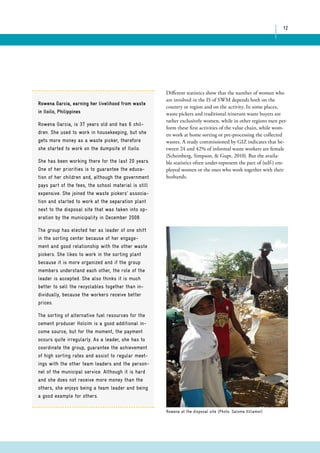
Rowena Garcia, earning her livelihood from waste 
in Iloilo, Philippines 
Rowena Garcia, is 37 years old and has 6 chil-dren. 
She used to work in housekeeping, but she 
gets more money as a waste picker, therefore 
she started to work on the dumpsite of Iloilo. 
She has been working there for the last 20 years. 
One of her priorities is to guarantee the educa-tion 
of her children and, although the government 
pays part of the fees, the school material is still 
expensive. She joined the waste pickers’ associa-tion 
and started to work at the separation plant 
next to the disposal site that was taken into op-eration 
by the municipality in December 2008. 
The group has elected her as leader of one shift 
in the sorting center because of her engage-ment 
and good relationship with the other waste 
pickers. She likes to work in the sorting plant 
because it is more organized and if the group 
members understand each other, the role of the 
leader is accepted. She also thinks it is much 
better to sell the recyclables together than in-dividually, 
because the workers receive better 
prices. 
The sorting of alternative fuel resources for the 
cement producer Holcim is a good additional in-come 
source, but for the moment, the payment 
occurs quite irregularly. As a leader, she has to 
coordinate the group, guarantee the achievement 
of high sorting rates and assist to regular meet-ings 
with the other team leaders and the person-nel 
of the municipal service. Although it is hard 
and she does not receive more money than the 
others, she enjoys being a team leader and being 
a good example for others. 
Different statistics show that the number of women who 
are involved in the IS of SWM depends both on the 
country or region and on the activity. In some places, 
waste pickers and traditional itinerant waste buyers are 
rather exclusively women, while in other regions men per-form 
these first activities of the value chain, while wom-en 
work at home sorting or pre-processing the collected 
wastes. A study commissioned by GIZ indicates that be-tween 
24 and 42% of informal waste workers are female 
(Scheinberg, Simpson, & Gupt, 2010). But the availa-ble 
statistics often under-represent the part of (self-) em-ployed 
women or the ones who work together with their 
husbands. 
Rowena at the disposal site (Photo: Salome Villamor)
13 
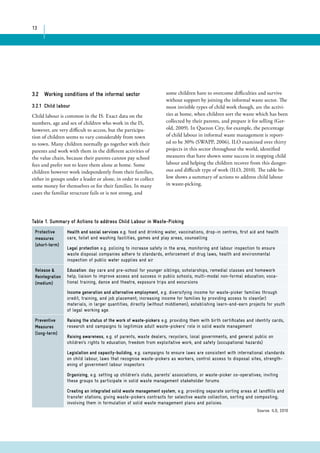
some children have to overcome difficulties and survive 
without support by joining the informal waste sector. The 
most invisible types of child work though, are the activi-ties 
at home, when children sort the waste which has been 
collected by their parents, and prepare it for selling (Ger-old, 
2009). In Quezon City, for example, the percentage 
of child labour in informal waste management is report-ed 
to be 30% (SWAPP, 2006). ILO examined over thirty 
projects in this sector throughout the world, identified 
measures that have shown some success in stopping child 
labour and helping the children recover from this danger-ous 
and difficult type of work (ILO, 2010). The table be-low 
shows a summary of actions to address child labour 
in waste-picking. 
3.2 Working conditions of the informal sector 
3.2.1 Child labour 
Child labour is common in the IS. Exact data on the 
numbers, age and sex of children who work in the IS, 
however, are very difficult to access, but the participa-tion 
of children seems to vary considerably from town 
to town. Many children normally go together with their 
parents and work with them in the different activities of 
the value chain, because their parents cannot pay school 
fees and prefer not to leave them alone at home. Some 
children however work independently from their families, 
either in groups under a leader or alone, in order to collect 
some money for themselves or for their families. In many 
cases the familiar structure fails or is not strong, and 
Protective 
measures 
(short-term) 
Health and social services e.g. food and drinking water, vaccinations, drop-in centres, first aid and health 
care, toilet and washing facilities, games and play areas, counselling 
Legal protection e.g. policing to increase safety in the area, monitoring and labour inspection to ensure 
waste disposal companies adhere to standards, enforcement of drug laws, health and environmental 
inspection of public water supplies and air 
Release & 
Reintegration 
(medium) 
Education: day care and pre-school for younger siblings; scholarships, remedial classes and homework 
help; liaison to improve access and success in public schools; multi-modal non-formal education; voca-tional 
training, dance and theatre, exposure trips and excursions 
Income generation and alternative employment, e.g. diversifying income for waste-picker families through 
credit, training, and job placement; increasing income for families by providing access to clean(er) 
materials, in larger quantities, directly (without middlemen); establishing learn-and-earn projects for youth 
of legal working age. 
Preventive 
Measures 
(long-term) 
Raising the status of the work of waste-pickers e.g. providing them with birth certificates and identity cards, 
research and campaigns to legitimize adult waste-pickers’ role in solid waste management 
Raising awareness, e.g. of parents, waste dealers, recyclers, local governments, and general public on 
children’s rights to education, freedom from exploitative work, and safety (occupational hazards) 
Legislation and capacity-building, e.g. campaigns to ensure laws are consistent with international standards 
on child labour, laws that recognise waste-pickers as workers, control access to disposal sites, strength-ening 
of government labour inspectors 
Organizing, e.g. setting up children’s clubs, parents’ associations, or waste-picker co-operatives; inviting 
these groups to participate in solid waste management stakeholder forums 
Creating an integrated solid waste management system, e.g. providing separate sorting areas at landfills and 
transfer stations; giving waste-pickers contracts for selective waste collection, sorting and composting; 
involving them in formulation of solid waste management plans and policies. 
Source: ILO, 2010 
Table 1. Summary of Actions to address Child Labour in Waste-Picking
14 
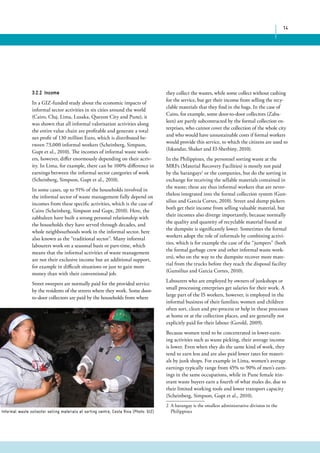
3.2.2 Income 
In a GIZ-funded study about the economic impacts of 
informal sector activities in six cities around the world 
(Cairo, Cluj, Lima, Lusaka, Quezon City and Pune), it 
was shown that all informal valorisation activities along 
the entire value chain are profitable and generate a total 
net profit of 130 million Euro, which is distributed be-tween 
73,000 informal workers (Scheinberg, Simpson, 
Gupt et al., 2010). The incomes of informal waste work-ers, 
however, differ enormously depending on their activ-ity. 
In Lima, for example, there can be 100% difference in 
earnings between the informal sector categories of work 
(Scheinberg, Simpson, Gupt et al., 2010). 
In some cases, up to 91% of the households involved in 
the informal sector of waste management fully depend on 
incomes from these specific activities, which is the case of 
Cairo (Scheinberg, Simpson and Gupt, 2010). Here, the 
zabbaleen have built a strong personal relationship with 
the households they have served through decades, and 
whole neighbourhoods work in the informal sector, here 
also known as the “traditional sector”. Many informal 
labourers work on a seasonal basis or part-time, which 
means that the informal activities of waste management 
are not their exclusive income but an additional support, 
for example in difficult situations or just to gain more 
money than with their conventional job. 
Street sweepers are normally paid for the provided service 
by the residents of the streets where they work. Some door-to- 
door collectors are paid by the households from where 
they collect the wastes, while some collect without cashing 
for the service, but get their income from selling the recy-clable 
materials that they find in the bags. In the case of 
Cairo, for example, some door-to-door collectors (Zaba-leen) 
are partly subcontracted by the formal collection en-terprises, 
who cannot cover the collection of the whole city 
and who would have unsustainable costs if formal workers 
would provide this service, to which the citizens are used to 
(Iskandar, Shaker and El-Sherbiny, 2010). 
In the Philippines, the personnel sorting waste at the 
MRFs (Material Recovery Facilities) is mostly not paid 
by the barangays2 or the companies, but do the sorting in 
exchange for receiving the sellable materials contained in 
the waste; these are thus informal workers that are never-theless 
integrated into the formal collection system (Gun-silius 
and Garcia Cortes, 2010). Street and dump pickers 
both get their income from selling valuable material, but 
their incomes also diverge importantly, because normally 
the quality and quantity of recyclable material found at 
the dumpsite is significantly lower. Sometimes the formal 
workers adopt the role of informals by combining activi-ties, 
which is for example the case of the “jumpers” (both 
the formal garbage crew and other informal waste work-ers), 
who on the way to the dumpsite recover more mate-rial 
from the trucks before they reach the disposal facility 
(Gunsilius and Garcia Cortes, 2010). 
Labourers who are employed by owners of junkshops or 
small processing enterprises get salaries for their work. A 
large part of the IS workers, however, is employed in the 
informal business of their families; women and children 
often sort, clean and pre-process or help in these processes 
at home or at the collection places, and are generally not 
explicitly paid for their labour (Gerold, 2009). 
Because women tend to be concentrated in lower-earn-ing 
activities such as waste picking, their average income 
is lower. Even when they do the same kind of work, they 
tend to earn less and are also paid lower rates for materi-als 
by junk shops. For example in Lima, women’s average 
earnings typically range from 45% to 90% of men’s earn-ings 
in the same occupations, while in Pune female itin-erant 
waste buyers earn a fourth of what males do, due to 
their limited working tools and lower transport capacity 
(Scheinberg, Simpson, Gupt et al., 2010). 
2 A barangay is the smallest administrative division in the 
Informal waste collector selling materials at sorting centre, Costa Rica (Photo: GIZ) Philippines
15 
Studying gender inequalities in the informal 
waste sector in Latin America 
By Dr. Anna Lúcia Florisbela dos Santos, Brazilian and Ger-man 
economist with focus on informal sector, waste and 
water management, training and gender in Africa and Latin 
America. Works in international development cooperation 
since 1987. Author of numerous publications. 
The general objective of a study undertaken by the 
Canadian International Development Research Centre 
(IDRC) in cooperation with GIZ is to reduce gender 
inequalities within the segment of the population 
that works in informal collection and classification 
of recyclable materials in cities of Latin America and 
the Caribbean. At the same time, it will attempt to 
demonstrate that the reduction of gender inequalities 
has a double positive impact: it reduces poverty and 
also improves local environmental management. 
The study began in July 2009 in the four Latin 
American cities of Lima, Cochabamba, São Paulo and 
Montevideo and is gathering information about 
income, social inequities, environmental improve-ments, 
cultural factors and the nature of women’s 
involvement in the area of municipal solid waste 
(MSW). This information will allow municipal 
governments to employ fundamental data in the 
design of policies, plans, programmes and various 
concrete sectoral measures and thus integrate 
gender policies into MSW management in the 
aforementioned cities. 
Identifying and analysing the best gender equity 
practices related to MSW in these Latin American 
cities permits to present basic elements and 
minimum measures that can be used to incorporate 
gender into MSW management strategies at the 
various action levels (federal, state, municipal and 
community). 
In the first of three phases, an analysis was carried 
out on the basis of secondary information, including 
general data on the population, its breakdown by 
sex, the generation and composition of domestic 
waste, and information on the organisational 
structure of waste management and processes such 
as collection, separation, final disposal, etc. Specific 
information on gender in the context of solid waste 
was not included. 
In the second phase, the emphasis was on conduct-ing 
and analysing in-depth interviews, group work 
with the interviewees and feedback from the 
evaluation and the interviews. An attempt was made 
to thoroughly understand the gender inequalities and 
their origins and to initiate cooperation between the 
cities. Information was obtained on the needs, 
interests, problems and expectations of the women 
involved in MSW management, and a regional report 
was drawn up on the problems that women in this 
sector confront.1 
The inequalities came to light when all the tasks 
involved in selective recovery in the informal sector 
were analysed. Generally, experts in the area of 
waste management attach little importance to the 
phase of thoroughly cleaning the material collected 
from the street. However, without this separation and 
cleaning, it is not possible to sell to the various 
waste buyers. This ‘invisible phase’ in the informal 
management of waste gives the activity a family 
character, because it is generally carried out at 
home with the participation of the entire family, 
including the children. The women are doubly 
invisible, as the importance of this work is neither 
understood nor valued because it is carried out at 
home. Our study revalues this step in the work of 
waste management in the informal sector and thus 
re-examines gender inequalities beyond those that 
are evident in urban low income families. 
The surveys yielded interesting results and, although 
the veracity of the information provided by inter-viewees 
may vary due to their feelings of shame, a 
general tendency is evident. The women tend to work 
more often in classification activities, although those 
who do not have a partner also work as collectors in 
the street. The economic situation of the women 
seems to be more precarious than that of the men, 
which is reflected, for example, in the fact that the 
women collectors in Lima have to work on foot 
1 Source: Acción-investigación e influencia en políticas: La 
dimensión de género en la gestión de residuos sólidos 
en las áreas urbanas y peri-urbanas de las ciudades de 
América Latina y el Caribe (Action research and policy 
guidelines: gender dimension in solid waste management 
in urban and periurban areas of Latin American and Car-ibbean 
cities); Funding IDRC 105183-001 (as of October 
6, 2010).
16 
because they do not have horse-drawn carts or 
motorised three-wheelers, as do most male collec-tors. 
The overwhelming majority of women have only 
a primary school education, and a few cases of 
illiteracy were observed. The women who indicated 
that they had worked in other fields previously said 
they had worked in other informal sector activities, 
mainly in domestic work; some indicated that they 
had always worked in material collection and 
classification. The majority expressed the desire to 
do something else in the future, although some saw 
no problem in continuing this activity. 
There are organised groups of recyclers and 
collectors in all the cities, among whom the 
percentage of female and male members is relatively 
balanced. In general, both men and women collect 
all the recyclable material they encounter; what they 
find most available is paper and cardboard combined 
with other materials. Few collectors specialise in 
only one material. Contrary to what is normally 
thought, it is not only the men who collect metal. It 
was not possible to obtain objective information from 
the men on the division of labour in the home. It 
would be interesting to directly survey the men 
about their experience and view of domestic work, 
instead of having only the interpretation of the 
women about the lack of assistance from the men. In 
Cochabamba, some discrimination against informal 
workers of Quechua or Aymara origin was observed, 
particularly against those who express their 
indigenous origin through typical clothing of their 
village, the majority of whom are women; many 
Quechua or Aymara men dress in western clothing. 
Environmental awareness does not appear to be an 
important issue for either men or women. 
The third phase is now being implemented and 
efforts are being made to study good gender equity 
practices related to urban solid waste management 
in each city, and to exchange information about 
experiences with these practices. It appears that the 
associative forms of organisation are the best 
practices with the greatest potential to improve 
working conditions in terms of security, hygiene and 
social insurance coverage; where these are not 
found, there is often a lack of trust in the commit-ments 
of others, the negotiations and the neighbours 
with respect to taking care of children and 
robberies.2 
2 (Preliminary) reflections of the Montevideo team. 
Compared to average salaries in industry and in the for-mal 
waste sector, the average income of informal workers 
shows different tendencies in different countries. The av-erage 
informal sector worker earns more than formal sec-tor 
workers in Cairo and Quezon City, and less in Pune, 
Lima, Lusaka, and Cluj. In all these cities, however, aver-age 
earnings in the informal waste sector are up to four 
times higher than salaries of unskilled labour in industry, 
which are normally lower than the wages of the formal 
waste sector (Scheinberg, Simpson, Gupt et al., 2010). 
This suggests that not all informal workers of this sec-tor 
belong to the poorest of society. If no exploitation oc-curs 
and these persons manage their work in an effective 
and organized way, this work can enable them to escape 
from poverty. Income from waste picking is sufficiently 
attractive for most of them to keep working in the sector 
despite very poor working conditions and health hazards 
(Price, Rivas and Lardinois, 1998). 
3.2.3 Social aspects and stigmatisation 
People involved in collecting, transporting and recycling 
of solid waste generally suffer a social stigma of being as-sociated 
with waste. Because their activities commonly 
affect their appearance, informal waste worker are often 
subjected to harassment from officials, exploited by trad-ers 
and are despised by the society. Their living and work-ing 
environments tend to overlap, which not only affects 
their health but also increases the disrespect and neglect 
from neighbours and enforces their exclusion. This seg-regation 
makes them weak and susceptible to exploita-tion 
from middlemen or corrupted policemen, they eas-ily 
end up in a dependent relationship with dealers from 
which they have to lend money, or are even persecuted by 
extremists who decide to abolish them in a violent way. 
They hardly find citizens who esteem and appreciate their 
work, or partners at the political and legal levels who de-fend 
their interests.
17 
They find no financial support at the bank because of 
their low and unstable income, while the solution of mi-crocredits 
is still not very common in this branch. Even 
when owning small informal enterprises, the owners are 
excluded from official support schemes for promotion of 
SME and they are not eligible for formal credits of banks 
or financing institutions (Gerold, 2009). The fluctuant 
and unstable prices of recyclable materials cause that their 
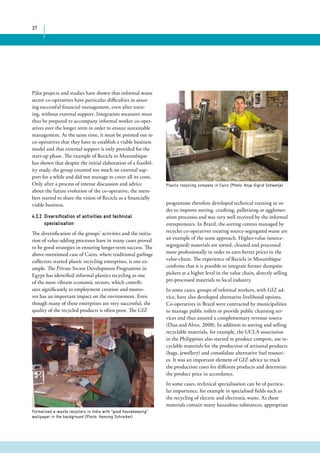
income is frequently threatened, especially in the case of 
wastepickers without storing facilities. On the other side, 
junkshop owners, dealers and middlemen are in general 
able to accumulate bigger quantities of material and sell 
it for a better price directly to the industry, while at the 
same time they can gather materials and wait until the 
prices are higher. 
Informality also influences the relationship between the 
owner of the enterprise and his/her workers. Labour laws 
and regulations are not observed. The number of em-ployed 
workers generally varies according to the season or 
the quantity of work; unskilled or low-skilled workers are 
often only employed on a daily basis (Gerold, 2009). 
3.2.4 Health and safety 
Informal jobs are not registered or protected by the state 
and therefore are informal workers normally excluded 
from the social security system and other benefits of for-mal 
contracting (Jütting & Laiglesia, 2009). At the same 
time, informal jobs are normally precarious and insecure; 
they take place in hazardous or unhealthy environments, 
and they are not covered at all by the formal health sys-tem. 
Because for most informal workers, especially in the 
waste management sector, this is the only available option 
for a financial income, they are willing to perform risky 
activities and renounce to use protective equipment due 
to the extra costs that they immediately cause, ignoring 
the possible costs that are avoided at the long term by pre-venting 
accidents, injuries and occupational diseases. 
The World Health Organisation (WHO) reports that 
formal workers involved in the waste management show 
higher injury rates than in industrial work. The situation 
for informal workers in developing and emerging coun-tries 
is evidently worse. While standards and norms for 
the formal solid waste management sector in industrial-ized 
countries have reduced occupational and environ-mental 
impacts significantly, the risk levels are still very 
high in most not-industrialized countries because of dif-ferent 
reasons (Cointreau, 2006). The composition of mu-nicipal 
waste, which is normally mixed and also contains 
hazardous wastes and faecal matter, the poor financial re-sources 
for better infrastructure and legal framework, and 
inadequate understanding of the magnitude of the prob-lem 
are some of these reasons. 
The risks to which they are exposed are related to the 
handling of wastes and containers, transport activities, 
operation of equipment and stress factors. Their work-ing 
environment is especially critical because it combines 
an unhygienic context and risks of accidents. Additional 
dangers for the informal sector appear because their living 
and working environments usually overlap. 
In the case of small-scale entrepreneurs of the waste man-agement 
sector, who normally have started as low-in-come 
independent waste workers and have grown until 
having their own small enterprise, the main reason that 
motivates them to consciously remain in the informal-ity 
is to save money by avoiding the payment of taxes, 
registration costs, public services and/or insurance fees. 
Because they have always been working under these con-ditions, 
they normally do not see the necessity of formal-izing 
their workers. Informal workers normally underesti-mate 
the dangerous character of the performed activities 
because they are familiar to them. Their health percep-tion 
is a subjective indicator linked to their few medical 
grievances. Without a doubt, medical examinations could 
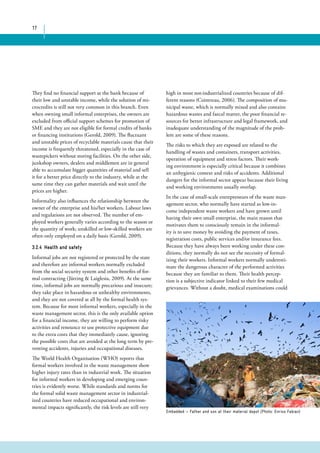
Embedded — Father and son at their material depot (Photo: Enrico Fabian)
18 
indicate the true health situation of each person. It can be 
assumed that the real situation is worse than perceived by 
the workers themselves. Additionally, the tendency to not 
recognize personal health problems could be explained by 
a sense of shame or fear of being criticized (ACEPESA, 
2010). 
In February 2010, ILO (International Labour Organiza-tion) 
and JICA (Japan International Cooperation Agency) 
developed and published the WARM (Work Adjustment 
for Recycling and Managing Waste) training manual to 
help improve the working conditions of workers of the 
waste sector, where safety and a healthy environment 
have to play a central role (Kawakami and Khai, 2010). 
Although it is focused on formal waste collectors and 
truck drivers in urban areas, the manual delivers good 
practices, approaches and improvements that can be 
likewise applied in most cases of informal work, when 
adapting some specific conditions. 
The most important success factors to improve the 
health and safety conditions of informal waste workers 
are presented below. 
1. Having direct contact to the informal workers: 
When trying to redesign working conditions is essential to interview informal workers and observe their 
working processes. With an active participation of at least some laborers, you can identify the real weak-nesses 
and risks that affect their working conditions and find applicable solutions. 
2. Promoting dialogue and cooperation between waste collectors and the community: 
Only when decision makers and the community understand the work this persons do and their importance for 
the society, their daily work will be lighten because of the support they will receive through better govern-ment 
policies towards occupational health and health insurances. A higher participation of the population, 
e.g. in sorting at the source also facilitates their activities, because the working time can be optimized and 
the dangerousness of the wastes decreases when they are not mixed with hazardous or dangerous residues. 
3. Learning from (local) good practices: 
Existing effective and safe systems should be stressed and optimized according to the local conditions. 
When applying good practice approaches from other regions, a previous analysis and adaptation process has 
to be done. Environmental, social, legal and economical conditions have a big influence of the success of 
solutions. An effective insurance system in one place might be a failure in another place if the legal frame-work 
is inconvenient. In the same way, a special kind of transport vehicle can bring advantages under 
specific weather conditions but disadvantages in other cases. 
4. Informing and training informal workers in health and safety issues: 
Because informal workers tend to underestimate the risks of their job and to not admit personal health 
problems, it is important to constantly inform them about the real risks and the importance of health 
checks, vaccines and protective equipment. Only if they are conscious and worried about their body, they will 
voluntarily apply the required measures. 
5. Implementing improvements in a stepwise manner: 
To start with simple, low-cost solutions motivates both informal workers and partners who provide the 
financial support to apply these solutions. If expensive solutions are planned at the beginning, it will be 
difficult to find the financial support and the informal workers will forget what they learned about the 
importance of safety and health; the motivation might decrease. After registering the first good results, 
planning and implementing more expensive and challenging solutions should be easier.
19 
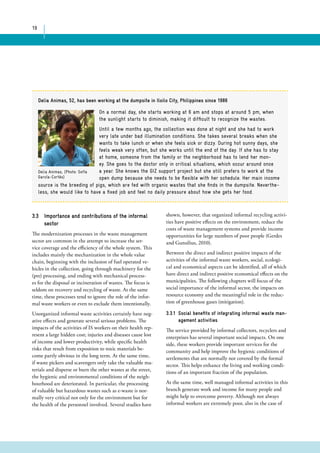
Delia Animas, 52, has been working at the dumpsite in Iloilo City, Philippines since 1986 
On a normal day, she starts working at 6 am and stops at around 5 pm, when 
the sunlight starts to diminish, making it difficult to recognize the wastes. 
Until a few months ago, the collection was done at night and she had to work 
very late under bad illumination conditions. She takes several breaks when she 
wants to take lunch or when she feels sick or dizzy. During hot sunny days, she 
feels weak very often, but she works until the end of the day. If she has to stay 
at home, someone from the family or the neighborhood has to lend her mon-ey. 
She goes to the doctor only in critical situations, which occur around once 
a year. She knows the GIZ support project but she still prefers to work at the 
open dump because she needs to be flexible with her schedule. Her main income 
Delia Animas, (Photo: Sofía 
García-Cortés) 
source is the breeding of pigs, which are fed with organic wastes that she finds in the dumpsite. Neverthe-less, 
she would like to have a fixed job and feel no daily pressure about how she gets her food. 
3.3 Importance and contributions of the informal 
sector 
The modernization processes in the waste management 
sector are common in the attempt to increase the ser-vice 
coverage and the efficiency of the whole system. This 
includes mainly the mechanization in the whole value 
chain, beginning with the inclusion of fuel operated ve-hicles 
in the collection, going through machinery for the 
(pre) processing, and ending with mechanical process-es 
for the disposal or incineration of wastes. The focus is 
seldom on recovery and recycling of waste. At the same 
time, these processes tend to ignore the role of the infor-mal 
waste workers or even to exclude them intentionally. 
Unorganized informal waste activities certainly have neg-ative 
effects and generate several serious problems. The 
impacts of the activities of IS workers on their health rep-resent 
a large hidden cost; injuries and diseases cause lost 
of income and lower productivity, while specific health 
risks that result from exposition to toxic materials be-come 
partly obvious in the long term. At the same time, 
if waste pickers and scavengers only take the valuable ma-terials 
and disperse or burn the other wastes at the street, 
the hygienic and environmental conditions of the neigh-bourhood 
are deteriorated. In particular, the processing 
of valuable but hazardous wastes such as e-waste is nor-mally 
very critical not only for the environment but for 
the health of the personnel involved. Several studies have 
shown, however, that organized informal recycling activi-ties 
have positive effects on the environment, reduce the 
costs of waste management systems and provide income 
opportunities for large numbers of poor people (Gerdes 
and Gunsilius, 2010). 
Between the direct and indirect positive impacts of the 
activities of the informal waste workers, social, ecologi-cal 
and economical aspects can be identified, all of which 
have direct and indirect positive economical effects on the 
municipalities. The following chapters will focus of the 
social importance of the informal sector, the impacts on 
resource economy and the meaningful role in the reduc-tion 
of greenhouse gases (mitigation). 
3.3.1 Social benefits of integrating informal waste man-agement 
activities 
The service provided by informal collectors, recyclers and 
enterprises has several important social impacts. On one 
side, these workers provide important services for the 
community and help improve the hygienic conditions of 
settlements that are normally not covered by the formal 
sector. This helps enhance the living and working condi-tions 
of an important fraction of the population. 
At the same time, well managed informal activities in this 
branch generate work and income for many people and 
might help to overcome poverty. Although not always 
informal workers are extremely poor, also in the case of
20 
Misconceptions about the Informal Waste Sector 
By Dr. Martin Medina 
Myth # 1: Informal recycling is a recent phenomenon 
Many people, including some specialists, think that 
informal recycling goes back only a few decades. In 
fact, it has existed for thousands of years. Our 
ancestors began to use and refine gold, copper and 
bronze when metallurgy first emerged, some 5,000 
years ago. They quickly realized that anything left 
over from the process—as well as old and broken 
objects—could be melted down and recycled to make 
new objects. People who specialize in recovering 
metals, not to mention other waste materials, such as 
glass, wood and paper, have been around for 
centuries. 
Myth # 2: All scavengers are indigent and extremely 
poor 
The way scavengers look and their daily contact with 
garbage leads society in general, as well as some 
academics, to believe that they are among the 
poorest members of society. It is true that scavengers 
sometimes have very low incomes, below poverty 
levels in many countries. However, this poverty tends 
to be caused by exploitation by middlemen and 
corrupt leaders. If scavengers are not exploited, they 
can earn several times the minimum wage, which 
enables them to escape from poverty. Microenterpris-es, 
co-operatives, and public and private associations 
have been successful in reducing poverty among 
scavengers. 
Myth # 3: Scavenging is a marginal activity 
Scavenging is often believed to be an activity 
relegated to society’s social and economic fringe. This 
is not true. Since scavengers first began to ply their 
trade, they have played a fundamental role in 
supplying raw materials for industry. In Latin 
America, scavengers have been essential to the 
development of the paper industry for more than four 
centuries. Mexico’s paper industry is trying to use as 
much waste paper and cardboard recovered by 
pepenadores (cardboard collectors) as possible in 
order to survive the international competition brought 
on by the country’s economic opening. 
Myth # 4: Scavenging is a disorganized activity 
It is true that many scavengers are often not 
affiliated with any particular organization. However, 
scavengers often specialize, and they even have 
systems of division of labor. In the streets, they 
sometimes establish territorial divisions. Scaven-gers 
also make agreements with local residents, 
stores and businesses, for example, that the latter 
sell or give away materials to certain scavengers 
and not to others. Garbage dumps and landfills are 
the most highly organized of all. Hundreds or even 
thousands of garbage-pickers may work there, and 
they tend to be organized in order to avoid conflicts 
and disorder. They have work shifts and supervisors, 
and each worker has a specialty. At some of these 
sites, scavenging resembles an industry. 
Myth # 5: Scavenging has a minimal economic impact 
This opinion is widely held but incorrect. We know 
relatively little about the financial impact of 
scavenging, but we do know that it has a large 
financial footprint than people acknowledge. In 
Brazil alone, scavenging has an annual economic 
impact of about US $3 billion. World Bank esti-mates 
suggest that more than 15 million people 
worldwide work as scavengers, which would put 
their economic impact at billions of dollars a year. 
Scavenging cuts down on imports of raw materials, 
which enables the country to save hard currency. 
The scavenger-recovered materials are often 
exported, thus generating hard currency. In Argenti-na, 
for example, the plastic used to make carbonat-ed 
beverage containers is exported to China, where 
it is recycled and transformed into new products. 
Myth # 6: Scavenging is a static activity 
Scavenging is actually highly dynamic. It is connect-ed 
to and depends directly on developments at the 
national and international level. Population growth 
and urbanization increase the production of 
consumer products and the resulting waste 
materials. The industries that produce these 
products require raw materials. Increased economic 
activity and international trade also boost the 
demand for the materials recovered by scavengers. 
The price of these materials depends on global 
supply and demand factors. In times of economic
21 
E-waste recycling (Photo: GIZ) 
crisis, scavenging tends to rise, as a result of 
unemployment and poverty. In Mexico, the 1994 peso 
devaluation and ensuing economic crisis led to a 
dramatic increase in scavenging. Similarly, Argenti-na’s 
devaluation and economic crisis during recent 
years have increased the number of cartoneros 
working on the streets of Buenos Aires and other 
cities. 
Myth # 7: Scavengers are a nuisance that must be 
eliminated 
Government authorities in most countries think that 
scavengers constitute a problem that must be 
eliminated. It is true that scavengers may cause some 
problems, such as opening bags of garbage and 
scattering their contents onto the streets. Working in 
garbage dumps presents serious health risks to 
scavengers. The authorities usually respond by 
making scavenging activities illegal and chasing down 
the offenders. In most cases, however, these repres-sive 
policies cut scavengers’ income and make their 
living conditions worse. If the authorities want to 
reduce poverty, they should not persecute scavengers. 
Myth # 8: Scavenging has no place in modern waste 
management systems 
As a result of the response described above, many 
officials believe that the solution to the solid waste 
problem is to adopt the kinds of advanced techniques 
used in developed countries. It is true that there is no 
role for scavengers to play in developed countries. 
But socioeconomic conditions in developed countries 
and developing ones are completely different. In many 
cases, it makes no sense for low-income countries to 
embrace the same waste management techniques 
used in Europe, Japan or the United States. Scaven-gers 
have a significant impact on garbage collection, 
decreasing the need for garbage trucks and sanitation 
workers, and lengthening the useful life of garbage 
dumps and sanitary landfills. In fact, it could be 
argued that when given proper support, scavenging 
offers a perfect example of sustainable development: 
it creates jobs, reduces poverty, prevents pollution, 
conserves natural resources, supplies low-cost raw 
materials to industry (thus making it more competi-tive) 
and protects the environment. 
informal entrepreneurs, the activities of recycling and re-tail 
of valuable materials draw concrete income opportu-nities 
for entire households and informally employed in-formal 
workers. 
Because the informal sector mainly works in the recov-ery 
and recycling of valuable materials and sometime 
in the collection service against tips and voluntary fees, 
their main income comes from the revenues of selling the 
materials. This causes that the net costs are significantly 
lower than the costs of the formal sector, which mainly 
provides the services of collection and disposal and has to 
finance its activities through fees and subventions from 
the municipality. The informal sector saves the formal au-thorities 
a great deal of money, mostly due to avoided col-lection 
and disposal costs (€14 million per year in Lima, 
€12 million in Cairo, and € 3.4 million in Quezon City) 
(Scheinberg, Simpson, Gupt et al., 2010).
22 
This concept suggests that the wastes and byproducts of a 
product or service over its life cycle should be introduced 
again to the production processes in order to close the 
loop. The new waste hierarchy proposed by the European 
Union (2008/98/EG) intends to harmonize with this con-cept 
and defines 5 levels: 
Indirect benefits brought by the informal sector are, for 
example, the decrease of associated health costs caused 
by water induced diseases and illnesses related to pollu-tion 
and rats or other vectors; or the savings related to the 
future clean-up of waste deposits and contaminated sites, 
which tends to be less problematic when organic and re-cyclable 
materials are sorted out before dumping. 
3.3.2 Potential contributions to the resource economy 
Through an increased recycling rate, the informal sec-tor 
helps reducing the depletion of raw materials, natu-ral 
resources and energy that otherwise would be used in 
the production of new products. The growing scarcity of 
primary resources, and therefore their increasing prices, 
means that the use of waste as a recyclable material holds 
considerable economic and ecological potential. These 
high and unstable prices constrain political and economi-cal 
stakeholders to look for possibilities in improving the 
efficiency of resource use. In this context, the optimi-zation 
of the relation between raw material (input) and 
products (output), as well as the reduction of byproducts 
play an important role. Higher material and energy ef-ficiencies 
mean improvements in the competitiveness of 
enterprises and national economies, for which the concept 
of circular economy delivers good solutions. By introduc-ing 
closed-loop waste-management systems, waste can be 
avoided, the quantity of waste in landfills reduced and 
secondary resources returned to the production cycle. In-directly, 
this helps avoid GHG emissions (GTZ, 2008). 
Submerged in resources from waste, Egypt (Photo: Nour El Refai) 
Graph: GIZ 
Waste Volume 
The German international cooperation communicates 
these tested concepts in the partner countries and tries to 
adapt them, together with the partners, to the specific lo-cal 
situation. A mix of technology transfer, access to infor-mation, 
financing, trainings of personnel and development 
of institutional capacities should be implemented, without 
trying to replace well-functioning existing systems. 
Recycling lowers the rate of depletion of natural resourc-es, 
reduces resource and extraction impacts of industri-al 
activities and the land area which is required for waste 
disposal. The use of compost replaces chemical fertilizers. 
The substitution of new by recycled materials decreases the 
energy consumption of the production processes. This ap-plies 
to both formal and informal sector, whenever they 
recover and recycle materials. 
Recycling activities in developing and emerging coun-tries, 
however, tend to be completely or to greater part 
done by the informal sector. This sector achieves high re-covery 
rates (up to 80%) because the revenues they get 
directly from selling the materials are vital for the liveli-hoods 
of the people involved. Consequently a huge variety 
Desirability 
Reduce 
Reuse 
Recycling 
Energy Recovery 
Disposal
23 
of recyclables is segregated and can be further processed 
in accordance with new demands and technological ad-vancements 
in the recycling industries (Gerdes and Gun-silius 
2010). 
Cairo, Cluj, Lima, Pune and Quezon City show a larg-er 
share of material recovery done by the informal sec-tor 
than corresponding formal activities (Scheinberg, 
Simpson, Gupt et al., 2010). In Cairo, the formal sector 
only recovers and recycles part of the organic fraction 
by producing compost, while the recyclable non-organic 
materials are either transported to the disposal sites or 
sold to informal groups dedicated to sort and recycle. In 
Pune, the formal sector does not recover or recycle at all. 
Lima shows a very intensive informal recycling activity 
compared to the formal sector, whose recycling rate is al-most 
negligible. In contrast, Lusaka has very low recy-cling 
percentages in both sectors, being however, the for-mal 
sector twice as effective (Scheinberg, Simpson, Gupt 
et al., 2010). The reported recovery rates can be seen in 
the next table. 
Table 2. Comparison of material recovery by formal and informal sector in six different cities 
Formal sector Informal sector 
City Tonnes Percent of total Tonnes Percent of total 
Cairo 433,200 13% 979,400 30% 
Cluj 8,900 5% 14,600 8% 
Lima 9,400 0.3% 529,400 19% 
Lusaka 12,000 4% 5,400 2% 
Pune - 0% 117,900 22% 
Quezon City 15,600 2% 141,800 23% 
Source: Scheinberg, Simpson, Gupt et al., 2010 
The informal sector contributes significantly to resource efficiency 
as well as to environmental and climate protection 
Illustration: Kirsten Reinhold, www.kommunikationslotsen.de
24 
3.3.3 Potential contributions to climate protection 
The reintroduction of materials into the production chain 
causes a direct reduction in the emission of pollutants gen-erated 
during the processes of extraction and production. 
Furthermore, by reducing the quantity of wastes that end 
up in the dumpsites and landfills, an important dispos-al 
volume is saved and the lifetime of the site is extended, 
while less greenhouse gases (GHG) are emitted due to the 
lower content of organic material. Model calculations show 
that GHG emissions in low- and middle-income countries 
could be reduced by 10-15% by establishing sustainable 
SWM systems (Ökoinstitut and IFEU, 2010). In this way 
developing and industrialising countries could make a con-siderable 
contribution to environmental protection at low 
specific costs. 
The highest quantity of waste in developing and newly in-dustrializing 
countries is disposed in dumpsites and land-fills. 
The decomposition of the organic material within the 
waste leads to the emission of a gas mainly composed of 
methane (50-70 Vol.%) and CO2 (30-50 Vol.%). Meth-ane 
is of special concern since its warming effect in the at-mosphere 
is 23 times stronger than that of carbon dioxide. 
Another big quantity of wastes is scattered and eventually 
buried. Although scattered waste produces significantly less 
GHG because the presence of Oxygen, it contaminates the 
soil and poses health hazards to the population. Addition-ally, 
the common spontaneous or induced fires also con-tribute 
to the emission of pollutants in the air. 
However, emissions of the waste sector can be easily 
avoided. Landfill gas can be captured, treated and utilized 
to produce energy; organic matter can be transformed 
into biogas and/or compost through biodigestion or com-posting 
processes; and recyclables can be transformed 
into secondary raw material at a lower energy demand 
and thus reduce energy consumption and use of primary 
resources. 
The high recovery rates of the informal sector contribute 
directly to emission reduction. The separation of organ-ic 
matter, which is normally used to feed animals or for 
composting causes a lower generation of landfill gas. The 
recyclable non-organics that they recover are reintroduced 
to the industrial processes and significantly reduce energy 
consumption and thus emissions during these production 
processes – e.g. in glass production by 35%, paper and 
steel by over 50%, plastics over 70% and aluminium by 
even more than 90%. 
The environmental impacts in terms of carbon footprint 
of informal and formal activities in 6 cities are shown in 
the next table. The emitted tonnes of GHG are shown as 
a positive value, while the saved emissions are shown as 
negative numbers (in parenthesis). The related monetised 
costs are shown in Euros per year using prices for carbon 
equivalent tonnes. 
Table 3. Comparison of carbon footprint by formal and informal sector in six cities 
Formal sector Informal sector 
City 
GHG 
(tonnes C02eq) 
Total net cost (benefit) 
of GHG emissions (€/y) 
GHG 
(tonnes C02eq) 
Total net cost (benefit) 
of GHG emissions (€/y) 
Cairo 1.689.200 16.244.800 -28.900 -277.500 
Cluj 103.600 1.295.300 -38.200 -478.000 
Lima 448.500 4.313.400 -496.700 -4.776.800 
Lusaka 25.800 247.700 57.700 554.600 
Pune 210.600 2.025.000 -295.000 -2.837.200 
Quezon City 472.800 4.546.700 -249.200 -2.397.000 
Source: Scheinberg, Simpson, Gupt et al., 2010
25 
4 Integrating the informal sector: approaches, examples, impacts 
The potential positive impacts of informal sector integra-tion 
show that measures to include this sector in waste 
management systems are necessary. Different levels and 
models of integration are possible and range from mere 
recognition of the informal workers by public authorities 
(e.g. provision of identity cards) to a complete formali-zation 
of actors as companies or co-operatives. When it 
comes to the question how to do this, several conditions 
have shown to be important for the successful implemen-tation. 
These are for example the attention paid to the 
activities of informal waste workers in public policies, 
regulations, and procedures, the organisation of informal 
actors, the technical and managerial capacity these work-ers 
have as economic actors, and the networks they es-tablish 
with formal companies and other institutions like 
providers of business or financing services. Pilot projects 
conducted by GIZ on behalf of BMZ, and by other or-ganisations 
show successful approaches and difficulties to 
take into account. 
4.1 Policy making for the informal sector 
Improving SWM systems can affect the IS positively or 
negatively. It can lead to the elaboration and implemen-tation 
of strategies which finally threaten or improve the 
income generating activities that IS workers traditionally 
carried out. Strategies for improving SWM systems, how-ever, 
can also support the integration of the IS in the (for-mal) 
municipal SWM system and formally charge infor-mal 
actors with SWM activities. 
As the main characteristic of the informal waste sector is 
its “invisibility”, one major element of strengthening in-formal 
sector integration consists of raising awareness of 
political decision-makers for the work and the possible 
contributions of the informal sector for an appropriate 
waste management system, as well as for the important 
aspects to consider when integrating them. Experience, 
especially from India and Brazil, clearly shows that the 
constitution of adequate legal structures and the process 
of informal sector integration go hand in hand. The adap-tation 
of laws, regulations and bylaws at federal, state and 
municipal levels to the requirements of a successful inte-gration 
process paves the way for further developments 
(Gerdes and Gunsilius, 2010). In advice to Solid Waste Man-agement, 
the experiences of informal waste management 
activities can be fed into policy processes in several ways: 
4.1.1 Action learning and scenario modelling 
Action learning has been one way of making the work of 
informal waste workers known to decision-makers. Simi-larly 
to the recognition of informal recyclers as a profes-sion 
and inclusion in official statistics described below, 
action learning initiatives can improve the information 
available about the sector. In addition, they serve to initi-ate 
an exchange with decision-makers about the potential 
benefits of integrating these workers. The elaboration of 
scenarios is an efficient instrument for analyzing the im-portance 
of IS activities for the functioning and improve-ment 
of the SWM system and can be used for making 
municipalities aware of the usefulness of the IS. 
The GIZ-funded study about the economic impacts of 
informal sector activities analysed the quantities of waste 
handled by informal and formal stakeholders, their inter-linkages 
and the specific costs of their operations (Schein-berg, 
Simpson, Gupt et al., 2010). In five of the six cit-ies, 
the activity of the informal sector resulted in a much 
higher recycling rate at a much lower cost than the activi-ties 
of the formal sector. This experience served for estab-lishing 
a better knowledge about the activities of the in-formal 
sector, their scope as well as their economic, social 
and environmental impacts. Municipal decision-makers 
have been involved in the development of scenarios ana-lyzing 
the economic impacts of restricting informal waste 
management activities or integrating informal stakehold-ers 
into the solid waste management system. The study 
shows that already the process of analyzing different sce-narios 
together with advocates of the informal sector and 
municipal decision makers can have an important impact 
on the way these decision-makers conceive and consider 
the work of informal waste workers. 
In the Philippines, the data on Quezon City from the 
study were a major starting point for and a data basis in 
the elaboration of a national framework for the integra-tion 
of the informal sector, supported by UNEP (Solid 
Waste Management Association of the Philippines, 2009). 
The National Solid Waste Management Commission that 
is currently elaborating the National Solid Waste Man-agement 
Strategy has been very active in the elaboration 
of this framework and demonstrates a vivid interest in 
good experiences from pilot projects to implement suc-cessful 
approaches.
26 
Recognition of Waste Picking as a Profession in 
Brazil and Its Impacts 
By Sonia Dias, sector specialist at Women in Informal Em-ployment 
Globalizing and Organizing (WIEGO), active in the 
waste management field in Brazil since 1985 with a focus 
on promoting the integration of social inclusion aspects into 
the technical planning of waste collection and recycling. 
For years, one of the main demands of the National 
Movement of Waste Pickers (MNCR) in Brazil was to 
have the activity of collection of recyclables recog-nized 
as a profession. In 2002 the Brazilian Govern-ment 
responded to this demand and the work of 
waste pickers, known in the country as catadores, 
was identified as a specific category in the Brazilian 
Classification of Occupations. In this classification, an 
informal collector of recyclables is called catador de 
material reciclável (collector of recyclables) and its 
job description is: someone who might collect 
recyclables in streets or at disposal sites, work as 
waste sorter and/or other related activities either in 
co-operatives or junk shops. 
This development made statistics on waste-pickers in 
Brazil available for the first time ever. As a result, 
national databases now include data on waste 
pickers: specifically, the National Household Sample 
Survey (PNAD) which provides socio-economical data 
on waste pickers both in formal and in informal 
employment1 and the Annual Listing of Social 
Information (RAIS) which provides data on waste 
pickers formally employed by commercial 
establishments. 
These databases include statistics on the distribution 
of waste pickers by federal units, sex, age, schooling, 
income etc. The data from the 2006 round of the 
PNAD (Crivellari,Dias and Pena, 2008), for instance, 
1 The distinction of formal and informal in Brazil is di-rectly 
linked to a body of legislation called CLT that con-tains 
rules for fair labour relations, which includes, work 
hours, minimum wage and other rights. Formal workers 
are those who are employed through a contract regis-tered 
in a specific document called carteira de trabal-ho 
(CT). Informal work under Brazil’s definition would be 
workers without a CT plus own account workers and un-paid 
workers. With the inclusion of waste picking as pro-fession 
this meant that waste pickers can be formally 
employed by commercial establishments. 
show a total of 229,568 waste pickers2 in the 
country: 67% were men, 33% were women 10% were 
children (10-16 years of age). The largest concentra-tion 
of waste-pickers is in the state of São Paulo. 
The 2006 round of the RAIS, found 11,781 waste 
pickers with contracts: 80% were men and 20% were 
women. Data also show that men earn much more 
than women in all age groups. In age groups with 
higher earnings, those receiving between 3 and 4 
times the minimum wage, 98 per cent are men and 
only 2 per cent are women. 
Analysis of these new data, show the segmentation 
within the occupational category of waste picking. 
One type of waste-picking that has emerged in 
recent years is a waste picker with a contract. Such 
workers are mainly in junk yards or in the metallur-gic 
industrial sector. Two additional types make a 
living picking recyclables on the streets or in waste 
dumps: 1. the non-organized or autonomous waste 
pickers disconnected from representative organiza-tions 
who sells waste to junk shops; and 2. those 
who are “organized” and work through co-operatives 
and associations. 
In sum, the inclusion of a special category for waste 
picking in the Brazilian Classification of Occupations 
(CBO) enables the identification of these workers in 
the basic sources of employment data in the country, 
as well as information on their earnings and 
employment and socio-economic characteristics. The 
new data together with their wider availability in 
official databases provides for the better design of 
policies towards integrating waste pickers in the 
national poverty reduction strategy. Inclusion in 
official statistics is a key sign of the greater 
visibility and recognition waste pickers have 
achieved in Brazil. 
2 This number contrasts with guestmates of the MNCR 
of 800,000 waste pickers. The 2010 Census will for the 
first time be able to record information on waste pickers 
which will be useful to complement PNADs.
27 
In the process in Romania, the action learning exercise 
did not result in a more integrative strategy of the munici-pality, 
but in a partnership with the formal private waste 
management service provider who established a partner-ship 
with informal waste pickers on the landfill in Piatra 
Neamt in the North-east of the country. 
4.1.2 Integration of IS in waste management planning 
In view of its integration in the formal SWM-system, 
the IS has to be considered already in waste management 
planning. The process of elaboration of a solid waste man-agement 
plan is a particularly good opportunity for con-sidering 
the role of the informal sector for several reasons: 
• For the elaboration, the current situation in all aspects 
of the waste management system is analysed, thus the 
interlinkages between formal and informal activities 
can be made visible. 
• For the waste management plan, an overarching vision 
and strategy is elaborated. On this occasion, the poten-tials 
of strengthening recycling systems and the signifi-cance 
of informal stakeholders in recycling manage-ment 
can be analysed in detail. 
• Planning processes are often participatory where mul-tiple 
stakeholders participate in consultation processes 
and the formulation of strategic orientations. This is an 
opportunity for stakeholders that had before been ig-nored 
to make themselves heard and be recognized as 
an important stakeholder. 
• In some planning processes, environmental or poverty 
impact assessments (PIA) are conducted, according to 
national regulation of donor requirements. Elements of 
this methodology approved by OECD DAC are useful 
Worker in Brazilian co-operative ASMARE (Photo: Sonia Dias) 
to analyse the impacts of waste management strategies 
on poor informal workers. GIZ elaborated impact hy-potheses 
for waste management plans on the informal 
sector within this methodology that could be a helpful tool. 
Integration of IS representatives in municipal waste man-agement 
planning processes has been pursued in several 
solid waste management programs on the local and the 
national level supported by GIZ and other organizations: 
Some hypotheses about impacts of SWM policies on 
the informal sector that should be considered in SWM 
planning 
* Privatisation and mechanisation of waste collec-tion 
as well as payment by disposed quantity may 
reduce access of the informal sector to waste and 
therefore destroy many employment opportunities 
in the informal sector. 
* The interdiction of waste recovery can raise the 
burden on poor waste pickers through fines and 
bribes that have to be paid to officials. 
* A collection provider also involved in recovery pro-vides 
a more regular collection service because of 
its interest in using waste. 
* Recycling of waste may reduce production costs for 
local industries. 
* Organisation, formalisation and micro-finance for 
waste pickers and recyclers leads to more bal-anced 
incomes among organised waste workers. 
* Integration / acceptance of informal sector recy-cling 
creates/formalises many jobs (labour inten-sive 
sector). 
* Subsidies to informal recyclers can make social 
welfare payments needless and thus relieve public 
budgets. 
* Extended recycling makes more peri-urban land 
available through reduction of needed landfill 
space. 
* Regulating waste sorting / recycling by waste pick-ers 
can reduce local pollution. 
* Infrastructure facilitating waste sorting (separate 
collection, recycling centres, transfer stations with 
secured sorting space) reduces health risks for in-formal 
workers. 
Source: GTZ, 2009
28 
• The organisation of “waste and citizenship forums” 
held in Brazil following a UNICEF campaign on limit-ing 
child labour on open dumps: The forums were first 
organized at national level and then adopted on state 
and local level. Its principles were inspired in progres-sive 
policies in cities such as Belo Horizonte´s. They 
included waste picker representatives, representatives 
from government agencies, and NGOs. The involve-ment 
of the Prosecutor’s office incited many mayors to 
give priority to the issue of informal sector integration. 
The Ministry of the Environment and the Ministry of 
the Cities have included as a pre-condition for fund-ing 
in the solid waste field the compliance to the social 
criteria set out by the National Forum (Dias and Alves, 
2008). 
• In Costa Rica, GIZ advised the elaboration of the na-tional 
Solid Waste Management Strategy and, in par-allel, 
supported the formulation of municipal solid 
waste management plans. In discussions of the Na-tional 
commission in charge of elaborating the strat-egy, 
the integration of the informal sector was chosen 
as one of the priority areas and included in the national 
solid waste management strategy (Programa CYMA, 
2008). As Costa Rica projects to become a carbon-neu-tral 
economy, recycling and reduction of waste receive 
a particular attention. Approaches to facilitate small-scale 
recycling solutions can be one important element 
in a successful recycling approach. In the elaboration 
of municipal solid waste management plans in selected 
municipalities, the facilitation of recycling systems also 
received a particular importance. On the one hand, ex-change 
meetings with womens’ groups active in recy-cling 
were organized. On the other hand, tools to ana-lyse 
the economic feasibility of recycling activities were 
used to plan measures to extend recycling. The setup of 
buy-back, sorting and recycling centers managed by fe-male 
small enterprises was an important element and is 
currently prepared in several municipalities. 
• In the elaboration of a municipal master plan for solid 
waste management in Maputo, GIZ supported strate-gic 
planning and an analysis of the most appropriate 
system for the Mozambican capital. Informal service 
providers in peripheral areas were taken into account 
when designing a system based on private sector partici-pation. 
The analysis of different collection options with 
regards to flexibility, appropriateness to the physical 
STRATEGIC ACTION No. 22: Integrate the informal sector into Integrated Solid Waste Management 
OBJECTIVE 
Creation and training of micro-enterprises, formalisation of informal sector in solid waste management or support in other areas through 
public and private social programs 
INDICATOR Persons currently working in integrated solid waste management continue to have access to employment in the future. 
INTERMEDIATE RESULTS Completion Responsibility 
The informal sector and micro-enterprises are officially recognized in national and 
local policies 2010 Coordination Unit for the implementation of the Plan (UCIP). 
2010 Coordination Unit for the implementation of the Plan (UCIP) 
Micro-enterprises or co-operatives are created and work as solid waste managers. 2010 UCIP 
PROPYME and state banks finance sorting centres and micro-enterprise projects; 
a system of micro-credits is established. 
2010 UCIP, Ministry of Economy, Industry and Commerce 
Continuous training for micro-enterprises in ISWM. 2010 UCIP, National training institute 
The micro-enterprises have organised (e.g. in an association). 2012 UCIP 
KEY POINTS: 
* It is necessary to establish an inventory of the current situation of the informal sector in solid waste management and a registry of existing initiatives. 
* It is important that micro-enterprises and co-operatives not only work as managers in ISWM, but as an integral part of municipal SWM, integrating them 
in municipal plans and specific social programs to create the necessary productive linkages. 
* Specials public and private programs for the support of innovative activities of micro-enterprises exist (e.g. recycling) 
* Alternative employment programs have to be created by public (Ministry of Employment) and private institutions (churches, Foundations, associations, 
trade associations etc.). 
Source: Programa CYMA, 2009 
Table 4: Strategic Action on Informal sector integration in National SWM strategy, Costa Rica
29 
Primary waste collector in Maputo suburb (Photo: GIZ) 
when new infrastructure is planned. Privatisation of 
waste collection or new operating mechanisms and 
rules for sanitary landfills can exclude informal workers 
from access to materials, and this can create conflicts 
and inefficiencies in the system. Therefore, GIZ and 
KfW Entwicklungsbank jointly elaborated a concept 
for taking into account more systematically the infor-mal 
sector in the preparation and implementation of 
projects supported by the financial cooperation. This 
includes, in the most favourable case, the recognition 
already during the strategic planning of the SWM sec-tor 
in the country, and complementary action by fi-nancial 
and technical co-operation. But also during a 
feasibility study for a sanitary landfill, number and im-portance 
of informal workers should be analysed and 
options for their integration into a new collection and 
disposal system should be developed. During imple-mentation, 
the financial cooperation can either con-duct 
an “accompanying measure” itself or coordinate 
with other actors as technical cooperation or NGOs 
to support the organisation and partnership of infor-mal 
SWM actors with the municipality. Adaptations 
to logistics and infrastructure could include collection 
systems where informal stakeholders can intervene in a 
controlled manner or are contracted by municipalities, 
and transfer stations or sorting stations at landfill sites 
that permit informal stakeholders to sort out materials 
safely or that are directly managed by them. 
characteristics of the quarters, efficiency and costs 
showed that non-mechanised primary collection would 
be the best solution in the suburban areas. The informal 
collectors were supported in registering and applying for 
the public tenders for collection zones. In addition, the 
master plan put a focus on improved recycling systems, 
including collaborating with a plastics processing center 
managed by an association of former dumpsite waste 
pickers. 
• Taking into account the informal sector is particular-ly 
important when a process of reorganizing the solid 
waste collection and disposal system is under way, and 
Illustration: Kirsten Reinhold, www.kommunikationslotsen.de 
Policy making for Solid Waste Management should include all relevant stakeholders
30 
4.1.3 Feeding pilot experiences into national policies and 
legislation 
Testing approaches and feeding in pilot experiences into na-tional 
policy making processes and legislation is a proven 
strategy in development cooperation in the solid waste sec-tor. 
In many cases, it needs good practices to prove to deci-sion- 
makers that an approach is viable. GIZ projects often 
work on several levels and combine pilot projects on the lo-cal 
level with accompanying the elaboration of public poli-cies 
and guidelines. This can facilitate the dissemination of 
new approaches on a national scale, as is happening in the 
management of electric and electronic waste in India: 
In India, pilot projects to support informal recyclers of elec-tric 
and electronic waste have been conducted. Studies on 
e-waste recycling showed that 95% of electronic waste was 
recycled by the informal sector, but that the formal and 
the informal recycling sector partly intervened in the same 
domains. The studies concluded that a division of labour 
might be more efficient. The informal stakeholders should 
assure collection and dismantling of devices, while recy-cling 
should be reserved to formal recyclers with appropriate 
equipment and processes. Informal dismantlers and recy-clers 
were brought in contact with formal recycling facilities 
to which they could provide pre-processed materials. On 
state level, an e-waste agency (EWA) was founded that re-groups 
informal and formal recyclers as well as government 
bodies. As the importance of the informal e-waste recy-cling 
sector in the value chain became obvious, measures to 
involve informal e-waste recyclers were integrated into the 
national Environment Policy and into national Guidelines 
for the sound management of e-waste (Ministry of Environ-ment, 
Central Pollution Control Board, 2008). The guide-line 
encourages the upgrading and formal recognition of 
the informal recycling units as they offer cost-efficient and 
labor-intensive dismantling and sorting of e-waste. In the 
national polices, it is thus stipulated that informal recyclers 
should be supported to formalize. 
Regarding municipal solid waste management, the state of 
Maharashtra in India has issued regulations facilitating the 
inclusion of informal waste workers, based on mobilization 
and projects for the inclusion of informal workers in Pune 
and Mumbai. Stipulations concern the issuing of identity 
cards to waste collectors and to contract waste picker organ-isations 
for waste collection (SNDT and Chintan, 2008). 
4.2 Strengthening the organisational capacities of 
the informal sector 
Strengthening Waste Picker Organisations 
By Sonia Dias, sector specialist for WIEGO–Women in Informal 
Employment Globalising and Organising 
Since the 1990’s, waste pickers in many Latin American 
countries have been actively organising themselves into 
local associations and/or co-operatives, federations, 
national co-operative movements and a network, as 
reported by many researchers (Dias, 2008; Fernandez, 
2008; Samson, 2009). The extent and depth of waste picker 
organisations varies across the LA countries as does the 
level of their integration into formal SWM systems. 
The first membership-based organisation (MBO) in the 
continent was founded in 1962 in Medellín, Colombia. 
However, it was only in the 1980s that co-operativism 
began to take shape there, with the NGO Fundación Social 
acting as catalyst. Brazil has seen an increase in the 
number of waste pickers organised into co-operatives and/ 
or associations since the late 1980’s, and this is reflected 
in the greater support these organisations have received 
from different levels of government and the private sector 
since 1990. NGOs linked to the Catholic Church began the 
process of organising waste pickers in the main capitals of 
the South and South-East regions. The commitment of 
NGOs to pastoral work with the urban poor was one of the 
main drivers for the formation of the first waste picker 
MBOs. In Brazil, socio-environmental concerns, such as 
upgrading existing systems and income generation for the 
poor, prompted municipalities to integrate waste pickers. 
Furthermore, under UNICEF’s leadership, a National Forum 
entitled Waste & Citizenship was launched and contributed 
to the visibility and integration of waste pickers within the 
country’s SWM sector. 
Measures in support of waste picker co-operatives/ 
associations across the country have been most compre-hensive 
in this region. These measures may be classified 
into three core dimensions (3Rs), as follows: 
1) Recognition through the policy framework adopted in 
Brazil towards associations and co-operatives includ-ing, 
amongst others, Law 11.107 passed in 2005, which 
entitles municipalities to conclude agreements with 
MBOs; Decree 5940 “Coleta Seletiva Solidária” passed in 
2006, which stipulates that all federal institutions must 
donate recyclables to waste picker organisations; and 
the National Policy of Solid Wastes, ratified in 2010, 
which makes inclusion of waste pickers in the reverse 
logistics system (related to the reuse of products)
31 
mandatory. To this end, fiscal and financial incentives 
must be made available for recycling industries and for 
the development of regional programmes in partnership 
with co-operatives/associations, in addition to financial 
support for the structuring of these organisations1. 
2) Representation through innovative forms, in order to 
increase the voice of MBOs. Participatory forums have 
been created and waste pickers have come together to 
form the National Movement of Waste Pickers - MNCR 
(Dias, 2006). Funds from government and non-govern-ment 
entities at different levels have been made 
available for capacity-building courses for waste picker 
organisations (Dias and Alves, 2008, Dias, 2009). 
3) Rights to redistribution through policies recognising 
waste pickers as legitimate actors and providing them 
with resources. Funds are being disbursed to the sector 
for recycling warehouse infrastructure and direct credit 
lines are being made available to co-operatives/ 
associations. Many social programmes targeting waste 
pickers have been created. 
The Brazilian integration scenario is a demonstrative model 
that has helped in the creation and strengthening of waste 
picker organisations in other Latin American countries and 
of the Latin American and Caribbean Network of Waste 
Pickers (LAPWN), consisting of 15 member countries. 
Colombia has also been an inspiration in the region. The 
organising process in this country goes back as far as 1962 
when the first co-operative was created in Medellín (Fernan-dez, 
2009). The 1990s saw the creation of the ARB (the 
association of recyclers of Bogota) and the ANR (national 
association of recyclers). 2009 saw a major breakthrough 
with waste pickers winning a legal battle guaranteeing rights 
to recyclables for the waste pickers of Cali2. 
A more recent development has taken place in Peru with 
the sanctioning by the Peruvian President, in June 2010, of 
Law 29.419, which was developed in conjunction with waste 
picker movement representative. It establishes a normative 
terrain for activity carried out by waste pickers and 
promotes capacity building and formalisation (via co-opera-tives) 
of informal workers. This is expected to strengthen 
waste picker organisations in the country. 
1 For an assessment of the legal framework focused on so-cial 
inclusion in Brazil and the newly approved National Policy, 
see “Overview of Legal Framework for Social Inclusion in Solid 
Waste Management in Brazil” at www.inclusivecities.org 
2 See CIVISOL note on this case on www.civisol.org 
Interactions between Latin American waste pickers date 
back to 1993 with the first international congress 
organised by the ARB in Colombia, in which representa-tives 
from Peru and Mexico took part. In 2003, the First 
Latin American Congress took place in Caxias do Sul, 
Brazil, and a number of events ensued in the following 
years. The networking initiated helped to showcase the 
experience of organisation and integration and served as 
an inspiration to nascent movements. 
Links between waste picker organisations/NGOs in Asia 
and Latin America were first forged in 2006 with the 
participation of NGO activists from Egypt and India at the 
Waste and Citizenship Festival in Belo Horizonte, with 
funding from the Collaborative Working Group (CWG) on 
Solid Waste Management in low and middle-income 
countries. In partnership with its waste picker member 
organisations, WIEGO facilitated the international 
networking of informal solid waste workers. With the help 
of the AVINA Foundation and CWG researchers and 
activists, links were forged between Latin American and 
Asian waste picker organisations. This interaction resulted 
in the joint organisation of the First World Conference and 
Third Latin American Conference of Waste Pickers, held in 
Bogotá, Colombia in March 2008 (Bonner, in Samson 2009). 
Since 2008, “… as part of a larger 5-year global project on 
Inclusive Cities, SEWA, the Latin American Movement of 
Waste Pickers, the trade union of waste pickers in Pune, 
India (KKPKP), AVINA and WIEGO embarked on a project to 
strengthen the organisation of waste pickers in Africa, 
Asia, and Latin America. A key component of this pro-gramme 
involved forming relations with waste pickers in 
Africa and Asia – regions that were underrepresented in 
Bogotá.” (Bonner, in Samson 2009). 
It is clear that there is a trend towards replacing 
repressive policies on waste picking with inclusive 
policies focused on legal backing, redistributive measures 
and social recognition of informal recycler organisations 
in various countries of the Latin American region. This in 
spite of the huge challenges that lie ahead in terms of 
consolidating of waste picker recognition. Strengthening 
the organisation and organisational capacity of waste 
pickers enhances their Voice, Visibility and Validity and 
improves their livelihoods, working conditions and status. 
Through such developments, waste pickers can contribute 
to building more robust and sustainable solid waste 
systems, the reduction of carbon emissions and a cleaner 
and healthier environment for everyone.
32 
Recicla: Recyclers’ cooperative in Maputo (Photo: AGRESU) 
Registered organisations are essential in terms of integrat-ing 
the IS into the (formal) SWM system. Such organisa-tions 
deal directly with municipalities. Municipalities gen-erally 
do not sign contracts and covenants with individual 
IS workers, but may be willing to enter into partnerships 
with their organisations, as these present a single and more 
reliable interlocutor than a multitude of informal and often 
unstable workers. In Brazil, for example, various co-oper-atives 
have concluded contracts or covenants with munici-pal 
governments for collecting the recyclable fraction, for 
sorting recyclables delivered to sorting centres by service 
providers, or for the provision of other waste management 
services (Dias and Alves, 2008). 
The above description of efforts to organise the informal 
waste sector in Latin America shows that organising and 
policy-making towards the recognition of informal activi-ties 
(described in Chapter 4.1) are closely linked. Informal 
worker organisations can press for more inclusive policy 
frameworks while political regulations favouring integra-tion 
and supporting informal stakeholders mostly apply 
to informal worker organisations rather than individual 
workers. Informal waste sector organisations take different 
forms, such as community-based organisations, co-oper-atives, 
associations, labour unions, etc. As informal waste 
workers are often marginalised, depend on a minimum 
daily income for their survival and thus have no safety net, 
the sector is often characterised by strong competition and 
mistrust between workers. Such mistrust must be overcome 
in the process of creating organisations. 
4.2.1 Benefits of organisation 
Forming an organisation and becoming a member of-fer 
a large number of advantages to IS actors. Member-ship 
in such an organisation allows the limitations and 
restrictions of individuals (low level of schooling, lack of 
experience in collaborating and negotiating with busi-ness 
partners and public authorities etc.) to be overcome. 
IS organisations offer their members opportunities to im-prove 
their working conditions, increase their income and 
access services such as health insurance and micro-cred-it. 
These organisations are also important instruments for 
exchange of experience, coordination and increased sector 
“visibility”. 
Informal workers often find their niches in exploiting ma-terials 
whose value has not yet become evident to formal 
stakeholders or which cannot be profitably exploited by 
these actors. As soon as the economic potential is recog-nised 
by formal actors, they will try to restrict informal sec-tor 
access to these materials. Informal workers can prepare 
themselves for this competition by forming organisations, 
and at the same time present themselves as reliable partners 
for other actors in a recycling economy. Organising allows 
the negotiating position of IS actors with other stakehold-ers 
in the value chain to be enhanced. Organisations can 
sensitise and inform municipalities and the general pub-lic 
about the importance and contribution of the IS to the 
cleanliness of cities and to conservation of the environment 
and thus improve the social status of informal workers. 
Important functions of IS organisations 
* Mobilisation and organisation of waste pickers and 
small junk dealers 
* Creating an identity for their members (“environment 
professionals”) 
* Support for their members in establishing networks 
and exchanging experience 
* Provision of services to members such as access to 
micro-credit, health insurance, training, opportunities 
to exchange experience 
* Sensitisation and information of public authorities 
(“the invisible sector becomes visible”) 
* Lobbying and representation of members’ interests 
* Official partners of municipalities for provision of ser-vices 
and collaboration (integration of IS) 
Source: Gerold, 2009
33 
4.2.2 Common ground for organising: trust-building and 
a shared vision 
Designing the organising process appropriately also in-volves 
refraining from creating organisations prematurely. 
In a GIZ pilot project in Chile, informal street pickers in-volved 
in a partnership with an international steel produc-er 
chose not to set up a co-operative, because they had had 
negative experience of joint financial management. In such 
cases, franchising systems or other partnerships with junk-shops 
or recycling enterprises enjoying the trust of informal 
workers can be a step towards further integration into the 
formal system. However, it must be borne in mind that in-dividual 
franchising or accreditation schemes often require 
higher education and negotiation skills on the part of the 
informal workers than collective integration schemes. 
Various waste picker co-operatives supported by develop-ment 
cooperation have disintegrated in time because of 
insufficient trust between members, proving that trans-parency 
and confidence-building are very important 
in the organising process. Participation in group train-ing 
and regular meetings can nevertheless contribute to 
building trust between informal workers, a precondition 
for possible later organisation. An important element in 
the successful development of IS organisations has been 
initial trust-building efforts supported by other actors. 
In the pilot projects, this role has been played by various 
stakeholders: by employees and decision-makers of the 
municipality, individual private sector actors and the pro-ject 
team in the Philippines; by NGOs and church-based 
organisations in Brazil or Mozambique; and by women’s 
organisations in India. 
Finding an inclusive and efficient model for organising waste pickers in the Philippines (Iloilo City) 
Since 2005, the municipality of Iloilo and GIZ through the consultancy group AHT have begun to re-energise a waste 
picker group on the disposal site of Iloilo. Based on a Social Development Programme for 140 waste pickers, a group 
was formed to participate in pilot activities. Workers for the pilot activities were selected according to their willingness 
to join the proposed waste reclaimer association and according to their involvement in previous joint activities. Training 
on sewing recycled design bags, pilot activities for sorting out alternative fuel resources (AFR) in co-operation with 
cement manufacturers HOLCIM and alternative livelihood activities were initiated. Several sub-groups were formed 
according to these activities and leaders were elected for each. 
The group registered as a formal incorporated association entitled UCLA Inc. 
(Uswag Calajunan Livelihood Association Incorporated) in May 2009. The stature of 
an incorporated body, with its own rights, privileges, and liabilities, was chosen by 
the workers because the registration process was simpler, less costly and more 
rapid than for a co-operative. Furthermore, as an incorporated body, the group is 
able to sign official contracts with project partners — an important prerequisite e.g. 
for further collaboration with Holcim or other private entities. 
In order to cover the registration costs, membership fees were determined: first at 
100 pesos per year and then, following a decision by the members in March 2010, 
at 30 pesos per month, a fact that demonstrates the improved income level of the 
workers and the importance they now attribute to common activities. They also 
agreed on rules for joint work at the dumpsite, e.g. not to allow any more children 
to work on the disposal site, or to control practices such as drinking alcohol or 
bringing weapons to the site. The formalised group also opened a bank account to 
facilitate payment procedures. UCLA now has around 150 members and has 
initiated a number of new income generating activities. Regular assemblies of all 
members and an annual Christmas party serve the purpose of maintaining and 
strengthening a common identity as a group and a consensus about the structure and activities of the organisation. It 
has also established a training centre and conducted further social activities such as childcare and health checks. 
UCLA members selling recycling products 
(Photo: Ellen Gunsilius)
34 
Caritas, the Italian NGO LVIA and the programme 
AGRESU of GIZ and the municipal government of Ma-puto. 
A group of 12 workers was formed and a plastic 
waste recycling centre was inaugurated in 2006. A con-tract 
with the municipal government allowed the use of 
the site for the recycling centre. 
Recyclable plastic materials brought by waste pickers are 
weighed, cut into pieces, cleaned, dried and shredded in 
a simple shredder. This material prepared for further pro-cessing 
in the local plastics industry constitutes a valuable 
secondary raw material for such industries and helps the 
members of Recicla earn a much higher income than is 
the case with waste materials. 
The workers received a literacy course and introductory 
training for the operation of the recycling centre, while 
the director of the recycling centre and two other women 
were given accountancy training. In order to make a con-sidered 
decision on the official status of the Recicla group, 
AGRESU commissioned a legal consultant to analyse 
strengths and weaknesses and assess the options for offi-cial 
registration of the group. The members opted to reg-ister 
officially and chose co-operative status. 
Recicla has already acquired some experience as a regis-tered 
co-operative. The workers had to deal with the issue 
Clear common understanding and communication of the 
role of informal waste workers and their future prospects 
are further important elements in the sustainability of in-formal 
sector organisations. Organisations based mainly 
on hope for external support will not survive the project 
duration. A clear common development perspective as 
social and economic actors must therefore be developed 
among members, and their own resources for improving 
living and working conditions must be mobilised. 
4.2.3 Inclusive, flexible and transparent design of IS 
organisations 
An important question to be addressed is the form of or-ganisation. 
The rules, regulations and denominations of 
organisational forms differ from country to country. As-sociations 
are often non-profit oriented organisations; co-operatives 
or small companies have different rights and 
duties regarding registration, taxes etc. The most frequent 
forms chosen by informal sector workers are associations 
or co-operatives, as these often require only a minimum 
of registration effort and give the workers flexibility in in-ternal 
work organisation. Group members organise col-lection 
or sorting activities among themselves according 
to their (financial) needs and availability. If one of the 
members cannot work on a specific day, s/he is replaced 
by another group member. The most appropriate form of 
organisation depends on the regulatory framework in the 
specific country. For South Africa, for example, WIEGO 
(2010) presented the implications of different organisa-tional 
forms and the rights that these provide to waste 
workers. Legal and organisational advice has also been 
an important part of GIZ support to informal sector 
organisations. 
The transparent and participatory set-up of IS organisa-tions 
is very important in preventing domination by indi-vidual 
stakeholders keen to control access to waste rather 
than improve members’ income-generating opportunities 
and living conditions. 
Recicla – co-operative of former dumpsite pickers man-aging 
a plastic recycling centre in Maputo 
Around 600-700 waste pickers were working on the un-managed 
dumpsite of Maputo in 2004. In order to im-prove 
the waste recovery and the working conditions of 
these workers, a joint initiative was established between 
Recicla member cleaning plastic foils (Photo: Ellen Gunsilius)
35 
“In the Private Sector Development Programme 
in Egypt, we support the private industrial sector 
in environmental services and technologies 
through the development of business and the 
legal framework. The informal plastic recycling 
sector has been selected because it is a vibrant 
and enduring industrial sector, although it lacks 
a supporting regulatory framework. 
When working with informal plastic recycling 
enterprises, characteristics common to all 
informal enterprises of any other sector such as 
food or textiles emerge: they lack managerial 
skills as they do not follow conventional book-keeping 
systems; their products are often of low 
quality; and they therefore have very limited 
access to finance and markets. However, the 
unique characteristic of the sector is that 
unregulated informal plastic recycling results in 
polluting the immediate surroundings and the 
whole business is thus seen as environmentally 
unfriendly by governmental organisations. 
The initiative started when we succeeded in 
convincing the Chamber of Chemical Industries 
to invite informal recyclers’ representatives for 
the first time to the chamber board meeting to 
advocate their position and thus use the lobbing 
power of the chamber. It was a win-win situa-tion. 
During the discussions, it became clear that 
plastic recycling is part of the plastic manufac-turing 
value chain, reflected in the willingness of 
members to facilitate the formalisation of the 
recycling sector in order to guarantee the quality 
of their raw materials. Now with chamber 
support, agreements with the Industrial Develop-ment 
Authority and Egyptian Environmental 
Affairs Agency are being developed that recog-nise 
the sector and will facilitate its formalisa-tion. 
A door has been opened.” 
Wael Sabry, GIZ advisor in the Private Sector 
Development Program, Egypt. 
that added value tax payments became necessary due to 
their new status, but they managed to comply with the 
new requirements. There are currently 18 workers and 4 
casual workers at Recicla, 10 of whom are women. The 
co-operative is organised into three committees (produc-tion, 
administration and social issues), who discuss deci-sions 
regarding the work organisation and environment. 
During managerial absences, Recicla members manage 
daily operations and business relations with client indus-tries, 
but are lack sufficiently capacity to conduct market-ing 
activities. 
The centre currently processes around 15 tons of recycla-bles 
every month. Members now receive the official mini-mum 
monthly wage of 2050 Mozambican MT, benefit 
from registration to the social security system and receive 
a bonus at the end of the year according to production. 
Recicla has also set up a social redistribution fund to cov-er 
extraordinary expenses by members or guarantee pay-ment 
for up to 6 months in case of poor sales. 
In order to make further progress, the co-operative has es-tablished 
business relations with companies seeking other 
plastics materials, e.g. film plastics and PET. They also 
linked up with an association that has created a collection 
point for recyclables in the city. Such collection points are 
expected to become more important for recycling stake-holders 
once the current dumpsite is no longer operation-al 
(possibly in 2014). Challenges remain with regard to ef-ficient 
autonomous administration, financial management 
and the entrepreneurial dynamism of Recicla co-operative 
workers. 
4.3. Strengthening the informal sector as an eco-nomic 
actor 
4.3.1. Business management 
Informal waste workers may be individual workers, small 
family enterprises or medium enterprises. The fact that 
they often act outside the legislative framework, work in-dividually 
or do not have much experience in manage-ment 
issues should nevertheless not obscure the fact that 
these workers are actually economic actors who excel in 
exploring and exploiting economic opportunities over-looked 
by others. They are either active in buying and 
selling recyclable materials, operate as service provid-ers 
for collecting waste and recyclable materials from
36 
Training programmes and advice for informal waste 
workers face particular challenges. One such challenge 
is that workers are often illiterate, making training in 
business management, financial management, and le-gal 
requirements especially difficult. Many pilot projects 
therefore include tailored training modules for informal 
workers. In Mozambique, as mentioned above, workers 
took literacy courses alongside their work in the recycling 
centre. In many cases, an important element of train-ing 
courses is information about health and hygiene in 
the working and living environment of informal waste 
workers. 
households or companies, or have set up small recycling 
workshops for processing materials. They therefore re-quire 
the same (technical, financial and management) 
capacity and services as formal enterprises. However, in-formal 
actors are mostly excluded from these services be-cause 
they lack the necessary legal status. 
Training and support in the following fields are therefore 
important prerequisites for their success: 
• technical processes and quality control 
• health and safety and environmental standards 
• business management 
• marketing 
• financial management 
• legal requirements and formalisation procedures 
• access to credit and 
• networking with stakeholders from the formal private sector 
In Costa Rica, a broad training programme was designed 
to support small enterprises of women’s groups active in 
sorting, selling, and processing waste materials. The train-ing 
programme was conducted together with the Cleaner 
Production Centre, the Institute of Enterprise Excellence, 
the External Commerce Promotion Centre in Costa Rica 
(PROCOMER) and a private consulting company. It cov-ered 
various topics from sustainable development to legal 
requirements and from accounting and marketing tech-niques 
to human resources management. 
Quantities processed and sold are registered at Recicla 
(Photo: Ellen Gunsilius) 
Illustration: Kirsten Reinhold, www.kommunikationslotsen.de 
Strong informal workers are stable entrepreneurs and reliable partners
37 
Pilot projects and studies have shown that informal waste 
sector co-operatives have particular difficulties in assur-ing 
successful financial management, even after train-ing, 
without external support. Integration measures must 
thus be prepared to accompany informal worker co-oper-atives 
over the longer term in order to ensure sustainable 
management. At the same time, it must be pointed out to 
co-operatives that they have to establish a viable business 
model and that external support is only provided for the 
start-up phase. The example of Recicla in Mozambique 
has shown that despite the initial elaboration of a feasibil-ity 
study, the group counted too much on external sup-port 
for a while and did not manage to cover all its costs. 
Only after a process of intense discussion and advice 
about the future evolution of the co-operative, the mem-bers 
started to share the vision of Recicla as a financially 
viable business. 
4.3.2 Diversification of activities and technical 
specialisation 
The diversification of the groups’ activities and the initia-tion 
of value-adding processes have in many cases proved 
to be good strategies in ensuring longer-term success. The 
above-mentioned case of Cairo, where traditional garbage 
collectors started plastic recycling enterprises, is one ex-ample. 
The Private Sector Development Programme in 
Egypt has identified informal plastics recycling as one 
of the most vibrant economic sectors, which contrib-utes 
significantly to employment creation and moreo-ver 
has an important impact on the environment. Even 
though many of these enterprises are very successful, the 
quality of the recycled products is often poor. The GIZ 
Plastic recycling company in Cairo (Photo: Anja-Sigrid Schwetje) 
Formalized e-waste recyclers in India with “good housekeeping” 
wallpaper in the background (Photo: Henning Schreiber) 
programme therefore developed technical training in or-der 
to improve sorting, crushing, palletising or agglomer-ation 
processes and was very well received by the informal 
entrepreneurs. In Brazil, the sorting centres managed by 
recycler co-operatives treating source-segregated waste are 
an example of the same approach. Higher-value (source-segregated) 
materials are sorted, cleaned and processed 
more professionally in order to earn better prices in the 
value-chain. The experience of Recicla in Mozambique 
confirms that it is possible to integrate former dumpsite 
pickers at a higher level in the value chain, directly selling 
pre-processed materials to local industry. 
In some cases, groups of informal workers, with GIZ ad-vice, 
have also developed alternative livelihood options. 
Co-operatives in Brazil were contracted by municipalities 
to manage public toilets or provide public cleansing ser-vices 
and thus assured a complementary revenue source 
(Dias and Alves, 2008). In addition to sorting and selling 
recyclable materials, for example, the UCLA association 
in the Philippines also started to produce compost, use re-cyclable 
materials for the production of artisanal products 
(bags, jewellery) and consolidate alternative fuel resourc-es. 
It was an important element of GIZ advice to track 
the production costs for different products and determine 
the product price in accordance. 
In some cases, technical specialisation can be of particu-lar 
importance, for example in specialised fields such as 
the recycling of electric and electronic waste. As these 
materials contain many hazardous substances, appropriate
38 
The GIZ programme working with informal e-waste recy-clers 
in India also supported formalisation processes, but 
in a different way. Dialogue with e-waste recyclers and 
authorities identified appropriate and safe infrastructure 
and equipment as an important prerequisite for an inte-gration 
model, which led to the merger of several small 
recycling workshops into a specialised company located 
in an industrial area. After a long process and much ad-vice 
on internal business management structure and for-malisation 
procedures, the company was finally founded 
in 2010. Six small dismantling workshops in Bangalore 
agreed to a new division of labour and joined together 
with other workshops to register a formal company. The 
new company E-WaRDD now has trained personnel and 
suitable equipment for the safe dismantling of electronic 
waste. It has established a business relationship with a for-mal 
e-waste recycler. The company is now treating 2 tons 
of e-waste daily in accordance with environmental stand-ards 
(Payattati, 2009). This model of registering formal 
e-waste recycler companies is currently being applied on a 
broader scale in other Indian cities. 
The professionalisation of informal entrepreneurs in busi-ness 
and financial management has involved systems that 
are small-scale and simple and should lead to the crea-tion 
of longer-term partnerships with local entrepreneurs, 
NGOs or universities in order to be sustainable. Oppor-tunities 
and examples for these kinds of partnerships are 
explored in the following chapter. 
processes in dismantling, recycling and elimination of re-siduals 
are key. A GIZ project supported informal recy-cling 
workshop training on electric and electronic health 
and environmental hazards. Simple management meas-ures 
of “good house-keeping” were implemented, increas-ing 
health and safety standards as well as environmental 
improvements; these measures are also often economically 
viable because they can reduce costs (Arlinghaus, 2007). 
Moreover, the training programme involved the introduc-tion 
of a certain division of labour, leaving toxic substance 
removal processes to specialised recyclers. 
This shows that some recycling activities require diversi-fication, 
while others may require specialisation; support-ers 
must therefore analyse the most sustainable business 
models in each case together with informal recyclers. The 
value chain approach is helpful in this undertaking. The 
Private Sector Development Programme in Egypt analysed 
the plastic recycling value chains In Cairo and Alexandria. 
The study shows that an approach to increase the rates of 
return is to expand the range of recycling processes a recy-cler 
performs, and it gives recommendations for the recy-cling 
of different plastic materials (Staffeld, 2010). 
4.3.3. Formalisation 
The Private Sector Development Programme in Egypt en-gaged 
in dialogue with informal recyclers on the advantag-es 
and obstacles to formalisation of their enterprises and 
initiated a process with local and national governments to 
facilitate their formalisation. First, the importance of the 
informal recycling sector for job creation was pointed out 
to the government. As the Egyptian government had just 
formulated ambitious job creation goals, the objective of 
formalising existing jobs in recycling was welcomed. The 
interests and concerns of the stakeholders involved (enter-prises 
and administration alike) and obstacles to formali-sation 
were analysed and discussed and the formalisation 
process was mapped and adapted. For example, different 
licenses were conceived for various kinds of recycling ac-tivities, 
so that not all recyclers needed to fulfil detailed 
requirements. The registration requirements were then 
communicated to informal enterprises. A setback was that 
public guarantees to refrain from sanctioning enterprises 
during the formalisation process were not respected. New 
efforts to re-establish relationships of trust between enter-prises 
and authorities therefore had to be instigated. 
Interview 
with Nader Abdel-Hady, Small Industries’ Modernisa-tion 
Association (SIMA), Egypt 
How did you get involved with the informal recycling 
sector? 
I started with a company active in shredding and 
recycling plastics and film materials. Later on, I 
turned to manufacturing, but as my suppliers were 
often informal recycling enterprises, I stayed in close 
cooperation with them. As the chamber of commerce 
and the chamber of industry do not represent the 
interests of small enterprises, I created the Small 
Industries Modernisation Association (SIMA) to give a
39 
4.4 Partnerships between the informal and formal 
private sectors 
Partnerships are a key element to working successfully 
– not only in the waste management industry, although 
working together with multiple stakeholders plays a spe-cial 
role in this sector. First of all, everyone has some in-teraction 
with waste. Everyone produces waste – at home 
or at work – and is thus a consumer or recipient of a ser-vice 
such as waste collection (albeit not everywhere). Then 
there are the major waste producers (industry, businesses 
or even institutions) and the private or municipal service 
providers that collect, transport or treat and dispose of 
this waste. Interest groups such as environmental NGOs 
also play a crucial role. As a result, a complex landscape of 
stakeholders exists in which not everyone shares the same 
interests. Partnerships between certain stakeholders are 
self-evident, while others are not so immediately appar-ent. 
If we look at partnerships between formal and infor-mal 
stakeholders, they tend to represent these less obvi-ous 
alliances. Intermediaries often operate in the middle, 
purchasing material from waste pickers and selling it on 
to industry – making a profit in the process. Why should 
an organised company acting in accordance with exist-ing 
rules work with small-scale informal groups that of-fer 
small volumes, use inefficient working methods and 
whose corporate structures are rather opaque? 
In spite of these reasons, there exist excellent examples of 
why both sides have good reason to work together. The 
growing integration of the informal sector over the past 
few years indicates that a paradigm shift is in progress. 
The next section includes both an interview with an inter-national 
expert and three models that highlight this shift. 
Providing alternative fuel resources to cement produc-tion, 
Iloilo City, Philippines 
The issue of informal sector workers was raised in con-nection 
with the aim of bringing the Calajunan dump 
(Iloilo City, Visayas, Philippines) into compliance with 
national law RA 9003. The legislation included a 25% 
reclamation target for recyclable materials, and the Japa-nese 
development agency JICA provided funding for a 
sorting plant, enabling some of these 300 waste pickers to 
be integrated into new operations. In addition to hand-made 
products made out of recycled materials, workers 
voice to these enterprises. We now comprise 20-30 
companies, and we cooperate with GIZ and other 
institutions in order to provide training, support for 
marketing or for securing financing, e.g. low interest 
rate loans for our member companies. It is not a 
condition to be formally registered in order to be a 
member, but advocating for and facilitating formalisa-tion 
is an important union goal. 
Do you see it as possible to formalise the informal 
recycling sector? If yes, what would this formalisation 
require? 
Small enterprises need to have a voice and to acquire 
rights by obtaining licenses etc. Informal companies 
sometimes cling to a “culture” of avoiding taxes, 
overheads costs associated with formal status, and 
social security payments. These objections are 
frequently based on misinformation about the 
regulatory framework. For example, taxes in Egypt 
are currently much lower than they were several 
years ago, so the negative impact of formalisation 
has decreased. Information and training on regulatory 
requirements are therefore very important, and 
should highlight the positive impact of formalisation: 
for example, that companies must be formalised in 
order to be suppliers of large companies, because 
these have to outline their supply chains in order to 
comply with ISO standards. Moreover, the formalisa-tion 
procedures should be simplified. 
What opportunities for co-operation do you see between 
informal and formal enterprises? 
Co-operation is not about ‘opportunities’, it is 
obligatory for all formal and informal companies 
because they are all part of the same value chain. 
They are already working together—only the official 
requirement to formalise in one way or another is 
getting stronger because of the factors I mentioned. I 
would also like to include more informal waste 
management businesses in our association because 
they are also part of the value chain, not only the 
recycling enterprises. We are in dialogue with the 
Environment Agency EEAA and the Department of 
Industry in an attempt to find solutions to the fact 
that waste management stakeholders are driven out 
of residential areas without viable alternatives.
40 
• GIZ would provide technical advisory services and 
make a financial contribution towards buying a ma-chine 
and holding workshops; 
• Holcim would pay the workers‘ wages and cover the 
cost of shipping the material to the cement plant on the 
island of Mindanao. 
All these agreements remained in effect until the new city 
government took office in May 2010. GIZ acted as a me-diator 
between the parties when the arrangements were 
revised. The agreement has since been modified again so 
as to integrate the newly registered firm established by the 
former waste collectors – UCLA (Uswag Calahunan Live-lihood 
Association), into the partnership and extend joint 
AFR extraction operations. Holcim guaranteed the pur-chase 
of 1,000 tonnes of AFR per year and the Iloilo city 
government committed to support UCLA‘s work, for in-stance 
by expanding sorting facilities, providing machin-ery 
and supplying sorting materials. 
Success factors: 
• Coordinating and cooperating with a variety of stake-holders 
(JICA, Iloilo City, Holcim, GIZ and UCLA), 
• Political will on the part of the city government, 
• A marketable strategy for the two private partners, 
UCLA and Holcim, 
• Test runs to estimate the potential volumes, thus yield-ing 
clear data and 
• Integrating suggestions for improvements put forward 
by UCLA. 
The informal sector as supplier of scrap metal for the 
steel producer Gerdau 
The Gerdau company, whose head office is in Brazil, 
signed a strategic alliance with GIZ in September 2009. 
This joint project aims to strengthen the organisation and 
entrepreneurship of groups working in the informal sector 
of the steel industry in selected Latin American countries. 
Other objectives include integrating these groups into the 
value chain systematically and profitably and under fair 
conditions, thus paving the way to formalisation of their 
status. 
At present, most scrap collectors sell their wares to inter-mediaries 
who fix prices. These intermediaries often buy 
UCLA members sorting AFR (Photo: Ellen Gunsilius) 
extracted alternative fuels and raw materials (AFR) from 
the waste stream and sent them to the firm Holcim for 
co-processing in its cement plant. A test run estimated 
the amount that could potentially be delivered. First and 
foremost, this AFR consisted of materials that were diffi-cult 
or impossible to recycle, such as lightweight packag-ing. 
The project began with 30 of the waste pickers who 
had formerly worked at the landfill, later increasing to 60 
workers. 
In addition to sorting out materials for co-processing, 
workers also extracted other marketable commodities to 
sell by themselves or together with colleagues in larg-er 
quantities. In 2009, they yielded around 17 tonnes of 
AFR each month. 
The first partnership agreement in 2009 between workers, 
the city government, Holcim and GIZ stipulated that: 
• The city government would cover the cost of transport-ing 
the AFR fraction from the sorting plant to the load-ing 
port in Iloilo;
41 
scrap at lower prices and sell it at a considerable profit. 
Selling directly to industry is difficult for informal col-lectors 
for a variety of reasons. On the one hand, the vol-umes 
are small and many businesses set minimum order 
quantities. On the other hand, large businesses typically 
need to be issued with invoices, which the informal sector 
cannot provide. 
Gerdau and GIZ are pursuing four approaches within 
this project: 
1) Training scrap collectors and educating them in sim-ple 
steel processing professions, as well as supporting 
their formalisation; 
2) Supporting intermediary organisations (NGOs) and 
creating a multi-country network to exchange infor-mation 
and experience; 
3) Developing and using a monitoring system along the 
steel value chain; 
4) Integrating the results and experience into municipal 
and national policies. 
One noteworthy feature of this approach is that, for Ger-dau, 
supporting scrap collectors is presently evolving from 
a CSR measure to a task integrated into its core business. 
An interview with Brazilian-German expert Anna Lúcia 
Florisbela dos Santos sheds light on her experience of pri-vate- 
private partnerships. 
Interview 
with Anna Lúcia Florisbela dos Santos, consultant 
with many years of experience working at the 
interface between waste management and the 
informal sector 
1) What is your experience of partnerships between 
private formal and informal stakeholders in the 
waste management sector? What is your favourite 
example? 
Public sector stakeholders tend to be more aware of 
integrating the informal sector when managing waste. 
The private formal sector is generally reluctant. 
Informal workers are often factored in conceptually 
as part of efforts to secure contracts from towns and 
communities, but when it comes to implementation, 
many reasons can be found not to honour these 
commitments. Generally speaking, there is talk of 
paying minimum wages for structured working hours. 
However, this approach runs counter to the interests 
of informal workers who often earn more than the 
minimum wage and can choose their own working 
hours. 
A primary example is the partnership between the 
public, private formal and informal sectors that led to 
the formalisation of informal groups operating recy-cling 
centres in São Sebastião in Brazil. The informal 
sector group became larger over time and then inde-pendent 
after one year of assistance. In addition to 
improved organisational structure and greater self-confidence, 
its members are in a stronger position to 
deal with private sector representatives, such as buy-ers 
of recyclable materials. A second example is a 
PPP project in Chile that provided training to selected 
groups from the informal waste management sec-tor. 
This measure strengthened workers’ confidence in 
particular. They are now proud of their uniforms bear-ing 
the emblems of their partners Gerdau1 and GIZ, 
setting them apart from other informal workers and 
enhancing their social acceptance. 
1 A major steel producer based in Brazil, with offices in 
virtually all Latin American countries. 
Waste collector in Kunming, China (Photo: GIZ)
42 
2) As an economist, why would you advise a company 
to work with informal workers? 
First, partnerships with informal workers can put 
corporate social responsibility (CSR) policies into 
action. 
Partnerships with informal workers can also yield 
benefits for companies’ core business. [...] The skills 
of informal workers can be useful and have dual 
benefits. Returning to the example of Gerdau, on the 
one hand, the partnership with GIZ allowed the com-pany 
to achieve its CSR objectives, such as help-ing 
to reduce poverty. On the other, it created a more 
stable business relationship between the steel group 
and the informal sector that provides the company 
with the raw materials it needs at fair conditions. 
Breaking down opposition can also motivate a com-pany 
to work together with the informal sector. 
Waste management contracts, for instance landfill 
operation agreements, often stipulate that a solu-tion 
is found for existing informal sector workers. By 
integrating these people, companies acquire work-ers 
skilled in waste management and simultaneous-ly 
reduce the potential for opposition to new landfill 
sites, which can incur significant additional costs if 
not resolved. 
3) In your experience, what are the greatest challeng-es 
in ensuring good partnerships? What are the 
factors for success? 
I understand good partnership to mean one that 
strives for sustainability as well as avoiding pater-nalistic 
action. [...] The informal sector must be in 
a position in which it can negotiate on equal terms 
with buyers or end customers as far as possible. In-formal 
workers need self-confidence for this to hap-pen, 
as they will be in a position to charge fair-er 
prices for their recyclable materials only if the 
informal sector becomes appealing enough for the 
formal sector, if they are the only group that can 
provide the quantities of secondary raw materi-als 
that the formal sector needs, for instance. [...] 
Selling recyclable materials together, in larger quan-tities, 
helps waste pickers to earn more. Howev-er, 
this presupposes that mutual trust exists among 
group members and that there is good organisation 
in place. 
In this case, it is important to be certain of support 
over an adequate period of time, for instance from 
local governments. [...] In my opinion, the factors for 
success are: 
* Eliminating paternalistic action; 
* Fair remuneration for recyclable materials; 
* Increased confidence among informal sector work-ers; 
and 
* Training courses, as these offer people greater op-portunities 
to find better sources of income both in 
the waste management sector and other areas. 
4) If you could change one thing to make it easier for 
the informal sector to work, what would it be? 
First, support for improving organisational struc-tures. 
Then preventing the weakest link in the waste man-agement 
chain, the informal sector, from bearing the 
brunt of a waste policy that aims at separate collec-tion 
for environmental motives. [...] Additional incen-tive 
schemes, such as lower fees, are necessary to 
motivate the public to sort recyclable materials in 
their homes. However, these lower revenues should 
not be offset at the expense of the informal sector, 
but rather by raising fees for those who do not sort 
their waste. Countries without waste fees must “re-ward” 
sorting efforts from national or local author-ity 
budgets. 
Looking at recent examples from Brazil, it is clear 
that local authorities currently pass on the cost of 
motivating the public to waste pickers by paying less 
for the recyclable materials the latter provide (e.g. 
Niteroi: Reducing electricity bills based on the quan-tity 
of recyclable materials provided).
43 
Efficient business relations between a recycling centre 
and waste pickers: Wongpanit, Thailand 
Wongpanit Co. Ltd., one of Thailand’s leading recycling 
factories, was established in 1974. It initially worked in 
the rural areas of Phitsanulok, where the volume of col-lected 
waste per day at the time was only around 1000 kg. 
After buying a small junk shop in 1977, several extensions 
followed; in 1989 Wongpanit Co. Ltd. opened Thailand’s 
first recycling plant. Today, it has 200 franchise branches 
in Thailand and Laos and sells recyclables to processing 
industries in Thailand and abroad. Wongpanit buys glass, 
plastic, scrap metals, paper, cardboard paper, e-waste, co-conut 
shells, textiles, shoes and organic waste. It currently 
receives around 205 tons of waste per day from house-holds, 
scavengers, collection crews, smaller junk shops, 
enterprises, schools, temples and franchising partners in 
the surrounding regions. 
Wongpanit deals with material that can be sold to recy-cling 
manufacturing industries or further processed; plas-tic 
is therefore sorted into types and then compacted; pa-per 
is separated by type/colour and compacted into large 
blocks; bottles in good condition are sold to breweries 
etc. Wongpanit employs currently around 220 people at 
its head office in Phitsanulok, including disabled persons 
employed for simple tasks. After pre-sorting, further sepa-ration 
is carried out by skilled workers specifically trained 
to perform this job. 
The company has several branches located at major street 
junctions in Phitsanulok; this strong visual presence en-hances 
the status of the company in the mind of all con-cerned 
stakeholders. The daily prices for all recyclable 
materials are written in front of the company premises. 
Furthermore, a leaflet has been published offering infor-mation 
about waste recycling and its economic value and 
is distributed at the main entrance of large department 
stores etc. 
The number of its branches has increased by using its spe-cific 
franchise system. (Potential) franchise partners have 
to participate in a five-day training workshop dealing 
with all aspects of SWM and providing information on 
how to start a successful recycling business. Needy people 
receive a start-up loan. In Phitsanulok there are monthly 
meetings in which Wongpanit and its franchise partners 
participate (exchanges of ideas for improving processing 
and setup of processing sites, evolution of prices in the 
recycling market etc.). Wongpanit is also involved in dif-ferent 
types of awareness-raising activities on recycling 
waste, such as “waste-banks” etc. Students or community 
members bring their recyclables to the waste bank in ex-change 
for cash at current market prices; on the occasion 
of “Pha Pa Khaya” people gather together bringing waste, 
which is then bought by Wongpanit, with the proceeds 
then donated to monks (Gerold, 2009). 
Illustration: Kirsten Reinhold, www.kommunikationslotsen.de 
Partnerships between different stakeholders can optimize Solid Waste Management
44 
4.5. Some recommendations for measures to integrate the informal waste sector 
There are a lot of recommendations that can be deducted from the experiences described 
above. We only want to focus on some points that are primarily addressed at decision-mak-ers, 
but require partnerships with other stakeholders like donors and NGOs, private enter-prises 
etc.: 
• Analyse the informal solid waste management activities, its linkages to the formal solid 
waste management system and its impacts 
• If significant informal waste management activities exist, foresee strategic measures for 
the inclusion of these activities in National Solid Waste Management Strategies, laws and 
regulations 
• Involve representatives of the informal sector in local solid waste management planning 
processes 
• Improve social recognition of waste recovery activities through communication cam-paigns, 
partnerships with NGOs and other actors to accompany informal stakeholders 
• Facilitate the organisation and formal recognition of informal waste workers (through 
identity cards, associations, co-operatives, enterprises, etc.) 
• Train informal stakeholders on health, environmental, technical and management 
aspects 
• Provide information about recycling markets and prices to informal workers 
• Create opportunities for resource recovery through the informal sector 
»» in waste collection systems (e.g. (separate) collection contracts for registered informal 
sector, buy-back or drop-off points for recyclable materials, partnerships or franchising 
systems with formal private sector) 
»» on transfer stations or landfill sites (by providing sorting space and infrastructure, es-tablishing 
agreements with waste pickers on recovery practices not disturbing landfill 
operation) 
• Analyse feasibility of upgrading informal sector recycling and initiating new recycling 
activities 
• Establish partnerships with the private sector to improve the informal sector’s linkages to 
industrial value chains
45 
well as national and local governments should encourage 
the involvement of informal actors and create incentives 
for new partnerships. An international partnership for ex-panding 
waste management services of local authorities 
is proposed, as well as a Global Platform on Solid Waste 
Management initiated by UNEP. 
These initiatives should be translated into concrete actions 
within national and local development programs. Politi-cal 
measures at national and local level could include re-cycling 
targets for municipalities or service providers, 
regulations about contracting organised recyclers, etc.. 
Inclusion of informal stakeholders in official solid waste 
management systems requires some kind of organisation 
and formal recognition, but these can take varying forms 
(co-operatives, companies franchising systems with regis-tered 
waste collectors, etc.). Informal workers have to play 
a key role in determining systems to be established. To 
make partnerships between the informal sector and for-mal 
enterprises successful, further research on recycling 
value chains is required. The GIZ study on economic as-pects 
of the informal sector in solid waste management 
constituted a first approach to value the macro-economic 
and environmental impacts of informal sector activities. 
This kind of analysis needs to be applied more broadly, 
and additional research is necessary on the micro-eco-nomic 
impacts of different integration options on recy-cling 
companies and their development. Further, prac-titioners 
should analyse how to deal with the unstable 
international markets for secondary raw materials in ap-proaches 
to integrate the informal sector. 
An important challenge for the success of informal work-ers’ 
organisations is the orientation towards economic sus-tainability 
as a co-operative or a company, and common, 
but efficient management of resources. When co-oper-atives 
enter new sorting and processing activities, they 
sometimes face initial difficulties to arrive at high efficien-cy 
rates and large production quantities that can make 
them an interesting partner for large industries. Busi-ness 
management and medium-term advice can help to 
improve these shortcomings, as well as partnerships with 
municipalities. These can pay co-operatives at the same 
rate they would pay to formal providers of collection or 
disposal services. Such payments can make the activities 
of co-operatives sustainable and at the same time contrib-ute 
to achieving municipal targets for recycling. 
5 Conclusions and Outlook 
Various cases have demonstrated that informal workers 
active in waste management and recycling contribute sig-nificantly 
to resource efficiency and effective waste man-agement. 
Pilot projects implemented by public authori-ties, 
partly supported by GIZ and other organisations, 
proved that informal stakeholders can become reliable 
partners in official waste management systems. At the 
same time, an increasing number of private companies 
start to recognize the value of using recyclable materi-als 
and working with informal actors. The interest of the 
private sector in cooperating with informal stakeholders 
shows their importance for establishing an effective sys-tem 
of resource recovery from waste. As UNEP (2011) 
stated, waste management is one of the sectors relevant 
to transform the economic system into a green economy. 
The importance of recycling and the informal sector is 
underlined by the following statement: “The waste recov-ery 
and recycling part of the waste treatment chain prob-ably 
holds the greatest potential in terms of contributions 
to a green economy. As natural resources become scarcer 
and with the prospect of peak oil, the commercial value of 
materials and energy recovered from waste could be sub-stantial. 
[...] Greening of the sector will involve formalisa-tion 
of the informal sector in many developing countries, 
including the provision of proper training, health protec-tion, 
and decent level of compensation for waste workers, 
and thereby contribute to improving equity and poverty 
alleviation” (UNEP, 2011). 
Private organisations in the field of international co-operation, 
like the Clinton Foundation or the Bill and 
Melinda Gates Foundation, are already committed to in 
supporting the integration of informal recyclers. Their 
engagement is primarily based on concerns about pov-erty 
reduction and economic development. Neverthe-less, 
their activities do not merely concern the improve-ment 
of working and living conditions or the prevention 
of health hazards, but are directed at making use of the 
economic potential contained in waste materials for poor 
populations. 
The Commission on Sustainable Development (CSD), 
which currently works on waste management as one of its 
priority issues, claimed that moving towards zero waste 
is an achievable goal, and that a strategic framework for a 
different partnership between stakeholders including the 
informal sector is necessary. International organisations as
46 
The demonstrated effect of informal recycling on GHG 
emission reduction might also be an additional revenue 
source for informal recycling activities. New and accessi-ble 
financing mechanisms should be designed to support 
the contribution of small-scale recycling to the reduction 
of GHG emissions. 
More and more stakeholders, be it development practi-tioners, 
municipalities, NGOs or companies, are realis-ing 
the potential contribution of integrating the informal 
sector to a cost-efficient solid waste management and a 
resource-efficient economy also contributing to poverty 
reduction. Global partnerships and national and local ac-tions 
should take into account the existing experiences 
and develop locally adapted approaches to include the in-formal 
stakeholders in order to improve solid waste man-agement 
systems and resource efficiency and create eco-nomic 
opportunities.
47 
References 
ACEPESA (2011): Health related issues of informal sec-tor 
involvement in solid waste management. Study 
prepared for GIZ’s sector project “Promotion of 
concepts for pro-poor and environmentally friendly 
closed-loop approaches in solid waste management”, 
Eschborn. 
Arlinghaus, S. (2007): Summary Report on the WEEE 
do GHK training implementation. Delhi, India, 
Nov 25th – Dec 10th 2006, Report prepared for 
GTZ, Köln. 
Arroyo, J. F. Rivas and I. Lardinois (1998): Solid Waste 
Management in Latin America - the case of small 
and micro-enterprises and co-operatives. WASTE 
Chaturvedi, B. (2009): Cooling Agents: The Impact on 
the Informal Recycling Sector on Carbon Emis-sions. 
Chintan-Environmental, Delhi, India. 
Chaturvedi, B. (2008): Privatisation of Solid Waste Col-lection 
and Transportation in Delhi: The Impact on 
the Informal Recycling Sector. Paper prepared as 
partial fulfilment of course on Urban Issues in De-veloping 
Countries, School for Advanced Interna-tional 
Studies, Johns Hopkins University. Washing-ton 
DC, December 2006. 
Cointreau, S. (1989): Provision of solid waste services in 
developing countries, Resource Paper presented at 
the International Seminar on the Provision of Mu-nicipal 
Public Services in Developing Countries, 
August 21-29, 1989 Assenovgrad, Bulgaria. 
Cointreau, S. (2006): Occupational and Environmental 
Health Issues of Solid Waste Management – Special 
Emphasis on Middle- and Lower Income Countries. 
Washington DC., USA: The World Bank Group. 
Crivellari, H.M.T, S.M. Dias, and A. de S. Pena (2008): 
Informação e trabalho: uma leitura sobre os catado-res 
de material reciclável a partir das bases públicas 
de dados. In: Kemp, V. H & H.M.T Crivellari: Cat-adores 
na cena urbana: construção de políticas so-cioambientais. 
Belo Horizonte: Autêntica Editora. 
Davies, R. (1979): Informal Sector or Subordinate Mode 
of Production? A Model. in Ray Bromley and Chris 
Gerry (eds.) Casual Work and Poverty in Third 
World Cities. New York: John Wiley & Sons. 
Dias, S.M. (2009): Trajetórias e Memórias dos Fóruns 
Lixo e Cidadania no Brasil: Experimentos Singu-lares 
de Justiça Social e Governança Participativa. 
2009. Dias, S.M. (Tese de Doutorado) Faculdade de 
Filosofia e Ciências Humanas, Universidade Federal 
de Minas Gerais. 
Dias, S.M and F.C.G. Alves (2008): Integration of the 
Informal Recycling Sector in Solid Waste Manage-ment 
in Brazil. Study prepared for GIZ´s sector pro-ject 
“Promotion of concepts for pro-poor and envi-ronmentally 
friendly closed-loop approaches in solid 
waste management”, available at www.giz.de. 
Dias, S.M. (2006): Waste & citizenship forum–achieve-ments 
and limitations. In: Solid Waste, health and 
the Millenium Development Goals CWG-WASH 
Workshop Proceedings (available at www.cwgnet. 
net ). 
Fernandez, L. (2008): Hacia Una Articulacion Global de 
Recicladores. In: Raccoglitori di residui, Una pan-oramica 
globale sul primo anello del circuito del 
riciclaggio‘ Proyecto CWG-Retos al Sur-Reorient. 
Compiladoras Cecilia Ruberto-Lucia Fernandez. 
(available at http://issuu.com/basurita/docs/activ_4_ 
sensibilisation_campaign_-_c_ruberto_sub_c). 
Gerdes, P. and E. Gunsilius (2010): The Waste Experts: 
Enabling Conditions for Informal Sector Integra-tion 
in Solid Waste Management. Lessons learned 
from Brazil, Egypt and India. Eschborn, Germany: 
GTZ. 
Gunsilius, E. and S. Garcia Cortes (2010): Waste and 
Livelihoods. Support of the informal recycling sec-tor 
in Iloilo, the Philippines. Eschborn: GTZ. 
Gerold, A. (2009): Integrating the Informal Sector in Sol-id 
Waste Management Systems. Basic Aspects and 
Experiences. Unpublished report for GTZ. 
Gille, Z. (2007): From the Cult of Waste to the Trash 
Heap of History: The Politics of Waste in Social-ist 
and Postsocialist Hungary. Indiana University 
Press, Bloomington, Indiana, USA.
48 
GTZ (2009): Poverty Impact Assessment (PIA) Appli-cation 
in the Elaboration of Waste Wanagement 
Plans. A Handout for Strengthening the Poverty 
Reduction Impacts in Waste Management. Unpub-lished 
document. 
GTZ (2008): Tackling Climate Change. Eschborn, 
Germany. 
Hart, J. (1973): Informal Income Opportunities and Ur-ban 
Employment in Ghana. Journal of Modern Af-rican 
Studies, 11. 
IDRC (2009): Diagnóstico de Manejo Integral de 
Desechos Sólidos de Las Ciudades de Cochabamba, 
São Paulo, Lima e Montevideo – Fase I, 2009, anal-ysis 
of overall solid waste management in the cities 
of Cochabamba, São Paulo, Lima and Montevideo, 
phase I. 
IDRC (2010): Informe de Investigación Fase II 
Cochabamba, São Paulo, Lima e Montevideo, 2010, 
research report, phase II Cochabamba, São Paulo, 
Lima and Montevideo. 
IDRC (2010): Situación de las mujeres en el manejo de 
los residuos domésticos – Una mirada a cuatro ciu-dades, 
Documento de discusión/ Coordinación Re-gional, 
23.06.2010, situation of women in domestic 
waste management – a view of four cities, discus-sion 
paper/regional coordination, June 23, 2010. 
IFC (International Finance Corporation) (2008): The 
IFC Recycling Linkages Programme. Presentation 
given at the CWG Workshop in Cluj-Napoca, Ro-mania, 
February 20-22, 2008. Available from www. 
greenpartners.ro. 
IFEU (2009): Manual for GHG-SWM Calculator. Tool 
for Calculating Greenhouse Gases (GHG) in Sol-id 
Waste Management (SWM). Germany: KfW, 
GTZ, BMZ. 
ILO (2010): Child Labour in Waste Picking, ILO. 
Iskandar, L., B. Shaker and R. El-Sherbiny (2010): Eco-nomic 
Aspects of the Informal Sector in Solid 
Waste Management. City Report for the City of 
Cairo. Eschborn, Germany: GTZ. 
Jütting, J. and J.R. Laiglesia (2009): Is Informal Nor-mal? 
Towards More and Better Jobs in Develop-ing 
Countries. Paris, France: OECD Development 
Centre. 
Kawakami, T. and T. Khai (2010): WARM: Work Ad-justment 
for Recycling and Managing Waste: ac-tion 
manual for waste collectors and communities 
to promote their joint actions in improving safety, 
health and efficiency in waste collection and man-agement. 
Bangkok, Thailand: ILO Subregional Of-fice 
for East Asia. 
Medina, M. (2007): The World’s Scavengers: Salvaging 
for Sustainable Consumption and Production. Lan-ham, 
Maryland: AltaMira Press. 
Medina, M. (2005): Serving the Unserved: Informal Re-fuse 
Collection in Mexico. Waste Management & 
Research. October, 23. 
Melosi, Martin (1981): Garbage in the Cities, Refuse, Re-form 
and Environment, 1880-1980. College Sta-tion, 
Texas (USA); Texas A&M Press. 
Ministry of Environment & Forests and Central Pollu-tion 
Control Board (2008): Guidelines for Environ-mentally 
Sound Management of E-Waste, Delhi. 
Ökoinstitut andIFEU (2010): Klimapotenziale der Abfall-wirtschaft. 
Am Beispiel von Siedlungsabfällen und 
Altholz. Germany: UBA, BMU, BDE. 
Payattati, B. (2009): E -Waste Management. Formaliza-tion 
of Informal E-Waste Recycling unit – Banga-lore 
Case Study, GTZ-ASEM. 
Pellow, D.N., A. Schnaiberg and A.S. Weinberg (2000): 
Putting the Ecological Modernisation Thesis to the 
Test: The Promises and Performances of Urban Re-cycling. 
In Mol, Sonnenfeld, eds., Ecological Mod-ernisation 
Around the World. London, Frank Cass. 
Programa Competitividad y Medio Ambiente (CYMA) 
(2008) : Plan de Residuos Sólidos Costa Rica 
(PRESOL). Plan de Acción, San José, Costa Rica: 
CYMA. 
Saarikoski, H. (2006): When frames conflict: policy dia-logue 
on waste. Environment and Planning C: Gov-ernment 
and Policy, vol. 24, pp 615-630.
49 
Staffeld, R. (2010): Report on Value Chain Analysis in 
the Plastic Recycling Sector in Cairo and Alexan-dria, 
report prepared for Egyptian-German Private 
Sector Development Programme, GTZ, Cairo. 
SWAPP (2006): Economic Aspects of Informal Sector 
Activities in Solid Waste Management. City Report 
for Quezon, Philippines. GTZ, WASTE, SKAT. 
UNEP (2011): Towards a Green Economy: Pathways to 
Sustainable Development and Poverty Eradication. 
WIEGO (Women in the Informal Economy Organising 
and Globalising) (2000): Women in the Informal 
Economy. Cambridge, Massachusetts: WIEGO. 
WIEGO (2010): Options for Organizing. Waste Pickers 
in South Africa, Cambridge/ Manchester. 
Wilson, D.C. (2007): Development Drivers for Waste 
Management. Waste Management and Research 
vol. 25, pp 198-207. 
World Bank: The concept of the Informal sector, http:// 
lnweb90.worldbank.org/eca/eca.nsf/1f3aa35cab9dea 
4f85256a77004e4ef4/2e4ede543787a0c085256a94 
0073f4e4?OpenDocument 
Zapata, S. Daniela (2007): ‘Transversalizando la per-spectiva 
de género en los Objetivos de Desarrollo 
del Milenio,’ (mainstreaming a gender perspective 
in the Millennium Development Goals), Estudi-os 
estadísticos y prospectivos, Economic Commis-sion 
for Latin America and the Caribbean (CE-PAL), 
http://www.eclac.org/deype/publicaciones/ 
xml/1/29291/LCL2764e.pdf 
Zúñiga, J. (2003): La Informalidad es ya la Principal 
Fuente de Empleo en la era Fox. La Jornada. Mexi-co 
City, December 30. 
Samson, M. (Ed.) (2009): Refusing to be Cast Aside– 
Waste Pickers Organising Around the World. Cam-bridge, 
MA, USA: WIEGO. 
Scheinberg, A. (2003): The Proof of the Pudding: Urban 
Recycling in North America as a Process of Ecologi-cal 
Modernisation, Environmental Politics, vol. 12, 
No. 4, Winter 2003, pp 49-75. 
Scheinberg, A. and J. Anschütz (2007): Slim pickin’s: 
Supporting waste pickers in the ecological mod-ernisation 
of urban waste management systems. 
International Journal of Technology Management 
and Sustainable Development, vol. 5, number 3, pp 
257-270. 
Scheinberg, A. and A.P.J. Mol (2010): Multiple moderni-ties; 
transitional Bulgaria and the ecological mod-ernisation 
of solid waste management. Environment 
and Planning C 28, 1, pp. 18-36. 
Scheinberg, A., D.C. Wilson and L. Rodic (2010): Sol-id 
Waste in the World’s Cities. Third Global Re-port 
on Water and Sanitation in the World’s Cities, 
2010. Earthscan Publications, Newcastle-on-Tyne, 
UK. 
Scheinberg, A., M. Simpson, Y.E. Gupt et al. (2010): 
Economic Aspects of the Informal Sector in Solid 
Waste. Eschborn, Germany: GTZ. 
Simpson-Hebert, M.L., A. Mitrovic and G. Zajic 
(2005): A Paper Life, UK: WEDC, Loughborough 
University. 
SNDT Womens’ University and Chintan Environmental 
Research & Action Group (2008): Recycling liveli-hoods 
- Integration of the Informal Recycling Sec-tor 
in Solid Waste Management in India, commis-sioned 
by GIZ, Eschborn. 
Solid Waste Management Association of the Philippines 
(2009): National Framework Plan for the Integra-tion 
of the Informal Sector. 
Spies, S., A. L Florisbela dos Santos and G. Wehenpohl 
(2005): Informal sector activities–obstacles and ex-amples 
for its integration in municipal solid waste 
management, Sardinia Landfill Symposium.
Deutsche Gesellschaft für 
Internationale Zusammenarbeit (GIZ) GmbH 
Dag-Hammarskjöld-Weg 1-5 
D-65760 Eschborn 
Germany 
T +49 6196 79-0 
F +49 6196 79-1115 
E info@giz.de 
I www.giz.de

Giz2011 0199en-recycling-informal-sector

  • 1.
    Recovering resources, creatingopportunities Integrating the informal sector into solid waste management
  • 2.
    Imprint The DeutscheGesellschaft für Internationale Zusammenarbeit (GIZ) GmbH was formed on 1 January 2011. It brings together the long-standing expertise of DED, GTZ and InWEnt. For further information, go to www.giz.de. Articles written by named authors do not necessarily reflect the views of the editors. Published by: Deutsche Gesellschaft für Internationale Zusammenarbeit (GIZ) GmbH Postfach 5180 65726 Eschborn / Germany T +49 61 96 79-0 F +49 61 96 79-11 15 E info@giz.de I www.giz.de Sector Project Recycling Partnerships Responsible: Sandra Spies Authors: Ellen Gunsilius, Sandra Spies, Sofía García-Cortés, Martin Medina, Sonia Dias, Anne Scheinberg, Wael Sabry, Nader Abdel-Hady, Ana-Lucia Florisbela dos Santos, Silvio Ruiz. Editors: Ellen Gunsilius, Sandra Spies, Sofía García-Cortés Contact person at the Federal Ministry for Economic Cooperation and Development: Franz Marré Illustrations: © Kirsten Reinhold, www.kommunikationslotsen.de Photos: ©GIZ Leslie Tuttle (cover), ©GIZ Enrico Fabian (back cover), ©GIZ Layout: Roger Krichbaum, GIZ Printed by: Aksoy Print, Eppelheim Eschborn, March 2011
  • 3.
    i Contents Listof Abbreviations ii Preface 1 Executive Summary 2 1 Introduction 4 2 The informal sector in a modern, integrated, sustainable waste management system 5 3 The informal sector – a driving force for recycling management 8 3.1 Definition of the informal sector 8 3.2 Working conditions of the informal sector 13 3.2.1 Child labour 13 3.2.2 Income 14 3.2.3 Social aspects and stigmatisation 16 3.2.4 Health and safety 17 3.3 Importance and contributions of the informal sector 19 3.3.1 Social benefits of integrating informal waste management activities 19 3.3.2 Potential contributions to the resource economy 22 3.3.3 Potential contributions to climate protection 24 4 Integrating the informal sector: approaches, examples, impacts 25 4.1 Policy making for the informal sector 25 4.1.1 Action learning and scenario modelling 25 4.1.2 Integration of IS in waste management planning 27 4.1.3 Feeding pilot experiences into national policies and legislation 30 4.2 Strengthening the organisational capacities of the informal sector 30 4.2.1 Benefits of organisation 32 4.2.2 Common ground for organising: trust-building and a shared vision 33 4.2.3 Inclusive, flexible and transparent design of IS organisations 34 4.3. Strengthening the informal sector as an economic actor 35 4.3.1. Business management 35 4.3.2 Diversification of activities and technical specialisation 37 4.3.3. Formalisation 38 4.4 Partnerships between the informal and formal private sectors 39 4.5. Some recommendations for measures to integrate the informal waste sector 44 5 Conclusions and Outlook 45 References 47
  • 4.
    ii List ofAbbreviations AFR Alternative fuel resources ANR Asociación Nacional de Recicladores Colombia ARB Asociación de Recicladores de Bogotá ASMARE Waste pickers’ association of Belo Horizonte BMZ Bundesministerium für wirtschaftliche Zusammenarbeit und Entwicklung (Federal Ministry for Economic Cooperation and Development) CSD Commission on Sustainable Development CSR Corporate social responsibility CWG Collaborative Working Group on Solid Waste Management in Low and Middle Income Countries EU European Union EWA E-Waste Agency India GHG Greenhouse Gas GIZ Deutsche Gesellschaft für Internationale Zusammenarbeit GTZ Deutsche Gesellschaft für Technische Zusammenarbeit ILO International Labour Organization IS Informal Sector ISP Informal service providers IWS Informal waste sector ILO International Labour Organization JICA Japan International Cooperation Agency KfW Kreditanstalt für Wiederaufbau (German Financial Cooperation) KKPKP Kagad Kach Patra Kashtakari Panchayat (waste picker union in Pune) LAPWN Latin American and Caribbean Network of Waste Pickers MBO Membership-based organisation MDGs Millennium Development Goals MNCR National Movement of Waste Pickers in Brazil NGO Non-governmental Organisation PNAD Brasilian National Household Sample Survey SWM Solid Waste Management SEWA Self-employed women’s association PFD Process Flow Diagram PNAD National Household Survey Brazil PROCOMER External Commerce Promotion Centre in Costa Rica RAIS Annual Listing of Social Information SIMA Small Industries Modernisation Association Egypt SME Small and Medium Enterprises UCLA Uswag Calahunan Livelihood Association, Iloilo UNEP Unites Nations Environment Program WARM Work Adjustment for Recycling and Managing Waste WIEGO Women in Informal Employment Globalising and Organising
  • 5.
    1 management systemadapted to the conditions in low-and middle-income countries can thus not only contrib-ute to a green economy and to resource efficiency, but also to the achievement of the Millennium Development Goals (MDGs). The experiences presented in this report show that the in-tegration of informal workers in solid waste management systems is possible and that it can contribute significantly to development objectives. Therefore, it is important that the current and potential contribution of the informal workers be analysed in processes of reforming solid waste management systems. They should be taken into account in waste management planning, designing infrastructure and establishing partnerships for efficient waste manage-ment. German international cooperation’s experiences can offer helpful indications for approaches and measures that facilitate a successful and sustainable integration of infor-mal stakeholders in integrated solid waste management. Franz Marré Federal Ministry for Economic Cooperation and Devel-opment (BMZ) Head of Division 313: Water, Energy, Urban Develop-ment, Geo-Sector Preface The Solid Waste Management sector has recently been re-discovered from a resource management perspective. In times of decreasing availability and increasing prices for raw materials, the “anthropogenic resources” con-tained in waste, become economically interesting. Pri-vate enterprises increasingly see waste as a commodity to which they seek to secure access. In various countries, discussions about recovering resources from landfill sites and out-of-use buildings and equipment, also described as “urban mining”, have arisen. The approach to solid waste management in German development cooperation follows the lines of the “waste hierarchy”: reduce, reuse, recycle, recover energy and dispose of waste reflects the order of the priorities. This approach is an important el-ement of a more sustainable economy which is not pri-marily based on the exploitation of natural resources, but on an efficient use of resources and their recovery in the productive cycle. The recently published UNEP Green economy Report highlights solid waste management as one important sector on the way to a green economy. The informal waste sector, especially vibrant in low- and middle income countries, can teach us a lot about this perspective. It recovers much larger amounts than the formal sector. These actors, despite their marginalised position and their simple equipment, often recover up to one third of the waste in a self-financing way. However recycling rates are needed. One way to improve resource and energy efficiency in industrial production is the in-formal sector integration. But this sector can only devel-op its full potential for recovering resources from waste if it is recognised, integrated and supported to establish more efficient processes. Not only resource recovery, but also many other basic developmental goals can be served by establishing part-nerships with informal waste collectors and recyclers. By recovering more resources from waste and dispos-ing of less waste, environmental harm can be reduced. Improved equipment and processes can reduce health risks to which informal workers and also surrounding populations are exposed to. These workers often be-long to the poorest parts of the population. Organising and integrating the informal workers into existing solid waste management systems can secure employment and improve their income opportunities. A circular waste
  • 6.
    2 When thepotential benefit of informal sector integration is recognised, the question arises how best to realise this integration. Chapter 4 presents approaches to informal sector integration based on GIZ pilot project’s experienc-es and other organisations’ activities. Municipalities, in-formal sector organisations and development cooperation organisations such as GIZ have acquired experiences dur-ing the past years about success factors for integration ap-proaches to make integration models sustainable. A mix of several approaches seems to be most promising. It com-prises first taking into account the informal waste sector in policy making and solid waste management planning. This can be facilitated by approaches such as action re-search establishing the impact of the informal sector and the development of scenarios about informal sector inte-gration, developing impact hypotheses on informal sector integration in planning processes and through an adapta-tion of infrastructure design as to make resource recovery through informal workers possible. GIZ pursued this ap-proach in successful projects in Mozambique, Costa Rica and the Philippines. Another important element for successful integration is the establishment of stable organisational structures. Co-operatives, small enterprises and networks in Brazil, India, and other countries show that the organisations were the first step to get informal workers out of social marginalisation, improved their economic efficiency and thus their position in the economic value chain and made partnerships with municipalities and other stakeholders possible. The focus on entrepreneurial spirit and strengthening the informal sector as an economic actor is a key topic for the support to the informal waste sector. Due to its low social status and low education, they need particular training and information, on health issues as well as management methods and technical expertise to upgrade their recovery activities and be able to conclude business contracts. But support activities should not be limited to improve the so-cial conditions of informal waste workers, but be aimed at establishing business activities that are economically via-ble over the longer term. This is important to prevent that informal workers’ co-operatives cease operation once the external support comes to an end. Executive Summary Informal stakeholders are active in solid waste collection and recovery all over the world, sometimes for centuries already. They work as waste collectors, collectors of recy-clable materials in the streets or as waste pickers on trans-fer stations and dumpsites. The present publication summarises the results of the GIZ Sector Project “Recycling Partnerships”, which ana-lysed the effects and integration potential of informal ac-tivities into solid waste management (SWM) on behalf of BMZ. After a short introduction, the role of the informal sector in a new, integrated solid waste management is de-scribed in chapter 2. Chapter 3 presents the activities, working conditions and significance of this sector. It is shown that informal waste workers often represent a significant portion of the urban population in low and middle-income countries and that they constitute an important element in the value chain of resources by recovering valuable materials from waste. Their work is characterised by low entry barriers, low or-ganisation levels, and irregular income situation. Working conditions are often bad, exposure to health risks is high, child labour is common, and there is a high vulnerability to unfair business relations due to the precarious income conditions of the workers. Informal actors are mostly not officially recognised or charged with solid waste manage-ment, and are often ignored or restricted by responsible authorities for solid waste management. The informal workers in SWM have a different vision of solid waste than formal service providers, as their primary interest is to recover valuable materials, and not to collect and dispose of waste to reduce health hazards and as a service. Therefore, informal actors contribute significantly to recovery and recycling of waste in a self-financing sys-tem. The integration of the informal sector into formal solid waste management systems can contribute to reduce overall system costs, to support the local industry by pro-viding low-cost materials and to create new jobs. On the other hand, it can reduce negative environmental and cli-mate impacts from solid waste management through im-proved resource recovery and reduced disposal. And final-ly, it can help to generate income and improve working conditions for poor populations who often do not have other economic opportunities.
  • 7.
    3 Finally, partnershipsamong the private sector, between formal and informal actors, become more and more im-portant. Many private enterprises perceive the opportu-nities stemming from the use of waste as a (material or energetic) resource and realise that they can benefit from partnerships with the informal sector in order to improve the value chains related to materials from waste. Some successful examples for a more organized resource recov-ery through informal stakeholders have been initiated by GIZ, for example the cement producer Holcim or the steel producer Gerdau. Chapter 5 draws a number of conclusions from these ex-periences, stressing the need for taking into account the informal waste sector at international, national and lo-cal level, as well as the potential contributions of partner-ships between public, formal private and informal private stakeholders for a green economy.
  • 8.
    4 1 Introduction Waste pickers, catadores, pepenadores, chiffonniers, récupérateurs, scavengers ... all these are names for people who make a living on waste in an informal way. Informal means that they have no contract, no regular income, rather simple equipment to work with, little recognition and high vulnerability. It is estimated that up to 2% of the urban population in low- and middle-income countries work in the in-formal waste sector. Informal workers in solid waste management (SWM) are often ignored or seen as hindrances to efficient waste management process-es. It is little known that these informal actors often contribute significantly to resource recovery and re-cycling of waste materials and can thus have a very positive impact on waste management systems, espe-cially in low and middle income countries. The present publication is the result of the GIZ Sec-tor Project “Recycling Partnerships”, carried out on behalf of BMZ, which analysed the effects and in-tegration potential of informal activities in SWM between October 2003 and March 2011. The sector project conducted studies and disseminated infor-mation about informal waste management activities, facilitated partnerships between stakeholders and supported pilot projects designed to integrate the in-formal sector. Experiences from countries that have a long history of informal sector involvement in waste management, like Brazil, India and Egypt have been analysed. In addition, the sector project supported pilot activities like trainings, the inclusion of infor-mal stakeholders in planning processing or the setup of new recycling activities. The publication aims to outline the role of the in-formal waste management and recycling sectors as well as successful approaches of integrating infor-mal workers into official solid waste management systems. The publication is a collaborative effort including contributions from various researchers and practi-tioners with particular expertise in informal waste management activities and presentations in which informal workers describe their experience and prior-ities. We thank all those who contributed their expe-riences and their expertise for this report. Living on Waste: Ghazipur Waste Dumpsite in New Delhi, India (Photo: Ulrike Killguss)
  • 9.
    5 2 Theinformal sector in a modern, integrated, sustainable waste management system The GIZ study on economic aspects of the informal sec-tor in 2006 and 2007 (Scheinberg, Simpson, Gupt et al., 2010, see also chapter 3.2.2 and 4.1.1) set off a kind of global chain reaction on the need for ways to understand and benchmark waste management systems in low- and middle-income countries. The study was created in part to respond to the question: what is really the future of waste management in low- and middle-income countries? Is it only to strive to be a poor shadow or an imperfect copy of the system in place in the North? Or do we have a chance to really understand the strengths of the private informal and formal sector actors in these countries, and to analyse the unseen and poorly understood processes by which informal entrepreneurs actually keep their cities’ waste systems operating. In most developed countries the origin of the recycling industry is to some extent related to the origins of solid waste management (see, for example, Melosi 1981). Ur-banisation in the 19th century provided livelihoods for rag-pickers, night soil and ash collectors, and other urban gleaners, who could remove unhealthy waste materials and commercialise them by selling them into the grow-ing industrial and agricultural value chains. In the late 1800s, under the influence of political panic associated with large-scale cholera epidemics, this activity became increasingly focused on maintaining sanitary conditions, and solid waste management gained the public works fo-cus which it maintains to this day. This increasing professionalisation of solid waste man-agement in the 20th century resulted in separating the development of solid waste management systems from re-cycling activities (Strasser 1999, Wilson 2007). Environ-mental insights stimulated engineers in large European and North American cities to refine a range of new tech-nical approaches to disposal which moved the two disci-plines even further apart (Wilson 2007; Scheinberg, Wil-son and Rodic 2010). While for most of the 20th century recycling systems operated as part of the industrial sup-ply chain, they moved further and further away from the public service of waste management (Scheinberg, 2003; Gille, 2007; Weinberg, Pellow and Schnaiberg, 2007). The post-Earth Day discipline of environmental manage-ment and resource conservation stimulated a new solid waste modernisation process which began to bring the two disciplines back together. Resource conservation in particular served to turn the attention of waste manag-ers in the direction of recycling. Thus it can be said that modernisation of waste management represents a re-turn to an improved – and updated – version of an older paradigm. The waste systems which had evolved to have a single technical idea – remove waste from populated areas and dump it on or bury it in some unused or far-away ground – are shifting towards deconstructing waste streams and looking for appropriate intermediate or final destinations for all the different components, according to their sources, value, and physical nature (Scheinberg 2003, Scheinberg, Wilson and Rodic 2010, Saarikoski 2006). In developed countries the main public sector motivation for a renewed interest in recycling is its value for environ-mental protection and resource conservation. The further integration of recycling into municipal solid waste man-agement – often referred to as ‘Integrated Solid Waste Management’ – significantly raises the importance of keeping materials out of disposal and directing them to valorisation, that is, to diversion from disposal into the industrial value chain for reuse and recycling, and the ag-ricultural value chain for composting and related uses. In high-income countries, recycling increasingly has become not only a practical strategy in response to rising dispos-al costs and growing waste streams of increasing toxicity and complexity, but also a symbolic antidote to ‘over-con-sumption’ and the throw-away society (Pellow, Schnai-berg and Weinberg 2000). In low- and middle-income countries recycling can be distinguished from solid waste management in that it is not a service of cleaning or removal, but a largely private economic activity based on valorisation and trading, with strong direct links to the industrial sector and hundreds of years of history (Scheinberg 2003; Gille 2007; Melo-si 1981; Strasser 1999). Specifically, private recycling has little or no relationship to the primary activity in waste By Anne Scheinberg, WASTE
  • 10.
    6 management (andsanitation), which is removing waste (or excreta, both ‘economic bads’) and minimising their nuisance, environmental or health impacts (Cointreau 1989; Scheinberg, Wilson and Rodic 2010). In contrast, recycling in not-yet-modernised solid waste systems has the opposite goal: to extract any remaining economic or use value from the ‘economic goods’ that end up in the waste stream, to prevent their removal and disposal, and to ‘valorise’ or commercialise them through aggregating quantities, removing contamination, sorting by grade or type, storage, transport, and marketing. Re-cent research for UN-Habitat (Scheinberg, Wilson and Rodic 2010) suggests that informal recycling may already be recovering 15-35 percent of generated waste in cities in low-and middle-income countries (Scheinberg, Wilson and Rodic 2010)1. In these cities, recycling forms the live-lihood of hundreds, sometimes thousands of individual and family-based entrepreneurs, who form the base of the recycling supply chain pyramid (Chaturvedi 2008, IFC 2008, Simpson-Hebert, Mitrovic and Zajic, 2005). 1 Based on research in 20 high-, middle, and low-income coun-tries for UN-Habitat in 2010, and the six cities reported on in this study. The range is large and depends, among other things, on how cities divide the waste stream between house-hold (hh) waste, commercial and industrial waste; construc-tion and demolition waste; agricultural waste, and other streams. Moreover, cities measure amounts of waste at differ-ent points and in different ways; these percents follow the cit-ies’ own claims and ways of measuring. Over the past two decades we see a modernisation pro-cess entering urban centres in low- and middle-income countries, where practices and systems of integrated solid waste management common in Europe, Australia, North America, and Japan are introduced as global best prac-tice into the formal waste sector. Modernisation and its globally driven ideals make it more and more difficult for informal entrepreneurs to have access to waste materials that they can valorise and live from. The global commons into which the waste materials are disposed is shrinking. Cities in the process of modernisation assign rights to re-cyclables to their formal private sector partners as a way of offsetting the costs of operating their modern, over-priced waste systems. They look for ‘buyers’ for ‘their re-cyclables,’ not thinking that these recyclables are already claimed through the informal base of the pyramid that is the recycling value chain. In the informal sector study, Waste and its partners be-gan by modelling informal and formal systems sepa-rately, to begin to understand how formal waste systems driven by a modernisation agenda might interfere with and threaten the largely informal recycling systems in the urban centres in low and middle-income countries. They found, first of all, that separating informal and formal on the one hand, and waste and recycling on the other, is simply not possible. The systems cross each other in every possible way, and are so thoroughly interwoven that any Waste Management from a new perspective: Waste as Resource Illustration: Kirsten Reinhold, www.kommunikationslotsen.de
  • 11.
    7 intervention anywherein the system will affect all parts of it. Solid waste management is not a set of unconnect-ed parts, it is a highly dynamic system with deep connec-tions between parts. Thus the introduction of EcoRom formal recycling in Cluj-Napoca, Romania, the only European city in the study, could have two or more results. Under EU pressure to reach recycling targets, EcoRom, a national agency, could seek to maximise revenues by bypassing the in-formal door to door system and reduce the quality and quantity of recyclable materials accessible to the informal community living in the slum called “Dallas.” At the oth-er end of the spectrum, it could co-operate with the infor-mal sector and support their activities, which maintains levels of recycling but does not improve the waste system nor does it put money into the municipality. What the study told them is that the first alternative, while it seems institutionally simpler, is actually quite shockingly expen-sive, because without broad public involvement in sepa-rating at the source, it captures only a small quantity of materials, making the cost per ton very high. In contrast, the informal systems cost little per ton, move quite a lot of materials, but fail to address issues of working condi-tions, child labour, and rent-seeking behaviour of private companies and the police who prey on informal entrepre-neurs. A truly modern way of thinking seeks above all to combine these two approaches, so that the experience and knowledge and efficiency of the informals contribute to the effectiveness and marketing access of the formal sys-tem. In low- and middle-income countries, this kind of hybrid “integration” approach has significant economic and social benefits. The ideal is a mixed, pluralistic com-bination of high- and low-technology treatment and col-lection, private, public, formal, and informal actors, and local and global practices. Analysing the paths of materials in process flow diagrams (PFD) reveals transactions and relations between different stakeholders, and relations between formal and informal systems. Information on mixing and parallelism are im-portant entry points for improvements. The Lusaka PFD shows that what appears to be a 30% loss of Lusaka’s waste (to be seen at the lower left part of the PFD) does not in fact leak into the environment, but is collected by informal service providers – most of whom bring it to the formal dumpsite at Chunga. Understanding this fact was “Words and labels can be important in governmental perceptions. For example, the PFD for Lusaka shifted the perception of key stakeholders. They changed from calling the ISPs in that city “illegal col-lectors” to “unregistered informal collec-tors”. This was reported to have played a role in shifting perceptions, and stimulat-ing informal recognition and more fa-vourable policies.” Scheinberg, Wilson, Gupt, 2010 Annex 6, Lusaka City Report, and the Addition Scenario Workbook a by-product of Lusaka’s participation in the study, and influenced the city’s attitude towards – and recognition of – the Lusaka informal service providers (ISPs). [...] Since the main period of field work in the study, sev-eral of the cities have contributed insights from the study to the national policies on the informal sector. Quezon City’s researchers at the Solid Waste Association of the Philippines pushed through a law requiring the integra-tion of informal recyclers in waste systems. The study contributed to informal integration initiatives and modi-fication of existing plans in favour of more integration and better protection of waste pickers in Lima, Peru, Pune, India and Lusaka, Zambia. After years of being ignored by their governorate, the Cairo Zabbaleen – in spite of the setbacks of privatisation in 2002 and the loss of their swine in 2008 – have achieved some measure of recognition, and are using opportunities to seize the lead in introducing source separation. As this publication went to press, the Zabbaleen seized the opportunity to become the clean-up crew for the ‘Egyptian Revolution’ in the Tahrir Square in Cairo – and also to educate their coun-trymen and women on source separation. There cannot be sustainable, fair, or even effective mod-ernisation of the waste management sector in South cities without the informal sector. While those who started the sector project suspected this, the informal study has now produced real information that backs this up.
  • 12.
    8 3 Theinformal sector – a driving force for recycling management 3.1 Definition of the informal sector The Informal Waste Sector By Dr. Martin Medina, researcher specialised on the infor-mal waste sector Informal economic activity has been the focus of intense debate among scholars for nearly four decades. Hart (1973) is credited with coining the term ‘informal’ referring to the income-generating activi-ties of the urban poor in Ghana. According to Hart, the distinction between formal and informal income opportunities relied essentially on that between wage earning and self-employment. However, subsequent studies conducted in several countries have shown that some workers are employed by informal businesses. Also, Hart did not offer criteria by which the self-employed in the informal sector can be distinguished from those in the formal sector (Davies, 1979). Empirical studies have demonstrated the importance of the informal sector in the economies of developing countries. In the late 1990s, informal employment accounted for 48% of non-agricultural employment in North Africa, 51% in Latin America, 65% in Asia, and 72% in sub-Saharan Africa. If agricultural employ-ment is included, the percentages rise, in India and many sub-Saharan African countries, beyond 90% (WIEGO, 2000). Economic crises have a direct impact on the informal economy: the urban informal employ-ment in Mexico declined slightly from 37.4% of the labor force in 1950 to 35.8% in 1980 as the country’s economy grew. However, in 1995, as a result of the economic crisis and the Mexican peso devaluation, informal sector occupations employed 18 million Mexicans, or 51% of the labor force. Thus, 50% or more of the urban working population in developing countries labors in the informal sector (Zúñiga, 2003). In the second half of the 1990s many scholars started to use the term “informal economy” instead of “informal sector” to refer to a broader concept that includes enterprises as well as employment in developing, transition, and advanced developed economies. The ILO defines informal waste workers as “individu-als or small and micro-enterprises that intervene in waste management without being registered and without being formally charged with providing waste management services.” The World Bank has estimated that up to 2% of the urban population in developing countries makes a living in the informal waste sector (IWS for short). Thus, the IWS provides an income to at least 15 million people worldwide. The IWS has an economic impact of several billion US $ a year (Medina, 2007). Main Activities The IWS includes the following categories of activi-ties related to solid wastes: 1) Informal waste collection – In some areas, often low-income neighborhoods not served by municipal waste collection service, entrepreneurs provide this service. Informal collectors charge a pick up fee to residents. Collectors use pushcarts, donkey carts, horse carts and motorized vehicles to transport the waste. Sometimes collectors recover the recyclables in the waste and sell them for reuse or recycling. In some cities, informal waste collectors serve a significant part of the popula-tion. Male, capital of the Maldives, lacks municipal waste collection, and informal collectors provide this service to most of the population in the city. By combining waste collection and recovery of recyclables, people engaged in this can earn high incomes. In Ciudad Nezahualcoyotl, near Mexico City, informal collectors earn five times the minimum wage, which is more than factory workers (Medina, 2005). 2) Informal recovery of recyclables – This is the most common activity in which people recover materials from waste for reuse or recycling. In English-speaking areas they are known as scavengers, waste pickers, rag pickers, salvagers, reclaimers, or other terms. Many other words are used to denote this activity, depending on the country and language. Recovery activities occur in any area
  • 13.
    9 where wasteaccumulates, such as on the streets, vacant land, bodies of water, open dumps, and landfills. In recent years and in many countries, incorporation of waste pickers in recycling programs that involve separation at the source are becoming more common. Many people engage in the recovery of recyclables as a full-time activity, but others do it part time, while still others recover recyclables as a side activity to increase their income. For example, municipal collectors in many cities salvage recyclables during their waste collection routes. 3) Manufacturing activities – Some enterprising individuals or groups engage in manufacturing activities that use materials recovered from waste as raw materials. By adding value to waste materials, they can earn higher incomes than just recovering and selling recyclables. A wide variety of items are manufactured from waste, such as pots and pans made from melted Aluminum cans, roof tiles from plastic waste, and cleaning mops made from textile waste. The transformation of organic waste into compost also falls into this category. 4) Provision of services – Individuals or groups can also engage in the provision of waste management services. The most common services provided are street sweeping and cleaning of facilities such as bus stations. Categories 1 and 4 have limited links to the formal economy. Categories 2 and 3 show direct and strong backward and forward linkages to the formal economy. The informal recovery of recyclables can even be linked to the global economy if the materials are exported to other countries in order to be recycled there (Medina, 2007). There can be large variations in earnings and working conditions within each category and between categories. In general, however, diversifying from the recovery of recyclables, adding value, providing services, and participating in source-separation programs, all tend to increase the earnings of the individuals involved. Perhaps the worst conditions for the recovery of recyclables occur at the open dumps, due to the unsanitary conditions that people have to endure to work in these places. Characteristics of People in the Informal Waste Sector Our qualitative knowledge of the IWS is far better than our quantitative knowledge. Most of the studies on the IWS have been conducted by Anthropologists and other Social Scientists that use mostly qualita-tive research methods. Thus, we lack reliable data and statistics on this population. We do know, however, that a significant percentage of people involved in the IWS have the following characteristics: * They are recent migrants, often from the rural ar-eas, or from neighboring countries * Child labor is common in the IWS, often working with their parents in family units, recovering mate-rials, guarding them, sorting or cleaning them * Women of all ages participate actively in the IWS. Sometimes women are forced into the IWS when their husbands die and they lack other sources of income * Laid off workers comprise an important part of the IWS population * Elderly individuals of retirement age that either do not receive pensions or the pensions they receive are insufficient for their needs * Disabled individuals unable to find regular employment Thus, the IWS population can be characterized as highly vulnerable, particularly women and children. Despite the millions of people worldwide that make a living in the IWS and their economic impact of several billion US dollars each year, it is still a neglected and understudied population.
  • 14.
    10 The term“informal sector” is used here only in relation with activities which are connected to SWM. They are not formally charged with the provision of the services which they provide, and no contract exists between self-employed workers and enterprises of the informal sector and the local government. These enterprises are not reg-istered and they work without licenses. IS enterprises do not pay commercial, income or any other type of taxes and they do often not consider legislation on employment and environmental protection. Corresponding to the definition of ILO, the informal sec-tor shows the following basic characteristics: • Existence of no or very low entrance barriers; • use of local resources; • mainly family enterprises or self-employed individuals; • mainly small enterprises; • use of relatively labour-intensive and adapted, local technologies; • acquisition of required skills outside of the formal schooling system; • unregulated markets with high competition; • no access to (public) social security schemes and • low income and low level of organization (unions) These characteristics explain why, especially in the infor-mal waste management sector, the numbers of persons often grow significantly during economic crises. Low en-trance barriers make informal waste recovery seem to be one of the few possibilities when there are no other in-come opportunities for non-skilled workers. In Rosario in Argentina, for example, the number of informal workers rose by 10 during the economic crisis in 2001 (Spies, Flo-risbela dos Santos, Wehenpohl, 2005). According to the World Bank, informal activities can be divided into: 1) Coping strategies (survival activities): casual/ tempo-rary jobs, unpaid jobs, multiple job holding; 2) Unofficial earning strategies (illegality in business): (1) Unofficial business activities: tax evasion, avoidance of labor regulation and other government or institution-al regulations, no registration of the company; and (2) Underground activities: crime, corruption – activities not registered by statistical offices. This distinction is important as most of support activities, often motivated by social concerns, focus on the first cat-egory. But when the informal activities develop, unofficial businesses may become a more common interlocutor, and the cooperation may be more characterised by finding ways to formalise these businesses. On the other hand, the support of individuals pursuing coping strategies can lead to interference and conflicts with systems of crime and corruption. Organisations working with the informal waste sector thus have to clearly define their target group and strategies to reach this target group. The analysis of the IS in SWM and the formulation of promotion and integration policies require to define the boundaries of the SWM system. Use of recycled waste or feeding of recovered organic waste to pigs, are these ac-tivities part of the SWM system? There are no general-ly correct answers to these questions; the way of dealing with them and defining the boundaries of SWM system Woman on dumpsite, Mozambique (Photo: GIZ)
  • 15.
    11 depends onthe objective of the analysis to be carried out and the policy to be formulated. Narrowly defined boundaries of the SWM system limit the results of the analysis by “cutting off” parts of the “value chain” of (sol-id) waste (Gerold, 2009). The focus is mainly on IS workers and enterprises which are directly involved in collecting, recycling and selling of solid waste, and the related organizations, as self-help organizations of the IS and NGOs. But in some of the projects presented here, pig feeding activities or the use of recycled inputs by companies are an important part of activities because these sectors are closely interlinked with the waste management system. In most studies, organisations of informal workers are also described as being part of the informal waste sector, although literally, a co-operative, association or compa-ny of former informal workers which is officially regis-tered and charged with waste management activities is no longer part of the informal sector. But in order to track the evolution of these groups and because in most cases, partnerships with informal actors do not stop with their official registration, these formalised groups will also be described in studies about the informal waste manage-ment sector. A big spectrum of persons is involved in the informal sec-tor of solid waste management, including men, women, children and elderly. In many cases they have a migrant background, belong to specific social groups or are from the surrounding rural areas. In India, for example, low-caste rural populations and Bangladeshi migrants came to Delhi and started to carry out activities in waste man-agement and sanitation (SNDT and Chintan, 2008). In Egypt, the informal workers traditionally assuring waste collection and recovery were Christian migrants from the rural South – the Zabbaleen (CID, 2008) These people are working and living under extremely difficult and haz-ardous conditions, and they are often threatened in their activity by public efforts to “modernize” waste manage-ment through mechanization and more effective waste collection and disposal (Gunsilius and Garcia Cortes, 2010). Wastepicking and Recycling in Colombia By Silvio Ruiz, Coordinator of the Recyclers’ Association ARB (Asociación de Recicladores de Bogotá) In Colombia, the activities of recycling started around the 1930’s, due to internal political, economical and social problems. Since then, the population has been constantly exposed to war and violence. Originally, the reason of the conflict was to try to solve the problem of distribution of wealth. The violence originated the forced displacement from rural to urban areas. These persons arrived to the cities with their children and their animals; without name or education, and the popular economy began. They started to watch out cars, to work in different homes and to look for food and shelter in the dumpsites. Recyclers in big cities like Bogota are former peasants and therefore the life in the city breaks their whole economical rationality. They used to get food from the soil and barter trade was their main way of paying for other things. At the same time, the consumption patterns in the city caused the generation of new kinds of wastes, which started being a problem. The only solution was to gather it and make it disappear by throwing it into rivers at the limits of the city. New uncontrolled dumpsites started to grow and offered an opportunity to the displaced population. They started to search and collect slaughter wastes, from which they could recover some food. They also started collecting cloths and metal plates to build their houses. It was the demand of apothecaries and the pharma-ceutical branch which initiated the recycling activi-ties. Their need of small glass bottles for different medicines created an opportunity for wastepickers. From a survival activity, recycling became a commer-cial practice. The demand increased later with the development of the metal, paper and glass industries in the country. The presence of German industry activated the recycling of other materials in the 1940s and 1950s, more as a way of reducing costs as of reducing environmental impacts. Today, however, the environ-mental relevance of wastepickers and recyclers cannot be ignored.
  • 16.
    12 Rowena Garcia,earning her livelihood from waste in Iloilo, Philippines Rowena Garcia, is 37 years old and has 6 chil-dren. She used to work in housekeeping, but she gets more money as a waste picker, therefore she started to work on the dumpsite of Iloilo. She has been working there for the last 20 years. One of her priorities is to guarantee the educa-tion of her children and, although the government pays part of the fees, the school material is still expensive. She joined the waste pickers’ associa-tion and started to work at the separation plant next to the disposal site that was taken into op-eration by the municipality in December 2008. The group has elected her as leader of one shift in the sorting center because of her engage-ment and good relationship with the other waste pickers. She likes to work in the sorting plant because it is more organized and if the group members understand each other, the role of the leader is accepted. She also thinks it is much better to sell the recyclables together than in-dividually, because the workers receive better prices. The sorting of alternative fuel resources for the cement producer Holcim is a good additional in-come source, but for the moment, the payment occurs quite irregularly. As a leader, she has to coordinate the group, guarantee the achievement of high sorting rates and assist to regular meet-ings with the other team leaders and the person-nel of the municipal service. Although it is hard and she does not receive more money than the others, she enjoys being a team leader and being a good example for others. Different statistics show that the number of women who are involved in the IS of SWM depends both on the country or region and on the activity. In some places, waste pickers and traditional itinerant waste buyers are rather exclusively women, while in other regions men per-form these first activities of the value chain, while wom-en work at home sorting or pre-processing the collected wastes. A study commissioned by GIZ indicates that be-tween 24 and 42% of informal waste workers are female (Scheinberg, Simpson, & Gupt, 2010). But the availa-ble statistics often under-represent the part of (self-) em-ployed women or the ones who work together with their husbands. Rowena at the disposal site (Photo: Salome Villamor)
  • 17.
    13 some childrenhave to overcome difficulties and survive without support by joining the informal waste sector. The most invisible types of child work though, are the activi-ties at home, when children sort the waste which has been collected by their parents, and prepare it for selling (Ger-old, 2009). In Quezon City, for example, the percentage of child labour in informal waste management is report-ed to be 30% (SWAPP, 2006). ILO examined over thirty projects in this sector throughout the world, identified measures that have shown some success in stopping child labour and helping the children recover from this danger-ous and difficult type of work (ILO, 2010). The table be-low shows a summary of actions to address child labour in waste-picking. 3.2 Working conditions of the informal sector 3.2.1 Child labour Child labour is common in the IS. Exact data on the numbers, age and sex of children who work in the IS, however, are very difficult to access, but the participa-tion of children seems to vary considerably from town to town. Many children normally go together with their parents and work with them in the different activities of the value chain, because their parents cannot pay school fees and prefer not to leave them alone at home. Some children however work independently from their families, either in groups under a leader or alone, in order to collect some money for themselves or for their families. In many cases the familiar structure fails or is not strong, and Protective measures (short-term) Health and social services e.g. food and drinking water, vaccinations, drop-in centres, first aid and health care, toilet and washing facilities, games and play areas, counselling Legal protection e.g. policing to increase safety in the area, monitoring and labour inspection to ensure waste disposal companies adhere to standards, enforcement of drug laws, health and environmental inspection of public water supplies and air Release & Reintegration (medium) Education: day care and pre-school for younger siblings; scholarships, remedial classes and homework help; liaison to improve access and success in public schools; multi-modal non-formal education; voca-tional training, dance and theatre, exposure trips and excursions Income generation and alternative employment, e.g. diversifying income for waste-picker families through credit, training, and job placement; increasing income for families by providing access to clean(er) materials, in larger quantities, directly (without middlemen); establishing learn-and-earn projects for youth of legal working age. Preventive Measures (long-term) Raising the status of the work of waste-pickers e.g. providing them with birth certificates and identity cards, research and campaigns to legitimize adult waste-pickers’ role in solid waste management Raising awareness, e.g. of parents, waste dealers, recyclers, local governments, and general public on children’s rights to education, freedom from exploitative work, and safety (occupational hazards) Legislation and capacity-building, e.g. campaigns to ensure laws are consistent with international standards on child labour, laws that recognise waste-pickers as workers, control access to disposal sites, strength-ening of government labour inspectors Organizing, e.g. setting up children’s clubs, parents’ associations, or waste-picker co-operatives; inviting these groups to participate in solid waste management stakeholder forums Creating an integrated solid waste management system, e.g. providing separate sorting areas at landfills and transfer stations; giving waste-pickers contracts for selective waste collection, sorting and composting; involving them in formulation of solid waste management plans and policies. Source: ILO, 2010 Table 1. Summary of Actions to address Child Labour in Waste-Picking
  • 18.
    14 3.2.2 Income In a GIZ-funded study about the economic impacts of informal sector activities in six cities around the world (Cairo, Cluj, Lima, Lusaka, Quezon City and Pune), it was shown that all informal valorisation activities along the entire value chain are profitable and generate a total net profit of 130 million Euro, which is distributed be-tween 73,000 informal workers (Scheinberg, Simpson, Gupt et al., 2010). The incomes of informal waste work-ers, however, differ enormously depending on their activ-ity. In Lima, for example, there can be 100% difference in earnings between the informal sector categories of work (Scheinberg, Simpson, Gupt et al., 2010). In some cases, up to 91% of the households involved in the informal sector of waste management fully depend on incomes from these specific activities, which is the case of Cairo (Scheinberg, Simpson and Gupt, 2010). Here, the zabbaleen have built a strong personal relationship with the households they have served through decades, and whole neighbourhoods work in the informal sector, here also known as the “traditional sector”. Many informal labourers work on a seasonal basis or part-time, which means that the informal activities of waste management are not their exclusive income but an additional support, for example in difficult situations or just to gain more money than with their conventional job. Street sweepers are normally paid for the provided service by the residents of the streets where they work. Some door-to- door collectors are paid by the households from where they collect the wastes, while some collect without cashing for the service, but get their income from selling the recy-clable materials that they find in the bags. In the case of Cairo, for example, some door-to-door collectors (Zaba-leen) are partly subcontracted by the formal collection en-terprises, who cannot cover the collection of the whole city and who would have unsustainable costs if formal workers would provide this service, to which the citizens are used to (Iskandar, Shaker and El-Sherbiny, 2010). In the Philippines, the personnel sorting waste at the MRFs (Material Recovery Facilities) is mostly not paid by the barangays2 or the companies, but do the sorting in exchange for receiving the sellable materials contained in the waste; these are thus informal workers that are never-theless integrated into the formal collection system (Gun-silius and Garcia Cortes, 2010). Street and dump pickers both get their income from selling valuable material, but their incomes also diverge importantly, because normally the quality and quantity of recyclable material found at the dumpsite is significantly lower. Sometimes the formal workers adopt the role of informals by combining activi-ties, which is for example the case of the “jumpers” (both the formal garbage crew and other informal waste work-ers), who on the way to the dumpsite recover more mate-rial from the trucks before they reach the disposal facility (Gunsilius and Garcia Cortes, 2010). Labourers who are employed by owners of junkshops or small processing enterprises get salaries for their work. A large part of the IS workers, however, is employed in the informal business of their families; women and children often sort, clean and pre-process or help in these processes at home or at the collection places, and are generally not explicitly paid for their labour (Gerold, 2009). Because women tend to be concentrated in lower-earn-ing activities such as waste picking, their average income is lower. Even when they do the same kind of work, they tend to earn less and are also paid lower rates for materi-als by junk shops. For example in Lima, women’s average earnings typically range from 45% to 90% of men’s earn-ings in the same occupations, while in Pune female itin-erant waste buyers earn a fourth of what males do, due to their limited working tools and lower transport capacity (Scheinberg, Simpson, Gupt et al., 2010). 2 A barangay is the smallest administrative division in the Informal waste collector selling materials at sorting centre, Costa Rica (Photo: GIZ) Philippines
  • 19.
    15 Studying genderinequalities in the informal waste sector in Latin America By Dr. Anna Lúcia Florisbela dos Santos, Brazilian and Ger-man economist with focus on informal sector, waste and water management, training and gender in Africa and Latin America. Works in international development cooperation since 1987. Author of numerous publications. The general objective of a study undertaken by the Canadian International Development Research Centre (IDRC) in cooperation with GIZ is to reduce gender inequalities within the segment of the population that works in informal collection and classification of recyclable materials in cities of Latin America and the Caribbean. At the same time, it will attempt to demonstrate that the reduction of gender inequalities has a double positive impact: it reduces poverty and also improves local environmental management. The study began in July 2009 in the four Latin American cities of Lima, Cochabamba, São Paulo and Montevideo and is gathering information about income, social inequities, environmental improve-ments, cultural factors and the nature of women’s involvement in the area of municipal solid waste (MSW). This information will allow municipal governments to employ fundamental data in the design of policies, plans, programmes and various concrete sectoral measures and thus integrate gender policies into MSW management in the aforementioned cities. Identifying and analysing the best gender equity practices related to MSW in these Latin American cities permits to present basic elements and minimum measures that can be used to incorporate gender into MSW management strategies at the various action levels (federal, state, municipal and community). In the first of three phases, an analysis was carried out on the basis of secondary information, including general data on the population, its breakdown by sex, the generation and composition of domestic waste, and information on the organisational structure of waste management and processes such as collection, separation, final disposal, etc. Specific information on gender in the context of solid waste was not included. In the second phase, the emphasis was on conduct-ing and analysing in-depth interviews, group work with the interviewees and feedback from the evaluation and the interviews. An attempt was made to thoroughly understand the gender inequalities and their origins and to initiate cooperation between the cities. Information was obtained on the needs, interests, problems and expectations of the women involved in MSW management, and a regional report was drawn up on the problems that women in this sector confront.1 The inequalities came to light when all the tasks involved in selective recovery in the informal sector were analysed. Generally, experts in the area of waste management attach little importance to the phase of thoroughly cleaning the material collected from the street. However, without this separation and cleaning, it is not possible to sell to the various waste buyers. This ‘invisible phase’ in the informal management of waste gives the activity a family character, because it is generally carried out at home with the participation of the entire family, including the children. The women are doubly invisible, as the importance of this work is neither understood nor valued because it is carried out at home. Our study revalues this step in the work of waste management in the informal sector and thus re-examines gender inequalities beyond those that are evident in urban low income families. The surveys yielded interesting results and, although the veracity of the information provided by inter-viewees may vary due to their feelings of shame, a general tendency is evident. The women tend to work more often in classification activities, although those who do not have a partner also work as collectors in the street. The economic situation of the women seems to be more precarious than that of the men, which is reflected, for example, in the fact that the women collectors in Lima have to work on foot 1 Source: Acción-investigación e influencia en políticas: La dimensión de género en la gestión de residuos sólidos en las áreas urbanas y peri-urbanas de las ciudades de América Latina y el Caribe (Action research and policy guidelines: gender dimension in solid waste management in urban and periurban areas of Latin American and Car-ibbean cities); Funding IDRC 105183-001 (as of October 6, 2010).
  • 20.
    16 because theydo not have horse-drawn carts or motorised three-wheelers, as do most male collec-tors. The overwhelming majority of women have only a primary school education, and a few cases of illiteracy were observed. The women who indicated that they had worked in other fields previously said they had worked in other informal sector activities, mainly in domestic work; some indicated that they had always worked in material collection and classification. The majority expressed the desire to do something else in the future, although some saw no problem in continuing this activity. There are organised groups of recyclers and collectors in all the cities, among whom the percentage of female and male members is relatively balanced. In general, both men and women collect all the recyclable material they encounter; what they find most available is paper and cardboard combined with other materials. Few collectors specialise in only one material. Contrary to what is normally thought, it is not only the men who collect metal. It was not possible to obtain objective information from the men on the division of labour in the home. It would be interesting to directly survey the men about their experience and view of domestic work, instead of having only the interpretation of the women about the lack of assistance from the men. In Cochabamba, some discrimination against informal workers of Quechua or Aymara origin was observed, particularly against those who express their indigenous origin through typical clothing of their village, the majority of whom are women; many Quechua or Aymara men dress in western clothing. Environmental awareness does not appear to be an important issue for either men or women. The third phase is now being implemented and efforts are being made to study good gender equity practices related to urban solid waste management in each city, and to exchange information about experiences with these practices. It appears that the associative forms of organisation are the best practices with the greatest potential to improve working conditions in terms of security, hygiene and social insurance coverage; where these are not found, there is often a lack of trust in the commit-ments of others, the negotiations and the neighbours with respect to taking care of children and robberies.2 2 (Preliminary) reflections of the Montevideo team. Compared to average salaries in industry and in the for-mal waste sector, the average income of informal workers shows different tendencies in different countries. The av-erage informal sector worker earns more than formal sec-tor workers in Cairo and Quezon City, and less in Pune, Lima, Lusaka, and Cluj. In all these cities, however, aver-age earnings in the informal waste sector are up to four times higher than salaries of unskilled labour in industry, which are normally lower than the wages of the formal waste sector (Scheinberg, Simpson, Gupt et al., 2010). This suggests that not all informal workers of this sec-tor belong to the poorest of society. If no exploitation oc-curs and these persons manage their work in an effective and organized way, this work can enable them to escape from poverty. Income from waste picking is sufficiently attractive for most of them to keep working in the sector despite very poor working conditions and health hazards (Price, Rivas and Lardinois, 1998). 3.2.3 Social aspects and stigmatisation People involved in collecting, transporting and recycling of solid waste generally suffer a social stigma of being as-sociated with waste. Because their activities commonly affect their appearance, informal waste worker are often subjected to harassment from officials, exploited by trad-ers and are despised by the society. Their living and work-ing environments tend to overlap, which not only affects their health but also increases the disrespect and neglect from neighbours and enforces their exclusion. This seg-regation makes them weak and susceptible to exploita-tion from middlemen or corrupted policemen, they eas-ily end up in a dependent relationship with dealers from which they have to lend money, or are even persecuted by extremists who decide to abolish them in a violent way. They hardly find citizens who esteem and appreciate their work, or partners at the political and legal levels who de-fend their interests.
  • 21.
    17 They findno financial support at the bank because of their low and unstable income, while the solution of mi-crocredits is still not very common in this branch. Even when owning small informal enterprises, the owners are excluded from official support schemes for promotion of SME and they are not eligible for formal credits of banks or financing institutions (Gerold, 2009). The fluctuant and unstable prices of recyclable materials cause that their income is frequently threatened, especially in the case of wastepickers without storing facilities. On the other side, junkshop owners, dealers and middlemen are in general able to accumulate bigger quantities of material and sell it for a better price directly to the industry, while at the same time they can gather materials and wait until the prices are higher. Informality also influences the relationship between the owner of the enterprise and his/her workers. Labour laws and regulations are not observed. The number of em-ployed workers generally varies according to the season or the quantity of work; unskilled or low-skilled workers are often only employed on a daily basis (Gerold, 2009). 3.2.4 Health and safety Informal jobs are not registered or protected by the state and therefore are informal workers normally excluded from the social security system and other benefits of for-mal contracting (Jütting & Laiglesia, 2009). At the same time, informal jobs are normally precarious and insecure; they take place in hazardous or unhealthy environments, and they are not covered at all by the formal health sys-tem. Because for most informal workers, especially in the waste management sector, this is the only available option for a financial income, they are willing to perform risky activities and renounce to use protective equipment due to the extra costs that they immediately cause, ignoring the possible costs that are avoided at the long term by pre-venting accidents, injuries and occupational diseases. The World Health Organisation (WHO) reports that formal workers involved in the waste management show higher injury rates than in industrial work. The situation for informal workers in developing and emerging coun-tries is evidently worse. While standards and norms for the formal solid waste management sector in industrial-ized countries have reduced occupational and environ-mental impacts significantly, the risk levels are still very high in most not-industrialized countries because of dif-ferent reasons (Cointreau, 2006). The composition of mu-nicipal waste, which is normally mixed and also contains hazardous wastes and faecal matter, the poor financial re-sources for better infrastructure and legal framework, and inadequate understanding of the magnitude of the prob-lem are some of these reasons. The risks to which they are exposed are related to the handling of wastes and containers, transport activities, operation of equipment and stress factors. Their work-ing environment is especially critical because it combines an unhygienic context and risks of accidents. Additional dangers for the informal sector appear because their living and working environments usually overlap. In the case of small-scale entrepreneurs of the waste man-agement sector, who normally have started as low-in-come independent waste workers and have grown until having their own small enterprise, the main reason that motivates them to consciously remain in the informal-ity is to save money by avoiding the payment of taxes, registration costs, public services and/or insurance fees. Because they have always been working under these con-ditions, they normally do not see the necessity of formal-izing their workers. Informal workers normally underesti-mate the dangerous character of the performed activities because they are familiar to them. Their health percep-tion is a subjective indicator linked to their few medical grievances. Without a doubt, medical examinations could Embedded — Father and son at their material depot (Photo: Enrico Fabian)
  • 22.
    18 indicate thetrue health situation of each person. It can be assumed that the real situation is worse than perceived by the workers themselves. Additionally, the tendency to not recognize personal health problems could be explained by a sense of shame or fear of being criticized (ACEPESA, 2010). In February 2010, ILO (International Labour Organiza-tion) and JICA (Japan International Cooperation Agency) developed and published the WARM (Work Adjustment for Recycling and Managing Waste) training manual to help improve the working conditions of workers of the waste sector, where safety and a healthy environment have to play a central role (Kawakami and Khai, 2010). Although it is focused on formal waste collectors and truck drivers in urban areas, the manual delivers good practices, approaches and improvements that can be likewise applied in most cases of informal work, when adapting some specific conditions. The most important success factors to improve the health and safety conditions of informal waste workers are presented below. 1. Having direct contact to the informal workers: When trying to redesign working conditions is essential to interview informal workers and observe their working processes. With an active participation of at least some laborers, you can identify the real weak-nesses and risks that affect their working conditions and find applicable solutions. 2. Promoting dialogue and cooperation between waste collectors and the community: Only when decision makers and the community understand the work this persons do and their importance for the society, their daily work will be lighten because of the support they will receive through better govern-ment policies towards occupational health and health insurances. A higher participation of the population, e.g. in sorting at the source also facilitates their activities, because the working time can be optimized and the dangerousness of the wastes decreases when they are not mixed with hazardous or dangerous residues. 3. Learning from (local) good practices: Existing effective and safe systems should be stressed and optimized according to the local conditions. When applying good practice approaches from other regions, a previous analysis and adaptation process has to be done. Environmental, social, legal and economical conditions have a big influence of the success of solutions. An effective insurance system in one place might be a failure in another place if the legal frame-work is inconvenient. In the same way, a special kind of transport vehicle can bring advantages under specific weather conditions but disadvantages in other cases. 4. Informing and training informal workers in health and safety issues: Because informal workers tend to underestimate the risks of their job and to not admit personal health problems, it is important to constantly inform them about the real risks and the importance of health checks, vaccines and protective equipment. Only if they are conscious and worried about their body, they will voluntarily apply the required measures. 5. Implementing improvements in a stepwise manner: To start with simple, low-cost solutions motivates both informal workers and partners who provide the financial support to apply these solutions. If expensive solutions are planned at the beginning, it will be difficult to find the financial support and the informal workers will forget what they learned about the importance of safety and health; the motivation might decrease. After registering the first good results, planning and implementing more expensive and challenging solutions should be easier.
  • 23.
    19 Delia Animas,52, has been working at the dumpsite in Iloilo City, Philippines since 1986 On a normal day, she starts working at 6 am and stops at around 5 pm, when the sunlight starts to diminish, making it difficult to recognize the wastes. Until a few months ago, the collection was done at night and she had to work very late under bad illumination conditions. She takes several breaks when she wants to take lunch or when she feels sick or dizzy. During hot sunny days, she feels weak very often, but she works until the end of the day. If she has to stay at home, someone from the family or the neighborhood has to lend her mon-ey. She goes to the doctor only in critical situations, which occur around once a year. She knows the GIZ support project but she still prefers to work at the open dump because she needs to be flexible with her schedule. Her main income Delia Animas, (Photo: Sofía García-Cortés) source is the breeding of pigs, which are fed with organic wastes that she finds in the dumpsite. Neverthe-less, she would like to have a fixed job and feel no daily pressure about how she gets her food. 3.3 Importance and contributions of the informal sector The modernization processes in the waste management sector are common in the attempt to increase the ser-vice coverage and the efficiency of the whole system. This includes mainly the mechanization in the whole value chain, beginning with the inclusion of fuel operated ve-hicles in the collection, going through machinery for the (pre) processing, and ending with mechanical process-es for the disposal or incineration of wastes. The focus is seldom on recovery and recycling of waste. At the same time, these processes tend to ignore the role of the infor-mal waste workers or even to exclude them intentionally. Unorganized informal waste activities certainly have neg-ative effects and generate several serious problems. The impacts of the activities of IS workers on their health rep-resent a large hidden cost; injuries and diseases cause lost of income and lower productivity, while specific health risks that result from exposition to toxic materials be-come partly obvious in the long term. At the same time, if waste pickers and scavengers only take the valuable ma-terials and disperse or burn the other wastes at the street, the hygienic and environmental conditions of the neigh-bourhood are deteriorated. In particular, the processing of valuable but hazardous wastes such as e-waste is nor-mally very critical not only for the environment but for the health of the personnel involved. Several studies have shown, however, that organized informal recycling activi-ties have positive effects on the environment, reduce the costs of waste management systems and provide income opportunities for large numbers of poor people (Gerdes and Gunsilius, 2010). Between the direct and indirect positive impacts of the activities of the informal waste workers, social, ecologi-cal and economical aspects can be identified, all of which have direct and indirect positive economical effects on the municipalities. The following chapters will focus of the social importance of the informal sector, the impacts on resource economy and the meaningful role in the reduc-tion of greenhouse gases (mitigation). 3.3.1 Social benefits of integrating informal waste man-agement activities The service provided by informal collectors, recyclers and enterprises has several important social impacts. On one side, these workers provide important services for the community and help improve the hygienic conditions of settlements that are normally not covered by the formal sector. This helps enhance the living and working condi-tions of an important fraction of the population. At the same time, well managed informal activities in this branch generate work and income for many people and might help to overcome poverty. Although not always informal workers are extremely poor, also in the case of
  • 24.
    20 Misconceptions aboutthe Informal Waste Sector By Dr. Martin Medina Myth # 1: Informal recycling is a recent phenomenon Many people, including some specialists, think that informal recycling goes back only a few decades. In fact, it has existed for thousands of years. Our ancestors began to use and refine gold, copper and bronze when metallurgy first emerged, some 5,000 years ago. They quickly realized that anything left over from the process—as well as old and broken objects—could be melted down and recycled to make new objects. People who specialize in recovering metals, not to mention other waste materials, such as glass, wood and paper, have been around for centuries. Myth # 2: All scavengers are indigent and extremely poor The way scavengers look and their daily contact with garbage leads society in general, as well as some academics, to believe that they are among the poorest members of society. It is true that scavengers sometimes have very low incomes, below poverty levels in many countries. However, this poverty tends to be caused by exploitation by middlemen and corrupt leaders. If scavengers are not exploited, they can earn several times the minimum wage, which enables them to escape from poverty. Microenterpris-es, co-operatives, and public and private associations have been successful in reducing poverty among scavengers. Myth # 3: Scavenging is a marginal activity Scavenging is often believed to be an activity relegated to society’s social and economic fringe. This is not true. Since scavengers first began to ply their trade, they have played a fundamental role in supplying raw materials for industry. In Latin America, scavengers have been essential to the development of the paper industry for more than four centuries. Mexico’s paper industry is trying to use as much waste paper and cardboard recovered by pepenadores (cardboard collectors) as possible in order to survive the international competition brought on by the country’s economic opening. Myth # 4: Scavenging is a disorganized activity It is true that many scavengers are often not affiliated with any particular organization. However, scavengers often specialize, and they even have systems of division of labor. In the streets, they sometimes establish territorial divisions. Scaven-gers also make agreements with local residents, stores and businesses, for example, that the latter sell or give away materials to certain scavengers and not to others. Garbage dumps and landfills are the most highly organized of all. Hundreds or even thousands of garbage-pickers may work there, and they tend to be organized in order to avoid conflicts and disorder. They have work shifts and supervisors, and each worker has a specialty. At some of these sites, scavenging resembles an industry. Myth # 5: Scavenging has a minimal economic impact This opinion is widely held but incorrect. We know relatively little about the financial impact of scavenging, but we do know that it has a large financial footprint than people acknowledge. In Brazil alone, scavenging has an annual economic impact of about US $3 billion. World Bank esti-mates suggest that more than 15 million people worldwide work as scavengers, which would put their economic impact at billions of dollars a year. Scavenging cuts down on imports of raw materials, which enables the country to save hard currency. The scavenger-recovered materials are often exported, thus generating hard currency. In Argenti-na, for example, the plastic used to make carbonat-ed beverage containers is exported to China, where it is recycled and transformed into new products. Myth # 6: Scavenging is a static activity Scavenging is actually highly dynamic. It is connect-ed to and depends directly on developments at the national and international level. Population growth and urbanization increase the production of consumer products and the resulting waste materials. The industries that produce these products require raw materials. Increased economic activity and international trade also boost the demand for the materials recovered by scavengers. The price of these materials depends on global supply and demand factors. In times of economic
  • 25.
    21 E-waste recycling(Photo: GIZ) crisis, scavenging tends to rise, as a result of unemployment and poverty. In Mexico, the 1994 peso devaluation and ensuing economic crisis led to a dramatic increase in scavenging. Similarly, Argenti-na’s devaluation and economic crisis during recent years have increased the number of cartoneros working on the streets of Buenos Aires and other cities. Myth # 7: Scavengers are a nuisance that must be eliminated Government authorities in most countries think that scavengers constitute a problem that must be eliminated. It is true that scavengers may cause some problems, such as opening bags of garbage and scattering their contents onto the streets. Working in garbage dumps presents serious health risks to scavengers. The authorities usually respond by making scavenging activities illegal and chasing down the offenders. In most cases, however, these repres-sive policies cut scavengers’ income and make their living conditions worse. If the authorities want to reduce poverty, they should not persecute scavengers. Myth # 8: Scavenging has no place in modern waste management systems As a result of the response described above, many officials believe that the solution to the solid waste problem is to adopt the kinds of advanced techniques used in developed countries. It is true that there is no role for scavengers to play in developed countries. But socioeconomic conditions in developed countries and developing ones are completely different. In many cases, it makes no sense for low-income countries to embrace the same waste management techniques used in Europe, Japan or the United States. Scaven-gers have a significant impact on garbage collection, decreasing the need for garbage trucks and sanitation workers, and lengthening the useful life of garbage dumps and sanitary landfills. In fact, it could be argued that when given proper support, scavenging offers a perfect example of sustainable development: it creates jobs, reduces poverty, prevents pollution, conserves natural resources, supplies low-cost raw materials to industry (thus making it more competi-tive) and protects the environment. informal entrepreneurs, the activities of recycling and re-tail of valuable materials draw concrete income opportu-nities for entire households and informally employed in-formal workers. Because the informal sector mainly works in the recov-ery and recycling of valuable materials and sometime in the collection service against tips and voluntary fees, their main income comes from the revenues of selling the materials. This causes that the net costs are significantly lower than the costs of the formal sector, which mainly provides the services of collection and disposal and has to finance its activities through fees and subventions from the municipality. The informal sector saves the formal au-thorities a great deal of money, mostly due to avoided col-lection and disposal costs (€14 million per year in Lima, €12 million in Cairo, and € 3.4 million in Quezon City) (Scheinberg, Simpson, Gupt et al., 2010).
  • 26.
    22 This conceptsuggests that the wastes and byproducts of a product or service over its life cycle should be introduced again to the production processes in order to close the loop. The new waste hierarchy proposed by the European Union (2008/98/EG) intends to harmonize with this con-cept and defines 5 levels: Indirect benefits brought by the informal sector are, for example, the decrease of associated health costs caused by water induced diseases and illnesses related to pollu-tion and rats or other vectors; or the savings related to the future clean-up of waste deposits and contaminated sites, which tends to be less problematic when organic and re-cyclable materials are sorted out before dumping. 3.3.2 Potential contributions to the resource economy Through an increased recycling rate, the informal sec-tor helps reducing the depletion of raw materials, natu-ral resources and energy that otherwise would be used in the production of new products. The growing scarcity of primary resources, and therefore their increasing prices, means that the use of waste as a recyclable material holds considerable economic and ecological potential. These high and unstable prices constrain political and economi-cal stakeholders to look for possibilities in improving the efficiency of resource use. In this context, the optimi-zation of the relation between raw material (input) and products (output), as well as the reduction of byproducts play an important role. Higher material and energy ef-ficiencies mean improvements in the competitiveness of enterprises and national economies, for which the concept of circular economy delivers good solutions. By introduc-ing closed-loop waste-management systems, waste can be avoided, the quantity of waste in landfills reduced and secondary resources returned to the production cycle. In-directly, this helps avoid GHG emissions (GTZ, 2008). Submerged in resources from waste, Egypt (Photo: Nour El Refai) Graph: GIZ Waste Volume The German international cooperation communicates these tested concepts in the partner countries and tries to adapt them, together with the partners, to the specific lo-cal situation. A mix of technology transfer, access to infor-mation, financing, trainings of personnel and development of institutional capacities should be implemented, without trying to replace well-functioning existing systems. Recycling lowers the rate of depletion of natural resourc-es, reduces resource and extraction impacts of industri-al activities and the land area which is required for waste disposal. The use of compost replaces chemical fertilizers. The substitution of new by recycled materials decreases the energy consumption of the production processes. This ap-plies to both formal and informal sector, whenever they recover and recycle materials. Recycling activities in developing and emerging coun-tries, however, tend to be completely or to greater part done by the informal sector. This sector achieves high re-covery rates (up to 80%) because the revenues they get directly from selling the materials are vital for the liveli-hoods of the people involved. Consequently a huge variety Desirability Reduce Reuse Recycling Energy Recovery Disposal
  • 27.
    23 of recyclablesis segregated and can be further processed in accordance with new demands and technological ad-vancements in the recycling industries (Gerdes and Gun-silius 2010). Cairo, Cluj, Lima, Pune and Quezon City show a larg-er share of material recovery done by the informal sec-tor than corresponding formal activities (Scheinberg, Simpson, Gupt et al., 2010). In Cairo, the formal sector only recovers and recycles part of the organic fraction by producing compost, while the recyclable non-organic materials are either transported to the disposal sites or sold to informal groups dedicated to sort and recycle. In Pune, the formal sector does not recover or recycle at all. Lima shows a very intensive informal recycling activity compared to the formal sector, whose recycling rate is al-most negligible. In contrast, Lusaka has very low recy-cling percentages in both sectors, being however, the for-mal sector twice as effective (Scheinberg, Simpson, Gupt et al., 2010). The reported recovery rates can be seen in the next table. Table 2. Comparison of material recovery by formal and informal sector in six different cities Formal sector Informal sector City Tonnes Percent of total Tonnes Percent of total Cairo 433,200 13% 979,400 30% Cluj 8,900 5% 14,600 8% Lima 9,400 0.3% 529,400 19% Lusaka 12,000 4% 5,400 2% Pune - 0% 117,900 22% Quezon City 15,600 2% 141,800 23% Source: Scheinberg, Simpson, Gupt et al., 2010 The informal sector contributes significantly to resource efficiency as well as to environmental and climate protection Illustration: Kirsten Reinhold, www.kommunikationslotsen.de
  • 28.
    24 3.3.3 Potentialcontributions to climate protection The reintroduction of materials into the production chain causes a direct reduction in the emission of pollutants gen-erated during the processes of extraction and production. Furthermore, by reducing the quantity of wastes that end up in the dumpsites and landfills, an important dispos-al volume is saved and the lifetime of the site is extended, while less greenhouse gases (GHG) are emitted due to the lower content of organic material. Model calculations show that GHG emissions in low- and middle-income countries could be reduced by 10-15% by establishing sustainable SWM systems (Ökoinstitut and IFEU, 2010). In this way developing and industrialising countries could make a con-siderable contribution to environmental protection at low specific costs. The highest quantity of waste in developing and newly in-dustrializing countries is disposed in dumpsites and land-fills. The decomposition of the organic material within the waste leads to the emission of a gas mainly composed of methane (50-70 Vol.%) and CO2 (30-50 Vol.%). Meth-ane is of special concern since its warming effect in the at-mosphere is 23 times stronger than that of carbon dioxide. Another big quantity of wastes is scattered and eventually buried. Although scattered waste produces significantly less GHG because the presence of Oxygen, it contaminates the soil and poses health hazards to the population. Addition-ally, the common spontaneous or induced fires also con-tribute to the emission of pollutants in the air. However, emissions of the waste sector can be easily avoided. Landfill gas can be captured, treated and utilized to produce energy; organic matter can be transformed into biogas and/or compost through biodigestion or com-posting processes; and recyclables can be transformed into secondary raw material at a lower energy demand and thus reduce energy consumption and use of primary resources. The high recovery rates of the informal sector contribute directly to emission reduction. The separation of organ-ic matter, which is normally used to feed animals or for composting causes a lower generation of landfill gas. The recyclable non-organics that they recover are reintroduced to the industrial processes and significantly reduce energy consumption and thus emissions during these production processes – e.g. in glass production by 35%, paper and steel by over 50%, plastics over 70% and aluminium by even more than 90%. The environmental impacts in terms of carbon footprint of informal and formal activities in 6 cities are shown in the next table. The emitted tonnes of GHG are shown as a positive value, while the saved emissions are shown as negative numbers (in parenthesis). The related monetised costs are shown in Euros per year using prices for carbon equivalent tonnes. Table 3. Comparison of carbon footprint by formal and informal sector in six cities Formal sector Informal sector City GHG (tonnes C02eq) Total net cost (benefit) of GHG emissions (€/y) GHG (tonnes C02eq) Total net cost (benefit) of GHG emissions (€/y) Cairo 1.689.200 16.244.800 -28.900 -277.500 Cluj 103.600 1.295.300 -38.200 -478.000 Lima 448.500 4.313.400 -496.700 -4.776.800 Lusaka 25.800 247.700 57.700 554.600 Pune 210.600 2.025.000 -295.000 -2.837.200 Quezon City 472.800 4.546.700 -249.200 -2.397.000 Source: Scheinberg, Simpson, Gupt et al., 2010
  • 29.
    25 4 Integratingthe informal sector: approaches, examples, impacts The potential positive impacts of informal sector integra-tion show that measures to include this sector in waste management systems are necessary. Different levels and models of integration are possible and range from mere recognition of the informal workers by public authorities (e.g. provision of identity cards) to a complete formali-zation of actors as companies or co-operatives. When it comes to the question how to do this, several conditions have shown to be important for the successful implemen-tation. These are for example the attention paid to the activities of informal waste workers in public policies, regulations, and procedures, the organisation of informal actors, the technical and managerial capacity these work-ers have as economic actors, and the networks they es-tablish with formal companies and other institutions like providers of business or financing services. Pilot projects conducted by GIZ on behalf of BMZ, and by other or-ganisations show successful approaches and difficulties to take into account. 4.1 Policy making for the informal sector Improving SWM systems can affect the IS positively or negatively. It can lead to the elaboration and implemen-tation of strategies which finally threaten or improve the income generating activities that IS workers traditionally carried out. Strategies for improving SWM systems, how-ever, can also support the integration of the IS in the (for-mal) municipal SWM system and formally charge infor-mal actors with SWM activities. As the main characteristic of the informal waste sector is its “invisibility”, one major element of strengthening in-formal sector integration consists of raising awareness of political decision-makers for the work and the possible contributions of the informal sector for an appropriate waste management system, as well as for the important aspects to consider when integrating them. Experience, especially from India and Brazil, clearly shows that the constitution of adequate legal structures and the process of informal sector integration go hand in hand. The adap-tation of laws, regulations and bylaws at federal, state and municipal levels to the requirements of a successful inte-gration process paves the way for further developments (Gerdes and Gunsilius, 2010). In advice to Solid Waste Man-agement, the experiences of informal waste management activities can be fed into policy processes in several ways: 4.1.1 Action learning and scenario modelling Action learning has been one way of making the work of informal waste workers known to decision-makers. Simi-larly to the recognition of informal recyclers as a profes-sion and inclusion in official statistics described below, action learning initiatives can improve the information available about the sector. In addition, they serve to initi-ate an exchange with decision-makers about the potential benefits of integrating these workers. The elaboration of scenarios is an efficient instrument for analyzing the im-portance of IS activities for the functioning and improve-ment of the SWM system and can be used for making municipalities aware of the usefulness of the IS. The GIZ-funded study about the economic impacts of informal sector activities analysed the quantities of waste handled by informal and formal stakeholders, their inter-linkages and the specific costs of their operations (Schein-berg, Simpson, Gupt et al., 2010). In five of the six cit-ies, the activity of the informal sector resulted in a much higher recycling rate at a much lower cost than the activi-ties of the formal sector. This experience served for estab-lishing a better knowledge about the activities of the in-formal sector, their scope as well as their economic, social and environmental impacts. Municipal decision-makers have been involved in the development of scenarios ana-lyzing the economic impacts of restricting informal waste management activities or integrating informal stakehold-ers into the solid waste management system. The study shows that already the process of analyzing different sce-narios together with advocates of the informal sector and municipal decision makers can have an important impact on the way these decision-makers conceive and consider the work of informal waste workers. In the Philippines, the data on Quezon City from the study were a major starting point for and a data basis in the elaboration of a national framework for the integra-tion of the informal sector, supported by UNEP (Solid Waste Management Association of the Philippines, 2009). The National Solid Waste Management Commission that is currently elaborating the National Solid Waste Man-agement Strategy has been very active in the elaboration of this framework and demonstrates a vivid interest in good experiences from pilot projects to implement suc-cessful approaches.
  • 30.
    26 Recognition ofWaste Picking as a Profession in Brazil and Its Impacts By Sonia Dias, sector specialist at Women in Informal Em-ployment Globalizing and Organizing (WIEGO), active in the waste management field in Brazil since 1985 with a focus on promoting the integration of social inclusion aspects into the technical planning of waste collection and recycling. For years, one of the main demands of the National Movement of Waste Pickers (MNCR) in Brazil was to have the activity of collection of recyclables recog-nized as a profession. In 2002 the Brazilian Govern-ment responded to this demand and the work of waste pickers, known in the country as catadores, was identified as a specific category in the Brazilian Classification of Occupations. In this classification, an informal collector of recyclables is called catador de material reciclável (collector of recyclables) and its job description is: someone who might collect recyclables in streets or at disposal sites, work as waste sorter and/or other related activities either in co-operatives or junk shops. This development made statistics on waste-pickers in Brazil available for the first time ever. As a result, national databases now include data on waste pickers: specifically, the National Household Sample Survey (PNAD) which provides socio-economical data on waste pickers both in formal and in informal employment1 and the Annual Listing of Social Information (RAIS) which provides data on waste pickers formally employed by commercial establishments. These databases include statistics on the distribution of waste pickers by federal units, sex, age, schooling, income etc. The data from the 2006 round of the PNAD (Crivellari,Dias and Pena, 2008), for instance, 1 The distinction of formal and informal in Brazil is di-rectly linked to a body of legislation called CLT that con-tains rules for fair labour relations, which includes, work hours, minimum wage and other rights. Formal workers are those who are employed through a contract regis-tered in a specific document called carteira de trabal-ho (CT). Informal work under Brazil’s definition would be workers without a CT plus own account workers and un-paid workers. With the inclusion of waste picking as pro-fession this meant that waste pickers can be formally employed by commercial establishments. show a total of 229,568 waste pickers2 in the country: 67% were men, 33% were women 10% were children (10-16 years of age). The largest concentra-tion of waste-pickers is in the state of São Paulo. The 2006 round of the RAIS, found 11,781 waste pickers with contracts: 80% were men and 20% were women. Data also show that men earn much more than women in all age groups. In age groups with higher earnings, those receiving between 3 and 4 times the minimum wage, 98 per cent are men and only 2 per cent are women. Analysis of these new data, show the segmentation within the occupational category of waste picking. One type of waste-picking that has emerged in recent years is a waste picker with a contract. Such workers are mainly in junk yards or in the metallur-gic industrial sector. Two additional types make a living picking recyclables on the streets or in waste dumps: 1. the non-organized or autonomous waste pickers disconnected from representative organiza-tions who sells waste to junk shops; and 2. those who are “organized” and work through co-operatives and associations. In sum, the inclusion of a special category for waste picking in the Brazilian Classification of Occupations (CBO) enables the identification of these workers in the basic sources of employment data in the country, as well as information on their earnings and employment and socio-economic characteristics. The new data together with their wider availability in official databases provides for the better design of policies towards integrating waste pickers in the national poverty reduction strategy. Inclusion in official statistics is a key sign of the greater visibility and recognition waste pickers have achieved in Brazil. 2 This number contrasts with guestmates of the MNCR of 800,000 waste pickers. The 2010 Census will for the first time be able to record information on waste pickers which will be useful to complement PNADs.
  • 31.
    27 In theprocess in Romania, the action learning exercise did not result in a more integrative strategy of the munici-pality, but in a partnership with the formal private waste management service provider who established a partner-ship with informal waste pickers on the landfill in Piatra Neamt in the North-east of the country. 4.1.2 Integration of IS in waste management planning In view of its integration in the formal SWM-system, the IS has to be considered already in waste management planning. The process of elaboration of a solid waste man-agement plan is a particularly good opportunity for con-sidering the role of the informal sector for several reasons: • For the elaboration, the current situation in all aspects of the waste management system is analysed, thus the interlinkages between formal and informal activities can be made visible. • For the waste management plan, an overarching vision and strategy is elaborated. On this occasion, the poten-tials of strengthening recycling systems and the signifi-cance of informal stakeholders in recycling manage-ment can be analysed in detail. • Planning processes are often participatory where mul-tiple stakeholders participate in consultation processes and the formulation of strategic orientations. This is an opportunity for stakeholders that had before been ig-nored to make themselves heard and be recognized as an important stakeholder. • In some planning processes, environmental or poverty impact assessments (PIA) are conducted, according to national regulation of donor requirements. Elements of this methodology approved by OECD DAC are useful Worker in Brazilian co-operative ASMARE (Photo: Sonia Dias) to analyse the impacts of waste management strategies on poor informal workers. GIZ elaborated impact hy-potheses for waste management plans on the informal sector within this methodology that could be a helpful tool. Integration of IS representatives in municipal waste man-agement planning processes has been pursued in several solid waste management programs on the local and the national level supported by GIZ and other organizations: Some hypotheses about impacts of SWM policies on the informal sector that should be considered in SWM planning * Privatisation and mechanisation of waste collec-tion as well as payment by disposed quantity may reduce access of the informal sector to waste and therefore destroy many employment opportunities in the informal sector. * The interdiction of waste recovery can raise the burden on poor waste pickers through fines and bribes that have to be paid to officials. * A collection provider also involved in recovery pro-vides a more regular collection service because of its interest in using waste. * Recycling of waste may reduce production costs for local industries. * Organisation, formalisation and micro-finance for waste pickers and recyclers leads to more bal-anced incomes among organised waste workers. * Integration / acceptance of informal sector recy-cling creates/formalises many jobs (labour inten-sive sector). * Subsidies to informal recyclers can make social welfare payments needless and thus relieve public budgets. * Extended recycling makes more peri-urban land available through reduction of needed landfill space. * Regulating waste sorting / recycling by waste pick-ers can reduce local pollution. * Infrastructure facilitating waste sorting (separate collection, recycling centres, transfer stations with secured sorting space) reduces health risks for in-formal workers. Source: GTZ, 2009
  • 32.
    28 • Theorganisation of “waste and citizenship forums” held in Brazil following a UNICEF campaign on limit-ing child labour on open dumps: The forums were first organized at national level and then adopted on state and local level. Its principles were inspired in progres-sive policies in cities such as Belo Horizonte´s. They included waste picker representatives, representatives from government agencies, and NGOs. The involve-ment of the Prosecutor’s office incited many mayors to give priority to the issue of informal sector integration. The Ministry of the Environment and the Ministry of the Cities have included as a pre-condition for fund-ing in the solid waste field the compliance to the social criteria set out by the National Forum (Dias and Alves, 2008). • In Costa Rica, GIZ advised the elaboration of the na-tional Solid Waste Management Strategy and, in par-allel, supported the formulation of municipal solid waste management plans. In discussions of the Na-tional commission in charge of elaborating the strat-egy, the integration of the informal sector was chosen as one of the priority areas and included in the national solid waste management strategy (Programa CYMA, 2008). As Costa Rica projects to become a carbon-neu-tral economy, recycling and reduction of waste receive a particular attention. Approaches to facilitate small-scale recycling solutions can be one important element in a successful recycling approach. In the elaboration of municipal solid waste management plans in selected municipalities, the facilitation of recycling systems also received a particular importance. On the one hand, ex-change meetings with womens’ groups active in recy-cling were organized. On the other hand, tools to ana-lyse the economic feasibility of recycling activities were used to plan measures to extend recycling. The setup of buy-back, sorting and recycling centers managed by fe-male small enterprises was an important element and is currently prepared in several municipalities. • In the elaboration of a municipal master plan for solid waste management in Maputo, GIZ supported strate-gic planning and an analysis of the most appropriate system for the Mozambican capital. Informal service providers in peripheral areas were taken into account when designing a system based on private sector partici-pation. The analysis of different collection options with regards to flexibility, appropriateness to the physical STRATEGIC ACTION No. 22: Integrate the informal sector into Integrated Solid Waste Management OBJECTIVE Creation and training of micro-enterprises, formalisation of informal sector in solid waste management or support in other areas through public and private social programs INDICATOR Persons currently working in integrated solid waste management continue to have access to employment in the future. INTERMEDIATE RESULTS Completion Responsibility The informal sector and micro-enterprises are officially recognized in national and local policies 2010 Coordination Unit for the implementation of the Plan (UCIP). 2010 Coordination Unit for the implementation of the Plan (UCIP) Micro-enterprises or co-operatives are created and work as solid waste managers. 2010 UCIP PROPYME and state banks finance sorting centres and micro-enterprise projects; a system of micro-credits is established. 2010 UCIP, Ministry of Economy, Industry and Commerce Continuous training for micro-enterprises in ISWM. 2010 UCIP, National training institute The micro-enterprises have organised (e.g. in an association). 2012 UCIP KEY POINTS: * It is necessary to establish an inventory of the current situation of the informal sector in solid waste management and a registry of existing initiatives. * It is important that micro-enterprises and co-operatives not only work as managers in ISWM, but as an integral part of municipal SWM, integrating them in municipal plans and specific social programs to create the necessary productive linkages. * Specials public and private programs for the support of innovative activities of micro-enterprises exist (e.g. recycling) * Alternative employment programs have to be created by public (Ministry of Employment) and private institutions (churches, Foundations, associations, trade associations etc.). Source: Programa CYMA, 2009 Table 4: Strategic Action on Informal sector integration in National SWM strategy, Costa Rica
  • 33.
    29 Primary wastecollector in Maputo suburb (Photo: GIZ) when new infrastructure is planned. Privatisation of waste collection or new operating mechanisms and rules for sanitary landfills can exclude informal workers from access to materials, and this can create conflicts and inefficiencies in the system. Therefore, GIZ and KfW Entwicklungsbank jointly elaborated a concept for taking into account more systematically the infor-mal sector in the preparation and implementation of projects supported by the financial cooperation. This includes, in the most favourable case, the recognition already during the strategic planning of the SWM sec-tor in the country, and complementary action by fi-nancial and technical co-operation. But also during a feasibility study for a sanitary landfill, number and im-portance of informal workers should be analysed and options for their integration into a new collection and disposal system should be developed. During imple-mentation, the financial cooperation can either con-duct an “accompanying measure” itself or coordinate with other actors as technical cooperation or NGOs to support the organisation and partnership of infor-mal SWM actors with the municipality. Adaptations to logistics and infrastructure could include collection systems where informal stakeholders can intervene in a controlled manner or are contracted by municipalities, and transfer stations or sorting stations at landfill sites that permit informal stakeholders to sort out materials safely or that are directly managed by them. characteristics of the quarters, efficiency and costs showed that non-mechanised primary collection would be the best solution in the suburban areas. The informal collectors were supported in registering and applying for the public tenders for collection zones. In addition, the master plan put a focus on improved recycling systems, including collaborating with a plastics processing center managed by an association of former dumpsite waste pickers. • Taking into account the informal sector is particular-ly important when a process of reorganizing the solid waste collection and disposal system is under way, and Illustration: Kirsten Reinhold, www.kommunikationslotsen.de Policy making for Solid Waste Management should include all relevant stakeholders
  • 34.
    30 4.1.3 Feedingpilot experiences into national policies and legislation Testing approaches and feeding in pilot experiences into na-tional policy making processes and legislation is a proven strategy in development cooperation in the solid waste sec-tor. In many cases, it needs good practices to prove to deci-sion- makers that an approach is viable. GIZ projects often work on several levels and combine pilot projects on the lo-cal level with accompanying the elaboration of public poli-cies and guidelines. This can facilitate the dissemination of new approaches on a national scale, as is happening in the management of electric and electronic waste in India: In India, pilot projects to support informal recyclers of elec-tric and electronic waste have been conducted. Studies on e-waste recycling showed that 95% of electronic waste was recycled by the informal sector, but that the formal and the informal recycling sector partly intervened in the same domains. The studies concluded that a division of labour might be more efficient. The informal stakeholders should assure collection and dismantling of devices, while recy-cling should be reserved to formal recyclers with appropriate equipment and processes. Informal dismantlers and recy-clers were brought in contact with formal recycling facilities to which they could provide pre-processed materials. On state level, an e-waste agency (EWA) was founded that re-groups informal and formal recyclers as well as government bodies. As the importance of the informal e-waste recy-cling sector in the value chain became obvious, measures to involve informal e-waste recyclers were integrated into the national Environment Policy and into national Guidelines for the sound management of e-waste (Ministry of Environ-ment, Central Pollution Control Board, 2008). The guide-line encourages the upgrading and formal recognition of the informal recycling units as they offer cost-efficient and labor-intensive dismantling and sorting of e-waste. In the national polices, it is thus stipulated that informal recyclers should be supported to formalize. Regarding municipal solid waste management, the state of Maharashtra in India has issued regulations facilitating the inclusion of informal waste workers, based on mobilization and projects for the inclusion of informal workers in Pune and Mumbai. Stipulations concern the issuing of identity cards to waste collectors and to contract waste picker organ-isations for waste collection (SNDT and Chintan, 2008). 4.2 Strengthening the organisational capacities of the informal sector Strengthening Waste Picker Organisations By Sonia Dias, sector specialist for WIEGO–Women in Informal Employment Globalising and Organising Since the 1990’s, waste pickers in many Latin American countries have been actively organising themselves into local associations and/or co-operatives, federations, national co-operative movements and a network, as reported by many researchers (Dias, 2008; Fernandez, 2008; Samson, 2009). The extent and depth of waste picker organisations varies across the LA countries as does the level of their integration into formal SWM systems. The first membership-based organisation (MBO) in the continent was founded in 1962 in Medellín, Colombia. However, it was only in the 1980s that co-operativism began to take shape there, with the NGO Fundación Social acting as catalyst. Brazil has seen an increase in the number of waste pickers organised into co-operatives and/ or associations since the late 1980’s, and this is reflected in the greater support these organisations have received from different levels of government and the private sector since 1990. NGOs linked to the Catholic Church began the process of organising waste pickers in the main capitals of the South and South-East regions. The commitment of NGOs to pastoral work with the urban poor was one of the main drivers for the formation of the first waste picker MBOs. In Brazil, socio-environmental concerns, such as upgrading existing systems and income generation for the poor, prompted municipalities to integrate waste pickers. Furthermore, under UNICEF’s leadership, a National Forum entitled Waste & Citizenship was launched and contributed to the visibility and integration of waste pickers within the country’s SWM sector. Measures in support of waste picker co-operatives/ associations across the country have been most compre-hensive in this region. These measures may be classified into three core dimensions (3Rs), as follows: 1) Recognition through the policy framework adopted in Brazil towards associations and co-operatives includ-ing, amongst others, Law 11.107 passed in 2005, which entitles municipalities to conclude agreements with MBOs; Decree 5940 “Coleta Seletiva Solidária” passed in 2006, which stipulates that all federal institutions must donate recyclables to waste picker organisations; and the National Policy of Solid Wastes, ratified in 2010, which makes inclusion of waste pickers in the reverse logistics system (related to the reuse of products)
  • 35.
    31 mandatory. Tothis end, fiscal and financial incentives must be made available for recycling industries and for the development of regional programmes in partnership with co-operatives/associations, in addition to financial support for the structuring of these organisations1. 2) Representation through innovative forms, in order to increase the voice of MBOs. Participatory forums have been created and waste pickers have come together to form the National Movement of Waste Pickers - MNCR (Dias, 2006). Funds from government and non-govern-ment entities at different levels have been made available for capacity-building courses for waste picker organisations (Dias and Alves, 2008, Dias, 2009). 3) Rights to redistribution through policies recognising waste pickers as legitimate actors and providing them with resources. Funds are being disbursed to the sector for recycling warehouse infrastructure and direct credit lines are being made available to co-operatives/ associations. Many social programmes targeting waste pickers have been created. The Brazilian integration scenario is a demonstrative model that has helped in the creation and strengthening of waste picker organisations in other Latin American countries and of the Latin American and Caribbean Network of Waste Pickers (LAPWN), consisting of 15 member countries. Colombia has also been an inspiration in the region. The organising process in this country goes back as far as 1962 when the first co-operative was created in Medellín (Fernan-dez, 2009). The 1990s saw the creation of the ARB (the association of recyclers of Bogota) and the ANR (national association of recyclers). 2009 saw a major breakthrough with waste pickers winning a legal battle guaranteeing rights to recyclables for the waste pickers of Cali2. A more recent development has taken place in Peru with the sanctioning by the Peruvian President, in June 2010, of Law 29.419, which was developed in conjunction with waste picker movement representative. It establishes a normative terrain for activity carried out by waste pickers and promotes capacity building and formalisation (via co-opera-tives) of informal workers. This is expected to strengthen waste picker organisations in the country. 1 For an assessment of the legal framework focused on so-cial inclusion in Brazil and the newly approved National Policy, see “Overview of Legal Framework for Social Inclusion in Solid Waste Management in Brazil” at www.inclusivecities.org 2 See CIVISOL note on this case on www.civisol.org Interactions between Latin American waste pickers date back to 1993 with the first international congress organised by the ARB in Colombia, in which representa-tives from Peru and Mexico took part. In 2003, the First Latin American Congress took place in Caxias do Sul, Brazil, and a number of events ensued in the following years. The networking initiated helped to showcase the experience of organisation and integration and served as an inspiration to nascent movements. Links between waste picker organisations/NGOs in Asia and Latin America were first forged in 2006 with the participation of NGO activists from Egypt and India at the Waste and Citizenship Festival in Belo Horizonte, with funding from the Collaborative Working Group (CWG) on Solid Waste Management in low and middle-income countries. In partnership with its waste picker member organisations, WIEGO facilitated the international networking of informal solid waste workers. With the help of the AVINA Foundation and CWG researchers and activists, links were forged between Latin American and Asian waste picker organisations. This interaction resulted in the joint organisation of the First World Conference and Third Latin American Conference of Waste Pickers, held in Bogotá, Colombia in March 2008 (Bonner, in Samson 2009). Since 2008, “… as part of a larger 5-year global project on Inclusive Cities, SEWA, the Latin American Movement of Waste Pickers, the trade union of waste pickers in Pune, India (KKPKP), AVINA and WIEGO embarked on a project to strengthen the organisation of waste pickers in Africa, Asia, and Latin America. A key component of this pro-gramme involved forming relations with waste pickers in Africa and Asia – regions that were underrepresented in Bogotá.” (Bonner, in Samson 2009). It is clear that there is a trend towards replacing repressive policies on waste picking with inclusive policies focused on legal backing, redistributive measures and social recognition of informal recycler organisations in various countries of the Latin American region. This in spite of the huge challenges that lie ahead in terms of consolidating of waste picker recognition. Strengthening the organisation and organisational capacity of waste pickers enhances their Voice, Visibility and Validity and improves their livelihoods, working conditions and status. Through such developments, waste pickers can contribute to building more robust and sustainable solid waste systems, the reduction of carbon emissions and a cleaner and healthier environment for everyone.
  • 36.
    32 Recicla: Recyclers’cooperative in Maputo (Photo: AGRESU) Registered organisations are essential in terms of integrat-ing the IS into the (formal) SWM system. Such organisa-tions deal directly with municipalities. Municipalities gen-erally do not sign contracts and covenants with individual IS workers, but may be willing to enter into partnerships with their organisations, as these present a single and more reliable interlocutor than a multitude of informal and often unstable workers. In Brazil, for example, various co-oper-atives have concluded contracts or covenants with munici-pal governments for collecting the recyclable fraction, for sorting recyclables delivered to sorting centres by service providers, or for the provision of other waste management services (Dias and Alves, 2008). The above description of efforts to organise the informal waste sector in Latin America shows that organising and policy-making towards the recognition of informal activi-ties (described in Chapter 4.1) are closely linked. Informal worker organisations can press for more inclusive policy frameworks while political regulations favouring integra-tion and supporting informal stakeholders mostly apply to informal worker organisations rather than individual workers. Informal waste sector organisations take different forms, such as community-based organisations, co-oper-atives, associations, labour unions, etc. As informal waste workers are often marginalised, depend on a minimum daily income for their survival and thus have no safety net, the sector is often characterised by strong competition and mistrust between workers. Such mistrust must be overcome in the process of creating organisations. 4.2.1 Benefits of organisation Forming an organisation and becoming a member of-fer a large number of advantages to IS actors. Member-ship in such an organisation allows the limitations and restrictions of individuals (low level of schooling, lack of experience in collaborating and negotiating with busi-ness partners and public authorities etc.) to be overcome. IS organisations offer their members opportunities to im-prove their working conditions, increase their income and access services such as health insurance and micro-cred-it. These organisations are also important instruments for exchange of experience, coordination and increased sector “visibility”. Informal workers often find their niches in exploiting ma-terials whose value has not yet become evident to formal stakeholders or which cannot be profitably exploited by these actors. As soon as the economic potential is recog-nised by formal actors, they will try to restrict informal sec-tor access to these materials. Informal workers can prepare themselves for this competition by forming organisations, and at the same time present themselves as reliable partners for other actors in a recycling economy. Organising allows the negotiating position of IS actors with other stakehold-ers in the value chain to be enhanced. Organisations can sensitise and inform municipalities and the general pub-lic about the importance and contribution of the IS to the cleanliness of cities and to conservation of the environment and thus improve the social status of informal workers. Important functions of IS organisations * Mobilisation and organisation of waste pickers and small junk dealers * Creating an identity for their members (“environment professionals”) * Support for their members in establishing networks and exchanging experience * Provision of services to members such as access to micro-credit, health insurance, training, opportunities to exchange experience * Sensitisation and information of public authorities (“the invisible sector becomes visible”) * Lobbying and representation of members’ interests * Official partners of municipalities for provision of ser-vices and collaboration (integration of IS) Source: Gerold, 2009
  • 37.
    33 4.2.2 Commonground for organising: trust-building and a shared vision Designing the organising process appropriately also in-volves refraining from creating organisations prematurely. In a GIZ pilot project in Chile, informal street pickers in-volved in a partnership with an international steel produc-er chose not to set up a co-operative, because they had had negative experience of joint financial management. In such cases, franchising systems or other partnerships with junk-shops or recycling enterprises enjoying the trust of informal workers can be a step towards further integration into the formal system. However, it must be borne in mind that in-dividual franchising or accreditation schemes often require higher education and negotiation skills on the part of the informal workers than collective integration schemes. Various waste picker co-operatives supported by develop-ment cooperation have disintegrated in time because of insufficient trust between members, proving that trans-parency and confidence-building are very important in the organising process. Participation in group train-ing and regular meetings can nevertheless contribute to building trust between informal workers, a precondition for possible later organisation. An important element in the successful development of IS organisations has been initial trust-building efforts supported by other actors. In the pilot projects, this role has been played by various stakeholders: by employees and decision-makers of the municipality, individual private sector actors and the pro-ject team in the Philippines; by NGOs and church-based organisations in Brazil or Mozambique; and by women’s organisations in India. Finding an inclusive and efficient model for organising waste pickers in the Philippines (Iloilo City) Since 2005, the municipality of Iloilo and GIZ through the consultancy group AHT have begun to re-energise a waste picker group on the disposal site of Iloilo. Based on a Social Development Programme for 140 waste pickers, a group was formed to participate in pilot activities. Workers for the pilot activities were selected according to their willingness to join the proposed waste reclaimer association and according to their involvement in previous joint activities. Training on sewing recycled design bags, pilot activities for sorting out alternative fuel resources (AFR) in co-operation with cement manufacturers HOLCIM and alternative livelihood activities were initiated. Several sub-groups were formed according to these activities and leaders were elected for each. The group registered as a formal incorporated association entitled UCLA Inc. (Uswag Calajunan Livelihood Association Incorporated) in May 2009. The stature of an incorporated body, with its own rights, privileges, and liabilities, was chosen by the workers because the registration process was simpler, less costly and more rapid than for a co-operative. Furthermore, as an incorporated body, the group is able to sign official contracts with project partners — an important prerequisite e.g. for further collaboration with Holcim or other private entities. In order to cover the registration costs, membership fees were determined: first at 100 pesos per year and then, following a decision by the members in March 2010, at 30 pesos per month, a fact that demonstrates the improved income level of the workers and the importance they now attribute to common activities. They also agreed on rules for joint work at the dumpsite, e.g. not to allow any more children to work on the disposal site, or to control practices such as drinking alcohol or bringing weapons to the site. The formalised group also opened a bank account to facilitate payment procedures. UCLA now has around 150 members and has initiated a number of new income generating activities. Regular assemblies of all members and an annual Christmas party serve the purpose of maintaining and strengthening a common identity as a group and a consensus about the structure and activities of the organisation. It has also established a training centre and conducted further social activities such as childcare and health checks. UCLA members selling recycling products (Photo: Ellen Gunsilius)
  • 38.
    34 Caritas, theItalian NGO LVIA and the programme AGRESU of GIZ and the municipal government of Ma-puto. A group of 12 workers was formed and a plastic waste recycling centre was inaugurated in 2006. A con-tract with the municipal government allowed the use of the site for the recycling centre. Recyclable plastic materials brought by waste pickers are weighed, cut into pieces, cleaned, dried and shredded in a simple shredder. This material prepared for further pro-cessing in the local plastics industry constitutes a valuable secondary raw material for such industries and helps the members of Recicla earn a much higher income than is the case with waste materials. The workers received a literacy course and introductory training for the operation of the recycling centre, while the director of the recycling centre and two other women were given accountancy training. In order to make a con-sidered decision on the official status of the Recicla group, AGRESU commissioned a legal consultant to analyse strengths and weaknesses and assess the options for offi-cial registration of the group. The members opted to reg-ister officially and chose co-operative status. Recicla has already acquired some experience as a regis-tered co-operative. The workers had to deal with the issue Clear common understanding and communication of the role of informal waste workers and their future prospects are further important elements in the sustainability of in-formal sector organisations. Organisations based mainly on hope for external support will not survive the project duration. A clear common development perspective as social and economic actors must therefore be developed among members, and their own resources for improving living and working conditions must be mobilised. 4.2.3 Inclusive, flexible and transparent design of IS organisations An important question to be addressed is the form of or-ganisation. The rules, regulations and denominations of organisational forms differ from country to country. As-sociations are often non-profit oriented organisations; co-operatives or small companies have different rights and duties regarding registration, taxes etc. The most frequent forms chosen by informal sector workers are associations or co-operatives, as these often require only a minimum of registration effort and give the workers flexibility in in-ternal work organisation. Group members organise col-lection or sorting activities among themselves according to their (financial) needs and availability. If one of the members cannot work on a specific day, s/he is replaced by another group member. The most appropriate form of organisation depends on the regulatory framework in the specific country. For South Africa, for example, WIEGO (2010) presented the implications of different organisa-tional forms and the rights that these provide to waste workers. Legal and organisational advice has also been an important part of GIZ support to informal sector organisations. The transparent and participatory set-up of IS organisa-tions is very important in preventing domination by indi-vidual stakeholders keen to control access to waste rather than improve members’ income-generating opportunities and living conditions. Recicla – co-operative of former dumpsite pickers man-aging a plastic recycling centre in Maputo Around 600-700 waste pickers were working on the un-managed dumpsite of Maputo in 2004. In order to im-prove the waste recovery and the working conditions of these workers, a joint initiative was established between Recicla member cleaning plastic foils (Photo: Ellen Gunsilius)
  • 39.
    35 “In thePrivate Sector Development Programme in Egypt, we support the private industrial sector in environmental services and technologies through the development of business and the legal framework. The informal plastic recycling sector has been selected because it is a vibrant and enduring industrial sector, although it lacks a supporting regulatory framework. When working with informal plastic recycling enterprises, characteristics common to all informal enterprises of any other sector such as food or textiles emerge: they lack managerial skills as they do not follow conventional book-keeping systems; their products are often of low quality; and they therefore have very limited access to finance and markets. However, the unique characteristic of the sector is that unregulated informal plastic recycling results in polluting the immediate surroundings and the whole business is thus seen as environmentally unfriendly by governmental organisations. The initiative started when we succeeded in convincing the Chamber of Chemical Industries to invite informal recyclers’ representatives for the first time to the chamber board meeting to advocate their position and thus use the lobbing power of the chamber. It was a win-win situa-tion. During the discussions, it became clear that plastic recycling is part of the plastic manufac-turing value chain, reflected in the willingness of members to facilitate the formalisation of the recycling sector in order to guarantee the quality of their raw materials. Now with chamber support, agreements with the Industrial Develop-ment Authority and Egyptian Environmental Affairs Agency are being developed that recog-nise the sector and will facilitate its formalisa-tion. A door has been opened.” Wael Sabry, GIZ advisor in the Private Sector Development Program, Egypt. that added value tax payments became necessary due to their new status, but they managed to comply with the new requirements. There are currently 18 workers and 4 casual workers at Recicla, 10 of whom are women. The co-operative is organised into three committees (produc-tion, administration and social issues), who discuss deci-sions regarding the work organisation and environment. During managerial absences, Recicla members manage daily operations and business relations with client indus-tries, but are lack sufficiently capacity to conduct market-ing activities. The centre currently processes around 15 tons of recycla-bles every month. Members now receive the official mini-mum monthly wage of 2050 Mozambican MT, benefit from registration to the social security system and receive a bonus at the end of the year according to production. Recicla has also set up a social redistribution fund to cov-er extraordinary expenses by members or guarantee pay-ment for up to 6 months in case of poor sales. In order to make further progress, the co-operative has es-tablished business relations with companies seeking other plastics materials, e.g. film plastics and PET. They also linked up with an association that has created a collection point for recyclables in the city. Such collection points are expected to become more important for recycling stake-holders once the current dumpsite is no longer operation-al (possibly in 2014). Challenges remain with regard to ef-ficient autonomous administration, financial management and the entrepreneurial dynamism of Recicla co-operative workers. 4.3. Strengthening the informal sector as an eco-nomic actor 4.3.1. Business management Informal waste workers may be individual workers, small family enterprises or medium enterprises. The fact that they often act outside the legislative framework, work in-dividually or do not have much experience in manage-ment issues should nevertheless not obscure the fact that these workers are actually economic actors who excel in exploring and exploiting economic opportunities over-looked by others. They are either active in buying and selling recyclable materials, operate as service provid-ers for collecting waste and recyclable materials from
  • 40.
    36 Training programmesand advice for informal waste workers face particular challenges. One such challenge is that workers are often illiterate, making training in business management, financial management, and le-gal requirements especially difficult. Many pilot projects therefore include tailored training modules for informal workers. In Mozambique, as mentioned above, workers took literacy courses alongside their work in the recycling centre. In many cases, an important element of train-ing courses is information about health and hygiene in the working and living environment of informal waste workers. households or companies, or have set up small recycling workshops for processing materials. They therefore re-quire the same (technical, financial and management) capacity and services as formal enterprises. However, in-formal actors are mostly excluded from these services be-cause they lack the necessary legal status. Training and support in the following fields are therefore important prerequisites for their success: • technical processes and quality control • health and safety and environmental standards • business management • marketing • financial management • legal requirements and formalisation procedures • access to credit and • networking with stakeholders from the formal private sector In Costa Rica, a broad training programme was designed to support small enterprises of women’s groups active in sorting, selling, and processing waste materials. The train-ing programme was conducted together with the Cleaner Production Centre, the Institute of Enterprise Excellence, the External Commerce Promotion Centre in Costa Rica (PROCOMER) and a private consulting company. It cov-ered various topics from sustainable development to legal requirements and from accounting and marketing tech-niques to human resources management. Quantities processed and sold are registered at Recicla (Photo: Ellen Gunsilius) Illustration: Kirsten Reinhold, www.kommunikationslotsen.de Strong informal workers are stable entrepreneurs and reliable partners
  • 41.
    37 Pilot projectsand studies have shown that informal waste sector co-operatives have particular difficulties in assur-ing successful financial management, even after train-ing, without external support. Integration measures must thus be prepared to accompany informal worker co-oper-atives over the longer term in order to ensure sustainable management. At the same time, it must be pointed out to co-operatives that they have to establish a viable business model and that external support is only provided for the start-up phase. The example of Recicla in Mozambique has shown that despite the initial elaboration of a feasibil-ity study, the group counted too much on external sup-port for a while and did not manage to cover all its costs. Only after a process of intense discussion and advice about the future evolution of the co-operative, the mem-bers started to share the vision of Recicla as a financially viable business. 4.3.2 Diversification of activities and technical specialisation The diversification of the groups’ activities and the initia-tion of value-adding processes have in many cases proved to be good strategies in ensuring longer-term success. The above-mentioned case of Cairo, where traditional garbage collectors started plastic recycling enterprises, is one ex-ample. The Private Sector Development Programme in Egypt has identified informal plastics recycling as one of the most vibrant economic sectors, which contrib-utes significantly to employment creation and moreo-ver has an important impact on the environment. Even though many of these enterprises are very successful, the quality of the recycled products is often poor. The GIZ Plastic recycling company in Cairo (Photo: Anja-Sigrid Schwetje) Formalized e-waste recyclers in India with “good housekeeping” wallpaper in the background (Photo: Henning Schreiber) programme therefore developed technical training in or-der to improve sorting, crushing, palletising or agglomer-ation processes and was very well received by the informal entrepreneurs. In Brazil, the sorting centres managed by recycler co-operatives treating source-segregated waste are an example of the same approach. Higher-value (source-segregated) materials are sorted, cleaned and processed more professionally in order to earn better prices in the value-chain. The experience of Recicla in Mozambique confirms that it is possible to integrate former dumpsite pickers at a higher level in the value chain, directly selling pre-processed materials to local industry. In some cases, groups of informal workers, with GIZ ad-vice, have also developed alternative livelihood options. Co-operatives in Brazil were contracted by municipalities to manage public toilets or provide public cleansing ser-vices and thus assured a complementary revenue source (Dias and Alves, 2008). In addition to sorting and selling recyclable materials, for example, the UCLA association in the Philippines also started to produce compost, use re-cyclable materials for the production of artisanal products (bags, jewellery) and consolidate alternative fuel resourc-es. It was an important element of GIZ advice to track the production costs for different products and determine the product price in accordance. In some cases, technical specialisation can be of particu-lar importance, for example in specialised fields such as the recycling of electric and electronic waste. As these materials contain many hazardous substances, appropriate
  • 42.
    38 The GIZprogramme working with informal e-waste recy-clers in India also supported formalisation processes, but in a different way. Dialogue with e-waste recyclers and authorities identified appropriate and safe infrastructure and equipment as an important prerequisite for an inte-gration model, which led to the merger of several small recycling workshops into a specialised company located in an industrial area. After a long process and much ad-vice on internal business management structure and for-malisation procedures, the company was finally founded in 2010. Six small dismantling workshops in Bangalore agreed to a new division of labour and joined together with other workshops to register a formal company. The new company E-WaRDD now has trained personnel and suitable equipment for the safe dismantling of electronic waste. It has established a business relationship with a for-mal e-waste recycler. The company is now treating 2 tons of e-waste daily in accordance with environmental stand-ards (Payattati, 2009). This model of registering formal e-waste recycler companies is currently being applied on a broader scale in other Indian cities. The professionalisation of informal entrepreneurs in busi-ness and financial management has involved systems that are small-scale and simple and should lead to the crea-tion of longer-term partnerships with local entrepreneurs, NGOs or universities in order to be sustainable. Oppor-tunities and examples for these kinds of partnerships are explored in the following chapter. processes in dismantling, recycling and elimination of re-siduals are key. A GIZ project supported informal recy-cling workshop training on electric and electronic health and environmental hazards. Simple management meas-ures of “good house-keeping” were implemented, increas-ing health and safety standards as well as environmental improvements; these measures are also often economically viable because they can reduce costs (Arlinghaus, 2007). Moreover, the training programme involved the introduc-tion of a certain division of labour, leaving toxic substance removal processes to specialised recyclers. This shows that some recycling activities require diversi-fication, while others may require specialisation; support-ers must therefore analyse the most sustainable business models in each case together with informal recyclers. The value chain approach is helpful in this undertaking. The Private Sector Development Programme in Egypt analysed the plastic recycling value chains In Cairo and Alexandria. The study shows that an approach to increase the rates of return is to expand the range of recycling processes a recy-cler performs, and it gives recommendations for the recy-cling of different plastic materials (Staffeld, 2010). 4.3.3. Formalisation The Private Sector Development Programme in Egypt en-gaged in dialogue with informal recyclers on the advantag-es and obstacles to formalisation of their enterprises and initiated a process with local and national governments to facilitate their formalisation. First, the importance of the informal recycling sector for job creation was pointed out to the government. As the Egyptian government had just formulated ambitious job creation goals, the objective of formalising existing jobs in recycling was welcomed. The interests and concerns of the stakeholders involved (enter-prises and administration alike) and obstacles to formali-sation were analysed and discussed and the formalisation process was mapped and adapted. For example, different licenses were conceived for various kinds of recycling ac-tivities, so that not all recyclers needed to fulfil detailed requirements. The registration requirements were then communicated to informal enterprises. A setback was that public guarantees to refrain from sanctioning enterprises during the formalisation process were not respected. New efforts to re-establish relationships of trust between enter-prises and authorities therefore had to be instigated. Interview with Nader Abdel-Hady, Small Industries’ Modernisa-tion Association (SIMA), Egypt How did you get involved with the informal recycling sector? I started with a company active in shredding and recycling plastics and film materials. Later on, I turned to manufacturing, but as my suppliers were often informal recycling enterprises, I stayed in close cooperation with them. As the chamber of commerce and the chamber of industry do not represent the interests of small enterprises, I created the Small Industries Modernisation Association (SIMA) to give a
  • 43.
    39 4.4 Partnershipsbetween the informal and formal private sectors Partnerships are a key element to working successfully – not only in the waste management industry, although working together with multiple stakeholders plays a spe-cial role in this sector. First of all, everyone has some in-teraction with waste. Everyone produces waste – at home or at work – and is thus a consumer or recipient of a ser-vice such as waste collection (albeit not everywhere). Then there are the major waste producers (industry, businesses or even institutions) and the private or municipal service providers that collect, transport or treat and dispose of this waste. Interest groups such as environmental NGOs also play a crucial role. As a result, a complex landscape of stakeholders exists in which not everyone shares the same interests. Partnerships between certain stakeholders are self-evident, while others are not so immediately appar-ent. If we look at partnerships between formal and infor-mal stakeholders, they tend to represent these less obvi-ous alliances. Intermediaries often operate in the middle, purchasing material from waste pickers and selling it on to industry – making a profit in the process. Why should an organised company acting in accordance with exist-ing rules work with small-scale informal groups that of-fer small volumes, use inefficient working methods and whose corporate structures are rather opaque? In spite of these reasons, there exist excellent examples of why both sides have good reason to work together. The growing integration of the informal sector over the past few years indicates that a paradigm shift is in progress. The next section includes both an interview with an inter-national expert and three models that highlight this shift. Providing alternative fuel resources to cement produc-tion, Iloilo City, Philippines The issue of informal sector workers was raised in con-nection with the aim of bringing the Calajunan dump (Iloilo City, Visayas, Philippines) into compliance with national law RA 9003. The legislation included a 25% reclamation target for recyclable materials, and the Japa-nese development agency JICA provided funding for a sorting plant, enabling some of these 300 waste pickers to be integrated into new operations. In addition to hand-made products made out of recycled materials, workers voice to these enterprises. We now comprise 20-30 companies, and we cooperate with GIZ and other institutions in order to provide training, support for marketing or for securing financing, e.g. low interest rate loans for our member companies. It is not a condition to be formally registered in order to be a member, but advocating for and facilitating formalisa-tion is an important union goal. Do you see it as possible to formalise the informal recycling sector? If yes, what would this formalisation require? Small enterprises need to have a voice and to acquire rights by obtaining licenses etc. Informal companies sometimes cling to a “culture” of avoiding taxes, overheads costs associated with formal status, and social security payments. These objections are frequently based on misinformation about the regulatory framework. For example, taxes in Egypt are currently much lower than they were several years ago, so the negative impact of formalisation has decreased. Information and training on regulatory requirements are therefore very important, and should highlight the positive impact of formalisation: for example, that companies must be formalised in order to be suppliers of large companies, because these have to outline their supply chains in order to comply with ISO standards. Moreover, the formalisa-tion procedures should be simplified. What opportunities for co-operation do you see between informal and formal enterprises? Co-operation is not about ‘opportunities’, it is obligatory for all formal and informal companies because they are all part of the same value chain. They are already working together—only the official requirement to formalise in one way or another is getting stronger because of the factors I mentioned. I would also like to include more informal waste management businesses in our association because they are also part of the value chain, not only the recycling enterprises. We are in dialogue with the Environment Agency EEAA and the Department of Industry in an attempt to find solutions to the fact that waste management stakeholders are driven out of residential areas without viable alternatives.
  • 44.
    40 • GIZwould provide technical advisory services and make a financial contribution towards buying a ma-chine and holding workshops; • Holcim would pay the workers‘ wages and cover the cost of shipping the material to the cement plant on the island of Mindanao. All these agreements remained in effect until the new city government took office in May 2010. GIZ acted as a me-diator between the parties when the arrangements were revised. The agreement has since been modified again so as to integrate the newly registered firm established by the former waste collectors – UCLA (Uswag Calahunan Live-lihood Association), into the partnership and extend joint AFR extraction operations. Holcim guaranteed the pur-chase of 1,000 tonnes of AFR per year and the Iloilo city government committed to support UCLA‘s work, for in-stance by expanding sorting facilities, providing machin-ery and supplying sorting materials. Success factors: • Coordinating and cooperating with a variety of stake-holders (JICA, Iloilo City, Holcim, GIZ and UCLA), • Political will on the part of the city government, • A marketable strategy for the two private partners, UCLA and Holcim, • Test runs to estimate the potential volumes, thus yield-ing clear data and • Integrating suggestions for improvements put forward by UCLA. The informal sector as supplier of scrap metal for the steel producer Gerdau The Gerdau company, whose head office is in Brazil, signed a strategic alliance with GIZ in September 2009. This joint project aims to strengthen the organisation and entrepreneurship of groups working in the informal sector of the steel industry in selected Latin American countries. Other objectives include integrating these groups into the value chain systematically and profitably and under fair conditions, thus paving the way to formalisation of their status. At present, most scrap collectors sell their wares to inter-mediaries who fix prices. These intermediaries often buy UCLA members sorting AFR (Photo: Ellen Gunsilius) extracted alternative fuels and raw materials (AFR) from the waste stream and sent them to the firm Holcim for co-processing in its cement plant. A test run estimated the amount that could potentially be delivered. First and foremost, this AFR consisted of materials that were diffi-cult or impossible to recycle, such as lightweight packag-ing. The project began with 30 of the waste pickers who had formerly worked at the landfill, later increasing to 60 workers. In addition to sorting out materials for co-processing, workers also extracted other marketable commodities to sell by themselves or together with colleagues in larg-er quantities. In 2009, they yielded around 17 tonnes of AFR each month. The first partnership agreement in 2009 between workers, the city government, Holcim and GIZ stipulated that: • The city government would cover the cost of transport-ing the AFR fraction from the sorting plant to the load-ing port in Iloilo;
  • 45.
    41 scrap atlower prices and sell it at a considerable profit. Selling directly to industry is difficult for informal col-lectors for a variety of reasons. On the one hand, the vol-umes are small and many businesses set minimum order quantities. On the other hand, large businesses typically need to be issued with invoices, which the informal sector cannot provide. Gerdau and GIZ are pursuing four approaches within this project: 1) Training scrap collectors and educating them in sim-ple steel processing professions, as well as supporting their formalisation; 2) Supporting intermediary organisations (NGOs) and creating a multi-country network to exchange infor-mation and experience; 3) Developing and using a monitoring system along the steel value chain; 4) Integrating the results and experience into municipal and national policies. One noteworthy feature of this approach is that, for Ger-dau, supporting scrap collectors is presently evolving from a CSR measure to a task integrated into its core business. An interview with Brazilian-German expert Anna Lúcia Florisbela dos Santos sheds light on her experience of pri-vate- private partnerships. Interview with Anna Lúcia Florisbela dos Santos, consultant with many years of experience working at the interface between waste management and the informal sector 1) What is your experience of partnerships between private formal and informal stakeholders in the waste management sector? What is your favourite example? Public sector stakeholders tend to be more aware of integrating the informal sector when managing waste. The private formal sector is generally reluctant. Informal workers are often factored in conceptually as part of efforts to secure contracts from towns and communities, but when it comes to implementation, many reasons can be found not to honour these commitments. Generally speaking, there is talk of paying minimum wages for structured working hours. However, this approach runs counter to the interests of informal workers who often earn more than the minimum wage and can choose their own working hours. A primary example is the partnership between the public, private formal and informal sectors that led to the formalisation of informal groups operating recy-cling centres in São Sebastião in Brazil. The informal sector group became larger over time and then inde-pendent after one year of assistance. In addition to improved organisational structure and greater self-confidence, its members are in a stronger position to deal with private sector representatives, such as buy-ers of recyclable materials. A second example is a PPP project in Chile that provided training to selected groups from the informal waste management sec-tor. This measure strengthened workers’ confidence in particular. They are now proud of their uniforms bear-ing the emblems of their partners Gerdau1 and GIZ, setting them apart from other informal workers and enhancing their social acceptance. 1 A major steel producer based in Brazil, with offices in virtually all Latin American countries. Waste collector in Kunming, China (Photo: GIZ)
  • 46.
    42 2) Asan economist, why would you advise a company to work with informal workers? First, partnerships with informal workers can put corporate social responsibility (CSR) policies into action. Partnerships with informal workers can also yield benefits for companies’ core business. [...] The skills of informal workers can be useful and have dual benefits. Returning to the example of Gerdau, on the one hand, the partnership with GIZ allowed the com-pany to achieve its CSR objectives, such as help-ing to reduce poverty. On the other, it created a more stable business relationship between the steel group and the informal sector that provides the company with the raw materials it needs at fair conditions. Breaking down opposition can also motivate a com-pany to work together with the informal sector. Waste management contracts, for instance landfill operation agreements, often stipulate that a solu-tion is found for existing informal sector workers. By integrating these people, companies acquire work-ers skilled in waste management and simultaneous-ly reduce the potential for opposition to new landfill sites, which can incur significant additional costs if not resolved. 3) In your experience, what are the greatest challeng-es in ensuring good partnerships? What are the factors for success? I understand good partnership to mean one that strives for sustainability as well as avoiding pater-nalistic action. [...] The informal sector must be in a position in which it can negotiate on equal terms with buyers or end customers as far as possible. In-formal workers need self-confidence for this to hap-pen, as they will be in a position to charge fair-er prices for their recyclable materials only if the informal sector becomes appealing enough for the formal sector, if they are the only group that can provide the quantities of secondary raw materi-als that the formal sector needs, for instance. [...] Selling recyclable materials together, in larger quan-tities, helps waste pickers to earn more. Howev-er, this presupposes that mutual trust exists among group members and that there is good organisation in place. In this case, it is important to be certain of support over an adequate period of time, for instance from local governments. [...] In my opinion, the factors for success are: * Eliminating paternalistic action; * Fair remuneration for recyclable materials; * Increased confidence among informal sector work-ers; and * Training courses, as these offer people greater op-portunities to find better sources of income both in the waste management sector and other areas. 4) If you could change one thing to make it easier for the informal sector to work, what would it be? First, support for improving organisational struc-tures. Then preventing the weakest link in the waste man-agement chain, the informal sector, from bearing the brunt of a waste policy that aims at separate collec-tion for environmental motives. [...] Additional incen-tive schemes, such as lower fees, are necessary to motivate the public to sort recyclable materials in their homes. However, these lower revenues should not be offset at the expense of the informal sector, but rather by raising fees for those who do not sort their waste. Countries without waste fees must “re-ward” sorting efforts from national or local author-ity budgets. Looking at recent examples from Brazil, it is clear that local authorities currently pass on the cost of motivating the public to waste pickers by paying less for the recyclable materials the latter provide (e.g. Niteroi: Reducing electricity bills based on the quan-tity of recyclable materials provided).
  • 47.
    43 Efficient businessrelations between a recycling centre and waste pickers: Wongpanit, Thailand Wongpanit Co. Ltd., one of Thailand’s leading recycling factories, was established in 1974. It initially worked in the rural areas of Phitsanulok, where the volume of col-lected waste per day at the time was only around 1000 kg. After buying a small junk shop in 1977, several extensions followed; in 1989 Wongpanit Co. Ltd. opened Thailand’s first recycling plant. Today, it has 200 franchise branches in Thailand and Laos and sells recyclables to processing industries in Thailand and abroad. Wongpanit buys glass, plastic, scrap metals, paper, cardboard paper, e-waste, co-conut shells, textiles, shoes and organic waste. It currently receives around 205 tons of waste per day from house-holds, scavengers, collection crews, smaller junk shops, enterprises, schools, temples and franchising partners in the surrounding regions. Wongpanit deals with material that can be sold to recy-cling manufacturing industries or further processed; plas-tic is therefore sorted into types and then compacted; pa-per is separated by type/colour and compacted into large blocks; bottles in good condition are sold to breweries etc. Wongpanit employs currently around 220 people at its head office in Phitsanulok, including disabled persons employed for simple tasks. After pre-sorting, further sepa-ration is carried out by skilled workers specifically trained to perform this job. The company has several branches located at major street junctions in Phitsanulok; this strong visual presence en-hances the status of the company in the mind of all con-cerned stakeholders. The daily prices for all recyclable materials are written in front of the company premises. Furthermore, a leaflet has been published offering infor-mation about waste recycling and its economic value and is distributed at the main entrance of large department stores etc. The number of its branches has increased by using its spe-cific franchise system. (Potential) franchise partners have to participate in a five-day training workshop dealing with all aspects of SWM and providing information on how to start a successful recycling business. Needy people receive a start-up loan. In Phitsanulok there are monthly meetings in which Wongpanit and its franchise partners participate (exchanges of ideas for improving processing and setup of processing sites, evolution of prices in the recycling market etc.). Wongpanit is also involved in dif-ferent types of awareness-raising activities on recycling waste, such as “waste-banks” etc. Students or community members bring their recyclables to the waste bank in ex-change for cash at current market prices; on the occasion of “Pha Pa Khaya” people gather together bringing waste, which is then bought by Wongpanit, with the proceeds then donated to monks (Gerold, 2009). Illustration: Kirsten Reinhold, www.kommunikationslotsen.de Partnerships between different stakeholders can optimize Solid Waste Management
  • 48.
    44 4.5. Somerecommendations for measures to integrate the informal waste sector There are a lot of recommendations that can be deducted from the experiences described above. We only want to focus on some points that are primarily addressed at decision-mak-ers, but require partnerships with other stakeholders like donors and NGOs, private enter-prises etc.: • Analyse the informal solid waste management activities, its linkages to the formal solid waste management system and its impacts • If significant informal waste management activities exist, foresee strategic measures for the inclusion of these activities in National Solid Waste Management Strategies, laws and regulations • Involve representatives of the informal sector in local solid waste management planning processes • Improve social recognition of waste recovery activities through communication cam-paigns, partnerships with NGOs and other actors to accompany informal stakeholders • Facilitate the organisation and formal recognition of informal waste workers (through identity cards, associations, co-operatives, enterprises, etc.) • Train informal stakeholders on health, environmental, technical and management aspects • Provide information about recycling markets and prices to informal workers • Create opportunities for resource recovery through the informal sector »» in waste collection systems (e.g. (separate) collection contracts for registered informal sector, buy-back or drop-off points for recyclable materials, partnerships or franchising systems with formal private sector) »» on transfer stations or landfill sites (by providing sorting space and infrastructure, es-tablishing agreements with waste pickers on recovery practices not disturbing landfill operation) • Analyse feasibility of upgrading informal sector recycling and initiating new recycling activities • Establish partnerships with the private sector to improve the informal sector’s linkages to industrial value chains
  • 49.
    45 well asnational and local governments should encourage the involvement of informal actors and create incentives for new partnerships. An international partnership for ex-panding waste management services of local authorities is proposed, as well as a Global Platform on Solid Waste Management initiated by UNEP. These initiatives should be translated into concrete actions within national and local development programs. Politi-cal measures at national and local level could include re-cycling targets for municipalities or service providers, regulations about contracting organised recyclers, etc.. Inclusion of informal stakeholders in official solid waste management systems requires some kind of organisation and formal recognition, but these can take varying forms (co-operatives, companies franchising systems with regis-tered waste collectors, etc.). Informal workers have to play a key role in determining systems to be established. To make partnerships between the informal sector and for-mal enterprises successful, further research on recycling value chains is required. The GIZ study on economic as-pects of the informal sector in solid waste management constituted a first approach to value the macro-economic and environmental impacts of informal sector activities. This kind of analysis needs to be applied more broadly, and additional research is necessary on the micro-eco-nomic impacts of different integration options on recy-cling companies and their development. Further, prac-titioners should analyse how to deal with the unstable international markets for secondary raw materials in ap-proaches to integrate the informal sector. An important challenge for the success of informal work-ers’ organisations is the orientation towards economic sus-tainability as a co-operative or a company, and common, but efficient management of resources. When co-oper-atives enter new sorting and processing activities, they sometimes face initial difficulties to arrive at high efficien-cy rates and large production quantities that can make them an interesting partner for large industries. Busi-ness management and medium-term advice can help to improve these shortcomings, as well as partnerships with municipalities. These can pay co-operatives at the same rate they would pay to formal providers of collection or disposal services. Such payments can make the activities of co-operatives sustainable and at the same time contrib-ute to achieving municipal targets for recycling. 5 Conclusions and Outlook Various cases have demonstrated that informal workers active in waste management and recycling contribute sig-nificantly to resource efficiency and effective waste man-agement. Pilot projects implemented by public authori-ties, partly supported by GIZ and other organisations, proved that informal stakeholders can become reliable partners in official waste management systems. At the same time, an increasing number of private companies start to recognize the value of using recyclable materi-als and working with informal actors. The interest of the private sector in cooperating with informal stakeholders shows their importance for establishing an effective sys-tem of resource recovery from waste. As UNEP (2011) stated, waste management is one of the sectors relevant to transform the economic system into a green economy. The importance of recycling and the informal sector is underlined by the following statement: “The waste recov-ery and recycling part of the waste treatment chain prob-ably holds the greatest potential in terms of contributions to a green economy. As natural resources become scarcer and with the prospect of peak oil, the commercial value of materials and energy recovered from waste could be sub-stantial. [...] Greening of the sector will involve formalisa-tion of the informal sector in many developing countries, including the provision of proper training, health protec-tion, and decent level of compensation for waste workers, and thereby contribute to improving equity and poverty alleviation” (UNEP, 2011). Private organisations in the field of international co-operation, like the Clinton Foundation or the Bill and Melinda Gates Foundation, are already committed to in supporting the integration of informal recyclers. Their engagement is primarily based on concerns about pov-erty reduction and economic development. Neverthe-less, their activities do not merely concern the improve-ment of working and living conditions or the prevention of health hazards, but are directed at making use of the economic potential contained in waste materials for poor populations. The Commission on Sustainable Development (CSD), which currently works on waste management as one of its priority issues, claimed that moving towards zero waste is an achievable goal, and that a strategic framework for a different partnership between stakeholders including the informal sector is necessary. International organisations as
  • 50.
    46 The demonstratedeffect of informal recycling on GHG emission reduction might also be an additional revenue source for informal recycling activities. New and accessi-ble financing mechanisms should be designed to support the contribution of small-scale recycling to the reduction of GHG emissions. More and more stakeholders, be it development practi-tioners, municipalities, NGOs or companies, are realis-ing the potential contribution of integrating the informal sector to a cost-efficient solid waste management and a resource-efficient economy also contributing to poverty reduction. Global partnerships and national and local ac-tions should take into account the existing experiences and develop locally adapted approaches to include the in-formal stakeholders in order to improve solid waste man-agement systems and resource efficiency and create eco-nomic opportunities.
  • 51.
    47 References ACEPESA(2011): Health related issues of informal sec-tor involvement in solid waste management. Study prepared for GIZ’s sector project “Promotion of concepts for pro-poor and environmentally friendly closed-loop approaches in solid waste management”, Eschborn. Arlinghaus, S. (2007): Summary Report on the WEEE do GHK training implementation. Delhi, India, Nov 25th – Dec 10th 2006, Report prepared for GTZ, Köln. Arroyo, J. F. Rivas and I. Lardinois (1998): Solid Waste Management in Latin America - the case of small and micro-enterprises and co-operatives. WASTE Chaturvedi, B. (2009): Cooling Agents: The Impact on the Informal Recycling Sector on Carbon Emis-sions. Chintan-Environmental, Delhi, India. Chaturvedi, B. (2008): Privatisation of Solid Waste Col-lection and Transportation in Delhi: The Impact on the Informal Recycling Sector. Paper prepared as partial fulfilment of course on Urban Issues in De-veloping Countries, School for Advanced Interna-tional Studies, Johns Hopkins University. Washing-ton DC, December 2006. Cointreau, S. (1989): Provision of solid waste services in developing countries, Resource Paper presented at the International Seminar on the Provision of Mu-nicipal Public Services in Developing Countries, August 21-29, 1989 Assenovgrad, Bulgaria. Cointreau, S. (2006): Occupational and Environmental Health Issues of Solid Waste Management – Special Emphasis on Middle- and Lower Income Countries. Washington DC., USA: The World Bank Group. Crivellari, H.M.T, S.M. Dias, and A. de S. Pena (2008): Informação e trabalho: uma leitura sobre os catado-res de material reciclável a partir das bases públicas de dados. In: Kemp, V. H & H.M.T Crivellari: Cat-adores na cena urbana: construção de políticas so-cioambientais. Belo Horizonte: Autêntica Editora. Davies, R. (1979): Informal Sector or Subordinate Mode of Production? A Model. in Ray Bromley and Chris Gerry (eds.) Casual Work and Poverty in Third World Cities. New York: John Wiley & Sons. Dias, S.M. (2009): Trajetórias e Memórias dos Fóruns Lixo e Cidadania no Brasil: Experimentos Singu-lares de Justiça Social e Governança Participativa. 2009. Dias, S.M. (Tese de Doutorado) Faculdade de Filosofia e Ciências Humanas, Universidade Federal de Minas Gerais. Dias, S.M and F.C.G. Alves (2008): Integration of the Informal Recycling Sector in Solid Waste Manage-ment in Brazil. Study prepared for GIZ´s sector pro-ject “Promotion of concepts for pro-poor and envi-ronmentally friendly closed-loop approaches in solid waste management”, available at www.giz.de. Dias, S.M. (2006): Waste & citizenship forum–achieve-ments and limitations. In: Solid Waste, health and the Millenium Development Goals CWG-WASH Workshop Proceedings (available at www.cwgnet. net ). Fernandez, L. (2008): Hacia Una Articulacion Global de Recicladores. In: Raccoglitori di residui, Una pan-oramica globale sul primo anello del circuito del riciclaggio‘ Proyecto CWG-Retos al Sur-Reorient. Compiladoras Cecilia Ruberto-Lucia Fernandez. (available at http://issuu.com/basurita/docs/activ_4_ sensibilisation_campaign_-_c_ruberto_sub_c). Gerdes, P. and E. Gunsilius (2010): The Waste Experts: Enabling Conditions for Informal Sector Integra-tion in Solid Waste Management. Lessons learned from Brazil, Egypt and India. Eschborn, Germany: GTZ. Gunsilius, E. and S. Garcia Cortes (2010): Waste and Livelihoods. Support of the informal recycling sec-tor in Iloilo, the Philippines. Eschborn: GTZ. Gerold, A. (2009): Integrating the Informal Sector in Sol-id Waste Management Systems. Basic Aspects and Experiences. Unpublished report for GTZ. Gille, Z. (2007): From the Cult of Waste to the Trash Heap of History: The Politics of Waste in Social-ist and Postsocialist Hungary. Indiana University Press, Bloomington, Indiana, USA.
  • 52.
    48 GTZ (2009):Poverty Impact Assessment (PIA) Appli-cation in the Elaboration of Waste Wanagement Plans. A Handout for Strengthening the Poverty Reduction Impacts in Waste Management. Unpub-lished document. GTZ (2008): Tackling Climate Change. Eschborn, Germany. Hart, J. (1973): Informal Income Opportunities and Ur-ban Employment in Ghana. Journal of Modern Af-rican Studies, 11. IDRC (2009): Diagnóstico de Manejo Integral de Desechos Sólidos de Las Ciudades de Cochabamba, São Paulo, Lima e Montevideo – Fase I, 2009, anal-ysis of overall solid waste management in the cities of Cochabamba, São Paulo, Lima and Montevideo, phase I. IDRC (2010): Informe de Investigación Fase II Cochabamba, São Paulo, Lima e Montevideo, 2010, research report, phase II Cochabamba, São Paulo, Lima and Montevideo. IDRC (2010): Situación de las mujeres en el manejo de los residuos domésticos – Una mirada a cuatro ciu-dades, Documento de discusión/ Coordinación Re-gional, 23.06.2010, situation of women in domestic waste management – a view of four cities, discus-sion paper/regional coordination, June 23, 2010. IFC (International Finance Corporation) (2008): The IFC Recycling Linkages Programme. Presentation given at the CWG Workshop in Cluj-Napoca, Ro-mania, February 20-22, 2008. Available from www. greenpartners.ro. IFEU (2009): Manual for GHG-SWM Calculator. Tool for Calculating Greenhouse Gases (GHG) in Sol-id Waste Management (SWM). Germany: KfW, GTZ, BMZ. ILO (2010): Child Labour in Waste Picking, ILO. Iskandar, L., B. Shaker and R. El-Sherbiny (2010): Eco-nomic Aspects of the Informal Sector in Solid Waste Management. City Report for the City of Cairo. Eschborn, Germany: GTZ. Jütting, J. and J.R. Laiglesia (2009): Is Informal Nor-mal? Towards More and Better Jobs in Develop-ing Countries. Paris, France: OECD Development Centre. Kawakami, T. and T. Khai (2010): WARM: Work Ad-justment for Recycling and Managing Waste: ac-tion manual for waste collectors and communities to promote their joint actions in improving safety, health and efficiency in waste collection and man-agement. Bangkok, Thailand: ILO Subregional Of-fice for East Asia. Medina, M. (2007): The World’s Scavengers: Salvaging for Sustainable Consumption and Production. Lan-ham, Maryland: AltaMira Press. Medina, M. (2005): Serving the Unserved: Informal Re-fuse Collection in Mexico. Waste Management & Research. October, 23. Melosi, Martin (1981): Garbage in the Cities, Refuse, Re-form and Environment, 1880-1980. College Sta-tion, Texas (USA); Texas A&M Press. Ministry of Environment & Forests and Central Pollu-tion Control Board (2008): Guidelines for Environ-mentally Sound Management of E-Waste, Delhi. Ökoinstitut andIFEU (2010): Klimapotenziale der Abfall-wirtschaft. Am Beispiel von Siedlungsabfällen und Altholz. Germany: UBA, BMU, BDE. Payattati, B. (2009): E -Waste Management. Formaliza-tion of Informal E-Waste Recycling unit – Banga-lore Case Study, GTZ-ASEM. Pellow, D.N., A. Schnaiberg and A.S. Weinberg (2000): Putting the Ecological Modernisation Thesis to the Test: The Promises and Performances of Urban Re-cycling. In Mol, Sonnenfeld, eds., Ecological Mod-ernisation Around the World. London, Frank Cass. Programa Competitividad y Medio Ambiente (CYMA) (2008) : Plan de Residuos Sólidos Costa Rica (PRESOL). Plan de Acción, San José, Costa Rica: CYMA. Saarikoski, H. (2006): When frames conflict: policy dia-logue on waste. Environment and Planning C: Gov-ernment and Policy, vol. 24, pp 615-630.
  • 53.
    49 Staffeld, R.(2010): Report on Value Chain Analysis in the Plastic Recycling Sector in Cairo and Alexan-dria, report prepared for Egyptian-German Private Sector Development Programme, GTZ, Cairo. SWAPP (2006): Economic Aspects of Informal Sector Activities in Solid Waste Management. City Report for Quezon, Philippines. GTZ, WASTE, SKAT. UNEP (2011): Towards a Green Economy: Pathways to Sustainable Development and Poverty Eradication. WIEGO (Women in the Informal Economy Organising and Globalising) (2000): Women in the Informal Economy. Cambridge, Massachusetts: WIEGO. WIEGO (2010): Options for Organizing. Waste Pickers in South Africa, Cambridge/ Manchester. Wilson, D.C. (2007): Development Drivers for Waste Management. Waste Management and Research vol. 25, pp 198-207. World Bank: The concept of the Informal sector, http:// lnweb90.worldbank.org/eca/eca.nsf/1f3aa35cab9dea 4f85256a77004e4ef4/2e4ede543787a0c085256a94 0073f4e4?OpenDocument Zapata, S. Daniela (2007): ‘Transversalizando la per-spectiva de género en los Objetivos de Desarrollo del Milenio,’ (mainstreaming a gender perspective in the Millennium Development Goals), Estudi-os estadísticos y prospectivos, Economic Commis-sion for Latin America and the Caribbean (CE-PAL), http://www.eclac.org/deype/publicaciones/ xml/1/29291/LCL2764e.pdf Zúñiga, J. (2003): La Informalidad es ya la Principal Fuente de Empleo en la era Fox. La Jornada. Mexi-co City, December 30. Samson, M. (Ed.) (2009): Refusing to be Cast Aside– Waste Pickers Organising Around the World. Cam-bridge, MA, USA: WIEGO. Scheinberg, A. (2003): The Proof of the Pudding: Urban Recycling in North America as a Process of Ecologi-cal Modernisation, Environmental Politics, vol. 12, No. 4, Winter 2003, pp 49-75. Scheinberg, A. and J. Anschütz (2007): Slim pickin’s: Supporting waste pickers in the ecological mod-ernisation of urban waste management systems. International Journal of Technology Management and Sustainable Development, vol. 5, number 3, pp 257-270. Scheinberg, A. and A.P.J. Mol (2010): Multiple moderni-ties; transitional Bulgaria and the ecological mod-ernisation of solid waste management. Environment and Planning C 28, 1, pp. 18-36. Scheinberg, A., D.C. Wilson and L. Rodic (2010): Sol-id Waste in the World’s Cities. Third Global Re-port on Water and Sanitation in the World’s Cities, 2010. Earthscan Publications, Newcastle-on-Tyne, UK. Scheinberg, A., M. Simpson, Y.E. Gupt et al. (2010): Economic Aspects of the Informal Sector in Solid Waste. Eschborn, Germany: GTZ. Simpson-Hebert, M.L., A. Mitrovic and G. Zajic (2005): A Paper Life, UK: WEDC, Loughborough University. SNDT Womens’ University and Chintan Environmental Research & Action Group (2008): Recycling liveli-hoods - Integration of the Informal Recycling Sec-tor in Solid Waste Management in India, commis-sioned by GIZ, Eschborn. Solid Waste Management Association of the Philippines (2009): National Framework Plan for the Integra-tion of the Informal Sector. Spies, S., A. L Florisbela dos Santos and G. Wehenpohl (2005): Informal sector activities–obstacles and ex-amples for its integration in municipal solid waste management, Sardinia Landfill Symposium.
  • 54.
    Deutsche Gesellschaft für Internationale Zusammenarbeit (GIZ) GmbH Dag-Hammarskjöld-Weg 1-5 D-65760 Eschborn Germany T +49 6196 79-0 F +49 6196 79-1115 E info@giz.de I www.giz.de