ROLE OF THE INFORMAL SECTOR IN SOLID WASTE MANAGEMENT AND ENABLING CONDITIONS FOR ITS INTEGRATION 
EXPERIENCES FROM GTZ 
Ellen Gunsilius 
Gesellschaft für Technische Zusammenarbeit GmbH (GTZ) 
Abstract: In many countries, informal waste pickers contribute significantly to waste management and resource efficiency by collecting, sorting, trading and sometimes even processing waste materials. These activities also provide an income opportunity for large numbers of poor people. GTZ aims to determine the factors for successful informal sector integration in solid waste management systems in order to design measures for integration of the informal workers in waste management strategies. This success seems to depend on the capacities of the informal sector to organize, to manage their businesses efficiently and to influence public and political opinion, on the political will to integrate the informal sector and on the possibilities for collaboration with the formal private sector and other actors. 
1. INTRODUCTION: THE ROLE OF INFORMAL WORKERS IN WASTE MANAGEMENT 
In many developing and transitional countries, the infrastructure and organizational system of waste management is insufficient. Municipalities and formal service providers can thus neither provide collection service to all households, nor guarantee an effective recycling and an environmentally sound treatment or disposal of wastes. Only half of the population in these countries is provided with sufficient and regular waste collection services. 
In many of these countries, informal waste pickers contribute significantly to waste management and resource efficiency by collecting, sorting, trading and sometimes even processing waste materials. Organically grown informal sector activities are highly adaptable, flexible and able to respond quickly to demand-driven forces. Informal waste collectors and recyclers constantly come up with adaptive strategies to access waste and circumvent barriers while at the same time integrating new systems as they emerge. These activities not only provide an income opportunity for as much as 1% of the urban population in many countries, but also serve the protection of natural resources and the environment by recovering up to 20% of municipal wastes in a self-financing system. 
1.1 Social Advantages of Informal Sector Integration 
Even though the income and living conditions of informal waste workers differ significantly according to their main activities, the majority of informal waste workers (dump and street waste pickers) are confronted with extremely hazardous working and living conditions. They generally lack of sanitary services, health care and social benefits. Child labour is very frequent, and life expectancy is low. The departure point for informal sector integration was the endeavour to improve social inclusion and protection. This was initially and exclusively the work of civil rights activists, attempting to help the poorest of the poor. But there are also environmental and economic arguments for informal sector integration. 
1.2 Environmental Advantages of Informal Sector 
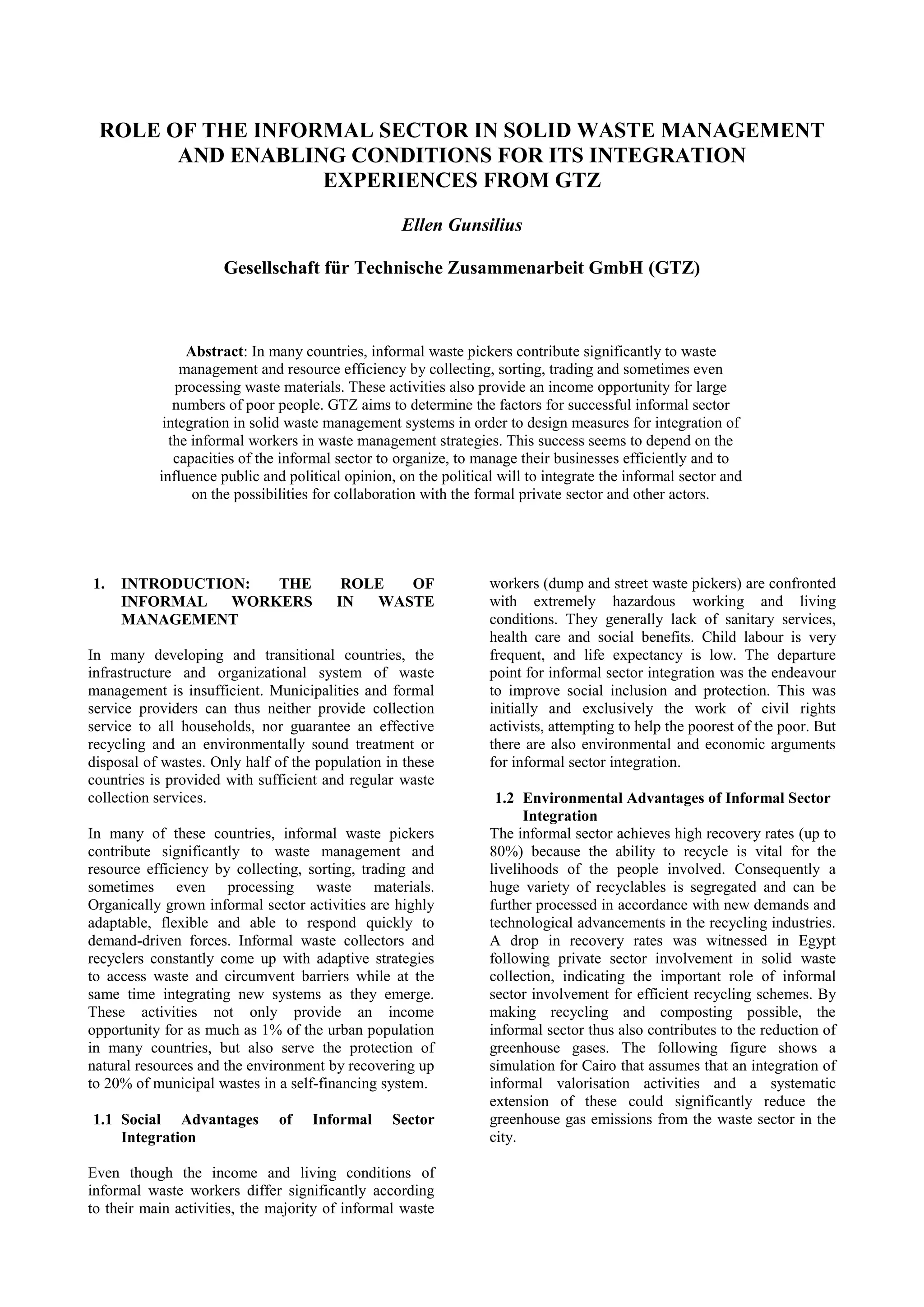
Integration The informal sector achieves high recovery rates (up to 80%) because the ability to recycle is vital for the livelihoods of the people involved. Consequently a huge variety of recyclables is segregated and can be further processed in accordance with new demands and technological advancements in the recycling industries. A drop in recovery rates was witnessed in Egypt following private sector involvement in solid waste collection, indicating the important role of informal sector involvement for efficient recycling schemes. By making recycling and composting possible, the informal sector thus also contributes to the reduction of greenhouse gases. The following figure shows a simulation for Cairo that assumes that an integration of informal valorisation activities and a systematic extension of these could significantly reduce the greenhouse gas emissions from the waste sector in the city.
(Source: calculation based on WASTE/GTZ/Skat, forthcoming and IFEU, 2009) On the other hand, one should not ignore negative environmental impacts by informal recovery activities. When sorting out recyclable waste in the streets or at waste transfer station, some informal workers contribute to scattering waste that might pollute the direct environment. Informal recycling activities do often not respect environmental standards and also might contribute to pollution. By integrating, organising and training informal workers on the negative effects of these practices, these practices can be better controlled and reduced. 
1.3 Economic Advantages of Informal Sector Integration 
Although informal sector activities very often take place outside official and formal channels, unlicensed and untaxed, they nevertheless contribute significantly to the national economy. Scrap collectors are entrepreneurs who add value by collecting and then transforming waste into tradable commodities. New enterprises are formed, trading networks evolve, capital accumulation and investments take place and savings are made in terms of raw materials, transport and energy. Furthermore, additional employment is generated through informal sector integration and gives income opportunities to disadvantaged social groups. A study conducted by WASTE, GTZ, Skat, and partners from developing countries has shown that most informal waste management operations achieve a net benefit while formal waste management operations have a net cost. This is partly due to the fact that the informal sector works primarily in waste valorisation, whereas the formal sector primarily works in waste management services (collection and disposal). But it is also due to the fact that the informal sector is, much more than formal actors, oriented on the productive use of waste materials in order to be self-financing. 
2. MODERNISATION OF WASTE MANAGEMENT AND INITIATIVES FOR INTEGRATING THE INFORMAL SECTOR 
Informal workers also suffer the lack of official recognition and capacities to fully develop their potential. As waste management becomes modernised, privatization and mechanisation of waste management services are common strategies, and the focus is often on efficient collection and disposal rather than on recovery and recycling of waste. Waste collection and disposal systems are often designed in a way that potentially denies the informal sector access to waste as a resource. When controlled management systems of disposal sites is introduced, waste pickers are often denied access to the site in order not to disturb unloading activities. When private companies are contracted, payment according to the quantities of waste disposed on the landfill or quota for formal recycling can put these formal companies in competition with informal actors for waste. In such a situation of competition, informal actors might face restrictions by formal companies or authorities. 
3. LOCAL CONTEXTS OF INFORMAL SECTOR ACTIVITIES 
The experience of informal sector intervention in waste management has been very diverse in different regional contexts. In some Asian and Latin American countries, informal waste workers have managed to establish organisations and networks that in some cases have become regular partners of municipal government and private enterprises. Various political, legal, cultural and social conditions determine the best possible approach to informal sector integration, and local, regional and national contexts must be taken into account. In India, for example, waste picking, along with any work related to garbage or the handling of carcasses and human excreta is traditionally bound to the ‘untouchables’. The informal waste sector is socially stratified in a pyramid with scrap collectors (waste pickers and itinerant waste buyers) at the bottom and re-processors at the top. Various actors such as retailers, stockists and wholesalers occupy the strata in between. The majority of retailers are former waste pickers who have managed to assemble some capital and to take up another activity. Since 1972, efforts have been made by local NGO‘s to organise the waste pickers, but the results do not yet extend across India. In Brazil, waste pickers traditionally collected organic material in order to feed animals. Waste recovery later evolved to include recyclable materials such as plastic waste, scrap metal etc. The sector evolved dynamically, including the creation of powerful and often monopolistic wholesalers buying waste materials. On the other hand, the development of waste picker organization was facilitated by charity organizations and social movements influencing political authorities. There is now extensive experience of waste pickers organising and establishing formal relationships with municipal and national governments.
Initiatives for the integration of informal waste 
workers, in order to be sustainable, have to analyse the 
local cultural and social conditions carefully and to 
identify the interests, needs and capacities of the 
different stakeholders. 
Photograph: Nour El Refai, Egypt / GTZ 
4. EXPERIENCES AND ENABLING 
CONDITIONS FOR INFORMAL SECTOR 
INTEGRATION 
The German Technical Cooperation (GTZ) puts a 
particular focus on the integration of informal workers 
and small enterprises in its technical assistance 
programs on waste management. Pilot activities in such 
diverse countries as Costa Rica, Brazil, Egypt, 
Mozambique or India show that the informal sector is 
able to act as an efficient partner of municipalities and 
the private waste management and recycling sector. 
Projects focus on the organization and official 
recognition of informal waste pickers, training on 
health and environmental aspects of waste recovery 
and business management skills, as well as the creation 
of partnerships with other actors. 
In order to identify the conditions that enable a 
successful integration of informal activities in waste 
management systems, experiences supported by 
various NGOs, international organizations and public 
authorities have been analysed. Complemented by the 
analysis of the pilot projects implemented by GTZ, 
several important factors for successful integration of 
informal workers and enterprises in solid waste 
management can be highlighted. 
4.1 Cooperation and organization of the informal 
sector 
The creation of self-confidence and trust between 
informal sector workers is a precondition for 
organisation in cooperatives or small enterprises, an 
important factor to establish regular relations with the 
local government and the private sector. NGO‘s often 
can help create a sense of common interests among 
informal waste workers, strengthen them in 
establishing groups and to formalize their status. Due 
to the predominant role of women in waste picking in 
India, women’s organisations were the first to cast light 
on waste pickers and their interests. In 1990 the Project 
for the Empowerment of Waste pickers of the 
Women’s University in Pune in Western India started 
organising waste pickers around their work issues. In 
Brazil, cooperatives of waste pickers were created in 
several cities, and were very successful. These 
activities paved the way for the creation of a national 
movement, which began with the ‘First National 
Congress of Brazilian Waste Pickers’ held in 2001. 
Cooperatives, associations or small enterprises have 
also been the means of integrating informal actors in 
formal systems in GTZ supported activities. In 
Mozambique, in cooperation with Caritas and the 
Italian NGO LVIA, a cooperative has been established 
and supported in the process of internal organisation, 
official registration, and technical operation of a center 
for sorting, washing and crushing plastics materials. 
In India, GTZ supported individual informal recyclers 
of electronic waste to associate with others in order to 
be registered as a formal company and to improve their 
recycling operations. Because of competition, lack of 
trust and varying interests of the recycling workshop 
owners, the process took two years. But finally, the 
new company could be established and is now treating 
2 tons of e-waste daily in accordance with 
environmental standards and in cooperation with an 
established e-waste recycler. 
4.2 Social acceptance of waste pickers’ activities 
Coming from the lowest social level, waste pickers in 
all cultures traditionally have a bad reputation. To 
promote the integration process, which can only 
proceed in step with public opinion, the widespread 
public idea of waste pickers as vagabonds and 
criminals must be changed into a perception of them as 
environmental agents and valued partners, acting 
together towards common goals. In India, as well as in 
Brazil, the media, as an important stakeholder in the 
system, has played a significant role in placing waste 
pickers and solid waste management issues in the 
public arena and thereby promoting the dissemination 
of information and informal sector integration. 
This kind of public attention and respect acts in two 
ways. On the one hand, social recognition and 
acceptance of informal sector activities is stimulated 
and the integration process is thus facilitated. On the 
other hand, through belonging to a socially upgraded 
group the integrity and self-assertiveness of the waste 
pickers improves due to enhanced social acceptance, 
along with an increased willingness to adapt and 
become organised. 
4.3 Political will for recognition 
Political will to integrate the informal sector is one of 
the major factors defining the level of integration being
reached. It is both a matter of national policy – of respective laws and regulations – and a question of underlying attitudes towards informal sector activities in general. It is also determined by the willingness and creativity of local decision makers, using the space within existing regulations to create initiatives with the informal sector. In Brazil, after an initial period of mutual mistrust and conflict, various functioning models of cooperation and partnership between waste picker organizations and formal authorities have evolved. This has resulted in the formation of municipal recycling scheme partnerships between many waste pickers’ organisations and local governments. Relations are regulated with specifically designed contracts, covenants and arrangements, always according to local circumstances. The establishment of direct contracts between informal sector organisations and local governments in Brazil has also been facilitated by a general trend towards re-democratising local governments and the clear commitment of state institutions to act as catalysts for social development. 
4.4 Legal protection measures for informal workers 
Legal protection measures for waste pickers (identity cards, land property rights etc.) facilitate the organization and professionalisation of waste pickers’ activities. The adaptation of laws, orders, regulations and bylaws at federal, state and municipal levels to the requirements of a successful integration process paves the way for further developments. To this end, fiscal and financial incentives must be made available for recycling industries and for the development of regional programs in partnership with pickers’ organisations, in addition to financial support for the structuring of these organisations. The Project for the Empowerment of Waste pickers of the Women’s University in Pune in Western India had first issued identity cards to waste pickers and promoted source segregation of waste and door–to- door collection by waste pickers. Following these developments and thanks to the presence of mass waste pickers’ organizations in Pune, Mumbai and other cities, the state of Maharashtra passed state orders to municipalities, directing them to issue identity cards to waste pickers, to allot the work of collecting waste from homes, shops and market places to organisations and cooperatives of waste pickers and to launch such organizations where they did not exist. Municipal initiatives all over the state were greatly strengthened by this. 
In Brazil, the federal district of Brasilia recognized organised waste pickers as the beneficiaries of the material generated in the state buildings. It determined the implementation of selective collection in all the administrative regions of the district and also dictates the destination of the materials to the waste pickers. 
This approach includes the subsidies paid to informal sector recycling centres in Brazil, based on the concept of ‘positive discrimination’ towards a traditionally disadvantaged social group. 
4.5 Management and technical skills 
The entrepreneurial capacities of informal sector workers and organizations are an important factor in the sustainability of informal sector intervention. Activities supporting informal sector integration include facilitating credit, skills development and improvements in managerial know-how and marketing to enhance the competitiveness of labour-intensive small-scale activities. In the Philippines, GTZ and the city council of Iloilo supported a group of former waste pickers at the disposal site to organize and manage a sorting center at the dumpsite to sort out recyclables. The workers, under supervision form a municipal engineer, now arrive at operating a sorting center with mechanized equipment like conveyor belts, drum sieve etc. The group has elected leaders that supervise the team work within the cooperative. The group also initiated new activities like composting and sorting out alternative fuel resources for co-processing in cement plants. But in order to conduct these new activities completely without support from the municipal authorities, additional trainings on financial management, marketing etc. seemed necessary and have recently been provided to group members. 
4.6 Partnerships with private enterprises 
In the context of privatised waste collection services, there are many sources of potential conflict between the formal waste collection enterprises and the informal sector. But there might also synergies between the two, and seeking convergent interests/complementary action between formal sector enterprises and the informal sector can strengthen the position of informal sector recyclers. Also, the establishment of regular business relationships with recycling and productive industry improves income opportunities of informal sector workers. UCLA, the cooperative of waste workers from Iloilo mentioned above has established a new cooperation with the international cement producer HOLCIM Inc. that has opened new opportunities of waste recovery. This cooperation was initiated by GTZ and the municipality of Iloilo. Materials that cannot be recycled, but that have a high calorific value, are sorted out and sold to HOLCIM. The waste workers benefit thus from a new income opportunity. HOLCIM on the other hand explores new sources for alternative fuels, and manifests also its social responsibility towards a disadvantaged group of citizens.
4.7 Access to waste materials 
The waste management system foreseen by the municipality should include measures guaranteeing regular access to waste for recovery. These can either be created by informal sector groups themselves or by official government arrangements. In Egypt, informal sector workers traditionally assured access to waste by providing collection services to the households even if they used only a part of the collected waste. Some cooperatives also arrange separate contracts with big waste producers such as supermarkets to ensure regular provision of recyclables. Activities of organising informal workers must bear in mind that a far greater number of people will continue to intervene in a non-organised manner and might even constitute competitors to newly organized informal sector actors in searching for recyclable materials. Establishing organized value chains and franchising systems with actors who are organised to a lesser or greater degree, might therefore constitute a solution to the problem that the whole waste recovery chain is difficult to control. The establishment of transparent and fair prices for recyclable materials paid by recycling cooperatives would already constitute a significant improvement in income for actors that continue to work individually in waste recovery. 
5. CONCLUSIONS 
The positive consequences of the different projects described above are visible: national and local government units have initiated partnerships with informal workers for waste collection or recovery. Informal workers have organized in small enterprises or cooperatives, manage sorting and recycling centers and provide the local or international recycling market with valuable materials. The workers integrated in cooperatives often earn 50-100% more than before the support measures. They also benefit from improved working conditions and better health protection. 
These experiences show that the partnership with the informal recycling sector is a real opportunity to improve waste management and resource efficiency in low- and middle income countries while contributing to poverty reduction. 
6. REFERENCES 
CID Consulting, Cairo (2008): The informal sector in waste recycling in Egypt, commissioned by GTZ, Eschborn. Dias, Sonia Maria and Fábio Cidrin Gama Alves (2008): Integration of the Informal Recycling Sector in Solid Waste Management in Brazil, commissioned by GTZ, Eschborn. Gerdes, Peter and Ellen Gunsilius (2010): The Waste Experts. Enabling Conditions for Informal Sector Integration in Solid Waste Management. Lessons learned from Brazil, Egypt and India, Eschborn. 
GTZ/ Skat/ WASTE (forthcoming): Economic Aspects of the Informal Sector in Solid Waste and Recycling, draft version, September 2010. 
IFEU 2009: SWM GHG Calculator. Tool for Calculating Greenhouse Gases (GHG in Solid Waste Management (SWM), commissioned by KfW, Frankfurt. SNDT Womens’ University and Chintan Environmental Research & Action Group (2008): Recycling livelihoods - Integration of the Informal Recycling Sector in Solid WasteManagement in India, commissioned by GTZ, Eschborn.

001441

  • 1.
    ROLE OF THEINFORMAL SECTOR IN SOLID WASTE MANAGEMENT AND ENABLING CONDITIONS FOR ITS INTEGRATION EXPERIENCES FROM GTZ Ellen Gunsilius Gesellschaft für Technische Zusammenarbeit GmbH (GTZ) Abstract: In many countries, informal waste pickers contribute significantly to waste management and resource efficiency by collecting, sorting, trading and sometimes even processing waste materials. These activities also provide an income opportunity for large numbers of poor people. GTZ aims to determine the factors for successful informal sector integration in solid waste management systems in order to design measures for integration of the informal workers in waste management strategies. This success seems to depend on the capacities of the informal sector to organize, to manage their businesses efficiently and to influence public and political opinion, on the political will to integrate the informal sector and on the possibilities for collaboration with the formal private sector and other actors. 1. INTRODUCTION: THE ROLE OF INFORMAL WORKERS IN WASTE MANAGEMENT In many developing and transitional countries, the infrastructure and organizational system of waste management is insufficient. Municipalities and formal service providers can thus neither provide collection service to all households, nor guarantee an effective recycling and an environmentally sound treatment or disposal of wastes. Only half of the population in these countries is provided with sufficient and regular waste collection services. In many of these countries, informal waste pickers contribute significantly to waste management and resource efficiency by collecting, sorting, trading and sometimes even processing waste materials. Organically grown informal sector activities are highly adaptable, flexible and able to respond quickly to demand-driven forces. Informal waste collectors and recyclers constantly come up with adaptive strategies to access waste and circumvent barriers while at the same time integrating new systems as they emerge. These activities not only provide an income opportunity for as much as 1% of the urban population in many countries, but also serve the protection of natural resources and the environment by recovering up to 20% of municipal wastes in a self-financing system. 1.1 Social Advantages of Informal Sector Integration Even though the income and living conditions of informal waste workers differ significantly according to their main activities, the majority of informal waste workers (dump and street waste pickers) are confronted with extremely hazardous working and living conditions. They generally lack of sanitary services, health care and social benefits. Child labour is very frequent, and life expectancy is low. The departure point for informal sector integration was the endeavour to improve social inclusion and protection. This was initially and exclusively the work of civil rights activists, attempting to help the poorest of the poor. But there are also environmental and economic arguments for informal sector integration. 1.2 Environmental Advantages of Informal Sector Integration The informal sector achieves high recovery rates (up to 80%) because the ability to recycle is vital for the livelihoods of the people involved. Consequently a huge variety of recyclables is segregated and can be further processed in accordance with new demands and technological advancements in the recycling industries. A drop in recovery rates was witnessed in Egypt following private sector involvement in solid waste collection, indicating the important role of informal sector involvement for efficient recycling schemes. By making recycling and composting possible, the informal sector thus also contributes to the reduction of greenhouse gases. The following figure shows a simulation for Cairo that assumes that an integration of informal valorisation activities and a systematic extension of these could significantly reduce the greenhouse gas emissions from the waste sector in the city.
  • 2.
    (Source: calculation basedon WASTE/GTZ/Skat, forthcoming and IFEU, 2009) On the other hand, one should not ignore negative environmental impacts by informal recovery activities. When sorting out recyclable waste in the streets or at waste transfer station, some informal workers contribute to scattering waste that might pollute the direct environment. Informal recycling activities do often not respect environmental standards and also might contribute to pollution. By integrating, organising and training informal workers on the negative effects of these practices, these practices can be better controlled and reduced. 1.3 Economic Advantages of Informal Sector Integration Although informal sector activities very often take place outside official and formal channels, unlicensed and untaxed, they nevertheless contribute significantly to the national economy. Scrap collectors are entrepreneurs who add value by collecting and then transforming waste into tradable commodities. New enterprises are formed, trading networks evolve, capital accumulation and investments take place and savings are made in terms of raw materials, transport and energy. Furthermore, additional employment is generated through informal sector integration and gives income opportunities to disadvantaged social groups. A study conducted by WASTE, GTZ, Skat, and partners from developing countries has shown that most informal waste management operations achieve a net benefit while formal waste management operations have a net cost. This is partly due to the fact that the informal sector works primarily in waste valorisation, whereas the formal sector primarily works in waste management services (collection and disposal). But it is also due to the fact that the informal sector is, much more than formal actors, oriented on the productive use of waste materials in order to be self-financing. 2. MODERNISATION OF WASTE MANAGEMENT AND INITIATIVES FOR INTEGRATING THE INFORMAL SECTOR Informal workers also suffer the lack of official recognition and capacities to fully develop their potential. As waste management becomes modernised, privatization and mechanisation of waste management services are common strategies, and the focus is often on efficient collection and disposal rather than on recovery and recycling of waste. Waste collection and disposal systems are often designed in a way that potentially denies the informal sector access to waste as a resource. When controlled management systems of disposal sites is introduced, waste pickers are often denied access to the site in order not to disturb unloading activities. When private companies are contracted, payment according to the quantities of waste disposed on the landfill or quota for formal recycling can put these formal companies in competition with informal actors for waste. In such a situation of competition, informal actors might face restrictions by formal companies or authorities. 3. LOCAL CONTEXTS OF INFORMAL SECTOR ACTIVITIES The experience of informal sector intervention in waste management has been very diverse in different regional contexts. In some Asian and Latin American countries, informal waste workers have managed to establish organisations and networks that in some cases have become regular partners of municipal government and private enterprises. Various political, legal, cultural and social conditions determine the best possible approach to informal sector integration, and local, regional and national contexts must be taken into account. In India, for example, waste picking, along with any work related to garbage or the handling of carcasses and human excreta is traditionally bound to the ‘untouchables’. The informal waste sector is socially stratified in a pyramid with scrap collectors (waste pickers and itinerant waste buyers) at the bottom and re-processors at the top. Various actors such as retailers, stockists and wholesalers occupy the strata in between. The majority of retailers are former waste pickers who have managed to assemble some capital and to take up another activity. Since 1972, efforts have been made by local NGO‘s to organise the waste pickers, but the results do not yet extend across India. In Brazil, waste pickers traditionally collected organic material in order to feed animals. Waste recovery later evolved to include recyclable materials such as plastic waste, scrap metal etc. The sector evolved dynamically, including the creation of powerful and often monopolistic wholesalers buying waste materials. On the other hand, the development of waste picker organization was facilitated by charity organizations and social movements influencing political authorities. There is now extensive experience of waste pickers organising and establishing formal relationships with municipal and national governments.
  • 3.
    Initiatives for theintegration of informal waste workers, in order to be sustainable, have to analyse the local cultural and social conditions carefully and to identify the interests, needs and capacities of the different stakeholders. Photograph: Nour El Refai, Egypt / GTZ 4. EXPERIENCES AND ENABLING CONDITIONS FOR INFORMAL SECTOR INTEGRATION The German Technical Cooperation (GTZ) puts a particular focus on the integration of informal workers and small enterprises in its technical assistance programs on waste management. Pilot activities in such diverse countries as Costa Rica, Brazil, Egypt, Mozambique or India show that the informal sector is able to act as an efficient partner of municipalities and the private waste management and recycling sector. Projects focus on the organization and official recognition of informal waste pickers, training on health and environmental aspects of waste recovery and business management skills, as well as the creation of partnerships with other actors. In order to identify the conditions that enable a successful integration of informal activities in waste management systems, experiences supported by various NGOs, international organizations and public authorities have been analysed. Complemented by the analysis of the pilot projects implemented by GTZ, several important factors for successful integration of informal workers and enterprises in solid waste management can be highlighted. 4.1 Cooperation and organization of the informal sector The creation of self-confidence and trust between informal sector workers is a precondition for organisation in cooperatives or small enterprises, an important factor to establish regular relations with the local government and the private sector. NGO‘s often can help create a sense of common interests among informal waste workers, strengthen them in establishing groups and to formalize their status. Due to the predominant role of women in waste picking in India, women’s organisations were the first to cast light on waste pickers and their interests. In 1990 the Project for the Empowerment of Waste pickers of the Women’s University in Pune in Western India started organising waste pickers around their work issues. In Brazil, cooperatives of waste pickers were created in several cities, and were very successful. These activities paved the way for the creation of a national movement, which began with the ‘First National Congress of Brazilian Waste Pickers’ held in 2001. Cooperatives, associations or small enterprises have also been the means of integrating informal actors in formal systems in GTZ supported activities. In Mozambique, in cooperation with Caritas and the Italian NGO LVIA, a cooperative has been established and supported in the process of internal organisation, official registration, and technical operation of a center for sorting, washing and crushing plastics materials. In India, GTZ supported individual informal recyclers of electronic waste to associate with others in order to be registered as a formal company and to improve their recycling operations. Because of competition, lack of trust and varying interests of the recycling workshop owners, the process took two years. But finally, the new company could be established and is now treating 2 tons of e-waste daily in accordance with environmental standards and in cooperation with an established e-waste recycler. 4.2 Social acceptance of waste pickers’ activities Coming from the lowest social level, waste pickers in all cultures traditionally have a bad reputation. To promote the integration process, which can only proceed in step with public opinion, the widespread public idea of waste pickers as vagabonds and criminals must be changed into a perception of them as environmental agents and valued partners, acting together towards common goals. In India, as well as in Brazil, the media, as an important stakeholder in the system, has played a significant role in placing waste pickers and solid waste management issues in the public arena and thereby promoting the dissemination of information and informal sector integration. This kind of public attention and respect acts in two ways. On the one hand, social recognition and acceptance of informal sector activities is stimulated and the integration process is thus facilitated. On the other hand, through belonging to a socially upgraded group the integrity and self-assertiveness of the waste pickers improves due to enhanced social acceptance, along with an increased willingness to adapt and become organised. 4.3 Political will for recognition Political will to integrate the informal sector is one of the major factors defining the level of integration being
  • 4.
    reached. It isboth a matter of national policy – of respective laws and regulations – and a question of underlying attitudes towards informal sector activities in general. It is also determined by the willingness and creativity of local decision makers, using the space within existing regulations to create initiatives with the informal sector. In Brazil, after an initial period of mutual mistrust and conflict, various functioning models of cooperation and partnership between waste picker organizations and formal authorities have evolved. This has resulted in the formation of municipal recycling scheme partnerships between many waste pickers’ organisations and local governments. Relations are regulated with specifically designed contracts, covenants and arrangements, always according to local circumstances. The establishment of direct contracts between informal sector organisations and local governments in Brazil has also been facilitated by a general trend towards re-democratising local governments and the clear commitment of state institutions to act as catalysts for social development. 4.4 Legal protection measures for informal workers Legal protection measures for waste pickers (identity cards, land property rights etc.) facilitate the organization and professionalisation of waste pickers’ activities. The adaptation of laws, orders, regulations and bylaws at federal, state and municipal levels to the requirements of a successful integration process paves the way for further developments. To this end, fiscal and financial incentives must be made available for recycling industries and for the development of regional programs in partnership with pickers’ organisations, in addition to financial support for the structuring of these organisations. The Project for the Empowerment of Waste pickers of the Women’s University in Pune in Western India had first issued identity cards to waste pickers and promoted source segregation of waste and door–to- door collection by waste pickers. Following these developments and thanks to the presence of mass waste pickers’ organizations in Pune, Mumbai and other cities, the state of Maharashtra passed state orders to municipalities, directing them to issue identity cards to waste pickers, to allot the work of collecting waste from homes, shops and market places to organisations and cooperatives of waste pickers and to launch such organizations where they did not exist. Municipal initiatives all over the state were greatly strengthened by this. In Brazil, the federal district of Brasilia recognized organised waste pickers as the beneficiaries of the material generated in the state buildings. It determined the implementation of selective collection in all the administrative regions of the district and also dictates the destination of the materials to the waste pickers. This approach includes the subsidies paid to informal sector recycling centres in Brazil, based on the concept of ‘positive discrimination’ towards a traditionally disadvantaged social group. 4.5 Management and technical skills The entrepreneurial capacities of informal sector workers and organizations are an important factor in the sustainability of informal sector intervention. Activities supporting informal sector integration include facilitating credit, skills development and improvements in managerial know-how and marketing to enhance the competitiveness of labour-intensive small-scale activities. In the Philippines, GTZ and the city council of Iloilo supported a group of former waste pickers at the disposal site to organize and manage a sorting center at the dumpsite to sort out recyclables. The workers, under supervision form a municipal engineer, now arrive at operating a sorting center with mechanized equipment like conveyor belts, drum sieve etc. The group has elected leaders that supervise the team work within the cooperative. The group also initiated new activities like composting and sorting out alternative fuel resources for co-processing in cement plants. But in order to conduct these new activities completely without support from the municipal authorities, additional trainings on financial management, marketing etc. seemed necessary and have recently been provided to group members. 4.6 Partnerships with private enterprises In the context of privatised waste collection services, there are many sources of potential conflict between the formal waste collection enterprises and the informal sector. But there might also synergies between the two, and seeking convergent interests/complementary action between formal sector enterprises and the informal sector can strengthen the position of informal sector recyclers. Also, the establishment of regular business relationships with recycling and productive industry improves income opportunities of informal sector workers. UCLA, the cooperative of waste workers from Iloilo mentioned above has established a new cooperation with the international cement producer HOLCIM Inc. that has opened new opportunities of waste recovery. This cooperation was initiated by GTZ and the municipality of Iloilo. Materials that cannot be recycled, but that have a high calorific value, are sorted out and sold to HOLCIM. The waste workers benefit thus from a new income opportunity. HOLCIM on the other hand explores new sources for alternative fuels, and manifests also its social responsibility towards a disadvantaged group of citizens.
  • 5.
    4.7 Access towaste materials The waste management system foreseen by the municipality should include measures guaranteeing regular access to waste for recovery. These can either be created by informal sector groups themselves or by official government arrangements. In Egypt, informal sector workers traditionally assured access to waste by providing collection services to the households even if they used only a part of the collected waste. Some cooperatives also arrange separate contracts with big waste producers such as supermarkets to ensure regular provision of recyclables. Activities of organising informal workers must bear in mind that a far greater number of people will continue to intervene in a non-organised manner and might even constitute competitors to newly organized informal sector actors in searching for recyclable materials. Establishing organized value chains and franchising systems with actors who are organised to a lesser or greater degree, might therefore constitute a solution to the problem that the whole waste recovery chain is difficult to control. The establishment of transparent and fair prices for recyclable materials paid by recycling cooperatives would already constitute a significant improvement in income for actors that continue to work individually in waste recovery. 5. CONCLUSIONS The positive consequences of the different projects described above are visible: national and local government units have initiated partnerships with informal workers for waste collection or recovery. Informal workers have organized in small enterprises or cooperatives, manage sorting and recycling centers and provide the local or international recycling market with valuable materials. The workers integrated in cooperatives often earn 50-100% more than before the support measures. They also benefit from improved working conditions and better health protection. These experiences show that the partnership with the informal recycling sector is a real opportunity to improve waste management and resource efficiency in low- and middle income countries while contributing to poverty reduction. 6. REFERENCES CID Consulting, Cairo (2008): The informal sector in waste recycling in Egypt, commissioned by GTZ, Eschborn. Dias, Sonia Maria and Fábio Cidrin Gama Alves (2008): Integration of the Informal Recycling Sector in Solid Waste Management in Brazil, commissioned by GTZ, Eschborn. Gerdes, Peter and Ellen Gunsilius (2010): The Waste Experts. Enabling Conditions for Informal Sector Integration in Solid Waste Management. Lessons learned from Brazil, Egypt and India, Eschborn. GTZ/ Skat/ WASTE (forthcoming): Economic Aspects of the Informal Sector in Solid Waste and Recycling, draft version, September 2010. IFEU 2009: SWM GHG Calculator. Tool for Calculating Greenhouse Gases (GHG in Solid Waste Management (SWM), commissioned by KfW, Frankfurt. SNDT Womens’ University and Chintan Environmental Research & Action Group (2008): Recycling livelihoods - Integration of the Informal Recycling Sector in Solid WasteManagement in India, commissioned by GTZ, Eschborn.