Comprehensive Care for persons with Sickle cell
Disease
Dr. Wanyama Ronald Stephen, MBCHB
Kampala international university
Outline
• Pathophysiology of SCD .
• Comprehensive care for SCD
Management of acute complications
• Hydroxyurea use in patients with SCD
Background – SCD Epidemiology
• Sickle cell disease (SCD) is a group of inherited blood disorders caused by an
abnormal hemoglobin- hemoglobin S (HbS).
• HbS results from point mutation in the B –globin genes, resulting in the
substitution of valine for glutamic acid at position 6 of the B-globin chains. SCA
(HBSS) is the most common and most severe form
• An estimate of over 300,000 babies annually are born globally with SCD and
80% are from sub-Saharan Africa (SSA)
• In Uganda, 20,000 babies are born with SCA annually, and its estimated that
80% die before their fifth birthday .
Back Ground – SCD Pathophysiology
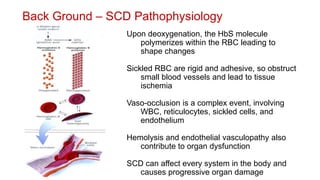
Upon deoxygenation, the HbS molecule
polymerizes within the RBC leading to
shape changes
Sickled RBC are rigid and adhesive, so obstruct
small blood vessels and lead to tissue
ischemia
Vaso-occlusion is a complex event, involving
WBC, reticulocytes, sickled cells, and
endothelium
Hemolysis and endothelial vasculopathy also
contribute to organ dysfunction
SCD can affect every system in the body and
causes progressive organ damage
Comprehensive care for SCD improves
outcomes
• Comprehensive care for SCD involves the prevention, screening for
and treating of SCD associated complications across the life span
Care for children and adults with SCD
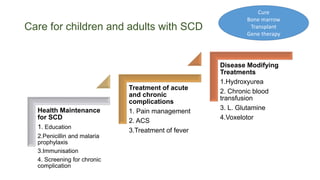
Health Maintenance
for SCD
1. Education
2.Penicillin and malaria
prophylaxis
3.Immunisation
4. Screening for chronic
complication
Treatment of acute
and chronic
complications
1. Pain management
2. ACS
3.Treatment of fever
Disease Modifying
Treatments
1.Hydroxyurea
2. Chronic blood
transfusion
3. L. Glutamine
4.Voxelotor
Cure
Bone marrow
Transplant
Gene therapy
Education and Counselling : Patients and care
givers
• Inheritance patterns of SCD
• Complications of SCD
• Educate – ask patients to seek care for all fevers above 38.50C
• Teach parents how to palpate for the spleen especially . in infants and
younger children with SCD
Prophylaxis against infections
Penicillin prophylaxis
Penicillin v125mg <3 years and 250mg for those 3 -5 years twice daily
Don’t discontinue at 5 years if child had a splenectomy
Malaria chemoprophylaxis
Immunization: Receive all vaccines according to local immunization schedule
• Infants receive the complete 3 does of PCV vaccinations
• Additional dose of PCV 23 at ages 2 t and 5 years old
Nutritional Supplements
Micronutrient deficiencies are common in
children with SCD
Persons with SCD may experience higher
metabolic rates than non SCD controls
Role of routine micronutrient
supplementation not well studied
Recommendation is replace deficient
micronutrient
Routine folic acid (5mg/daily) given as local
standard of care
Primary Stroke prevention
• Annual Transcranial Doppler Ultra sound
Scan(TCD) from ages 2-16 years
• Abnormal TCD (>200cm/sec):chronic
blond transfusion if feasible or start
hydroxyurea
• Conditional, 170-199 cm/sec, repeat in 6
months
Screen for Stroke
Screening for renal disease
• Screen all children >10 years
annually for proteinuria
• If result is positive, do early
morning urine albumin
creatinine ratio and if abnormal
refer to a nephrologist
• Repeat annually for negative
result
Screening for pulmonary disease
• Using history and physical
examination, screen children
and adults for Asthma, COPD
• If suggestive do further
assessment with pulmonary
tests
• Routine pulmonary function
tests not recommend
• Routine screening for pulmonary
hypertension in asymptomatic
children and adults not
recommend
Reproductive counselling for patients with
SCD
• Counsel men and women with SCD to have a reproductive plan
• Offer contraception to avoid unintended pregnancy
• Educate need for testing partners of persons with SCD for
haemoglobinopathies
• Pregnancy is in SCD high risk – have clear follow up plan
• Stop hydroxyurea 3 months before a woman gets pregnant
Treatment of Acute and Chronic Complications
Acute complications
• Pain crises
• Acute chest syndrome
• Severe acute anaemia
• Fever
• Priapism
• Acute stroke
• Acute splenic sequestration
Chronic complications
• Leg ulcers
• Avascular necrosis
• Stroke
• Recurrent priapism
• Chronic kidney disease
• Pulmonary hypertension
• Chronic lung disease
Evaluation of pain in SCD
• Patients who present in pain must be evaluated rapidly – both for pain and
any underlying comorbidities
• Evaluate for severity which can vary from mild to debilitating
• Do not delay initiation of analgesia – Start within 20 minutes
Home Management of pain is the most
common type of management in SCD
• Evidence from the PiSCES trial – used patient dairies
• Home management includes access to analgesia and instructions
when to seek medical attention
• Mild pain – Paracetamol or NSAIDS . May escalate to opioids for some
un resolving pain
• Adjuvant therapies: Relaxing, mild exercise, hot compress. Avoid – cold
/ice compression which can precipitate sickling
• Seek medical care : Fever, cough, signs of stroke, splenic sequestration
Hospital Management of Pain
• Majority of patients have true, severe pain and do not have drug seeking
behavior
• Assess pain: location and severity of pain
• Patient or parental report –most important assessment tool for pain
• Use pain scores for older children; younger children- degree of irritability
• Assess for contributing comorbidities – ACS, stroke, infection . These may
develop during hospitalization – assess vitals including pulse oximetry
Pain score cards
Management of Acute Pain Episodes: MHSCC
Protocol
• Assess patient’s general state, the level of consciousness and
hydration.
• Vitals and examine areas of tenderness
• Evaluate the severity
• Look for other causes of pain other than VOC
• Rapidly assess the patient’s recent use of analgesics
Management of Acute pain: Pharmacological
Iv morphine may be used at 0.1-0.15mg/kg – max dose 10mg
Adjuvant Treatments
• In euvolemic patients, administer fluids at maintenance. Total fluid should
not exceed 1.5 times the maintenance
• To reduce the risk of ACS, initiate use of incentive spirometry
• Do not transfuse children with VOC unless there are other indications for
blood transfusion such ACS.
• A painful crisis without fever does not require antibiotics.
• Heat compresses :avoid cold/ice compresses
• Early ambulation
• Reassess patient pain control at least every 4 hours
• Readjust /escalate doses doses if necessary (mind time to peak to
avoid toxicity)
• NSAIDS for hospitalized patients should be minimized (5 to 7 days)
• Avoid PRN medications
• Review prior analgesia dosing to guide initial dosing
• Treatment of respiratory depression due to morphine overdose
• Naloxone (0.01 mg/kg/dose, max 0.4 mg/dose) IV every 2-3 minutes
as necessary to a maximum of 10 doses
Newer Treatments for Acute Pain
• Patient controlled analgesia(PCA) have been found very effective
• Intranasal fentanyl also effective for acute pain management
• Ketamine may be used for pain refractory to opioids (intranasal or
continuous infusion)
• Offer psychosocial support and disease modifying agents like
hydroxyurea
When its more than pain
• Abdominal pain with distension – Liver /splenic sequestration
• Severe pain with increasing hematuria may indicate renal pathology
• Pain with leukopenia, may indicate infection
• Pain with worsening anemia may indicate bone marrow suppression
Role of Hydroxyurea in the treatment of
SCD
• Hydroxylated analog of urea originally synthesized in 1869
• First animal studies in 1928 for leukopenia, macrocytosis, anemia, death
• First tested in SCD in 1984
• Principal mechanism of cytotoxicity is the inhibition of DNA synthesis
(Ribonucloetide Reductase inhibitor)- causing intermittent suppression of
erythroid progenitors
• Spontaneous recovery of the enzyme occurs when hydroxyurea is
removed
• Resistance and tolerance have not been described to occur
Hydroxyurea: Multiple Mechanisms of
Action with Multiple Benefits to Patient
• HbF induction
• Myelosuppression
• ↓RBC adhesion to
endothelium
• Better rheology
• ↑ Nitric Oxide
Hydroxyurea is Efficacious in Children and
Adolescents with SCD
• Reduces Pain episodes by 50%
• Reduces need for blood transfusion
• Decreases trans cranial doppler velocities ,reduces risk of primary and
secondary stroke
• Decreases the rates of acute chest syndrome
• Reduces rates of hospitalization
• Preserves splenic function in infants and improves growth and development
Opoka et al, Ware et al, Jayabose et al, wang et al.
Thirty Years of Research
Hydroxyurea is Safe and Does not
Increase Malaria Risk in African Children
Indications and Contraindications for
Hydroxyurea Use
• Frequent Pain Crises ,>5 in a
year
• Stroke or history of stroke
• Abnormal TCD velocities>
200cm/sec
• Low baseline
Haemoglobin,<6g/dL
• History of/admission for acute
chest syndrome
Contraindications
• Pregnancy or sexually active
and not willing to use
contraception
• Active liver disease
• Hypersensitivity to
Hydroxyurea
• Significant non compliance to
therapy
• Offer Hydroxyurea to all children older than 9 months – National
Heart, Lung and Blood Institute
Dosing and Monitoring
• Baseline Investigations
• CBC with differential ,MCV and reticulocyte count
• Quantitative HB electrophoresis – Help in monitoring response
• Creatinine and Urea – Should be in normal range
• Liver function – AST/ALT- Should be <2 times the upper limit
Prior to Initiating Hydroxyurea Therapy
• Complete history and physical exam.
• Discuss the rationale and potential adverse effects of hydroxyurea
with patient and family members.
• Document that family agrees to have regular clinic monitoring.
• Document diagnosis of SCD
• Patient must meet initial blood count and chemistry criteria: ANC
> 1,500/µl, platelet > 100,000/ul, and ALT< X2 the upper limit of
normal, and normal creatinine .
Dosing and Monitoring
• Start at 20mg/kg /day for children, 15mg/kg /day for adults
• Monitor CBC every month for 3 months, then every 3 months
• Monitor for toxicity and clinical and laboratory response
• Escalate when indicated: Abnormal TCD, stroke, ANC>6,000,
no clinical response
• Escalate by 5mg/kg/day every 6-8 weeks up to 30mg/kg/day
Hydroxyurea at MTD is Safe and Superior to Fixed Dose
Laboratory Effects of MTD vs. Fixed
Dose
Adapted from Opoka et al
• MTD: Mild myelosuppression- ANC 2-4,000/uL without toxicity
• Monitor CBC at each dose escalation
• At each monitoring visit, assess
• Interim clinical events
• Adherence; check MCV, WBC, ANC, ARC on CBC which should reduce while
haemoglobin level should increase
• Reweigh the patient and check dose against weight
• CBC: Stop Hydroxyurea if ANC <1500 OR Hb<6 AND ARC <80,000 OR platelets
<80,000
Dosing and Monitoring
• Monitor WBC weekly after holding hydroxyurea. Restart at a dose
5mg/kg/day lower when counts recover
• Effectiveness of hydroxyurea depends on adherence .
• Clinical response may take 3- 6 months
• Lack of increase in HBF or MCV is not an indication to stop therapy
• Do not discontinue therapy due to uncomplicated fever or
hospitalization
Challenges with Hydroxyurea therapy in
Clinical Practice
• 1. Formulations of 250 and 500 mg capsules
• 2. Capsule formulations and no syrups
• 3.Adherence to dosing
• 4.Erractic availability of drugs
Fertility and Hydroxyurea
• SCD is associated with fertility
challenges , especially among
males
• Some studies in rats revealed
reduction in sperm counts and
motility following hydroxyurea
exposure
• Similar trends suggested by
other studies post pubertal
males
THANK YOU
Q & A

sickle cell anema.pptx

  • 1.
    Comprehensive Care forpersons with Sickle cell Disease Dr. Wanyama Ronald Stephen, MBCHB Kampala international university
  • 2.
    Outline • Pathophysiology ofSCD . • Comprehensive care for SCD Management of acute complications • Hydroxyurea use in patients with SCD
  • 3.
    Background – SCDEpidemiology • Sickle cell disease (SCD) is a group of inherited blood disorders caused by an abnormal hemoglobin- hemoglobin S (HbS). • HbS results from point mutation in the B –globin genes, resulting in the substitution of valine for glutamic acid at position 6 of the B-globin chains. SCA (HBSS) is the most common and most severe form • An estimate of over 300,000 babies annually are born globally with SCD and 80% are from sub-Saharan Africa (SSA) • In Uganda, 20,000 babies are born with SCA annually, and its estimated that 80% die before their fifth birthday .
  • 4.
    Back Ground –SCD Pathophysiology Upon deoxygenation, the HbS molecule polymerizes within the RBC leading to shape changes Sickled RBC are rigid and adhesive, so obstruct small blood vessels and lead to tissue ischemia Vaso-occlusion is a complex event, involving WBC, reticulocytes, sickled cells, and endothelium Hemolysis and endothelial vasculopathy also contribute to organ dysfunction SCD can affect every system in the body and causes progressive organ damage
  • 5.
    Comprehensive care forSCD improves outcomes • Comprehensive care for SCD involves the prevention, screening for and treating of SCD associated complications across the life span
  • 6.
    Care for childrenand adults with SCD Health Maintenance for SCD 1. Education 2.Penicillin and malaria prophylaxis 3.Immunisation 4. Screening for chronic complication Treatment of acute and chronic complications 1. Pain management 2. ACS 3.Treatment of fever Disease Modifying Treatments 1.Hydroxyurea 2. Chronic blood transfusion 3. L. Glutamine 4.Voxelotor Cure Bone marrow Transplant Gene therapy
  • 7.
    Education and Counselling: Patients and care givers • Inheritance patterns of SCD • Complications of SCD • Educate – ask patients to seek care for all fevers above 38.50C • Teach parents how to palpate for the spleen especially . in infants and younger children with SCD
  • 8.
    Prophylaxis against infections Penicillinprophylaxis Penicillin v125mg <3 years and 250mg for those 3 -5 years twice daily Don’t discontinue at 5 years if child had a splenectomy Malaria chemoprophylaxis Immunization: Receive all vaccines according to local immunization schedule • Infants receive the complete 3 does of PCV vaccinations • Additional dose of PCV 23 at ages 2 t and 5 years old
  • 9.
    Nutritional Supplements Micronutrient deficienciesare common in children with SCD Persons with SCD may experience higher metabolic rates than non SCD controls Role of routine micronutrient supplementation not well studied Recommendation is replace deficient micronutrient Routine folic acid (5mg/daily) given as local standard of care
  • 10.
    Primary Stroke prevention •Annual Transcranial Doppler Ultra sound Scan(TCD) from ages 2-16 years • Abnormal TCD (>200cm/sec):chronic blond transfusion if feasible or start hydroxyurea • Conditional, 170-199 cm/sec, repeat in 6 months Screen for Stroke
  • 11.
    Screening for renaldisease • Screen all children >10 years annually for proteinuria • If result is positive, do early morning urine albumin creatinine ratio and if abnormal refer to a nephrologist • Repeat annually for negative result
  • 12.
    Screening for pulmonarydisease • Using history and physical examination, screen children and adults for Asthma, COPD • If suggestive do further assessment with pulmonary tests • Routine pulmonary function tests not recommend • Routine screening for pulmonary hypertension in asymptomatic children and adults not recommend
  • 13.
    Reproductive counselling forpatients with SCD • Counsel men and women with SCD to have a reproductive plan • Offer contraception to avoid unintended pregnancy • Educate need for testing partners of persons with SCD for haemoglobinopathies • Pregnancy is in SCD high risk – have clear follow up plan • Stop hydroxyurea 3 months before a woman gets pregnant
  • 14.
    Treatment of Acuteand Chronic Complications Acute complications • Pain crises • Acute chest syndrome • Severe acute anaemia • Fever • Priapism • Acute stroke • Acute splenic sequestration Chronic complications • Leg ulcers • Avascular necrosis • Stroke • Recurrent priapism • Chronic kidney disease • Pulmonary hypertension • Chronic lung disease
  • 15.
    Evaluation of painin SCD • Patients who present in pain must be evaluated rapidly – both for pain and any underlying comorbidities • Evaluate for severity which can vary from mild to debilitating • Do not delay initiation of analgesia – Start within 20 minutes
  • 16.
    Home Management ofpain is the most common type of management in SCD • Evidence from the PiSCES trial – used patient dairies • Home management includes access to analgesia and instructions when to seek medical attention • Mild pain – Paracetamol or NSAIDS . May escalate to opioids for some un resolving pain • Adjuvant therapies: Relaxing, mild exercise, hot compress. Avoid – cold /ice compression which can precipitate sickling • Seek medical care : Fever, cough, signs of stroke, splenic sequestration
  • 17.
    Hospital Management ofPain • Majority of patients have true, severe pain and do not have drug seeking behavior • Assess pain: location and severity of pain • Patient or parental report –most important assessment tool for pain • Use pain scores for older children; younger children- degree of irritability • Assess for contributing comorbidities – ACS, stroke, infection . These may develop during hospitalization – assess vitals including pulse oximetry
  • 18.
  • 19.
    Management of AcutePain Episodes: MHSCC Protocol • Assess patient’s general state, the level of consciousness and hydration. • Vitals and examine areas of tenderness • Evaluate the severity • Look for other causes of pain other than VOC • Rapidly assess the patient’s recent use of analgesics
  • 22.
    Management of Acutepain: Pharmacological Iv morphine may be used at 0.1-0.15mg/kg – max dose 10mg
  • 23.
    Adjuvant Treatments • Ineuvolemic patients, administer fluids at maintenance. Total fluid should not exceed 1.5 times the maintenance • To reduce the risk of ACS, initiate use of incentive spirometry • Do not transfuse children with VOC unless there are other indications for blood transfusion such ACS. • A painful crisis without fever does not require antibiotics. • Heat compresses :avoid cold/ice compresses • Early ambulation
  • 24.
    • Reassess patientpain control at least every 4 hours • Readjust /escalate doses doses if necessary (mind time to peak to avoid toxicity) • NSAIDS for hospitalized patients should be minimized (5 to 7 days) • Avoid PRN medications • Review prior analgesia dosing to guide initial dosing • Treatment of respiratory depression due to morphine overdose • Naloxone (0.01 mg/kg/dose, max 0.4 mg/dose) IV every 2-3 minutes as necessary to a maximum of 10 doses
  • 25.
    Newer Treatments forAcute Pain • Patient controlled analgesia(PCA) have been found very effective • Intranasal fentanyl also effective for acute pain management • Ketamine may be used for pain refractory to opioids (intranasal or continuous infusion) • Offer psychosocial support and disease modifying agents like hydroxyurea
  • 26.
    When its morethan pain • Abdominal pain with distension – Liver /splenic sequestration • Severe pain with increasing hematuria may indicate renal pathology • Pain with leukopenia, may indicate infection • Pain with worsening anemia may indicate bone marrow suppression
  • 27.
    Role of Hydroxyureain the treatment of SCD • Hydroxylated analog of urea originally synthesized in 1869 • First animal studies in 1928 for leukopenia, macrocytosis, anemia, death • First tested in SCD in 1984 • Principal mechanism of cytotoxicity is the inhibition of DNA synthesis (Ribonucloetide Reductase inhibitor)- causing intermittent suppression of erythroid progenitors • Spontaneous recovery of the enzyme occurs when hydroxyurea is removed • Resistance and tolerance have not been described to occur
  • 28.
    Hydroxyurea: Multiple Mechanismsof Action with Multiple Benefits to Patient • HbF induction • Myelosuppression • ↓RBC adhesion to endothelium • Better rheology • ↑ Nitric Oxide
  • 29.
    Hydroxyurea is Efficaciousin Children and Adolescents with SCD • Reduces Pain episodes by 50% • Reduces need for blood transfusion • Decreases trans cranial doppler velocities ,reduces risk of primary and secondary stroke • Decreases the rates of acute chest syndrome • Reduces rates of hospitalization • Preserves splenic function in infants and improves growth and development Opoka et al, Ware et al, Jayabose et al, wang et al.
  • 30.
  • 31.
    Hydroxyurea is Safeand Does not Increase Malaria Risk in African Children
  • 32.
    Indications and Contraindicationsfor Hydroxyurea Use • Frequent Pain Crises ,>5 in a year • Stroke or history of stroke • Abnormal TCD velocities> 200cm/sec • Low baseline Haemoglobin,<6g/dL • History of/admission for acute chest syndrome Contraindications • Pregnancy or sexually active and not willing to use contraception • Active liver disease • Hypersensitivity to Hydroxyurea • Significant non compliance to therapy
  • 33.
    • Offer Hydroxyureato all children older than 9 months – National Heart, Lung and Blood Institute
  • 34.
    Dosing and Monitoring •Baseline Investigations • CBC with differential ,MCV and reticulocyte count • Quantitative HB electrophoresis – Help in monitoring response • Creatinine and Urea – Should be in normal range • Liver function – AST/ALT- Should be <2 times the upper limit
  • 35.
    Prior to InitiatingHydroxyurea Therapy • Complete history and physical exam. • Discuss the rationale and potential adverse effects of hydroxyurea with patient and family members. • Document that family agrees to have regular clinic monitoring. • Document diagnosis of SCD • Patient must meet initial blood count and chemistry criteria: ANC > 1,500/µl, platelet > 100,000/ul, and ALT< X2 the upper limit of normal, and normal creatinine .
  • 36.
    Dosing and Monitoring •Start at 20mg/kg /day for children, 15mg/kg /day for adults • Monitor CBC every month for 3 months, then every 3 months • Monitor for toxicity and clinical and laboratory response • Escalate when indicated: Abnormal TCD, stroke, ANC>6,000, no clinical response • Escalate by 5mg/kg/day every 6-8 weeks up to 30mg/kg/day
  • 37.
    Hydroxyurea at MTDis Safe and Superior to Fixed Dose
  • 38.
    Laboratory Effects ofMTD vs. Fixed Dose Adapted from Opoka et al
  • 39.
    • MTD: Mildmyelosuppression- ANC 2-4,000/uL without toxicity • Monitor CBC at each dose escalation • At each monitoring visit, assess • Interim clinical events • Adherence; check MCV, WBC, ANC, ARC on CBC which should reduce while haemoglobin level should increase • Reweigh the patient and check dose against weight • CBC: Stop Hydroxyurea if ANC <1500 OR Hb<6 AND ARC <80,000 OR platelets <80,000 Dosing and Monitoring
  • 40.
    Dosing and Monitoring •Monitor WBC weekly after holding hydroxyurea. Restart at a dose 5mg/kg/day lower when counts recover • Effectiveness of hydroxyurea depends on adherence . • Clinical response may take 3- 6 months • Lack of increase in HBF or MCV is not an indication to stop therapy • Do not discontinue therapy due to uncomplicated fever or hospitalization
  • 41.
    Challenges with Hydroxyureatherapy in Clinical Practice • 1. Formulations of 250 and 500 mg capsules • 2. Capsule formulations and no syrups • 3.Adherence to dosing • 4.Erractic availability of drugs
  • 42.
    Fertility and Hydroxyurea •SCD is associated with fertility challenges , especially among males • Some studies in rats revealed reduction in sperm counts and motility following hydroxyurea exposure • Similar trends suggested by other studies post pubertal males
  • 43.

Editor's Notes

  • #31 Baby hug – primary endpts of splenic & renal fcn no sign diff but were ↓ painful episodes – generally & dactylitis
  • #39 Add ANC, ARC, WBC and plt