December 2017
Ship to Ship Operation
Health, Safety, Security and Environment
Ship to Ship Operation – December 2017
Notes for Guidance
This Engagement Pack IS NOT to be used for skills training
or a task requiring a licensed operator. This IS NOT a tool
box talk. This is an opportunity for the engagement between
Vessel operator representative, Mooring Master and staff on
board to talk about operational safety aspects without
feeling rushed to commence their work.
What the Engagement Pack includes
• Key points the Mooring master/ supervisor / trainer should
cover in their discussion
• Questions the Mooring master/ supervisor / trainer can ask the
group
Purpose of the Engagement Pack
To help Mooring master/ supervisor to provide the vessel staff with
a platform to have a meaningful operational safety discussion
prior the STS operation.
This pack can also be used by vessel operator for training crew
Using the Engagement Pack
This pack has been designed for use by a Mooring master/
supervisor in front of a group of no more than 10 people. The pack
should be placed on a table with the pictures facing the group and
the notes facing the Mooring master/ supervisor . Use practical
demonstration where possible. The notes are memory joggers to
highlight key points but should not be read word for word.
Preparing for an Engagement Session
Before beginning the session the Mooring master/ supervisor
should familiarise themselves with the content and it’s purpose.
Make sure there is enough space and time for the vessel staff to
ask questions.
Who is to be Engaged?
For the use of vessel staff who are involved in the Ship to Ship
operations. This include Bridge team, Mooring crew and crew
involved in assisting with cargo hose connections.
Where?
Engagement should be carried out in a quiet room/area where
they will not be disturbed. The vessel’s office, mess room, or quiet
area in a workshop would be suitable.
When to hold the Engagement
This should be done once the Mooring master boards the vessel
prior the commencement of operation similar to tool box talk.
This can also be used as part of routine crew training.
Health, Safety, Security and Environment
Ship to Ship Operation – December 2017
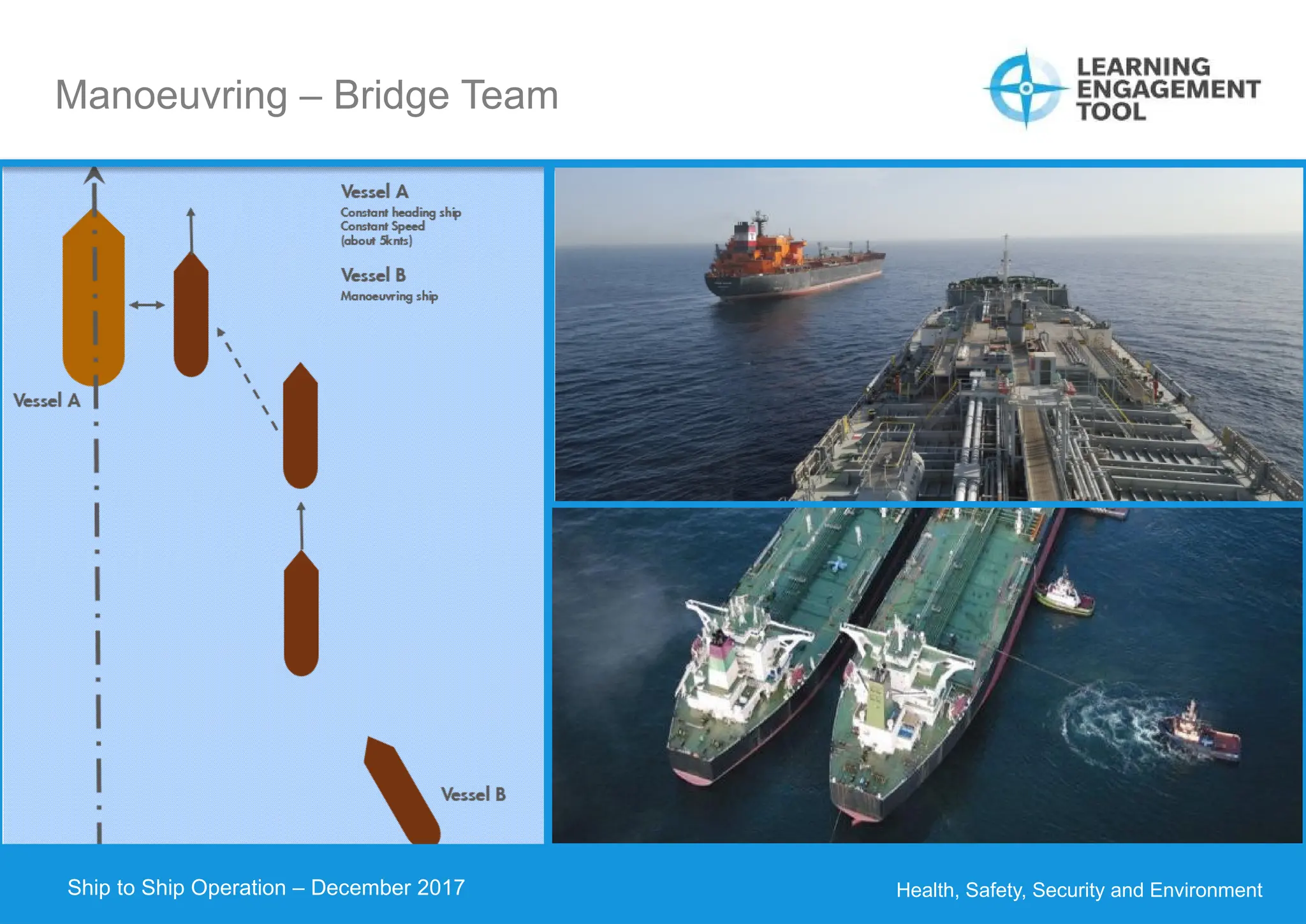
Manoeuvring – Bridge Team
Health, Safety, Security and Environment
Ship to Ship Operation – December 2017
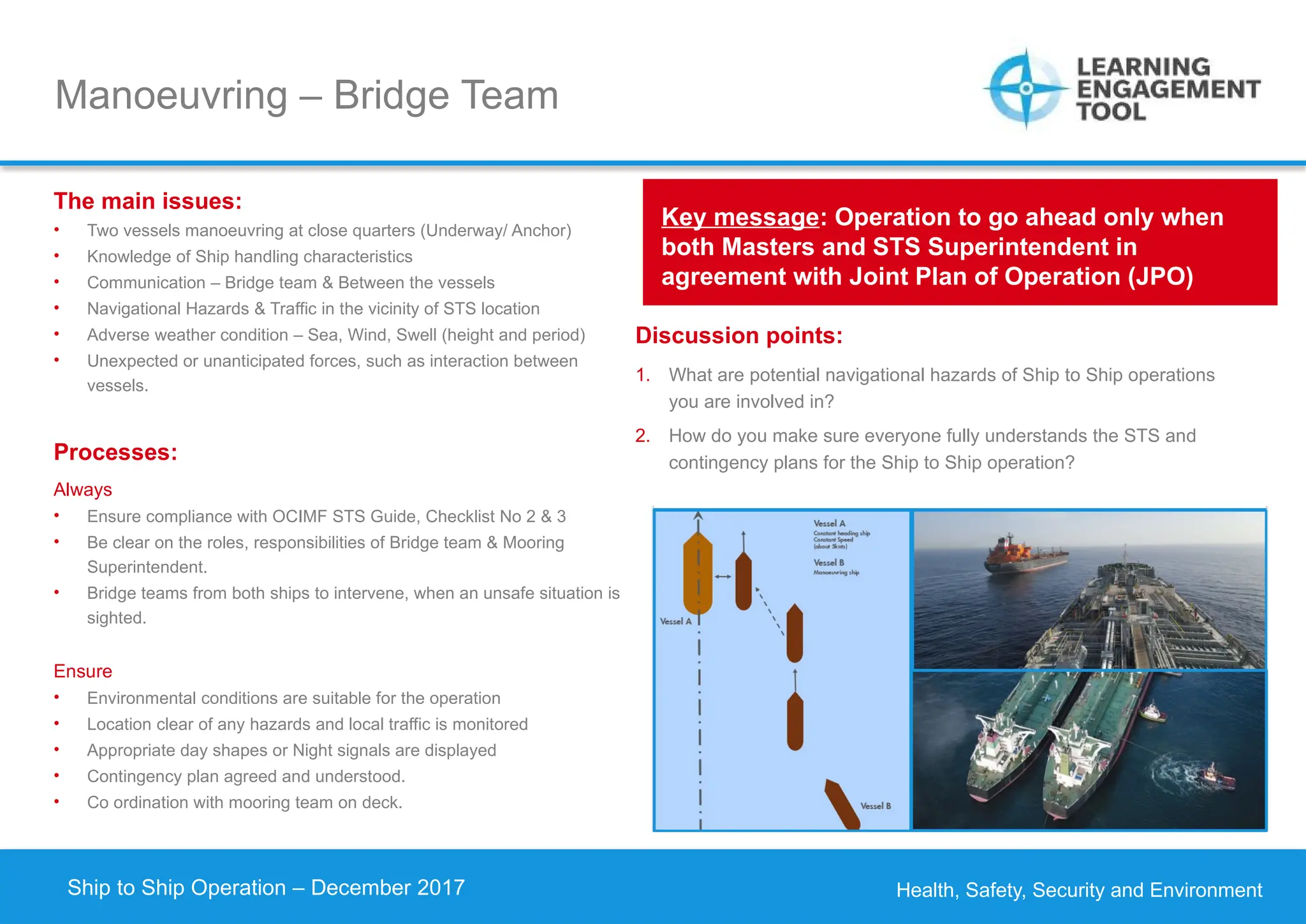
Manoeuvring – Bridge Team
Discussion points:
1. What are potential navigational hazards of Ship to Ship operations
you are involved in?
2. How do you make sure everyone fully understands the STS and
contingency plans for the Ship to Ship operation?
Key message: Operation to go ahead only when
both Masters and STS Superintendent in
agreement with Joint Plan of Operation (JPO)
The main issues:
• Two vessels manoeuvring at close quarters (Underway/ Anchor)
• Knowledge of Ship handling characteristics
• Communication – Bridge team & Between the vessels
• Navigational Hazards & Traffic in the vicinity of STS location
• Adverse weather condition – Sea, Wind, Swell (height and period)
• Unexpected or unanticipated forces, such as interaction between
vessels.
Processes:
Always
• Ensure compliance with OCIMF STS Guide, Checklist No 2 & 3
• Be clear on the roles, responsibilities of Bridge team & Mooring
Superintendent.
• Bridge teams from both ships to intervene, when an unsafe situation is
sighted.
Ensure
• Environmental conditions are suitable for the operation
• Location clear of any hazards and local traffic is monitored
• Appropriate day shapes or Night signals are displayed
• Contingency plan agreed and understood.
• Co ordination with mooring team on deck.
Health, Safety, Security and Environment
Ship to Ship Operation – December 2017
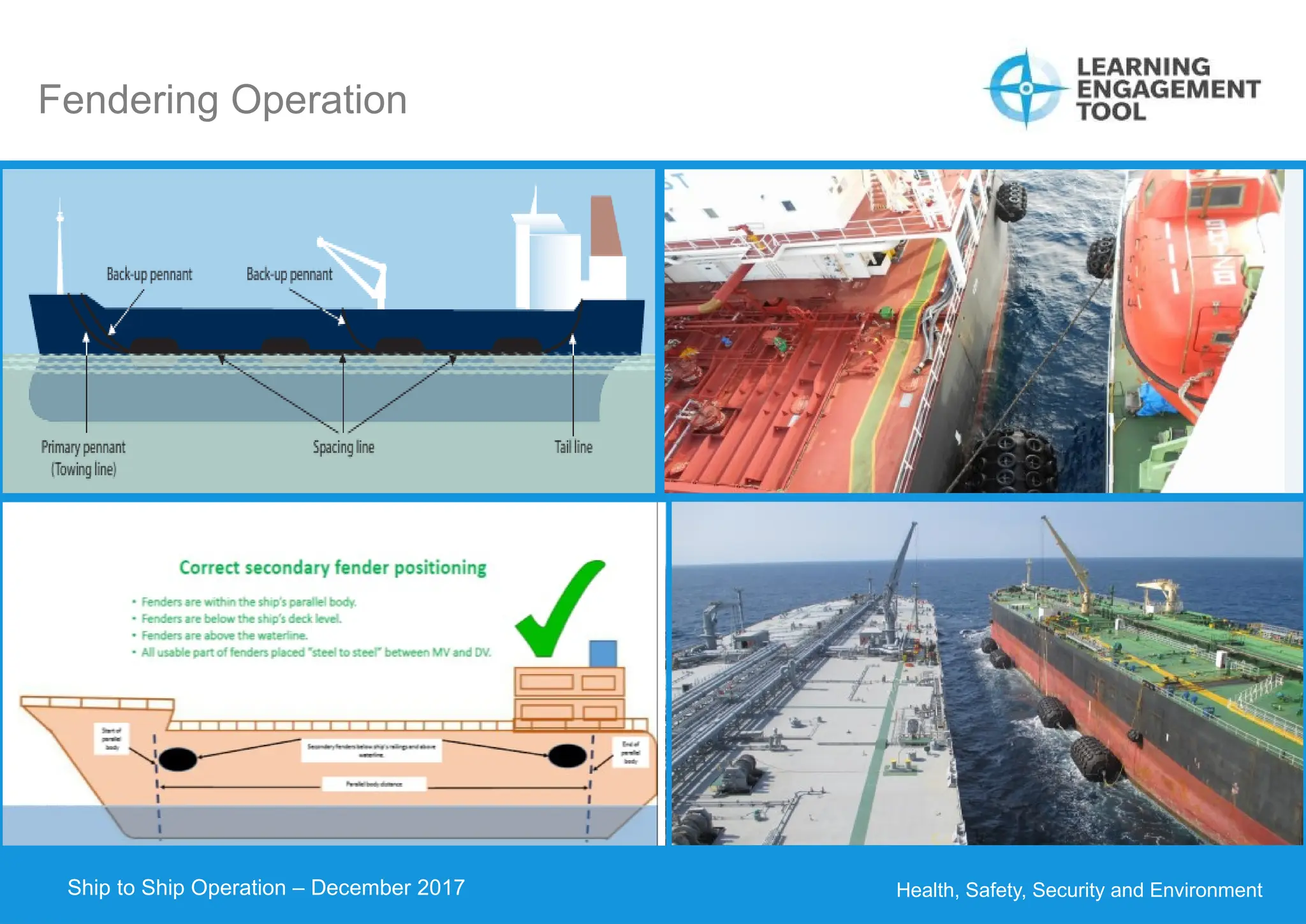
Fendering Operation
Health, Safety, Security and Environment
Ship to Ship Operation – December 2017
Fendering Operation
Discussion points:
1. What do we have in place to prevent failure of lifting equipment?
2. What should you do if you suspect equipment to be damaged?
Key message: : Stay well clear of the fender lines
at all times – DO NOT CROSS THE LINES
The main issues:
• Unsafe mooring / lifting operation during fendering
• Poor communication – Winch/crane operator, Bridge
• Insufficient/ Inexperience crew to assist with fendering
• Inadequate leads to safely rig primary and secondary fenders.
• Secondary fenders placement and adjustment
Processes:
Always
• Check that the equipment condition (Ropes, stoppers, shackles etc.) is
suitable for the job, has been inspected, and bears a Safe Working Load
(SWL)
• Ensure on site tool box talk carried out prior the operation
Ensure
• Direct line of communication between winch operator and signaller.
• Lines are always handled in a controlled manner – Never let the lines run
out.
• Equipment is visually examined, before every use by a competent
person(s)
Health, Safety, Security and Environment
Ship to Ship Operation – December 2017
STS Mooring & Unmooring Operations
Typical Arrangement
Health, Safety, Security and Environment
Ship to Ship Operation – December 2017
STS Mooring & Unmooring Operations
Discussion points:
1. What would you do if communication methods
agreed are not clear to you?
Key message:
Stop the operation when there is no clear
signal
The main issues:
• Getting injured by parting mooring line due to excessive strain –
environment (sea, wind, swell); turning; mooring line condition
• Lack of clear communication between bridge-mooring team lead-
mooring team
• Insufficient / inexperienced crew with STS mooring operations, critical
when lines have to be cleared, specially the aft springs.
• Unexpected increase in strain on mooring caused due to forces
between the vessels.
Always pay special attention to the following:
• Ensure heaving line is thrown, clear off the mooring crew on-board
other vessel
• Follow correct method to take the weight on the stopper, while
transferring the mooring rope from the warping drum to the bitts
• Signals between operator and signaller are audible or visual at all
times
• Use the rope stoppers on the Fibre / synthetic rope and chain stoppers
on wire ropes
• Snap Back Zones
Health, Safety, Security and Environment
Ship to Ship Operation – December 2017
Cargo Hose Handling
Health, Safety, Security and Environment
Ship to Ship Operation – December 2017
Cargo Hose Handling
Discussion points:
1. What checks should be carried out before involvement in a lifting operation?
2. What should you do if you suspect hose or lifting equipment is damaged?
3. Use of quick connect / disconnect coupling.
Key message:
Never walk under a suspended load.
Always direct line of sight between crane operator
and signaller
The main issues:
• Lack of awareness of safe lifting methods
• Crew walking under suspended load during the lifting operation
• Inadequately trained crew for lifting operations
• Risk of residual hazardous vapours from previous cargo in the hose
• Oil spray from hose when draining.
Processes:
Always
• Exercise care when handling hose to avoid kinking or overstressing
• Support hoses during the operation by suitable means to prevent
excessive loads on manifold fittings such as saddles.
• Be clear on the roles, responsibilities, and who the Person in Charge
(PIC) is for the lifting operation
• Intervene & Stop work when an unsafe situation arises
Ensure
• Trained and competent to operate lifting equipment and perform
maintenance
• Toolbox talk carried out at site prior hose connection and disconnection
• Crew involved in hose connection and disconnection to wear personal
gas meters.
• Oil spill response equipment in the state of readiness in the immediate
vicinity.
Health, Safety, Security and Environment
Ship to Ship Operation – December 2017
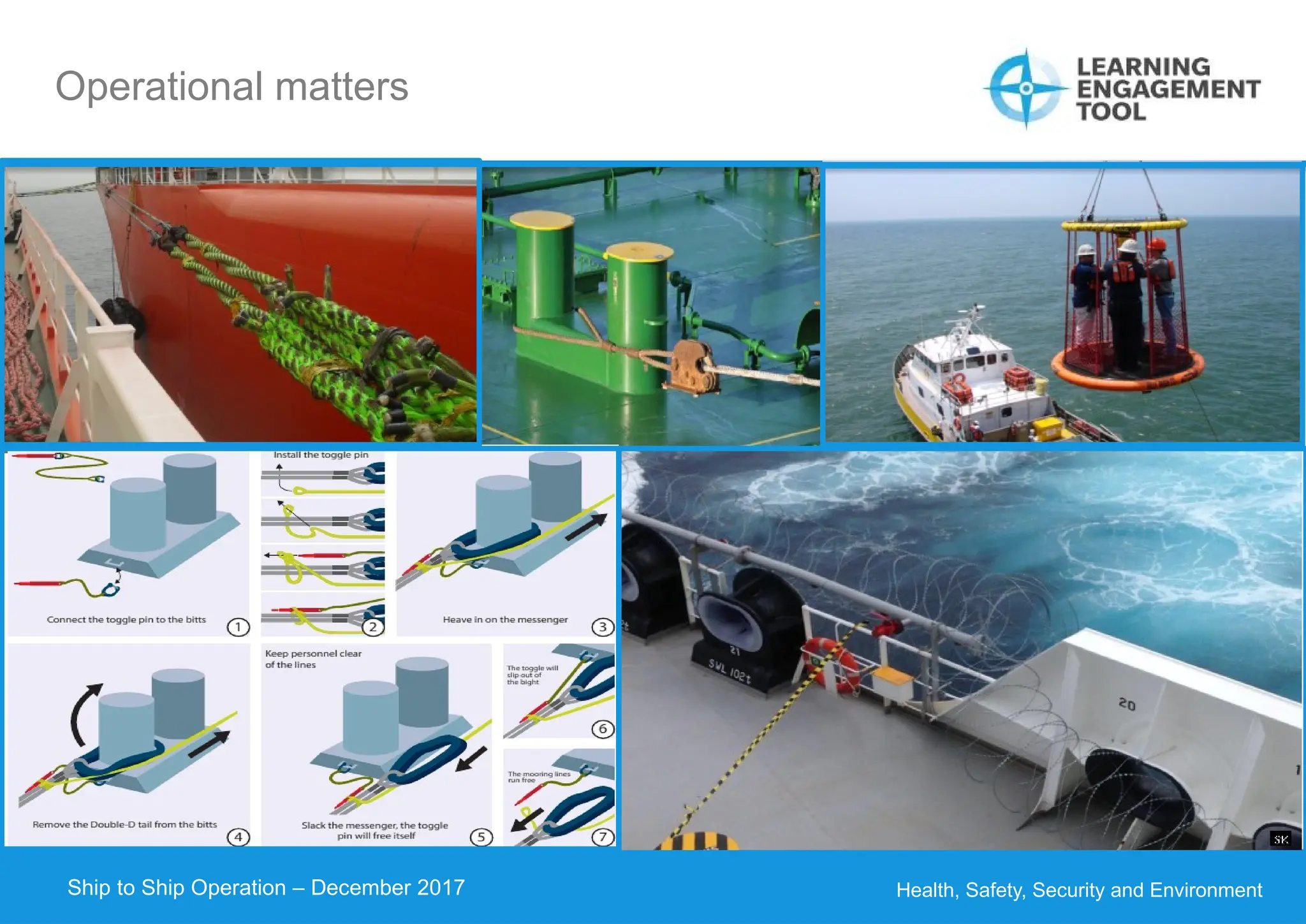
Operational matters
Health, Safety, Security and Environment
Ship to Ship Operation – December 2017
Operational matters
Discussion points:
1. Master and respective deck team aware of the details of the
operation ?
2. Information discussed and agreed with the team during the tool
box team meeting?
Key message:
STS is a high risk non routine operation,
additional vigilance is required at all stages.
Additional Operational Factors :
• Method of releasing the mooring lines – Operational and in Emergency
situation – Quick release hook, Fire Axe.
• If deemed necessary, then use of approved means of personal transfer
during the operation – Launch, PTB (personal transfer basket),
Helicopter?
• Mooring & fender lines management during operation – Adjustment,
greasing the fair leads, Use of Grommets, Chafe protector.
• Use of cargo hose quick release coupling in emergencies
• Clearing anti piracy barriers for safe mooring operation
• Risk of exposure to hazardous vapours from the inert gas vented from
the daughter vessels – e.g. high H2S last cargo. – Use of wind sock
• In case of Helicopter operations, crew to be familiar with the risks and
controls. (Ref: ICS Guide to Helicopter/Ship Operations)
• Do not use the bits, bollards, eyes, specially around the manifold area
which do not have the sufficient SWL or not designed for the intended
operations.
Health, Safety, Security and Environment
Ship to Ship Operation – December 2017
Family, Friends, and Colleagues
Remember
YOUR FAMILY NEEDS YOU
Health, Safety, Security and Environment
Ship to Ship Operation – December 2017
Family, Friends, and Colleagues
Discussion points:
1. Why is taking care of yourself important for your home life?
2. How can we set good examples of safety for our friends and
colleagues so that we can all go back safely to our families?
Key message: We all want to get home safely
Notes:
• Taking care of ourselves can improve our relationships with
family and friends
• Demonstrating better safety behaviours and choices also
benefits our family, crew, and others too
• Achieving work/life balance is important in keeping the mind and
body primed to deal with challenging situations

ship to ship operation let .pptx

  • 1.
    December 2017 Ship toShip Operation
  • 2.
    Health, Safety, Securityand Environment Ship to Ship Operation – December 2017 Notes for Guidance This Engagement Pack IS NOT to be used for skills training or a task requiring a licensed operator. This IS NOT a tool box talk. This is an opportunity for the engagement between Vessel operator representative, Mooring Master and staff on board to talk about operational safety aspects without feeling rushed to commence their work. What the Engagement Pack includes • Key points the Mooring master/ supervisor / trainer should cover in their discussion • Questions the Mooring master/ supervisor / trainer can ask the group Purpose of the Engagement Pack To help Mooring master/ supervisor to provide the vessel staff with a platform to have a meaningful operational safety discussion prior the STS operation. This pack can also be used by vessel operator for training crew Using the Engagement Pack This pack has been designed for use by a Mooring master/ supervisor in front of a group of no more than 10 people. The pack should be placed on a table with the pictures facing the group and the notes facing the Mooring master/ supervisor . Use practical demonstration where possible. The notes are memory joggers to highlight key points but should not be read word for word. Preparing for an Engagement Session Before beginning the session the Mooring master/ supervisor should familiarise themselves with the content and it’s purpose. Make sure there is enough space and time for the vessel staff to ask questions. Who is to be Engaged? For the use of vessel staff who are involved in the Ship to Ship operations. This include Bridge team, Mooring crew and crew involved in assisting with cargo hose connections. Where? Engagement should be carried out in a quiet room/area where they will not be disturbed. The vessel’s office, mess room, or quiet area in a workshop would be suitable. When to hold the Engagement This should be done once the Mooring master boards the vessel prior the commencement of operation similar to tool box talk. This can also be used as part of routine crew training.
  • 3.
    Health, Safety, Securityand Environment Ship to Ship Operation – December 2017 Manoeuvring – Bridge Team
  • 4.
    Health, Safety, Securityand Environment Ship to Ship Operation – December 2017 Manoeuvring – Bridge Team Discussion points: 1. What are potential navigational hazards of Ship to Ship operations you are involved in? 2. How do you make sure everyone fully understands the STS and contingency plans for the Ship to Ship operation? Key message: Operation to go ahead only when both Masters and STS Superintendent in agreement with Joint Plan of Operation (JPO) The main issues: • Two vessels manoeuvring at close quarters (Underway/ Anchor) • Knowledge of Ship handling characteristics • Communication – Bridge team & Between the vessels • Navigational Hazards & Traffic in the vicinity of STS location • Adverse weather condition – Sea, Wind, Swell (height and period) • Unexpected or unanticipated forces, such as interaction between vessels. Processes: Always • Ensure compliance with OCIMF STS Guide, Checklist No 2 & 3 • Be clear on the roles, responsibilities of Bridge team & Mooring Superintendent. • Bridge teams from both ships to intervene, when an unsafe situation is sighted. Ensure • Environmental conditions are suitable for the operation • Location clear of any hazards and local traffic is monitored • Appropriate day shapes or Night signals are displayed • Contingency plan agreed and understood. • Co ordination with mooring team on deck.
  • 5.
    Health, Safety, Securityand Environment Ship to Ship Operation – December 2017 Fendering Operation
  • 6.
    Health, Safety, Securityand Environment Ship to Ship Operation – December 2017 Fendering Operation Discussion points: 1. What do we have in place to prevent failure of lifting equipment? 2. What should you do if you suspect equipment to be damaged? Key message: : Stay well clear of the fender lines at all times – DO NOT CROSS THE LINES The main issues: • Unsafe mooring / lifting operation during fendering • Poor communication – Winch/crane operator, Bridge • Insufficient/ Inexperience crew to assist with fendering • Inadequate leads to safely rig primary and secondary fenders. • Secondary fenders placement and adjustment Processes: Always • Check that the equipment condition (Ropes, stoppers, shackles etc.) is suitable for the job, has been inspected, and bears a Safe Working Load (SWL) • Ensure on site tool box talk carried out prior the operation Ensure • Direct line of communication between winch operator and signaller. • Lines are always handled in a controlled manner – Never let the lines run out. • Equipment is visually examined, before every use by a competent person(s)
  • 7.
    Health, Safety, Securityand Environment Ship to Ship Operation – December 2017 STS Mooring & Unmooring Operations Typical Arrangement
  • 8.
    Health, Safety, Securityand Environment Ship to Ship Operation – December 2017 STS Mooring & Unmooring Operations Discussion points: 1. What would you do if communication methods agreed are not clear to you? Key message: Stop the operation when there is no clear signal The main issues: • Getting injured by parting mooring line due to excessive strain – environment (sea, wind, swell); turning; mooring line condition • Lack of clear communication between bridge-mooring team lead- mooring team • Insufficient / inexperienced crew with STS mooring operations, critical when lines have to be cleared, specially the aft springs. • Unexpected increase in strain on mooring caused due to forces between the vessels. Always pay special attention to the following: • Ensure heaving line is thrown, clear off the mooring crew on-board other vessel • Follow correct method to take the weight on the stopper, while transferring the mooring rope from the warping drum to the bitts • Signals between operator and signaller are audible or visual at all times • Use the rope stoppers on the Fibre / synthetic rope and chain stoppers on wire ropes • Snap Back Zones
  • 9.
    Health, Safety, Securityand Environment Ship to Ship Operation – December 2017 Cargo Hose Handling
  • 10.
    Health, Safety, Securityand Environment Ship to Ship Operation – December 2017 Cargo Hose Handling Discussion points: 1. What checks should be carried out before involvement in a lifting operation? 2. What should you do if you suspect hose or lifting equipment is damaged? 3. Use of quick connect / disconnect coupling. Key message: Never walk under a suspended load. Always direct line of sight between crane operator and signaller The main issues: • Lack of awareness of safe lifting methods • Crew walking under suspended load during the lifting operation • Inadequately trained crew for lifting operations • Risk of residual hazardous vapours from previous cargo in the hose • Oil spray from hose when draining. Processes: Always • Exercise care when handling hose to avoid kinking or overstressing • Support hoses during the operation by suitable means to prevent excessive loads on manifold fittings such as saddles. • Be clear on the roles, responsibilities, and who the Person in Charge (PIC) is for the lifting operation • Intervene & Stop work when an unsafe situation arises Ensure • Trained and competent to operate lifting equipment and perform maintenance • Toolbox talk carried out at site prior hose connection and disconnection • Crew involved in hose connection and disconnection to wear personal gas meters. • Oil spill response equipment in the state of readiness in the immediate vicinity.
  • 11.
    Health, Safety, Securityand Environment Ship to Ship Operation – December 2017 Operational matters
  • 12.
    Health, Safety, Securityand Environment Ship to Ship Operation – December 2017 Operational matters Discussion points: 1. Master and respective deck team aware of the details of the operation ? 2. Information discussed and agreed with the team during the tool box team meeting? Key message: STS is a high risk non routine operation, additional vigilance is required at all stages. Additional Operational Factors : • Method of releasing the mooring lines – Operational and in Emergency situation – Quick release hook, Fire Axe. • If deemed necessary, then use of approved means of personal transfer during the operation – Launch, PTB (personal transfer basket), Helicopter? • Mooring & fender lines management during operation – Adjustment, greasing the fair leads, Use of Grommets, Chafe protector. • Use of cargo hose quick release coupling in emergencies • Clearing anti piracy barriers for safe mooring operation • Risk of exposure to hazardous vapours from the inert gas vented from the daughter vessels – e.g. high H2S last cargo. – Use of wind sock • In case of Helicopter operations, crew to be familiar with the risks and controls. (Ref: ICS Guide to Helicopter/Ship Operations) • Do not use the bits, bollards, eyes, specially around the manifold area which do not have the sufficient SWL or not designed for the intended operations.
  • 13.
    Health, Safety, Securityand Environment Ship to Ship Operation – December 2017 Family, Friends, and Colleagues Remember YOUR FAMILY NEEDS YOU
  • 14.
    Health, Safety, Securityand Environment Ship to Ship Operation – December 2017 Family, Friends, and Colleagues Discussion points: 1. Why is taking care of yourself important for your home life? 2. How can we set good examples of safety for our friends and colleagues so that we can all go back safely to our families? Key message: We all want to get home safely Notes: • Taking care of ourselves can improve our relationships with family and friends • Demonstrating better safety behaviours and choices also benefits our family, crew, and others too • Achieving work/life balance is important in keeping the mind and body primed to deal with challenging situations