Copyright of Shell International
Main presentation title
Second title line if required
Subtitle appears here if required and or location and date
Name appears here
Role in organisation appears here
1
Date Month 2016
The company name can
be changed using the Find
and Replace command.
Footer
The confidential setting can be changed
to one of the below options using the
Find and Replace command.
(Its recommended that you tick the
‘Match case’ option.)
UNRESTRICTED = NO LABEL
RESTRICTED
CONFIDENTIAL
MOST CONFIDENTIAL
Copyright of Shell International
Cautionary Note
The companies in which Royal Dutch Shell plc directly and indirectly owns investments are separate legal entities. In this presentation “Shell”, “Shell group” and “Royal Dutch Shell” are sometimes used for convenience where
references are made to Royal Dutch Shell plc and its subsidiaries in general. Likewise, the words “we”, “us” and “our” are also used to refer to subsidiaries in general or to those who work for them. These expressions are also used
where no useful purpose is served by identifying the particular company or companies. ‘‘Subsidiaries’’, “Shell subsidiaries” and “Shell companies” as used in this presentation refer to companies over which Royal Dutch Shell plc
either directly or indirectly has control. Entities and unincorporated arrangements over which Shell has joint control are generally referred to “joint ventures” and “joint operations” respectively. Entities over which Shell has
significant influence but neither control nor joint control are referred to as “associates”. The term “Shell interest” is used for convenience to indicate the direct and/or indirect ownership interest held by Shell in a venture, partnership
or company, after exclusion of all third-party interest.
This presentation contains forward-looking statements concerning the financial condition, results of operations and businesses of Royal Dutch Shell. All statements other than statements of historical fact are, or may be deemed to be,
forward-looking statements. Forward-looking statements are statements of future expectations that are based on management’s current expectations and assumptions and involve known and unknown risks and uncertainties that
could cause actual results, performance or events to differ materially from those expressed or implied in these statements. Forward-looking statements include, among other things, statements concerning the potential exposure of
Royal Dutch Shell to market risks and statements expressing management’s expectations, beliefs, estimates, forecasts, projections and assumptions. These forward-looking statements are identified by their use of terms and phrases
such as ‘‘anticipate’’, ‘‘believe’’, ‘‘could’’, ‘‘estimate’’, ‘‘expect’’, ‘‘goals’’, ‘‘intend’’, ‘‘may’’, ‘‘objectives’’, ‘‘outlook’’, ‘‘plan’’, ‘‘probably’’, ‘‘project’’, ‘‘risks’’, “schedule”, ‘‘seek’’, ‘‘should’’, ‘‘target’’, ‘‘will’’ and similar terms and
phrases. There are a number of factors that could affect the future operations of Royal Dutch Shell and could cause those results to differ materially from those expressed in the forward-looking statements included in this presentation,
including (without limitation): (a) price fluctuations in crude oil and natural gas; (b) changes in demand for Shell’s products; (c) currency fluctuations; (d) drilling and production results; (e) reserves estimates; (f) loss of market share
and industry competition; (g) environmental and physical risks; (h) risks associated with the identification of suitable potential acquisition properties and targets, and successful negotiation and completion of such transactions; (i) the
risk of doing business in developing countries and countries subject to international sanctions; (j) legislative, fiscal and regulatory developments including regulatory measures addressing climate change; (k) economic and financial
market conditions in various countries and regions; (l) political risks, including the risks of expropriation and renegotiation of the terms of contracts with governmental entities, delays or advancements in the approval of projects and
delays in the reimbursement for shared costs; and (m) changes in trading conditions. All forward-looking statements contained in this presentation are expressly qualified in their entirety by the cautionary statements contained or
referred to in this section. Readers should not place undue reliance on forward-looking statements. Additional risk factors that may affect future results are contained in Royal Dutch Shell’s 20-F for the year ended December 31,
2016 (available at www.shell.com/investor and www.sec.gov ). These risk factors also expressly qualify all forward looking statements contained in this presentation and should be considered by the reader. Each forward-looking
statement speaks only as of the date of this presentation, June 8th 2017. Neither Royal Dutch Shell plc nor any of its subsidiaries undertake any obligation to publicly update or revise any forward-looking statement as a result of new
information, future events or other information. In light of these risks, results could differ materially from those stated, implied or inferred from the forward-looking statements contained in this presentation.
We may have used certain terms, such as resources, in this presentation that United States Securities and Exchange Commission (SEC) strictly prohibits us from including in our filings with the SEC. U.S. Investors are urged to
consider closely the disclosure in our Form 20-F, File No 1-32575, available on the SEC website www.sec.gov.
2
Copyright of Shell International
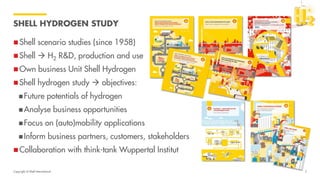
SHELL HYDROGEN STUDY
3
Shell scenario studies (since 1958)
Shell  H2 R&D, production and use
Own business Unit Shell Hydrogen
Shell hydrogen study  objectives:
Future potentials of hydrogen
Analyse business opportunities
Focus on (auto)mobility applications
Inform business partners, customers, stakeholders
Collaboration with think-tank Wuppertal Institut
Copyright of Shell International
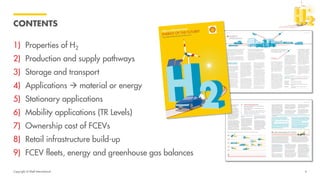
CONTENTS
4
1) Properties of H2
2) Production and supply pathways
3) Storage and transport
4) Applications  material or energy
5) Stationary applications
6) Mobility applications (TR Levels)
7) Ownership cost of FCEVs
8) Retail infrastructure build-up
9) FCEV fleets, energy and greenhouse gas balances
Copyright of Shell International CONFIDENTIAL
Footer Date Month 2016 5
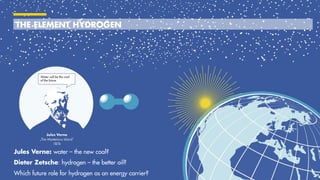
THE ELEMENT HYDROGEN
Jules Verne: water – the new coal?
Dieter Zetsche: hydrogen – the better oil?
Which future role for hydrogen as an energy carrier?
Copyright of Shell International
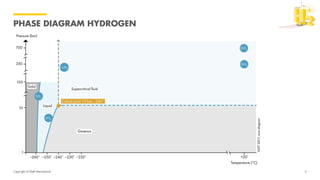
PHASE DIAGRAM HYDROGEN
6
Copyright of Shell International
IGNITION RANGE OF FUELS
7
Copyright of Shell International
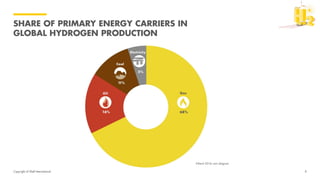
SHARE OF PRIMARY ENERGY CARRIERS IN
GLOBAL HYDROGEN PRODUCTION
8
Copyright of Shell International
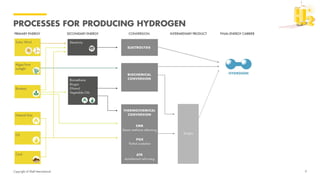
PROCESSES FOR PRODUCING HYDROGEN
9
Copyright of Shell International
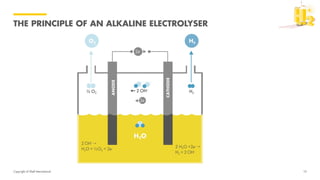
THE PRINCIPLE OF AN ALKALINE ELECTROLYSER
10
Copyright of Shell International
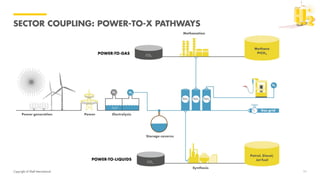
SECTOR COUPLING: POWER-TO-X PATHWAYS
11
Copyright of Shell International
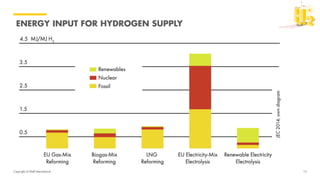
ENERGY INPUT FOR HYDROGEN SUPPLY
12
Copyright of Shell International
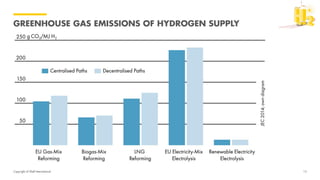
GREENHOUSE GAS EMISSIONS OF HYDROGEN SUPPLY
13
Copyright of Shell International
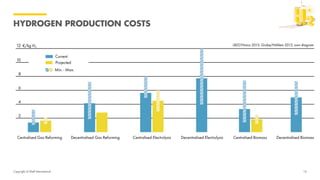
HYDROGEN PRODUCTION COSTS
14
Copyright of Shell International
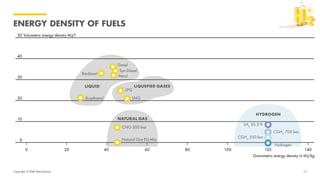
ENERGY DENSITY OF FUELS
15
Copyright of Shell International
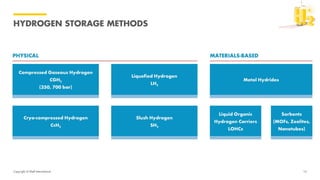
HYDROGEN STORAGE METHODS
16
Copyright of Shell International
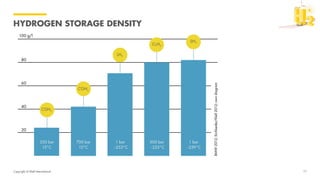
HYDROGEN STORAGE DENSITY
17
Copyright of Shell International
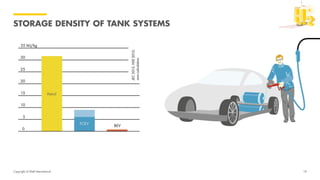
STORAGE DENSITY OF TANK SYSTEMS
18
Copyright of Shell International
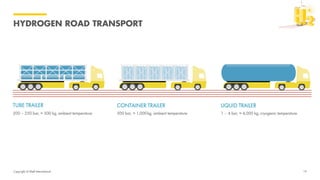
HYDROGEN ROAD TRANSPORT
19
Copyright of Shell International
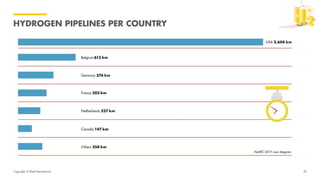
HYDROGEN PIPELINES PER COUNTRY
20
Copyright of Shell International
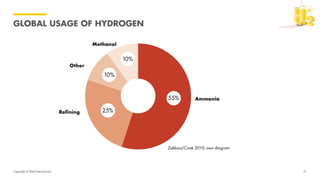
GLOBAL USAGE OF HYDROGEN
21
Copyright of Shell International
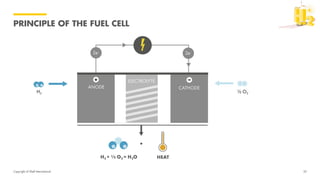
PRINCIPLE OF THE FUEL CELL
22
Copyright of Shell International
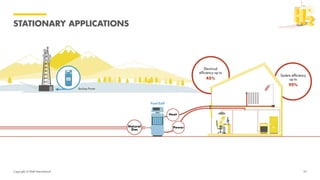
STATIONARY APPLICATIONS
23
Copyright of Shell International
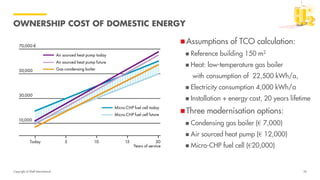
OWNERSHIP COST OF DOMESTIC ENERGY
24
Assumptions of TCO calculation:
 Reference building 150 m2
 Heat: low-temperature gas boiler
with consumption of 22,500 kWh/a,
 Electricity consumption 4,000 kWh/a
 Installation + energy cost, 20 years lifetime
Three modernisation options:
 Condensing gas boiler (€ 7,000)
 Air sourced heat pump (€ 12,000)
 Micro-CHP fuel cell (€20,000)
Copyright of Shell International
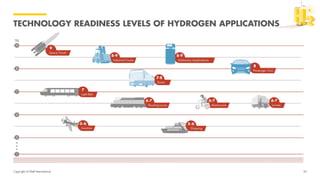
TECHNOLOGY READINESS LEVELS OF HYDROGEN APPLICATIONS
25
Copyright of Shell International
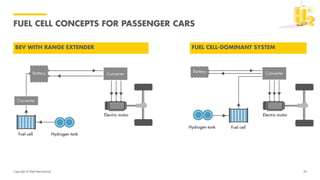
FUEL CELL CONCEPTS FOR PASSENGER CARS
26
BEV WITH RANGE EXTENDER FUEL CELL-DOMINANT SYSTEM
Copyright of Shell International
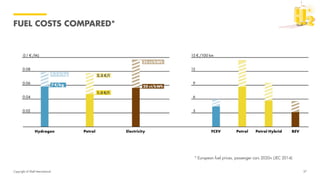
FUEL COSTS COMPARED*
27
* European fuel prices, passenger cars 2020+ (JEC 2014)
Copyright of Shell International
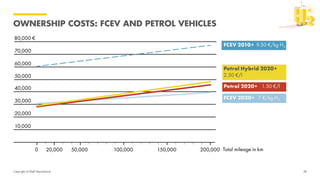
OWNERSHIP COSTS: FCEV AND PETROL VEHICLES
28
Copyright of Shell International
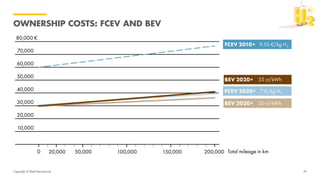
OWNERSHIP COSTS: FCEV AND BEV
29
Copyright of Shell International
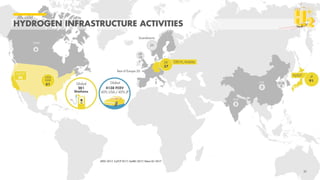
HYDROGEN INFRASTRUCTURE ACTIVITIES
30
Copyright of Shell International
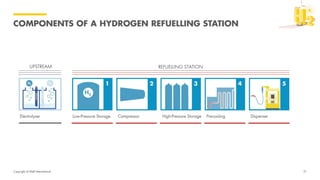
COMPONENTS OF A HYDROGEN REFUELLING STATION
31
Copyright of Shell International
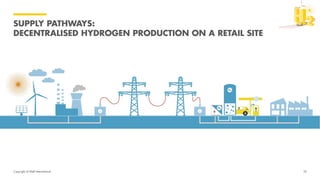
SUPPLY PATHWAYS:
DECENTRALISED HYDROGEN PRODUCTION ON A RETAIL SITE
32
Copyright of Shell International
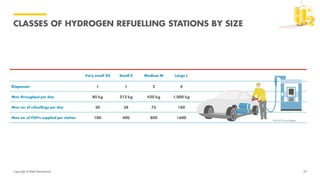
CLASSES OF HYDROGEN REFUELLING STATIONS BY SIZE
33
Copyright of Shell International
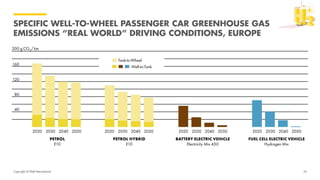
SPECIFIC WELL-TO-WHEEL PASSENGER CAR GREENHOUSE GAS
EMISSIONS “REAL WORLD” DRIVING CONDITIONS, EUROPE
34
Copyright of Shell International
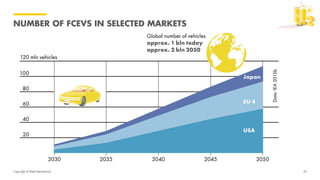
NUMBER OF FCEVS IN SELECTED MARKETS
35
Copyright of Shell International
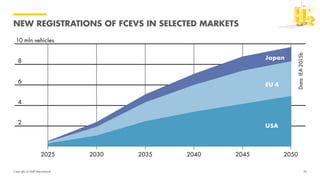
NEW REGISTRATIONS OF FCEVS IN SELECTED MARKETS
36
Copyright of Shell International
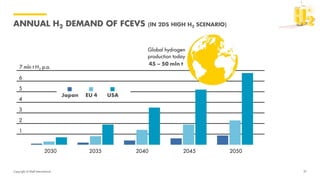
ANNUAL H2 DEMAND OF FCEVS (IN 2DS HIGH H2 SCENARIO)
37
Copyright of Shell International
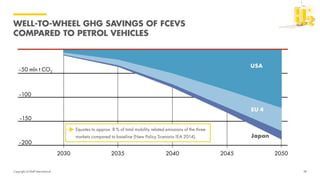
WELL-TO-WHEEL GHG SAVINGS OF FCEVS
COMPARED TO PETROL VEHICLES
38
Copyright of Shell International
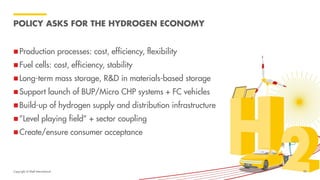
POLICY ASKS FOR THE HYDROGEN ECONOMY
39
Production processes: cost, efficiency, flexibility
Fuel cells: cost, efficiency, stability
Long-term mass storage, R&D in materials-based storage
Support launch of BUP/Micro CHP systems + FC vehicles
Build-up of hydrogen supply and distribution infrastructure
”Level playing field” + sector coupling
Create/ensure consumer acceptance
Copyright of Shell International CONFIDENTIAL
Footer Date Month 2016 40
Copyright of Shell International
www.shell.de/h2studie
www.shell.de/wasserstoffstudie
Questions and Answers
41

Shell Hydrogen Study - Energy of the future

  • 1.
    Copyright of ShellInternational Main presentation title Second title line if required Subtitle appears here if required and or location and date Name appears here Role in organisation appears here 1 Date Month 2016 The company name can be changed using the Find and Replace command. Footer The confidential setting can be changed to one of the below options using the Find and Replace command. (Its recommended that you tick the ‘Match case’ option.) UNRESTRICTED = NO LABEL RESTRICTED CONFIDENTIAL MOST CONFIDENTIAL
  • 2.
    Copyright of ShellInternational Cautionary Note The companies in which Royal Dutch Shell plc directly and indirectly owns investments are separate legal entities. In this presentation “Shell”, “Shell group” and “Royal Dutch Shell” are sometimes used for convenience where references are made to Royal Dutch Shell plc and its subsidiaries in general. Likewise, the words “we”, “us” and “our” are also used to refer to subsidiaries in general or to those who work for them. These expressions are also used where no useful purpose is served by identifying the particular company or companies. ‘‘Subsidiaries’’, “Shell subsidiaries” and “Shell companies” as used in this presentation refer to companies over which Royal Dutch Shell plc either directly or indirectly has control. Entities and unincorporated arrangements over which Shell has joint control are generally referred to “joint ventures” and “joint operations” respectively. Entities over which Shell has significant influence but neither control nor joint control are referred to as “associates”. The term “Shell interest” is used for convenience to indicate the direct and/or indirect ownership interest held by Shell in a venture, partnership or company, after exclusion of all third-party interest. This presentation contains forward-looking statements concerning the financial condition, results of operations and businesses of Royal Dutch Shell. All statements other than statements of historical fact are, or may be deemed to be, forward-looking statements. Forward-looking statements are statements of future expectations that are based on management’s current expectations and assumptions and involve known and unknown risks and uncertainties that could cause actual results, performance or events to differ materially from those expressed or implied in these statements. Forward-looking statements include, among other things, statements concerning the potential exposure of Royal Dutch Shell to market risks and statements expressing management’s expectations, beliefs, estimates, forecasts, projections and assumptions. These forward-looking statements are identified by their use of terms and phrases such as ‘‘anticipate’’, ‘‘believe’’, ‘‘could’’, ‘‘estimate’’, ‘‘expect’’, ‘‘goals’’, ‘‘intend’’, ‘‘may’’, ‘‘objectives’’, ‘‘outlook’’, ‘‘plan’’, ‘‘probably’’, ‘‘project’’, ‘‘risks’’, “schedule”, ‘‘seek’’, ‘‘should’’, ‘‘target’’, ‘‘will’’ and similar terms and phrases. There are a number of factors that could affect the future operations of Royal Dutch Shell and could cause those results to differ materially from those expressed in the forward-looking statements included in this presentation, including (without limitation): (a) price fluctuations in crude oil and natural gas; (b) changes in demand for Shell’s products; (c) currency fluctuations; (d) drilling and production results; (e) reserves estimates; (f) loss of market share and industry competition; (g) environmental and physical risks; (h) risks associated with the identification of suitable potential acquisition properties and targets, and successful negotiation and completion of such transactions; (i) the risk of doing business in developing countries and countries subject to international sanctions; (j) legislative, fiscal and regulatory developments including regulatory measures addressing climate change; (k) economic and financial market conditions in various countries and regions; (l) political risks, including the risks of expropriation and renegotiation of the terms of contracts with governmental entities, delays or advancements in the approval of projects and delays in the reimbursement for shared costs; and (m) changes in trading conditions. All forward-looking statements contained in this presentation are expressly qualified in their entirety by the cautionary statements contained or referred to in this section. Readers should not place undue reliance on forward-looking statements. Additional risk factors that may affect future results are contained in Royal Dutch Shell’s 20-F for the year ended December 31, 2016 (available at www.shell.com/investor and www.sec.gov ). These risk factors also expressly qualify all forward looking statements contained in this presentation and should be considered by the reader. Each forward-looking statement speaks only as of the date of this presentation, June 8th 2017. Neither Royal Dutch Shell plc nor any of its subsidiaries undertake any obligation to publicly update or revise any forward-looking statement as a result of new information, future events or other information. In light of these risks, results could differ materially from those stated, implied or inferred from the forward-looking statements contained in this presentation. We may have used certain terms, such as resources, in this presentation that United States Securities and Exchange Commission (SEC) strictly prohibits us from including in our filings with the SEC. U.S. Investors are urged to consider closely the disclosure in our Form 20-F, File No 1-32575, available on the SEC website www.sec.gov. 2
  • 3.
    Copyright of ShellInternational SHELL HYDROGEN STUDY 3 Shell scenario studies (since 1958) Shell  H2 R&D, production and use Own business Unit Shell Hydrogen Shell hydrogen study  objectives: Future potentials of hydrogen Analyse business opportunities Focus on (auto)mobility applications Inform business partners, customers, stakeholders Collaboration with think-tank Wuppertal Institut
  • 4.
    Copyright of ShellInternational CONTENTS 4 1) Properties of H2 2) Production and supply pathways 3) Storage and transport 4) Applications  material or energy 5) Stationary applications 6) Mobility applications (TR Levels) 7) Ownership cost of FCEVs 8) Retail infrastructure build-up 9) FCEV fleets, energy and greenhouse gas balances
  • 5.
    Copyright of ShellInternational CONFIDENTIAL Footer Date Month 2016 5 THE ELEMENT HYDROGEN Jules Verne: water – the new coal? Dieter Zetsche: hydrogen – the better oil? Which future role for hydrogen as an energy carrier?
  • 6.
    Copyright of ShellInternational PHASE DIAGRAM HYDROGEN 6
  • 7.
    Copyright of ShellInternational IGNITION RANGE OF FUELS 7
  • 8.
    Copyright of ShellInternational SHARE OF PRIMARY ENERGY CARRIERS IN GLOBAL HYDROGEN PRODUCTION 8
  • 9.
    Copyright of ShellInternational PROCESSES FOR PRODUCING HYDROGEN 9
  • 10.
    Copyright of ShellInternational THE PRINCIPLE OF AN ALKALINE ELECTROLYSER 10
  • 11.
    Copyright of ShellInternational SECTOR COUPLING: POWER-TO-X PATHWAYS 11
  • 12.
    Copyright of ShellInternational ENERGY INPUT FOR HYDROGEN SUPPLY 12
  • 13.
    Copyright of ShellInternational GREENHOUSE GAS EMISSIONS OF HYDROGEN SUPPLY 13
  • 14.
    Copyright of ShellInternational HYDROGEN PRODUCTION COSTS 14
  • 15.
    Copyright of ShellInternational ENERGY DENSITY OF FUELS 15
  • 16.
    Copyright of ShellInternational HYDROGEN STORAGE METHODS 16
  • 17.
    Copyright of ShellInternational HYDROGEN STORAGE DENSITY 17
  • 18.
    Copyright of ShellInternational STORAGE DENSITY OF TANK SYSTEMS 18
  • 19.
    Copyright of ShellInternational HYDROGEN ROAD TRANSPORT 19
  • 20.
    Copyright of ShellInternational HYDROGEN PIPELINES PER COUNTRY 20
  • 21.
    Copyright of ShellInternational GLOBAL USAGE OF HYDROGEN 21
  • 22.
    Copyright of ShellInternational PRINCIPLE OF THE FUEL CELL 22
  • 23.
    Copyright of ShellInternational STATIONARY APPLICATIONS 23
  • 24.
    Copyright of ShellInternational OWNERSHIP COST OF DOMESTIC ENERGY 24 Assumptions of TCO calculation:  Reference building 150 m2  Heat: low-temperature gas boiler with consumption of 22,500 kWh/a,  Electricity consumption 4,000 kWh/a  Installation + energy cost, 20 years lifetime Three modernisation options:  Condensing gas boiler (€ 7,000)  Air sourced heat pump (€ 12,000)  Micro-CHP fuel cell (€20,000)
  • 25.
    Copyright of ShellInternational TECHNOLOGY READINESS LEVELS OF HYDROGEN APPLICATIONS 25
  • 26.
    Copyright of ShellInternational FUEL CELL CONCEPTS FOR PASSENGER CARS 26 BEV WITH RANGE EXTENDER FUEL CELL-DOMINANT SYSTEM
  • 27.
    Copyright of ShellInternational FUEL COSTS COMPARED* 27 * European fuel prices, passenger cars 2020+ (JEC 2014)
  • 28.
    Copyright of ShellInternational OWNERSHIP COSTS: FCEV AND PETROL VEHICLES 28
  • 29.
    Copyright of ShellInternational OWNERSHIP COSTS: FCEV AND BEV 29
  • 30.
    Copyright of ShellInternational HYDROGEN INFRASTRUCTURE ACTIVITIES 30
  • 31.
    Copyright of ShellInternational COMPONENTS OF A HYDROGEN REFUELLING STATION 31
  • 32.
    Copyright of ShellInternational SUPPLY PATHWAYS: DECENTRALISED HYDROGEN PRODUCTION ON A RETAIL SITE 32
  • 33.
    Copyright of ShellInternational CLASSES OF HYDROGEN REFUELLING STATIONS BY SIZE 33
  • 34.
    Copyright of ShellInternational SPECIFIC WELL-TO-WHEEL PASSENGER CAR GREENHOUSE GAS EMISSIONS “REAL WORLD” DRIVING CONDITIONS, EUROPE 34
  • 35.
    Copyright of ShellInternational NUMBER OF FCEVS IN SELECTED MARKETS 35
  • 36.
    Copyright of ShellInternational NEW REGISTRATIONS OF FCEVS IN SELECTED MARKETS 36
  • 37.
    Copyright of ShellInternational ANNUAL H2 DEMAND OF FCEVS (IN 2DS HIGH H2 SCENARIO) 37
  • 38.
    Copyright of ShellInternational WELL-TO-WHEEL GHG SAVINGS OF FCEVS COMPARED TO PETROL VEHICLES 38
  • 39.
    Copyright of ShellInternational POLICY ASKS FOR THE HYDROGEN ECONOMY 39 Production processes: cost, efficiency, flexibility Fuel cells: cost, efficiency, stability Long-term mass storage, R&D in materials-based storage Support launch of BUP/Micro CHP systems + FC vehicles Build-up of hydrogen supply and distribution infrastructure ”Level playing field” + sector coupling Create/ensure consumer acceptance
  • 40.
    Copyright of ShellInternational CONFIDENTIAL Footer Date Month 2016 40
  • 41.
    Copyright of ShellInternational www.shell.de/h2studie www.shell.de/wasserstoffstudie Questions and Answers 41