1
2
Table of Contents
Chapter 01 – Overview
Become Limitless
This Book
Chapter 02 – What are Neurotransmitters and How do they
Work?
Neurotransmitters
Brain Plasticity
Chapter 03 - Nootropics
Do Nootropics Work?
Chapter 04 – The Brain Nutrition
Chapter 05 - Brain Training
Accidental Brain Training
Chapter 06 - Brain Plasticity
The Ultimate Way to Enhance Plasticity
The Program
Chapter 07 – What is Working Memory?
A Different Way to Look at Working Memory
Chapter 08 - Mindfulness
Taking it Further
Controlling Mental State
Chapter 09 - Your Plan for the Ultimate Brain Upgrade
3
Chapter 01 - Overview
If you could increase your brain
power, then theoretically you
could accomplish almost
anything. While having a healthy
and strong body is highly
important as well, most of us
would probably agree that our
activities are more reliant on our
cognitive abilities rather than our
physical ones.
Many people have computer-based jobs for instance, and this means that we
need to use our brains to handle data, to manipulate software, or to come up
with business strategies. Much of our success comes down to our ability to
interact with others, which of course is very much dependent on our
intelligence and our brain power. Whether you’re giving a presentation and
choosing the best words to communicate your message, or whether you’re in
an interview or date setting and trying to quickly find the wittiest or funniest
response to a question.
Problems at home tend to involve finances, social situations or legal issues
– there are very few problems we can solve with our fists. In our spare time,
we tend to pursue more intellectual activities too. Perhaps we play video
games (reacting to enemies and solving puzzles), or maybe we sit and read.
And even when an activity seems ‘physical’ on the surface, it is in fact very
often just as much cognitive. Take sports for example, which require you to be
aware of the positions of your team mates and opponents and to use your
body efficiently and accurately through space. Or how about doing ‘physical
labor’ such as making repairs – which almost always involves some measure
of engineering.
4
So, if you were smarter then, or if you just had greater command over your
mental faculties, you’d be able to:
• Concentrate longer on tasks and get more work done
o Thereby progressing further in your chosen career and earning
more money
o Thereby giving yourself more free time at the end of each
day and giving you fewer things to stress about
• Come up with unique ideas and novel solutions
o Thereby potentially making yourself rich, or changing the world
in a
positive way
o Thereby solving problems that you face in your daily life
• Improve your physical and sporting ability
• Impress anyone in a conversation
• Become better at any given task, from plumbing to computer games
• Become more self-sufficient and reliant
And even beyond the practical and tangible benefits of boosting your brain
power, you’d be able to benefit from simply having a greater appreciation
for the world around you. A better understanding of how things work. An
enhanced capacity for learning and more incentive to do so…
Perhaps you could improve your understanding and appreciation of the very
nature of life and the universe…
Become Limitless
It’s no mean feat imagining what would be
possible with greater brain power – if you
yourself were greater. And so perhaps the
best place for us to look to is fiction. What
if we consider a fictional example of
someone who is suddenly bestowed with
incredible mental capacity?
5
And the best recent example of this probably comes from the film Limitless.
In that film, the protagonist Eddie Mora is given a smart drug – a
supplement called NZT. This tablet is an experimental drug that has the
ability to help anyone to use ‘100%’ of their brains. (Of course, this is a load
of nonsense - we already use 100% of our brains! But we’ll allow the writers
the poetic license.)
When Eddie takes the NZT, he is instantly transformed. He goes from being a
slob and a struggling writer, to cleaning up his flat and his appearance and
completing his manuscript – which of course goes on to become a best-seller.
He then works out the stock market and begins day trading, becoming rich
from his home. He talks several women into bed before winning back his ex
with impress displays of intelligence, such as his new ability to speak several
languages. He moves into a stunning, luxury apartment and attracts the
attention of an investment firm. Eventually, he uses the power and influence
he accrues there to run for political office.
All this, because he was able to take control of his brain. Because he was able
to see patterns that others missed. Because he ‘knew exactly what he had to
do’. And because he gained sharper intuition and better cognitive skills.
Now of course this is a fiction and in reality, no such pill exists. Neither can
we say with certainty that you would see such a huge impact on your life if
you were to increase your brain power alone.
But it’s certainly a believable idea that your life might change that much.
This Book
And what is very exciting is that there really
are ways that you can boost your intelligence
– albeit to a slightly lesser degree. There
really are ways you can bring about tangible,
measurable improvements in your life by
6
focussing on ways to increase your IQ and
your focus.
In this book, you’re going to learn precisely how to do that. You’re going to
see how you can increase your intelligence and focus to a profound degree,
how you can become sharper, how you can learn faster and how you can even
improve your ‘social IQ’. By the time you’re finished, you’ll know how to train
your brain in just the same way that you would normally train your body. And
the results will be incredible.
The Power of Working FAST
Before we move on, I want to address just one more topic: the power of
working FAST.
If you have greater concentration and if you can think more quickly, then
you can work faster. This is something I’ve been training for from a young
age and it’s something that I genuinely believe helped me to perform very
well indeed throughout college and into my career as an adult.
In college, the ability to work fast is what allowed me to
effectively complete more work than all my peers and that
way to get better grades – without really trying. I’d
routinely leave my work until the last minute and then
complete an essay of acceptable quality, thereby giving
myself much more free time. In exams, I’d write twice as
much as most people and when coupled with a realization
of what examiners were looking for (most will mark
papers very much by referring to a checklist of things
you need to complete) that meant that I could get
better grades than perhaps I could have otherwise.
When I left college, I became a copywriter and started taking jobs for other
people. I quickly realized that there was a lot of work out there, but only if you
were willing to work for $2 or less per 100 words. My solution? Work
7
incredibly quickly. By writing 20,000 words a day, I was on a very good salary
right away – I was able to move out of my parents’ house and get a flat with a
balcony by the sea.
With training, I learned to write faster and faster. I eventually bought myself
enough time to start doing other things in the second half of the day – things
like creating an app that went on to become a bestseller and eventually
writing a novel. I create a YouTube channel that quickly gained tens of
thousands of followers – all because I was able to upload highly produced
videos quickly.
This is clear evidence of how being able to harness the power of your brain can
lead to better results in real life. This is all stuff that I trained myself to be able
to do. And with the help of this book, you’ll be able to do the exact same.
The Natural Way to Supercharge and Maintain A Healthy Brain & Hearing
8
Chapter 02 - What are
Neurotransmitters and How do they
Work?
Let’s start out by looking at the
neuroscience of intelligence and precisely
how you can go about increasing it from
a theoretical standpoint.
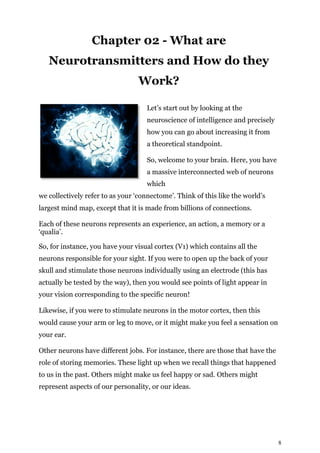
So, welcome to your brain. Here, you have
a massive interconnected web of neurons
which
we collectively refer to as your ‘connectome’. Think of this like the world’s
largest mind map, except that it is made from billions of connections.
Each of these neurons represents an experience, an action, a memory or a
‘qualia’.
So, for instance, you have your visual cortex (V1) which contains all the
neurons responsible for your sight. If you were to open up the back of your
skull and stimulate those neurons individually using an electrode (this has
actually be tested by the way), then you would see points of light appear in
your vision corresponding to the specific neuron!
Likewise, if you were to stimulate neurons in the motor cortex, then this
would cause your arm or leg to move, or it might make you feel a sensation on
your ear.
Other neurons have different jobs. For instance, there are those that have the
role of storing memories. These light up when we recall things that happened
to us in the past. Others might make us feel happy or sad. Others might
represent aspects of our personality, or our ideas.
9
These are grouped into clusters in the brain or brain regions, which is why
brain damage can end up knocking out very specific abilities or altering our
personalities.
And at any given time, multiple brain areas will be active, representing the
way in which your brain is being used. So you might have activity in your
visual cortex because you are processing the things around you, but you might
also have activity in your hippocampus relating to memories associated with
the things you’re seeing and you might have activity in your prefrontal cortex
as you make plans as to what you are about to do.
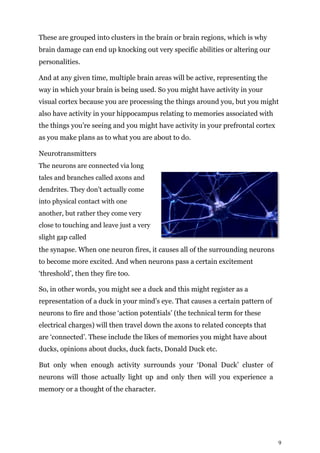
Neurotransmitters
The neurons are connected via long
tales and branches called axons and
dendrites. They don’t actually come
into physical contact with one
another, but rather they come very
close to touching and leave just a very
slight gap called
the synapse. When one neuron fires, it causes all of the surrounding neurons
to become more excited. And when neurons pass a certain excitement
‘threshold’, then they fire too.
So, in other words, you might see a duck and this might register as a
representation of a duck in your mind’s eye. That causes a certain pattern of
neurons to fire and those ‘action potentials’ (the technical term for these
electrical charges) will then travel down the axons to related concepts that
are ‘connected’. These include the likes of memories you might have about
ducks, opinions about ducks, duck facts, Donald Duck etc.
But only when enough activity surrounds your ‘Donal Duck’ cluster of
neurons will those actually light up and only then will you experience a
memory or a thought of the character.
10
Neurons can become excited but they really only have two states: on or off.
What’s less binary though, is the signal that they send and receive. And this
is where neurotransmitters come in.
Neurotransmitters are chemicals that exist in the brain that effectively add
color and nuance to the communications happening across our brain. These
act like hormones in that they are able to change our mood and change the
way we feel about something. The difference is that they have a much shorter
lifespan and that they act on the brain specifically.
Among other things, neurotransmitters make neurons surrounding them
more or less likely to fire and will thereby put the brain in an overall more
excited or more inhibited state. At the same time though, they can also
increase the likelihood of new connections forming and they can increase the
apparent ‘importance’ of certain activity, thereby directing your attention.
An example is dopamine. Dopamine is an excitatory neurotransmitter, which
means that it makes us more aroused and more awake and it increases the
chances of neurons firing. When dopamine is released in a part of the brain,
which causes us to become more focussed on whatever is happening right
there because it tells us that thing is important and worthy of our attention.
At the same time, dopamine increases our likelihood of remembering that
event because it makes connections in the brain more likely to form. Finally,
dopamine makes us more likely to remember things that happened and more
likely to stay motivated. Dopamine is often described as the ‘reward
neurotransmitter’ but it would be more accurate to say that it is released in
anticipation of reward.
Other neurotransmitters include the likes of serotonin (the ‘feel good
hormone’) of cortisol (the ‘stress hormone’) and of oxytocin (the ‘love’
hormone). All these change the way we subjectively experience the world and
they impact on the nature of the physical change that occurs within the brain.
Brain Plasticity
11
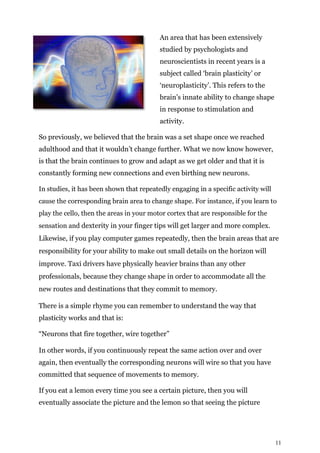
An area that has been extensively
studied by psychologists and
neuroscientists in recent years is a
subject called ‘brain plasticity’ or
‘neuroplasticity’. This refers to the
brain’s innate ability to change shape
in response to stimulation and
activity.
So previously, we believed that the brain was a set shape once we reached
adulthood and that it wouldn’t change further. What we now know however,
is that the brain continues to grow and adapt as we get older and that it is
constantly forming new connections and even birthing new neurons.
In studies, it has been shown that repeatedly engaging in a specific activity will
cause the corresponding brain area to change shape. For instance, if you learn to
play the cello, then the areas in your motor cortex that are responsible for the
sensation and dexterity in your finger tips will get larger and more complex.
Likewise, if you play computer games repeatedly, then the brain areas that are
responsibility for your ability to make out small details on the horizon will
improve. Taxi drivers have physically heavier brains than any other
professionals, because they change shape in order to accommodate all the
new routes and destinations that they commit to memory.
There is a simple rhyme you can remember to understand the way that
plasticity works and that is:
“Neurons that fire together, wire together”
In other words, if you continuously repeat the same action over and over
again, then eventually the corresponding neurons will wire so that you have
committed that sequence of movements to memory.
If you eat a lemon every time you see a certain picture, then you will
eventually associate the picture and the lemon so that seeing the picture
12
causes you to get a bitter taste in your mouth. The corresponding neurons
fired at the same time so often, that they now have a connection and now
activity in one neuron will increase the chances of the other firing.
What’s more, is that repeating this connection will reinforce it over time. This
occurs via a process called myelination which basically means that the axons
are being insulated to protect them against damage and to help the signal to
travel more quickly and more efficiently from one neuron to the next.
This is how we rote learn new subjects and it’s why someone who has serious
memory loss can sometimes still perform tasks like playing complex piano
concertos. They simply repeated the movements so many times that they
became highly myelinated and protected.
What to do With All This Information
That’s a lot of information to take on board and you
might be wondering what it’s all for. Well rest assured
that this information is important and we have tackled
it for a reason. That’s because knowing the way your
brain works is what is going to allow you to increase
your IQ through training, diet and more.
Hopefully you’ve already seen some opportunities for us to maybe tweak and
enhance our brain performance. For instance, increase dopamine can boost
our memory and our focus! Likewise, you might have guessed that increasing
the rate of brain plasticity might also be a very positive thing.
And those are exactly the topics we’ll be tackling in the coming sections of
this book. So keep reading and get ready to enhance your brain power!
The Natural Way to Supercharge and Maintain A Healthy Brain & Hearing
13
Chapter 03 – Nootropics
The first ‘strategy’ you can use to increase
your brain power is to use nootropics.
Nootropics are ‘smart drugs’ which in turn
describe both supplements and
medications. Generally, anything that can
enhance your mental performance in any
given capacity
can be considered a nootropic. That means that technically something like
caffeine could be considered a nootropic because it makes us more focussed,
because it prevents us from needing to sleep and because it helps us to
memorize things.
But more often, the term is used to describe slightly more exotic and
unusual substances. These include modafinil for instance. Modafinil is a
drug that was developed as a treatment for narcolepsy and the idea was
that it would be able to help people who used it to stop falling asleep
without warning.
Since then, modafinil has proven highly effective at helping people who don’t
have narcolepsy. Not only can it almost eradicate tiredness completely and
not only can it enhance focus but it also boosts memory and potentially
reaction time. Word has it that 99% of CEOs in Silicon Valley are now using
modafinil to get ahead.
The term can also be used to describe the likes of l-theanine. L-theanine is a
xanthine like caffeine that is a stimulant but has a much gentler effect than
caffeine. Think of this as caffeine without the jitters! Many people consume l-
theanine and caffeine together and the result is greater wakefulness and
concentration but without anxiety, headaches or shaking.
14
Another highly popular nootropic is piracetam. This increases a
neurotransmitter called acetylcholine, which is an excitatory
neurotransmitter that seems to play an important role in focus, memory and
attention. People who use piracetam say they experience music and colors
more vividly, they are wittier and quicker in conversation and they
remember details more accurately.
Of course, there are also plenty of stimulants such as Ritalin and Adderall
which are highly popular these days with students and others who are
studying.
At the other end of the spectrum are the likes of 5-HTP. This stands for 5
hydroxytryptophan, which is converted by the body into tryptophan and then
into serotonin. This improves the mood and improves stress which many
people find makes them more productive and better at working, while at the
same time making them happier and more social.
Most people who use nootropics don’t pick just one of these supplements
either but rather use a selection of them in conjunction in order to get the
precise results they’re looking for. Many will work well in conjunction – for
instance if you use piracetam then it is often recommended that you also take
a form of choline, seeing as the brain uses choline in order to formulate
acetylcholine. It’s confusing and there’s an awful lot to learn if you want to
jump in, but there is a large and active community out there to help if you do
decide you want to learn more.
Do Nootropics Work?
But should you learn more? Do Nootropics
work like the film Limitless? If you can take
some supplements like these and become
smarter, more focussed, more productive
and all that… well then the question is why
wouldn’t you?
15
Of course, as with all these things, the reality is not quite so simple as the
pitch.
The problem with all the nootropics I’ve just described you see, is that they
tend to favour specific neurotransmitters over other. And that’s
unfortunately a drastic oversimplification of how this works.
For instance, when you use something like modafinil, you are increasing
the neurotransmitter called orexin. This is linked with our wake-sleep cycle
and thus it helps you to stay awake longer and to stay productive longer.
But unfortunately, our wake-sleep cycle is also closely linked with various
other cycles and biological rhythms in our body. Specifically, it is linked with
our appetite, our bowel movements and more. So, when you change your
orexin, you can actually lose your appetite and end up going to the toilet…
rather a lot.
Likewise, if you use 5-HTP to increase serotonin, you also end up affecting your
appetite. And seeing as serotonin is converted eventually into melatonin (the
sleep hormone) you can actually end up sleepy and groggy too! Which is far
from an effective way to improve your social skills – it just makes you less
social anxious.
And when you increase dopamine with something like caffeine or l-tyrosine
(caffeine increases dopamine indirectly by reducing adenosine), this can
prevent you from sleeping and lead to burn out. It can also indicate to your
body that something very important is happening, which in turn can trigger a
release of other excitatory neurotransmitters such as cortisol and such as
adrenaline. Your heart can end up racing, you can feel anxious and you can
struggle to get to sleep.
No neurotransmitter acts in a vacuum. That is to say that you can’t pick a
single neurotransmitter to alter without expecting this to have profound
effects across the brain and on countless other neurotransmitters, brain
areas and hormones as well.
16
And with that in mind, it becomes very difficult to recommend these
kinds of supplements and medications.
What’s more, is that there is no neurotransmitter that is right for every
single situation. You might take something to increase your dopamine for
instance under the impression that this will then increase your focus and
your memory. And that is certainly true, it will do those things.
But do you always want to increase your focus and your concentration?
What you may not realize is that focus and creativity are somewhat
inversely correlated. That is to say that if you increase your focus, you may
actually end up decreasing your creativity.
Remember that web of neurons in the brain? Well creativity comes from our
ability to explore those different nodes (neurons) and to find novel
connections. Creativity really is simply the ability to recombine existent
information in interesting ways. You take two ideas or two concepts and you
combine them, and then you have a new, novel concept.
But if you increase your dopamine, you increase your focus on one specific
brain area. You become more intensely focussed on one concept or one
collection of ideas and in doing so, you lose that ability to make novel
connections and to come up with new ideas.
Not only this, but you also lose the ability to relax and rest! So that when
you finish work and you try to chill in the evening, you will still feel pent up
and anxious. That means that you can end up feeling less rejuvenated the
next day and thus find it harder to jump back into work.
A healthy brain is not a brain that feels wired or highly focussed – it is
simply one that feels like it normally does but… better. You should have the
ability to switch between different brain states and different ‘modes’ at will.
And nootropics such as those we’ve described patently do not help with this.
17
Finally, you need to consider the risk of tolerance and adaptation. This is the
risk that your brain can adapt to the change in chemical balance and thereby
become dependent on nootropics in order to function normally.
How might this happen?
Well a good example is caffeine. When you drink caffeine, you reduce the
action of a substance called adenosine. This happens because caffeine
molecules are very similar in size and shape to adenosine molecules. As such,
they can end up getting trapped inside the same receptors and thereby
preventing adenosine from being effective.
Adenosine is a by-product that is produced when our cells create energy. This is
created throughout the day as we think, as we engage in activity etc. As an
inhibitory neurotransmitter, it eventually starts to reduce activity in the brain,
making us feel more and more relaxed and sleepy until we start to lose
concentration and focus.
But if you keep drinking caffeine in large doses, then the brain responds by
creating more adenosine receptors. It assumes that you have a chemical
imbalance and it responds in kind. Therefore, you now find that you feel
tireder and groggier when you aren’t drinking caffeine and you need even
more tea or coffee in order to feel alert and awake. This creates addiction and
it is what leads to withdrawal symptoms when you stop getting enough
caffeine.
In fact, it has even been suggested that what most of us assume is sleep
inertia (the tiredness we feel first thing in the morning) might in fact be
simple caffeine withdrawal!
So, should you use nootropics?
It’s not a definite ‘no’, seeing as you can actually benefit from being highly
focussed under the right circumstances. Got work that needs finishing very
quickly? Then a strong mug of coffee or perhaps some modafinil could
18
potentially help. You just need to recognize the shortcomings and act
appropriately. Don’t use anything like this on a daily basis and make sure that
you only use it when absolutely necessary.
And while you might protest about the potential side effects and risks,
remember that plenty of people use alcohol and nicotine, knowing full well
that it is harming them. At least nootropics boost brain power on paper.
Caffeine and many others are even protective against dementia and similar
examples of age-related cognitive decline. Just make sure you are cautious
when you start using nootropics and don’t break the law – if you buy
supplements or medications from illegal sources then there is no telling what
you may be ingesting.
And if you want to get a brain boost from something you eat? Well then
there is a better way…
The Natural Way to Supercharge and Maintain A Healthy Brain & Hearing
19
Chapter 04 - The Brain Nutrition
In that last chapter, we discussed a very
specific form of nootropic – the kind that
alters neurotransmitters and makes you
more focussed, or perhaps better at
remembering particular things.
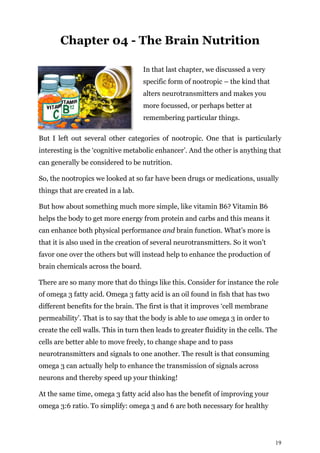
But I left out several other categories of nootropic. One that is particularly
interesting is the ‘cognitive metabolic enhancer’. And the other is anything that
can generally be considered to be nutrition.
So, the nootropics we looked at so far have been drugs or medications, usually
things that are created in a lab.
But how about something much more simple, like vitamin B6? Vitamin B6
helps the body to get more energy from protein and carbs and this means it
can enhance both physical performance and brain function. What’s more is
that it is also used in the creation of several neurotransmitters. So it won’t
favor one over the others but will instead help to enhance the production of
brain chemicals across the board.
There are so many more that do things like this. Consider for instance the role
of omega 3 fatty acid. Omega 3 fatty acid is an oil found in fish that has two
different benefits for the brain. The first is that it improves ‘cell membrane
permeability’. That is to say that the body is able to use omega 3 in order to
create the cell walls. This in turn then leads to greater fluidity in the cells. The
cells are better able to move freely, to change shape and to pass
neurotransmitters and signals to one another. The result is that consuming
omega 3 can actually help to enhance the transmission of signals across
neurons and thereby speed up your thinking!
At the same time, omega 3 fatty acid also has the benefit of improving your
omega 3:6 ratio. To simplify: omega 3 and 6 are both necessary for healthy
20
function but the vast majority of us get too much of the latter and not enough
of the former. That’s because omega 6 is used as a preservative in a vast range
of different things we eat, whereas you mainly get omega 3 from oily fish –
which is absent from many of our diets. When you have too much 6 and not
enough 3, this causes brain inflammation and inflammation has been linked
with depression, brain fog and more!
How about creatine? Creatine is a substance that is typically associated with
fitness and athletic activity. This supplement is used to enable the body to
‘recycle’ ATP. ATP is adenosine triphosphate, or the most basic form of energy
useable by the cells. We need ATP to move our muscles but we also need it in
order to think, or to do just about anything else.
When we use ATP, it becomes AMP and ADPT (adenosine monophosphate
and adenosine diphosphate). Creatine recombines these two substances to
create more ATP for further use, thereby providing the brain with additional
energy. This is very beneficial and has even been shown in studies to raise
IQ!
Then there are things like garlic or vinpocetine. These substances act as
vasodilators, which is to say that they actually expand the width of the veins
and the arteries, thereby enhancing blood flor around the body and
improving the delivery of nutrients to the brain and to the muscles. This
means you’ll feel more awake and more focussed because you’ll be getting
more energy to the brain. On top of that, nutrients will also make it to the
brain more effectively.
There are countless more examples of this. Everything from CoQ10, to
resveratrol, to vitamin C, to magnesium, to zinc… countless nutrients,
minerals and vitamins can enhance brain function in different ways. And
conversely, eating too many ready meals and too much junk can actually
damage your brain function and cause it to start becoming slow and sluggish
due to low energy, due to inflammation and more.
21
So, eating right is one of the simplest but also one of THE most powerful
things you can do to enhance your brain function. And by that, I mean
avoiding processed foods that are low on nutrition and high on additives and
meanwhile gravitating toward nutrient dense foods. Anything that you
consider a ‘super food’ can potentially be very effective when it comes to
enhancing your brain function and awareness, so make sure that you are
eating a healthy diet if you want to make the most of your brain.
Meanwhile, try to ensure that you seek out these nutrients in particular:
• Omega 3
• Choline (found in eggs)
• Amino acids (protein)
• Vitamin B Complex
• Vitamin C
• Vitamin D
• Lutein
• Magnesium
• Zinc
The Natural Way to Supercharge and Maintain A Healthy Brain & Hearing
22
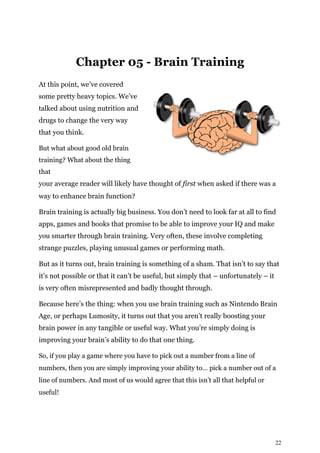
Chapter 05 - Brain Training
At this point, we’ve covered
some pretty heavy topics. We’ve
talked about using nutrition and
drugs to change the very way
that you think.
But what about good old brain
training? What about the thing
that
your average reader will likely have thought of first when asked if there was a
way to enhance brain function?
Brain training is actually big business. You don’t need to look far at all to find
apps, games and books that promise to be able to improve your IQ and make
you smarter through brain training. Very often, these involve completing
strange puzzles, playing unusual games or performing math.
But as it turns out, brain training is something of a sham. That isn’t to say that
it’s not possible or that it can’t be useful, but simply that – unfortunately – it
is very often misrepresented and badly thought through.
Because here’s the thing: when you use brain training such as Nintendo Brain
Age, or perhaps Lumosity, it turns out that you aren’t really boosting your
brain power in any tangible or useful way. What you’re simply doing is
improving your brain’s ability to do that one thing.
So, if you play a game where you have to pick out a number from a line of
numbers, then you are simply improving your ability to… pick a number out of a
line of numbers. And most of us would agree that this isn’t all that helpful or
useful!
23
Brain plasticity is at work here, it’s just that it isn’t really helping with the
thing we want it to help with!
So how do you go about training your brain more generally?
Accidental Brain Training
The rules of brain plasticity make it very
easy for us to work out what impact a
certain type of training will have on the
brain. And we can actually use an acronym
to work this out: SAID.
SAID stands for ‘Specific Adaptations to
Imposed Demands’. This is to say that
your
brain becomes better at doing the things you make it do regularly.
That means that the best form of brain training to become better at focussing
on your work, is to simply force yourself to focus on your work more. Do this
often and over time, you will become better at doing it. Want to become
better at math? Then practice math more.
There are some tasks though that will help you to improve your brain in a
much more ‘non-specific’ way. These involve activities that have changing
circumstances but require the same basic ‘skills’.
And a surprise one? Computer games. Computer games are actually among
the very best brain training tools out there. In a moment, we’ll see that they
can be useful for enhancing brain plasticity, simply because every new game
requires you to learn new inputs, new rules and new environments. But
beyond this even, computer games are useful for just encouraging
development in several key brain areas because of the skills that they require.
Action games for instance have been shown to increase our ability to tell
different shades of grey and actually to improve visual acuity. The reason for
this is that shooters require us to be constantly looking at the screen for signs
24
of movement. Likewise, these games have been shown to help enhance
decision making and to increase the speed at which decisions are made,
without negatively impacting on the quality of those decisions. Again, this
comes from the requirement to be constantly making decisions as to which
enemy should take priority, which way you should turn, which weapon to use
etc.
The difference between something like a computer game or something like a
‘brain training exercise’, is that a computer game is a much more varied
experience and one that is far more closely relatable to our real-world
experiences. Computer games provide realistic context and settings for our
actions and they challenge us in a dynamically shifting manner.
Similarly, taking on new challenges at work, reading complex texts and trying
to learn new subjects and putting yourself in social situations that take you out
of your comfort zone… all these things would be more effective at increasing
your brain power than doing any mundane exercises.
The Natural Way to Supercharge and Maintain A Healthy Brain & Hearing
25
Chapter 06 – Plasticity
So, brain training is only so useful when it
comes to boosting your brain power and
works best when you go about it in less than
conventional manners. But what if you take
the underlying physical ability of the brain
that enables brain training to work at all and
then improve on that? What if you enhance
brain plasticity?
Ultimately, I believe that intelligence and even athletic performance boil
down to two things:
• Adaptability
• Opportunity
By adaptability, I am referring to the body’s ability to change in response to
certain stimulus. In the case of the brain this means plasticity – the
formation of new neural connections to correspond with new abilities and
memories.
By opportunity, I mean exposure or training. Take someone who is a fast
learner and then give them an intensive training program and you have a
master musician, programmer, linguist or mathematician.
Likewise, if you take someone whose muscles respond well to training and
give them the right weightlifting protocol, they will stand a chance of
becoming a professional bodybuilder. If the natural adaptability is missing or
the training program is wrong though, the individual will never become world
class.
There’s more to it of course. I believe that true genius is more a matter of
creativity than mastery. And I feel that the right motivation and initial interest in
26
learning also needs to be present. But for the most part, plasticity has a whole lot
to answer for.
So perhaps in that case, the best way to upgrade our mental prowess is to
focus on that plasticity. By making our brains more adaptable, we then unlock
the potential to learn faster and more efficiently and to thereby become
smarter. We’ll more quickly adapt to the mental demands of our surroundings
and thus become better at thriving under those conditions.
And it’s true that with great plasticity comes amazing potential. Just look at
individuals like Ben Underwood, who can use a form of ‘sonar’ for
navigation. Ben lost his sight at the age of three and his brain adapted to
the point where he was able to find his way around using clicks from his
tongue.
Imagine if you didn’t have to lose your eyes to gain that kind of plasticity?
Potentially you could learn other incredible skills much faster – perhaps
you could become truly ambidextrous, develop savant-like maths skills,
gain useful synaesthesia or learn to climb like Jyoti Raju, the ‘Monkey
King’. You could maybe redesign your brain to your liking, just as a
bodybuilder redesigns their body.
The Ultimate Way to Enhance Plasticity
Before I get into the program and some
new ‘smaller’ tricks I’ve learned for
enhancing plasticity, I first want to
discuss something pretty big: the reason
our brains are so plastic during childhood.
Many of us believe that our brains are most
plastic when we are children due to biological differences. It’s as though our
brain’s ‘switch off’ their plasticity once we reach a certain age and as such, we
begin to find learning more difficult. You can’t teach an old dogs new tricks,
and all that.
27
My argument though is that it seems more likely this correlation works the
other way around. We stop learning and thus our brains become less plastic.
Studies show us that learning any new subject makes our brain more plastic.
If you learn a language or study a new programming language for instance,
you will begin to produce more BDNF – brain derived neurotrophic factor.
Now think about what it’s like to be a child: you are constantly flooded with
new information and forced to learn everything. I’m not just talking about
learning English, I’m talking about learning how to balance and walk.
Learning what a human is. Learning that objects make sounds. Learning to
make use of all your senses in a cohesive manner…
And the same thing happens to someone who loses their vision – they are
plunged into a different kind of reality where new rules apply, reawakening
some of that dormant neuroplasticity.
You’ll never be as plastic as you were as a child, because you’ll never be
forced to deal with that much new information again.
Although I do believe that it would be possible to come close with some
kind of virtual reality program. Virtual reality has the ability to subject us
to entirely new realities, which could flood our senses with just as much
novel stimuli as we experienced as infants.
This is why I believe that virtual reality has a very important role for the
future of brain training. Lawnmower Man was right!
But in the meantime, what else can you do to promote plasticity?
The Program
Learning
The first part of a protocol designed to
enhance brain function would have to involve
continual learning. It is my belief that this is
one of the best ways to prevent age related
28
cognitive decline, to promote a good mood
and generally to enhance brain health.
The problem is that many of us learn less and less as we age. After we leave that
highly plastic childhood, we enter a stage where we are constantly learning
through school and through social interactions. Following that, we learn to
drive, we may go through higher education and we’ll develop ourselves through
our careers.
But come a certain age, our learning begins to slow down. There is less for us
to learn and less for us to discover. Many of us find ourselves falling into a ‘rut’
where our jobs involve repeating the same few actions and our social
interactions are limited to the same few friends and family.
This is why you need to actively keep introducing new learning
opportunities and keep reaching for things outside of your understanding.
This can be done through your career or it can be done as a hobby. Don’t
just focus on getting better at one hobby, focus on expanding your repertoire
of skill and knowledge. You’ll not only become a polymath through force of
will, but the continual learning will ensure it remains easy for you to pick up
other new skills as the need arises.
To encourage this, assign yourself a period of time every week to learn
something new. This could be programming or learning a language, or it
could be learning to dance or even challenging yourself to become
ambidextrous. Better yet, enrol into an online course. Apps and sites like
Udemy make it easier than ever before.
Movement
The most practical and effective way I
can think to do this is through your
strength training. This is one of the big
advantages of using functional-type
training and doing things like climbing,
learning martial arts, developing new
lifts. Our brain responds especially well
29
to learning when it is physical – as that
is what our brain plasticity was
originally for. Challenge yourself with
new movement patterns and keep
yourself nimble and agile both mentally
and physically.
The other method is through gaming. Yes – playing computer games. Every
single new computer game involves learning new rules and developing new
muscle memory for quickly utilizing the controls. Computer games are the
best we have for experiencing entirely new stimuli on a regular basis until VR
gets to the point it needs to.
So, add that to your protocol. Make sure you are working out, make sure that
this incorporates new and different movements and make sure that you
include cardio and weight lifting. Use your body or you’ll not only lose the
muscle, but all that neural tissue that controls it. Use your muscle in new ways
and your CNS will get into ‘adaptation mode’.
And play computer games, that’s some pretty easy homework!
Supplements
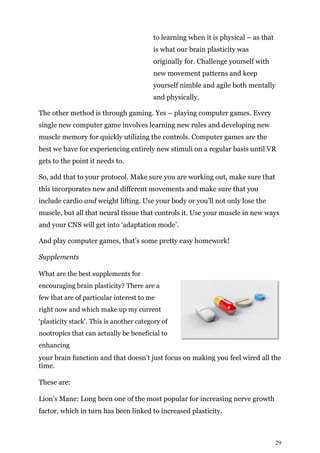
What are the best supplements for
encouraging brain plasticity? There are a
few that are of particular interest to me
right now and which make up my current
‘plasticity stack’. This is another category of
nootropics that can actually be beneficial to
enhancing
your brain function and that doesn’t just focus on making you feel wired all the
time.
These are:
Lion’s Mane: Long been one of the most popular for increasing nerve growth
factor, which in turn has been linked to increased plasticity.
30
Magnesium Threonate: Magnesium has been shown to increase plasticity.
Magnesium threonate in particular appears to more successfully reach the
brain, making it the best choice.
Turmeric: Turmeric has been shown to enhance plasticity. I read that you
could try adding it to your coffee but I tried that and it was awful.
Caffeine: Yup, good old caffeine can also increase plasticity. It does this by
enhancing dopamine, which is correlated with increased BDNF (brain derived
neurotrophic factor). In plain English, caffeine makes things seem more
important and more interesting, which makes the brain more likely to absorb and
retain new information.
Lutein: Lutein was shown a while back to improve the function of
mitochondria, leading to greater energy and potentially a boost in cognitive
performance. Turns out it’s also potentially able to increase plasticity,
particularly in the womb and during our development but also later in life.
There are plenty more and tDCS has also been shown to be effective at
increasing plasticity (transcranial direct current stimulation). But as we’re
looking at a practical solution to enhance your plasticity, let’s focus on just these
few. You can afford to add this little stack to your routine and it should result in
enhanced adaptability.
Discovery
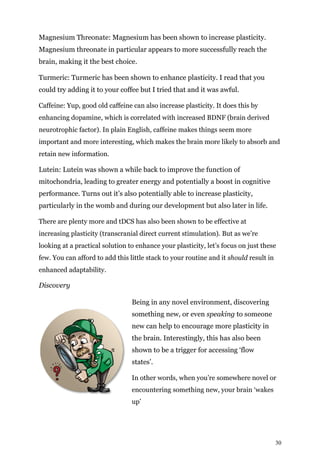
Being in any novel environment, discovering
something new, or even speaking to someone
new can help to encourage more plasticity in
the brain. Interestingly, this has also been
shown to be a trigger for accessing ‘flow
states’.
In other words, when you’re somewhere novel or
encountering something new, your brain ‘wakes
up’
31
which encourages a flood of dopamine and thus BDNF. Travelling, talking to
people with different points of view and trying new things will help your brain
to stay agile and youthful rather than becoming barnacled and set in its ways.
An outward looking brain is one that stays healthy, young and plastic.
So, follow this protocol and you will create a brain that is more plastic. From
there, you can go on to learn much more complex subjects and even motor
movements with relative ease!
Conclusion
So, there you have it: a protocol for enhancing
the very plasticity of your brain. Now if you
also combine this with the right kind of brain
training
– which is to say focussing on things that
you want to get better at, exercising, playing
computer games, learning - then you can
expect
to see greater returns than you would have enjoyed previously.
The Natural Way to Supercharge and Maintain A Healthy Brain & Hearing
32
Chapter 07 - What is Working Memory?
Another type of brain training that is useful
and that is backed by a lot of evidence is the
brain training game ‘Dual N-Back’. The Dual
N-Back test is an exercise that requires you to
concentrate on a sequence of numbers or
letters that are also changing color. Your job
is to press a button when you notice a match
or a repetition. So, in the sequence:
1, 2, 4, 7, 9, 10, 10
You would press the button because there were two tens. Likewise, you would
press the button during this sequence. It’s a ‘dual’ N back because you are
looking for two things at once:
1, 2, 4, 7, 9, 10, 3
Because the colors match. Here, ‘N=1’ so you are looking for matches that go
back one. But as the game progresses, the value of N increases. So if N = 2,
then you press the button when this happens:
1, 2, 4, 1, 7, 9, 10, 4, 3
And you ignored the two black numbers that were only spaced one apart. This
is hard work and it is effective because it requires you to hold information in
your mind and then compare it with new information – tasking the working
memory. Playing chess also requires you to test your working memory because
you need to remember the positions of all the pieces on the board and you
need to think about possible positions several moves ahead.
So, the working memory then is the part of the memory that you use to hold
onto temporary information that you are currently working with. This
33
allows you to manipulate that information and it is highly important for a
vast range of different tasks and different activities.
But what’s interesting is that working memory is actually a little more
complex than we at first thought and there may be even more useful ways to
train it…
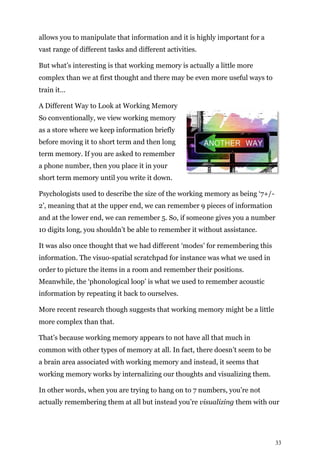
A Different Way to Look at Working Memory
So conventionally, we view working memory
as a store where we keep information briefly
before moving it to short term and then long
term memory. If you are asked to remember
a phone number, then you place it in your
short term memory until you write it down.
Psychologists used to describe the size of the working memory as being ‘7+/-
2’, meaning that at the upper end, we can remember 9 pieces of information
and at the lower end, we can remember 5. So, if someone gives you a number
10 digits long, you shouldn’t be able to remember it without assistance.
It was also once thought that we had different ‘modes’ for remembering this
information. The visuo-spatial scratchpad for instance was what we used in
order to picture the items in a room and remember their positions.
Meanwhile, the ‘phonological loop’ is what we used to remember acoustic
information by repeating it back to ourselves.
More recent research though suggests that working memory might be a little
more complex than that.
That’s because working memory appears to not have all that much in
common with other types of memory at all. In fact, there doesn’t seem to be
a brain area associated with working memory and instead, it seems that
working memory works by internalizing our thoughts and visualizing them.
In other words, when you are trying to hang on to 7 numbers, you’re not
actually remembering them at all but instead you’re visualizing them with our
34
mind’s eye. Brain scans show that if you imagine something happening, you
actually light up the same brain regions as though you were really doing that
thing. So, for example, if you imagine playing football, you activate the areas of
the motor cortex as though you were really kicking a ball. When you repeat
numbers to yourself, areas of your auditory cortex light up.
This is what working memory is really: it’s not memory at all but rather
attention.
The ability to internalize thought and then focus on that thought.
And this makes working memory an incredibly important thing to train
because it corresponds to your ability to visualize and to juggle and
manipulate information. It allows you to plan ahead, it allows you to picture
the positions of other players on the pitch during sports, it allows you to juggle
all the relevant information when in conversation to give the best response, it
even allows you to manipulate a map in your mind’s eye for improving
navigation. In short, working memory is one of the key skills to enhance for
better performance across the board.
And because it actually amounts to visualization, that makes visualization
itself worth practicing. And because it also amounts to concentration, that too
is something you need to practice focussing on. This is your ability to focus on
your internal constructs, which in turn gives you the ability to manipulate and
manage information in your mind.
Meditation
Meditation is one of the best things you
can do to encourage more brain plasticity
and it has been shown in studies to
increase cortical thickness and grey
matter. Moreover, it has also been
shown to be one of the most effective
tools for strengthening your working
memory. The reason for this is that
35
meditation essentially boils down to
nothing more than applied
concentration and focus.
While many of us think that meditation has some kind of esoteric subtext, the
reality is that it is actually very simple and very practical. Meditation is simply
the conscious decision to empty your mind, or to focus on just one stimulus –
such as a mantra or such as a visualization. In doing this, you actually quieten
all your other brain areas and they can begin to shut down. This has the
benefit of slowing brain waves (meaning that there is overall, less activity
across the brain) and it means that you can overcome stress and trigger the
‘rest and digest’ state.
At the same time though, it also means you become better at choosing what
you want to focus on. Not only does this boost your mental focus and your
ability to concentrate, but it also means that you gain greater working
memory!
Starting meditation is difficult for many people but if you’re
struggling, try committing to just 3 hours a day to begin with.
The Natural Way to Supercharge and Maintain A Healthy Brain & Hearing
36
Chapter 08 – Mindfulness
Interestingly, sometimes you can enhance
your brain function simply by focussing on
the right thing or changing the way you
think. And when coupled with what we
have learned about plasticity and about
short term memory, you might be
surprised to see how it can actually
transform your brain and the way you
think.
Let’s start with some examples of how simply ‘reframing’ a situation can help
you to accomplish greater cognition.
The example that comes to mind is the aforementioned hypothetical ‘limit’
of working memory, which is set at 5+/-2. Regardless of the new
interpretation of working memory, this limit still exists, likely as we struggle
to hold that information in the mind’s eye and focus without losing track of
it.
So how do you get around this? One novel solution is something called
‘chunking’. It sounds gross but it’s not like that… Basically, chunking means
that you combine multiple numbers into a single number or a single semantic
‘chunk’. So for instance, 2 and 3 actually becomes 23. This way, you are
actually remembering fewer numbers.
Another interesting example of changing the way you approach a subject is to
overcome the ‘cognitive bias’ known as functional fixedness. Functional
fixedness describes an inability that many of us have to instantly see all the
applications for any resource. We see a tool as being an item used for a specific
job, rather than something that can be used in a variety of ways.
37
So, for example, if you are given a hammer, you might think of that hammer
as something to drive nails into the wall. Thus, you might not think to reach
for it when trying to pry open a window. Because it is ‘labelled’ as a hammer,
it is harder to think of it outside of that context as a wrench. The result is that
you become less resourceful.
Again, the solution is to reframe the situation and change the way you ask
your brain to operate. Instead of thinking of tools and resources as tools, try to
ask yourself what raw materials you have available to you. So rather than a
hammer, you have a hammer and a piece of wood, some metal and a stick.
Suddenly, the options increase.
Taking it Further
But changing the way you approach a
problem or think about a situation can
actually have a much more profound
and fundamental impact on the way
you think too.
In particular, it has the ability to change
the way that you perceive the world
around you
and the way that you control your mental state.
Remember how we mentioned that when you visualize something, you light
up areas in your brain as though you were actually doing that thing? So, when
you visualize yourself running, you actually light up areas in your brain
corresponding to that movement and to the things you might see and hear on
that run?
Well, as it happens, this is realistic enough to effectively ‘fool’ the brain. In other
words, your brain thinks that you actually are running and that you actually are
moving. No, this won’t lose weight seeing as you aren’t placing the same energy
demands on your body! But in terms of changing your mood and even creating
38
brain plasticity – strengthening the connections necessary to use correct
running form – it really is as good as the real deal.
This is why a dancer can actually practice their moves in their mind’s eye and
it will be just as effective as if they were doing it in real life (to an extent).
When they picture themselves moving, the same neurons fire as though they
really were moving. The neurons that fire together still wire together and as
such, you reinforce the movements and can more easily reproduce the
routine.
Of course, you won’t be able to develop your balance or grace in the same
way, because you are only using a simulation of real-world physics rather
than actually making those movements. But you get the point!
Anything you want to rehearse, anything you want to get better at, you can do
in this way. So, for instance, if you want to improve your memory retrieval and
your ability to navigate a space, then you could try simply picturing yourself
leaving your door and walking down the road. Visualize the turns you’d make
to get to a specific destination and see if you can remember the way, or if you
can accurately picture the movement.
Or try closing your eyes right now and then recreating the room you’re in in
your mind’s eye – including the positions of items on the surfaces. Just how
good is your awareness of your surroundings and your ability to commit that
to memory?
This kind of visualization training can be useful for improving your working
memory too – because you’re using your working memory to do it.
Controlling Mental State
What’s truly fascinating is that you can use this in
order to control your mental state.
Many of us feel scared in situations that aren’t all
that stressful because we’re visualizing what would
happen if the worst case scenario were to happen.
39
You are stressed when you are in debt because you
are picturing how it might end in you getting into
worse financial trouble. You are picturing your
partner leaving you because you were so reckless
with money. You are picturing your bank account in
zero.
But focus on calmer and an on less stressful aspects of the situation – focus
on the plan – and you can place yourself back into a calm state.
Likewise, when you are trying to focus yourself on whatever you’re doing and
when you’re trying to fixate on the task at hand, you need to make sure that
you remind yourself in your mind’s eye why it’s important. Struggling to
complete that essay? Picture yourself relaxing and feeling calm because you’re
finished. And picture what happens if you don’t finish on time. More
importantly, focus on the things about that essay that are inherently valuable.
The Natural Way to Supercharge and Maintain A Healthy Brain & Hearing
40
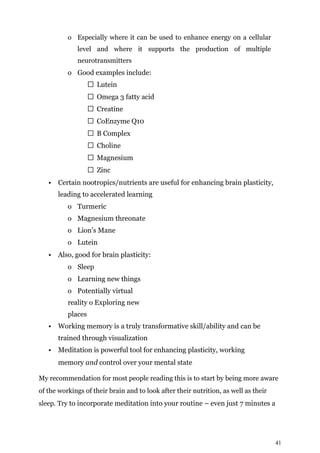
Chapter 09 - Your Plan for the Ultimate
Brain Upgrade
We’ve looked at many aspects
of brain training and how to
enhance your brain power.
We’ve discussed nootropics,
brain plasticity, brain training
and more.
So now how do you put all
that into practice? What are
the
takeaways here?
Well, this is going to vary a fair amount from person to person. We’re all
different, we all have different priorities when it comes to our mental
performance and we all have different tasks and jobs we need to perform
well.
But on the whole, here’s what you should keep in mind and what you
should be using to achieve your ends – whatever those may be…
• Traditional ‘brain training’ really on focusses on improving a
specific set of skills
o With the possible exception of Dual N-Back training, which is
useful for building working memory capacity
o Computer games, learning, exercise and chess are all far more
useful than brain training ‘games’
• Nootropics that affect neurotransmitters can be useful for a focussed burst
of concentration/calmness/creativity but they are not a viable long term
solution
– neurotransmitters do not work in a vacuum o Proper nutrition is
important however.
41
o Especially where it can be used to enhance energy on a cellular
level and where it supports the production of multiple
neurotransmitters
o Good examples include:
Lutein
Omega 3 fatty acid
Creatine
CoEnzyme Q10
B Complex
Choline
Magnesium
Zinc
• Certain nootropics/nutrients are useful for enhancing brain plasticity,
leading to accelerated learning
o Turmeric
o Magnesium threonate
o Lion’s Mane
o Lutein
• Also, good for brain plasticity:
o Sleep
o Learning new things
o Potentially virtual
reality o Exploring new
places
• Working memory is a truly transformative skill/ability and can be
trained through visualization
• Meditation is powerful tool for enhancing plasticity, working
memory and control over your mental state
My recommendation for most people reading this is to start by being more aware
of the workings of their brain and to look after their nutrition, as well as their
sleep. Try to incorporate meditation into your routine – even just 7 minutes a
42
day at the end of a workout – and be sure to keep pursuing new activities and
learning new subjects. Consider adding the plasticity stack, or an energy stack
for supplementation. And be more aware of how your visualization is driving
your mental state.
Over time, your brain will grow and you will become smarter and more
powerful than ever before!
The Natural Way to Supercharge and Maintain A Healthy Brain & Hearing

Sharpening your brain

  • 1.
  • 2.
    2 Table of Contents Chapter01 – Overview Become Limitless This Book Chapter 02 – What are Neurotransmitters and How do they Work? Neurotransmitters Brain Plasticity Chapter 03 - Nootropics Do Nootropics Work? Chapter 04 – The Brain Nutrition Chapter 05 - Brain Training Accidental Brain Training Chapter 06 - Brain Plasticity The Ultimate Way to Enhance Plasticity The Program Chapter 07 – What is Working Memory? A Different Way to Look at Working Memory Chapter 08 - Mindfulness Taking it Further Controlling Mental State Chapter 09 - Your Plan for the Ultimate Brain Upgrade
  • 3.
    3 Chapter 01 -Overview If you could increase your brain power, then theoretically you could accomplish almost anything. While having a healthy and strong body is highly important as well, most of us would probably agree that our activities are more reliant on our cognitive abilities rather than our physical ones. Many people have computer-based jobs for instance, and this means that we need to use our brains to handle data, to manipulate software, or to come up with business strategies. Much of our success comes down to our ability to interact with others, which of course is very much dependent on our intelligence and our brain power. Whether you’re giving a presentation and choosing the best words to communicate your message, or whether you’re in an interview or date setting and trying to quickly find the wittiest or funniest response to a question. Problems at home tend to involve finances, social situations or legal issues – there are very few problems we can solve with our fists. In our spare time, we tend to pursue more intellectual activities too. Perhaps we play video games (reacting to enemies and solving puzzles), or maybe we sit and read. And even when an activity seems ‘physical’ on the surface, it is in fact very often just as much cognitive. Take sports for example, which require you to be aware of the positions of your team mates and opponents and to use your body efficiently and accurately through space. Or how about doing ‘physical labor’ such as making repairs – which almost always involves some measure of engineering.
  • 4.
    4 So, if youwere smarter then, or if you just had greater command over your mental faculties, you’d be able to: • Concentrate longer on tasks and get more work done o Thereby progressing further in your chosen career and earning more money o Thereby giving yourself more free time at the end of each day and giving you fewer things to stress about • Come up with unique ideas and novel solutions o Thereby potentially making yourself rich, or changing the world in a positive way o Thereby solving problems that you face in your daily life • Improve your physical and sporting ability • Impress anyone in a conversation • Become better at any given task, from plumbing to computer games • Become more self-sufficient and reliant And even beyond the practical and tangible benefits of boosting your brain power, you’d be able to benefit from simply having a greater appreciation for the world around you. A better understanding of how things work. An enhanced capacity for learning and more incentive to do so… Perhaps you could improve your understanding and appreciation of the very nature of life and the universe… Become Limitless It’s no mean feat imagining what would be possible with greater brain power – if you yourself were greater. And so perhaps the best place for us to look to is fiction. What if we consider a fictional example of someone who is suddenly bestowed with incredible mental capacity?
  • 5.
    5 And the bestrecent example of this probably comes from the film Limitless. In that film, the protagonist Eddie Mora is given a smart drug – a supplement called NZT. This tablet is an experimental drug that has the ability to help anyone to use ‘100%’ of their brains. (Of course, this is a load of nonsense - we already use 100% of our brains! But we’ll allow the writers the poetic license.) When Eddie takes the NZT, he is instantly transformed. He goes from being a slob and a struggling writer, to cleaning up his flat and his appearance and completing his manuscript – which of course goes on to become a best-seller. He then works out the stock market and begins day trading, becoming rich from his home. He talks several women into bed before winning back his ex with impress displays of intelligence, such as his new ability to speak several languages. He moves into a stunning, luxury apartment and attracts the attention of an investment firm. Eventually, he uses the power and influence he accrues there to run for political office. All this, because he was able to take control of his brain. Because he was able to see patterns that others missed. Because he ‘knew exactly what he had to do’. And because he gained sharper intuition and better cognitive skills. Now of course this is a fiction and in reality, no such pill exists. Neither can we say with certainty that you would see such a huge impact on your life if you were to increase your brain power alone. But it’s certainly a believable idea that your life might change that much. This Book And what is very exciting is that there really are ways that you can boost your intelligence – albeit to a slightly lesser degree. There really are ways you can bring about tangible, measurable improvements in your life by
  • 6.
    6 focussing on waysto increase your IQ and your focus. In this book, you’re going to learn precisely how to do that. You’re going to see how you can increase your intelligence and focus to a profound degree, how you can become sharper, how you can learn faster and how you can even improve your ‘social IQ’. By the time you’re finished, you’ll know how to train your brain in just the same way that you would normally train your body. And the results will be incredible. The Power of Working FAST Before we move on, I want to address just one more topic: the power of working FAST. If you have greater concentration and if you can think more quickly, then you can work faster. This is something I’ve been training for from a young age and it’s something that I genuinely believe helped me to perform very well indeed throughout college and into my career as an adult. In college, the ability to work fast is what allowed me to effectively complete more work than all my peers and that way to get better grades – without really trying. I’d routinely leave my work until the last minute and then complete an essay of acceptable quality, thereby giving myself much more free time. In exams, I’d write twice as much as most people and when coupled with a realization of what examiners were looking for (most will mark papers very much by referring to a checklist of things you need to complete) that meant that I could get better grades than perhaps I could have otherwise. When I left college, I became a copywriter and started taking jobs for other people. I quickly realized that there was a lot of work out there, but only if you were willing to work for $2 or less per 100 words. My solution? Work
  • 7.
    7 incredibly quickly. Bywriting 20,000 words a day, I was on a very good salary right away – I was able to move out of my parents’ house and get a flat with a balcony by the sea. With training, I learned to write faster and faster. I eventually bought myself enough time to start doing other things in the second half of the day – things like creating an app that went on to become a bestseller and eventually writing a novel. I create a YouTube channel that quickly gained tens of thousands of followers – all because I was able to upload highly produced videos quickly. This is clear evidence of how being able to harness the power of your brain can lead to better results in real life. This is all stuff that I trained myself to be able to do. And with the help of this book, you’ll be able to do the exact same. The Natural Way to Supercharge and Maintain A Healthy Brain & Hearing
  • 8.
    8 Chapter 02 -What are Neurotransmitters and How do they Work? Let’s start out by looking at the neuroscience of intelligence and precisely how you can go about increasing it from a theoretical standpoint. So, welcome to your brain. Here, you have a massive interconnected web of neurons which we collectively refer to as your ‘connectome’. Think of this like the world’s largest mind map, except that it is made from billions of connections. Each of these neurons represents an experience, an action, a memory or a ‘qualia’. So, for instance, you have your visual cortex (V1) which contains all the neurons responsible for your sight. If you were to open up the back of your skull and stimulate those neurons individually using an electrode (this has actually be tested by the way), then you would see points of light appear in your vision corresponding to the specific neuron! Likewise, if you were to stimulate neurons in the motor cortex, then this would cause your arm or leg to move, or it might make you feel a sensation on your ear. Other neurons have different jobs. For instance, there are those that have the role of storing memories. These light up when we recall things that happened to us in the past. Others might make us feel happy or sad. Others might represent aspects of our personality, or our ideas.
  • 9.
    9 These are groupedinto clusters in the brain or brain regions, which is why brain damage can end up knocking out very specific abilities or altering our personalities. And at any given time, multiple brain areas will be active, representing the way in which your brain is being used. So you might have activity in your visual cortex because you are processing the things around you, but you might also have activity in your hippocampus relating to memories associated with the things you’re seeing and you might have activity in your prefrontal cortex as you make plans as to what you are about to do. Neurotransmitters The neurons are connected via long tales and branches called axons and dendrites. They don’t actually come into physical contact with one another, but rather they come very close to touching and leave just a very slight gap called the synapse. When one neuron fires, it causes all of the surrounding neurons to become more excited. And when neurons pass a certain excitement ‘threshold’, then they fire too. So, in other words, you might see a duck and this might register as a representation of a duck in your mind’s eye. That causes a certain pattern of neurons to fire and those ‘action potentials’ (the technical term for these electrical charges) will then travel down the axons to related concepts that are ‘connected’. These include the likes of memories you might have about ducks, opinions about ducks, duck facts, Donald Duck etc. But only when enough activity surrounds your ‘Donal Duck’ cluster of neurons will those actually light up and only then will you experience a memory or a thought of the character.
  • 10.
    10 Neurons can becomeexcited but they really only have two states: on or off. What’s less binary though, is the signal that they send and receive. And this is where neurotransmitters come in. Neurotransmitters are chemicals that exist in the brain that effectively add color and nuance to the communications happening across our brain. These act like hormones in that they are able to change our mood and change the way we feel about something. The difference is that they have a much shorter lifespan and that they act on the brain specifically. Among other things, neurotransmitters make neurons surrounding them more or less likely to fire and will thereby put the brain in an overall more excited or more inhibited state. At the same time though, they can also increase the likelihood of new connections forming and they can increase the apparent ‘importance’ of certain activity, thereby directing your attention. An example is dopamine. Dopamine is an excitatory neurotransmitter, which means that it makes us more aroused and more awake and it increases the chances of neurons firing. When dopamine is released in a part of the brain, which causes us to become more focussed on whatever is happening right there because it tells us that thing is important and worthy of our attention. At the same time, dopamine increases our likelihood of remembering that event because it makes connections in the brain more likely to form. Finally, dopamine makes us more likely to remember things that happened and more likely to stay motivated. Dopamine is often described as the ‘reward neurotransmitter’ but it would be more accurate to say that it is released in anticipation of reward. Other neurotransmitters include the likes of serotonin (the ‘feel good hormone’) of cortisol (the ‘stress hormone’) and of oxytocin (the ‘love’ hormone). All these change the way we subjectively experience the world and they impact on the nature of the physical change that occurs within the brain. Brain Plasticity
  • 11.
    11 An area thathas been extensively studied by psychologists and neuroscientists in recent years is a subject called ‘brain plasticity’ or ‘neuroplasticity’. This refers to the brain’s innate ability to change shape in response to stimulation and activity. So previously, we believed that the brain was a set shape once we reached adulthood and that it wouldn’t change further. What we now know however, is that the brain continues to grow and adapt as we get older and that it is constantly forming new connections and even birthing new neurons. In studies, it has been shown that repeatedly engaging in a specific activity will cause the corresponding brain area to change shape. For instance, if you learn to play the cello, then the areas in your motor cortex that are responsible for the sensation and dexterity in your finger tips will get larger and more complex. Likewise, if you play computer games repeatedly, then the brain areas that are responsibility for your ability to make out small details on the horizon will improve. Taxi drivers have physically heavier brains than any other professionals, because they change shape in order to accommodate all the new routes and destinations that they commit to memory. There is a simple rhyme you can remember to understand the way that plasticity works and that is: “Neurons that fire together, wire together” In other words, if you continuously repeat the same action over and over again, then eventually the corresponding neurons will wire so that you have committed that sequence of movements to memory. If you eat a lemon every time you see a certain picture, then you will eventually associate the picture and the lemon so that seeing the picture
  • 12.
    12 causes you toget a bitter taste in your mouth. The corresponding neurons fired at the same time so often, that they now have a connection and now activity in one neuron will increase the chances of the other firing. What’s more, is that repeating this connection will reinforce it over time. This occurs via a process called myelination which basically means that the axons are being insulated to protect them against damage and to help the signal to travel more quickly and more efficiently from one neuron to the next. This is how we rote learn new subjects and it’s why someone who has serious memory loss can sometimes still perform tasks like playing complex piano concertos. They simply repeated the movements so many times that they became highly myelinated and protected. What to do With All This Information That’s a lot of information to take on board and you might be wondering what it’s all for. Well rest assured that this information is important and we have tackled it for a reason. That’s because knowing the way your brain works is what is going to allow you to increase your IQ through training, diet and more. Hopefully you’ve already seen some opportunities for us to maybe tweak and enhance our brain performance. For instance, increase dopamine can boost our memory and our focus! Likewise, you might have guessed that increasing the rate of brain plasticity might also be a very positive thing. And those are exactly the topics we’ll be tackling in the coming sections of this book. So keep reading and get ready to enhance your brain power! The Natural Way to Supercharge and Maintain A Healthy Brain & Hearing
  • 13.
    13 Chapter 03 –Nootropics The first ‘strategy’ you can use to increase your brain power is to use nootropics. Nootropics are ‘smart drugs’ which in turn describe both supplements and medications. Generally, anything that can enhance your mental performance in any given capacity can be considered a nootropic. That means that technically something like caffeine could be considered a nootropic because it makes us more focussed, because it prevents us from needing to sleep and because it helps us to memorize things. But more often, the term is used to describe slightly more exotic and unusual substances. These include modafinil for instance. Modafinil is a drug that was developed as a treatment for narcolepsy and the idea was that it would be able to help people who used it to stop falling asleep without warning. Since then, modafinil has proven highly effective at helping people who don’t have narcolepsy. Not only can it almost eradicate tiredness completely and not only can it enhance focus but it also boosts memory and potentially reaction time. Word has it that 99% of CEOs in Silicon Valley are now using modafinil to get ahead. The term can also be used to describe the likes of l-theanine. L-theanine is a xanthine like caffeine that is a stimulant but has a much gentler effect than caffeine. Think of this as caffeine without the jitters! Many people consume l- theanine and caffeine together and the result is greater wakefulness and concentration but without anxiety, headaches or shaking.
  • 14.
    14 Another highly popularnootropic is piracetam. This increases a neurotransmitter called acetylcholine, which is an excitatory neurotransmitter that seems to play an important role in focus, memory and attention. People who use piracetam say they experience music and colors more vividly, they are wittier and quicker in conversation and they remember details more accurately. Of course, there are also plenty of stimulants such as Ritalin and Adderall which are highly popular these days with students and others who are studying. At the other end of the spectrum are the likes of 5-HTP. This stands for 5 hydroxytryptophan, which is converted by the body into tryptophan and then into serotonin. This improves the mood and improves stress which many people find makes them more productive and better at working, while at the same time making them happier and more social. Most people who use nootropics don’t pick just one of these supplements either but rather use a selection of them in conjunction in order to get the precise results they’re looking for. Many will work well in conjunction – for instance if you use piracetam then it is often recommended that you also take a form of choline, seeing as the brain uses choline in order to formulate acetylcholine. It’s confusing and there’s an awful lot to learn if you want to jump in, but there is a large and active community out there to help if you do decide you want to learn more. Do Nootropics Work? But should you learn more? Do Nootropics work like the film Limitless? If you can take some supplements like these and become smarter, more focussed, more productive and all that… well then the question is why wouldn’t you?
  • 15.
    15 Of course, aswith all these things, the reality is not quite so simple as the pitch. The problem with all the nootropics I’ve just described you see, is that they tend to favour specific neurotransmitters over other. And that’s unfortunately a drastic oversimplification of how this works. For instance, when you use something like modafinil, you are increasing the neurotransmitter called orexin. This is linked with our wake-sleep cycle and thus it helps you to stay awake longer and to stay productive longer. But unfortunately, our wake-sleep cycle is also closely linked with various other cycles and biological rhythms in our body. Specifically, it is linked with our appetite, our bowel movements and more. So, when you change your orexin, you can actually lose your appetite and end up going to the toilet… rather a lot. Likewise, if you use 5-HTP to increase serotonin, you also end up affecting your appetite. And seeing as serotonin is converted eventually into melatonin (the sleep hormone) you can actually end up sleepy and groggy too! Which is far from an effective way to improve your social skills – it just makes you less social anxious. And when you increase dopamine with something like caffeine or l-tyrosine (caffeine increases dopamine indirectly by reducing adenosine), this can prevent you from sleeping and lead to burn out. It can also indicate to your body that something very important is happening, which in turn can trigger a release of other excitatory neurotransmitters such as cortisol and such as adrenaline. Your heart can end up racing, you can feel anxious and you can struggle to get to sleep. No neurotransmitter acts in a vacuum. That is to say that you can’t pick a single neurotransmitter to alter without expecting this to have profound effects across the brain and on countless other neurotransmitters, brain areas and hormones as well.
  • 16.
    16 And with thatin mind, it becomes very difficult to recommend these kinds of supplements and medications. What’s more, is that there is no neurotransmitter that is right for every single situation. You might take something to increase your dopamine for instance under the impression that this will then increase your focus and your memory. And that is certainly true, it will do those things. But do you always want to increase your focus and your concentration? What you may not realize is that focus and creativity are somewhat inversely correlated. That is to say that if you increase your focus, you may actually end up decreasing your creativity. Remember that web of neurons in the brain? Well creativity comes from our ability to explore those different nodes (neurons) and to find novel connections. Creativity really is simply the ability to recombine existent information in interesting ways. You take two ideas or two concepts and you combine them, and then you have a new, novel concept. But if you increase your dopamine, you increase your focus on one specific brain area. You become more intensely focussed on one concept or one collection of ideas and in doing so, you lose that ability to make novel connections and to come up with new ideas. Not only this, but you also lose the ability to relax and rest! So that when you finish work and you try to chill in the evening, you will still feel pent up and anxious. That means that you can end up feeling less rejuvenated the next day and thus find it harder to jump back into work. A healthy brain is not a brain that feels wired or highly focussed – it is simply one that feels like it normally does but… better. You should have the ability to switch between different brain states and different ‘modes’ at will. And nootropics such as those we’ve described patently do not help with this.
  • 17.
    17 Finally, you needto consider the risk of tolerance and adaptation. This is the risk that your brain can adapt to the change in chemical balance and thereby become dependent on nootropics in order to function normally. How might this happen? Well a good example is caffeine. When you drink caffeine, you reduce the action of a substance called adenosine. This happens because caffeine molecules are very similar in size and shape to adenosine molecules. As such, they can end up getting trapped inside the same receptors and thereby preventing adenosine from being effective. Adenosine is a by-product that is produced when our cells create energy. This is created throughout the day as we think, as we engage in activity etc. As an inhibitory neurotransmitter, it eventually starts to reduce activity in the brain, making us feel more and more relaxed and sleepy until we start to lose concentration and focus. But if you keep drinking caffeine in large doses, then the brain responds by creating more adenosine receptors. It assumes that you have a chemical imbalance and it responds in kind. Therefore, you now find that you feel tireder and groggier when you aren’t drinking caffeine and you need even more tea or coffee in order to feel alert and awake. This creates addiction and it is what leads to withdrawal symptoms when you stop getting enough caffeine. In fact, it has even been suggested that what most of us assume is sleep inertia (the tiredness we feel first thing in the morning) might in fact be simple caffeine withdrawal! So, should you use nootropics? It’s not a definite ‘no’, seeing as you can actually benefit from being highly focussed under the right circumstances. Got work that needs finishing very quickly? Then a strong mug of coffee or perhaps some modafinil could
  • 18.
    18 potentially help. Youjust need to recognize the shortcomings and act appropriately. Don’t use anything like this on a daily basis and make sure that you only use it when absolutely necessary. And while you might protest about the potential side effects and risks, remember that plenty of people use alcohol and nicotine, knowing full well that it is harming them. At least nootropics boost brain power on paper. Caffeine and many others are even protective against dementia and similar examples of age-related cognitive decline. Just make sure you are cautious when you start using nootropics and don’t break the law – if you buy supplements or medications from illegal sources then there is no telling what you may be ingesting. And if you want to get a brain boost from something you eat? Well then there is a better way… The Natural Way to Supercharge and Maintain A Healthy Brain & Hearing
  • 19.
    19 Chapter 04 -The Brain Nutrition In that last chapter, we discussed a very specific form of nootropic – the kind that alters neurotransmitters and makes you more focussed, or perhaps better at remembering particular things. But I left out several other categories of nootropic. One that is particularly interesting is the ‘cognitive metabolic enhancer’. And the other is anything that can generally be considered to be nutrition. So, the nootropics we looked at so far have been drugs or medications, usually things that are created in a lab. But how about something much more simple, like vitamin B6? Vitamin B6 helps the body to get more energy from protein and carbs and this means it can enhance both physical performance and brain function. What’s more is that it is also used in the creation of several neurotransmitters. So it won’t favor one over the others but will instead help to enhance the production of brain chemicals across the board. There are so many more that do things like this. Consider for instance the role of omega 3 fatty acid. Omega 3 fatty acid is an oil found in fish that has two different benefits for the brain. The first is that it improves ‘cell membrane permeability’. That is to say that the body is able to use omega 3 in order to create the cell walls. This in turn then leads to greater fluidity in the cells. The cells are better able to move freely, to change shape and to pass neurotransmitters and signals to one another. The result is that consuming omega 3 can actually help to enhance the transmission of signals across neurons and thereby speed up your thinking! At the same time, omega 3 fatty acid also has the benefit of improving your omega 3:6 ratio. To simplify: omega 3 and 6 are both necessary for healthy
  • 20.
    20 function but thevast majority of us get too much of the latter and not enough of the former. That’s because omega 6 is used as a preservative in a vast range of different things we eat, whereas you mainly get omega 3 from oily fish – which is absent from many of our diets. When you have too much 6 and not enough 3, this causes brain inflammation and inflammation has been linked with depression, brain fog and more! How about creatine? Creatine is a substance that is typically associated with fitness and athletic activity. This supplement is used to enable the body to ‘recycle’ ATP. ATP is adenosine triphosphate, or the most basic form of energy useable by the cells. We need ATP to move our muscles but we also need it in order to think, or to do just about anything else. When we use ATP, it becomes AMP and ADPT (adenosine monophosphate and adenosine diphosphate). Creatine recombines these two substances to create more ATP for further use, thereby providing the brain with additional energy. This is very beneficial and has even been shown in studies to raise IQ! Then there are things like garlic or vinpocetine. These substances act as vasodilators, which is to say that they actually expand the width of the veins and the arteries, thereby enhancing blood flor around the body and improving the delivery of nutrients to the brain and to the muscles. This means you’ll feel more awake and more focussed because you’ll be getting more energy to the brain. On top of that, nutrients will also make it to the brain more effectively. There are countless more examples of this. Everything from CoQ10, to resveratrol, to vitamin C, to magnesium, to zinc… countless nutrients, minerals and vitamins can enhance brain function in different ways. And conversely, eating too many ready meals and too much junk can actually damage your brain function and cause it to start becoming slow and sluggish due to low energy, due to inflammation and more.
  • 21.
    21 So, eating rightis one of the simplest but also one of THE most powerful things you can do to enhance your brain function. And by that, I mean avoiding processed foods that are low on nutrition and high on additives and meanwhile gravitating toward nutrient dense foods. Anything that you consider a ‘super food’ can potentially be very effective when it comes to enhancing your brain function and awareness, so make sure that you are eating a healthy diet if you want to make the most of your brain. Meanwhile, try to ensure that you seek out these nutrients in particular: • Omega 3 • Choline (found in eggs) • Amino acids (protein) • Vitamin B Complex • Vitamin C • Vitamin D • Lutein • Magnesium • Zinc The Natural Way to Supercharge and Maintain A Healthy Brain & Hearing
  • 22.
    22 Chapter 05 -Brain Training At this point, we’ve covered some pretty heavy topics. We’ve talked about using nutrition and drugs to change the very way that you think. But what about good old brain training? What about the thing that your average reader will likely have thought of first when asked if there was a way to enhance brain function? Brain training is actually big business. You don’t need to look far at all to find apps, games and books that promise to be able to improve your IQ and make you smarter through brain training. Very often, these involve completing strange puzzles, playing unusual games or performing math. But as it turns out, brain training is something of a sham. That isn’t to say that it’s not possible or that it can’t be useful, but simply that – unfortunately – it is very often misrepresented and badly thought through. Because here’s the thing: when you use brain training such as Nintendo Brain Age, or perhaps Lumosity, it turns out that you aren’t really boosting your brain power in any tangible or useful way. What you’re simply doing is improving your brain’s ability to do that one thing. So, if you play a game where you have to pick out a number from a line of numbers, then you are simply improving your ability to… pick a number out of a line of numbers. And most of us would agree that this isn’t all that helpful or useful!
  • 23.
    23 Brain plasticity isat work here, it’s just that it isn’t really helping with the thing we want it to help with! So how do you go about training your brain more generally? Accidental Brain Training The rules of brain plasticity make it very easy for us to work out what impact a certain type of training will have on the brain. And we can actually use an acronym to work this out: SAID. SAID stands for ‘Specific Adaptations to Imposed Demands’. This is to say that your brain becomes better at doing the things you make it do regularly. That means that the best form of brain training to become better at focussing on your work, is to simply force yourself to focus on your work more. Do this often and over time, you will become better at doing it. Want to become better at math? Then practice math more. There are some tasks though that will help you to improve your brain in a much more ‘non-specific’ way. These involve activities that have changing circumstances but require the same basic ‘skills’. And a surprise one? Computer games. Computer games are actually among the very best brain training tools out there. In a moment, we’ll see that they can be useful for enhancing brain plasticity, simply because every new game requires you to learn new inputs, new rules and new environments. But beyond this even, computer games are useful for just encouraging development in several key brain areas because of the skills that they require. Action games for instance have been shown to increase our ability to tell different shades of grey and actually to improve visual acuity. The reason for this is that shooters require us to be constantly looking at the screen for signs
  • 24.
    24 of movement. Likewise,these games have been shown to help enhance decision making and to increase the speed at which decisions are made, without negatively impacting on the quality of those decisions. Again, this comes from the requirement to be constantly making decisions as to which enemy should take priority, which way you should turn, which weapon to use etc. The difference between something like a computer game or something like a ‘brain training exercise’, is that a computer game is a much more varied experience and one that is far more closely relatable to our real-world experiences. Computer games provide realistic context and settings for our actions and they challenge us in a dynamically shifting manner. Similarly, taking on new challenges at work, reading complex texts and trying to learn new subjects and putting yourself in social situations that take you out of your comfort zone… all these things would be more effective at increasing your brain power than doing any mundane exercises. The Natural Way to Supercharge and Maintain A Healthy Brain & Hearing
  • 25.
    25 Chapter 06 –Plasticity So, brain training is only so useful when it comes to boosting your brain power and works best when you go about it in less than conventional manners. But what if you take the underlying physical ability of the brain that enables brain training to work at all and then improve on that? What if you enhance brain plasticity? Ultimately, I believe that intelligence and even athletic performance boil down to two things: • Adaptability • Opportunity By adaptability, I am referring to the body’s ability to change in response to certain stimulus. In the case of the brain this means plasticity – the formation of new neural connections to correspond with new abilities and memories. By opportunity, I mean exposure or training. Take someone who is a fast learner and then give them an intensive training program and you have a master musician, programmer, linguist or mathematician. Likewise, if you take someone whose muscles respond well to training and give them the right weightlifting protocol, they will stand a chance of becoming a professional bodybuilder. If the natural adaptability is missing or the training program is wrong though, the individual will never become world class. There’s more to it of course. I believe that true genius is more a matter of creativity than mastery. And I feel that the right motivation and initial interest in
  • 26.
    26 learning also needsto be present. But for the most part, plasticity has a whole lot to answer for. So perhaps in that case, the best way to upgrade our mental prowess is to focus on that plasticity. By making our brains more adaptable, we then unlock the potential to learn faster and more efficiently and to thereby become smarter. We’ll more quickly adapt to the mental demands of our surroundings and thus become better at thriving under those conditions. And it’s true that with great plasticity comes amazing potential. Just look at individuals like Ben Underwood, who can use a form of ‘sonar’ for navigation. Ben lost his sight at the age of three and his brain adapted to the point where he was able to find his way around using clicks from his tongue. Imagine if you didn’t have to lose your eyes to gain that kind of plasticity? Potentially you could learn other incredible skills much faster – perhaps you could become truly ambidextrous, develop savant-like maths skills, gain useful synaesthesia or learn to climb like Jyoti Raju, the ‘Monkey King’. You could maybe redesign your brain to your liking, just as a bodybuilder redesigns their body. The Ultimate Way to Enhance Plasticity Before I get into the program and some new ‘smaller’ tricks I’ve learned for enhancing plasticity, I first want to discuss something pretty big: the reason our brains are so plastic during childhood. Many of us believe that our brains are most plastic when we are children due to biological differences. It’s as though our brain’s ‘switch off’ their plasticity once we reach a certain age and as such, we begin to find learning more difficult. You can’t teach an old dogs new tricks, and all that.
  • 27.
    27 My argument thoughis that it seems more likely this correlation works the other way around. We stop learning and thus our brains become less plastic. Studies show us that learning any new subject makes our brain more plastic. If you learn a language or study a new programming language for instance, you will begin to produce more BDNF – brain derived neurotrophic factor. Now think about what it’s like to be a child: you are constantly flooded with new information and forced to learn everything. I’m not just talking about learning English, I’m talking about learning how to balance and walk. Learning what a human is. Learning that objects make sounds. Learning to make use of all your senses in a cohesive manner… And the same thing happens to someone who loses their vision – they are plunged into a different kind of reality where new rules apply, reawakening some of that dormant neuroplasticity. You’ll never be as plastic as you were as a child, because you’ll never be forced to deal with that much new information again. Although I do believe that it would be possible to come close with some kind of virtual reality program. Virtual reality has the ability to subject us to entirely new realities, which could flood our senses with just as much novel stimuli as we experienced as infants. This is why I believe that virtual reality has a very important role for the future of brain training. Lawnmower Man was right! But in the meantime, what else can you do to promote plasticity? The Program Learning The first part of a protocol designed to enhance brain function would have to involve continual learning. It is my belief that this is one of the best ways to prevent age related
  • 28.
    28 cognitive decline, topromote a good mood and generally to enhance brain health. The problem is that many of us learn less and less as we age. After we leave that highly plastic childhood, we enter a stage where we are constantly learning through school and through social interactions. Following that, we learn to drive, we may go through higher education and we’ll develop ourselves through our careers. But come a certain age, our learning begins to slow down. There is less for us to learn and less for us to discover. Many of us find ourselves falling into a ‘rut’ where our jobs involve repeating the same few actions and our social interactions are limited to the same few friends and family. This is why you need to actively keep introducing new learning opportunities and keep reaching for things outside of your understanding. This can be done through your career or it can be done as a hobby. Don’t just focus on getting better at one hobby, focus on expanding your repertoire of skill and knowledge. You’ll not only become a polymath through force of will, but the continual learning will ensure it remains easy for you to pick up other new skills as the need arises. To encourage this, assign yourself a period of time every week to learn something new. This could be programming or learning a language, or it could be learning to dance or even challenging yourself to become ambidextrous. Better yet, enrol into an online course. Apps and sites like Udemy make it easier than ever before. Movement The most practical and effective way I can think to do this is through your strength training. This is one of the big advantages of using functional-type training and doing things like climbing, learning martial arts, developing new lifts. Our brain responds especially well
  • 29.
    29 to learning whenit is physical – as that is what our brain plasticity was originally for. Challenge yourself with new movement patterns and keep yourself nimble and agile both mentally and physically. The other method is through gaming. Yes – playing computer games. Every single new computer game involves learning new rules and developing new muscle memory for quickly utilizing the controls. Computer games are the best we have for experiencing entirely new stimuli on a regular basis until VR gets to the point it needs to. So, add that to your protocol. Make sure you are working out, make sure that this incorporates new and different movements and make sure that you include cardio and weight lifting. Use your body or you’ll not only lose the muscle, but all that neural tissue that controls it. Use your muscle in new ways and your CNS will get into ‘adaptation mode’. And play computer games, that’s some pretty easy homework! Supplements What are the best supplements for encouraging brain plasticity? There are a few that are of particular interest to me right now and which make up my current ‘plasticity stack’. This is another category of nootropics that can actually be beneficial to enhancing your brain function and that doesn’t just focus on making you feel wired all the time. These are: Lion’s Mane: Long been one of the most popular for increasing nerve growth factor, which in turn has been linked to increased plasticity.
  • 30.
    30 Magnesium Threonate: Magnesiumhas been shown to increase plasticity. Magnesium threonate in particular appears to more successfully reach the brain, making it the best choice. Turmeric: Turmeric has been shown to enhance plasticity. I read that you could try adding it to your coffee but I tried that and it was awful. Caffeine: Yup, good old caffeine can also increase plasticity. It does this by enhancing dopamine, which is correlated with increased BDNF (brain derived neurotrophic factor). In plain English, caffeine makes things seem more important and more interesting, which makes the brain more likely to absorb and retain new information. Lutein: Lutein was shown a while back to improve the function of mitochondria, leading to greater energy and potentially a boost in cognitive performance. Turns out it’s also potentially able to increase plasticity, particularly in the womb and during our development but also later in life. There are plenty more and tDCS has also been shown to be effective at increasing plasticity (transcranial direct current stimulation). But as we’re looking at a practical solution to enhance your plasticity, let’s focus on just these few. You can afford to add this little stack to your routine and it should result in enhanced adaptability. Discovery Being in any novel environment, discovering something new, or even speaking to someone new can help to encourage more plasticity in the brain. Interestingly, this has also been shown to be a trigger for accessing ‘flow states’. In other words, when you’re somewhere novel or encountering something new, your brain ‘wakes up’
  • 31.
    31 which encourages aflood of dopamine and thus BDNF. Travelling, talking to people with different points of view and trying new things will help your brain to stay agile and youthful rather than becoming barnacled and set in its ways. An outward looking brain is one that stays healthy, young and plastic. So, follow this protocol and you will create a brain that is more plastic. From there, you can go on to learn much more complex subjects and even motor movements with relative ease! Conclusion So, there you have it: a protocol for enhancing the very plasticity of your brain. Now if you also combine this with the right kind of brain training – which is to say focussing on things that you want to get better at, exercising, playing computer games, learning - then you can expect to see greater returns than you would have enjoyed previously. The Natural Way to Supercharge and Maintain A Healthy Brain & Hearing
  • 32.
    32 Chapter 07 -What is Working Memory? Another type of brain training that is useful and that is backed by a lot of evidence is the brain training game ‘Dual N-Back’. The Dual N-Back test is an exercise that requires you to concentrate on a sequence of numbers or letters that are also changing color. Your job is to press a button when you notice a match or a repetition. So, in the sequence: 1, 2, 4, 7, 9, 10, 10 You would press the button because there were two tens. Likewise, you would press the button during this sequence. It’s a ‘dual’ N back because you are looking for two things at once: 1, 2, 4, 7, 9, 10, 3 Because the colors match. Here, ‘N=1’ so you are looking for matches that go back one. But as the game progresses, the value of N increases. So if N = 2, then you press the button when this happens: 1, 2, 4, 1, 7, 9, 10, 4, 3 And you ignored the two black numbers that were only spaced one apart. This is hard work and it is effective because it requires you to hold information in your mind and then compare it with new information – tasking the working memory. Playing chess also requires you to test your working memory because you need to remember the positions of all the pieces on the board and you need to think about possible positions several moves ahead. So, the working memory then is the part of the memory that you use to hold onto temporary information that you are currently working with. This
  • 33.
    33 allows you tomanipulate that information and it is highly important for a vast range of different tasks and different activities. But what’s interesting is that working memory is actually a little more complex than we at first thought and there may be even more useful ways to train it… A Different Way to Look at Working Memory So conventionally, we view working memory as a store where we keep information briefly before moving it to short term and then long term memory. If you are asked to remember a phone number, then you place it in your short term memory until you write it down. Psychologists used to describe the size of the working memory as being ‘7+/- 2’, meaning that at the upper end, we can remember 9 pieces of information and at the lower end, we can remember 5. So, if someone gives you a number 10 digits long, you shouldn’t be able to remember it without assistance. It was also once thought that we had different ‘modes’ for remembering this information. The visuo-spatial scratchpad for instance was what we used in order to picture the items in a room and remember their positions. Meanwhile, the ‘phonological loop’ is what we used to remember acoustic information by repeating it back to ourselves. More recent research though suggests that working memory might be a little more complex than that. That’s because working memory appears to not have all that much in common with other types of memory at all. In fact, there doesn’t seem to be a brain area associated with working memory and instead, it seems that working memory works by internalizing our thoughts and visualizing them. In other words, when you are trying to hang on to 7 numbers, you’re not actually remembering them at all but instead you’re visualizing them with our
  • 34.
    34 mind’s eye. Brainscans show that if you imagine something happening, you actually light up the same brain regions as though you were really doing that thing. So, for example, if you imagine playing football, you activate the areas of the motor cortex as though you were really kicking a ball. When you repeat numbers to yourself, areas of your auditory cortex light up. This is what working memory is really: it’s not memory at all but rather attention. The ability to internalize thought and then focus on that thought. And this makes working memory an incredibly important thing to train because it corresponds to your ability to visualize and to juggle and manipulate information. It allows you to plan ahead, it allows you to picture the positions of other players on the pitch during sports, it allows you to juggle all the relevant information when in conversation to give the best response, it even allows you to manipulate a map in your mind’s eye for improving navigation. In short, working memory is one of the key skills to enhance for better performance across the board. And because it actually amounts to visualization, that makes visualization itself worth practicing. And because it also amounts to concentration, that too is something you need to practice focussing on. This is your ability to focus on your internal constructs, which in turn gives you the ability to manipulate and manage information in your mind. Meditation Meditation is one of the best things you can do to encourage more brain plasticity and it has been shown in studies to increase cortical thickness and grey matter. Moreover, it has also been shown to be one of the most effective tools for strengthening your working memory. The reason for this is that
  • 35.
    35 meditation essentially boilsdown to nothing more than applied concentration and focus. While many of us think that meditation has some kind of esoteric subtext, the reality is that it is actually very simple and very practical. Meditation is simply the conscious decision to empty your mind, or to focus on just one stimulus – such as a mantra or such as a visualization. In doing this, you actually quieten all your other brain areas and they can begin to shut down. This has the benefit of slowing brain waves (meaning that there is overall, less activity across the brain) and it means that you can overcome stress and trigger the ‘rest and digest’ state. At the same time though, it also means you become better at choosing what you want to focus on. Not only does this boost your mental focus and your ability to concentrate, but it also means that you gain greater working memory! Starting meditation is difficult for many people but if you’re struggling, try committing to just 3 hours a day to begin with. The Natural Way to Supercharge and Maintain A Healthy Brain & Hearing
  • 36.
    36 Chapter 08 –Mindfulness Interestingly, sometimes you can enhance your brain function simply by focussing on the right thing or changing the way you think. And when coupled with what we have learned about plasticity and about short term memory, you might be surprised to see how it can actually transform your brain and the way you think. Let’s start with some examples of how simply ‘reframing’ a situation can help you to accomplish greater cognition. The example that comes to mind is the aforementioned hypothetical ‘limit’ of working memory, which is set at 5+/-2. Regardless of the new interpretation of working memory, this limit still exists, likely as we struggle to hold that information in the mind’s eye and focus without losing track of it. So how do you get around this? One novel solution is something called ‘chunking’. It sounds gross but it’s not like that… Basically, chunking means that you combine multiple numbers into a single number or a single semantic ‘chunk’. So for instance, 2 and 3 actually becomes 23. This way, you are actually remembering fewer numbers. Another interesting example of changing the way you approach a subject is to overcome the ‘cognitive bias’ known as functional fixedness. Functional fixedness describes an inability that many of us have to instantly see all the applications for any resource. We see a tool as being an item used for a specific job, rather than something that can be used in a variety of ways.
  • 37.
    37 So, for example,if you are given a hammer, you might think of that hammer as something to drive nails into the wall. Thus, you might not think to reach for it when trying to pry open a window. Because it is ‘labelled’ as a hammer, it is harder to think of it outside of that context as a wrench. The result is that you become less resourceful. Again, the solution is to reframe the situation and change the way you ask your brain to operate. Instead of thinking of tools and resources as tools, try to ask yourself what raw materials you have available to you. So rather than a hammer, you have a hammer and a piece of wood, some metal and a stick. Suddenly, the options increase. Taking it Further But changing the way you approach a problem or think about a situation can actually have a much more profound and fundamental impact on the way you think too. In particular, it has the ability to change the way that you perceive the world around you and the way that you control your mental state. Remember how we mentioned that when you visualize something, you light up areas in your brain as though you were actually doing that thing? So, when you visualize yourself running, you actually light up areas in your brain corresponding to that movement and to the things you might see and hear on that run? Well, as it happens, this is realistic enough to effectively ‘fool’ the brain. In other words, your brain thinks that you actually are running and that you actually are moving. No, this won’t lose weight seeing as you aren’t placing the same energy demands on your body! But in terms of changing your mood and even creating
  • 38.
    38 brain plasticity –strengthening the connections necessary to use correct running form – it really is as good as the real deal. This is why a dancer can actually practice their moves in their mind’s eye and it will be just as effective as if they were doing it in real life (to an extent). When they picture themselves moving, the same neurons fire as though they really were moving. The neurons that fire together still wire together and as such, you reinforce the movements and can more easily reproduce the routine. Of course, you won’t be able to develop your balance or grace in the same way, because you are only using a simulation of real-world physics rather than actually making those movements. But you get the point! Anything you want to rehearse, anything you want to get better at, you can do in this way. So, for instance, if you want to improve your memory retrieval and your ability to navigate a space, then you could try simply picturing yourself leaving your door and walking down the road. Visualize the turns you’d make to get to a specific destination and see if you can remember the way, or if you can accurately picture the movement. Or try closing your eyes right now and then recreating the room you’re in in your mind’s eye – including the positions of items on the surfaces. Just how good is your awareness of your surroundings and your ability to commit that to memory? This kind of visualization training can be useful for improving your working memory too – because you’re using your working memory to do it. Controlling Mental State What’s truly fascinating is that you can use this in order to control your mental state. Many of us feel scared in situations that aren’t all that stressful because we’re visualizing what would happen if the worst case scenario were to happen.
  • 39.
    39 You are stressedwhen you are in debt because you are picturing how it might end in you getting into worse financial trouble. You are picturing your partner leaving you because you were so reckless with money. You are picturing your bank account in zero. But focus on calmer and an on less stressful aspects of the situation – focus on the plan – and you can place yourself back into a calm state. Likewise, when you are trying to focus yourself on whatever you’re doing and when you’re trying to fixate on the task at hand, you need to make sure that you remind yourself in your mind’s eye why it’s important. Struggling to complete that essay? Picture yourself relaxing and feeling calm because you’re finished. And picture what happens if you don’t finish on time. More importantly, focus on the things about that essay that are inherently valuable. The Natural Way to Supercharge and Maintain A Healthy Brain & Hearing
  • 40.
    40 Chapter 09 -Your Plan for the Ultimate Brain Upgrade We’ve looked at many aspects of brain training and how to enhance your brain power. We’ve discussed nootropics, brain plasticity, brain training and more. So now how do you put all that into practice? What are the takeaways here? Well, this is going to vary a fair amount from person to person. We’re all different, we all have different priorities when it comes to our mental performance and we all have different tasks and jobs we need to perform well. But on the whole, here’s what you should keep in mind and what you should be using to achieve your ends – whatever those may be… • Traditional ‘brain training’ really on focusses on improving a specific set of skills o With the possible exception of Dual N-Back training, which is useful for building working memory capacity o Computer games, learning, exercise and chess are all far more useful than brain training ‘games’ • Nootropics that affect neurotransmitters can be useful for a focussed burst of concentration/calmness/creativity but they are not a viable long term solution – neurotransmitters do not work in a vacuum o Proper nutrition is important however.
  • 41.
    41 o Especially whereit can be used to enhance energy on a cellular level and where it supports the production of multiple neurotransmitters o Good examples include: Lutein Omega 3 fatty acid Creatine CoEnzyme Q10 B Complex Choline Magnesium Zinc • Certain nootropics/nutrients are useful for enhancing brain plasticity, leading to accelerated learning o Turmeric o Magnesium threonate o Lion’s Mane o Lutein • Also, good for brain plasticity: o Sleep o Learning new things o Potentially virtual reality o Exploring new places • Working memory is a truly transformative skill/ability and can be trained through visualization • Meditation is powerful tool for enhancing plasticity, working memory and control over your mental state My recommendation for most people reading this is to start by being more aware of the workings of their brain and to look after their nutrition, as well as their sleep. Try to incorporate meditation into your routine – even just 7 minutes a
  • 42.
    42 day at theend of a workout – and be sure to keep pursuing new activities and learning new subjects. Consider adding the plasticity stack, or an energy stack for supplementation. And be more aware of how your visualization is driving your mental state. Over time, your brain will grow and you will become smarter and more powerful than ever before! The Natural Way to Supercharge and Maintain A Healthy Brain & Hearing