Yeah! Recess!
By Suzzy Bautista
July, 2014
When people think about recess period usually think about food,
chilling and having fun; some people might think about going to the
bathroom, yet not all people think about that period like an opportunity
for hand washing. Whether they are constantly touching different things
or not this habit must be done. Many organizations and people are trying to
inform people and have them to be aware of the situations that involves. A
clear example of that is Alex’s story.
Alex is a fourth grade student. He studies in a school located in
Tibas named Kamuk School. He has an older brother in sixth grade; both
of them enjoy their mother’s food and playing soccer during the break. At
the beginning of the year Alex used to bring a lot of snacks for all the day,
he used to eat fruit, cookies or sandwiches, and after that, he used to go
out to play soccer with his friends.
One of the school’s rules is that students should / must wash their
hands before eating, and after recess. Most of students follow that rule,
which was the case of Alex. Weeks later, his teacher realized that he was
leaving some food on his lunchbox; she also found out that he was
returning to lessons with his hands dirty. The
teacher decided to have a talk with her students
about the importance of that rule. She explained
them that according to Kids Health, when kids
come into contact with germs, they can unknowingly
become infected simply by touching their eyes, nose, or mouth. And once
they're infected, it's usually just a matter of time before the whole family
comes down with the same illness.
During the next teacher’s meeting she commented Alex’s case with
some other peers, who agreed in having a project with the rest of the
school. The project was supposed to present different situations in which
the influence of washing hands was shown. One of the objectives was to
show that good hand washing is the first line of defense against the spread
of many illnesses, from the common cold to more serious illnesses such as
meningitis, bronchiolitis, influenza, hepatitis A, and most
types of infectious diarrhea. At first students were
bored, they thought the project was worthless; however,
after some research they found really interesting cases.
Teachers chose the best cases from each level, and organized a
campaign with all of them. They saw that students started to feel very
motivated, so they decided to announce that students who were willing to
present their projects to the community would be able to skip the final
exam. Of course, all students worked very hard to achieve that. All that
brought some benefits to the students, they polished their researching,
writing and speaking skills, at the same time they learned about the positive
effects of a good hand washing habit, and the bad effects for do not
doing it. They prepared beautiful cardboards with images, drawings and
real pictures.
After some weeks, the school presented the most outstanding
projects to the community, everyone was excited and especially the
students who wanted to skip the final test. According to the research
they made, they exposed different examples and consequences. Finally,
they exposed the main ideas, in order to encourage people to wash their
hands more often. They could accomplish these using the information
from interviews and investigation students worked on.
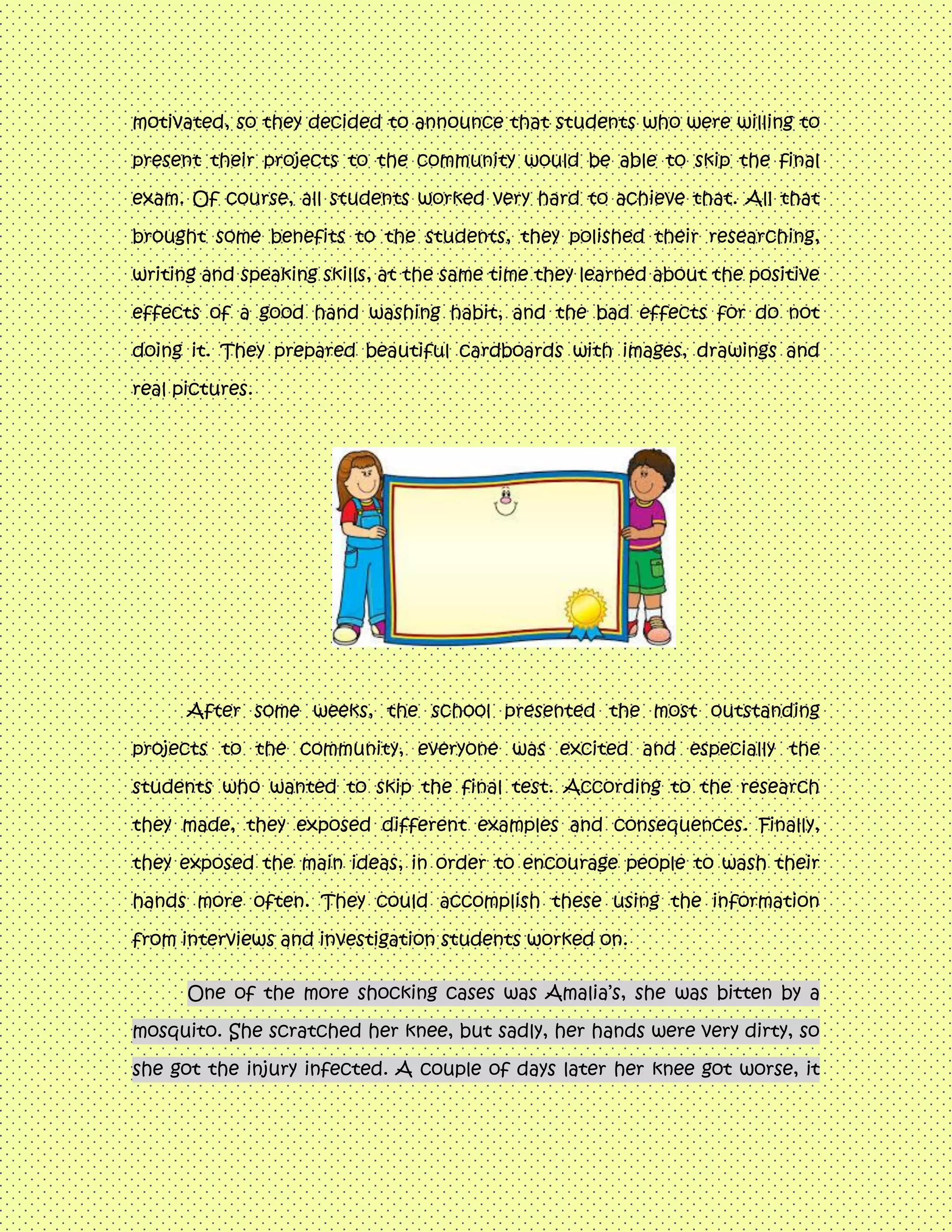
One of the more shocking cases was Amalia’s, she was bitten by a
mosquito. She scratched her knee, but sadly, her hands were very dirty, so
she got the injury infected. A couple of days later her knee got worse, it
was extremely swell up, she could barely remind stand, she was not able to
walk and was full of pain and medicines.
As a result, all the students were surprised with the
expositions and research. Moreover, Alex got worry, this
because he realized he was not washing his hands before or
after eating, he was just playing soccer, getting hurt and scratching
constantly. For this reason, Alex decided to create a challenge with his
soccer pals. They would have to end the soccer game in the bathroom
cleaning up themselves, and the team who did it better, would get and
extra goal on the score.
Alex’s teacher was very proud of him and of all the projects
presented; she and the rest of the teacher felt that the effort made
worth more than what they expected. Students learned and helped their
community by providing them information and tips. They decided none
student would do the final test, so everyone turned with a happy ending.
References
Dowshen, S (2011)
http://kidshealth.org/teen/your_body/skin_stuff/handwashing.html#
Drawings from:
https://www.google.co.cr/search?hl=es&site=imghp&tbm=isch&source
=hp&biw=1366&bih=667&q=carsondellosa&oq=carsondellosa&gs_l=img.3..0i10j0
i24.301214.303752.0.304496.13.12.0.1.1.0.164.1097.4j6.10.0....0...1ac.1.48.img..2.11
.1108.jDRrR2VysIw#hl=es&q=carson+dellosa+kids&tbm=isch&tbs=itp:clipart&
imgdii=_

Sharing my story 2

  • 1.
    Yeah! Recess! By SuzzyBautista July, 2014 When people think about recess period usually think about food, chilling and having fun; some people might think about going to the bathroom, yet not all people think about that period like an opportunity for hand washing. Whether they are constantly touching different things or not this habit must be done. Many organizations and people are trying to inform people and have them to be aware of the situations that involves. A clear example of that is Alex’s story. Alex is a fourth grade student. He studies in a school located in Tibas named Kamuk School. He has an older brother in sixth grade; both of them enjoy their mother’s food and playing soccer during the break. At the beginning of the year Alex used to bring a lot of snacks for all the day, he used to eat fruit, cookies or sandwiches, and after that, he used to go out to play soccer with his friends.
  • 2.
    One of theschool’s rules is that students should / must wash their hands before eating, and after recess. Most of students follow that rule, which was the case of Alex. Weeks later, his teacher realized that he was leaving some food on his lunchbox; she also found out that he was returning to lessons with his hands dirty. The teacher decided to have a talk with her students about the importance of that rule. She explained them that according to Kids Health, when kids come into contact with germs, they can unknowingly become infected simply by touching their eyes, nose, or mouth. And once they're infected, it's usually just a matter of time before the whole family comes down with the same illness. During the next teacher’s meeting she commented Alex’s case with some other peers, who agreed in having a project with the rest of the school. The project was supposed to present different situations in which the influence of washing hands was shown. One of the objectives was to show that good hand washing is the first line of defense against the spread of many illnesses, from the common cold to more serious illnesses such as meningitis, bronchiolitis, influenza, hepatitis A, and most types of infectious diarrhea. At first students were bored, they thought the project was worthless; however, after some research they found really interesting cases. Teachers chose the best cases from each level, and organized a campaign with all of them. They saw that students started to feel very
  • 3.
    motivated, so theydecided to announce that students who were willing to present their projects to the community would be able to skip the final exam. Of course, all students worked very hard to achieve that. All that brought some benefits to the students, they polished their researching, writing and speaking skills, at the same time they learned about the positive effects of a good hand washing habit, and the bad effects for do not doing it. They prepared beautiful cardboards with images, drawings and real pictures. After some weeks, the school presented the most outstanding projects to the community, everyone was excited and especially the students who wanted to skip the final test. According to the research they made, they exposed different examples and consequences. Finally, they exposed the main ideas, in order to encourage people to wash their hands more often. They could accomplish these using the information from interviews and investigation students worked on. One of the more shocking cases was Amalia’s, she was bitten by a mosquito. She scratched her knee, but sadly, her hands were very dirty, so she got the injury infected. A couple of days later her knee got worse, it
  • 4.
    was extremely swellup, she could barely remind stand, she was not able to walk and was full of pain and medicines. As a result, all the students were surprised with the expositions and research. Moreover, Alex got worry, this because he realized he was not washing his hands before or after eating, he was just playing soccer, getting hurt and scratching constantly. For this reason, Alex decided to create a challenge with his soccer pals. They would have to end the soccer game in the bathroom cleaning up themselves, and the team who did it better, would get and extra goal on the score. Alex’s teacher was very proud of him and of all the projects presented; she and the rest of the teacher felt that the effort made worth more than what they expected. Students learned and helped their community by providing them information and tips. They decided none student would do the final test, so everyone turned with a happy ending.
  • 5.
    References Dowshen, S (2011) http://kidshealth.org/teen/your_body/skin_stuff/handwashing.html# Drawingsfrom: https://www.google.co.cr/search?hl=es&site=imghp&tbm=isch&source =hp&biw=1366&bih=667&q=carsondellosa&oq=carsondellosa&gs_l=img.3..0i10j0 i24.301214.303752.0.304496.13.12.0.1.1.0.164.1097.4j6.10.0....0...1ac.1.48.img..2.11 .1108.jDRrR2VysIw#hl=es&q=carson+dellosa+kids&tbm=isch&tbs=itp:clipart& imgdii=_